

When people in Brampton ask about the cost of a divorce in Ontario, the honest answer is: it depends. The price tag can swing dramatically, from around $1,500 for a straightforward, amicable split to well over $20,000 if you’re headed for a complex legal fight.
There’s no one-size-fits-all number. Your final bill is a direct reflection of the conflict and complexity involved in your unique situation, a reality many families in Brampton and the Greater Toronto Area face. This guide provides actionable insights to help you navigate the process and manage costs effectively.
Breaking Down Your Potential Divorce Costs

Going through a divorce is emotionally draining, and worrying about the cost only adds to the stress. Getting a handle on the potential expenses right from the start helps you prepare financially and make smarter decisions. While the process falls under Ontario's Family Law Act, the final cost comes down to how you and your spouse decide to settle the big issues.
The single biggest factor that drives your legal bill is whether your divorce is uncontested or contested. Think of it as choosing between two very different paths.
-
An uncontested divorce is the most affordable route. If you and your spouse see eye-to-eye on how to divide property, handle support payments, and arrange parenting time, the process is mostly administrative. Your actionable step is to work together on a separation agreement. Costs are generally limited to court filing fees and some basic legal help to get the paperwork drafted and filed correctly.
-
A contested divorce is where expenses can really climb. Any disagreement—whether it's over the house, spousal support, or custody—requires more work. This means more time spent on negotiations, mediation, or court appearances, and every step adds to the billable hours. The key here is to understand that every dispute has a price tag.
The Financial Spectrum of Divorce
For a simple, uncontested divorce in the Brampton area where both of you agree on everything, you can expect the cost to land somewhere between $1,500 and $2,000. This covers the essential court fees and professional help to ensure your documents are in order.
However, the moment disputes over assets or parenting enter the picture, costs escalate. A contested divorce in Ontario can range from $5,750 to over $80,000, sometimes even more. The high price reflects the intensive legal work, court appearances, and expert consultations needed to resolve complex disagreements. You can find out more about the financial breakdown of divorce proceedings from this detailed analysis.
To give you a clearer picture, here’s a quick overview of what you might expect to pay in the Brampton area.
Estimated Divorce Costs in Ontario at a Glance
This table breaks down the typical cost ranges for different divorce scenarios, giving you a quick snapshot of the financial road ahead.
| Divorce Type | Typical Cost Range (Brampton/GTA) | Key Cost Drivers |
|---|---|---|
| Uncontested (Simple) | $1,500 – $3,500 | Court filing fees, flat-fee legal services for paperwork. |
| Contested (with Mediation) | $5,000 – $15,000 | Lawyer fees, mediator fees, financial disclosure. |
| Contested (Litigated) | $20,000 – $80,000+ | High hourly lawyer fees, multiple court appearances, expert reports, trial preparation. |
As you can see, the path you choose—cooperation or conflict—has a massive impact on the final cost. The more you can agree on outside of court, the more you’ll keep in your pocket.
Understanding the Core Costs of a Divorce
When you start to think about the cost of a divorce in Ontario, it helps to picture it as three separate buckets of expenses. Each one plays a different role, and knowing what they are helps you see exactly where your money is going and why.
Let’s break down these core components, especially for anyone navigating this process in Brampton or the GTA.
The Unavoidable Court Filing Fees
First up are the non-negotiable costs set by the government. Think of these as the official entry ticket to the legal divorce process—you can’t get started without them.
No matter how simple or friendly your separation is, you have to pay court filing fees. These are fixed costs required by the Ontario Superior Court of Justice to get your divorce application processed. The good news is they are the same across the province, so what you pay in Brampton is identical to Toronto or Ottawa.
Currently, filing an application for divorce costs about $250. Later, when you're ready for a judge to review it, you’ll pay another $445 to put your case on the court's list. That brings the total mandatory court fees to around $669. Your actionable takeaway is to budget for this amount as a minimum, non-negotiable expense.
Demystifying Your Lawyer's Bill
This is the second, and by far the largest, bucket of costs. Your legal fees are the most variable part of the divorce equation. It's here that the difference between a straightforward, uncontested divorce and a messy, contested one becomes crystal clear.
Brampton lawyers typically use a few common billing models, and your actionable step is to ask a potential lawyer which model they use for a case like yours.
- Hourly Rates: This is the most common approach. Your lawyer will bill you for everything related to your file—phone calls, emails, drafting documents, and court appearances. In the GTA, rates for family lawyers can run from $200 to over $700 per hour, depending on their experience.
- Flat Fees: Some lawyers offer a fixed price for a specific, predictable service, like an uncontested divorce. This is a great option if your case is simple, as it covers all the standard paperwork for one set price.
- Retainers: This isn’t really a fee model, but more of a down payment. You pay a lump sum upfront, which your lawyer holds in a trust account. As they work, they bill their time against that fund. When it gets low, you'll be asked to top it up.
A lawyer's retainer acts like a security deposit for their future work. It ensures they are compensated for their time as they begin managing your case, providing both you and the firm with financial clarity from the start.
The Necessary Third-Party Experts
The final bucket of costs is for third-party professionals. You might not need any of them, but if your situation involves complex assets or serious disagreements over the kids, their help becomes essential—and adds to the total bill.
These specialists are brought in to provide objective, expert opinions that help settle arguments or satisfy court requirements under the Family Law Act. Common examples for a Brampton family include:
- Property Appraisers: To figure out the fair market value of your matrimonial home in a neighbourhood like Castlemore or Springdale.
- Business Valuators: If a family business in the Brampton area needs to be valued for property division.
- Pension Actuaries: To calculate the exact value of a pension from a local employer that needs to be split.
- Child Specialists or Assessors: In high-conflict parenting disputes, a professional might be hired to assess the family and recommend what's in the children's best interests, a process overseen by the courts.
Each of these experts charges their own fees, which can range from hundreds to thousands of dollars. While it's an added expense, their input is often vital for reaching a fair and legally sound settlement.
The Uncontested vs. Contested Divorce Cost Divide
When Brampton residents ask how much a divorce costs in Ontario, they're often surprised by the answer. The biggest factor isn't your net worth or how many years you were married—it's how much you and your spouse disagree.
Your ability to cooperate is the single biggest lever you can pull to control the final bill. When you and your spouse are on the same page, the process is mostly administrative. When you can't agree, the legal fees start to climb with every phone call, court motion, and meeting. Your most actionable insight is this: every issue you resolve directly with your spouse is money saved.
What Makes a Divorce Contested in Ontario?
So, what flips the switch from "uncontested" to "contested"? Under Ontario's Family Law Act, your divorce is considered contested the moment you and your spouse hit a wall and can't agree on one or more key issues. It’s not just about having an argument; it's about the failure to reach a final, legally binding settlement on the core parts of your separation.
These are the common sticking points that officially push a divorce into the more expensive, contested category:
- Property Division: You can't agree on what the matrimonial home is worth, how to split pensions and investments, or who gets to keep specific assets.
- Spousal Support: There's a dispute over whether one spouse should get support, how much that support should be, and for how long it should be paid.
- Child-Related Issues: You disagree on decision-making responsibility (what used to be called custody), the parenting time schedule (formerly access), or the proper amount of child support.
Any one of these disagreements means your lawyers have to spend more time negotiating, drafting offers, or preparing for court. That extra time directly translates into higher legal fees.
This infographic breaks down how the costs expand once a divorce becomes contested.
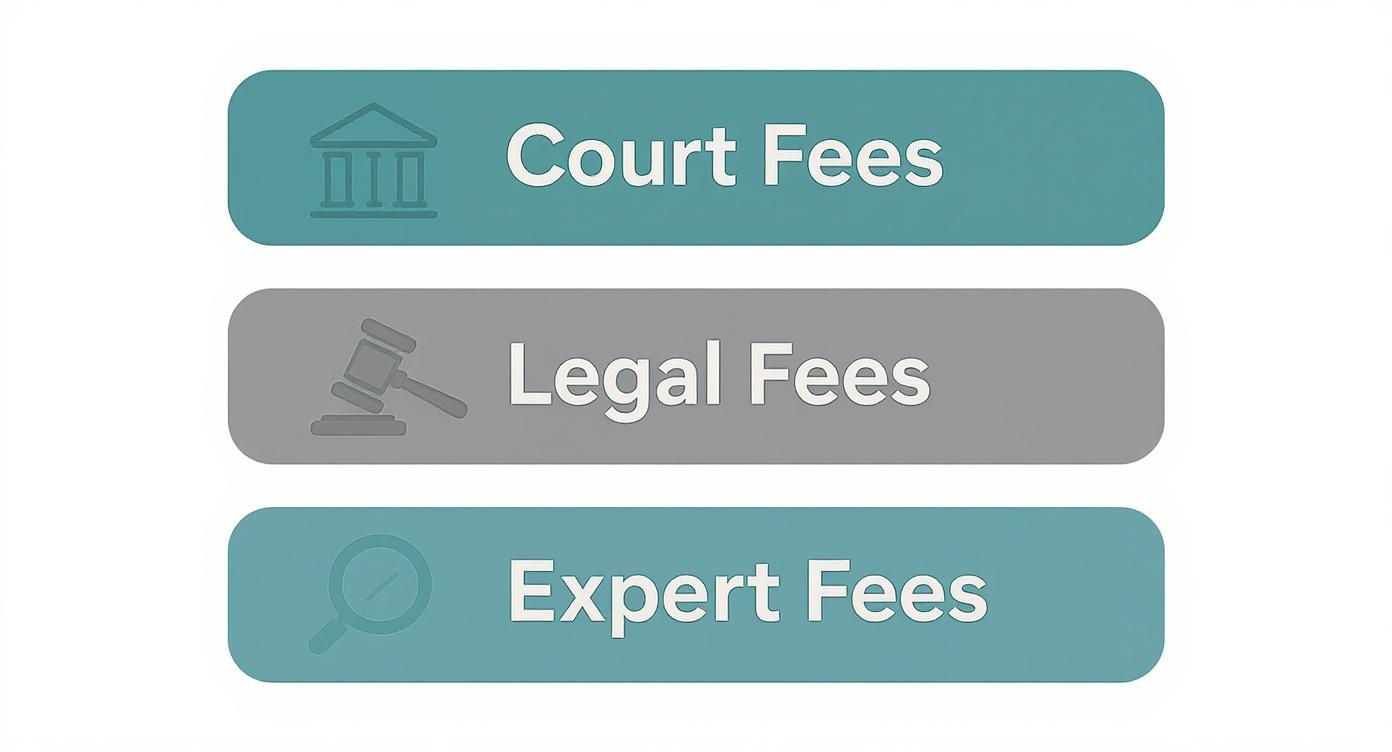
As you can see, while the basic court fees don't change, the legal and expert fees can skyrocket depending on the level of conflict.
Brampton Scenario A: The Uncontested Path
Let’s imagine a Brampton couple, Priya and Raj. They were married for eight years, have no kids, and have decided to go their separate ways. Thankfully, they agree on everything. Priya will buy Raj's half of their condo near Bramalea City Centre, they’ve agreed on a fair appraisal value, and since their incomes are similar, they've decided spousal support isn't necessary.
They hire one lawyer to draft their separation agreement and file the simple divorce paperwork. The whole process is smooth, predictable, and mostly administrative.
An uncontested divorce operates on a foundation of mutual agreement. When both parties are willing to compromise and find common ground on all major issues, the legal process becomes one of documentation rather than dispute resolution, saving immense time and money.
Their final cost is minimal. It's basically the lawyer's flat fee for the paperwork plus the standard court filing fees. Priya and Raj took the direct, paved road, and their final bill shows it.
Brampton Scenario B: The Contested Trail
Now, let's picture another Brampton couple, Maria and David. They have two kids and disagree on just about everything. Maria wants to stay in the family home in Fletcher's Meadow, but they're miles apart on what it's worth. David is fighting the amount of spousal support Maria is asking for, and they have completely different ideas for the kids' weekly parenting schedule.
Their divorce is contested from day one. Each hires their own lawyer on an hourly retainer, and the process quickly gets complicated. It involves:
- Financial Disclosure: Months are spent gathering, exchanging, and picking apart financial statements.
- Multiple Negotiations: Their lawyers spend hours on the phone and drafting emails, trading offers and counter-offers that go nowhere.
- Court Appearances: They have to attend a case conference at the Brampton courthouse just to get a judge's opinion on how to move forward.
- Expert Reports: They must hire a professional appraiser to value the home, which is another bill to pay.
Each one of these steps adds thousands of dollars to their legal bills. Because Maria and David couldn't find common ground, they are now on that winding, uphill trail, and the financial cost is getting steeper with every turn.
Let's look at the numbers side-by-side. The table below gives you a clear picture of how dramatically the costs can diverge based on the path you take.
Cost Comparison: Uncontested vs. Contested Divorce in Brampton
| Expense Category | Estimated Cost (Uncontested) | Estimated Cost (Contested) |
|---|---|---|
| Court Filing Fees | $632 (fixed) | $632 (fixed) |
| Lawyer Fees | $1,500 – $3,000 (flat fee) | $15,000 – $75,000+ (hourly retainer) |
| Expert Valuations | $0 – $500 (if needed for agreement) | $2,500 – $10,000+ (appraisers, actuaries) |
| Mediation/Arbitration | Not usually required | $3,000 – $10,000+ (if used) |
| Process Servers | ~$100 | ~$100 – $300 |
| Total Estimated Cost | ~$2,200 – $4,200 | ~$21,000 – $100,000+ |
The difference is staggering. Maria and David's final cost is tens of thousands of dollars higher than Priya and Raj's, not because their assets were more complex, but simply because they couldn't agree. This is the true financial reality of a contested divorce.
Hidden Factors That Inflate Divorce Costs
While lawyer and court fees are the baseline costs, several other factors can feel like financial landmines, blowing up your divorce budget when you least expect it. These are the complicated, emotional issues that require more time, specialized expertise, and, frankly, more money to sort out. Getting ahead of these potential cost drivers is the best way to keep your expenses from spiralling.
The financial difference between a smooth separation and a messy one is huge. In Canada, a simple uncontested divorce averages around $1,860, but a contested case can easily skyrocket to $20,625 or more. As you can see from these Canadian divorce statistics, the stakes are high in Ontario’s legal landscape.
So, let's break down the specific issues that tend to drive up the cost of a divorce right here in Ontario.
Complex Asset Division
Splitting assets isn't always as simple as dividing the cash in a bank account. When your shared property includes more complex items, the time and cost needed for a fair valuation can jump dramatically.
For a couple in Brampton or Mississauga, this could involve:
- A Family Business: You can't just guess the value of a family-owned business, like a popular restaurant near Bramalea City Centre. You'll need a forensic accountant or business valuator to figure out its true worth, a process that can cost thousands.
- Pensions: If one or both of you have a pension from a major local employer—say, a manufacturing plant or a public service job—you'll need to hire a specialized actuary to calculate its value for division.
- Investments and Stock Options: Dividing a complicated portfolio of investments, stock options, or inheritances often means bringing in financial experts. They'll need to trace where the funds came from and determine what’s legally considered family property under the Family Law Act.
Each of these scenarios means hiring outside experts, adding another layer of professional fees to your final bill.
High-Conflict Parenting Disputes
Nothing inflates divorce costs faster than fighting over the kids. When parents can't agree on decision-making responsibility (formerly custody) or parenting time, the court system steps in with a much more intensive—and expensive—process to protect the children's best interests. This can also intersect with the Criminal Code if allegations of abuse or parental alienation arise, adding another layer of complexity and cost.
This can lead to multiple costly steps:
- Motions: If you need a judge to make a temporary decision on parenting time, your lawyer will need to file a "motion." Just preparing the paperwork and appearing in court for that one issue can cost several thousand dollars.
- Assessments: In really high-conflict situations, a judge might order a formal assessment by a social worker or psychologist to recommend a parenting plan. This is an incredibly thorough and very expensive process.
- Mediation and Arbitration: While usually cheaper than going to trial, specialized mediation focused on parenting disputes still adds to the overall expense.
Unreasonable Behaviour and Legal Consequences
The court system has very little patience for people who deliberately drag things out or refuse to cooperate. Under Ontario's Family Law Rules, if one person acts unreasonably, a judge can order them to pay a portion—or even all—of the other person's legal fees. This is called an award of "costs."
Unreasonable behaviour includes things like hiding assets, refusing to hand over financial documents, ignoring court orders, or making baseless claims just to prolong the fight. A judge uses a "costs" award to penalize this kind of conduct and repay the other party for the unnecessary legal bills they had to pay.
This rule is a powerful deterrent. It creates a strong financial reason for everyone to act in good faith. Intentionally causing conflict not only wastes your own money but puts you at serious risk of having to pay your ex-spouse's legal bill on top of it—a truly devastating financial hit.
Actionable Ways to Reduce Your Divorce Costs

Knowing what drives up divorce costs is one thing, but actively steering clear of those pitfalls is another. You are not a passive passenger in this process. By taking a few strategic steps, you can get into the driver's seat and guide your divorce toward a far more affordable conclusion, potentially saving yourself thousands.
The real goal is to cut down on conflict and be as efficient as possible. Here is your actionable playbook for a cost-effective divorce in Brampton.
Be Exceptionally Prepared Before You Meet a Lawyer
Your first meeting with a Brampton family lawyer isn't just a casual chat; it's a working session you're paying for by the hour. Walking in unprepared is like paying a mechanic to stand around while you search for your car keys. To make every minute—and every dollar—count, you need to do some homework first.
Gathering and organizing all your relevant financial documents is the single most powerful thing you can do to save money right from the start.
- Tax Returns: Get your last three years of Notices of Assessment and complete tax returns.
- Bank and Investment Statements: You'll want statements from the date you were married and the date you separated for all accounts.
- Property Documents: Find your property deeds, mortgage statements, and any recent appraisals.
- Pension and RRSP Statements: Locate the most current statements for any retirement savings.
- Debt Information: Make a clear list of all outstanding loans, credit card debts, and lines of credit.
When you show up with neatly organized documents, your lawyer can get a clear financial picture immediately. This saves hours of expensive back-and-forth down the road.
Prioritize Communication and De-escalation
Conflict is the fuel that makes the engine of divorce costs run hot. Every hostile text message or stubborn refusal to cooperate translates directly into more work for your lawyers and a higher final bill for you. Emotions are understandably high, but making a conscious effort to communicate calmly and respectfully can have a massive financial payoff.
Under Ontario's Family Law Act, the primary goal is to resolve disputes. The less you and your spouse need your lawyers to act as messengers, the lower your costs will be. Your actionable step: try to handle simple logistics directly and save your legal budget for major strategic decisions.
If talking directly is impossible, stick to brief, business-like emails. Focus only on the facts and what's needed to move forward. Avoid blame or emotional language that will only escalate the conflict—and the cost.
Explore Alternative Dispute Resolution (ADR)
Going to court is almost always the longest and most expensive path to getting divorced. Thankfully, there are other options. Alternative Dispute Resolution (ADR) methods are specifically designed to help you and your spouse reach a settlement outside of a courtroom, which is both faster and significantly cheaper.
For those in Brampton, these are the most common and effective ADR paths:
- Mediation: A neutral third-party mediator facilitates a conversation between you and your spouse, helping you negotiate an agreement you can both live with. It’s a collaborative process, not an adversarial one, which keeps you in control of the final outcome.
- Collaborative Family Law: In this process, you and your spouse each hire specially trained collaborative lawyers. Everyone signs an agreement committing to resolve all issues without going to court. The entire process is transparent and geared toward finding creative, win-win solutions.
Both mediation and collaborative law can finalize a divorce in a fraction of the time and for a fraction of the cost of a traditional court battle.
Utilize Local Brampton and Peel Region Resources
You don't have to rely on expensive legal counsel for every single question. The Brampton area has several resources that provide free or low-cost guidance to help you understand your rights and the court process.
- Family Law Information Centre (FLIC): You can find a FLIC right at the Brampton courthouse (A. Grenville and William Davis Courthouse). They offer free information and summary legal advice from lawyers on a first-come, first-served basis.
- Legal Aid Ontario: If you have a low income, you might qualify for a certificate to cover some or all of your legal fees. Their website has easy-to-use eligibility tools to see if you can get help.
Using these resources for foundational questions can save you from paying your lawyer their full hourly rate just to explain basic procedures. This lets you reserve your legal budget for the complex strategic advice that truly makes a difference in your case.
Your Divorce Cost Questions Answered
When you're facing a divorce, the financial side of things can feel overwhelming. Even after you get a handle on the main expenses, specific questions tend to pop up. Let's tackle some of the most common ones people ask about the cost of divorce in Ontario, especially with an eye toward how things play out in Brampton.
Can I Get a Divorce in Ontario for Free?
Honestly, a completely free divorce isn't really on the table, but you can get pretty close. The one cost that's almost impossible to avoid is the mandatory court filing fees, which add up to about $669. Think of this as the basic entry fee for the legal process.
Now, if your income is very low, you might qualify for a fee waiver from the court. This would wipe out that $669 cost. The biggest expense, of course, is legal fees. To avoid those, you could represent yourself, but that’s a path best reserved for the simplest, most straightforward cases—where you and your spouse are in total agreement on absolutely everything.
For anyone who needs legal help but can't afford it, resources like Legal Aid Ontario can offer free advice if you meet their financial criteria. For most people, the cheapest route is a simple, uncontested divorce handled with a flat-fee service. It minimizes the cost, but it doesn't eliminate it entirely.
Who Pays the Legal Fees in a Brampton Divorce?
The starting point in Ontario is simple: each person pays for their own lawyer. You should always plan and budget to cover your own legal representation. Don't ever assume your spouse is going to pick up your tab.
That said, the court does have the power to make an exception. Under the Family Law Rules, a judge can order one person to pay some or all of the other person's legal costs if they have behaved unreasonably during the divorce process. This is known as an "award of costs," and its purpose is to discourage bad-faith tactics.
What counts as unreasonable? Things like hiding assets, deliberately ignoring court orders, making ridiculous claims just to cause delays, or refusing to hand over financial documents. The best way to protect yourself financially is to act in good faith from start to finish.
Does Having Children Make a Divorce More Expensive?
Yes, it almost always does. When children are involved, a divorce becomes significantly more complex, and that complexity translates directly into higher costs.
It’s no longer just about separating two people's assets. You now have to legally resolve a number of sensitive, child-focused issues. This includes creating a detailed Parenting Plan, figuring out decision-making responsibility (what used to be called custody) and parenting time (formerly access), and calculating child support.
Getting child support right requires a complete exchange of financial information and careful application of the Federal Child Support Guidelines. Any disagreements over these parenting matters can lead straight to expensive mediation sessions, professional assessments, or court motions. All of these steps add substantial costs that you just wouldn't see in a divorce between a childless couple.
How Does the Divorce Timeline Affect the Total Cost?
In family law, time really is money. The longer it takes to finalize your divorce, the more it will cost in legal fees—it’s a direct correlation. Every extra month usually means more emails, more phone calls, more documents to prepare, and more strategic planning from your lawyer, and all of that is billable time.
A simple, uncontested divorce can be done and dusted in as little as 4 to 6 months in Ontario, which helps keep the costs low and predictable.
On the other hand, a contested divorce that gets tangled up in the court system can easily drag on for 1.5 to 3 years, or even longer. That extended timeline is filled with expensive stages, from financial disclosure and case conferences to motions and, in some cases, a full trial. Each step requires a significant number of billable hours from your legal team. This is why reaching a fair agreement with your spouse as efficiently as possible is the single most effective way to control the final cost of your divorce.
Navigating the complexities of a divorce requires clear guidance and strong advocacy. At Badesha Law, we provide strategic, client-focused support for families in Brampton and the GTA. Whether you are facing a simple uncontested divorce or a complex dispute, our team is here to protect your interests and help you move forward. Contact us for a consultation to understand your options and secure the representation you deserve. Learn more at our family law practice page.