

When you start digging into divorce statistics in Canada, it’s easy to get lost in the numbers. Many people still think of the outdated myth that 50% of all marriages end in divorce. But for anyone in Brampton facing a separation, the real story is more complex and far more personal.
Understanding the data is the first step toward making informed decisions. It provides context for the legal journey ahead, whether you are considering an uncontested divorce or need to navigate more complex issues like property division or child custody.
At Badesha Law, we serve Brampton and the GTA, helping families find clear, practical paths forward. If you have questions about your specific situation, a consultation with an experienced divorce lawyer in Brampton can provide the clarity you need.
What Is the Real Divorce Rate in Canada?
Let’s clear this up right away: the idea that half of all marriages fail is a myth. It doesn’t reflect Canada’s current reality. The actual crude divorce rate, which is the number of divorces per 1,000 married people, has been hovering around 5.6 in recent years. That’s the lowest it’s been in almost half a century.
So, why the big drop? A few key things are going on:
- Fewer Marriages Overall: Compared to past generations, a smaller percentage of Canadians are getting married in the first place, which naturally brings down the total number of divorces.
- Marrying Later in Life: People are tying the knot later, often with more financial stability and maturity, which seems to be contributing to unions that last longer.
- The Rise of Common-Law Relationships: More couples, especially in Ontario, are choosing to live in common-law partnerships. When these relationships end, they aren’t counted in federal divorce statistics, meaning the official numbers don’t capture the full picture of relationship breakdowns.
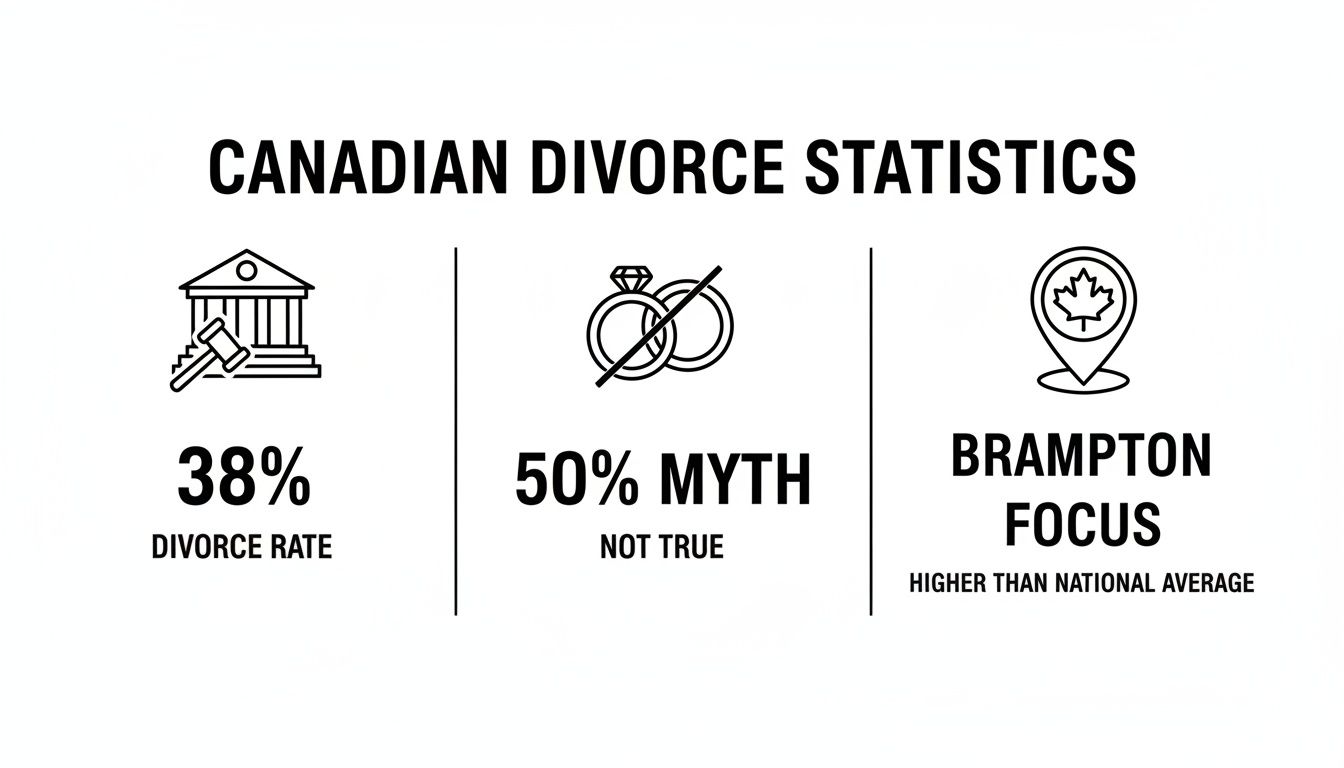
This infographic gives you a quick visual on the national divorce rate, that 50% myth, and why a local focus is so important.
While the national rate gives us some context, you really need to understand the nuances that matter here in Brampton to make smart decisions.
How Do Ontario’s Divorce Trends Compare to National Averages?
While national divorce statistics in Canada give us a bird’s-eye view, the trends that truly matter are the ones happening right here. When we zoom in on Ontario, we see a unique picture—one shaped by economic pressures that don’t always track with the rest of the country.
The Economic Squeeze on Brampton Families
The Greater Toronto Area faces a distinct set of challenges that directly influence separation and divorce. The biggest driver? The sky-high cost of living. This economic reality acts as a powerful force, sometimes delaying separation for couples who simply cannot afford to maintain two separate households in the Peel Region.
The financial strain can mean couples stay together longer than they otherwise would—not because they’ve reconciled, but out of sheer financial necessity.
Common-Law Relationships in Ontario
Another major reason Ontario’s relationship landscape looks different is the growing number of common-law relationships. More and more couples are choosing to build their lives together without legally marrying.
Critically, when a common-law relationship ends, it is not recorded as a divorce. This means a huge portion of relationship breakdowns in Ontario are completely invisible in the official federal data, making the true separation rate much higher than statistics suggest.
For residents in Brampton, this is a vital distinction. The legal rights and obligations for common-law partners regarding property division are different from those of married spouses, making it essential to get clear legal advice from a family lawyer in Brampton.
What Are the Main Reasons for Divorce in Ontario?

While Statistics Canada no longer collects specific “reasons” for divorce, our experience as family lawyers shows that certain themes appear consistently. The primary legal ground for divorce in Ontario is “marriage breakdown,” which is most commonly established by being separated for at least one year.
The underlying personal reasons that lead to this breakdown often include:
- Financial Disagreements: Clashes over spending, debt, and mismatched financial goals are a massive source of conflict.
- Communication Breakdown: Over time, a couple’s inability to communicate effectively can erode the foundation of their marriage.
- Differing Life Goals: People change. It’s not uncommon for couples to realize they want fundamentally different things out of life.
- Infidelity or Cruelty: While “no-fault” divorce is the standard, adultery and cruelty remain legal grounds under the Divorce Act.
Understanding the root cause of the separation can help you and your lawyer determine the best path forward, whether through mediation or a formal separation agreement.
How Long Does a Marriage Last Before Divorce?
You’ve probably heard of the “seven-year itch,” but the data tells a very different story. The median duration of a marriage ending in divorce in Canada is actually closer to 15 years.
This shows that most divorces happen after couples have already spent a huge chunk of their lives together. This reinforces how complicated it can be to separate these long-term partnerships, especially when dealing with shared assets, pensions, and potential spousal support obligations. For more information, you can explore our detailed guide on navigating divorce in Brampton.
What Is a “Grey Divorce” and Why Is It on the Rise?
One of the most significant shifts we’ve seen is the rise of “grey divorce”—separations among couples aged 50 and older. While divorce rates have dropped for younger Canadians, the rate for older adults has held steady or increased.
Key drivers of this trend include:
- Longer Life Expectancy: People are unwilling to spend their next few decades in an unhappy partnership.
- Empty Nests: Once children leave home, some couples find they have little in common.
- Financial Independence: Many individuals, particularly women, have the financial stability to support themselves after a separation.
The legal implications of a grey divorce are often more complex, involving significant retirement savings, pensions, and long-term assets. This requires a careful and strategic legal approach.
Understanding your options is the first step. Our team is here to help you navigate the process with confidence. Call today to discuss your next steps.
How to Get a Divorce in Brampton, Ontario

To file for divorce in Ontario, you or your spouse must have lived in the province for at least one year. The process involves several key steps:
- Meet the Eligibility Criteria: The primary ground for divorce is marriage breakdown, established by a one-year separation.
- File an Application for Divorce: This is the initial court document (Form 8A) that starts the process. It can be filed jointly with your spouse or on your own.
- Serve Your Spouse: If you file alone, you must have the documents legally served on your spouse.
- Address Other Issues: Before a divorce is granted, you must resolve issues like child custody and access, child support, spousal support, and property division. This is often done through a Separation Agreement.
- Finalize the Divorce: Once all documents are filed and issues are settled, a judge can grant the Divorce Order.
The timeline can vary from a few months for a simple, uncontested divorce in Brampton to over a year for complex cases. For a deeper look, see our guide on the divorce process in Ontario.
Common Mistakes to Avoid During Your Divorce
Navigating a divorce can be emotionally challenging. Here are some common mistakes to avoid:
- Making decisions based on emotion: Try to approach negotiations practically, focusing on long-term solutions.
- Hiding assets: Failing to provide full financial disclosure can have serious legal consequences.
- Using children as leverage: This can harm your children and damage your case in court.
- Ignoring legal advice: An experienced lawyer can help you avoid costly errors and protect your rights. Our guide on why the divorce rate is so high from badesha law offers more context on marital challenges.
Disclaimer: This is general information, not legal advice. Your situation is unique, and you should consult with a lawyer for advice tailored to your specific circumstances.
Brampton Clients Often Ask…
1. How much does a divorce cost in Brampton?
Costs vary widely. A simple, uncontested divorce may cost a few thousand dollars in legal fees, while a contested divorce involving complex property or custody issues can cost significantly more. Fee drivers include the level of conflict between spouses and whether the case goes to court.
2. Do I need to go to the Brampton courthouse to get a divorce?
Not necessarily. Many divorces are settled out of court through negotiation or mediation. Even if you file court documents, you may not need to appear before a judge if you and your spouse agree on all terms. A local family lawyer can guide you through the court process if it becomes necessary.
3. How is our Brampton home handled in a divorce?
The matrimonial home is treated specially under Ontario law. Its value is typically divided equally between spouses, regardless of whose name is on the title. You can’t sell or mortgage it without your spouse’s consent. A family lawyer explains your rights and responsibilities in Canada regarding the home.
Frequently Asked Questions About Divorce Statistics in Canada
1. What is the success rate of marriage in Canada?
Based on current data suggesting a lifetime divorce risk of around 38-41%, the marriage “success rate” (marriages that do not end in divorce) is approximately 60%.
2. Who is more likely to initiate a divorce?
Historically and anecdotally, women are more likely to initiate divorce proceedings, particularly in younger to middle-aged demographics.
3. Does living together before marriage increase the chance of divorce?
Older studies suggested a link, but modern research shows this is no longer a significant factor. Today, cohabitation is a common step before marriage and does not statistically increase the likelihood of divorce.
4. What percentage of second marriages end in divorce in Canada?
Statistics indicate that second marriages have a slightly higher rate of divorce than first marriages, though the data is less precise.
5. How do common-law separations affect divorce statistics?
They don’t. A common-law separation is not legally a divorce and is not included in federal statistics. This means the official divorce rate underrepresents the total number of relationship breakdowns in Canada.
6. Is the “seven-year itch” a statistical reality?
No. While the idea is popular, Canadian data shows the median duration of a marriage ending in divorce is closer to 15 years.
At Badesha Law, we know that behind every number is a real person with a unique story. If you’re thinking about separation or just need some clarity on your next steps, we’re here to give you the strategic, no-nonsense advice you deserve. Book a free consultation today to discuss your situation with an experienced divorce lawyer in Brampton.