

Many couples searching for a “cohabitation agreement template Ontario” are looking for a straightforward way to protect their financial future. What they often miss is why this document is so critical, especially here in Ontario. The blunt truth is that under Ontario’s Family Law Act, being ‘common-law’ does not grant you the same automatic property rights as married couples. This is a harsh reality many in Brampton only discover after a painful and costly separation.
A solid, well-crafted agreement is your best, most actionable step for creating clarity and financial security for your future.
Protecting Your Future: An Actionable Guide for Brampton Couples

It’s easy to feel overwhelmed when facing a blank legal document. The process can feel intimidating, and it’s tempting to delay it, worrying it might signal a lack of trust. But creating a cohabitation agreement is less about mistrust and more about smart, practical financial planning. It’s a proactive conversation about your shared future, ensuring you and your partner are on the same page from the start.
Think of it as a financial roadmap. You wouldn’t launch a business in Brampton without a partnership agreement. The same logic applies when you’re combining finances and assets. This document allows you to define the terms of your partnership yourselves, rather than leaving it to the default—and often surprising—rules of Ontario’s Family Law Act.
Why Your Common-Law Status Isn’t Enough Protection
One of the most dangerous myths is that after living together for a few years, your assets automatically become shared property. This is false. In Ontario, common-law partners have no automatic right to equalize property accumulated during the relationship. This legal gap can lead to devastating financial outcomes.
Consider this common Brampton scenario: one partner owns a condo before moving in together. The other partner moves in, contributes to the mortgage, pays for renovations, and covers household bills for over a decade. If they split up without an agreement:
- The partner whose name isn’t on the title could have no legal claim to the home’s value.
- They would face a complex and expensive legal battle, such as a claim for unjust enrichment, with no guarantee of success.
- The emotional and financial stress of such a fight, which could also involve elements of the Criminal Code if disputes escalate, can be immense.
A cohabitation agreement cuts through this ambiguity. It clearly outlines who owns what and what happens to any shared property if the relationship ends.
A cohabitation agreement isn’t for the end of a relationship; it’s for the healthy duration of one. It removes financial uncertainty, allowing both partners to build a future together with confidence and mutual respect.
Taking this proactive step is more relevant than ever. Between 1981 and 2021, the number of common-law couples in Ontario surged by a staggering 447%. In cities like Brampton and Mississauga, over 18% of couples now live together without marrying. This demographic shift makes these agreements essential. You can dig deeper into this trend and its legal side-effects at Common law separation.
Ultimately, this document ensures the major decisions about your life are made by you, not by a judge. It provides peace of mind, knowing that you and your partner have a fair, clear plan, no matter what the future holds.
Understanding Your Common-Law Status in Ontario
Before building a cohabitation agreement, let’s clarify what “common-law” actually means for you in Brampton. People use the term casually, but under Ontario’s Family Law Act, it’s a legal status with specific rules and serious financial implications.
Misunderstanding this is one of the most common and costly mistakes separating couples make. A cohabitation agreement exists to bridge the gap between what you think your rights are and what the law actually dictates.
The Two Paths to Common-Law Status
In Ontario, you don’t become common-law after a few months. The Family Law Act sets out two clear tests to determine if you are legally “spouses” for the purpose of spousal support, even without a marriage certificate.
You are considered common-law partners if you have:
- Lived together continuously in a conjugal relationship for at least three years.
- Lived together in a relationship of some permanence and are the parents of a child together, whether by birth or adoption.
This definition is critical. It’s not about how you feel, but about meeting one of these two legal thresholds. You can get more details on how courts interpret cohabitation from the experts at kellyjordanfamilylaw.com.
Property Rights Versus Support Obligations
This is the single most important distinction. Achieving common-law status creates a potential obligation for spousal support, but it does not give you automatic rights to property division. This is a massive difference from being married.
When a married couple separates, the law generally requires them to equalize their net family property, which usually means splitting the value of assets accumulated during the marriage 50/50.
This is not the case for common-law partners.
Without a cohabitation agreement, you are not automatically entitled to half the value of the Brampton home you lived in, your partner’s pension, or their investments—even if you were together for 20 years. To make a claim, you would have to launch a complex and expensive lawsuit for “unjust enrichment,” with absolutely no guarantee of success.
Key Takeaway: In Ontario, being common-law gives you the right to ask for spousal support but does not grant an automatic right to share in your partner’s property. A cohabitation agreement is your tool to create your own rules for property division, overriding the default law.
To make this crystal clear, let’s compare the default rights for married versus common-law partners in Ontario upon separation.
Married vs Common-Law Spouses A Comparison of Rights in Ontario
This table highlights the fundamental legal differences in rights and obligations for married versus common-law couples upon separation under Ontario’s Family Law Act.
| Legal Right / Obligation | Married Spouses | Common-Law Partners (No Agreement) |
|---|---|---|
| Property Division | Entitled to a 50/50 equalization of the value of net family property accumulated during the marriage. | No automatic right to property division. Each partner keeps what is in their own name. |
| Matrimonial Home | Both spouses have an equal right to possess the matrimonial home, regardless of who is on the title. | The non-titled partner has no automatic right to stay in the home. |
| Spousal Support | Both partners have the right to claim spousal support based on factors like the length of the marriage and roles during it. | Both partners have the same right to claim spousal support as married spouses if they meet the definition of common-law. |
| Inheritance Rights | A surviving spouse has specific rights to a share of the deceased spouse’s estate, even without a will. | No automatic inheritance rights. Without a will, a surviving partner may receive nothing from the estate. |
As you can see, the differences are stark, especially regarding property. This is precisely why a well-drafted cohabitation agreement is not just a good idea—it’s essential protection for both partners living in Brampton and across Ontario.
Building Your Cohabitation Agreement Clause by Clause
This is where you take action. A template is just a skeleton; the real strength of your cohabitation agreement comes from the specific clauses you build into it. These clauses are the practical tools that define your financial relationship, protect your individual assets, and create a clear roadmap for your future together in Ontario.
We’ll move beyond dense legal jargon and break down the essential pieces of a solid agreement. For couples in Brampton, Mississauga, and across the GTA, getting these details right is what makes the difference between a useless document and one that provides genuine security.

Defining Separate and Joint Property
The cornerstone of any cohabitation agreement is clearly separating what’s yours, what’s mine, and what’s ours. This clause prevents the fuzzy assumption that everything eventually becomes shared. You must be crystal clear.
Your agreement must list all significant assets each of you is bringing into the relationship. This is your separate property. It’s like drawing a financial line in the sand.
Actionable List of Separate Property:
- Real Estate: The condo you owned in Brampton before your partner moved in.
- Investments: Your RRSP, TFSA, and any other investment accounts in your name.
- Business Interests: Shares in a family business or your own incorporated company.
- Significant Personal Items: Valuable art, heirlooms, jewelry, or a vehicle.
- Inheritances or Gifts: Any money or property you’ve received (or expect to receive) from family.
Next, define what will be considered joint property. This is anything you acquire together during the relationship. A practical rule is that an asset is only joint if it is explicitly titled in both your names. This simple step avoids a world of ambiguity.
By clearly defining what’s yours, mine, and ours, you eliminate the single most common source of conflict and legal battles upon separation. This clarity is the main purpose of your agreement.
Handling Debts and Liabilities
Just as important as assets are debts. A well-drafted agreement specifies how liabilities will be handled. This clause protects you from suddenly becoming responsible for your partner’s student loans or credit card debt.
The agreement must state that each partner is solely responsible for:
- Any debts they brought into the relationship.
- Any debts they take on in their own name during the relationship.
You also need a plan for joint debts, like a shared line of credit or a car loan. The agreement should spell out exactly how these will be paid off if you separate.
The Spousal Support Clause
Under Ontario’s Family Law Act, common-law partners can claim spousal support after separation. A cohabitation agreement lets you decide this issue for yourselves.
You have several options. Many couples agree to a full waiver, where both partners give up any right to claim spousal support. This is common when both partners have similar incomes.
Alternatively, you can set specific conditions. For example, you might agree that support is only payable if you have children together, or if one person steps back from their career. You can even define the amount and duration of potential support payments in advance.
Estate Rights and Inheritance
What happens if one of you passes away without a will? As noted, common-law partners in Ontario have no automatic inheritance rights under the Succession Law Reform Act. Your cohabitation agreement can and should address this directly.
You can include a clause where each partner waives any claim against the other’s estate. This ensures your assets go to your chosen beneficiaries—like children from a previous relationship. This is critical for blended families in the Brampton area who need to ensure their estate plans are followed.
It’s a common mistake to think this agreement covers everything. To be enforceable, cohabitation agreements in Ontario must follow specific legal rules, including full and honest financial disclosure and being signed with witnesses. You can get more details on these crucial legal requirements and learn how they are handled with expert guidance in Ontario.
Addressing the Shared Home
For many Brampton couples, the shared home is the biggest financial and emotional asset. Your agreement needs a detailed clause to handle it, especially if one person owned it beforehand.
Let’s look at a common scenario:
Scenario: Partner A owns a Brampton townhouse. Partner B moves in and contributes to the mortgage, property tax, and bills.
Your agreement must spell out:
- Ownership: The townhouse remains Partner A’s separate property.
- Contributions: Partner B’s payments are defined as rent and do not create any ownership interest.
- Increase in Value: The agreement must state that Partner B has no claim to any increase in the home’s value (appreciation).
If you buy a home together, the clause should outline what happens if you break up. Will you sell it? Will one partner have the option to buy out the other? How will you split the equity? Answering these questions now prevents a messy, forced sale or a costly court application later.
From Template to Tailor-Made: Customizing Your Agreement
Turning a generic template into a personalized legal document is the most critical step. This is where you create a solid, actionable plan that reflects your life in Ontario. The goal is to iron out every detail and leave no room for confusion.
The bedrock of any valid cohabitation agreement under Ontario’s Family Law Act is full and honest financial disclosure. This is a non-negotiable legal requirement. Skimping on this can get your entire agreement invalidated by a court.
Step One: Laying All Your Financial Cards on the Table
Before filling in any blanks, you and your partner must each gather all financial information. This isn’t just about numbers; it forces a level of transparency that’s crucial for building a fair agreement.
Think of your financial disclosure as schedules attached to the main agreement. Here’s an actionable checklist:
- Proof of Income: Recent pay stubs, T4 slips, or your latest Notice of Assessment from the CRA.
- Property Valuations: Recent appraisals or property tax assessments for any real estate you own. For a home in Brampton, the legal description is on your property tax bill.
- Bank and Investment Statements: Statements for all accounts—chequing, savings, RRSPs, TFSAs.
- Business Records: Financial statements or a proper valuation if you own a business.
- Debt Statements: Paperwork for mortgages, lines of credit, car loans, student loans, and credit card balances.
Yes, this can feel invasive. But it’s non-negotiable. Trying to hide an asset or debt is one of the fastest ways to have your agreement thrown out of court.
Step Two: Filling in the Blanks with Pinpoint Accuracy
Once your financials are organized, you can start customizing the template. Every clause needs careful thought and specific details. Vague language is your enemy; precision is your best friend.
A classic mistake is using generic terms. Don’t just write “car”—specify the “2022 Honda Civic, VIN…” Don’t just list “investments”—write down the specific account numbers and institutions. This detail eliminates any guesswork.
Let’s walk through a real-world example for a Brampton couple.
Scenario: A couple is drafting their agreement. One partner bought a townhouse in Brampton before they met, and they opened a joint savings account for household expenses.
Their property clause must be airtight:
- Separate Property: The agreement must list “The residential property located at [Full Address, Brampton, ON], legally described as [Legal Description from Deed/Tax Bill]…” and state it belongs solely to that one partner.
- Excluding Appreciation: It must explicitly say the other partner will have no claim to the increase in the home’s value during the relationship. This is crucial.
- Joint Property: The agreement should identify their joint savings account by bank and account number, specifying it’s the only asset they consider joint property.
This clarity prevents a future argument where one partner claims their contributions to bills entitled them to a piece of the home’s equity.
Crucial Tip: Think of your agreement as a living document. Add a “review clause” that triggers a check-in every few years or after a major life event—like having a child or buying property together—to ensure it still fits your circumstances.
Step Three: Looking Ahead at What’s to Come
A strong agreement doesn’t just cover what you have today; it anticipates the future. Are you planning to start a business together? Is one of you expecting an inheritance?
These need to be spelled out in the document. For instance, include a clause stating any future gifts or inheritances one of you receives will remain your separate property, free from any claims by the other partner. This is key for protecting family assets.
Ultimately, customizing your cohabitation agreement template for Ontario is about turning your verbal understandings into something legally binding. Every number you write down and every asset you list strengthens the document, transforming it from a piece of paper into a powerful shield that provides financial clarity and peace of mind.
Making Your Agreement Legally Binding in Ontario
You’ve done the work: customized your agreement, accounted for every asset, and mapped out your financial future. But a signed piece of paper isn’t automatically an ironclad legal shield in Ontario.
To turn that document into a legally enforceable contract that will hold up in a Brampton court, you must follow the final steps. Skipping these formalities can render all your hard work useless. This final stage is about ensuring fairness and preventing future challenges under the Family Law Act.
The path from a drafted template to a finalized, legally sound agreement involves a few critical stages.
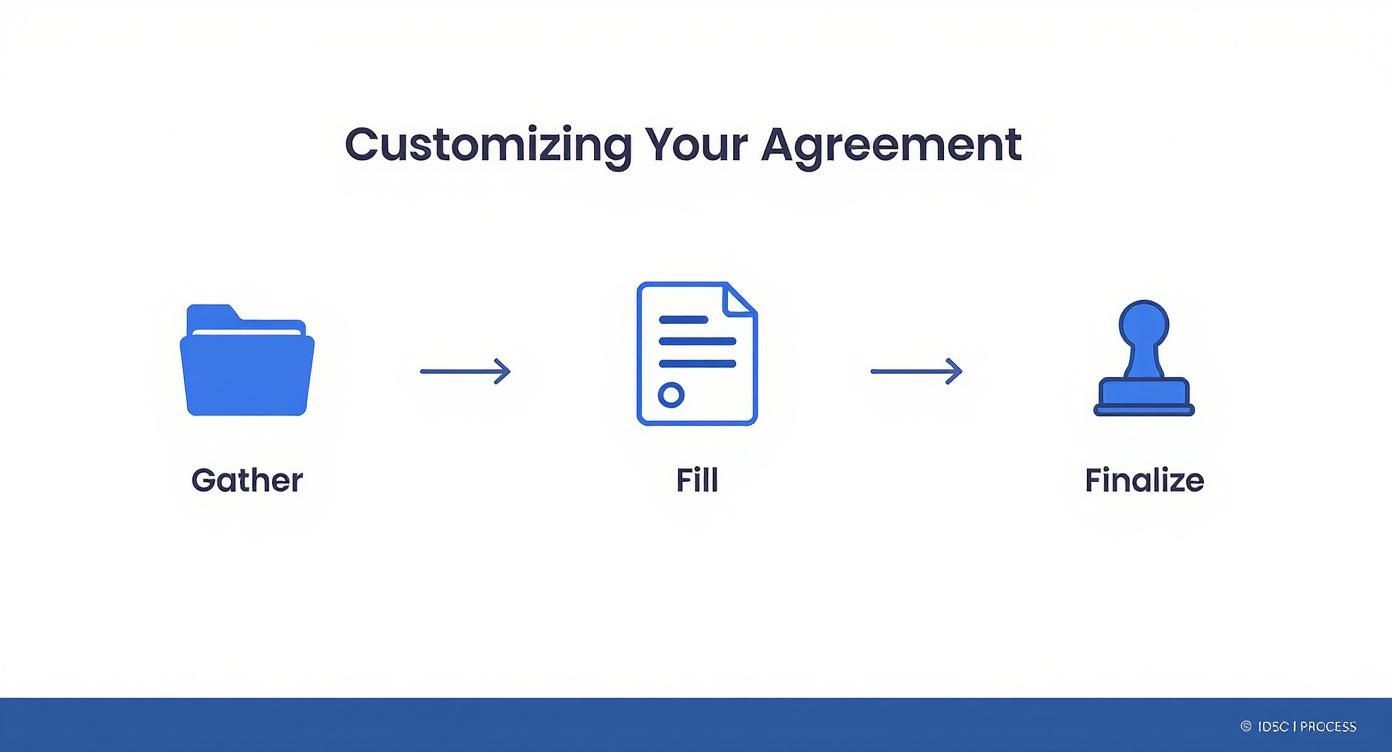
Think of it as building a strong foundation. Each step—gathering financials, carefully completing the template, and getting legal sign-off—builds on the last to create a defensible agreement.
The Non-Negotiable Role of Independent Legal Advice
If you take one thing from this section, let it be this: the single most important step to make your agreement legally binding is for both you and your partner to get Independent Legal Advice (ILA).
This isn’t just a suggestion; it’s your best defense against having the agreement invalidated later. It means each of you meets separately with your own lawyer to review the document line by line.
A Brampton lawyer providing ILA will:
- Confirm you understand every clause and its long-term impact.
- Check that your partner’s financial disclosure appears complete and accurate.
- Ensure you are signing freely, without any pressure or duress.
When a court sees that both partners received ILA, it’s powerful evidence the agreement was entered into fairly. It makes it incredibly difficult for one person to later claim they were taken advantage of or didn’t understand what they were signing.
For couples in the Brampton area, sitting down with a local family lawyer for ILA is a wise and necessary investment. They understand the local court system and can offer practical, relevant advice.
Formal Signing and Witnessing Requirements
Under Ontario’s Family Law Act, a domestic contract like a cohabitation agreement must be signed and witnessed in a specific way to be valid. You cannot just sign it at the kitchen table.
The process must be followed precisely:
- Both Partners Must Sign: Both of you must sign the final document.
- Each Signature Must Be Witnessed: Someone must be physically present to watch each of you sign.
- The Witness Must Also Sign: The witness then signs the document, confirming they saw you sign it.
Crucially, you cannot witness your partner’s signature, and they cannot witness yours. Witnesses should be neutral third parties. The best practice is to have the lawyers providing ILA also act as the witnesses.
What Makes an Agreement Unenforceable
Even with signatures, an Ontario court can set aside a cohabitation agreement if it was created improperly. A judge will look for red flags that undermine its fairness.
Common reasons an agreement is overturned:
- Failure to Disclose: One partner deliberately hid a major asset or a significant debt.
- Lack of Understanding: There is proof that one person did not comprehend the agreement’s consequences. This is why ILA is vital.
- Duress or Coercion: Evidence shows one partner was pressured, threatened, or forced into signing. Such actions can even have implications under the Criminal Code.
The goal is to create a fair and transparent document. By ensuring full financial disclosure, getting Independent Legal Advice, and following proper signing procedures, you give your agreement the legal strength it needs to protect both of you as intended.
Common Questions About Ontario Cohabitation Agreements
Even after covering the basics, specific questions always arise as Brampton couples work through this process. This final section provides clear, actionable answers to the most common queries we hear.
Can We Write Our Ontario Cohabitation Agreement Without a Lawyer?
Yes, you can draft your own agreement using a template, but it is a significant risk. For an agreement to be upheld in an Ontario court, a judge will look for fairness, complete financial disclosure, and no signs of pressure.
The best way to meet these legal standards is for both partners to get Independent Legal Advice (ILA) from separate lawyers. A lawyer in Brampton will identify potential issues, ensure the wording is legally sound, and add a layer of validity that is difficult to challenge later.
What Happens If We Get Married After Signing?
This is an excellent question. Under section 52(2) of Ontario’s Family Law Act, a cohabitation agreement automatically becomes a marriage contract (often called a prenup) if the partners later marry.
This means all the terms you agreed on for property, debts, and support will carry forward into your marriage and apply if you ever separate or divorce.
Actionable Tip: Include a specific clause in your agreement acknowledging this. It should confirm that you both intend for the agreement’s terms to remain in effect if you transition from common-law partners to married spouses.
How Much Does a Cohabitation Agreement Cost in Brampton?
The cost can vary significantly. Using a free online template is the cheapest option but carries the highest legal risk—it may not be enforceable when you need it most. Hiring two lawyers to draft a custom agreement from scratch can cost several thousand dollars, especially with complex finances.
For most couples in Brampton, a cost-effective middle ground is the most practical approach:
- Start by drafting the agreement yourselves using a high-quality, comprehensive template.
- Then, each of you takes that draft to your own lawyer for Independent Legal Advice (ILA).
This method allows lawyers to review and advise on the document for a flat fee, providing crucial legal oversight without the high cost of full drafting services. You get peace of mind and an ironclad agreement at a more predictable price.
Navigating the details of a cohabitation agreement requires clear, strategic guidance. At Badesha Law, we provide precise legal advice to families in Brampton, Mississauga, and the GTA, making sure your rights are protected every step of the way. Whether you need an agreement drafted, reviewed, or enforced, our team is here to help. For a clear path forward, explore our family law services.