Material Change of Circumstances in Ontario Explained

You may have reached a point where your current family law arrangement no longer fits your life. A parenting schedule that worked two years ago may now conflict with school, work, or a child’s needs. Child support may no longer match a parent’s income. Spousal support may need to be reviewed after a major financial shift. In Ontario family law, these situations often raise one core question: has there been a material change of circumstances?

For families in Brampton, this issue comes up often after separation or divorce. A court order or separation agreement is meant to provide stability, but it is not always meant to remain untouched forever. When important facts change in a serious and ongoing way, Ontario law may allow a support or parenting arrangement to be changed.

This guide explains, in plain English, what material change of circumstances Ontario means, when an order or agreement may potentially be changed, what evidence may be needed, and what to do if the other party does not agree. If you are dealing with a support or parenting issue, speaking with a family lawyer Brampton can help you understand the right next step.

The same phrase can work differently

Moving Forward With Confidence After a Material Change

Choose the right route

Begin the court process carefully

Build a usable record

How to Apply to Vary a Parenting or Support Order in Ontario

Changes that usually fall short

Less obvious patterns

Examples That Qualify and Changes That Usually Do Not

Spousal support

Child support

Parenting orders

How the Test Differs for Parenting Time Child Support and Spousal Support

Third, was the change unforeseeable

Second, does the change materially affect the child

First, what changed

The Legal Test Courts Apply Before Varying an Order

What Material Change of Circumstances Means in Ontario Family Law

Why the threshold exists

Ontario family-law guidance on material change

When Life Has Moved On But Your Court Order Has Not

Table of Contents


What Is a Material Change of Circumstances in Ontario?

A material change of circumstances is a legal threshold. It means there has been a significant change in the situation of a parent, child, or former spouse, and that change is serious enough that the existing order or agreement may no longer work fairly or properly.

In practical terms, the court usually looks for a change that is:

  • Important, not minor or trivial
  • Ongoing, not just temporary or short lived
  • Relevant to the issue, such as support, parenting, or a child’s needs
  • Different from what was expected when the original order or agreement was made

This does not mean every inconvenience counts. A short period of reduced work hours, an occasional scheduling conflict, or a disagreement about parenting style may not be enough. The issue is whether the change is serious enough that the legal arrangement may need to be revisited.

For many families, this becomes relevant after a separation, divorce, or support order. If you are unsure whether your situation meets the threshold, a divorce lawyer Brampton or family law professional can review the facts carefully.


Which Laws Apply in Ontario Family Law Cases?

When discussing a material change of circumstances, it is important to separate Ontario law from federal Canadian law.


Ontario Family Law Act, Ontario legislation

Ontario family law matters may involve the Family Law Act, which is Ontario legislation. It often applies to issues such as spousal support between unmarried spouses, enforcement of domestic contracts, and certain support claims within Ontario. Ontario’s legislation is available through Ontario.ca and Ontario’s e-Laws website.

Ontario parenting matters may also involve the Children’s Law Reform Act, especially where the parties were not married or where parenting issues are determined under provincial legislation. Ontario court and legislative resources are important when reviewing whether a parenting order Ontario may be varied.


Divorce Act, federal Canadian legislation

The Divorce Act is federal Canadian legislation. It applies when married spouses are seeking divorce, and it also addresses parenting orders, child support, and spousal support in divorce cases. The current federal legislation can be reviewed through the Department of Justice Canada Divorce Act page.


Federal Child Support Guidelines

Child support is often calculated under the Federal Child Support Guidelines, which are also federal law. They help determine table support and address variation issues where income or parenting time changes. The Guidelines can be reviewed here: Federal Child Support Guidelines.

A diagram outlining the Supreme Court of Canada test for variation in family law cases.

The law that applies depends on your exact situation. In Brampton family law cases, a support or parenting issue may be dealt with in the Ontario Court of Justice or the Superior Court of Justice, including matters heard at the Brampton Courthouse, 7755 Hurontario Street.


What Changes May Qualify?

There is no single list that covers every case, but some changes appear often in Ontario family law variation proceedings.


Job loss or major income changes

One of the most common examples is a major change in income. This may include:

  • job loss
  • layoff
  • long term illness affecting work
  • disability
  • significant reduction in hours
  • major increase in income
  • retirement, in some cases
  • business income changes

A small or temporary dip in income may not be enough. Courts usually want to see that the income change is real, meaningful, and not just a short term fluctuation.

This can be especially important in Brampton where many families face changing work schedules, self employment income issues, or shifting household costs. If your support amount no longer reflects reality, legal advice from a family lawyer Brampton may help you decide whether a motion to change or another process is appropriate.

family court motion hearing


Child support changes

A change in income can directly affect child support. Child support may also change when:

  • a child is no longer entitled to support
  • parenting time changes significantly
  • a child begins living primarily with a different parent
  • special or extraordinary expenses change
  • there is a major change in the number of children eligible for support

Under section 14 of the Federal Child Support Guidelines, a change that would result in a different child support order may qualify in the right case.

For example, if one parent in Brampton loses a well paid job and remains unemployed or underemployed for a meaningful period, the existing child support order may no longer reflect actual income. On the other hand, if income rises substantially, support may increase.


Spousal support changes

Spousal support may also be changed where there has been a material change of circumstances. Common examples include:

  • a major increase or decrease in the payor’s income
  • a significant change in the recipient’s financial needs
  • illness or disability
  • retirement
  • the end of child support where child support had been prioritized before spousal support
  • a change that was not anticipated when the original order was made

Ontario’s Family Law Act specifically recognizes some situations in which support may need to be revisited. Whether a spousal support order can be changed depends heavily on the wording of the original order or agreement, the legal basis for support, and whether the change is substantial and continuing.


Parenting arrangement changes

A flow chart explaining the four legal tests courts apply before deciding to vary an existing order.

A parenting time arrangement may need to be changed if the child’s best interests are affected by a major new reality. Examples may include:

  • one parent moving farther away
  • repeated failure of the schedule in practice
  • serious communication breakdown between parents
  • a major change in a parent’s work schedule
  • safety concerns
  • a child’s age and developmental needs changing over time
  • a parent taking on much more or much less actual parenting time than the order states

In Ontario, a parenting order Ontario will not usually be changed just because one parent prefers a different arrangement. There must be a meaningful change affecting the child or the child’s best interests.

If a family in Brampton is already following a different parenting routine from what the court order says, it may be wise to get legal advice before the conflict grows or one parent tries to strictly enforce outdated terms.


Changes in a child’s needs

Children grow, routines change, and some needs become more complex over time. A material change may arise where there is a serious shift in a child’s:

  • educational needs
  • medical needs
  • counselling or therapy needs
  • disability related needs
  • extracurricular commitments, if they significantly affect parenting or expense sharing
  • emotional or developmental needs

A change in a child’s needs is often central to both parenting and support decisions. Courts focus on whether the current arrangement still works for the child now, not just whether it worked in the past.


When a Separation Agreement or Court Order May Be Changed

Some families have a court order. Others have a negotiated domestic contract, such as a separation agreement. In either case, a major change may create grounds to review or change the arrangement.


Court orders

Ontario family-law continuing legal education materials

If there is already a court order dealing with parenting, child support, or spousal support, a party may need to bring a motion to change or another variation process. The court will usually want to know:

  • what the old order says
  • what has changed since it was made
  • why the change is material
  • what new order is being requested


Separation agreements

A separation agreement can also sometimes be changed, but the process depends on the wording of the agreement and the issue involved. Some agreements contain review clauses. Others require negotiation, mediation, or court action if one party refuses to cooperate.

Even where parties signed an agreement willingly, a later material change may justify a fresh look at support or parenting terms. That does not mean the whole agreement automatically disappears. Usually, the focus is on the specific term that no longer fits the family’s actual circumstances.


What Evidence May Be Needed

Strong evidence matters. Courts do not change support or parenting arrangements just because someone says life is harder now. The party asking for change usually needs reliable proof.

Useful evidence may include:

  • income tax returns and notices of assessment
  • recent pay stubs
  • employment letters
  • records of job loss or medical leave
  • bank statements or business records, where relevant
  • calendars showing actual parenting time
  • text messages or emails showing a long term schedule change
  • school records
  • medical or counselling records, where appropriate
  • receipts and expense records for children’s needs
  • copies of the original order or agreement

The goal is to show what changed, when it changed, and why it matters legally.

If your case may proceed in Brampton, clear documentation can make a major difference when preparing materials for the Brampton Courthouse at 7755 Hurontario Street.


What Happens If the Other Party Does Not Agree

Disagreement is common. One party may believe the change is serious, while the other may say nothing important has happened.

If the other party does not agree, possible next steps may include:

  • lawyer negotiation
  • exchange of financial disclosure
  • mediation, where appropriate
  • a case conference
  • a motion to change or variation application
  • a court hearing if settlement is not reached

A judge will not simply change an order because one side asks. The court will review the evidence, the governing legislation, and the child’s best interests where parenting is involved.

If you are involved in a family law Ontario dispute in Brampton, the matter may proceed through the local court process at 7755 Hurontario Street depending on the court and type of case. Procedural steps can vary, so getting early legal advice often helps avoid delays and weak evidence.


When to Speak With a Family Lawyer

You should consider speaking with a lawyer if:

A five-step flowchart explaining the legal process to vary a parenting or support order in Ontario.
  • your income has changed significantly
  • child support no longer matches current finances
  • spousal support no longer seems fair or workable
  • your parenting schedule is no longer being followed
  • your child’s needs have changed substantially
  • your separation agreement no longer reflects reality
  • the other party refuses to cooperate
  • you are unsure whether you need a court motion or a negotiated update

A family lawyer Brampton can help you assess whether the change may be material, what evidence you need, and whether your issue is better handled through negotiation, variation, enforcement, or review.


Frequently Asked Questions


What qualifies as a material change of circumstances in Ontario?

A material change is usually a significant, ongoing, and legally relevant change that affects support, parenting, or a child’s needs. It must be more than a minor inconvenience or temporary issue.


Can child support change if income changes?

Yes. A serious increase or decrease in income may justify a change to child support. The court or parties will usually need updated financial disclosure to determine whether support should be varied.


Can spousal support be changed?

Yes, in some cases. Spousal support may be changed if there has been a substantial and continuing change, such as income loss, illness, retirement, or a major shift in financial need.

Ontario family-law forms guide


Can parenting arrangements be changed?

Yes. Parenting arrangements can be changed where there has been a material change affecting the child’s best interests, such as relocation, a major schedule problem, or a change in the child’s needs.


Does losing a job qualify?

Sometimes. Losing a job may qualify if it causes a real and lasting income change. A brief interruption in employment may not be enough by itself.


Can a separation agreement be changed?

In some situations, yes. A separation agreement may be changed by agreement, through a review clause, or by court process depending on the issue and the terms of the agreement.


Do I need to go back to court?

Not always. Some issues can be resolved by negotiation or agreement. If the other party does not agree, or if a formal court order must be changed, going back to court may be necessary.


Talk to Badesha Law in Brampton

If your income, parenting schedule, support obligations, or your child’s needs have changed in a serious way, do not assume your current order or agreement still fits your situation. A material change of circumstances can affect child support Ontario, spousal support Ontario, and any parenting order Ontario in important ways.

Badesha Law helps families in Brampton understand when a family law arrangement may need to be updated and what steps may be available under family law Ontario. Whether you need help with child support, spousal support, parenting time, separation agreements, or speaking with a divorce lawyer Brampton, getting advice early can protect your position.

If important circumstances have changed, visit the contact page and speak with Badesha Law about your options in Brampton.


If you are dealing with a major change in income, parenting arrangements, support obligations, or your child’s needs, Badesha Law can help you review your order or agreement and decide on the right next step in Brampton.

Voidable Marriage in Ontario: An Annulment Guide

You may have married in good faith and then learned something was wrong from the start. Maybe you were pressured into the ceremony. Maybe a core fact was hidden from you. Maybe your spouse’s capacity to consent was missing that day. In Ontario, those facts don’t automatically erase the marriage. They may create grounds to ask the court for an annulment of a voidable marriage.

That distinction matters because a voidable marriage isn’t handled like a routine breakup. It calls for proof, court process, and a careful look at consequences that differ from divorce, especially around property and support. For broader planning before or during marriage, it also helps to understand how prenuptial agreements work in Canada.

A sad woman in a white robe looking down at a gold wedding ring in her hand.

Annulment remains unusual in practice. While national statistics on voidable marriages specifically aren’t available, Canada recorded 98,355 marriages in 2020, the lowest number since 1938, and 42,933 divorces, a 25% drop from 2019, which helps show how much more common divorce is than annulment in family court practice, according to the Department of Justice Canada overview of marriage and divorce trends.

Table of Contents


What Is a Voidable Marriage in Ontario

A voidable marriage is a marriage that the law treats as valid unless and until a court declares it invalid. That makes it very different from a divorce. Divorce ends a valid marriage. Annulment says the marriage should be treated as legally defective from the beginning because of a problem that already existed when the ceremony took place.

In Ontario, that legal defect has to be specific. General unhappiness, regret, incompatibility, or discovering your spouse is difficult to live with won’t justify annulment. The issue has to go to the foundation of the marriage itself.

The practical meaning of valid until annulled

The easiest way to think about a voidable marriage is this. The marriage stands unless someone asks the court to set it aside and proves why. Until then, it carries legal weight.

That’s why people are often surprised when they learn they can’t declare the marriage “not real” because they feel deceived. In family law, labels don’t decide the outcome. Evidence does.

Practical rule: If the problem began after the wedding, annulment usually isn’t the remedy. The court looks for a defect that existed at the time of the ceremony.

Where people get confused

Many people use “annulment” to mean any short marriage they want to erase. Ontario law doesn’t work that way. A short marriage can still require a divorce. A religious annulment also isn’t the same as a civil annulment. If you need your marital status changed in law, the court process matters.

A voidable marriage also sits beside another category, a void marriage. That comparison matters because the strategy, proof, and legal consequences are not the same. One needs a court ruling to undo it. The other was never legally effective in the first place.

Voidable vs Void Marriages Explained

A person can stand in court saying, “We had a wedding, but was this marriage ever legally effective?” The answer depends on which category the case falls into. In Ontario, that distinction shapes the evidence, the court process, and often the financial discussion that follows.

An infographic comparing the legal differences between voidable marriages and void marriages using clear icons.

A voidable marriage is legally valid unless and until a judge grants a declaration of nullity. A void marriage was invalid from the start because a basic legal requirement for marriage was missing. That difference sounds abstract, but in practice it affects what must be proved, how urgent the evidence is, and whether divorce may be the cleaner route. If the facts do not support annulment, the court may still expect the parties to end the marriage through the regular divorce process, and it helps to know how to apply for divorce in Ontario.

The core legal difference

A voidable marriage works like an agreement that appears valid until someone proves a hidden legal defect. A void marriage is closer to a ceremony blocked by law from the beginning.

For a voidable marriage, the court asks: was there a defect at the time of the wedding serious enough to justify setting the marriage aside? For a void marriage, the question is more basic: was there ever a legally valid marriage at all?

Factor Voidable Marriage Void Marriage (Void ab initio)
Legal status at the start Valid unless a court annuls it Invalid from the start
Need for court process Usually yes, to obtain a declaration of nullity A declaration may still be useful, but the marriage is not made valid by the absence of an order
Typical issue A defect affecting consent, capacity, or a basic marital requirement at the ceremony A legal bar that prevents a valid marriage from existing
Can parties continue living as spouses after discovery Sometimes. Continued voluntary cohabitation can weaken the claim The defect is not cured just because the parties carry on as a couple
Litigation focus Evidence from the wedding period, including what each party knew and did Proof that the marriage fell into a prohibited category from the outset


Why the distinction changes strategy

This distinction affects more than legal labels. It affects case strategy.

In a voidable marriage case, the applicant usually carries a heavier factual burden. The court will want clear evidence about what existed on the wedding day, what was known, what was concealed, and what happened after the defect was discovered. Delay can create problems. So can messages, travel records, medical records, or continued cohabitation that suggest the spouse accepted the marriage after learning the issue.

A void marriage claim is often more direct. If there was a legal bar from the start, the case may turn less on credibility and more on documents that prove that bar existed.

The financial consequences also deserve careful attention. People often assume an annulment wipes the slate clean in every respect. Ontario family law is rarely that simple. Depending on the facts, disputes about property, equalization, support, or children may still need to be addressed even if a marriage is declared void or voidable. By contrast, a standard divorce starts from the accepted premise that there was a valid marriage, so the route to resolving support and property issues is often more familiar and, in some cases, more predictable.

That is why short marriages do not automatically make strong annulment cases. If the evidence for nullity is thin but the financial and parenting issues are real, a divorce application may be faster, less expensive, and easier to prove.

Common Grounds for Annulment in Ontario

Ontario courts don’t grant annulments because a marriage became disappointing. The court looks for a defect that existed when the parties exchanged vows. That’s a narrow inquiry, and the evidence has to fit the legal ground.

A flowchart outlining the common legal grounds for voidable marriage annulments in the province of Ontario.


Lack of consent through duress or fraud

Consent must be real. If someone agreed to marry because of pressure so severe that their choice wasn’t free, the marriage may be voidable on the basis of duress. Family pressure alone isn’t always enough. The court looks closely at whether the person still had meaningful freedom to refuse.

Fraud also has limits. Not every lie counts. The misrepresentation usually has to concern a fundamental aspect of the marriage itself. A disappointing truth about money, habits, or personality often won’t be enough on its own.

For example, if a spouse concealed a fact that goes to the core of married life and that fact induced the marriage, the court may treat the consent as legally defective. But if the complaint is that someone exaggerated their career prospects or social standing, that’s much harder to fit into annulment law.


Underage marriage without required consent

Canada’s federal law sets the minimum age for marriage at 16, and a person aged 16 or 17 requires parental consent. Marriages involving someone in that age group may be voidable if that consent wasn’t properly obtained, under the Civil Marriage Act.

This ground is often misunderstood. Turning 18 later doesn’t automatically answer what happened at the time of the ceremony. The court still focuses on whether the legal requirements were met on the wedding day.


Mental incapacity at the ceremony

Mental capacity is about understanding the nature of marriage when the ceremony happened. The issue can arise from illness, cognitive impairment, or intoxication so serious that the person didn’t understand the marriage contract.

The court won’t annul a marriage because someone was nervous, emotional, or had consumed alcohol casually. The question is much sharper. Did the person have enough capacity to understand what they were doing?

Useful evidence in these cases may include:

  • Medical records: Records close in time to the ceremony can help show capacity or its absence.
  • Witness accounts: People present that day may describe confusion, disorientation, or inability to communicate.
  • Timeline evidence: Messages, photos, and event details can support or weaken the account being advanced.

The closer your proof is to the date of the ceremony, the more persuasive it usually becomes.


Physical incapacity to consummate

Ontario law has long recognised physical incapacity to consummate as a possible ground for annulment. This is narrower than many people expect. Mere refusal to have sexual relations is not the same as incapacity. The issue must be an actual inability, not a later choice.

This ground also tends to require careful evidence. Courts won’t make findings lightly about private matters. If this is the alleged defect, medical or expert evidence may become important.

Common mistakes include:

  1. Relying on assumption instead of diagnosis
  2. Confusing non-consummation with unwillingness
  3. Waiting too long while continuing the relationship as normal


How to Annul a Voidable Marriage Step by Step

You may know the marriage is not sustainable. That is not enough for an annulment. In court, the specific question is narrower and harder: can you prove a legal defect existed at the time of the ceremony?

Annulment cases are usually decided on preparation. The applicant has to present a clear legal ground, support it with evidence tied to the wedding date, and follow the Superior Court process carefully.

A step-by-step infographic illustrating the legal process for annulling a voidable marriage in five distinct stages.


1. Match the facts to a recognised ground

Start by asking a disciplined question: what exactly made this marriage voidable in law?

That sounds obvious, but it is where many cases go off track. Hurt feelings, regret, family conflict, or a very short marriage may justify separation or divorce. They do not automatically justify nullity. The court looks for a specific defect such as lack of capacity, duress, fraud going to the nature of the marriage, or another accepted ground, and the defect must exist when the parties married.

A useful test is this. If the problem arose after the wedding, the case usually points toward divorce, not annulment.


2. Prepare the court documents properly

Annulment applications are brought in the Ontario Superior Court of Justice. The paperwork has to do more than tell your story. It has to set out the legal basis for nullity and the facts that support it.

For people gathering documents themselves, this guide to Ontario family law forms and filing requirements helps explain what the court expects.

At this stage, include the facts that matter and leave out the facts that do not. Judges do not need every argument from the relationship. They need the pieces that prove the defect, when it existed, who saw it, and what records support it.


3. Issue the application and serve it correctly

Once the materials are ready, the application must be issued in the proper court and served on the other spouse using the rules the court requires. Informal notice will not do. A text message, a phone call, or handing over papers without proper service can create delay and added cost.

This step often feels procedural, but it has practical consequences. If service is defective, the case can stall before the court even reaches the merits.


4. Build evidence like you are proving a fact, not telling a story

This is usually the turning point.

A voidable marriage case works a bit like reconstructing an accident. The judge is trying to determine what was true at a specific moment in time. Evidence created close to the ceremony usually carries more weight than explanations developed months later after the relationship collapsed.

Useful evidence may include:

  • Messages and emails from around the wedding: These can show pressure, concealment, confusion, or admissions.
  • Medical and treatment records: These matter in capacity and physical incapacity cases.
  • Witness statements: Family members, friends, officiants, or others present may confirm what they observed.
  • A clean chronology: Dates matter. When did you learn the problem? What happened before the ceremony? What happened immediately after?

In practice, weak annulment cases often fail for a simple reason. The applicant may hold a firm belief that the marriage should never have happened, but belief is not proof.


5. Expect a response and possible factual dispute

If the other spouse agrees, the process can be more contained. If the other spouse disputes the alleged defect, the case becomes more evidence-heavy very quickly.

That changes how the file should be prepared. Contradictions in text messages, gaps in medical records, and post-wedding conduct can all be used to argue that the marriage was valid after all. For example, if someone alleges they never consented freely but continued presenting the marriage as normal for a long period, the court will examine that closely.


6. Understand what the judge is actually deciding

The court is not deciding whether the marriage was a mistake. It is deciding whether the marriage was legally defective from the start.

If the evidence is strong enough, the court can declare the marriage a nullity. If the evidence falls short, the marriage remains legally valid unless it is later ended by divorce. That is an important trade-off. An annulment may fit the facts better in some cases, but it can be harder to prove than a standard divorce because the evidentiary burden is tied to a specific legal defect, not solely the breakdown of the relationship.

For that reason, I often tell clients to assess process and outcome together. The right question is not just, “Can I ask for an annulment?” It is also, “Can I prove it, and does the result help me financially compared with divorce?”


Effects of an Annulment on Your Life

People often focus on the label “annulment” and miss the practical consequences. In Ontario, those consequences can be more important than the declaration itself.


Property isn’t handled like a standard divorce

With divorce, spouses usually think in terms of equalization under the Family Law Act. With annulment, that framework may not apply the same way. In a voidable marriage, property issues can turn on ownership rather than the standard equalization model that applies to valid marriages terminated by divorce.

That creates real trade-offs. If one spouse owns most of the assets and the other expected a standard equalization claim, annulment may produce a less favourable financial result. In short marriages, some people assume annulment is financially simpler. Sometimes it is not.

Careful fact review is critical. Title, contributions, bank records, and the source of funds become highly relevant. In some cases, claims outside standard equalization analysis may still matter. If one spouse contributed significantly to property held by the other, principles such as unjust enrichment in Ontario family law may become part of the discussion.


Support can still survive nullity

Annulment does not always wipe away support rights. Under Ontario’s Family Law Act, a spouse who entered a void or voidable marriage in good faith may still claim spousal support, while a spouse who knew of the defect from the outset does not have the same protection under the Family Law Act.

That good-faith principle is one of the most important practical points in this area. It means annulment isn’t always a clean escape from financial obligations. The court can still look at fairness where one person entered the relationship in good faith and relied on the marriage.

Key takeaway: If you believed the marriage was valid and acted in good faith, nullity may not strip you of every family law remedy.


Children and legal status

Children born during a voidable marriage keep their legal status. Their rights don’t disappear because the parents later obtain an annulment. Child-related issues are treated seriously and separately from the question of whether the marriage itself was legally defective.

Remarriage and immigration consequences can also require extra care. If you need to prove marital status to another jurisdiction, to a government body, or for a future marriage, the wording and effect of the court order matter. Those are not details to leave until the end.


Real-World Examples of Voidable Marriages

A few examples make the law easier to place in real life.

A woman agrees to marry after intense threats from family members who tell her she’ll be cut off entirely if she refuses. She goes through with the ceremony, but the evidence shows her consent was not freely given. That may support an annulment claim based on duress.

Another spouse marries after being told a core fact about the marriage is true, only to discover almost immediately that it was a deliberate misrepresentation tied to the very foundation of the relationship. If the deception goes beyond ordinary dating dishonesty and reaches a legally fundamental matter, that may fit fraud.

A third example involves capacity. A person arrives at the ceremony in a state of such severe intoxication or mental impairment that they cannot understand the nature of the marriage contract. If witnesses and records support that account, the marriage may be voidable because consent was not legally meaningful.

These examples also show what usually doesn’t work. Regretting the marriage later isn’t enough. Discovering ordinary incompatibility isn’t enough. Feeling emotionally manipulated in a broad sense may not be enough unless the evidence supports a recognised legal ground.

The line is narrow. That’s why the facts have to be organised with care before anyone assumes annulment is available.


How Badesha Law Can Guide You Through an Annulment

Annulment cases are technical, personal, and evidence-driven. The hardest part for applicants isn’t describing what happened. It’s translating those facts into a legal ground the Ontario court will recognise and then proving that ground with records, witness evidence, and a coherent timeline.

That’s where experienced family law counsel matters. A careful lawyer will test whether annulment is the right remedy, explain how the Family Law Act may affect support and property issues, and help you avoid a strategy that sounds right emotionally but doesn’t hold up in court. Cost and procedure also need attention from the start, including whether full representation or more limited help makes sense. For some clients, unbundled legal services can be a practical option for document review, drafting, or hearing preparation.

Badesha Law assists clients across Brampton, Mississauga, and the GTA with clear advice, careful preparation, and strong advocacy in family court. If you’re dealing with a potentially voidable marriage, getting specific advice early can protect both your legal position and your peace of mind.


If you need clarity on whether your marriage may be voidable, or whether divorce is the safer route, contact Badesha Law for a confidential consultation. You’ll get practical guidance on your grounds, your evidence, and the financial consequences before you take the next step.

How to Write a Prenuptial Agreement in Canada: Ontario Guide

You're probably here because the wedding planning is moving fast, the conversations are getting more practical, and someone has finally asked the question: should we get a prenup?

That moment often feels awkward at first. One person may be thinking about a home they already own, a business they built before the relationship, family money, existing debt, or children from a previous relationship. The other may be wondering whether the request signals distrust. In practice, the strongest prenuptial agreements usually come from couples who treat the process as financial planning, not conflict planning.

In Ontario, a prenup is usually called a marriage contract. If you're learning how to write a prenuptial agreement in Canada, it helps to start with one core idea. The legal rules are not random paperwork. They exist to prevent the exact arguments that later destroy agreements in court. A well-prepared contract creates clarity now and reduces room for future allegations of surprise, pressure, or unfairness.

Table of Contents

Starting the Prenup Conversation

A couple might spend months comparing venues, guest lists, and mortgage options, yet avoid one direct conversation about how they'll handle property, debt, and support if life changes later. That silence creates more risk than the prenup itself.

A marriage contract works best when it starts as an honest talk. One partner may say, “I own a condo and want clarity about it.” The other may want protection from pre-existing debt. Another couple may want a shared understanding of how savings, inheritances, or business interests will be treated. None of that is cynical. It's organised.

A happy couple sitting on a sofa looking at a tablet screen together.

Why the conversation matters

When couples talk early, they usually uncover practical issues before lawyers start drafting. That matters because legal drafting cannot fix a conversation that never happened. If one person assumes the house will remain separate property and the other assumes marriage changes everything, the core problem is not the document. The core problem is the mismatch in expectations.

Practical rule: Raise the topic when there's still time to think, ask questions, and revise. A prenup should feel deliberate, not imposed.

Ontario law begins with a simple baseline. Under Section 55(1) of the Ontario Family Law Act, which continues the authority granted by the 1978 Family Law Reform Act, a marriage contract must be in writing, signed by both parties, and witnessed by at least one other person to be legally valid in Canada, rendering oral agreements unenforceable, as explained in this overview of prenuptial agreements in Canada.

That rule exists for a reason. Couples often remember conversations differently, especially after separation. A written agreement reduces disputes about who said what, when they said it, and whether both people agreed. If you're at the stage of asking whether legal help is worth it, this guide on finding a prenuptial agreement lawyer near you can help you understand what to look for.

A better frame for the discussion

It helps to approach the subject as a joint planning exercise:

  • Protect what already exists: A home, business, investment account, or inherited asset may need clear treatment.
  • Clarify responsibility: Debt brought into the marriage should not remain vague.
  • Reduce future conflict: Clear language now can prevent expensive arguments later.
  • Create transparency: The process pushes both people to be candid about finances.

If you want to know how to write a prenuptial agreement in Canada, start there. Not with a template. With a conversation both of you can stand behind later.

What a Prenup Can and Cannot Legally Include

A good prenup is powerful because it's specific. A bad one fails because it tries to control matters the law reserves for the court. The key is knowing where the line is.

What you can include

Most valid marriage contracts focus on financial and property issues. That's where these agreements do their best work.

You can usually address matters such as:

  • Property ownership: Who brought what into the marriage, and how certain assets should be treated later.
  • Division of assets: How investment accounts, savings, real estate interests, or business growth will be handled if the relationship ends.
  • Debt allocation: Whether one spouse remains solely responsible for pre-marriage liabilities or specific obligations.
  • Spousal support: The agreement may address support and can include a waiver, although courts still retain oversight in unfair situations.
  • Family gifts and inheritances: Couples often want express language around money or property received from relatives.

This is one area where many couples confuse marriage contracts with cohabitation agreements. The goals overlap, but the legal context changes once marriage is involved. If you're comparing options before the wedding, it helps to understand cohabitation agreements in Ontario.

What you cannot include

The biggest drafting errors happen when people assume they can contract around everything. They can't.

Child-related terms are not controlled by private preference alone. As noted in this discussion of whether self-signed prenups are recognized in Canada, while prenups can address spousal support and property, they are largely ineffective for child-related matters. Child support must comply with the Federal Child Support Guidelines, and parenting arrangements, formerly custody and access, are determined by courts based on the child's best interests at the time of separation. Section 7 special expenses also cannot be waived.

That rule protects children from agreements made before anyone knows what the child's needs, living arrangements, health, schooling, or care costs will be.

Another major limit concerns the matrimonial home. In Ontario and under federal divorce law protections, spouses cannot contract out of the statutory rights attached to the matrimonial home. Clauses attempting to remove those protections are vulnerable because the law treats the family home differently from other property.

A marriage contract can organise financial expectations between adults. It cannot override the legal protections the law reserves for children or the matrimonial home.

Quick comparison

Prenuptial Agreement: Includable vs. Unenforceable Clauses What You CAN Include What You CANNOT Include
Property Ownership of pre-marriage assets, treatment of investments, business interests, debt responsibility Terms that attempt to remove statutory matrimonial home protections
Support Spousal support terms, including waivers, subject to court review in unfair circumstances Child support terms that conflict with the Federal Child Support Guidelines
Parenting General statements of values may appear, but they won't decide legal rights Decision-making responsibility and parenting time
Child expenses None as a binding waiver mechanism Waivers or fixed terms for Section 7 expenses

A useful drafting test is simple. Ask, does this clause govern the financial relationship between the spouses, or does it try to bind the court on future child issues or protected rights? If it's the latter, it likely doesn't belong.

The Three Pillars of an Enforceable Agreement in Ontario

An Ontario prenup is strongest when it can survive a judge's most predictable questions. Was it signed properly? Did both people know the financial picture? Did anyone feel cornered? Those questions form the core of enforceability.

A diagram outlining the three essential pillars for creating an enforceable prenuptial agreement in Ontario, Canada.

Pillar one, proper form

The first pillar is formal execution. In Ontario, the agreement must be in writing, signed, and witnessed. That sounds basic, but formalities matter because they answer future arguments about authenticity.

A properly executed document tells the court that this was meant to be a real legal contract, not a draft, not a rough note, and not a casual exchange of messages. Form is the first layer of proof.

Pillar two, full disclosure

The second pillar is complete financial disclosure. Many agreements frequently founder at this point.

As explained in this article on what can be included in an Ontario marriage contract, in Ontario a prenuptial agreement must be in writing, signed, and witnessed, and each party must provide full financial disclosure. That same source states that a 2023 Ontario Bar Association study found that 32% of contested marriage contracts were struck down due to a lack of transparency or unequal bargaining power.

That figure tells you why disclosure is not a side task. It is central. If one person signs without knowing the other's assets, liabilities, income, gifts, or inheritances, the court may conclude the bargain was never informed in the first place.

For many couples, the easiest way to approach disclosure is to prepare the same kind of information family courts expect in other financial cases. A practical starting point is understanding the documents behind a Form 13.1 financial statement, even if your lawyer tailors the disclosure package for a prenup.

Pillar three, real consent

The third pillar is voluntary consent. A court wants to see that both people had time to think, obtain advice, and make a free choice.

This requirement exists because weddings create pressure. Deposits are paid. Guests are invited. Family expectations build. If the agreement appears suddenly, the weaker party may sign to save the event, not because the terms are fair or understood. Courts know that.

Legal reality: The closer the signing is to the wedding, the easier it is for one party to argue pressure, haste, or lack of meaningful choice.

The three pillars work together. Proper signatures prove the contract exists. Full disclosure proves the bargain was informed. Real consent proves the choice was voluntary. When one pillar is weak, the entire agreement becomes easier to attack.

A Practical Guide to Negotiating Your Prenup

Negotiating a prenup is not a courtroom exercise. It should feel more like careful planning with legal guardrails. The tone matters almost as much as the terms.

Start early and speak plainly

Start the discussion well before final wedding preparations take over. Last-minute drafting creates the wrong atmosphere. People become defensive when time is short.

Use direct language. “I want to protect my business.” “I'm worried about taking on debt I didn't create.” “I want us both to know what happens if one of us pauses work to raise children.” Those statements are easier to work with than vague assurances.

A strong first conversation usually includes three topics:

  1. What each person wants to protect
  2. What each person fears
  3. What would feel fair if the marriage ended years from now

Prepare before you negotiate

Do not start with opinions. Start with documents.

Each person should gather the information their lawyer will need. That often includes a list of assets, debts, income sources, business interests, expected inheritances or gifts, and any property already owned. Once the facts are on the table, the discussion becomes more grounded and much less emotional.

Bring paper, not assumptions. Most prenup disputes begin where one person guessed and the other stayed silent.

If negotiations become tense, some couples benefit from a structured process that reduces positional arguing. In some cases, understanding the difference between mediation and litigation helps couples choose a more constructive path for difficult financial conversations.

Keep the process collaborative

A practical approach is to separate the conversation into categories rather than argue about everything at once.

For example:

  • Category one, existing property: What belongs to whom now?
  • Category two, future accumulation: How will savings, investments, or business growth be treated?
  • Category three, support expectations: What happens if one spouse earns less or leaves work for family reasons?
  • Category four, debt: Which debts stay individual, and which become shared?

That approach works because it narrows the disagreement. Couples often agree on two categories quickly and need focused help only on the others.

It also helps to keep draft language neutral. A clause doesn't need to sound suspicious to be effective. The best drafting is usually clear, spare, and precise. If a sentence invites three interpretations, it needs rewriting.

When people ask how to write a prenuptial agreement in Canada, they often expect a form. The better answer is a process. Clear goals, full information, careful drafting, and enough time for both people to say yes without pressure.

Costly Mistakes That Can Invalidate Your Agreement

Most broken prenups do not fail because the couple lacked good intentions. They fail because one practical mistake gave the court a reason to doubt the whole process.

An infographic detailing five costly mistakes to avoid when drafting a prenuptial agreement for legal validity.

The rushed signing problem

A classic example is the agreement produced at the last moment. One partner is told the document must be signed immediately because the wedding is days away, travel is booked, and relatives are arriving.

Ontario courts look hard at those facts. According to this discussion of Ontario prenuptial agreement pitfalls, an Ontario Superior Court of Justice ruling in 2022 voided a prenup signed on the wedding day due to evidence of coercion. The same source notes that clauses attempting to predetermine child custody or waive Section 7 expenses are legally unenforceable.

That outcome makes sense. If the pressure of cancelling a wedding hangs over the signature, the court may conclude the agreement was not freely made.

The hidden information problem

Another common failure starts with omission. One spouse lists the house but not the line of credit. A business interest is described vaguely. An expected inheritance is mentioned casually but never properly disclosed. The couple still signs because they want to move forward.

Years later, the missing information becomes the centre of the dispute.

A judge does not need to see dramatic fraud to lose confidence in the agreement. Even partial disclosure can create a serious problem if it affected bargaining power. The issue is not only dishonesty. It is whether the other person had enough information to make an informed decision.

The illegal clause problem

Some couples download a broad template and add whatever terms feel important. They include future parenting schedules, child support amounts, or a clause saying one spouse has no claim to the family home under any circumstances.

Those clauses often create more trouble than protection. They signal that the agreement was drafted without attention to the boundaries of family law. In some cases, one bad clause can also invite scrutiny of the rest of the document.

The most dangerous prenup language is often the language that sounds toughest. Courts enforce careful agreements, not overreaching ones.

A few caution signs deserve immediate attention:

  • Wedding-week signing: Courts may see urgency as evidence of duress.
  • Missing schedules: If assets and debts are not attached clearly, the bargain looks incomplete.
  • One-sided language: Terms that are grossly unfair invite an unconscionability argument.
  • Improper signing steps: A strong draft can still fail if execution is sloppy.
  • Copied templates: Generic clauses often ignore Ontario-specific limits.

The lesson is simple. A prenup doesn't become stronger by being aggressive. It becomes stronger by being fair, complete, and carefully prepared.

Why a DIY Prenup Is a Gamble You Cannot Afford

The attraction of a DIY prenup is obvious. Download a template, fill in names and assets, sign it, and move on. For a legal document with long-term consequences, that shortcut is risky.

Templates miss the legal pressure points

A template cannot assess whether the disclosure was complete, whether a support waiver may later look unconscionable, whether the treatment of a business interest is precise enough, or whether the timing of the signing creates a duress problem.

It also cannot provide Independent Legal Advice, which is one of the strongest protections against later challenges. As explained in this overview of prenuptial agreement costs and enforceability, the DIY prenup myth overlooks the critical role of ILA. That source states that without ILA certificates, Ontario courts frequently set agreements aside as unconscionable, and that drafting costs with lawyers typically range from CA$2,500 to CA$7,500 per party.

That cost is significant. So is the cost of litigating over a defective agreement years later.

Legal review is part of the protection

Separate legal advice does more than “check the box.” It helps prove that each person understood the terms, had a chance to ask questions, and was not passively led through a signing exercise. That is exactly the kind of evidence courts care about.

For some clients, full representation is the right fit. For others, a more targeted service may still be better than going fully alone. If you're weighing options, learning how a limited scope retainer works can help you decide whether you need complete drafting support or a narrower legal review.

A DIY prenup often saves money only if it never gets tested. The moment it does, its weaknesses become expensive.


If you're considering a marriage contract and want careful, practical guidance, Badesha Law helps clients in Brampton, Peel Region, and across the GTA prepare, review, and negotiate prenuptial agreements that reflect Ontario family law requirements. The firm provides clear advice on financial disclosure, enforceability, support terms, and the matrimonial home, with a focus on reducing stress and avoiding costly mistakes before the wedding day.

A Quick Guide to a Statutory Declaration of a Common-Law Union in Brampton

A statutory declaration of a common-law union is a formal, sworn legal statement that proves you and your partner are in a common-law relationship. For couples in Brampton, this document is often the key to unlocking immigration approvals, insurance benefits, or filing taxes together. It's a crucial, actionable tool for formalizing your status without getting married.

Understanding Common-Law Status in Brampton

Before you draft any legal document, it's vital to understand what being "common-law" actually means under Ontario's Family Law Act. Many Brampton couples operate under myths about their rights, which can lead to heartbreaking and financially devastating problems if the relationship ends.

A statutory declaration acts as your official proof, but the legal definition of your relationship changes depending on the context.

  • For family law purposes (like spousal support), you're considered common-law if you've lived together in a marriage-like relationship for at least three years.
  • This three-year rule is waived if you're in a relationship of "some permanence" and have a child together, whether biologically or through adoption.

Knowing this distinction is incredibly important because it directly impacts your legal obligations, especially when it comes to spousal support.

Key Legal Realities for Common-Law Couples in Ontario

Here's the hard truth for Brampton residents: common-law status in Ontario does not give you the same rights as a married couple, particularly when it comes to property. This is where most people get it wrong.

Unlike married spouses, common-law partners do not have an automatic right to equalize property acquired during the relationship. What you bring into the union and what you buy in your own name during it generally stays yours if you separate.

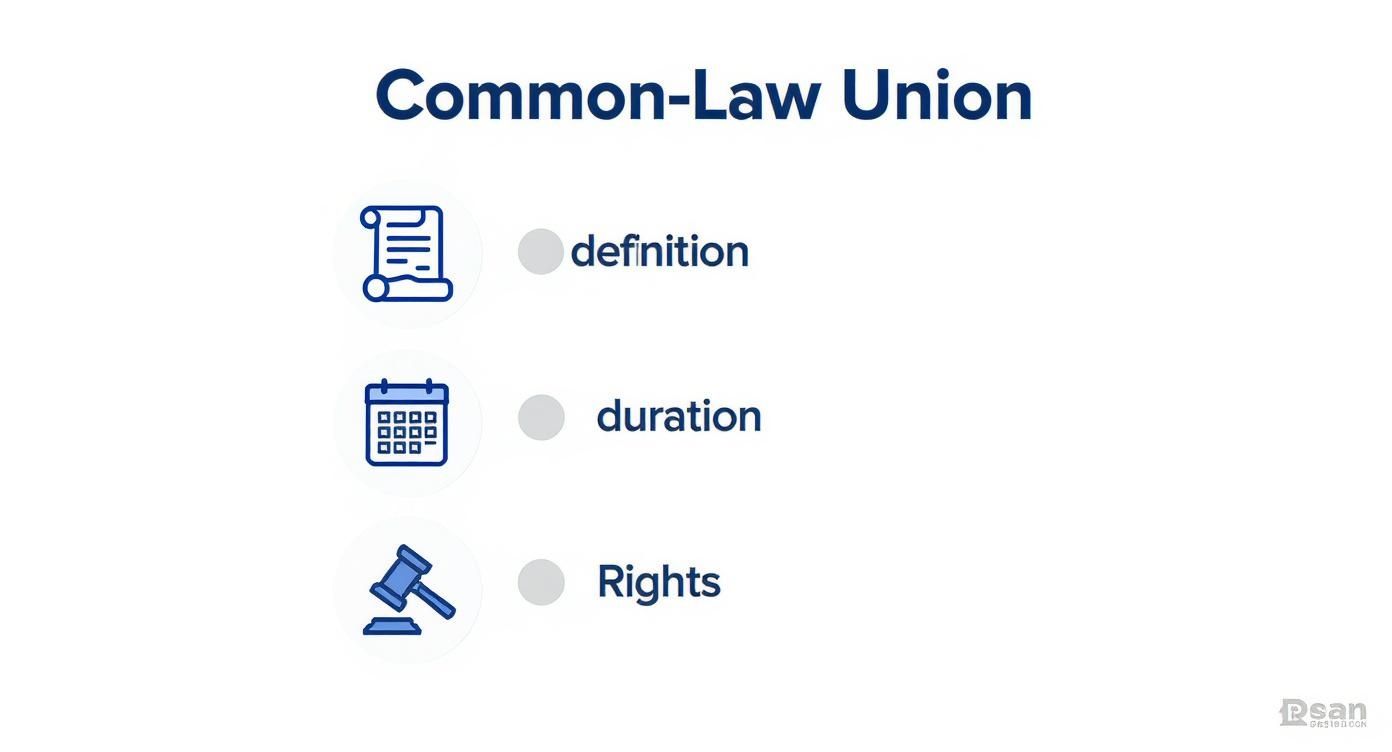
This infographic gives a quick rundown of the essential elements.

Infographic about statutory declaration of a common-law union

It breaks down the definition, how long you need to cohabit, and the limited rights that come with this status, really driving home the need for clear legal paperwork.

Think of a statutory declaration as more than just a form. It's your formal assertion, made under oath, that your relationship meets specific legal tests. Misrepresenting the facts on this document is a serious offence under the Criminal Code of Canada and can lead to perjury charges.

The table below breaks down the major legal differences between marriage and common-law unions in Ontario. Understanding these distinctions is the first step in protecting yourself.

Key Differences Between Marriage and Common-Law Union in Ontario

Legal Aspect Married Couples (Family Law Act) Common-Law Couples (Family Law Act)
Property Division Entitled to an equal division of the value of property accumulated during the marriage (equalization of net family property). The matrimonial home has special protections. No automatic right to divide or share the value of property. Assets generally belong to the person who holds the title. Claims can be made through trust law, which is complex and expensive.
Inheritance Rights If a spouse dies without a will, the surviving spouse has automatic inheritance rights under the Succession Law Reform Act. No automatic inheritance rights. If a partner dies without a will, the surviving partner is not entitled to any part of the estate unless they can prove dependency.
Separation Rights Entitled to spousal support and equalization of property. Both spouses have equal rights to possess the matrimonial home until a court order or agreement says otherwise. Entitled to apply for spousal support but have no automatic right to property division or possession of a shared home owned by the other partner.

As you can see, the legal protections are vastly different. A statutory declaration won't change these fundamental property rules, but it's essential for proving your relationship's existence for other legal and administrative needs.

The Growing Trend of Common-Law Unions

Canadian society is evolving, and more couples are choosing to build a life together without getting married. The numbers are staggering: common-law relationships shot up by 447% between 1981 and 2021. Compare that to just a 26% increase in marriages over the same period.

While Ontario's rate of common-law partnerships is a bit lower than the national average at around 16%, the trend is clear. You can dig deeper into these demographic shifts and their legal implications in Canada.

This shift makes it more critical than ever to understand your legal standing. For couples here in Brampton, a statutory declaration provides the necessary evidence for bodies like the Canada Revenue Agency or Immigration, Refugees and Citizenship Canada. It cements your status for specific purposes, even if it doesn't grant you the property rights of a married couple.

How to Draft Your Statutory Declaration

Putting together a statutory declaration of a common-law union is more than just filling in blanks on a form. You’re essentially creating the official, sworn story of your relationship, so every detail has to be right. This document is your testimony under oath, and you need to be precise. Remember, any intentionally false statements can lead to serious consequences under the Criminal Code of Canada.

Two people reviewing a document together at a desk

The structure is fairly standard, but the specific details you include are what give it real legal authority. Your objective is to give any government agency or legal body clear, undeniable proof that your relationship meets Ontario's definition of a common-law partnership. Think of it as building a solid case for your relationship, one sworn fact at a time.

The Essential Opening Statements

Every statutory declaration kicks off with the basics that identify you and your partner. This part needs to be flawless. Even a simple typo in a name or an old address can cause frustrating delays or get the whole document rejected.

Get these foundational details right from the start:

  • Full Legal Names: Use your complete legal names exactly as they appear on government ID like a driver’s licence or passport. No nicknames, no shortcuts.
  • Current Shared Address: Clearly state the full address where you both currently live in Brampton. That means the street address, city, province, and postal code.
  • Occupation: Listing your current jobs adds another layer of formal identification.

As an example, your opening clause will look something like this:

"We, JANE MARY DOE, of the City of Brampton, in the Province of Ontario, and JOHN MICHAEL SMITH, of the City of Brampton, in the Province of Ontario, do solemnly declare that:"

This formal introduction sets the stage for the specific facts about your union that will follow. It anchors your declaration in verifiable details, establishing who you are and where you live.

Declaring Your Cohabitation and Relationship Start Date

This is arguably the most crucial piece of your declaration. The exact date you began living together in a marriage-like (or "conjugal") relationship is what officially starts the clock on your common-law union. You have to be precise and completely honest here.

You’ll need to state the specific date your cohabitation started. If you’ve lived together at more than one address in Brampton or the GTA, it’s a smart move to list them all. This shows a continuous, uninterrupted living arrangement, which strengthens your case.

A well-drafted clause should be direct and leave no room for doubt:

Example Wording:
"1. We have been living together in a conjugal relationship continuously since January 15, 2019."
"2. We currently reside together at 123 Main Street, Brampton, Ontario, L6X 0B7, and have done so since May 1, 2021. Prior to this, we resided together at 456 Maple Avenue, Mississauga, Ontario, L5B 2C9, from January 15, 2019, to April 30, 2021."

This level of detail creates a clean, verifiable timeline that an official can easily cross-reference with supporting evidence like old lease agreements, mail, or utility bills.

Articulating the Nature of Your Relationship

Your declaration needs to go beyond just stating that you share a home. You have to affirm the key traits that define a common-law union in the eyes of the law. This involves confirming that you share finances, present yourselves as a couple in public, and are committed to a life together. These statements are what prove the "conjugal" nature of your relationship as required by the Family Law Act.

Your declaration should include clauses that touch on these points:

  • Public Representation: How do friends, family, and the Brampton community see you?
  • Shared Life: Do you pool your money, share chores, and have a social life together?
  • Mutual Commitment: Is the plan to continue your life together as a couple?

Here are a few examples of clear, effective wording for these vital statements:

  • "We have presented ourselves to our family, our friends, and our community as a couple in a common-law relationship."
  • "We maintain a joint bank account and share responsibility for household expenses, including rent, utilities, and groceries."
  • "We are mutually committed to one another and intend to continue our life together as a couple."

Adding these statements elevates the document from a simple confirmation of cohabitation to a powerful testament to the depth and permanence of your relationship. They directly address the legal tests for a common-law union in Ontario, making your declaration a strong piece of evidence for any purpose, whether it’s for immigration, benefits, or tax filings.

Gathering Evidence to Support Your Declaration

Your sworn statutory declaration is the core of your common-law claim, but it’s the supporting evidence that makes it bulletproof. Think of it this way: your declaration is your story, and the evidence is the collection of exhibits that proves every word is true. For any organization you're dealing with—be it a bank or a government agency—a well-organized file of documents elevates your statement from a simple claim to an undeniable fact.

A person organizing documents and paperwork into a folder on a desk

This isn’t about just digging up an old hydro bill with both your names on it. You’re building a portfolio that paints a clear, consistent picture of your shared life in Brampton. The real goal is to gather documents that back up the key statements in your declaration, especially the date you started living together and the genuine, conjugal nature of your relationship.

Financial Interdependence as Proof

Showing that your financial lives are intertwined is one of the most powerful ways to demonstrate a common-law union. Why? Because separate finances can sometimes raise doubts about the depth of your commitment.

Start by collecting documents that clearly illustrate a shared financial life. These are the concrete, black-and-white pieces of proof that you operate as a single economic household.

  • Joint Bank Account Statements: Statements from a local Brampton branch showing regular, shared activity are gold. It’s not just about having the account; it’s about proving you both use it for everyday household expenses.
  • Shared Credit Cards or Loans: Proof of joint debt, like a car loan registered in Ontario or a credit card you both use, speaks volumes about your financial trust and interdependence.
  • Insurance Policies: Life insurance policies that name each other as beneficiaries are incredibly strong evidence of a long-term, serious commitment. On a similar note, having both partners listed on a car or tenant insurance policy for your Brampton address is essential.

One of the most powerful—and often overlooked—pieces of evidence is your tax filing history. If you've filed your income taxes with the Canada Revenue Agency (CRA) and declared your status as "common-law," you have an official government record that powerfully supports your declaration.

This financial paper trail is objective and incredibly difficult to dispute. It demonstrates a level of integration that goes far beyond simply being roommates.

Proving Your Shared Household

Next, you need to prove you share a roof and a life under it. This means collecting documents that tie both of you to the same Brampton address over a continuous stretch of time. Consistency is absolutely key here; you want to create an uninterrupted timeline of cohabitation right from the date you listed in your declaration.

Start compiling a file with these types of documents:

  • Lease Agreements or Mortgage Documents: A signed tenancy agreement or mortgage papers with both of your names is primary, foundational evidence.
  • Utility Bills: Gather a collection of bills (Alectra, Enbridge, etc.) addressed to both of you at your shared Brampton address. One bill is good, but a series of them over several years is far better.
  • Official Mail: Any government correspondence from ServiceOntario, the CRA, or other official bodies addressed to both of you at the same location helps solidify your case.

This collection of paperwork firmly establishes your shared residence, directly backing up the cohabitation clause in your statutory declaration of a common-law union.

Evidence of Your Public Relationship

Finally, you need to demonstrate that you present yourselves to your friends, family, and community as a couple. This element proves your relationship isn't a secret but a recognized social reality. While this might seem less tangible than a bank statement, there are plenty of documents that can help.

Look for items that show you are integrated into each other's lives and social circles:

  • Joint Memberships: Proof of a shared gym membership at a local Brampton facility or other community clubs.
  • Invitations and Photographs: Wedding invitations addressed to you as a couple, or photos from holidays and social events with your mutual friends and family.
  • Travel Itineraries: Documentation for vacations you took together, such as flight confirmations or hotel reservations in both names.
  • Affidavits from Others: Sworn statements from friends, family, or even neighbours in your Brampton community who can attest to your relationship can also serve as powerful supporting evidence.

By methodically gathering these three types of evidence—financial, household, and social—you create a robust package that leaves no doubt about the validity of your common-law union. A little preparation now ensures your declaration will be accepted without any frustrating issues down the line.

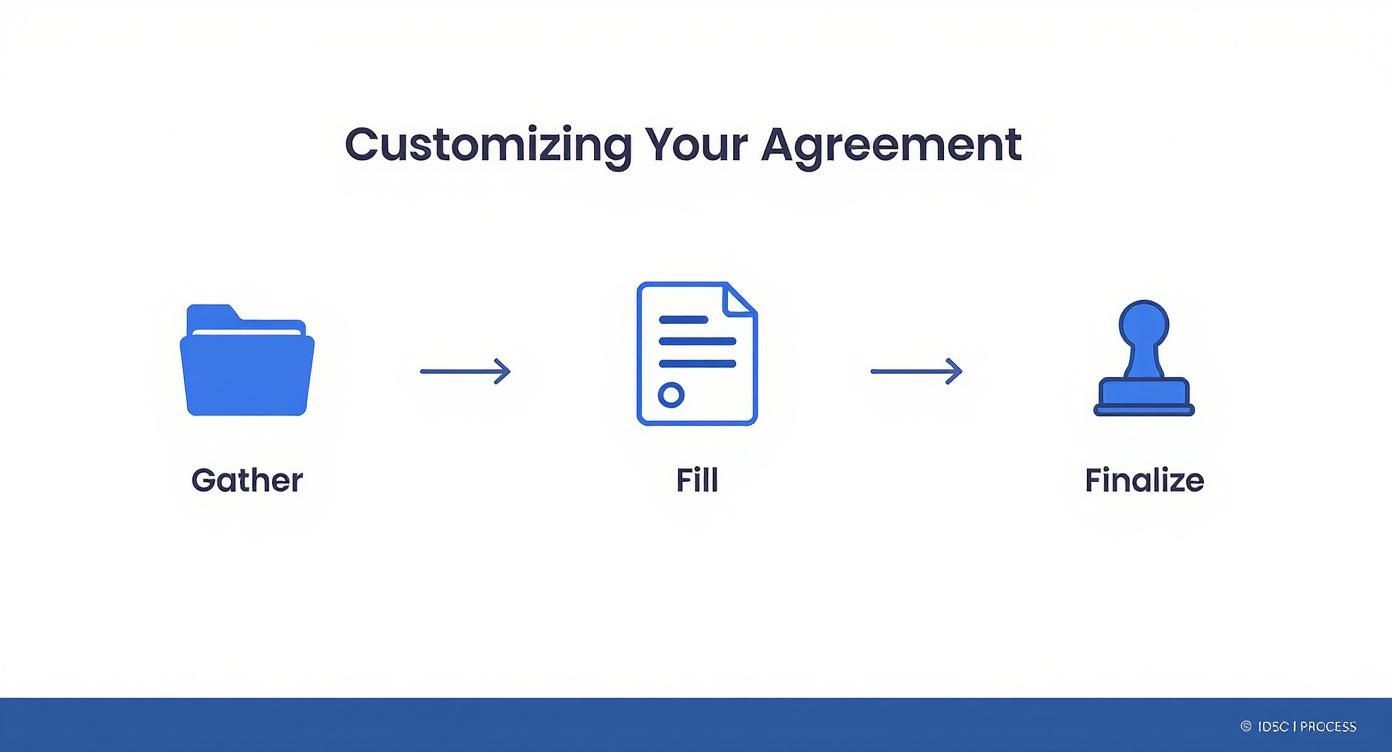
Finalizing Your Declaration in Brampton

Once you’ve drafted your statutory declaration and gathered all your supporting documents, you’re at the final, crucial step: making it an official legal document. This isn't just about signing on the dotted line. It’s a formal process that must be done correctly to be valid under both Ontario's Evidence Act and the federal Canada Evidence Act. This last part, known as commissioning, is what turns your written statements into sworn testimony.

A person signing a legal document in front of an official

If you're in Brampton, this means you'll need to find a qualified individual—like a notary public or a commissioner for taking affidavits—to witness you and your partner sign and administer an oath. It's a very common procedure, but you have to follow the rules to the letter.

The Role of a Notary or Commissioner

A commissioner for taking affidavits is someone authorized by the provincial government to administer oaths and take declarations. Lots of lawyers, paralegals, and even some government clerks in Brampton have this authority. Their job isn't to give you legal advice on what you've written, but to confirm who you are and watch you swear that everything in the document is true.

There's one golden rule here, and it’s non-negotiable: do not sign the document beforehand. The whole point of the process is that you sign it in front of the official after you've sworn the oath. Signing it at home makes the document invalid, and you'll just have to print a new one and start again.

What to Expect at Your Appointment

The appointment itself is usually pretty quick. The key thing is that both you and your partner must be there together, as you will both be signing.

Here’s a quick rundown of what to bring and what happens:

  • Government-Issued Photo ID: Both of you need to show valid, unexpired ID, like a driver’s licence or passport. The commissioner has to verify you are who you say you are.
  • The Unsigned Declaration: Bring the final, printed version of your statutory declaration. Don't forget—no signatures yet!
  • Taking the Oath: The commissioner will ask you to raise your right hand and swear an oath that the information in the declaration is true. If you're not comfortable swearing on a religious text, you can make a solemn affirmation instead. This is a serious legal step; making a false declaration is a criminal offence under the Criminal Code of Canada.

Once you’ve taken the oath, you’ll finally sign the document while the commissioner watches. They will then sign, date, and add their official seal or stamp. That stamp is what makes the document legally executed and ready to go.

This final act of commissioning gives your document serious legal weight. It proves you have formally sworn to the truth of your relationship's details under penalty of law, satisfying the requirements of everyone from immigration authorities to insurance companies.

It’s interesting to note that while this process is standard across Canada, common-law relationships themselves aren't equally common everywhere. The 2021 Census revealed that while 12.6% of Canadians over 15 are in common-law unions, Ontario actually has one of the lowest rates at just 8.61%.

This regional difference really underscores why having a properly executed statutory declaration is so important here. In a province where common-law status might face a bit more scrutiny, this document is your best evidence. You can dig deeper into these Canadian relationship trends. With your document properly signed and commissioned in Brampton, you'll have the solid proof you need to validate your relationship status, no matter who asks.

Common Mistakes to Avoid When Drafting Your Declaration

It might seem like just another form, but a statutory declaration of a common-law union is a sworn legal document. Tiny mistakes can have massive legal fallout, leading to rejections by government agencies or serious headaches if you ever separate. For couples in Brampton, sidestepping these common pitfalls is the key to making sure your declaration is accurate, legally sound, and actually protects you.

Many couples treat the declaration as a simple formality, but it’s a legal instrument with real weight. A small error made today could unravel months or even years down the road. You need to approach this with the seriousness it deserves, paying close attention to every detail you swear to be true.

Guessing Your Cohabitation Start Date

This is, without a doubt, the most frequent and damaging mistake. The exact date you started living together as a couple is the bedrock of your common-law status under Ontario's Family Law Act. Just guessing or throwing in a rough estimate is a huge risk. If that date is ever challenged, it could invalidate your claims for benefits, immigration sponsorship, or even spousal support eligibility.

Actionable Insight: Do the work. Go back through your records—lease agreements, old bank statements, and even mail with postmarks—to nail down the precise date your shared life began in Brampton.

Using Generic Online Templates

The internet is swimming with one-size-fits-all legal templates, but using one for your statutory declaration is a gamble you don't want to take. A generic form you download, especially from a non-Canadian site, probably won't meet the specific requirements of Ontario law or the Canada Evidence Act. These templates often miss the crucial language needed to prove the "conjugal" nature of your relationship, which is a key legal test.

A declaration that isn’t tailored to your specific situation and Ontario’s legal standards can be dismissed out of hand. If it's missing the key clauses that officials in Brampton or at a federal level look for, you'll be forced to start the entire process all over again.

A statutory declaration isn't just a form; it's a sworn affidavit. Relying on a generic template is like using a map for a different city—it might look right, but it won't get you where you need to go legally. A flawed document is often worse than no document at all.

Underestimating the Document's Legal Power

Don't forget: you are swearing under oath that every piece of information is true. A false statement, even if it feels like a harmless "white lie," is a serious offence under the Criminal Code of Canada. Misrepresenting facts on a statutory declaration can lead to charges of perjury.

This often happens when one partner pressures the other to backdate the cohabitation to qualify for a benefit or sponsorship sooner. This isn't just a fib; it's illegal. The consequences can be severe, including hefty fines, imprisonment, and the immediate rejection of any application tied to the fraudulent declaration.

When You Absolutely Need a Brampton Family Lawyer

While you can technically draft a declaration yourself, some situations absolutely demand a lawyer's eye. A lawyer ensures the document is not only compliant but strategically written to protect your specific interests. You should always consult a family lawyer in these Brampton-specific scenarios:

  • Significant or Complex Assets: If either of you owns a business, has major investments, or owns real estate in Brampton or the GTA, a lawyer is non-negotiable.
  • Blended Families: When children from previous relationships are involved, a declaration can have ripple effects on support and inheritance that need careful legal planning.
  • Considering a Cohabitation Agreement: If you’re also creating a cohabitation agreement to define property rights, your lawyer must draft both documents together. This ensures they are consistent and legally airtight. Badesha Law can provide guidance on both criminal and family law matters, ensuring all your legal bases are covered.
  • Uncertainty About Your Legal Status: If you're not 100% sure your relationship legally qualifies as common-law under the Family Law Act, a lawyer can give you a clear assessment before you sign a sworn statement.

Trying to navigate the legalities of a statutory declaration on your own can be risky. By avoiding these common mistakes and getting professional advice when your situation is complex, you ensure your declaration is a solid, reliable document that does its job without creating future legal nightmares.

Answering Your Questions About Common-Law Declarations

When you're formalizing a common-law relationship, a lot of questions pop up. For couples in Brampton, getting the details right on a statutory declaration is a common concern. Let's clear up some of the most frequent queries so you can move forward with confidence.

Do We Really Need a Lawyer to Draft This?

Legally, no, you aren't required to have a lawyer draft the declaration for you. But should you? For Brampton couples, it’s a very good idea.

A local family lawyer does more than just fill out a form. They use precise, legally sound language that aligns with Ontario's Family Law Act. This isn't just about sounding official—this strategic wording can make all the difference if the document is ever challenged or scrutinized.

Plus, a lawyer can also serve as the commissioner for taking affidavits or notary public needed to make it official. This streamlines the whole process, making sure your declaration is not only drafted to protect your interests but also properly signed and witnessed to be legally valid.

What Does it Cost to Get the Declaration Commissioned?

The final step—getting the document commissioned—is usually quite affordable. In the Brampton area, you can expect a notary public or commissioner for taking affidavits to charge somewhere between $40 and $80.

This fee covers their time to verify your IDs, administer the oath, watch you sign, and apply their official seal. Just remember, this cost is separate from any fees you might pay a lawyer to draft the document itself.

Actionable Tip: A statutory declaration is a powerful tool, but it is not a cohabitation agreement. The declaration proves your relationship exists. A cohabitation agreement sets out your financial rights and obligations, especially if you separate. They serve very different but equally important purposes.

Understanding what your declaration can and can't do is critical. It’s a foundational document, but it doesn't cover every legal angle of your partnership, which brings us to another key question.

Can We Use This Declaration to Divide Property?

This is a major point of confusion for many common-law couples in Ontario, and the answer is a firm no. A statutory declaration of a common-law union does not give either partner automatic rights to property division. Its sole purpose is to act as sworn proof of your relationship for organizations like the CRA, insurance companies, or for immigration applications.

Under Ontario's Family Law Act, common-law partners do not get the same property rights as married spouses. There is no automatic equalization of property you've accumulated together. If you split up, assets generally stay with whoever legally owns them.

To set out property rights and protect your financial future in Brampton, you need a completely different document: a cohabitation agreement. This is where you and your partner agree ahead of time on how assets and debts would be handled if the relationship ends. Trying to use a statutory declaration to claim property is a fundamental misunderstanding of its legal role and won't get you far in court.

What if My Partner Won't Sign It?

A statutory declaration has to be a joint effort—both partners must sign it. If one person refuses, you simply can't create a joint declaration. But that doesn't mean you're out of options.

You can still draft what's called a unilateral declaration. This is a sworn statement from just you, outlining the facts of your relationship as you see them. While it's not as powerful as a joint declaration, it can still serve as evidence, especially if you back it up with all the supporting documents we discussed earlier (like joint bank statements or bills).

Honestly, a situation like this is a big red flag. It’s a clear sign that you should get legal advice immediately to understand your rights and figure out the best way to protect yourself.


Navigating the complexities of family law requires clear guidance and strong advocacy. Whether you are formalizing your common-law status, drafting a cohabitation agreement, or facing a separation, the team at Badesha Law provides the expert legal support you need. We serve clients across Brampton, Mississauga, and the GTA with integrity and a client-first approach. Protect your rights and secure your future by visiting Badesha Law to schedule a consultation.

Cohabitation Agreement Template Ontario: A Practical Brampton Guide

Many couples searching for a “cohabitation agreement template Ontario” are looking for a straightforward way to protect their financial future. What they often miss is why this document is so critical, especially here in Ontario. The blunt truth is that under Ontario’s Family Law Act, being ‘common-law’ does not grant you the same automatic property rights as married couples. This is a harsh reality many in Brampton only discover after a painful and costly separation.

A solid, well-crafted agreement is your best, most actionable step for creating clarity and financial security for your future.

Protecting Your Future: An Actionable Guide for Brampton Couples

A couple planning their future together, symbolizing the proactive nature of creating a cohabitation agreement.

It’s easy to feel overwhelmed when facing a blank legal document. The process can feel intimidating, and it’s tempting to delay it, worrying it might signal a lack of trust. But creating a cohabitation agreement is less about mistrust and more about smart, practical financial planning. It’s a proactive conversation about your shared future, ensuring you and your partner are on the same page from the start.

Think of it as a financial roadmap. You wouldn’t launch a business in Brampton without a partnership agreement. The same logic applies when you’re combining finances and assets. This document allows you to define the terms of your partnership yourselves, rather than leaving it to the default—and often surprising—rules of Ontario’s Family Law Act.

Why Your Common-Law Status Isn’t Enough Protection

One of the most dangerous myths is that after living together for a few years, your assets automatically become shared property. This is false. In Ontario, common-law partners have no automatic right to equalize property accumulated during the relationship. This legal gap can lead to devastating financial outcomes.

Consider this common Brampton scenario: one partner owns a condo before moving in together. The other partner moves in, contributes to the mortgage, pays for renovations, and covers household bills for over a decade. If they split up without an agreement:

  • The partner whose name isn’t on the title could have no legal claim to the home’s value.
  • They would face a complex and expensive legal battle, such as a claim for unjust enrichment, with no guarantee of success.
  • The emotional and financial stress of such a fight, which could also involve elements of the Criminal Code if disputes escalate, can be immense.

A cohabitation agreement cuts through this ambiguity. It clearly outlines who owns what and what happens to any shared property if the relationship ends.

A cohabitation agreement isn’t for the end of a relationship; it’s for the healthy duration of one. It removes financial uncertainty, allowing both partners to build a future together with confidence and mutual respect.

Taking this proactive step is more relevant than ever. Between 1981 and 2021, the number of common-law couples in Ontario surged by a staggering 447%. In cities like Brampton and Mississauga, over 18% of couples now live together without marrying. This demographic shift makes these agreements essential. You can dig deeper into this trend and its legal side-effects at Common law separation.

Ultimately, this document ensures the major decisions about your life are made by you, not by a judge. It provides peace of mind, knowing that you and your partner have a fair, clear plan, no matter what the future holds.

Understanding Your Common-Law Status in Ontario

Before building a cohabitation agreement, let’s clarify what “common-law” actually means for you in Brampton. People use the term casually, but under Ontario’s Family Law Act, it’s a legal status with specific rules and serious financial implications.

Misunderstanding this is one of the most common and costly mistakes separating couples make. A cohabitation agreement exists to bridge the gap between what you think your rights are and what the law actually dictates.

The Two Paths to Common-Law Status

In Ontario, you don’t become common-law after a few months. The Family Law Act sets out two clear tests to determine if you are legally “spouses” for the purpose of spousal support, even without a marriage certificate.

You are considered common-law partners if you have:

  • Lived together continuously in a conjugal relationship for at least three years.
  • Lived together in a relationship of some permanence and are the parents of a child together, whether by birth or adoption.

This definition is critical. It’s not about how you feel, but about meeting one of these two legal thresholds. You can get more details on how courts interpret cohabitation from the experts at kellyjordanfamilylaw.com.

Property Rights Versus Support Obligations

This is the single most important distinction. Achieving common-law status creates a potential obligation for spousal support, but it does not give you automatic rights to property division. This is a massive difference from being married.

When a married couple separates, the law generally requires them to equalize their net family property, which usually means splitting the value of assets accumulated during the marriage 50/50.

This is not the case for common-law partners.

Without a cohabitation agreement, you are not automatically entitled to half the value of the Brampton home you lived in, your partner’s pension, or their investments—even if you were together for 20 years. To make a claim, you would have to launch a complex and expensive lawsuit for “unjust enrichment,” with absolutely no guarantee of success.

Key Takeaway: In Ontario, being common-law gives you the right to ask for spousal support but does not grant an automatic right to share in your partner’s property. A cohabitation agreement is your tool to create your own rules for property division, overriding the default law.

To make this crystal clear, let’s compare the default rights for married versus common-law partners in Ontario upon separation.

Married vs Common-Law Spouses A Comparison of Rights in Ontario

This table highlights the fundamental legal differences in rights and obligations for married versus common-law couples upon separation under Ontario’s Family Law Act.

Legal Right / Obligation Married Spouses Common-Law Partners (No Agreement)
Property Division Entitled to a 50/50 equalization of the value of net family property accumulated during the marriage. No automatic right to property division. Each partner keeps what is in their own name.
Matrimonial Home Both spouses have an equal right to possess the matrimonial home, regardless of who is on the title. The non-titled partner has no automatic right to stay in the home.
Spousal Support Both partners have the right to claim spousal support based on factors like the length of the marriage and roles during it. Both partners have the same right to claim spousal support as married spouses if they meet the definition of common-law.
Inheritance Rights A surviving spouse has specific rights to a share of the deceased spouse’s estate, even without a will. No automatic inheritance rights. Without a will, a surviving partner may receive nothing from the estate.

As you can see, the differences are stark, especially regarding property. This is precisely why a well-drafted cohabitation agreement is not just a good idea—it’s essential protection for both partners living in Brampton and across Ontario.

Building Your Cohabitation Agreement Clause by Clause

This is where you take action. A template is just a skeleton; the real strength of your cohabitation agreement comes from the specific clauses you build into it. These clauses are the practical tools that define your financial relationship, protect your individual assets, and create a clear roadmap for your future together in Ontario.

We’ll move beyond dense legal jargon and break down the essential pieces of a solid agreement. For couples in Brampton, Mississauga, and across the GTA, getting these details right is what makes the difference between a useless document and one that provides genuine security.

Two people sitting at a table, reviewing a document together with pens, symbolizing the collaborative process of building a cohabitation agreement.

Defining Separate and Joint Property

The cornerstone of any cohabitation agreement is clearly separating what’s yours, what’s mine, and what’s ours. This clause prevents the fuzzy assumption that everything eventually becomes shared. You must be crystal clear.

Your agreement must list all significant assets each of you is bringing into the relationship. This is your separate property. It’s like drawing a financial line in the sand.

Actionable List of Separate Property:

  • Real Estate: The condo you owned in Brampton before your partner moved in.
  • Investments: Your RRSP, TFSA, and any other investment accounts in your name.
  • Business Interests: Shares in a family business or your own incorporated company.
  • Significant Personal Items: Valuable art, heirlooms, jewelry, or a vehicle.
  • Inheritances or Gifts: Any money or property you’ve received (or expect to receive) from family.

Next, define what will be considered joint property. This is anything you acquire together during the relationship. A practical rule is that an asset is only joint if it is explicitly titled in both your names. This simple step avoids a world of ambiguity.

By clearly defining what’s yours, mine, and ours, you eliminate the single most common source of conflict and legal battles upon separation. This clarity is the main purpose of your agreement.

Handling Debts and Liabilities

Just as important as assets are debts. A well-drafted agreement specifies how liabilities will be handled. This clause protects you from suddenly becoming responsible for your partner’s student loans or credit card debt.

The agreement must state that each partner is solely responsible for:

  • Any debts they brought into the relationship.
  • Any debts they take on in their own name during the relationship.

You also need a plan for joint debts, like a shared line of credit or a car loan. The agreement should spell out exactly how these will be paid off if you separate.

The Spousal Support Clause

Under Ontario’s Family Law Act, common-law partners can claim spousal support after separation. A cohabitation agreement lets you decide this issue for yourselves.

You have several options. Many couples agree to a full waiver, where both partners give up any right to claim spousal support. This is common when both partners have similar incomes.

Alternatively, you can set specific conditions. For example, you might agree that support is only payable if you have children together, or if one person steps back from their career. You can even define the amount and duration of potential support payments in advance.

Estate Rights and Inheritance

What happens if one of you passes away without a will? As noted, common-law partners in Ontario have no automatic inheritance rights under the Succession Law Reform Act. Your cohabitation agreement can and should address this directly.

You can include a clause where each partner waives any claim against the other’s estate. This ensures your assets go to your chosen beneficiaries—like children from a previous relationship. This is critical for blended families in the Brampton area who need to ensure their estate plans are followed.

It’s a common mistake to think this agreement covers everything. To be enforceable, cohabitation agreements in Ontario must follow specific legal rules, including full and honest financial disclosure and being signed with witnesses. You can get more details on these crucial legal requirements and learn how they are handled with expert guidance in Ontario.

Addressing the Shared Home

For many Brampton couples, the shared home is the biggest financial and emotional asset. Your agreement needs a detailed clause to handle it, especially if one person owned it beforehand.

Let’s look at a common scenario:
Scenario: Partner A owns a Brampton townhouse. Partner B moves in and contributes to the mortgage, property tax, and bills.

Your agreement must spell out:

  1. Ownership: The townhouse remains Partner A’s separate property.
  2. Contributions: Partner B’s payments are defined as rent and do not create any ownership interest.
  3. Increase in Value: The agreement must state that Partner B has no claim to any increase in the home’s value (appreciation).

If you buy a home together, the clause should outline what happens if you break up. Will you sell it? Will one partner have the option to buy out the other? How will you split the equity? Answering these questions now prevents a messy, forced sale or a costly court application later.

From Template to Tailor-Made: Customizing Your Agreement

Turning a generic template into a personalized legal document is the most critical step. This is where you create a solid, actionable plan that reflects your life in Ontario. The goal is to iron out every detail and leave no room for confusion.

The bedrock of any valid cohabitation agreement under Ontario’s Family Law Act is full and honest financial disclosure. This is a non-negotiable legal requirement. Skimping on this can get your entire agreement invalidated by a court.

Step One: Laying All Your Financial Cards on the Table

Before filling in any blanks, you and your partner must each gather all financial information. This isn’t just about numbers; it forces a level of transparency that’s crucial for building a fair agreement.

Think of your financial disclosure as schedules attached to the main agreement. Here’s an actionable checklist:

  • Proof of Income: Recent pay stubs, T4 slips, or your latest Notice of Assessment from the CRA.
  • Property Valuations: Recent appraisals or property tax assessments for any real estate you own. For a home in Brampton, the legal description is on your property tax bill.
  • Bank and Investment Statements: Statements for all accounts—chequing, savings, RRSPs, TFSAs.
  • Business Records: Financial statements or a proper valuation if you own a business.
  • Debt Statements: Paperwork for mortgages, lines of credit, car loans, student loans, and credit card balances.

Yes, this can feel invasive. But it’s non-negotiable. Trying to hide an asset or debt is one of the fastest ways to have your agreement thrown out of court.

Step Two: Filling in the Blanks with Pinpoint Accuracy

Once your financials are organized, you can start customizing the template. Every clause needs careful thought and specific details. Vague language is your enemy; precision is your best friend.

A classic mistake is using generic terms. Don’t just write “car”—specify the “2022 Honda Civic, VIN…” Don’t just list “investments”—write down the specific account numbers and institutions. This detail eliminates any guesswork.

Let’s walk through a real-world example for a Brampton couple.

Scenario: A couple is drafting their agreement. One partner bought a townhouse in Brampton before they met, and they opened a joint savings account for household expenses.

Their property clause must be airtight:

  1. Separate Property: The agreement must list “The residential property located at [Full Address, Brampton, ON], legally described as [Legal Description from Deed/Tax Bill]…” and state it belongs solely to that one partner.
  2. Excluding Appreciation: It must explicitly say the other partner will have no claim to the increase in the home’s value during the relationship. This is crucial.
  3. Joint Property: The agreement should identify their joint savings account by bank and account number, specifying it’s the only asset they consider joint property.

This clarity prevents a future argument where one partner claims their contributions to bills entitled them to a piece of the home’s equity.

Crucial Tip: Think of your agreement as a living document. Add a “review clause” that triggers a check-in every few years or after a major life event—like having a child or buying property together—to ensure it still fits your circumstances.

Step Three: Looking Ahead at What’s to Come

A strong agreement doesn’t just cover what you have today; it anticipates the future. Are you planning to start a business together? Is one of you expecting an inheritance?

These need to be spelled out in the document. For instance, include a clause stating any future gifts or inheritances one of you receives will remain your separate property, free from any claims by the other partner. This is key for protecting family assets.

Ultimately, customizing your cohabitation agreement template for Ontario is about turning your verbal understandings into something legally binding. Every number you write down and every asset you list strengthens the document, transforming it from a piece of paper into a powerful shield that provides financial clarity and peace of mind.

Making Your Agreement Legally Binding in Ontario

You’ve done the work: customized your agreement, accounted for every asset, and mapped out your financial future. But a signed piece of paper isn’t automatically an ironclad legal shield in Ontario.

To turn that document into a legally enforceable contract that will hold up in a Brampton court, you must follow the final steps. Skipping these formalities can render all your hard work useless. This final stage is about ensuring fairness and preventing future challenges under the Family Law Act.

The path from a drafted template to a finalized, legally sound agreement involves a few critical stages.

Infographic about cohabitation agreement template ontario

Think of it as building a strong foundation. Each step—gathering financials, carefully completing the template, and getting legal sign-off—builds on the last to create a defensible agreement.

The Non-Negotiable Role of Independent Legal Advice

If you take one thing from this section, let it be this: the single most important step to make your agreement legally binding is for both you and your partner to get Independent Legal Advice (ILA).

This isn’t just a suggestion; it’s your best defense against having the agreement invalidated later. It means each of you meets separately with your own lawyer to review the document line by line.

A Brampton lawyer providing ILA will:

  • Confirm you understand every clause and its long-term impact.
  • Check that your partner’s financial disclosure appears complete and accurate.
  • Ensure you are signing freely, without any pressure or duress.

When a court sees that both partners received ILA, it’s powerful evidence the agreement was entered into fairly. It makes it incredibly difficult for one person to later claim they were taken advantage of or didn’t understand what they were signing.

For couples in the Brampton area, sitting down with a local family lawyer for ILA is a wise and necessary investment. They understand the local court system and can offer practical, relevant advice.

Formal Signing and Witnessing Requirements

Under Ontario’s Family Law Act, a domestic contract like a cohabitation agreement must be signed and witnessed in a specific way to be valid. You cannot just sign it at the kitchen table.

The process must be followed precisely:

  1. Both Partners Must Sign: Both of you must sign the final document.
  2. Each Signature Must Be Witnessed: Someone must be physically present to watch each of you sign.
  3. The Witness Must Also Sign: The witness then signs the document, confirming they saw you sign it.

Crucially, you cannot witness your partner’s signature, and they cannot witness yours. Witnesses should be neutral third parties. The best practice is to have the lawyers providing ILA also act as the witnesses.

What Makes an Agreement Unenforceable

Even with signatures, an Ontario court can set aside a cohabitation agreement if it was created improperly. A judge will look for red flags that undermine its fairness.

Common reasons an agreement is overturned:

  • Failure to Disclose: One partner deliberately hid a major asset or a significant debt.
  • Lack of Understanding: There is proof that one person did not comprehend the agreement’s consequences. This is why ILA is vital.
  • Duress or Coercion: Evidence shows one partner was pressured, threatened, or forced into signing. Such actions can even have implications under the Criminal Code.

The goal is to create a fair and transparent document. By ensuring full financial disclosure, getting Independent Legal Advice, and following proper signing procedures, you give your agreement the legal strength it needs to protect both of you as intended.

Common Questions About Ontario Cohabitation Agreements

Even after covering the basics, specific questions always arise as Brampton couples work through this process. This final section provides clear, actionable answers to the most common queries we hear.

Can We Write Our Ontario Cohabitation Agreement Without a Lawyer?

Yes, you can draft your own agreement using a template, but it is a significant risk. For an agreement to be upheld in an Ontario court, a judge will look for fairness, complete financial disclosure, and no signs of pressure.

The best way to meet these legal standards is for both partners to get Independent Legal Advice (ILA) from separate lawyers. A lawyer in Brampton will identify potential issues, ensure the wording is legally sound, and add a layer of validity that is difficult to challenge later.

What Happens If We Get Married After Signing?

This is an excellent question. Under section 52(2) of Ontario’s Family Law Act, a cohabitation agreement automatically becomes a marriage contract (often called a prenup) if the partners later marry.

This means all the terms you agreed on for property, debts, and support will carry forward into your marriage and apply if you ever separate or divorce.

Actionable Tip: Include a specific clause in your agreement acknowledging this. It should confirm that you both intend for the agreement’s terms to remain in effect if you transition from common-law partners to married spouses.

How Much Does a Cohabitation Agreement Cost in Brampton?

The cost can vary significantly. Using a free online template is the cheapest option but carries the highest legal risk—it may not be enforceable when you need it most. Hiring two lawyers to draft a custom agreement from scratch can cost several thousand dollars, especially with complex finances.

For most couples in Brampton, a cost-effective middle ground is the most practical approach:

  • Start by drafting the agreement yourselves using a high-quality, comprehensive template.
  • Then, each of you takes that draft to your own lawyer for Independent Legal Advice (ILA).

This method allows lawyers to review and advise on the document for a flat fee, providing crucial legal oversight without the high cost of full drafting services. You get peace of mind and an ironclad agreement at a more predictable price.


Navigating the details of a cohabitation agreement requires clear, strategic guidance. At Badesha Law, we provide precise legal advice to families in Brampton, Mississauga, and the GTA, making sure your rights are protected every step of the way. Whether you need an agreement drafted, reviewed, or enforced, our team is here to help. For a clear path forward, explore our family law services.