

When you’re navigating child support in Ontario, the first thing to understand is a fundamental truth: child support is the legal right of every child. It’s not a discretionary payment or a bargaining chip between parents.
This core principle is embedded in both federal and provincial law, like the Family Law Act, designed to give children consistent financial stability after their parents separate or divorce. The whole system is built for predictability and fairness, with the primary goal of protecting the child's standard of living as much as possible.
Understanding Your Core Obligations in Ontario
Once parents separate, one of their most critical legal duties is sorting out financial support for their children. In Ontario, this isn't left to guesswork. The process is strictly governed by a clear set of rules called the Federal Child Support Guidelines.
These guidelines apply to everyone, whether you were married or in a common-law relationship. The big idea is simple: children should continue to benefit from the financial resources of both parents, almost as if the family were still living together. The courts take this obligation incredibly seriously, and it’s a central piece of any separation or divorce. A knowledgeable child support lawyer in Ontario can clarify these duties from the outset.
The Two Pillars of Child Support
Child support in Ontario is really broken down into two distinct categories. Each one serves a specific purpose in covering a child's needs, and you need to understand both.
The Table Amount: This is the base monthly payment, calculated straight from the official Child Support Tables. It’s meant to cover the essentials—everyday expenses like food, housing, and clothes.
Special or Extraordinary Expenses: Often called Section 7 expenses, these are for costs that go beyond the basics. Think of things like orthodontics, competitive sports fees, or post-secondary education. These costs are calculated separately and are typically shared between parents based on their respective incomes.
A good way to think about it is that the table amount covers a child's foundational needs, while special expenses address the specific, often larger, costs that come up as they grow. A knowledgeable child support lawyer in Ontario can help you figure out exactly which expenses qualify under this second category.
How the Guidelines Ensure Fairness
The legal framework is designed to create consistency and cut down on conflict. Child support amounts are determined using the Federal Child Support Guidelines tables, which set a mandatory 'table amount' based on a few key factors: the paying parent's annual income, the number of children, and their province of residence.
For example, a parent in Ontario earning $50,000 before taxes with two children must pay $755 per month in basic support. This structured, formula-based approach gives parents in Brampton and across the GTA a clear financial roadmap as they navigate their separation. It removes a lot of the guesswork and fighting.
At its heart, the law puts the child's well-being above everything else. The right to support belongs to the child and can't be waived or negotiated away by the parents. This ensures a child's financial security is protected, no matter what’s going on between the parents.
This non-negotiable right is a cornerstone of family law. If you’re heading into a separation, getting a firm handle on your obligations from the very beginning is the first step toward a fair and lasting resolution. For those in common-law relationships, a well-drafted separation agreement is crucial; you can learn more about the specifics of a common law separation agreement to ensure all your legal bases are covered. The team at Badesha Law can provide the guidance you need.
How Child Support Is Calculated in Ontario
Figuring out child support in Ontario might seem like a maze of complex rules, but it’s actually built on a surprisingly straightforward formula. The whole system is designed to be predictable and consistent for families across the province, taking a lot of the guesswork—and potential conflict—out of the equation.
The entire process is anchored by the Federal Child Support Guidelines, which use a set of official tables to determine the base amount of support. To get to that number, you only need three key pieces of information:
The paying parent’s gross annual income.
The number of children who need support.
The province where the paying parent lives (in this case, Ontario).
Once you have those three facts, you can look up the corresponding Child Support Table to find a specific monthly payment. This is what’s known as the "table amount," and it’s designed to cover a child’s essential day-to-day expenses like food, housing, and clothing.
What Really Counts as "Income"?
The most critical—and often the most debated—part of the whole calculation is figuring out the paying parent’s gross annual income. For most people who get a regular paycheque and a T4 slip from their employer, it’s a simple case of looking at Line 15000 on their income tax return.
But life isn’t always that neat and tidy. The courts have the power to dig deeper when a parent’s financial situation is more complicated.
For the Self-Employed: If you own a business or work as a freelancer, your income is what’s left after you subtract legitimate business expenses. This is a notorious grey area, and knowing what counts as a valid deduction versus a personal expense is where things can get contentious.
For Fluctuating Incomes: For parents who rely on commissions, seasonal work, or bonuses, the court will often average their income over the last three years. This smooths out the peaks and valleys to arrive at a figure that’s fair and realistic.
For Intentional Underemployment: This is a big one. If a court suspects a parent is deliberately working less or earning less than they’re capable of just to lower their support payments, it can "impute" income. This means the judge will calculate support based on what that parent should be earning, not what they’re actually bringing home.
Full and honest financial disclosure isn't just good practice; it's a legal requirement. Both parents have to lay their cards on the table, and documents like a properly completed Form 13.1 Financial Statement are absolutely essential to ensure the process is transparent and fair from the very beginning.
This flowchart breaks down the basic steps involved in determining child support obligations in Ontario.
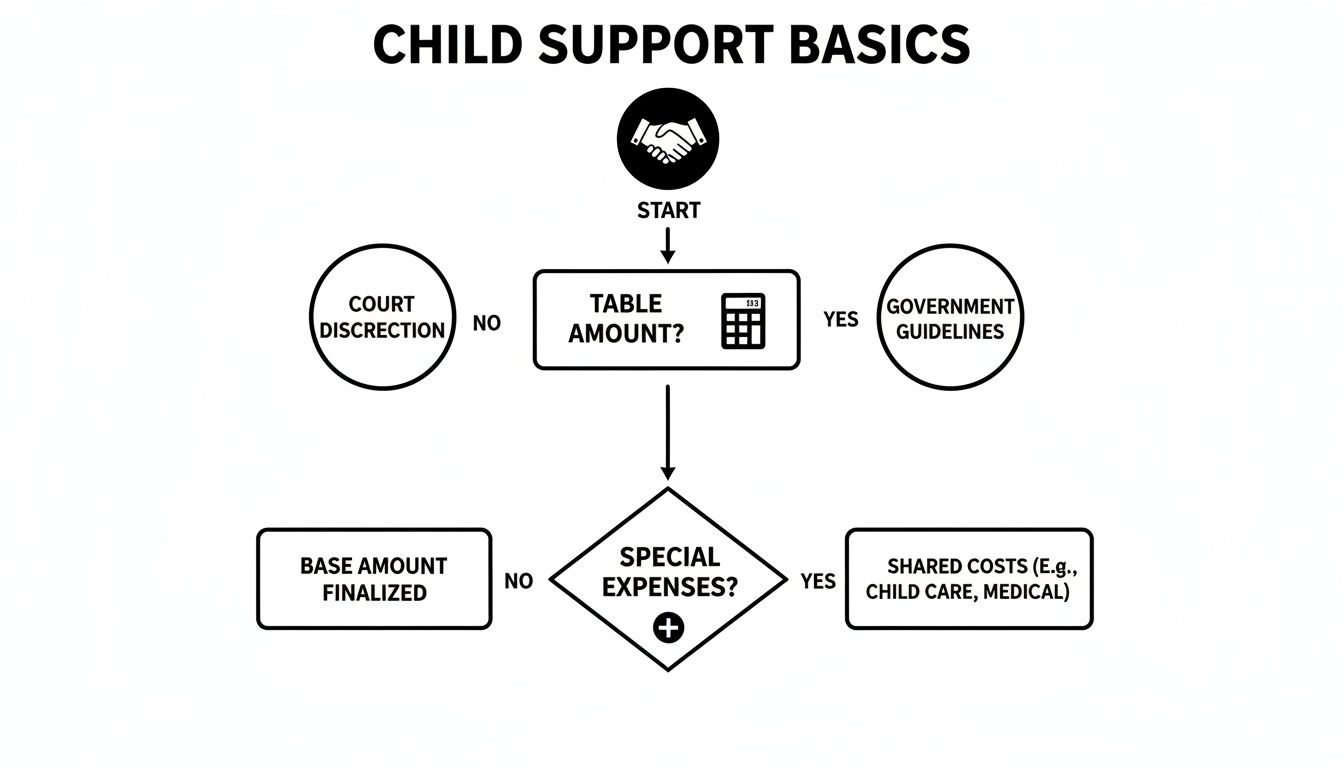
As the visual shows, nailing down the table amount is the foundational first step. Only after that baseline is set do you move on to consider other shared costs, like special and extraordinary expenses.
Sample Monthly Child Support Table Amounts in Ontario
To give you a clearer picture of how this works in practice, the table below shows some sample monthly child support payments based on the paying parent's gross annual income and the number of children, according to the Federal Child Support Guidelines.
| Payor's Gross Annual Income | 1 Child | 2 Children | 3 Children |
|---|---|---|---|
| $50,000 | $450 | $743 | $968 |
| $75,000 | $691 | $1,142 | $1,489 |
| $100,000 | $919 | $1,519 | $1,983 |
| $125,000 | $1,135 | $1,877 | $2,451 |
| $150,000 | $1,346 | $2,225 | $2,905 |
These figures are for illustrative purposes. Always refer to the official government tables for precise calculations.
As you can see, the table amount isn’t arbitrary; it’s a standardized figure calculated directly from the guidelines to ensure fairness and consistency for families at similar income levels.
Covering Costs Beyond the Basics
The monthly table amount is the foundation of child support, but it’s not the whole story. Life with children is filled with expenses that go far beyond food and shelter, from essential daycare to the high cost of a university education. This is where special and extraordinary expenses, often called Section 7 expenses, come into play under Ontario’s child support laws.
Think of the table amount as covering the predictable, everyday costs of raising a child. Section 7 expenses, on the other hand, are for specific, significant costs that are necessary for the child's best interests. These aren’t automatically included; they must be justified, agreed upon, and then shared between the parents.

This distinction is crucial because it ensures children don’t miss out on important opportunities or necessities just because their parents are separated. A skilled child support lawyer in Ontario can provide much-needed clarity on which costs are likely to qualify and which aren't.
What Qualifies as a Special Expense
Not every extra cost will get the green light as a Section 7 expense. The Family Law Act and the Federal Child Support Guidelines lay out a clear two-part test: is the expense necessary for the child's best interests, and is it reasonable given the family's financial means?
Here are some of the most common examples of qualifying expenses:
Childcare Costs: Expenses paid so the custodial parent can work, go to school, or manage an illness.
Medical and Dental Insurance Premiums: The portion of health insurance premiums that specifically covers the child.
Uninsured Health and Dental Costs: This is a big one. It covers things like orthodontics, prescription glasses, counselling, or physiotherapy that insurance doesn't pick up.
Post-Secondary Education: Contributions toward tuition, residence, books, and other related costs for college or university.
Extraordinary Extracurricular Activities: This isn't for every T-ball league. It’s for high-cost activities like competitive hockey, elite gymnastics, or specialized music lessons, especially if the child showed talent in that area before the separation.
Primary or Secondary School Needs: Costs for private school or tutoring if it’s required to meet the child’s specific educational needs.
These costs are handled differently than the base table amount. Instead of one parent simply paying the other, these expenses are shared proportionally based on each parent's income.
How Costs Are Shared Proportionally
Once an expense is agreed upon or ordered by the court, the cost is split fairly. For instance, if one parent earns $60,000 a year and the other earns $40,000, their total combined income is $100,000. The first parent earns 60% of that total, and the second earns 40%.
So, when a $1,000 orthodontist bill comes in, they would share it like this:
Parent 1 (60% of income): Pays $600
Parent 2 (40% of income): Pays $400
This proportional sharing ensures the financial burden is distributed fairly, reflecting each parent's actual capacity to contribute.
It's vital to clearly define what constitutes a special expense in your separation agreement. Vague language can lead to endless disagreements down the road about what is 'reasonable' or 'necessary'.
Proactively addressing these details is a key role of a Badesha Law divorce lawyer in Brampton. By outlining specific categories of expenses and setting a clear process for reimbursement, you can prevent a lot of future conflict. For more details on what to include, check out our guide on creating a comprehensive separation agreement template in Ontario. Getting this right from the start protects both your finances and your co-parenting relationship.
How Parenting Time Affects Child Support
Child support isn't just a simple calculation based on a pay stub. It's deeply tied to the real-world logistics of parenting time. How often a child stays with each parent can completely change the financial formula, shifting it from a standard table amount to a more tailored calculation that reflects the actual, hands-on costs of raising a child in two separate homes.
This is all about fairness. When parents are sharing the day-to-day expenses of raising their kids more equally, child support laws in Ontario are smart enough to recognize that financial reality. Getting your head around this connection is the key to creating a parenting plan that works for your children and makes sense for your bank account.

The 40% Rule and Shared Parenting
The biggest game-changer in these calculations is the “40% rule.” This rule kicks in when a child lives with each parent for at least 40% of the time over a year. Once you cross that threshold, you’re in a shared parenting arrangement, and the standard way of calculating child support goes out the window.
Instead of one parent simply paying the other the full table amount, the math gets more nuanced. A judge will look at three key things to figure out the right amount of support:
The table amount each parent would pay the other based on their individual incomes.
The increased costs that come with running two households for a child (think two sets of clothes, toys, furniture, and groceries).
The specific financial situations, needs, and overall circumstances of each parent and the child.
This doesn’t automatically mean the higher-income parent just pays the difference between the two table amounts. The court has the flexibility to adjust the final number to make sure it’s fair and properly covers the child's needs in both homes.
Understanding Split Parenting Arrangements
There’s another scenario that changes the formula: split parenting. This happens when you have two or more children, and each parent has primary care of at least one of them. For instance, your son might live mostly with his dad, while your daughter lives mostly with her mom.
In a split parenting case, the calculation is much more direct:
First, you figure out the table amount Parent A would pay for the child living with Parent B.
Then, you figure out the table amount Parent B would pay for the child living with Parent A.
The parent with the higher obligation pays the difference between the two amounts.
So, if Parent A owes $800 and Parent B owes $500, Parent A will pay Parent B the difference, which is $300 per month. It’s a straightforward set-off that acknowledges both parents are handling the primary costs for at least one child.
The whole point of these adjustments is to land on a child support order that mirrors the financial reality of your co-parenting arrangement. It’s about making sure the support payments line up with the actual costs each parent is shouldering.
Getting the parenting time calculation right is everything, as it’s the foundation for these financial adjustments. For a deeper look into the legal definitions and what they mean, you can learn more about how shared and joint custody are handled in family law.
The table below breaks down how these different parenting arrangements typically affect the child support calculation method.
Child Support Calculation Methods by Parenting Arrangement
| Parenting Arrangement | Calculation Method | Key Consideration |
|---|---|---|
| Primary Parenting (Less than 40% with one parent) | Table Amount: The non-primary parent pays the full amount from the Child Support Guidelines table based on their income. | This is the most straightforward calculation, assuming one parent bears the majority of day-to-day costs. |
| Shared Parenting (At least 40% with each parent) | Set-Off with Adjustments: A set-off between what each parent would pay is the starting point, but judges adjust for increased costs and fairness. | The "40% rule" is a critical threshold. The court has significant discretion to deviate from a simple set-off. |
| Split Parenting (Each parent has one or more children primarily) | Direct Set-Off: Calculate what each parent owes for the child(ren) in the other's care, and the higher amount pays the difference. | This method directly balances the financial responsibilities each parent has taken on for the children in their care. |
As you can see, the specific parenting schedule you agree to has a direct and significant impact on financial obligations.
Why Precise Calculations Matter
Whether you have a shared or split parenting setup, precision is non-negotiable. Being off by just a few percentage points in your parenting time calculation can be the difference between a simple table-based payment and a much more complex financial arrangement. This is exactly why having an experienced child support lawyer in Brampton on your side is so important.
A firm like Badesha Law divorce lawyer Brampton can help you accurately calculate parenting time, build a strong case, and make sure the final support order is both fair and sustainable for the long haul. We ensure every factor, from your income down to your living arrangements, is correctly factored in according to Ontario law.
Enforcing and Changing a Child Support Order
A child support order or agreement isn't a "set it and forget it" document. For it to be effective, two things have to happen: payments must be made consistently, and the amount has to stay fair as life circumstances change. This is where enforcement and variation become critical parts of Ontario's child support laws.
The system is built to provide both security and adaptability. It ensures children get the financial support they are entitled to, but it also recognizes that major life events can force a re-evaluation of the original terms. Understanding these two mechanisms gives parents peace of mind, knowing there are clear pathways to both enforce compliance and adjust to new realities.
The Family Responsibility Office (FRO)
In Ontario, you don’t have to chase down late or missing child support payments on your own. Once a support order is filed with the court, it is automatically registered with the Family Responsibility Office (FRO). This government agency acts as the central enforcement body, collecting payments from the payor and distributing them to the recipient.
The FRO has powerful legal tools to ensure compliance when a payor falls behind. These enforcement actions are serious and can escalate quickly.
Garnishing Wages: The FRO can legally require an employer to deduct support payments directly from the payor's paycheque.
Seizing Bank Accounts: Funds can be taken directly from the payor's bank accounts.
Suspending a Driver's Licence: This is one of the most common and effective tools used to compel payment.
Reporting to Credit Bureaus: Defaulting on support can seriously damage the payor's credit score.
Seizing Assets: The FRO can place a lien on property or seize other assets.
Court Action: In severe cases, the FRO can take the payor to court, which could result in fines or even jail time.
This automated system takes the personal conflict out of enforcement, placing the responsibility on a neutral government body to uphold the court's order. A child support lawyer in Brampton can make sure your order is filed and registered correctly, activating the FRO's powerful enforcement capabilities from the start.
Changing a Child Support Order: Variation
Life is rarely static. Incomes go up and down, parenting arrangements shift, and children's needs evolve over time. The law recognizes this by allowing parents to apply for a variation of their child support order. But you can't just request a change because you feel like it.
You must prove there has been a "material change in circumstances." This is a legal term for a significant, ongoing, and often unforeseen change that, if known when the original order was made, would have likely resulted in a different amount.
Common examples of a material change include:
A significant increase or decrease in the payor's income (e.g., a major promotion or a job loss).
A change in the parenting schedule, like a child moving from one parent's primary care to a shared parenting arrangement.
A child turning 18 and no longer being eligible for support (unless they are still in school full-time).
A change in the child's needs, such as a new and expensive medical requirement.
Ontario's child support enforcement is closely tied to broader social assistance initiatives. For 2024-2025, the Ministry of Children, Community and Social Services reported major advancements that support family law outcomes. For example, automated verification for social assistance applications slashed wait times and prevented over $35 million in losses, which directly aids low-income parents with support obligations. Employment successes saw Ontario Works cases exiting to jobs jump by 22% to 34,994, and rate hikes in 2024 and 2025 will increase social assistance by nearly 20% since 2022, helping custodial parents when support payments are delayed. For Brampton families, this data shows how support laws and welfare intersect, making timely agreements crucial to avoid reliance on aid. You can learn more about how these provincial policies support families on the Government of Ontario's website.
To change an order, you can either negotiate a new agreement with the other parent and file it with the court, or one parent can bring a Motion to Change to have a judge decide. A clear and properly drafted agreement prepared with a Badesha Law divorce lawyer Brampton can make this process much smoother.
If you and the other parent agree on the new amount, you can formalize it through a Consent Order, which simplifies the legal process considerably. You can find out more about this cooperative approach by reading our explanation of what a consent order is and how it can save you time and stress.
Common Questions About Ontario Child Support
When you're dealing with the realities of separation, the rules around child support can feel like a minefield of "what ifs." Life doesn't stand still, and practical questions pop up long after the initial agreements are signed. Here are some clear, straightforward answers to the questions we hear most often.
When Does Child Support Officially End?
Many parents think child support just stops cold when a child hits 18. That’s one of the biggest myths in family law. The truth is, the obligation continues as long as a child is considered a "child of the marriage" under the Divorce Act or a dependent under the Family Law Act.
Support usually ends when a child turns 18 and is no longer under parental control. But, and this is a big but, it often extends well beyond that birthday if the child can't support themselves because of an illness, disability, or—most commonly—because they are in school full-time.
If your child is enrolled in a college, university, or another post-secondary program, they are almost always still considered a dependent. In most cases, support continues until they finish their first degree or diploma.
How Does Post-Secondary Education Affect Payments?
When a child heads off to college or university, the child support conversation changes. The basic table amount might need a second look, especially if the child is living away from home for school. After all, their living costs are now split between their dorm or apartment and their home base.
On top of the table amount, big-ticket items like tuition, books, and residence fees are treated as Section 7 special or extraordinary expenses. These costs are split between the parents based on their incomes. Courts also expect the child to chip in, usually through student loans, scholarships, or a part-time job. It becomes a three-way contribution.
Does a New Spouse's Income Affect Child Support?
This question comes up all the time, and the answer is usually a firm no. A new partner's income does not directly change the amount of basic child support you pay or receive. The duty to financially support a child belongs to the child's legal parents, period.
There is one very narrow exception: a claim of undue hardship. If a paying parent argues they simply can't afford the table support amount because of things like massive debt or the cost of supporting other children, a court will compare the standard of living in both households. To do that, they have to look at all the income coming into each home—and that includes the income of new partners.
Is Child Support Taxable in Canada?
This one is refreshingly simple. The Canada Revenue Agency (CRA) has a crystal-clear rule: child support payments are neither taxable income for the person receiving them nor a tax deduction for the person paying them.
This rule applies to any court order or written agreement made after April 30, 1997. The monthly amount you receive is 100% for the child and doesn't get reported on your tax return. Likewise, the paying parent can't use those payments to lower their taxable income.
This keeps things clean and ensures the full support amount goes exactly where it's intended—to the child.
What if the Other Parent Is Not Paying?
If court-ordered child support payments are missing or late, you don't have to chase them down alone. The moment your support order is filed with the court, it’s automatically registered with Ontario's Family Responsibility Office (FRO). The FRO has serious power to collect overdue payments, also known as arrears.
They have a whole toolkit of enforcement actions, including:
Garnishing the paying parent's wages or other income.
Freezing and seizing bank accounts.
Suspending their driver’s licence or passport.
Putting a lien on their property.
If payments stop, your first call should be to the FRO. Let them know what’s happening so they can get the ball rolling on enforcement.
Can I Claim Child Support Retroactively?
Yes, you absolutely can. If there's a past period where support should have been paid but wasn't, you can make a claim for retroactive child support. This allows you to go back in time and collect what was owed.
As a general rule, courts will award retroactive support for up to three years before you gave the other parent formal notice that you were seeking support. A judge might go back even further if there was "blameworthy conduct"—for example, if the paying parent actively hid their income or lied to avoid their support obligations. Pursuing a retroactive claim is complex and requires solid evidence, making it essential to work with a child support lawyer in Brampton to build the strongest possible case.
Navigating the complexities of child support laws in Ontario requires precision, clarity, and experienced legal guidance. Whether you are establishing a new agreement, modifying an existing one, or dealing with complex income or enforcement issues, having the right advocate is key. The team at Badesha Law provides the expert advice you need to protect your child's rights and secure a fair outcome. Contact us for a consultation to move forward with confidence. Visit us at https://badeshalaw.ca.