

A common law separation agreement is a legally binding contract that spells out exactly how an unmarried couple in Ontario will handle everything when their relationship ends. It’s a critical tool for partners who have built a life together but aren't legally married, offering clear protection where the law doesn’t provide automatic rights for property division.
What a Common Law Separation Agreement Really Means

When an unmarried couple separates, many people believe their rights are the same as a married couple's. This is a widespread—and incredibly costly—myth. In Ontario, the Family Law Act treats common law partners very differently, especially when it comes to property.
Think of a common law separation agreement not as a sign of failure, but as a practical ‘partnership dissolution plan.’ It's a clear, mutually agreed-upon roadmap that guides you and your former partner through the complex process of untangling your lives. A well-drafted agreement lets you make your own decisions about your future, rather than leaving them in the hands of a judge.
Defining Your Relationship and Your Rights
Under Ontario's Family Law Act, you’re considered common law spouses if you have lived together in a conjugal relationship for at least three years, or if you have a child together and have been in a relationship of "some permanence." While hitting this milestone is significant, it absolutely does not grant you the automatic property rights that married couples have.
The reality is that common law separations are happening more and more often. Back in 2017, 8% of Canadians aged 25 to 64 were separated from common-law relationships. For these couples in Ontario, there is no automatic right to an equal share of the property you built up together, and that includes the family home. While you might be able to claim spousal support, getting a share of assets requires complex legal arguments. This makes a separation agreement an essential tool for protecting your financial future. You can discover more insights about this demographic shift on StatCan.
The Protections Offered by an Agreement
A properly drafted common law separation agreement gives you a structured framework for resolving all the key issues, preventing misunderstandings and future conflict. Without one, you’re risking a long, expensive, and stressful court battle.
A strong agreement brings clarity to:
- Property Division: How will assets like real estate, vehicles, investments, and even furniture be divided?
- Debt Responsibility: Who is on the hook for paying off joint debts like credit cards, loans, or the mortgage?
- Spousal Support: Will one partner provide financial support to the other? If so, for how long, and how much?
- Parenting Arrangements: This covers the details of parenting time (what used to be called custody) and who makes the major decisions for any children.
- Child Support: What are the financial obligations for supporting your children, calculated based on provincial guidelines?
By tackling these issues head-on, the agreement becomes your most vital tool for achieving financial security and personal closure. If you're looking for more information on the legal definitions of your relationship, you can learn more about the statutory declaration of a common law union in our detailed guide.
How Common Law Separation Differs from Divorce
It’s one of the most common and dangerous assumptions in Ontario family law: that separating from a common law partner is basically the same as getting a divorce. This misunderstanding isn’t just a small legal detail; it can lead to devastating financial outcomes.
While both scenarios mark the end of a significant relationship, the legal rules that apply are worlds apart. The difference is especially stark in three key areas: how you divide property, your rights to spousal support, and what happens to the family home.
Knowing these differences is crucial for protecting yourself. A common law separation agreement becomes an essential tool precisely because the law doesn't grant you the same automatic protections that married couples have.
The Great Divide in Property Division
The single biggest difference between a divorce and a common law separation is how you split your assets. For married couples, Ontario's Family Law Act gives them a powerful right called the equalization of net family property. In simple terms, this means the wealth built up during the marriage is split right down the middle, no matter whose name is on the title.
Common law partners have no automatic right to equalization. Zero. This means if you separate, you are not legally entitled to half of the assets your partner accumulated while you were together, even if you were a team for decades.
If you want a share of property that isn't in your name, you have to launch a complex and expensive legal claim for unjust enrichment. This means proving that your contributions—whether financial or through homemaking and child-rearing—made your partner richer and that you suffered a loss as a result. These claims are difficult, time-consuming, and offer no guarantees.
Key Takeaway: For married spouses, property division is a right. For common law partners, it's often a fight. A separation agreement lets you skip the fight entirely by setting your own fair rules for dividing your assets.
Spousal Support: A Different Path
While the property rules are black and white, the rules around spousal support are a bit more similar. Both married and common law partners can claim spousal support under the Family Law Act. The goal is the same: to address any economic imbalance caused by the relationship or its breakdown.
But the road to getting that support can still be tougher for common law partners. First, you have to prove you even qualify as a "spouse" under the Act—by living together for at least three years or having a child together. Even if you qualify, the amount and duration of support can be harder to settle without the clear start and end dates of a marriage.
An agreement cuts through all this uncertainty. You can clearly define if support will be paid, exactly how much, and for how long.
Rights to the Family Home
For married couples, the "matrimonial home" has a special, protected status. Both spouses have an equal right to stay in the home after separating, even if only one person's name is on the title. This stops one spouse from being kicked out or locked out.
Common law partners get no such protection. If the family home is only in your ex-partner's name, you have no automatic right to live there after you break up. You could be asked to leave immediately, creating a massive crisis for you and any children involved.
This is another huge reason why a separation agreement is so critical. It allows you to decide what happens to the home—whether one partner buys the other out, you agree to sell it and split the money, or make other arrangements.
For a deeper dive into the distinctions, you might be interested in our guide on the difference between legal separation and divorce.
To make these differences crystal clear, here’s a side-by-side comparison:
Married vs Common Law Separation Rights in Ontario
| Legal Area | Married Spouses | Common Law Partners |
|---|---|---|
| Property Division | Automatic right to equalize (split) the value of property gained during the marriage. | No automatic right to share in property. Must make a claim like "unjust enrichment" to get a share of assets not in your name. |
| The Family Home | Both have an equal right to live in the "matrimonial home" after separation, regardless of whose name is on the title. | No right to stay in the home if it's not in your name. You can be asked to leave immediately. |
| Spousal Support | Can claim spousal support. The marriage itself establishes the relationship. | Can claim spousal support, but must first prove you meet the definition of a "spouse" (cohabited for 3+ years or have a child). |
| Inheritance Rights | If a spouse dies without a will, the surviving spouse automatically inherits a significant portion of the estate. | No automatic inheritance rights. If your partner dies without a will, you get nothing under succession law. |
This table shows just how vulnerable common law partners can be without a legal agreement in place. Relying on the default laws can leave you with very little, making a separation agreement an absolutely essential tool for securing a fair outcome.
Core Components of a Strong Separation Agreement

A good common law separation agreement is more than just a piece of paper; it’s the blueprint for the next chapter of your life. To be worth anything, it has to be detailed, clear, and legally solid, covering every critical area of the life you once shared. Think of it like a detailed instruction manual for dismantling something complex—miss a single step, and things can fall apart later.
A vague or incomplete agreement is a recipe for future conflict. By methodically working through each core element, you create a clear, enforceable contract that locks in your decisions and provides much-needed stability for everyone involved, especially your children. Let’s break down the essential building blocks.
Parenting Time and Decision-Making Responsibility
When children are part of the equation, their well-being is the number one priority. Your agreement needs to create a stable, predictable, and consistent environment for them. This section isn't just about stating who the kids live with; it’s about mapping out the entire co-parenting relationship.
This means establishing a crystal-clear parenting time schedule. This schedule should detail the regular week-to-week routine, but also cover holidays, summer vacations, birthdays, and PA days. The more detail you include, the less room there is for arguments down the road.
The agreement must also spell out decision-making responsibility (what used to be called legal custody). This defines who gets the final say on the big-picture decisions in a child’s life, such as:
- Healthcare: Who consents to medical or dental treatments?
- Education: Where will the child go to school?
- Religion: How will religious and cultural upbringing be handled?
- Major extracurriculars: Who decides if a child joins a competitive sports team or another significant commitment?
You can agree to make these decisions together, or you can assign the final say on certain issues to one parent.
Child Support Obligations
In Ontario, child support is the legal right of the child, period. It’s not a bargaining chip. The amount is set by the mandatory federal Child Support Guidelines, which calculate payments based on the paying parent's income and the number of children.
Your separation agreement must state the exact monthly child support amount. It also needs a plan for handling "special or extraordinary expenses"—costs that go beyond day-to-day needs. These often include things like braces, competitive hockey fees, or tutoring. The agreement should detail how you'll share these costs, which is usually done in proportion to your incomes.
Important Note: You cannot agree to a child support amount below the Guideline amount unless you have very specific, legally recognized reasons. Trying to do so will almost certainly make that part of your agreement unenforceable in court.
Spousal Support Terms
Unlike child support, there’s no automatic right to spousal support for common law partners. The first hurdle is figuring out if one person is even entitled to receive it. This depends on factors like the length of your relationship, the roles you each played, and whether one partner was financially disadvantaged by the relationship or its breakdown.
If you agree that one partner is entitled, the agreement must clearly define the terms:
- Amount: The specific dollar figure to be paid each month.
- Duration: How long the payments will continue (e.g., for a fixed term of 5 years or indefinitely).
- Method: Will it be a one-time lump-sum payment or ongoing monthly support?
- Review Clause: Conditions that would allow you to revisit the support amount, like a major job loss or promotion for either partner.
Nailing down these terms prevents endless disputes about financial obligations later on.
Division of Property and Debts
This is where you conduct a complete financial inventory of your shared life. Because common law partners in Ontario do not have an automatic right to equalize property like married couples do, this section is based entirely on what you negotiate and agree to.
You'll need to list every significant asset and debt, assign a value to each, and clearly state who gets what. This includes everything from bank accounts, investments, and vehicles to pensions and household furniture. Just as importantly, you must assign responsibility for any shared debts, like lines of credit, credit card balances, or car loans. Full and honest financial disclosure from both of you is absolutely essential for this section to be valid.
The Family Home
The home you shared is often your biggest financial asset and the one with the most emotional baggage. Your agreement must have a clear, actionable plan for it. This is especially critical for common law couples, who don't have the special legal protections of a "matrimonial home." You can learn more about matrimonial home rights in Ontario in our dedicated post to understand the difference.
Common arrangements you can spell out in your agreement include:
- Selling the Home: The property is listed for sale, and you agree on how the net proceeds will be split between you.
- One Partner Buys Out the Other: One person keeps the home by purchasing the other's share of the equity, which usually requires refinancing the mortgage.
- Delayed Sale: One partner (often the one with the children) stays in the home for a specific period of time, after which it is sold.
Addressing each of these components with care and detail ensures your common law separation agreement is a robust, practical, and legally sound document that lets you both move forward with clarity and confidence.
The Process for Creating a Legally Binding Agreement
Knowing what goes into a common law separation agreement is the first step. The next, and arguably most important, is understanding how to make that agreement legally binding. The process isn't just about writing down what you both want; it’s a structured sequence designed to ensure the final document is fair, comprehensive, and enforceable under Ontario's Family Law Act.
Think of it like building a house. You can't just start putting up walls without pouring a solid foundation first. Here, that foundation is total financial transparency, followed by careful negotiation and professional drafting. Following these steps in order is the best way to create an agreement that protects both of you and avoids expensive legal battles down the road.
Stage 1: Full and Honest Financial Disclosure
Before you can even begin to negotiate, both you and your former partner have to lay all your financial cards on the table. This is called full and honest financial disclosure, and it is the absolute bedrock of a valid separation agreement. It’s not just a good idea—it’s a legal requirement.
Each person must provide a complete and accurate picture of their finances, including:
- Income: Pay stubs, tax returns, and proof of any other money coming in.
- Assets: Bank accounts, investments, real estate, vehicles, pensions, and any valuable personal items.
- Debts: Mortgages, car loans, lines of credit, and all credit card balances.
- Business Interests: If one of you owns a business, this includes detailed financial statements and a proper valuation.
This exchange ensures that all negotiations are based on facts, not guesswork. Hiding assets or downplaying your income is a surefire way to have a court throw out your entire agreement later on. For a closer look at what this involves, check out our guide on completing a Form 13.1 Financial Statement.
Stage 2: Negotiation and Mediation
Once you both have a clear view of the complete financial landscape, the real negotiations begin. This is where you work through the key issues—property division, support, and parenting arrangements. You've got a few options for how to tackle this.
If your split is amicable, you might be able to negotiate directly with each other. However, most couples find it incredibly helpful to bring in a neutral third party, like a mediator, or have their lawyers negotiate on their behalf. Mediation is often a great choice, as it provides a structured, less confrontational setting to find common ground and reach a compromise.
Stage 3: Drafting the Legal Agreement
After you’ve reached a verbal agreement on all the major points, those decisions must be translated into a formal legal document. This is not a DIY project. A qualified family lawyer will take the terms you’ve agreed upon and draft the common law separation agreement using precise legal language that leaves no room for confusion or misinterpretation.
This step is critical for ensuring your agreement complies with Ontario law and covers all the necessary legal formalities, making it a solid, enforceable contract. The need for these formal agreements is growing fast. From 1981 to 2021, the number of common-law couples in Canada exploded by an incredible 447%. This trend means more Ontarians are separating without the automatic legal protections of marriage, making a negotiated agreement the only way to divide property outside of court. You can discover more insights about this demographic shift on StatCan.
A handshake deal is not a separation agreement. The terms you discuss must be meticulously documented by a legal professional to have any legal weight. An improperly drafted document can be just as problematic as having no agreement at all.
Stage 4: Independent Legal Advice
This might be the single most important step for making your agreement legally ironclad. Each of you must get Independent Legal Advice (ILA), which means taking the final draft of the agreement to your own separate lawyer for review before you sign it.
During the ILA meeting, your lawyer's job is to explain what every clause means, ensure you fully understand your rights and obligations, and confirm that you are signing the document voluntarily, without any pressure. This step protects both of you and serves as proof to a court that the agreement was fair and fully understood by everyone involved.
Stage 5: Signing and Witnessing
The final step is to sign the agreement. To be legally binding, the document must be signed by both you and your partner. Each of your signatures also has to be witnessed by another adult, who will then sign the document to confirm they saw you sign it.
Once signed and witnessed, your common law separation agreement becomes a legally enforceable contract that will govern your separation for years to come.
Common Mistakes That Can Invalidate Your Agreement
A common law separation agreement is a powerful tool, but it's only as strong as its foundation. A single critical error can unravel the entire document, leaving you exposed to the costly and emotionally draining court battles you thought you had avoided. Knowledge is your best defence.
Understanding these common pitfalls isn't just about dodging legal trouble; it’s about ensuring the agreement you sign today provides the security and clarity you absolutely need for tomorrow. Even a seemingly small oversight can create a loophole that renders your decisions completely unenforceable.
The flowchart below shows the correct legal process—disclosure, negotiation, and signing—which is designed to prevent these very mistakes.
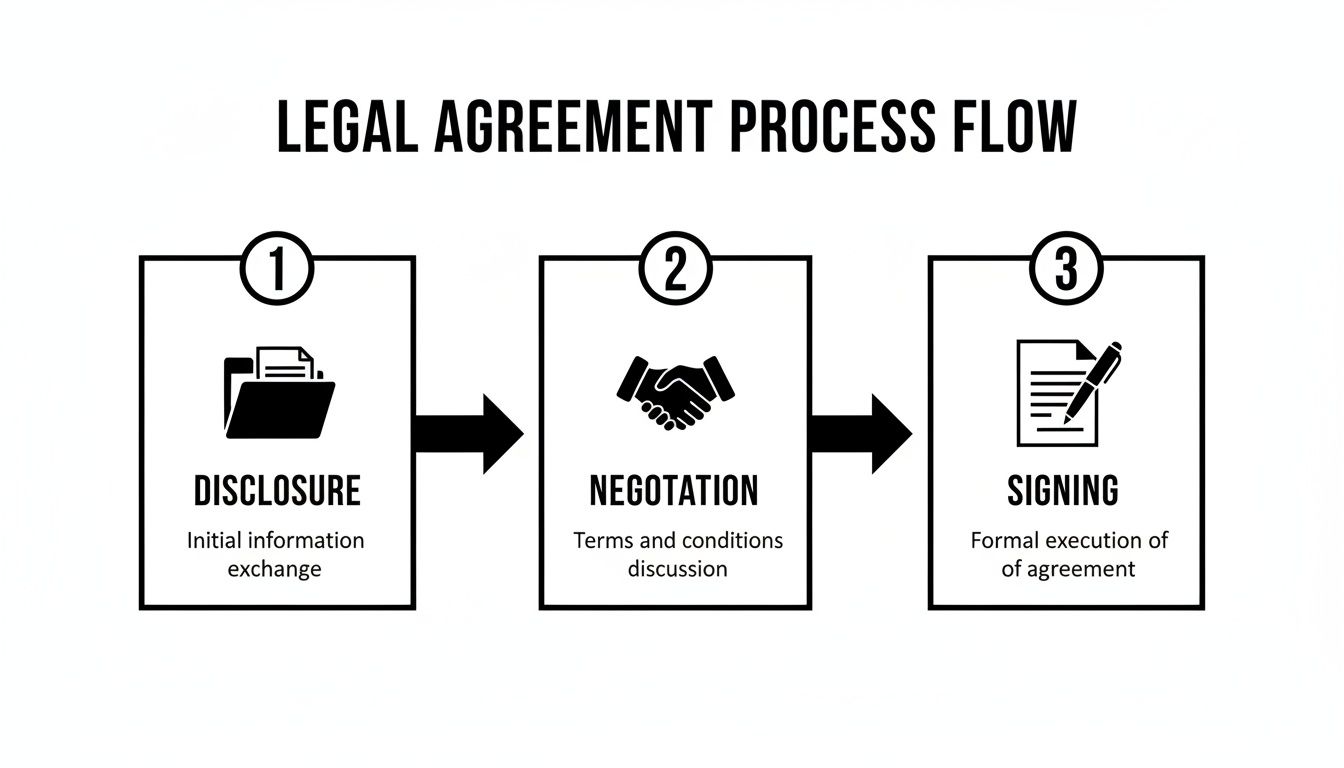
This visual guide drives home a key point: a legally sound agreement is built on a sequence of essential steps. Each stage builds on the last to create a contract that will actually hold up in court.
Hiding Assets or Incomplete Financial Disclosure
The absolute cornerstone of any valid separation agreement is full and honest financial disclosure. This is a non-negotiable requirement under Ontario's Family Law Act. Hiding assets—like a secret investment account or downplaying the value of a business—is the quickest way to have a court set your agreement aside.
Imagine this scenario: Alex and Taylor sign an agreement. Years later, Taylor discovers Alex failed to disclose a significant pension plan. A judge would almost certainly find the agreement fundamentally unfair and could reopen the entire case, forcing a new division of property based on the correct numbers.
The Solution: Be meticulous and transparent. Disclose everything, even assets you believe might be exempt. It is far better to have a frank discussion about an asset now than to have a judge invalidate your entire agreement years down the road.
Signing Under Pressure or Duress
For an agreement to be legally binding, both people must sign it freely and voluntarily. If one person can prove they were pressured, threatened, or coerced into signing, the agreement can be challenged and potentially thrown out. This is known in legal terms as signing under duress.
Duress doesn't have to be a direct physical threat. It can include intense emotional pressure, threats to withhold parenting time with the children, or taking advantage of a partner's vulnerable state after the breakup. A court has to be satisfied that both individuals signed with a clear and willing mind.
Using Vague or Ambiguous Language
A separation agreement is not the place for generalities. Vague phrases are a recipe for disaster, creating confusion that can lead to completely different interpretations down the road.
Think about the difference here:
- Vague: "The parties will share the children's extracurricular costs reasonably." What on earth does "reasonably" mean?
- Clear: "The parties will share the costs of hockey and piano lessons, up to a combined maximum of $2,000 per child per calendar year, with each party contributing in proportion to their respective incomes."
This kind of precision is vital for every single clause, from the parenting schedule to who gets the living room sofa. Every term must be defined so that a total stranger could read it and understand exactly what was agreed upon.
Skipping Independent Legal Advice
One of the most critical, and common, mistakes is failing to get Independent Legal Advice (ILA). While you can technically sign an agreement without it, doing so puts the entire document at risk. A court will be far more likely to uphold an agreement where both parties had their own lawyers review the terms and confirm they understood their rights.
ILA serves as powerful proof that you weren't pressured and that you fully grasped the consequences of what you were signing. Skipping this step to save a bit of money in the short term can lead to massive legal bills later if your ex-partner decides to challenge the agreement. Understanding these dynamics is crucial, especially if you're facing a situation where your spouse won't sign the separation agreement in Ontario.
Your Top Questions About Separation Agreements, Answered
When a relationship ends, the questions can feel endless, especially around the legal paperwork. Your common law separation agreement is the single most important document you’ll create, but the details often seem confusing. Here are some clear, direct answers to the questions we hear most often.
Do We Really Need a Lawyer for This?
Legally, no, you aren't required to hire a lawyer. But in reality? It’s absolutely essential, and here’s why: enforceability. For a court to ever uphold your agreement, a judge needs to be sure that both of you fully understood what you were signing, knew your legal rights, and signed without pressure.
The clearest way to prove this is for each of you to get Independent Legal Advice (ILA) from your own separate lawyers. A family lawyer does more than just fill out a template; they protect your rights, use precise language to cover every issue, and help you sidestep hugely expensive court fights later on. Think of it as a crucial investment in your future security.
How Much Is a Separation Agreement Going to Cost?
There's no single price tag—the cost of a separation agreement depends entirely on the complexity of your situation and how much you and your ex have already agreed on.
If you’ve already managed to sort out the big things—like how property gets divided and who pays for what—the cost will be on the lower end. In that scenario, your legal fees will mostly cover the professional drafting of the document and that critical ILA session. But if you’re at odds over major assets, debts, or support, the cost will naturally go up to cover the time needed for negotiation or mediation.
Pro Tip: Getting organized and having some frank conversations with your ex-partner before you bring in lawyers can really help keep costs down. A transparent family law firm can give you a much clearer cost estimate after an initial consultation once they understand your specific circumstances.
What if My Ex Just Ignores the Agreement?
A properly drafted and signed separation agreement isn’t a suggestion—it’s a legally binding contract. If your former partner doesn’t hold up their end of the deal, like by missing support payments or failing to hand over an asset, you have powerful enforcement options.
The first step is usually to file your agreement with the court. This simple action gives it the same weight and authority as a court order. For support payments, this allows the Family Responsibility Office (FRO) to get involved. The FRO has serious power to collect the money you're owed, including the ability to garnish wages or seize assets. The best way to understand and pursue your options is to talk to a lawyer who can guide you through the enforcement process.
Can We Change the Agreement Down the Road?
Yes, absolutely. A separation agreement isn’t frozen in time. Life happens, and your agreement can be updated to reflect major changes, as long as both of you consent to the new terms.
Any updates must be made in writing in a new legal document, often called an "amending agreement" or a "variation agreement." Just like the original, this document has to be signed and witnessed to be legally valid.
If your life changes dramatically—a serious illness, a long-term job loss—and your ex-partner refuses to agree to an update, you may need to ask a court to vary a specific part of the agreement, like spousal support. It’s critical to get legal advice before you try to change anything to ensure it's done correctly and remains fully enforceable.
At Badesha Law, we know that drafting a common law separation agreement can feel like a huge task. Our experienced team is here to give you clear, step-by-step guidance to protect your rights and help you move forward with confidence. If you have more questions or you’re ready to get started, contact us for a consultation.