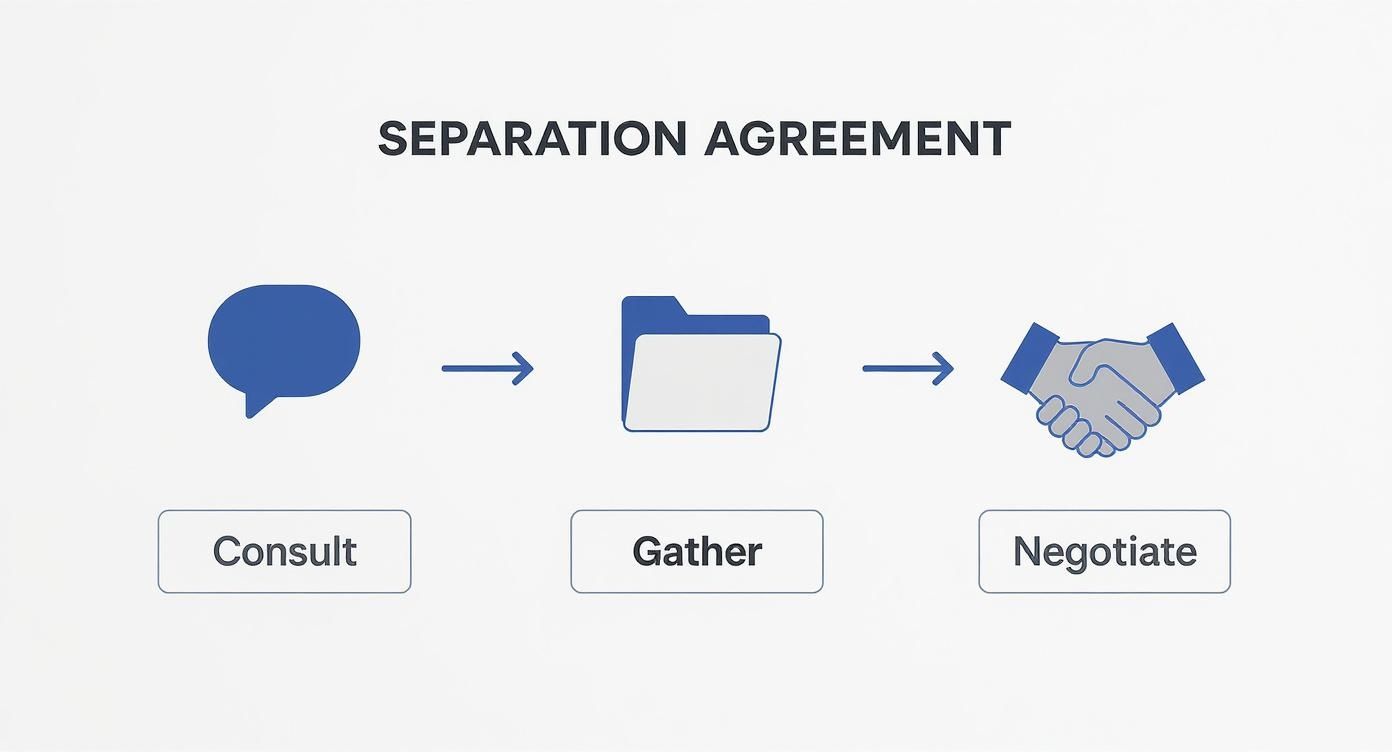
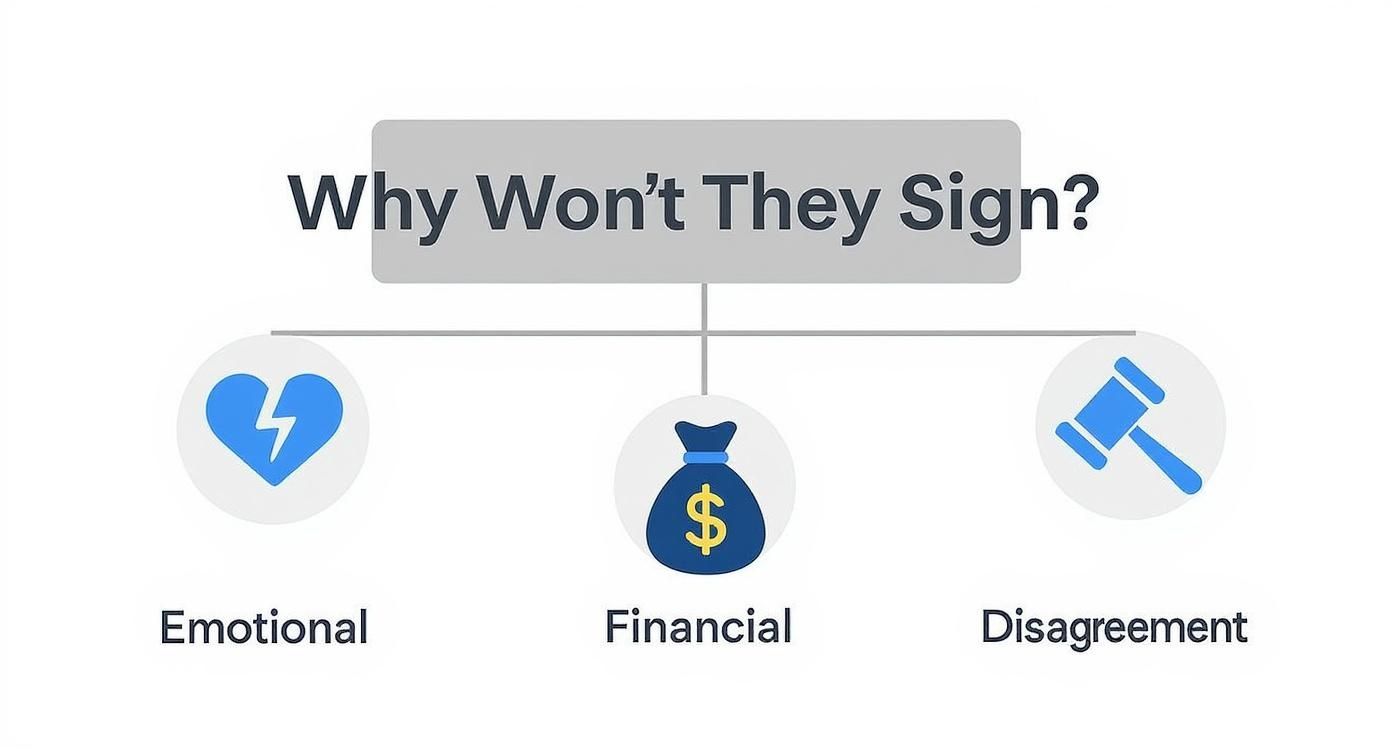
Ontario Family Law: Mediation vs Litigation

You may be reading this late at night, after another tense conversation about the house, the children, or money. One of you wants to “keep it civil.” The other says court is the only way anything will get done. In Ontario family law, that fork in the road matters more than is commonly understood.

The choice between mediation and litigation shapes nearly everything that follows. It affects how much control you keep, how quickly issues get resolved, how much pressure lands on your finances, and whether future co-parenting becomes more workable or more strained. For many separating spouses in Brampton, Mississauga, and across the GTA, the legal terms are familiar but the practical consequences are not.

Ontario law gives families more than one path forward. The right path depends less on what sounds nicer and more on what your facts are. If you need focused help on only part of your case, a limited scope retainer in family law can also be part of a practical strategy.

Table of Contents

The Crossroads of Separation Choosing Your Legal Path

Separation rarely begins in a lawyer's office. It usually starts in a kitchen, a driveway, or over text messages that become shorter and colder over time. Then the practical questions arrive all at once. Who stays in the matrimonial home. What happens with parenting time. How are support and property handled. Who decides if no one agrees.

Under Ontario's legal framework, including the Family Law Act and the federal Divorce Act, those questions can be addressed through negotiated processes or through court. The two paths commonly compared are mediation and litigation. They aren't interchangeable. They ask very different things of you.

What most families are actually deciding

For many people, the question isn't “Which process sounds better?” It's this:

  • Can we still exchange information openly
  • Can we discuss parenting and money without pressure or fear
  • Do we need a judge to make orders because one person won't cooperate
  • Is speed more important, or is enforceability the priority

A family that can still sit in the same room and work through options may be a good fit for mediation. A family dealing with intimidation, hidden finances, or urgent parenting risk usually needs the structure of court.

The best legal path is the one that fits the facts you're living with, not the one that sounds most peaceful in theory.

Ontario law still expects serious efforts to resolve matters

The law doesn't treat court as the first answer in every case. It also doesn't assume mediation is suitable in every case. That balance matters. Family law in Ontario is built around disclosure, fairness, and the best interests of children. Those principles matter whether you settle in a boardroom or appear before a judge.

Understanding Family Mediation in Ontario

Family mediation is a structured settlement process where a neutral third party helps separating spouses identify issues, exchange positions, and work toward an agreement. The mediator does not act as a judge and does not impose a result. The purpose is to help both people reach their own terms on parenting, support, and property.

In Ontario family law, mediation is voluntary. A party can choose to start, pause, or end the process, and a mediator can also stop if the process is no longer appropriate. The Ontario Women's Justice Network explains that family mediation in Ontario is strictly voluntary. That matters because real agreement isn't possible if one person is being pushed through a process that isn't safe or workable.

Why mediation matters under the Divorce Act

The federal government has made out-of-court resolution a serious part of modern family law practice. The Department of Justice states that under the Divorce Act, in force as of March 1, 2021, parties are legally required to attempt family dispute resolution processes if it is appropriate. That includes mediation, negotiation, and collaborative law.

This does not mean every case must go to mediation. It means separating spouses should consider dispute resolution where it is suitable. If there are safety concerns, severe imbalance, or refusal to disclose finances, mediation may not be appropriate.

What the process usually looks like

Most mediations focus on a manageable set of issues:

  1. Parenting arrangements such as decision-making responsibility, parenting time, holiday schedules, and communication rules.
  2. Support questions involving child support and, where applicable, spousal support.
  3. Property issues such as equalisation, debts, the matrimonial home, and treatment of joint accounts.

The practical goal is usually a written settlement framework, often leading to a separation agreement. Before signing, each party should get legal advice. If you want a fuller look at the process, this guide to legal separation mediation in Ontario is a useful starting point.

Practical rule: Mediation works best when both people are willing to disclose, listen, and compromise. It works poorly when one person treats it as a delay tactic.

Understanding Family Law Litigation in Ontario

Litigation is the court-based process for resolving family law disputes when agreement can't be reached or shouldn't be relied on. In this route, the parties don't control the final outcome. A judge does.

Court proceedings in Ontario family law follow the Family Law Rules. Those rules govern how documents are served and filed, when conferences happen, what financial disclosure must be produced, and how motions and trials proceed. The process is formal because the court is being asked to make enforceable decisions that affect parenting, support, and property rights.

What usually happens in a litigated family case

Most family court cases move through a series of steps rather than going straight to trial:

  • Starting the case by filing an Application or Answer that sets out the orders being requested.
  • Financial disclosure so both sides produce the records needed to address support and property issues.
  • Case conferences and settlement conferences where the court reviews the issues and pushes the matter toward resolution.
  • Motions when temporary orders are needed before final resolution.
  • Trial if the issues remain contested and a judge must decide them.

A case conference is often one of the first meaningful court events, and understanding its role can reduce a lot of anxiety. This overview of what a case conference is in Ontario family court explains what parties can expect.

What litigation gives you that mediation does not

Litigation is slower and more demanding, but it provides things mediation cannot always provide:

  • Binding court orders
  • Judicial enforcement tools
  • Compelled procedural steps
  • A decision even when one person refuses to cooperate

That last point is often why litigation becomes necessary. If one spouse won't produce records, won't negotiate, or keeps changing positions, a private process may stall.

The trade-off

Court can protect rights when negotiation has broken down. It can also deepen conflict. Hearings, affidavits, cross-allegations, and rigid deadlines create pressure. That pressure sometimes helps a case move. It also often increases emotional strain, especially where children are already caught in the middle.

Key Differences A Side-by-Side Comparison

When people compare mediation vs litigation, they usually start with cost. That matters, but it isn't the whole story. Control, privacy, pace, and emotional impact often shape the better choice.

Mediation vs Litigation At a Glance

Factor Mediation Litigation
Control over outcome The parties negotiate their own terms A judge makes the final decision if no settlement is reached
Cost Usually lower because the process is narrower and more collaborative Usually higher because of court steps, preparation, and ongoing advocacy
Timeline Often faster and more flexible Often slower because it depends on court scheduling and procedural steps
Privacy Private process Court process is more public
Emotional impact Can reduce hostility where both people participate in good faith More adversarial and often harder on co-parenting relationships

Cost and speed are often the first visible difference

Ontario data on family mediation is stark. According to Ontario divorce mediation guidance, family mediation achieves an 87% success rate, with private mediation costs between $2,500 and $3,500 per couple. The same source states this represents 70% to 80% savings compared to litigation costs that can reach $15,000 to $50,000 per spouse, and that mediation usually finishes in days or weeks, while litigation can take months or years.

In practice, people often feel the difference before they fully understand it. One process asks, “What can both of you live with?” The other asks, “What order should the court impose?”

Control is not a small issue

In mediation, the parties can shape details a court might not have time to craft with the same nuance. Parenting exchanges, holiday schedules, sale timelines for a home, communication protocols, and review dates can all be adjusted with greater precision.

In litigation, flexibility narrows. The court must apply legal principles and manage a busy docket. Judges can and do make practical orders, but the process is constrained by evidence, procedure, and the limits of what either side has formally asked for.

Privacy and emotional wear matter too

Mediation is generally private. That can matter where finances, health concerns, or parenting disagreements are personal in nature. Litigation places those issues into a formal court record and often in a more adversarial format.

This doesn't mean mediation is always gentler. In the wrong case, it can become another place where one spouse dominates the conversation. Suitability matters more than branding.

A Deeper Dive Into Cost and Timelines

A separating couple can agree on the big issues, then still lose months and thousands of dollars to the wrong process. In Ontario family law, cost is rarely just about the final bill. It is about how long two households stay under strain, how long support remains unsettled, and how much conflict the process creates while the case is pending.

A comparison chart showing that mediation is more cost-effective and faster than traditional legal litigation.

Why litigation gets expensive fast

Litigation costs rise because every step has rules, deadlines, and paperwork attached to it. A court case may require an application or answer, sworn financial statements, affidavits, case conference briefs, settlement conference briefs, motion materials, updated disclosure, and trial preparation if settlement does not happen earlier. Clients also pay for lawyer time spent reviewing the other side's materials, preparing responses, attending court, and dealing with adjournments or urgent issues.

That work is sometimes necessary. Under Ontario's Family Law Act and the Divorce Act, support, property, and parenting disputes still have to be decided on proper facts and legal principles. But if the case is headed to court too early, legal fees often go toward procedure before they go toward resolution.

Mediation is usually narrower. The parties still need financial disclosure and legal advice, but they often use their lawyers for targeted help instead of full court representation from start to finish. That difference matters.

The cheaper process is not always the better one

I regularly tell clients not to choose mediation just because the hourly rate looks lower. A low-cost mediation becomes expensive if one spouse is withholding bank records, refusing to discuss support, or using sessions to delay a decision. In those cases, paying for a motion, disclosure order, or temporary support order may save money over the life of the file because it forces the matter into a structure with deadlines and consequences.

Ontario courts also expect parties to consider settlement options where appropriate. The Divorce Act places a duty on legal advisers to discuss dispute resolution with clients unless it would be clearly inappropriate. That does not mean every family should mediate. It means the process should fit the facts.

Ontario options families often overlook

Many families assume the only choices are full private mediation or full litigation. The options are more varied.

Some matters are suitable for private mediation with both parties getting independent legal advice in the background. Some qualify for subsidized or court-connected services. In Brampton, shorter issues may sometimes be addressed through courthouse mediation services if the case is appropriate and both sides are prepared to participate in good faith.

There are also community-based options. Peel Family Mediation Services may assist eligible families in Brampton and Orangeville, which can make early resolution more realistic for people under financial pressure.

If budget is the main concern, compare likely scenarios instead of guessing. This overview of Ontario divorce costs and legal fees gives a more practical starting point than broad averages.

Time affects legal outcomes, not just stress levels

Delay has consequences. A temporary parenting schedule can harden into the status quo. Support arrears can build. A home sale can stall while carrying costs continue. Business records and account statements get older and harder to interpret. The longer a case drifts, the more expensive it often becomes to sort out what should have been addressed early.

Mediation can move quickly if both people are organized, honest, and ready to make decisions. Litigation depends on court dates, judicial availability, disclosure fights, and whether one side brings motions along the way. In Peel Region, families often feel this most sharply when they expected one or two appearances and instead spend many months working through interim issues before a final resolution is even in sight.

Speed matters because family life does not pause while a case is waiting for the next date.

When Litigation Is Unavoidable Red Flags for Mediation

Mediation is often presented as the sensible, mature option. Sometimes it is. Sometimes it is absolutely the wrong process.

A checklist infographic outlining five red flags indicating that litigation may be more appropriate than mediation.

Green flags that support mediation

Mediation is often suitable where both spouses can still behave like problem-solvers even if they are angry or hurt. The strongest signs include:

  • Functional communication so each person can speak, respond, and make proposals without intimidation.
  • Reliable disclosure because support and property discussions are useless if income, assets, or debts are being hidden.
  • A co-parenting focus where the parties want a workable plan rather than a symbolic win.
  • Room for compromise on process, timing, and practical details.

Where those conditions exist, mediation can protect time, money, and a future parenting relationship.

Red flags that usually push the case toward court

Some facts should make you very cautious about mediation:

  • Domestic violence or safety concerns
  • Major power imbalance, especially where one spouse controls money, housing, or access to information
  • Bad-faith participation, such as using mediation to delay support or avoid disclosure
  • Suspected hidden assets or manipulated income
  • Urgency, where a child's safety, access, or immediate financial stability needs a court order now

If the situation is urgent, an emergency motion in family court may be the more appropriate tool.

High-conflict cases are where theory often breaks down

This is the part many online guides skip. Mediation does not automatically preserve relationships. In some high-conflict cases, it produces weak agreements that fall apart quickly.

Recent Ontario data described in a discussion of under-addressed risks reports that in 34% of high-conflict Ontario divorce cases, mediation led to unenforceable agreements or renewed court filings within six months, particularly where one party had greater financial or emotional control. That does not mean mediation fails generally. It means screening matters.

A process is only as fair as the conditions inside it. If one person cannot negotiate freely, the appearance of cooperation can hide a very unfair result.

The legal point many people overlook

Ontario family law still requires full financial disclosure whether you settle or litigate. You do not avoid that obligation by choosing mediation. The Family Law Act framework, together with Ontario family law procedure, depends on informed decision-making. If one party won't disclose, the problem is not solved by changing the room you are sitting in. It usually requires stronger enforcement.

How Badesha Law Helps You Navigate Your Path

The right answer is rarely “always mediate” or “always go to court.” Good family law advice starts with a sharper question. Is this a case that can be resolved safely and fairly through negotiation, or does it need the authority and structure of litigation?

Screenshot from https://badeshalaw.ca

A Brampton family lawyer should be able to help with both. That includes representing clients in contested divorce litigation, but also advising people who are already in mediation and need independent legal advice before signing a separation agreement. That review matters. A negotiated agreement still has to protect your rights, reflect proper disclosure, and fit Ontario family law principles under the Family Law Act and the Divorce Act.

For many families, the most useful legal service is not force. It is clarity. Once the facts are properly assessed, the better path usually becomes much easier to see.

Frequently Asked Questions

What happens if mediation fails

A failed mediation does not automatically hurt your case. Refusing to engage at all can be a different story. A 2023 Canadian study on Ontario family court decision-making found that 38% of Ontario family court judges cited mediation participation or refusal as a factor in final custody decisions, and refusal was linked to lower cooperativeness scores in 29% of contested cases. Courts generally understand the difference between trying mediation in good faith and refusing reasonable dispute resolution without a sound reason.

Is a mediated agreement legally binding

The mediation itself is non-binding. The parties negotiate terms, usually recorded in a separation agreement if settlement is reached. That agreement becomes far stronger once each side receives independent legal advice and the document is properly drafted and signed. In some cases, terms can also be incorporated into a court order for easier enforcement.

Can I still have my own lawyer during mediation

Yes. You should. A mediator is neutral and cannot protect only your interests. Your own lawyer can explain support rights, property implications, parenting clauses, and whether the proposed settlement is one you should sign.

When should I skip mediation and go straight to court

If there are safety concerns, intimidation, hidden assets, refusal to disclose finances, or urgent issues involving children or support, court may be the safer and more effective route. Mediation is a tool, not a moral test. You are allowed to choose the process that protects you and your children.


If you're deciding between mediation and court, Badesha Law can help you assess the facts clearly and choose the right path under Ontario family law. The firm assists clients across Brampton, Mississauga, and the GTA with contested divorce litigation, separation agreements, parenting disputes, support issues, and independent legal advice for mediated settlements. A focused consultation can save time, reduce mistakes, and give you a plan you can act on.

How to Prepare for Divorce: Ontario & GTA Guide

If you're reading this late at night, switching between bank statements, school emails, and search results about divorce, you're probably not looking for theory. You're looking for a way to steady yourself. People in Brampton and across the GTA often reach this point before they've spoken to a lawyer, before they've decided whether the separation will be calm or combative, and before they know what matters legally.

That uncertainty is normal. It also creates risk. People make avoidable mistakes when they act from panic, move money without advice, leave the matrimonial home without understanding the consequences, or rely on verbal promises that never become enforceable terms.

The better approach is preparation. If you want to know how to prepare for divorce, start with the parts you can control. Get your documents together. Build a child-focused routine if you have children. Learn how Ontario treats the matrimonial home, support, and separation agreements under the Family Law Act. Then choose the right path for your situation, whether that's an uncontested resolution or court.

Table of Contents

Your First Step Before the First Step

Before any form is filed, before anyone talks about court dates, take one step back. Ask a simple question: What do I need to protect and clarify right now? For some people, that's access to money for groceries and rent. For others, it's a parenting routine that doesn't throw the children into chaos. For many, it's understanding whether the home, pension, or support situation is going to become a fight.

The first practical step is to stop treating divorce preparation like one giant task. Break it into four separate jobs:

  1. Collect facts about income, property, debt, and family records.
  2. Stabilise parenting if children are involved.
  3. Understand the Ontario rules that will shape outcomes.
  4. Choose a process that matches the level of conflict.

That shift matters. People often think preparing for divorce means preparing for war. Usually, it means preparing for clarity. Clear records reduce arguments. Clear parenting plans reduce confusion. Clear legal advice reduces expensive mistakes.

Practical rule: Don't start by asking, "How do I win?" Start by asking, "What will I need to prove, disclose, and decide?"

In Brampton, Mississauga, and the wider GTA, one of the biggest problems isn't lack of rights. It's lack of organisation. A spouse may have a valid claim, but if their records are scattered across email, paper files, CRA downloads, banking apps, and text messages, the process becomes slower, more stressful, and harder to settle.

If you're overwhelmed, keep your timeline short. Focus on the next seven days, not the next seven months. Make a document list. Save copies. Write down key dates. Note any urgent concerns involving the children, the house, or joint money. That's how people regain control.

Gathering Your Financial and Personal Documents

The fastest way to lose an advantage in a divorce is to show up unprepared. In Ontario, financial disclosure isn't a side issue. It's the backbone of property division, support, and settlement. If your records are incomplete, your case can stall even before the main issues are discussed.

Ontario requires financial disclosure through the Financial Statement (Form 13.1) in cases involving property or support. In Peel Region, 68% of contested divorce cases face delays over 12 months due to disclosure failures, and organising documents within 90 days of starting can reduce court-ordered sanctions by 45%, as discussed in this review of the Ontario Form 13.1 financial statement process.

A checklist infographic listing essential documents to organize when preparing for a legal divorce process.

Start with a full paper trail

Don't wait until someone asks for records. Pull them now and save them in a dedicated folder, both digitally and in hard copy if possible.

Gather these first:

  • Tax records: The last three years of tax returns, Notices of Assessment, T4 slips, and any self-employment income records.
  • Banking documents: Statements for chequing, savings, joint accounts, lines of credit, and credit cards.
  • Property records: Deeds, mortgage statements, property tax bills, appraisal documents, and records of major renovations.
  • Investments and retirement assets: RRSP, TFSA, pension statements, RESPs, and brokerage accounts.
  • Employment and business records: Pay stubs, employment contracts, bonus information, and, if applicable, corporate ledgers and shareholder documents.
  • Insurance and estate documents: Life insurance, benefits booklets, wills, powers of attorney, and beneficiary designations.
  • Children's records: Birth certificates, school records, daycare invoices, and medical insurance information.
  • Digital assets: Records of online payment platforms, cryptocurrency holdings, digital businesses, and important account access details.

How to organise what you collect

A messy box of papers is better than nothing, but it still causes problems. Organise by category and date. Create folders such as Income, Debt, Assets, Property, and Children's Expenses. Name files so another person can understand them quickly, such as "RBC Joint Account Jan 2024" or "Mortgage Statement Date of Separation".

Use one master list to track what's missing. That list should show what you have, what you're waiting for, and where each document came from. If a statement is only available online, download it right away. Access can disappear when passwords change or accounts are closed.

The person with the better records usually negotiates from the stronger position.

This stage isn't about arguing over values yet. It's about preserving evidence. People often think they'll remember balances, dates, and account details later. They usually don't. Good preparation means you won't have to reconstruct years of financial history when emotions are high and deadlines are tight.

Creating a Stable Plan for Your Children

When children are involved, divorce preparation changes immediately. The legal focus in Ontario is the best interests of the child under the Children's Law Reform Act. That sounds broad, but in practice it comes down to something very concrete: who has been doing what for the child, what routine is realistic, and whether the adults can propose a stable plan.

A caring mother reads a bedtime storybook to her young daughter while they sit together on a sofa.

A lot of parents make the mistake of speaking only in general terms. They say they want fairness, shared parenting, or regular contact. Courts and mediators need detail. In the GTA Region, 74% of contested custody cases hinge on the lack of a documented Parenting Log, and parents who pre-file a detailed Proposed Parenting Schedule are 82% more likely to reach a mediated agreement without a judicial hearing, as noted in this overview of Ontario child support laws and related parenting issues.

Build a parenting record before conflict builds

A Parenting Log is one of the most useful preparation tools available. It doesn't need legal language. It needs accuracy.

Track things such as:

  • Daily care: School drop-offs, pick-ups, meals, homework, bedtime, and supervision.
  • Health involvement: Doctor visits, medication management, therapy appointments, and communication with healthcare providers.
  • School participation: Parent-teacher meetings, permission forms, attendance issues, tutoring, and extracurricular coordination.
  • Communication patterns: How the parents exchange information, how often conflict arises, and whether urgent issues are handled reasonably.

Keep the tone factual. Don't use the log to editorialise or insult the other parent. A short entry like "Picked up child from school at 3:25 p.m., attended dental appointment at 5:00 p.m." is useful. A paragraph attacking the other parent usually isn't.

Talk to your child with care and structure

Children need calm, simple explanations. They don't need adult grievances. If you're preparing for separation, decide in advance what you will say and what you will not say.

A useful approach is:

  • Keep the message brief: Tell the child the adults have decided to live separately.
  • Reassure consistently: Make clear that the separation is not the child's fault.
  • Avoid false promises: Don't promise living arrangements or holiday schedules that haven't been decided.
  • Protect the child from the case: Don't ask the child to report on the other parent or carry messages.

A stable parenting plan should also deal with routine details that many parents ignore at first and then fight about later. Think about school mornings, transitions, holiday rotations, birthdays, religious events, extracurriculars, and communication rules. If the plan includes shared decision-making, it should also state how disputes will be handled.

Children cope better when parents reduce uncertainty, not when parents win arguments.

If support is also in issue, keep your expense records. Base child support in Ontario follows the Federal Child Support Guidelines and uses the payer's gross annual income and the number of children. The rules are mechanical. For example, the verified 2024 figures provided for Toronto indicate that $30,000 in income results in $0 base support, while $60,000 results in approximately $337 per month for one child, with additional Section 7 expenses shared proportionally when properly documented.

Understanding Property Division and Support in Ontario

People often assume divorce means splitting everything in half in a rough, common-sense way. Ontario law is more specific than that. The broad framework is the equalization of net family property, but some assets are treated differently, and the matrimonial home is the most common source of surprise.

An infographic titled Ontario Divorce Finances outlining the key concepts of property division and support payments.

Why the matrimonial home surprises people

Under Ontario's Family Law Act, the matrimonial home's value is treated differently from other assets. Its full value is shared 50/50 and cannot be deducted against pre-marriage assets by the person who owned it before the marriage, which is a rule explained in this guide to matrimonial home rights in Ontario.

That matters because many spouses assume title decides everything. It doesn't. Others assume that if they bought the house before the marriage, they can deduct that value the way they might with another asset. In many cases involving the matrimonial home, they can't. The home occupies a special place in Ontario family law.

A realistic preparation checklist for the home includes:

  • Get the ownership documents and confirm whose names appear on title.
  • Pull mortgage statements and any secured line of credit documents.
  • Identify the date of marriage and date of separation because both dates matter in property analysis.
  • Collect valuation evidence if there is disagreement about fair market value.
  • Do not move out or sign anything casually without understanding how possession, value, and settlement strategy may be affected.

Support is about rules first and negotiation second

Spousal support and child support are often discussed together, but they are not the same. Child support is driven by legislative guidelines. Spousal support depends on entitlement, need, means, and the history of the relationship.

If you've been out of the workforce, relocated for your spouse's career, or carried a disproportionate share of child care, support may become a significant issue. If both spouses are financially independent and the marriage was shorter, the analysis can look very different. The point isn't to guess the answer from social media or a friend's experience. The point is to prepare the facts that drive the analysis.

Key distinction: collecting statements tells you what exists. Understanding Ontario property and support rules tells you what those statements mean.

For longer marriages, financial planning becomes even more important. Verified background data notes that divorce among people aged 50 and older has doubled since the 1990s across North America, and the median length of marriages ending in divorce increased from 10 years in 2008 to 12 years in 2023. In practical terms, later-life divorces in the GTA often involve older pensions, long-held homes, and retirement planning that can't be treated casually.

Choosing Your Path Uncontested vs Contested Divorce

Once your information is organised and the main family issues are identified, the next decision is strategic. Are you trying to complete a negotiated divorce, or are you heading into a contested process because key issues can't be resolved?

In Ontario, 75% of divorces are resolved through uncontested agreements. In the GTA, an uncontested divorce averages 4 to 6 months and costs approximately $1,500 to $2,500, while a contested case can take 12 to 18 months and cost $10,000 to $20,000 or more, as described in this practical guide on how to file for divorce in Ontario.

Uncontested vs. Contested Divorce in Ontario at a Glance

Factor Uncontested Divorce (Collaborative Path) Contested Divorce (Court-Involved Path)
Core requirement Both spouses agree on all issues, usually through a separation agreement One or more issues remain disputed
Timeline 4 to 6 months 12 to 18 months
Typical cost $1,500 to $2,500 $10,000 to $20,000 or more
Control over outcome Higher. The spouses shape the terms Lower. A judge may decide unresolved issues
Stress level Usually lower if disclosure is complete and communication is workable Usually higher because of motions, deadlines, and hearings
Best fit Couples who can exchange information and negotiate in good faith Cases involving concealment, high conflict, parenting disputes, or urgent relief

Uncontested doesn't mean casual. It means complete agreement. If even one issue remains unresolved, such as property, parenting time, child support, or spousal support, the matter may move into contested territory.

What makes an agreement legally reliable

A separation agreement only helps if it is valid and enforceable. Under Section 56 of the Family Law Act, an agreement must be signed in the presence of a witness who is not a party and has no financial interest in the outcome. The Act also allows agreements to be set aside in some circumstances, including where a party did not understand the nature or consequences of what they signed.

That is why rushed kitchen-table settlements often fail. People focus on getting something signed, but ignore disclosure, legal advice, or proper drafting. A weak agreement can create more litigation, not less.

If you're deciding between paths, ask yourself:

  • Can both of us exchange full financial disclosure?
  • Can we discuss parenting without using the children to gain an advantage?
  • Is there trust enough to negotiate safely?
  • Do I understand the legal effect of the terms being proposed?

If the answer to those questions is mostly yes, an uncontested route may be sensible. If the answer is no, pretending the case is amicable won't save money for long.

When to Get Legal Help from a Brampton Lawyer

Many people wait too long to get legal advice because they think calling a lawyer means declaring war. It doesn't. Early advice often prevents conflict. It helps you understand the rules before you make moves that are hard to undo.

A professional lawyer consults with a client in an office while reviewing legal documents together.

Call early if any issue is unclear

In Ontario, this isn't just about convenience. Under Section 56(4) of the Family Law Act, a separation agreement can be set aside if a party signs it without understanding its consequences or without proper legal disclosure. That's one reason a step-by-step divorce lawyer guide for Ontario is often useful even for people who hope to settle.

You should seek advice early if any of these apply:

  • The home is in dispute
  • One spouse controls the finances
  • A business, corporation, or pension is involved
  • There are children and no stable schedule yet
  • You were presented with an agreement to sign quickly
  • A foreign divorce may need recognition for remarriage or immigration purposes in Ontario

What a first consultation should do

A good first meeting should reduce confusion, not increase it. You should leave knowing the likely legal issues, what documents still need to be gathered, whether your matter looks uncontested or contested, and what immediate risks need attention.

You should also get a plain-language explanation of trade-offs. For example, settling quickly may reduce cost, but not if the proposed terms ignore the matrimonial home rule, support obligations, or proper disclosure. On the other hand, fighting every issue on principle can damage children, drain savings, and delay closure.

A lawyer's job isn't only to argue. It's to filter noise, identify risk, and turn a stressful situation into a sequence of manageable decisions.

Common Pitfalls to Avoid During Your Preparation

Some divorce mistakes are expensive. Others are avoidable and still end up shaping the whole case.

Watch for these problems:

  • Hiding or moving assets: This usually backfires. Missing disclosure damages credibility and can derail settlement.
  • Using children as messengers: It harms the child and weakens your position in any parenting dispute.
  • Making verbal side deals: If it isn't properly documented and enforceable, it may not protect you.
  • Leaving the matrimonial home without advice: Sometimes it's the right decision. Sometimes it creates complications you didn't anticipate.
  • Signing an agreement you don't fully understand: A rushed signature can trigger bigger legal problems later.
  • Ignoring overseas divorce issues: Newcomers sometimes discover too late that an overseas divorce needs proper validation in Ontario before remarriage or related legal steps.
  • Forgetting related updates: Wills, beneficiary designations, insurance instructions, and emergency contacts often need review after separation.

If you remember one thing, make it this: preparation isn't about escalating conflict. It's about reducing uncertainty. People who prepare carefully usually make better decisions, negotiate from firmer ground, and protect their children more effectively.


If you're separating in Brampton, Mississauga, Toronto, or elsewhere in the GTA, Badesha Law helps clients move through divorce with clear advice, careful drafting, and practical next steps. Whether you need help with an uncontested divorce, a contested family court matter, a separation agreement, parenting issues, support, property division, or a foreign divorce opinion letter, the firm offers compassionate guidance rooted in Ontario family law.

How to File for Divorce Ontario: How to File for Divorce

When people search how to file for divorce ontario, they’re usually not looking for theory. They’re trying to move a difficult situation forward without making a costly mistake. In Brampton, Mississauga, Toronto, and across the GTA, that usually means juggling court forms, practical deadlines, parenting concerns, living arrangements, and the stress of not knowing what happens next.

The good news is that the Ontario divorce process is manageable when you break it into the right decisions. The hard part is that many delays come from small administrative errors, not major legal disputes. A missing marriage certificate, an affidavit signed improperly, or service done the wrong way can stall a file that should have been straightforward.

Some divorces are mostly paperwork. Others become disputes about parenting, support, or property. The path you’re on matters from the start, because it affects what you file, how long the process takes, and where legal help becomes worth it. If you want a broader overview first, this guide to the divorce process in Ontario is a useful companion.

Starting the Ontario Divorce Process

The first practical step is to separate the emotional decision from the court process. Wanting a divorce and being ready to file are related, but they aren’t always the same thing. Before you prepare forms, you need to know whether Ontario has jurisdiction, whether you meet the legal ground for divorce, and whether the rest of your family issues are already resolved.

For many people in Peel Region, the process becomes easier once they stop treating it as one giant problem. It’s really a series of smaller questions. Can you file in Ontario? Is this a simple divorce or a contested one? Do you have the right documents? Can your spouse be served properly? Have parenting, child support, spousal support, and property issues been dealt with?

Practical rule: A divorce order ends the marriage. It doesn’t automatically fix everything else that broke down around the marriage.

That distinction matters. If you and your spouse already agree on the important terms, the filing side may be relatively direct. If you still disagree about children, support, or assets, the divorce paperwork is only one part of a larger family law matter.

Confirming Your Eligibility to File for Divorce

A common Brampton problem looks like this: one spouse has moved out, the other is asking whether they can “file now,” and nobody is sure whether the court will accept the application. Before you spend time on forms or filing fees, confirm two things. Ontario must have jurisdiction, and you must meet a legal ground for divorce.

A person reviews a divorce eligibility checklist document on a wooden table with the flag of Ontario nearby.

The ground for divorce

Under the Divorce Act, the court grants a divorce only if there has been a breakdown of the marriage. In day-to-day Ontario practice, that usually means one year of separation. Adultery and cruelty are also legal grounds, but they often create more proof issues, more conflict, and little practical advantage for someone who can rely on separation instead.

You do not always have to wait until the full year has passed before preparing the paperwork. But the court cannot finalize the divorce until the one-year separation period is complete. That timing point is explained in this Ontario filing guide from GTA Divorce.

Separation also causes confusion when spouses still live under the same roof, which happens often in Peel because housing costs are high. You can be separated while living in the same home if the relationship has ended and you are functioning separately in the ways that matter. If you are unsure whether your separation date is clear enough for court forms, this article on the difference between legal separation and divorce explains the distinction.

The residency rule

Ontario can process your divorce only if at least one spouse has been ordinarily resident in Ontario for at least 12 consecutive months immediately before the application is issued. That rule comes from the Divorce Act.

“Ordinarily resident” means Ontario is the person’s regular home. Short trips outside the province usually do not cause a problem. A recent move to Brampton or Mississauga can cause one. I often see delay start here, especially where one spouse has immigration paperwork, works outside Canada for stretches, or married abroad and assumes Ontario can deal with the divorce immediately.

If residency is uncertain, check it before filing. A rejected application costs time, and in some cases you lose filing fees and have to start again with corrected material.

A practical eligibility check

A file is usually ready to proceed when these points are true:

  • There is a valid legal basis for divorce. In most cases, that is one year of separation, even if the paperwork is started earlier.
  • Ontario has jurisdiction. One spouse has lived here ordinarily for the required 12 months before the application is issued.
  • You can prove the marriage. The court will expect a marriage certificate or other acceptable proof, and extra steps may be needed if the certificate is from outside Canada or not in English.
  • Your facts are clear enough for court forms. Unclear separation dates, disputed addresses, or missing marriage documents are common administrative problems that slow GTA divorce files.

Filing before these basics are confirmed usually creates a practical problem, not a strategic advantage. The court may reject the material, request corrections, or leave the file stalled until the missing piece is fixed.

Choosing Your Path Contested vs Uncontested Divorce

The biggest practical decision isn’t the form. It’s the level of agreement between you and your spouse. That determines whether your file is likely to move through a simple paper process or into a more involved family court matter.

A comparison infographic showing the key differences between contested and uncontested divorce processes for legal guidance.

What uncontested really means

An uncontested divorce works best when there’s no dispute over the divorce itself and no unresolved fight over parenting, support, or property. In the cleanest version of this process, one spouse files a sole application and the other spouse doesn’t oppose it, or both spouses file together in a joint application.

People often confuse “we’re being civil” with “we have an uncontested divorce.” They’re not the same. You can be polite and still have a contested matter if you disagree about child support, the matrimonial home, or decision-making for the children.

For a closer breakdown of that distinction, this article on contested vs uncontested divorce is worth reading.

What makes a divorce contested

A contested divorce means there’s a live dispute that the parties haven’t resolved. Sometimes that dispute is about the divorce itself. More often, it’s about the related family law issues. Once that happens, the court process becomes more procedural and more demanding. You may be dealing with case conferences, financial disclosure, motions, and, in some cases, a trial track.

That doesn’t mean every disagreement leads to a final hearing. Many contested files still settle. But the preparation is different from day one.

Uncontested vs. Contested Divorce in Ontario

Factor Uncontested Divorce (Simple Divorce) Contested Divorce
Agreement level Both spouses agree, or one spouse doesn’t oppose the divorce Spouses disagree on one or more major issues
Filing style Often sole simple application or joint application Usually broader family court pleadings and ongoing procedural steps
Court involvement Primarily document review if the paperwork is complete Active court management may be needed
Stress level Usually lower if the settlement is already done Often higher because issues remain unresolved
Common issues Administrative accuracy, service, document completeness Parenting disputes, support disputes, property division, disclosure problems
Best use Ending the marriage formally after issues are settled Resolving legal disputes before or alongside the divorce

Sole application or joint application

People also need to choose how the file starts.

  • Joint application: Both spouses file together. This is often the cleanest option when everything is settled and both people are willing to sign.
  • Sole application: One spouse starts the divorce. This can still be uncontested if the other spouse doesn’t oppose it.
  • Contested application: One spouse starts the case and the other responds because there’s disagreement over important terms.

Here’s the trade-off. A joint divorce tends to reduce friction because there’s no issue of one spouse “serving” the other in the usual way. A sole application can still work well, but only if service is done correctly and the responding spouse doesn’t escalate the matter.

The fastest-looking path isn’t always the best path. If the paperwork says “simple divorce” but the relationship still has unresolved financial or parenting conflict, the file usually stops being simple very quickly.

How to decide honestly

Ask yourself these questions:

  1. Do we agree on all major issues already?
    If not, don’t assume the divorce filing will force a settlement.

  2. Do we have a written separation agreement?
    If yes, your path may be much smoother.

  3. Will my spouse cooperate with signatures and service?
    If the answer is uncertain, plan for a sole application and possible service issues.

  4. Are there children, support issues, or property claims still in dispute?
    If yes, you may need legal advice before treating this as a simple filing exercise.

Gathering Your Essential Divorce Documents

Most delays begin before the file even reaches a judge. They start when the applicant doesn’t have the right documents, doesn’t understand what a form is for, or files incomplete materials. If you’re trying to handle how to file for divorce ontario without unnecessary delay, document control matters more than often realized.

The core documents for a simple divorce

Ontario simple divorce filings commonly involve these documents:

  • Form 8A Application for Divorce: This is the main court form used to ask for a divorce.
  • Form 36 Affidavit for Divorce: This confirms the factual basis for the divorce and supports the request for a divorce order.
  • Registration of Divorce Proceedings: This federal registration helps prevent duplicate divorce proceedings.
  • Original marriage certificate: The court expects proof of the marriage.
  • Table of Contents for the Continuing Record: In the simple-application track, court materials need to be organised properly in the continuing record.

The practical point is that each form does a different job. One starts the case. Another proves the legal basis. Another handles federal registration. Another confirms the marriage itself. When people treat the package as “just paperwork,” that’s when missing items slip through.

The marriage certificate issue

The original marriage certificate is one of the most common problem areas. If it’s missing, damaged, or issued in another country, don’t leave that issue to the last minute. A foreign marriage document may still be usable, but the court file needs proper proof of marriage and sometimes supporting explanation.

This is also where people sometimes discover a separate legal issue. If there was a prior divorce outside Canada, Ontario may require additional legal analysis before a new marriage or new divorce matter can proceed properly.

A file can be legally straightforward and still get delayed because the documents don’t prove the basics cleanly.

If support is in dispute, your paperwork changes

A simple divorce is narrow. Once child support, spousal support, or property claims are part of the court case, the document list grows and the work becomes more technical. Financial disclosure may become necessary, and that’s where forms such as a Form 13.1 financial statement become relevant.

That’s why it’s important to identify your path early. People often gather the wrong documents because they think they’re filing only for divorce, when in reality they’re starting a broader family law proceeding.

Court fees and fee waiver options

Cost matters. For many filers, the total court fees are approximately $632, and that can be a real barrier. Legal Aid Ontario notes that if you can’t afford the fee, you can ask the court to waive it by submitting a Fee Waiver Request form, and eligibility is based on a means test, as described in Legal Aid Ontario’s page on simple divorce and fee waiver information.

If cost is tight, deal with that issue before filing rather than after the clerk asks for payment. Fee waiver requests can be worth exploring, but the supporting documents and timing can vary in practice.

The Filing and Serving Process Explained

A Brampton client can have every form signed, the marriage certificate ready, and the court fee paid, then still lose weeks because the application was issued but never served properly. That is a common GTA problem. The court process has two separate steps, and each one has to be done correctly.

A pair of hands holding legal documents from the Ontario Superior Court inside a manila file folder.

Filing the application with the court

Divorce applications in Ontario go to the Superior Court of Justice. For many sole uncontested divorces, the court will issue the application if the forms are complete, the filing fee is paid or waived, and the supporting documents match what the rules require.

The practical problem is not usually the act of filing. It is filing a package the court staff can process without sending it back. Missing dates, inconsistent names, an unclear address for service, or a marriage certificate that does not match the application can all slow the file down. In Peel Region, those small errors often matter more than people expect because they create another round of corrections, re-sworn forms, and delay.

A clean filing also depends on the kind of divorce case you are starting. If support is still in dispute, or if parenting terms are not settled, the court process may require more than a simple divorce application. Anyone dealing with children should understand how Ontario courts assess child support obligations under Ontario law before assuming the file will stay simple.

What happens after filing

Once the court issues the application, you have an active court file. In a sole application, the next job is service. The court does not usually serve your spouse for you, and the applicant cannot ignore that step because the file number has been assigned.

Joint divorces are different. If both spouses sign and file together, service is usually not the issue it is in a sole application. In sole files, service is often the first real obstacle.

Service is often where self-represented files stall

Under the Family Law Rules, the applicant usually cannot serve the divorce application personally. Another adult has to do it, and the person who served the documents must complete proof of service. If that proof is missing or inaccurate, the court can refuse to move the file forward.

That creates real problems in the GTA. A spouse may have moved from Brampton to another city, may be staying with relatives, or may be avoiding contact altogether. Sometimes there are safety concerns, especially where there has been family violence. In those cases, proper service is no longer an administrative detail. It becomes a strategy issue.

Ontario courts can permit another method of service when ordinary service is not working, but you do not get to choose that on your own. A judge must authorize substituted service or another form of service if the rules require it, as discussed in this guide to an uncontested divorce in Ontario and service challenges.

Service problems usually start as practical obstacles. You need a reliable address, a lawful method, and proof the documents reached the right person.

What usually helps

  • Use a reliable server. A friend can sometimes do it, but a professional process server is often the better choice if the spouse is evasive, lives outside Peel, or there are safety concerns.
  • Give the server accurate information. A full name, current address, work location, photo, and vehicle details can save several failed attempts.
  • Get the affidavit of service done promptly. Service without proper proof often creates the same delay as no service at all.
  • Address foreign or out-of-province service early. If your spouse is outside Ontario or outside Canada, the timing and method can change, and mistakes there are expensive to fix.
  • Ask for help when the facts are messy. Badesha Law handles filing and service logistics for clients who do not want to manage those court steps themselves.

What causes avoidable delay

  • Serving the documents yourself in a sole application.
  • Mailing materials without authority when personal service is required.
  • Using an old address because it is the only one you have.
  • Waiting too long to deal with an evasive spouse instead of bringing a motion for another service method if the facts support it.

For GTA residents, this is the stage where local experience often saves time. I often see straightforward divorces become expensive because someone guessed at service, filed the wrong proof, or waited until a deadline had already passed before asking how to fix it.

Resolving Parenting Support and Property Division

Many people think the divorce application is where everything gets sorted out. In reality, the divorce order mainly ends the marriage itself. The family issues that matter day to day usually need their own resolution, whether by agreement, negotiation, or litigation.

Divorce doesn’t replace a settlement

If you have children, shared property, support obligations, or a dispute about the home, those issues generally need to be resolved separately from the basic request for a divorce. In an uncontested situation, that often means the spouses already have a separation agreement in place before the divorce materials go in.

That order of operations matters. A simple divorce moves best when the substantive disputes are already settled. If they aren’t, the court file can become more complex very quickly.

Parenting issues come first in real life

For parents, the urgent questions are usually practical. Where will the children live? How will parenting time work? Who makes major decisions? What happens on holidays, school breaks, or during transitions between homes?

The law now uses terms like parenting time and decision-making responsibility, but the practical concern is the same. Children need a stable plan. If child support is also in play, the financial side should be addressed at the same time. This overview of child support laws in Ontario is a helpful starting point if support hasn’t been worked out yet.

The main issues that need to be settled

When spouses say they want an uncontested divorce, these are the subjects that usually have to be clear first:

  • Parenting arrangements: A schedule, decision-making structure, and a realistic routine for the children.
  • Child support: Proper support based on the applicable legal framework.
  • Spousal support: Whether it’s payable, in what amount, and for how long.
  • Property division: Who keeps what, whether equalisation is owed, and what happens with the matrimonial home.
  • Debts and practical clean-up: Joint accounts, lines of credit, household contents, insurance, and beneficiary designations.

Why the matrimonial home causes so much conflict

The home often carries both financial and emotional weight. One spouse may want to keep it. The other may want it sold. Sometimes both are focused on affordability, not ownership. Sometimes the underlying conflict is about where the children will live and whether a move is possible.

That’s why property discussions can’t be left vague. A divorce order doesn’t automatically transfer title, remove a spouse from a mortgage, or settle equalisation rights. Those details need to be negotiated and documented properly.

A clean divorce file is usually the result of earlier legal work, not a shortcut around it.

When settlement is possible

Settlement works best when both spouses have exchanged the information needed to make informed decisions. That usually includes financial disclosure, practical proposals, and a willingness to document terms clearly. Informal verbal understandings often collapse later because each person remembers them differently.

If your issues are modest and both sides are cooperative, a separation agreement can keep the actual divorce filing relatively narrow. If the issues are significant or trust is low, legal advice before signing anything is the safer course.

Common Pitfalls and When to Call a Lawyer

A Brampton spouse files the paperwork, pays the fee, and expects the divorce to move ahead. A few weeks later, the court sends the materials back because the marriage certificate is missing, the affidavit was not commissioned properly, or service does not meet the Family Law Rules. That kind of delay is common in Peel and across the GTA. It usually starts with procedure, not a fight in court.

The practical problem is simple. Ontario divorce forms are manageable, but the court expects accuracy. If dates do not match, documents are incomplete, or service was done the wrong way, the file can stall for weeks or months.

Errors that routinely slow divorce files

Certain mistakes show up again and again:

  • Inconsistent separation dates: If the date in the application does not match the affidavit or other materials, the court may question whether the ground for divorce has been proven.
  • Affidavit defects: Form 36 must be sworn or affirmed properly before a commissioner for taking affidavits. If that step is done incorrectly, the court can reject it.
  • Missing marriage document: An original marriage certificate, or the proper replacement or explanation, is often required. This is a frequent administrative problem.
  • Incomplete filing package: One missing form, endorsement, or supporting document can stop the file from being issued or reviewed.
  • Improper service: A spouse usually cannot serve their own divorce application. If service is not done according to the rules, the next steps may be invalid.
  • Using the wrong divorce stream: A simple divorce is only for the divorce itself. If parenting, support, or property issues are still disputed, the paperwork needs to match that reality.

Court staff can identify a missing document. They cannot advise on strategy, disputed facts, or how to fix a file that was started on the wrong track.

Local pitfalls GTA clients run into

In Brampton and Mississauga files, I often see delays tied to small administrative points that look minor until the clerk reviews the package. Names on the marriage certificate do not exactly match current ID. A party was married outside Canada and does not know what document the Ontario court will accept. Someone tries to use email service without the other side consenting or without a court order permitting it. These are fixable problems, but they are easier to fix before filing than after rejection.

Cost is another place people make avoidable mistakes. The court filing fees for a divorce are usually paid in stages, not all at once, and rejected materials can mean lost time, extra commissioning, extra process server fees, or another attendance at the courthouse. For GTA clients balancing work, childcare, and court deadlines, that practical cost matters as much as the legal fee.

When calling a lawyer makes practical sense

Some files are realistic do-it-yourself matters. Others deserve legal help early because the risk of delay or a bad outcome is much higher.

Consider speaking to a lawyer if:

  1. Children are involved and parenting is not fully settled
    Parenting terms need to be clear, workable, and focused on the child’s best interests. Vague arrangements often create fresh conflict after the divorce is granted.

  2. Support is disputed or uncertain
    Child support and spousal support affect monthly cash flow, tax planning, and enforcement risk. A rushed position can be expensive to correct later.

  3. Property issues are still live
    If there is a house, pension, business interest, significant debt, or disagreement about equalization, the divorce itself is only one part of the file.

  4. Your spouse is in another province or another country
    Service, jurisdiction, and timing become more technical quickly. This is especially true where a spouse is avoiding service or where court materials need to cross borders.

  5. A foreign divorce is part of the history
    Ontario courts, immigration authorities, and remarriage planning sometimes require a foreign divorce opinion letter or other proof that the overseas divorce should be recognized here.

  6. There are safety concerns or coercive control
    Service arrangements, communication, and court attendance should be planned carefully. These are not routine filing details.

What a lawyer should actually help with

Good legal help is not limited to appearing in court. In many GTA divorce files, its primary value is earlier and more practical. That includes checking whether the case is genuinely uncontested, confirming the right forms are being used, arranging valid service, spotting issues tied to foreign marriage documents, and making sure the divorce order will fit with the larger family law picture.

For clients in Peel, local experience can also save time. Each courthouse has its own filing habits, clerk expectations, and recurring document problems. That does not change the law, but it does affect how smoothly a file moves through the system.

If you’re trying to move ahead with a divorce in Brampton, Mississauga, Toronto, or elsewhere in the GTA, Badesha Law assists with sole and joint uncontested divorces, contested family court matters, separation agreements, parenting and support issues, property division, and foreign divorce opinion letters. Early advice often prevents the kind of filing mistake that is inexpensive to avoid and frustrating to repair.

A Guide to Common Law Separation Agreements in Ontario

A common law separation agreement is a legally binding contract that spells out exactly how an unmarried couple in Ontario will handle everything when their relationship ends. It’s a critical tool for partners who have built a life together but aren't legally married, offering clear protection where the law doesn’t provide automatic rights for property division.

What a Common Law Separation Agreement Really Means

A couple discussing a separation agreement with house keys and a miniature house on a table.

When an unmarried couple separates, many people believe their rights are the same as a married couple's. This is a widespread—and incredibly costly—myth. In Ontario, the Family Law Act treats common law partners very differently, especially when it comes to property.

Think of a common law separation agreement not as a sign of failure, but as a practical ‘partnership dissolution plan.’ It's a clear, mutually agreed-upon roadmap that guides you and your former partner through the complex process of untangling your lives. A well-drafted agreement lets you make your own decisions about your future, rather than leaving them in the hands of a judge.

Defining Your Relationship and Your Rights

Under Ontario's Family Law Act, you’re considered common law spouses if you have lived together in a conjugal relationship for at least three years, or if you have a child together and have been in a relationship of "some permanence." While hitting this milestone is significant, it absolutely does not grant you the automatic property rights that married couples have.

The reality is that common law separations are happening more and more often. Back in 2017, 8% of Canadians aged 25 to 64 were separated from common-law relationships. For these couples in Ontario, there is no automatic right to an equal share of the property you built up together, and that includes the family home. While you might be able to claim spousal support, getting a share of assets requires complex legal arguments. This makes a separation agreement an essential tool for protecting your financial future. You can discover more insights about this demographic shift on StatCan.

The Protections Offered by an Agreement

A properly drafted common law separation agreement gives you a structured framework for resolving all the key issues, preventing misunderstandings and future conflict. Without one, you’re risking a long, expensive, and stressful court battle.

A strong agreement brings clarity to:

  • Property Division: How will assets like real estate, vehicles, investments, and even furniture be divided?
  • Debt Responsibility: Who is on the hook for paying off joint debts like credit cards, loans, or the mortgage?
  • Spousal Support: Will one partner provide financial support to the other? If so, for how long, and how much?
  • Parenting Arrangements: This covers the details of parenting time (what used to be called custody) and who makes the major decisions for any children.
  • Child Support: What are the financial obligations for supporting your children, calculated based on provincial guidelines?

By tackling these issues head-on, the agreement becomes your most vital tool for achieving financial security and personal closure. If you're looking for more information on the legal definitions of your relationship, you can learn more about the statutory declaration of a common law union in our detailed guide.

How Common Law Separation Differs from Divorce

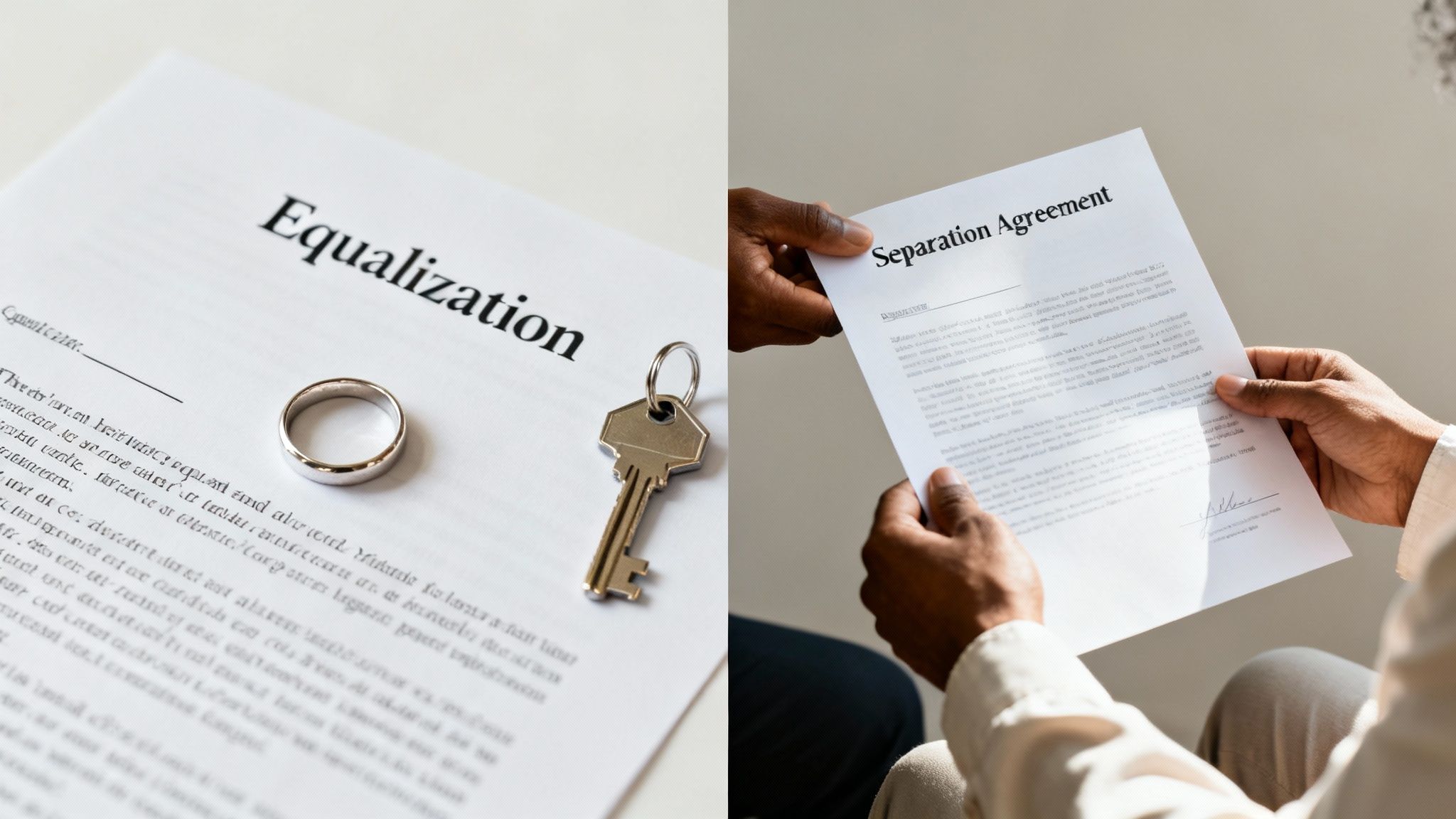
Hands holding a separation agreement and a document about equalization with a wedding ring and house key.

It’s one of the most common and dangerous assumptions in Ontario family law: that separating from a common law partner is basically the same as getting a divorce. This misunderstanding isn’t just a small legal detail; it can lead to devastating financial outcomes.

While both scenarios mark the end of a significant relationship, the legal rules that apply are worlds apart. The difference is especially stark in three key areas: how you divide property, your rights to spousal support, and what happens to the family home.

Knowing these differences is crucial for protecting yourself. A common law separation agreement becomes an essential tool precisely because the law doesn't grant you the same automatic protections that married couples have.

The Great Divide in Property Division

The single biggest difference between a divorce and a common law separation is how you split your assets. For married couples, Ontario's Family Law Act gives them a powerful right called the equalization of net family property. In simple terms, this means the wealth built up during the marriage is split right down the middle, no matter whose name is on the title.

Common law partners have no automatic right to equalization. Zero. This means if you separate, you are not legally entitled to half of the assets your partner accumulated while you were together, even if you were a team for decades.

If you want a share of property that isn't in your name, you have to launch a complex and expensive legal claim for unjust enrichment. This means proving that your contributions—whether financial or through homemaking and child-rearing—made your partner richer and that you suffered a loss as a result. These claims are difficult, time-consuming, and offer no guarantees.

Key Takeaway: For married spouses, property division is a right. For common law partners, it's often a fight. A separation agreement lets you skip the fight entirely by setting your own fair rules for dividing your assets.

Spousal Support: A Different Path

While the property rules are black and white, the rules around spousal support are a bit more similar. Both married and common law partners can claim spousal support under the Family Law Act. The goal is the same: to address any economic imbalance caused by the relationship or its breakdown.

But the road to getting that support can still be tougher for common law partners. First, you have to prove you even qualify as a "spouse" under the Act—by living together for at least three years or having a child together. Even if you qualify, the amount and duration of support can be harder to settle without the clear start and end dates of a marriage.

An agreement cuts through all this uncertainty. You can clearly define if support will be paid, exactly how much, and for how long.

Rights to the Family Home

For married couples, the "matrimonial home" has a special, protected status. Both spouses have an equal right to stay in the home after separating, even if only one person's name is on the title. This stops one spouse from being kicked out or locked out.

Common law partners get no such protection. If the family home is only in your ex-partner's name, you have no automatic right to live there after you break up. You could be asked to leave immediately, creating a massive crisis for you and any children involved.

This is another huge reason why a separation agreement is so critical. It allows you to decide what happens to the home—whether one partner buys the other out, you agree to sell it and split the money, or make other arrangements.

For a deeper dive into the distinctions, you might be interested in our guide on the difference between legal separation and divorce.

To make these differences crystal clear, here’s a side-by-side comparison:

Married vs Common Law Separation Rights in Ontario

Legal Area Married Spouses Common Law Partners
Property Division Automatic right to equalize (split) the value of property gained during the marriage. No automatic right to share in property. Must make a claim like "unjust enrichment" to get a share of assets not in your name.
The Family Home Both have an equal right to live in the "matrimonial home" after separation, regardless of whose name is on the title. No right to stay in the home if it's not in your name. You can be asked to leave immediately.
Spousal Support Can claim spousal support. The marriage itself establishes the relationship. Can claim spousal support, but must first prove you meet the definition of a "spouse" (cohabited for 3+ years or have a child).
Inheritance Rights If a spouse dies without a will, the surviving spouse automatically inherits a significant portion of the estate. No automatic inheritance rights. If your partner dies without a will, you get nothing under succession law.

This table shows just how vulnerable common law partners can be without a legal agreement in place. Relying on the default laws can leave you with very little, making a separation agreement an absolutely essential tool for securing a fair outcome.

Core Components of a Strong Separation Agreement

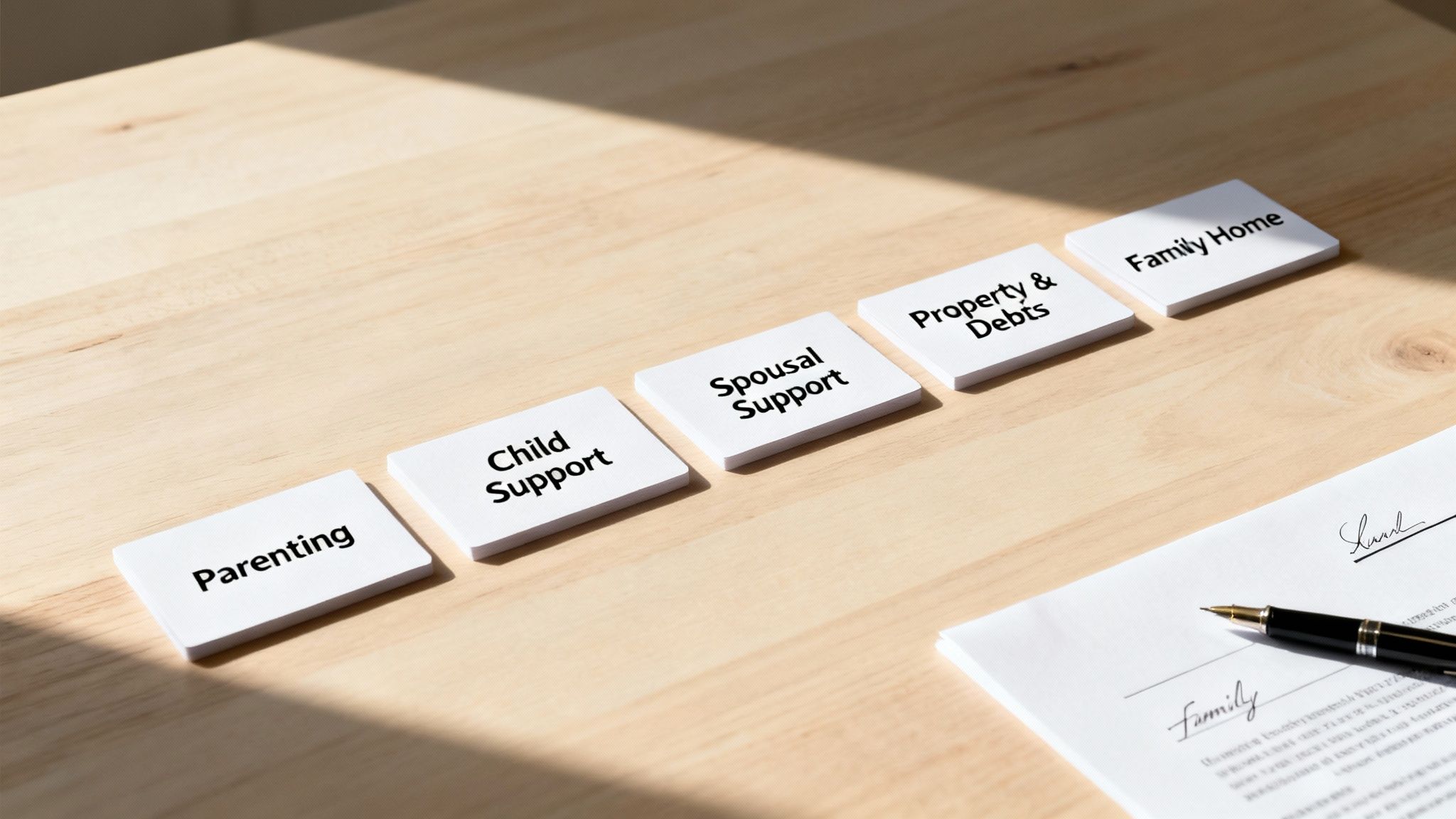
White cards with family law terms like 'Parenting', 'Child Support', 'Spousal Support' on a table, next to a signed agreement.

A good common law separation agreement is more than just a piece of paper; it’s the blueprint for the next chapter of your life. To be worth anything, it has to be detailed, clear, and legally solid, covering every critical area of the life you once shared. Think of it like a detailed instruction manual for dismantling something complex—miss a single step, and things can fall apart later.

A vague or incomplete agreement is a recipe for future conflict. By methodically working through each core element, you create a clear, enforceable contract that locks in your decisions and provides much-needed stability for everyone involved, especially your children. Let’s break down the essential building blocks.

Parenting Time and Decision-Making Responsibility

When children are part of the equation, their well-being is the number one priority. Your agreement needs to create a stable, predictable, and consistent environment for them. This section isn't just about stating who the kids live with; it’s about mapping out the entire co-parenting relationship.

This means establishing a crystal-clear parenting time schedule. This schedule should detail the regular week-to-week routine, but also cover holidays, summer vacations, birthdays, and PA days. The more detail you include, the less room there is for arguments down the road.

The agreement must also spell out decision-making responsibility (what used to be called legal custody). This defines who gets the final say on the big-picture decisions in a child’s life, such as:

  • Healthcare: Who consents to medical or dental treatments?
  • Education: Where will the child go to school?
  • Religion: How will religious and cultural upbringing be handled?
  • Major extracurriculars: Who decides if a child joins a competitive sports team or another significant commitment?

You can agree to make these decisions together, or you can assign the final say on certain issues to one parent.

Child Support Obligations

In Ontario, child support is the legal right of the child, period. It’s not a bargaining chip. The amount is set by the mandatory federal Child Support Guidelines, which calculate payments based on the paying parent's income and the number of children.

Your separation agreement must state the exact monthly child support amount. It also needs a plan for handling "special or extraordinary expenses"—costs that go beyond day-to-day needs. These often include things like braces, competitive hockey fees, or tutoring. The agreement should detail how you'll share these costs, which is usually done in proportion to your incomes.

Important Note: You cannot agree to a child support amount below the Guideline amount unless you have very specific, legally recognized reasons. Trying to do so will almost certainly make that part of your agreement unenforceable in court.

Spousal Support Terms

Unlike child support, there’s no automatic right to spousal support for common law partners. The first hurdle is figuring out if one person is even entitled to receive it. This depends on factors like the length of your relationship, the roles you each played, and whether one partner was financially disadvantaged by the relationship or its breakdown.

If you agree that one partner is entitled, the agreement must clearly define the terms:

  • Amount: The specific dollar figure to be paid each month.
  • Duration: How long the payments will continue (e.g., for a fixed term of 5 years or indefinitely).
  • Method: Will it be a one-time lump-sum payment or ongoing monthly support?
  • Review Clause: Conditions that would allow you to revisit the support amount, like a major job loss or promotion for either partner.

Nailing down these terms prevents endless disputes about financial obligations later on.

Division of Property and Debts

This is where you conduct a complete financial inventory of your shared life. Because common law partners in Ontario do not have an automatic right to equalize property like married couples do, this section is based entirely on what you negotiate and agree to.

You'll need to list every significant asset and debt, assign a value to each, and clearly state who gets what. This includes everything from bank accounts, investments, and vehicles to pensions and household furniture. Just as importantly, you must assign responsibility for any shared debts, like lines of credit, credit card balances, or car loans. Full and honest financial disclosure from both of you is absolutely essential for this section to be valid.

The Family Home

The home you shared is often your biggest financial asset and the one with the most emotional baggage. Your agreement must have a clear, actionable plan for it. This is especially critical for common law couples, who don't have the special legal protections of a "matrimonial home." You can learn more about matrimonial home rights in Ontario in our dedicated post to understand the difference.

Common arrangements you can spell out in your agreement include:

  • Selling the Home: The property is listed for sale, and you agree on how the net proceeds will be split between you.
  • One Partner Buys Out the Other: One person keeps the home by purchasing the other's share of the equity, which usually requires refinancing the mortgage.
  • Delayed Sale: One partner (often the one with the children) stays in the home for a specific period of time, after which it is sold.

Addressing each of these components with care and detail ensures your common law separation agreement is a robust, practical, and legally sound document that lets you both move forward with clarity and confidence.

The Process for Creating a Legally Binding Agreement

Knowing what goes into a common law separation agreement is the first step. The next, and arguably most important, is understanding how to make that agreement legally binding. The process isn't just about writing down what you both want; it’s a structured sequence designed to ensure the final document is fair, comprehensive, and enforceable under Ontario's Family Law Act.

Think of it like building a house. You can't just start putting up walls without pouring a solid foundation first. Here, that foundation is total financial transparency, followed by careful negotiation and professional drafting. Following these steps in order is the best way to create an agreement that protects both of you and avoids expensive legal battles down the road.

Stage 1: Full and Honest Financial Disclosure

Before you can even begin to negotiate, both you and your former partner have to lay all your financial cards on the table. This is called full and honest financial disclosure, and it is the absolute bedrock of a valid separation agreement. It’s not just a good idea—it’s a legal requirement.

Each person must provide a complete and accurate picture of their finances, including:

  • Income: Pay stubs, tax returns, and proof of any other money coming in.
  • Assets: Bank accounts, investments, real estate, vehicles, pensions, and any valuable personal items.
  • Debts: Mortgages, car loans, lines of credit, and all credit card balances.
  • Business Interests: If one of you owns a business, this includes detailed financial statements and a proper valuation.

This exchange ensures that all negotiations are based on facts, not guesswork. Hiding assets or downplaying your income is a surefire way to have a court throw out your entire agreement later on. For a closer look at what this involves, check out our guide on completing a Form 13.1 Financial Statement.

Stage 2: Negotiation and Mediation

Once you both have a clear view of the complete financial landscape, the real negotiations begin. This is where you work through the key issues—property division, support, and parenting arrangements. You've got a few options for how to tackle this.

If your split is amicable, you might be able to negotiate directly with each other. However, most couples find it incredibly helpful to bring in a neutral third party, like a mediator, or have their lawyers negotiate on their behalf. Mediation is often a great choice, as it provides a structured, less confrontational setting to find common ground and reach a compromise.

Stage 3: Drafting the Legal Agreement

After you’ve reached a verbal agreement on all the major points, those decisions must be translated into a formal legal document. This is not a DIY project. A qualified family lawyer will take the terms you’ve agreed upon and draft the common law separation agreement using precise legal language that leaves no room for confusion or misinterpretation.

This step is critical for ensuring your agreement complies with Ontario law and covers all the necessary legal formalities, making it a solid, enforceable contract. The need for these formal agreements is growing fast. From 1981 to 2021, the number of common-law couples in Canada exploded by an incredible 447%. This trend means more Ontarians are separating without the automatic legal protections of marriage, making a negotiated agreement the only way to divide property outside of court. You can discover more insights about this demographic shift on StatCan.

A handshake deal is not a separation agreement. The terms you discuss must be meticulously documented by a legal professional to have any legal weight. An improperly drafted document can be just as problematic as having no agreement at all.

Stage 4: Independent Legal Advice

This might be the single most important step for making your agreement legally ironclad. Each of you must get Independent Legal Advice (ILA), which means taking the final draft of the agreement to your own separate lawyer for review before you sign it.

During the ILA meeting, your lawyer's job is to explain what every clause means, ensure you fully understand your rights and obligations, and confirm that you are signing the document voluntarily, without any pressure. This step protects both of you and serves as proof to a court that the agreement was fair and fully understood by everyone involved.

Stage 5: Signing and Witnessing

The final step is to sign the agreement. To be legally binding, the document must be signed by both you and your partner. Each of your signatures also has to be witnessed by another adult, who will then sign the document to confirm they saw you sign it.

Once signed and witnessed, your common law separation agreement becomes a legally enforceable contract that will govern your separation for years to come.

Common Mistakes That Can Invalidate Your Agreement

A common law separation agreement is a powerful tool, but it's only as strong as its foundation. A single critical error can unravel the entire document, leaving you exposed to the costly and emotionally draining court battles you thought you had avoided. Knowledge is your best defence.

Understanding these common pitfalls isn't just about dodging legal trouble; it’s about ensuring the agreement you sign today provides the security and clarity you absolutely need for tomorrow. Even a seemingly small oversight can create a loophole that renders your decisions completely unenforceable.

The flowchart below shows the correct legal process—disclosure, negotiation, and signing—which is designed to prevent these very mistakes.

Flowchart illustrating the three-step legal agreement process: Disclosure, Negotiation, and Signing with icons.

This visual guide drives home a key point: a legally sound agreement is built on a sequence of essential steps. Each stage builds on the last to create a contract that will actually hold up in court.

Hiding Assets or Incomplete Financial Disclosure

The absolute cornerstone of any valid separation agreement is full and honest financial disclosure. This is a non-negotiable requirement under Ontario's Family Law Act. Hiding assets—like a secret investment account or downplaying the value of a business—is the quickest way to have a court set your agreement aside.

Imagine this scenario: Alex and Taylor sign an agreement. Years later, Taylor discovers Alex failed to disclose a significant pension plan. A judge would almost certainly find the agreement fundamentally unfair and could reopen the entire case, forcing a new division of property based on the correct numbers.

The Solution: Be meticulous and transparent. Disclose everything, even assets you believe might be exempt. It is far better to have a frank discussion about an asset now than to have a judge invalidate your entire agreement years down the road.

Signing Under Pressure or Duress

For an agreement to be legally binding, both people must sign it freely and voluntarily. If one person can prove they were pressured, threatened, or coerced into signing, the agreement can be challenged and potentially thrown out. This is known in legal terms as signing under duress.

Duress doesn't have to be a direct physical threat. It can include intense emotional pressure, threats to withhold parenting time with the children, or taking advantage of a partner's vulnerable state after the breakup. A court has to be satisfied that both individuals signed with a clear and willing mind.

Using Vague or Ambiguous Language

A separation agreement is not the place for generalities. Vague phrases are a recipe for disaster, creating confusion that can lead to completely different interpretations down the road.

Think about the difference here:

  • Vague: "The parties will share the children's extracurricular costs reasonably." What on earth does "reasonably" mean?
  • Clear: "The parties will share the costs of hockey and piano lessons, up to a combined maximum of $2,000 per child per calendar year, with each party contributing in proportion to their respective incomes."

This kind of precision is vital for every single clause, from the parenting schedule to who gets the living room sofa. Every term must be defined so that a total stranger could read it and understand exactly what was agreed upon.

Skipping Independent Legal Advice

One of the most critical, and common, mistakes is failing to get Independent Legal Advice (ILA). While you can technically sign an agreement without it, doing so puts the entire document at risk. A court will be far more likely to uphold an agreement where both parties had their own lawyers review the terms and confirm they understood their rights.

ILA serves as powerful proof that you weren't pressured and that you fully grasped the consequences of what you were signing. Skipping this step to save a bit of money in the short term can lead to massive legal bills later if your ex-partner decides to challenge the agreement. Understanding these dynamics is crucial, especially if you're facing a situation where your spouse won't sign the separation agreement in Ontario.

Your Top Questions About Separation Agreements, Answered

When a relationship ends, the questions can feel endless, especially around the legal paperwork. Your common law separation agreement is the single most important document you’ll create, but the details often seem confusing. Here are some clear, direct answers to the questions we hear most often.

Do We Really Need a Lawyer for This?

Legally, no, you aren't required to hire a lawyer. But in reality? It’s absolutely essential, and here’s why: enforceability. For a court to ever uphold your agreement, a judge needs to be sure that both of you fully understood what you were signing, knew your legal rights, and signed without pressure.

The clearest way to prove this is for each of you to get Independent Legal Advice (ILA) from your own separate lawyers. A family lawyer does more than just fill out a template; they protect your rights, use precise language to cover every issue, and help you sidestep hugely expensive court fights later on. Think of it as a crucial investment in your future security.

How Much Is a Separation Agreement Going to Cost?

There's no single price tag—the cost of a separation agreement depends entirely on the complexity of your situation and how much you and your ex have already agreed on.

If you’ve already managed to sort out the big things—like how property gets divided and who pays for what—the cost will be on the lower end. In that scenario, your legal fees will mostly cover the professional drafting of the document and that critical ILA session. But if you’re at odds over major assets, debts, or support, the cost will naturally go up to cover the time needed for negotiation or mediation.

Pro Tip: Getting organized and having some frank conversations with your ex-partner before you bring in lawyers can really help keep costs down. A transparent family law firm can give you a much clearer cost estimate after an initial consultation once they understand your specific circumstances.

What if My Ex Just Ignores the Agreement?

A properly drafted and signed separation agreement isn’t a suggestion—it’s a legally binding contract. If your former partner doesn’t hold up their end of the deal, like by missing support payments or failing to hand over an asset, you have powerful enforcement options.

The first step is usually to file your agreement with the court. This simple action gives it the same weight and authority as a court order. For support payments, this allows the Family Responsibility Office (FRO) to get involved. The FRO has serious power to collect the money you're owed, including the ability to garnish wages or seize assets. The best way to understand and pursue your options is to talk to a lawyer who can guide you through the enforcement process.

Can We Change the Agreement Down the Road?

Yes, absolutely. A separation agreement isn’t frozen in time. Life happens, and your agreement can be updated to reflect major changes, as long as both of you consent to the new terms.

Any updates must be made in writing in a new legal document, often called an "amending agreement" or a "variation agreement." Just like the original, this document has to be signed and witnessed to be legally valid.

If your life changes dramatically—a serious illness, a long-term job loss—and your ex-partner refuses to agree to an update, you may need to ask a court to vary a specific part of the agreement, like spousal support. It’s critical to get legal advice before you try to change anything to ensure it's done correctly and remains fully enforceable.


At Badesha Law, we know that drafting a common law separation agreement can feel like a huge task. Our experienced team is here to give you clear, step-by-step guidance to protect your rights and help you move forward with confidence. If you have more questions or you’re ready to get started, contact us for a consultation.

Simple Divorce in Brampton: What to Expect and When to Call a Family Lawyer

Going through a separation is tough, and the thought of a complicated legal process can make it feel even more overwhelming. But for many couples in Brampton, a simple divorce—also known as an uncontested divorce—offers a clear, straightforward path forward without ever stepping into a courtroom. It’s designed for couples who have already sorted out the big issues and just need to make the end of their marriage official.

Your Clear Path Forward with a Simple Divorce

Stylized illustration of a woman walking alone and a couple walking together on diverging paths towards a house.

Separation isn’t just an ending; it’s a new beginning. When you and your spouse have already agreed on the fundamentals—like how to divide property, handle support payments, and co-parent your children—an uncontested divorce is the most efficient way to formalize your new reality. Under Ontario’s Family Law Act, this process is built for amicable resolutions, not arguments.

Think of it less as a legal battle and more as the final administrative step. The main requirement? You must have been living separate and apart for at least one full year. This rule is in place to ensure the decision is final and settled before the court grants the divorce.

Working with a knowledgeable family lawyer in Brampton is key. They’ll guide you through the paperwork, making sure every form is filled out perfectly and meets the court’s strict requirements. This helps you avoid common mistakes that can cause frustrating delays in getting your Divorce Order.

Simple Divorce vs. Contested Divorce: A Quick Comparison

So, is a simple divorce the right choice for you? This quick comparison table breaks down the key differences to help you decide.

AspectSimple (Uncontested) DivorceContested Divorce
AgreementSpouses agree on all major issues (property, support, parenting).Spouses disagree on one or more major issues.
ProcessPrimarily paperwork-based; no court appearances required.Involves negotiations, mediation, and potentially court hearings or a trial.
TimelineTypically faster (usually 4-6 months after filing).Can take much longer, often over a year, due to conflict and court dates.
CostMore affordable, often managed with a predictable flat fee.Significantly more expensive due to legal fees for negotiation and litigation.
StressLower stress, as it’s a cooperative and administrative process.High emotional and financial stress due to ongoing conflict and uncertainty.

Ultimately, a simple divorce allows you and your ex-partner to move forward with dignity and control over the outcome, making it the preferred route for many couples in Brampton.

When to Call a Family Lawyer in Brampton (and Why Timing Matters)

Knowing when to call a lawyer is one of the most critical decisions in your divorce. While it’s tempting to wait until you have everything figured out, a proactive approach almost always saves time, money, and stress. Getting a family lawyer Brampton residents trust involved early—even before you’ve finalized every detail—can confirm you qualify for a simple divorce Brampton and set you on the right path.

A lawyer is your guide. They ensure any separation agreement Ontario requires is fair and legally sound, and that all court forms are filed correctly. This proactive step helps you sidestep common mistakes, like incomplete forms or unaddressed legal issues, that can get your application rejected and send you back to square one.

Common Mistakes That Delay a Divorce

Putting off legal advice can create preventable problems. Here are a few common headaches that arise when people wait too long:

  • Incorrectly Completed Forms: Ontario’s court forms are notoriously specific. A small error or missed signature can get your entire application rejected, forcing you to start over and lose months of progress.
  • Overlooking Key Issues: You might agree on the house but forget about pensions, hidden debts, or future expenses for the children. A lawyer is trained to spot these potential conflicts.
  • Signing an Unfair Agreement: Without a professional review, you could unknowingly agree to terms that are not in your or your children’s best interests. Once a separation agreement is signed, it is very difficult and expensive to change.
  • Emotional Decision-Making: A good Brampton divorce lawyer provides an objective, calm perspective, helping you separate emotional turmoil from the practical decisions needed for your future.

Contacting a lawyer early doesn’t mean you’re looking for a fight; it’s the best way to prevent one. Their job is to make sure your uncontested divorce proceeds smoothly, protecting your rights while honouring the agreements you’ve already made.

Step-by-Step—How a Simple Divorce Works in Ontario

Understanding the journey from separation to a final divorce can bring a sense of control during an uncertain time. For residents of Brampton and Peel Region, a simple divorce is a structured legal process, not a courtroom drama.

The first and most critical step is the mandatory one-year separation period required by the federal Divorce Act. You and your spouse must be living separate and apart for a full 12 months before the court will grant your divorce. This period confirms the marriage has broken down permanently.

The Core Stages of an Uncontested Divorce

Once you’ve met the one-year requirement, the paperwork begins. This involves preparing and filing specific court forms, like the Form 8A Application for Divorce, which officially starts the legal process.

The flowchart below shows the key moments where having a family lawyer makes a significant difference.

A flowchart detailing the lawyer timing process, showing before, during, and after stages with duration.

As you can see, getting legal guidance before, during, and after filing leads to a smooth and efficient resolution. Bringing in a lawyer early ensures your application is filled out correctly, served properly, and tracked until the final order is granted.

Filing and Finalizing Your Divorce

After filing the application, your spouse must be formally notified through a process called ‘service.’ This ensures they are officially aware of the divorce proceedings. However, if you file a joint divorce Ontario application together, you can skip this step, simplifying the process.

More couples are choosing this cooperative route. Simple divorces in Brampton are part of a Canadian trend where joint applications jumped from 25% in 2016 to 31% by 2020. With the average uncontested divorce costing around $1,860 compared to over $20,000 for contested cases, the financial motivation to stay amicable is clear. You can learn more about divorce rates and trends in Canada.

Once all documents are filed and served, they go to a judge for review. In a simple divorce, you almost never have to appear in court. The judge reviews the paperwork, and if everything is in order, they sign the Divorce Order. About 31 days after the order is granted, your divorce becomes final. A family lawyer Brampton residents trust can handle this entire process, ensuring every step is completed accurately and without unnecessary delays.

What to Bring to Your Divorce Consultation

To make your initial consultation as productive as possible, gathering a few key documents beforehand is a great idea. While not mandatory for a first meeting, having these items on hand can help your lawyer give you more specific guidance.

  • Your Original Marriage Certificate: This is essential for the court filing. If you can’t find it, your lawyer can advise on how to order a new one.
  • Government-Issued Photo ID: For both you and your spouse, if available (e.g., driver’s licence, passport).
  • Separation Agreement: If you already have one drafted or signed, bring a copy.
  • Basic Information: Know the full legal names, birth dates, and current addresses for both you and your spouse. The date you officially separated is also crucial.
  • List of Questions: Write down any questions or concerns you have. This ensures you don’t forget anything important during the meeting.

What Happens During a Free Consultation with Badesha Law

Two women and a man having a professional discussion at a table in a bright office.

Walking into a lawyer’s office can feel intimidating. At Badesha Law, our free consultation is a straightforward, no-pressure conversation designed to give you clarity and confidence. It’s an opportunity for you to understand your options, get answers, and see if we’re the right fit for you—all without obligation.

The Meeting Flow: What to Expect

Our consultation is designed to be efficient and valuable. We respect your time and cut through the legal jargon to provide clear, actionable insights.

  1. Brief Fact-Gathering: We’ll start with key questions about your marriage, separation date, and any agreements you’ve reached.
  2. Identify Whether It’s Truly “Simple”: We will quickly assess whether a simple divorce, joint divorce, or an agreement-first approach is the best route for your situation.
  3. Confirm the Best Route: We’ll explain the pros and cons of each option so you can make an informed choice.
  4. Discuss Timelines and Typical Milestones: We will walk you through what happens from filing to receiving your final Divorce Order.
  5. Explain Likely Documents Needed Next: You’ll leave knowing exactly what documents are needed to get started.
  6. Outline Fee Model and Next Steps: We believe in transparency. We’ll explain our fee model and outline the immediate next steps if you choose to work with us.

What You Can Ask

This is your time. We encourage you to come prepared with questions.

  • “Do I qualify for a simple divorce or joint divorce?”
  • “What timeline should I expect from start to finish?”
  • “What documents do you need from me?”
  • “How does service work in general?”
  • “What could cause delays?”
  • “What are my options if my spouse won’t cooperate?”
  • “How do your fees work—flat fee vs hourly?”
  • “Do you offer payment plans?”

What You Can Expect to Learn

Our goal is for you to leave your consultation with a clear head and a concrete plan.

  • Clear next steps checklist: A practical guide to what you need to do next.
  • Estimated ranges for timing (without guarantees): A realistic sense of how long the process might take.
  • Whether other issues should be handled first: General advice on whether support, parenting, or property issues need to be formally settled.
  • Cost structure and scope: A transparent breakdown of the costs and exactly what our services cover.

Confidentiality and Privacy—What You Tell Your Lawyer Stays Protected

When you speak with a family lawyer, you can be assured that your conversation is confidential. Solicitor-client privilege is a cornerstone of the legal profession in Canada, meaning what you share with your lawyer is protected. This allows you to speak honestly and openly about your situation, which is crucial for receiving the best possible guidance. At Badesha Law, we handle all sensitive matters with the utmost discretion and respect, ensuring your privacy is maintained throughout the entire process.

Cost, Affordability, and Payment Plans

Budgeting for legal help is a major concern, and the search for an affordable divorce lawyer Brampton residents can trust is common. The good news is that for a simple or uncontested divorce, costs are generally predictable. However, costs can be affected by factors like missing documents, issues with serving your spouse, or if an uncontested matter becomes contested. We are transparent about all potential costs from the start. For families needing flexibility, payment plans may be available to make the process more manageable.

What a Free Consultation Includes (and Does Not Include)

A free consultation divorce lawyer Brampton offers should provide real value. It’s your chance to get a clear picture of the road ahead.

  • What it Includes: An initial discussion to understand your situation, spot key issues, receive a process overview, get a next-step plan, and a clear explanation of our fees.
  • What it Does Not Include: The consultation does not include drafting full legal documents, providing detailed written legal opinions, or filing court materials on your behalf. These services begin once you have formally retained our firm.

Choosing the Right Bramton Divorce Lawyer (Best/Top/Good/Affordable)

Finding the right legal partner is a huge step. It’s not just about hiring someone with a law degree; it’s about finding an ally who understands your need for a straightforward, efficient, and respectful process. Here’s how to choose what’s best for you.

A Checklist for Making Your Decision

Use these points to evaluate your options and find a professional who aligns with your goals.

  • Experience with Ontario divorce procedure: Do they focus on family law and have a track record with uncontested divorces in Peel Region?
  • Clarity on scope and fees (flat fee vs hourly): Are they upfront about their fee structure? You should never be left guessing about the final cost.
  • Responsiveness and communication standards: Do they have clear standards for keeping clients informed so you’re not left wondering about progress?
  • Transparent process and realistic expectations: Do they explain the steps and potential hurdles honestly, without overpromising?
  • Comfort level and professionalism: Do you feel comfortable discussing sensitive personal and financial details with them? Trust your gut.
  • Reviews and reputation (encourage checking multiple sources): What do past clients say on Google, legal directories, and other platforms?
  • Local familiarity with Brampton/Peel procedures (general): A lawyer familiar with the local court system can navigate procedures more efficiently.

Why Brampton Clients Choose Badesha Law

At Badesha Law, we are dedicated to providing clear, practical, and compassionate legal support to our clients.

  • Family Law Support in Brampton and Peel Region: We are a local family law firm Brampton residents can rely on.
  • Focus on Practical, Respectful Resolutions: Our goal is to help you finalize your divorce efficiently and amicably.
  • Clear Communication and Step-by-Step Guidance: We keep you informed at every stage, so you always know what to expect.
  • Options for Cost Transparency and Affordability Discussions: We are upfront about costs and discuss payment options to make legal support accessible.

Frequently Asked Questions

Is a free consultation really free?

Yes. Our initial meeting is completely free and comes with no obligation. It is designed to provide you with a clear understanding of the simple divorce Brampton process and our fees so you can make an informed decision.

How long does a simple divorce take in Ontario?

After meeting the one-year separation requirement and filing all paperwork correctly, a simple divorce typically takes 4 to 6 months to be finalized by the court. This timeline is an estimate and can be affected by court backlogs.

Do I need to go to court for a simple divorce?

Almost certainly not. For the vast majority of uncontested divorce Brampton cases, the entire process is handled through paperwork. A judge reviews the file and grants the Divorce Order without requiring a court appearance. You can find more Canadian divorce statistics and trends showing the popularity of this streamlined approach.

Can I get a payment plan for legal fees?

We understand that managing legal costs can be a concern. We may be able to offer flexible payment plans to make the process more affordable. We discuss all fee structures and payment options during your free consultation.

What if I can’t find my marriage certificate?

This is a common issue. If you were married in Ontario, a new certificate can be ordered from the provincial government. Your divorce lawyer Brampton can guide you on the exact steps to obtain a replacement.

What if my spouse won’t sign or cooperate?

If your spouse refuses to cooperate, the case is no longer a “simple” or joint divorce. However, you can still proceed by filing a sole application and having them formally “served.” If they don’t respond, you can often proceed with an undefended divorce. A lawyer can explain your options.

Can Badesha Law help if we have children or support issues?

Absolutely. We are a full-service family law firm Brampton residents trust for all related matters, including parenting time, decision-making responsibility, child support, spousal support, and property division. These issues are typically resolved in a formal separation agreement Ontario law requires before the final divorce is filed.


Navigating the end of a marriage is tough enough without legal confusion. At Badesha Law, we provide the clear guidance and dedicated support you need to move forward with confidence.

If you’re looking for a simple divorce family lawyer in Brampton who offers a clear path and compassionate advice, let’s talk. Contact us by phone or fill out our online form for a free, no-strings-attached consultation to discuss your options.

Book Your Free Consultation with Badesha Law

Separation Agreement Ontario for Brampton Residents: Your Essential Guide

When you and your partner decide to go your separate ways, the future can feel like a huge question mark. A separation agreement in Ontario is the first step toward finding answers. It's a legally binding contract that you and your former partner—whether you were married or common-law—create together after deciding to live apart. This document is where you formalize all the big decisions about your future, from property division and spousal support to parenting arrangements, all without a judge having to make those choices for you. For clients in Brampton, this guide will keep you focused on actionable steps that comply with Ontario’s Family Law Act and relevant Criminal Code protections.

What a Separation Agreement Really Means in Ontario

A couple sitting at a table signing documents, symbolizing a separation agreement.

Think of a separation agreement not as a sign of conflict, but as a practical roadmap you and your former partner build together. It’s the rulebook that will guide your financial and parental responsibilities from this point forward, giving you both a clear path to follow.

This private contract puts the power back in your hands, letting you make your own decisions instead of leaving them to the courts. For couples in Brampton and across Ontario, this document offers stability and predictability during what is often a very challenging time. It’s designed to work for both married spouses and common-law partners, making sure everyone’s rights are clearly defined under the province's Family Law Act. If there are existing criminal matters—such as domestic violence charges under the Criminal Code—ensure your agreement does not conflict with any no-contact or peace bond orders; Criminal Code provisions take precedence.

Your Blueprint for a New Beginning

At its heart, a separation agreement is a tool for taking control and creating clarity. It lets you settle the issues that could otherwise drag on for months or even years, leading to bitter disputes and expensive court battles. By dealing with everything upfront, you lay a solid foundation for your new life in Brampton.

A good agreement will typically iron out all the major details, including:

  • Property and Debts: How will you split the assets you built together? This covers everything from the matrimonial home and investments to pensions and any shared debts.
  • Parenting and Children: This section outlines custody, access schedules (parenting time), and who makes the big decisions for your kids, all to ensure their routine and well-being are protected.
  • Financial Support: Here, you’ll determine if one person needs spousal support and calculate child support based on the official federal guidelines.

The Growing Importance of Agreements

Separation agreements have become a cornerstone of modern family law in Ontario. More and more couples are choosing to formalize their separation this way, often without immediately moving on to a divorce. As the number of separations continues to rise—with some studies suggesting up to 40% of married couples may separate—having a solid agreement is more critical than ever. The Ontario Family Law Act gives these agreements their legal weight, protecting the rights and outlining the responsibilities of both parties. You can learn more about the key differences between separation and divorce in Ontario.

A separation agreement is about creating certainty. It transforms verbal understandings into an enforceable contract, protecting you from future misunderstandings and legal challenges. This is your first and most critical step toward a stable, fair resolution.

The Four Pillars of Your Separation Agreement

A professional legal document being reviewed on a wooden desk, symbolizing the key components of a separation agreement.

Think of a strong separation agreement like a well-built house—it needs a solid foundation. In Ontario, that foundation rests on four critical pillars. These aren't just legal sections; they're the main chapters of the rulebook for your new lives apart.

Getting them right is everything. A well-drafted agreement addresses the most significant parts of your shared life—your children, your finances, and your property—to prevent future conflict and create a clear path forward for everyone. Let's break down exactly what needs to be included in your separation agreement Ontario.

Pillar 1: Custody and Parenting Time

When children are involved, their well-being isn't just a priority; it's the only priority under Ontario's Family Law Act. This pillar of your agreement needs to clearly spell out the parenting arrangements. This is about more than just deciding who the children live with; it's about building a predictable and stable routine they can count on.

You’ll need to define two key concepts:

  • Decision-Making Responsibility (formerly Custody): This covers who gets to make the big decisions about your children’s lives—think education, major healthcare choices, and religious upbringing. It can be held solely by one parent or shared jointly.
  • Parenting Time (formerly Access): This is the nitty-gritty schedule detailing when the children will be with each parent. A solid plan covers the regular weekly routine, but also holidays, summer vacations, and birthdays.

For instance, a couple in Brampton might agree to joint decision-making, meaning they have to consult on big choices. At the same time, they could set a "week-on, week-off" parenting schedule to give their kids much-needed consistency.

Pillar 2: Child Support

Once the parenting schedule is settled, the next logical step is child support. In Canada, this isn't a number you negotiate like any other term. Child support is the legal right of the child, and its calculation follows the mandatory Federal Child Support Guidelines. This provides a structured and predictable framework so there are no surprises.

The amount is calculated based on two main things: the paying parent's gross annual income and the number of children they need to support. The entire goal is to make sure your children continue to benefit from the financial means of both parents, just as they would if you were still together. Your agreement must reflect these guideline amounts unless there's a very specific, justifiable reason to do otherwise.

Pillar 3: Spousal Support

Spousal support is easily one of the trickiest parts of a separation agreement because it’s not an automatic right. Unlike child support, there isn't a simple table to consult. Instead, whether someone is entitled to support depends on factors like the length of the relationship, the roles each person played, and any economic disadvantages one spouse suffered because of the marriage.

If entitlement is established, then you figure out the amount and duration of support, weighing the recipient's needs against the payor's ability to pay.

Spousal support is designed to address financial imbalances that come from the breakdown of the relationship. It can be compensatory (for sacrifices made), non-compensatory (based on need), or contractual (if you agreed to it previously).

Pillar 4: Division of Property and Debts

The final pillar is all about untangling your financial lives. For married couples in Ontario, this process is called equalization. It's a structured way to divide the wealth you built together. Each of you calculates your Net Family Property (NFP), which is basically the value of your assets on the day you separated, minus your debts and any assets you brought into the marriage (with a few exceptions).

The spouse with the higher NFP then makes an "equalization payment" to the spouse with the lower NFP. The goal is simple: you both walk away with an equal share of the wealth accumulated during the marriage. This includes the value of your matrimonial home, pensions, investments, and business assets.

When dividing up your life together, it's crucial to understand how different assets and debts are handled. The table below gives a snapshot of the typical approach under Ontario's family law principles.

Typical Handling of Assets and Debts in an Ontario Separation

Item Typical Treatment Key Consideration
Matrimonial Home Value is divided equally, regardless of who is on title. Cannot be deducted as a date-of-marriage asset, even if owned prior.
Pensions & RRSPs Value accumulated during the marriage is included in NFP. A professional valuation is often required to determine the correct amount.
Bank Accounts/Investments Balances on the date of separation are included in each spouse's NFP. Funds must be traced to ensure they weren't gifts or inheritances.
Gifts/Inheritances Excluded from NFP if kept separate and not used for the home. If co-mingled or put toward the matrimonial home, the exclusion may be lost.
Debts (Loans, Credit Cards) Debts incurred during the marriage are deducted from each spouse's assets. Must prove the debt was for a family purpose to be included in NFP.
Business Assets Value of the business is included in the owner-spouse's NFP. A business valuation is almost always necessary and can be complex.

The matrimonial home, for example, is often a family’s biggest asset and gets special treatment. A couple might decide one person will buy out the other's share, or they may agree to sell it and split the proceeds. Whatever you decide, it must be clearly laid out in the agreement to be legally binding and avoid headaches down the road.

Making Your Agreement Legally Bulletproof

A solid foundation being laid for a house, symbolizing the legal pillars of a separation agreement.

A separation agreement is only as strong as its legal foundation. Without the right elements in place, the document you spent time and money creating could be challenged and overturned by a court, leaving you completely unprotected. To make your separation agreement Ontario truly enforceable, you have to make sure it's legally bulletproof from the very start.

Think of your agreement like building a house. You wouldn't build on shaky ground, and the same principle applies here. There are three non-negotiable pillars that give your agreement the strength to stand up to future scrutiny, ensuring the terms you agree on today will actually protect you tomorrow.

These pillars aren't just suggestions; they are strict requirements under Ontario's Family Law Act. Missing even one can put the entire structure at risk.

The First Pillar: Full Financial Disclosure

The first and most critical pillar is Full Financial Disclosure. This means both you and your former partner must be completely honest and transparent about your financial situations. Every asset, every debt, and every source of income has to be on the table.

This isn't the time for secrets. Hiding a bank account, downplaying the value of a business, or failing to mention a future bonus can invalidate the whole agreement. A court simply will not uphold a contract if it was based on incomplete or misleading information. For example, failing to disclose a work pension could lead a judge to set aside the property division clauses years down the road.

To meet this requirement, both of you will typically need to provide:

  • Financial Statements: These are detailed forms that outline all your assets and liabilities.
  • Supporting Documents: Think tax returns, pay stubs, bank statements, property appraisals, and pension valuations.

The Second Pillar: Independent Legal Advice

The second pillar is Independent Legal Advice (ILA). This is arguably the most important shield protecting your agreement from ever being challenged. ILA means that each of you has met with your own separate lawyer to review the agreement, understand its terms, and confirm you are signing it voluntarily.

This step proves to a court that neither person was pressured, coerced, or taken advantage of. It confirms that you both understood your rights and obligations under Ontario law and made a truly informed decision. For instance, if one partner later claims they "didn't understand" what they were signing, the ILA certificate from their lawyer serves as powerful evidence against that claim.

A common misconception is that if you and your partner agree on everything, you don't need separate lawyers. This is a dangerous mistake. Without ILA, your agreement has a significant vulnerability that could be exploited down the road.

The Third Pillar: Proper Legal Execution

Finally, the agreement must be executed correctly. This is the formal process of signing the document and making it legally binding. Under the Family Law Act, a domestic contract like a separation agreement must follow specific formalities.

These formalities are straightforward but absolutely essential:

  1. In Writing: The agreement must be a physical document, not just a verbal understanding.
  2. Signed: Both you and your ex-partner must sign the final agreement.
  3. Witnessed: Each of your signatures must be witnessed by another person, who also signs the document.

Without these three simple steps, your agreement isn't legally valid. A handshake deal or an unsigned draft holds zero legal weight in an Ontario family court. By ensuring these three pillars—full disclosure, independent legal advice, and proper execution—are firmly in place, you transform your agreement from a simple document into a legally sound contract that secures your future.

Your Step-by-Step Path to a Final Agreement

Moving from the emotional decision to separate to a signed, legally sound document can feel like a massive undertaking. But the journey to a final separation agreement in Ontario isn’t a mystery—it’s a clear, manageable sequence of steps. Think of it as a roadmap that transforms uncertainty into an actionable plan, putting you back in control.

For our clients in Brampton, the path always starts with getting professional guidance to understand your rights and figure out the best course for your specific circumstances.

Step 1: Initial Consultation and Information Gathering

Your very first move should be booking an initial consultation with a Brampton family lawyer—ideally one who understands both the Family Law Act and relevant Criminal Code considerations. This meeting is your chance to get the lay of the legal land, discuss the details of your situation, and get a realistic picture of what’s ahead. It’s a crucial first step for building a strategy that actually fits your goals.

After that meeting, the next phase is all about gathering your financial documents. This is the foundation of your entire agreement, so it’s not a step to rush. You’ll be collecting things like:

  • Tax returns and notices of assessment
  • Statements for bank, investment, and retirement accounts
  • Property appraisals and mortgage statements
  • Credit card statements and any loan documents

This stage is known as financial disclosure, and it’s mandatory under Ontario law. It ensures that all negotiations are based on a complete and honest financial picture, leaving no room for guesswork.

Step 2: Choosing Your Negotiation Method

Once your finances are organized, you and your former partner need to decide how you’ll negotiate the terms. There’s no one-size-fits-all approach here; the best method really depends on your ability to communicate and cooperate. The two most common paths in Ontario are mediation and collaborative family law.

Mediation brings in a neutral third-party professional—the mediator—to help guide a conversation between you and your ex-partner. The mediator doesn't make decisions for you; their job is to help you find common ground and craft your own solutions. It's often a faster and less confrontational route than heading to court.

Collaborative Family Law, on the other hand, involves both you and your partner having your own specially trained lawyers in the room for every negotiation. Everyone signs an agreement at the start promising not to go to court. This creates a team-oriented environment focused entirely on reaching a settlement that works for everyone.

Comparing Negotiation Approaches

Feature Mediation Collaborative Family Law
Key Professional A neutral mediator facilitates. Each person has their own lawyer present.
Decision-Making You and your partner make the final calls. You and your partner decide, with legal advice.
Legal Advice The mediator is neutral; you need separate lawyers for ILA. Lawyers provide real-time advice during talks.
Best For Couples who can communicate reasonably well. Couples who want strong legal support in a non-adversarial setting.

Step 3: Drafting and Finalizing the Agreement

After negotiations are done and you’ve reached a consensus on the big issues—parenting, support, and property—it’s time to draft the formal separation agreement. Typically, one person's lawyer will write up the first draft based on the terms you’ve settled on.

This draft is not the final word. It's a starting point for review. Both you and your respective lawyers will carefully comb through the document to make sure it accurately reflects your agreement and doesn't contain any vague or confusing language.

Once both sides are happy with the wording, you move to the last, critical step: obtaining Independent Legal Advice (ILA). Each of you will meet separately with your own lawyer to review the final document and sign it in front of a witness. With those signatures, your roadmap is complete. You now have a legally binding and enforceable separation agreement Ontario that provides clarity and security for your future.

Avoiding Common Pitfalls in Your Agreement

Learning from the missteps of others is one of the smartest ways to protect yourself during a separation. Crafting a separation agreement in Ontario is a detailed process, and a few common errors can lead to serious emotional and financial pain down the road. Steering clear of these pitfalls is key to creating a document that is fair, enforceable, and built to last.

One of the most damaging mistakes is a lack of full financial disclosure. Under Ontario's Family Law Act, both parties must be completely transparent about their assets, debts, and income. Hiding an investment account or undervaluing a business isn't just unethical; it can give your former partner grounds to have the entire agreement thrown out by a court years later. Honesty isn't just the best policy—it's a legal requirement.

Another frequent error is relying on generic, do-it-yourself templates found online. While they might seem like a cost-effective solution, these documents often fail to address the specific legal nuances of Ontario law or your unique family situation. A template can’t account for the special treatment of a matrimonial home in Brampton or properly structure a complex pension division, leaving you dangerously exposed.

Resisting Pressure and Planning for the Future

Signing an agreement under duress or coercion is a critical mistake that can invalidate the entire thing. You should never feel rushed or pressured into signing. The requirement for Independent Legal Advice (ILA) exists for this exact reason—to ensure you fully understand the terms and are signing voluntarily. If you feel pressured, it's a major red flag to step back and speak with your lawyer immediately.

Failing to consider future life changes is another common oversight. What happens if one of you loses a job, wants to move, or becomes seriously ill? A well-drafted agreement includes clauses that anticipate these possibilities, outlining a clear process for how to handle them. Without this foresight, you could be forced back into costly court proceedings just to make necessary changes.

This infographic outlines the core steps to building a solid agreement, helping you visualize the path from our first meeting to a final, negotiated settlement.

Infographic about separation agreement ontario

By following a structured process of consulting, gathering information, and negotiating, you can systematically avoid the common errors that derail so many agreements.

Vague Language and Economic Pressures

Ambiguity is the enemy of a strong separation agreement. Using vague terms like "reasonable access" for parenting time or "help with expenses" for support is a recipe for endless conflict. Your agreement must be precise and specific, with clear schedules, exact support amounts, and detailed descriptions of how property will be divided.

It's also important to acknowledge how external factors can influence separations. Recent economic pressures have played a significant role in relationship breakdowns across Ontario. A recent study highlighted that rising costs for essentials like groceries, housing, and gas have increased family conflict, leading to more separations. In this climate, agreements have become a practical tool for couples to manage property and support issues without the immediate and substantial cost of a formal divorce. You can discover more insights about how economic factors impact separation rates in Ontario.

Key Takeaway: The most reliable way to avoid these pitfalls is to secure professional legal guidance from the start. An experienced family lawyer in Brampton can help ensure full disclosure, tailor the agreement to your specific needs, protect you from pressure, and draft clear, enforceable terms that safeguard your future.

Your Separation Agreement Questions Answered

When a relationship ends, it’s natural to have a million questions running through your mind. This FAQ section tackles the most common and pressing queries we hear from our clients in Brampton and across Ontario. The answers are straightforward, practical, and based on the realities of Ontario's Family Law Act—designed to give you the clarity you need to move forward.

Do We Need a Separation Agreement If We Agree on Everything?

Yes, absolutely. Even if you and your former partner are on great terms and have everything figured out, a handshake deal just won’t cut it in the eyes of the law. Verbal understandings are not legally enforceable in Ontario.

People’s memories fade, circumstances change, and what seemed crystal clear one day can become a major point of conflict the next. A written, signed, and witnessed separation agreement ontario turns your mutual understanding into a proper legal contract. Think of it as insurance for your amicable split—it’s the official record of your decisions, protecting both of you from incredibly stressful and expensive court battles down the road.

What Does a Separation Agreement Cost in Brampton?

There’s no one-size-fits-all answer here. The cost to prepare a separation agreement in Brampton can vary quite a bit, depending on how complex your situation is and how well you and your former partner are cooperating.

A few key factors will influence the final cost:

  • Complexity of Assets: A couple with a shared home, a couple of bank accounts, and simple pensions will almost always have lower legal costs than a couple with a family business, multiple investment properties, or complicated international assets.
  • Level of Conflict: If you and your partner have already sorted out most of the big issues and can negotiate the rest amicably, the process is much faster and cheaper. High-conflict separations that require back-and-forth negotiations will naturally drive up the cost.
  • Negotiation Method: Choosing a process like mediation is often far more cost-effective than a traditional, adversarial approach where lawyers do all the negotiating.

While it’s tempting to look for the cheapest option, remember that investing in a properly drafted agreement by an experienced Brampton family lawyer is an investment in your future. It’s designed to prevent the much bigger financial and emotional costs that come with a weak or unenforceable document.

Can We Change Our Separation Agreement Later?

Yes, you can. A separation agreement isn't necessarily locked in forever. Life is unpredictable, and an arrangement that works perfectly today might not be suitable in five or ten years. The law gets this, which is why agreements can be changed, or "varied," under certain circumstances.

If you and your former partner both agree to the changes, the process is pretty simple. You’ll create a formal "amending agreement," which has to follow the same legal rules as the original: it must be in writing, signed by both of you, and properly witnessed. It's also strongly recommended that you both get Independent Legal Advice (ILA) on the amendment.

But what if one person doesn’t agree? The other party might have to go to court. A judge will only change a final agreement if there has been a material change in circumstances. This can’t be just any small change—it has to be significant, something that wasn’t foreseen when the agreement was made, and has a lasting impact. For example, a major and involuntary job loss could qualify as a material change.

How Long Do We Have to Be Separated to Get an Agreement?

You don’t have to wait at all. In fact, you can—and should—start working on a separation agreement in Ontario as soon as you and your partner have decided to separate. Getting started early allows you to set clear rules for your finances, property, and parenting arrangements right away. This helps minimize conflict and creates stability for everyone, especially children.

To be legally "separated," you just need to be living "separate and apart" with the plan to end the relationship. It's a common myth that one person has to physically move out. You can be separated while still living under the same roof, as long as you’re no longer functioning as a couple—for instance, sleeping in separate rooms, handling your finances independently, and not presenting yourselves socially as a couple. The day this starts is your "date of separation," a critical date for calculating property division.


Navigating the details of a separation agreement requires clear, strategic legal advice. If you are in Brampton or the GTA and need guidance on your rights and options, the team at Badesha Law is here to help you achieve a fair and secure resolution. Contact us today to ensure your future is protected. Find out more at https://badeshalaw.ca/brampton-criminal-lawyer.

What if my spouse won’t sign our separation agreement in Brampton?

So, your spouse won’t sign the separation agreement. What now? It’s a frustrating position to be in, but it’s crucial to know that you are not stuck. While their signature is needed to make an agreement official, you can still legally separate and get a divorce in Ontario. The law doesn’t let one person hold the entire process hostage; it just means you’ll need to take a different road to get to the same destination right here in Brampton.

Your Options When a Spouse Refuses to Sign

Facing a refusal can feel like hitting a brick wall. It’s a surprisingly common scenario in Brampton, but it’s not the end of your journey. Ontario’s family law system has clear procedures to ensure you can move forward and get closure, even without your spouse’s willing participation.

Think of it this way: a stalemate isn’t a stop sign, it’s a detour. While a signed separation agreement is the ideal path—it gives you control, privacy, and keeps costs down—it’s just one of several tools available to finalize your separation.

Moving Beyond the Stalemate

When you can’t get an agreement through direct talks, your next move is to explore other ways to resolve the dispute, or if all else fails, turn to the court system. For those in Brampton and the wider Peel Region, there are several effective pathways forward.

Here are the key, actionable options on the table:

  • Lawyer-Assisted Negotiation: This is often the first step. Instead of you and your spouse arguing, your lawyers do the talking. They can cut through the emotional noise, focus on the legal facts, and find common ground that you might not see on your own.
  • Mediation: In mediation, a neutral third party steps in to guide the conversation. A mediator doesn’t take sides or make decisions for you; their job is to help you and your spouse find a resolution you can both live with in a structured, collaborative setting.
  • Court Application: If your spouse is completely unreasonable or simply won’t engage, filing an application at the Brampton courthouse is your ultimate backstop. This kicks off a formal legal process where a judge will eventually make binding decisions on everything from property division to parenting time.

Ultimately, a spouse’s refusal to sign does not prevent you from separating, dividing property, or establishing support and parenting arrangements. It simply changes the method you use to get there. The law ensures that one person cannot indefinitely block the process.

Each of these avenues leads to a legally binding outcome, whether it’s a mediated agreement that gets turned into a court order or a final decision from a judge. Your goal is to choose the path that makes the most sense for your family’s situation, so you can finally move on with clarity and security.

To make it clearer, here’s a quick summary of the main pathways forward.

Pathways Forward When Your Spouse Won’t Sign

This table breaks down your primary options in Ontario when a voluntary separation agreement isn’t possible.

Option Key Feature Best For
Lawyer-Assisted Negotiation Lawyers communicate on your behalf to find a compromise. Couples who are still somewhat willing to negotiate but need help removing emotion from the discussion.
Mediation A neutral third party helps guide you to an agreement. Situations where communication has broken down but both parties want to avoid court and find a solution.
Court Application A judge makes legally binding decisions on all unresolved issues. Cases where a spouse is uncooperative, unreasonable, or there are complex issues requiring a formal ruling.

Choosing the right option depends entirely on your unique circumstances, but understanding that you have options is the most important first step.

Why a Separation Agreement Is the Preferred First Step

Before diving into what happens when a spouse refuses to sign, it’s worth understanding why a separation agreement is so strongly recommended in Ontario. Think of it as the blueprint for your new, separate lives. It’s a legally binding contract that lets you and your spouse decide on your own terms how to untangle your shared life.

It’s a lot like dissolving a business partnership. You wouldn’t just walk away and hope for the best, would you? You’d create a detailed plan outlining who gets what assets and who is responsible for which debts. A separation agreement does the exact same thing for your family, providing a clear and predictable roadmap for the future.

This single document covers all the critical aspects of your separation, empowering you to make these decisions together instead of leaving them to a judge who doesn’t know you or your family.

Taking Control of Your Future

The single greatest benefit of a separation agreement is control. When you and your spouse sit down to negotiate the terms—usually with the help of your respective lawyers—you are in the driver’s seat. This collaborative approach keeps intensely personal decisions where they belong: with you.

A well-drafted agreement provides certainty and finality on all the key issues:

  • Division of Property: How you’ll split assets like the family home in Brampton, RRSPs, pensions, and vehicles.
  • Parenting Arrangements: A clear plan for where the children will live and how major decisions about their upbringing will be made.
  • Financial Support: Firm terms for child support and any spousal support, including exact amounts and for how long.
  • Debt Responsibility: A straightforward outline of who is responsible for paying off joint debts, like credit cards or lines of credit.

Without an agreement, all of these deeply personal matters get handed over to the court system. A judge will apply rigid legal formulas that may not be the right fit for your family’s unique circumstances.

By creating your own agreement, you replace uncertainty with clarity. You build a stable foundation for both of your futures, based on mutual understanding rather than a court-imposed order. The process is far less adversarial, more private, and significantly more cost-effective than heading to court.

Ultimately, while the court is a necessary tool when a spouse won’t sign a separation agreement in Ontario, it should always be the last resort. The agreement is the preferred first step because it empowers you to close one chapter of your life with dignity and start the next with a clear, mutually accepted plan.

Understanding Why Your Spouse Is Uncooperative

When your spouse refuses to sign a separation agreement in Ontario, it’s easy to jump to conclusions and assume they’re just being difficult. But in my experience, the refusal is rarely about simple stubbornness. It almost always stems from deeper, more complex issues. Figuring out the root cause of their hesitation is your first real step toward finding a path forward.

Most of the time, the reasons for not cooperating fall into one of three buckets: emotional roadblocks, financial fears, or practical disagreements. Once you can identify which of these is driving the stalemate, you and your lawyer can build a strategy that actually addresses the core problem, not just the symptom of their refusal to sign.

Emotional Roadblocks to Signing

Separation is an emotional rollercoaster, and your spouse’s refusal to sign might just be a reflection of their own internal struggle. The reality is, they may not be emotionally ready to accept that the relationship is over for good.

For some, refusing to sign is a way of clinging to the hope of getting back together. In their mind, as long as nothing is finalized on paper, the door isn’t fully closed. For others, it’s about anger, betrayal, or a feeling of injustice that makes signing feel like giving in. They might be using the refusal as a way to exert some control in a situation where they feel completely powerless.

Financial Motivations and Control

Money is a powerful motivator, and financial anxiety is often behind a spouse’s refusal to sign. Your spouse might be terrified about their future financial stability and genuinely believe the proposed terms will leave them in a bad spot. Sometimes, they just want to delay the process to keep control over shared assets or stay in the matrimonial home.

This is especially common when complex assets are involved:

  • The Family Home: With Brampton’s competitive real estate market, disagreements over the home’s value or who gets to buy out the other can bring everything to a grinding halt.
  • A Family Business: If you share a business, your spouse could be afraid of losing their livelihood or simply disagree on what the company is actually worth.
  • Pensions and Investments: Major pushback often comes from concerns over how retirement savings and other investments will be divided.

Understanding these financial fears is crucial. Sometimes, the refusal isn’t about stopping the separation but about making sure they feel financially secure once it’s done. Getting clear, professional valuations for key assets can often help calm these fears and get things moving again.

Genuine Disagreements on Key Terms

Finally, the refusal might be purely practical. Your spouse could genuinely disagree with specific clauses in the agreement, and they have every right to. Maybe they believe the proposed parenting schedule isn’t what’s best for the kids, or they think the spousal support calculations are unfair. This isn’t just being difficult; it’s a real dispute over the substance of the agreement. Pinpointing these specific points of contention is the most direct way to break the deadlock, either through further negotiation or mediation.

Your Legal Options When Negotiations Stall

When your spouse refuses to sign a separation agreement, it can feel like you’ve hit a brick wall. The whole process seems to stop dead in its tracks. But this is exactly where the legal system steps in to provide a clear path forward. You have real, powerful options to move things along, even without their signature.

The key is to shift your mindset from informal, voluntary talks to the formal legal process. This doesn’t automatically mean you’re headed for a nasty courtroom battle. There are smart, intermediate steps designed to be less combative and more cost-effective—steps the courts, including our local Brampton courthouse, strongly encourage.

Exploring Alternative Dispute Resolution

Before you even think about filing court papers, looking into Alternative Dispute Resolution (ADR) is almost always the best first move. Think of ADR as a guided negotiation, where a neutral professional helps break the deadlock.

  • Mediation: This is where you and your spouse sit down with a neutral third-party mediator. Their job isn’t to pick sides or make decisions for you. Instead, they facilitate a productive conversation, help you find common ground, and steer you toward an agreement you can both live with. It’s confidential, and often much faster and cheaper than court.
  • Collaborative Family Law: This is a team-based approach. You, your spouse, and your respective lawyers all sign a contract committing to resolve every issue without going to court. It’s a cooperative process that focuses on finding creative, respectful solutions tailored to your family.

Both of these ADR methods keep you in control of the final outcome and are significantly less expensive and stressful than litigation.

This infographic breaks down the common reasons a spouse might refuse to sign, which can help you figure out what’s really causing the stalemate.

Infographic about what if spouse won't sign separation agreement ontario

By understanding if the refusal is rooted in emotional resistance, financial anxiety, or a simple misunderstanding, you and your lawyer can choose a much more effective strategy.

Filing a Court Application in Brampton

If mediation or other negotiations just don’t work, your next definitive step is to start a court case. This is done by filing a document called a Form 8 Application at the A. Grenville and William Davis Courthouse in Brampton. Filing this application officially brings all the unresolved issues—like property division, support, or parenting time—before a judge.

Once that application is filed, the court process compels your spouse to participate. Their refusal to sign an agreement becomes irrelevant because a judge now has the authority to make binding decisions for both of you. This is a crucial safeguard in our legal system. With approximately 40% of marriages in Canada potentially ending in divorce, the courts are designed to ensure one person’s refusal can’t trap the other in legal limbo. You can learn more about the differences between separation and divorce and how the system handles each.

A court application completely changes the game. It shifts the power from your spouse having a veto to the court having the final say. The process creates a firm timeline, forces financial disclosure, and guarantees that things will move forward.

The court process in Brampton generally follows a few key stages:

  1. First Appearance: A quick, administrative court date just to get the ball rolling and set some initial timelines.
  2. Case Conference: This is a meeting with a judge to pinpoint the main issues, make sure all the financial information has been shared, and see if there’s a chance to settle. The judge’s feedback here often gives a reluctant spouse a serious reality check.
  3. Settlement Conference: Here, you meet with another judge whose entire focus is on helping you resolve the case without a trial. The judge will give a very strong opinion on what would likely happen at trial, putting a lot of pressure on any party who is being unreasonable.

If you still can’t reach an agreement after all that, the final step is a trial. At the end of the trial, a judge will issue a final, legally binding Court Order. This order does the exact same job as a separation agreement—it provides clear, enforceable rules on all the issues.

The Reality of Costs and Timelines in a Contested Separation

When a spouse refuses to sign a separation agreement in Ontario, the entire path to resolution changes. What could have been a straightforward, private negotiation suddenly becomes a much more complex, public, and expensive process. It’s critical to have a realistic understanding of the money and time you’ll need to invest when collaboration is no longer an option.

The cost difference between a peaceful settlement and a court battle is massive. A cooperatively drafted separation agreement is a manageable expense, mostly covering legal advice and drafting. But when your spouse’s refusal forces you into the court system, the bills start piling up fast.

Breaking Down the Expenses of a Contested Separation

The financial burden of a contested separation goes far beyond typical legal fees. You’re now looking at a whole new range of costs that add up quickly over time. These often include:

  • Lawyer’s Fees: Forget a flat fee for an agreement. You’ll now be billed hourly for everything—court preparation, appearances, emails, and phone calls.
  • Court Filing Fees: Every application and motion you file with the court comes with its own administrative price tag.
  • Expert Valuations: If you can’t agree on the value of major assets like a family business, property in Brampton, or a pension, you’ll have to hire professional appraisers or actuaries. These reports can easily cost thousands of dollars.

This financial strain is exactly why it’s so important to try and settle things at every opportunity. When one spouse refuses to cooperate, the legal costs skyrocket. The average cost of a divorce in Canada is already around $18,000, but that number climbs to $25,000 or more for contested cases. The burden gets even heavier when one person’s stubbornness forces the matter through the courts. You can discover more insights about the costs of separation in Canada.

Comparing Timelines From Agreement to Court Order

Just like the costs multiply, the timelines stretch out dramatically. A separation agreement can often be negotiated and signed within a few months, allowing everyone to move on.

In stark contrast, navigating the Brampton court system is a marathon, not a sprint.

A contested separation can easily take over a year or more to resolve. The court system has mandatory steps and is subject to scheduling backlogs, meaning you move at the court’s pace, not your own.

This dragged-out timeline extends the emotional and financial stress of the separation for everyone involved. It creates a long period of uncertainty that makes it incredibly difficult for you and your family to start fresh. Understanding this reality reinforces the immense value of reaching an agreement whenever possible, saving you time, money, and emotional energy in the long run.

How to Protect Yourself and Move Forward

A person organizing financial documents like bills and statements at a desk, symbolizing taking control of their separation.

When your spouse refuses to sign a separation agreement, it’s easy to feel stuck and powerless. But this is the moment to stop waiting for them to cooperate and start actively protecting your own interests.

You can take concrete steps right now to regain control of the situation. This isn’t about escalating conflict; it’s about building a solid foundation for whatever comes next, whether that’s a negotiated settlement or a court application. The key is to shift your focus from reacting to their delays to proactively moving your life forward.

Start Building Your Case Today

You don’t need your spouse’s permission to get organized. The goal is to create a complete and accurate financial picture of your shared life. This file is the bedrock of any successful resolution, whether you end up in mediation or before a judge at the Brampton courthouse.

Start by gathering these key documents:

  • Financial Statements: Collect bank account statements, credit card bills, and investment summaries for at least the last 12 months.
  • Tax Returns: Get copies of your and your spouse’s income tax returns and Notices of Assessment for the past three years.
  • Property Documents: Find the deeds for any real estate you own, along with property tax bills and current mortgage statements.
  • Proof of Income: Assemble recent pay stubs, T4 slips, or if either of you is self-employed, the business’s financial statements.

By gathering these documents, you are doing more than just collecting paper. You’re building a foundation of undeniable facts. These numbers will be the basis for dividing property and calculating support under Ontario’s Family Law Act, making it much harder for an uncooperative spouse to delay the process with disputes or claims of ignorance.

Seek Professional Guidance Immediately

While gathering your documents is a crucial first step, the single most important thing you can do is consult an experienced Brampton family lawyer. A lawyer can review your unique situation, explain your rights in plain language, and map out a clear strategy to move forward.

They can also help you get independent valuations for significant assets like the family home or a business—something that’s essential for ensuring a fair and equitable division of property.

Hiring a lawyer sends a clear signal that you are serious about resolving matters. It officially moves the process from a frustrating standstill to a structured, legally sound path toward resolution. This step empowers you to confidently handle whatever comes next, knowing your rights are protected every step of the way.

Your Questions Answered: Dealing with a Reluctant Spouse

When you’re trying to move forward and your spouse is digging in their heels, it’s natural to feel stuck and uncertain. Below are straightforward answers to the most common questions we hear from people in Brampton facing this exact situation.

Can My Spouse Actually Stop Our Divorce by Refusing to Sign?

No, they can’t. In Ontario, your spouse’s signature isn’t needed for you to get a divorce. Once you’ve been separated for at least one year, you are legally entitled to file your divorce application with the court.

Their refusal to sign a separation agreement definitely complicates things—it means a judge will have to step in to settle financial and parenting matters. But it cannot legally prevent the divorce itself from being finalized by the court.

What if I Suspect My Spouse Is Hiding Assets?

Full and honest financial disclosure isn’t just good faith; it’s a mandatory legal requirement in Ontario family law. If you believe your spouse is hiding assets or refusing to share financial information, your lawyer has formal tools to force their hand.

This might involve bringing a motion before a judge right here at the Brampton courthouse. Courts take non-disclosure very seriously and can impose stiff penalties. A judge could order your spouse to pay all your legal costs or even make a final decision using only the information you were able to provide.

Can I Get Temporary Support or Custody Orders to Tide Me Over?

Absolutely. If you have urgent needs, you don’t have to wait for the entire case to be resolved. You can ask the court for temporary orders (also called “interim” orders) to create stability while everything else gets sorted out.

These temporary orders can cover critical, immediate issues, such as:

  • Child and spousal support payments to cover expenses.
  • Parenting schedules and who makes decisions for the children.
  • Exclusive possession of the matrimonial home, allowing you or the children to remain there.

A judge can grant these orders early on, ensuring your family’s immediate needs are met and providing crucial support until a final agreement or court order is in place.


Facing a separation is tough, and it’s even harder when your spouse refuses to cooperate. At Badesha Law, our experienced Brampton family lawyers are here to protect your rights and guide you through every step. If you need clear advice and strong advocacy, contact us today for a consultation.