How to File for Divorce Ontario: How to File for Divorce
When people search how to file for divorce ontario, they’re usually not looking for theory. They’re trying to move a difficult situation forward without making a costly mistake. In Brampton, Mississauga, Toronto, and across the GTA, that usually means juggling court forms, practical deadlines, parenting concerns, living arrangements, and the stress of not knowing what happens next.
The good news is that the Ontario divorce process is manageable when you break it into the right decisions. The hard part is that many delays come from small administrative errors, not major legal disputes. A missing marriage certificate, an affidavit signed improperly, or service done the wrong way can stall a file that should have been straightforward.
Some divorces are mostly paperwork. Others become disputes about parenting, support, or property. The path you’re on matters from the start, because it affects what you file, how long the process takes, and where legal help becomes worth it. If you want a broader overview first, this guide to the divorce process in Ontario is a useful companion.
Starting the Ontario Divorce Process
The first practical step is to separate the emotional decision from the court process. Wanting a divorce and being ready to file are related, but they aren’t always the same thing. Before you prepare forms, you need to know whether Ontario has jurisdiction, whether you meet the legal ground for divorce, and whether the rest of your family issues are already resolved.
For many people in Peel Region, the process becomes easier once they stop treating it as one giant problem. It’s really a series of smaller questions. Can you file in Ontario? Is this a simple divorce or a contested one? Do you have the right documents? Can your spouse be served properly? Have parenting, child support, spousal support, and property issues been dealt with?
Practical rule: A divorce order ends the marriage. It doesn’t automatically fix everything else that broke down around the marriage.
That distinction matters. If you and your spouse already agree on the important terms, the filing side may be relatively direct. If you still disagree about children, support, or assets, the divorce paperwork is only one part of a larger family law matter.
Confirming Your Eligibility to File for Divorce
A common Brampton problem looks like this: one spouse has moved out, the other is asking whether they can “file now,” and nobody is sure whether the court will accept the application. Before you spend time on forms or filing fees, confirm two things. Ontario must have jurisdiction, and you must meet a legal ground for divorce.

The ground for divorce
Under the Divorce Act, the court grants a divorce only if there has been a breakdown of the marriage. In day-to-day Ontario practice, that usually means one year of separation. Adultery and cruelty are also legal grounds, but they often create more proof issues, more conflict, and little practical advantage for someone who can rely on separation instead.
You do not always have to wait until the full year has passed before preparing the paperwork. But the court cannot finalize the divorce until the one-year separation period is complete. That timing point is explained in this Ontario filing guide from GTA Divorce.
Separation also causes confusion when spouses still live under the same roof, which happens often in Peel because housing costs are high. You can be separated while living in the same home if the relationship has ended and you are functioning separately in the ways that matter. If you are unsure whether your separation date is clear enough for court forms, this article on the difference between legal separation and divorce explains the distinction.
The residency rule
Ontario can process your divorce only if at least one spouse has been ordinarily resident in Ontario for at least 12 consecutive months immediately before the application is issued. That rule comes from the Divorce Act.
“Ordinarily resident” means Ontario is the person’s regular home. Short trips outside the province usually do not cause a problem. A recent move to Brampton or Mississauga can cause one. I often see delay start here, especially where one spouse has immigration paperwork, works outside Canada for stretches, or married abroad and assumes Ontario can deal with the divorce immediately.
If residency is uncertain, check it before filing. A rejected application costs time, and in some cases you lose filing fees and have to start again with corrected material.
A practical eligibility check
A file is usually ready to proceed when these points are true:
- There is a valid legal basis for divorce. In most cases, that is one year of separation, even if the paperwork is started earlier.
- Ontario has jurisdiction. One spouse has lived here ordinarily for the required 12 months before the application is issued.
- You can prove the marriage. The court will expect a marriage certificate or other acceptable proof, and extra steps may be needed if the certificate is from outside Canada or not in English.
- Your facts are clear enough for court forms. Unclear separation dates, disputed addresses, or missing marriage documents are common administrative problems that slow GTA divorce files.
Filing before these basics are confirmed usually creates a practical problem, not a strategic advantage. The court may reject the material, request corrections, or leave the file stalled until the missing piece is fixed.
Choosing Your Path Contested vs Uncontested Divorce
The biggest practical decision isn’t the form. It’s the level of agreement between you and your spouse. That determines whether your file is likely to move through a simple paper process or into a more involved family court matter.

What uncontested really means
An uncontested divorce works best when there’s no dispute over the divorce itself and no unresolved fight over parenting, support, or property. In the cleanest version of this process, one spouse files a sole application and the other spouse doesn’t oppose it, or both spouses file together in a joint application.
People often confuse “we’re being civil” with “we have an uncontested divorce.” They’re not the same. You can be polite and still have a contested matter if you disagree about child support, the matrimonial home, or decision-making for the children.
For a closer breakdown of that distinction, this article on contested vs uncontested divorce is worth reading.
What makes a divorce contested
A contested divorce means there’s a live dispute that the parties haven’t resolved. Sometimes that dispute is about the divorce itself. More often, it’s about the related family law issues. Once that happens, the court process becomes more procedural and more demanding. You may be dealing with case conferences, financial disclosure, motions, and, in some cases, a trial track.
That doesn’t mean every disagreement leads to a final hearing. Many contested files still settle. But the preparation is different from day one.
Uncontested vs. Contested Divorce in Ontario
| Factor | Uncontested Divorce (Simple Divorce) | Contested Divorce |
|---|---|---|
| Agreement level | Both spouses agree, or one spouse doesn’t oppose the divorce | Spouses disagree on one or more major issues |
| Filing style | Often sole simple application or joint application | Usually broader family court pleadings and ongoing procedural steps |
| Court involvement | Primarily document review if the paperwork is complete | Active court management may be needed |
| Stress level | Usually lower if the settlement is already done | Often higher because issues remain unresolved |
| Common issues | Administrative accuracy, service, document completeness | Parenting disputes, support disputes, property division, disclosure problems |
| Best use | Ending the marriage formally after issues are settled | Resolving legal disputes before or alongside the divorce |
Sole application or joint application
People also need to choose how the file starts.
- Joint application: Both spouses file together. This is often the cleanest option when everything is settled and both people are willing to sign.
- Sole application: One spouse starts the divorce. This can still be uncontested if the other spouse doesn’t oppose it.
- Contested application: One spouse starts the case and the other responds because there’s disagreement over important terms.
Here’s the trade-off. A joint divorce tends to reduce friction because there’s no issue of one spouse “serving” the other in the usual way. A sole application can still work well, but only if service is done correctly and the responding spouse doesn’t escalate the matter.
The fastest-looking path isn’t always the best path. If the paperwork says “simple divorce” but the relationship still has unresolved financial or parenting conflict, the file usually stops being simple very quickly.
How to decide honestly
Ask yourself these questions:
Do we agree on all major issues already?
If not, don’t assume the divorce filing will force a settlement.Do we have a written separation agreement?
If yes, your path may be much smoother.Will my spouse cooperate with signatures and service?
If the answer is uncertain, plan for a sole application and possible service issues.Are there children, support issues, or property claims still in dispute?
If yes, you may need legal advice before treating this as a simple filing exercise.
Gathering Your Essential Divorce Documents
Most delays begin before the file even reaches a judge. They start when the applicant doesn’t have the right documents, doesn’t understand what a form is for, or files incomplete materials. If you’re trying to handle how to file for divorce ontario without unnecessary delay, document control matters more than often realized.
The core documents for a simple divorce
Ontario simple divorce filings commonly involve these documents:
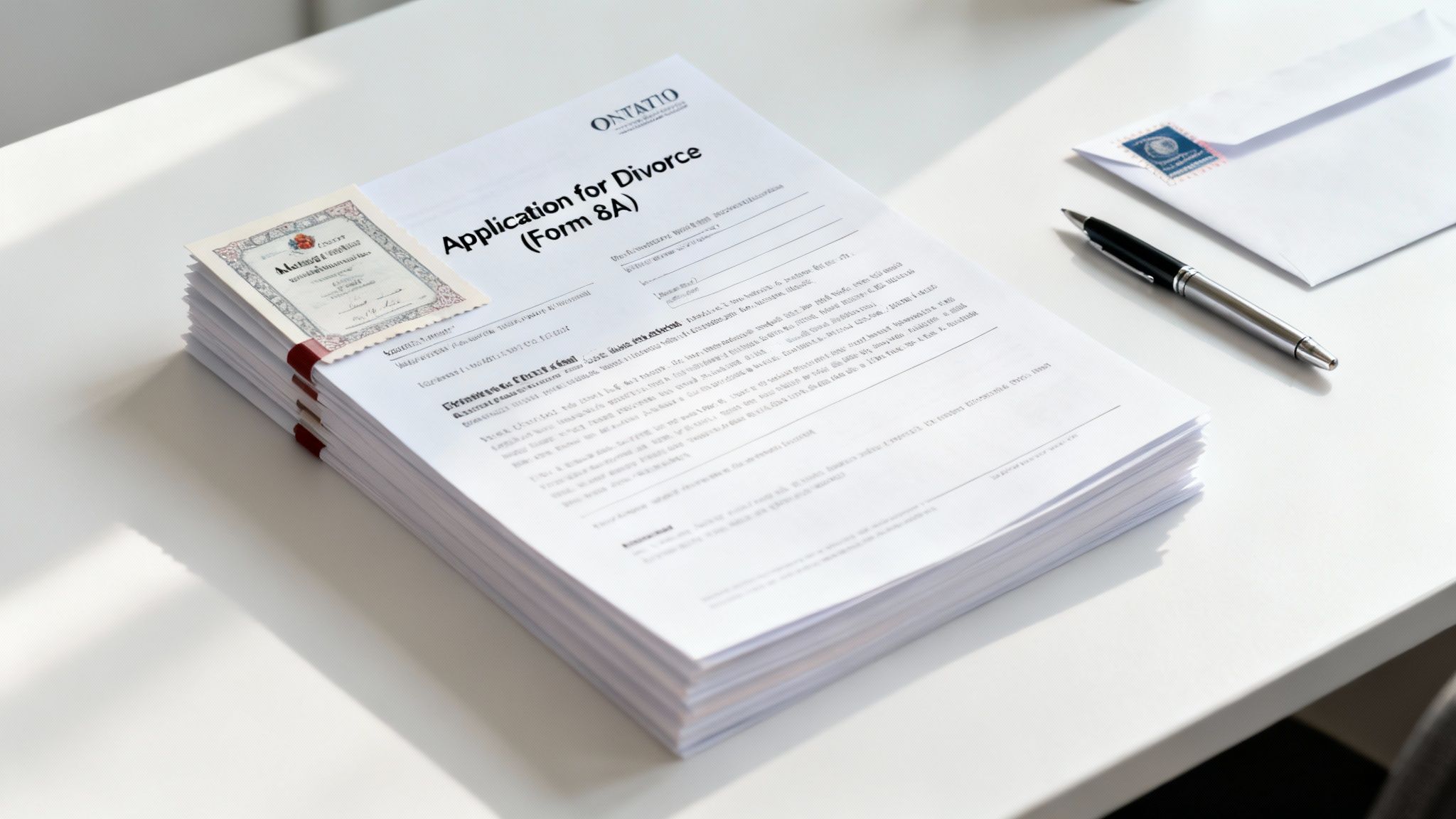
- Form 8A Application for Divorce: This is the main court form used to ask for a divorce.
- Form 36 Affidavit for Divorce: This confirms the factual basis for the divorce and supports the request for a divorce order.
- Registration of Divorce Proceedings: This federal registration helps prevent duplicate divorce proceedings.
- Original marriage certificate: The court expects proof of the marriage.
- Table of Contents for the Continuing Record: In the simple-application track, court materials need to be organised properly in the continuing record.
The practical point is that each form does a different job. One starts the case. Another proves the legal basis. Another handles federal registration. Another confirms the marriage itself. When people treat the package as “just paperwork,” that’s when missing items slip through.
The marriage certificate issue
The original marriage certificate is one of the most common problem areas. If it’s missing, damaged, or issued in another country, don’t leave that issue to the last minute. A foreign marriage document may still be usable, but the court file needs proper proof of marriage and sometimes supporting explanation.
This is also where people sometimes discover a separate legal issue. If there was a prior divorce outside Canada, Ontario may require additional legal analysis before a new marriage or new divorce matter can proceed properly.
A file can be legally straightforward and still get delayed because the documents don’t prove the basics cleanly.
If support is in dispute, your paperwork changes
A simple divorce is narrow. Once child support, spousal support, or property claims are part of the court case, the document list grows and the work becomes more technical. Financial disclosure may become necessary, and that’s where forms such as a Form 13.1 financial statement become relevant.
That’s why it’s important to identify your path early. People often gather the wrong documents because they think they’re filing only for divorce, when in reality they’re starting a broader family law proceeding.
Court fees and fee waiver options
Cost matters. For many filers, the total court fees are approximately $632, and that can be a real barrier. Legal Aid Ontario notes that if you can’t afford the fee, you can ask the court to waive it by submitting a Fee Waiver Request form, and eligibility is based on a means test, as described in Legal Aid Ontario’s page on simple divorce and fee waiver information.
If cost is tight, deal with that issue before filing rather than after the clerk asks for payment. Fee waiver requests can be worth exploring, but the supporting documents and timing can vary in practice.
The Filing and Serving Process Explained
A Brampton client can have every form signed, the marriage certificate ready, and the court fee paid, then still lose weeks because the application was issued but never served properly. That is a common GTA problem. The court process has two separate steps, and each one has to be done correctly.

Filing the application with the court
Divorce applications in Ontario go to the Superior Court of Justice. For many sole uncontested divorces, the court will issue the application if the forms are complete, the filing fee is paid or waived, and the supporting documents match what the rules require.
The practical problem is not usually the act of filing. It is filing a package the court staff can process without sending it back. Missing dates, inconsistent names, an unclear address for service, or a marriage certificate that does not match the application can all slow the file down. In Peel Region, those small errors often matter more than people expect because they create another round of corrections, re-sworn forms, and delay.
A clean filing also depends on the kind of divorce case you are starting. If support is still in dispute, or if parenting terms are not settled, the court process may require more than a simple divorce application. Anyone dealing with children should understand how Ontario courts assess child support obligations under Ontario law before assuming the file will stay simple.
What happens after filing
Once the court issues the application, you have an active court file. In a sole application, the next job is service. The court does not usually serve your spouse for you, and the applicant cannot ignore that step because the file number has been assigned.
Joint divorces are different. If both spouses sign and file together, service is usually not the issue it is in a sole application. In sole files, service is often the first real obstacle.
Service is often where self-represented files stall
Under the Family Law Rules, the applicant usually cannot serve the divorce application personally. Another adult has to do it, and the person who served the documents must complete proof of service. If that proof is missing or inaccurate, the court can refuse to move the file forward.
That creates real problems in the GTA. A spouse may have moved from Brampton to another city, may be staying with relatives, or may be avoiding contact altogether. Sometimes there are safety concerns, especially where there has been family violence. In those cases, proper service is no longer an administrative detail. It becomes a strategy issue.
Ontario courts can permit another method of service when ordinary service is not working, but you do not get to choose that on your own. A judge must authorize substituted service or another form of service if the rules require it, as discussed in this guide to an uncontested divorce in Ontario and service challenges.
Service problems usually start as practical obstacles. You need a reliable address, a lawful method, and proof the documents reached the right person.
What usually helps
- Use a reliable server. A friend can sometimes do it, but a professional process server is often the better choice if the spouse is evasive, lives outside Peel, or there are safety concerns.
- Give the server accurate information. A full name, current address, work location, photo, and vehicle details can save several failed attempts.
- Get the affidavit of service done promptly. Service without proper proof often creates the same delay as no service at all.
- Address foreign or out-of-province service early. If your spouse is outside Ontario or outside Canada, the timing and method can change, and mistakes there are expensive to fix.
- Ask for help when the facts are messy. Badesha Law handles filing and service logistics for clients who do not want to manage those court steps themselves.
What causes avoidable delay
- Serving the documents yourself in a sole application.
- Mailing materials without authority when personal service is required.
- Using an old address because it is the only one you have.
- Waiting too long to deal with an evasive spouse instead of bringing a motion for another service method if the facts support it.
For GTA residents, this is the stage where local experience often saves time. I often see straightforward divorces become expensive because someone guessed at service, filed the wrong proof, or waited until a deadline had already passed before asking how to fix it.
Resolving Parenting Support and Property Division
Many people think the divorce application is where everything gets sorted out. In reality, the divorce order mainly ends the marriage itself. The family issues that matter day to day usually need their own resolution, whether by agreement, negotiation, or litigation.
Divorce doesn’t replace a settlement
If you have children, shared property, support obligations, or a dispute about the home, those issues generally need to be resolved separately from the basic request for a divorce. In an uncontested situation, that often means the spouses already have a separation agreement in place before the divorce materials go in.
That order of operations matters. A simple divorce moves best when the substantive disputes are already settled. If they aren’t, the court file can become more complex very quickly.
Parenting issues come first in real life
For parents, the urgent questions are usually practical. Where will the children live? How will parenting time work? Who makes major decisions? What happens on holidays, school breaks, or during transitions between homes?
The law now uses terms like parenting time and decision-making responsibility, but the practical concern is the same. Children need a stable plan. If child support is also in play, the financial side should be addressed at the same time. This overview of child support laws in Ontario is a helpful starting point if support hasn’t been worked out yet.
The main issues that need to be settled
When spouses say they want an uncontested divorce, these are the subjects that usually have to be clear first:
- Parenting arrangements: A schedule, decision-making structure, and a realistic routine for the children.
- Child support: Proper support based on the applicable legal framework.
- Spousal support: Whether it’s payable, in what amount, and for how long.
- Property division: Who keeps what, whether equalisation is owed, and what happens with the matrimonial home.
- Debts and practical clean-up: Joint accounts, lines of credit, household contents, insurance, and beneficiary designations.
Why the matrimonial home causes so much conflict
The home often carries both financial and emotional weight. One spouse may want to keep it. The other may want it sold. Sometimes both are focused on affordability, not ownership. Sometimes the underlying conflict is about where the children will live and whether a move is possible.
That’s why property discussions can’t be left vague. A divorce order doesn’t automatically transfer title, remove a spouse from a mortgage, or settle equalisation rights. Those details need to be negotiated and documented properly.
A clean divorce file is usually the result of earlier legal work, not a shortcut around it.
When settlement is possible
Settlement works best when both spouses have exchanged the information needed to make informed decisions. That usually includes financial disclosure, practical proposals, and a willingness to document terms clearly. Informal verbal understandings often collapse later because each person remembers them differently.
If your issues are modest and both sides are cooperative, a separation agreement can keep the actual divorce filing relatively narrow. If the issues are significant or trust is low, legal advice before signing anything is the safer course.
Common Pitfalls and When to Call a Lawyer
A Brampton spouse files the paperwork, pays the fee, and expects the divorce to move ahead. A few weeks later, the court sends the materials back because the marriage certificate is missing, the affidavit was not commissioned properly, or service does not meet the Family Law Rules. That kind of delay is common in Peel and across the GTA. It usually starts with procedure, not a fight in court.
The practical problem is simple. Ontario divorce forms are manageable, but the court expects accuracy. If dates do not match, documents are incomplete, or service was done the wrong way, the file can stall for weeks or months.
Errors that routinely slow divorce files
Certain mistakes show up again and again:
- Inconsistent separation dates: If the date in the application does not match the affidavit or other materials, the court may question whether the ground for divorce has been proven.
- Affidavit defects: Form 36 must be sworn or affirmed properly before a commissioner for taking affidavits. If that step is done incorrectly, the court can reject it.
- Missing marriage document: An original marriage certificate, or the proper replacement or explanation, is often required. This is a frequent administrative problem.
- Incomplete filing package: One missing form, endorsement, or supporting document can stop the file from being issued or reviewed.
- Improper service: A spouse usually cannot serve their own divorce application. If service is not done according to the rules, the next steps may be invalid.
- Using the wrong divorce stream: A simple divorce is only for the divorce itself. If parenting, support, or property issues are still disputed, the paperwork needs to match that reality.
Court staff can identify a missing document. They cannot advise on strategy, disputed facts, or how to fix a file that was started on the wrong track.
Local pitfalls GTA clients run into
In Brampton and Mississauga files, I often see delays tied to small administrative points that look minor until the clerk reviews the package. Names on the marriage certificate do not exactly match current ID. A party was married outside Canada and does not know what document the Ontario court will accept. Someone tries to use email service without the other side consenting or without a court order permitting it. These are fixable problems, but they are easier to fix before filing than after rejection.
Cost is another place people make avoidable mistakes. The court filing fees for a divorce are usually paid in stages, not all at once, and rejected materials can mean lost time, extra commissioning, extra process server fees, or another attendance at the courthouse. For GTA clients balancing work, childcare, and court deadlines, that practical cost matters as much as the legal fee.
When calling a lawyer makes practical sense
Some files are realistic do-it-yourself matters. Others deserve legal help early because the risk of delay or a bad outcome is much higher.
Consider speaking to a lawyer if:
Children are involved and parenting is not fully settled
Parenting terms need to be clear, workable, and focused on the child’s best interests. Vague arrangements often create fresh conflict after the divorce is granted.Support is disputed or uncertain
Child support and spousal support affect monthly cash flow, tax planning, and enforcement risk. A rushed position can be expensive to correct later.Property issues are still live
If there is a house, pension, business interest, significant debt, or disagreement about equalization, the divorce itself is only one part of the file.Your spouse is in another province or another country
Service, jurisdiction, and timing become more technical quickly. This is especially true where a spouse is avoiding service or where court materials need to cross borders.A foreign divorce is part of the history
Ontario courts, immigration authorities, and remarriage planning sometimes require a foreign divorce opinion letter or other proof that the overseas divorce should be recognized here.There are safety concerns or coercive control
Service arrangements, communication, and court attendance should be planned carefully. These are not routine filing details.
What a lawyer should actually help with
Good legal help is not limited to appearing in court. In many GTA divorce files, its primary value is earlier and more practical. That includes checking whether the case is genuinely uncontested, confirming the right forms are being used, arranging valid service, spotting issues tied to foreign marriage documents, and making sure the divorce order will fit with the larger family law picture.
For clients in Peel, local experience can also save time. Each courthouse has its own filing habits, clerk expectations, and recurring document problems. That does not change the law, but it does affect how smoothly a file moves through the system.
If you’re trying to move ahead with a divorce in Brampton, Mississauga, Toronto, or elsewhere in the GTA, Badesha Law assists with sole and joint uncontested divorces, contested family court matters, separation agreements, parenting and support issues, property division, and foreign divorce opinion letters. Early advice often prevents the kind of filing mistake that is inexpensive to avoid and frustrating to repair.