

When you're facing the end of a marriage in Ontario, the first and most important choice you'll make is whether to pursue a contested vs uncontested divorce. This isn't just a legal distinction; it's a decision that sets the entire tone for your future, impacting everything from your finances to your emotional well-being.
An uncontested divorce is the collaborative route. It’s possible only when both you and your spouse agree on every single issue, making it a faster, more private, and far less expensive process. A contested divorce, on the other hand, is what happens when even one issue remains unresolved. At that point, the court system has to step in to make the final decisions for you. Understanding the implications of each path is critical, and the guidance of an experienced Brampton divorce lawyer from a firm like Badesha Law can be invaluable.
Defining Your Path: Contested vs Uncontested Divorce
Navigating the end of a marriage is a journey, and that first choice between a contested or uncontested divorce determines the map you'll follow. It’s a decision between two profoundly different paths, each with its own timeline, emotional toll, and financial cost.
A divorce is much more than just the legal end of a marriage. Under Canada's federal Divorce Act and Ontario’s provincial Family Law Act, it requires you to formally resolve several deeply personal and interconnected issues:
Parenting Time and Decision-Making Responsibility: This is what used to be called custody. It lays out how you'll divide your children's time and who will make the major decisions about their health, education, and well-being.
Child and Spousal Support: These are the financial obligations one spouse might have to the other, both for themselves and for the children, calculated according to federal and provincial guidelines.
Property Division: This involves the equal division of all assets and debts you both accumulated during the marriage, including the family's matrimonial home, as mandated by the Family Law Act.
The path you take hinges entirely on whether you and your spouse can settle these matters yourselves, without a judge needing to intervene. An experienced Brampton divorce lawyer can provide the strategic guidance you need, whether that means skilled negotiation to find common ground or strong advocacy in a courtroom.
Before we go deeper, it’s also useful to understand the difference between legal separation and divorce, as they are two distinct legal concepts.
At a Glance: Comparing Divorce Paths in Ontario
When you're trying to figure out which path makes sense for your family, seeing the core differences side-by-side can make things much clearer.
This table cuts through the legal jargon to give you a straightforward summary of what to expect from each process.
| Factor | Uncontested Divorce | Contested Divorce |
|---|---|---|
| Agreement Level | Full agreement on all issues (property, support, parenting). | Disagreement on at least one major issue. |
| Court Involvement | Minimal; primarily for administrative approval of the divorce order. | Extensive; involves conferences, motions, and possibly a trial. |
| Key Document | A signed Separation Agreement is the foundation. | Court Application (Form 8) initiates the process. |
| Control Over Outcome | Spouses retain full control over the final terms. | A judge makes the final, binding decisions. |
| Typical Timeline | Usually 4-6 months after filing, pending court processing. | Can take 1.5 to 3+ years to resolve through the court system. |
| Emotional Stress | Significantly lower due to the cooperative nature of the process. | High, as the process is adversarial and often prolonged. |
Ultimately, the choice comes down to control. The uncontested path keeps the power in your hands, but it requires cooperation. The contested route provides a formal structure for resolving conflict, but it comes at a much higher price—financially, emotionally, and in terms of time.
The Uncontested Divorce Process in Ontario
The uncontested divorce is all about reaching an agreement and choosing an efficient, peaceful path forward. While it’s far simpler than a contested divorce, it’s still a formal legal process that demands careful attention to meet the court’s strict requirements. The goal is to take your mutual understanding and turn it into legally solid documents the court will accept.

This entire process hinges on one single document: the Separation Agreement. This isn't just a handshake deal; it's a comprehensive, legally binding contract that spells out exactly how you and your spouse have settled every issue. It has to be drafted with precision to be enforceable under Ontario's Family Law Act.
At Badesha Law, this is often where our work begins. We help clients negotiate and draft Separation Agreements that are clear, fair, and legally sound. This crucial step makes sure all the terms you’ve agreed on—from property division to parenting plans—are formally documented, leaving no room for future fights.
Key Steps in the Uncontested Process
Once the Separation Agreement is signed and witnessed, the court filing can begin. This part of the journey is mostly administrative, following a clear set of steps designed to prove to the court that all legal boxes have been ticked. Having a lawyer’s oversight here is invaluable to avoid common mistakes that can cause major delays.
The main steps look like this:
Drafting and Filing the Application: The process kicks off by preparing a Form 8A: Application (Divorce). This document officially asks the court to grant your divorce and is filed along with your original marriage certificate.
Completing the Affidavit for Divorce: Both spouses (in a joint application) or just the filing spouse (in a sole application) must complete a Form 36: Affidavit for Divorce. This is a sworn statement confirming details about the marriage, separation, and any children, proving all issues are resolved.
Preparing the Draft Divorce Order: Your lawyer will prepare a Form 25A: Divorce Order, which is the final document a judge will sign to officially end your marriage.
Clerk’s Certificate and Court Review: The court clerk checks all your documents to make sure they're complete and correct. If everything is in order, they issue a certificate, and the file goes to a judge for a final review and signature.
The whole point of an uncontested divorce is to show the court there's nothing left for a judge to decide. A well-drafted Separation Agreement and accurately completed court forms provide that proof, turning a complicated legal matter into a predictable, administrative task.
Avoiding Common Filing Pitfalls
A lot of people ask about getting a divorce without a lawyer. While it's technically possible, the administrative hurdles can be surprisingly tough. Simple mistakes on forms, incorrect filing procedures, or a poorly written Separation Agreement can cause the court to reject your application, forcing you to start all over again.
A lawyer ensures all your paperwork is filed correctly the first time. That professional oversight is what keeps the uncontested process smooth and efficient, giving you peace of mind and letting you focus on moving forward with your life.
Navigating the Contested Divorce Court System
When communication breaks down and a mutual agreement is completely off the table, your divorce moves out of your hands and into the formal court system. This path, known as a contested divorce, is a world away from the simple administrative process of an uncontested case. Instead of working together to decide your own future, you’re asking a judge to make legally binding decisions for you and your family.
The journey doesn't start with a collaborative Separation Agreement. It kicks off with filing a Form 8: Application with the court, a document that officially launches the litigation process. This form lays out your claims on everything from parenting and support to how you want to divide your property. From this moment on, the process is structured, adversarial, and dictated by strict court rules and deadlines.
This is precisely where having an experienced Brampton divorce lawyer becomes non-negotiable. At Badesha Law, our job is to protect your rights at every turn, manage the complex procedures, and advocate fiercely for your best interests in a formal court setting.
The Stages of Litigation in Ontario
A contested divorce isn't a single event; it's a series of mandatory steps designed to organize information, push for a settlement, and, if all else fails, get the case ready for a judge’s final decision. Each step has a very specific purpose in moving your case along the court’s conveyor belt.
Here are the key court appearances you'll go through:
First Appearance: This is a brief, administrative meeting to set dates and make sure all the initial documents have been filed correctly. It's more about logistics than anything else.
Case Conference: This is the first major step where you, your lawyers, and a judge sit down to discuss the unresolved issues. The judge's role here is to see where you agree, narrow down the points of conflict, and give both sides some frank feedback on the strengths and weaknesses of their positions. The real goal is to get you to settle before the costs spiral out of control.
Settlement Conference: If you still can't agree after the Case Conference, you'll head to a Settlement Conference with a different judge. This is a much more intensive push to resolve the case without a trial. The judge will be more direct, often giving a strong opinion on how the case would likely end at trial to encourage both of you to find a middle ground.
Trial Management Conference: If a settlement is still out of reach, this conference is all about planning the trial itself. You’ll deal with the logistics—who the witnesses will be, what evidence will be presented, and how the schedule will run.
The Critical Role of Financial Disclosure
At the heart of almost every contested divorce is the process of financial disclosure. Under Ontario's Family Law Rules, both you and your spouse have an absolute legal duty to provide complete and honest information about your income, assets, and debts. This is done by completing a detailed Financial Statement (Form 13 or 13.1).
This stage is often where things get heated. Disputes explode when one spouse suspects the other is hiding assets, deliberately undervaluing a business, or not being truthful about their income. These fights can lead to formal requests for more documents, questioning under oath (called examinations), and motions asking the court to force the other side to hand over information.
In a contested divorce, financial transparency isn’t optional—it’s a legal command. Failing to provide full and frank disclosure can lead to serious penalties from the court, including being ordered to pay the other party's legal costs.
This is exactly why the process takes so much longer and costs so much more. Every single disagreement chews up lawyer time, requires court filings, and might even need expensive expert reports, all of which get added to the final bill. The adversarial nature of litigation can also poison any future co-parenting relationship, making it incredibly difficult to work together down the road. For more insights, you can explore some strategies for managing conflict in a contested divorce.
A skilled lawyer can help you navigate these high-stakes conflicts while never losing sight of the main goal: reaching a fair and final resolution.
Comparing Timelines: How Long Each Divorce Takes
One of the first, most urgent questions people ask when they start this process is, "How long is this all going to take?" The answer hinges almost entirely on whether your divorce is contested or uncontested. This timeline isn't just about patience; it directly hits your finances and your emotional health as you wait to move on with your life.
An uncontested divorce in Ontario moves along a fairly predictable track. Once you’ve signed a Separation Agreement and all the right paperwork is filed, the process is mostly administrative. You can generally expect the final Divorce Order in about 4 to 6 months. The biggest variable is simply how backed up the court is at that moment.
A contested divorce, on the other hand, isn't measured in months—it's measured in years. The journey through the Ontario court system is a long haul, filled with mandatory steps that create huge delays. A contested case can easily stretch from 1.5 to over 3 years from the day you file to the day you get a final resolution.
Factors That Extend Contested Divorce Timelines
The dramatic difference in timing is baked right into the court system itself. These long delays aren't just a possibility in litigation; they're an expected part of the process.
Here are the key sources of delay:
Court Backlogs: Ontario's family courts are overloaded. This means you can be left waiting for months just to get your next scheduled date, whether it's for a Case Conference or a Settlement Conference.
Scheduling Conflicts: Trying to line up the calendars of two lawyers, both spouses, and a judge for multiple court dates is a logistical nightmare that can add months of waiting.
The Lengthy Discovery Process: The process of gathering and exchanging financial documents is a major bottleneck. If one person is being uncooperative or is suspected of hiding assets, motions have to be filed to force them to produce the information, adding even more delays and legal fees.
Expert Valuations: When you’re dealing with assets like a family business or complex investment portfolios, getting professional valuations can take many months to complete.
The timeline is a direct reflection of conflict. In an uncontested divorce, the work is done upfront through negotiation. In a contested divorce, the work unfolds over years of court procedures, with each disagreement acting as another roadblock.
A Look at Timelines Elsewhere
This massive time gap isn't unique to Ontario. Take California, for instance, where contested divorces take dramatically longer than uncontested ones—averaging 12-18 months versus 6-8 months. This is due to mandatory waiting periods plus the time it takes to fight over custody, property, or support. If you add in a complex child custody battle, you can tack on another 6-12 months, pushing some cases to last 1-3 years.
Understanding these realistic timeframes is crucial. A Brampton divorce lawyer can give you a more personalized estimate based on the specifics of your situation. For a deeper dive into what affects timelines in our province, check out our guide on how long a divorce takes in Ontario. At Badesha Law, we make sure our clients understand these timelines from the start so they can weigh their priorities and make informed decisions.
The Financial Reality: A Detailed Cost Analysis
For most people starting the divorce process, the biggest question is simple: what’s this going to cost? It's the most pressing concern, and the answer depends almost entirely on the path you choose. Deciding between a contested and an uncontested divorce isn't just a legal choice—it's a financial one with radically different consequences for your bank account.
The route you take will determine whether your costs are predictable and manageable, or a source of constant, escalating stress.
An uncontested divorce is all about financial clarity. Because you and your spouse resolve every single issue in a Separation Agreement before anything is filed with the court, the legal work is precise and contained. This allows a Brampton divorce lawyer to handle the entire process for a flat-rate fee, covering the expert drafting of your agreement and the filing of all the necessary court forms.
This approach gives you certainty from day one. At Badesha Law, we believe in that transparency. Our clients know the full cost upfront, turning a potentially stressful legal process into a smart, efficient investment in a peaceful resolution.
The Predictable Costs of an Uncontested Divorce
With an uncontested divorce, you can actually budget for the end of your marriage. There are no surprise invoices or spiralling legal bills from drawn-out court battles.
Your main expenses are straightforward and known from the start:
Lawyer's Fees: Usually a flat rate to draft a rock-solid Separation Agreement and manage the court filing process from start to finish. This fee covers the legal expertise needed to ensure your agreement is airtight and your paperwork is perfect.
Court Filing Fees: These are standard administrative fees charged by the Ontario court system to process your divorce application.
Disbursements: These are minor out-of-pocket costs for things like couriers or postage.
Think of it this way: an uncontested divorce lets you purchase a result—a finalized divorce for a known price. A contested divorce means you’re purchasing a process—a series of legal battles with no guaranteed outcome and an unknown final cost.
The Escalating Costs of a Contested Divorce
The financial world of a contested divorce is the polar opposite: it's built on unpredictability. The costs aren't fixed because they’re tied directly to the amount of conflict and the time it takes to resolve it. Legal services are billed by the hour, which means every single phone call, email, and court appearance adds to your final bill.
These costs can spiral out of control, and fast. While every case is unique to Ontario, data from other jurisdictions shows a stark contrast. In California, for example, an uncontested divorce might cost under $10,000, while litigated battles frequently soar to $20,000, $50,000, or much more. The driver is simple: minimal court time and lawyer hours are needed when a settlement is reached without a fight. You can read more about these cost comparisons on westcoastdivorce.com.
In a contested Ontario case, the sources of these high costs are numerous and they compound over time. Prolonged litigation introduces expenses that simply don’t exist in an uncontested file, like fees for financial experts, property appraisers, and bringing motions for temporary court orders.
For a comprehensive breakdown of what to expect financially, take a look at our detailed guide on understanding Ontario divorce costs. Choosing the uncontested path isn't just about saving money in the short term; it’s about protecting your entire financial future from the immense risks of a court battle.
How to Choose the Right Path for Your Situation
Deciding between a contested and an uncontested divorce is the first, and most significant, choice you'll make on this journey. The right path isn't about which one is "better"—it's about which one is right for your specific circumstances, your communication style, and your family's future.
The decision tree below maps out the primary trade-off, showing how your choice will directly impact your financial reality.
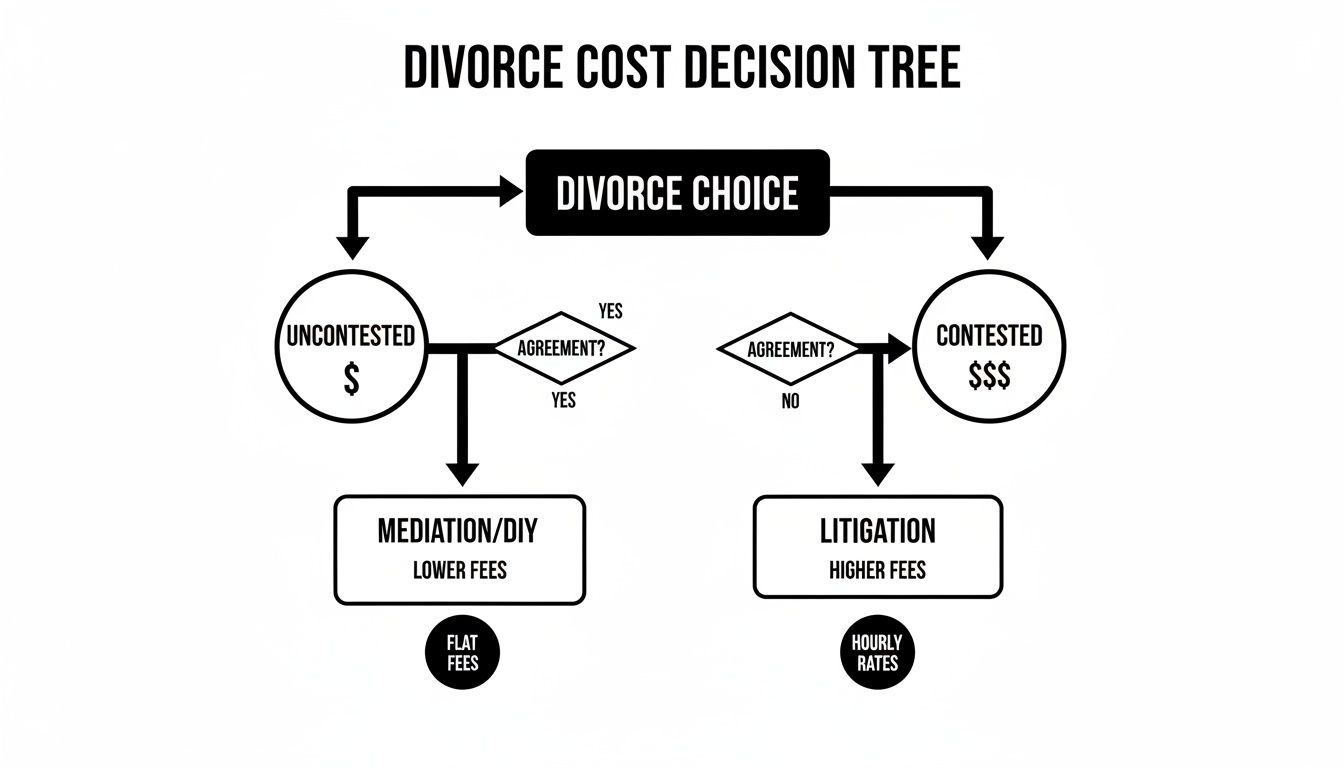
As the chart makes clear, the uncontested path gives you financial predictability. The contested route, on the other hand, introduces significant and often escalating costs. This financial truth should be a central factor in your decision.
When an Uncontested Divorce Is the Best Fit
An uncontested divorce is the ideal path forward when you and your spouse can still operate from a foundation of mutual respect and a genuine commitment to fairness. This approach works best when:
You can communicate effectively: You are both capable of having productive, even if difficult, conversations about your finances and children.
There is mutual trust: You both believe the other will provide full and honest financial disclosure without being forced to by a court.
You agree on the major issues: While you may need to negotiate the fine print, you are aligned on the big picture for property division, support, and a co-parenting plan.
In Ontario, there is a strong preference for resolving matters amicably. Although specific data for Ontario is collected, experiences from places like California reveal that almost 90% of divorces end up being uncontested. This indicates that many couples manage to reach an agreement without enduring a lengthy court dispute, helping to preserve assets and protect children from extended conflict.
When a Contested Divorce Is Unavoidable
Sometimes, collaboration just isn't possible or safe. A contested divorce then becomes a necessary measure to protect your rights and ensure a just outcome under the law. This path is often required in situations involving:
A refusal to negotiate: One spouse is completely unwilling to communicate, compromise, or participate in the process in good faith.
Significant power imbalances or abuse: If there is a history of domestic violence, coercion, or financial control, the formal structure of the court system provides essential protection.
Hidden assets or financial dishonesty: If you suspect your spouse is hiding money or misrepresenting their income, the formal discovery process in a contested divorce is the only tool to uncover the truth.
Pursuing a fair settlement should always be the starting point. However, when faced with a spouse who refuses to be reasonable or transparent, litigation becomes your tool for ensuring fairness under the law.
At Badesha Law, we provide the strategic advice you need to make this crucial choice. As your Brampton divorce lawyer, we can act as skilled negotiators to secure a peaceful settlement or as determined litigators to fight for your rights in court. We are fully equipped to guide you down the path that best protects your future. Schedule a consultation today to create a clear, strategic plan.
Frequently Asked Questions
When you're trying to figure out the difference between a contested vs. uncontested divorce, a lot of specific questions come up. Here are some clear, straightforward answers to the queries we hear most often, grounded in the realities of Ontario's family law system.
Can a Contested Divorce Become Uncontested?
Yes, absolutely. In fact, this is a very common and welcome outcome. A divorce might kick off as contested because of some initial, heated disagreements, but it can settle through negotiation at any point before you find yourself in a trial.
The court system actually encourages this. Steps like Case Conferences are specifically designed to push both sides toward a resolution. A sharp Brampton divorce lawyer knows how to use these mandatory meetings to bring a reluctant spouse to the table. When you successfully resolve those sticking points mid-process, you can switch gears and finalize everything as an uncontested divorce, saving an enormous amount of time and money.
What if We Only Disagree on One Issue?
Even if you and your spouse are stuck on just one significant point—like the final number for spousal support or a particular detail in the parenting schedule—your divorce is technically considered contested.
But that doesn't automatically mean you're doomed to a long, drawn-out court battle. Instead, you can use targeted strategies like mediation or focused lawyer-to-lawyer negotiations to attack that single issue. Once you reach an agreement and get it down in writing, the rest of the divorce can move forward on a simple, uncontested basis. It’s all about containing the conflict and the costs.
The goal is to isolate the disagreement and resolve it efficiently. A single dispute doesn't have to derail the entire process if handled strategically.
Is a Lawyer Necessary for an Uncontested Divorce?
While it’s not legally mandatory in Ontario, trying to handle an uncontested divorce without a lawyer is a risky move. A family lawyer’s real value is in drafting a Separation Agreement that is ironclad, legally binding, and fully protects your rights under the Family Law Act.
Beyond that, a lawyer manages the entire court filing process. It’s a minefield of technical rules, and simple errors on the forms can get your application rejected or cause months of delays. A firm like Badesha Law handles these details efficiently—often for a transparent flat fee—which gives you invaluable peace of mind.
What Is a Separation Agreement and Why Do I Need One?
Think of a Separation Agreement as the master blueprint for your post-marriage life. It’s a comprehensive, legally binding contract that spells out exactly how you and your spouse have agreed to untangle your lives. It covers everything:
Division of property and debts
Child and spousal support arrangements
Parenting time and decision-making responsibility
In Ontario, having a signed Separation Agreement is the absolute cornerstone of an uncontested divorce. It acts as definitive proof for the court that all issues are settled, which allows a judge to grant the divorce order without getting involved in your personal affairs.
Understanding the nuances of a contested vs. uncontested divorce is the first step toward a resolution that protects your future. The experienced team at Badesha Law is ready to provide the clear, strategic guidance you need, whether you are aiming for an amicable agreement or require strong advocacy in court. Contact us for a consultation to discuss your situation and create a plan to move forward with confidence.