Is Spousal Support Tax Deductible in Canada 2026?

Spousal support is tax-deductible for the payer and taxable for the recipient in Canada, but only when the payments meet strict legal and tax conditions. If your separation agreement or court order isn't worded properly, or if the payments are structured the wrong way, the deduction can be lost.

That's the part many people in Brampton, Mississauga, and across the GTA discover too late. You may already be trying to budget for two households, deal with support discussions, and understand what your post-separation income will look like after tax. In practice, the answer to whether spousal support is tax deductible isn't just “yes.” It's “yes, if the paperwork is precise and the payments qualify.”

The wording in the agreement matters more than is commonly expected. A support clause that seems harmless, such as one blended payment for “family support,” can create a tax problem if it doesn't clearly separate spousal support from child support. That's where costly mistakes happen.

If you're still gathering your financial picture, a Form 13.1 financial statement in Ontario is often the place where the practical work starts. Once the numbers are clear, the support terms need to be drafted with equal care.

Table of Contents

Understanding Your Finances After Separation

Separation changes cash flow immediately. One household becomes two, regular expenses shift, and support discussions often start before either person feels financially settled. Tax treatment matters because the same support amount can affect each person very differently once annual filing season arrives.

In Ontario, support rights and obligations are shaped by family law principles, including the Family Law Act, but the tax treatment comes from federal income tax rules. That distinction matters. A support term may be valid from a family law perspective, yet still fail to produce the tax result one party expected because the agreement wasn't drafted with tax clarity in mind.

The real issue is structure

Many people ask whether spousal support tax deductible rules are straightforward. They aren't difficult, but they are strict. The law rewards proper structure. It doesn't reward assumptions.

Two clients can pay the same total amount over a year and get completely different tax treatment depending on how the order or agreement reads, whether the payments are periodic, and whether spousal support is clearly separated from child support.

Practical rule: Never assume the CRA will “understand what you meant” if the agreement is vague. The CRA looks first at the written terms.

What usually needs attention first

Before anyone signs a separation agreement, these points should be checked carefully:

  • Support type: Is the payment clearly identified as spousal support, child support, or both?
  • Payment method: Is it periodic, such as monthly, rather than a one-time settlement amount?
  • Allocation language: If both types of support exist, does the document assign a specific amount to each?
  • Living arrangements: Are the parties living separate and apart when the payments are made?
  • Tax reporting: Does each side know how the payment will be claimed or included?

Clients often focus on the monthly amount and overlook the clause wording. That's understandable, but it's also where preventable tax problems begin.

The Core Rule Spousal Support vs Child Support Taxation

A common problem starts like this. One spouse pays a single monthly amount described as "family support," assumes it will be deductible, and learns at tax time that the CRA wants clearer wording before allowing the claim.

Canadian tax law draws a firm line between spousal support and child support. Qualifying spousal support is generally deductible to the payer and taxable to the recipient. Child support is generally not deductible to the payer and not taxable to the recipient.

The distinction matters on the return, but it matters even more in the document that created the payment obligation. If an order or separation agreement does not clearly separate the spousal amount from the child amount, the deduction can be denied even where both parties thought they had agreed on tax-deductible support.

If child support is part of your case, review the broader rules under Ontario child support laws, because the tax treatment starts from a different legal premise.

Why the law treats them differently

Spousal support is treated as a transfer between former spouses or partners. Where the legal requirements are met, the payer may claim the deduction on line 22000, and the recipient reports the amount as income on line 12800.

Child support serves a different purpose. It is for the child's benefit, so the tax system does not give the payer a deduction or require the recipient to include it as income.

That is why vague wording causes real trouble. A clause that says "the payor shall pay family support of $3,000 per month" may be useful during negotiation, but it often creates avoidable tax risk. A clause that says "$1,800 per month as child support and $1,200 per month as spousal support, payable on the first day of each month" gives the CRA much clearer footing.

Tax Treatment of Support Payments in Canada 2026

Payment Type For the Payer For the Recipient
Spousal support Deductible if it qualifies under the tax rules Taxable income
Child support Not deductible Not taxable

A blended payment can look tidy on paper. In practice, clear allocation usually protects both sides better.

Qualifying Conditions for Tax Deductibility in Canada

A payment doesn't become deductible just because the parties call it spousal support. The CRA and the Income Tax Act focus on legal form, payment structure, and the wording of the underlying document.

Under sections 56.1 and 60.1 of the Income Tax Act, the payor of periodic spousal support may deduct the payments, while the recipient must include them as income. To qualify, the payments must be required by a registered separation agreement or court order that specifies recurring payments and clearly designates the amount as spousal support rather than child support, as outlined in this explanation of Canadian support tax rules.

For readers trying to estimate support before drafting the final terms, this overview of how to calculate spousal support in Canada is a useful starting point.

An infographic detailing the six qualifying conditions for claiming spousal support tax deductibility in Canada.

What has to exist on paper

The first requirement is a written separation agreement or court order. Informal arrangements don't give the CRA what it needs. If one party voluntarily sends money each month without a proper legal document, the tax deduction is at risk from the outset.

The second requirement is clear designation. The document should identify the former spouse or partner as the recipient and state that the payment is for spousal support. If the wording leaves the support category uncertain, tax treatment becomes uncertain too.

What the CRA looks for in the payment itself

The payment must be periodic. Monthly payments are the classic example. A one-time settlement amount usually won't qualify as deductible spousal support.

The parties must also be living separate and apart when the payments are made. If they are still living under the same roof in a way that doesn't meet the legal separation standard, the tax treatment may be challenged.

A practical checklist looks like this:

  • Legal basis: There must be a written agreement or court order.
  • Recurring obligation: The document should require periodic payments, not a lump-sum buyout.
  • Specific label: The support must be identified as spousal support.
  • Recipient control: The recipient should generally be free to use the funds as support, rather than the payer controlling every dollar.
  • No child support confusion: If there is also child support, each amount should be listed separately.
  • Separation status: The parties must be living apart at the time of payment.

The Family Law Act in Ontario helps frame entitlement and support obligations between spouses, but tax deductibility still depends on satisfying these federal conditions.

Why Specific Wording in Your Agreement Is Crucial

A common tax problem starts with a sentence that looked harmless at signing. One spouse pays every month. The other reports what was received. Then the CRA reviews the agreement and sees only “family support” or a blended amount for a former spouse and children. At that point, the deduction can be denied because the document does not clearly say what part is spousal support.

That is why wording matters so much in family law drafting. The tax result often turns on a few lines in the separation agreement or court order, not on what both parties say they meant later.

A close-up view of a person signing a formal legal agreement with a black pen on a clipboard.

If you are weighing a one-time payout instead of monthly payments, this discussion of lump-sum spousal support and how payment structure affects tax treatment explains why drafting and payment design must be reviewed together.

Bad wording versus good wording

Bad wording example

“The payor shall pay the recipient family support in the amount of $____ per month for the support of the recipient and the children.”

I regularly warn clients about clauses like this. It mixes child support and spousal support into one amount. It does not assign a separate monthly figure to spousal support. It also makes later tax reporting harder because the CRA can look at the clause and conclude that the amount is not clearly deductible spousal support.

Better wording example

“The payor shall pay to the recipient spousal support in the amount of $____ per month, payable on the first day of each month, commencing on [date], pursuant to this separation agreement. This amount is separate from child support. Any child support payable shall be set out in a separate clause as a separate monthly amount.”

That version does useful legal work. It names the support as spousal support. It states a fixed amount. It sets a payment schedule. It keeps child support in its own clause, where it belongs.

A short clause can still be precise.

A sample clause clients can actually use

In many files, I prefer wording that goes one step further and removes room for argument:

“The payor shall pay spousal support to the recipient in the amount of $____ per month, payable on the first day of each month beginning on [date] and continuing until [end date, review date, or triggering event], unless varied by written agreement or court order. This spousal support is separate from any child support payable between the parties. Child support, if any, shall be set out in a separate clause with a separately stated amount and payment obligation.”

This kind of clause helps in three places at once. It helps with CRA reporting. It helps if enforcement becomes necessary. It helps if one party later asks to vary support and the court needs to see exactly what was agreed.

The trade-off is straightforward. Broad “family support” language may feel simpler during negotiation, especially where parties want flexibility. But vague language often creates a bigger problem later, because tax treatment depends on the written terms, not on assumptions or side conversations. If deductibility matters, the agreement should say so by clearly setting out separate obligations and separate amounts.

The expensive mistakes are usually drafting mistakes.

How to Report Support Payments to the CRA

Once the agreement is set up properly, the tax reporting still has to match the legal wording and the actual payment history. Sloppy reporting can trigger questions even where the clause itself is well drafted.

If you are paying support

A payer who has made qualifying spousal support payments claims the deduction on line 22000 of the income tax return. The amount claimed should match the support that qualifies under the written agreement or court order and the payments made.

Keep these records together:

  • Your agreement or order: The signed separation agreement or court order should be easy to produce.
  • Proof of payment: Bank transfers, cancelled cheques, or other payment records matter.
  • Support breakdown: If both child and spousal support exist, maintain a clean record showing which amount is which.

If support is collected or enforced through Ontario's enforcement system, keeping records from the Family Responsibility Office contact and payment process can also help confirm what was paid and when.

If you are receiving support

A recipient who receives qualifying spousal support reports it on line 12800 as income. That reporting should align with the written terms and the actual amounts received.

Recipients should also keep the agreement, payment records, and any year-end summaries prepared by their accountant or lawyer. If your agreement contains both child and spousal support, don't guess which part is taxable. The document should already answer that question.

A practical approach is to review your support paperwork before tax season begins, not after your return is prepared. That gives you time to fix misunderstandings before they become filing problems.

Common Pitfalls That Can Invalidate Your Deduction

Some problems begin in drafting. Others happen months later when people start making payments in a way that doesn't match the agreement. Both can lead to a denied deduction.

A four-point infographic illustrating common pitfalls that can invalidate your spousal support tax deduction claim.

Mistakes in setup

The first mistake is relying on a verbal arrangement. The CRA wants a written separation agreement or court order. Good intentions don't replace legal documentation.

Another common issue is combining child and spousal support into one unallocated amount. Under Canadian rules, if the agreement fails to clearly allocate the amounts, the payment may be treated as child support for tax purposes, which can wipe out the deduction.

Lump-sum payments create another trap. People often use a buyout approach to “finish things cleanly,” but a lump sum is generally not deductible as spousal support.

Mistakes in payment and follow-through

Even a strong agreement can be undermined by poor execution. Problems often include:

  • Paying irregular amounts: If the agreement says monthly support and the payer sends sporadic different sums, the paper trail becomes harder to defend.
  • Paying third parties directly: If the payer sends money to a landlord, lender, or other third party without proper wording in the agreement, deductibility may be questioned.
  • Ignoring child support obligations: The tax treatment can be affected if child support obligations haven't been properly dealt with.
  • Using outdated terms: If circumstances change, an old agreement may no longer reflect what the parties are doing.

The CRA does not audit your intentions. It reviews your documents and your payment history.

People often assume that once a support clause is signed, the tax result is locked in. It isn't. The deduction depends on both a valid structure and disciplined follow-through.

Frequently Asked Questions About Spousal Support Tax

Is a lump-sum spousal support payment deductible

Usually, no. In Canada, the general rule is that only periodic payments under a written agreement or court order qualify for deductibility. A lump-sum payment is generally treated differently and won't usually produce the same tax result.

What if my former spouse lives outside Canada

Canadian tax rules may still matter if the support is being paid under a Canadian agreement or order, but cross-border cases need individual advice. Residence, enforcement, and foreign tax treatment can all affect the practical outcome. These are not files to handle casually.

Can I deduct legal fees related to support

The answer depends on the purpose of the legal fees and who paid them. Legal fees don't follow the same rule as support itself, and people often assume they do. Before claiming them, get advice from an accountant or lawyer who deals with family law tax issues.

Does Ontario family law decide the tax result

Not by itself. Ontario family law, including the Family Law Act, governs support rights and obligations. Federal tax law decides whether a support payment is deductible, taxable, or neutral. Both need to be considered together when the agreement is drafted.

What wording should I insist on in my agreement

Ask for language that does all of the following:

  • Separates support types: Spousal support and child support should appear in different clauses with different amounts.
  • States timing clearly: Monthly or other recurring payment dates should be listed.
  • Avoids umbrella labels: Terms like “family support” should be used carefully, if at all.
  • Matches real life: The agreement should reflect how payments will be made.

A strong separation agreement doesn't just settle the family law issue. It reduces the chance of a tax dispute later.


If you're dealing with separation, support, or agreement drafting in Brampton or the GTA, Badesha Law can help you prepare or review support terms with the precision they require. Clear wording now can prevent tax mistakes, enforcement trouble, and expensive disputes later.

Legal Separation Mediation in Ontario: A Clear Guide

You may already be living in separate rooms, or one of you may have moved out weeks ago. The urgent questions usually arrive before the paperwork does. Who pays the mortgage? What happens with the children's schedule? Can either of you use the joint line of credit? Do you need to “file for legal separation” before doing anything else?

That last question causes a lot of confusion in Ontario. People use the phrase legal separation mediation because they want a structured way to sort out parenting, support, property, and day-to-day rules while they live apart. What they usually need, though, isn't a court status called legal separation. It's a solid, enforceable Separation Agreement reached through a careful mediation process.

When mediation works well, it lowers the temperature. Instead of trading accusations through lawyers or waiting for a judge to decide intimate family issues on a crowded court list, both spouses work through the practical terms of their separation with a neutral mediator guiding the discussion. That doesn't make it soft or vague. Good mediation is organised, legally informed, and focused on getting real decisions made.

It also gives people something they often feel they've lost during separation. Control.

Table of Contents

Starting Your Separation Journey in Ontario

A separation rarely begins with a neat legal checklist. It starts with ordinary life becoming unworkable. One parent sleeps in the basement. Someone starts tracking grocery costs because the old routine no longer makes sense. The children ask where they'll be this weekend, and both parents realise they haven't agreed on anything.

That's where mediation can be useful. It gives separating spouses a place to sort out practical issues in a controlled setting before conflict hardens into positions. For many families, that means discussing parenting schedules, support, use of the home, debt payments, and the timing of next steps, all without turning every disagreement into a court fight.

A contemplative woman standing by a large window overlooking a scenic countryside landscape at sunset.

What works in this stage is structure. What doesn't work is assuming goodwill alone will carry difficult conversations. Even couples who want an amicable separation often need a framework, an agenda, and a process for making decisions one issue at a time.

Practical rule: Don't wait until every emotional issue is resolved before dealing with the legal and financial ones. Most families need a working plan early.

Ontario law matters here. Under the Family Law Act and the broader family law framework in Canada, spouses can live separate and apart and make enforceable arrangements without rushing into an immediate court battle. That's why legal separation mediation, in the Ontario sense, is usually about creating order during separation rather than obtaining a separate court label.

A good starting point is simple:

  • Stabilise the basics: where each person will live, how bills will be handled, and what the parenting schedule looks like this week and next week.
  • Protect disclosure: gather income information, debts, account balances, and property records early.
  • Use a process that fits the family: mediation can work very well when both people are willing to exchange information and negotiate in good faith.

People often feel they must choose between doing nothing and going straight to court. In practice, there's a middle path. For many Ontario families, mediation is that path.

What Legal Separation Really Means in Ontario

A spouse will often sit across from me and say, “I want to get legally separated first.” In Ontario, that usually means they are trying to solve a real problem with the wrong legal label.

You are separated when you live apart with the intent to separate

Ontario does not have a separate court status called legal separation. You remain married until you divorce. You become separated when at least one spouse decides the relationship is over and you begin living separate and apart, even if some practical overlap continues for a time.

That distinction matters because it changes what mediation is meant to produce. The goal is usually not a court document declaring you “legally separated.” The goal is a written agreement that deals with the consequences of separation in a clear, enforceable way.

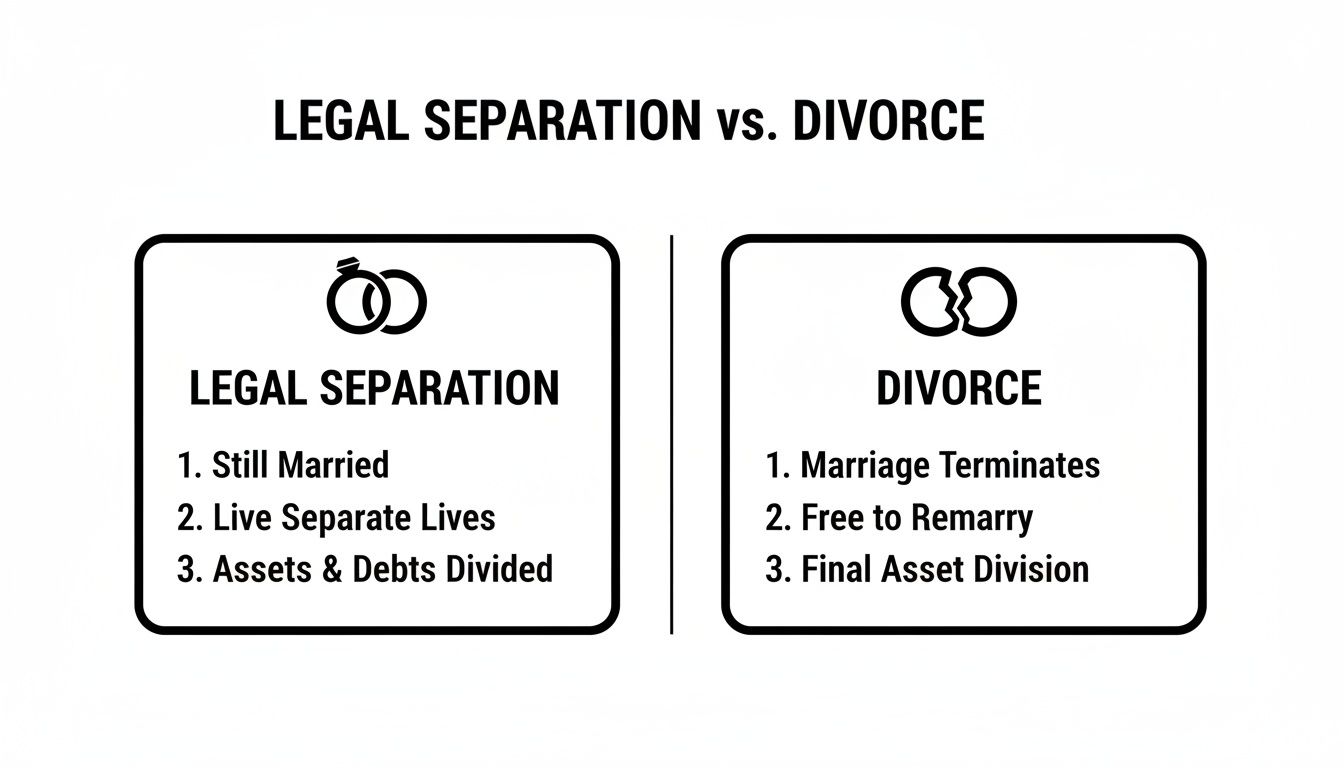
If you want a fuller explanation of the terminology, this guide on the difference between legal separation and divorce in Ontario sets out the legal distinction.

In practice, mediation during separation and mediation before divorce often cover the same issues. The difference is timing, not a special Ontario process called legal separation.

What mediation is actually building

In most cases, mediation is working toward a Separation Agreement. That document sets out the terms you and your spouse agree on while living apart. If it is drafted properly, with full financial disclosure and independent legal advice, it can become the foundation for stability now and a later uncontested divorce if you choose to apply for one.

A useful Separation Agreement usually addresses:

  • Parenting arrangements: decision-making responsibility, parenting time, holidays, travel, and communication
  • Child support: table support, section 7 expenses, sharing percentages, and review terms
  • Spousal support: whether support is paid, the amount, duration, and review or variation triggers
  • Property issues: equalization, bank accounts, pensions, vehicles, and the matrimonial home
  • Debt allocation: responsibility for credit cards, lines of credit, tax debt, and joint liabilities

The quality of the agreement matters as much as the deal itself. A vague term about the house can create a fight six months later. A support clause without income review dates can cause the same problem. Good mediation does not just settle today's dispute. It addresses the predictable pressure points that tend to come next.

Ontario family law allows spouses to make domestic contracts, but those contracts need care. Full and honest disclosure is not optional if support or property is in issue. Clear drafting matters. So does fairness in the process. Mediation can help spouses reach common ground, but the final agreement still needs to stand up if one person later refuses to comply.

Some families do need court orders before they are ready to divorce, especially where support is urgent, parenting is disputed, or disclosure is being withheld. That happens. Still, for many separating spouses in Ontario, “legal separation mediation” really means using mediation to negotiate a detailed Separation Agreement that brings order to an unsettled situation.

The Ontario Mediation Process Step by Step

Mediation feels less intimidating when you know what happens. Most files follow a fairly predictable sequence, even though each family's issues are different.

A six-step infographic illustrating the legal separation mediation process in Ontario, from initial consultation to final agreement.

The first meeting and suitability screening

The first step is usually an intake meeting. Sometimes each spouse speaks with the mediator separately first. Sometimes there is a joint introductory meeting. The point isn't to settle everything immediately. It's to determine whether mediation is appropriate and to identify the issues that need to be addressed.

A competent mediator will screen for problems that can make mediation unsafe or unworkable, such as family violence, coercive control, serious non-disclosure, or an inability to negotiate on anything at all. Mediation is not a good fit in every file.

Early in the process, each person should also understand the financial disclosure expected in family law. If support or property is in issue, incomplete numbers lead to bad agreements. Ontario spouses often need documents similar to those used in court financial statements, and it helps to review what belongs in a Form 13.1 financial statement in Ontario family law before mediation gets too far along.

Disclosure negotiation and drafting

Once the process is underway, the parties usually exchange documents and attend one or more mediation sessions. These meetings can cover:

  1. Immediate arrangements such as parenting transitions, interim bill payments, and use of the home.
  2. Support questions based on income and the children's needs.
  3. Property issues including equalization, debts, pensions, and sale or buyout options.
  4. Future mechanics such as review dates, tax filing obligations, refinancing deadlines, or dispute resolution clauses.

The mediator's role is neutral. The mediator does not act for either spouse and does not replace independent legal advice. Good mediators keep the conversation focused, reality-test proposals, and stop the discussion from drifting into old marital grievances that don't help solve current legal issues.

What works well here is issue-by-issue negotiation. Settle one area, write it down, then move to the next. What tends not to work is trying to resolve parenting, support, property, and personal resentment in one sweeping conversation.

What I see most often: mediation succeeds when both spouses come prepared to trade proposals, not speeches.

When progress is made, the mediator will usually prepare a summary document, often called minutes of settlement or a memorandum of understanding. That summary is not always the final binding agreement, but it becomes the blueprint for one.

Independent legal advice before signing

Before anyone signs a final Separation Agreement, each spouse should obtain independent legal advice. This is one of the most important safeguards in the process.

Independent legal advice does several jobs at once:

  • It helps a spouse understand rights and risks under Ontario law.
  • It identifies missing language, tax issues, and enforcement gaps.
  • It reduces the chance that one party later argues they didn't understand what they signed.

After legal advice, revisions may be made. Then the final Separation Agreement is signed and witnessed. Once signed properly, it can become the working legal framework for the family's separation and, in many cases, later support an uncontested divorce process.

Mediation vs Litigation Choosing Your Path

You and your spouse may agree that the relationship is over, but still disagree on how to sort out the children's schedule, support, or the house. That is usually the primary fork in the road. The choice is not between “being separated” or “going to court.” In Ontario, separation itself is not a court status. The practical question is how you will reach a signed Separation Agreement, or whether a judge will have to decide some of the terms for you.

Cost matters. So does speed. But in my experience, the better test is this: which process gives your family the best chance of reaching terms that are fair, workable, and likely to hold.

Where mediation usually works better

There is no Ontario government statistic that gives a clean side by side comparison between mediation and litigation for separated spouses. Some articles cite data from California to show that mediated files often settle more often, cost less, and finish sooner, but those figures are not Ontario data and should not be treated as a local benchmark.

The Ontario pattern is still familiar. Where both spouses are prepared to exchange full financial disclosure, stay focused on solving present-day issues, and get legal advice before signing, mediation is often the more practical route. It gives the parties more say over the result, keeps private family matters out of the public court process, and allows for terms that fit real life rather than the narrower wording found in many court orders.

That flexibility matters in separation cases. A mediated Separation Agreement can deal with parenting schedules, child support adjustments, spousal support review terms, sale timelines for the home, debt allocation, and dispute-resolution steps if problems come up later. Court can decide those issues too, but the process is more rigid and usually more expensive.

Here is the comparison clients usually want at this stage:

Factor Mediation toward a Separation Agreement Court Litigation
Cost Usually lower if both spouses provide disclosure and negotiate in good faith Usually higher because of motion materials, case conferences, preparation time, and court attendances
Timeline Often shorter if the issues are defined and both parties participate Often longer because hearing dates depend on the court's schedule
Privacy Discussions and draft terms stay private Court filings and attendances are part of a formal public process
Control Spouses shape the terms of their agreement A judge decides any issue the parties cannot resolve
Stress level Usually lower because the process is settlement-focused Often higher because the process is adversarial and affidavit-driven
Flexibility Terms can be tailored to the family's day-to-day needs Orders are usually limited to the issues argued before the court

When court may still be necessary

Mediation is not appropriate in every case.

Court may be the better starting point where one spouse is hiding income or assets, where there is a safety concern, where parenting decisions cannot wait, or where someone is using delay as a strategy. The same is true if there is such a strong power imbalance that one spouse cannot negotiate freely, even with support people, separate sessions, or counsel in the background.

Many families end up using both processes. They may go to court for urgent parenting terms or financial disclosure, then return to settlement discussions once the immediate pressure is under control. That is often a sensible middle path, not a failure.

If your goal is to resolve the separation first and keep the divorce step as straightforward as possible, it also helps to understand the difference between a contested and uncontested divorce in Ontario. In many cases, once the Separation Agreement is signed, the later divorce application becomes much simpler.

How to Prepare for a Successful Mediation

Preparation changes the quality of mediation more than people expect. Spouses who arrive organised usually spend less time arguing about basic facts and more time solving actual problems.

A checklist infographic titled Your Mediation Preparation Checklist featuring seven steps for preparing for divorce mediation.

Get your financial picture into one place

Start with documents. Not guesses, not memory, and not screenshots from six months ago. Family law negotiations are only as reliable as the disclosure behind them.

Gather the core records first:

  • Income records: recent pay stubs, tax returns, notices of assessment, and business income documents if applicable
  • Banking and investments: account statements, RRSPs, TFSAs, pensions, RESPs, and non-registered investments
  • Debts: mortgage statements, credit cards, lines of credit, car loans, and personal loans
  • Property documents: deeds, mortgage balances, appraisals if available, and purchase or sale records
  • Insurance and benefits: life insurance, health benefits, and disability coverage

People often underestimate the importance of tracing dates. Separation date, date of marriage, account balances on those dates, and ownership records can all affect support and property discussions.

Know your priorities before the session starts

Mediation goes better when you know the difference between your goals and your positions. A position is “I must keep the house.” A goal may be “I need housing stability for the children until the school year ends.”

That distinction opens options.

Ask yourself these questions before the first serious session:

  • Parenting: what schedule is realistic for the children, not just preferable for me?
  • Support: what monthly arrangement is workable and legally supportable?
  • Home: do I want to keep it, sell it, or use it temporarily before a sale?
  • Debt: which obligations must be dealt with immediately to protect credit and cash flow?
  • Timing: what needs to happen now, and what can be reviewed later?

If your spouse has been hard to deal with, it may also help to read practical guidance on what happens when a spouse won't sign a separation agreement in Ontario. That issue changes negotiation strategy.

Bring the right mindset

Preparation isn't only financial. It's behavioural.

Enter mediation ready to listen for interests, not just statements. The proposal you reject at first may contain the clue to a workable settlement.

A few habits make a significant difference:

  • Stay future-focused: mediation is for decision-making, not winning arguments about the past.
  • Use precise language: “alternate weekends from Friday after school” is better than “fair access.”
  • Expect give and take: no durable agreement leaves both people feeling they won every point.
  • Pause before reacting: difficult offers can often be improved. They don't always need to be treated as final insults.

What usually doesn't work is turning mediation into a performance. Long speeches, moral scoring, and threats to “see you in court” tend to waste time and narrow options.

Key Issues Resolved in a Separation Agreement

A Separation Agreement turns broad anxiety into concrete terms. It answers the questions that keep separated spouses up at night and puts those answers into language that can be followed, reviewed, and enforced.

A diagram outlining the six core elements of a legal separation agreement including custody and finances.

Parenting and support terms

If children are involved, the agreement should be detailed. Vague parenting clauses often create repeat conflict. In Ontario family law, current language focuses on decision-making responsibility and parenting time, not the older custody and access terms people still use informally.

A well-drafted parenting section often covers:

  • the regular weekly schedule
  • exchanges and transportation
  • holidays, birthdays, and school breaks
  • communication with the children
  • medical, school, and extracurricular decision-making
  • travel and passport consent
  • a process for future schedule changes

Child support should also be specific. The agreement should identify the payor, the amount or calculation method, treatment of special expenses, exchange of income information, and review dates where needed. Spousal support deserves the same care. If there is support, the agreement should set out amount, duration, review triggers, and termination events.

Property debt and the matrimonial home

Property issues are where many mediated agreements either become very useful or very fragile. Ontario's property regime is not about “who paid for what.” Married spouses usually need to consider equalization of net family property, along with practical concerns about possession, sale, and debt responsibility.

The matrimonial home needs special attention. A spouse may want to remain there temporarily for the children's stability while the other relocates, sometimes even to another country. In those situations, mediation can create temporary occupancy terms dealing with who remains in the home, who pays carrying costs, how long the arrangement lasts, and what event triggers a sale or buyout.

That kind of clause needs precision. It should address maintenance, insurance, listing decisions, appraisals, access for sale preparation, and what happens if refinancing is not completed on time.

For a fuller look at how these terms are commonly assembled, review a practical guide to a Separation Agreement in Ontario.

What makes the agreement enforceable

A handshake is not enough. A text message understanding is not enough either. To be effective, a Separation Agreement should be in writing, clearly drafted, properly signed, and witnessed. It should also be grounded in honest financial disclosure.

The strongest agreements don't just state outcomes. They also state deadlines, documents required, and what happens if one party doesn't cooperate.

When properly prepared, a Separation Agreement can later be used in court processes, including support enforcement or as part of an uncontested divorce. But the quality of that later use depends on the quality of the drafting now. Clear language is not cosmetic. It is what makes settlement durable.

Common Questions and Your Next Steps

Late in mediation, the hardest questions are often the ones that determine whether your agreement will work six months from now.

A common example is the person who says, "We agree on the big issues, so why does the wording matter so much?" In family law, wording matters because a signed Separation Agreement is usually the legal goal in Ontario. "Legal separation" is not a separate court status here. What protects you is a clear written agreement that can be relied on later if support is missed, parenting disputes return, or a divorce application is filed.

Can mediation help if I need to remarry after a foreign divorce

Sometimes, yes. But mediation is only part of the answer.

If you were divorced outside Canada and now plan to remarry here, or need to address immigration concerns, the key question is often whether Ontario will recognize that foreign divorce. A mediated Separation Agreement can still be useful. It can set out your present parenting arrangements, support terms, and property issues in Ontario. It does not, by itself, prove that a foreign divorce is valid for every legal purpose.

That distinction matters. In practice, these cases need careful drafting with the later use of the document in mind. Dates of marriage and separation, the place of the prior divorce, the parties involved, and the issues being resolved in Ontario should all be stated accurately and consistently. If there is any concern about remarriage or immigration, get legal advice early so the mediation record and final agreement do not create avoidable problems.

What if my spouse agrees in principle but refuses to sign

This happens often.

Sometimes the hold-up is legitimate. One spouse may have received legal advice that exposed a drafting problem, missing financial disclosure, or an unclear support term. Sometimes the delay is strategic. A party may prefer an informal arrangement because it gives them room to change position later.

The response depends on the cause. If the issue is wording, revisions and independent legal advice may get the deal across the finish line. If the issue is incomplete disclosure, pause and get the missing documents before anyone signs. If the issue is repeated delay, control, or bad faith, mediation may have done all it can do and a court process may be the next practical step.

Do not confuse verbal progress with a final settlement. Until the agreement is properly signed, the risk remains.

If you are deciding what to do next, keep the objective simple and realistic. In Ontario, the usual aim is not to get a court order declaring you "legally separated." It is to leave the process with a signed Separation Agreement that deals clearly with parenting, support, property, debt, deadlines, and future steps.

If you need clear advice about separation, divorce, parenting, support, the matrimonial home, or a foreign divorce opinion letter, Badesha Law offers practical family law guidance across Brampton, Peel Region, and the GTA. A free consultation can help you understand your options, avoid common mistakes, and decide whether mediation, negotiation, or court is the right next step for your situation.

Lump Sum Spousal Support Calculator Ontario: A 2026 Guide

You’re probably here because you typed “lump sum spousal support calculator Ontario” into Google and expected a clean tool where you enter two incomes, click a button, and get an answer.

That tool doesn’t really exist for Ontario.

That’s frustrating, especially when you’re trying to make decisions about separation, housing, support, and how to move forward without getting lost in legal jargon. But there’s a good reason for it. In Ontario, a proper lump sum spousal support calculation isn’t a one-step formula. It’s a legal and financial process.

If you understand that process, you’ll be in a much stronger position. You’ll know why many online calculators are misleading, what numbers matter, and when a proposed buyout is reasonable versus risky.

Why You Can’t Find a Simple Ontario Lump Sum Calculator

A concerned woman looking at an Ontario lump sum spousal support calculator on her laptop screen.

People assume spousal support should work like child support. Enter income, get a number, move on. Ontario doesn’t work that way for lump sums.

The first problem is that Ontario lacks any official or standardised lump sum spousal support calculator. Generic online tools are often built for U.S. jurisdictions and apply formulas that don’t match Ontario law. A source discussing these calculator issues notes that Ontario courts determine lump sums through present value calculations of ongoing support under the Divorce Act, which generic tools ignore (discussion of calculator limitations and present value under the Divorce Act).

Child support has tables. Spousal support doesn’t.

That distinction matters. Child support is built around formal guideline tables. Spousal support is more discretionary. Courts look at incomes, the length of the relationship, the roles each spouse had during the marriage, and other facts that affect need and ability to pay.

For lump sum support, there’s another layer. Before anyone can even talk about a buyout amount, someone has to determine what the periodic support would have been. After that, the future stream of payments has to be converted into a present-day value.

That’s why a simple “calculator” usually fails. It skips the legal work and pretends the financial work is automatic.

What most online calculators get wrong

Many online tools mix together concepts from different places. Some use U.S. alimony formulas. Some rely on rough income percentages. Some just multiply a monthly amount by a number of months. That may feel clear, but it isn’t reliable.

A proper Ontario analysis has to fit within Canadian family law principles and the support framework courts use. If you need a broader overview of how support fits into separation rights and obligations, it helps to review family law rights and responsibilities in Canada.

Practical rule: If a “lump sum spousal support calculator” gives you an answer without first dealing with periodic support and present value, treat it as rough internet content, not legal guidance.

Here’s the more accurate way to approach it:

What people look for What Ontario actually requires
One calculator A two-step legal and financial method
One final number A support range, duration analysis, and present value conversion
Generic formula Case-specific assessment under Canadian family law principles

The Two-Step Method Lawyers Use for Lump Sum Support

An infographic showing the two-step method for calculating lump sum spousal support with periodic payments and present value conversion.

When lawyers assess a lump sum spousal support issue in Ontario, they usually work through two separate calculations. People often search for one tool, but this method has two parts because the law and the math answer different questions.

Step one is legal

The first question is this: What should the support amount and duration be if it were paid periodically?

That analysis usually starts with the Spousal Support Advisory Guidelines, often called the SSAGs. They aren’t binding in the way some people think a formula is binding, but they are widely used as a framework for estimating support.

The inputs matter. Income matters. The relationship length matters. Whether there are children matters. In some files, the timing of separation, bonuses, or self-employment income can also complicate the picture.

If you want background on how support is generally calculated, this guide on how to calculate spousal support in Canada is a useful starting point.

Step two is financial

Once the periodic support picture is clear, the second question is different: What is that stream of future payments worth today as a single lump sum?

That’s a present value analysis.

A lump sum isn’t usually the same as adding up all future monthly payments. The law recognises that money paid now and money paid years from now are not economically identical. A one-time payment gives immediate access to capital, but it also shifts risk and finality in a way monthly payments do not.

A quick roadmap

Lawyers typically work through something like this:

  1. Gather income information
    Tax returns, pay records, business records, and other financial documents shape the support analysis.

  2. Estimate periodic support
    The SSAG framework helps identify an amount range and a likely duration.

  3. Choose the structure
    Decide whether monthly support, a lump sum, or a blended approach makes sense in the specific case.

  4. Convert to present value
    Financial software or detailed calculations are used to discount future payments into a present-day amount.

The legal question is “what support is fair?” The financial question is “what is that support worth if paid now instead of over time?”

Those are not the same question, and treating them as one is where many mistakes start.

Step One Calculating Periodic Support with the SSAGs

A professional analyzing Spousal Support Advisory Guidelines on a tablet screen in a bright office environment.

The first half of a lump sum spousal support calculator analysis is not really about the lump sum at all. It’s about building the support foundation correctly.

In Canada, the Spousal Support Advisory Guidelines are commonly used as a framework. They are not legally binding, but they are important because they help lawyers and courts estimate what periodic support may look like in a given case. One summary of the SSAG framework states that, after support is paid, the receiving spouse should typically have between 40% and 46% of the couple’s combined net income (SSAG summary and income-sharing framework).

What goes into the SSAG analysis

This isn’t just a matter of comparing two salaries. Support calculations often turn on the quality of the financial disclosure.

A proper review usually includes:

  • Income from all relevant sources. Employment income is the obvious starting point, but support discussions can become more complicated where there are bonuses, commissions, business income, or fluctuating earnings.
  • Length of the relationship. Duration often affects both amount and how long support may be payable.
  • Family structure. Cases with children can produce very different support outcomes than cases without children.
  • Post-separation reality. A court or negotiator still needs to understand actual financial circumstances, not just headline income figures.

Why the result is usually a range

Clients often want one precise monthly number. In many cases, the SSAGs produce a range, not a single fixed amount. That’s normal.

The range reflects the fact that support decisions involve judgment. Two spouses may agree on income and still disagree on the right point within the range. One side may argue for more support because of a clear economic disadvantage caused by the marriage. The other may argue for a lower figure because the recipient has stronger earning capacity than they claim.

If you want to compare your situation to a general Ontario framework, this overview of a spousal support calculator in Ontario can help you understand the basic inputs.

Documents that help most

When someone asks for a lump sum estimate, the quality of the answer depends heavily on the paperwork available. The most useful starting materials usually include:

  • Recent tax returns
  • Current proof of income
  • Records of variable compensation
  • A clear separation date
  • Information about children and parenting arrangements
  • A summary of monthly expenses

A weak support calculation at step one produces a weak lump sum analysis at step two.

That’s why experienced lawyers spend time on the income and support foundation before talking seriously about a buyout.

Step Two Converting Periodic Payments to Present Value

A person writing complex financial equations in a notebook with a pen, with a calculator nearby.

Once periodic support has been estimated, the next issue is whether those future payments can be translated into one fair number today.

People often get tripped up at this point. They assume a lump sum is just the monthly payment multiplied by the number of months. That feels intuitive, but present value analysis works differently.

What present value means in plain language

Present value asks a simple question: if someone was supposed to receive support over time, what single payment today would be financially equivalent?

The answer is usually lower than the total of all future payments added together. That isn’t because the recipient is being shortchanged by definition. It’s because money received now has current use and potential investment value, while money received over time is delayed.

Courts and lawyers use a discount rate to convert those future payments into a present-day amount. The selection of that rate matters. A higher discount rate usually lowers the lump sum. A lower discount rate usually increases it.

A worked example

One real-world example shows why this matters. A spousal support order of $2,400 monthly for 120 months, using a 4.57% discount rate, was converted into a present value lump sum of approximately $213,000, not $288,000 from simple multiplication (present value example using monthly support and discount rate).

That example tells you two important things.

First, simple multiplication can badly distort the value of a buyout. Second, the technical assumptions behind the calculation matter enough to change negotiation outcomes in a major way.

Why duration changes everything

A short support period and a long support period should not be treated the same way. The longer the support stream, the more important discounting becomes. Timing changes value.

The discount rate also has practical impact. Family law software often uses treasury-based rates or rates grounded in legal practice. But software is only as good as the assumptions entered into it. Garbage in, garbage out still applies.

Here’s a simple comparison:

Method How it works Main problem
Simple multiplication Monthly support × number of months Ignores present value
Present value analysis Discounts future payments into today’s dollars Requires careful assumptions

What lawyers and financial professionals look at

A proper present value review usually considers several moving parts at once:

  • Support amount and duration. These come from the periodic support analysis.
  • Discount rate. This affects how heavily future payments are reduced to present value.
  • Tax treatment. The net effect of periodic versus lump sum support can differ.
  • Inflation and purchasing power. Ignoring future value erosion can distort fairness.
  • Risk and finality. A lump sum may end future enforcement disputes, but it may also shift long-term risk to one side.

If someone gives you a lump sum number without explaining the discount rate and assumptions behind it, you don’t have a calculation. You have a proposal.

Why some clients still prefer a lump sum

Even where the math is properly done, the best structure depends on the people involved.

A recipient may prefer a lump sum for certainty. There’s no monthly collection issue, no worry about missed payments, and no ongoing tie to the former spouse on support enforcement.

A payor may also prefer a lump sum because it creates finality. There may be value in closing the issue completely and reducing future conflict.

But certainty can come at a cost. A recipient who takes a lump sum gives up the possibility of future variation in some circumstances. A payor who agrees to a buyout may be taking on a significant immediate financial burden.

That’s why the number itself is only part of the conversation. The structure has to make practical sense too.

Critical Pitfalls in Lump Sum Negotiations

The most expensive errors in lump sum support cases usually happen in negotiation, not in court. People get tired. They want closure. They accept a number that sounds fair because it looks large in one sentence or reasonable in a text exchange.

That’s dangerous.

A key warning from commentary on lump sum alimony is that parties who skip present value analysis and multiply monthly support by duration can end up with settlements worth 15% to 30% less than the actuarial equivalent of the monthly payments (warning about miscalculation and loss in lump sum settlements).

The most common mistake

The simplest mistake is also the most common. Someone says, “Support would have been this amount per month for this many years, so let’s just multiply it.”

That shortcut can miss the mark badly. It ignores present value. It can also ignore timing, tax consequences, enforceability concerns, and the possibility that the periodic support estimate itself was off.

Tax treatment can change the real value

In practice, tax treatment often changes the fairness of a deal. Lump sum and periodic support are not always economically identical just because the gross numbers look similar.

A deal can look balanced on paper and still be uneven in real life if no one has tested the net effect. This is one reason separation agreements need careful drafting and careful financial review. If you’re working through settlement terms generally, a guide to an Ontario separation agreement template can help you understand how support terms fit into the larger agreement.

Watch for these negotiation traps

  • A large number with no explanation. If the other side offers a lump sum but won’t show the assumptions, be cautious.
  • Pressure to settle quickly. Fast offers often benefit the person who already understands the math.
  • Confusing certainty with fairness. A clean break can be attractive, but finality alone doesn’t make the amount reasonable.
  • Ignoring future enforcement risk. Monthly support can create collection problems. A lump sum removes some risks but creates others.
  • Overlooking drafting issues. The agreement has to state the support terms clearly and match the intended legal effect.

A fair lump sum is not the same thing as a convenient lump sum.

What tends to work better

The stronger approach is slower, but safer.

Ask for the periodic support basis first. Then ask how the lump sum was derived from that support stream. Then test whether the structure makes sense for your actual life. Can the payor fund it? Does the recipient need long-term income stability more than immediate capital? Are there other settlement terms being traded against support?

People often focus only on the headline dollar figure. That’s rarely enough.

When You Need a Lawyer Not a Calculator

A basic online estimator can help you understand vocabulary. It won’t reliably resolve your case.

Lump sum spousal support involves legal judgment, financial modelling, and careful drafting. Even when both spouses want an amicable resolution, the details still matter. Income must be assessed properly. The support framework must fit the facts. The present value analysis must use defensible assumptions. The final agreement must reflect what the parties intended.

Ontario family law doesn’t treat spousal support like a plug-in formula. The Family Law Act and the Divorce Act sit in the background of these negotiations, and support outcomes still depend on the facts of the marriage, the separation, and each spouse’s financial position.

If you’re trying to decide between monthly support and a buyout, or you’ve been handed a lump sum figure that doesn’t fully make sense, get legal advice before signing anything. A proper review now can prevent a very expensive mistake later. If you need legal help focused specifically on support issues, see this overview of spousal support legal services.


Badesha Law helps clients in Brampton, Peel Region, and across the GTA understand spousal support clearly and negotiate practical, legally sound outcomes. If you need advice on a lump sum spousal support calculator issue, a separation agreement, or a full divorce matter, contact Badesha Law for guidance specific to your situation.

What is a Settlement Conference in Ontario Family Law?

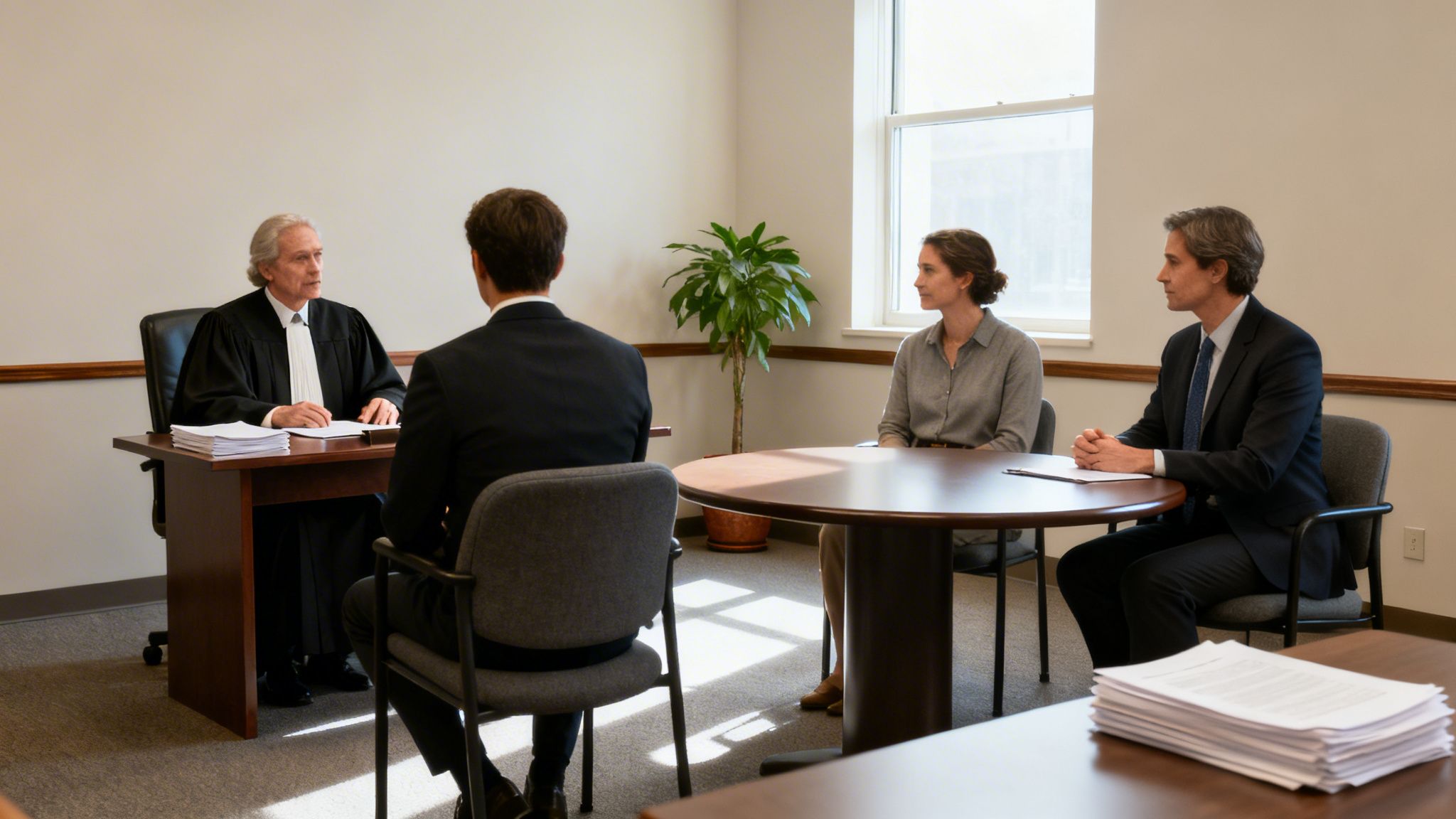
A settlement conference is one of the most important steps in your family law case—a mandatory meeting designed to get you and the other party to find a resolution without going to trial. Think of it as a guided, high-stakes negotiation with a judge acting as an expert referee. This is your chance to settle big issues like parenting time, property division, or support payments with the help of your divorce lawyer in Brampton, ultimately saving you money, reducing conflict, and giving you far more control over the final outcome.

Four people, including a judge or mediator, in a settlement conference room discussing documents.

Understanding the Settlement Conference in Ontario Family Law

When you’re navigating a separation or divorce in Ontario, the court system can feel like a maze. The process includes several required steps to keep cases moving fairly and efficiently, and one of the most critical milestones is the settlement conference. This process is governed by the Family Law Act and the Family Law Rules in Canada, ensuring a structured approach to resolving disputes.

This isn't a trial where a judge bangs a gavel and makes a final ruling. Far from it. This is a formal but private meeting where a judge acts as a neutral facilitator. Their one and only goal is to help you and the other party find enough common ground to reach a mutually acceptable agreement on some, or even all, of your outstanding issues.

The Judge's Role as a Facilitator

The judge’s job here is to offer an experienced, third-party perspective on your case. They will have read the materials filed by both sides, and they’ll give you their candid opinion on what would likely happen if your case went all the way to trial. This "reality check" is often the most valuable part of the day, helping both parties step back and see their positions more objectively.

A key thing to remember is that the judge at the settlement conference is there to guide you, not decide for you. Their insights come from seeing hundreds of cases just like yours, giving them a unique ability to point out the strengths and weaknesses in each side's arguments.

Key Issues Addressed in a Conference

Family law disputes can touch every part of your life, from your finances to your relationship with your children. A settlement conference is the perfect setting to negotiate these sensitive topics. A skilled family lawyer in Brampton will help you focus on resolving the core issues, such as:

  • Parenting Time and Decision-Making: Hammering out the schedules and responsibilities for your children, always with their best interests as the primary focus, as required by Canadian family law.

  • Child and Spousal Support: Calculating fair financial support based on legal guidelines and your family's specific circumstances.

  • Division of Property: Equitably dividing the assets and debts you accumulated during the marriage, including the all-important matrimonial home.

In Ontario's incredibly busy family courts, this step is more than just a formality—it works. In fact, data has shown that settlement conferences successfully resolved 21% of cases, highlighting just how crucial they are in helping families find a way forward without the immense stress and expense of a trial.

Successfully settling these matters gives you a clear, legally binding agreement so you can finally move on. For a deeper dive into the first steps of the process, you might find our guide on how to get a divorce in Canada helpful. Getting advice from a divorce lawyer in Brampton early on is the best way to make sure you walk into this critical meeting fully prepared.

The True Purpose and Goals of the Conference

Let's clear up a common misconception. While the name says "settle," the purpose of a settlement conference is much broader than just signing an agreement on the spot. Think of it as a strategic, judge-led meeting designed to break through the gridlock that keeps families stuck in expensive, draining court battles.

Its primary goal is to create a structured, off-the-record space for a candid conversation about how to resolve your case.

This is a world away from a trial. At trial, a judge hears evidence and imposes a final, binding decision on your family. In a settlement conference, the judge’s role is completely different. They act as a facilitator and guide—not a final decision-maker. Their job is to offer a neutral, expert opinion on how a trial might play out, pushing both sides toward a reasonable compromise.

Narrowing the Issues in Dispute

One of the most valuable things that happens in a settlement conference is narrowing the scope of the conflict. Even if you can’t solve the whole puzzle, you can often put a few key pieces in place.

For example, you might not agree on spousal support, but you might be able to agree on the value of the family home or a specific holiday schedule for the kids. By getting these smaller items off the table, you simplify the entire case. This saves a mountain of time and legal fees, ensuring that if you do end up at trial, it’s only to fight over the one or two core issues that truly need a judge’s ruling. This is precisely why a sharp divorce lawyer in Brampton will tell you how critical this step is.

The judge’s insight is like getting a sneak peek at how a court might view your case. This "reality check" can be powerful, often prompting both sides to reconsider entrenched positions and move closer to a fair agreement, empowering you to maintain control over the outcome.

Ensuring Full Financial Disclosure

Another critical function of the conference is to act as a financial checkpoint. Under Ontario’s Family Law Act, full and frank financial disclosure isn't optional—it's mandatory. This meeting is where the judge ensures everyone has laid their cards on the table.

The judge will confirm that all essential documents have been exchanged, such as:

  • Proof of income (pay stubs, tax returns)

  • Bank and investment account statements

  • Property valuations

  • Credit card and loan statements

If one side is holding back information, the judge can make a direct order compelling them to produce it. This ensures no one is negotiating in the dark and is the absolute bedrock of any fair settlement.

Finally, the conference is about exploring every possible path to resolution. This could mean brainstorming creative solutions you hadn’t considered or talking through different settlement proposals. For anyone weighing their options, understanding the massive difference between a negotiated settlement and a court battle is crucial. You can learn more about how these paths diverge in our article on contested vs. uncontested divorce.

Ultimately, the conference helps you and your family lawyer in Brampton map out the most efficient and effective way forward for your family.

How to Prepare for Your Settlement Conference

Success in a settlement conference isn't about luck—it's a direct result of meticulous preparation. Walking into that meeting unprepared is like trying to navigate a new city without a map. You'll get lost, fast. By taking deliberate steps beforehand, you and your family lawyer in Brampton can build a strong, clear, and persuasive case for your desired outcome.

The cornerstone of this preparation is your Settlement Conference Brief (Form 17C). This is, without a doubt, one of the most important documents you will file in your entire case. It's your formal opportunity to tell your story to the judge, outline the history of the dispute, clearly state what's left to resolve, and—most importantly—present your formal Offer to Settle.

Mastering the Settlement Conference Brief

Think of the brief as the judge’s roadmap to your case. A well-organized, compelling brief allows the judge to quickly grasp the core of the conflict and the reasonableness of your position before you even step into the room.

Your brief must include several key parts:

  • A Summary of the Issues: A clean, concise overview of what you've already agreed on and what's still in dispute.

  • Your Proposed Solutions: This is where you get specific. You'll detail your proposal for resolving each outstanding issue, whether it’s parenting time, property division, or something else.

  • Updated Financial Statements: Complete and accurate financial disclosure is non-negotiable. For a detailed breakdown, you can learn more about the Form 13.1 Financial Statement in our guide.

  • A Formal Offer to Settle: This is a crucial strategic document detailing the exact terms under which you are willing to resolve the entire case.

Filing this document on time is absolutely critical. Missing the court-mandated deadline can lead to cost penalties or even force the conference to be rescheduled, causing unnecessary delays and expenses.

Developing Your Negotiation Strategy

Beyond the paperwork, effective preparation means working closely with your divorce lawyer in Brampton to develop a clear and realistic negotiation strategy. This isn't about just showing up; it's about going into the conference with a firm understanding of your goals and your limits.

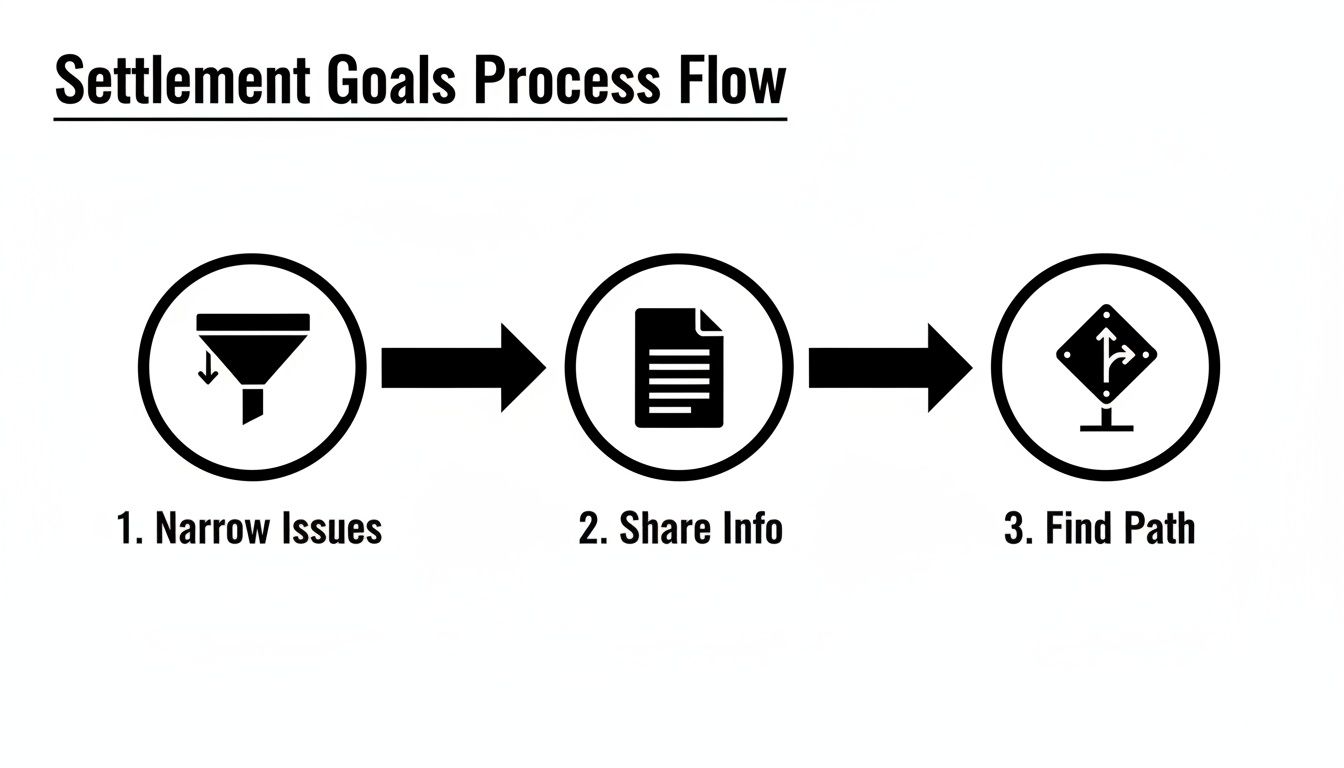
This infographic shows the fundamental goals of the settlement process.

A flowchart illustrates three steps for settlement goals: Narrow Issues, Share Info, and Find Path.

As you can see, success comes from a structured approach: focus the dispute, ensure everyone has the right information, and then work together to find a path forward.

Before the conference, you and your lawyer should define three key settlement positions:

  1. Your Ideal Outcome (Best-Case Scenario): This is the opening position you will aim for.

  2. Your Acceptable Middle Ground: A reasonable compromise you are willing to consider.

  3. Your Bottom Line (Worst-Case Scenario): The absolute minimum you will accept before deciding to proceed to trial.

Knowing these three positions empowers you to negotiate from a place of strength and confidence. It prevents you from making reactive decisions under pressure and ensures any agreement you make aligns with your fundamental needs.

Ultimately, thorough preparation demystifies the entire process. It reduces anxiety and significantly increases the odds of achieving a fair and lasting resolution at your settlement conference.

Pros and Cons of a Settlement Conference

Heading to a settlement conference can bring a mix of hope and apprehension. While these conferences are a powerful tool for resolving your case, it's wise to enter with a balanced perspective. Understanding the potential upsides and downsides helps you and your divorce lawyer in Brampton set realistic goals and make clear-headed decisions.

The Pros: Clear Advantages of Settling

The benefits are significant, primarily saving you time, money, and emotional energy. A successful conference can conclude months or years of legal battles in a single day, allowing you to avoid the immense stress and expense of a full trial.

  • Cost and Time Savings: A trial is an incredibly expensive and slow process. Settling here means you avoid staggering legal fees, expert witness costs, and days spent in a courtroom.

  • Reduced Emotional Strain: The constant conflict of a trial takes a serious toll on you and your family. A settlement provides closure and allows everyone to move forward.

  • You Control the Outcome: In a trial, a judge makes the final decision. Here, you and the other party are in control, allowing for creative and personalized solutions that fit your family’s unique needs.

  • Priceless Judicial Insight: You get a rare chance to hear a judge’s honest, off-the-record take on your case. This feedback is invaluable, whether you settle that day or not.

The Cons: Potential Drawbacks and Risks

Of course, the process isn't perfect, and there are potential downsides. Knowing these risks helps you avoid disappointment and ensures you aren't pressured into an unfair compromise. A sharp family lawyer in Brampton will be your safeguard against these possibilities.

  • No Guaranteed Resolution: Despite best efforts, a settlement isn't guaranteed. If you can't reach an agreement, you'll have spent time and money on a meeting that didn't end the dispute.

  • Pressure to Settle: The environment is geared toward compromise, which can sometimes create intense pressure to accept an offer that feels unfair or falls short of your needs.

  • Emotional Burnout: The day can be long and emotionally draining. Fatigue can cloud your judgment when making critical decisions.

A settlement conference is a strategic fork in the road. It provides an excellent off-ramp from the lengthy and expensive highway of litigation, but only if the destination is fair and acceptable to you. Never feel forced to take an exit that doesn't lead where you need to go.

Effective Strategies for a Settlement Conference

Showing up to your settlement conference with a skilled legal advocate is like bringing a seasoned guide on a tough expedition. An experienced divorce lawyer in Brampton does more than just file paperwork; they come armed with specific, proven strategies designed to protect your interests and steer the negotiations toward a resolution in your favour.

A core strategy is shifting from positional bargaining ("I want the house") to interest-based negotiation ("I need the house for the children's stability"). This approach uncovers the real needs driving both sides, often revealing creative solutions that break through deadlocks.

The Power of the Offer to Settle

One of the most powerful tools is the formal Offer to Settle, submitted with your conference brief. This is a strategic legal move with serious weight under Ontario's Family Law Rules. A well-crafted offer clearly lays out a reasonable solution and creates significant cost consequences for the other party if they unreasonably reject it and fail to get a better result at trial.

An Offer to Settle is a calculated move that turns the tables. It's not a sign of weakness; it's a demonstration of reasonableness that puts the financial risk squarely on the other party if they choose to drag out the conflict.

Leveraging Judicial Feedback and Strategic Concessions

Throughout the conference, the judge will give candid feedback. An astute family lawyer in Brampton knows how to use these insights to your advantage. If the judge hints your position is strong, your lawyer will press that advantage. If the judge raises a concern, your lawyer will know how to pivot. Part of this involves making calculated concessions on lower-priority issues to build goodwill and encourage reciprocation on what matters most to you.

For those just starting this journey, understanding what to expect from an initial meeting is key. You can learn more by reading our guide on what happens during a free divorce lawyer consultation. This expert guidance ensures that every move made during the conference is deliberate and aimed at achieving your best possible outcome.

What Happens After the Conference Ends

The meeting is over, the discussions have ended, and you’re walking out of the courthouse. So, what’s next? The path forward now splits into two very different tracks, and it all depends on what happened inside that conference room—whether you managed to reach a full agreement, a partial one, or no deal at all.

Close-up of two professionals shaking hands over a contract, signifying a successful business agreement.

If You Reach an Agreement

This is the best-case scenario. When you and the other party successfully resolve all the outstanding issues, your divorce lawyer in Brampton immediately shifts gears to make that agreement official and legally binding. A handshake deal isn't enough; it needs to be properly documented and filed with the court.

This usually happens in two main steps:

  • Minutes of Settlement: This is the document often drafted right there at the courthouse while the terms are fresh in everyone’s mind. It lays out everything you agreed upon. Both you and the other party (and your lawyers) sign it, and it's filed with the court.

  • Consent Order: The terms from those Minutes of Settlement are then converted into a formal Consent Order. A judge signs this document, transforming your private agreement into a powerful, legally enforceable court order.

A signed agreement provides finality. Once it’s turned into a court order, it carries the full weight of the law. This ensures both sides must follow the terms you negotiated, bringing the dispute to an official close.

To get a clearer picture of this final step, you can learn more about what a consent order is and see how it cements your settlement into law.

If No Agreement Is Reached

Don’t lose hope if you can't solve every single issue. A settlement conference is almost never a waste of time. Even reaching a partial agreement is a win because it narrows down the list of things you still have to fight about in court.

For any issues that remain unresolved, the judge will set the schedule for the next phase of the court process. This typically includes:

  1. A Trial Management Conference: This is another meeting, but its purpose is purely logistical. You'll plan out the details of a trial, like scheduling witnesses and confirming what evidence will be presented.

  2. Trial: If a settlement just isn't possible, the remaining issues will ultimately be decided by a judge at a formal trial.

Even without a full resolution, the conference forces both sides to put their cards on the table. It clarifies everyone's position and gives your family lawyer in Brampton invaluable insight into the other party’s case—all of which is critical for trial preparation.

Frequently Asked Questions

When you're heading into a settlement conference, it's natural to have a lot of questions. Here are some straightforward answers to the most common ones we hear from our clients in Brampton.

Is a Settlement Conference Mandatory in Ontario?

Yes, for most contested family law cases, it absolutely is. Before you can even get a date for a trial, the court system in Ontario requires you to go through a settlement conference. Think of it as a mandatory, structured opportunity for you and your spouse to resolve your issues with the guidance of a judge and an experienced family lawyer in Brampton. The goal is to avoid the cost and stress of a trial if at all possible.

Can the Judge at the Settlement Conference Make a Final Decision?

No, and this is a critical point to understand. The judge's role at a settlement conference is to be a guide, not a final decision-maker. They'll listen to both sides, offer their experienced opinion on the likely outcome at trial, and help facilitate a productive discussion. However, they cannot impose a final, binding order on any contested issue unless both you and your spouse agree to it. To ensure fairness, the judge who oversees your settlement conference will never be the same judge who would preside over your trial if your case doesn't settle.

What if We Don’t Settle at the Conference?

Don't worry, this happens all the time. If you can't reach a full agreement, the conference is still incredibly valuable. The judge will make a note of any progress you made, which often helps narrow down the list of issues that actually need to go to trial. From there, the judge will set dates for the next steps in your case, which is usually a Trial Management Conference. A divorce lawyer in Brampton can walk you through what comes next and how to prepare.


Navigating a settlement conference successfully requires a clear strategy and strong, experienced advocacy. If you still have questions about what a settlement conference is or need clear guidance on your family law matter, the team at Badesha Law is here to help. We bring the expertise needed to protect your interests and work toward a fair, lasting resolution.

Contact us for a consultation at https://badeshalaw.ca.

Contested vs Uncontested Divorce: Which Path Is Right for You in Ontario?

When you're facing the end of a marriage in Ontario, the first and most important choice you'll make is whether to pursue a contested vs uncontested divorce. This isn't just a legal distinction; it's a decision that sets the entire tone for your future, impacting everything from your finances to your emotional well-being.

An uncontested divorce is the collaborative route. It’s possible only when both you and your spouse agree on every single issue, making it a faster, more private, and far less expensive process. A contested divorce, on the other hand, is what happens when even one issue remains unresolved. At that point, the court system has to step in to make the final decisions for you. Understanding the implications of each path is critical, and the guidance of an experienced Brampton divorce lawyer from a firm like Badesha Law can be invaluable.

Defining Your Path: Contested vs Uncontested Divorce

Navigating the end of a marriage is a journey, and that first choice between a contested or uncontested divorce determines the map you'll follow. It’s a decision between two profoundly different paths, each with its own timeline, emotional toll, and financial cost.

A divorce is much more than just the legal end of a marriage. Under Canada's federal Divorce Act and Ontario’s provincial Family Law Act, it requires you to formally resolve several deeply personal and interconnected issues:

  • Parenting Time and Decision-Making Responsibility: This is what used to be called custody. It lays out how you'll divide your children's time and who will make the major decisions about their health, education, and well-being.

  • Child and Spousal Support: These are the financial obligations one spouse might have to the other, both for themselves and for the children, calculated according to federal and provincial guidelines.

  • Property Division: This involves the equal division of all assets and debts you both accumulated during the marriage, including the family's matrimonial home, as mandated by the Family Law Act.

The path you take hinges entirely on whether you and your spouse can settle these matters yourselves, without a judge needing to intervene. An experienced Brampton divorce lawyer can provide the strategic guidance you need, whether that means skilled negotiation to find common ground or strong advocacy in a courtroom.

Before we go deeper, it’s also useful to understand the difference between legal separation and divorce, as they are two distinct legal concepts.

At a Glance: Comparing Divorce Paths in Ontario

When you're trying to figure out which path makes sense for your family, seeing the core differences side-by-side can make things much clearer.

This table cuts through the legal jargon to give you a straightforward summary of what to expect from each process.

Factor Uncontested Divorce Contested Divorce
Agreement Level Full agreement on all issues (property, support, parenting). Disagreement on at least one major issue.
Court Involvement Minimal; primarily for administrative approval of the divorce order. Extensive; involves conferences, motions, and possibly a trial.
Key Document A signed Separation Agreement is the foundation. Court Application (Form 8) initiates the process.
Control Over Outcome Spouses retain full control over the final terms. A judge makes the final, binding decisions.
Typical Timeline Usually 4-6 months after filing, pending court processing. Can take 1.5 to 3+ years to resolve through the court system.
Emotional Stress Significantly lower due to the cooperative nature of the process. High, as the process is adversarial and often prolonged.

Ultimately, the choice comes down to control. The uncontested path keeps the power in your hands, but it requires cooperation. The contested route provides a formal structure for resolving conflict, but it comes at a much higher price—financially, emotionally, and in terms of time.

The Uncontested Divorce Process in Ontario

The uncontested divorce is all about reaching an agreement and choosing an efficient, peaceful path forward. While it’s far simpler than a contested divorce, it’s still a formal legal process that demands careful attention to meet the court’s strict requirements. The goal is to take your mutual understanding and turn it into legally solid documents the court will accept.

Two people review and sign a 'Separation Agreement' document with a lawyer's guidance.

This entire process hinges on one single document: the Separation Agreement. This isn't just a handshake deal; it's a comprehensive, legally binding contract that spells out exactly how you and your spouse have settled every issue. It has to be drafted with precision to be enforceable under Ontario's Family Law Act.

At Badesha Law, this is often where our work begins. We help clients negotiate and draft Separation Agreements that are clear, fair, and legally sound. This crucial step makes sure all the terms you’ve agreed on—from property division to parenting plans—are formally documented, leaving no room for future fights.

Key Steps in the Uncontested Process

Once the Separation Agreement is signed and witnessed, the court filing can begin. This part of the journey is mostly administrative, following a clear set of steps designed to prove to the court that all legal boxes have been ticked. Having a lawyer’s oversight here is invaluable to avoid common mistakes that can cause major delays.

The main steps look like this:

  1. Drafting and Filing the Application: The process kicks off by preparing a Form 8A: Application (Divorce). This document officially asks the court to grant your divorce and is filed along with your original marriage certificate.

  2. Completing the Affidavit for Divorce: Both spouses (in a joint application) or just the filing spouse (in a sole application) must complete a Form 36: Affidavit for Divorce. This is a sworn statement confirming details about the marriage, separation, and any children, proving all issues are resolved.

  3. Preparing the Draft Divorce Order: Your lawyer will prepare a Form 25A: Divorce Order, which is the final document a judge will sign to officially end your marriage.

  4. Clerk’s Certificate and Court Review: The court clerk checks all your documents to make sure they're complete and correct. If everything is in order, they issue a certificate, and the file goes to a judge for a final review and signature.

The whole point of an uncontested divorce is to show the court there's nothing left for a judge to decide. A well-drafted Separation Agreement and accurately completed court forms provide that proof, turning a complicated legal matter into a predictable, administrative task.

Avoiding Common Filing Pitfalls

A lot of people ask about getting a divorce without a lawyer. While it's technically possible, the administrative hurdles can be surprisingly tough. Simple mistakes on forms, incorrect filing procedures, or a poorly written Separation Agreement can cause the court to reject your application, forcing you to start all over again.

A lawyer ensures all your paperwork is filed correctly the first time. That professional oversight is what keeps the uncontested process smooth and efficient, giving you peace of mind and letting you focus on moving forward with your life.

Navigating the Contested Divorce Court System

When communication breaks down and a mutual agreement is completely off the table, your divorce moves out of your hands and into the formal court system. This path, known as a contested divorce, is a world away from the simple administrative process of an uncontested case. Instead of working together to decide your own future, you’re asking a judge to make legally binding decisions for you and your family.

Two lawyers, a distressed woman and a man, discuss documents outside Judge's Chambers in a court hallway.

The journey doesn't start with a collaborative Separation Agreement. It kicks off with filing a Form 8: Application with the court, a document that officially launches the litigation process. This form lays out your claims on everything from parenting and support to how you want to divide your property. From this moment on, the process is structured, adversarial, and dictated by strict court rules and deadlines.

This is precisely where having an experienced Brampton divorce lawyer becomes non-negotiable. At Badesha Law, our job is to protect your rights at every turn, manage the complex procedures, and advocate fiercely for your best interests in a formal court setting.

The Stages of Litigation in Ontario

A contested divorce isn't a single event; it's a series of mandatory steps designed to organize information, push for a settlement, and, if all else fails, get the case ready for a judge’s final decision. Each step has a very specific purpose in moving your case along the court’s conveyor belt.

Here are the key court appearances you'll go through:

  • First Appearance: This is a brief, administrative meeting to set dates and make sure all the initial documents have been filed correctly. It's more about logistics than anything else.

  • Case Conference: This is the first major step where you, your lawyers, and a judge sit down to discuss the unresolved issues. The judge's role here is to see where you agree, narrow down the points of conflict, and give both sides some frank feedback on the strengths and weaknesses of their positions. The real goal is to get you to settle before the costs spiral out of control.

  • Settlement Conference: If you still can't agree after the Case Conference, you'll head to a Settlement Conference with a different judge. This is a much more intensive push to resolve the case without a trial. The judge will be more direct, often giving a strong opinion on how the case would likely end at trial to encourage both of you to find a middle ground.

  • Trial Management Conference: If a settlement is still out of reach, this conference is all about planning the trial itself. You’ll deal with the logistics—who the witnesses will be, what evidence will be presented, and how the schedule will run.

The Critical Role of Financial Disclosure

At the heart of almost every contested divorce is the process of financial disclosure. Under Ontario's Family Law Rules, both you and your spouse have an absolute legal duty to provide complete and honest information about your income, assets, and debts. This is done by completing a detailed Financial Statement (Form 13 or 13.1).

This stage is often where things get heated. Disputes explode when one spouse suspects the other is hiding assets, deliberately undervaluing a business, or not being truthful about their income. These fights can lead to formal requests for more documents, questioning under oath (called examinations), and motions asking the court to force the other side to hand over information.

In a contested divorce, financial transparency isn’t optional—it’s a legal command. Failing to provide full and frank disclosure can lead to serious penalties from the court, including being ordered to pay the other party's legal costs.

This is exactly why the process takes so much longer and costs so much more. Every single disagreement chews up lawyer time, requires court filings, and might even need expensive expert reports, all of which get added to the final bill. The adversarial nature of litigation can also poison any future co-parenting relationship, making it incredibly difficult to work together down the road. For more insights, you can explore some strategies for managing conflict in a contested divorce.

A skilled lawyer can help you navigate these high-stakes conflicts while never losing sight of the main goal: reaching a fair and final resolution.

Comparing Timelines: How Long Each Divorce Takes

One of the first, most urgent questions people ask when they start this process is, "How long is this all going to take?" The answer hinges almost entirely on whether your divorce is contested or uncontested. This timeline isn't just about patience; it directly hits your finances and your emotional health as you wait to move on with your life.

An uncontested divorce in Ontario moves along a fairly predictable track. Once you’ve signed a Separation Agreement and all the right paperwork is filed, the process is mostly administrative. You can generally expect the final Divorce Order in about 4 to 6 months. The biggest variable is simply how backed up the court is at that moment.

A contested divorce, on the other hand, isn't measured in months—it's measured in years. The journey through the Ontario court system is a long haul, filled with mandatory steps that create huge delays. A contested case can easily stretch from 1.5 to over 3 years from the day you file to the day you get a final resolution.

Factors That Extend Contested Divorce Timelines

The dramatic difference in timing is baked right into the court system itself. These long delays aren't just a possibility in litigation; they're an expected part of the process.

Here are the key sources of delay:

  • Court Backlogs: Ontario's family courts are overloaded. This means you can be left waiting for months just to get your next scheduled date, whether it's for a Case Conference or a Settlement Conference.

  • Scheduling Conflicts: Trying to line up the calendars of two lawyers, both spouses, and a judge for multiple court dates is a logistical nightmare that can add months of waiting.

  • The Lengthy Discovery Process: The process of gathering and exchanging financial documents is a major bottleneck. If one person is being uncooperative or is suspected of hiding assets, motions have to be filed to force them to produce the information, adding even more delays and legal fees.

  • Expert Valuations: When you’re dealing with assets like a family business or complex investment portfolios, getting professional valuations can take many months to complete.

The timeline is a direct reflection of conflict. In an uncontested divorce, the work is done upfront through negotiation. In a contested divorce, the work unfolds over years of court procedures, with each disagreement acting as another roadblock.

A Look at Timelines Elsewhere

This massive time gap isn't unique to Ontario. Take California, for instance, where contested divorces take dramatically longer than uncontested ones—averaging 12-18 months versus 6-8 months. This is due to mandatory waiting periods plus the time it takes to fight over custody, property, or support. If you add in a complex child custody battle, you can tack on another 6-12 months, pushing some cases to last 1-3 years.

Understanding these realistic timeframes is crucial. A Brampton divorce lawyer can give you a more personalized estimate based on the specifics of your situation. For a deeper dive into what affects timelines in our province, check out our guide on how long a divorce takes in Ontario. At Badesha Law, we make sure our clients understand these timelines from the start so they can weigh their priorities and make informed decisions.

The Financial Reality: A Detailed Cost Analysis

For most people starting the divorce process, the biggest question is simple: what’s this going to cost? It's the most pressing concern, and the answer depends almost entirely on the path you choose. Deciding between a contested and an uncontested divorce isn't just a legal choice—it's a financial one with radically different consequences for your bank account.

The route you take will determine whether your costs are predictable and manageable, or a source of constant, escalating stress.

An uncontested divorce is all about financial clarity. Because you and your spouse resolve every single issue in a Separation Agreement before anything is filed with the court, the legal work is precise and contained. This allows a Brampton divorce lawyer to handle the entire process for a flat-rate fee, covering the expert drafting of your agreement and the filing of all the necessary court forms.

This approach gives you certainty from day one. At Badesha Law, we believe in that transparency. Our clients know the full cost upfront, turning a potentially stressful legal process into a smart, efficient investment in a peaceful resolution.

The Predictable Costs of an Uncontested Divorce

With an uncontested divorce, you can actually budget for the end of your marriage. There are no surprise invoices or spiralling legal bills from drawn-out court battles.

Your main expenses are straightforward and known from the start:

  • Lawyer's Fees: Usually a flat rate to draft a rock-solid Separation Agreement and manage the court filing process from start to finish. This fee covers the legal expertise needed to ensure your agreement is airtight and your paperwork is perfect.

  • Court Filing Fees: These are standard administrative fees charged by the Ontario court system to process your divorce application.

  • Disbursements: These are minor out-of-pocket costs for things like couriers or postage.

Think of it this way: an uncontested divorce lets you purchase a result—a finalized divorce for a known price. A contested divorce means you’re purchasing a process—a series of legal battles with no guaranteed outcome and an unknown final cost.

The Escalating Costs of a Contested Divorce

The financial world of a contested divorce is the polar opposite: it's built on unpredictability. The costs aren't fixed because they’re tied directly to the amount of conflict and the time it takes to resolve it. Legal services are billed by the hour, which means every single phone call, email, and court appearance adds to your final bill.

These costs can spiral out of control, and fast. While every case is unique to Ontario, data from other jurisdictions shows a stark contrast. In California, for example, an uncontested divorce might cost under $10,000, while litigated battles frequently soar to $20,000, $50,000, or much more. The driver is simple: minimal court time and lawyer hours are needed when a settlement is reached without a fight. You can read more about these cost comparisons on westcoastdivorce.com.

In a contested Ontario case, the sources of these high costs are numerous and they compound over time. Prolonged litigation introduces expenses that simply don’t exist in an uncontested file, like fees for financial experts, property appraisers, and bringing motions for temporary court orders.

For a comprehensive breakdown of what to expect financially, take a look at our detailed guide on understanding Ontario divorce costs. Choosing the uncontested path isn't just about saving money in the short term; it’s about protecting your entire financial future from the immense risks of a court battle.

How to Choose the Right Path for Your Situation

Deciding between a contested and an uncontested divorce is the first, and most significant, choice you'll make on this journey. The right path isn't about which one is "better"—it's about which one is right for your specific circumstances, your communication style, and your family's future.

The decision tree below maps out the primary trade-off, showing how your choice will directly impact your financial reality.

Decision tree flow chart outlining divorce choices, costs, and processes for uncontested versus contested cases.

As the chart makes clear, the uncontested path gives you financial predictability. The contested route, on the other hand, introduces significant and often escalating costs. This financial truth should be a central factor in your decision.

When an Uncontested Divorce Is the Best Fit

An uncontested divorce is the ideal path forward when you and your spouse can still operate from a foundation of mutual respect and a genuine commitment to fairness. This approach works best when:

  • You can communicate effectively: You are both capable of having productive, even if difficult, conversations about your finances and children.

  • There is mutual trust: You both believe the other will provide full and honest financial disclosure without being forced to by a court.

  • You agree on the major issues: While you may need to negotiate the fine print, you are aligned on the big picture for property division, support, and a co-parenting plan.

In Ontario, there is a strong preference for resolving matters amicably. Although specific data for Ontario is collected, experiences from places like California reveal that almost 90% of divorces end up being uncontested. This indicates that many couples manage to reach an agreement without enduring a lengthy court dispute, helping to preserve assets and protect children from extended conflict.

When a Contested Divorce Is Unavoidable

Sometimes, collaboration just isn't possible or safe. A contested divorce then becomes a necessary measure to protect your rights and ensure a just outcome under the law. This path is often required in situations involving:

  • A refusal to negotiate: One spouse is completely unwilling to communicate, compromise, or participate in the process in good faith.

  • Significant power imbalances or abuse: If there is a history of domestic violence, coercion, or financial control, the formal structure of the court system provides essential protection.

  • Hidden assets or financial dishonesty: If you suspect your spouse is hiding money or misrepresenting their income, the formal discovery process in a contested divorce is the only tool to uncover the truth.

Pursuing a fair settlement should always be the starting point. However, when faced with a spouse who refuses to be reasonable or transparent, litigation becomes your tool for ensuring fairness under the law.

At Badesha Law, we provide the strategic advice you need to make this crucial choice. As your Brampton divorce lawyer, we can act as skilled negotiators to secure a peaceful settlement or as determined litigators to fight for your rights in court. We are fully equipped to guide you down the path that best protects your future. Schedule a consultation today to create a clear, strategic plan.

Frequently Asked Questions

When you're trying to figure out the difference between a contested vs. uncontested divorce, a lot of specific questions come up. Here are some clear, straightforward answers to the queries we hear most often, grounded in the realities of Ontario's family law system.

Can a Contested Divorce Become Uncontested?

Yes, absolutely. In fact, this is a very common and welcome outcome. A divorce might kick off as contested because of some initial, heated disagreements, but it can settle through negotiation at any point before you find yourself in a trial.

The court system actually encourages this. Steps like Case Conferences are specifically designed to push both sides toward a resolution. A sharp Brampton divorce lawyer knows how to use these mandatory meetings to bring a reluctant spouse to the table. When you successfully resolve those sticking points mid-process, you can switch gears and finalize everything as an uncontested divorce, saving an enormous amount of time and money.

What if We Only Disagree on One Issue?

Even if you and your spouse are stuck on just one significant point—like the final number for spousal support or a particular detail in the parenting schedule—your divorce is technically considered contested.

But that doesn't automatically mean you're doomed to a long, drawn-out court battle. Instead, you can use targeted strategies like mediation or focused lawyer-to-lawyer negotiations to attack that single issue. Once you reach an agreement and get it down in writing, the rest of the divorce can move forward on a simple, uncontested basis. It’s all about containing the conflict and the costs.

The goal is to isolate the disagreement and resolve it efficiently. A single dispute doesn't have to derail the entire process if handled strategically.

Is a Lawyer Necessary for an Uncontested Divorce?

While it’s not legally mandatory in Ontario, trying to handle an uncontested divorce without a lawyer is a risky move. A family lawyer’s real value is in drafting a Separation Agreement that is ironclad, legally binding, and fully protects your rights under the Family Law Act.

Beyond that, a lawyer manages the entire court filing process. It’s a minefield of technical rules, and simple errors on the forms can get your application rejected or cause months of delays. A firm like Badesha Law handles these details efficiently—often for a transparent flat fee—which gives you invaluable peace of mind.

What Is a Separation Agreement and Why Do I Need One?

Think of a Separation Agreement as the master blueprint for your post-marriage life. It’s a comprehensive, legally binding contract that spells out exactly how you and your spouse have agreed to untangle your lives. It covers everything:

  • Division of property and debts

  • Child and spousal support arrangements

  • Parenting time and decision-making responsibility

In Ontario, having a signed Separation Agreement is the absolute cornerstone of an uncontested divorce. It acts as definitive proof for the court that all issues are settled, which allows a judge to grant the divorce order without getting involved in your personal affairs.


Understanding the nuances of a contested vs. uncontested divorce is the first step toward a resolution that protects your future. The experienced team at Badesha Law is ready to provide the clear, strategic guidance you need, whether you are aiming for an amicable agreement or require strong advocacy in court. Contact us for a consultation to discuss your situation and create a plan to move forward with confidence.

Divorce Lawyer Consultation Free: Your Ontario Guide to Next Steps

Facing a separation can feel like trying to navigate a maze in the dark. A free divorce lawyer consultation is often the first real light you'll find on that path. This initial meeting isn’t some sales pitch; it's a critical, strategic session designed to arm you with the knowledge you need to make smart decisions, all without any upfront financial commitment.

Why a Free Consultation Is Your Most Important First Step

A free consultation is your chance to turn overwhelming uncertainty into a clear, actionable plan. In this one meeting, you can get a solid, foundational understanding of your rights and obligations under Ontario's Family Law Act. It’s a completely confidential space to discuss sensitive issues and get a professional, objective assessment of your unique situation.

Think of it as getting a legal roadmap. Instead of guessing about what might happen, you get preliminary insights on the core issues of any separation, including:

  • Parenting Time and Decision-Making Responsibility: You'll learn the correct terminology and the legal standards that courts in Ontario actually use when it comes to children, as outlined in the Divorce Act and the Children's Law Reform Act.
  • Property Division: You can start to understand how assets and debts accumulated during the marriage, especially the matrimonial home, are typically divided under the equalization of net family property rules in Ontario.
  • Child and Spousal Support: You'll get a general idea of how support is calculated based on the Federal Child Support Guidelines and Spousal Support Advisory Guidelines and what factors a judge would consider in your case.

Gaining Clarity and Reducing Anxiety

The emotional toll of a separation is immense, and the fear of the unknown almost always makes it worse. A consultation demystifies the entire process, replacing that raw anxiety with a sense of clarity. You’ll walk away knowing what to expect, the potential next steps, and what common pitfalls to avoid.

This early guidance helps you steer clear of mistakes that can be incredibly costly and difficult to fix down the road. For example, simply knowing your rights regarding the matrimonial home under the Family Law Act can prevent you from moving out prematurely without first understanding the serious legal implications.

A free consultation is also a vital screening process. It lets you size up a lawyer’s communication style, their expertise, and their strategic thinking to see if they're the right fit for you and your family before you put any money down.

A Crucial Step in a Complex System

The family law system is intricate and emotionally charged. Even with divorce rates fluctuating in different regions, the volume of family law cases remains incredibly high. Take California, for instance—despite a recent drop in its divorce rate, its courts still handled roughly 4.5 million cases between 2022 and 2023, many of which were complex family law matters that would have benefited from early legal guidance. You can explore more about California's divorce rate trends and what they mean for legal needs.

This high volume just underscores the value of that initial consultation. It gives people a way to gauge their needs without an immediate financial burden—a model that firms like Badesha Law provide to clients across Brampton and the GTA to make sure they start off on the right foot.

How to Prepare for Your No-Cost Legal Consultation

To get the absolute most out of your free consultation, a bit of prep work goes a very long way. This isn’t about showing up with every single document you own or having all the answers. It’s about organizing your thoughts and key information so the lawyer can give you specific, meaningful insights right from the start.

Honestly, walking in with a clear summary allows for a much more productive chat. A simple step that makes a huge difference is jotting down a quick timeline of your relationship. You don’t need to write a novel—just a few key dates on a piece of paper can frame the entire conversation and give the lawyer immediate context.

Create a Simple Relationship Timeline

Start by listing the handful of dates that are legally significant under Canada's Divorce Act and Ontario's Family Law Act. This information helps a lawyer quickly get a handle on jurisdiction and important deadlines.

  • Date of Marriage: The official start of your legal union.
  • Date of Cohabitation: If you lived together before getting married, this date is crucial for property and sometimes support calculations.
  • Date of Separation: This is the day one of you decided the marriage was over and communicated it to the other—even if you were still living under the same roof. It’s a critical date.
  • Children's Birthdays: Just list the names and birthdates of any children from the relationship.

This simple timeline gives the lawyer an instant snapshot of your circumstances, letting them zero in on the issues that matter most to you.

Outline Your Financial Picture

Next, pull together a high-level overview of your family's finances. You don’t need exact figures down to the penny, but a general list of assets and debts is incredibly helpful.

I often see clients from Mississauga who just jot down notes about their shared home, their RRSPs, and a joint car loan before a meeting. This simple act allows me to offer specific initial thoughts on property division right away, turning confusion into a clear path forward.

This is the entire goal of your initial consultation: to move from a place of uncertainty to having a concrete plan.

A three-step process flow illustrating how to gain legal clarity: Uncertainty, Consultation, Plan.

As you can see, the consultation is the turning point where all that stress and confusion gets channelled into an actionable strategy.

To make this happen, try to list the major financial items, noting whether they are in your name, your spouse's name, or held jointly:

  • Assets: Real estate (like the matrimonial home), vehicles, bank accounts, investments (RRSPs, TFSAs), and pensions.
  • Debts: Mortgages, lines of credit, car loans, credit card balances, and any personal loans.

Gathering these key details beforehand will help your prospective lawyer provide the most relevant and helpful guidance during your free meeting.

Your Pre-Consultation Checklist

Information to Gather Examples and Why It Matters
Key Relationship Dates Marriage, cohabitation, and separation dates. This helps the lawyer instantly understand the legal framework and timelines for your case.
Children's Details Full names and birthdates. This is essential for discussing parenting arrangements, decision-making, and child support.
List of Major Assets The house, cars, bank accounts, RRSPs, pensions. A rough idea of value helps frame the conversation around property division.
List of Major Debts Mortgage, lines of credit, credit card debt. This gives a complete picture of the family's net worth and financial obligations.
Income Information Your and your spouse's approximate annual income. This is the starting point for any discussion about spousal or child support.
Top 3 Questions "Can I stay in the house?" "How is child support calculated?" "What are my rights?" Writing them down ensures you don't forget.

This preliminary list is just a starting point. For the more detailed breakdown required later, you can learn more about completing an official Form 13.1 Financial Statement in our comprehensive guide.

Key Takeaway: The goal isn't to create a perfect financial statement for your first meeting. It's to provide enough information for the lawyer to identify potential issues and explain how Ontario's property division laws might apply to your situation.

Finally, think about your main concerns and goals. Are you most worried about parenting arrangements, staying in the matrimonial home, or just understanding spousal support? Write down your top three questions. This ensures you leave the divorce lawyer consultation free of charge with answers that bring you peace of mind and a clear direction for what to do next.

Crucial Questions to Ask Your Potential Divorce Lawyer

That first consultation isn't just about you telling your story; it's a two-way interview. You're looking to hire a professional who will navigate you through one of the most stressful periods of your life, and finding the right fit is absolutely critical.

Sure, fees are important, but the best questions go much deeper. You need to understand a lawyer's strategy, their real-world experience, and how they communicate. This is your chance to see if their professional style actually lines up with what you need. Are you aiming for a quiet, collaborative separation, or do you know a tough fight is coming? The right lawyer will have a philosophy that matches your goals.

A person in a suit holds a checklist titled 'Questions to Ask' during a consultation.

Questions About Strategy and Experience

Don't be afraid to ask direct questions that show you how they think and operate, especially within the framework of Ontario's Family Law Act. Go beyond the basics.

  • "Based on what I’ve shared, what do you see as the biggest potential hurdle in my case?" This is a great test. It shows you if they were actually listening and can spot the key issues right away. Their answer will reveal whether they’ve grasped the unique details of your situation.
  • "What is your philosophy on mediation versus litigation?" A good family lawyer needs to be skilled at both negotiation and courtroom battles. Their answer tells you if they lean towards costly, aggressive tactics by default or if they prioritize finding collaborative, more affordable solutions first.
  • "How much experience do you have with cases like mine in the Brampton courthouse?" Local experience matters. A lot. A lawyer who knows the judges and specific procedures at the A. Grenville and William Davis Courthouse can give you far more practical and realistic advice.

These kinds of questions get past the surface-level facts and into strategic thinking, giving you a much clearer idea of what it would actually be like to have them on your side. Understanding their approach is a huge part of learning what a family lawyer in Ontario actually does and how they can best help you.

Questions About Communication and Logistics

The day-to-day practicalities of working with a lawyer are just as important as their legal skills. If your expectations around communication don't match up, it can lead to a ton of frustration down the road.

Your relationship with your divorce lawyer is a professional partnership. Clear communication, transparent billing, and a shared strategic vision are the cornerstones of a successful outcome.

Get on the same page from day one by asking these simple, direct questions:

  • "What is your preferred way to communicate, and what’s your policy on returning calls or emails?" This question sets clear boundaries and expectations for how and when you'll get updates.
  • "Who will be my main point of contact? Will I be working directly with you, or mostly with a paralegal or junior lawyer?" You need to know who is handling your file day-to-day. It’s essential for building trust and making sure nothing falls through the cracks.
  • "Can you walk me through your fee structure and billing in detail?" Don't just ask for the hourly rate. Ask about the initial retainer, when it needs to be topped up, and what other costs get billed (like photocopies or courier fees). This kind of transparency prevents nasty surprises on your invoice later.

By asking these crucial questions during your divorce lawyer consultation free of charge, you empower yourself to make a truly informed decision. You aren't just looking for any legal expert; you're looking for a trusted partner to help you move forward.

What Happens During and After the Consultation

A free consultation should feel like a safe harbour—a confidential space where you can finally get your bearings. When you connect with a firm like Badesha Law, our goal is to provide a no-pressure, informative session that helps you see a clear path forward.

During the meeting, the lawyer’s most important job is to listen. They'll go over the timeline and notes you’ve prepared, asking clarifying questions to get a complete picture of your life. From there, they can offer an initial assessment, pointing out the key issues that fall under Ontario's Family Law Act and explaining how the law might apply to your specific circumstances.

This entire conversation is protected by solicitor-client privilege. That means everything you say is completely confidential, whether you decide to hire the lawyer or not.

Reflecting on the Advice You Received

After you leave, take some time to let everything sink in. The objective isn't just to find a lawyer; it's to find the right lawyer for you.

Think about how the conversation felt. Did they explain complex legal ideas in a way that made sense? Did you feel heard and respected, or did they seem to dismiss your concerns? Trust your gut. A strong lawyer-client relationship is built on trust and communication, and if you felt rushed or pressured, that’s a major red flag. You should walk away feeling more informed and empowered, not more confused and anxious.

A critical part of this process is getting a handle on the potential costs. Vague answers about fees are a recipe for stress down the road. A trustworthy lawyer will be upfront about their retainer and how they bill for their time.

Understanding the Financial Big Picture

The financial reality of divorce is a huge source of anxiety for many people, which is what makes a free consultation so valuable. It’s your chance to get clarity on costs right from the start.

While every case is different, understanding the potential financial road ahead is crucial. The cost of a divorce can range from a few thousand dollars for a simple, uncontested case to six-figure sums for high-conflict battles over complex assets. A good consultation helps you understand what to expect and avoid the kind of financial surprises that can derail your life. For context on how divorce costs can escalate in contested cases, it’s clear why getting upfront clarity is so essential.

After your meeting, you should receive a clear explanation of the firm’s retainer agreement. This document outlines exactly what they will do for you and how their fees work. Read it carefully. Never sign anything you don't fully understand. If you're comfortable and ready to move forward, this is the final step before officially starting the divorce process in Ontario.

Taking the Next Steps in Brampton and the GTA

That first consultation is a huge step. You've gone from uncertainty to having a clear picture of the road ahead. Now, for those of us in Brampton, Mississauga, and across the GTA, it's time to shift gears from gathering information to taking real, practical action.

Your first move is to formally hire the lawyer you’ve chosen. This means signing a retainer agreement and providing the initial funds that allow them to officially represent you. Once that’s done, they can get to work immediately, often by sending the first formal communication to your spouse or their lawyer.

A laptop showing a map of the Greater Toronto area with a location pin in Brampton, next to a smartphone.

Beginning the Financial Disclosure Process

One of the most critical, non-negotiable next steps under Ontario law is financial disclosure. This is where you and your spouse exchange comprehensive financial statements, creating a complete and honest picture of your assets, debts, and income. It might sound tedious, but this transparency is the absolute foundation for negotiating everything from property division to support payments.

This isn't just paperwork; it's the bedrock of a fair settlement. Your lawyer will guide you through completing the necessary forms, helping you pull together key documents like:

  • Tax returns and recent pay stubs
  • Statements for bank and investment accounts
  • Property assessments and mortgage details
  • Pension valuations

Taking control of your future starts with these structured, necessary steps. From drafting a separation agreement to filing documents at the Brampton courthouse, each action moves you closer to resolution and a new beginning.

While the legal process can feel isolating, it helps to see the bigger picture. In California, for instance, the divorce rate has seen a steady decline, hitting 5.88 divorces per 1,000 women in 2022. For those of us here in the Greater Toronto Area facing these same challenges, numbers like these highlight why getting clear, early legal advice is so important. Without it, you risk getting stuck in drawn-out proceedings that drain you emotionally and financially. You can discover more insights about these divorce statistics to understand the broader context.

If you are ready to take control, the next step is straightforward. You can learn more about finding the right family law lawyer in Brampton to represent your interests. At Badesha Law, we offer a no-obligation, free consultation to provide the compassionate, clear guidance needed to navigate this transition with confidence.

Frequently Asked Questions

When you’re just starting to navigate a separation, it’s natural to have a lot of specific, pressing questions. Here are some straightforward answers to the most common things people ask about a divorce lawyer consultation free of charge in Ontario, designed to give you some much-needed clarity.

Is a Free Consultation with a Divorce Lawyer Really Confidential?

Yes, absolutely. In Ontario, any conversation you have with a lawyer for the purpose of getting legal advice is protected by what’s called solicitor-client privilege. This is a powerful legal shield that means everything you share is kept in the strictest confidence.

This protection kicks in the moment your consultation begins, and it doesn't matter whether you end up hiring that lawyer or not. It's a fundamental part of our legal system, creating a safe space for you to be completely honest about your situation without worrying about your words leaving the room.

Will I Get Real Legal Advice in a Free Consultation?

You’ll walk away with valuable legal information and a professional's initial take on your case. A lawyer can explain your rights and responsibilities under Ontario’s Family Law Act, sketch out some potential strategies, and talk about possible outcomes based on the details you've shared.

While this is definitely a form of legal advice, it's preliminary. A deep-dive legal opinion or the actual drafting of court documents would only happen after you formally hire the lawyer with a retainer agreement. Think of the free session as getting a clear, professional map of the road ahead.

Do I Need a Consultation if My Spouse and I Agree on Everything?

Even in the most amicable, uncontested divorce, getting a consultation is one of the smartest things you can do. A family lawyer can review your separation agreement to make sure it’s legally sound, fair, and covers all the bases required by Ontario law for things like property division and support.

A quick, professional check-up like this can prevent massive and expensive legal headaches down the road. A free consultation is the perfect, no-risk way to confirm you’ve covered everything before you finalize your agreement and file it with the court.

Having an expert eye on your agreement ensures its terms are actually enforceable and that you haven't accidentally missed a critical detail that could come back to haunt you later.

How Does a Free Consultation Help with a Foreign Divorce Opinion Letter?

A free consultation is the perfect starting point if you need to get a foreign divorce recognized here in Canada. It's your chance to explain the specifics—why you need the letter, whether it's for getting remarried, for immigration, or for some other official reason.

During this meeting, the lawyer can lay out the exact process. They'll tell you which documents you'll need from your home country, give you a realistic timeline, and explain the steps required to get your foreign divorce officially validated in Ontario. This initial chat turns a confusing, bureaucratic process into a clear, manageable plan.

For more in-depth answers, you might find what you're looking for on our comprehensive family law FAQ page, which covers a much wider range of topics.


At Badesha Law, we believe that clarity and confidence are the best tools you can have when facing a separation. We are committed to providing compassionate, practical guidance to help you move forward. If you are in Brampton or the GTA and ready to take the next step, schedule your free, no-obligation consultation with our experienced family law team today. https://badeshalaw.ca

Child Custody Ontario: A Modern Guide for Parents

When you're separating, one of the first things you'll notice is that the language around child custody in Ontario has changed. The law has moved away from confrontational terms like 'custody' and 'access.' Today, the focus is on parental responsibilities, not parental rights—a subtle but powerful shift designed to put your child’s well-being first.

Understanding How Ontario Defines Child Custody

A family reviewing a 'Parenting Plan' and 'Decision-Making Responsibility' document with a Canadian mug.

If you're starting this journey, getting comfortable with the new legal vocabulary is key. This isn't just a matter of semantics; it’s a fundamental change in how the courts approach parenting after a split. The goal is to lower the temperature and encourage parents to work as partners in raising their children.

This modern framework is consistent across both the federal Divorce Act (for married couples) and Ontario's Children’s Law Reform Act (which applies to all parents, including common-law and unmarried couples). This alignment ensures a uniform approach to parenting matters across the province.

The Two Pillars of Parenting Arrangements

The old, single concept of "custody" has been split into two distinct and equally vital parts. Getting this distinction right is the foundation for creating a clear, stable plan for your kids.

  • Decision-Making Responsibility: This is about who has the legal authority to make the big calls on your child’s upbringing—think major decisions about health care, education, and religious or spiritual life.
  • Parenting Time: This is simply the schedule outlining when your child is in each parent's care. During your parenting time, you're in charge of all the day-to-day decisions, from what’s for dinner to when homework gets done.

Think of it like this: decision-making is the "what" and "why" of your child’s life strategy, while parenting time is the "when" and "how" of daily life.

This legal shift emphasizes that parents have responsibilities toward their children, rather than rights over them. The entire system is built to answer one question: What is in the best interests of the child?

The terminology may have been updated, but the core concepts are what parents have always negotiated. The new language just provides a healthier framework for those discussions. To help clarify, here’s a quick reference for the change in terms that happened in 2021.

Old vs New Child Custody Terms in Ontario

Old Term (Pre-2021) New Term (Current Law) What It Means in Practice
Custody Decision-Making Responsibility The authority to make major decisions about a child's health, education, and religion.
Access Parenting Time The schedule of when the child is in each parent's care.
"Custodial Parent" Parent with Primary Care The parent with whom the child lives most of the time. This is often tied to day-to-day decisions.
"Access Parent" Parent with Parenting Time A parent who has scheduled time with the child but isn't the primary caregiver.

These new terms are used in both the federal Divorce Act and Ontario's provincial laws, creating a consistent approach that focuses on cooperation rather than conflict.

How Responsibility is Divided

Decision-making responsibility isn't a one-size-fits-all arrangement. Depending on what's best for the child, a court can order sole decision-making responsibility (one parent makes all major choices) or joint decision-making responsibility (both parents must agree).

Often, even with a joint arrangement, one parent is named the primary caregiver. To learn more about this specific role, check out our detailed guide on the custodial parent definition.

The landscape of family law has shifted dramatically over the years. Where mothers were once awarded primary care in about 70% of cases, joint arrangements are becoming much more common. For child support purposes, a shared parenting time arrangement kicks in when a child spends at least 40% of their time with each parent.

What Courts Consider The Best Interests Of The Child

Parents comfort their son on a sofa next to a 'Best Interests' document on a clipboard.

When it comes to parenting time and decision-making responsibility, every single ruling a judge in Ontario makes is filtered through one powerful, guiding principle: the best interests of the child. This isn't just a suggestion; it's the absolute cornerstone of both the federal Divorce Act and Ontario's Children’s Law Reform Act.

This concept isn't some vague, feel-good idea. It's a specific legal test that forces a judge to look at the whole picture of a child’s unique life. The law actually provides a checklist of factors that have to be considered to figure out what arrangement will best protect a child's physical, emotional, and psychological well-being.

The court’s job is to see the entire situation from the child’s point of view. It’s not about what a parent wants or feels they are entitled to. It’s about creating the most stable, healthy, and supportive environment for that child as they move forward.

Key Factors in the Best Interests Test

When a judge is weighing decisions about child custody in Ontario, they look at a whole range of factors together. No single factor automatically outweighs the others; instead, they are all pieced together to form a complete picture of the family's dynamic.

Here are some of the main factors outlined in the legislation:

  • The Child's Needs: This goes beyond just food and shelter. It includes the need for love, affection, stability, and consistent emotional support—all the things that are fundamental to healthy development.
  • The Nature of Relationships: The court will examine the strength of the child’s bond with each parent, but also with their siblings, grandparents, and other people who play a significant role in their life.
  • Each Parent's Care Plan: Judges need to see a realistic, well-thought-out plan from each parent. This isn't just a wish list; it’s a practical outline of how you will care for the child day-to-day, including details about housing, school, and daily routines.
  • Stability: Children thrive on stability. The court will always consider how much a proposed change will disrupt the child’s current living situation and routines.

A parent’s past behaviour is usually only considered if that conduct directly impacts their ability to be a good parent. The focus is kept firmly on what is best for the child’s future.

The ultimate goal is to craft a parenting arrangement that allows the child to thrive. This means ensuring they have strong, positive relationships with both parents, provided it is safe and appropriate to do so.

The Child's Views and Preferences

A question we hear all the time is, "Does my child get to decide where they live?" The law is very clear on this: a child’s views and preferences must be considered, but the weight given to those wishes depends entirely on their age and maturity level.

For example, the opinion of a sharp, mature 16-year-old is going to carry a lot of weight with a judge. The preference of a 6-year-old, on the other hand, will be listened to but it certainly won't be the deciding factor. In the end, a judge always makes the final call based on all the evidence, which may or may not line up with what the child says they want.

The Impact of Family Violence and Conflict

The presence of family violence is a massive red flag for the court. The law requires judges to look closely at any instances of abuse or neglect, their effect on the child, and whether the offending parent can provide proper care.

Just as important, a parent's willingness to support the child’s relationship with the other parent is put under a microscope. A parent who constantly badmouths the other or creates conflict is often seen as not acting in the child’s best interests. This is a huge deal, because courts know that ongoing parental conflict is one of the most damaging things for a child’s well-being. To get a deeper insight into this complex evaluation, you can learn more about how courts decide child custody in these difficult situations.

Whether you're sitting down in mediation or standing in a courtroom, your ability to show how your plan checks all these boxes is everything. Presenting a clear, logical plan that puts your child’s needs first will always be your strongest strategy.

Crafting A Practical Parenting Plan

A well-crafted parenting plan is the single most important tool you have for preventing future conflict and bringing stability to your children's lives. Think of it as a detailed business plan for co-parenting. The clearer you make the terms, the less room there is for misunderstandings down the road, making it an absolutely essential document for any family navigating a child custody ontario matter.

This plan goes way beyond just agreeing on the basics. It’s a living document that anticipates what’s coming next and gives you both a clear roadmap for handling it. By investing the time to create a thorough plan now, you are building a foundation of predictability and security that benefits everyone—most importantly, your children.

Core Components of a Strong Parenting Plan

Every family is unique, so every parenting plan is going to look a little different. That said, a strong plan always covers the same fundamental areas to make sure all the major parts of a child's life are clearly addressed.

  • Parenting Time Schedule: This is the calendar of your child's life. It needs to be specific, covering the regular weekly schedule (like a 2-2-5-5 rotation), school breaks, summer holidays, and special days like birthdays and religious holidays.
  • Decision-Making Protocols: This section outlines how major decisions will be made. Will you decide everything together, or will one parent have the final say on specific areas like healthcare while the other decides on education? Be precise.
  • Communication Guidelines: Set the rules of engagement. Establish how you and the other parent will communicate about the children. This can mean specifying the use of a co-parenting app, setting rules for texting, and scheduling regular check-ins.
  • Child-Related Expenses: While child support covers the basics, your parenting plan should detail how extraordinary expenses (like competitive sports fees, tutoring, or orthodontics) will be shared.

A vague plan is a recipe for conflict. For example, just stating "holidays will be shared" is not enough. A much better clause would be: "Parent A will have the children for the first half of the winter break in even-numbered years, and Parent B will have them for the second half, with the schedule reversing in odd-numbered years." That level of detail removes any guesswork.

A parenting plan is not about winning or losing; it's about creating a stable, predictable environment for your child. It transforms abstract legal principles into a practical, day-to-day guide for your family.

Adding Details That Matter

The difference between a decent plan and a great one lies in the details. Thinking through potential future scenarios now can save you an immense amount of stress and legal fees later. These finer points show a real commitment to cooperative co-parenting.

For parents looking to create a schedule where time is divided more equally, understanding the nuances of different arrangements is key. You can learn more about how to structure these types of agreements by exploring our guide on shared and joint custody arrangements.

How to Create Your Parenting Plan

You have several options for developing your parenting plan, and the best path depends entirely on your family's ability to communicate and cooperate.

  1. Direct Negotiation: If you and your ex-partner are on amicable terms, you can sit down together and draft a plan. It is absolutely crucial to have a family lawyer review any agreement before you sign to ensure it's legally sound and enforceable.
  2. Mediation: A neutral third-party mediator can help guide your discussion, offer suggestions, and keep the conversation focused on your children's best interests. This is an excellent choice for parents who struggle to communicate but want to avoid court.
  3. Collaborative Family Law: In this process, both parents and their specially trained lawyers agree to work together to find a solution without ever going to court. It’s a team-based approach focused entirely on reaching a settlement.
  4. Litigation: If all other methods fail, a judge will create a parenting plan for you through a court order. This is the least desirable option, as it removes control from the parents and places it in the hands of the court.

Choosing Your Legal Path: Uncontested Vs. Contested

Once you’ve hammered out the details of a parenting plan, the next step is to make it official and legally binding. When it comes to child custody in Ontario, you’re essentially looking at two very different roads: the cooperative path of an uncontested agreement, or the structured, court-driven path of a contested case.

The route you take will have a massive impact on the cost, timeline, and emotional toll of your separation. Understanding the difference isn't just academic—it's the key to making an empowered choice for your family. One path puts the control in your hands, while the other asks a judge to make the final call when you and the other parent simply can't agree.

The Uncontested Path: Cooperation and Control

For most families, the uncontested route is the best-case scenario. It means both parents are able to work together—either on their own, with lawyers, or a mediator—to finalize a parenting plan and settle all their issues. This shared agreement is then locked into a formal, legally binding document.

There are two primary ways to do this:

  1. Separation Agreement: Think of this as a private, comprehensive contract between you and the other parent. It details every aspect of your separation, from parenting time and decision-making to financial support. When a lawyer drafts it properly, it's a powerful and fully enforceable document.
  2. Consent Order: If you’ve reached a full agreement, you can submit your terms to the court and ask a judge to convert them into a formal court order. This gives your agreement the exact same weight and enforceability as an order made by a judge after a full-blown trial. You can learn more about this powerful tool in our article on what is a consent order.

The upsides to staying out of court are huge. You keep control over the final outcome, you save an incredible amount of money on legal fees, and, most importantly, you protect your children from the conflict and stress of a court battle.

A parenting plan process flow diagram illustrating three steps: Schedule, Decisions, and Details.

This visual breaks down the core components of a solid parenting plan. Whether you're working together or heading to court, moving from the schedule to decisions and then ironing out the details is the foundation of a stable plan for your kids.

Navigating The Contested Path: When Agreement Fails

Sometimes, no matter how hard everyone tries, you just can't find common ground. When negotiation and mediation fall short, the contested path—going to court—is the only option left. This is a much more formal, structured, and frankly, expensive process where a judge will make the final decisions for you.

Ontario’s family courts are swamped. With 8,083 new family applications filed in a single recent year, the system is under incredible strain. This statistic alone should tell you why finding a way to agree is so important—it helps you avoid getting stuck in a very long queue.

But going to court isn't a single, dramatic event like you see on TV. It's actually a series of steps, and each one is designed to give you and the other parent another chance to settle.

The purpose of the family court system is to resolve disputes. While a trial is the final step, the process itself provides multiple opportunities for parents to reach an agreement with the help of judges and court resources.

Here’s a rough sketch of what the contested process looks like:

  1. Filing an Application: The process starts when one parent (the "Applicant") files an Application with the court. This document lays out what they're asking the judge to order. It then has to be formally served on the other parent (the "Respondent").
  2. First Appearance: This is a brief, administrative court date. It’s mostly about setting timelines and making sure everyone understands the next steps in the court process.
  3. Case Conference: This is a pivotal meeting with a judge. Both sides get to discuss the key issues, explore ways to settle, and map out a plan. The judge can't make a final order here, but they can offer their professional opinion, which often helps move things along.
  4. Motions for Temporary Orders: Life doesn't stop just because you have a court case. If there are urgent issues that can't wait for a trial—like who the kids live with day-to-day or who pays child support in the meantime—a parent can bring a "motion" to ask a judge for a temporary order.
  5. Trial: If all else fails and no settlement can be reached, the case moves to a trial. This is where both sides present their evidence and witnesses, and a judge makes a final, binding decision. When a case gets this far, having a perfect record is critical, and services for reliable court audio transcription can become essential.

The contested path can feel daunting, but knowing how it's structured can help take some of the fear away. Every step is part of a system designed to find a resolution that, above all, serves the best interests of your child.


Let's break down the core differences between these two paths in a simple table.

Comparing Uncontested and Contested Paths in Ontario

Feature Uncontested Process (Agreement) Contested Process (Court Litigation)
Control Over Outcome Complete control. You and the other parent decide the terms. No control. A judge makes the final, binding decisions.
Timeline Fast. Can be finalized in a few months once the agreement is signed. Slow. Often takes 12-24 months or longer to reach a trial.
Cost Predictable and much lower. Often handled with flat fees. Unpredictable and high. Billed hourly, costs escalate quickly.
Process Collaborative. Focuses on negotiation, mediation, and paperwork. Adversarial. Involves formal court procedures, motions, and evidence.
Emotional Stress Lower. Cooperation reduces conflict and shields children. High. The adversarial nature is stressful for parents and kids.
Privacy Private. Your agreement is a confidential contract. Public. Court documents and proceedings are generally public record.

As you can see, the path of agreement offers significant advantages in cost, speed, and emotional well-being. The court process provides a necessary structure for resolving deep-seated conflicts, but it comes at a much higher price—financially and emotionally.

How To Modify Or Enforce Your Parenting Arrangement

Parenting plans, whether they’re laid out in a separation agreement or a formal court order, are meant to create stability and predictability. But life isn’t static. Kids get older, their needs shift, and parents' circumstances can change dramatically, sometimes making the original terms unworkable.

Then there are the times when one parent simply doesn't stick to the plan. This can create chaos and conflict, undermining the very stability the arrangement was designed to provide. Knowing how to legally modify a parenting plan or enforce its terms is absolutely essential for managing your co-parenting relationship and protecting your child’s best interests.

How to Modify a Parenting Order or Agreement

You can't just ask a court to change a parenting order because you’ve had a change of heart. To get a judge in Ontario to alter an existing agreement or order, you have to prove there has been a “material change in circumstances.”

This is a specific legal test with a high bar. A material change isn't a small scheduling conflict; it’s a significant, unforeseen event that fundamentally alters the landscape for your child. It must be something that, had it been known when the original order was made, would have likely led to a completely different outcome.

A material change is more than a minor inconvenience or a small shift in schedules. It must be a fundamental alteration of the situation that directly impacts the child's well-being and was not anticipated when the original plan was made.

So, what actually qualifies? Here are a few common examples that might meet the test:

  • A parent has to relocate. A new job in another city could make the current parenting time schedule impossible to maintain.
  • A parent's capacity changes. A serious health diagnosis or a demanding new work schedule could make it impractical to stick to the original plan.
  • The child's needs evolve. A child might develop new medical needs or require specialized educational support that the current arrangement can’t accommodate.
  • A co-parenting breakdown. If one parent consistently refuses to communicate or actively undermines the other's role, joint decision-making might become impossible, forcing a change.

Enforcing Your Parenting Arrangement

What do you do when the other parent just isn’t holding up their end of the deal? Maybe they're consistently late for pick-ups, cancelling parenting time at the last minute, or making big decisions about the kids without even talking to you. It's incredibly frustrating and can be very damaging to your child's sense of routine and security.

Your first step should always be to document everything. Start a log. Write down every single breach with dates, times, and the specific details of what happened. This written record isn't just for your own sanity; it’s crucial evidence if you have to go to court.

If talking it out doesn’t work, your next move is to seek legal enforcement. This usually means filing a motion with the court. Depending on how serious and frequent the breaches are, a judge can order several different remedies:

  1. A Clarification Order: Sometimes the problem is just a poorly worded agreement. A judge can issue an order that clarifies the exact terms to remove any ambiguity.
  2. A Motion for Contempt: This is a very serious step. You're asking the court to formally declare that the other parent has wilfully disobeyed a court order. If you're successful, the penalties can range from fines to, in the most extreme cases, jail time.
  3. An Order for Make-Up Time: The court can order the parent who denied parenting time to provide that lost time back to the other parent.

When a situation becomes dire and you believe your child is at risk, you may need to act much more quickly. Our guide on obtaining an emergency child custody order explains the process for taking urgent court action. However, the best strategy is always to resolve these issues before they escalate to that point.

Common Questions About Child Custody In Ontario

As you navigate a separation, it’s completely normal for a flood of questions to surface. The world of family law can feel like a maze, and finding clear, direct answers to your biggest concerns is the first step toward regaining your footing. Let's tackle some of the most common questions we hear about child custody in Ontario to give you practical insights and more confidence moving forward.

At What Age Can A Child Decide Who To Live With In Ontario?

This is easily one of the biggest myths in family law. The truth is, there is no magic age in Ontario where a child suddenly gets to decide which parent they live with. A judge always makes the final call, and their decision is based on a full picture of the child’s best interests.

That said, a child's own views are a mandatory factor that judges must consider under both the federal Divorce Act and Ontario's Children's Law Reform Act. The real key is how much weight the judge gives those views. It all comes down to the child's age and maturity. The well-reasoned opinion of a 15-year-old will carry a lot more influence than the preference of a 7-year-old, whose wishes might be based on who has the better video games or fewer rules about bedtime.

While a child's voice is always heard, it is never the sole deciding factor. The court's primary duty is to ensure the parenting arrangement serves the child's overall physical, psychological, and emotional well-being, which may sometimes differ from the child's stated preference.

In the end, a judge will balance what the child wants against all the other best-interest factors, like the stability of each home and each parent’s ability to provide care.

What Is The Difference Between Sole And Joint Decision-Making Responsibility?

Getting this distinction right is absolutely critical when you're building a parenting plan. This isn't about where the child lives; it’s about who has the final say on the big, life-shaping decisions for them.

  • Sole Decision-Making Responsibility: Think of this as one parent being the designated captain for major choices about the child's health, education, and significant activities like religion. The other parent usually has a right to be consulted and given information, but the parent with sole responsibility gets to make the final call.
  • Joint Decision-Making Responsibility: This model requires both parents to function like a team. You have to reach a mutual agreement on all those major decisions together. It demands a high level of cooperation and communication. If parents with joint responsibility can’t agree, they’ll likely need a mediator or even have to go back to court to break the deadlock.

It’s important to remember this is separate from the small, everyday stuff. The parent who has the child in their care during their parenting time is always in charge of routine decisions like what’s for dinner, when homework gets done, and daily activities.

Do I Need A Lawyer To Get A Custody Order In Ontario?

Legally, you have the right to represent yourself in the child custody Ontario process. But just because you can doesn't mean you should. Family law is an incredibly specialized and complex field, with intricate court rules and case law that changes all the time. Going it alone is a huge risk.

An experienced family lawyer does far more than just fill out paperwork. They give you strategic advice, make sure your rights and your child’s interests are fiercely protected, and help you negotiate an agreement that is fair and legally airtight. A poorly drafted agreement, for example, could be challenged and overturned by a court years down the road, costing you far more in stress and money than hiring a lawyer from the start.

Think about what you get with a lawyer:

  • Expertise: They understand the nuances of the law and how judges in your specific courthouse are likely to rule.
  • Objectivity: They bring a calm, level-headed perspective to an emotionally explosive time, stopping you from making decisions driven by anger or hurt.
  • Efficiency: They know the system inside and out, helping you avoid rookie mistakes that cause frustrating and expensive delays.
  • Advocacy: They are your champion, ensuring your voice is heard and your case is presented in the strongest, most compelling way possible.

While it is an investment, hiring a lawyer is often the single most effective way to secure a stable and positive outcome for your family.

What Happens If My Ex-Partner Moves Away With Our Child?

One parent can't just pack up and move with a child if it's going to significantly disrupt the other parent's time with them. This kind of major move is called a "relocation" under the Divorce Act, and it’s governed by very strict rules. Trying to relocate without permission can lead to serious legal consequences.

If a parent with decision-making responsibility or parenting time wants to relocate, they must provide at least 60 days' written notice to the other parent. This isn't just a casual heads-up; it's a formal notice that has to include the new address, the date of the move, and a proposal for a new parenting time schedule.

The other parent then has 30 days to object. If they do, the parent who wants to move is stuck—they cannot go anywhere without a court order. A judge will only grant permission if the moving parent proves two things: that the move is in "good faith" (for a legitimate reason, like a great new job) and that it is in the best interests of the child. The court will carefully weigh the pros of the move against the damage it could do by disrupting the child's relationship with the other parent and their entire community.


Navigating the complexities of child custody requires clear guidance and strong legal advocacy. The team at Badesha Law is committed to helping you understand your rights and responsibilities, so you can make informed decisions that protect your children and your future. If you are in Brampton or the GTA and need assistance with your family law matter, we invite you to reach out for a consultation.

Contact Badesha Law today to secure the expert legal support you deserve.

Exploring the Difference Between Legal Separation and Divorce in Ontario

The biggest difference between a legal separation and a divorce comes down to one simple fact: when you're legally separated, you live apart and sort out all your financial and parenting issues, but you're still technically married. A divorce, on the other hand, is the official, court-ordered end of that marriage.

Think of it this way: separation draws the lines for your new, separate lives. Divorce legally erases the marriage itself.

Understanding Legal Separation vs Divorce in Ontario

When a marriage breaks down in Ontario, many people think divorce is the automatic next step. But that's not the case. The law actually gives you two very different options, and the one you choose has big consequences for your legal status, your finances, and your future. Figuring out the difference between a legal separation and a divorce is the first, most important step you can take.

A legal separation isn’t something a court grants you; it's a state of being that starts the moment you and your spouse begin living "separate and apart." You can even be separated while still living in the same house. This new reality is then usually cemented in a Separation Agreement—a private, legally binding contract that tackles all the tough questions:

  • Parenting time (custody) and decision-making for the kids.
  • Who pays child and spousal support, and how much.
  • How you'll divide property and debts, including what happens to the matrimonial home.

A divorce, however, is a formal court order that officially dissolves your marriage. Under Canada's federal Divorce Act, you have to be separated for at least one full year before a judge can grant a divorce. While you can—and should—settle everything in a Separation Agreement first, the divorce is the final legal action that changes your marital status and lets you remarry.

Legal Separation and Divorce at a Glance

The following chart breaks down the essential differences between being legally separated and officially divorced in Ontario.

A visual comparison chart outlining the key differences between legal separation and divorce processes.

As you can see, most of the heavy lifting—like sorting out finances and parenting—happens during the separation phase. Only a divorce can legally cut the marital tie for good.

To make these distinctions even clearer, here’s a direct comparison table. It's a good idea to understand your family's rights and responsibilities under Canadian law as you think about which path is right for you.

Key Distinctions Legal Separation vs Divorce

Aspect Legal Separation Divorce
Marital Status You are still legally married to your spouse. A court order has legally terminated your marriage.
Ability to Remarry No. You cannot legally marry someone else. Yes. You are legally single and free to remarry.
Legal Process Starts when you live apart; formalized with a private Separation Agreement. A formal court application filed after one year of separation.
Shared Benefits You might be able to stay on your spouse's health or dental insurance plans. Shared benefits (like insurance coverage) are almost always terminated.
Reconciliation It’s much easier to get back together. You can just void the agreement and resume your marriage. If you reconcile after the divorce is final, you have to get remarried.

Ultimately, the table shows that a Separation Agreement handles the practical details of your split, while a divorce is the legal finality that changes your status from “married” to “single.”

When a marriage breaks down in Ontario, you’ll find yourself navigating one of two distinct legal pathways. Each serves a completely different purpose. Understanding the fundamental difference between a legal separation and a divorce is the first critical step—one is a private agreement that settles all your affairs, while the other is the formal court action that legally ends your marriage.

Stacks of 'Separation Agreement' and 'Divorce Order' documents, wedding ring, and calendar on a table.

Establishing a Legal Separation

Contrary to what many people think, you don’t go to court to become “legally separated.” In Canada, a legal separation starts the moment you and your spouse begin living “separate and apart” with the intent to end your marriage. This can even happen while you’re both still under the same roof, often for financial reasons or to maintain stability for the kids.

The key to making this official is the Separation Agreement. This is a private, legally binding contract that you and your spouse negotiate, usually with lawyers guiding the process. Think of it as the comprehensive rulebook for your new, separate lives.

A solid Separation Agreement will nail down all the big issues:

  • Parenting Arrangements: A detailed plan for parenting time and who makes the major decisions for your children.
  • Child and Spousal Support: Clear calculations and payment schedules for any financial support, based on established guidelines.
  • Division of Property: The equalization of your net family property, outlining exactly how assets and debts from the marriage will be split.
  • The Matrimonial Home: A clear decision on who stays in the home, whether it will be sold, and how the money will be divided.

This document gives you certainty and legal muscle without ever needing to step inside a courtroom, making it the foundational step for nearly every couple.

Key Takeaway: The Separation Agreement is the cornerstone of the entire process. It resolves every major issue privately, turning a messy, emotional split into a structured and manageable transition. This is the document that governs your rights and obligations from the moment you part ways.

The Formal Divorce Process

While your Separation Agreement settles the terms of your split, only a divorce can legally end your marriage. This process is governed by Canada’s federal Divorce Act and requires a formal application to the court. The main ground for divorce in Canada is marriage breakdown, which is most often proven by living separate and apart for at least one full year.

Once that one-year clock has run out, one or both spouses can file an Application for Divorce (Form 8A) with the Ontario Superior Court of Justice. If you already have a comprehensive Separation Agreement signed and sealed, the divorce is considered “uncontested,” making the court process mostly an administrative exercise. A clerk and then a judge review the file, and if all the boxes are ticked, they issue a Divorce Order.

This order is the final, official document that legally dissolves your marriage. It officially changes your marital status back to “single” and gives you the legal right to remarry. Getting the steps right is crucial, and you can get the full breakdown in our guide on how to file for divorce in Ontario. For anyone digging deep into the nuances of family law, using a tool like an AI Legal Case Researcher can be a huge help for understanding legal precedents and specific statutes.

Comparing Financial Outcomes: Property and Support

When a marriage ends, one of the biggest sources of anxiety is money. How will everything be divided? How will we manage? The real difference between a legal separation and a divorce becomes crystal clear when you look at how property division and support obligations are handled under Ontario’s Family Law Act.

While both processes use your date of separation as the official starting line for all financial calculations, they offer very different levels of control and finality.

Miniature matrimonial home with 'Separation' and 'Divorce' papers, coins, and a calculator, symbolizing legal choices.

Think of it this way: a Separation Agreement gives you immediate control and certainty over your finances, while a divorce is the legal step that makes those agreements permanent and court-enforceable.

Property Division and the Matrimonial Home

In Ontario, both separation and divorce kick off the same process for dividing assets and debts, known as the equalization of net family property. The most important date in this entire calculation is your valuation date—the day you and your spouse officially separated. Everything is valued as of that day.

The key difference, however, is how and when this division gets finalized.

  • During Legal Separation: You and your spouse hammer out all the details of who gets what—assets, debts, everything—and lock it down in a private, legally binding Separation Agreement. This contract gives you legal certainty long before a divorce is even on the table.
  • During Divorce: The property division terms you already agreed to in your Separation Agreement get formally incorporated into the final Divorce Order from the court. If you skipped the agreement, the court decides for you, which is almost always a longer, more expensive, and more stressful path.

The matrimonial home is often the most significant and emotionally charged asset you own together. One of the huge advantages of a Separation Agreement is the flexibility it gives you here. It can grant one spouse exclusive possession of the home for a specific period, which is a fantastic way to keep the children in a stable environment without being forced to sell right away.

Divorce, on the other hand, usually forces the issue, often leading to the sale of the home so that the finances can be split for good.

Key Insight: A well-drafted Separation Agreement is your financial roadmap. It empowers you to settle complex property issues, especially the fate of your home, on your own terms and timeline. This provides critical stability while you wait out the mandatory one-year separation period required for a divorce.

Child and Spousal Support Obligations

Just like with property, your obligations for child and spousal support start from the date you separate, not the date you get divorced. The amounts are calculated using established guidelines and are typically set in stone within your Separation Agreement.

This agreement lays out the payment terms, ensuring that financial responsibilities are clear and being met from day one of your separation. Later, when you file for divorce, these support terms are simply included in the final Divorce Order, making them fully enforceable by the court. While support amounts can always be revisited if someone’s financial situation changes significantly, the initial framework is built during the separation phase.

Getting the property division right is a critical step, and you can dive deeper into this topic in our detailed guide on the division of property in an Ontario divorce.

For our Brampton and GTA clients at Badesha Law, it’s important to understand how Ontario’s rules provide a structured and equitable process for asset division. This contrasts with other jurisdictions, which might use different models. Our province’s focus on equalization ensures a fair split based on the value accumulated during the marriage, and a Separation Agreement is the most effective tool to manage this process smoothly and with legal certainty.

The Impact on Children and Co-Parenting Structures

For parents going through a separation, the biggest worry is always the kids. There’s a common myth that you have to wait for the final divorce papers to create stability and routine. But under Ontario family law, that’s just not true. All the critical decisions about parenting are made right when you separate, not a year later when the divorce is granted.

Hands hold a child's drawing of a house and a boy, with a "Parenting Plan" document nearby.

This is a crucial distinction. It means you can build a stable co-parenting framework immediately, giving your children the consistency they desperately need during a tough time. The difference between separation and divorce here isn’t what gets decided, but how—either collaboratively in an agreement or contentiously in court.

Establishing Parenting Plans and Decision-Making

From the day you officially separate, you and your co-parent need to sort out two fundamental things. These are formalized in a parenting plan, which becomes a core part of your Separation Agreement:

  • Parenting Time: This is the schedule. It outlines exactly when the children will be in each parent’s care, from the weekly routine down to specific plans for holidays and summer vacation.
  • Decision-Making Responsibility: This covers who makes the big calls about a child’s health, education, religion, and major extracurriculars. You can share this responsibility or assign certain areas to one parent.

The huge advantage of doing this during separation is control. When you negotiate a Separation Agreement, you create a customized plan that actually fits your family’s reality. If you leave these issues to be fought over in a contested divorce, a judge who knows nothing about your family will be the one making these personal decisions for you.

A Proactive Approach Benefits Children: Establishing a clear and predictable parenting structure in a Separation Agreement from the outset is one of the most effective ways to minimize conflict and reduce the emotional strain on children. Stability is paramount, and separation provides the opportunity to build that foundation immediately.

Child Support Obligations Begin at Separation

Just like parenting arrangements, the legal obligation to financially support your children kicks in on the date of separation. Child support doesn’t wait for a divorce. In Canada, the amount is calculated using the Federal Child Support Guidelines, a standardized formula based on the paying parent’s income and the number of children.

The process is refreshingly straightforward, and the core calculation isn’t up for debate:

  1. Determine the paying parent’s gross annual income.
  2. Look up that income on the federal table for your province to find the base monthly amount.
  3. Add in any special or extraordinary expenses, like costs for competitive sports, orthodontics, or specialized tutoring.

By calculating and documenting these payments in your Separation Agreement, you guarantee financial consistency for your children from day one. Later, when you file for an uncontested divorce, the court simply confirms that your support arrangements follow the federal guidelines. The divorce itself doesn’t restart the calculation; it just formalizes the agreement you already made. This really shows how vital a Separation Agreement is for securing your child’s financial well-being right away. For a deeper look, you can learn more by understanding child custody in Ontario and how these principles are applied.

Timelines, Costs, and Future Goals: Choosing Your Path

When you’re standing at a crossroads, you need a clear map. Choosing between legal separation and divorce isn’t just a legal question—it’s a practical one that will shape your timeline, your finances, and what you can do next in life. Each path comes with its own schedule, price tag, and long-term consequences that need to line up with where you want to go.

One of the biggest practical differences is the timeline. You can negotiate and sign a Separation Agreement relatively quickly, often within a few months, depending on how complex things are and how willing you both are to cooperate. That agreement gives you immediate legal certainty on things like parenting, support, and property.

A divorce, on the other hand, comes with a mandatory waiting period. Under Canada’s Divorce Act, you have to live separate and apart for a minimum of one full year before a court can legally grant your divorce. This means separation is always the first step; divorce is the final one.

Comparing the Financial Investment

Cost is a huge concern for most people, and this is where the two paths really diverge. The most expensive part of ending a marriage isn’t the divorce application itself—it’s the fighting over property, support, and parenting.

A legal separation, finalized with a negotiated Separation Agreement, is by far the most cost-effective route. It lets you and your spouse settle every single issue privately with your lawyers, steering clear of expensive court battles.

Once you have that agreement locked in, filing for an uncontested divorce becomes a simple administrative task with predictable, minimal legal fees. In sharp contrast, a contested divorce where you litigate every issue in court can lead to unpredictable and massive costs. You can get a clearer picture of the expenses involved by reading our guide on understanding Ontario divorce costs.

Strategic Insight: Investing in a comprehensive Separation Agreement upfront is the single best way to control costs. It transforms the divorce from a potentially contentious legal battle into a simple, affordable administrative step, saving you thousands of dollars and immense stress.

Planning for Your Future

What you want for your future is probably the most important factor in this decision. While a Separation Agreement settles your day-to-day life and finances, only a divorce can change your fundamental legal status from “married” to “single.”

This difference has major real-world consequences:

  • Remarriage: You absolutely cannot remarry while you are legally separated. You’re still legally married to your spouse until a final Divorce Order is granted.
  • Immigration: If you plan to sponsor a new partner to immigrate to Canada, a separation isn’t enough. You must be officially divorced.
  • Estate Planning: Being separated can create a messy situation for inheritance rights. A divorce cleanly severs those ties, which makes drafting a new will and planning your estate much simpler.

For newcomers to Canada, these issues can get even more complicated. If you were divorced in another country, you might need a foreign divorce opinion letter to confirm that your divorce is recognized in Ontario before you can remarry here. A family lawyer can sort this out and help you take the right steps.

Common Questions About Separation and Divorce in Ontario

The end of a marriage brings a storm of questions and uncertainty. While the line between legal separation and divorce can seem blurry at first, getting a handle on the key differences is the first step toward making clear, confident decisions for your future.

This section tackles the most frequent questions we hear from clients across Ontario, providing practical answers grounded in Ontario’s Family Law Act and Canada’s Divorce Act.

Do I Need a Separation Agreement Before Getting a Divorce?

While it’s not a legal requirement to have a Separation Agreement before you file for divorce, it is the single most important thing you can do to ensure the process is smooth, predictable, and cost-effective. Think of it as creating the blueprint for your divorce first.

This legally binding contract is where you and your spouse privately settle all the major issues—property division, support, and parenting plans—on your own terms. Once that agreement is signed, the divorce itself becomes a simple, administrative step. It provides immediate certainty and a clear rulebook for your separate lives.

Without an agreement, you’re walking into a contested divorce. That means every unresolved issue will be decided by a judge in a courtroom, a process that is guaranteed to be more expensive, take far longer, and be emotionally draining for everyone involved. A family lawyer can help you draft a solid agreement that protects your interests and turns the divorce into a straightforward formality.

Can We Be Legally Separated and Live in the Same House?

Yes, absolutely. Under Canadian law, a couple can be “separate and apart” while still living under the same roof. This is a very common arrangement, often done for financial reasons or to provide stability for children while one spouse figures out their next move.

The key isn’t your mailing address; it’s the clear and final end of your marital relationship. To prove you’re separated while cohabiting, you need to show a fundamental shift in how you live.

Evidence of living separate and apart in the same home includes:

  • Sleeping in separate bedrooms.
  • No longer presenting as a couple at social events.
  • Managing your finances and bank accounts independently.
  • Splitting household chores like roommates, not a couple.
  • Telling family and friends that you have separated.

Critical Tip: It is absolutely crucial to document your date of separation, even when you’re still in the same house. This date is the official “valuation date” for dividing property and starts the clock on the one-year waiting period required to finalize a divorce.

How Does Separation Affect My Immigration Status?

A legal separation won’t automatically cancel your immigration status if it was tied to your spouse, but it’s a major life event that will absolutely impact any future immigration applications. Getting this wrong can have serious consequences, so it’s vital to tread carefully.

For example, you cannot sponsor a new partner for permanent residence in Canada until you are officially divorced. Just being separated isn’t enough. If your spouse sponsored you for your own permanent residency, a separation could be a factor that immigration authorities look at when you apply to renew your residency or for citizenship down the road.

The situation gets even more complicated if you have a divorce from a previous marriage that took place outside of Canada. You may need a foreign divorce opinion letter to prove that your prior divorce is recognized here before you can legally remarry in Canada. Given how deeply family and immigration law can intersect, the smartest move is to get advice from both a family lawyer and an immigration lawyer to protect your status and keep your options open.

What if My Spouse Refuses to Sign the Separation Agreement?

A Separation Agreement is a voluntary contract, meaning you can’t force your spouse to sign it. If they’re refusing to negotiate or sign on the dotted line, it can feel like you’ve hit a brick wall. But you still have clear options to move forward.

The first step is usually to try alternative dispute resolution methods, which are designed to help you find a resolution without heading straight to court.

Common next steps include:

  1. Mediation: You and your spouse sit down with a neutral third-party mediator who helps guide the conversation and find common ground on the sticking points. The mediator doesn’t make decisions for you; they help you build your own solution.
  2. Collaborative Family Law: You and your spouse each hire a specially trained collaborative lawyer and commit to resolving everything outside of court. The process involves a series of focused meetings aimed at open communication and creative problem-solving.

If these cooperative approaches don’t work, your final option is to start a formal court application. This means a judge will make the final decisions on property, support, and parenting. This litigation path is more adversarial, takes much longer, and is significantly more expensive. Getting legal advice early can help you build a negotiation strategy that encourages your spouse to cooperate and avoid a drawn-out court battle.


Navigating the complexities of separation and divorce requires clear, compassionate, and precise legal guidance. At Badesha Law, we provide step-by-step support to clients in Brampton and the GTA, ensuring you understand your rights and can move forward with confidence. Whether you need a comprehensive Separation Agreement, representation in a divorce, or a foreign divorce opinion letter, our team is here to help. To discuss your situation and learn how we can assist you, book your free consultation today at https://badeshalaw.ca.

Avoid DIY Divorce Mistakes With a Brampton Divorce Lawyer

Thinking about handling your own divorce in Brampton? It might look like a smart way to save money, but it’s often a path filled with hidden legal traps that can seriously compromise your future. Small mistakes in a do-it-yourself divorce application can get it thrown out by the court, leading to expensive, long-term complications that turn a simple process into a nightmare. A Brampton divorce lawyer isn’t just a cost—it’s your best defence against these risks.

The Real Cost of a DIY Divorce in Ontario

The idea of filing your own divorce papers is tempting, especially when you’re trying to keep expenses down. However, for many people in Brampton, this route is paved with legal landmines that are easy to step on without an expert guide. The process is much more than just filling out forms; it demands a solid understanding of Ontario's Family Law Act and strict adherence to court procedures.

Worried man in Toronto holds a stack of rejected 'EGGAL' documents, with city skyline.

Think of a DIY divorce like trying to rewire your house without being an electrician. You might save money on the initial call-out fee, but one wrong connection could lead to a fire or a massive repair bill down the road. In the same way, a seemingly small error on your divorce application can have a devastating impact on your financial stability and family life for years to come.

Common Pitfalls of Self-Filing

When you choose to file for divorce on your own, you’re taking on the full responsibility of navigating a complex legal system. This is where simple oversights in your do-it-yourself divorce application can snowball into major headaches. Some of the most frequent mistakes we see include:

  • Using Outdated or Incorrect Forms: Court documents are constantly being updated. Submitting an old version is a surefire way to get your application rejected right off the bat.
  • Improperly Serving Documents: There are strict, non-negotiable rules for how your spouse must be officially notified of the divorce. If you don't follow them to the letter, the entire process is invalid.
  • Misunderstanding Legal Requirements: The Family Law Act has very specific guidelines for everything from financial disclosure to calculating child support, and they're incredibly easy to misinterpret without legal training.
  • Failing to Address All Legal Issues: A simple divorce order only does one thing: it legally ends your marriage. It says nothing about how property gets divided, who pays support, or what parenting arrangements look like, leaving you wide open to future claims.

These errors don't just cause delays; they create a legal vacuum. Without a formal, legally sound separation agreement, any verbal understandings you have about assets or custody are completely unenforceable. This leaves the most important parts of your life unsettled and at risk.

A rejected application isn't just a setback; it's a warning sign that your legal rights are probably not being protected. The time and money spent fixing these mistakes almost always end up costing more than hiring a professional from the start.

In the end, hiring a divorce lawyer isn't an expense—it’s a critical investment in your future. A lawyer makes sure every document is filed correctly, your rights under Ontario law are protected, and you're building your new life on a solid legal foundation. That professional oversight is what lets you move forward with confidence and security.

Overlooking the Need for a Formal Separation Agreement

One of the single most dangerous mistakes you can make in a do-it-yourself divorce is assuming a verbal agreement is enough to protect you. So many people in Brampton believe that once the divorce is filed, everything else—property, support, parenting—just falls into place. This is a massive misunderstanding of how Ontario law works.

Illustration of two hands shaking above a house on cracked ground, representing a property deal.

Here's the hard truth: in Ontario, a divorce order simply ends the marriage. That's it. It does nothing to settle your life's most critical financial and parental issues. A handshake deal, an informal email, or a verbal promise about who gets the house is legally unenforceable and can ignite huge conflicts years down the road.

Think of it this way: a divorce without a formal separation agreement is like building a house with no foundation. It might look fine on the surface for a little while, but it’s destined to crumble under the slightest pressure. When it does, you're left with a costly and chaotic mess to clean up.

Why a Handshake Deal Fails Under Ontario Law

A formal, written separation agreement isn't just paperwork; it's a legally binding contract that clearly defines the rights and obligations of both spouses after a separation. Without one, you are completely exposed. Ontario's Family Law Act governs how these matters are resolved, and an informal understanding carries zero weight in court.

This means that years after you think you've moved on, your ex-spouse could make a claim against your property, your pension, or other assets if there's no official agreement in place. Any verbal promises made during the separation become meaningless, potentially dragging you back into expensive and stressful legal proceedings. This is where a divorce lawyer is essential—to draft a document that actually stands up to legal scrutiny.

A separation agreement isn't about mistrust; it’s about clarity and protection. It provides a clear, legally enforceable roadmap for your future, preventing misunderstandings and ensuring that both parties are treated fairly according to Ontario law.

Key Components of an Ironclad Separation Agreement

A proper separation agreement drafted by a legal professional does far more than just outline who gets what. It's a detailed document that anticipates future issues and provides clear solutions, protecting you from uncertainty. For couples in Brampton, a thorough agreement must address several key areas:

  • Equalization of Net Family Property: This involves the precise calculation and division of assets and debts built up during the marriage, from the family home to investments and pensions. It ensures a fair division as required by the Family Law Act.
  • Spousal Support: The agreement will clearly state if one party will pay spousal support, how much, and for how long. It can also include a full waiver of support if both parties agree, preventing future claims.
  • Parenting Plan (Decision-Making and Parenting Time): For couples with kids, this is the most critical part. It details who makes major decisions, lays out a specific parenting time schedule (including holidays and vacations), and sets rules for communication.
  • Child Support: The agreement calculates child support based on the Federal Child Support Guidelines. It also covers how "special or extraordinary expenses" (known as Section 7 expenses), like daycare, university tuition, or competitive sports, will be shared.

Without a professionally drafted agreement covering these points, you are leaving the most important aspects of your financial and family life to chance. A skilled Brampton divorce lawyer ensures your agreement is not only comprehensive but also fully compliant with Ontario's legal standards, creating a stable and predictable future for everyone involved.

Making Critical Errors in Financial Disclosure

When it comes to divorce, what you don't know about your finances—or what you fail to disclose—can absolutely come back to haunt you. In Ontario, the process of financial disclosure isn't just a friendly suggestion; under the Family Law Act, full and honest financial disclosure is a strict legal requirement. Getting this wrong is easily one of the most damaging mistakes in a do-it-yourself divorce application.

Think of it like filing your taxes without all your T4 slips or property assessments. You’d end up with an inaccurate return that practically begs the Canada Revenue Agency for an audit, complete with hefty penalties. It's the same in a divorce. A mistake on your financial statements can lead a judge to throw out your entire agreement, sometimes years down the line. That triggers incredibly expensive and stressful litigation to fix what should have been done right from the start.

The Dangers of Inaccurate Financial Statements

The financial disclosure forms (Form 13 or Form 13.1) are dense, legally complex documents. For someone in Brampton trying to tackle them without professional guidance, it’s a minefield of potential errors. Some of the most common—and costly—mistakes include:

  • Undervaluing or Omitting Assets: Forgetting about a small investment account, guessing the value of a pension, or not disclosing a side hustle are all frequent slip-ups.
  • Incorrectly Calculating Debts: Misstating the balance on a mortgage or line of credit can completely throw off the equalization calculation.
  • Failing to Provide Backup Documentation: The court doesn't just take your word for it; you need to provide proof for the numbers you list. Missing bank statements or property valuations will get your disclosure flagged as incomplete.

These mistakes are rarely intentional, but in the eyes of the law, the impact is the same. An incomplete financial picture leads to an unfair division of property, which is one of the main reasons a judge will reject a DIY divorce agreement.

The Cost of Divorce and the Price of Errors

The financial strain of a separation is very real, which is why so many people in Brampton are tempted to go the DIY route. We're seeing a significant trend here. While the Canadian divorce rate hit a 50-year low of 5.6 divorces per 1,000 married persons in 2020, many experts believe this is partly due to the high costs involved. The average divorce in Canada can easily hit $18,000, and that number can soar past $25,000 for contested cases. That financial reality makes avoiding expensive mistakes more critical than ever.

A critical error in your financial disclosure doesn't just delay your divorce; it can poison the entire process. The moment one spouse suspects the other is hiding assets, trust evaporates, conflict skyrockets, and the odds of a lengthy, costly court battle increase dramatically.

How a Divorce Lawyer Ensures Accuracy

This is where a skilled Brampton divorce lawyer makes all the difference. They transform the process from a high-stakes guessing game into a methodical, legally sound procedure. They’ll make sure every single asset is accounted for, from real estate in Brampton to complex stock options and pensions. When necessary, they bring in professional valuators to put an accurate market value on businesses, properties, and other major assets, ensuring the final equalization payment is calculated fairly.

Professionals in the legal field deal with massive amounts of paperwork daily, and effective legal document management is key to maintaining accuracy, especially during something as vital as financial disclosure. A lawyer’s expertise shields you from future claims by ensuring your disclosure is complete, defensible, and fully compliant with both the Family Law Act and even the Criminal Code in cases of fraudulent non-disclosure. That professional oversight is what allows you to achieve a fair settlement and finally close this chapter of your life with confidence.

Mishandling Child Custody and Support Calculations

When children are part of a separation, the stakes are immeasurably higher. This is exactly where DIY solutions pose the greatest danger. The legal landscape around decision-making responsibility (what we used to call custody) and child support is incredibly nuanced. One small mistake in a do-it-yourself divorce application can create lasting instability for your kids.

Trying to handle this alone often leads to critical errors. I’ve seen countless self-drafted parenting plans that use vague phrases like "reasonable access." While it sounds agreeable on paper, it's completely unenforceable in court. When a disagreement pops up—and it will—what you consider "reasonable" might be worlds apart from your ex-spouse's view, leading you right back into conflict.

The Problem with Online Calculators

Many people in Brampton turn to online child support calculators, thinking they'll get a clear, final number. This is a bit like using a web symptom checker instead of seeing a doctor—it doesn't give you the full picture. These tools might provide a basic figure, but they frequently miss the crucial details that make or break a fair agreement.

For instance, they often fail to properly account for:

  • Variable or Self-Employed Income: Figuring out support for a business owner, a commission-based employee, or someone with fluctuating income isn't a simple plug-and-play calculation.
  • Shared Parenting Arrangements: The final support amount can change dramatically if parenting time is split close to 50/50.
  • Section 7 Expenses: These are the "special or extraordinary" costs that go beyond basic support. Think daycare, braces, competitive hockey fees, or university tuition. DIY agreements often forget to include a clear, proportional plan for how you’ll share these essential costs.

A divorce lawyer makes sure the correct income figures are used from the start and that every relevant financial detail is factored in. The result is a support arrangement that's both fair and legally sound.

In family law, every single decision a judge makes is guided by one core principle: the best interests of the child. A poorly written, vague, or unfair parenting plan or support agreement will almost certainly be rejected by the court, sending you right back to the drawing board.

The Foundation of a Stable Future

Under Ontario’s Family Law Act, a clear and comprehensive parenting plan isn't just a good idea—it's essential. This document needs to spell out everything from the weekly parenting schedule to how you'll handle holidays, birthdays, and summer vacations. It also must specify who is responsible for making major decisions about your children’s health, education, and religious upbringing. Building a plan like this requires legal precision and the foresight to anticipate future conflicts, which is exactly what a professional brings to the table.

This is particularly true in Brampton, where family life is always in motion. Interestingly, Canada saw 42,933 divorces in 2020, a 25% drop from the year before and the lowest number in nearly five decades. While this might suggest couples are staying together longer, it also underscores that when separations do happen, they must be managed correctly to protect family stability, especially for the children. You can discover more insights about these divorce trends in the GTA and see how they impact families right here in Brampton.

Without an expert on your side, you risk creating an agreement that a judge deems contrary to your children's well-being. A Brampton-based divorce lawyer isn't just an advisor; they are the architect of a stable, predictable, and legally secure future for your children, ensuring their needs are protected above all else.

Failing to Navigate Court Procedures and Filing Rules

Even when you and your spouse agree on everything, the entire divorce can get thrown out by the court because of a simple paperwork mistake. This is one of the most frustrating hurdles for people trying to handle their own divorce in Brampton. The court system operates like a complex machine with very specific rules; one wrong move in your do-it-yourself divorce application can send you right back to the beginning.

We're not talking about major legal arguments here—we're talking about administrative errors. But these seemingly small procedural slip-ups can cause months of delays, add extra costs, and bring the immense frustration of having to restart the entire application from scratch.

This is the common path for a DIY application: it starts with a vague plan, leads to critical miscalculations, and often ends in court rejection.

A DIY divorce mistakes process flow diagram showing three steps: Vague Plan, Miscalculating Assets/Debts, and Court Rejection.

The key takeaway is that procedural mistakes are a top reason why perfectly good agreements get rejected, creating stress and delays that are completely unnecessary.

Common Procedural Mistakes That Halt Your Divorce

Getting through Ontario's court system requires precision. The rules are strict, non-negotiable, and not always intuitive. Without a divorce lawyer managing the process, it's incredibly easy to make one of these common filing errors:

  • Filing at the Wrong Courthouse: Divorce applications have to be filed in the municipality where at least one spouse lives. Filing in the wrong jurisdiction is an instant rejection.
  • Incorrectly Serving Documents: There are specific legal rules under the Family Law Act for how your spouse must be formally notified of the divorce. Just handing them the papers or sending an email doesn't count and will get your application thrown out.
  • Missing Critical Deadlines: The court process runs on a strict schedule. If you miss a deadline to file a response or submit a form, your case can grind to a halt.
  • Submitting Improperly Commissioned Affidavits: Key documents need to be sworn or affirmed before a Commissioner for Taking Affidavits. Any error here, like a missed signature or wrong date, makes the document legally useless.

These administrative steps are tedious, but they are absolutely critical. Get them wrong, and the court clerk will return your application, often with very little explanation, leaving you to figure out what went wrong on your own.

Think of a lawyer as more than just a legal advisor; they are also your project manager for the divorce process. They ensure every form is correct, every deadline is met, and every procedural rule is followed precisely.

The True Cost of Administrative Errors

The real price of these mistakes isn't just the filing fees you might lose. It's the lost time and the emotional toll. When your application is rejected, the clock resets. This can be devastating if you’re trying to move on with your life, buy a new home, or remarry.

For anyone in Brampton, this is where the value of a professional becomes crystal clear. A Brampton divorce lawyer takes on the entire administrative burden. They make sure your documents are prepared correctly, filed at the right court, and served according to the proper legal standards. This careful oversight ensures your divorce moves forward smoothly, preventing the costly and avoidable setbacks that so often trip up DIY applications.

How a Divorce Lawyer Protects Your Future

After seeing the many ways a do-it-yourself divorce can go wrong, it becomes clear that hiring a professional isn’t about starting a fight—it’s about preventing one. Each mistake, from an incomplete financial disclosure in Brampton to an unenforceable parenting plan, creates a crack in the foundation of your future stability. A qualified Brampton divorce lawyer acts as your shield, making sure the groundwork for your new life is solid, secure, and legally sound.

A man in a suit shields children with a courthouse shield from falling legal papers and gavels.

Think of this investment as a proactive step toward peace of mind. A lawyer’s job is to translate your separation into a language the court understands and respects, ensuring every procedure is followed correctly and your rights under Ontario's Family Law Act are fully protected.

From Risk to Resolution

Choosing professional guidance transforms what could be a high-risk gamble into a controlled, manageable resolution. A divorce lawyer provides several key protections that a DIY approach simply cannot match:

  • Drafting an Ironclad Agreement: They craft a separation agreement that is comprehensive, enforceable, and tailored to your specific situation, leaving no room for future disputes to crop up.
  • Ensuring Procedural Perfection: Your lawyer manages every deadline, form, and filing requirement, guaranteeing your application moves through the court system without frustrating and unnecessary delays.
  • Protecting Your Legal Rights: They make certain that property division is equitable, support calculations are accurate, and your long-term financial interests are properly secured.

From the very first conversation, a skilled divorce lawyer prioritizes mastering client intake and onboarding to ensure a smooth and complete legal process. This meticulous attention to detail allows you to move forward with absolute confidence that your future is in good hands.

Investing in professional legal guidance is the single most effective way to secure a fair outcome and a stable future for you and your family. It closes the door on conflict and opens the door to your next chapter.

The need for this expertise is only growing. The Greater Toronto Area is a major centre for family law, and there's been a significant rise in recognized family law experts following recent Divorce Act amendments. For families in Brampton, this just highlights the importance of having a skilled divorce lawyer to handle separations and agreements the right way. You can read the full analysis on family law trends and see why professional guidance has never been more critical. Don't risk your future on a guess—seek a consultation to avoid these costly mistakes.

Common Questions About Ontario Divorce Applications

Even with a good grasp of what not to do, you’re probably still wondering how the divorce process actually works on the ground. Let's tackle some of the most common questions we hear from our clients in Brampton. Here are the straightforward answers you need.

Do I Need a Separation Agreement to Get Divorced in Ontario?

Technically, no—but filing for divorce without one is one of the riskiest mistakes you can make in a do-it-yourself application. A court-issued Divorce Order does only one thing: it legally ends your marriage. That's it. It leaves every other critical issue completely unresolved.

Without a legally binding separation agreement in place, you have no enforceable plan for crucial matters like:

  • Property Division: How will you split the family home, pensions, investments, and other assets?
  • Spousal Support: Will one person pay support? If so, how much and for how long?
  • Parenting Arrangements: Who has the final say on major decisions for the kids? What does the day-to-day parenting schedule look like?

A divorce lawyer drafts this agreement to act as a detailed, comprehensive contract. It protects your rights and prevents you from ending up back in a legal battle years after your divorce is finalized. Think of it as the foundation for your future stability.

How Long Does a Divorce Take in Brampton?

The timeline for a divorce in Ontario can really vary. If you have a simple, uncontested divorce—meaning both of you agree on everything and have a signed separation agreement—the process usually takes about four to six months from the day your application is filed with the court.

But that’s a best-case scenario. If a DIY application has procedural mistakes, like the wrong forms or incorrect service, you could be delayed by months and forced to start over. And if the divorce is contested (you and your spouse disagree on key issues), the process can easily drag on for over a year and become far more expensive.

A huge part of your Brampton divorce lawyer’s job is to manage this process efficiently. We make sure all the paperwork is filed correctly the first time to sidestep unnecessary delays and keep things moving as quickly as possible.

What if My Spouse Refuses to Sign the Divorce Papers?

This is a very common fear, but don't worry—one spouse can’t legally stop a divorce from happening in Canada. If your spouse refuses to sign the Application for Divorce, your case just shifts from being "uncontested" to "contested."

Your lawyer will then follow the specific procedural steps laid out in the Family Law Act. This means arranging for a third party to formally "serve" your spouse with the divorce application. Once they receive the papers, they have a set amount of time (usually 30 days) to file a formal response with the court.

If they don't respond within that window, your divorce lawyer can ask the court to move forward with the divorce without their signature or involvement. Getting this right requires strict adherence to legal rules, which is why having a professional guide you is essential to make sure the process is valid and successful.


At Badesha Law, we know that going through a divorce brings up countless questions and anxieties. Our experienced family law team offers clear, practical advice to clients in Brampton, making sure your rights are protected every step of the way. Avoid the expensive mistakes of a do-it-yourself divorce application and build a secure future with professional guidance. Contact us for a confidential consultation today.

Learn more about our family and divorce law services

What Is Uncontested Divorce? A Brampton Guide

An uncontested divorce is where both spouses agree on all the critical issues before finalizing their separation. It's a cooperative route that sidesteps court battles over property, support, and children, making the process faster, cheaper, and far less stressful for everyone involved. For families in Brampton, this means you control the outcome, not a judge.

Understanding the Uncontested Divorce Pathway in Brampton

Often called a simple divorce, an uncontested divorce is the most amicable way to legally end a marriage in Ontario. This process is built on mutual agreement rather than conflict. It’s a formal recognition that both partners have already done the hard work of resolving their issues and just need the court to legally dissolve their marriage.

This entire method is guided by Ontario's Family Law Act, which lays out the rules for things like property division and support obligations. For a divorce to be truly uncontested, you and your spouse have to be in complete agreement on every major point. No exceptions.

Key Areas of Agreement Required

To move forward with an uncontested divorce in Brampton, you must have settled every matter tied to your separation. This includes:

  • Property Division: How you’ll split the assets and debts you accumulated during the marriage, including the matrimonial home.

  • Spousal Support: Deciding if one person will pay support to the other, for how long, and exactly how much.

  • Child Custody and Access: Finalizing the parenting plan, which covers decision-making responsibilities and the schedule for when the children are with each parent.

  • Child Support: Calculating the financial support for the children based on the official Federal Child Support Guidelines.

All these decisions are recorded in a legally binding document called a Separation Agreement. This agreement becomes the backbone of your divorce application.

Uncontested vs. Contested At a Glance

The path you choose—uncontested or contested—completely changes the divorce experience. It's the difference between a cooperative negotiation and an adversarial legal fight. The table below breaks down the practical differences for families here in Brampton.

Factor Uncontested Divorce Contested Divorce
Foundation Mutual agreement and cooperation. Disagreement and conflict.
Decision-Making You and your spouse control the outcome. A judge makes the final decisions.
Typical Timeline Faster, usually a few months after filing. Slower, can take years to resolve.
Financial Cost Significantly lower, predictable legal fees. High and unpredictable legal costs.
Emotional Impact Lower stress and less animosity. High emotional and psychological strain.

An uncontested divorce is not a "DIY" process. While it's built on agreement, it still requires precise legal paperwork filed correctly with the court. An experienced Brampton divorce lawyer ensures your rights are protected and the process is completed without costly errors.

Uncontested vs. Contested Divorce: A Practical Comparison

Deciding how to approach your divorce in Brampton is more than just a legal choice—it’s a decision that will profoundly impact your finances, emotional health, and future. Think of it as a fork in the road: one path leads to a cooperative resolution, while the other leads to an adversarial battle in court.

One way is defined by teamwork and mutual agreement. The other is marked by disagreement and requires a judge to step in. This single distinction shapes every part of your separation, from the very first steps to the final order. Let's break down what each approach really means for you and your family in Brampton.
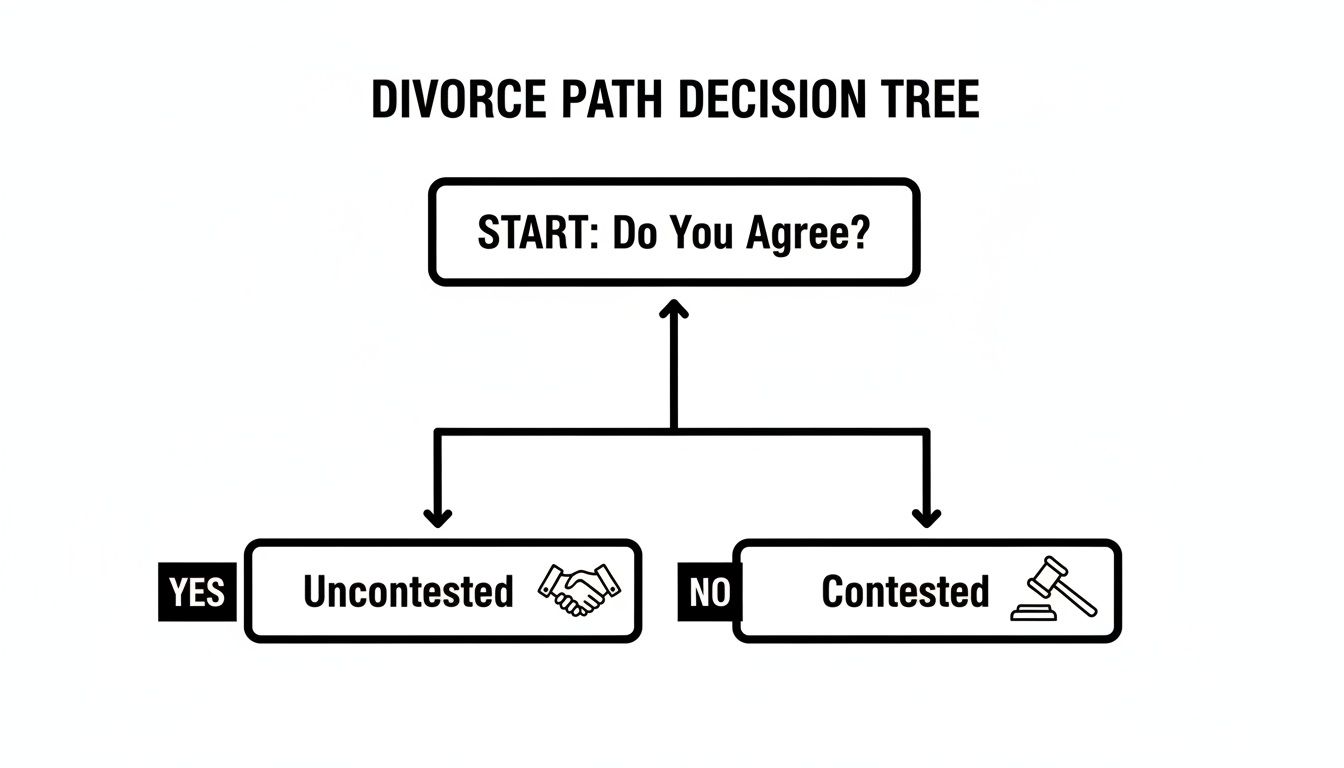
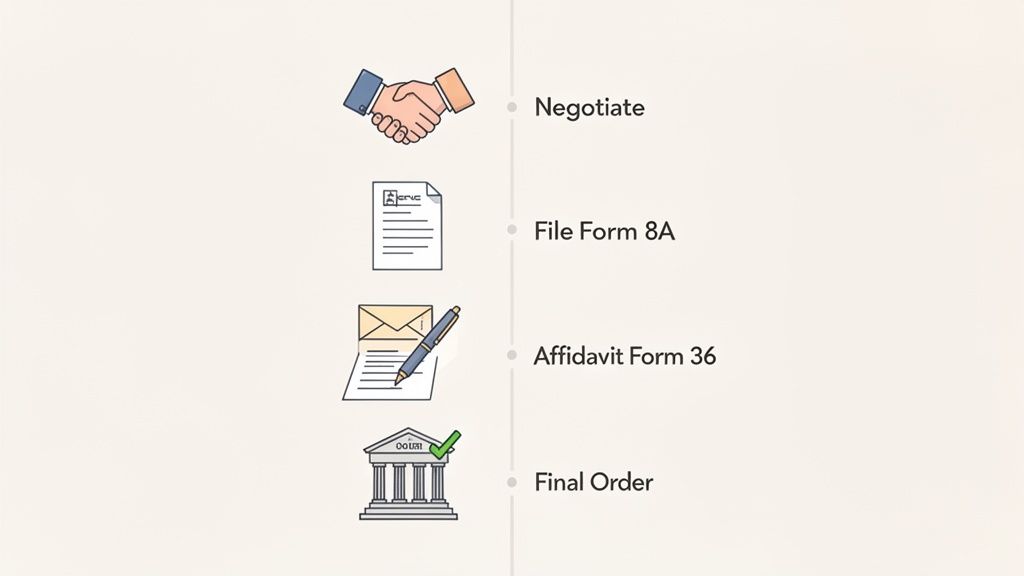
Control Over the Outcome

In an uncontested divorce, you and your spouse are in the driver's seat. You hold the power to shape your own future. Through direct negotiation, often guided by a Brampton divorce lawyer, you create a Separation Agreement that works for your family’s unique situation—one you both agree is fair.

A contested divorce is the exact opposite. When you can’t find common ground, you're essentially handing over control to a judge who will make life-altering decisions for you. Those decisions, while based on Ontario's Family Law Act, might not reflect what either of you actually wanted.

The core difference comes down to who holds the power. In an uncontested divorce, the power stays with you. In a contested divorce, you give that power to the court.

Financial Cost: A Tale of Two Budgets

The financial gap between these two paths can be staggering. An uncontested divorce comes with predictable, manageable costs. You're typically looking at flat fees for a lawyer to draft and finalize your Separation Agreement, plus standard court filing fees. There are no hidden surprises because the process is straightforward.

On the other hand, the costs of a contested divorce are unpredictable and can spiral out of control. Every motion filed, every court appearance, and every hour your lawyer spends in litigation adds to a growing legal bill. It’s not uncommon for disagreements over assets or support to drain the very resources you’re fighting to keep.

For instance, a couple in Brampton might spend a few thousand dollars to finalize an amicable, uncontested divorce. In stark contrast, a contested case with disputes over the matrimonial home and spousal support could easily soar past $25,000 to $50,000 per person, and sometimes much more.

The Emotional Strain on Your Family

The emotional toll is another critical factor to consider. An uncontested divorce, while still a difficult life event, is built to minimize conflict. It gives couples a path to separate with dignity, allowing them to focus on co-parenting and moving forward constructively. That cooperative spirit helps preserve a functional relationship, which is absolutely vital when kids are involved.

A contested divorce almost always amplifies animosity. The adversarial nature of court proceedings can poison relationships, turning disagreements into deep-seated resentment that makes effective co-parenting nearly impossible. The process is inherently stressful and filled with conflict that can leave lasting emotional scars on everyone—especially children.

Timeline: Predictability vs. Prolonged Uncertainty

Time is a resource you can’t get back, and these two divorce paths consume it very differently. An uncontested divorce runs on a fairly predictable schedule. Once you’ve met the one-year separation requirement and your paperwork is in order, the divorce can often be finalized in just a few months.

A contested divorce, however, moves at the pace of the court system, which is notoriously slow and backlogged. The process can drag on for years, bogged down in procedural delays, document discovery, and long waits for trial dates. This prolonged uncertainty keeps families in limbo, unable to find closure and start rebuilding their lives.

To make the differences even clearer, here is a side-by-side look at how these two approaches stack up for families in Ontario.

Key Differences: Uncontested vs. Contested Divorce in Ontario

This table breaks down the crucial distinctions between the two divorce pathways, helping you see which one might be a better fit for your family's circumstances in Brampton.

Factor Uncontested Divorce Contested Divorce
Decision-Making You and your spouse make all final decisions together. A judge imposes a final decision based on the law.
Financial Cost Predictable and significantly lower legal fees. Unpredictable, often escalating into tens of thousands.
Typical Timeline A few months after filing. Can take years to resolve through the court system.
Emotional Impact Lower stress, less conflict, and promotes amicable co-parenting. High emotional strain, fosters animosity, and harms relationships.
Privacy Kept private between you, your spouse, and your lawyers. Becomes a matter of public record in court documents.

Ultimately, knowing the difference between an uncontested and contested divorce gives you the power to make an informed choice. It boils down to a simple question: do you want to navigate your separation through cooperative problem-solving, or are you headed for a formal legal battle?

Meeting the Requirements for an Uncontested Divorce

Thinking about an uncontested divorce in Brampton? It’s not quite as simple as shaking hands and walking away. Before you can take advantage of this more cooperative route, you have to meet several non-negotiable legal requirements under the Family Law Act. If you miss one of these, the court can reject your application, leading to frustrating delays and costs you didn't plan for.

The very first hurdle is the mandatory one-year separation period. Canadian law is clear on this: you and your spouse must have lived separate and apart for at least one full year before a judge will grant the divorce. You can get the paperwork started before the year is up, but the final divorce order can't be issued until that timeline is met.

The Cornerstone of Your Agreement

The absolute foundation of any uncontested divorce is a comprehensive and legally sound Separation Agreement. This is the formal, written contract that proves to the court you’ve both resolved all the critical issues. A casual verbal agreement or a quick email exchange won’t cut it—the court simply won't accept it.

Your Separation Agreement needs to be incredibly detailed, spelling out exactly how you've settled all of the following:

  • Division of Property and Debts: A clear breakdown of how every family asset (like the matrimonial home, investments, and pensions) and all liabilities are going to be divided.

  • Spousal Support: This section must state whether one person will pay support to the other, for how much, and for how long. If you both agree to waive spousal support, that has to be explicitly written into the agreement.

  • Parenting Arrangements: A detailed parenting plan is essential. It must outline who has decision-making responsibility (formerly custody) and the specific access schedule for your children.

  • Child Support: The calculated amount of child support, which must follow the Federal Child Support Guidelines. No exceptions.

This decision tree shows the first choice every couple has to make.

Decision tree flowchart illustrating two divorce paths: Uncontested if both parties agree, or Contested if they don't.

As you can see, the whole process comes down to one simple question: can you agree? If the answer is yes, the smoother, uncontested path opens up for you.

Preparing for a Brampton Divorce Lawyer

To make sure your Separation Agreement is airtight and enforceable, it’s smart to get your documents in order before meeting with a lawyer. Having everything ready makes the process far more efficient and helps your lawyer protect your interests from day one.

A common misconception is that "uncontested" means "no lawyers needed." In reality, having a Brampton divorce lawyer draft or review your Separation Agreement is crucial to ensure it is fair, legally binding, and will hold up in court.

While Ontario law governs local divorces, the core principle of mutual agreement is common in many places. For example, in California, an uncontested divorce also requires both spouses to agree on all key issues like property division and support, allowing them to avoid a court trial based on "irreconcilable differences." You can read more about the California divorce rate and process to see how this principle is applied elsewhere.

Before your consultation, try to gather the following:

  • Financial Statements: Recent pay stubs, bank account statements, and investment details for both of you.

  • Asset and Debt Lists: A complete inventory of everything you own and owe, both jointly and individually.

  • Property Valuations: Appraisals or market assessments for major assets like your home or vehicles.

  • Tax Information: Your most recent income tax returns and Notices of Assessment.

Bringing these documents allows your lawyer to give you accurate advice and draft an agreement that truly reflects what you've both decided, setting the stage for a successful uncontested divorce.

The Uncontested Divorce Process Step by Step

Knowing what an uncontested divorce is one thing, but actually navigating the court process can feel like a maze of legal forms and procedures. For Brampton residents, the path is generally straightforward, but it demands careful attention to detail. This step-by-step guide breaks down each stage into clear, manageable actions so you know exactly what to expect from start to finish.

The journey begins long before you file any paperwork. It starts with collaboration and ends with a legally binding court order that officially dissolves your marriage.

A four-step legal process timeline showing negotiation, filing forms, affidavit, and final order.

Step 1: Finalize Your Separation Agreement

This is the most critical stage. Before you can even think about filing for divorce, you and your spouse must have a fully signed and witnessed Separation Agreement. This document is the cornerstone of your uncontested divorce, proving to the court that you've already sorted out all the major issues related to property, support, and children.

A Brampton divorce lawyer can ensure this agreement is drafted correctly, follows Ontario's Family Law Act, and fully protects your rights. Trying to move forward without a comprehensive, legally sound agreement will bring the whole process to a grinding halt.

Step 2: Prepare and File the Application for Divorce

With your Separation Agreement finalized, the next step is to officially start the divorce proceeding with the court. This involves completing and filing an Application for Divorce (Form 8A), the document that formally asks the court to grant your divorce.

Your application includes essential information like your names, date of marriage, and the date you separated. You’ll file this form, along with your original marriage certificate, at the Superior Court of Justice in Brampton.

The accuracy of the information on Form 8A is vital. Even a small error, like a misspelled name or an incorrect date, can cause the court to reject your application, leading to preventable delays and additional filing fees.

This cooperative approach is becoming the standard for families looking for a less adversarial split. In fact, recent data shows that uncontested divorces make up the majority of cases, which is reshaping how family courts operate. For instance, a review of state statistics shows that nearly 90% of all divorces in California are uncontested, meaning spouses resolve their issues through a written agreement instead of a trial.

Step 3: Serve Your Spouse with the Divorce Documents

Once your Application for Divorce is filed and issued by the court, you must legally "serve" a copy to your spouse. This is a formal, mandatory step to ensure your spouse has been officially notified of the divorce proceedings.

In Ontario, you cannot serve the documents yourself. They have to be delivered by a third party who is over 18, like a friend, family member, or a professional process server. After serving the documents, this person must complete an Affidavit of Service (Form 6B) and swear before a commissioner that they did it correctly.

Step 4: Complete and File the Affidavit for Divorce

After your spouse has been served and the required 30-day response period has passed (which they won't act on in an uncontested case), you can move to the next stage. You now need to complete and file an Affidavit for Divorce (Form 36).

This is a sworn document that confirms several key details for the judge:

  • You meet the one-year separation requirement.

  • There is no chance of reconciliation.

  • All reasonable arrangements have been made for any children, in line with the Federal Child Support Guidelines.

You must sign this form in the presence of a lawyer or a commissioner for taking affidavits. It's then filed with the court, along with a draft of the final Divorce Order. To better understand how paralegals can help you navigate an uncontested split, you can explore the offerings of paralegal divorce services.

Step 5: Await the Final Divorce Order

Once all your paperwork has been filed correctly, a court clerk reviews it to make sure everything is complete. If it is, your file is passed to a judge for a final review. In an uncontested divorce, you don't need to appear in court—the judge reviews your documents in their chambers.

If the judge is satisfied that all legal requirements have been met, they will sign the Divorce Order. This order becomes legally effective 31 days after the date it is signed. After this waiting period, you can request a Certificate of Divorce, which is the official proof that your marriage has been legally terminated.

Understanding the Costs and Timelines in Brampton

When you're thinking about divorce, two of the biggest questions are always: "How much will this cost?" and "How long will this take?" For anyone in Brampton, an uncontested divorce offers a clear and predictable path forward, saving you a whole lot of money and stress compared to a drawn-out court battle. Knowing what to expect helps you plan for your future with a bit more confidence.

An uncontested divorce really has two types of expenses: fixed court filing fees and professional legal fees. The Ontario government sets standard fees for filing the Application for Divorce and getting the final order. While you can't avoid these, they’re a tiny fraction of what a prolonged legal fight could cost.

Breaking Down the Financial Costs

Where you really save money with an uncontested divorce is on the legal fees. Since you and your spouse have already done the hard work of agreeing on all the major issues, your Brampton divorce lawyer isn’t racking up hours on lengthy negotiations, court appearances, or filing endless motions. Their work is targeted and efficient.

Typically, legal services will cover:

  • Drafting the Separation Agreement: This is the critical legal document that puts all your mutual decisions about property, support, and the kids down on paper.

  • Providing Independent Legal Advice (ILA): It’s crucial that both you and your spouse fully understand your rights and what you’re signing. ILA ensures this happens.

  • Preparing and Filing Court Documents: Your lawyer will accurately handle all the necessary forms, like the Form 8A Application and Form 36 Affidavit, making sure they’re done right the first time.

The financial difference is night and day. An uncontested divorce with a solid agreement usually comes with predictable, flat-rate legal fees. A contested divorce, on the other hand, is a different story. With hourly billing for litigation, costs can quickly spiral into the tens of thousands of dollars—sometimes draining the very assets you’re fighting over.

This massive cost difference is why so many couples work hard to find an amicable solution. While fees can vary by location, the principle is universal. A fully litigated divorce can be incredibly expensive no matter where you are, whereas an uncontested divorce might only cost a little more than the court filing fees plus some legal help for the paperwork. To get a sense of how costs compare elsewhere, you can discover more insights about the cost of divorce in California.

Navigating the Divorce Timeline

Even though an uncontested divorce is much faster, some timelines are set in stone under Canadian law. The big one is the mandatory one-year separation period. You must live separate and apart from your spouse for at least 12 months before a judge can legally grant your divorce.

Once you’ve met that requirement and filed your completed application, the court’s processing time kicks in. Here in Brampton and the GTA, you can generally expect this to take between two to four months, assuming all your paperwork is flawless. Any mistakes or missing info can cause major delays, which is exactly why having a lawyer's professional eye on everything is so valuable.

After the judge signs the Divorce Order, there’s one last 31-day waiting period before it officially takes effect. This clear timeline gives you a predictable end date, so you can finally close this chapter and move on with your life.

How a Brampton Divorce Lawyer Protects Your Interests

Even when a separation is completely amicable, trying to handle an uncontested divorce without a lawyer is a major risk. You and your spouse might agree on everything, but the law itself is incredibly complex. A skilled Brampton divorce lawyer isn't there to create conflict; they act as your safety net, ensuring the agreement you've made is not just fair for today but legally solid for years to come.

Their main job is to protect your rights and look out for your long-term interests. A lawyer's trained eye can catch potential problems you might never see, like unspoken assumptions about how property is divided or what happens if financial needs change down the road. They make sure every single detail is compliant with Ontario's Family Law Act and the federal Divorce Act.

Three people under a Brampton umbrella holding an agreement document, with legal scales and books in the background.

Beyond Drafting Paperwork

Thinking a lawyer just fills out forms is a common misconception. Their true value is in strategic guidance and preventing future problems. An experienced family lawyer in Brampton performs critical tasks that safeguard your future well beyond the paperwork.

Here’s where their expertise becomes crucial:

  • Drafting Precise Legal Language: They take your verbal agreements and translate them into a legally binding Separation Agreement. The language they use is precise and ironclad, leaving no room for future arguments or misinterpretations.

  • Providing Independent Legal Advice (ILA): The court needs to know that both of you made informed choices without being pressured. ILA is a formal process where a lawyer confirms you fully understand your rights and the long-term consequences of the agreement you're about to sign.

  • Identifying Future Conflicts: A good lawyer thinks ahead. What if one person wants to move away with the kids? What if someone’s income changes dramatically? They help you build contingencies into the agreement to head off potential court battles later on.

  • Managing the Court Process: They handle the complex court filing process from start to finish. From the initial Form 8A Application to the final Form 36 Affidavit, they ensure every document is perfect to avoid costly rejections or delays from the court clerk.

A well-drafted Separation Agreement is your best insurance against future legal trouble. Investing in a lawyer to get it right from the start is far more cost-effective than hiring one later to fix a flawed or incomplete agreement.

Ultimately, your Brampton divorce lawyer’s role is to make sure the cooperative spirit of your uncontested divorce is cemented in a legally enforceable document. They provide the professional oversight needed to turn your handshake deal into a binding resolution, giving you the security and peace of mind to truly move forward.

Frequently Asked Questions About Uncontested Divorce

As you explore an uncontested divorce, you'll naturally have questions about the finer details. Here are some clear, straightforward answers to the questions we hear most often from clients in Brampton and the GTA.

Can We File an Uncontested Divorce if We Have Children?

Yes, absolutely. Having children doesn’t prevent you from pursuing an uncontested divorce. In fact, it’s often the best path forward for families, as long as you and your spouse are in complete agreement on all parenting matters.

This means you must have settled:

  • Decision-Making Responsibility: This used to be called custody. It’s about who will make the major decisions for your children’s health, education, and religious upbringing.

  • Parenting Time: This is the schedule that outlines when the children will be with each parent.

  • Child Support: The amount must follow the Federal Child Support Guidelines. This isn't something you can negotiate away; it's a legal requirement.

Your Separation Agreement needs to lay out a detailed parenting plan covering all these points. A Brampton divorce lawyer can make sure your plan is solid and meets the court’s standards, which is critical for getting your divorce approved.

What if My Spouse Lives Outside of Ontario?

You can still file for an uncontested divorce here, even if your spouse is in another province or another country altogether. The key legal requirement is that at least one of you has been “ordinarily resident” in Ontario for a full year right before filing the divorce application.

The process is mostly the same, but serving the divorce papers gets a little trickier. You have to follow specific rules for "out-of-jurisdiction service" to make sure the legal notification is done correctly. This is one of those steps where getting professional help from a Brampton divorce lawyer is crucial to avoid simple mistakes that could get your application rejected.

An uncontested divorce isn’t limited by geography, as long as one spouse meets Ontario’s residency rule. The important things are to maintain your agreement and follow the proper legal steps for serving documents across borders.

Do I Have to Go to Court for an Uncontested Divorce?

No, and for many people, this is the biggest benefit. You do not have to step foot in a courtroom for an uncontested divorce in Brampton. The whole process is handled on paper.

Once your Application for Divorce, Separation Agreement, and final Affidavit for Divorce are filed correctly, a judge reviews everything in their office—or "chambers." If they’re satisfied that all the legal boxes are ticked and that the arrangements for any children are fair, they will sign the Divorce Order. There's no hearing and no need to appear in person. This "desk divorce" saves a tremendous amount of time, money, and stress.


At Badesha Law, we know how to provide the clarity and guidance you need to get through your uncontested divorce with confidence. If you're in Brampton or the GTA and need a Brampton divorce lawyer on your side, we’re here to protect your interests and make the process as smooth as possible. Contact us today to discuss your situation by visiting www.badeshalaw.ca