Exploring the Difference Between Legal Separation and Divorce in Ontario

The biggest difference between a legal separation and a divorce comes down to one simple fact: when you're legally separated, you live apart and sort out all your financial and parenting issues, but you're still technically married. A divorce, on the other hand, is the official, court-ordered end of that marriage.

Think of it this way: separation draws the lines for your new, separate lives. Divorce legally erases the marriage itself.

Understanding Legal Separation vs Divorce in Ontario

When a marriage breaks down in Ontario, many people think divorce is the automatic next step. But that's not the case. The law actually gives you two very different options, and the one you choose has big consequences for your legal status, your finances, and your future. Figuring out the difference between a legal separation and a divorce is the first, most important step you can take.

A legal separation isn’t something a court grants you; it's a state of being that starts the moment you and your spouse begin living "separate and apart." You can even be separated while still living in the same house. This new reality is then usually cemented in a Separation Agreement—a private, legally binding contract that tackles all the tough questions:

  • Parenting time (custody) and decision-making for the kids.
  • Who pays child and spousal support, and how much.
  • How you'll divide property and debts, including what happens to the matrimonial home.

A divorce, however, is a formal court order that officially dissolves your marriage. Under Canada's federal Divorce Act, you have to be separated for at least one full year before a judge can grant a divorce. While you can—and should—settle everything in a Separation Agreement first, the divorce is the final legal action that changes your marital status and lets you remarry.

Legal Separation and Divorce at a Glance

The following chart breaks down the essential differences between being legally separated and officially divorced in Ontario.
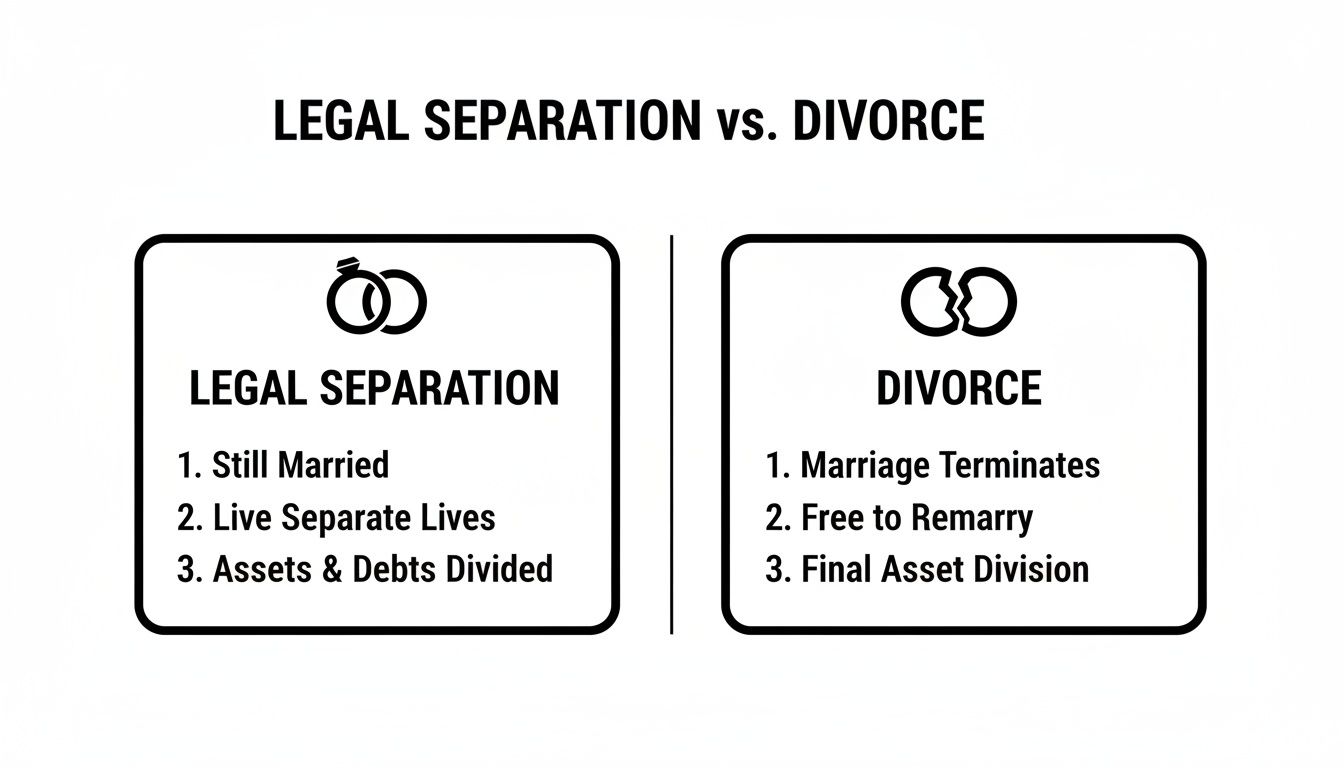
A visual comparison chart outlining the key differences between legal separation and divorce processes.

As you can see, most of the heavy lifting—like sorting out finances and parenting—happens during the separation phase. Only a divorce can legally cut the marital tie for good.

To make these distinctions even clearer, here’s a direct comparison table. It's a good idea to understand your family's rights and responsibilities under Canadian law as you think about which path is right for you.

Key Distinctions Legal Separation vs Divorce

Aspect Legal Separation Divorce
Marital Status You are still legally married to your spouse. A court order has legally terminated your marriage.
Ability to Remarry No. You cannot legally marry someone else. Yes. You are legally single and free to remarry.
Legal Process Starts when you live apart; formalized with a private Separation Agreement. A formal court application filed after one year of separation.
Shared Benefits You might be able to stay on your spouse's health or dental insurance plans. Shared benefits (like insurance coverage) are almost always terminated.
Reconciliation It’s much easier to get back together. You can just void the agreement and resume your marriage. If you reconcile after the divorce is final, you have to get remarried.

Ultimately, the table shows that a Separation Agreement handles the practical details of your split, while a divorce is the legal finality that changes your status from “married” to “single.”

When a marriage breaks down in Ontario, you’ll find yourself navigating one of two distinct legal pathways. Each serves a completely different purpose. Understanding the fundamental difference between a legal separation and a divorce is the first critical step—one is a private agreement that settles all your affairs, while the other is the formal court action that legally ends your marriage.
Stacks of 'Separation Agreement' and 'Divorce Order' documents, wedding ring, and calendar on a table.

Establishing a Legal Separation

Contrary to what many people think, you don’t go to court to become “legally separated.” In Canada, a legal separation starts the moment you and your spouse begin living “separate and apart” with the intent to end your marriage. This can even happen while you’re both still under the same roof, often for financial reasons or to maintain stability for the kids.

The key to making this official is the Separation Agreement. This is a private, legally binding contract that you and your spouse negotiate, usually with lawyers guiding the process. Think of it as the comprehensive rulebook for your new, separate lives.

A solid Separation Agreement will nail down all the big issues:

  • Parenting Arrangements: A detailed plan for parenting time and who makes the major decisions for your children.
  • Child and Spousal Support: Clear calculations and payment schedules for any financial support, based on established guidelines.
  • Division of Property: The equalization of your net family property, outlining exactly how assets and debts from the marriage will be split.
  • The Matrimonial Home: A clear decision on who stays in the home, whether it will be sold, and how the money will be divided.

This document gives you certainty and legal muscle without ever needing to step inside a courtroom, making it the foundational step for nearly every couple.

Key Takeaway: The Separation Agreement is the cornerstone of the entire process. It resolves every major issue privately, turning a messy, emotional split into a structured and manageable transition. This is the document that governs your rights and obligations from the moment you part ways.

The Formal Divorce Process

While your Separation Agreement settles the terms of your split, only a divorce can legally end your marriage. This process is governed by Canada’s federal Divorce Act and requires a formal application to the court. The main ground for divorce in Canada is marriage breakdown, which is most often proven by living separate and apart for at least one full year.

Once that one-year clock has run out, one or both spouses can file an Application for Divorce (Form 8A) with the Ontario Superior Court of Justice. If you already have a comprehensive Separation Agreement signed and sealed, the divorce is considered “uncontested,” making the court process mostly an administrative exercise. A clerk and then a judge review the file, and if all the boxes are ticked, they issue a Divorce Order.

This order is the final, official document that legally dissolves your marriage. It officially changes your marital status back to “single” and gives you the legal right to remarry. Getting the steps right is crucial, and you can get the full breakdown in our guide on how to file for divorce in Ontario. For anyone digging deep into the nuances of family law, using a tool like an AI Legal Case Researcher can be a huge help for understanding legal precedents and specific statutes.

Comparing Financial Outcomes: Property and Support

When a marriage ends, one of the biggest sources of anxiety is money. How will everything be divided? How will we manage? The real difference between a legal separation and a divorce becomes crystal clear when you look at how property division and support obligations are handled under Ontario’s Family Law Act.

While both processes use your date of separation as the official starting line for all financial calculations, they offer very different levels of control and finality.

Miniature matrimonial home with 'Separation' and 'Divorce' papers, coins, and a calculator, symbolizing legal choices.

Think of it this way: a Separation Agreement gives you immediate control and certainty over your finances, while a divorce is the legal step that makes those agreements permanent and court-enforceable.

Property Division and the Matrimonial Home

In Ontario, both separation and divorce kick off the same process for dividing assets and debts, known as the equalization of net family property. The most important date in this entire calculation is your valuation date—the day you and your spouse officially separated. Everything is valued as of that day.

The key difference, however, is how and when this division gets finalized.

  • During Legal Separation: You and your spouse hammer out all the details of who gets what—assets, debts, everything—and lock it down in a private, legally binding Separation Agreement. This contract gives you legal certainty long before a divorce is even on the table.
  • During Divorce: The property division terms you already agreed to in your Separation Agreement get formally incorporated into the final Divorce Order from the court. If you skipped the agreement, the court decides for you, which is almost always a longer, more expensive, and more stressful path.

The matrimonial home is often the most significant and emotionally charged asset you own together. One of the huge advantages of a Separation Agreement is the flexibility it gives you here. It can grant one spouse exclusive possession of the home for a specific period, which is a fantastic way to keep the children in a stable environment without being forced to sell right away.

Divorce, on the other hand, usually forces the issue, often leading to the sale of the home so that the finances can be split for good.

Key Insight: A well-drafted Separation Agreement is your financial roadmap. It empowers you to settle complex property issues, especially the fate of your home, on your own terms and timeline. This provides critical stability while you wait out the mandatory one-year separation period required for a divorce.

Child and Spousal Support Obligations

Just like with property, your obligations for child and spousal support start from the date you separate, not the date you get divorced. The amounts are calculated using established guidelines and are typically set in stone within your Separation Agreement.

This agreement lays out the payment terms, ensuring that financial responsibilities are clear and being met from day one of your separation. Later, when you file for divorce, these support terms are simply included in the final Divorce Order, making them fully enforceable by the court. While support amounts can always be revisited if someone’s financial situation changes significantly, the initial framework is built during the separation phase.

Getting the property division right is a critical step, and you can dive deeper into this topic in our detailed guide on the division of property in an Ontario divorce.

For our Brampton and GTA clients at Badesha Law, it’s important to understand how Ontario’s rules provide a structured and equitable process for asset division. This contrasts with other jurisdictions, which might use different models. Our province’s focus on equalization ensures a fair split based on the value accumulated during the marriage, and a Separation Agreement is the most effective tool to manage this process smoothly and with legal certainty.

The Impact on Children and Co-Parenting Structures

For parents going through a separation, the biggest worry is always the kids. There’s a common myth that you have to wait for the final divorce papers to create stability and routine. But under Ontario family law, that’s just not true. All the critical decisions about parenting are made right when you separate, not a year later when the divorce is granted.

Hands hold a child's drawing of a house and a boy, with a "Parenting Plan" document nearby.

This is a crucial distinction. It means you can build a stable co-parenting framework immediately, giving your children the consistency they desperately need during a tough time. The difference between separation and divorce here isn’t what gets decided, but how—either collaboratively in an agreement or contentiously in court.

Establishing Parenting Plans and Decision-Making

From the day you officially separate, you and your co-parent need to sort out two fundamental things. These are formalized in a parenting plan, which becomes a core part of your Separation Agreement:

  • Parenting Time: This is the schedule. It outlines exactly when the children will be in each parent’s care, from the weekly routine down to specific plans for holidays and summer vacation.
  • Decision-Making Responsibility: This covers who makes the big calls about a child’s health, education, religion, and major extracurriculars. You can share this responsibility or assign certain areas to one parent.

The huge advantage of doing this during separation is control. When you negotiate a Separation Agreement, you create a customized plan that actually fits your family’s reality. If you leave these issues to be fought over in a contested divorce, a judge who knows nothing about your family will be the one making these personal decisions for you.

A Proactive Approach Benefits Children: Establishing a clear and predictable parenting structure in a Separation Agreement from the outset is one of the most effective ways to minimize conflict and reduce the emotional strain on children. Stability is paramount, and separation provides the opportunity to build that foundation immediately.

Child Support Obligations Begin at Separation

Just like parenting arrangements, the legal obligation to financially support your children kicks in on the date of separation. Child support doesn’t wait for a divorce. In Canada, the amount is calculated using the Federal Child Support Guidelines, a standardized formula based on the paying parent’s income and the number of children.

The process is refreshingly straightforward, and the core calculation isn’t up for debate:

  1. Determine the paying parent’s gross annual income.
  2. Look up that income on the federal table for your province to find the base monthly amount.
  3. Add in any special or extraordinary expenses, like costs for competitive sports, orthodontics, or specialized tutoring.

By calculating and documenting these payments in your Separation Agreement, you guarantee financial consistency for your children from day one. Later, when you file for an uncontested divorce, the court simply confirms that your support arrangements follow the federal guidelines. The divorce itself doesn’t restart the calculation; it just formalizes the agreement you already made. This really shows how vital a Separation Agreement is for securing your child’s financial well-being right away. For a deeper look, you can learn more by understanding child custody in Ontario and how these principles are applied.

Timelines, Costs, and Future Goals: Choosing Your Path

When you’re standing at a crossroads, you need a clear map. Choosing between legal separation and divorce isn’t just a legal question—it’s a practical one that will shape your timeline, your finances, and what you can do next in life. Each path comes with its own schedule, price tag, and long-term consequences that need to line up with where you want to go.

One of the biggest practical differences is the timeline. You can negotiate and sign a Separation Agreement relatively quickly, often within a few months, depending on how complex things are and how willing you both are to cooperate. That agreement gives you immediate legal certainty on things like parenting, support, and property.

A divorce, on the other hand, comes with a mandatory waiting period. Under Canada’s Divorce Act, you have to live separate and apart for a minimum of one full year before a court can legally grant your divorce. This means separation is always the first step; divorce is the final one.

Comparing the Financial Investment

Cost is a huge concern for most people, and this is where the two paths really diverge. The most expensive part of ending a marriage isn’t the divorce application itself—it’s the fighting over property, support, and parenting.

A legal separation, finalized with a negotiated Separation Agreement, is by far the most cost-effective route. It lets you and your spouse settle every single issue privately with your lawyers, steering clear of expensive court battles.

Once you have that agreement locked in, filing for an uncontested divorce becomes a simple administrative task with predictable, minimal legal fees. In sharp contrast, a contested divorce where you litigate every issue in court can lead to unpredictable and massive costs. You can get a clearer picture of the expenses involved by reading our guide on understanding Ontario divorce costs.

Strategic Insight: Investing in a comprehensive Separation Agreement upfront is the single best way to control costs. It transforms the divorce from a potentially contentious legal battle into a simple, affordable administrative step, saving you thousands of dollars and immense stress.

Planning for Your Future

What you want for your future is probably the most important factor in this decision. While a Separation Agreement settles your day-to-day life and finances, only a divorce can change your fundamental legal status from “married” to “single.”

This difference has major real-world consequences:

  • Remarriage: You absolutely cannot remarry while you are legally separated. You’re still legally married to your spouse until a final Divorce Order is granted.
  • Immigration: If you plan to sponsor a new partner to immigrate to Canada, a separation isn’t enough. You must be officially divorced.
  • Estate Planning: Being separated can create a messy situation for inheritance rights. A divorce cleanly severs those ties, which makes drafting a new will and planning your estate much simpler.

For newcomers to Canada, these issues can get even more complicated. If you were divorced in another country, you might need a foreign divorce opinion letter to confirm that your divorce is recognized in Ontario before you can remarry here. A family lawyer can sort this out and help you take the right steps.

Common Questions About Separation and Divorce in Ontario

The end of a marriage brings a storm of questions and uncertainty. While the line between legal separation and divorce can seem blurry at first, getting a handle on the key differences is the first step toward making clear, confident decisions for your future.

This section tackles the most frequent questions we hear from clients across Ontario, providing practical answers grounded in Ontario’s Family Law Act and Canada’s Divorce Act.

Do I Need a Separation Agreement Before Getting a Divorce?

While it’s not a legal requirement to have a Separation Agreement before you file for divorce, it is the single most important thing you can do to ensure the process is smooth, predictable, and cost-effective. Think of it as creating the blueprint for your divorce first.

This legally binding contract is where you and your spouse privately settle all the major issues—property division, support, and parenting plans—on your own terms. Once that agreement is signed, the divorce itself becomes a simple, administrative step. It provides immediate certainty and a clear rulebook for your separate lives.

Without an agreement, you’re walking into a contested divorce. That means every unresolved issue will be decided by a judge in a courtroom, a process that is guaranteed to be more expensive, take far longer, and be emotionally draining for everyone involved. A family lawyer can help you draft a solid agreement that protects your interests and turns the divorce into a straightforward formality.

Can We Be Legally Separated and Live in the Same House?

Yes, absolutely. Under Canadian law, a couple can be “separate and apart” while still living under the same roof. This is a very common arrangement, often done for financial reasons or to provide stability for children while one spouse figures out their next move.

The key isn’t your mailing address; it’s the clear and final end of your marital relationship. To prove you’re separated while cohabiting, you need to show a fundamental shift in how you live.

Evidence of living separate and apart in the same home includes:

  • Sleeping in separate bedrooms.
  • No longer presenting as a couple at social events.
  • Managing your finances and bank accounts independently.
  • Splitting household chores like roommates, not a couple.
  • Telling family and friends that you have separated.

Critical Tip: It is absolutely crucial to document your date of separation, even when you’re still in the same house. This date is the official “valuation date” for dividing property and starts the clock on the one-year waiting period required to finalize a divorce.

How Does Separation Affect My Immigration Status?

A legal separation won’t automatically cancel your immigration status if it was tied to your spouse, but it’s a major life event that will absolutely impact any future immigration applications. Getting this wrong can have serious consequences, so it’s vital to tread carefully.

For example, you cannot sponsor a new partner for permanent residence in Canada until you are officially divorced. Just being separated isn’t enough. If your spouse sponsored you for your own permanent residency, a separation could be a factor that immigration authorities look at when you apply to renew your residency or for citizenship down the road.

The situation gets even more complicated if you have a divorce from a previous marriage that took place outside of Canada. You may need a foreign divorce opinion letter to prove that your prior divorce is recognized here before you can legally remarry in Canada. Given how deeply family and immigration law can intersect, the smartest move is to get advice from both a family lawyer and an immigration lawyer to protect your status and keep your options open.

What if My Spouse Refuses to Sign the Separation Agreement?

A Separation Agreement is a voluntary contract, meaning you can’t force your spouse to sign it. If they’re refusing to negotiate or sign on the dotted line, it can feel like you’ve hit a brick wall. But you still have clear options to move forward.

The first step is usually to try alternative dispute resolution methods, which are designed to help you find a resolution without heading straight to court.

Common next steps include:

  1. Mediation: You and your spouse sit down with a neutral third-party mediator who helps guide the conversation and find common ground on the sticking points. The mediator doesn’t make decisions for you; they help you build your own solution.
  2. Collaborative Family Law: You and your spouse each hire a specially trained collaborative lawyer and commit to resolving everything outside of court. The process involves a series of focused meetings aimed at open communication and creative problem-solving.

If these cooperative approaches don’t work, your final option is to start a formal court application. This means a judge will make the final decisions on property, support, and parenting. This litigation path is more adversarial, takes much longer, and is significantly more expensive. Getting legal advice early can help you build a negotiation strategy that encourages your spouse to cooperate and avoid a drawn-out court battle.


Navigating the complexities of separation and divorce requires clear, compassionate, and precise legal guidance. At Badesha Law, we provide step-by-step support to clients in Brampton and the GTA, ensuring you understand your rights and can move forward with confidence. Whether you need a comprehensive Separation Agreement, representation in a divorce, or a foreign divorce opinion letter, our team is here to help. To discuss your situation and learn how we can assist you, book your free consultation today at https://badeshalaw.ca.

Step-by-Step Guide to Getting a Divorce in Ontario

Navigating a divorce can feel overwhelming, especially when you’re trying to understand the legal system in Brampton. For anyone needing a Divorce Lawyer in Brampton, the first step is often the hardest: figuring out where to begin. This guide provides a clear, step-by-step roadmap to the divorce process in Ontario, grounded in the Family Law Act and Canada’s Divorce Act, giving you actionable insights to move forward with confidence.

Your First Steps in the Brampton Divorce Process

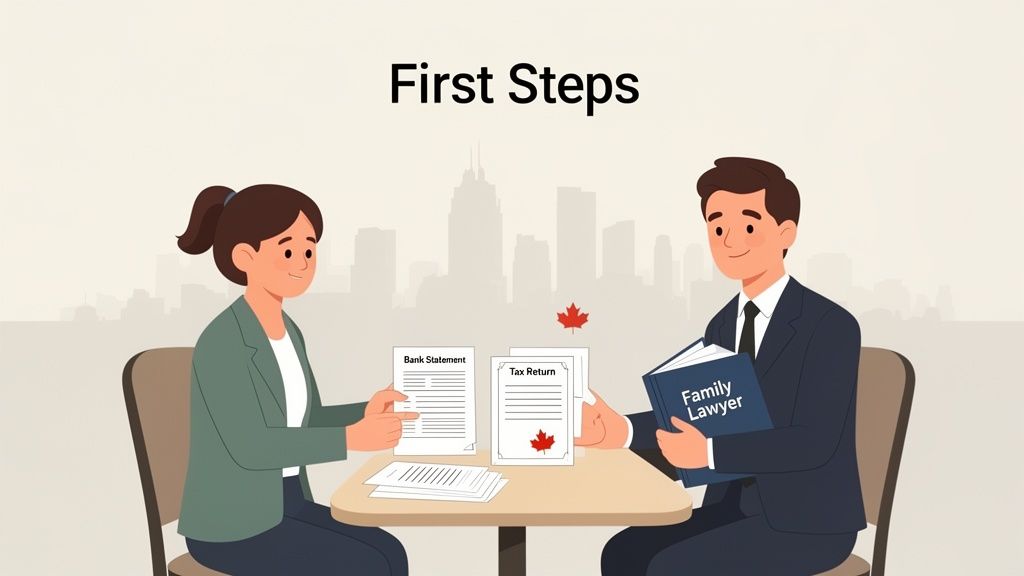
Two people discuss financial documents and legal matters, including a bank statement and tax return, with a family lawyer.

Starting the divorce process in Brampton is about strategic preparation, not emotional reactions. Before filing any paperwork, it’s crucial to build a solid foundation. By focusing on these initial tasks, you empower yourself with the knowledge and organization needed to navigate the legal journey ahead, taking back control of your situation.

Step 1: Confirm You Are Eligible for a Divorce

Before any legal action can be taken, you must meet the basic requirements for a divorce in Canada. Under the federal Divorce Act, the sole ground for divorce is marriage breakdown. The most common way to prove this is by living separate and apart from your spouse for at least one year.

This one-year separation is a mandatory waiting period. However, you do not have to wait for the year to be over to start the process. You can begin negotiations, draft a separation agreement, and even file your Application for Divorce. The final Divorce Order will simply not be granted until the one-year mark has passed.

Step 2: Schedule an Initial Legal Consultation

One of the most powerful first moves you can make is scheduling a consultation with an experienced family lawyer in Brampton. This meeting is not about starting a conflict; it’s about understanding your rights and obligations regarding property division, support, and parenting arrangements under Ontario law.

A proactive consultation provides a personalized roadmap. You’ll understand potential outcomes, the process ahead, and how to protect your interests before making irreversible decisions.

This early legal advice is invaluable. It helps you avoid common mistakes, such as informally agreeing to terms that are not in your best interest or moving out of the matrimonial home without understanding the potential legal consequences.

Step 3: Organize Your Financial Documents

Financial disclosure is the cornerstone of any Ontario divorce. Getting a head start on gathering your financial paperwork will save you significant time, stress, and money. This involves creating a complete financial snapshot of your marriage.

Start collecting these key documents for both yourself and, if possible, for your spouse:

  • Proof of Income: Recent pay stubs, T4 slips, and Notices of Assessment from the Canada Revenue Agency for the last three years.
  • Asset Information: Bank account statements, investment summaries (RRSPs, TFSAs), and property deeds.
  • Debt Records: Statements for mortgages, lines of credit, credit cards, and car loans.
  • Business Valuations: If you or your spouse owns a business, any relevant financial statements are crucial.

As you navigate these initial stages, you may also consider new living arrangements; finding reliable movers in Brampton can help facilitate a smoother transition. Taking these organized steps provides the foundation needed to approach the rest of your divorce with clarity and confidence.

Understanding the Grounds for Divorce in Ontario

In Canada, the divorce process is designed to be “no-fault.” The federal Divorce Act establishes only one legal reason for divorce: marriage breakdown. This approach removes blame from the legal equation and focuses instead on achieving a fair and practical resolution for your family’s future.

For most couples in Brampton, proving marriage breakdown is straightforward: you must show that you and your spouse have lived separate and apart for at least one full year. This is the standard path to legally ending a marriage.

The One-Year Separation Rule

“Living separate and apart” is the key to demonstrating marriage breakdown. This doesn’t necessarily mean one person must move out immediately. Many couples continue to live in the same home while legally separated for financial reasons or to provide stability for their children.

What matters is the intention to end the marital relationship. This means you stop living as a couple—perhaps by sleeping in separate rooms, managing finances independently, and no longer presenting socially as a couple. This one-year period allows both individuals time to be certain about their decision. A skilled divorce lawyer in Brampton can provide clear advice on what constitutes a legal separation, even if you are still living under the same roof.

Are There Other Grounds for Divorce?

While the one-year separation is the most common path, the Divorce Act does provide two other grounds for proving marriage breakdown:

  1. Adultery: You would need to provide clear proof that your spouse was physically intimate with another person.
  2. Cruelty: This requires showing that your spouse has treated you with such severe physical or mental cruelty that it is impossible to continue living together.

In modern family law, these “fault-based” grounds are rarely used. The standard of proof is extremely high, and attempting to prove them can turn the process into an expensive and emotionally draining battle. Crucially, proving fault does not provide an advantage in matters of property division or support. For these reasons, legal experts almost universally recommend proceeding based on the one-year separation.

The purpose of Ontario’s divorce system is not to punish past behaviour. It is to dissolve the legal union and create a fair plan for the future, focusing on key issues like parenting, support, and property division.

The rapid growth in Peel Region has placed significant pressure on the Brampton courthouse, leading to serious backlogs. With local divorce rates at approximately 12.5 per 1,000 marriages—higher than the provincial average—you need an expert to navigate this congested system. An experienced Brampton lawyer ensures your documents are prepared perfectly to avoid the rejections and delays that affect many others.

Solving the Core Issues of Your Divorce

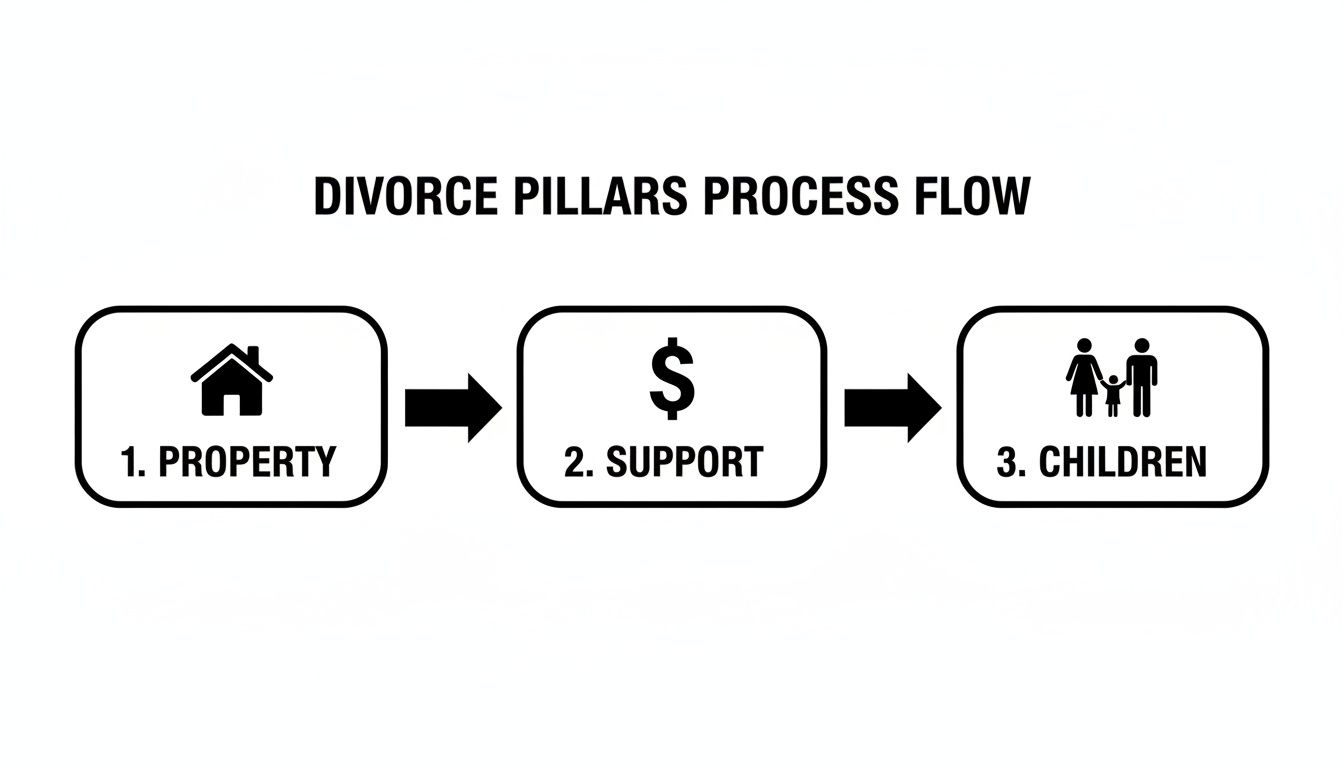
Once the divorce process is initiated, the real work involves resolving the three core pillars: property, support, and children’s well-being. By addressing each of these methodically, you can work toward a fair and stable resolution that allows everyone to move forward.

An experienced family lawyer in Brampton is your guide through this process, ensuring you understand how the Family Law Act protects your rights at every stage.

Untangling Your Finances: Property Division

Under Ontario law, marriage is viewed as an equal economic partnership. The wealth you accumulated together during the marriage must be shared fairly when it ends. This is achieved through a process called equalization.

The process involves balancing the financial growth of each spouse during the marriage. Each spouse calculates their Net Family Property (NFP) by taking their assets on the date of separation and subtracting their debts and the assets they brought into the marriage. The spouse with the higher NFP pays the other spouse half of the difference.

This is called an equalization payment, and its purpose is to ensure both partners leave the marriage with an equal share of the wealth accumulated as a team.

The calculation follows these steps:

  1. List all assets and debts as of the date of separation.
  2. Do the same for the date of marriage (excluding certain items like gifts or inheritances).
  3. Subtract the marriage-date value from the separation-date value for each spouse to determine their individual NFP.
  4. The spouse with the higher NFP pays half the difference to the other.

The matrimonial home receives special treatment in these calculations. For many, deciding what to do with the house is a significant challenge. Understanding your options for selling your marital home during a divorce is a critical part of financial planning.

To clarify these core issues, here is a summary of what you will be navigating.

Key Divorce Issues in Ontario at a Glance

Issue What It Involves Governing Principle (Ontario Family Law Act)
Property Division Calculating and dividing the wealth accumulated during the marriage. Includes assets like the home, pensions, investments, and debts. Equalization: The spouse with the higher Net Family Property growth pays the other half of the difference to ensure both partners share the marital wealth equally.
Support Determining financial assistance for a spouse (spousal support) and children (child support) to address financial imbalances post-separation. Fairness and Need: Spousal support is based on factors like roles in the marriage and need. Child support is a child’s right, calculated using mandatory government guidelines.
Parenting Creating a plan for how children will be cared for. This includes who makes major life decisions (decision-making) and the schedule of time spent with each parent (parenting time). Best Interests of the Child: All decisions must prioritize the child’s physical, emotional, and psychological well-being above all else.

Each issue is governed by a distinct legal principle, which is why a clear strategy is essential.

Establishing Financial Stability: Spousal and Child Support

Support payments are not a penalty. They are a legal mechanism to ensure financial fairness and stability after separation, particularly for children or a spouse who may be financially disadvantaged.

Spousal Support
Spousal support is not automatic. It is intended to recognize a spouse’s contributions to the marriage and assist them in becoming self-sufficient. To determine if support is warranted, a court will consider:

  • The length of the marriage.
  • The roles each spouse played (e.g., one as primary caregiver while the other advanced their career).
  • The income and earning capacity of each spouse.
  • Any economic hardship caused by the separation.

Child Support
Unlike spousal support, child support is the legal right of every child. The calculation is based on mandatory government guidelines. The amount depends almost entirely on the paying parent’s gross annual income and the number of children, ensuring predictable financial support.

Focusing on the Future: Parenting and Decision-Making

When children are involved, Ontario law prioritizes their best interests above all else. The federal Divorce Act now uses terms like “decision-making responsibility” and “parenting time” instead of “custody” and “access” to encourage a more collaborative approach.

This shift in language encourages parents to focus on their roles and responsibilities, rather than on “winning” or “losing” their children.

Decision-Making Responsibility refers to who makes major decisions about a child’s life, such as:

  • Health and medical care
  • Education
  • Religious upbringing
  • Significant extracurricular activities

Parenting Time is the schedule that outlines when the children are in the care of each parent. The goal is to create a stable routine that allows the children to maintain a strong relationship with both parents. A Brampton family lawyer can help you create a detailed parenting plan that fits your family’s unique needs, preventing future conflicts and providing stability for your children.

The Step-by-Step Ontario Divorce Court Process

While the Ontario court system may seem intimidating, it follows a structured and predictable path. Understanding this roadmap helps set realistic expectations and highlights the value of having a skilled legal guide in Brampton.

The process begins when the first set of documents is filed with the court. Each subsequent stage is designed to narrow down the issues, encourage settlement, and move your case toward a final resolution.

Step 1: Filing the Initial Application

The first official step is filing an Application for Divorce (Form 8A). This document formally requests a divorce from the court and outlines the issues you need resolved, such as property division, support, and parenting arrangements.

Once completed with the help of your family lawyer, the application is filed with the Superior Court of Justice in Brampton. This officially opens your court file and initiates the legal process.

Step 2: Serving Your Spouse and Waiting for a Response

After filing, you must “serve” your spouse with a copy of the Application. This formal delivery process ensures your spouse is officially notified of the legal action.

Your spouse then has 30 days to file an Answer (Form 10) (or 60 days if living outside Canada or the US). If they fail to respond, the divorce may proceed as “uncontested,” which can significantly speed up the process.

This flowchart illustrates the three core pillars the court process is designed to resolve.

Divorce pillars process flow diagram outlining steps for property, financial support, and children.

The system methodically addresses property, support, and children to achieve a comprehensive and final resolution.

Step 3: The All-Important Exchange of Financials

This is one of the most critical stages. Both you and your spouse are legally required to provide full and honest financial disclosure by completing a Financial Statement (Form 13 or 13.1). This must be supported by documents like tax returns, pay stubs, and bank statements.

Full financial disclosure is the bedrock of a fair settlement. Hiding assets can lead to severe court penalties. Without transparency, it is impossible to correctly calculate equalization or determine support.

An experienced family lawyer in Brampton will ensure your financial statement is prepared accurately, helping you avoid common errors that cause delays in the busy Brampton court system.

Step 4: Navigating the Court Conferences

Before a case goes to trial, it must proceed through a series of conferences with a judge. These are structured meetings designed to manage the case and explore settlement opportunities.

  • Case Conference: The first meeting with a judge to identify disputed issues, ensure documents have been exchanged, and set a timeline.
  • Settlement Conference: The focus is on resolving the case. The judge will offer an opinion on the likely outcome at trial to encourage a compromise.
  • Trial Management Conference: If no settlement is reached, this final conference prepares for trial by finalizing witness lists and scheduling trial dates.

Each conference is a checkpoint to resolve your divorce without the cost and stress of a full trial. A good lawyer uses these meetings strategically to advocate for you and guide your case toward an efficient resolution.

Reaching a Fair Agreement Outside of Court

Court is not the only path to a divorce. In fact, most successful divorces in Brampton are settled amicably outside the courtroom. Alternative Dispute Resolution (ADR) methods like negotiation and mediation can save you significant time, money, and emotional stress.

These methods empower you to control the outcome rather than having a judge make decisions for your family. This is often the best way to maintain a respectful co-parenting relationship.

Lawyer-Led Negotiation

The most common starting point is direct negotiation between lawyers. Your family lawyer in Brampton communicates with your spouse’s lawyer to resolve key issues like property, support, and parenting. Your lawyer acts as your professional advocate, presenting your position and providing strategic advice based on Ontario’s Family Law Act. This is often the quickest and most cost-effective way to achieve a comprehensive separation agreement.

Mediation: A Guided Path to Common Ground

If direct negotiations stall, mediation is an excellent option. In this voluntary process, a neutral third-party mediator helps guide a productive conversation between you and your spouse. The mediator’s role is not to make decisions but to improve communication, identify common interests, and explore creative solutions that a court might not be able to order. You still have your own lawyer providing independent legal advice.

Mediation empowers you to be the architect of your own settlement. It shifts the focus from winning and losing to finding a practical, fair resolution that works for your entire family.

Collaborative Family Law: A Team-Based Approach

Collaborative family law is a unique process where you, your spouse, and your specially trained lawyers sign an agreement committing to resolve all issues without going to court. If the process fails, both lawyers must withdraw, creating a strong incentive for good-faith cooperation. This model often includes neutral financial specialists or family coaches to provide expert guidance, making it an excellent option for couples determined to minimize conflict.

How to Choose the Right Family Lawyer in Brampton

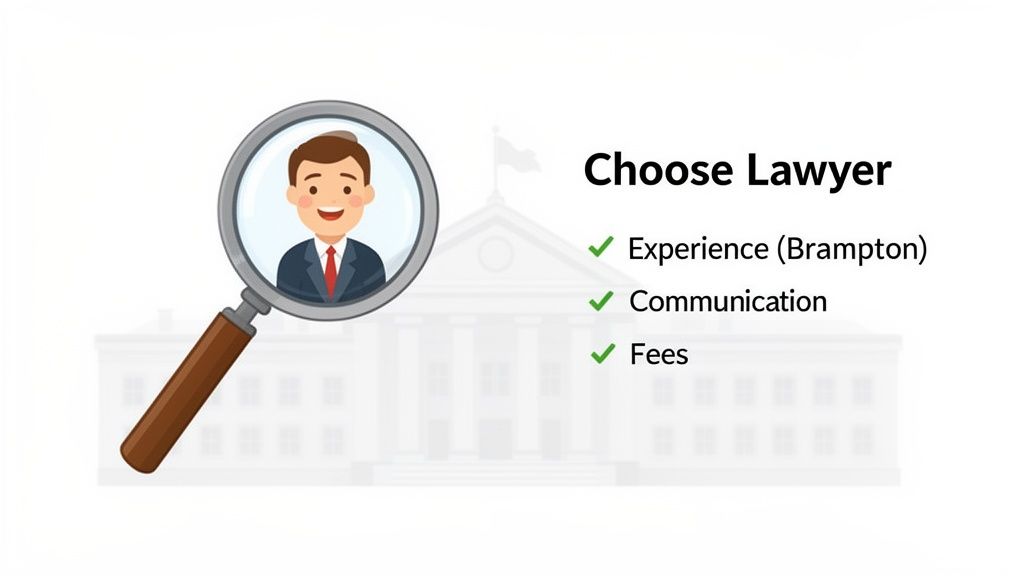
A magnifying glass highlights a cartoon lawyer, next to a checklist for choosing a lawyer.

Choosing the right legal advocate is the most critical decision you will make in your divorce. Your lawyer is your strategist, advisor, and advocate. The right fit ensures your journey through the legal system is as smooth and fair as possible. It’s about finding a professional who understands your goals and has the specific experience to achieve them within the Brampton legal landscape.

Look for Deep Brampton Court Experience

The family court in Brampton has its own unique procedures and judicial personalities. A lawyer who is a regular presence at the Brampton courthouse offers a significant advantage. They understand the system’s nuances and know how to prepare documents that won’t get bogged down in administrative delays. This local knowledge is a practical asset that saves you time and money.

Choosing a lawyer with deep local roots is about competence. Their familiarity with the Brampton court system translates directly into a smoother, more predictable process for you.

Key Questions for Your Consultation

The initial consultation is your opportunity to interview a potential lawyer. Be prepared to ask direct questions to understand their approach and whether they are the right fit for you.

Here are a few essential questions to ask any family lawyer in Brampton:

  • Strategic Approach: Based on my situation, would you recommend negotiation, mediation, or court? What is your general philosophy on resolving cases like mine?
  • Local Experience: How frequently are you in the Brampton courthouse? What is your experience with cases similar to mine in this jurisdiction?
  • Communication Style: Who will be my primary point of contact? How quickly can I expect a response to calls or emails?
  • Fee Structure: Can you explain your retainer and hourly rates? What other potential costs should I anticipate?

Clear, straightforward answers are a sign of a transparent and client-focused firm. Take your time to choose a legal partner you trust to protect your future.

Common Questions About Divorce in Brampton

Going through a divorce brings up many questions. Here are straightforward answers to common concerns we hear from clients in Brampton.

How Long Does a Divorce Take in Brampton?

The timeline depends almost entirely on the level of cooperation between you and your spouse. A simple, uncontested divorce, where all issues are resolved in a separation agreement, typically takes 4 to 6 months after filing the paperwork.

However, a contested case requiring court intervention can take over a year due to significant backlogs at the Brampton courthouse. The fastest way to finalize your divorce is by reaching a settlement outside of court.

Can I File for Divorce Without a Lawyer?

While you can legally represent yourself, it is strongly discouraged. Ontario’s family law is complex, and errors in paperwork or negotiation can lead to long-term negative financial and parenting consequences.

Hiring an experienced family lawyer in Brampton is an investment in your future. A good lawyer ensures your rights under the Family Law Act are protected, files documents correctly to avoid delays, and advocates for a fair, legally sound outcome.

Your separation agreement is the most important document in your divorce. It is a legally binding contract that outlines all arrangements for property, support, and parenting, forming the blueprint for an efficient, uncontested divorce.

How Much Will a Divorce Lawyer Cost?

The cost is directly tied to the complexity and conflict level of your case. An uncontested divorce with a signed separation agreement may cost a few thousand dollars. A high-conflict case that proceeds to trial can cost tens of thousands.

The best way to manage legal fees is to work toward a resolution without a protracted fight. Choose a lawyer who is transparent about their fee structure from the outset.


Navigating the complexities of divorce requires a clear strategy and trusted legal advice. The team at Badesha Law is here to provide the guidance you need to protect your rights and secure a fair resolution. Contact us today for a consultation to discuss your case by visiting https://badeshalaw.ca/

Your Expert Guide to a Simple Divorce with a Brampton Family Lawyer

Navigating a separation can feel like a heavy burden, but a simple divorce offers a cooperative and much less stressful path forward for many Brampton families. This approach, guided by an experienced simple divorce family lawyer in Brampton from a firm like Badesha Law, is all about agreement, not conflict.

When you and your spouse have already settled the big questions, a simple divorce is the most efficient way to legally finalize your separation and move on with your life.

What is a Simple Divorce in Brampton?

A cartoon man and woman exchange a document on a bridge between two houses, with background buildings and a maple leaf.

Facing the end of a marriage is tough, but understanding your legal options can make all the difference. In Ontario, a “simple” or “uncontested” divorce is specifically designed for couples who have already reached a consensus on the critical aspects of their separation.

Think of it as building a bridge to your new future rather than fighting a battle over the past. This collaborative method, grounded in Ontario’s Family Law Act, requires you to have a mutual agreement on all key terms before any court documents are ever filed.

The Foundation of Agreement

So, what does “agreeing on everything” actually mean? To qualify for a simple divorce, you and your spouse must have a clear, settled plan for these core issues:

  • Property Division: How will all assets (like the family home in Brampton, cars, and investments) and debts be divided?
  • Support Payments: Is child support or spousal support applicable? If so, the amounts and schedule must be agreed upon.
  • Parenting Arrangements: For couples with children, you’ll need a detailed plan for decision-making responsibility (formerly custody) and parenting time (formerly access).

This cooperative approach can save you a substantial amount of time, money, and emotional energy. While national divorce statistics have been declining, the reality for Brampton families is often more complex. Canada’s divorce rate recently hit a 50-year low of about 5.6 divorces per 1,000 married persons, and Ontario saw a massive 36% drop in registered divorces between 2019 and 2020.

However, in a city like Brampton, the high cost of living often forces couples to delay formal separation, as maintaining two separate households is a huge financial hurdle. This means many local separations aren’t even captured in those official statistics, making the efficiency of a simple divorce even more crucial when the time is right. You can read more about these Canadian divorce trends to get the bigger picture.

A specialized simple divorce family lawyer in Brampton, like the team at Badesha Law, acts as your guide, ensuring the entire process is handled with legal precision from start to finish.

How to Prepare for a Simple Divorce in Brampton

A smooth divorce process doesn’t just happen—it starts with solid preparation. When you organize your key information before ever sitting down with a simple divorce family lawyer in Brampton, you’re setting the stage for an efficient and far less stressful experience. This proactive approach is a key reason why Badesha Law can finalize simple divorces so effectively for our Brampton clients.

Your Document Gathering Checklist

The foundation of any fair settlement is full financial transparency. Under Ontario’s Family Law Act, both you and your spouse have a duty to disclose your complete financial picture. Start by collecting these essential documents:

  • Proof of Income: Your last three years of income tax returns and the corresponding Notices of Assessment from the Canada Revenue Agency.
  • Asset Information: Statements for all your bank accounts, investments like RRSPs and TFSAs, and any pensions, dated as close to your separation date as possible.
  • Property Documents: The deeds and mortgage statements for any real estate you own. If you have a recent valuation, even better.
  • Debt Statements: The most recent statements for all your loans, lines of credit, and credit cards.

Having this information ready allows your Brampton family lawyer to quickly map out the financial landscape and draft an accurate Separation Agreement. It cuts out the guesswork and prevents frustrating delays.

At Badesha Law, we believe preparation is power. A well-organized client is an empowered client. By walking in with your financial documents ready, you’re not just saving time—you’re taking control of your future and setting a collaborative tone for the entire process.

Aligning on Key Issues with Your Spouse

Paperwork is only half the battle. The other half involves having calm, productive conversations with your spouse. While your lawyer will handle the legal formalities, agreeing on the big-picture items beforehand is what truly makes a divorce “simple.”

Try to find common ground on these crucial points:

  1. The Separation Date: This date is legally very important. It marks the official end of your financial partnership and kicks off the one-year separation period required for a divorce in Canada.
  2. Parenting Vision: If you have children, discuss a general schedule for parenting time. How will you share decision-making for big things like school and health care?
  3. Property Goals: What’s the plan for the family home? Does one of you want to buy the other out, or will you sell it and split the proceeds?

When you can present a united front on these key issues, you give your lawyer a clear roadmap to follow. This focus on cooperative planning is why so many clients consider us the best family lawyer in Brampton for peaceful and efficient resolutions. Our expertise lies in taking your mutual agreements and turning them into an ironclad legal document that protects everyone’s rights.

 Understanding Your Parental Rights in an Ontario Divorce

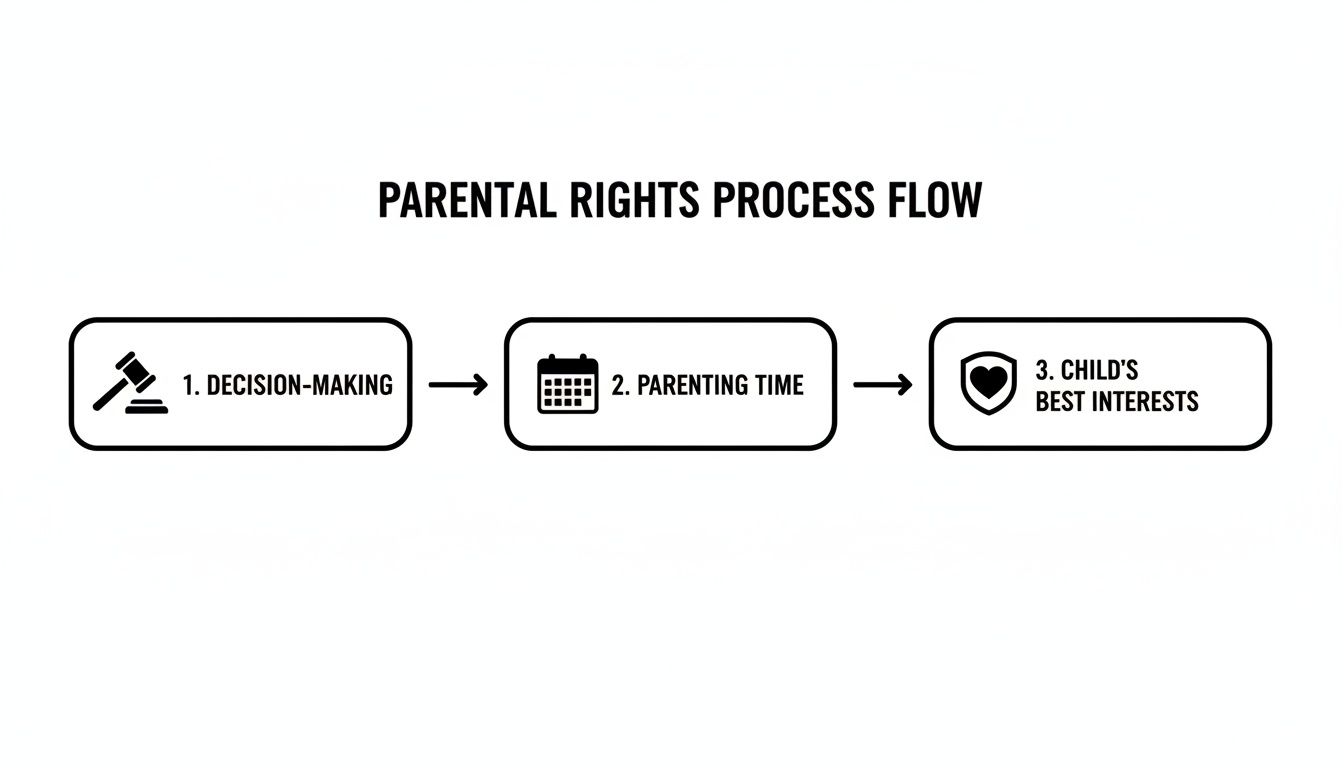
Flowchart illustrating the parental rights process, detailing steps for decision-making, parenting time, and child's best interests.

When kids are part of a separation, their well-being is rightly everyone’s top priority. The entire legal framework in Ontario is built around one single, powerful principle: the best interests of the child. If you’re a parent in Brampton facing divorce, understanding your rights and responsibilities isn’t just about legal procedure—it’s about giving your children the stability and support they need to thrive long after the divorce is final.

You might notice the language in family law has changed. We’ve moved away from outdated, adversarial terms like “custody” and “access.” Today, the focus is on concepts that reflect the cooperative nature of modern co-parenting. This shift emphasizes shared duties over a win-lose battle, which is a philosophy we deeply believe in at Badesha Law.

Decision-Making Responsibility and Parenting Time

Under Ontario’s Family Law Act, your parental rights really boil down to two key ideas. Getting a solid grasp on these will empower you to build a clear and effective plan for your family’s future.

  • Decision-Making Responsibility: This is about who has the authority to make the big calls for a child’s upbringing. It covers major choices about their health care, education, and religious or spiritual life. This responsibility can be shared jointly, where both parents have to agree, or held solely by one parent.
  • Parenting Time: This is the schedule that outlines when the children are in each parent’s care. A well-thought-out parenting time schedule gives children the predictability and routine they crave, which is especially important during a period of huge change.

When you team up with a simple divorce family lawyer in Brampton, one of the first goals is to get these arrangements down on paper in a document called a Parenting Plan. This plan then becomes a legally binding part of your Separation Agreement. It’s crucial to remember that actions which contravene the Criminal Code of Canada, such as family violence or harassment, can severely impact a parent’s rights and the court’s decisions regarding these responsibilities.

Crafting a Practical Parenting Plan

A Parenting Plan is more than a calendar; it’s a detailed roadmap for your co-parenting relationship. It’s your opportunity to get ahead of potential disagreements. A solid plan, drafted by an expert family lawyer from a firm like Badesha Law, will almost always cover:

  1. A Regular Schedule: This lays out the day-to-day routine, from weekdays and weekends to school pick-ups and drop-offs.
  2. Holiday and Vacation Plans: It clearly specifies how special times like Christmas, March Break, and summer vacation will be shared.
  3. Communication Guidelines: This part sets clear expectations for how you and your co-parent will talk to each other about the kids.
  4. Travel Protocols: It outlines the rules for travelling with the children, whether it’s within Canada or internationally.

The best family lawyer in Brampton will tell you that a thorough Parenting Plan is the absolute key to preventing future conflict. It acts as a clear reference guide, allowing you and your co-parent to focus on what truly matters: raising happy and healthy children. At Badesha Law, we excel at creating these detailed, practical documents that stand the test of time.

The Simple Divorce Process Step by Step

Navigating the legal system can feel overwhelming, but a simple divorce follows a clear, predictable path. Once you and your spouse have settled all your issues, the process becomes mostly paper-based, avoiding the time, cost, and stress of going to court.

Your Legal Roadmap in Brampton

The entire process is built on one crucial document: a comprehensive Separation Agreement signed by both of you. This is the blueprint for your divorce, outlining every single detail of your settlement—from property division to parenting plans. It’s this foundation that a simple divorce family lawyer in Brampton from Badesha Law will use to present your case to the court.

Filing the Application and Getting the Final Order

With a signed Separation Agreement in hand, your lawyer will prepare and file the official Application for Divorce (Form 8A) at the Brampton courthouse, along with all the other required paperwork. This step is where expertise really matters. Badesha Law ensures every detail is perfect, preventing the common filing errors that lead to frustrating and unnecessary delays.

From there, a judge reviews your file privately. Because you’ve already agreed on everything, there’s no need for a trial or a court hearing. This is often called a “desk order divorce.” The judge simply verifies that your agreement is fair, complete, and follows Ontario’s Family Law Act.

The key to a simple divorce is that you’re presenting the court with a solution, not a problem. By submitting a complete and legally sound agreement, you give the judge everything they need to grant the Divorce Order without ever needing you to step foot in a courtroom.

Once the judge is satisfied, they sign the Divorce Order. This order legally finalizes your divorce, but it doesn’t take effect immediately. It officially comes into effect 31 days after the date it was signed. This brief waiting period is there to allow for any appeals, though they are incredibly rare in simple divorce cases.

The journey ends when you receive your final Certificate of Divorce, officially closing this chapter and giving you the legal certainty to move forward.

Why Choose Badesha Law as the Best Family Lawyer in Brampton?

Choosing the right legal partner is the most important decision you’ll make in your divorce. For residents of Brampton, Badesha Law stands out as a dedicated guide committed to making your simple divorce process as clear, calm, and correct as possible. Our entire approach is built on efficiency and empathy, ensuring you can move forward with confidence.

When you work with a simple divorce family lawyer in Brampton from our team, you’re getting more than just a legal professional. You’re partnering with an expert who has deep, firsthand experience with Brampton’s court system and a practical understanding of Ontario’s Family Law Act. That local knowledge is priceless—we know exactly what the Brampton Superior Court of Justice expects, helping you sidestep common errors that cause frustrating delays.

A Client-Centred Approach

At Badesha Law, we firmly believe that an empowered client is a successful one. We make clear, consistent communication and compassionate guidance our top priorities. We take the time to actually explain your rights and the real-world implications of every decision, so you feel fully informed every step of the way.

The best family lawyer in Brampton is one who listens first. At Badesha Law, our goal is to understand your unique situation and what you hope to achieve. From there, we build a legal strategy that is efficient, effective, and tailored specifically to your family’s needs.

Our commitment is reflected in the robust, personalized Separation Agreements we create. This isn’t about using a template. It’s about meticulously documenting your mutual decisions to protect your interests for years to come. We ensure every detail—from property division to parenting plans—is legally solid and leaves no room for future arguments. That’s how we deliver true peace of mind.

Preparing You for the Next Chapter

One of the most crucial steps in a simple divorce is getting all your financial and personal documents in order. We guide you through this from the very beginning, helping you organize the necessary paperwork so we can move forward without a hitch. This collaborative preparation is a cornerstone of how we work.

Here’s what proper preparation with Badesha Law helps you achieve:

  • Clarity: You get a full, transparent understanding of your financial picture and where you stand legally.
  • Efficiency: With all your documents organized, the drafting and filing process becomes significantly faster.
  • Confidence: Knowing you have a complete and accurate file eliminates the uncertainty that causes so much anxiety.

Our focus is always on an efficient resolution. By combining expert legal knowledge with a supportive, client-focused process, Badesha Law ensures your simple divorce is handled with the care and precision it deserves. We are committed to being the best family lawyer in Brampton for clients looking for a peaceful and conclusive end to their marriage.

Getting Your Questions on Simple Divorce Answered

It’s only natural to have a lot of questions when you’re wrapping up a marriage. This section tackles some of the most common things we’re asked by Brampton residents, giving you the straightforward answers you need.

Why is Badesha Law the best law firm for simple divorce?

Choosing the right family lawyer in Brampton is about finding a team that understands the local legal landscape. At Badesha Law, we know the Brampton court system inside and out. Our singular focus is on making your simple divorce as efficient and low-stress as possible by crafting a rock-solid Separation Agreement that safeguards your future. We believe in clear, honest communication and provide the compassionate guidance you need to close this chapter and start the next one on the right foot.

How does one prepare for a simple divorce?

A little preparation goes a long way. Before you even sit down with a lawyer, you can get a head start in two key areas:

  1. Start Gathering Your Documents: Begin collecting important financial papers. Good starting points are your tax returns from the last three years, recent statements for any bank accounts and investments, and deeds for any property you own.
  2. Have a Preliminary Chat: If you can, have a calm conversation with your spouse about the big-picture items. Try to nail down your official date of separation, a general idea for a parenting schedule, and what you both envision for major assets, especially the family home.

Getting this groundwork done allows your simple divorce family lawyer in Brampton to hit the ground running.

What rights do you have as a parent?

When it comes to your kids, Ontario’s Family Law Act is clear: every decision revolves around the “best interests of the child.” Your rights break down into two main concepts:

  • Decision-Making Responsibility: This is your legal right to weigh in on the major decisions affecting your child’s life—things like their health, education, and general upbringing.
  • Parenting Time: This refers to the schedule outlining when your child is physically in your care.

The entire goal is to build a stable, loving, and supportive environment for them across both households. It’s also critical to remember that certain actions, like those falling under the Criminal Code of Canada (think harassment or violence), can have a severe and negative impact on these parental rights.

Question Answer
How long must we be separated before filing for a simple divorce in Ontario? You must be separated for at least one year before the court can grant your divorce. However, you don’t have to wait a full year to start. You can prepare and file all your paperwork with the court beforehand, stating your date of separation, which helps move the process along efficiently.
Will I have to go to court for a simple divorce in Brampton? For a truly uncontested divorce, a court appearance is almost never required. The entire process is managed through documents. Your lawyer files the necessary paperwork, a judge reviews your file privately, and if everything is in order, they sign the Divorce Order without you ever needing to step into a courtroom.
What if my spouse and I agree on almost everything? If you’re stuck on one or two issues, you’re on the right track but not yet at a ‘simple’ divorce. A skilled family lawyer can help you bridge the gap through focused negotiation or mediation. The goal is to resolve those final points and create a full Separation Agreement, allowing you to proceed with the simple divorce process and avoid the stress and expense of court.

Ready to move forward with clarity and confidence? The team at Badesha Law is here to provide the expert guidance you need for your simple divorce in Brampton. We ensure your rights are protected every step of the way. Contact us today for a consultation.