Spousal Support Eligibility in Ontario

If you are separating or divorcing in Brampton, one of the biggest questions is often whether spousal support may be owed, or whether you may be entitled to receive it. Many people assume support is automatic after marriage or that it only applies when one spouse never worked. In Ontario, the reality is more nuanced.

Spousal support is about more than a simple income gap. The law looks at the nature of the relationship, the roles each person took on during it, the financial impact of separation, and whether one person is at an economic disadvantage because of the relationship or its breakdown. In some cases, support is clearly appropriate. In others, entitlement is weak or may not exist at all.

For separating spouses in Brampton and across Ontario, it helps to break the issue into three separate questions:

  1. Eligibility: Does this person have a legal basis to ask for spousal support?
  2. Amount: If support is appropriate, how much might be paid?
  3. Duration: If support is appropriate, how long might it last?

Those questions are related, but they are not the same. A person can qualify to make a claim and still receive less support than expected, or support for a shorter time than expected.

What Is Spousal Support?

Who Counts as a Spouse Under Ontario and Federal Law

Two gates, not one

Where You Stand Before You Ask About Spousal Support Eligibility

Spousal support is money paid by one spouse or partner to the other after separation or divorce in certain circumstances. Its purpose may include compensating someone for economic disadvantages linked to the relationship, helping with financial need after separation, or supporting a transition toward greater financial independence.

The main legal framework comes from the federal Divorce Act for married spouses who are divorcing, and Ontario’s Family Law Act for married and eligible common-law partners in Ontario. Public guidance from Ontario.ca also makes clear that support is not automatic just because a relationship has ended.

In practical terms, spousal support after divorce or separation may arise when one person earned much more, one partner stepped back from a career for children or family responsibilities, or one person is left in genuine financial hardship after the relationship ends.

Is Spousal Support Automatic After Divorce?

No. Spousal support is not automatic after divorce, separation, or the end of a common-law relationship.

This is one of the most common misunderstandings in family law. A marriage certificate alone does not guarantee support. A large income difference alone does not guarantee support either. The person asking for support usually needs to show a legal basis for entitlement.

That is why it is important to separate these issues:

  • Being married or qualifying as a spouse gives someone the ability to raise a support claim.
  • Entitlement determines whether support should be paid at all.
  • Amount and duration are considered only after entitlement is established.

The Department of Justice Canada explains that spousal support may be based on compensatory and non-compensatory considerations, and that each case turns on its own facts.

Where You Stand Before You Ask About Spousal Support Eligibility

A useful way to think about spousal support eligibility is to picture two gates, not one.

Two gates, not one

The first gate is status. You must be a spouse for support purposes, either because you are married or because you meet Ontario’s common-law support rules.

The second gate is entitlement. Even if you are a spouse in law, support is not automatic. You still need to show a legal basis for support, such as economic disadvantage, need, or a history of roles that affected one person’s earning capacity.

This two-step framework helps answer many common questions quickly. For example, someone may clearly count as a spouse but still have a weak support claim. Someone else may have a strong entitlement argument, but only if they can first prove common-law status.

Who Counts as a Spouse Under Ontario and Federal Law

Married spouses

If you are legally married, you may be able to claim spousal support under the Divorce Act or Ontario’s Family Law Act, depending on the type of proceeding.

Common-law partners

In Ontario, some common-law partners can also claim support under the Family Law Act. A partner may seek support if the parties:

  • lived together continuously for at least three years, or
  • lived together in a relationship of some permanence and are the parents of a child together

This is why common law spousal support Ontario claims are very real, even where the parties never married.

Am I Eligible for Spousal Support in Ontario?

There is no single checklist that guarantees entitlement, but the following signs often mean it is worth getting legal advice.

You should consider speaking with a family lawyer if one or more of these apply:

  • there is a significant income difference between you and your spouse or former partner
  • you stayed home to raise children during part of the relationship
  • you reduced your work hours or career growth because of family responsibilities
  • you helped your spouse build a career, business, or professional practice
  • you were financially dependent during the relationship
  • you are having difficulty becoming financially independent after separation
  • you have a health issue, age-related limitation, or work interruption that affects your earning ability
  • you were in a long-term relationship where one person carried more of the domestic or caregiving role

These factors do not automatically guarantee support. They simply suggest that a closer legal assessment may be important.

Questions about eligibility? Call 289 406 0110

A person may have several of these factors and still face arguments against support. On the other hand, even someone who worked throughout the relationship may still have a valid claim if the relationship created an economic disadvantage.

Who Qualifies for Spousal Support in Ontario?

When people ask who qualifies for spousal support, the answer usually starts with relationship status and then moves to entitlement.

Broadly speaking, support claims are more likely to arise where there is:

  • financial need after separation
  • a history of career sacrifice during the relationship
  • unequal economic consequences from family roles
  • illness, disability, age, or reduced earning capacity
  • a long relationship where one person became financially dependent

The law does not require every factor to be present. The question is whether there is a legal basis for support on the facts of that relationship.

The Difference Between Eligibility, Amount, and Duration

discussion of when spousal support is denied

This distinction matters in almost every spousal support eligibility case.

1. Eligibility

Eligibility asks whether there is a legal basis for support.

2. Amount

If support is appropriate, the next issue is how much should be paid. This often involves income information and the Spousal Support Advisory Guidelines, usually called the SSAG.

3. Duration

Duration asks how long support may continue. Some support orders are time-limited. Others may be indefinite, subject to later review or variation.

People often jump straight to the monthly number, but that can be a mistake. If entitlement is weak, the amount may not matter because support may not be ordered at all.

Factors Considered When Determining Entitlement

Ontario courts do not use a single mechanical rule. Instead, the analysis usually focuses on the relationship and its financial consequences.

Income differences between spouses

A higher income can be relevant, but it does not automatically mean support is payable. The law does not simply equalize incomes. Instead, the court looks at why there is a difference and whether the relationship created economic disadvantage or need.

Career sacrifices and stay-at-home parents

One of the strongest support claims often arises where one spouse stayed home with children, worked less, turned down promotions, or left the workforce to support the family. In those situations, the person may have lost income, pension growth, work experience, or long-term earning potential.

Compensatory support

Compensatory support is meant to address economic loss or disadvantage caused by the relationship or its breakdown. For example, if one spouse paused a career to care for children while the other built earning power, support may be used to recognize that imbalance.

Needs-based or non-compensatory support

Support can also be based on financial need, especially after a long relationship or where a person cannot reasonably become self-sufficient right away. This is sometimes described as non-compensatory support.

Age, health, and employability

A person’s age, health, and realistic ability to return to work can all affect entitlement. A short interruption in work may be easier to recover from than a long absence from the workforce.

Roles during the relationship

Courts often look at how responsibilities were shared. If one spouse advanced professionally while the other took on more childcare, household management, or support work behind the scenes, that history may matter.

Can Both Working Spouses Still Have a Spousal Support Claim?

Yes. Both spouses working does not automatically rule out spousal support.

A person may still have a valid claim even if they are employed full time, especially if:

  • they earn much less than the other spouse
  • they gave up advancement opportunities for family reasons
  • they moved for the other spouse’s career
  • they took on primary childcare or domestic responsibilities that affected earnings
  • their current income does not reflect what they could likely have earned without those sacrifices

A working spouse may still have an entitlement claim if the relationship created an economic disadvantage or if there is real ongoing need.

Common-Law Spousal Support in Ontario

A strong section on common-law support matters because many people in Brampton assume that common-law partners have no support rights. That is not correct.

Under Ontario’s Family Law Act, a common-law partner may seek support if the parties:

  • lived together continuously for at least three years, or
  • lived together in a relationship of some permanence and are the parents of a child together

This means common law spousal support Ontario claims can exist even when the couple never married.

Common-law support rights are different from property rights

This is a critical distinction. Common-law partners may have support rights, but that does not mean they have the same automatic property division rights as married spouses. Support and property are separate legal issues.

A person may have a support claim but no automatic right to equalization of net family property. That is one reason common-law separation often requires careful legal review of both support and property questions.

What courts may look at in common-law cases

Common-law support cases often turn on proof of the relationship itself and the roles each partner had. Helpful evidence may include:

  • leases or mortgage records
  • joint bills or shared accounts
  • tax documents
  • proof of shared address
  • records showing parenting roles or financial dependence
  • messages or documents showing how the parties organized their lives

how spousal support is calculated in Canada

For many people searching who qualifies for spousal support after a common-law breakup, the answer depends on both relationship status and the same entitlement factors that apply in married cases.

A four-step infographic explaining how spousal support advisory guidelines determine payment amounts and duration.

Does Cheating Affect Spousal Support?

Usually, no.

In Canada, family law generally does not award or deny spousal support based on who was morally at fault for the relationship breakdown. Adultery may matter in a divorce context for ending the marriage, but it does not usually determine spousal support entitlement.

The real questions are economic. Did the relationship create financial disadvantage, dependence, or need? Is there a legal basis for support under the law?

That means cheating is often emotionally significant, but it is usually not legally decisive for support.

Child Support Versus Spousal Support

People often confuse child support and spousal support, but they serve different purposes.

  • Child support is for the support of the child.
  • Spousal support is for the spouse or former partner.

Child support usually takes priority when both are being considered. A parent cannot trade away a child’s support rights simply to settle a spousal issue. The legal analysis, calculation methods, and policy goals are different.

In many family law files, both issues need to be assessed together because child support obligations can affect the range used for spousal support calculations under the SSAG.

How Is Spousal Support Generally Calculated?

Once entitlement is established, lawyers and courts often use the Spousal Support Advisory Guidelines to help estimate a range for amount and duration.

The SSAG are not legislation, but they are widely used across Canada as a practical framework.

The calculation usually depends on factors such as:

  • each spouse’s income
  • whether there are dependent children
  • the amount of child support being paid
  • the length of the relationship or cohabitation
  • the ages of the spouses
  • any other relevant financial circumstances

There are different formulas for cases with child support and without child support. Because of that, online estimates can be misleading if income is unclear or parenting arrangements are still in dispute.

family law services in Hamilton and the GTA

How Long Does Spousal Support Last?

There is no universal answer.

Support may last for:

  • a short transition period
  • several years
  • an indefinite period, especially after a long relationship or where age or health affects self-sufficiency

The SSAG provide ranges for duration, but outcomes vary depending on the facts. In some cases, support is reviewed after a set period. In others, it continues unless there is a later material change.

Factors that may affect duration include:

Badesha Law’s free consultation page

  • length of the relationship
  • age of the spouses
  • time out of the workforce
  • childcare responsibilities
  • efforts toward financial independence
  • health and employability

Indefinite support does not always mean permanent support. It often means there is no fixed end date at the time of the order.

Separation Agreements and Spousal Support

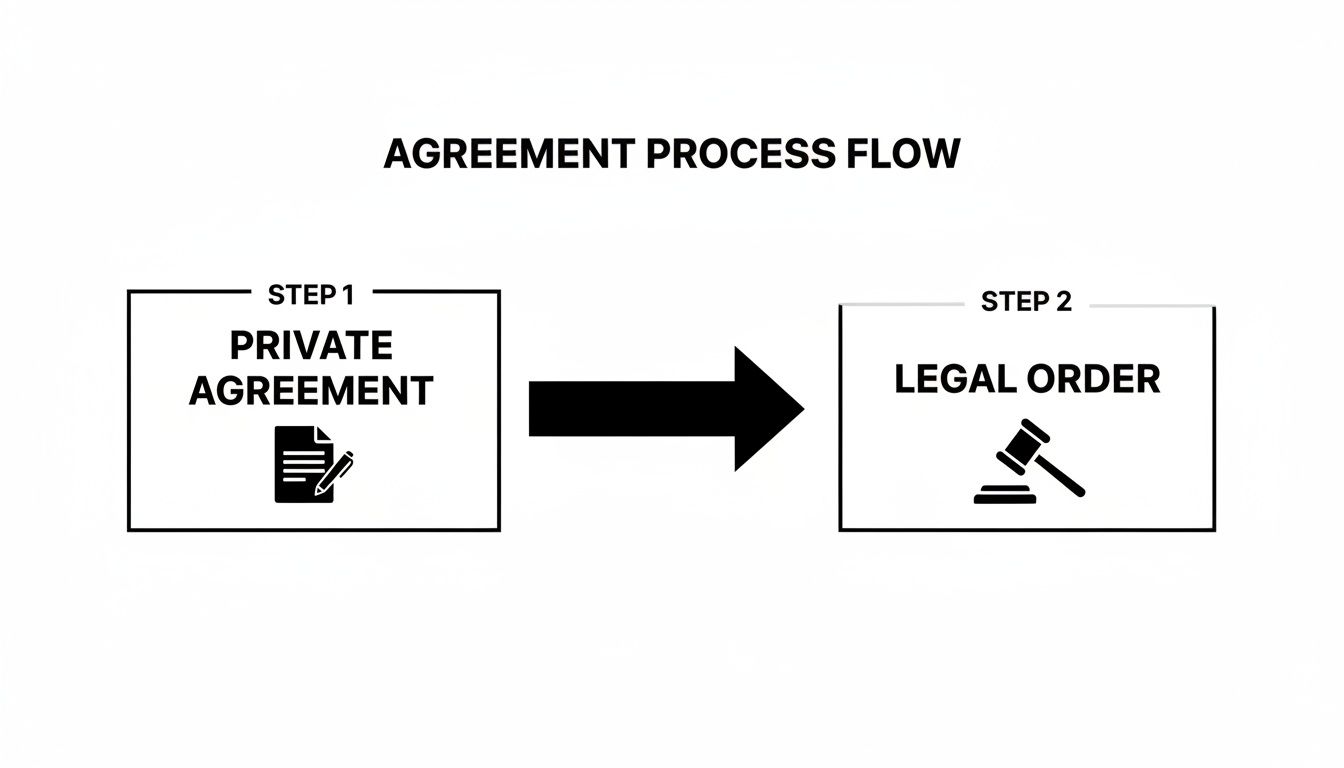
Many spousal support issues are resolved by agreement rather than trial. A separation agreement may set out whether support will be paid, how much, for how long, and whether it can later be reviewed or changed.

That said, an agreement should be approached carefully. If one party did not understand their rights, lacked disclosure, or signed under pressure, support terms may later be challenged.

Good agreements are usually based on:

  • complete financial disclosure
  • realistic legal advice
  • clear language about amount, duration, review, and termination
  • coordination with child support and property issues

Before signing away support rights or agreeing to pay support, it helps to understand what a court might have done in the same situation.

What Happens When Spouses Cannot Agree?

When spouses cannot agree on support, the issue may be resolved through negotiation, mediation, lawyer-assisted settlement discussions, court motions for temporary support, or a trial.

In Brampton family law matters, the outcome often depends on the quality of financial disclosure and the strength of the entitlement argument. If one person is self-employed, underreporting income, or refusing disclosure, the case can become more complex.

When a dispute reaches court, the judge may consider the legislation, the evidence, prior agreements, and the SSAG framework. Temporary support may be ordered while the case is ongoing.

Why This Matters in Real Life

Many people searching about spousal support Ontario want a simple yes or no answer. In real life, support cases rarely work that way.

A person may have a strong claim but need proper financial disclosure to prove it. Another person may worry they will automatically have to pay support because they earn more, when the legal picture is actually much more limited. Some cases settle early. Others turn on small but important facts, such as who took time away from work, whether a relationship qualifies as common-law, or whether child support changes the support range.

That is why early legal advice can make a real difference. Understanding the difference between status, entitlement, amount, and duration often helps people make better decisions before signing an agreement or taking a firm position.

Simple Hypothetical Examples

Example 1: Stay-at-home parent after a long marriage

Priya and Aman were married for 14 years in Brampton. Priya left her job when their children were young and only recently returned to part-time work. Aman earns substantially more. Priya may have a strong claim for support because the relationship appears to have affected her earning capacity and left her financially disadvantaged after separation.

Example 2: Both spouses work, but one career was limited

Sara and Daniel both work full time. Daniel earns more, but that alone does not decide the issue. During the relationship, Sara turned down promotions and handled most of the childcare so Daniel could travel for work. Sara may still have a spousal support claim even though she is employed.

Example 3: Common-law relationship with a child

Nina and Raj lived together for four years in Ontario and have one child. They never married. Nina reduced her hours after the child was born and became partly financially dependent. Nina may be able to pursue common law spousal support Ontario under the Family Law Act, even though property rights may be different from those of married spouses.

These examples are simplified. Real outcomes depend on the full facts, income evidence, and legal context.

FAQ

Who qualifies for spousal support in Ontario?

A person may qualify if they are a married spouse or an eligible common-law partner and can show a legal basis for support, such as financial need, career sacrifice, caregiving impact, or economic disadvantage caused by the relationship.

Is spousal support automatic?

No. Spousal support is not automatic after separation or divorce. The person asking for support must usually show entitlement based on the facts of the relationship and its financial consequences.

Can common-law partners get spousal support?

Yes. In Ontario, some common-law partners can seek support under the Family Law Act if they lived together continuously for at least three years, or if they were in a relationship of some permanence and had a child together.

Do I have to pay spousal support if my spouse works?

Possibly. A working spouse may still have a support claim if there is a significant income gap, past career sacrifice, childcare-related disadvantage, or ongoing financial need.

Does a higher income automatically mean support is payable?

No. Higher income is important, but it does not automatically create support. The legal analysis also looks at entitlement, economic disadvantage, need, and the history of the relationship.

How is spousal support calculated?

After entitlement is established, support is often estimated using the Spousal Support Advisory Guidelines. The calculation usually considers incomes, length of relationship, child support, and other financial factors.

How long does spousal support last?

It depends. Support may be short term, time-limited, or indefinite, depending on factors such as the length of the relationship, age, health, work history, and the ability to become self-sufficient.

Does cheating affect spousal support?

Usually not. Spousal support is generally based on financial and legal factors, not moral blame for the relationship ending.

Speak With a Spousal Support Lawyer in Brampton

If you are unsure whether you may have a claim, or whether you may have to pay support, it helps to get advice before making assumptions or signing an agreement. A spousal support lawyer Brampton families trust can help review entitlement, income issues, common-law status, separation terms, and likely support ranges.

Book a free consultation with Badesha Law to get clear answers about your support rights and obligations. If you are separating or divorcing in Brampton, early legal advice can help you avoid costly mistakes and take the right next steps with confidence.

Book Your Free Consultation, Call 289 406 0110

At Badesha Law, we help clients in Brampton understand their possible rights and obligations involving spousal support, divorce, separation, child-related issues, and financial claims that arise when relationships end. Early advice can make a major difference in how you negotiate, what documents you gather, and what outcome may be realistic.

If you are dealing with separation or divorce in Brampton, Badesha Law can help you assess whether support may be owed, whether support may be challenged, and what practical next steps make sense for your situation.

Speak With Badesha Law Today, Free Consultation

You may also want to explore related support and family law topics, including Divorce Lawyer Brampton, Family Lawyer Brampton, Separation Agreements, Child Support, Property Division, and the Contact page.

A Practical Guide to Cohabitation Agreements in Ontario

A cohabitation agreement in Ontario is a legal contract for unmarried couples that outlines how you’ll handle assets, debts, and support if the relationship ever ends. It’s a smart, proactive step for Brampton couples that provides clarity and protection where the Family Law Act doesn't automatically grant property rights, unlike for married spouses.

Why a Cohabitation Agreement Is a Smart Move for Brampton Couples

A cartoon couple holds a cohabitation agreement document with a house plan in a city.

As more couples in Brampton and the Greater Toronto Area build their lives together without getting married, many find themselves in a legal grey area without even realizing it. A common—and costly—mistake is believing that "common-law" status automatically provides the same property rights as marriage. Under Ontario's Family Law Act, this is simply not true.

Think of a cohabitation agreement not as a sign of distrust, but as a practical blueprint for your financial future. It functions like a business partnership agreement, creating certainty and preventing expensive, emotionally draining disputes down the road. It’s about laying a strong foundation by agreeing on the rules ahead of time, while things are good, so you and your partner can focus on your life together.

The Growing Need for Clarity in Brampton

Living together without marriage is a fast-growing trend. Between 1981 and 2021, the number of common‑law couples in Canada surged by an incredible 447%. In major GTA centres like Brampton and Mississauga, over 18% of couples are choosing cohabitation, reflecting a major lifestyle shift.

As more couples enter these relationships unaware that their legal rights differ dramatically from married spouses, the need for a clear agreement has never been greater. For clients in Brampton, this is an actionable step to protect your assets. You can discover more insights about common-law couples in Ontario and the unique legal landscape they face.

A cohabitation agreement transforms ambiguity into certainty. It allows you and your partner—not a court—to decide what is fair regarding your finances and property if your paths diverge in the future.

This guide is your roadmap to understanding your rights. A well-drafted agreement offers essential protection, particularly in a high-asset region like Brampton, by ensuring fairness and predictability. It’s a tool for empowerment, helping you and your partner build a future with confidence and mutual understanding.

How Ontario Law Treats Married vs Common-Law Property

Here's the single most important thing for Brampton clients to understand: when it comes to property, Ontario's Family Law Act treats married and common-law couples in vastly different ways. This isn't a minor detail—it's the core reason why cohabitation agreements in Ontario are an essential tool for protecting yourself financially.

For married couples, Ontario's Family Law Act lays out a clear process called equalization. This recognizes marriage as an equal economic partnership. When a marriage ends, the value of most assets built up during that time is tallied and split right down the middle, 50/50. It doesn't matter whose name is on the title.

Common-law partners get no such automatic protection. None at all.

The Common-Law Property Trap

For unmarried couples, the law operates on a much harsher principle: what's in your name is yours. Period.

There is no automatic right to share in the value of your partner's property, no matter how long you've lived together or how much you contributed to the household. This catches countless people by surprise, often with devastating financial consequences.

A striking feature of Ontario family law is that common‑law partners do not benefit from the matrimonial property “equalization” regime, no matter how long they live together. Unlike married spouses, common‑law partners in Ontario do not automatically share in the growth of each other’s net worth.

This creates deeply unfair situations that we see all the time in our Brampton practice. For a clearer picture, you can learn more about how Ontario law treats common-law relationships and the financial risks involved.

Here are a couple of classic scenarios we see with couples in Brampton:

  • Scenario 1: The Pre-Owned Home. You move into the Brampton house your partner owned before you met. For 15 years, you help with the mortgage, pay for a new kitchen, and cover the bills. If you split up, you have no automatic claim to a single dollar of that home's value or the equity you helped build. Legally, it’s still 100% your partner’s.

  • Scenario 2: The Jointly Paid Asset. You and your partner buy an investment condo in Mississauga, but it's put in your partner’s name to get a better mortgage rate. You both chipped in for the down payment and split the costs every month. If the relationship ends, your partner is the sole legal owner. You’d be left with nothing without a fight.

The Costly and Uncertain Alternative

Without a cohabitation agreement, your only way to claim a share of property is to sue your ex-partner for what’s called a trust claim. This means heading to court and trying to prove that your contributions—whether money or work—made your partner wealthier while leaving you at a financial disadvantage.

A trust claim is a complex, expensive, and emotionally draining legal battle with no guaranteed outcome. You’re asking a judge to create a financial remedy where the Family Law Act doesn't provide one automatically. This process can drag on for years and rack up tens of thousands of dollars in legal fees.

A cohabitation agreement is the most predictable and peaceful way to ensure fairness. It lets you and your partner set your own rules for property, choosing certainty over a potential court battle.

To see these differences side-by-side, take a look at this table. It breaks down the default legal positions for married versus common-law partners in Ontario if you don't have an agreement in place.

Property and Support Rights Married vs Common-Law Partners

Legal Right or Obligation Married Spouses (Family Law Act) Common-Law Partners (Default Law)
Property Division Automatic right to equalize the value of property acquired during the marriage. Each spouse is generally entitled to 50% of the growth in net worth. No automatic right to property division. Each partner keeps what is in their own name.
Matrimonial Home Both spouses have equal rights to possess the matrimonial home, regardless of whose name is on the title. It receives special protection. No "matrimonial home" concept. The person whose name is on the title has the right to the home. The other partner may be forced to leave.
Spousal Support Entitled to claim spousal support based on the roles and contributions during the marriage. Entitled to claim spousal support if they meet the definition of "spouse" (cohabited for 3+ years or have a child together).
Inheritance (No Will) The surviving spouse automatically inherits a significant portion or all of the deceased spouse's estate under intestacy laws. No automatic inheritance rights. The surviving partner gets nothing unless specifically named in a will.

As you can see, the legal safety nets available to married spouses simply don’t exist for common-law couples. An agreement allows you to build those protections yourselves, on your own terms.

Understanding Spousal Support and Legal Timelines

When it comes to common-law relationships, the rules around spousal support are a huge source of confusion—and risk. While the property division rules are completely different from those for married couples, many people in Brampton wrongly assume that if they aren't married, no financial support obligations can ever arise after a breakup. This is a dangerous myth.

The reality is, Ontario’s Family Law Act absolutely allows a common-law partner to claim spousal support. This is a critical point for clients to understand. Unlike property rights, which aren't automatic, support obligations can be triggered simply by the length and nature of your relationship. A cohabitation agreement is your only real tool to get ahead of this possibility.

The Timelines That Trigger Support Obligations

The Family Law Act is very clear about the thresholds that can define you as a "spouse" for support purposes, even if you never married. Knowing these timelines is essential for any cohabiting couple in Ontario.

A potential claim for spousal support can arise if you meet either of these two conditions:

  • The Three-Year Rule: You have lived together in a conjugal (marriage-like) relationship continuously for at least three years.
  • The Parent Rule: You are in a "relationship of some permanence" and have a child together, whether by birth or adoption.

If your relationship ticks either of these boxes, a judge can order one partner to pay spousal support to the other if you separate. How much and for how long depends on things like income differences, the roles each person played in the relationship, and whether one partner was left at an economic disadvantage.

For example, think of a Brampton couple where one partner steps back from their career to raise a child. Even if they were together for less than three years, that partner could be entitled to support after a split because their earning ability was hurt for the good of the family.

Gaining Certainty and Control with an Agreement

These legal timelines create a potential financial obligation that catches many couples completely off guard. A well-drafted cohabitation agreement lets you address or even completely waive these obligations, giving you financial predictability. To get a better handle on your situation, learn more about how cohabitation is legally defined in Ontario.

A cohabitation agreement allows you to write your own rules for spousal support. You get to decide what’s fair for your specific circumstances, rather than leaving that decision to a judge years down the road.

This is especially vital in Brampton, where incomes between partners can be worlds apart. An agreement lets you set out crystal-clear terms, such as:

  • A full waiver of support: Both partners agree that no spousal support will be paid by either person, no matter how long they live together.
  • Lump-sum payment: Instead of ongoing monthly payments, a specific, one-time amount is agreed upon.
  • Time-limited support: Support will only be paid for a set period (like one year) to help the lower-income partner get back on their feet.

Without an agreement, you’re stuck with the default rules of the Family Law Act. By creating one, you and your partner take control, ensuring any potential separation is handled on your own terms.

What Every Ontario Cohabitation Agreement Should Cover

Okay, let's move from the "what if" to the "what's in it." A cohabitation agreement is your relationship's financial rulebook. It's a document you and your partner build to set clear expectations for your assets, debts, and future responsibilities. While no two couples are the same, every solid, protective agreement drafted for a Brampton client should have a few core components locked down.

Think of these clauses as the essential pillars holding up the entire structure. If one is weak or missing, the whole agreement could be challenged down the road if you ever need to rely on it.

Defining Property Ownership and Division

This is the most important part of any cohabitation agreement. Since Ontario's Family Law Act doesn't automatically split property for common-law couples, this section is where you create your own fair rules. It must clearly state who owns what coming into the relationship and what happens to property you buy together if you separate.

Specificity is key. It’s not enough to say, "we'll split the house." A properly drafted agreement gets into the details:

  • Existing Assets: List the significant assets each of you is bringing to the table (like RRSPs, cars, or investment accounts) and confirm they will always remain your separate property.
  • The Home: For most Brampton couples, the home is the biggest asset. If one person already owns it, will the other get a share of the equity for helping with the mortgage or renovations? If you buy a home together, how will you divide the proceeds if you sell it—a straight 50/50 split, or based on who contributed to the down payment?
  • Future Assets: Lay out the plan for assets you acquire as a couple, such as joint savings accounts or new investments.

For example, say you move into your partner's condo in Brampton. The agreement can state that your partner keeps the condo's original value, but you’ll share 50% of the increase in its value from the day you moved in. This acknowledges your contributions to the mortgage and upkeep.

Clarifying Responsibility for Debts

Just like assets, debts are treated separately under Ontario law for common-law couples. You are only responsible for debts in your name. But couples often take on joint debt—think lines of credit, shared credit cards, or car loans.

This clause is your protection against being saddled with your partner's debt. It should clearly state:

  • Which debts belong to each individual and which ones are shared.
  • How any joint debts will be paid off if you separate.
  • A confirmation that neither of you is responsible for the other’s pre-relationship or secret debts.

Setting Out Terms for Spousal Support

As we’ve covered, spousal support can be an obligation for common-law couples in Ontario. Your agreement is your chance to decide on this issue for yourselves instead of leaving it to a judge.

An agreement gives you total control over spousal support. You can set clear limits, define specific terms, or waive it entirely, giving both of you complete financial certainty for the future.

You could agree to a full waiver, where both of you give up any right to seek support from the other. Or, you could set specific terms, like a one-time lump-sum payment or monthly support for a fixed amount of time. To ensure your cohabitation agreement is comprehensive, legally sound, and addresses all necessary considerations, an AI Legal Contract Analyzer can provide invaluable insights and identify potential gaps.

Addressing Estate Rights and Inheritance

This is a critical section many people overlook. If you pass away without a will, Ontario's intestacy laws do not automatically give your common-law partner any right to your estate. Your assets would likely go to your next of kin (like your parents or siblings), leaving your partner with nothing.

While a cohabitation agreement isn't a substitute for a will, it can include a clause where you both agree to give up your rights to make a dependant’s support claim against the other’s estate. More importantly, it can state that each of you promises to create a will that provides for the other in a specific way. This simple step ensures your final wishes are honoured and your partner is taken care of.

How to Create a Legally Binding Agreement

A cohabitation agreement is a powerful legal tool. But for it to protect you, it needs to be created correctly. Under Ontario's Family Law Act, there are specific steps you must follow to make sure the agreement is legally enforceable and can hold up if ever challenged in court. This process is about creating fairness, transparency, and crystal-clear understanding for both partners.

For cohabitation agreements in Ontario, the foundation is built on total honesty and proper legal procedure.

Step 1: Start with an Open Conversation

Before any lawyers get involved, the very first step is for you and your partner to sit down and have an honest, calm conversation about your goals and concerns. What assets are you each bringing into the relationship? What about debts? How do you picture handling finances as a couple? This initial chat sets the stage for a much smoother process.

Step 2: Complete Full and Honest Financial Disclosure

This is the most critical, non-negotiable step. For a cohabitation agreement to be valid, both partners must provide a complete and truthful picture of their finances. This means listing all your assets (property, investments, savings), debts (loans, credit card balances), and income.

Hiding an asset or downplaying your income can invalidate the entire agreement later on. A judge can set aside an agreement if they discover that one partner wasn't fully honest, because it means the other person couldn't have made a truly informed decision.

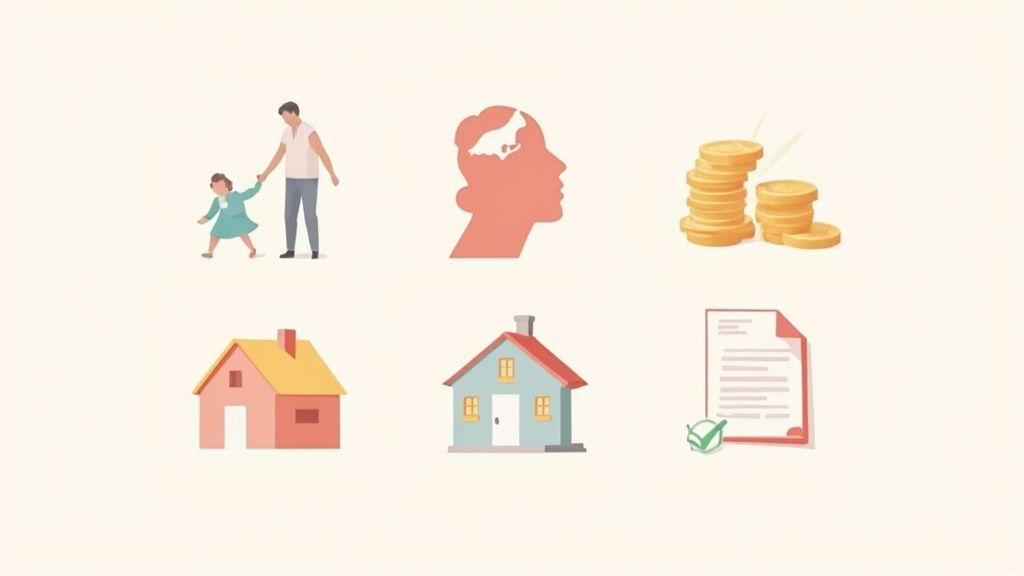
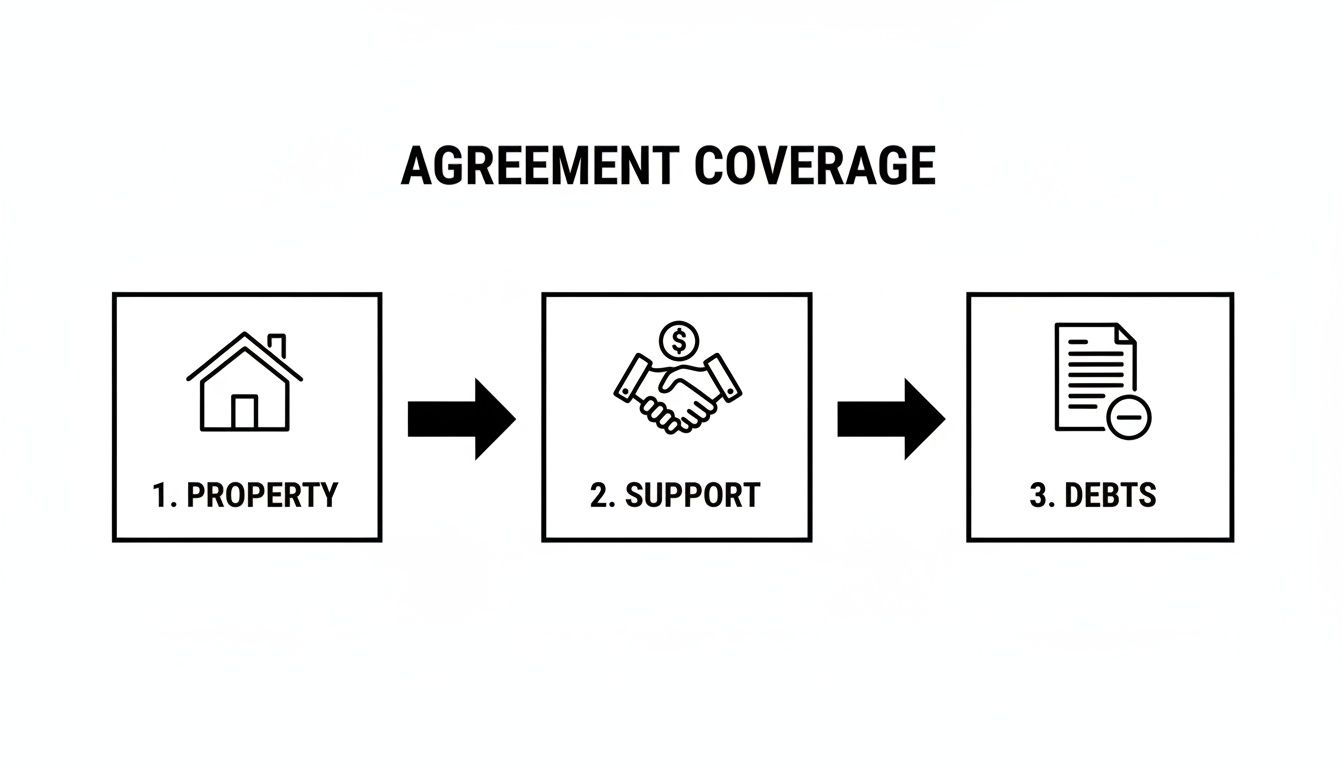
This flowchart shows the key areas a typical agreement will cover—all of which depend on honest disclosure.

Flowchart illustrating agreement coverage, detailing property, support, and debts with corresponding icons.

The way property, support, and debts are all connected shows just how intertwined your financial lives can become, reinforcing why full disclosure is the bedrock of a fair outcome.

Step 3: Get Independent Legal Advice

Here’s another mandatory requirement: each partner must get advice from their own, separate lawyer. One lawyer cannot represent both of you, as it would be a clear conflict of interest. Your lawyer’s job is to explain your rights under the Family Law Act, go through the proposed agreement with you, and make sure you understand exactly what you are signing and what rights you might be giving up.

Independent Legal Advice (ILA) is the legal system's built-in safeguard. It proves that both partners signed the agreement with their eyes wide open, free from any pressure or misunderstanding, which makes the contract that much stronger.

Step 4: Draft and Finalize the Agreement

Once disclosure is complete and you’ve both spoken with your lawyers, one of the lawyers will draft the initial agreement based on your discussions. This draft is then sent to the other lawyer for review, who may suggest changes or additions. This back-and-forth negotiation continues until both you and your lawyers are satisfied with the final terms.

Step 5: Properly Sign and Witness the Document

The last step is signing the agreement, and it has to be done correctly for it to be legally binding. Your signature, and your partner's, must be witnessed by another person. Your lawyers will typically act as the witnesses for you.

To ensure your cohabitation agreement is legally sound, understanding modern signing methods is also helpful. You can learn more about how to electronically sign documents for a convenient and secure option. Following these steps ensures your agreement will work as the reliable shield it’s meant to be.

Common Mistakes That Can Invalidate Your Agreement

Putting together a cohabitation agreement is a huge step toward financial clarity. But a few critical missteps can render your agreement totally useless, turning that shield you built into a worthless document right when you need it most. Knowing these common pitfalls is the only way to ensure your agreement will actually stand up in an Ontario court.

If your agreement isn't enforceable, you're right back where you started—facing the default rules of the Family Law Act and a likely court battle. For couples in Brampton, where property values are soaring, a voided agreement can be financially devastating.

The Pitfall of Incomplete Financial Disclosure

This is, without a doubt, the number one reason judges throw cohabitation agreements out. The entire point of a fair agreement is transparency. Both you and your partner must provide a full, honest, and detailed picture of your finances. We’re talking every asset, every debt, and every source of income.

Trying to hide a secret investment account or downplaying the value of your business is a fatal mistake. If a court finds out that one partner wasn't completely truthful, it can invalidate the entire contract.

Under Ontario's Family Law Act, a court has the power to set aside an agreement if a party failed to disclose significant assets or debts. Honesty isn’t just good practice; it's a legal requirement.

Signing Under Duress or Pressure

For an agreement to be legally sound, both partners have to sign it freely and voluntarily. Duress is a legal term for being pressured, threatened, or otherwise forced into signing something. An Ontario court will not uphold a contract that wasn't entered into willingly by both sides.

A classic example of a high-pressure situation is being handed the agreement just days before you’re set to close on a new house in Brampton.

  • Cautionary Scenario: Imagine your partner says, "You need to sign this by tomorrow, or we’re going to lose the house we've been dreaming of." This creates a massive power imbalance and could easily be seen as duress, putting the entire agreement at risk.

The timing of the signing matters. It should be a calm, considered process, not a last-minute ultimatum tied to a major life event.

Relying on Generic Online Templates

Downloading a cheap template from the internet is one of the riskiest shortcuts you can take. These one-size-fits-all documents are not tailored to Ontario's Family Law Act and can’t account for the unique details of your financial situation. They almost always lack the specific clauses and legal language needed to be enforceable here.

Using a generic template without having an Ontario family lawyer review it is like trying to perform surgery with a plastic knife—it’s the completely wrong tool for the job, and it will almost certainly end in disaster.

Including Unfair or Illegal Terms

Finally, an agreement can be set aside if its terms are fundamentally unfair or if they break Canadian law. While you have a lot of freedom to set your own rules, there are limits. For example, you cannot include clauses that try to pre-determine child custody or waive child support. Those rights belong to the child, not the parents, and are always unenforceable. Likewise, any term that violates the Criminal Code of Canada would obviously be void.

Trying to cut corners on legal advice to save money now often means paying far more in legal fees and financial losses down the road. Getting professional guidance from the start is the only way to ensure your agreement truly protects you.

Frequently Asked Questions About Cohabitation Agreements

Diving into the world of cohabitation agreements naturally brings up a few questions. Below, I’ve answered the most common ones we hear from couples across Brampton and the GTA, giving you the clear, straightforward information you need to move forward.

How Much Does a Cohabitation Agreement Cost in Brampton?

The cost of drafting a cohabitation agreement really depends on how complex your financial picture is. A couple with straightforward assets will pay less than partners who own businesses, have diverse investment portfolios, or need to negotiate more complicated terms.

It’s helpful to think of this not as an expense, but as an investment in your financial future. A professionally drafted agreement is your shield against the potentially massive legal fees and financial headaches that can come with a messy separation down the road. The best way to know for sure is to book a consultation, where we can give you a clear estimate based on your specific situation.

Can We Change Our Cohabitation Agreement Later?

Absolutely. A cohabitation agreement is a living document, not something set in stone. If you and your partner both agree, you can amend or even cancel the agreement entirely.

Life changes, and your agreement should be able to change with it. Just remember, any updates must follow the same legal rules as the original document to be valid:

  • The changes must be in writing.
  • Both of you must sign the new document.
  • Each signature needs to be properly witnessed.

It’s a smart move to pull out your agreement and review it after any major life event—like having a child, getting a big inheritance, or a significant change in either of your incomes—to make sure it still makes sense for you.

What Happens if We Get Married After Signing an Agreement?

Under Ontario's Family Law Act, if you get married, your cohabitation agreement automatically becomes a marriage contract (what many people call a prenup). The terms you already agreed to will generally stay in place and remain enforceable.

However, marriage brings a new set of legal rights and obligations that don't apply to common-law partners, especially when it comes to the matrimonial home. Because of this, it is highly recommended that you review and update your agreement before you get married. This step ensures it addresses these new legal realities and aligns with your intentions as a married couple.

Do We Need a Lawyer if We Agree on Everything?

Yes, this one is non-negotiable. For a cohabitation agreement in Ontario to hold up in court, both partners must have received independent legal advice (ILA).

An Ontario court has the power to set aside an agreement if one partner didn't have their own lawyer explain its terms and what they mean. Legal oversight isn’t just a good idea; it’s what makes your agreement legally solid.

Having your own lawyer ensures you fully understand your rights and obligations, confirms all financial information has been shared openly, and verifies that you’re signing the document freely and without pressure. This professional guidance is what gives the agreement its real power to protect you.


At Badesha Law, we offer clear, strategic guidance for couples in Brampton and the GTA looking to build a secure future with a strong cohabitation agreement. We make the process transparent and ensure you feel confident every step of the way. Contact us to schedule a consultation and take control of your financial future today.

Step-by-Step Guide to Getting a Divorce in Ontario

Navigating a divorce can feel overwhelming, especially when you’re trying to understand the legal system in Brampton. For anyone needing a Divorce Lawyer in Brampton, the first step is often the hardest: figuring out where to begin. This guide provides a clear, step-by-step roadmap to the divorce process in Ontario, grounded in the Family Law Act and Canada’s Divorce Act, giving you actionable insights to move forward with confidence.

Your First Steps in the Brampton Divorce Process

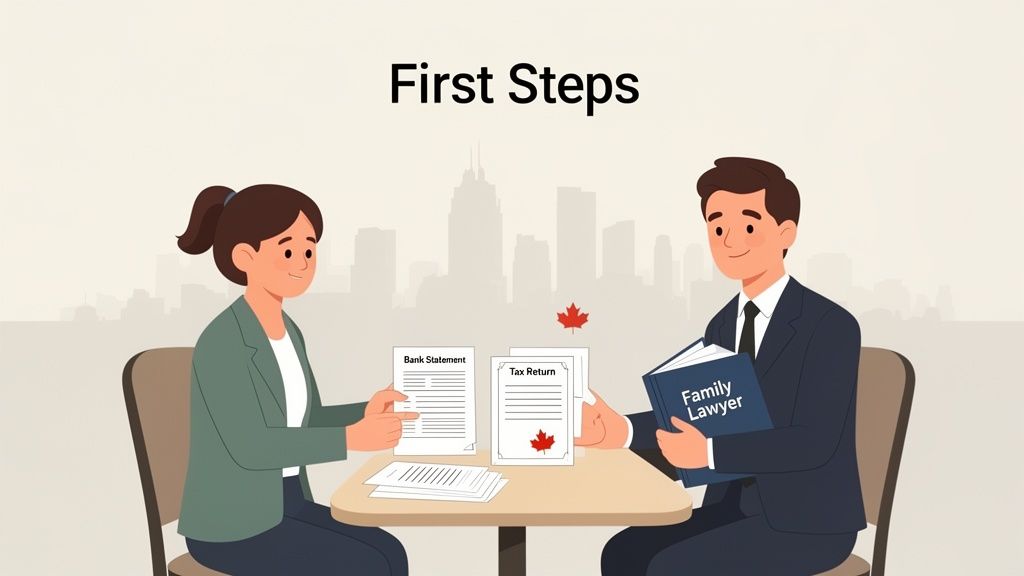
Two people discuss financial documents and legal matters, including a bank statement and tax return, with a family lawyer.

Starting the divorce process in Brampton is about strategic preparation, not emotional reactions. Before filing any paperwork, it’s crucial to build a solid foundation. By focusing on these initial tasks, you empower yourself with the knowledge and organization needed to navigate the legal journey ahead, taking back control of your situation.

Step 1: Confirm You Are Eligible for a Divorce

Before any legal action can be taken, you must meet the basic requirements for a divorce in Canada. Under the federal Divorce Act, the sole ground for divorce is marriage breakdown. The most common way to prove this is by living separate and apart from your spouse for at least one year.

This one-year separation is a mandatory waiting period. However, you do not have to wait for the year to be over to start the process. You can begin negotiations, draft a separation agreement, and even file your Application for Divorce. The final Divorce Order will simply not be granted until the one-year mark has passed.

Step 2: Schedule an Initial Legal Consultation

One of the most powerful first moves you can make is scheduling a consultation with an experienced family lawyer in Brampton. This meeting is not about starting a conflict; it’s about understanding your rights and obligations regarding property division, support, and parenting arrangements under Ontario law.

A proactive consultation provides a personalized roadmap. You’ll understand potential outcomes, the process ahead, and how to protect your interests before making irreversible decisions.

This early legal advice is invaluable. It helps you avoid common mistakes, such as informally agreeing to terms that are not in your best interest or moving out of the matrimonial home without understanding the potential legal consequences.

Step 3: Organize Your Financial Documents

Financial disclosure is the cornerstone of any Ontario divorce. Getting a head start on gathering your financial paperwork will save you significant time, stress, and money. This involves creating a complete financial snapshot of your marriage.

Start collecting these key documents for both yourself and, if possible, for your spouse:

  • Proof of Income: Recent pay stubs, T4 slips, and Notices of Assessment from the Canada Revenue Agency for the last three years.
  • Asset Information: Bank account statements, investment summaries (RRSPs, TFSAs), and property deeds.
  • Debt Records: Statements for mortgages, lines of credit, credit cards, and car loans.
  • Business Valuations: If you or your spouse owns a business, any relevant financial statements are crucial.

As you navigate these initial stages, you may also consider new living arrangements; finding reliable movers in Brampton can help facilitate a smoother transition. Taking these organized steps provides the foundation needed to approach the rest of your divorce with clarity and confidence.

Understanding the Grounds for Divorce in Ontario

In Canada, the divorce process is designed to be “no-fault.” The federal Divorce Act establishes only one legal reason for divorce: marriage breakdown. This approach removes blame from the legal equation and focuses instead on achieving a fair and practical resolution for your family’s future.

For most couples in Brampton, proving marriage breakdown is straightforward: you must show that you and your spouse have lived separate and apart for at least one full year. This is the standard path to legally ending a marriage.

The One-Year Separation Rule

“Living separate and apart” is the key to demonstrating marriage breakdown. This doesn’t necessarily mean one person must move out immediately. Many couples continue to live in the same home while legally separated for financial reasons or to provide stability for their children.

What matters is the intention to end the marital relationship. This means you stop living as a couple—perhaps by sleeping in separate rooms, managing finances independently, and no longer presenting socially as a couple. This one-year period allows both individuals time to be certain about their decision. A skilled divorce lawyer in Brampton can provide clear advice on what constitutes a legal separation, even if you are still living under the same roof.

Are There Other Grounds for Divorce?

While the one-year separation is the most common path, the Divorce Act does provide two other grounds for proving marriage breakdown:

  1. Adultery: You would need to provide clear proof that your spouse was physically intimate with another person.
  2. Cruelty: This requires showing that your spouse has treated you with such severe physical or mental cruelty that it is impossible to continue living together.

In modern family law, these “fault-based” grounds are rarely used. The standard of proof is extremely high, and attempting to prove them can turn the process into an expensive and emotionally draining battle. Crucially, proving fault does not provide an advantage in matters of property division or support. For these reasons, legal experts almost universally recommend proceeding based on the one-year separation.

The purpose of Ontario’s divorce system is not to punish past behaviour. It is to dissolve the legal union and create a fair plan for the future, focusing on key issues like parenting, support, and property division.

The rapid growth in Peel Region has placed significant pressure on the Brampton courthouse, leading to serious backlogs. With local divorce rates at approximately 12.5 per 1,000 marriages—higher than the provincial average—you need an expert to navigate this congested system. An experienced Brampton lawyer ensures your documents are prepared perfectly to avoid the rejections and delays that affect many others.

Solving the Core Issues of Your Divorce

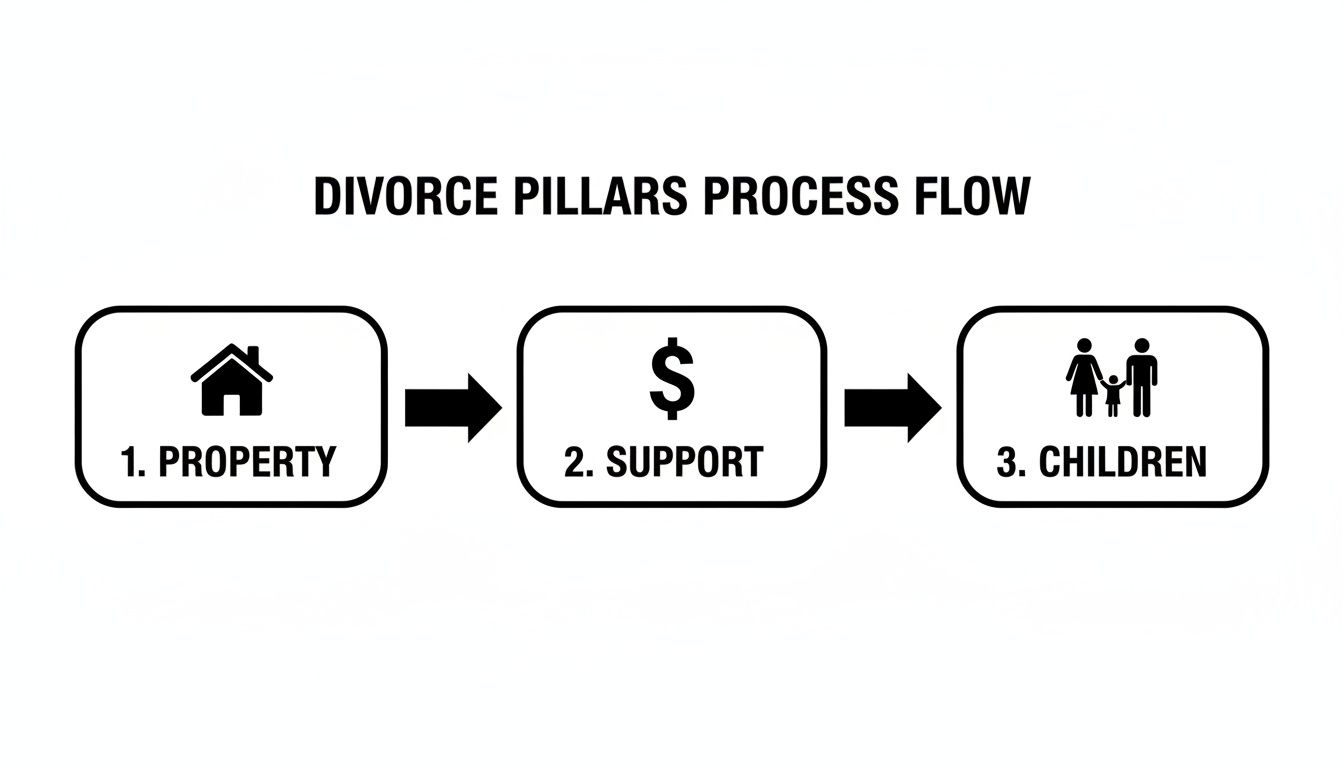
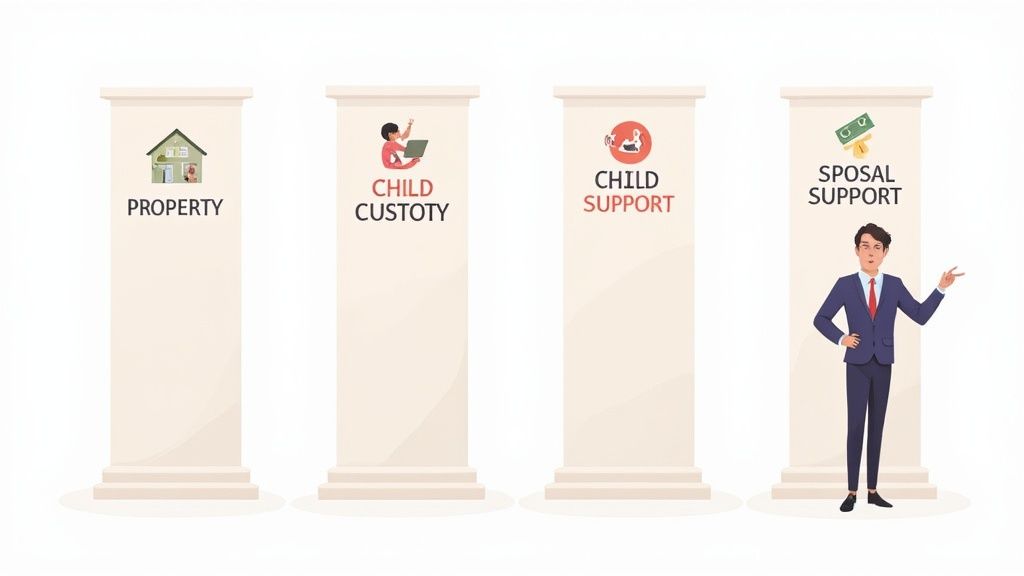
Once the divorce process is initiated, the real work involves resolving the three core pillars: property, support, and children’s well-being. By addressing each of these methodically, you can work toward a fair and stable resolution that allows everyone to move forward.

An experienced family lawyer in Brampton is your guide through this process, ensuring you understand how the Family Law Act protects your rights at every stage.

Untangling Your Finances: Property Division

Under Ontario law, marriage is viewed as an equal economic partnership. The wealth you accumulated together during the marriage must be shared fairly when it ends. This is achieved through a process called equalization.

The process involves balancing the financial growth of each spouse during the marriage. Each spouse calculates their Net Family Property (NFP) by taking their assets on the date of separation and subtracting their debts and the assets they brought into the marriage. The spouse with the higher NFP pays the other spouse half of the difference.

This is called an equalization payment, and its purpose is to ensure both partners leave the marriage with an equal share of the wealth accumulated as a team.

The calculation follows these steps:

  1. List all assets and debts as of the date of separation.
  2. Do the same for the date of marriage (excluding certain items like gifts or inheritances).
  3. Subtract the marriage-date value from the separation-date value for each spouse to determine their individual NFP.
  4. The spouse with the higher NFP pays half the difference to the other.

The matrimonial home receives special treatment in these calculations. For many, deciding what to do with the house is a significant challenge. Understanding your options for selling your marital home during a divorce is a critical part of financial planning.

To clarify these core issues, here is a summary of what you will be navigating.

Key Divorce Issues in Ontario at a Glance

Issue What It Involves Governing Principle (Ontario Family Law Act)
Property Division Calculating and dividing the wealth accumulated during the marriage. Includes assets like the home, pensions, investments, and debts. Equalization: The spouse with the higher Net Family Property growth pays the other half of the difference to ensure both partners share the marital wealth equally.
Support Determining financial assistance for a spouse (spousal support) and children (child support) to address financial imbalances post-separation. Fairness and Need: Spousal support is based on factors like roles in the marriage and need. Child support is a child’s right, calculated using mandatory government guidelines.
Parenting Creating a plan for how children will be cared for. This includes who makes major life decisions (decision-making) and the schedule of time spent with each parent (parenting time). Best Interests of the Child: All decisions must prioritize the child’s physical, emotional, and psychological well-being above all else.

Each issue is governed by a distinct legal principle, which is why a clear strategy is essential.

Establishing Financial Stability: Spousal and Child Support

Support payments are not a penalty. They are a legal mechanism to ensure financial fairness and stability after separation, particularly for children or a spouse who may be financially disadvantaged.

Spousal Support
Spousal support is not automatic. It is intended to recognize a spouse’s contributions to the marriage and assist them in becoming self-sufficient. To determine if support is warranted, a court will consider:

  • The length of the marriage.
  • The roles each spouse played (e.g., one as primary caregiver while the other advanced their career).
  • The income and earning capacity of each spouse.
  • Any economic hardship caused by the separation.

Child Support
Unlike spousal support, child support is the legal right of every child. The calculation is based on mandatory government guidelines. The amount depends almost entirely on the paying parent’s gross annual income and the number of children, ensuring predictable financial support.

Focusing on the Future: Parenting and Decision-Making

When children are involved, Ontario law prioritizes their best interests above all else. The federal Divorce Act now uses terms like “decision-making responsibility” and “parenting time” instead of “custody” and “access” to encourage a more collaborative approach.

This shift in language encourages parents to focus on their roles and responsibilities, rather than on “winning” or “losing” their children.

Decision-Making Responsibility refers to who makes major decisions about a child’s life, such as:

  • Health and medical care
  • Education
  • Religious upbringing
  • Significant extracurricular activities

Parenting Time is the schedule that outlines when the children are in the care of each parent. The goal is to create a stable routine that allows the children to maintain a strong relationship with both parents. A Brampton family lawyer can help you create a detailed parenting plan that fits your family’s unique needs, preventing future conflicts and providing stability for your children.

The Step-by-Step Ontario Divorce Court Process

While the Ontario court system may seem intimidating, it follows a structured and predictable path. Understanding this roadmap helps set realistic expectations and highlights the value of having a skilled legal guide in Brampton.

The process begins when the first set of documents is filed with the court. Each subsequent stage is designed to narrow down the issues, encourage settlement, and move your case toward a final resolution.

Step 1: Filing the Initial Application

The first official step is filing an Application for Divorce (Form 8A). This document formally requests a divorce from the court and outlines the issues you need resolved, such as property division, support, and parenting arrangements.

Once completed with the help of your family lawyer, the application is filed with the Superior Court of Justice in Brampton. This officially opens your court file and initiates the legal process.

Step 2: Serving Your Spouse and Waiting for a Response

After filing, you must “serve” your spouse with a copy of the Application. This formal delivery process ensures your spouse is officially notified of the legal action.

Your spouse then has 30 days to file an Answer (Form 10) (or 60 days if living outside Canada or the US). If they fail to respond, the divorce may proceed as “uncontested,” which can significantly speed up the process.

This flowchart illustrates the three core pillars the court process is designed to resolve.

Divorce pillars process flow diagram outlining steps for property, financial support, and children.

The system methodically addresses property, support, and children to achieve a comprehensive and final resolution.

Step 3: The All-Important Exchange of Financials

This is one of the most critical stages. Both you and your spouse are legally required to provide full and honest financial disclosure by completing a Financial Statement (Form 13 or 13.1). This must be supported by documents like tax returns, pay stubs, and bank statements.

Full financial disclosure is the bedrock of a fair settlement. Hiding assets can lead to severe court penalties. Without transparency, it is impossible to correctly calculate equalization or determine support.

An experienced family lawyer in Brampton will ensure your financial statement is prepared accurately, helping you avoid common errors that cause delays in the busy Brampton court system.

Step 4: Navigating the Court Conferences

Before a case goes to trial, it must proceed through a series of conferences with a judge. These are structured meetings designed to manage the case and explore settlement opportunities.

  • Case Conference: The first meeting with a judge to identify disputed issues, ensure documents have been exchanged, and set a timeline.
  • Settlement Conference: The focus is on resolving the case. The judge will offer an opinion on the likely outcome at trial to encourage a compromise.
  • Trial Management Conference: If no settlement is reached, this final conference prepares for trial by finalizing witness lists and scheduling trial dates.

Each conference is a checkpoint to resolve your divorce without the cost and stress of a full trial. A good lawyer uses these meetings strategically to advocate for you and guide your case toward an efficient resolution.

Reaching a Fair Agreement Outside of Court

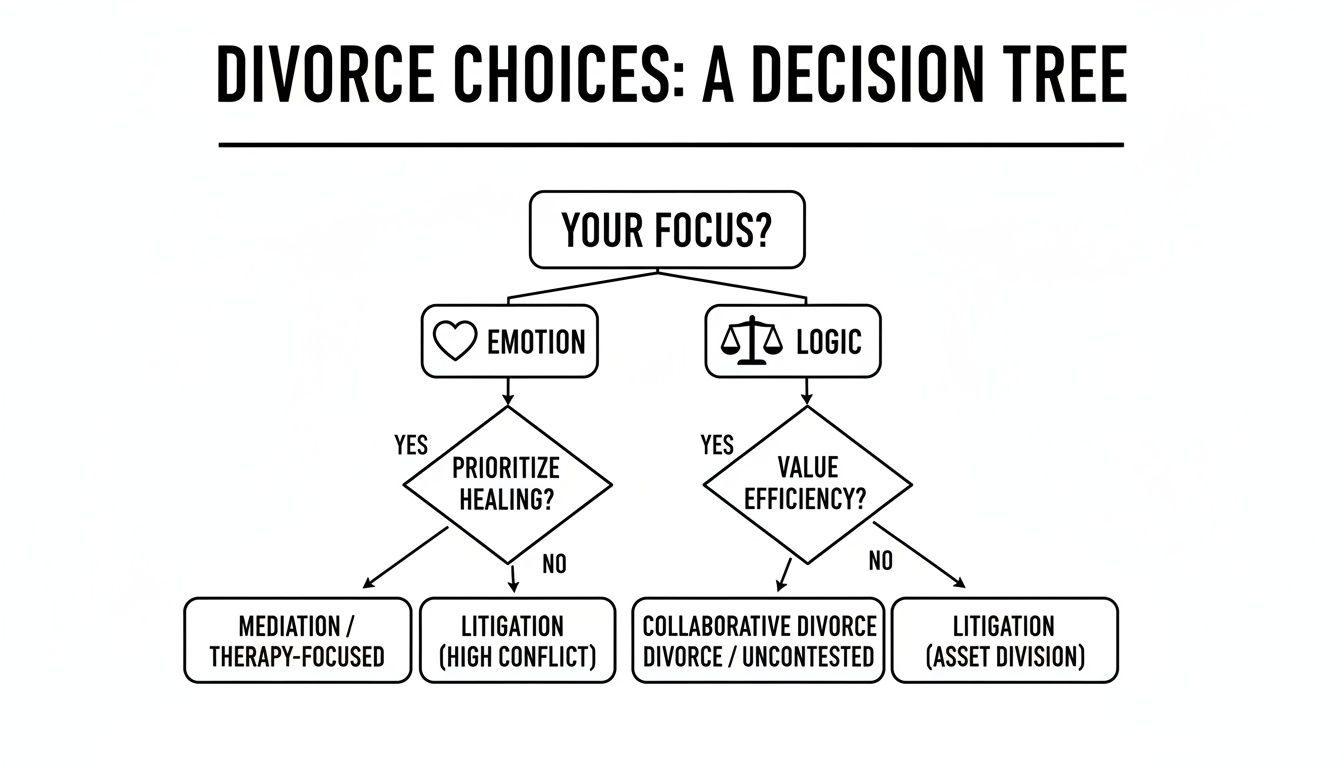
Court is not the only path to a divorce. In fact, most successful divorces in Brampton are settled amicably outside the courtroom. Alternative Dispute Resolution (ADR) methods like negotiation and mediation can save you significant time, money, and emotional stress.

These methods empower you to control the outcome rather than having a judge make decisions for your family. This is often the best way to maintain a respectful co-parenting relationship.

Lawyer-Led Negotiation

The most common starting point is direct negotiation between lawyers. Your family lawyer in Brampton communicates with your spouse’s lawyer to resolve key issues like property, support, and parenting. Your lawyer acts as your professional advocate, presenting your position and providing strategic advice based on Ontario’s Family Law Act. This is often the quickest and most cost-effective way to achieve a comprehensive separation agreement.

Mediation: A Guided Path to Common Ground

If direct negotiations stall, mediation is an excellent option. In this voluntary process, a neutral third-party mediator helps guide a productive conversation between you and your spouse. The mediator’s role is not to make decisions but to improve communication, identify common interests, and explore creative solutions that a court might not be able to order. You still have your own lawyer providing independent legal advice.

Mediation empowers you to be the architect of your own settlement. It shifts the focus from winning and losing to finding a practical, fair resolution that works for your entire family.

Collaborative Family Law: A Team-Based Approach

Collaborative family law is a unique process where you, your spouse, and your specially trained lawyers sign an agreement committing to resolve all issues without going to court. If the process fails, both lawyers must withdraw, creating a strong incentive for good-faith cooperation. This model often includes neutral financial specialists or family coaches to provide expert guidance, making it an excellent option for couples determined to minimize conflict.

How to Choose the Right Family Lawyer in Brampton

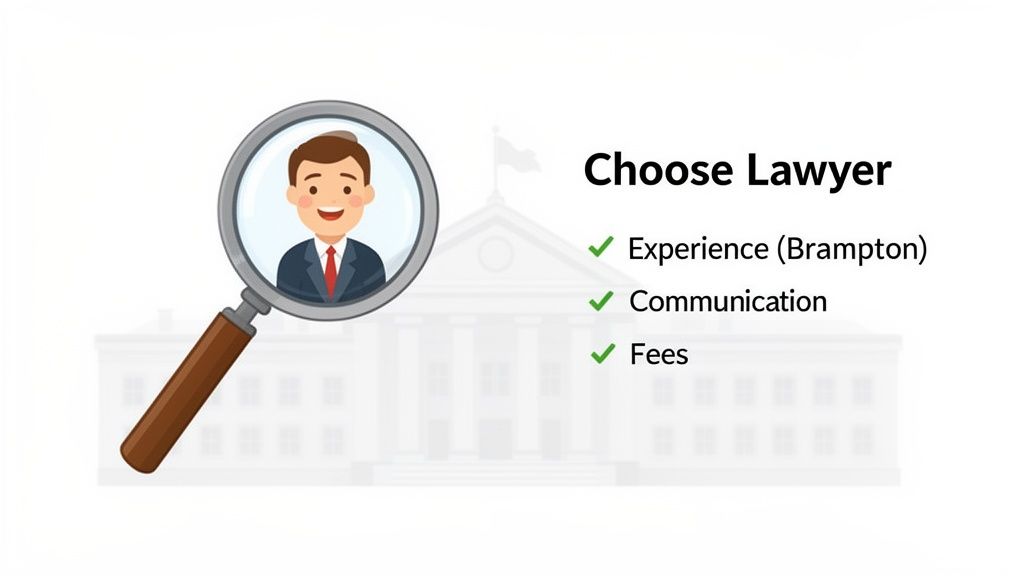
A magnifying glass highlights a cartoon lawyer, next to a checklist for choosing a lawyer.

Choosing the right legal advocate is the most critical decision you will make in your divorce. Your lawyer is your strategist, advisor, and advocate. The right fit ensures your journey through the legal system is as smooth and fair as possible. It’s about finding a professional who understands your goals and has the specific experience to achieve them within the Brampton legal landscape.

Look for Deep Brampton Court Experience

The family court in Brampton has its own unique procedures and judicial personalities. A lawyer who is a regular presence at the Brampton courthouse offers a significant advantage. They understand the system’s nuances and know how to prepare documents that won’t get bogged down in administrative delays. This local knowledge is a practical asset that saves you time and money.

Choosing a lawyer with deep local roots is about competence. Their familiarity with the Brampton court system translates directly into a smoother, more predictable process for you.

Key Questions for Your Consultation

The initial consultation is your opportunity to interview a potential lawyer. Be prepared to ask direct questions to understand their approach and whether they are the right fit for you.

Here are a few essential questions to ask any family lawyer in Brampton:

  • Strategic Approach: Based on my situation, would you recommend negotiation, mediation, or court? What is your general philosophy on resolving cases like mine?
  • Local Experience: How frequently are you in the Brampton courthouse? What is your experience with cases similar to mine in this jurisdiction?
  • Communication Style: Who will be my primary point of contact? How quickly can I expect a response to calls or emails?
  • Fee Structure: Can you explain your retainer and hourly rates? What other potential costs should I anticipate?

Clear, straightforward answers are a sign of a transparent and client-focused firm. Take your time to choose a legal partner you trust to protect your future.

Common Questions About Divorce in Brampton

Going through a divorce brings up many questions. Here are straightforward answers to common concerns we hear from clients in Brampton.

How Long Does a Divorce Take in Brampton?

The timeline depends almost entirely on the level of cooperation between you and your spouse. A simple, uncontested divorce, where all issues are resolved in a separation agreement, typically takes 4 to 6 months after filing the paperwork.

However, a contested case requiring court intervention can take over a year due to significant backlogs at the Brampton courthouse. The fastest way to finalize your divorce is by reaching a settlement outside of court.

Can I File for Divorce Without a Lawyer?

While you can legally represent yourself, it is strongly discouraged. Ontario’s family law is complex, and errors in paperwork or negotiation can lead to long-term negative financial and parenting consequences.

Hiring an experienced family lawyer in Brampton is an investment in your future. A good lawyer ensures your rights under the Family Law Act are protected, files documents correctly to avoid delays, and advocates for a fair, legally sound outcome.

Your separation agreement is the most important document in your divorce. It is a legally binding contract that outlines all arrangements for property, support, and parenting, forming the blueprint for an efficient, uncontested divorce.

How Much Will a Divorce Lawyer Cost?

The cost is directly tied to the complexity and conflict level of your case. An uncontested divorce with a signed separation agreement may cost a few thousand dollars. A high-conflict case that proceeds to trial can cost tens of thousands.

The best way to manage legal fees is to work toward a resolution without a protracted fight. Choose a lawyer who is transparent about their fee structure from the outset.


Navigating the complexities of divorce requires a clear strategy and trusted legal advice. The team at Badesha Law is here to provide the guidance you need to protect your rights and secure a fair resolution. Contact us today for a consultation to discuss your case by visiting https://badeshalaw.ca/

Top 5 Mistakes to Avoid When Divorcing in Brampton

Facing a divorce in Brampton can be completely overwhelming, and the fear of making a costly mistake only adds to the stress. The single most critical first step you can take to protect your future is to hire a skilled divorce lawyer. This guide provides a clear, actionable roadmap, highlighting the five most common pitfalls people encounter when divorcing in Ontario and how to avoid them.

Navigating Your Brampton Divorce with Confidence

Think of this guide as your strategic plan for navigating the Brampton legal system without losing your footing. We’ll break down the common errors we see time and again—from underestimating the importance of local court procedures to letting emotions drive major financial decisions. The goal is to protect your assets, your children’s future, and your peace of mind.

Every piece of advice is grounded in Ontario’s Family Law Act and the Criminal Code of Canada to give you actionable insights. Understanding these challenges upfront is the first step toward securing a fair outcome. The informed choices you make today will save you from expensive regrets down the road.

Why Local Knowledge Matters

Successfully navigating a divorce requires more than just knowing the law; it demands deep familiarity with the local legal landscape. A lawyer from another city simply won’t have the same on-the-ground advantage. Here’s why a Brampton focus is non-negotiable:

  • Court Procedures: The Brampton courthouse operates with its own specific administrative rules and filing preferences. An outsider can easily make a procedural mistake that delays your case.
  • Judicial Insight: An experienced local lawyer has appeared before the judges in Brampton countless times. They understand their temperaments and how they tend to rule on certain issues, which is invaluable for building your case strategy.
  • Community Network: A well-regarded local lawyer has established relationships with other legal professionals in the area. This network can make negotiations smoother and less adversarial.

Ultimately, choosing the right advocate is everything. When you decide to hire Badesha Law Brampton divorce lawyer, you’re not just getting legal advice. You’re partnering with a team that specializes in guiding local residents through this exact process, ensuring your rights are protected every step of the way.

Mistake 1: Going It Alone Without Local Legal Expertise

One of the biggest—and most common—mistakes people make in a divorce is underestimating the complexity of the local legal system. Trying to handle it yourself or hiring a lawyer who isn’t from Brampton might seem like a way to save money, but this strategy almost always leads to expensive and time-consuming problems.

The legal system isn’t one-size-fits-all. Every courthouse has its own way of doing things, and the one in Brampton is no different. It has specific procedural rules, administrative timelines, and judicial preferences. These aren’t things you can learn from a book; they come from years of hands-on experience in the local courts.

An experienced local divorce lawyer lives and breathes this unique environment.

The Advantage of a Brampton Divorce Lawyer

A seasoned divorce lawyer in Brampton brings more to the table than just knowledge of Ontario’s Family Law Act. They offer practical, on-the-ground expertise that directly impacts how smoothly and successfully your case moves forward. This local insight is critical for a few key reasons:

  • Procedural Accuracy: They know exactly how to file documents at the Brampton courthouse to avoid rejections and needless delays that could stall your case for months.
  • Strategic Insight: After appearing before local judges time and time again, they can anticipate how certain arguments might land, allowing them to shape a much more effective legal strategy for you.
  • Professional Network: A local lawyer has built relationships with other lawyers and court staff, which can help make negotiations smoother and the whole process less combative.

Navigating the system efficiently is about more than just knowing the law; it’s about saving you time, stress, and money. A professional ensures your case moves forward as smoothly as possible, preventing small procedural errors from turning into major setbacks.

Recent trends highlight the value of this local expertise. The number of divorces and how quickly they are finalized have changed, with many Peel Region family courts still working through backlogs. Statistics Canada reported a crude divorce rate of about 5.6 divorces per 1,000 married people in 2020. This national number underscores why having a local expert who can navigate scheduling bottlenecks and administrative hurdles is so important.

When you hire Badesha Law Brampton divorce lawyer, you’re not just getting legal advice. You’re securing an advocate who is deeply familiar with the specific challenges and opportunities inside the local court system.

Mistake 2: Lacking a Clear Financial Picture

Trying to negotiate a divorce settlement without a complete and accurate understanding of your family’s finances is like navigating a maze blindfolded. It’s a recipe for a bad outcome. Here in Brampton, and right across the province, Ontario’s Family Law Act is crystal clear: both spouses must provide full and honest financial disclosure. A surprisingly common mistake is not taking this step seriously, which almost always leads to disastrous financial results.

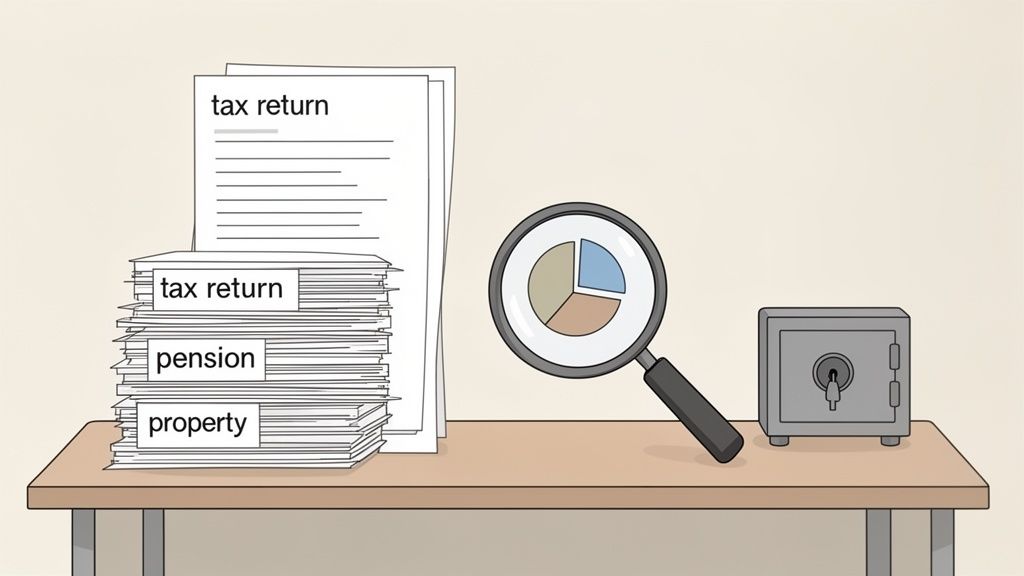
This isn’t just a matter of glancing at your last few bank statements. A proper financial review means digging into everything—tax returns, property valuations, pension statements, investment portfolios, business records, and more. Without this complete picture, it’s simply impossible to divide assets fairly.

Documents labeled tax return, pension, and property are reviewed with a magnifying glass and a safe.

Understanding Equalization in Ontario

One of the most critical concepts in Ontario divorce law is the equalization of Net Family Property. At its core, this legal principle ensures that the wealth built up during the marriage gets split down the middle. This is precisely why every single dollar must be accounted for. People often stumble here by:

  • Undervaluing assets: This happens all the time, especially with shared businesses or unique investments where a professional valuation is absolutely necessary.
  • Forgetting future assets: Pensions and stock options aren’t just future money; they’re valuable assets that must be included in today’s calculations.
  • Hiding or transferring funds: Trying to hide money is a terrible idea. It’s not just unethical; it can lead to severe legal penalties under the Criminal Code of Canada and will completely destroy your credibility in court.

An experienced family lawyer makes sure no stone is left unturned. Their job is to get you a fair deal based on facts, not guesswork, and to protect your financial future.

To get started, it’s crucial to gather the right documents. This first step helps your divorce lawyer build a clear, evidence-based picture of your marital finances.

Your Financial Disclosure Checklist

Gathering these key documents is the first step toward ensuring a fair and transparent division of assets under Ontario law.

Document Category Specific Examples Why It’s Critical
Income & Employment T4 slips, pay stubs, employment contracts, notices of assessment from the CRA for the last 3 years. Establishes income for calculating child and spousal support, and tracks financial contributions.
Assets & Property Property deeds, mortgage statements, MPAC assessments, vehicle ownerships, appraisals for art or jewelry. Determines the value of real estate and other significant assets to be included in the division.
Banking & Investments Bank statements (chequing/savings), RRSP/TFSA statements, investment portfolio reports for the last 3 years. Provides a complete picture of liquid assets and investment growth during the marriage.
Pensions & Retirement Annual pension statements from employers, statements for any private retirement plans. Pensions are valuable assets that must be properly valued and divided.
Business Interests Financial statements for any business, shareholder agreements, corporate tax returns. Ensures any family-owned or shared businesses are accurately valued for equalization.
Debts & Liabilities Credit card statements, lines of credit, car loans, personal loans, student loan statements. Debts are subtracted from assets to calculate your Net Family Property, so they must be fully disclosed.

Having these documents organized and ready will save time, reduce legal fees, and strengthen your negotiating position from day one.

When you hire Badesha Law Brampton divorce lawyer, you’re not just getting legal advice; you’re getting a partner dedicated to achieving financial clarity. Our team will help you organize your records, ensure your spouse provides complete disclosure, and won’t hesitate to bring in forensic accountants if we suspect something isn’t right. Securing your financial stability starts with a clear and honest accounting of your marital assets.

Mistake 3: Letting Emotions Drive Your Legal Decisions

Going through a divorce is one of the most gut-wrenching experiences anyone can face. It’s completely normal to feel a storm of emotions—anger, betrayal, grief, and fear. But letting those raw feelings take the driver’s seat in your legal strategy is a mistake that can haunt you for years.

When you’re hurt, the temptation to lash out is strong. You might want to reject a perfectly reasonable settlement offer just to make things difficult, or sink thousands into a legal fight over a piece of furniture that’s more sentimental than valuable. These decisions, driven by a need for revenge, almost always backfire. They burn through your savings, drag out the pain, and make it harder for everyone, including your children, to heal.

This is where a good Brampton divorce lawyer becomes your anchor. They act as an objective, clear-headed advocate, helping you see past the emotional fog and focus on what truly matters for your future.

Focusing on a Stable Future, Not a Bitter Past

An experienced divorce lawyer helps you shift from reactive, emotional choices to strategic, forward-thinking ones. It’s a tough pill to swallow, but in Ontario, the family court system isn’t interested in who was “right” or “wrong” in the marriage. Outcomes are guided by established legal principles designed to be fair and predictable.

  • Child Support: This isn’t a penalty. It’s calculated using the federal Child Support Guidelines, which are based almost entirely on the payor’s income and the parenting schedule. Marital misconduct doesn’t move the needle.
  • Spousal Support: This is determined by factors like the length of your marriage, the difference in your incomes, and the roles each of you played. It’s about need and compensation, not blame.
  • Property Division: The law aims for a straightforward 50/50 split of the wealth you built together during the marriage, as laid out in the Family Law Act.

Family law outcomes are driven by rules and guidelines, not by feelings. Working with a local Brampton divorce lawyer who knows the Peel Region courts inside and out will lead to a more predictable, stable, and financially sound resolution for you.

Understanding this from the start is critical. Child support is a math problem, and spousal support follows well-worn paths based on specific facts. When you hire Badesha Law, our experienced divorce lawyer team, who works in the Brampton courthouse regularly, gives you a huge advantage. We know the local landscape and can help you secure a grounded outcome that protects your long-term stability.

Learn more about the statistical realities of divorce outcomes in Ontario to see how the numbers play out.

Mistake 4: Overlooking Alternatives to Court

When people think of divorce, their minds often jump straight to a dramatic, high-conflict courtroom battle. This is one of the most persistent and costly misconceptions out there. The reality is, here in Brampton, you have highly effective out-of-court solutions that can save you an incredible amount of time, money, and emotional strain.

These options, often called Alternative Dispute Resolution (ADR), put you back in the driver’s seat. Instead of a judge making life-altering decisions for your family, you and your spouse work together with professional guidance. A skilled divorce lawyer in Brampton shifts from being a courtroom fighter to a strategic advisor, focused on helping you negotiate a fair and lasting agreement.

Empowering You with Options

ADR isn’t a one-size-fits-all solution; it’s a toolkit of options designed for different family situations. The two most common paths in Ontario family law are:

  • Mediation: A neutral third-party mediator sits down with you and your spouse to guide the conversation. Their job is to help you find common ground on tough issues like parenting plans and how to divide property.
  • Collaborative Family Law: This is a team approach. You and your spouse each have your own specially trained lawyer, and all four of you agree from the start to resolve everything without ever stepping into a courtroom.

This flowchart shows how your main priority—whether it’s preserving emotional well-being or reaching a logical outcome—can point you toward the best legal path for you.

A decision tree flowchart outlining divorce choices based on emotion or logic, leading to different legal paths.

The key takeaway is that ADR empowers you to create custom solutions that actually work for your family’s unique needs. By choosing to hire Badesha Law Brampton divorce lawyer, you’re not just getting a litigator; you’re gaining an advocate skilled in these powerful and cost-effective negotiation techniques.

Mistake 5: Partnering with the Wrong Legal Advocate

This last mistake is arguably the most critical one you can make: choosing the wrong legal partner for your journey. The relationship you have with your divorce lawyer in Brampton will fundamentally shape your experience and the final outcome. Picking someone who doesn’t align with your goals or communication style can quickly lead to frustration, unnecessary costs, and a resolution that just doesn’t meet your needs.

Cartoon comparing a 'Not Right' lawyer to a 'Right Fit' professional shaking hands near a courthouse.

This isn’t just about looking at credentials; it’s about finding the right fit for you. Do you need an aggressive litigator who is ready for a courtroom battle, or would you be better served by a skilled negotiator who excels at mediation? Your initial consultation is your opportunity to interview them and see if their approach actually matches what you’re trying to achieve.

Finding Your Trusted Advisor

The financial stakes of this decision are huge. Legal costs for divorce in Brampton can vary wildly depending on how complex your case is, with hourly rates typically falling between CAD 200 to CAD 500. A contested divorce can easily run into the tens of thousands of dollars, making it vital to find a lawyer who is focused on cost-effective strategies.

To find the best fit, don’t be shy about asking direct questions during your consultation:

  • What is your primary approach to resolving family law disputes?
  • How will you keep me informed about my case?
  • Based on my situation, what potential outcomes do you foresee?

Choosing the right lawyer is an investment in your future. You need a partner you can trust, one who provides clear guidance and advocates for your best interests with integrity and skill.

This is where a client-focused approach, like the one we have at Badesha Law, makes a real difference. When you hire Badesha Law Brampton divorce lawyer, you’re not just getting legal representation; you’re getting a team dedicated to understanding your unique situation. We provide support that’s shaped around you, ensuring you have a trusted advocate to guide you toward the best possible future.

Common Questions About Divorce in Brampton

Getting started with a divorce can feel overwhelming, and it’s natural to have a lot of questions. Below are straightforward answers to some of the most common queries we hear from clients in Brampton. Think of this as a starting point, but remember, nothing replaces a conversation with an experienced divorce lawyer in Brampton who can apply the law to your unique circumstances.

How Long Must We Be Separated to Get Divorced in Ontario?

In Canada, the law requires you to be separated for at least one full year before the court can grant your divorce. A common misconception is that you have to wait that entire year before you can do anything. That’s not the case.

You can—and should—start the legal process much sooner. A Brampton divorce lawyer can help you file the necessary applications and begin working on critical issues like property division, spousal support, and child arrangements right away. Resolving these matters first often makes the final divorce order a simple last step.

What Is an Uncontested Versus Contested Divorce?

The difference really comes down to one thing: agreement.

An uncontested divorce is when you and your spouse agree on all the major issues—how to divide property, who the children will live with, and the terms of financial support. Because there’s no conflict to resolve, this path is much faster, less stressful, and significantly more affordable.

A contested divorce, on the other hand, happens when you disagree on one or more of those key issues. This disagreement requires a formal process to resolve, whether it’s through negotiation, mediation, or going to court. Naturally, this extends the timeline and increases the legal costs.

Can I File for Divorce in Brampton if I Got Married Abroad?

Yes, absolutely. The location of your marriage doesn’t matter as much as where you live now. As long as either you or your spouse has lived in Ontario for at least one year before filing for divorce, the Brampton courts have the authority to handle your case.

You may need one extra document, often called a Foreign Divorce Opinion Letter, to confirm for the court that your foreign marriage was legal. This is a standard procedure that a family law firm can easily help you obtain.


The path forward might look complicated, but you don’t have to walk it alone. For clear, strategic guidance tailored to your family’s needs, connect with the experienced team at Badesha Law. We’re here to protect your rights and help you find a fair resolution. Learn more about our approach to family law and schedule your consultation today.

Your Guide to a Family Law Brampton Free Consultation

When you're facing a family law issue, the first question is always the same: Where do I even start? For anyone in Brampton, a family law Brampton free consultation is the answer. It’s a confidential, no-cost way to get initial legal advice and finally understand your options. Think of it as your first step toward getting clarity on your rights and the legal path ahead under Ontario's Family Law Act.

Understanding The Value Of Your First Legal Conversation

Dealing with a separation, divorce, or custody dispute is overwhelming. That’s why a free consultation isn't just another meeting—it’s a strategic move designed to turn your uncertainty into a concrete plan. It acts as a foundational assessment of your case, grounded in the specifics of Ontario's legal system.

This initial conversation gives you a vital opportunity to discuss your unique circumstances with a legal professional. Whether you're in Brampton or the surrounding Peel Region, a lawyer can offer preliminary thoughts on how the Family Law Act applies to your situation, helping you grasp your rights and obligations right from the start.

Why This Meeting Is So Critical

Think of this consultation as a roadmap. It helps you pinpoint the key issues you’re about to face, whether that’s property division, spousal support, or parenting arrangements. You get a professional’s perspective on the potential complexities of your case without any financial commitment. This empowers you to make informed decisions instead of acting on emotion or bad advice.

For many people in Brampton, this is the first time they learn about the different ways to resolve their issues:

  • Negotiation: Direct discussions between you and your ex-partner, often with your lawyers, to hammer out a separation agreement. This is a primary tool for resolving issues outside of court.

  • Mediation: A process where a neutral third party helps you and your former partner find common ground. This is often a more collaborative and cost-effective approach.

  • Litigation: The court process, which is usually the last resort when other methods are not suitable or have failed.

This confidential conversation is your chance to see if a lawyer's expertise and approach are the right fit for you. It lets you gauge their communication style and ensure you're choosing an advocate who truly understands the nuances of the Brampton court system.

Ultimately, a free consultation delivers immediate clarity. It demystifies the legal process and gives you a realistic idea of what’s coming next. By investing just an hour of your time, you'll walk away with a much clearer sense of direction, a strategic advantage, and the confidence to take the next step.

How to Find the Right Family Lawyer in Brampton

Finding the right legal advocate starts with knowing where to look. While a quick search for a "family law Brampton free consultation" is a decent starting point, you’ll get much better results with a more focused approach.

Your goal isn't just to find any lawyer offering a free chat; it's to connect with a true expert who can offer real value from the get-go. After all, not all free consultations are created equal.

Family law is a massive field, covering everything from prenuptial agreements to complex property division and high-conflict child custody disputes. A lawyer who’s a rockstar in one area might not be the best fit for another. That’s why your search should zero in on lawyers with specific, proven experience in whatever you’re facing.

Going Beyond a Basic Search

To find a lawyer whose expertise truly aligns with your needs, you have to dig a little deeper. The right professional not only understands the nuances of the Brampton court system but also has a track record of handling cases just like yours.

Here’s how to do your homework effectively:

  • Check the Official Directory: Your first stop should be the Law Society of Ontario's directory. It’s a non-negotiable step to verify a lawyer's credentials and confirm they are licensed and in good standing.

  • Scrutinize Law Firm Websites: Look for firms that actually dedicate a huge chunk of their practice to family law in Brampton. It’s a good sign. Then, read the lawyer bios. Do they talk about their experience in spousal support, parenting plans, or high-asset divorce? This tells you where their focus really lies.

  • Read Client Reviews Thoughtfully: Go beyond the star rating and look for patterns. Do people consistently mention clear communication, empathy, and effective representation? A single negative review isn't a deal-breaker, but if you see recurring complaints about being slow to respond or unprofessional, pay attention.

Matching Expertise to Your Situation

This is the most critical part of your search: aligning a lawyer’s skills with the nitty-gritty of your case. For example, if your primary concern is creating a fair and stable parenting plan, you need a lawyer who lives and breathes child custody matters under Ontario’s Family Law Act.

But if you’re a business owner facing separation, your needs are totally different. You'll need someone skilled in complex financial disclosures and business valuations.

Remember, the point of a free consultation isn’t just to get a bit of free advice. It’s an interview. You’re vetting a potential advocate who will be trusted to protect your rights through one of the most challenging times of your life.

Think about a real-world scenario: a Brampton couple with a shared business decides to separate. Their case is tangled up in intricate business valuations and shareholder agreements. They would be wasting their time talking to a generalist. Instead, they need a lawyer with demonstrable experience at the intersection of corporate and family law.

By shortlisting lawyers with that specific background, they ensure their consultation is a productive, strategic meeting from the very first minute. This targeted approach doesn’t just save time—it puts you in a much stronger position to get a favourable outcome.

What Really Happens During a Free Consultation?

Two business professionals discussing legal agreement, with thought bubbles showing a checklist, justice scales, and a handshake.

Walking into a law office for the first time can feel pretty intimidating. A free consultation is designed to be the exact opposite—it's a supportive and completely confidential first step.

Think of it as a structured, fact-finding conversation. A lawyer will listen to your story, ask targeted questions to understand the key legal issues, and give you a preliminary opinion on where you stand. The goal isn't to solve everything in 30 minutes; it's to give you clarity and a roadmap. We’ll need to know the basics—your relationship status, if children are involved, and the general nature of your assets—so we can apply the rules of Ontario's Family Law Act to your life.

Your Confidential Case Assessment

First things first: everything you say in that meeting is protected by solicitor-client privilege. This is true even if you decide not to hire the lawyer. It creates a safe space for you to be completely open about your situation, including sensitive issues that may intersect with the Criminal Code, such as domestic disputes.

The lawyer will then give you an initial assessment of your legal position. This isn't a crystal ball prediction of how your case will end. It’s an educated overview of your rights and obligations in the main areas of family law:

  • Parenting: How decision-making responsibility (what used to be called custody) and parenting time are typically handled by courts in Brampton.

  • Support: A general discussion about potential child and spousal support. Are you likely to pay or receive it, and what factors are considered under the Family Law Act?

  • Property: An explanation of how family property, especially the matrimonial home, is divided under Ontario law.

This assessment is a crucial reality check. It grounds you in legal precedent and gives you a realistic framework for what to expect moving forward.

Discussing Your Potential Paths Forward

A huge part of the consultation is exploring how to resolve your issues. Not every family law matter has to turn into a bitter courtroom battle. In fact, most don't.

The lawyer will outline the different paths available. These often include direct negotiation to create a separation agreement, mediation with a neutral professional to find common ground, or, if absolutely necessary, litigation through the court system. This discussion helps you see that you have choices in how you handle this.

A critical reason to seek professional guidance early is to level the playing field. If your partner has already hired a lawyer, you’re at an immediate and serious disadvantage trying to navigate this alone.

This imbalance is a real problem. In fact, self-representation plagues 72% of family law cases across Canada, creating a stark reality for Brampton residents facing these challenges without legal counsel. The data shows that those who file for divorce have lawyers 42% of the time, versus just 23% for respondents. This creates a power imbalance that a family law Brampton free consultation from a local firm is designed to correct.

You can read the full research about these family law statistics to better understand the challenges. A consultation ensures you understand the rules of the game right from the start.

Preparing to Maximize Your Consultation Time

That initial 30-minute free consultation can feel incredibly short. To make every minute count, a little bit of prep work beforehand can turn a brief chat into a genuinely productive strategy session.

When you walk in organized, your lawyer doesn't have to spend precious time on basic fact-finding. Instead, they can get right to the heart of your issues and start giving you the specific, practical advice you came for.

Desk setup with laptop, stacks of papers, a document featuring a timeline of houses, and a pen.

Gathering Your Essential Information

This isn't about hauling in a box full of every bill you've ever received. It’s about collecting the key documents that give a clear snapshot of your family's financial and personal situation right now.

Even just having these handy for your own reference can make the conversation flow much more smoothly.

Try to pull together:

  • Financial Statements: A recent pay stub, a Notice of Assessment from the CRA, or a bank statement helps illustrate the current financial picture.

  • Property Records: If you own a home in Brampton, a recent property tax bill or mortgage statement is perfect.

  • Existing Agreements or Orders: If you have a prenup, cohabitation agreement, or any past court orders, bring a copy. These are legally significant.

  • A Simple Timeline: Jot down a few key dates on a piece of paper: the date you married or started living together, the date of separation, and the birthdates of your children.

This small amount of homework allows the lawyer to quickly grasp the core elements of your situation, so you can spend the consultation talking about solutions, not just history.

Your main goal during a family law Brampton free consultation is to walk away with clarity. You want to understand your rights and see a potential path forward. Being prepared ensures every minute is focused on what truly matters.

This groundwork becomes even more critical when you think about the potential costs down the road. While Canada's divorce rate recently hit a 50-year low of 5.6 per 1,000 married persons, that number doesn't account for the countless common-law separations. And for those who do divorce, the financial impact can be staggering. You can learn more about these trends from our guide on divorce statistics in Canada on badeshalaw.ca.

Estimated Divorce Costs in Ontario: A Financial Snapshot

To put the value of early legal strategy into perspective, look at the difference in costs between settling a case versus fighting it out in court. An uncontested divorce is almost always the more financially sound route for middle-class families in Brampton.

Factor Uncontested Divorce Contested Divorce
Average Cost $1,860 $20,625+
Typical Timeline 4-6 months 12-24+ months
Legal Process Paperwork, negotiation, simple court approval Multiple court appearances, motions, trials
Emotional Toll Lower stress, more cooperative High stress, adversarial, prolonged conflict

As the numbers show, getting clear, strategic advice from the very beginning can save you an immense amount of time, money, and emotional energy.

Prioritizing Your Most Pressing Questions

With your documents organized, it's time to think about what you really need to know. Since your time is limited, a prioritized list of questions is your most powerful tool. Start with the issues that are causing you the most anxiety.

What’s keeping you up at night? Is it the thought of losing your home? The well-being of your kids? Your financial future? Build your questions around these core concerns.

Here are a few real-world examples to get you thinking:

  • "We own our home together in Brampton. How does Ontario's Family Law Act typically deal with the matrimonial home after separation?"

  • "What does the law say about decision-making responsibility for our kids, and how is parenting time usually determined?"

  • "Based on our incomes, what are the general principles for calculating child and spousal support in my situation?"

  • "I was in a common-law relationship for ten years. What are my rights to the property we bought together?"

Asking specific, focused questions like these pushes the conversation beyond generic legal information and toward actionable advice that applies directly to your life. This is how you walk away from a free consultation feeling empowered, not overwhelmed.

Crucial Questions to Ask Your Prospective Lawyer

Two businessmen, one questioning and one searching, symbolizing a legal inquiry or investigation.

Think of this initial meeting as a two-way interview. While the lawyer is getting a feel for your case, you should be getting a feel for them. It’s your chance to look past the credentials on the wall and figure out if they’re the right person to guide you through this.

Your goal here is simple: find a professional you can actually trust with one of the most personal challenges of your life. The answers they give will tell you everything you need to know about their experience, how they communicate, and their overall philosophy.

Gauging Experience and Strategy

Every family law case has its own unique twists and turns. You need a lawyer who has seen something like your situation before, especially within the Brampton court system. Don't be afraid to ask direct questions about their track record.

Try asking things like:

  • "What’s your specific experience with cases like mine in the Brampton courts?"

  • "Based on what you've heard so far, what do you think will be the biggest challenge in my case?"

  • "What's your general approach? Do you prefer to negotiate a resolution or are you quick to litigate?"

These questions shift the conversation from abstract legal talk to practical, real-world strategy. A lawyer’s familiarity with the local Brampton courthouse is a huge advantage—they know the judges, the staff, and how things really work.

Remember, a good lawyer won't just tell you what you want to hear. They will provide a realistic assessment based on the facts and the law, preparing you for the road ahead.

This practical approach is critical when kids are involved. Here in Brampton and across the Peel Region, parenting issues are often the most difficult part of a separation. In fact, nearly 40% of Canadian couples who divorce share at least one child, which makes parenting arrangements a central focus under Ontario's Family Law Act.

Understanding Communication and Costs

Nothing adds stress to an already stressful situation like confusion over billing and communication. A transparent lawyer will be upfront about their process from day one, so you’re never left wondering about the status of your case or what the next bill will look like.

Here are some effective questions to get clarity:

  • "How do you keep your clients updated, and what's your typical response time for calls or emails?"

  • "Will I be dealing with you directly, or will someone else at the firm be my main contact?"

  • "Can you walk me through your fee structure? What does the retainer cover, and are there other costs I should expect?"

You need to feel confident in how your lawyer communicates. Finding someone who is responsive, clear, and totally transparent about costs will make this entire process feel much more manageable. That clarity is the foundation of a strong solicitor-client relationship, built on trust from the very start.

Alright, the consultation is over. You've just taken in a lot of information, and now you have some thinking to do. This is a critical moment—time to step back, process the conversation, and decide how you want to move forward.

The best time to do this is right after the meeting, while everything is still fresh in your mind. Grab your notes and take a few minutes to go over them. What were the most important takeaways? Did the lawyer outline a clear, initial strategy that actually made sense to you? This quick review is your first real gut check in figuring out if you've found the right person to handle your family law case.

Evaluating the Fit and Making a Choice

Now, think beyond the legal advice for a second. How did you feel during the conversation? Did the lawyer listen to you? Did you feel respected and understood? A solid solicitor-client relationship is built on trust, and you absolutely must feel comfortable enough to be completely honest with this person.

If everything feels right and you’re confident this is the lawyer for you, the next step is usually signing a retainer agreement.

  • What is a Retainer Agreement? Think of it as the formal contract that officially brings the lawyer onto your team. It lays out what they'll do for you, how their fees work, and the ground rules of your professional relationship.

  • What Does it Commit You To? Once you sign this agreement and pay the initial retainer fee, you've officially hired them. They become your lawyer of record and can start working on your file immediately, whether that means drafting documents or getting in touch with your ex-partner's lawyer.

The whole point of a free consultation is to see if it’s a good match. You are never, ever obligated to hire a lawyer just because you met with them. If something feels off, trust your gut.

What to Do If It Wasn't the Right Fit

Sometimes, a lawyer's personality or proposed strategy just doesn't click with what you need, and that's perfectly okay. Don’t let anyone pressure you into making a decision on the spot. If you have any hesitation at all, take it as a sign to keep looking.

Simply thank the lawyer for their time and let them know you need to consider your options. You can now use what you learned in this meeting to make your search even smarter. Your questions will be more targeted, and you'll have a better idea of what you're looking for in your next family law Brampton free consultation. Every meeting helps you become a more informed client, putting you in a better position to find the perfect legal partner to protect your future.


At Badesha Law, we know that finding the right lawyer is the single most important first step. We offer clear, strategic, and compassionate guidance to families in Brampton, Mississauga, and across the GTA. When you're ready to take control of your situation, we're here to help. Contact us for a confidential consultation to discuss your case and learn more about how we can protect your rights. Visit us at Badesha Law to get started.

What Is a Consent Order in Brampton Family Law?

A consent order is a powerful legal document that takes a private agreement you’ve made with your ex-partner and turns it into an official, legally binding court order. It's the final, crucial step that gives your mutual decisions on parenting or property the full weight and enforcement power of the Ontario court system, creating a clear and secure path forward for families in Bramton.

Understanding a Consent Order in Brampton Family Law

Man hands document to woman in suit, with a courthouse and official stamp in background.

When a relationship ends, the road ahead can feel uncertain. For many families in Brampton, the thought of resolving issues like parenting arrangements, support, and property division in court feels intimidating and adversarial. Thankfully, there’s a cooperative, efficient, and far less stressful alternative to a drawn-out court battle: the consent order.

Think of it this way: you and your former partner are the co-authors of a new rulebook for your family’s future. Together, you negotiate the terms, write them down, and agree on every detail. A consent order is what happens when you take that rulebook to a judge. The judge reviews it to make sure it’s fair and lawful under Ontario's Family Law Act, then gives it an official stamp of approval. That stamp transforms your private agreement into a document with the same legal force as if a judge had made the decisions after a full trial.

Why Is This Transformation So Important?

The main advantage of a consent order is enforceability. A handshake deal or an informal written agreement relies entirely on goodwill. A court order, on the other hand, is backed by the full power of the law in Ontario.

If one person fails to follow the terms—for example, by missing child support payments—the other person has immediate and direct legal options. This provides a critical layer of security and predictability that informal agreements just can't offer.

This legal tool is incredibly valuable because it can cover nearly every aspect of a separation, including:

  • Parenting Arrangements: Clearly defines who makes major decisions for the children (decision-making responsibility) and sets out the specific parenting time schedule.

  • Child and Spousal Support: Formalizes the amount and duration of support payments. Once it’s in an order, it can be enforced by the Family Responsibility Office (FRO).

  • Division of Property: Finalizes how assets like the family home and pensions, as well as debts, are to be divided according to Ontario's equalization rules.

A consent order isn’t about one person winning and the other losing. It’s a testament to two people choosing to resolve their differences collaboratively, creating a stable and legally secure foundation for the next chapter of their lives.

Your Path to a Final Resolution

For residents of Brampton and the surrounding Peel Region, understanding what a consent order is represents the first step toward a more amicable separation. It allows you to stay in control of the outcome while gaining the certainty that only a court order can provide.

By working together to create the terms, you save time, reduce legal costs, and minimize the emotional strain on your family. Ultimately, it ensures a smoother transition for everyone involved.

Consent Order vs. Separation Agreement: What Brampton Families Should Know

When you're navigating a separation in Brampton, you'll hear about two key legal documents: the separation agreement and the consent order. They both lay out the terms of your split, but they work in very different ways and offer completely different levels of security. Understanding this difference is critical to protecting your family's future.

Think of a separation agreement as a private contract between you and your former partner, governed by Ontario's family law. You work it out together, often with the help of your family lawyers, and detail all your decisions on everything from parenting schedules to who gets the house. It's negotiated and signed by both of you, and it stays private.

A consent order, on the other hand, is what happens when you take that private agreement and give it the power of the court. You submit your signed agreement to a judge, who reviews and approves it. Once signed by the judge, its terms become an official, legally binding court directive.

The Power of Enforceability

The biggest difference between the two comes down to enforcement. A separation agreement is a contract. If your ex-partner breaks the rules, you have to go back to court to enforce it—just like with any other broken contract. That means filing a new application, gathering evidence, and asking a judge to force them to follow through.

This process can be slow, stressful, and expensive. For example, if your spousal support payments suddenly stop, you’d have to start a whole new court case just to get the money you’re owed under the separation agreement.

A consent order changes the game completely. Because it’s already a court order, its terms are immediately enforceable.

In Ontario, support payments outlined in a court order can be automatically filed with the Family Responsibility Office (FRO). The FRO is a provincial agency with serious power—they can garnish wages, suspend driver's licences, and even seize assets to make sure payments are made. These are actions you simply can't take on your own with just a separation agreement.

This direct line to enforcement is a huge safety net, especially when it comes to child and spousal support. It takes the burden off you to chase down missed payments through the courts.

Privacy Versus Public Record

While a consent order offers rock-solid enforcement, a separation agreement gives you more privacy. A separation agreement is a confidential document shared only between you, your ex-partner, and your lawyers. It never becomes part of the public court record.

Once your agreement becomes a consent order, however, it’s filed with the court and becomes a public document. For some families in Brampton who prefer to keep the specific details of their finances or parenting arrangements completely private, this is a major factor. The desire for confidentiality is a key reason why some couples decide to stick with a separation agreement alone.

Separation Agreement vs. Consent Order At a Glance

To make it even clearer, here's a quick comparison to help you understand the key differences in legal power, how they are enforced, and the process for creating them in Ontario.

Feature Separation Agreement Consent Order
Legal Status A private contract between two people. An official court order, signed by a judge.
Enforcement Must sue for breach of contract in court. Immediately enforceable by the court & agencies like the FRO.
Privacy Completely private and confidential. Becomes part of the public court record.
Creation Process Negotiated and signed by both parties. A signed agreement is submitted to the court for approval.
Best For… Situations with high trust and a strong desire for privacy. Situations where support payments need guaranteed enforcement.

This table shows that your choice really depends on what you value more: the absolute privacy of an agreement or the guaranteed security of a court order.

How They Can Work Together

It’s crucial to know that these documents aren't an "either/or" choice. In fact, they often work hand-in-hand. The most effective approach for many Brampton families is to first negotiate and sign a detailed separation agreement. This lets you sort through everything privately and on your own timeline.

Once you’re both happy with the terms, you can submit the signed agreement to the court with the right forms to turn it into a consent order. This two-step process gives you the best of both worlds: the privacy and control of a negotiated settlement, followed by the iron-clad security of a court order.

Deciding whether to leave your terms in a private agreement or get the finality of a consent order depends on your unique situation. Key factors include the level of trust between you and your ex-partner and the nature of the terms you’ve agreed upon. Speaking with an experienced Brampton family lawyer can help you figure out which path best protects your interests and gives you peace of mind.

The Step-by-Step Process To Get A Consent Order In Ontario

Transforming a private agreement into a formal court order might feel intimidating, but Ontario’s family law system lays out a straightforward path. For couples in Brampton, knowing these stages brings clarity and control.

You’ll move from a mutual understanding to a written separation agreement, then ask the court to give it legal force. Think of it as turning your negotiated terms into an official document the judge can sign off on.

A flowchart titled 'AGREEMENT PROCESS FLOW' showing step 1 as 'PRIVATE AGREEMENT' leading to step 2 'LEGAL ORDER'.

This visual sums up how your private deal becomes a legally enforceable order once it passes through the court’s doors.

Step 1 Reaching A Mutual Agreement

Before any paperwork lands on the judge’s desk, you and your former partner must reach a full consensus on every issue you want in the order, such as parenting time, child support, or property division.

Most couples in Brampton reach these terms through direct talks, mediation, or with the guidance of family lawyers. The crucial point is that both sides agree freely, without pressure or coercion.

Step 2 Drafting The Formal Terms

Once you’ve agreed on the details, a family lawyer translates those discussions into precise legal language compliant with Ontario’s Family Law Act. This step turns your verbal agreements into a solid separation agreement ready for court.

Every clause must be clear and unambiguous—any vague wording can spark future disputes. Your lawyer’s job is to ensure the document reflects exactly what you both intended and is legally sound.

By working with an experienced lawyer in Brampton, you’re not just putting words on paper; you’re creating a robust legal framework a judge can confidently approve. This foresight prevents arguments over interpretation down the road.

Step 3 Preparing The Court Forms

With your signed separation agreement in hand, it’s time to assemble the court package. In Ontario, you request a consent order through a motion on consent, which often doesn't require a court appearance.

You’ll need to include:

  • Form 14B (Motion Form): Your formal request for a court order based on your agreed terms.

  • Draft Consent Order: A proposed order that exactly matches your separation agreement.

  • Signed Separation Agreement: Proof that both parties consented to the terms.

  • Financial Statements: Sworn statements if your order covers support or property matters.

Every detail on these forms must be accurate—mistakes will only cause delays.

Step 4 Filing With The Court And Awaiting Approval

Once everything is ready, you file your documents at the Superior Court of Justice in Brampton. The court clerk performs an initial check for completeness before passing the package to a judge.

The judge’s review focuses on:

  • Compliance With The Law: Ensuring terms follow the Federal Child Support Guidelines and prioritize the children’s best interests.

  • Voluntary Consent: Confirming that both parties entered the agreement willingly, often evidenced by independent legal advice.

  • Clarity And Completeness: Making sure the order is straightforward and leaves no room for confusion.

If the judge is satisfied, they’ll sign the draft order—and just like that, your private arrangement becomes a binding consent order. You’ll then receive the final, signed document, giving you the confidence that your agreement is enforceable in Ontario’s courts.

What Your Family Law Consent Order Can Cover

Illustrations of a man and child, a woman's head, money, two houses, and a signed legal document.

When you and your former partner agree on how to move forward, a consent order turns that understanding into an official rulebook. For families in Brampton, it’s the legal tool that locks down every major decision, making sure there are no loose ends or confusion down the road.

This is a powerful document. It can tackle the full spectrum of issues that come with a separation, from your children’s well-being to the final split of your shared home and assets, all under the framework of Canadian family law.

Parenting, Decision-Making, and Schedules

One of the most important jobs of a consent order is to lay out a clear, predictable plan for your children. In Ontario, the Family Law Act makes it clear that a child’s best interests always come first, and your consent order must reflect that. It will detail two key aspects of parenting.

First is decision-making responsibility, formerly known as custody. This part states who makes major decisions for your child—such as their education, significant health care choices, and religious upbringing. It can be held solely by one parent or shared jointly.

Second, it details the parenting time schedule, formerly known as access. This is the day-to-day calendar that specifies when the children will be with each parent. A well-drafted order is specific, covering the regular weekly routine, holidays, summer vacation, and birthdays to prevent future arguments.

Child and Spousal Support

Financial stability is essential for everyone to move on after a separation. A consent order brings certainty to money matters by formalizing both child and spousal support, making the terms fully enforceable through the Family Responsibility Office (FRO).

  • Child Support: This is not negotiable; it's calculated using the mandatory Federal Child Support Guidelines. Your order will lock in the monthly amount, who pays it, and how you’ll share special and extraordinary expenses like orthodontics or post-secondary education.

  • Spousal Support: This has more flexibility. The order will define the support amount, how long it will be paid (duration), and the basis for the payments (e.g., to compensate a spouse for career sacrifices). It can also include triggers for when support might be reviewed or terminated, such as retirement or remarriage.

Turning support promises into a consent order means you’re creating a legally enforceable obligation. This ensures your children receive consistent financial support and gives both partners predictability.

Splitting Up Property and Debts

Finalizing your finances is key to a clean break. In Ontario, the law is based on the equalization of net family property. This process involves calculating the value of assets acquired during the marriage (minus debts), and the spouse with the higher net worth typically makes a payment to the other to equalize their financial positions.

Your consent order will map this entire process out. It will clearly state:

  • The official valuation date for all assets and debts.

  • A complete list of what’s being divided, such as the matrimonial home, pensions, RRSPs, and investments.

  • The final equalization payment amount and a firm deadline for payment.

  • The mechanics of asset transfers—for instance, who keeps the home and how the other spouse’s share is bought out.

By covering these three core areas—parenting, support, and property—a consent order delivers a complete and final resolution. It transforms your private agreements into clear, court-backed clauses, giving your family the legal certainty needed to close one chapter and confidently start the next.

Enforcing or Changing Your Brampton Consent Order

Getting a consent order signed provides peace of mind, but its real power is in its enforceability. Once a judge signs off, it’s no longer just a promise—it’s the law. This section explains what you can do if your ex-partner doesn’t follow the rules and how to adapt the order when life changes.

For anyone in Brampton, understanding these processes is crucial for ensuring your agreement remains fair and effective. Think of a consent order as a living document; Ontario's family law provides clear paths to both enforce and change it.

When Your Ex-Partner Ignores the Order

What happens if your former partner violates the terms—say, by missing support payments or ignoring the parenting schedule? A consent order provides powerful legal tools without having to start a new lawsuit. You can move straight to enforcement.

Your options in Ontario include:

  • Family Responsibility Office (FRO): For any support-related orders, the FRO is your most powerful ally. This provincial agency has significant authority to collect unpaid child and spousal support. They can garnish wages, seize bank accounts, suspend driver's licences, and report the debt to credit bureaus.

  • Motion for Contempt: For non-financial violations, like being repeatedly denied your agreed-upon parenting time, you can file a motion for contempt. This is a serious step where you ask the court to declare that your ex-partner is deliberately defying the order. This could lead to fines or, in extreme cases, imprisonment, as outlined in the Criminal Code of Canada.

The straightforward nature of enforcement is one of the biggest reasons people in Brampton choose a consent order over a simple separation agreement.

The purpose of a consent order is to prevent you from having to drag your ex back to court to enforce something you both already agreed to. It gives you a built-in, structured path to ensure compliance.

How to Formally Change a Consent Order

Life is always changing. What worked for your family after separation might not be suitable years later. Incomes fluctuate, children's needs shift, and people might need to move. The law acknowledges this. You cannot just informally agree to change the terms. To legally modify a consent order, you must apply to the court for a **Variation Order**. The key to success is proving a **"material change in circumstances."** A material change must be a significant, unforeseen, and lasting change from the situation that existed when the original order was made. Common examples that might qualify in Brampton include: – A significant and ongoing increase or decrease in one parent's income. – A child developing new medical needs with much higher expenses. – One parent receiving a job offer requiring a move out of the Peel Region. – A child finishing post-secondary school, which could be a reason to end child support. The process for varying an order is similar to getting one. If you both agree on the new terms, you can file another motion on consent. If you can’t agree, one of you will have to file a motion to change, and a judge will make the final decision. Consent-based resolutions are effective, as seen in other legal fields where many cases are settled through similar mechanisms instead of full trials. Ensuring your order reflects your current reality is just as important as being able to enforce it. A family lawyer in Brampton can help you determine if your situation qualifies as a material change and guide you through the variation process.

How to Avoid Common Pitfalls When Drafting a Consent Order

Getting a consent order is your opportunity to set the terms for your family’s future—clearly, fairly, and definitively. But if not drafted correctly, it can create more confusion and conflict. For families in Brampton, knowing what can go wrong is the first step to ensuring your agreement is truly ironclad.

One of the most common mistakes is using vague or ambiguous language. Terms like "reasonable parenting time" or "contribute to expenses as able" sound agreeable but are a recipe for future arguments. What one person considers "reasonable" can be completely different from what the other expects.

A strong consent order leaves no room for interpretation. Instead of "the father will have access on weekends," a precise clause would state: "The father’s parenting time shall commence every second Friday at 6:00 PM and conclude on the following Sunday at 6:00 PM." This level of detail prevents disputes before they start.

The Critical Need for Full Financial Disclosure

Another major pitfall is failing to be completely open about your finances. Under Ontario's Family Law Act, both you and your ex-partner are legally required to provide a full and honest disclosure of your assets, debts, and income. Hiding property or under-reporting income can have severe consequences.

If a judge later discovers that one person was not truthful, they have the power to set aside the entire consent order. This means all the time, effort, and money spent reaching an agreement could be wasted. You could find yourself back at square one, facing expensive court battles and even penalties.

Independent legal advice isn't just a formality; it's your most important safeguard. Having your own lawyer in Brampton review the terms ensures you fully understand your rights and obligations and protects you from signing an unfair agreement.

Planning for the Future

It's easy to focus on solving today's problems and forget to plan for tomorrow. A good consent order should be a forward-looking document that anticipates life's changes. Consider adding clauses that address future possibilities.

  • Relocation: What happens if one parent needs to move out of Brampton or the GTA?

  • Income Changes: How will support be adjusted if someone gets a significant raise or loses their job?

  • New Partners: Does cohabitation with a new partner impact spousal support obligations?

Building clear processes for these scenarios into your order now will save you immense stress and legal fees later. It’s about creating a roadmap that works for your family today and in the future.

Your Questions About Consent Orders, Answered

Family law in Ontario can feel complex. To help Brampton residents navigate this process, we've answered some of the most common questions about consent orders.

Can We Get a Consent Order Without Going to Court?

Yes, absolutely. This is one of its biggest benefits. If you and your ex-partner have resolved all issues and signed a separation agreement, you typically do not need to appear in a courtroom in Brampton.

Your lawyer can file the required paperwork with the court (such as a Form 14B Motion on Consent). A judge will review the documents, and if everything complies with the law, they will sign the order. It’s a much more efficient and less stressful path to a legally binding outcome.

Is a Consent Order Final and Unchangeable?

A consent order provides finality, but with flexibility where needed. When it comes to property division, the order is almost always final. The goal under the Family Law Act is to create a clean financial break so everyone can move forward.

However, issues involving children and support can be modified because circumstances change. Child support, spousal support, and parenting time can be varied later on, but only if you can prove a “material change in circumstances”—a significant, unforeseen, and lasting shift since the original order was made.

A consent order is like the foundation of a house. The property division is the concrete—solid and permanent. The parenting and support terms are the interior walls; they can be adjusted as your family's needs evolve, but the core structure remains intact.

What Happens If My Ex-Partner Does Not Sign the Agreement?

A consent order requires consent. It is a voluntary process built on mutual agreement. If your former partner refuses to sign off on the terms, you cannot get a consent order.

At that point, your path forward shifts to the traditional court process. You will need to file an Application with the court, and a judge will ultimately make the decisions for you. This highlights the value of cooperation—it keeps you and your ex-partner in control of the outcome.

How Long Does It Take to Get a Consent Order?

Once you have a signed separation agreement, the process is relatively quick. After your lawyer files all the necessary documents with the court in Brampton, you must wait for a judge to review and sign off.

Depending on the court's backlog, this can take anywhere from a few weeks to a couple of months. This is significantly faster than a contested court case, which can easily take many months or even years to resolve.


Every family's situation is unique, and getting these details right is crucial for building a stable future. If you're navigating a separation in Brampton or the GTA and need clear, practical advice, Badesha Law is here to help. We can guide you in drafting a solid agreement and ensure it becomes an enforceable consent order that protects your interests under Canadian law. Contact us today to secure a fair resolution.

Finding the Best Divorce Lawyer in Bramton: A Client’s Guide

When you’re searching for the “best divorce lawyers in Brampton with good client reviews,” you’re not just looking for a legal representative. You’re seeking a strategic partner who understands your needs and can fiercely protect your future. A top-tier lawyer doesn’t just know Ontario’s Family Law Act; they have a proven track record in the Brampton court system and are committed to turning an overwhelming, high-stakes process into a clear, actionable plan for you.

Why a Brampton Divorce Lawyer Is Your Strongest Ally

Navigating a divorce can feel like weathering a storm without a compass. The emotional toll is immense, and the legal complexities can seem impossible to untangle. This is precisely why hiring an experienced Brampton divorce lawyer isn’t a luxury—it’s a critical first step toward building a stable future for yourself and your children.

A specialized lawyer does far more than just file paperwork. They act as your strategic advisor, identifying potential legal pitfalls before they arise and crafting a legal strategy tailored to your specific situation. Their primary role is to bring order and clarity to a process that often feels chaotic, ensuring your decisions are informed and legally sound.

Local Expertise Matters More Than You Think

Every courthouse has its own unique procedures and unwritten rules. A lawyer who is a regular presence in the Peel Region courts understands the expectations of Brampton judges and is familiar with the local legal community. This insider knowledge is a significant advantage, whether you are negotiating a separation agreement or presenting your case before a judge.

This local insight is especially vital in a diverse and growing city like Brampton. According to the 2016 Statistics Canada census, 4.21% of Brampton’s residents were divorced, a rate slightly higher than the Ontario average. This statistic underscores the need for skilled, local legal guidance from a professional who understands the specific challenges faced by families in our community.

Turning Legal Jargon into a Clear Plan

The Family Law Act and Canada’s Criminal Code (which can be relevant in cases involving domestic issues) are dense and complex. A skilled lawyer’s job is to translate these intricate laws into practical, straightforward advice that empowers you. They will clarify your rights and obligations regarding:

  • Property Division: Ensuring a fair and legal equalization of family property, including the matrimonial home, investments, and pensions, as mandated by Ontario law.
  • Spousal and Child Support: Accurately calculating support payments based on federal guidelines and advocating for your financial security.
  • Child Custody and Access: Developing a parenting plan that prioritizes your children’s well-being while safeguarding your parental rights.

A great divorce lawyer doesn’t just react to problems—they build a proactive strategy. They anticipate the other side’s moves, protect you from common pitfalls, and focus on achieving a fair resolution that allows you to move forward with confidence and security.

Think of your lawyer as a professional who builds a protective wall around you during this difficult time. They handle all the stressful communications with your ex-spouse’s lawyer, manage all the deadlines, and gather the financial proof needed to build your case. This frees you up to focus on what really matters: your emotional health and your family. By preventing costly mistakes and advocating fiercely for you, a Brampton divorce lawyer becomes your most crucial supporter during one of life’s toughest transitions.

Understanding the Brampton Divorce Process Step by Step

Going through a divorce in Ontario can feel like trying to find your way through a legal maze, filled with confusing paperwork and unfamiliar rules. If you live in Brampton, getting a clear picture of the steps involved can make a world of difference, cutting down on the stress and uncertainty. Think of it as a roadmap—it helps you see what’s coming next so you can prepare properly and protect your rights from start to finish.

The whole process kicks off with one crucial step: filing the Application for Divorce. This is done with a specific court document called Form 8A Application (Divorce), which gets submitted to the Superior Court of Justice right here in Brampton. This form officially begins the legal proceedings and tells the court what you’re asking for on issues like property, support, and child custody.

Once that’s filed, the next critical task is to make sure your spouse is legally notified. This is known as “serving” the documents, and it has to be done by the book according to Ontario’s rules, or it won’t count. An experienced divorce lawyer in Brampton makes sure this gets handled perfectly, preventing simple mistakes that could stall your case right out of the gate.

This is where a lawyer really shows their value—transforming a confusing and overwhelming situation into a clear, guided process.

As you can see, the journey starts with confusion but ends in clarity. Your lawyer is the one who builds that bridge, guiding you every step of the way.

To give you a clearer picture of the road ahead, here’s a breakdown of the key stages you’ll encounter when filing for divorce at the Brampton courthouse.

Key Stages of the Ontario Divorce Process in Brampton

Stage Purpose Key Document(s)
1. Application To officially start the divorce proceedings and state your claims. Form 8A: Application (Divorce)
2. Service To legally notify your spouse that you have filed for divorce. Form 6B: Affidavit of Service
3. Answer For your spouse to respond to your application and state their claims. Form 10: Answer
4. Financial Disclosure For both parties to provide full details of their finances. Form 13.1: Financial Statement
5. Case Conference An initial meeting with a judge to identify issues and plan next steps. Case Conference Brief
6. Settlement Conference A meeting with a judge to encourage a final agreement before trial. Settlement Conference Brief
7. Trial If no agreement is reached, a judge hears evidence and makes a final decision. Trial Record, Witness Statements

This table outlines the typical path, but remember, not every case will go through every single stage. The goal is always to find a resolution as early as possible.

Contested Versus Uncontested Divorce

The path your divorce takes through the Brampton court system really boils down to one thing: is it contested or uncontested? Knowing the difference is huge, as it directly impacts the timeline, the cost, and the emotional energy required.

  • Uncontested Divorce: This is the ideal scenario. It happens when you and your spouse agree on all the big issues—property, support, and the kids. The process is mostly paperwork, and you might not even need to set foot in a courtroom. It’s faster, cheaper, and far less stressful.
  • Contested Divorce: This is what happens when you can’t agree on one or more key issues. The matter has to move through the court system, where a resolution will be reached through negotiation, mediation, or ultimately, a judge’s ruling.

Even if you think your separation is amicable, it’s always smart to have a lawyer look over your agreement. A small oversight can easily turn into a major headache down the road.

Key Milestones in a Contested Divorce

If you and your spouse can’t find common ground, your case will proceed through a series of court events designed to help you reach a resolution. Your lawyer will be by your side for each one, fighting for your best interests.

The first major step is financial disclosure. This isn’t optional. Both of you are legally required to provide a complete and honest picture of your finances—income, assets, debts, everything. This transparency is the bedrock of any fair negotiation on property division or support. Trying to hide assets is a serious mistake with severe consequences under the Family Law Act.

After disclosure, you’ll likely attend one or more conferences at the Brampton courthouse:

  1. Case Conference: This is an informal meeting with a judge. The goal is to talk about the issues, make sure everyone has shared the necessary information, and see if there are opportunities to settle.
  2. Settlement Conference: This meeting is more focused. The judge will give their opinion on what would likely happen if the case went to trial, putting pressure on both sides to find a final agreement.

It’s worth knowing that the vast majority of divorce cases in Ontario, including those here in Brampton, are settled long before they ever see a trial. These conferences are specifically designed to make that happen, saving everyone time, money, and heartache.

If you still can’t reach an agreement after these steps, the final stop is a trial. This is where a judge hears all the evidence and testimony from both sides and then makes a final, legally binding order. Having a skilled divorce lawyer at this stage is absolutely essential to present your case clearly and ensure the judge has what they need to make a fair decision.

Navigating the Core Issues in Your Divorce

A divorce is so much more than just ending a marriage. It’s the complicated process of untangling two lives that were once completely woven together. Here at Badesha Law, we find the best way to tackle this is to break it down into four key pillars. By addressing each one with a clear, focused strategy, your divorce lawyer in Brampton can build a strong case that protects your rights and secures your future.

Four pillars representing family law topics: property, child custody, child support, and spousal support, with a lawyer.

These four pillars are property division, child custody and access, child support, and spousal support. Each one is governed by specific rules under Ontario’s Family Law Act and federal guidelines, and how they’re handled will have a real, lasting impact on your life after the divorce is final.

Property Division and Equalization

One of the biggest jobs in any divorce is dividing up the assets you and your spouse built during your marriage. In Ontario, this process is called equalization, and it’s designed to ensure a fair split of the financial value you created as a team.

Think of your marriage like a joint business venture. When that partnership ends, you have to calculate the growth in value from the day you started to the day you separated. Your lawyer’s job is to meticulously catalogue every asset and debt to make sure this calculation is spot-on. This includes everything from:

  • The Matrimonial Home: This is often the most significant asset and is treated uniquely under the law.
  • Investments and Savings: RRSPs, TFSAs, stocks, and bank accounts all get factored in.
  • Pensions and Business Interests: These are complex assets that demand careful, expert valuation.
  • Debts: Mortgages, car loans, and credit card balances are also part of the final equation.

The goal is for the spouse with the higher net family property value to make a payment to the other to “equalize” their financial positions. Hiding assets isn’t just frowned upon—it’s a serious offence with severe penalties, which is why full and honest financial disclosure is mandatory.

Child Custody and Parenting Time

When children are involved, their best interests become the court’s absolute top priority. This single principle guides every decision about custody (who makes the major decisions) and access (the parenting schedule). The terms might sound a bit clinical, but what they’re really about is making sure your children have a stable, supportive, and loving environment to thrive in.

Your lawyer will help you create a detailed parenting plan, which is essentially a practical roadmap for co-parenting. It covers everything from the weekly schedule and holidays to birthdays and travel arrangements. A well-thought-out plan minimizes future arguments and gives your kids the consistency they need.

A key thing to remember is that under Ontario law, there is no automatic preference for mothers or fathers. The court’s sole focus is on what arrangement best serves the child’s physical, emotional, and psychological well-being. They’ll look at the history of caregiving and, depending on their age and maturity, the child’s own wishes.

Child Support Obligations

Both parents have a legal duty to financially support their children. It’s important to understand that child support is the right of the child, not the parent receiving it. The amounts are calculated using the federal Child Support Guidelines, which ensures payments are consistent and predictable no matter where you are in the country.

The calculation is generally based on two main factors:

  1. The paying parent’s gross annual income.
  2. The number of children who need support.

While the base amount is fairly straightforward, things can get more complex with shared parenting time or when calculating “special and extraordinary expenses.” These are costs for things like competitive sports, tutoring, or orthodontic care. A good lawyer makes sure all income is properly declared and that the final support payments are fair and legally sound.

Spousal Support Considerations

Spousal support is intended to address any financial imbalances that happen because of the marriage or its breakdown. It isn’t automatic and depends entirely on the specific circumstances of your family. It might be awarded to a spouse who paused their career to raise children, or to help a lower-earning spouse get back on their feet financially.

Unlike child support, there’s no simple formula. A judge will look at the length of the marriage, the roles each spouse played, and their financial means and needs. Your divorce lawyer in Brampton will build a strong argument based on these factors to secure a fair outcome, whether you are the one paying or receiving support.

Choosing Your Path: Negotiation, Mediation, or Court

Not every divorce has to end in a dramatic courtroom battle. In fact, most don’t. The Ontario family law system actually encourages couples to find common ground outside of a formal trial, and for good reason—it’s faster, cheaper, and far less stressful.

Choosing the right path forward—whether it’s negotiation, mediation, or court—is one of the most important strategic decisions you’ll make with your divorce lawyer in Brampton. It sets the tone for your entire separation and has a huge impact on the cost, timeline, and emotional fallout.

Many people picture divorce as two lawyers fighting it out in front of a judge, but the truth is, the vast majority of cases in Brampton are settled long before a trial. The key is using Alternative Dispute Resolution (ADR), which is just a formal name for processes designed to help you and your spouse reach a fair agreement without a judge making the final call.

The Power of Collaborative Negotiation

Often, the most direct route to a resolution is through collaborative negotiation. This isn’t just random back-and-forth arguing. It’s a structured process where you and your lawyer work directly with your spouse and their lawyer to hammer out the details of your separation agreement.

Think of it as a series of focused business meetings with a clear goal. In these meetings, your lawyer’s job is to champion your best interests, give you clear advice on what’s being proposed, and make sure any final agreement is fair, legally sound, and compliant with Ontario’s Family Law Act. The biggest advantage here is control—you and your spouse make the decisions, not a judge who doesn’t know you or your family.

Finding Middle Ground with Mediation

What if direct talks stall? Mediation is an excellent next step. This process brings in a neutral third party—the mediator—who is specially trained to guide conversations and help you and your spouse find creative solutions to your disagreements.

It’s really important to understand what a mediator does (and doesn’t do):

  • They don’t give legal advice. A mediator can’t take sides or tell you what to do. They’re impartial.
  • They guide the conversation. Their role is to keep discussions productive and focused on finding a resolution.
  • They help you find common ground. A great mediator can help you look past the immediate conflict to find shared goals, especially when it comes to your children.

Even when you’re in mediation, your divorce lawyer plays a crucial role behind the scenes. They’ll prepare you for each session, offer private legal advice on the options on the table, and, once you’ve reached a deal, draft the final, legally binding separation agreement.

Mediation gives you the power to create a customized agreement that actually works for your unique family. It’s almost always faster and significantly less expensive than going to court, which helps preserve both your finances and your ability to co-parent peacefully down the road.

When Court Becomes Necessary

Sometimes, no matter how hard everyone tries, an agreement just isn’t possible. This might happen if there’s a history of domestic violence, a serious power imbalance, or if one person simply refuses to be honest about their finances or negotiate in good faith. In these tough situations, heading to court—or litigation—becomes the only way to protect your rights.

Litigation is the most formal and structured path. It follows the court timelines and procedures we’ve discussed, moving through case conferences and, if no settlement is reached, to a trial at the Brampton courthouse. At a trial, a judge listens to the evidence and arguments from both sides before making a final, binding decision on everything.

While court is the last resort, having a skilled litigator from a firm with deep experience in Brampton’s family courts is your strongest asset if you have to go this route. They will build a solid case, present your evidence effectively, and fight fiercely to get you a just outcome under the law. Choosing the right path is the first step, and a skilled divorce lawyer in Brampton can guide you to the one that best protects your family’s future.

How to Prepare for Your First Lawyer Meeting

That first consultation with a divorce lawyer in Brampton is more than just a meeting. Think of it as an interview—you’re deciding if this is the right professional to guide you through one of life’s most challenging chapters. When you walk in prepared, the conversation immediately shifts from a general overview into a productive, focused strategy session. It lets the lawyer give you meaningful, specific advice right from the start.

Being organized shows you’re serious and helps your potential lawyer get a clear, immediate picture of your situation. This initial clarity is key to building a strong foundation for your case and making sure you get the most out of this crucial first step.

A person holds a clipboard titled 'First lawyer meeting,' with another hand pointing and a question mark.

What to Bring: Essential Documents

You don’t need every single piece of paper you own, but bringing key documents can significantly speed things up. It gives the lawyer tangible information to work with, rather than just relying on your memory.

Try to gather what you can from this list:

  • Personal Information: Your full name, your spouse’s full name, and your marriage certificate.
  • Financial Records: Recent pay stubs for both of you (if you have access), tax returns, and statements for bank accounts, investments, and debts.
  • Property Documents: Deeds for any real estate, property tax bills, and mortgage statements.
  • Children’s Information: Full names and birthdates of any children.
  • Existing Agreements: Any prenuptial or cohabitation agreements you might have signed.

Don’t worry if you can’t find everything. The goal here is to provide a snapshot, not a complete archive. Your lawyer will guide you on gathering the rest later on.

Questions to Ask Your Potential Lawyer

The documents tell your story, but your questions help you understand the lawyer’s. This is your chance to look past the website and see if their approach actually aligns with what you need. It’s about more than just asking about fees.

Your initial meeting is the best time to gauge a lawyer’s communication style, experience, and strategic thinking. A good lawyer will welcome detailed questions and provide clear, direct answers that build your confidence in their ability to handle your case.

Here are some insightful questions you should consider asking:

  1. Experience: How many divorce cases have you handled specifically in the Brampton court system? Do you have experience with situations similar to mine (e.g., involving business assets, high conflict, etc.)?
  2. Strategy: Based on what I’ve shared, what’s your initial assessment? What do you see as the potential strengths and weaknesses of my case?
  3. Communication: What is your preferred way to communicate? Who will be my main point of contact at the firm, and what’s your policy on returning calls or emails?
  4. Process: What is your philosophy on negotiation versus going to court? Do you see my case as one that could likely be settled through mediation or collaborative law?
  5. Billing: Can you explain your fee structure in detail? What does the initial retainer cover, and when would I be billed for additional costs?

Coming prepared with these documents and questions will help you leave that first meeting with a clear sense of direction. It empowers you to confidently choose the right divorce lawyer in Brampton—someone who will protect your interests and guide you toward a secure future.

Frequently Asked Questions About Divorce in Brampton

Stepping into the world of divorce brings up a flood of questions. Getting clear, honest answers is the first step toward reducing stress and making decisions you can feel confident about. Here, we tackle some of the most common concerns people have when they start looking for a divorce lawyer in Brampton, with practical information grounded in Ontario family law.

How Much Does a Divorce Lawyer in Brampton Cost?

This is usually the first question on everyone’s mind, and for good reason. The truth is, the cost of a divorce in Brampton can vary wildly, and it really comes down to the complexity of your situation and how much conflict there is between you and your spouse. It’s best to think of it in two main buckets.

  • Uncontested Divorce: If you and your spouse are on the same page about all the big issues—property, support, and the kids—the process is far simpler. For a straightforward, uncontested divorce, legal fees generally fall in the $2,000 to $5,000 range. This typically covers the cost of drafting your separation agreement and filing all the necessary court paperwork.
  • Contested Divorce: When you can’t agree, the costs climb. A contested divorce that involves back-and-forth negotiations, court appearances, and deep dives into financial records can range from $15,000 to well over $50,000. The final bill is driven by the number of hours your lawyer needs to invest to resolve the disputes.

Most family lawyers in Brampton work on an hourly rate and will ask for an initial retainer. This is an upfront payment held in a trust account that they draw from as they work on your case. Make sure you ask for a clear breakdown of their fees during your first meeting.

How Long Does a Divorce Take in Brampton?

Like the cost, the timeline for a divorce isn’t set in stone. One thing is non-negotiable, though: in Canada, you must be separated from your spouse for at least one full year before a court can officially grant your divorce. There’s no way around this waiting period.

Once you’ve hit the one-year mark and filed your application, the timeline splits depending on whether your case is contested.

An uncontested divorce can be wrapped up relatively quickly, often within 4 to 6 months after filing. The main holdups are usually just the administrative processing times at the Brampton courthouse.

A contested divorce, on the other hand, is a marathon, not a sprint. Because it requires financial disclosures, negotiations, and potentially multiple court conferences, these cases can easily take 18 months to several years to resolve completely. Unfortunately, backlogs in the Peel Region court system can add to these delays.

Do I Have to Go to Court for My Divorce?

Not necessarily. In fact, most divorce cases in Ontario are settled without anyone ever stepping into a courtroom for a full trial. The family law system is designed to encourage you to find solutions outside of court.

If you and your spouse can hammer out a comprehensive agreement on all the issues, it’s very likely you’ll never have to appear before a judge. This can be done through direct negotiations between your lawyers, collaborative family law, or mediation.

Court is really reserved for contested cases where a judge needs to step in and make a decision. Even then, you might only attend case conferences or settlement conferences, which are more informal meetings designed to help you reach an agreement. A full-blown trial is the last resort.

What Is the Difference Between Separation and Divorce?

People often use these terms interchangeably, but in Ontario law, they mean very different things. Getting the distinction right is key to protecting your rights.

Separation is the moment you and your spouse decide to live apart with no real chance of reconciliation. You can even be legally “separated” while still living in the same house, as long as you’re leading separate lives (think different bedrooms, separate finances, no more social life as a couple). A Separation Agreement is a crucial legal contract that lays out all the terms of your split—property, support, and parenting. It’s highly recommended, but it doesn’t legally end your marriage.

Divorce is the official, legal end of your marriage. You can only get a divorce through a court order, which you can apply for after you’ve been separated for a year. The divorce order is what legally dissolves the marriage and allows you to remarry. In most cases, your Separation Agreement becomes the foundation for the final divorce order. An experienced divorce lawyer in Brampton can draft a solid Separation Agreement that protects you and makes the final divorce process much smoother.


Navigating your separation and divorce requires a strategic partner who can protect your rights and guide you toward a stable future. At Badesha Law, we provide clear, client-focused legal advice tailored to your unique situation. To discuss your case and learn how we can help, schedule a confidential consultation with our team.

Learn more and contact us at https://badeshalaw.ca

A Client’s Guide to Divorce in Brampton: Process, Custody, and Costs

When a marriage concludes, securing an effective divorce lawyer in Brampton is a crucial initial move to reestablish control. A proficient lawyer not only handles paperwork but also outlines a clear and practical course of action, safeguarding your rights under Ontario's family law from the outset. This guide provides valuable insights into the divorce process in Brampton, emphasizing essential information to help you make well-informed decisions. Badesha Law, a respected divorce lawyer in Brampton, offers expert guidance and support throughout this challenging period, ensuring your interests are prioritized.

Starting The Divorce Process In Brampton

Facing a divorce can be overwhelming. Understanding the process is key to navigating it with clarity and confidence. In Ontario, the journey is governed by the provincial Family Law Act and the federal Divorce Act. Your Brampton divorce lawyer is your personal strategist, guiding you through complex issues like property division and child custody with expertise tailored to the Brampton courts.

The goal is to move you from a state of uncertainty to a position of strength. An experienced lawyer cuts through the legal jargon, breaking down the process into understandable steps. They help you anticipate challenges, making the entire journey less intimidating and empowering you to make the best decisions for your future.

The First Steps And Legal Realities

In Ontario, the decision to end a marriage leads to a series of legal procedures, beginning with the preparation and filing of an Application for Divorce at the Ontario Superior Court of Justice. This document is essential as it outlines the reasons for divorce, typically citing a separation of one year. It also highlights critical issues that need addressing, such as parenting arrangements, financial support, and asset division. When considering divorce in Brampton, it is important to understand the current legal environment. The Ontario court system has experienced significant changes, including a 36% decrease in divorce filings between 2019 and 2020, largely due to pandemic-related disruptions. These circumstances have led to backlogs and procedural changes, making it crucial to consult a lawyer who is well-versed in the system to effectively guide clients through the process. To apply for a divorce, you need to be separated from your spouse for at least one year. Additionally, you must provide necessary documentation, including your marriage certificate, financial statements, and any relevant agreements or court orders. These documents ensure that all aspects of the divorce, including custody, support, and property division, are adequately addressed.

From Simple To Contested: Why Cooperation Matters

Every couple hopes for a simple, uncontested divorce. That’s the ideal scenario where both people agree on all the major terms, including:

  • Property Division: How to fairly divide the assets and debts you accumulated together.

  • Spousal Support: Whether one person needs financial help from the other, for how long, and how much.

  • Parenting Arrangements: Who makes the major decisions for the children and how parenting time is shared.

What starts as a "simple" separation can quickly spiral into a contested fight if disagreements pop up. Hidden assets, unresolved anger, or a breakdown in communication can turn an amicable split into a draining and expensive court battle.

This is exactly why cooperating with your ex-spouse is so powerful. When you work together through negotiation or mediation, guided by your respective lawyers, the process becomes more efficient, less costly, and far less stressful for everyone—especially your kids. Your lawyer's job isn't to create a fight, but to facilitate productive conversations while always defending your legal rights.

A Step-by-Step Guide to Getting Divorced in Ontario

Figuring out the legal side of a divorce in Ontario can feel overwhelming, but it follows a predictable path. Once you understand the roadmap, you can make smarter decisions with your Brampton divorce lawyer guiding you. The journey really starts before any papers are filed and doesn't end until a court order makes the end of your marriage official.

At its heart, the entire Ontario divorce process hinges on a key principle from Canada's Divorce Act: you must be separated from your spouse for at least one year before a judge can grant your divorce. This "one-year separation" rule is the most common reason for divorce, as it proves the marriage has broken down with no real chance of getting back together.

But "separation" doesn't always mean packing bags and moving out. You can be legally "separate and apart" even while living in the same house, as long as you're no longer living like a married couple. Think sleeping in different rooms, handling your own finances, and stopping social outings together. A lawyer can give you crucial advice on how to properly document this kind of in-home separation.

The Formal Legal Steps

Once you've started your separation, the official legal process can kick off. It’s not a single event but a series of deliberate steps designed to make sure everything is fair and transparent.

  1. Filing the Application for Divorce: This is the first formal move. Your lawyer will prepare and file an "Application for Divorce" (Form 8A) with the Ontario Superior Court of Justice in Brampton. This document explains why you're divorcing and lists everything that needs to be sorted out, like property, support, and parenting arrangements.

  2. Serving Your Spouse: After the application is filed, a copy has to be legally delivered—or "served"—to your spouse. This makes sure they are officially notified and have a chance to respond. Under Ontario law, you can't serve the papers yourself; a neutral third party has to do it.

  3. Financial Disclosure: This is one of the most important stages. Both you and your spouse are legally required to provide a complete and honest picture of your finances. This means everything—income, assets, debts, and pensions. Full transparency isn't optional; it's the foundation for a fair settlement.

A simple divorce can quickly turn into a messy, contested one if one person suspects the other is hiding financial information. An experienced divorce lawyer in Brampton knows exactly what to look for to ensure every asset is on the table for a fair division.

This visual guide breaks down the essential journey, from the moment you separate to the final resolution with your divorce lawyer in Brampton.

A diagram illustrating the three steps of a legal separation or divorce: separate, lawyer, and final order.

As the infographic shows, the formal legal steps you take with a lawyer are built on that initial foundation of separation.

Reaching a Resolution and Finalizing the Divorce

The good news is that most divorce cases in Brampton are settled without ever seeing the inside of a courtroom. Working collaboratively with your ex-spouse, through your lawyers, is almost always the most cost-effective and least stressful way to go.

  • Negotiation and Separation Agreements: Your lawyer will negotiate with your spouse's lawyer to agree on all the outstanding issues. These terms are then put into a legally binding Separation Agreement.

  • Mediation or Collaborative Law: These are great alternatives to court. They involve neutral professionals who help you and your spouse find common ground, avoiding the need for a judge to step in.

Once every issue is settled and your one-year separation period is over, your lawyer files the last of the paperwork. A judge reviews everything, and if it’s all in order, they will sign the Divorce Order. This is the document that officially and legally ends your marriage, freeing both of you to move on.

Why Simple Separations Become Complicated Divorces

Most couples start their separation hoping for the best. They promise to be reasonable and aim for a quick, simple divorce. Yet, many well-intentioned separations spiral into contested, complicated, and expensive battles. The emotional pressure of a separation can easily cloud judgment, turning minor disagreements into major disputes.

The truth is, what begins as a small disagreement over a piece of furniture can explode into a full-blown dispute over property division. A successful outcome requires a clear strategy from the start, guided by a level-headed legal professional.

From Agreement to Disagreement: The Common Triggers

There are a few key issues that act like flashpoints, turning a straightforward separation into a contested divorce. An experienced divorce lawyer in Brampton has seen these patterns and can help you get ahead of them.

The most common triggers are:

  • Hidden or Undisclosed Finances: The entire process is built on trust. If one spouse suspects the other is hiding assets or downplaying their income to reduce support payments, that trust is shattered. This is a primary reason simple matters become contested.

  • Disputes Over Property Value: You might agree to split everything 50/50, but what happens when you can’t agree on the value of the family home in Brampton's real estate market? Or the value of a business? This alone can bring negotiations to a halt.

  • Emotional Conflicts and New Partners: The arrival of a new partner can stir up old feelings of hurt, making objective negotiations nearly impossible. Unresolved emotional baggage often resurfaces, turning practical decisions into personal battles.

Under Ontario's Family Law Act, full and frank financial disclosure isn't just a suggestion—it's a legal requirement. Failing to be completely transparent can lead to serious penalties from the court and will almost certainly turn a simple divorce into a high-conflict nightmare.

The Slippery Slope of Parenting Disagreements

While money is a frequent source of conflict, nothing complicates a divorce faster than disagreements over the children. What might start as a small difference in parenting styles can escalate into a major fight over decision-making responsibility (formerly custody) and parenting time.

One parent might feel the other isn't spending enough meaningful time with the kids, while the other feels their parenting choices are constantly under attack. These conflicts are deeply personal and make it incredibly difficult for parents to find common ground. This is exactly where having a calm, objective legal advisor becomes essential.

How a Lawyer Prevents Escalation

The real value of hiring the best divorce lawyer in Brampton isn’t just to fight for you in court—it’s to keep you out of it in the first place. An expert lawyer acts as a buffer and a strategist, de-escalating conflict before it even begins.

They can spot potential trouble areas early on and suggest practical solutions, like using a neutral third-party valuator for your property or bringing in a parenting coordinator to help resolve disputes. By managing communication and focusing on resolution instead of conflict, a skilled lawyer steers the process back toward a cost-effective and peaceful conclusion.

Understanding Parenting Time and Decision-Making in Brampton

For parents separating in Brampton, nothing matters more than the well-being of their children. The legal framework in Ontario is built on one simple idea: the best interests of the child. The law separates parenting into two key areas:

  • Decision-Making Responsibility: This refers to who makes major decisions about a child’s life—such as schooling, significant healthcare choices, and religious upbringing.

  • Parenting Time: This is the schedule that outlines when the children are in each parent's care.

The courts in Brampton, guided by the Family Law Act, strongly prefer arrangements where both parents are actively involved. The goal is to ensure the child maintains a strong, meaningful relationship with each parent. A knowledgeable divorce lawyer in Brampton can help you craft a detailed parenting plan that fits your family's unique needs.

A father and young child hold hands while walking on a suburban sidewalk, with 'PARENTING TIME' text.

When Does a Court Grant Sole Decision-Making?

It's a common question: what does it take for a court to give one parent 100% of the decision-making authority? It's crucial to understand that this is the exception, not the rule. Ontario courts only grant sole decision-making responsibility (what used to be called sole custody) in serious situations where a child's safety or well-being is clearly at risk.

A judge must be convinced that sharing decisions would actively harm the child. This requires solid, documented evidence, not just disagreements over parenting styles.

The "best interests of the child" is the only test the court uses when making parenting orders. This standard is defined in Ontario's Children's Law Reform Act and considers all factors related to the child's physical, emotional, and psychological safety and well-being.

Circumstances Leading to Sole Authority

To award sole decision-making, a Brampton court needs compelling evidence of issues that make co-parenting unworkable or dangerous. These are serious problems that directly threaten a child's welfare:

  • Family Violence or Abuse: A documented history of physical, emotional, or psychological abuse by one parent—directed at the child or the other parent—is a primary factor. The court will act decisively to protect the child, as this is taken extremely seriously under both family law and the Criminal Code of Canada.

  • Substance Abuse: If a parent has an ongoing, unmanaged addiction to drugs or alcohol that impairs their judgment and ability to care for a child, a sole decision-making order may be granted. The key is showing how the substance abuse puts the child in direct danger.

  • Severe Mental Health Issues: A severe, untreated mental health condition that renders a parent incapable of making rational, safe decisions for their child could lead to the other parent being granted sole authority.

  • Extreme Parental Alienation: This is a pattern of behaviour where one parent actively and consistently tries to destroy the child's relationship with the other parent without justification. If severe enough to be considered emotionally abusive, a court may intervene.

  • Abandonment: When one parent has been absent from the child's life for a long period with no interest in being involved, the court may formalize the existing reality by giving the involved parent sole decision-making power.

In these high-stakes scenarios, finding the best divorce lawyer in Brampton is absolutely critical. An experienced lawyer knows how to gather the right evidence and advocate fiercely for an arrangement that truly serves your child’s best interests.

How Cooperation Can Reduce Your Divorce Costs

The financial impact of a divorce is a major source of stress. While you can't sidestep the emotional toll, you have control over the financial strain. The single most effective way to protect your finances is to work cooperatively with your ex-spouse.

Choosing collaboration over conflict is a strategic decision to keep money in your pocket instead of funding escalating legal fees. Every hour spent arguing in court or exchanging hostile emails through lawyers adds to your final bill. A cost-effective divorce is achieved when both parties commit to finding a fair and efficient resolution.

The Financial Reality of a Contested Divorce

The difference in cost between an amicable split and a high-conflict court battle is staggering. When you and your spouse agree on major issues, the process becomes about efficient paperwork. When you disagree, it quickly involves motions, court appearances, and potentially a trial, with each step adding thousands to your costs.

An uncontested divorce might cost a few thousand dollars, but a contested matter can easily skyrocket to tens of thousands. This stark contrast is why more couples are choosing to work together. You can learn more about the financial implications of divorce in Canada from nussbaumlaw.ca.

When a divorce is framed as a battle to be won, both parties often lose financially. A cooperative approach, guided by an experienced Brampton divorce lawyer, reframes the goal as finding a fair resolution that preserves assets for both of your futures.

Actionable Strategies for a Cost-Effective Process

Working together doesn’t mean you have to be best friends; it means you agree to approach the separation as a shared problem to solve. This mindset opens the door to more affordable resolution methods.

Here are some practical ways to cut down on conflict and costs:

  • Choose Mediation: A neutral third-party mediator helps you and your spouse communicate and find common ground on tough issues. It’s far less adversarial—and significantly cheaper—than going to court.

  • Embrace Collaborative Family Law: In this process, both of you, along with your respective lawyers, sign an agreement to resolve everything without going to court. It commits everyone to a cooperative, problem-solving approach from the start.

  • Focus on Business-Like Negotiations: Try to separate the emotional side of the breakup from the practical decisions that need to be made. Treat negotiations about property and finances like a business transaction, focusing on facts and fair outcomes.

Hiring the best divorce lawyer in Brampton for your situation means finding someone who is a strong advocate and a skilled negotiator. Their expertise can guide you toward a settlement that protects your rights without draining your savings.

How to Choose the Right Brampton Divorce Lawyer for You

Picking your legal counsel is easily one of the most important decisions you'll make during your divorce. The right lawyer isn’t just a legal expert; they're your strategic partner, advocate, and guide through what can be an emotionally and financially draining process. Finding the best divorce lawyer in Brampton for your unique situation means looking for the right mix of legal skill, local experience, and a personality that clicks with yours.

Your goal is to find an advocate who not only knows Ontario’s Family Law Act inside and out but also makes you feel heard, respected, and confident about the road ahead. This partnership is the bedrock of a successful outcome.

Two people, one in a suit and one in a blue sweater, shake hands over legal documents with a 'CHOOSE YOUR LAWYER' sign.

What to Look for in a Top Brampton Lawyer

When you first start looking, it's easy to feel overwhelmed. To cut through the noise, focus on a few key qualities that separate a good lawyer from a great one. A truly effective lawyer has a blend of technical expertise and interpersonal skills that match what you need.

Here are the essential traits to watch for:

  • Exclusive Focus on Family Law: This area of law is incredibly specialized. You want a lawyer who lives and breathes divorce cases, not someone who just dabbles in it on the side.

  • Deep Brampton Court Experience: A lawyer who is a familiar face at the Brampton courthouse—who knows the judges and local procedures—brings a priceless home-field advantage to your case.

  • A Clear Communication Style: Your lawyer needs to be able to break down complex legal concepts into plain English. You should never leave a conversation feeling confused or in the dark about your own case.

  • A Balanced Approach to Conflict: Look for someone who is a skilled negotiator and wants to find a resolution, but is also more than ready to fight for you in court if it comes to that.

This is especially critical for more complex cases. For example, there's been a noticeable rise in "grey divorce" among couples over 50. These situations often involve complicated finances, like tangled assets and retirement income, which demand a lawyer with very specific knowledge. You can find more insights on this trend and how it's affecting divorce in Canada over at athenalawoffice.com.

Critical Questions for Your Initial Consultation

That first meeting is your chance to interview potential lawyers and see who feels right. Don't be shy about asking direct, detailed questions. This meeting is for you to size them up just as much as it is for them to assess your case.

Come to your consultation ready with a list of questions. The clarity and confidence in their answers will tell you a lot about their experience and whether their approach lines up with your goals.

Get ready to ask things like:

  1. Strategy and Approach: "Based on what I've shared, what’s your initial take on my case? What kind of strategy would you suggest we start with?"

  2. Conflict Resolution: "What's your philosophy on negotiation versus going to court? How do you help clients avoid unnecessary legal battles?"

  3. Caseload and Communication: "Who will I be dealing with day-to-day at your firm? What’s your policy for getting back to calls and emails?"

  4. Fees and Billing: "Can you walk me through your fee structure? What is your retainer, and what are the potential total costs I should be prepared for?"

Choosing the right advocate is an investment in your future. By focusing on experience, communication, and a clear strategy, you can select the best divorce lawyer in Brampton to protect your interests and guide you toward a fair resolution.

Common Questions About Divorce in Brampton

Going through a separation brings up a flood of urgent questions. Getting straight answers from an experienced divorce lawyer in Brampton is the first real step toward getting your feet back on solid ground. Here are a few of the most common questions we hear from clients in our community.

How Long Must I Be Separated Before a Divorce?

In Ontario, the law says you need to be separated for at least one full year before a court can officially grant your divorce. This is the most common reason given for a divorce, as it proves the marriage has broken down.

But here’s a critical detail: you don't have to wait that year to get started. In fact, you shouldn’t. You can—and should—begin sorting out a separation agreement right away. This is where you’ll tackle the big issues like property division, support, and parenting arrangements. The final Divorce Order is just the last piece of the puzzle, issued once the 12-month period is over.

Divorce vs. Separation Agreement: What Is the Difference?

Think of it this way: the separation agreement is the detailed game plan for your new reality, while the divorce is the final whistle that officially ends the match.

  • A Separation Agreement is a legally binding contract that you and your spouse create to settle everything. It’s the rulebook covering finances, property, and parenting in detail.

  • A Divorce Order is the official court document that legally ends your marriage, allowing you both to remarry if you choose.

Before a court in Brampton will grant your divorce, you must have all your issues settled, which is almost always done through a comprehensive separation agreement. A lawyer is crucial here to make sure your agreement is iron-clad, enforceable, and actually protects your rights.

Do I Have to Go to Court in Brampton for My Divorce?

It's one of the biggest myths out there—that every divorce ends in a dramatic courtroom battle. The truth is, the vast majority of divorces in Brampton are settled out of court, usually through negotiation or mediation.

If you and your spouse can work out all the terms and create an uncontested divorce, your lawyer simply files the right paperwork with the court. In most of these cases, you will never have to step foot in front of a judge. Court is really the last resort, reserved for high-conflict situations where reaching an agreement on your own just isn't possible.

Can I Get Divorced Without a Lawyer?

Technically, you can represent yourself, but it's an incredibly risky move. Ontario's family law is a complex web of rules and procedures. A simple mistake in a legal document or a poorly worded clause in an agreement can lead to severe, long-term financial consequences that are a nightmare to fix later on.

Hiring a divorce lawyer in Brampton isn't just a cost; it's an investment in your future. It’s the best way to ensure your rights are protected, all the financial details are handled correctly, and your final agreement is built to last, saving you from a world of trouble and expense down the road.


At Badesha Law, we provide clear, strategic guidance to help you navigate your separation with confidence. For expert legal support with your family law matter in Brampton, contact our team today. Visit Badesha Law to schedule your consultation.

A Quick Guide to a Statutory Declaration of a Common-Law Union in Brampton

A statutory declaration of a common-law union is a formal, sworn legal statement that proves you and your partner are in a common-law relationship. For couples in Brampton, this document is often the key to unlocking immigration approvals, insurance benefits, or filing taxes together. It's a crucial, actionable tool for formalizing your status without getting married.

Understanding Common-Law Status in Brampton

Before you draft any legal document, it's vital to understand what being "common-law" actually means under Ontario's Family Law Act. Many Brampton couples operate under myths about their rights, which can lead to heartbreaking and financially devastating problems if the relationship ends.

A statutory declaration acts as your official proof, but the legal definition of your relationship changes depending on the context.

  • For family law purposes (like spousal support), you're considered common-law if you've lived together in a marriage-like relationship for at least three years.
  • This three-year rule is waived if you're in a relationship of "some permanence" and have a child together, whether biologically or through adoption.

Knowing this distinction is incredibly important because it directly impacts your legal obligations, especially when it comes to spousal support.

Key Legal Realities for Common-Law Couples in Ontario

Here's the hard truth for Brampton residents: common-law status in Ontario does not give you the same rights as a married couple, particularly when it comes to property. This is where most people get it wrong.

Unlike married spouses, common-law partners do not have an automatic right to equalize property acquired during the relationship. What you bring into the union and what you buy in your own name during it generally stays yours if you separate.

This infographic gives a quick rundown of the essential elements.

Infographic about statutory declaration of a common-law union

It breaks down the definition, how long you need to cohabit, and the limited rights that come with this status, really driving home the need for clear legal paperwork.

Think of a statutory declaration as more than just a form. It's your formal assertion, made under oath, that your relationship meets specific legal tests. Misrepresenting the facts on this document is a serious offence under the Criminal Code of Canada and can lead to perjury charges.

The table below breaks down the major legal differences between marriage and common-law unions in Ontario. Understanding these distinctions is the first step in protecting yourself.

Key Differences Between Marriage and Common-Law Union in Ontario

Legal Aspect Married Couples (Family Law Act) Common-Law Couples (Family Law Act)
Property Division Entitled to an equal division of the value of property accumulated during the marriage (equalization of net family property). The matrimonial home has special protections. No automatic right to divide or share the value of property. Assets generally belong to the person who holds the title. Claims can be made through trust law, which is complex and expensive.
Inheritance Rights If a spouse dies without a will, the surviving spouse has automatic inheritance rights under the Succession Law Reform Act. No automatic inheritance rights. If a partner dies without a will, the surviving partner is not entitled to any part of the estate unless they can prove dependency.
Separation Rights Entitled to spousal support and equalization of property. Both spouses have equal rights to possess the matrimonial home until a court order or agreement says otherwise. Entitled to apply for spousal support but have no automatic right to property division or possession of a shared home owned by the other partner.

As you can see, the legal protections are vastly different. A statutory declaration won't change these fundamental property rules, but it's essential for proving your relationship's existence for other legal and administrative needs.

The Growing Trend of Common-Law Unions

Canadian society is evolving, and more couples are choosing to build a life together without getting married. The numbers are staggering: common-law relationships shot up by 447% between 1981 and 2021. Compare that to just a 26% increase in marriages over the same period.

While Ontario's rate of common-law partnerships is a bit lower than the national average at around 16%, the trend is clear. You can dig deeper into these demographic shifts and their legal implications in Canada.

This shift makes it more critical than ever to understand your legal standing. For couples here in Brampton, a statutory declaration provides the necessary evidence for bodies like the Canada Revenue Agency or Immigration, Refugees and Citizenship Canada. It cements your status for specific purposes, even if it doesn't grant you the property rights of a married couple.

How to Draft Your Statutory Declaration

Putting together a statutory declaration of a common-law union is more than just filling in blanks on a form. You’re essentially creating the official, sworn story of your relationship, so every detail has to be right. This document is your testimony under oath, and you need to be precise. Remember, any intentionally false statements can lead to serious consequences under the Criminal Code of Canada.

Two people reviewing a document together at a desk

The structure is fairly standard, but the specific details you include are what give it real legal authority. Your objective is to give any government agency or legal body clear, undeniable proof that your relationship meets Ontario's definition of a common-law partnership. Think of it as building a solid case for your relationship, one sworn fact at a time.

The Essential Opening Statements

Every statutory declaration kicks off with the basics that identify you and your partner. This part needs to be flawless. Even a simple typo in a name or an old address can cause frustrating delays or get the whole document rejected.

Get these foundational details right from the start:

  • Full Legal Names: Use your complete legal names exactly as they appear on government ID like a driver’s licence or passport. No nicknames, no shortcuts.
  • Current Shared Address: Clearly state the full address where you both currently live in Brampton. That means the street address, city, province, and postal code.
  • Occupation: Listing your current jobs adds another layer of formal identification.

As an example, your opening clause will look something like this:

"We, JANE MARY DOE, of the City of Brampton, in the Province of Ontario, and JOHN MICHAEL SMITH, of the City of Brampton, in the Province of Ontario, do solemnly declare that:"

This formal introduction sets the stage for the specific facts about your union that will follow. It anchors your declaration in verifiable details, establishing who you are and where you live.

Declaring Your Cohabitation and Relationship Start Date

This is arguably the most crucial piece of your declaration. The exact date you began living together in a marriage-like (or "conjugal") relationship is what officially starts the clock on your common-law union. You have to be precise and completely honest here.

You’ll need to state the specific date your cohabitation started. If you’ve lived together at more than one address in Brampton or the GTA, it’s a smart move to list them all. This shows a continuous, uninterrupted living arrangement, which strengthens your case.

A well-drafted clause should be direct and leave no room for doubt:

Example Wording:
"1. We have been living together in a conjugal relationship continuously since January 15, 2019."
"2. We currently reside together at 123 Main Street, Brampton, Ontario, L6X 0B7, and have done so since May 1, 2021. Prior to this, we resided together at 456 Maple Avenue, Mississauga, Ontario, L5B 2C9, from January 15, 2019, to April 30, 2021."

This level of detail creates a clean, verifiable timeline that an official can easily cross-reference with supporting evidence like old lease agreements, mail, or utility bills.

Articulating the Nature of Your Relationship

Your declaration needs to go beyond just stating that you share a home. You have to affirm the key traits that define a common-law union in the eyes of the law. This involves confirming that you share finances, present yourselves as a couple in public, and are committed to a life together. These statements are what prove the "conjugal" nature of your relationship as required by the Family Law Act.

Your declaration should include clauses that touch on these points:

  • Public Representation: How do friends, family, and the Brampton community see you?
  • Shared Life: Do you pool your money, share chores, and have a social life together?
  • Mutual Commitment: Is the plan to continue your life together as a couple?

Here are a few examples of clear, effective wording for these vital statements:

  • "We have presented ourselves to our family, our friends, and our community as a couple in a common-law relationship."
  • "We maintain a joint bank account and share responsibility for household expenses, including rent, utilities, and groceries."
  • "We are mutually committed to one another and intend to continue our life together as a couple."

Adding these statements elevates the document from a simple confirmation of cohabitation to a powerful testament to the depth and permanence of your relationship. They directly address the legal tests for a common-law union in Ontario, making your declaration a strong piece of evidence for any purpose, whether it’s for immigration, benefits, or tax filings.

Gathering Evidence to Support Your Declaration

Your sworn statutory declaration is the core of your common-law claim, but it’s the supporting evidence that makes it bulletproof. Think of it this way: your declaration is your story, and the evidence is the collection of exhibits that proves every word is true. For any organization you're dealing with—be it a bank or a government agency—a well-organized file of documents elevates your statement from a simple claim to an undeniable fact.

A person organizing documents and paperwork into a folder on a desk

This isn’t about just digging up an old hydro bill with both your names on it. You’re building a portfolio that paints a clear, consistent picture of your shared life in Brampton. The real goal is to gather documents that back up the key statements in your declaration, especially the date you started living together and the genuine, conjugal nature of your relationship.

Financial Interdependence as Proof

Showing that your financial lives are intertwined is one of the most powerful ways to demonstrate a common-law union. Why? Because separate finances can sometimes raise doubts about the depth of your commitment.

Start by collecting documents that clearly illustrate a shared financial life. These are the concrete, black-and-white pieces of proof that you operate as a single economic household.

  • Joint Bank Account Statements: Statements from a local Brampton branch showing regular, shared activity are gold. It’s not just about having the account; it’s about proving you both use it for everyday household expenses.
  • Shared Credit Cards or Loans: Proof of joint debt, like a car loan registered in Ontario or a credit card you both use, speaks volumes about your financial trust and interdependence.
  • Insurance Policies: Life insurance policies that name each other as beneficiaries are incredibly strong evidence of a long-term, serious commitment. On a similar note, having both partners listed on a car or tenant insurance policy for your Brampton address is essential.

One of the most powerful—and often overlooked—pieces of evidence is your tax filing history. If you've filed your income taxes with the Canada Revenue Agency (CRA) and declared your status as "common-law," you have an official government record that powerfully supports your declaration.

This financial paper trail is objective and incredibly difficult to dispute. It demonstrates a level of integration that goes far beyond simply being roommates.

Proving Your Shared Household

Next, you need to prove you share a roof and a life under it. This means collecting documents that tie both of you to the same Brampton address over a continuous stretch of time. Consistency is absolutely key here; you want to create an uninterrupted timeline of cohabitation right from the date you listed in your declaration.

Start compiling a file with these types of documents:

  • Lease Agreements or Mortgage Documents: A signed tenancy agreement or mortgage papers with both of your names is primary, foundational evidence.
  • Utility Bills: Gather a collection of bills (Alectra, Enbridge, etc.) addressed to both of you at your shared Brampton address. One bill is good, but a series of them over several years is far better.
  • Official Mail: Any government correspondence from ServiceOntario, the CRA, or other official bodies addressed to both of you at the same location helps solidify your case.

This collection of paperwork firmly establishes your shared residence, directly backing up the cohabitation clause in your statutory declaration of a common-law union.

Evidence of Your Public Relationship

Finally, you need to demonstrate that you present yourselves to your friends, family, and community as a couple. This element proves your relationship isn't a secret but a recognized social reality. While this might seem less tangible than a bank statement, there are plenty of documents that can help.

Look for items that show you are integrated into each other's lives and social circles:

  • Joint Memberships: Proof of a shared gym membership at a local Brampton facility or other community clubs.
  • Invitations and Photographs: Wedding invitations addressed to you as a couple, or photos from holidays and social events with your mutual friends and family.
  • Travel Itineraries: Documentation for vacations you took together, such as flight confirmations or hotel reservations in both names.
  • Affidavits from Others: Sworn statements from friends, family, or even neighbours in your Brampton community who can attest to your relationship can also serve as powerful supporting evidence.

By methodically gathering these three types of evidence—financial, household, and social—you create a robust package that leaves no doubt about the validity of your common-law union. A little preparation now ensures your declaration will be accepted without any frustrating issues down the line.

Finalizing Your Declaration in Brampton

Once you’ve drafted your statutory declaration and gathered all your supporting documents, you’re at the final, crucial step: making it an official legal document. This isn't just about signing on the dotted line. It’s a formal process that must be done correctly to be valid under both Ontario's Evidence Act and the federal Canada Evidence Act. This last part, known as commissioning, is what turns your written statements into sworn testimony.

A person signing a legal document in front of an official

If you're in Brampton, this means you'll need to find a qualified individual—like a notary public or a commissioner for taking affidavits—to witness you and your partner sign and administer an oath. It's a very common procedure, but you have to follow the rules to the letter.

The Role of a Notary or Commissioner

A commissioner for taking affidavits is someone authorized by the provincial government to administer oaths and take declarations. Lots of lawyers, paralegals, and even some government clerks in Brampton have this authority. Their job isn't to give you legal advice on what you've written, but to confirm who you are and watch you swear that everything in the document is true.

There's one golden rule here, and it’s non-negotiable: do not sign the document beforehand. The whole point of the process is that you sign it in front of the official after you've sworn the oath. Signing it at home makes the document invalid, and you'll just have to print a new one and start again.

What to Expect at Your Appointment

The appointment itself is usually pretty quick. The key thing is that both you and your partner must be there together, as you will both be signing.

Here’s a quick rundown of what to bring and what happens:

  • Government-Issued Photo ID: Both of you need to show valid, unexpired ID, like a driver’s licence or passport. The commissioner has to verify you are who you say you are.
  • The Unsigned Declaration: Bring the final, printed version of your statutory declaration. Don't forget—no signatures yet!
  • Taking the Oath: The commissioner will ask you to raise your right hand and swear an oath that the information in the declaration is true. If you're not comfortable swearing on a religious text, you can make a solemn affirmation instead. This is a serious legal step; making a false declaration is a criminal offence under the Criminal Code of Canada.

Once you’ve taken the oath, you’ll finally sign the document while the commissioner watches. They will then sign, date, and add their official seal or stamp. That stamp is what makes the document legally executed and ready to go.

This final act of commissioning gives your document serious legal weight. It proves you have formally sworn to the truth of your relationship's details under penalty of law, satisfying the requirements of everyone from immigration authorities to insurance companies.

It’s interesting to note that while this process is standard across Canada, common-law relationships themselves aren't equally common everywhere. The 2021 Census revealed that while 12.6% of Canadians over 15 are in common-law unions, Ontario actually has one of the lowest rates at just 8.61%.

This regional difference really underscores why having a properly executed statutory declaration is so important here. In a province where common-law status might face a bit more scrutiny, this document is your best evidence. You can dig deeper into these Canadian relationship trends. With your document properly signed and commissioned in Brampton, you'll have the solid proof you need to validate your relationship status, no matter who asks.

Common Mistakes to Avoid When Drafting Your Declaration

It might seem like just another form, but a statutory declaration of a common-law union is a sworn legal document. Tiny mistakes can have massive legal fallout, leading to rejections by government agencies or serious headaches if you ever separate. For couples in Brampton, sidestepping these common pitfalls is the key to making sure your declaration is accurate, legally sound, and actually protects you.

Many couples treat the declaration as a simple formality, but it’s a legal instrument with real weight. A small error made today could unravel months or even years down the road. You need to approach this with the seriousness it deserves, paying close attention to every detail you swear to be true.

Guessing Your Cohabitation Start Date

This is, without a doubt, the most frequent and damaging mistake. The exact date you started living together as a couple is the bedrock of your common-law status under Ontario's Family Law Act. Just guessing or throwing in a rough estimate is a huge risk. If that date is ever challenged, it could invalidate your claims for benefits, immigration sponsorship, or even spousal support eligibility.

Actionable Insight: Do the work. Go back through your records—lease agreements, old bank statements, and even mail with postmarks—to nail down the precise date your shared life began in Brampton.

Using Generic Online Templates

The internet is swimming with one-size-fits-all legal templates, but using one for your statutory declaration is a gamble you don't want to take. A generic form you download, especially from a non-Canadian site, probably won't meet the specific requirements of Ontario law or the Canada Evidence Act. These templates often miss the crucial language needed to prove the "conjugal" nature of your relationship, which is a key legal test.

A declaration that isn’t tailored to your specific situation and Ontario’s legal standards can be dismissed out of hand. If it's missing the key clauses that officials in Brampton or at a federal level look for, you'll be forced to start the entire process all over again.

A statutory declaration isn't just a form; it's a sworn affidavit. Relying on a generic template is like using a map for a different city—it might look right, but it won't get you where you need to go legally. A flawed document is often worse than no document at all.

Underestimating the Document's Legal Power

Don't forget: you are swearing under oath that every piece of information is true. A false statement, even if it feels like a harmless "white lie," is a serious offence under the Criminal Code of Canada. Misrepresenting facts on a statutory declaration can lead to charges of perjury.

This often happens when one partner pressures the other to backdate the cohabitation to qualify for a benefit or sponsorship sooner. This isn't just a fib; it's illegal. The consequences can be severe, including hefty fines, imprisonment, and the immediate rejection of any application tied to the fraudulent declaration.

When You Absolutely Need a Brampton Family Lawyer

While you can technically draft a declaration yourself, some situations absolutely demand a lawyer's eye. A lawyer ensures the document is not only compliant but strategically written to protect your specific interests. You should always consult a family lawyer in these Brampton-specific scenarios:

  • Significant or Complex Assets: If either of you owns a business, has major investments, or owns real estate in Brampton or the GTA, a lawyer is non-negotiable.
  • Blended Families: When children from previous relationships are involved, a declaration can have ripple effects on support and inheritance that need careful legal planning.
  • Considering a Cohabitation Agreement: If you’re also creating a cohabitation agreement to define property rights, your lawyer must draft both documents together. This ensures they are consistent and legally airtight. Badesha Law can provide guidance on both criminal and family law matters, ensuring all your legal bases are covered.
  • Uncertainty About Your Legal Status: If you're not 100% sure your relationship legally qualifies as common-law under the Family Law Act, a lawyer can give you a clear assessment before you sign a sworn statement.

Trying to navigate the legalities of a statutory declaration on your own can be risky. By avoiding these common mistakes and getting professional advice when your situation is complex, you ensure your declaration is a solid, reliable document that does its job without creating future legal nightmares.

Answering Your Questions About Common-Law Declarations

When you're formalizing a common-law relationship, a lot of questions pop up. For couples in Brampton, getting the details right on a statutory declaration is a common concern. Let's clear up some of the most frequent queries so you can move forward with confidence.

Do We Really Need a Lawyer to Draft This?

Legally, no, you aren't required to have a lawyer draft the declaration for you. But should you? For Brampton couples, it’s a very good idea.

A local family lawyer does more than just fill out a form. They use precise, legally sound language that aligns with Ontario's Family Law Act. This isn't just about sounding official—this strategic wording can make all the difference if the document is ever challenged or scrutinized.

Plus, a lawyer can also serve as the commissioner for taking affidavits or notary public needed to make it official. This streamlines the whole process, making sure your declaration is not only drafted to protect your interests but also properly signed and witnessed to be legally valid.

What Does it Cost to Get the Declaration Commissioned?

The final step—getting the document commissioned—is usually quite affordable. In the Brampton area, you can expect a notary public or commissioner for taking affidavits to charge somewhere between $40 and $80.

This fee covers their time to verify your IDs, administer the oath, watch you sign, and apply their official seal. Just remember, this cost is separate from any fees you might pay a lawyer to draft the document itself.

Actionable Tip: A statutory declaration is a powerful tool, but it is not a cohabitation agreement. The declaration proves your relationship exists. A cohabitation agreement sets out your financial rights and obligations, especially if you separate. They serve very different but equally important purposes.

Understanding what your declaration can and can't do is critical. It’s a foundational document, but it doesn't cover every legal angle of your partnership, which brings us to another key question.

Can We Use This Declaration to Divide Property?

This is a major point of confusion for many common-law couples in Ontario, and the answer is a firm no. A statutory declaration of a common-law union does not give either partner automatic rights to property division. Its sole purpose is to act as sworn proof of your relationship for organizations like the CRA, insurance companies, or for immigration applications.

Under Ontario's Family Law Act, common-law partners do not get the same property rights as married spouses. There is no automatic equalization of property you've accumulated together. If you split up, assets generally stay with whoever legally owns them.

To set out property rights and protect your financial future in Brampton, you need a completely different document: a cohabitation agreement. This is where you and your partner agree ahead of time on how assets and debts would be handled if the relationship ends. Trying to use a statutory declaration to claim property is a fundamental misunderstanding of its legal role and won't get you far in court.

What if My Partner Won't Sign It?

A statutory declaration has to be a joint effort—both partners must sign it. If one person refuses, you simply can't create a joint declaration. But that doesn't mean you're out of options.

You can still draft what's called a unilateral declaration. This is a sworn statement from just you, outlining the facts of your relationship as you see them. While it's not as powerful as a joint declaration, it can still serve as evidence, especially if you back it up with all the supporting documents we discussed earlier (like joint bank statements or bills).

Honestly, a situation like this is a big red flag. It’s a clear sign that you should get legal advice immediately to understand your rights and figure out the best way to protect yourself.


Navigating the complexities of family law requires clear guidance and strong advocacy. Whether you are formalizing your common-law status, drafting a cohabitation agreement, or facing a separation, the team at Badesha Law provides the expert legal support you need. We serve clients across Brampton, Mississauga, and the GTA with integrity and a client-first approach. Protect your rights and secure your future by visiting Badesha Law to schedule a consultation.