

Finding the Best Divorce Lawyer in Bramton: A Client’s Guide
When you’re searching for the “best divorce lawyers in Brampton with good client reviews,” you’re not just looking for a legal representative. You’re seeking a strategic partner who understands your needs and can fiercely protect your future. A top-tier lawyer doesn’t just know Ontario’s Family Law Act; they have a proven track record in the Brampton court system and are committed to turning an overwhelming, high-stakes process into a clear, actionable plan for you.
Why a Brampton Divorce Lawyer Is Your Strongest Ally
Navigating a divorce can feel like weathering a storm without a compass. The emotional toll is immense, and the legal complexities can seem impossible to untangle. This is precisely why hiring an experienced Brampton divorce lawyer isn’t a luxury—it’s a critical first step toward building a stable future for yourself and your children.
A specialized lawyer does far more than just file paperwork. They act as your strategic advisor, identifying potential legal pitfalls before they arise and crafting a legal strategy tailored to your specific situation. Their primary role is to bring order and clarity to a process that often feels chaotic, ensuring your decisions are informed and legally sound.
Local Expertise Matters More Than You Think
Every courthouse has its own unique procedures and unwritten rules. A lawyer who is a regular presence in the Peel Region courts understands the expectations of Brampton judges and is familiar with the local legal community. This insider knowledge is a significant advantage, whether you are negotiating a separation agreement or presenting your case before a judge.
This local insight is especially vital in a diverse and growing city like Brampton. According to the 2016 Statistics Canada census, 4.21% of Brampton’s residents were divorced, a rate slightly higher than the Ontario average. This statistic underscores the need for skilled, local legal guidance from a professional who understands the specific challenges faced by families in our community.
Turning Legal Jargon into a Clear Plan
The Family Law Act and Canada’s Criminal Code (which can be relevant in cases involving domestic issues) are dense and complex. A skilled lawyer’s job is to translate these intricate laws into practical, straightforward advice that empowers you. They will clarify your rights and obligations regarding:
- Property Division: Ensuring a fair and legal equalization of family property, including the matrimonial home, investments, and pensions, as mandated by Ontario law.
- Spousal and Child Support: Accurately calculating support payments based on federal guidelines and advocating for your financial security.
- Child Custody and Access: Developing a parenting plan that prioritizes your children’s well-being while safeguarding your parental rights.
A great divorce lawyer doesn’t just react to problems—they build a proactive strategy. They anticipate the other side’s moves, protect you from common pitfalls, and focus on achieving a fair resolution that allows you to move forward with confidence and security.
Think of your lawyer as a professional who builds a protective wall around you during this difficult time. They handle all the stressful communications with your ex-spouse’s lawyer, manage all the deadlines, and gather the financial proof needed to build your case. This frees you up to focus on what really matters: your emotional health and your family. By preventing costly mistakes and advocating fiercely for you, a Brampton divorce lawyer becomes your most crucial supporter during one of life’s toughest transitions.
Understanding the Brampton Divorce Process Step by Step
Going through a divorce in Ontario can feel like trying to find your way through a legal maze, filled with confusing paperwork and unfamiliar rules. If you live in Brampton, getting a clear picture of the steps involved can make a world of difference, cutting down on the stress and uncertainty. Think of it as a roadmap—it helps you see what’s coming next so you can prepare properly and protect your rights from start to finish.
The whole process kicks off with one crucial step: filing the Application for Divorce. This is done with a specific court document called Form 8A Application (Divorce), which gets submitted to the Superior Court of Justice right here in Brampton. This form officially begins the legal proceedings and tells the court what you’re asking for on issues like property, support, and child custody.
Once that’s filed, the next critical task is to make sure your spouse is legally notified. This is known as “serving” the documents, and it has to be done by the book according to Ontario’s rules, or it won’t count. An experienced divorce lawyer in Brampton makes sure this gets handled perfectly, preventing simple mistakes that could stall your case right out of the gate.
This is where a lawyer really shows their value—transforming a confusing and overwhelming situation into a clear, guided process.
As you can see, the journey starts with confusion but ends in clarity. Your lawyer is the one who builds that bridge, guiding you every step of the way.
To give you a clearer picture of the road ahead, here’s a breakdown of the key stages you’ll encounter when filing for divorce at the Brampton courthouse.
Key Stages of the Ontario Divorce Process in Brampton
| Stage | Purpose | Key Document(s) |
|---|---|---|
| 1. Application | To officially start the divorce proceedings and state your claims. | Form 8A: Application (Divorce) |
| 2. Service | To legally notify your spouse that you have filed for divorce. | Form 6B: Affidavit of Service |
| 3. Answer | For your spouse to respond to your application and state their claims. | Form 10: Answer |
| 4. Financial Disclosure | For both parties to provide full details of their finances. | Form 13.1: Financial Statement |
| 5. Case Conference | An initial meeting with a judge to identify issues and plan next steps. | Case Conference Brief |
| 6. Settlement Conference | A meeting with a judge to encourage a final agreement before trial. | Settlement Conference Brief |
| 7. Trial | If no agreement is reached, a judge hears evidence and makes a final decision. | Trial Record, Witness Statements |
This table outlines the typical path, but remember, not every case will go through every single stage. The goal is always to find a resolution as early as possible.
Contested Versus Uncontested Divorce
The path your divorce takes through the Brampton court system really boils down to one thing: is it contested or uncontested? Knowing the difference is huge, as it directly impacts the timeline, the cost, and the emotional energy required.
- Uncontested Divorce: This is the ideal scenario. It happens when you and your spouse agree on all the big issues—property, support, and the kids. The process is mostly paperwork, and you might not even need to set foot in a courtroom. It’s faster, cheaper, and far less stressful.
- Contested Divorce: This is what happens when you can’t agree on one or more key issues. The matter has to move through the court system, where a resolution will be reached through negotiation, mediation, or ultimately, a judge’s ruling.
Even if you think your separation is amicable, it’s always smart to have a lawyer look over your agreement. A small oversight can easily turn into a major headache down the road.
Key Milestones in a Contested Divorce
If you and your spouse can’t find common ground, your case will proceed through a series of court events designed to help you reach a resolution. Your lawyer will be by your side for each one, fighting for your best interests.
The first major step is financial disclosure. This isn’t optional. Both of you are legally required to provide a complete and honest picture of your finances—income, assets, debts, everything. This transparency is the bedrock of any fair negotiation on property division or support. Trying to hide assets is a serious mistake with severe consequences under the Family Law Act.
After disclosure, you’ll likely attend one or more conferences at the Brampton courthouse:
- Case Conference: This is an informal meeting with a judge. The goal is to talk about the issues, make sure everyone has shared the necessary information, and see if there are opportunities to settle.
- Settlement Conference: This meeting is more focused. The judge will give their opinion on what would likely happen if the case went to trial, putting pressure on both sides to find a final agreement.
It’s worth knowing that the vast majority of divorce cases in Ontario, including those here in Brampton, are settled long before they ever see a trial. These conferences are specifically designed to make that happen, saving everyone time, money, and heartache.
If you still can’t reach an agreement after these steps, the final stop is a trial. This is where a judge hears all the evidence and testimony from both sides and then makes a final, legally binding order. Having a skilled divorce lawyer at this stage is absolutely essential to present your case clearly and ensure the judge has what they need to make a fair decision.
Navigating the Core Issues in Your Divorce
A divorce is so much more than just ending a marriage. It’s the complicated process of untangling two lives that were once completely woven together. Here at Badesha Law, we find the best way to tackle this is to break it down into four key pillars. By addressing each one with a clear, focused strategy, your divorce lawyer in Brampton can build a strong case that protects your rights and secures your future.
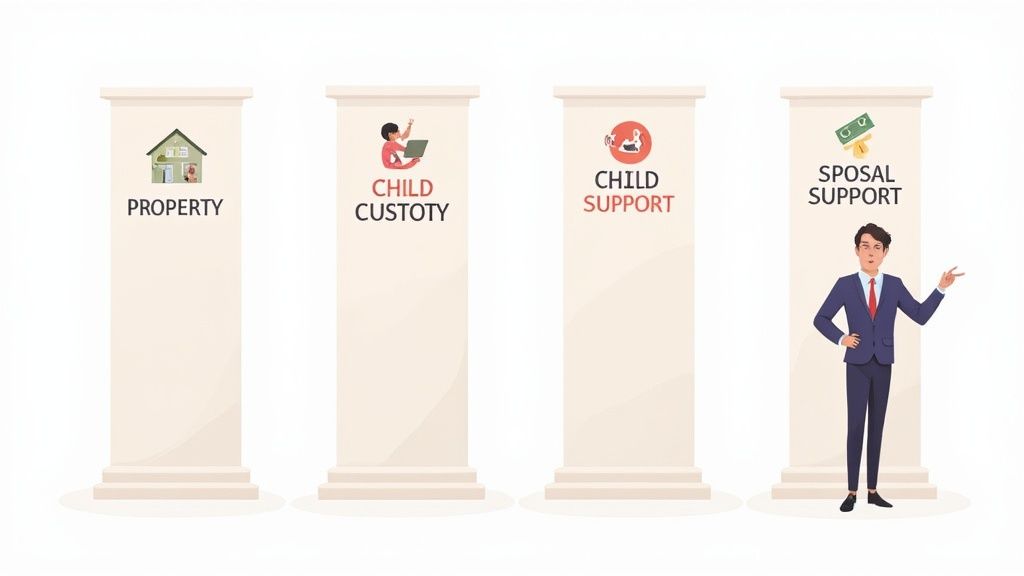
These four pillars are property division, child custody and access, child support, and spousal support. Each one is governed by specific rules under Ontario’s Family Law Act and federal guidelines, and how they’re handled will have a real, lasting impact on your life after the divorce is final.
Property Division and Equalization
One of the biggest jobs in any divorce is dividing up the assets you and your spouse built during your marriage. In Ontario, this process is called equalization, and it’s designed to ensure a fair split of the financial value you created as a team.
Think of your marriage like a joint business venture. When that partnership ends, you have to calculate the growth in value from the day you started to the day you separated. Your lawyer’s job is to meticulously catalogue every asset and debt to make sure this calculation is spot-on. This includes everything from:
- The Matrimonial Home: This is often the most significant asset and is treated uniquely under the law.
- Investments and Savings: RRSPs, TFSAs, stocks, and bank accounts all get factored in.
- Pensions and Business Interests: These are complex assets that demand careful, expert valuation.
- Debts: Mortgages, car loans, and credit card balances are also part of the final equation.
The goal is for the spouse with the higher net family property value to make a payment to the other to “equalize” their financial positions. Hiding assets isn’t just frowned upon—it’s a serious offence with severe penalties, which is why full and honest financial disclosure is mandatory.
Child Custody and Parenting Time
When children are involved, their best interests become the court’s absolute top priority. This single principle guides every decision about custody (who makes the major decisions) and access (the parenting schedule). The terms might sound a bit clinical, but what they’re really about is making sure your children have a stable, supportive, and loving environment to thrive in.
Your lawyer will help you create a detailed parenting plan, which is essentially a practical roadmap for co-parenting. It covers everything from the weekly schedule and holidays to birthdays and travel arrangements. A well-thought-out plan minimizes future arguments and gives your kids the consistency they need.
A key thing to remember is that under Ontario law, there is no automatic preference for mothers or fathers. The court’s sole focus is on what arrangement best serves the child’s physical, emotional, and psychological well-being. They’ll look at the history of caregiving and, depending on their age and maturity, the child’s own wishes.
Child Support Obligations
Both parents have a legal duty to financially support their children. It’s important to understand that child support is the right of the child, not the parent receiving it. The amounts are calculated using the federal Child Support Guidelines, which ensures payments are consistent and predictable no matter where you are in the country.
The calculation is generally based on two main factors:
- The paying parent’s gross annual income.
- The number of children who need support.
While the base amount is fairly straightforward, things can get more complex with shared parenting time or when calculating “special and extraordinary expenses.” These are costs for things like competitive sports, tutoring, or orthodontic care. A good lawyer makes sure all income is properly declared and that the final support payments are fair and legally sound.
Spousal Support Considerations
Spousal support is intended to address any financial imbalances that happen because of the marriage or its breakdown. It isn’t automatic and depends entirely on the specific circumstances of your family. It might be awarded to a spouse who paused their career to raise children, or to help a lower-earning spouse get back on their feet financially.
Unlike child support, there’s no simple formula. A judge will look at the length of the marriage, the roles each spouse played, and their financial means and needs. Your divorce lawyer in Brampton will build a strong argument based on these factors to secure a fair outcome, whether you are the one paying or receiving support.
Choosing Your Path: Negotiation, Mediation, or Court
Not every divorce has to end in a dramatic courtroom battle. In fact, most don’t. The Ontario family law system actually encourages couples to find common ground outside of a formal trial, and for good reason—it’s faster, cheaper, and far less stressful.
Choosing the right path forward—whether it’s negotiation, mediation, or court—is one of the most important strategic decisions you’ll make with your divorce lawyer in Brampton. It sets the tone for your entire separation and has a huge impact on the cost, timeline, and emotional fallout.
Many people picture divorce as two lawyers fighting it out in front of a judge, but the truth is, the vast majority of cases in Brampton are settled long before a trial. The key is using Alternative Dispute Resolution (ADR), which is just a formal name for processes designed to help you and your spouse reach a fair agreement without a judge making the final call.
The Power of Collaborative Negotiation
Often, the most direct route to a resolution is through collaborative negotiation. This isn’t just random back-and-forth arguing. It’s a structured process where you and your lawyer work directly with your spouse and their lawyer to hammer out the details of your separation agreement.
Think of it as a series of focused business meetings with a clear goal. In these meetings, your lawyer’s job is to champion your best interests, give you clear advice on what’s being proposed, and make sure any final agreement is fair, legally sound, and compliant with Ontario’s Family Law Act. The biggest advantage here is control—you and your spouse make the decisions, not a judge who doesn’t know you or your family.
Finding Middle Ground with Mediation
What if direct talks stall? Mediation is an excellent next step. This process brings in a neutral third party—the mediator—who is specially trained to guide conversations and help you and your spouse find creative solutions to your disagreements.
It’s really important to understand what a mediator does (and doesn’t do):
- They don’t give legal advice. A mediator can’t take sides or tell you what to do. They’re impartial.
- They guide the conversation. Their role is to keep discussions productive and focused on finding a resolution.
- They help you find common ground. A great mediator can help you look past the immediate conflict to find shared goals, especially when it comes to your children.
Even when you’re in mediation, your divorce lawyer plays a crucial role behind the scenes. They’ll prepare you for each session, offer private legal advice on the options on the table, and, once you’ve reached a deal, draft the final, legally binding separation agreement.
Mediation gives you the power to create a customized agreement that actually works for your unique family. It’s almost always faster and significantly less expensive than going to court, which helps preserve both your finances and your ability to co-parent peacefully down the road.
When Court Becomes Necessary
Sometimes, no matter how hard everyone tries, an agreement just isn’t possible. This might happen if there’s a history of domestic violence, a serious power imbalance, or if one person simply refuses to be honest about their finances or negotiate in good faith. In these tough situations, heading to court—or litigation—becomes the only way to protect your rights.
Litigation is the most formal and structured path. It follows the court timelines and procedures we’ve discussed, moving through case conferences and, if no settlement is reached, to a trial at the Brampton courthouse. At a trial, a judge listens to the evidence and arguments from both sides before making a final, binding decision on everything.
While court is the last resort, having a skilled litigator from a firm with deep experience in Brampton’s family courts is your strongest asset if you have to go this route. They will build a solid case, present your evidence effectively, and fight fiercely to get you a just outcome under the law. Choosing the right path is the first step, and a skilled divorce lawyer in Brampton can guide you to the one that best protects your family’s future.
How to Prepare for Your First Lawyer Meeting
That first consultation with a divorce lawyer in Brampton is more than just a meeting. Think of it as an interview—you’re deciding if this is the right professional to guide you through one of life’s most challenging chapters. When you walk in prepared, the conversation immediately shifts from a general overview into a productive, focused strategy session. It lets the lawyer give you meaningful, specific advice right from the start.
Being organized shows you’re serious and helps your potential lawyer get a clear, immediate picture of your situation. This initial clarity is key to building a strong foundation for your case and making sure you get the most out of this crucial first step.
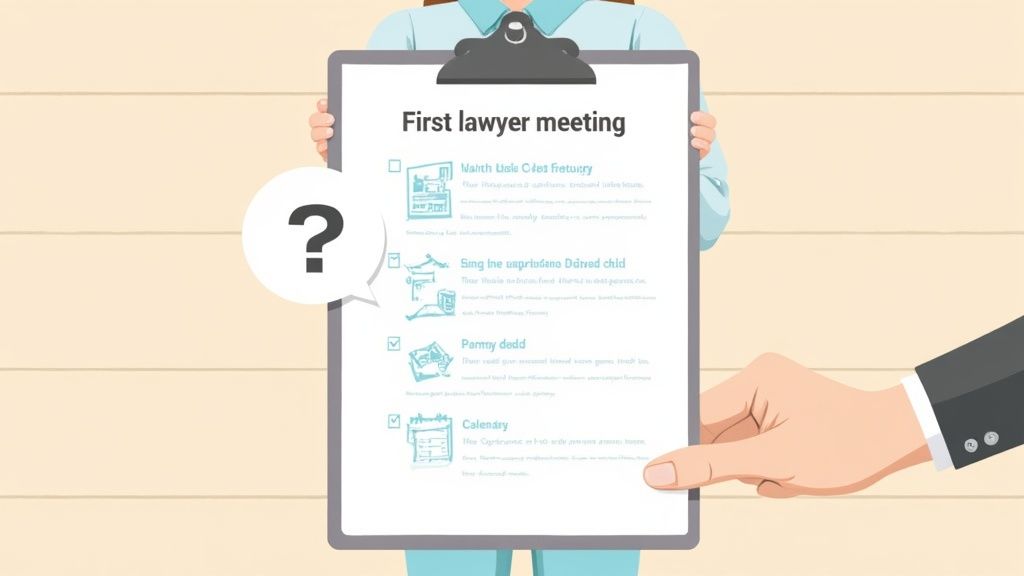
What to Bring: Essential Documents
You don’t need every single piece of paper you own, but bringing key documents can significantly speed things up. It gives the lawyer tangible information to work with, rather than just relying on your memory.
Try to gather what you can from this list:
- Personal Information: Your full name, your spouse’s full name, and your marriage certificate.
- Financial Records: Recent pay stubs for both of you (if you have access), tax returns, and statements for bank accounts, investments, and debts.
- Property Documents: Deeds for any real estate, property tax bills, and mortgage statements.
- Children’s Information: Full names and birthdates of any children.
- Existing Agreements: Any prenuptial or cohabitation agreements you might have signed.
Don’t worry if you can’t find everything. The goal here is to provide a snapshot, not a complete archive. Your lawyer will guide you on gathering the rest later on.
Questions to Ask Your Potential Lawyer
The documents tell your story, but your questions help you understand the lawyer’s. This is your chance to look past the website and see if their approach actually aligns with what you need. It’s about more than just asking about fees.
Your initial meeting is the best time to gauge a lawyer’s communication style, experience, and strategic thinking. A good lawyer will welcome detailed questions and provide clear, direct answers that build your confidence in their ability to handle your case.
Here are some insightful questions you should consider asking:
- Experience: How many divorce cases have you handled specifically in the Brampton court system? Do you have experience with situations similar to mine (e.g., involving business assets, high conflict, etc.)?
- Strategy: Based on what I’ve shared, what’s your initial assessment? What do you see as the potential strengths and weaknesses of my case?
- Communication: What is your preferred way to communicate? Who will be my main point of contact at the firm, and what’s your policy on returning calls or emails?
- Process: What is your philosophy on negotiation versus going to court? Do you see my case as one that could likely be settled through mediation or collaborative law?
- Billing: Can you explain your fee structure in detail? What does the initial retainer cover, and when would I be billed for additional costs?
Coming prepared with these documents and questions will help you leave that first meeting with a clear sense of direction. It empowers you to confidently choose the right divorce lawyer in Brampton—someone who will protect your interests and guide you toward a secure future.
Frequently Asked Questions About Divorce in Brampton
Stepping into the world of divorce brings up a flood of questions. Getting clear, honest answers is the first step toward reducing stress and making decisions you can feel confident about. Here, we tackle some of the most common concerns people have when they start looking for a divorce lawyer in Brampton, with practical information grounded in Ontario family law.
How Much Does a Divorce Lawyer in Brampton Cost?
This is usually the first question on everyone’s mind, and for good reason. The truth is, the cost of a divorce in Brampton can vary wildly, and it really comes down to the complexity of your situation and how much conflict there is between you and your spouse. It’s best to think of it in two main buckets.
- Uncontested Divorce: If you and your spouse are on the same page about all the big issues—property, support, and the kids—the process is far simpler. For a straightforward, uncontested divorce, legal fees generally fall in the $2,000 to $5,000 range. This typically covers the cost of drafting your separation agreement and filing all the necessary court paperwork.
- Contested Divorce: When you can’t agree, the costs climb. A contested divorce that involves back-and-forth negotiations, court appearances, and deep dives into financial records can range from $15,000 to well over $50,000. The final bill is driven by the number of hours your lawyer needs to invest to resolve the disputes.
Most family lawyers in Brampton work on an hourly rate and will ask for an initial retainer. This is an upfront payment held in a trust account that they draw from as they work on your case. Make sure you ask for a clear breakdown of their fees during your first meeting.
How Long Does a Divorce Take in Brampton?
Like the cost, the timeline for a divorce isn’t set in stone. One thing is non-negotiable, though: in Canada, you must be separated from your spouse for at least one full year before a court can officially grant your divorce. There’s no way around this waiting period.
Once you’ve hit the one-year mark and filed your application, the timeline splits depending on whether your case is contested.
An uncontested divorce can be wrapped up relatively quickly, often within 4 to 6 months after filing. The main holdups are usually just the administrative processing times at the Brampton courthouse.
A contested divorce, on the other hand, is a marathon, not a sprint. Because it requires financial disclosures, negotiations, and potentially multiple court conferences, these cases can easily take 18 months to several years to resolve completely. Unfortunately, backlogs in the Peel Region court system can add to these delays.
Do I Have to Go to Court for My Divorce?
Not necessarily. In fact, most divorce cases in Ontario are settled without anyone ever stepping into a courtroom for a full trial. The family law system is designed to encourage you to find solutions outside of court.
If you and your spouse can hammer out a comprehensive agreement on all the issues, it’s very likely you’ll never have to appear before a judge. This can be done through direct negotiations between your lawyers, collaborative family law, or mediation.
Court is really reserved for contested cases where a judge needs to step in and make a decision. Even then, you might only attend case conferences or settlement conferences, which are more informal meetings designed to help you reach an agreement. A full-blown trial is the last resort.
What Is the Difference Between Separation and Divorce?
People often use these terms interchangeably, but in Ontario law, they mean very different things. Getting the distinction right is key to protecting your rights.
Separation is the moment you and your spouse decide to live apart with no real chance of reconciliation. You can even be legally “separated” while still living in the same house, as long as you’re leading separate lives (think different bedrooms, separate finances, no more social life as a couple). A Separation Agreement is a crucial legal contract that lays out all the terms of your split—property, support, and parenting. It’s highly recommended, but it doesn’t legally end your marriage.
Divorce is the official, legal end of your marriage. You can only get a divorce through a court order, which you can apply for after you’ve been separated for a year. The divorce order is what legally dissolves the marriage and allows you to remarry. In most cases, your Separation Agreement becomes the foundation for the final divorce order. An experienced divorce lawyer in Brampton can draft a solid Separation Agreement that protects you and makes the final divorce process much smoother.
Navigating your separation and divorce requires a strategic partner who can protect your rights and guide you toward a stable future. At Badesha Law, we provide clear, client-focused legal advice tailored to your unique situation. To discuss your case and learn how we can help, schedule a confidential consultation with our team.
Learn more and contact us at https://badeshalaw.ca