Divorce Lawyer Brampton: Difference Between Sole and Joint Custody in Ontario

When you are going through a separation in Brampton, understanding the difference between sole and joint custody is critical. The terms you might be familiar with have changed under Ontario's family law. The courts now focus on two core concepts: decision-making responsibility and parenting time.

Understanding these legal terms is the first step in navigating your family's future. A divorce lawyer in Brampton can clarify how these principles, governed by Ontario's Family Law Act, will apply to your specific situation, ensuring you are prepared for the road ahead.

Your First Steps in a Brampton Child Custody Case

Facing a family court battle in Brampton can be daunting, but understanding the legal framework is crucial. The process is guided by one overarching principle: the best interests of the child. Every decision a judge makes must prioritize your child's physical, emotional, and psychological well-being above everything else.

What was traditionally called "legal custody" is now known in Ontario as decision-making responsibility. This right covers the authority to make significant choices about a child’s life, including:

  • Healthcare decisions and medical treatments
  • Their educational path, including school choice
  • Any religious or spiritual upbringing
  • Major extracurricular activities

In contrast, what was known as "physical custody" is now called parenting time. This term simply defines the schedule outlining when the child resides with each parent. It's important to note that parenting time and decision-making responsibility are separate; one parent can have the child for the majority of the time while both parents share decision-making authority equally.

Sole vs. Joint Decision-Making

When one parent has sole decision-making responsibility, they have the legal authority to make all major life choices for the child without consulting the other parent. This arrangement is rare and typically ordered by Brampton courts only in specific circumstances where co-parenting is not feasible. This may be due to a history of family violence (as defined under the Divorce Act and the Criminal Code of Canada), severe substance abuse, or one parent's demonstrated inability to participate in the child's life constructively.

Conversely, joint decision-making responsibility requires both parents to cooperate and agree on these critical life decisions. This is the preferred arrangement in Ontario, as it encourages both parents to remain actively involved. Success in a joint arrangement depends on effective communication and a mutual commitment to co-parenting.

At-a-Glance Custody Comparison in Ontario

This table breaks down the key differences between sole and joint arrangements, providing clarity on what each means for you and your child in Brampton, according to the Family Law Act.

Custody Aspect Sole Decision-Making Responsibility Joint Decision-Making Responsibility
Who Decides? One parent makes all major decisions (health, education, religion). Both parents must agree on major decisions.
When Is It Used? Typically in high-conflict cases, situations involving family violence, abuse, or when one parent is absent or unable to co-parent. The preferred and most common arrangement in Ontario, assuming both parents are fit and willing.
Communication Minimal co-parenting communication is required for major decisions. Requires ongoing communication and cooperation to be successful.
Flexibility Less flexible. The decision-making parent has the final say. More flexible, but can lead to deadlocks if parents cannot agree.

Understanding these distinctions is fundamental as you prepare your case. Getting a broader perspective on the legal services industry can also be helpful; you might find it useful to explore insights into child custody law firm marketing.

A knowledgeable Brampton divorce lawyer can help determine which arrangement best serves your child's needs and guide you through the family court process.

When to Pursue Sole Custody in Ontario

While Brampton courts favour joint decision-making, it is not always in a child's best interest. Pursuing sole decision-making responsibility is a significant legal step reserved for situations where co-parenting is either impossible or would be harmful to the child. This is not about "winning" but about protecting your child's safety and stability.

A Brampton court will only grant sole decision-making authority when there is a documented history of serious issues that make joint decision-making unworkable. Such situations may involve:

  • Family violence or abuse, as defined under the Divorce Act and Criminal Code. This includes physical, emotional, psychological, and financial abuse.
  • Serious substance abuse issues that impair a parent's judgment and ability to care for the child.
  • A complete and hostile communication breakdown where parents cannot make any joint decisions without exposing the child to extreme conflict.
  • One parent’s abandonment or consistent unwillingness to participate in the child’s life.

Building Your Case for Sole Custody

To succeed, you must provide the court with clear and convincing evidence that joint decision-making would directly harm your child's well-being. This requires more than claims of difficulty; it demands concrete proof.

For example, a log of incidents showing the other parent consistently making unilateral decisions about schooling or medical care without consultation becomes powerful evidence. This documentation helps paint a clear picture for the judge, demonstrating a pattern of behaviour that undermines the child's best interests.

This flowchart gives you a simplified look at the decision path for custody arrangements in Ontario.
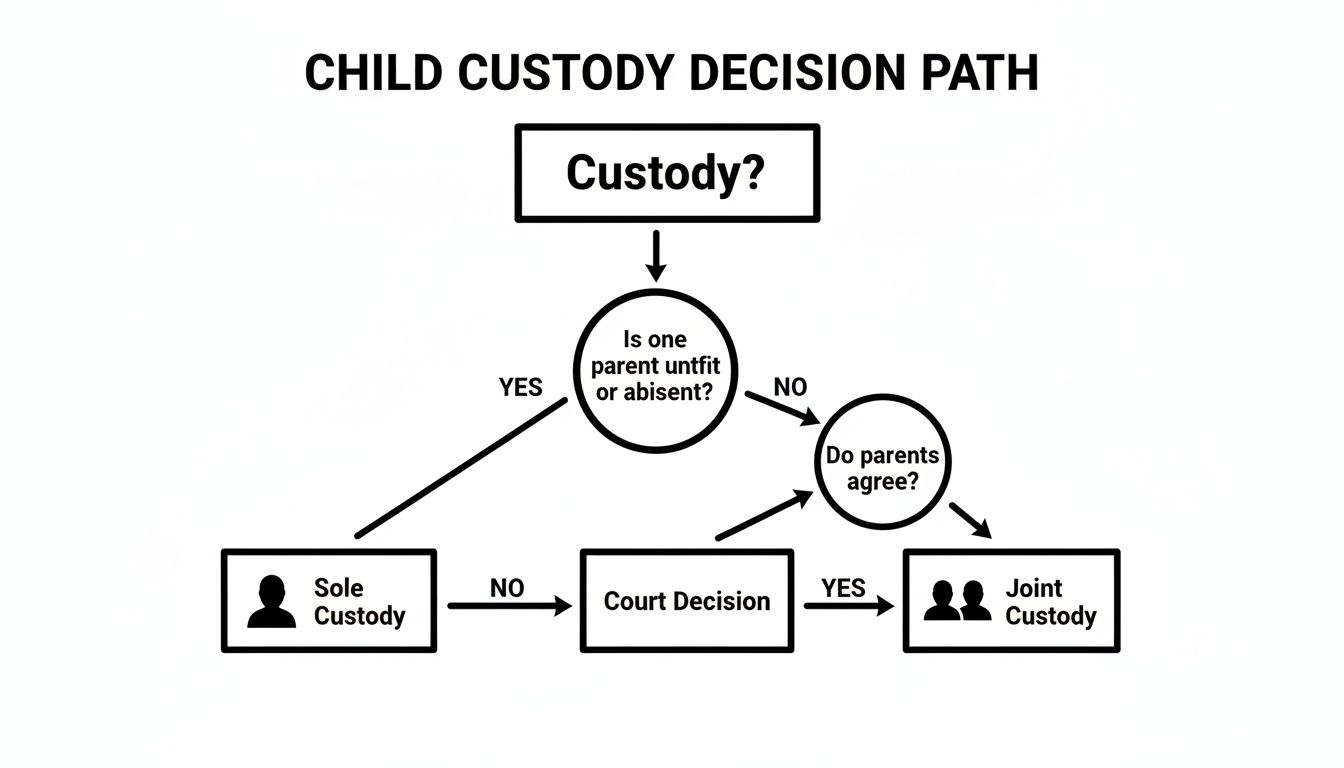
A flowchart showing the child custody decision path, illustrating conditions for sole, joint, or court-decided custody.

The court's primary path leads toward shared responsibility. Sole decision-making is the exception, reserved for cases with serious safety or conflict issues.

Legal systems are increasingly recognizing the harm caused by high-conflict dynamics. For instance, recent legal updates in other jurisdictions now treat coercive control and financial abuse as major factors in custody decisions. This trend just highlights how important it is to document every form of harmful behaviour. You can learn more about how custody laws are evolving to protect children.

A judge’s primary concern is stability and safety for the child. Your job is to demonstrate, with clear and consistent evidence, that a sole decision-making framework is the only way to provide that.

This means gathering police reports, saving harassing communications, and obtaining witness statements. Working with an experienced divorce lawyer in Brampton is crucial. They will help you strategically present this evidence to meet the strict requirements of Ontario's Family Law Act.

Making Joint Custody Work for Your Family
A happy family, parents and child, look at a map, planning a trip with calendars and puzzle pieces.

When you enter a Brampton family court, it's vital to understand the judge's perspective. Ontario law operates on the principle that children thrive when both parents are actively and meaningfully involved in their lives.

For this reason, joint decision-making responsibility is the standard arrangement. It mandates that you and your ex-partner must collaborate on major decisions concerning your child’s health, education, and general welfare.

However, "joint" does not always mean easy, particularly amid conflict. Success hinges on your ability to cooperate. Demonstrating to a judge that you can set aside personal conflict to co-parent effectively is one of the most persuasive actions you can take. This cooperation is formalized in a parenting plan, a detailed agreement that serves as the rulebook for your co-parenting relationship. A well-drafted plan can prevent minor disagreements from escalating into future court battles.

Crafting an Effective Parenting Plan

A robust parenting plan does more than allocate weekends. It anticipates future points of friction and establishes clear resolution processes. A divorce lawyer in Brampton can be instrumental in drafting a plan that is both comprehensive and legally enforceable.

Your plan should include:

  • Detailed Communication Protocols: Specify the method (e.g., a co-parenting app, weekly email), frequency, and scope of your communication to ensure it remains child-focused.
  • Dispute Resolution Mechanisms: Include a clause requiring mediation or consultation with a parenting coordinator before either parent can file a court motion over a disagreement.
  • Specific Holiday and Vacation Schedules: Clearly outline schedules for Christmas, March Break, summer holidays, and birthdays to prevent recurring annual conflicts.

The goal is to create a predictable and stable environment for your child. This aligns with broader trends in family law, where detailed parenting plans are used to minimize conflict and keep families out of court. You can discover more insights about how family law is evolving to promote cooperation on ceb.com.

Remember, a judge in Brampton isn't just assessing who is the "better" parent. They are looking for the parent who best supports the child's relationship with the other parent.

This means every communication matters. It must be respectful, child-focused, and business-like. Emotional or accusatory language can be used as evidence against you. Proving you are the parent who can co-parent effectively is a powerful argument in your favour.

Building a Winning Case with Evidence
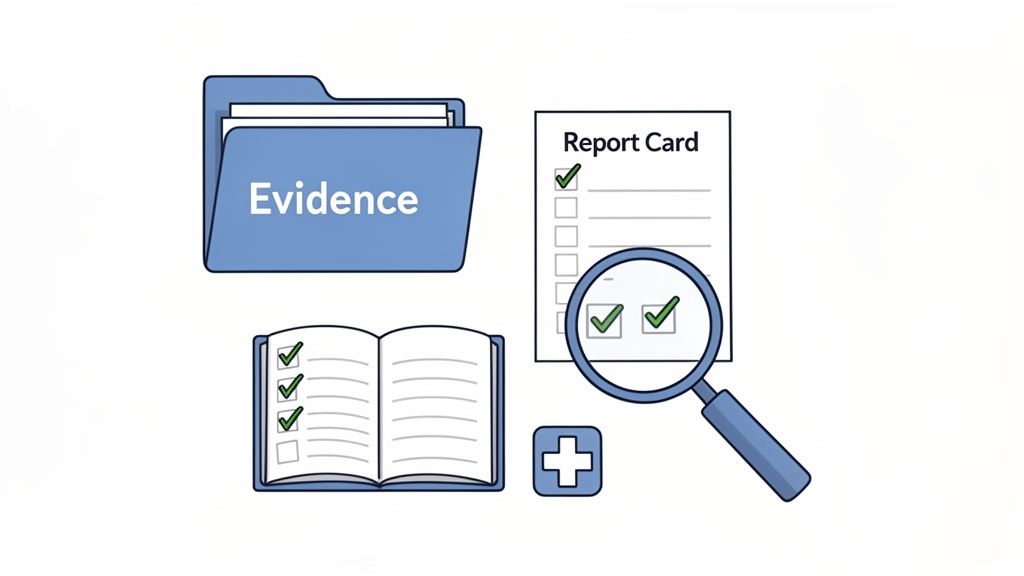
Blue icons: 'Evidence' folder, 'Report Card' with checks, open book with checks, magnifying glass, and medical cross.

In a Brampton family court, your case will be decided on what you can prove, not just what you say. Your arguments must be supported by organized, credible evidence that directly addresses your child's best interests. A judge will not be swayed by emotional appeals or unverified claims; they require concrete proof.

Your objective is to compile a clear record demonstrating your consistent and positive involvement in your child's life, showing that you are a stable and capable parent.

The Essential Evidence Checklist

Begin gathering and organizing these documents immediately. They provide third-party validation of your parenting capabilities and form the foundation of your case.

Key items to collect include:

  • Academic Records: Report cards, emails with teachers, and attendance records show your engagement in your child's education.
  • Medical and Health Records: Documentation of doctor visits, dental appointments, and therapy sessions demonstrates your attention to your child's health needs.
  • Communication Logs: Preserve all relevant emails, text messages, and communications from co-parenting apps. This log can either showcase your efforts to cooperate or expose a pattern of conflict initiated by the other party.
  • Financial Records: Keep receipts for child-related expenses to document your financial support.

This documentation is vital. Courts are overloaded and rely on clear, organized proof to make timely and informed decisions. To see what those decisions often look like, you can discover more insights about child custody arrangements on drurypullenlaw.com.

Your Most Powerful Tool: A Parenting Journal

Beyond official documents, a detailed parenting journal can be your most valuable piece of evidence. This is a chronological log where you track everything relevant to your child and the case.

A well-kept journal transforms your personal observations into a credible timeline of events. It helps your divorce lawyer in Brampton connect the dots and build a compelling narrative for the court.

Use it to note pick-up and drop-off times, summaries of parenting discussions, any instances of missed parenting time by the other party, and positive milestones your child achieves in your care. Each entry helps prove your consistent and caring involvement in your child's life.

How a Brampton Divorce Lawyer Shapes Your Case

Navigating the Brampton family court system alone is a significant risk. An effective divorce lawyer is more than a legal guide; they are your strategist and advocate, ensuring your case is presented clearly and persuasively.

An experienced divorce lawyer in Brampton will analyze the facts of your case to build an evidence-based argument aligned with Ontario's Family Law Act. They know which evidence will be most impactful to a judge and how to structure your narrative to focus on the best interests of the child.

More Than Just Court Appearances

A lawyer's most critical work is often done behind the scenes, preparing the legal documents that form the foundation of your case.

  • Affidavits: This is your sworn written testimony. Your lawyer will help you craft a clear, concise statement that tells your story effectively, free from emotional language that could weaken your credibility.
  • Case Conference Briefs: These documents summarize the issues, your position, and your supporting evidence for the judge before a conference. A well-prepared brief sets a professional tone and can significantly influence the proceedings.

A skilled lawyer anticipates the opposing side's arguments and prepares you for challenging questions in mediation or in court. They provide the objective guidance needed to make sound decisions when emotions are high, helping you focus on presenting yourself as a stable and responsible parent.

A lawyer’s experience can be the difference between feeling lost in the system and feeling empowered by it. They provide the objective perspective you need to make smart decisions when emotions are running high.

Hiring a Brampton lawyer is an investment in protecting your parental rights and securing a stable future for your child. They ensure every action taken is strategic and focused on achieving the best possible outcome for your family.

Frequently Asked Questions About Custody in Brampton

When you are in a family court dispute, questions can feel endless. This FAQ section addresses common concerns for parents in Brampton, with answers grounded in Ontario's Family Law Act.

At What Age Can a Child Choose Who to Live With in Ontario?

There is no specific age in Ontario at which a child can legally decide their own living arrangements. However, as a child matures, their views and preferences are given more weight by the court. The wishes of a teenager will be considered more significantly than those of a young child. It is crucial to remember that the child's preference is only one factor among many that a judge considers when determining the child's best interests.

What Is the Difference Between Parenting Time and Decision-Making?

Understanding this distinction is central to any custody case in Ontario.

  • Decision-making responsibility is the legal authority to make major choices for your child regarding their health, education, and religious upbringing.
  • Parenting time refers to the schedule that dictates when the child is in each parent's care.

It is common for parents to share joint decision-making responsibility even if the parenting time schedule is not an equal 50/50 split.

How Can I Get Sole Custody if My Ex Makes Co-Parenting Impossible?

Obtaining an order for sole decision-making responsibility is challenging. You must prove to the court that a joint arrangement is contrary to your child's best interests. This requires more than demonstrating that co-parenting is difficult or that you have personality clashes. You must provide compelling evidence of serious issues such as family violence, untreated substance abuse, or a documented pattern of high-conflict behaviour by the other parent that negatively impacts the child. An experienced divorce lawyer in Brampton is essential for presenting this type of evidence effectively.


Navigating a custody battle is complex and emotionally draining. The team at Badesha Law has the experience to protect your rights and fight for your child's future. For clear guidance and strategic representation in Brampton, visit us at badeshalaw.ca/brampton-criminal-lawyer.

Top 5 Mistakes to Avoid When Divorcing in Brampton

Facing a divorce in Brampton can be completely overwhelming, and the fear of making a costly mistake only adds to the stress. The single most critical first step you can take to protect your future is to hire a skilled divorce lawyer. This guide provides a clear, actionable roadmap, highlighting the five most common pitfalls people encounter when divorcing in Ontario and how to avoid them.

Navigating Your Brampton Divorce with Confidence

Think of this guide as your strategic plan for navigating the Brampton legal system without losing your footing. We’ll break down the common errors we see time and again—from underestimating the importance of local court procedures to letting emotions drive major financial decisions. The goal is to protect your assets, your children’s future, and your peace of mind.

Every piece of advice is grounded in Ontario’s Family Law Act and the Criminal Code of Canada to give you actionable insights. Understanding these challenges upfront is the first step toward securing a fair outcome. The informed choices you make today will save you from expensive regrets down the road.

Why Local Knowledge Matters

Successfully navigating a divorce requires more than just knowing the law; it demands deep familiarity with the local legal landscape. A lawyer from another city simply won’t have the same on-the-ground advantage. Here’s why a Brampton focus is non-negotiable:

  • Court Procedures: The Brampton courthouse operates with its own specific administrative rules and filing preferences. An outsider can easily make a procedural mistake that delays your case.
  • Judicial Insight: An experienced local lawyer has appeared before the judges in Brampton countless times. They understand their temperaments and how they tend to rule on certain issues, which is invaluable for building your case strategy.
  • Community Network: A well-regarded local lawyer has established relationships with other legal professionals in the area. This network can make negotiations smoother and less adversarial.

Ultimately, choosing the right advocate is everything. When you decide to hire Badesha Law Brampton divorce lawyer, you’re not just getting legal advice. You’re partnering with a team that specializes in guiding local residents through this exact process, ensuring your rights are protected every step of the way.

Mistake 1: Going It Alone Without Local Legal Expertise

One of the biggest—and most common—mistakes people make in a divorce is underestimating the complexity of the local legal system. Trying to handle it yourself or hiring a lawyer who isn’t from Brampton might seem like a way to save money, but this strategy almost always leads to expensive and time-consuming problems.

The legal system isn’t one-size-fits-all. Every courthouse has its own way of doing things, and the one in Brampton is no different. It has specific procedural rules, administrative timelines, and judicial preferences. These aren’t things you can learn from a book; they come from years of hands-on experience in the local courts.

An experienced local divorce lawyer lives and breathes this unique environment.

The Advantage of a Brampton Divorce Lawyer

A seasoned divorce lawyer in Brampton brings more to the table than just knowledge of Ontario’s Family Law Act. They offer practical, on-the-ground expertise that directly impacts how smoothly and successfully your case moves forward. This local insight is critical for a few key reasons:

  • Procedural Accuracy: They know exactly how to file documents at the Brampton courthouse to avoid rejections and needless delays that could stall your case for months.
  • Strategic Insight: After appearing before local judges time and time again, they can anticipate how certain arguments might land, allowing them to shape a much more effective legal strategy for you.
  • Professional Network: A local lawyer has built relationships with other lawyers and court staff, which can help make negotiations smoother and the whole process less combative.

Navigating the system efficiently is about more than just knowing the law; it’s about saving you time, stress, and money. A professional ensures your case moves forward as smoothly as possible, preventing small procedural errors from turning into major setbacks.

Recent trends highlight the value of this local expertise. The number of divorces and how quickly they are finalized have changed, with many Peel Region family courts still working through backlogs. Statistics Canada reported a crude divorce rate of about 5.6 divorces per 1,000 married people in 2020. This national number underscores why having a local expert who can navigate scheduling bottlenecks and administrative hurdles is so important.

When you hire Badesha Law Brampton divorce lawyer, you’re not just getting legal advice. You’re securing an advocate who is deeply familiar with the specific challenges and opportunities inside the local court system.

Mistake 2: Lacking a Clear Financial Picture

Trying to negotiate a divorce settlement without a complete and accurate understanding of your family’s finances is like navigating a maze blindfolded. It’s a recipe for a bad outcome. Here in Brampton, and right across the province, Ontario’s Family Law Act is crystal clear: both spouses must provide full and honest financial disclosure. A surprisingly common mistake is not taking this step seriously, which almost always leads to disastrous financial results.

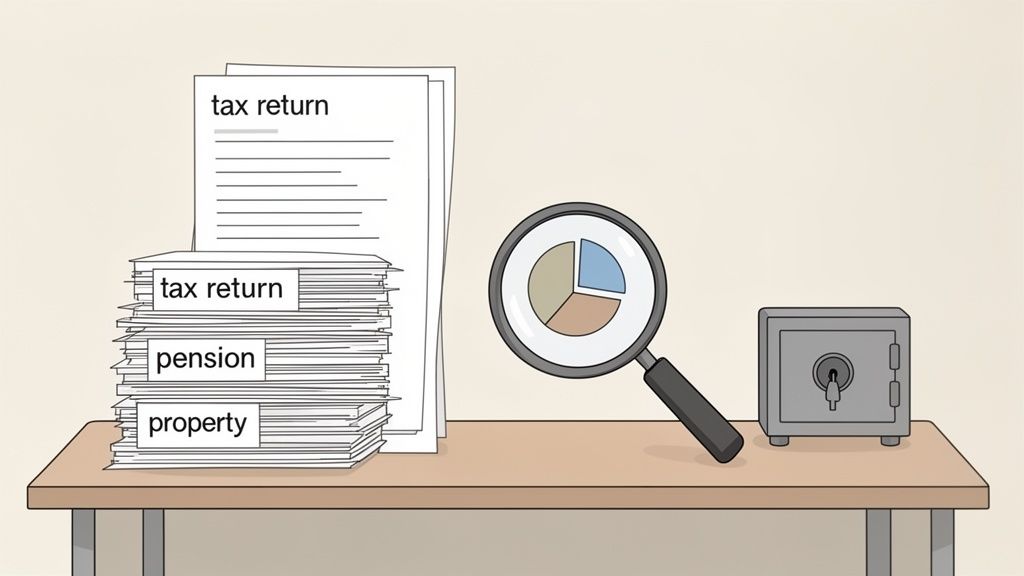
This isn’t just a matter of glancing at your last few bank statements. A proper financial review means digging into everything—tax returns, property valuations, pension statements, investment portfolios, business records, and more. Without this complete picture, it’s simply impossible to divide assets fairly.

Documents labeled tax return, pension, and property are reviewed with a magnifying glass and a safe.

Understanding Equalization in Ontario

One of the most critical concepts in Ontario divorce law is the equalization of Net Family Property. At its core, this legal principle ensures that the wealth built up during the marriage gets split down the middle. This is precisely why every single dollar must be accounted for. People often stumble here by:

  • Undervaluing assets: This happens all the time, especially with shared businesses or unique investments where a professional valuation is absolutely necessary.
  • Forgetting future assets: Pensions and stock options aren’t just future money; they’re valuable assets that must be included in today’s calculations.
  • Hiding or transferring funds: Trying to hide money is a terrible idea. It’s not just unethical; it can lead to severe legal penalties under the Criminal Code of Canada and will completely destroy your credibility in court.

An experienced family lawyer makes sure no stone is left unturned. Their job is to get you a fair deal based on facts, not guesswork, and to protect your financial future.

To get started, it’s crucial to gather the right documents. This first step helps your divorce lawyer build a clear, evidence-based picture of your marital finances.

Your Financial Disclosure Checklist

Gathering these key documents is the first step toward ensuring a fair and transparent division of assets under Ontario law.

Document Category Specific Examples Why It’s Critical
Income & Employment T4 slips, pay stubs, employment contracts, notices of assessment from the CRA for the last 3 years. Establishes income for calculating child and spousal support, and tracks financial contributions.
Assets & Property Property deeds, mortgage statements, MPAC assessments, vehicle ownerships, appraisals for art or jewelry. Determines the value of real estate and other significant assets to be included in the division.
Banking & Investments Bank statements (chequing/savings), RRSP/TFSA statements, investment portfolio reports for the last 3 years. Provides a complete picture of liquid assets and investment growth during the marriage.
Pensions & Retirement Annual pension statements from employers, statements for any private retirement plans. Pensions are valuable assets that must be properly valued and divided.
Business Interests Financial statements for any business, shareholder agreements, corporate tax returns. Ensures any family-owned or shared businesses are accurately valued for equalization.
Debts & Liabilities Credit card statements, lines of credit, car loans, personal loans, student loan statements. Debts are subtracted from assets to calculate your Net Family Property, so they must be fully disclosed.

Having these documents organized and ready will save time, reduce legal fees, and strengthen your negotiating position from day one.

When you hire Badesha Law Brampton divorce lawyer, you’re not just getting legal advice; you’re getting a partner dedicated to achieving financial clarity. Our team will help you organize your records, ensure your spouse provides complete disclosure, and won’t hesitate to bring in forensic accountants if we suspect something isn’t right. Securing your financial stability starts with a clear and honest accounting of your marital assets.

Mistake 3: Letting Emotions Drive Your Legal Decisions

Going through a divorce is one of the most gut-wrenching experiences anyone can face. It’s completely normal to feel a storm of emotions—anger, betrayal, grief, and fear. But letting those raw feelings take the driver’s seat in your legal strategy is a mistake that can haunt you for years.

When you’re hurt, the temptation to lash out is strong. You might want to reject a perfectly reasonable settlement offer just to make things difficult, or sink thousands into a legal fight over a piece of furniture that’s more sentimental than valuable. These decisions, driven by a need for revenge, almost always backfire. They burn through your savings, drag out the pain, and make it harder for everyone, including your children, to heal.

This is where a good Brampton divorce lawyer becomes your anchor. They act as an objective, clear-headed advocate, helping you see past the emotional fog and focus on what truly matters for your future.

Focusing on a Stable Future, Not a Bitter Past

An experienced divorce lawyer helps you shift from reactive, emotional choices to strategic, forward-thinking ones. It’s a tough pill to swallow, but in Ontario, the family court system isn’t interested in who was “right” or “wrong” in the marriage. Outcomes are guided by established legal principles designed to be fair and predictable.

  • Child Support: This isn’t a penalty. It’s calculated using the federal Child Support Guidelines, which are based almost entirely on the payor’s income and the parenting schedule. Marital misconduct doesn’t move the needle.
  • Spousal Support: This is determined by factors like the length of your marriage, the difference in your incomes, and the roles each of you played. It’s about need and compensation, not blame.
  • Property Division: The law aims for a straightforward 50/50 split of the wealth you built together during the marriage, as laid out in the Family Law Act.

Family law outcomes are driven by rules and guidelines, not by feelings. Working with a local Brampton divorce lawyer who knows the Peel Region courts inside and out will lead to a more predictable, stable, and financially sound resolution for you.

Understanding this from the start is critical. Child support is a math problem, and spousal support follows well-worn paths based on specific facts. When you hire Badesha Law, our experienced divorce lawyer team, who works in the Brampton courthouse regularly, gives you a huge advantage. We know the local landscape and can help you secure a grounded outcome that protects your long-term stability.

Learn more about the statistical realities of divorce outcomes in Ontario to see how the numbers play out.

Mistake 4: Overlooking Alternatives to Court

When people think of divorce, their minds often jump straight to a dramatic, high-conflict courtroom battle. This is one of the most persistent and costly misconceptions out there. The reality is, here in Brampton, you have highly effective out-of-court solutions that can save you an incredible amount of time, money, and emotional strain.

These options, often called Alternative Dispute Resolution (ADR), put you back in the driver’s seat. Instead of a judge making life-altering decisions for your family, you and your spouse work together with professional guidance. A skilled divorce lawyer in Brampton shifts from being a courtroom fighter to a strategic advisor, focused on helping you negotiate a fair and lasting agreement.

Empowering You with Options

ADR isn’t a one-size-fits-all solution; it’s a toolkit of options designed for different family situations. The two most common paths in Ontario family law are:

  • Mediation: A neutral third-party mediator sits down with you and your spouse to guide the conversation. Their job is to help you find common ground on tough issues like parenting plans and how to divide property.
  • Collaborative Family Law: This is a team approach. You and your spouse each have your own specially trained lawyer, and all four of you agree from the start to resolve everything without ever stepping into a courtroom.

This flowchart shows how your main priority—whether it’s preserving emotional well-being or reaching a logical outcome—can point you toward the best legal path for you.

A decision tree flowchart outlining divorce choices based on emotion or logic, leading to different legal paths.

The key takeaway is that ADR empowers you to create custom solutions that actually work for your family’s unique needs. By choosing to hire Badesha Law Brampton divorce lawyer, you’re not just getting a litigator; you’re gaining an advocate skilled in these powerful and cost-effective negotiation techniques.

Mistake 5: Partnering with the Wrong Legal Advocate

This last mistake is arguably the most critical one you can make: choosing the wrong legal partner for your journey. The relationship you have with your divorce lawyer in Brampton will fundamentally shape your experience and the final outcome. Picking someone who doesn’t align with your goals or communication style can quickly lead to frustration, unnecessary costs, and a resolution that just doesn’t meet your needs.

Cartoon comparing a 'Not Right' lawyer to a 'Right Fit' professional shaking hands near a courthouse.

This isn’t just about looking at credentials; it’s about finding the right fit for you. Do you need an aggressive litigator who is ready for a courtroom battle, or would you be better served by a skilled negotiator who excels at mediation? Your initial consultation is your opportunity to interview them and see if their approach actually matches what you’re trying to achieve.

Finding Your Trusted Advisor

The financial stakes of this decision are huge. Legal costs for divorce in Brampton can vary wildly depending on how complex your case is, with hourly rates typically falling between CAD 200 to CAD 500. A contested divorce can easily run into the tens of thousands of dollars, making it vital to find a lawyer who is focused on cost-effective strategies.

To find the best fit, don’t be shy about asking direct questions during your consultation:

  • What is your primary approach to resolving family law disputes?
  • How will you keep me informed about my case?
  • Based on my situation, what potential outcomes do you foresee?

Choosing the right lawyer is an investment in your future. You need a partner you can trust, one who provides clear guidance and advocates for your best interests with integrity and skill.

This is where a client-focused approach, like the one we have at Badesha Law, makes a real difference. When you hire Badesha Law Brampton divorce lawyer, you’re not just getting legal representation; you’re getting a team dedicated to understanding your unique situation. We provide support that’s shaped around you, ensuring you have a trusted advocate to guide you toward the best possible future.

Common Questions About Divorce in Brampton

Getting started with a divorce can feel overwhelming, and it’s natural to have a lot of questions. Below are straightforward answers to some of the most common queries we hear from clients in Brampton. Think of this as a starting point, but remember, nothing replaces a conversation with an experienced divorce lawyer in Brampton who can apply the law to your unique circumstances.

How Long Must We Be Separated to Get Divorced in Ontario?

In Canada, the law requires you to be separated for at least one full year before the court can grant your divorce. A common misconception is that you have to wait that entire year before you can do anything. That’s not the case.

You can—and should—start the legal process much sooner. A Brampton divorce lawyer can help you file the necessary applications and begin working on critical issues like property division, spousal support, and child arrangements right away. Resolving these matters first often makes the final divorce order a simple last step.

What Is an Uncontested Versus Contested Divorce?

The difference really comes down to one thing: agreement.

An uncontested divorce is when you and your spouse agree on all the major issues—how to divide property, who the children will live with, and the terms of financial support. Because there’s no conflict to resolve, this path is much faster, less stressful, and significantly more affordable.

A contested divorce, on the other hand, happens when you disagree on one or more of those key issues. This disagreement requires a formal process to resolve, whether it’s through negotiation, mediation, or going to court. Naturally, this extends the timeline and increases the legal costs.

Can I File for Divorce in Brampton if I Got Married Abroad?

Yes, absolutely. The location of your marriage doesn’t matter as much as where you live now. As long as either you or your spouse has lived in Ontario for at least one year before filing for divorce, the Brampton courts have the authority to handle your case.

You may need one extra document, often called a Foreign Divorce Opinion Letter, to confirm for the court that your foreign marriage was legal. This is a standard procedure that a family law firm can easily help you obtain.


The path forward might look complicated, but you don’t have to walk it alone. For clear, strategic guidance tailored to your family’s needs, connect with the experienced team at Badesha Law. We’re here to protect your rights and help you find a fair resolution. Learn more about our approach to family law and schedule your consultation today.

Finding the Best Divorce Lawyer in Bramton: A Client’s Guide

When you’re searching for the “best divorce lawyers in Brampton with good client reviews,” you’re not just looking for a legal representative. You’re seeking a strategic partner who understands your needs and can fiercely protect your future. A top-tier lawyer doesn’t just know Ontario’s Family Law Act; they have a proven track record in the Brampton court system and are committed to turning an overwhelming, high-stakes process into a clear, actionable plan for you.

Why a Brampton Divorce Lawyer Is Your Strongest Ally

Navigating a divorce can feel like weathering a storm without a compass. The emotional toll is immense, and the legal complexities can seem impossible to untangle. This is precisely why hiring an experienced Brampton divorce lawyer isn’t a luxury—it’s a critical first step toward building a stable future for yourself and your children.

A specialized lawyer does far more than just file paperwork. They act as your strategic advisor, identifying potential legal pitfalls before they arise and crafting a legal strategy tailored to your specific situation. Their primary role is to bring order and clarity to a process that often feels chaotic, ensuring your decisions are informed and legally sound.

Local Expertise Matters More Than You Think

Every courthouse has its own unique procedures and unwritten rules. A lawyer who is a regular presence in the Peel Region courts understands the expectations of Brampton judges and is familiar with the local legal community. This insider knowledge is a significant advantage, whether you are negotiating a separation agreement or presenting your case before a judge.

This local insight is especially vital in a diverse and growing city like Brampton. According to the 2016 Statistics Canada census, 4.21% of Brampton’s residents were divorced, a rate slightly higher than the Ontario average. This statistic underscores the need for skilled, local legal guidance from a professional who understands the specific challenges faced by families in our community.

Turning Legal Jargon into a Clear Plan

The Family Law Act and Canada’s Criminal Code (which can be relevant in cases involving domestic issues) are dense and complex. A skilled lawyer’s job is to translate these intricate laws into practical, straightforward advice that empowers you. They will clarify your rights and obligations regarding:

  • Property Division: Ensuring a fair and legal equalization of family property, including the matrimonial home, investments, and pensions, as mandated by Ontario law.
  • Spousal and Child Support: Accurately calculating support payments based on federal guidelines and advocating for your financial security.
  • Child Custody and Access: Developing a parenting plan that prioritizes your children’s well-being while safeguarding your parental rights.

A great divorce lawyer doesn’t just react to problems—they build a proactive strategy. They anticipate the other side’s moves, protect you from common pitfalls, and focus on achieving a fair resolution that allows you to move forward with confidence and security.

Think of your lawyer as a professional who builds a protective wall around you during this difficult time. They handle all the stressful communications with your ex-spouse’s lawyer, manage all the deadlines, and gather the financial proof needed to build your case. This frees you up to focus on what really matters: your emotional health and your family. By preventing costly mistakes and advocating fiercely for you, a Brampton divorce lawyer becomes your most crucial supporter during one of life’s toughest transitions.

Understanding the Brampton Divorce Process Step by Step

Going through a divorce in Ontario can feel like trying to find your way through a legal maze, filled with confusing paperwork and unfamiliar rules. If you live in Brampton, getting a clear picture of the steps involved can make a world of difference, cutting down on the stress and uncertainty. Think of it as a roadmap—it helps you see what’s coming next so you can prepare properly and protect your rights from start to finish.

The whole process kicks off with one crucial step: filing the Application for Divorce. This is done with a specific court document called Form 8A Application (Divorce), which gets submitted to the Superior Court of Justice right here in Brampton. This form officially begins the legal proceedings and tells the court what you’re asking for on issues like property, support, and child custody.

Once that’s filed, the next critical task is to make sure your spouse is legally notified. This is known as “serving” the documents, and it has to be done by the book according to Ontario’s rules, or it won’t count. An experienced divorce lawyer in Brampton makes sure this gets handled perfectly, preventing simple mistakes that could stall your case right out of the gate.

This is where a lawyer really shows their value—transforming a confusing and overwhelming situation into a clear, guided process.

As you can see, the journey starts with confusion but ends in clarity. Your lawyer is the one who builds that bridge, guiding you every step of the way.

To give you a clearer picture of the road ahead, here’s a breakdown of the key stages you’ll encounter when filing for divorce at the Brampton courthouse.

Key Stages of the Ontario Divorce Process in Brampton

Stage Purpose Key Document(s)
1. Application To officially start the divorce proceedings and state your claims. Form 8A: Application (Divorce)
2. Service To legally notify your spouse that you have filed for divorce. Form 6B: Affidavit of Service
3. Answer For your spouse to respond to your application and state their claims. Form 10: Answer
4. Financial Disclosure For both parties to provide full details of their finances. Form 13.1: Financial Statement
5. Case Conference An initial meeting with a judge to identify issues and plan next steps. Case Conference Brief
6. Settlement Conference A meeting with a judge to encourage a final agreement before trial. Settlement Conference Brief
7. Trial If no agreement is reached, a judge hears evidence and makes a final decision. Trial Record, Witness Statements

This table outlines the typical path, but remember, not every case will go through every single stage. The goal is always to find a resolution as early as possible.

Contested Versus Uncontested Divorce

The path your divorce takes through the Brampton court system really boils down to one thing: is it contested or uncontested? Knowing the difference is huge, as it directly impacts the timeline, the cost, and the emotional energy required.

  • Uncontested Divorce: This is the ideal scenario. It happens when you and your spouse agree on all the big issues—property, support, and the kids. The process is mostly paperwork, and you might not even need to set foot in a courtroom. It’s faster, cheaper, and far less stressful.
  • Contested Divorce: This is what happens when you can’t agree on one or more key issues. The matter has to move through the court system, where a resolution will be reached through negotiation, mediation, or ultimately, a judge’s ruling.

Even if you think your separation is amicable, it’s always smart to have a lawyer look over your agreement. A small oversight can easily turn into a major headache down the road.

Key Milestones in a Contested Divorce

If you and your spouse can’t find common ground, your case will proceed through a series of court events designed to help you reach a resolution. Your lawyer will be by your side for each one, fighting for your best interests.

The first major step is financial disclosure. This isn’t optional. Both of you are legally required to provide a complete and honest picture of your finances—income, assets, debts, everything. This transparency is the bedrock of any fair negotiation on property division or support. Trying to hide assets is a serious mistake with severe consequences under the Family Law Act.

After disclosure, you’ll likely attend one or more conferences at the Brampton courthouse:

  1. Case Conference: This is an informal meeting with a judge. The goal is to talk about the issues, make sure everyone has shared the necessary information, and see if there are opportunities to settle.
  2. Settlement Conference: This meeting is more focused. The judge will give their opinion on what would likely happen if the case went to trial, putting pressure on both sides to find a final agreement.

It’s worth knowing that the vast majority of divorce cases in Ontario, including those here in Brampton, are settled long before they ever see a trial. These conferences are specifically designed to make that happen, saving everyone time, money, and heartache.

If you still can’t reach an agreement after these steps, the final stop is a trial. This is where a judge hears all the evidence and testimony from both sides and then makes a final, legally binding order. Having a skilled divorce lawyer at this stage is absolutely essential to present your case clearly and ensure the judge has what they need to make a fair decision.

Navigating the Core Issues in Your Divorce

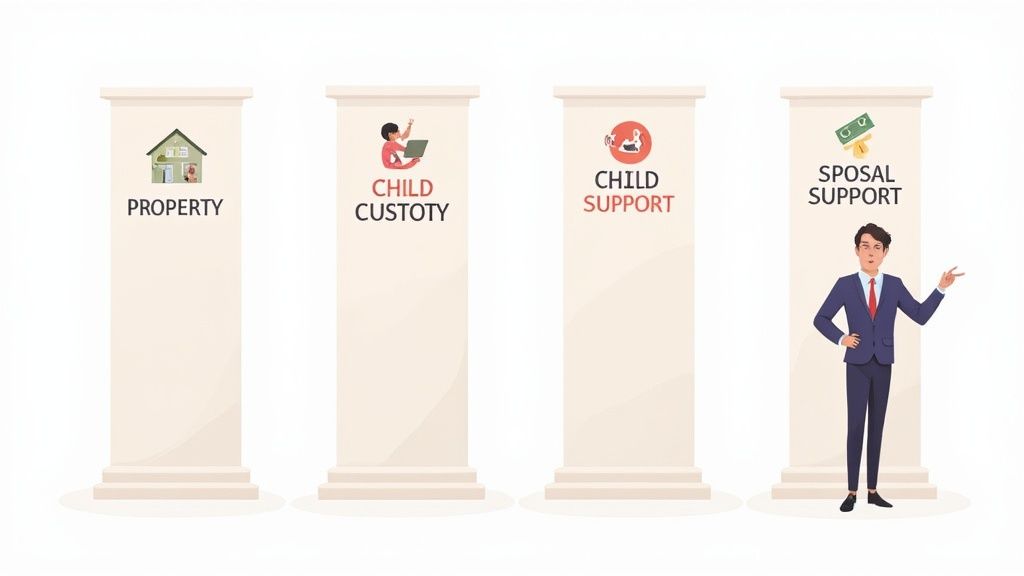
A divorce is so much more than just ending a marriage. It’s the complicated process of untangling two lives that were once completely woven together. Here at Badesha Law, we find the best way to tackle this is to break it down into four key pillars. By addressing each one with a clear, focused strategy, your divorce lawyer in Brampton can build a strong case that protects your rights and secures your future.

Four pillars representing family law topics: property, child custody, child support, and spousal support, with a lawyer.

These four pillars are property division, child custody and access, child support, and spousal support. Each one is governed by specific rules under Ontario’s Family Law Act and federal guidelines, and how they’re handled will have a real, lasting impact on your life after the divorce is final.

Property Division and Equalization

One of the biggest jobs in any divorce is dividing up the assets you and your spouse built during your marriage. In Ontario, this process is called equalization, and it’s designed to ensure a fair split of the financial value you created as a team.

Think of your marriage like a joint business venture. When that partnership ends, you have to calculate the growth in value from the day you started to the day you separated. Your lawyer’s job is to meticulously catalogue every asset and debt to make sure this calculation is spot-on. This includes everything from:

  • The Matrimonial Home: This is often the most significant asset and is treated uniquely under the law.
  • Investments and Savings: RRSPs, TFSAs, stocks, and bank accounts all get factored in.
  • Pensions and Business Interests: These are complex assets that demand careful, expert valuation.
  • Debts: Mortgages, car loans, and credit card balances are also part of the final equation.

The goal is for the spouse with the higher net family property value to make a payment to the other to “equalize” their financial positions. Hiding assets isn’t just frowned upon—it’s a serious offence with severe penalties, which is why full and honest financial disclosure is mandatory.

Child Custody and Parenting Time

When children are involved, their best interests become the court’s absolute top priority. This single principle guides every decision about custody (who makes the major decisions) and access (the parenting schedule). The terms might sound a bit clinical, but what they’re really about is making sure your children have a stable, supportive, and loving environment to thrive in.

Your lawyer will help you create a detailed parenting plan, which is essentially a practical roadmap for co-parenting. It covers everything from the weekly schedule and holidays to birthdays and travel arrangements. A well-thought-out plan minimizes future arguments and gives your kids the consistency they need.

A key thing to remember is that under Ontario law, there is no automatic preference for mothers or fathers. The court’s sole focus is on what arrangement best serves the child’s physical, emotional, and psychological well-being. They’ll look at the history of caregiving and, depending on their age and maturity, the child’s own wishes.

Child Support Obligations

Both parents have a legal duty to financially support their children. It’s important to understand that child support is the right of the child, not the parent receiving it. The amounts are calculated using the federal Child Support Guidelines, which ensures payments are consistent and predictable no matter where you are in the country.

The calculation is generally based on two main factors:

  1. The paying parent’s gross annual income.
  2. The number of children who need support.

While the base amount is fairly straightforward, things can get more complex with shared parenting time or when calculating “special and extraordinary expenses.” These are costs for things like competitive sports, tutoring, or orthodontic care. A good lawyer makes sure all income is properly declared and that the final support payments are fair and legally sound.

Spousal Support Considerations

Spousal support is intended to address any financial imbalances that happen because of the marriage or its breakdown. It isn’t automatic and depends entirely on the specific circumstances of your family. It might be awarded to a spouse who paused their career to raise children, or to help a lower-earning spouse get back on their feet financially.

Unlike child support, there’s no simple formula. A judge will look at the length of the marriage, the roles each spouse played, and their financial means and needs. Your divorce lawyer in Brampton will build a strong argument based on these factors to secure a fair outcome, whether you are the one paying or receiving support.

Choosing Your Path: Negotiation, Mediation, or Court

Not every divorce has to end in a dramatic courtroom battle. In fact, most don’t. The Ontario family law system actually encourages couples to find common ground outside of a formal trial, and for good reason—it’s faster, cheaper, and far less stressful.

Choosing the right path forward—whether it’s negotiation, mediation, or court—is one of the most important strategic decisions you’ll make with your divorce lawyer in Brampton. It sets the tone for your entire separation and has a huge impact on the cost, timeline, and emotional fallout.

Many people picture divorce as two lawyers fighting it out in front of a judge, but the truth is, the vast majority of cases in Brampton are settled long before a trial. The key is using Alternative Dispute Resolution (ADR), which is just a formal name for processes designed to help you and your spouse reach a fair agreement without a judge making the final call.

The Power of Collaborative Negotiation

Often, the most direct route to a resolution is through collaborative negotiation. This isn’t just random back-and-forth arguing. It’s a structured process where you and your lawyer work directly with your spouse and their lawyer to hammer out the details of your separation agreement.

Think of it as a series of focused business meetings with a clear goal. In these meetings, your lawyer’s job is to champion your best interests, give you clear advice on what’s being proposed, and make sure any final agreement is fair, legally sound, and compliant with Ontario’s Family Law Act. The biggest advantage here is control—you and your spouse make the decisions, not a judge who doesn’t know you or your family.

Finding Middle Ground with Mediation

What if direct talks stall? Mediation is an excellent next step. This process brings in a neutral third party—the mediator—who is specially trained to guide conversations and help you and your spouse find creative solutions to your disagreements.

It’s really important to understand what a mediator does (and doesn’t do):

  • They don’t give legal advice. A mediator can’t take sides or tell you what to do. They’re impartial.
  • They guide the conversation. Their role is to keep discussions productive and focused on finding a resolution.
  • They help you find common ground. A great mediator can help you look past the immediate conflict to find shared goals, especially when it comes to your children.

Even when you’re in mediation, your divorce lawyer plays a crucial role behind the scenes. They’ll prepare you for each session, offer private legal advice on the options on the table, and, once you’ve reached a deal, draft the final, legally binding separation agreement.

Mediation gives you the power to create a customized agreement that actually works for your unique family. It’s almost always faster and significantly less expensive than going to court, which helps preserve both your finances and your ability to co-parent peacefully down the road.

When Court Becomes Necessary

Sometimes, no matter how hard everyone tries, an agreement just isn’t possible. This might happen if there’s a history of domestic violence, a serious power imbalance, or if one person simply refuses to be honest about their finances or negotiate in good faith. In these tough situations, heading to court—or litigation—becomes the only way to protect your rights.

Litigation is the most formal and structured path. It follows the court timelines and procedures we’ve discussed, moving through case conferences and, if no settlement is reached, to a trial at the Brampton courthouse. At a trial, a judge listens to the evidence and arguments from both sides before making a final, binding decision on everything.

While court is the last resort, having a skilled litigator from a firm with deep experience in Brampton’s family courts is your strongest asset if you have to go this route. They will build a solid case, present your evidence effectively, and fight fiercely to get you a just outcome under the law. Choosing the right path is the first step, and a skilled divorce lawyer in Brampton can guide you to the one that best protects your family’s future.

How to Prepare for Your First Lawyer Meeting

That first consultation with a divorce lawyer in Brampton is more than just a meeting. Think of it as an interview—you’re deciding if this is the right professional to guide you through one of life’s most challenging chapters. When you walk in prepared, the conversation immediately shifts from a general overview into a productive, focused strategy session. It lets the lawyer give you meaningful, specific advice right from the start.

Being organized shows you’re serious and helps your potential lawyer get a clear, immediate picture of your situation. This initial clarity is key to building a strong foundation for your case and making sure you get the most out of this crucial first step.

A person holds a clipboard titled 'First lawyer meeting,' with another hand pointing and a question mark.

What to Bring: Essential Documents

You don’t need every single piece of paper you own, but bringing key documents can significantly speed things up. It gives the lawyer tangible information to work with, rather than just relying on your memory.

Try to gather what you can from this list:

  • Personal Information: Your full name, your spouse’s full name, and your marriage certificate.
  • Financial Records: Recent pay stubs for both of you (if you have access), tax returns, and statements for bank accounts, investments, and debts.
  • Property Documents: Deeds for any real estate, property tax bills, and mortgage statements.
  • Children’s Information: Full names and birthdates of any children.
  • Existing Agreements: Any prenuptial or cohabitation agreements you might have signed.

Don’t worry if you can’t find everything. The goal here is to provide a snapshot, not a complete archive. Your lawyer will guide you on gathering the rest later on.

Questions to Ask Your Potential Lawyer

The documents tell your story, but your questions help you understand the lawyer’s. This is your chance to look past the website and see if their approach actually aligns with what you need. It’s about more than just asking about fees.

Your initial meeting is the best time to gauge a lawyer’s communication style, experience, and strategic thinking. A good lawyer will welcome detailed questions and provide clear, direct answers that build your confidence in their ability to handle your case.

Here are some insightful questions you should consider asking:

  1. Experience: How many divorce cases have you handled specifically in the Brampton court system? Do you have experience with situations similar to mine (e.g., involving business assets, high conflict, etc.)?
  2. Strategy: Based on what I’ve shared, what’s your initial assessment? What do you see as the potential strengths and weaknesses of my case?
  3. Communication: What is your preferred way to communicate? Who will be my main point of contact at the firm, and what’s your policy on returning calls or emails?
  4. Process: What is your philosophy on negotiation versus going to court? Do you see my case as one that could likely be settled through mediation or collaborative law?
  5. Billing: Can you explain your fee structure in detail? What does the initial retainer cover, and when would I be billed for additional costs?

Coming prepared with these documents and questions will help you leave that first meeting with a clear sense of direction. It empowers you to confidently choose the right divorce lawyer in Brampton—someone who will protect your interests and guide you toward a secure future.

Frequently Asked Questions About Divorce in Brampton

Stepping into the world of divorce brings up a flood of questions. Getting clear, honest answers is the first step toward reducing stress and making decisions you can feel confident about. Here, we tackle some of the most common concerns people have when they start looking for a divorce lawyer in Brampton, with practical information grounded in Ontario family law.

How Much Does a Divorce Lawyer in Brampton Cost?

This is usually the first question on everyone’s mind, and for good reason. The truth is, the cost of a divorce in Brampton can vary wildly, and it really comes down to the complexity of your situation and how much conflict there is between you and your spouse. It’s best to think of it in two main buckets.

  • Uncontested Divorce: If you and your spouse are on the same page about all the big issues—property, support, and the kids—the process is far simpler. For a straightforward, uncontested divorce, legal fees generally fall in the $2,000 to $5,000 range. This typically covers the cost of drafting your separation agreement and filing all the necessary court paperwork.
  • Contested Divorce: When you can’t agree, the costs climb. A contested divorce that involves back-and-forth negotiations, court appearances, and deep dives into financial records can range from $15,000 to well over $50,000. The final bill is driven by the number of hours your lawyer needs to invest to resolve the disputes.

Most family lawyers in Brampton work on an hourly rate and will ask for an initial retainer. This is an upfront payment held in a trust account that they draw from as they work on your case. Make sure you ask for a clear breakdown of their fees during your first meeting.

How Long Does a Divorce Take in Brampton?

Like the cost, the timeline for a divorce isn’t set in stone. One thing is non-negotiable, though: in Canada, you must be separated from your spouse for at least one full year before a court can officially grant your divorce. There’s no way around this waiting period.

Once you’ve hit the one-year mark and filed your application, the timeline splits depending on whether your case is contested.

An uncontested divorce can be wrapped up relatively quickly, often within 4 to 6 months after filing. The main holdups are usually just the administrative processing times at the Brampton courthouse.

A contested divorce, on the other hand, is a marathon, not a sprint. Because it requires financial disclosures, negotiations, and potentially multiple court conferences, these cases can easily take 18 months to several years to resolve completely. Unfortunately, backlogs in the Peel Region court system can add to these delays.

Do I Have to Go to Court for My Divorce?

Not necessarily. In fact, most divorce cases in Ontario are settled without anyone ever stepping into a courtroom for a full trial. The family law system is designed to encourage you to find solutions outside of court.

If you and your spouse can hammer out a comprehensive agreement on all the issues, it’s very likely you’ll never have to appear before a judge. This can be done through direct negotiations between your lawyers, collaborative family law, or mediation.

Court is really reserved for contested cases where a judge needs to step in and make a decision. Even then, you might only attend case conferences or settlement conferences, which are more informal meetings designed to help you reach an agreement. A full-blown trial is the last resort.

What Is the Difference Between Separation and Divorce?

People often use these terms interchangeably, but in Ontario law, they mean very different things. Getting the distinction right is key to protecting your rights.

Separation is the moment you and your spouse decide to live apart with no real chance of reconciliation. You can even be legally “separated” while still living in the same house, as long as you’re leading separate lives (think different bedrooms, separate finances, no more social life as a couple). A Separation Agreement is a crucial legal contract that lays out all the terms of your split—property, support, and parenting. It’s highly recommended, but it doesn’t legally end your marriage.

Divorce is the official, legal end of your marriage. You can only get a divorce through a court order, which you can apply for after you’ve been separated for a year. The divorce order is what legally dissolves the marriage and allows you to remarry. In most cases, your Separation Agreement becomes the foundation for the final divorce order. An experienced divorce lawyer in Brampton can draft a solid Separation Agreement that protects you and makes the final divorce process much smoother.


Navigating your separation and divorce requires a strategic partner who can protect your rights and guide you toward a stable future. At Badesha Law, we provide clear, client-focused legal advice tailored to your unique situation. To discuss your case and learn how we can help, schedule a confidential consultation with our team.

Learn more and contact us at https://badeshalaw.ca

A Brampton Family Lawyer’s Guide to Division of Property in Divorce

When you're facing a separation in Brampton, one of the most pressing questions is always about your finances and assets. Many people assume division of property in Ontario means splitting every single item 50/50, but that’s not quite right. The real goal is to equalize the financial growth you achieved together as a couple. This whole process is guided by Ontario's Family Law Act, giving you a structured path to a fair outcome.

How Property Division Works in a Brampton Divorce

When a marriage ends here in Ontario, the law isn't focused on dividing up your furniture piece by piece. Instead, it’s designed to achieve a fair financial result by balancing the economic gains you both made during your partnership. Think of it less like splitting household items and more like sharing the increase in your collective net worth from your wedding day to the day you separated.

This process is officially called the equalization of Net Family Property. It helps to think of your marriage as a kind of shared financial venture. Now that the venture is ending, the law makes sure that both partners walk away with an equal share of the wealth that was built together.

A scale of justice on a desk with an open book, pen, and laptop, highlighting 'Equalization Basics'.

The Principle of Equalization

At its core, equalization is about fairness. To get there, each of you will calculate your own Net Family Property (NFP), which is basically a financial snapshot of your individual standing on the day you officially separated.

This calculation breaks down into three key parts:

  • The total value of all your assets on your date of separation.

  • The total value of all your debts on that same date.

  • The value of any assets (minus debts) you already owned on the day you got married.

Once you and your spouse have figured out your individual NFP, the person with the higher number usually makes a payment to the person with the lower number. This is the "equalization payment," and its job is to make your final NFP values equal.

To help simplify this, here are the core ideas that drive property division in our province.

Key Principles of Property Division in Ontario

Principle What It Means for You
Equalization, Not Division The law doesn’t split assets 50/50. Instead, it equalizes the growth in your net worth from marriage to separation.
Net Family Property (NFP) This is your individual financial worth on the separation date, minus what you brought into the marriage and certain exclusions.
Equalization Payment A payment made from the spouse with the higher NFP to the spouse with the lower NFP to balance the scales.
Valuation Date is Key The "date of separation" is the critical moment for valuing all assets and debts.
Full Financial Disclosure Both you and your spouse are legally required to provide a complete and honest picture of your finances.

This framework ensures that every contribution to the marriage—whether it was earning an income or raising children and managing the home—is recognized as having equal value in building the family’s wealth.

Why You Need a Brampton Divorce Lawyer

Navigating the rules of property division is complex and requires a solid grasp of the Family Law Act. A skilled Brampton divorce lawyer is absolutely essential to protect your rights and ensure the final calculation is fair and accurate.

An experienced family lawyer in Brampton will help you identify every relevant asset and debt, get proper valuations for tricky items like business shares or pensions, and argue effectively for your best interests. This guidance is what secures your financial future as you start your next chapter.

Calculating Your Net Family Property and Equalization

When a marriage ends in Ontario, the law doesn’t focus on physically splitting every single asset down the middle. Instead, it’s all about balancing the financial books. This process, outlined in the Family Law Act, uses a specific formula to make sure the outcome is fair. To get there, we first have to figure out your Net Family Property (NFP), which is the cornerstone of the whole division.

Think of your marriage like a business partnership. The law wants to measure the financial growth that happened from the day you started (your wedding day) to the day it ended (your separation date). The NFP calculation is how we measure that growth for each of you, giving a clear snapshot of your individual finances on the day you separated.

The Basic NFP Formula Explained

At its heart, the NFP formula is a pretty straightforward calculation. For both you and your spouse, the process looks like this:

  1. List all your assets: First, you add up the fair market value of everything you owned on your date of separation. This means your share of the house, cars, bank accounts, RRSPs, pensions—everything goes on the list.

  2. Subtract your debts: Next, you subtract all your liabilities from that total. This includes mortgages, car loans, lines of credit, credit card balances, and any other debts you had on the separation date.

  3. Deduct what you started with: Finally, you subtract the value of any property (minus debts) that you brought into the marriage. This step also includes deducting most gifts or inheritances you received from a third party during the marriage.

The number you're left with is your Net Family Property. We do this exact same calculation for both you and your spouse, completely independently.

The whole point of the NFP calculation is to isolate the wealth that was built up during the marriage. By subtracting what you had before you got married, the law makes sure you're only dividing the value you created together.

From NFP to an Equalization Payment

Once you and your ex have calculated your individual NFP values, you simply compare the two numbers. It’s almost never a perfect match. The spouse with the higher NFP then pays half of the difference to the spouse with the lower NFP. This payment is what we call the equalization payment.

Let’s look at a quick example. Imagine Spouse A has an NFP of $300,000 and Spouse B has an NFP of $100,000.

  • The Difference: $300,000 – $100,000 = $200,000

  • Half the Difference: $200,000 ÷ 2 = $100,000

In this case, Spouse A would owe Spouse B an equalization payment of $100,000. Once that’s paid, both spouses effectively walk away with $200,000 each from the wealth built during the marriage. This payment is what makes the division of property equitable, fulfilling the law’s promise to share the marriage’s financial growth equally.

Why This Calculation Matters for Brampton Families

Having a set formula like this brings a clear, structured approach to what can otherwise be a very emotional and messy process. It shifts the conversation away from fighting over who gets the couch and toward a more objective, mathematical calculation. That said, the math can get tricky, especially when you need to value complex assets like pensions or a family business.

This is where a Brampton divorce lawyer becomes essential. We make sure every asset is correctly identified, properly valued, and included in your financial statements. An experienced family lawyer in Brampton will protect your financial interests, ensure all your deductions are claimed, and see to it that the final equalization payment is calculated accurately and fairly under Ontario law. Getting that professional guidance is critical to securing a stable financial future as you move forward.

Identifying What's Included in Your Net Family Property

The first real step in any division of property is to create a complete and honest inventory of your shared financial life. This isn’t just about listing the big-ticket items; it’s a detailed accounting of everything you both own and owe. Under Ontario's Family Law Act, this comprehensive list is the foundation for calculating each person’s Net Family Property (NFP), making sure the final equalization is fair and accurate.

To do this right, you have to think broadly. The law considers almost everything acquired during the marriage as part of the family’s wealth. This process demands diligence and, most importantly, absolute transparency from both you and your spouse.

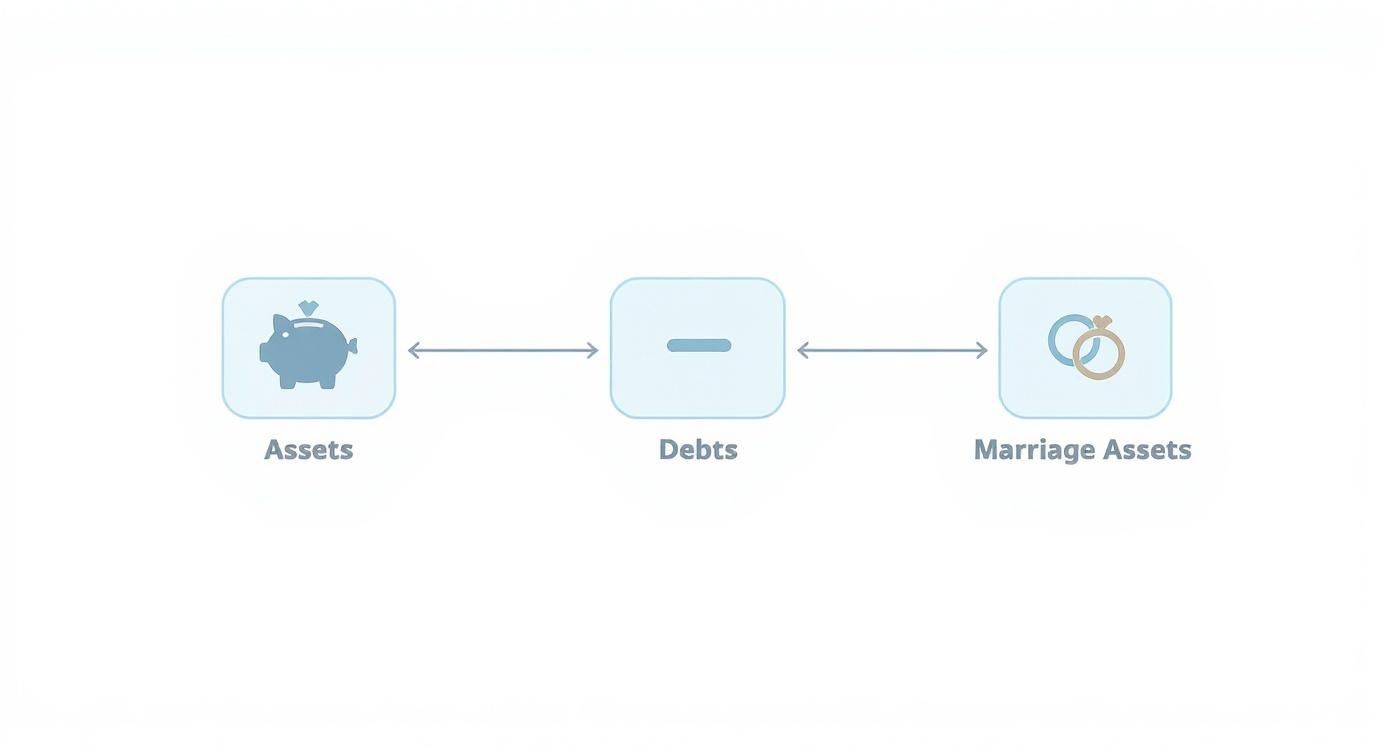
This diagram helps simplify the NFP calculation by showing how your assets, debts, and the resulting marital property all connect.

Diagram showing the financial relationship between personal Assets, Debts, and shared Marriage Assets.

As the visual shows, the core of the equalization process is simple on the surface: subtract what you owe from what you own. The result is the net value created during your marriage, which is what we aim to divide fairly.

What Goes on the Asset List

When you start compiling your assets, the goal is to capture the fair market value of each item as of your official date of separation. Think of it as taking a complete financial snapshot on that specific day. An experienced Brampton divorce lawyer will guide you, but you can get a head start by gathering documents for the following:

  • The Matrimonial Home: The full value of the home you shared is always included, no matter whose name is on the title.

  • Other Real Estate: This includes any cottages, investment properties, or land you own, whether in Brampton or somewhere else.

  • Bank Accounts: Pull together statements for all chequing, savings, and joint accounts.

  • Investments: This is a wide category that includes RRSPs, TFSAs, stocks, bonds, and mutual funds.

  • Pensions: The value of a pension earned during the marriage is a major asset that must be professionally valued.

  • Vehicles: Cars, trucks, boats, and any other motor vehicles all count.

  • Business Interests: If either of you owns a business, its value has to be professionally assessed.

  • Personal Belongings: High-value items like jewellery, art, and expensive collections are also part of the calculation.

Acknowledging Your Liabilities

Just as important as your assets are your debts. You can't get an accurate NFP calculation without a complete picture of your liabilities. You’ll need to list every single debt that existed on your date of separation.

Common liabilities include:

  • Mortgages on any real estate

  • Car loans or leases

  • Personal lines of credit

  • Student loans

  • Credit card balances

Subtracting these debts from your total assets gives you the “net” value that is so central to the equalization formula.

The Critical Importance of Full Financial Disclosure

Under the Family Law Act, both you and your spouse have a legal duty to provide full and honest financial disclosure. This isn’t just a suggestion; it’s a mandatory requirement. Hiding assets or deliberately undervaluing property is a serious mistake with severe consequences.

A court can impose harsh penalties if it finds that one spouse has intentionally hidden assets. These can include ordering that spouse to pay a larger share of the equalization payment, forcing them to cover the other’s legal fees, or even assigning the entire value of the hidden asset to the dishonest party.

In the most serious cases, hiding assets can move beyond family court. Providing false information in sworn financial documents can lead to charges under the Criminal Code of Canada, such as perjury or fraud. This is exactly why working with a trusted family lawyer in Brampton is so critical. We make sure your financial disclosure is complete and accurate, protecting you from legal trouble while securing your fair share.

Understanding Which Assets Are Excluded from Division

When you're facing a separation in Brampton, it’s easy to assume that every single thing you own gets thrown into one big pot for division. But that’s not quite how it works. While Ontario’s goal is fairness, the Family Law Act recognizes that some assets just aren’t a product of the marriage. These are considered your separate property.

Think of it like this: the law creates a protective bubble around certain assets, shielding them from the equalization calculation. This means their value isn't included in your Net Family Property (NFP), so you don't have to share them with your spouse. Understanding what fits inside this bubble is a game-changer in the division of property.

Key Exclusions Under the Family Law Act

The law is very clear about what counts as excluded property. If you received an asset that falls into one of these categories and you still have it on the day you separate, you can deduct its value from your side of the ledger.

Here are the most common examples of property you get to keep:

  • Gifts from a Third Party: Any gift you personally received from someone other than your spouse is yours. For example, if your parents gave you $25,000 to buy a car that’s only in your name, that money is excluded from the family pot.

  • Inheritances: If you inherited money or property during the marriage, it remains yours. That $100,000 GIC left to you by your grandmother? It's protected and doesn’t get split.

  • Life Insurance Proceeds: Payouts from a life insurance policy where you were named the beneficiary are considered excluded funds.

  • Damages from Personal Injury Lawsuits: Compensation you received from a settlement—like for a car accident—is meant to make you whole, not to be shared as a family asset.

It's on you to prove an asset should be excluded. You need a clear paper trail showing where the money or property came from and that you still had it at separation. This is where good record-keeping becomes your best friend.

The Importance of Keeping Excluded Property Separate

Here’s the catch: to keep that protective bubble intact, you have to keep the excluded asset separate. Don’t mix it with family money. For instance, if you inherit $50,000 and put it into a new investment account solely in your name, it stays excluded. Simple.

But if you take that same $50,000 and drop it into the joint chequing account you both use for groceries and bills, you’ve likely just gifted it to the family. Once commingled, the law may see it as joint property, and you could lose your right to exclude it. A family lawyer in Brampton can give you practical advice on how to handle these funds correctly from day one.

The Major Exception: The Matrimonial Home

There’s one huge exception that trips up a lot of people in Brampton: the matrimonial home. Under Ontario law, the family home is treated differently than any other asset. Its special status trumps almost all other rules.

Even if you poured your entire inheritance or a massive gift into the down payment or mortgage, you cannot exclude that amount from the home's value. So, if your parents gifted you $100,000 for the down payment on your house, that money is now part of the home's divisible value. The law prioritizes the stability of the family residence above protecting individual contributions. This rule often comes as a shock and is a perfect example of why getting clear legal advice from a Brampton divorce lawyer is non-negotiable for a fair outcome.

Why the Matrimonial Home Is a Special Asset

When it comes to dividing property in an Ontario divorce, one asset stands in a class of its own: the matrimonial home. The Family Law Act carves out a unique set of rules just for the family home, recognizing its central role in a family’s life. It isn't treated like an RRSP, a car, or a cottage.

For homeowners in Brampton and the GTA going through a separation, getting a handle on these specific rules is absolutely critical. The law is designed to protect the value and stability the home represents, making it the cornerstone of the entire property division calculation.

A two-story brick house with a green lawn, a driveway, and a sign reading 'MATRIMONIAL HOME'.

No Deduction for Pre-Marriage Value

Here’s the biggest difference: you cannot deduct the value of the matrimonial home that you owned before the marriage. Think about that for a second. If you owned the house on your wedding day, its entire value on the date you separate gets included in your Net Family Property (NFP). This is a huge departure from other assets, like an investment account, where you’d get to subtract its pre-marriage value.

This rule holds true even if the home was a gift or an inheritance. Let's say your parents gifted you a house, and you and your spouse moved in and made it your family home. You’ve just lost the ability to exclude that gift from the NFP calculation. The law effectively transforms what was once your separate property into a shared family asset.

Equal Possessory Rights After Separation

Another unique feature of the matrimonial home is what’s known as possessory rights. Under Ontario law, both spouses have an equal right to live in the home after you separate, and it doesn't matter whose name is on the title.

This means one spouse can’t just change the locks and kick the other one out. To force someone to leave, you need either a court order or a signed separation agreement. These rights are in place to prevent a spouse from being left homeless and to maintain stability, especially when there are children involved.

Common Scenarios for Brampton Homeowners

For most families in Brampton, the home is their single biggest asset, which naturally makes it a major focus of negotiations. When it comes to deciding what to do, there are usually three main options:

  1. One Spouse Buys Out the Other: If one person wants to stay in the home, they can buy out their spouse's share of the equity. This almost always requires refinancing the mortgage to qualify for a new, larger loan on a single income—a tough financial hurdle for many.

  2. The House Is Sold: This is the most common path. You sell the home, pay off the mortgage and all the costs like real estate commissions and legal fees, and then split the leftover equity.

  3. Delayed Sale: Sometimes, particularly when young children are involved, a couple agrees that one parent will stay in the home for a set period. The house is then sold down the road, maybe when the youngest child finishes high school.

The treatment of property varies greatly by jurisdiction. For example, in California, which operates under community property laws, the state's high home values significantly impact divorces. California homeowners have nearly triple the home equity of those in other states, making the division of the marital home a central and complex issue in their family law system. You can discover more insights about assets and wealth in California on ppic.org.

Working through the financial and legal maze surrounding the matrimonial home requires a solid strategy. A knowledgeable Brampton divorce lawyer can walk you through your rights, help you weigh the pros and cons of a buyout versus a sale, and ensure your largest asset is handled fairly in the final settlement.

Navigating the Property Division Process Step by Step

Thinking about the division of property can feel overwhelming, but it's not a chaotic free-for-all. It's actually a structured path with clear, deliberate steps designed to get a fair and legally sound outcome under Ontario's Family Law Act.

The whole process kicks off the moment you and your spouse separate. That specific day establishes the all-important valuation date—the snapshot in time used to value all your assets and debts for the NFP calculation. From there, you move into gathering and sharing information, which is the bedrock of any good negotiation.

A wooden desk with a laptop, a green book, a pen, and a notebook displaying 'STEP-BY-STEP GUIDE' with a checked box.

Gathering Your Financial Information

The first active step is to collect every single relevant financial document. This part is non-negotiable and demands thoroughness. You and your spouse will need to formally exchange this information in a document called a Financial Statement, which is a sworn legal document confirming its accuracy.

It can feel like a lot, but breaking it down makes it manageable. Focus on getting proof for:

  • Income: Recent pay stubs, T4 slips, and income tax returns.

  • Assets: Bank statements, investment summaries (RRSPs, TFSAs), property deeds, and vehicle ownerships.

  • Debts: Mortgage statements, credit card bills, and loan agreements.

To make this crucial step easier, here's a checklist of the documents you'll need to start gathering. Having these ready will save you time and help your lawyer build a clear picture of your finances from day one.

Document Category Specific Examples
Proof of Income Pay stubs, T4/T4A slips, recent tax returns and Notices of Assessment, business financial statements.
Bank & Investment Accounts Statements for chequing/savings accounts, RRSPs, TFSAs, GICs, stocks, and mutual funds.
Real Estate Property deeds, mortgage statements, property tax assessments (MPAC), home appraisal reports.
Pensions & Retirement Plans Pension plan statements, company retirement plan summaries.
Vehicles & Valuables Vehicle ownership documents (pink slips), appraisals for art, jewelry, or collectibles.
Debts & Liabilities Credit card statements, lines of credit statements, student loan agreements, car loan documents.
Insurance Life insurance policies with a cash surrender value.

This isn't an exhaustive list, but it's a solid start. The goal is complete transparency—it’s the only way to ensure the final division is fair and legally sound.

Valuing Your Assets and Negotiating a Settlement

Once all the information is on the table, the next step is to put a fair market value on each asset as of your separation date. While figuring out the value of a bank account is easy, some assets are more complicated. Things like pensions, stock options, or business interests often require professional appraisers to lock down an accurate value.

With a clear financial picture, you can finally start negotiating a settlement. For many Brampton couples, this doesn't have to mean a drawn-out courtroom battle. There are several ways to get to a resolution:

  • Lawyer-led Negotiation: Your lawyers talk directly to hammer out an agreement on your behalf.

  • Mediation: A neutral third-party mediator guides you and your spouse toward a compromise.

  • Collaborative Family Law: You, your spouse, and your lawyers all commit to working together outside of court to find a solution.

The goal of any negotiation is to arrive at a legally binding Separation Agreement. This document finalizes the equalization payment and settles all property issues, allowing both of you to move forward with financial certainty.

While Ontario's legal framework guides how we handle things here, it's interesting to see how other places tackle similar issues. For instance, California’s property tax system can add a whole other layer of complexity. There, assessed values for tax purposes can be much lower than actual market values, which significantly impacts how properties are valued in a divorce. You can see how they manage statewide assessments through the California State Board of Equalization.

Every single step, from digging up old bank statements to signing a final agreement, is critical. Getting guidance from an experienced Brampton divorce lawyer makes sure you follow the right procedures, protect your rights, and achieve a result that is truly fair.

Common Questions About Property Division in Brampton

When a relationship ends, it's natural to have a flood of urgent questions. Here in Brampton, we often hear the same concerns from clients trying to make sense of their rights and what comes next. Let's tackle some of the most common questions we get about division of property in Ontario.

What Happens to Property for Common-Law Partners?

This is one of the biggest misconceptions in Ontario family law. Many people believe common-law partners have the same property rights as married spouses, but that's simply not the case under the Family Law Act. The rules for equalization of Net Family Property—the 50/50 split—do not automatically apply to unmarried couples.

Instead of splitting the wealth you built together, property is usually divided based on who legally owns it. If your name is on the title, you typically keep the asset. However, it's not always that simple. If one partner contributed significantly to an asset owned by the other (like paying down the mortgage on a house they don't own), they may have a trust claim for "unjust enrichment" to get compensated. This is a complex legal argument and requires help from an experienced family lawyer in Brampton to navigate successfully.

Can We Agree to an Unequal Division?

Absolutely. The 50/50 equalization rule is just the starting point. You and your spouse have the freedom to negotiate a different arrangement that you both feel is fair and works for your unique situation.

For an agreement like this to hold up in court, it has to be formalized in a legally binding Separation Agreement. To make sure the agreement is solid and can't be easily challenged later, both of you must:

  • Provide full and honest financial disclosure to each other.

  • Get independent legal advice from your own separate lawyers.

  • Sign the agreement voluntarily, without being pressured or forced.

What if My Spouse Is Hiding Assets?

Trying to hide assets during a separation is a massive mistake with serious legal consequences, not just under the Family Law Act but also potentially under the Criminal Code of Canada. If you have a gut feeling that your spouse isn't being upfront about their finances, your lawyer can take immediate action. This could mean filing a motion with the court to force them to produce specific documents and be transparent.

A judge has the power to bring down heavy penalties for hiding assets. This can include giving the innocent spouse a larger share of the property, ordering the dishonest spouse to pay all the legal costs, or even assigning the full value of the hidden asset to their side of the ledger.

Is There a Deadline to Make a Property Claim?

Yes, and the timelines are strict. You must file a property claim with the court within:

  • Six years from the date you separated.

  • Two years from the date your divorce was finalized.

If you miss these deadlines, you could permanently lose your right to an equalization payment. It is absolutely critical to speak with a Brampton divorce lawyer as soon as possible after you separate to make sure your rights are protected.


Navigating these complexities requires clear, strategic legal advice. If you are facing a separation in Brampton, a dedicated family lawyer can protect your financial future and guide you toward a fair resolution. Contact a legal professional to ensure your rights are protected at every step. Learn more at https://badeshalaw.ca/brampton-criminal-lawyer.
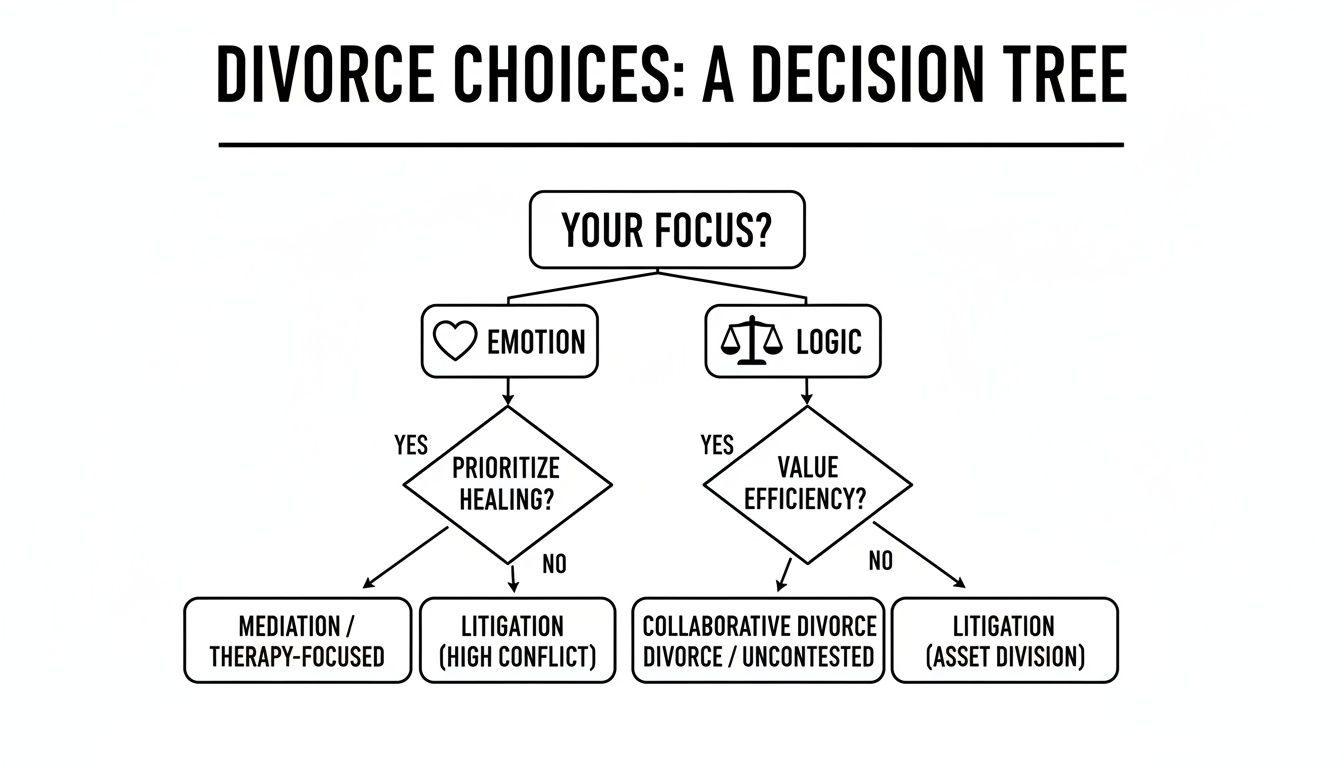
A Client’s Guide to Divorce in Brampton: Process, Custody, and Costs

When a marriage concludes, securing an effective divorce lawyer in Brampton is a crucial initial move to reestablish control. A proficient lawyer not only handles paperwork but also outlines a clear and practical course of action, safeguarding your rights under Ontario's family law from the outset. This guide provides valuable insights into the divorce process in Brampton, emphasizing essential information to help you make well-informed decisions. Badesha Law, a respected divorce lawyer in Brampton, offers expert guidance and support throughout this challenging period, ensuring your interests are prioritized.

Starting The Divorce Process In Brampton

Facing a divorce can be overwhelming. Understanding the process is key to navigating it with clarity and confidence. In Ontario, the journey is governed by the provincial Family Law Act and the federal Divorce Act. Your Brampton divorce lawyer is your personal strategist, guiding you through complex issues like property division and child custody with expertise tailored to the Brampton courts.

The goal is to move you from a state of uncertainty to a position of strength. An experienced lawyer cuts through the legal jargon, breaking down the process into understandable steps. They help you anticipate challenges, making the entire journey less intimidating and empowering you to make the best decisions for your future.

The First Steps And Legal Realities

In Ontario, the decision to end a marriage leads to a series of legal procedures, beginning with the preparation and filing of an Application for Divorce at the Ontario Superior Court of Justice. This document is essential as it outlines the reasons for divorce, typically citing a separation of one year. It also highlights critical issues that need addressing, such as parenting arrangements, financial support, and asset division. When considering divorce in Brampton, it is important to understand the current legal environment. The Ontario court system has experienced significant changes, including a 36% decrease in divorce filings between 2019 and 2020, largely due to pandemic-related disruptions. These circumstances have led to backlogs and procedural changes, making it crucial to consult a lawyer who is well-versed in the system to effectively guide clients through the process. To apply for a divorce, you need to be separated from your spouse for at least one year. Additionally, you must provide necessary documentation, including your marriage certificate, financial statements, and any relevant agreements or court orders. These documents ensure that all aspects of the divorce, including custody, support, and property division, are adequately addressed.

From Simple To Contested: Why Cooperation Matters

Every couple hopes for a simple, uncontested divorce. That’s the ideal scenario where both people agree on all the major terms, including:

  • Property Division: How to fairly divide the assets and debts you accumulated together.

  • Spousal Support: Whether one person needs financial help from the other, for how long, and how much.

  • Parenting Arrangements: Who makes the major decisions for the children and how parenting time is shared.

What starts as a "simple" separation can quickly spiral into a contested fight if disagreements pop up. Hidden assets, unresolved anger, or a breakdown in communication can turn an amicable split into a draining and expensive court battle.

This is exactly why cooperating with your ex-spouse is so powerful. When you work together through negotiation or mediation, guided by your respective lawyers, the process becomes more efficient, less costly, and far less stressful for everyone—especially your kids. Your lawyer's job isn't to create a fight, but to facilitate productive conversations while always defending your legal rights.

A Step-by-Step Guide to Getting Divorced in Ontario

Figuring out the legal side of a divorce in Ontario can feel overwhelming, but it follows a predictable path. Once you understand the roadmap, you can make smarter decisions with your Brampton divorce lawyer guiding you. The journey really starts before any papers are filed and doesn't end until a court order makes the end of your marriage official.

At its heart, the entire Ontario divorce process hinges on a key principle from Canada's Divorce Act: you must be separated from your spouse for at least one year before a judge can grant your divorce. This "one-year separation" rule is the most common reason for divorce, as it proves the marriage has broken down with no real chance of getting back together.

But "separation" doesn't always mean packing bags and moving out. You can be legally "separate and apart" even while living in the same house, as long as you're no longer living like a married couple. Think sleeping in different rooms, handling your own finances, and stopping social outings together. A lawyer can give you crucial advice on how to properly document this kind of in-home separation.

The Formal Legal Steps

Once you've started your separation, the official legal process can kick off. It’s not a single event but a series of deliberate steps designed to make sure everything is fair and transparent.

  1. Filing the Application for Divorce: This is the first formal move. Your lawyer will prepare and file an "Application for Divorce" (Form 8A) with the Ontario Superior Court of Justice in Brampton. This document explains why you're divorcing and lists everything that needs to be sorted out, like property, support, and parenting arrangements.

  2. Serving Your Spouse: After the application is filed, a copy has to be legally delivered—or "served"—to your spouse. This makes sure they are officially notified and have a chance to respond. Under Ontario law, you can't serve the papers yourself; a neutral third party has to do it.

  3. Financial Disclosure: This is one of the most important stages. Both you and your spouse are legally required to provide a complete and honest picture of your finances. This means everything—income, assets, debts, and pensions. Full transparency isn't optional; it's the foundation for a fair settlement.

A simple divorce can quickly turn into a messy, contested one if one person suspects the other is hiding financial information. An experienced divorce lawyer in Brampton knows exactly what to look for to ensure every asset is on the table for a fair division.

This visual guide breaks down the essential journey, from the moment you separate to the final resolution with your divorce lawyer in Brampton.

A diagram illustrating the three steps of a legal separation or divorce: separate, lawyer, and final order.

As the infographic shows, the formal legal steps you take with a lawyer are built on that initial foundation of separation.

Reaching a Resolution and Finalizing the Divorce

The good news is that most divorce cases in Brampton are settled without ever seeing the inside of a courtroom. Working collaboratively with your ex-spouse, through your lawyers, is almost always the most cost-effective and least stressful way to go.

  • Negotiation and Separation Agreements: Your lawyer will negotiate with your spouse's lawyer to agree on all the outstanding issues. These terms are then put into a legally binding Separation Agreement.

  • Mediation or Collaborative Law: These are great alternatives to court. They involve neutral professionals who help you and your spouse find common ground, avoiding the need for a judge to step in.

Once every issue is settled and your one-year separation period is over, your lawyer files the last of the paperwork. A judge reviews everything, and if it’s all in order, they will sign the Divorce Order. This is the document that officially and legally ends your marriage, freeing both of you to move on.

Why Simple Separations Become Complicated Divorces

Most couples start their separation hoping for the best. They promise to be reasonable and aim for a quick, simple divorce. Yet, many well-intentioned separations spiral into contested, complicated, and expensive battles. The emotional pressure of a separation can easily cloud judgment, turning minor disagreements into major disputes.

The truth is, what begins as a small disagreement over a piece of furniture can explode into a full-blown dispute over property division. A successful outcome requires a clear strategy from the start, guided by a level-headed legal professional.

From Agreement to Disagreement: The Common Triggers

There are a few key issues that act like flashpoints, turning a straightforward separation into a contested divorce. An experienced divorce lawyer in Brampton has seen these patterns and can help you get ahead of them.

The most common triggers are:

  • Hidden or Undisclosed Finances: The entire process is built on trust. If one spouse suspects the other is hiding assets or downplaying their income to reduce support payments, that trust is shattered. This is a primary reason simple matters become contested.

  • Disputes Over Property Value: You might agree to split everything 50/50, but what happens when you can’t agree on the value of the family home in Brampton's real estate market? Or the value of a business? This alone can bring negotiations to a halt.

  • Emotional Conflicts and New Partners: The arrival of a new partner can stir up old feelings of hurt, making objective negotiations nearly impossible. Unresolved emotional baggage often resurfaces, turning practical decisions into personal battles.

Under Ontario's Family Law Act, full and frank financial disclosure isn't just a suggestion—it's a legal requirement. Failing to be completely transparent can lead to serious penalties from the court and will almost certainly turn a simple divorce into a high-conflict nightmare.

The Slippery Slope of Parenting Disagreements

While money is a frequent source of conflict, nothing complicates a divorce faster than disagreements over the children. What might start as a small difference in parenting styles can escalate into a major fight over decision-making responsibility (formerly custody) and parenting time.

One parent might feel the other isn't spending enough meaningful time with the kids, while the other feels their parenting choices are constantly under attack. These conflicts are deeply personal and make it incredibly difficult for parents to find common ground. This is exactly where having a calm, objective legal advisor becomes essential.

How a Lawyer Prevents Escalation

The real value of hiring the best divorce lawyer in Brampton isn’t just to fight for you in court—it’s to keep you out of it in the first place. An expert lawyer acts as a buffer and a strategist, de-escalating conflict before it even begins.

They can spot potential trouble areas early on and suggest practical solutions, like using a neutral third-party valuator for your property or bringing in a parenting coordinator to help resolve disputes. By managing communication and focusing on resolution instead of conflict, a skilled lawyer steers the process back toward a cost-effective and peaceful conclusion.

Understanding Parenting Time and Decision-Making in Brampton

For parents separating in Brampton, nothing matters more than the well-being of their children. The legal framework in Ontario is built on one simple idea: the best interests of the child. The law separates parenting into two key areas:

  • Decision-Making Responsibility: This refers to who makes major decisions about a child’s life—such as schooling, significant healthcare choices, and religious upbringing.

  • Parenting Time: This is the schedule that outlines when the children are in each parent's care.

The courts in Brampton, guided by the Family Law Act, strongly prefer arrangements where both parents are actively involved. The goal is to ensure the child maintains a strong, meaningful relationship with each parent. A knowledgeable divorce lawyer in Brampton can help you craft a detailed parenting plan that fits your family's unique needs.

A father and young child hold hands while walking on a suburban sidewalk, with 'PARENTING TIME' text.

When Does a Court Grant Sole Decision-Making?

It's a common question: what does it take for a court to give one parent 100% of the decision-making authority? It's crucial to understand that this is the exception, not the rule. Ontario courts only grant sole decision-making responsibility (what used to be called sole custody) in serious situations where a child's safety or well-being is clearly at risk.

A judge must be convinced that sharing decisions would actively harm the child. This requires solid, documented evidence, not just disagreements over parenting styles.

The "best interests of the child" is the only test the court uses when making parenting orders. This standard is defined in Ontario's Children's Law Reform Act and considers all factors related to the child's physical, emotional, and psychological safety and well-being.

Circumstances Leading to Sole Authority

To award sole decision-making, a Brampton court needs compelling evidence of issues that make co-parenting unworkable or dangerous. These are serious problems that directly threaten a child's welfare:

  • Family Violence or Abuse: A documented history of physical, emotional, or psychological abuse by one parent—directed at the child or the other parent—is a primary factor. The court will act decisively to protect the child, as this is taken extremely seriously under both family law and the Criminal Code of Canada.

  • Substance Abuse: If a parent has an ongoing, unmanaged addiction to drugs or alcohol that impairs their judgment and ability to care for a child, a sole decision-making order may be granted. The key is showing how the substance abuse puts the child in direct danger.

  • Severe Mental Health Issues: A severe, untreated mental health condition that renders a parent incapable of making rational, safe decisions for their child could lead to the other parent being granted sole authority.

  • Extreme Parental Alienation: This is a pattern of behaviour where one parent actively and consistently tries to destroy the child's relationship with the other parent without justification. If severe enough to be considered emotionally abusive, a court may intervene.

  • Abandonment: When one parent has been absent from the child's life for a long period with no interest in being involved, the court may formalize the existing reality by giving the involved parent sole decision-making power.

In these high-stakes scenarios, finding the best divorce lawyer in Brampton is absolutely critical. An experienced lawyer knows how to gather the right evidence and advocate fiercely for an arrangement that truly serves your child’s best interests.

How Cooperation Can Reduce Your Divorce Costs

The financial impact of a divorce is a major source of stress. While you can't sidestep the emotional toll, you have control over the financial strain. The single most effective way to protect your finances is to work cooperatively with your ex-spouse.

Choosing collaboration over conflict is a strategic decision to keep money in your pocket instead of funding escalating legal fees. Every hour spent arguing in court or exchanging hostile emails through lawyers adds to your final bill. A cost-effective divorce is achieved when both parties commit to finding a fair and efficient resolution.

The Financial Reality of a Contested Divorce

The difference in cost between an amicable split and a high-conflict court battle is staggering. When you and your spouse agree on major issues, the process becomes about efficient paperwork. When you disagree, it quickly involves motions, court appearances, and potentially a trial, with each step adding thousands to your costs.

An uncontested divorce might cost a few thousand dollars, but a contested matter can easily skyrocket to tens of thousands. This stark contrast is why more couples are choosing to work together. You can learn more about the financial implications of divorce in Canada from nussbaumlaw.ca.

When a divorce is framed as a battle to be won, both parties often lose financially. A cooperative approach, guided by an experienced Brampton divorce lawyer, reframes the goal as finding a fair resolution that preserves assets for both of your futures.

Actionable Strategies for a Cost-Effective Process

Working together doesn’t mean you have to be best friends; it means you agree to approach the separation as a shared problem to solve. This mindset opens the door to more affordable resolution methods.

Here are some practical ways to cut down on conflict and costs:

  • Choose Mediation: A neutral third-party mediator helps you and your spouse communicate and find common ground on tough issues. It’s far less adversarial—and significantly cheaper—than going to court.

  • Embrace Collaborative Family Law: In this process, both of you, along with your respective lawyers, sign an agreement to resolve everything without going to court. It commits everyone to a cooperative, problem-solving approach from the start.

  • Focus on Business-Like Negotiations: Try to separate the emotional side of the breakup from the practical decisions that need to be made. Treat negotiations about property and finances like a business transaction, focusing on facts and fair outcomes.

Hiring the best divorce lawyer in Brampton for your situation means finding someone who is a strong advocate and a skilled negotiator. Their expertise can guide you toward a settlement that protects your rights without draining your savings.

How to Choose the Right Brampton Divorce Lawyer for You

Picking your legal counsel is easily one of the most important decisions you'll make during your divorce. The right lawyer isn’t just a legal expert; they're your strategic partner, advocate, and guide through what can be an emotionally and financially draining process. Finding the best divorce lawyer in Brampton for your unique situation means looking for the right mix of legal skill, local experience, and a personality that clicks with yours.

Your goal is to find an advocate who not only knows Ontario’s Family Law Act inside and out but also makes you feel heard, respected, and confident about the road ahead. This partnership is the bedrock of a successful outcome.

Two people, one in a suit and one in a blue sweater, shake hands over legal documents with a 'CHOOSE YOUR LAWYER' sign.

What to Look for in a Top Brampton Lawyer

When you first start looking, it's easy to feel overwhelmed. To cut through the noise, focus on a few key qualities that separate a good lawyer from a great one. A truly effective lawyer has a blend of technical expertise and interpersonal skills that match what you need.

Here are the essential traits to watch for:

  • Exclusive Focus on Family Law: This area of law is incredibly specialized. You want a lawyer who lives and breathes divorce cases, not someone who just dabbles in it on the side.

  • Deep Brampton Court Experience: A lawyer who is a familiar face at the Brampton courthouse—who knows the judges and local procedures—brings a priceless home-field advantage to your case.

  • A Clear Communication Style: Your lawyer needs to be able to break down complex legal concepts into plain English. You should never leave a conversation feeling confused or in the dark about your own case.

  • A Balanced Approach to Conflict: Look for someone who is a skilled negotiator and wants to find a resolution, but is also more than ready to fight for you in court if it comes to that.

This is especially critical for more complex cases. For example, there's been a noticeable rise in "grey divorce" among couples over 50. These situations often involve complicated finances, like tangled assets and retirement income, which demand a lawyer with very specific knowledge. You can find more insights on this trend and how it's affecting divorce in Canada over at athenalawoffice.com.

Critical Questions for Your Initial Consultation

That first meeting is your chance to interview potential lawyers and see who feels right. Don't be shy about asking direct, detailed questions. This meeting is for you to size them up just as much as it is for them to assess your case.

Come to your consultation ready with a list of questions. The clarity and confidence in their answers will tell you a lot about their experience and whether their approach lines up with your goals.

Get ready to ask things like:

  1. Strategy and Approach: "Based on what I've shared, what’s your initial take on my case? What kind of strategy would you suggest we start with?"

  2. Conflict Resolution: "What's your philosophy on negotiation versus going to court? How do you help clients avoid unnecessary legal battles?"

  3. Caseload and Communication: "Who will I be dealing with day-to-day at your firm? What’s your policy for getting back to calls and emails?"

  4. Fees and Billing: "Can you walk me through your fee structure? What is your retainer, and what are the potential total costs I should be prepared for?"

Choosing the right advocate is an investment in your future. By focusing on experience, communication, and a clear strategy, you can select the best divorce lawyer in Brampton to protect your interests and guide you toward a fair resolution.

Common Questions About Divorce in Brampton

Going through a separation brings up a flood of urgent questions. Getting straight answers from an experienced divorce lawyer in Brampton is the first real step toward getting your feet back on solid ground. Here are a few of the most common questions we hear from clients in our community.

How Long Must I Be Separated Before a Divorce?

In Ontario, the law says you need to be separated for at least one full year before a court can officially grant your divorce. This is the most common reason given for a divorce, as it proves the marriage has broken down.

But here’s a critical detail: you don't have to wait that year to get started. In fact, you shouldn’t. You can—and should—begin sorting out a separation agreement right away. This is where you’ll tackle the big issues like property division, support, and parenting arrangements. The final Divorce Order is just the last piece of the puzzle, issued once the 12-month period is over.

Divorce vs. Separation Agreement: What Is the Difference?

Think of it this way: the separation agreement is the detailed game plan for your new reality, while the divorce is the final whistle that officially ends the match.

  • A Separation Agreement is a legally binding contract that you and your spouse create to settle everything. It’s the rulebook covering finances, property, and parenting in detail.

  • A Divorce Order is the official court document that legally ends your marriage, allowing you both to remarry if you choose.

Before a court in Brampton will grant your divorce, you must have all your issues settled, which is almost always done through a comprehensive separation agreement. A lawyer is crucial here to make sure your agreement is iron-clad, enforceable, and actually protects your rights.

Do I Have to Go to Court in Brampton for My Divorce?

It's one of the biggest myths out there—that every divorce ends in a dramatic courtroom battle. The truth is, the vast majority of divorces in Brampton are settled out of court, usually through negotiation or mediation.

If you and your spouse can work out all the terms and create an uncontested divorce, your lawyer simply files the right paperwork with the court. In most of these cases, you will never have to step foot in front of a judge. Court is really the last resort, reserved for high-conflict situations where reaching an agreement on your own just isn't possible.

Can I Get Divorced Without a Lawyer?

Technically, you can represent yourself, but it's an incredibly risky move. Ontario's family law is a complex web of rules and procedures. A simple mistake in a legal document or a poorly worded clause in an agreement can lead to severe, long-term financial consequences that are a nightmare to fix later on.

Hiring a divorce lawyer in Brampton isn't just a cost; it's an investment in your future. It’s the best way to ensure your rights are protected, all the financial details are handled correctly, and your final agreement is built to last, saving you from a world of trouble and expense down the road.


At Badesha Law, we provide clear, strategic guidance to help you navigate your separation with confidence. For expert legal support with your family law matter in Brampton, contact our team today. Visit Badesha Law to schedule your consultation.

What if my spouse won’t sign our separation agreement in Brampton?

So, your spouse won’t sign the separation agreement. What now? It’s a frustrating position to be in, but it’s crucial to know that you are not stuck. While their signature is needed to make an agreement official, you can still legally separate and get a divorce in Ontario. The law doesn’t let one person hold the entire process hostage; it just means you’ll need to take a different road to get to the same destination right here in Brampton.

Your Options When a Spouse Refuses to Sign

Facing a refusal can feel like hitting a brick wall. It’s a surprisingly common scenario in Brampton, but it’s not the end of your journey. Ontario’s family law system has clear procedures to ensure you can move forward and get closure, even without your spouse’s willing participation.

Think of it this way: a stalemate isn’t a stop sign, it’s a detour. While a signed separation agreement is the ideal path—it gives you control, privacy, and keeps costs down—it’s just one of several tools available to finalize your separation.

Moving Beyond the Stalemate

When you can’t get an agreement through direct talks, your next move is to explore other ways to resolve the dispute, or if all else fails, turn to the court system. For those in Brampton and the wider Peel Region, there are several effective pathways forward.

Here are the key, actionable options on the table:

  • Lawyer-Assisted Negotiation: This is often the first step. Instead of you and your spouse arguing, your lawyers do the talking. They can cut through the emotional noise, focus on the legal facts, and find common ground that you might not see on your own.
  • Mediation: In mediation, a neutral third party steps in to guide the conversation. A mediator doesn’t take sides or make decisions for you; their job is to help you and your spouse find a resolution you can both live with in a structured, collaborative setting.
  • Court Application: If your spouse is completely unreasonable or simply won’t engage, filing an application at the Brampton courthouse is your ultimate backstop. This kicks off a formal legal process where a judge will eventually make binding decisions on everything from property division to parenting time.

Ultimately, a spouse’s refusal to sign does not prevent you from separating, dividing property, or establishing support and parenting arrangements. It simply changes the method you use to get there. The law ensures that one person cannot indefinitely block the process.

Each of these avenues leads to a legally binding outcome, whether it’s a mediated agreement that gets turned into a court order or a final decision from a judge. Your goal is to choose the path that makes the most sense for your family’s situation, so you can finally move on with clarity and security.

To make it clearer, here’s a quick summary of the main pathways forward.

Pathways Forward When Your Spouse Won’t Sign

This table breaks down your primary options in Ontario when a voluntary separation agreement isn’t possible.

Option Key Feature Best For
Lawyer-Assisted Negotiation Lawyers communicate on your behalf to find a compromise. Couples who are still somewhat willing to negotiate but need help removing emotion from the discussion.
Mediation A neutral third party helps guide you to an agreement. Situations where communication has broken down but both parties want to avoid court and find a solution.
Court Application A judge makes legally binding decisions on all unresolved issues. Cases where a spouse is uncooperative, unreasonable, or there are complex issues requiring a formal ruling.

Choosing the right option depends entirely on your unique circumstances, but understanding that you have options is the most important first step.

Why a Separation Agreement Is the Preferred First Step

Before diving into what happens when a spouse refuses to sign, it’s worth understanding why a separation agreement is so strongly recommended in Ontario. Think of it as the blueprint for your new, separate lives. It’s a legally binding contract that lets you and your spouse decide on your own terms how to untangle your shared life.

It’s a lot like dissolving a business partnership. You wouldn’t just walk away and hope for the best, would you? You’d create a detailed plan outlining who gets what assets and who is responsible for which debts. A separation agreement does the exact same thing for your family, providing a clear and predictable roadmap for the future.

This single document covers all the critical aspects of your separation, empowering you to make these decisions together instead of leaving them to a judge who doesn’t know you or your family.

Taking Control of Your Future

The single greatest benefit of a separation agreement is control. When you and your spouse sit down to negotiate the terms—usually with the help of your respective lawyers—you are in the driver’s seat. This collaborative approach keeps intensely personal decisions where they belong: with you.

A well-drafted agreement provides certainty and finality on all the key issues:

  • Division of Property: How you’ll split assets like the family home in Brampton, RRSPs, pensions, and vehicles.
  • Parenting Arrangements: A clear plan for where the children will live and how major decisions about their upbringing will be made.
  • Financial Support: Firm terms for child support and any spousal support, including exact amounts and for how long.
  • Debt Responsibility: A straightforward outline of who is responsible for paying off joint debts, like credit cards or lines of credit.

Without an agreement, all of these deeply personal matters get handed over to the court system. A judge will apply rigid legal formulas that may not be the right fit for your family’s unique circumstances.

By creating your own agreement, you replace uncertainty with clarity. You build a stable foundation for both of your futures, based on mutual understanding rather than a court-imposed order. The process is far less adversarial, more private, and significantly more cost-effective than heading to court.

Ultimately, while the court is a necessary tool when a spouse won’t sign a separation agreement in Ontario, it should always be the last resort. The agreement is the preferred first step because it empowers you to close one chapter of your life with dignity and start the next with a clear, mutually accepted plan.

Understanding Why Your Spouse Is Uncooperative

When your spouse refuses to sign a separation agreement in Ontario, it’s easy to jump to conclusions and assume they’re just being difficult. But in my experience, the refusal is rarely about simple stubbornness. It almost always stems from deeper, more complex issues. Figuring out the root cause of their hesitation is your first real step toward finding a path forward.

Most of the time, the reasons for not cooperating fall into one of three buckets: emotional roadblocks, financial fears, or practical disagreements. Once you can identify which of these is driving the stalemate, you and your lawyer can build a strategy that actually addresses the core problem, not just the symptom of their refusal to sign.

Emotional Roadblocks to Signing

Separation is an emotional rollercoaster, and your spouse’s refusal to sign might just be a reflection of their own internal struggle. The reality is, they may not be emotionally ready to accept that the relationship is over for good.

For some, refusing to sign is a way of clinging to the hope of getting back together. In their mind, as long as nothing is finalized on paper, the door isn’t fully closed. For others, it’s about anger, betrayal, or a feeling of injustice that makes signing feel like giving in. They might be using the refusal as a way to exert some control in a situation where they feel completely powerless.

Financial Motivations and Control

Money is a powerful motivator, and financial anxiety is often behind a spouse’s refusal to sign. Your spouse might be terrified about their future financial stability and genuinely believe the proposed terms will leave them in a bad spot. Sometimes, they just want to delay the process to keep control over shared assets or stay in the matrimonial home.

This is especially common when complex assets are involved:

  • The Family Home: With Brampton’s competitive real estate market, disagreements over the home’s value or who gets to buy out the other can bring everything to a grinding halt.
  • A Family Business: If you share a business, your spouse could be afraid of losing their livelihood or simply disagree on what the company is actually worth.
  • Pensions and Investments: Major pushback often comes from concerns over how retirement savings and other investments will be divided.

Understanding these financial fears is crucial. Sometimes, the refusal isn’t about stopping the separation but about making sure they feel financially secure once it’s done. Getting clear, professional valuations for key assets can often help calm these fears and get things moving again.

Genuine Disagreements on Key Terms

Finally, the refusal might be purely practical. Your spouse could genuinely disagree with specific clauses in the agreement, and they have every right to. Maybe they believe the proposed parenting schedule isn’t what’s best for the kids, or they think the spousal support calculations are unfair. This isn’t just being difficult; it’s a real dispute over the substance of the agreement. Pinpointing these specific points of contention is the most direct way to break the deadlock, either through further negotiation or mediation.

Your Legal Options When Negotiations Stall

When your spouse refuses to sign a separation agreement, it can feel like you’ve hit a brick wall. The whole process seems to stop dead in its tracks. But this is exactly where the legal system steps in to provide a clear path forward. You have real, powerful options to move things along, even without their signature.

The key is to shift your mindset from informal, voluntary talks to the formal legal process. This doesn’t automatically mean you’re headed for a nasty courtroom battle. There are smart, intermediate steps designed to be less combative and more cost-effective—steps the courts, including our local Brampton courthouse, strongly encourage.

Exploring Alternative Dispute Resolution

Before you even think about filing court papers, looking into Alternative Dispute Resolution (ADR) is almost always the best first move. Think of ADR as a guided negotiation, where a neutral professional helps break the deadlock.

  • Mediation: This is where you and your spouse sit down with a neutral third-party mediator. Their job isn’t to pick sides or make decisions for you. Instead, they facilitate a productive conversation, help you find common ground, and steer you toward an agreement you can both live with. It’s confidential, and often much faster and cheaper than court.
  • Collaborative Family Law: This is a team-based approach. You, your spouse, and your respective lawyers all sign a contract committing to resolve every issue without going to court. It’s a cooperative process that focuses on finding creative, respectful solutions tailored to your family.

Both of these ADR methods keep you in control of the final outcome and are significantly less expensive and stressful than litigation.

This infographic breaks down the common reasons a spouse might refuse to sign, which can help you figure out what’s really causing the stalemate.

Infographic about what if spouse won't sign separation agreement ontario

By understanding if the refusal is rooted in emotional resistance, financial anxiety, or a simple misunderstanding, you and your lawyer can choose a much more effective strategy.

Filing a Court Application in Brampton

If mediation or other negotiations just don’t work, your next definitive step is to start a court case. This is done by filing a document called a Form 8 Application at the A. Grenville and William Davis Courthouse in Brampton. Filing this application officially brings all the unresolved issues—like property division, support, or parenting time—before a judge.

Once that application is filed, the court process compels your spouse to participate. Their refusal to sign an agreement becomes irrelevant because a judge now has the authority to make binding decisions for both of you. This is a crucial safeguard in our legal system. With approximately 40% of marriages in Canada potentially ending in divorce, the courts are designed to ensure one person’s refusal can’t trap the other in legal limbo. You can learn more about the differences between separation and divorce and how the system handles each.

A court application completely changes the game. It shifts the power from your spouse having a veto to the court having the final say. The process creates a firm timeline, forces financial disclosure, and guarantees that things will move forward.

The court process in Brampton generally follows a few key stages:

  1. First Appearance: A quick, administrative court date just to get the ball rolling and set some initial timelines.
  2. Case Conference: This is a meeting with a judge to pinpoint the main issues, make sure all the financial information has been shared, and see if there’s a chance to settle. The judge’s feedback here often gives a reluctant spouse a serious reality check.
  3. Settlement Conference: Here, you meet with another judge whose entire focus is on helping you resolve the case without a trial. The judge will give a very strong opinion on what would likely happen at trial, putting a lot of pressure on any party who is being unreasonable.

If you still can’t reach an agreement after all that, the final step is a trial. At the end of the trial, a judge will issue a final, legally binding Court Order. This order does the exact same job as a separation agreement—it provides clear, enforceable rules on all the issues.

The Reality of Costs and Timelines in a Contested Separation

When a spouse refuses to sign a separation agreement in Ontario, the entire path to resolution changes. What could have been a straightforward, private negotiation suddenly becomes a much more complex, public, and expensive process. It’s critical to have a realistic understanding of the money and time you’ll need to invest when collaboration is no longer an option.

The cost difference between a peaceful settlement and a court battle is massive. A cooperatively drafted separation agreement is a manageable expense, mostly covering legal advice and drafting. But when your spouse’s refusal forces you into the court system, the bills start piling up fast.

Breaking Down the Expenses of a Contested Separation

The financial burden of a contested separation goes far beyond typical legal fees. You’re now looking at a whole new range of costs that add up quickly over time. These often include:

  • Lawyer’s Fees: Forget a flat fee for an agreement. You’ll now be billed hourly for everything—court preparation, appearances, emails, and phone calls.
  • Court Filing Fees: Every application and motion you file with the court comes with its own administrative price tag.
  • Expert Valuations: If you can’t agree on the value of major assets like a family business, property in Brampton, or a pension, you’ll have to hire professional appraisers or actuaries. These reports can easily cost thousands of dollars.

This financial strain is exactly why it’s so important to try and settle things at every opportunity. When one spouse refuses to cooperate, the legal costs skyrocket. The average cost of a divorce in Canada is already around $18,000, but that number climbs to $25,000 or more for contested cases. The burden gets even heavier when one person’s stubbornness forces the matter through the courts. You can discover more insights about the costs of separation in Canada.

Comparing Timelines From Agreement to Court Order

Just like the costs multiply, the timelines stretch out dramatically. A separation agreement can often be negotiated and signed within a few months, allowing everyone to move on.

In stark contrast, navigating the Brampton court system is a marathon, not a sprint.

A contested separation can easily take over a year or more to resolve. The court system has mandatory steps and is subject to scheduling backlogs, meaning you move at the court’s pace, not your own.

This dragged-out timeline extends the emotional and financial stress of the separation for everyone involved. It creates a long period of uncertainty that makes it incredibly difficult for you and your family to start fresh. Understanding this reality reinforces the immense value of reaching an agreement whenever possible, saving you time, money, and emotional energy in the long run.

How to Protect Yourself and Move Forward

A person organizing financial documents like bills and statements at a desk, symbolizing taking control of their separation.

When your spouse refuses to sign a separation agreement, it’s easy to feel stuck and powerless. But this is the moment to stop waiting for them to cooperate and start actively protecting your own interests.

You can take concrete steps right now to regain control of the situation. This isn’t about escalating conflict; it’s about building a solid foundation for whatever comes next, whether that’s a negotiated settlement or a court application. The key is to shift your focus from reacting to their delays to proactively moving your life forward.

Start Building Your Case Today

You don’t need your spouse’s permission to get organized. The goal is to create a complete and accurate financial picture of your shared life. This file is the bedrock of any successful resolution, whether you end up in mediation or before a judge at the Brampton courthouse.

Start by gathering these key documents:

  • Financial Statements: Collect bank account statements, credit card bills, and investment summaries for at least the last 12 months.
  • Tax Returns: Get copies of your and your spouse’s income tax returns and Notices of Assessment for the past three years.
  • Property Documents: Find the deeds for any real estate you own, along with property tax bills and current mortgage statements.
  • Proof of Income: Assemble recent pay stubs, T4 slips, or if either of you is self-employed, the business’s financial statements.

By gathering these documents, you are doing more than just collecting paper. You’re building a foundation of undeniable facts. These numbers will be the basis for dividing property and calculating support under Ontario’s Family Law Act, making it much harder for an uncooperative spouse to delay the process with disputes or claims of ignorance.

Seek Professional Guidance Immediately

While gathering your documents is a crucial first step, the single most important thing you can do is consult an experienced Brampton family lawyer. A lawyer can review your unique situation, explain your rights in plain language, and map out a clear strategy to move forward.

They can also help you get independent valuations for significant assets like the family home or a business—something that’s essential for ensuring a fair and equitable division of property.

Hiring a lawyer sends a clear signal that you are serious about resolving matters. It officially moves the process from a frustrating standstill to a structured, legally sound path toward resolution. This step empowers you to confidently handle whatever comes next, knowing your rights are protected every step of the way.

Your Questions Answered: Dealing with a Reluctant Spouse

When you’re trying to move forward and your spouse is digging in their heels, it’s natural to feel stuck and uncertain. Below are straightforward answers to the most common questions we hear from people in Brampton facing this exact situation.

Can My Spouse Actually Stop Our Divorce by Refusing to Sign?

No, they can’t. In Ontario, your spouse’s signature isn’t needed for you to get a divorce. Once you’ve been separated for at least one year, you are legally entitled to file your divorce application with the court.

Their refusal to sign a separation agreement definitely complicates things—it means a judge will have to step in to settle financial and parenting matters. But it cannot legally prevent the divorce itself from being finalized by the court.

What if I Suspect My Spouse Is Hiding Assets?

Full and honest financial disclosure isn’t just good faith; it’s a mandatory legal requirement in Ontario family law. If you believe your spouse is hiding assets or refusing to share financial information, your lawyer has formal tools to force their hand.

This might involve bringing a motion before a judge right here at the Brampton courthouse. Courts take non-disclosure very seriously and can impose stiff penalties. A judge could order your spouse to pay all your legal costs or even make a final decision using only the information you were able to provide.

Can I Get Temporary Support or Custody Orders to Tide Me Over?

Absolutely. If you have urgent needs, you don’t have to wait for the entire case to be resolved. You can ask the court for temporary orders (also called “interim” orders) to create stability while everything else gets sorted out.

These temporary orders can cover critical, immediate issues, such as:

  • Child and spousal support payments to cover expenses.
  • Parenting schedules and who makes decisions for the children.
  • Exclusive possession of the matrimonial home, allowing you or the children to remain there.

A judge can grant these orders early on, ensuring your family’s immediate needs are met and providing crucial support until a final agreement or court order is in place.


Facing a separation is tough, and it’s even harder when your spouse refuses to cooperate. At Badesha Law, our experienced Brampton family lawyers are here to protect your rights and guide you through every step. If you need clear advice and strong advocacy, contact us today for a consultation.