

So, your spouse won’t sign the separation agreement. What now? It’s a frustrating position to be in, but it’s crucial to know that you are not stuck. While their signature is needed to make an agreement official, you can still legally separate and get a divorce in Ontario. The law doesn’t let one person hold the entire process hostage; it just means you’ll need to take a different road to get to the same destination right here in Brampton.
Your Options When a Spouse Refuses to Sign
Facing a refusal can feel like hitting a brick wall. It’s a surprisingly common scenario in Brampton, but it’s not the end of your journey. Ontario’s family law system has clear procedures to ensure you can move forward and get closure, even without your spouse’s willing participation.
Think of it this way: a stalemate isn’t a stop sign, it’s a detour. While a signed separation agreement is the ideal path—it gives you control, privacy, and keeps costs down—it’s just one of several tools available to finalize your separation.
Moving Beyond the Stalemate
When you can’t get an agreement through direct talks, your next move is to explore other ways to resolve the dispute, or if all else fails, turn to the court system. For those in Brampton and the wider Peel Region, there are several effective pathways forward.
Here are the key, actionable options on the table:
- Lawyer-Assisted Negotiation: This is often the first step. Instead of you and your spouse arguing, your lawyers do the talking. They can cut through the emotional noise, focus on the legal facts, and find common ground that you might not see on your own.
- Mediation: In mediation, a neutral third party steps in to guide the conversation. A mediator doesn’t take sides or make decisions for you; their job is to help you and your spouse find a resolution you can both live with in a structured, collaborative setting.
- Court Application: If your spouse is completely unreasonable or simply won’t engage, filing an application at the Brampton courthouse is your ultimate backstop. This kicks off a formal legal process where a judge will eventually make binding decisions on everything from property division to parenting time.
Ultimately, a spouse’s refusal to sign does not prevent you from separating, dividing property, or establishing support and parenting arrangements. It simply changes the method you use to get there. The law ensures that one person cannot indefinitely block the process.
Each of these avenues leads to a legally binding outcome, whether it’s a mediated agreement that gets turned into a court order or a final decision from a judge. Your goal is to choose the path that makes the most sense for your family’s situation, so you can finally move on with clarity and security.
To make it clearer, here’s a quick summary of the main pathways forward.
Pathways Forward When Your Spouse Won’t Sign
This table breaks down your primary options in Ontario when a voluntary separation agreement isn’t possible.
| Option | Key Feature | Best For |
|---|---|---|
| Lawyer-Assisted Negotiation | Lawyers communicate on your behalf to find a compromise. | Couples who are still somewhat willing to negotiate but need help removing emotion from the discussion. |
| Mediation | A neutral third party helps guide you to an agreement. | Situations where communication has broken down but both parties want to avoid court and find a solution. |
| Court Application | A judge makes legally binding decisions on all unresolved issues. | Cases where a spouse is uncooperative, unreasonable, or there are complex issues requiring a formal ruling. |
Choosing the right option depends entirely on your unique circumstances, but understanding that you have options is the most important first step.
Why a Separation Agreement Is the Preferred First Step
Before diving into what happens when a spouse refuses to sign, it’s worth understanding why a separation agreement is so strongly recommended in Ontario. Think of it as the blueprint for your new, separate lives. It’s a legally binding contract that lets you and your spouse decide on your own terms how to untangle your shared life.
It’s a lot like dissolving a business partnership. You wouldn’t just walk away and hope for the best, would you? You’d create a detailed plan outlining who gets what assets and who is responsible for which debts. A separation agreement does the exact same thing for your family, providing a clear and predictable roadmap for the future.
This single document covers all the critical aspects of your separation, empowering you to make these decisions together instead of leaving them to a judge who doesn’t know you or your family.
Taking Control of Your Future
The single greatest benefit of a separation agreement is control. When you and your spouse sit down to negotiate the terms—usually with the help of your respective lawyers—you are in the driver’s seat. This collaborative approach keeps intensely personal decisions where they belong: with you.
A well-drafted agreement provides certainty and finality on all the key issues:
- Division of Property: How you’ll split assets like the family home in Brampton, RRSPs, pensions, and vehicles.
- Parenting Arrangements: A clear plan for where the children will live and how major decisions about their upbringing will be made.
- Financial Support: Firm terms for child support and any spousal support, including exact amounts and for how long.
- Debt Responsibility: A straightforward outline of who is responsible for paying off joint debts, like credit cards or lines of credit.
Without an agreement, all of these deeply personal matters get handed over to the court system. A judge will apply rigid legal formulas that may not be the right fit for your family’s unique circumstances.
By creating your own agreement, you replace uncertainty with clarity. You build a stable foundation for both of your futures, based on mutual understanding rather than a court-imposed order. The process is far less adversarial, more private, and significantly more cost-effective than heading to court.
Ultimately, while the court is a necessary tool when a spouse won’t sign a separation agreement in Ontario, it should always be the last resort. The agreement is the preferred first step because it empowers you to close one chapter of your life with dignity and start the next with a clear, mutually accepted plan.
Understanding Why Your Spouse Is Uncooperative
When your spouse refuses to sign a separation agreement in Ontario, it’s easy to jump to conclusions and assume they’re just being difficult. But in my experience, the refusal is rarely about simple stubbornness. It almost always stems from deeper, more complex issues. Figuring out the root cause of their hesitation is your first real step toward finding a path forward.
Most of the time, the reasons for not cooperating fall into one of three buckets: emotional roadblocks, financial fears, or practical disagreements. Once you can identify which of these is driving the stalemate, you and your lawyer can build a strategy that actually addresses the core problem, not just the symptom of their refusal to sign.
Emotional Roadblocks to Signing
Separation is an emotional rollercoaster, and your spouse’s refusal to sign might just be a reflection of their own internal struggle. The reality is, they may not be emotionally ready to accept that the relationship is over for good.
For some, refusing to sign is a way of clinging to the hope of getting back together. In their mind, as long as nothing is finalized on paper, the door isn’t fully closed. For others, it’s about anger, betrayal, or a feeling of injustice that makes signing feel like giving in. They might be using the refusal as a way to exert some control in a situation where they feel completely powerless.
Financial Motivations and Control
Money is a powerful motivator, and financial anxiety is often behind a spouse’s refusal to sign. Your spouse might be terrified about their future financial stability and genuinely believe the proposed terms will leave them in a bad spot. Sometimes, they just want to delay the process to keep control over shared assets or stay in the matrimonial home.
This is especially common when complex assets are involved:
- The Family Home: With Brampton’s competitive real estate market, disagreements over the home’s value or who gets to buy out the other can bring everything to a grinding halt.
- A Family Business: If you share a business, your spouse could be afraid of losing their livelihood or simply disagree on what the company is actually worth.
- Pensions and Investments: Major pushback often comes from concerns over how retirement savings and other investments will be divided.
Understanding these financial fears is crucial. Sometimes, the refusal isn’t about stopping the separation but about making sure they feel financially secure once it’s done. Getting clear, professional valuations for key assets can often help calm these fears and get things moving again.
Genuine Disagreements on Key Terms
Finally, the refusal might be purely practical. Your spouse could genuinely disagree with specific clauses in the agreement, and they have every right to. Maybe they believe the proposed parenting schedule isn’t what’s best for the kids, or they think the spousal support calculations are unfair. This isn’t just being difficult; it’s a real dispute over the substance of the agreement. Pinpointing these specific points of contention is the most direct way to break the deadlock, either through further negotiation or mediation.
Your Legal Options When Negotiations Stall
When your spouse refuses to sign a separation agreement, it can feel like you’ve hit a brick wall. The whole process seems to stop dead in its tracks. But this is exactly where the legal system steps in to provide a clear path forward. You have real, powerful options to move things along, even without their signature.
The key is to shift your mindset from informal, voluntary talks to the formal legal process. This doesn’t automatically mean you’re headed for a nasty courtroom battle. There are smart, intermediate steps designed to be less combative and more cost-effective—steps the courts, including our local Brampton courthouse, strongly encourage.
Exploring Alternative Dispute Resolution
Before you even think about filing court papers, looking into Alternative Dispute Resolution (ADR) is almost always the best first move. Think of ADR as a guided negotiation, where a neutral professional helps break the deadlock.
- Mediation: This is where you and your spouse sit down with a neutral third-party mediator. Their job isn’t to pick sides or make decisions for you. Instead, they facilitate a productive conversation, help you find common ground, and steer you toward an agreement you can both live with. It’s confidential, and often much faster and cheaper than court.
- Collaborative Family Law: This is a team-based approach. You, your spouse, and your respective lawyers all sign a contract committing to resolve every issue without going to court. It’s a cooperative process that focuses on finding creative, respectful solutions tailored to your family.
Both of these ADR methods keep you in control of the final outcome and are significantly less expensive and stressful than litigation.
This infographic breaks down the common reasons a spouse might refuse to sign, which can help you figure out what’s really causing the stalemate.
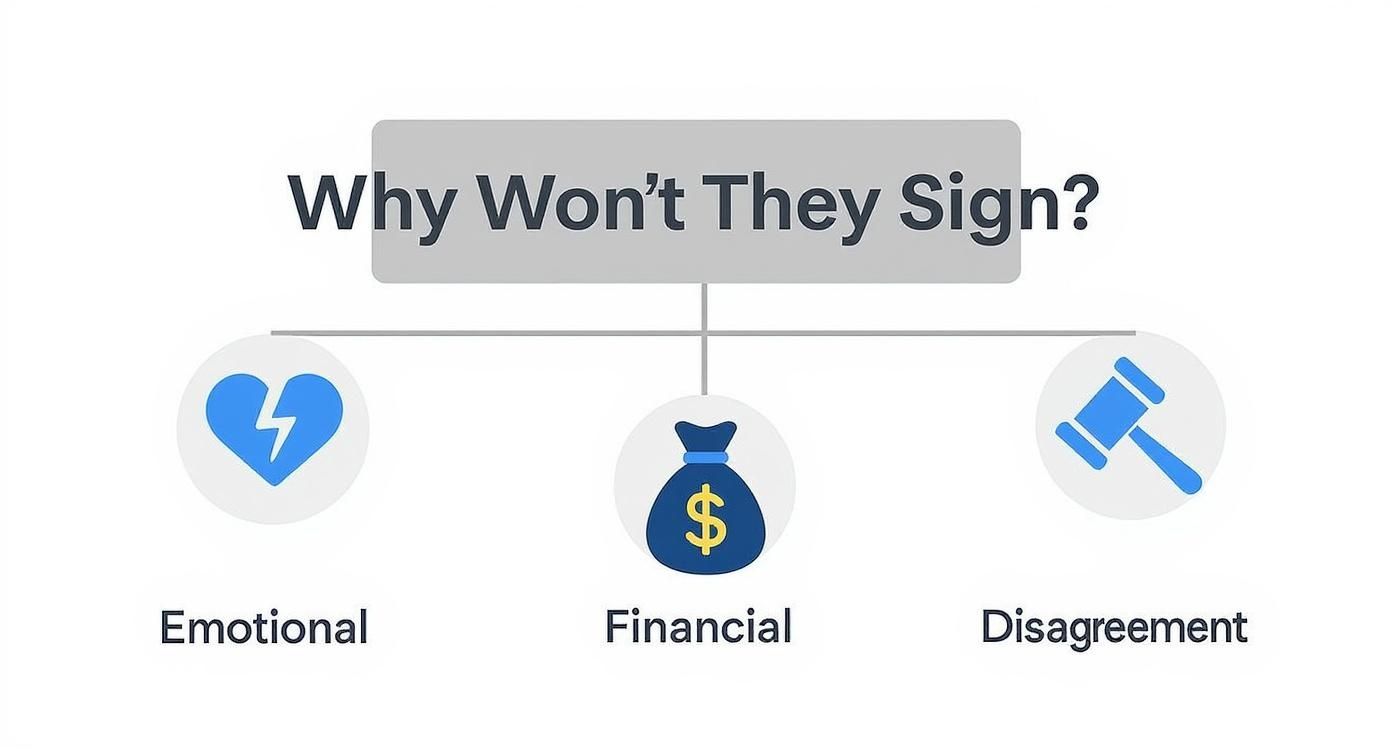
By understanding if the refusal is rooted in emotional resistance, financial anxiety, or a simple misunderstanding, you and your lawyer can choose a much more effective strategy.
Filing a Court Application in Brampton
If mediation or other negotiations just don’t work, your next definitive step is to start a court case. This is done by filing a document called a Form 8 Application at the A. Grenville and William Davis Courthouse in Brampton. Filing this application officially brings all the unresolved issues—like property division, support, or parenting time—before a judge.
Once that application is filed, the court process compels your spouse to participate. Their refusal to sign an agreement becomes irrelevant because a judge now has the authority to make binding decisions for both of you. This is a crucial safeguard in our legal system. With approximately 40% of marriages in Canada potentially ending in divorce, the courts are designed to ensure one person’s refusal can’t trap the other in legal limbo. You can learn more about the differences between separation and divorce and how the system handles each.
A court application completely changes the game. It shifts the power from your spouse having a veto to the court having the final say. The process creates a firm timeline, forces financial disclosure, and guarantees that things will move forward.
The court process in Brampton generally follows a few key stages:
- First Appearance: A quick, administrative court date just to get the ball rolling and set some initial timelines.
- Case Conference: This is a meeting with a judge to pinpoint the main issues, make sure all the financial information has been shared, and see if there’s a chance to settle. The judge’s feedback here often gives a reluctant spouse a serious reality check.
- Settlement Conference: Here, you meet with another judge whose entire focus is on helping you resolve the case without a trial. The judge will give a very strong opinion on what would likely happen at trial, putting a lot of pressure on any party who is being unreasonable.
If you still can’t reach an agreement after all that, the final step is a trial. At the end of the trial, a judge will issue a final, legally binding Court Order. This order does the exact same job as a separation agreement—it provides clear, enforceable rules on all the issues.
The Reality of Costs and Timelines in a Contested Separation
When a spouse refuses to sign a separation agreement in Ontario, the entire path to resolution changes. What could have been a straightforward, private negotiation suddenly becomes a much more complex, public, and expensive process. It’s critical to have a realistic understanding of the money and time you’ll need to invest when collaboration is no longer an option.
The cost difference between a peaceful settlement and a court battle is massive. A cooperatively drafted separation agreement is a manageable expense, mostly covering legal advice and drafting. But when your spouse’s refusal forces you into the court system, the bills start piling up fast.
Breaking Down the Expenses of a Contested Separation
The financial burden of a contested separation goes far beyond typical legal fees. You’re now looking at a whole new range of costs that add up quickly over time. These often include:
- Lawyer’s Fees: Forget a flat fee for an agreement. You’ll now be billed hourly for everything—court preparation, appearances, emails, and phone calls.
- Court Filing Fees: Every application and motion you file with the court comes with its own administrative price tag.
- Expert Valuations: If you can’t agree on the value of major assets like a family business, property in Brampton, or a pension, you’ll have to hire professional appraisers or actuaries. These reports can easily cost thousands of dollars.
This financial strain is exactly why it’s so important to try and settle things at every opportunity. When one spouse refuses to cooperate, the legal costs skyrocket. The average cost of a divorce in Canada is already around $18,000, but that number climbs to $25,000 or more for contested cases. The burden gets even heavier when one person’s stubbornness forces the matter through the courts. You can discover more insights about the costs of separation in Canada.
Comparing Timelines From Agreement to Court Order
Just like the costs multiply, the timelines stretch out dramatically. A separation agreement can often be negotiated and signed within a few months, allowing everyone to move on.
In stark contrast, navigating the Brampton court system is a marathon, not a sprint.
A contested separation can easily take over a year or more to resolve. The court system has mandatory steps and is subject to scheduling backlogs, meaning you move at the court’s pace, not your own.
This dragged-out timeline extends the emotional and financial stress of the separation for everyone involved. It creates a long period of uncertainty that makes it incredibly difficult for you and your family to start fresh. Understanding this reality reinforces the immense value of reaching an agreement whenever possible, saving you time, money, and emotional energy in the long run.
How to Protect Yourself and Move Forward

When your spouse refuses to sign a separation agreement, it’s easy to feel stuck and powerless. But this is the moment to stop waiting for them to cooperate and start actively protecting your own interests.
You can take concrete steps right now to regain control of the situation. This isn’t about escalating conflict; it’s about building a solid foundation for whatever comes next, whether that’s a negotiated settlement or a court application. The key is to shift your focus from reacting to their delays to proactively moving your life forward.
Start Building Your Case Today
You don’t need your spouse’s permission to get organized. The goal is to create a complete and accurate financial picture of your shared life. This file is the bedrock of any successful resolution, whether you end up in mediation or before a judge at the Brampton courthouse.
Start by gathering these key documents:
- Financial Statements: Collect bank account statements, credit card bills, and investment summaries for at least the last 12 months.
- Tax Returns: Get copies of your and your spouse’s income tax returns and Notices of Assessment for the past three years.
- Property Documents: Find the deeds for any real estate you own, along with property tax bills and current mortgage statements.
- Proof of Income: Assemble recent pay stubs, T4 slips, or if either of you is self-employed, the business’s financial statements.
By gathering these documents, you are doing more than just collecting paper. You’re building a foundation of undeniable facts. These numbers will be the basis for dividing property and calculating support under Ontario’s Family Law Act, making it much harder for an uncooperative spouse to delay the process with disputes or claims of ignorance.
Seek Professional Guidance Immediately
While gathering your documents is a crucial first step, the single most important thing you can do is consult an experienced Brampton family lawyer. A lawyer can review your unique situation, explain your rights in plain language, and map out a clear strategy to move forward.
They can also help you get independent valuations for significant assets like the family home or a business—something that’s essential for ensuring a fair and equitable division of property.
Hiring a lawyer sends a clear signal that you are serious about resolving matters. It officially moves the process from a frustrating standstill to a structured, legally sound path toward resolution. This step empowers you to confidently handle whatever comes next, knowing your rights are protected every step of the way.
Your Questions Answered: Dealing with a Reluctant Spouse
When you’re trying to move forward and your spouse is digging in their heels, it’s natural to feel stuck and uncertain. Below are straightforward answers to the most common questions we hear from people in Brampton facing this exact situation.
Can My Spouse Actually Stop Our Divorce by Refusing to Sign?
No, they can’t. In Ontario, your spouse’s signature isn’t needed for you to get a divorce. Once you’ve been separated for at least one year, you are legally entitled to file your divorce application with the court.
Their refusal to sign a separation agreement definitely complicates things—it means a judge will have to step in to settle financial and parenting matters. But it cannot legally prevent the divorce itself from being finalized by the court.
What if I Suspect My Spouse Is Hiding Assets?
Full and honest financial disclosure isn’t just good faith; it’s a mandatory legal requirement in Ontario family law. If you believe your spouse is hiding assets or refusing to share financial information, your lawyer has formal tools to force their hand.
This might involve bringing a motion before a judge right here at the Brampton courthouse. Courts take non-disclosure very seriously and can impose stiff penalties. A judge could order your spouse to pay all your legal costs or even make a final decision using only the information you were able to provide.
Can I Get Temporary Support or Custody Orders to Tide Me Over?
Absolutely. If you have urgent needs, you don’t have to wait for the entire case to be resolved. You can ask the court for temporary orders (also called “interim” orders) to create stability while everything else gets sorted out.
These temporary orders can cover critical, immediate issues, such as:
- Child and spousal support payments to cover expenses.
- Parenting schedules and who makes decisions for the children.
- Exclusive possession of the matrimonial home, allowing you or the children to remain there.
A judge can grant these orders early on, ensuring your family’s immediate needs are met and providing crucial support until a final agreement or court order is in place.
Facing a separation is tough, and it’s even harder when your spouse refuses to cooperate. At Badesha Law, our experienced Brampton family lawyers are here to protect your rights and guide you through every step. If you need clear advice and strong advocacy, contact us today for a consultation.