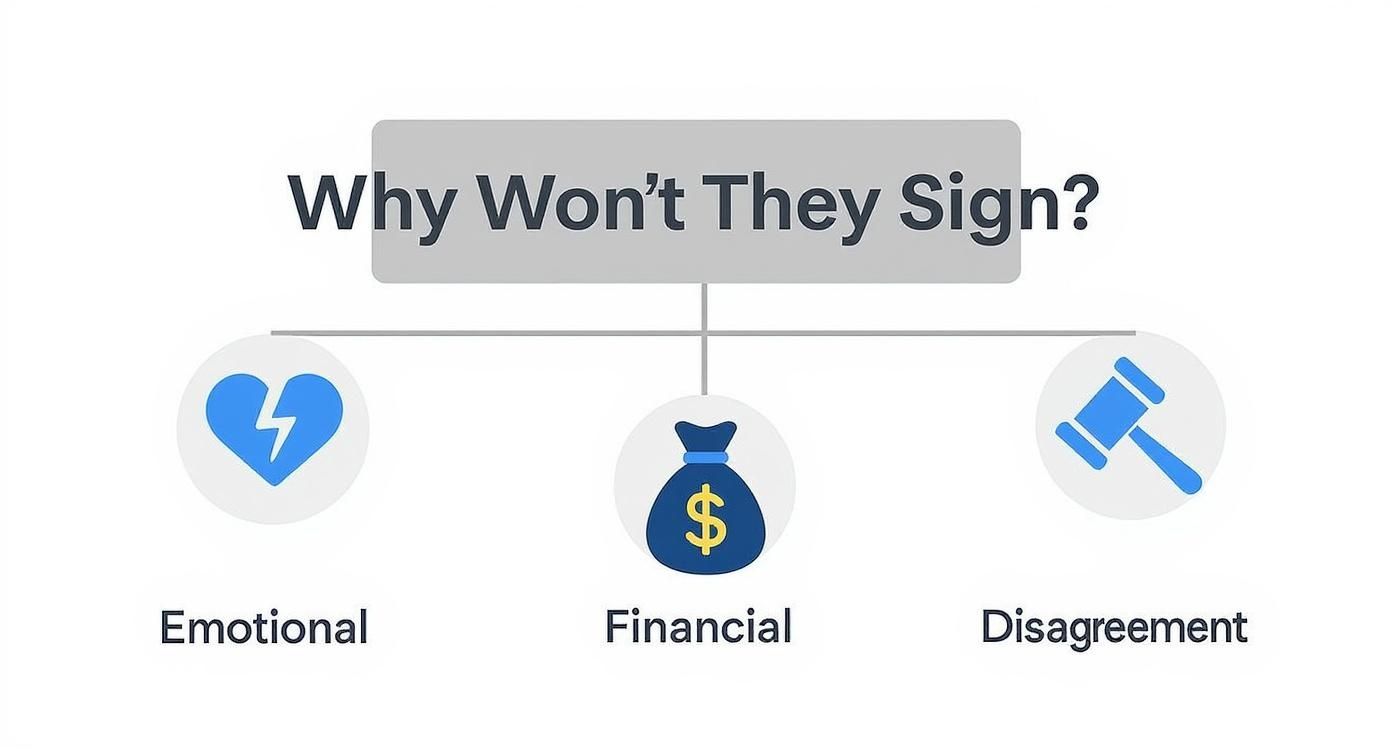
How Much Does a Divorce Cost in Ontario? A 2024 Guide

When you’re facing a separation, the most stressful question is often the most practical: “What is this going to cost me?” Understanding Ontario divorce costs upfront is the first step toward regaining control. The honest answer is that the price varies widely. A simple, amicable split might cost as little as $1,500, while a high-conflict court battle can easily exceed $50,000.

The final bill isn’t a random number. It’s a direct result of the legal path you choose, the level of cooperation between you and your spouse, and the complexity of your finances. This guide will break down the numbers, explain what drives costs up, and give you practical strategies to protect your finances.


Estimated Ontario Divorce Costs at a Glance

That feeling of uncertainty about divorce costs is completely normal. The good news is that you have more control over the final expense than you might think. Getting a handle on what drives the price up—or keeps it down—is the first step toward managing it.

The single biggest driver of your legal bill is conflict. An amicable, uncontested divorce is by far the most affordable route. In these cases, your lawyer’s job is mostly about drafting the right documents, which can often be done for a predictable flat fee.

On the other hand, a contested divorce—where you disagree on property, support, or parenting—is where hourly billing comes into play. Costs add up quickly through negotiations, financial disclosures, court filings, and appearances. Beyond your lawyer’s fees, other expenses can pop up. For instance, if your marriage involves international documents, understanding document translation costs can help you budget for that piece of the puzzle.

This table provides a high-level summary of potential costs to help you identify the financial scale of your situation.

Divorce Type Typical Cost Range (Per Person) Key Influencing Factors
Simple Uncontested Divorce $1,500 – $3,500 Full agreement on all issues; minimal legal negotiation needed.
Negotiated/Mediated Divorce $5,000 – $15,000 Some disagreements that require professional help to resolve, but avoids court.
Moderately Contested Divorce $15,000 – $30,000 Several court appearances (conferences, motions) but settles before trial.
High-Conflict/Trial Divorce $50,000+ Multiple complex issues (business valuation, custody battles) that go to trial.

As you can see, the path you choose has a massive impact on the bottom line. A simple uncontested divorce is the most budget-friendly, and many Ontario law firms offer flat-rate packages to make the divorce process in Ontario more predictable.

Comparing Uncontested vs. Contested Divorce Costs

The path your divorce takes is the single biggest factor influencing your final legal bill. Think of it as the difference between buying a fixed-price ticket for a direct flight versus hailing a taxi in rush-hour traffic with the meter running. One is predictable; the other can become wildly expensive.

This is the core difference between an uncontested and a contested divorce. Understanding how each one impacts the average cost of divorce in Ontario is the first step in managing both your budget and your expectations.

The Predictable Cost of an Uncontested Divorce

An uncontested divorce is, by far, the most straightforward and affordable route. This happens when you and your spouse have already agreed on all the major issues—how to divide property, who pays what support, and the parenting plan—before a single court document is filed.

In this scenario, your lawyer’s role is to ensure your agreement is legally sound, draft the paperwork, and file it correctly. Because the work is defined, most family law firms in Ontario offer a flat-rate fee for this service.

  • Legal Fees: Usually a flat rate, which gives you complete cost certainty.
  • Court Fees: Standardized government charges for filing the application.
  • Timeline: Much faster, often wrapping up in just a few months.

This streamlined process keeps billable hours to a minimum, making the overall price tag low and predictable.
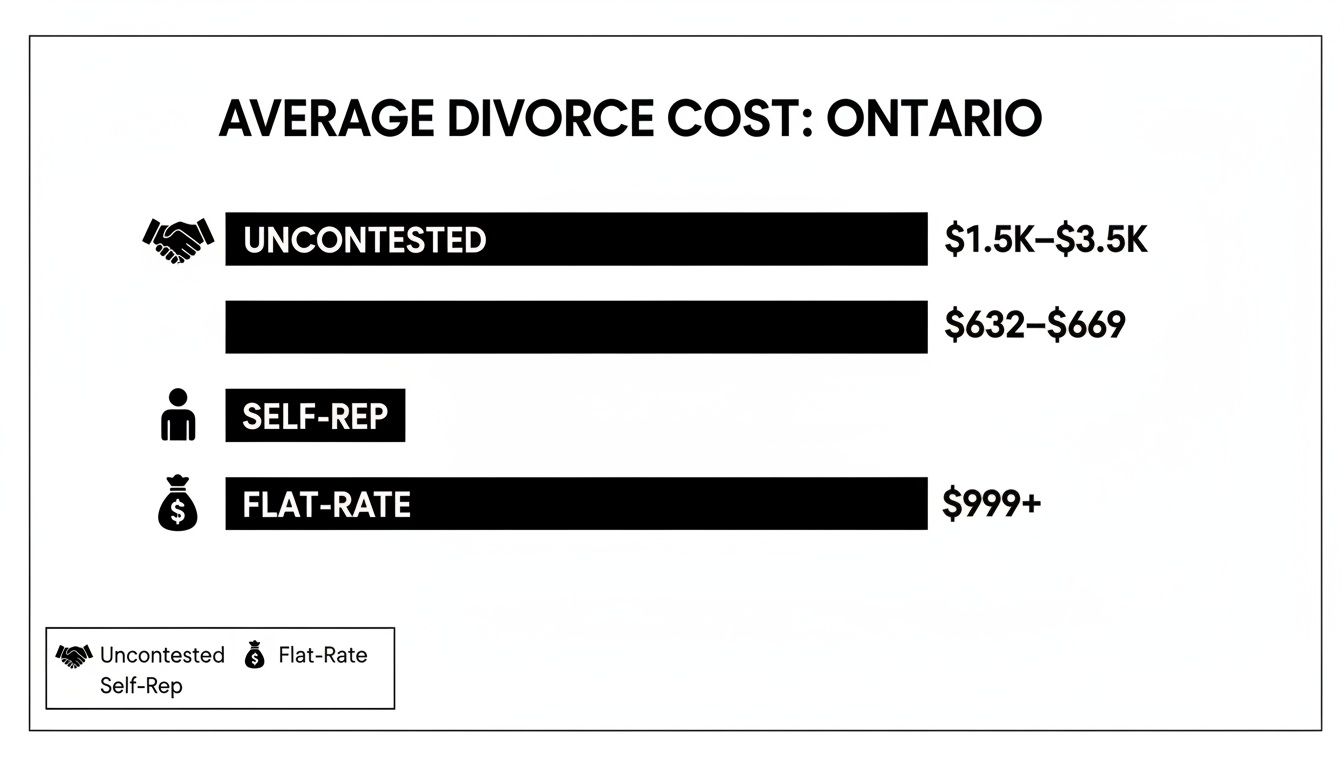
Infographic showing average divorce costs in Ontario for uncontested, self-rep, and flat-rate categories.

As you can see, a lawyer-assisted uncontested divorce is dramatically more affordable. For a deeper look, you can explore the key differences between contested and uncontested divorce in Brampton in our detailed guide.

Why Contested Divorce Costs Escalate

A contested divorce is where the legal meter starts running. This happens when you and your spouse can’t agree on one or more issues, forcing your lawyers to negotiate, mediate, or ultimately, fight it out in court.

In these situations, lawyers almost always bill by the hour. Every phone call, email, and court document adds to the final bill. The more conflict there is, the more hours your legal team must dedicate to your case.

Common Mistake: Underestimating how quickly small disagreements can inflate legal bills. An argument over a $5,000 asset can easily cost $10,000 in legal fees to resolve in court. Always weigh the cost of the fight against the value of what you’re fighting for.

Contested divorces in Ontario carry much higher financial stakes. The actions that drive up hourly billing include:

  • Financial Disclosure: Compiling, reviewing, and often disputing complex financial statements.
  • Motions: Filing formal legal requests with the court for temporary decisions.
  • Questioning/Discovery: The formal process where lawyers question the other party under oath.
  • Court Conferences: Mandatory meetings with a judge to narrow down issues.
  • Trial Preparation: Extensive and costly work required if your case heads to trial.

Uncovering the Hidden Financial Layers of Divorce

A magnifying glass rests on financial documents, with three binders labeled Appraisal, Valuation, and Assessments nearby.

It’s a common misconception that your lawyer’s bill is the only expense. A realistic picture of your Ontario divorce costs must include other professional services needed to untangle a shared life.

These are the necessary expenses that arise from the complex details of your marriage. Budgeting for these layers isn’t just smart—it’s crucial for your long-term financial health and helps you make more strategic decisions.

The Cost of Expert Reports and Valuations

When you and your spouse can’t agree on the value of a major asset, the court needs objective opinions from neutral experts. The cost for these reports is typically shared, and they can be a significant line item.

Here are the most common experts you might need:

  • Business Valuations: A chartered business valuator (CBV) is needed to determine the fair market value of a family business. This can cost anywhere from $5,000 to $25,000 or more.
  • Property Appraisals: A certified appraiser provides the value of the matrimonial home or other real estate. These reports usually run between $500 and $1,000 per property.
  • Pension Valuations: A pension must be valued by an actuary before it can be divided. Expect this to cost $1,000 to $3,000.
  • Parenting Assessments (Section 30): In high-conflict custody battles, a judge might order a formal parenting assessment to recommend what’s in the children’s best interests. These can cost from $10,000 to $30,000.

Pro Tip: These expert reports might seem expensive, but they provide the hard data needed to end arguments. Investing in an accurate valuation can save you thousands in legal fees fighting over what something is worth.

Trying to cut corners here can backfire. Our guide on the hidden costs of ignoring family law issues dives deeper into why being proactive is so important.

Investing in Alternative Dispute Resolution

It might sound strange to add another professional’s fee, but services like mediation are investments, not just costs. Alternative Dispute Resolution (ADR) aims to solve problems outside a courtroom, which is almost always faster and cheaper.

Mediation brings in a neutral third party to help you negotiate your own agreement. A qualified mediator in Ontario typically charges between $300 and $700 per hour, a cost you usually split. A few productive sessions can resolve issues that would have taken months—and thousands more in legal fees—to battle out in court. It’s also critical to understand how divorce can impact your taxes to get a complete financial picture.

How Core Issues Drive Up Your Divorce Bill

Think of your divorce cost like a fire. Every unresolved disagreement is another piece of fuel. The final bill for your divorce in Ontario is the cumulative cost of every argument that requires a lawyer’s time to sort out.

It’s the hours spent negotiating, drafting proposals, and preparing for court that inflate the final number. Knowing which disputes act as financial accelerants is key to keeping your costs under control.

The Financial Drain of Property Division Disputes

Dividing property often becomes one of the most heated parts of a divorce. These arguments aren’t just about who gets the couch; they’re about complex assets that can trigger a cascade of expensive professional services.

When you can’t agree on what something is worth, you must bring in outside experts. This is where costs climb:

  • Business Valuations: If one of you owns a business, its value must be calculated. This requires a Chartered Business Valuator (CBV) and can easily cost $10,000 to $25,000.
  • Pension Valuations: You’ll likely need an actuary to calculate a pension’s value for equalization, adding another $1,000 to $3,000.
  • The Matrimonial Home: Disagreements over the home’s value can lead to appraisals and court motions, all adding hours to your lawyer’s invoice.

Child Support and Parenting Time Conflicts

Nothing is more emotionally charged than issues involving children, and that emotional weight often translates directly into higher legal costs. Disagreements over parenting time and decision-making can become the most draining aspect of a divorce.

When parents can’t agree on a schedule, lawyers step in. This can quickly lead to:

  • Multiple court appearances.
  • Drafting complex parenting plans.
  • Negotiations that drag on for months.

In high-conflict situations, a judge may order a formal parenting assessment. These investigations, conducted by social workers or psychologists, are incredibly thorough and can cost between $10,000 and $30,000.

The High Cost of Spousal Support Arguments

Spousal support is another major battleground. Unlike child support, which often follows clear formulas, spousal support involves more judicial discretion, fueling intense and expensive disputes.

Arguments typically boil down to three key questions:

  1. Entitlement: Is one spouse even entitled to support?
  2. Amount: If so, how much should be paid?
  3. Duration: And for how long?

Resolving these questions requires extensive financial disclosure and legal arguments, which can easily add tens of thousands of dollars to your final legal bill. You can learn more about the common issues in a contested Ontario divorce in our detailed guide.

Practical Strategies to Lower Your Divorce Costs

Hands holding a checklist with checked items during a video call on a laptop with documents on a desk.

While the factors driving up Ontario divorce costs can feel intimidating, you have significant control over the final legal bill. By taking a proactive, organized, and resolution-focused approach, you can actively cut down on unnecessary fees.

Think of your lawyer’s time as an expensive resource. Every minute they spend chasing documents or de-escalating conflicts is a minute you pay for. The more work you do upfront, the less your lawyer has to.

Be Your Lawyer’s Most Efficient Client

One of the most effective ways to lower your legal bill is to make your lawyer’s job easier. When you walk in prepared and organized, you minimize the hours they spend on administrative legwork.

Before your first meeting, start gathering documents:

  • Financial Statements: At least three years of statements for all bank accounts, credit cards, and investments.
  • Tax Returns: Your last three years of income tax returns and Notices of Assessment from the Canada Revenue Agency.
  • Property Documents: Deeds, mortgage statements, and recent property tax bills.
  • Debt Information: Up-to-date statements for any loans, lines of credit, or other debts.

Presenting this information clearly drastically reduces the time your lawyer needs for financial discovery, directly cutting your costs.

Embrace Cooperation Over Conflict

Conflict is the fuel that powers an expensive divorce. Consciously choosing a cooperative mindset can dramatically lower the temperature—and the cost. Every issue you and your spouse resolve directly is one less issue your lawyers need to bill hours negotiating.

Prioritizing a negotiated settlement over a court battle is the single most impactful financial decision you can make. A firm that focuses on negotiation first aligns with a cost-effective strategy that protects your assets and well-being.

Seriously consider Alternative Dispute Resolution (ADR) options like mediation. It is almost always faster and significantly cheaper than court. You can find qualified professionals through organizations like the Ontario Association for Family Mediation (OAFM). This approach saves money and gives you more control over the final outcome.

Your Cost-Saving Divorce Checklist

Action Item Why It Saves Money Pro Tip
Gather All Financials First Reduces the hours your lawyer spends on administrative “discovery” tasks. Create a simple, organized digital folder with subfolders for bank statements, taxes, and property docs.
Create a Marital Balance Sheet Listing all assets and debts gives your lawyer a clear snapshot, saving them analysis time. Use a basic spreadsheet. List everything you own and owe, and note who holds the title or debt.
Discuss Goals with Your Spouse Finding common ground on even small issues (like who keeps the couch) saves negotiation time. Focus on what you can agree on first to build momentum. Don’t start with the biggest fights.
Be Honest and Transparent Hiding assets or income leads to expensive legal battles and potential court sanctions. Full financial disclosure is mandatory in Ontario. Hiding things will always cost you more in the long run.
Keep Communications Business-Like Emotional, angry emails require your lawyer to spend time deciphering and de-escalating. Stick to the facts. Communicate calmly and clearly, as if you were writing to a business colleague.
Bundle Your Questions Instead of multiple calls or emails a day, send one organized email with a list of questions. This respects your lawyer’s time and prevents you from being billed for five separate small interactions.

By being proactive and organized, you can effectively manage the costs of your divorce. What to do next? The best first step is to book a confidential consultation to understand your specific situation and get a clear picture of potential costs and strategies.

Serving Brampton and the Greater Toronto Area

Getting divorced in the Greater Toronto Area brings its own unique financial pressures. Between the high cost of living and a competitive real estate market, understanding your Ontario divorce costs is critical.

At Badesha Law, we are part of this community. We provide focused, practical legal support to families in Brampton, Mississauga, and across the Peel Region. Our deep understanding of the local court system and GTA property market gives our clients a real-world advantage.

Local Expertise for Your Financial Peace of Mind

Whether you’re dividing a matrimonial home in this market or calculating support based on local income realities, having a legal team that gets the regional context is invaluable. We pride ourselves on offering accessible, compassionate legal guidance.

Our client-first approach is simple: clear communication and completely transparent fees. We believe you should never feel in the dark about your legal spending.

Choosing a divorce lawyer in Brampton who is committed to a cost-effective, negotiation-first strategy can make all the difference. We are dedicated to helping our neighbours manage their divorce costs wisely so they can move forward with confidence.

Ready to understand your options? Book a confidential consultation with our team today to get clarity on your next steps.

Frequently Asked Questions About Ontario Divorce Costs

What is the average cost of divorce in Ontario?

The average cost varies dramatically. A simple, uncontested divorce often costs between $1,500 and $3,500. However, a contested divorce that requires negotiation or court appearances can easily range from $15,000 to over $50,000 per person. The final price depends entirely on the level of conflict and complexity.

How can I get a cheap divorce in Ontario?

The cheapest way to get a divorce is by filing for an uncontested divorce. This means you and your spouse agree on all major issues beforehand. Using a lawyer’s flat-rate service for this process is a cost-effective way to ensure it’s done correctly while keeping the price predictable and avoiding costly mistakes.

Does my spouse have to pay my legal fees?

Generally, each person pays their own legal fees in an Ontario divorce. However, a judge can order one spouse to pay a portion of the other’s costs if that person has behaved unreasonably—for example, by hiding assets, ignoring court orders, or making frivolous claims that unnecessarily prolong the process.

Is mediation cheaper than going to court?

Yes, absolutely. Mediation is almost always significantly cheaper than litigation. The collaborative process of mediation helps you resolve issues directly with your spouse, avoiding the massive expenses associated with court filings, multiple appearances, and trial preparation. It can save you tens of thousands of dollars and months, if not years, of time.

How are lawyer fees for a contested divorce calculated?

For a contested divorce, lawyers typically bill by the hour. Your final bill is based on the total time spent on your case, including phone calls, emails, document drafting, and court appearances. You will usually pay an upfront “retainer,” and the lawyer’s hourly rate is drawn from that amount as work is completed.


Related Reading


Written by the legal team at Badesha Law. Our family lawyers are dedicated to providing clear, practical guidance on divorce and separation.

Disclaimer: This article provides general information and does not constitute legal advice. For advice on your specific situation, please consult with a qualified family lawyer.


What if Your Spouse Won’t Sign a Separation Agreement in Ontario? Your Next Steps

When your spouse refuses to sign a separation agreement, it feels less like a bump in the road and more like the road has disappeared entirely. Suddenly, the amicable path you hoped for is gone. This is the moment your separation shifts from a cooperative discussion to a formal, legal dispute. If you’re facing this challenge, understanding what if your spouse won’t sign a separation agreement in Ontario is the first step toward regaining control.

Instead of working together, you are now facing a contested separation. This means a judge, not you, will likely make the final decisions about your property, finances, and children.


Key Takeaways

  • Refusal to Sign Means a Contested Separation: Your spouse cannot be forced to sign. Their refusal moves the process from a private negotiation to a formal court-based system.
  • You Have Options: Even without a signed agreement, you can move forward through lawyer-assisted negotiation, mediation, or, if necessary, a court application.
  • Protect Yourself Immediately: You can seek interim court orders for exclusive possession of the home, child support, spousal support, and to freeze assets to prevent them from being depleted.
  • Court is a Last Resort: The court process is expensive and time-consuming, often costing over $20,000 and taking 18-24 months. A judge will make the final decisions, removing your control.
  • Legal Counsel is Crucial: An experienced family lawyer is essential to navigate the complexities, protect your rights, and guide you toward the most strategic and cost-effective resolution.

Table of Contents


The Immediate Shift From Amicable To Contested Separation

In Ontario, a spouse’s refusal to sign is more than just a frustrating delay. It’s a fundamental pivot in your legal journey. The cooperative process you envisioned evaporates, replaced by a formal, structured, and often adversarial court system.

Instead of working together to decide the terms of your future, you’re now preparing for a judge to make those decisions for you on the most critical issues: property division, spousal support, and the parenting plan for your children.

This refusal is what officially transforms your situation from an uncontested separation into a contested one. The reasons for this can be complex, and sometimes, understanding the dynamics can involve recognizing signs of narcissism, as certain personality traits often fuel conflict and a need to control the process.

From Cooperation To Court Intervention

Think about a typical Brampton couple. They agree to separate but hit a wall over who keeps the matrimonial home on their quiet suburban street. One spouse drafts a fair proposal, but the other, unwilling to budge, simply refuses to sign.

That one act escalates everything. What could have been resolved through a few focused negotiation sessions now requires court intervention, dramatically ratcheting up both the stress and the legal bills. It’s a scenario we see all the time when a partner won’t sign separation papers in Peel Region.

The financial hit is massive. An uncontested divorce might cost somewhere in the neighbourhood of $1,860, but a contested case can easily skyrocket to an average of $20,625 in Canada—a number that truly reflects the complex and lengthy court process in Ontario.

Loss Of Control And Predictability

The biggest consequence of a contested separation is the loss of control. A separation agreement is your chance to craft a customized solution that actually works for your unique family. When that option is gone, you’re handing the decision-making power to a judge who doesn’t know you, your finances, or your children.

Suddenly, you’re facing a world of uncertainty.

  • Financial Uncertainty: Without an agreement, there’s no way to predict how assets will be divided or what support payments will look like.
  • Parenting Decisions: A judge, based on limited information presented in a formal courtroom setting, will decide on parenting time and major decision-making for your kids.
  • Prolonged Conflict: The court process is inherently adversarial. It can poison an already tense relationship, making effective co-parenting down the road that much harder.

To get a clear picture of what you’re giving up, it helps to know what a good agreement covers. Our detailed guide on what a separation agreement in Ontario should include breaks down all the crucial components you’ll want to protect.

To make the difference crystal clear, let’s compare the two paths side-by-side. The table below shows just how different the journey becomes when that signature is missing.

Uncontested vs. Contested Separation: A Quick Comparison

Aspect Signed Separation Agreement (Uncontested) No Signed Agreement (Contested)
Process Collaborative and private. You file paperwork after all issues are settled. Adversarial and public. Involves court filings, conferences, and potentially a trial.
Control You and your spouse make all the final decisions about your future. A judge makes the final decisions based on the law and evidence presented.
Timeline Predictable and much faster. Typically 4-6 months for the court to process. Unpredictable and slow. Can take 12-24 months or even longer to resolve.
Cost Significantly lower. Often managed with flat fees, providing cost certainty. Substantially higher. Billed hourly, with costs escalating with every conflict.
Emotional Toll Lower stress. The focus is on finding common ground and moving forward. High stress. The process is designed for conflict, which can damage co-parenting relationships.

As you can see, the presence or absence of a signed agreement creates two completely different realities. One is a path you control; the other is a path controlled by the court system.

What Are Your Options When a Spouse Refuses to Sign?

When your spouse flat-out refuses to sign a separation agreement, it’s easy to feel like you’ve hit a brick wall. But it’s not the end of the road; it’s just a detour. This is where strategic thinking comes in, and thankfully, Ontario’s family law system provides several other paths forward. You are not powerless just because your spouse is being difficult.

Instead of working toward a single signed document, your journey now branches into different ways of resolving the dispute. The destination is the same: to formally and finally settle issues like property division, support, and parenting. It’s the route to get there that changes, shifting from a private agreement to a more structured negotiation or, if needed, court intervention.

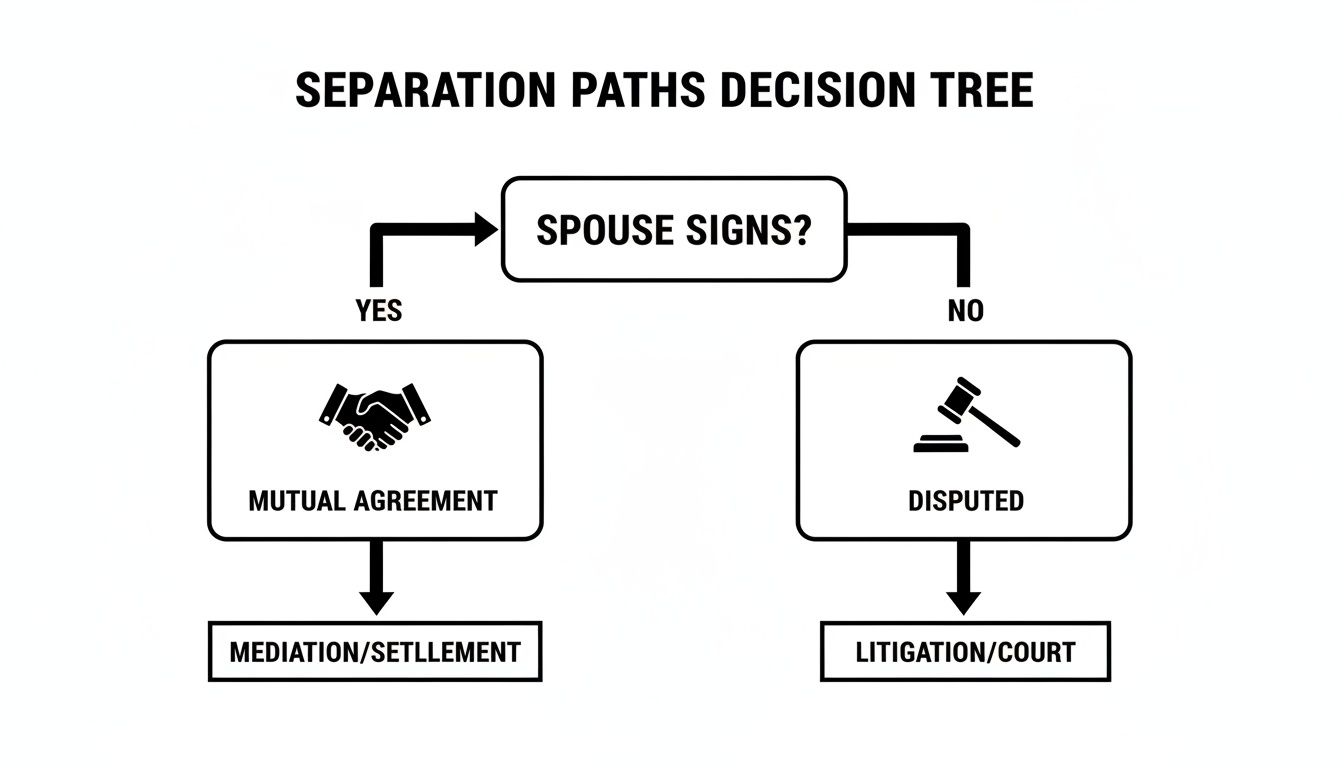
The flowchart below gives you a clear visual of the choice you’re facing. It separates the collaborative path from the formal legal one you’ll need to take when your spouse won’t cooperate.

A decision tree flowchart outlining separation paths based on spouse agreement, leading to mediation or litigation.

As you can see, a signed agreement is the most direct route. But a refusal to sign simply opens up other structured, necessary alternatives to get you to the finish line.

Lawyer-Assisted Negotiation

Often, the very first step after hitting an impasse is to get the lawyers talking. Your lawyer can communicate directly with your spouse’s lawyer, which shields you from the direct—and often highly emotional—conflict. They’ll present your position, exchange formal proposals, and work toward a compromise based on established legal principles.

A skilled family lawyer can pinpoint areas of leverage and reframe your proposals in a way that makes an agreement seem much more appealing, often turning a hard “no” into a “maybe.” That professional distance is frequently what it takes to break the stalemate.

This process is definitely less formal than going to court, but it’s far more structured than just talking things out yourselves. It leaves room for creative solutions while making sure your legal rights are protected every step of the way.

Mediation and Collaborative Family Law

If direct lawyer-to-lawyer negotiation doesn’t work, alternative dispute resolution (ADR) offers a great middle ground between negotiation and court.

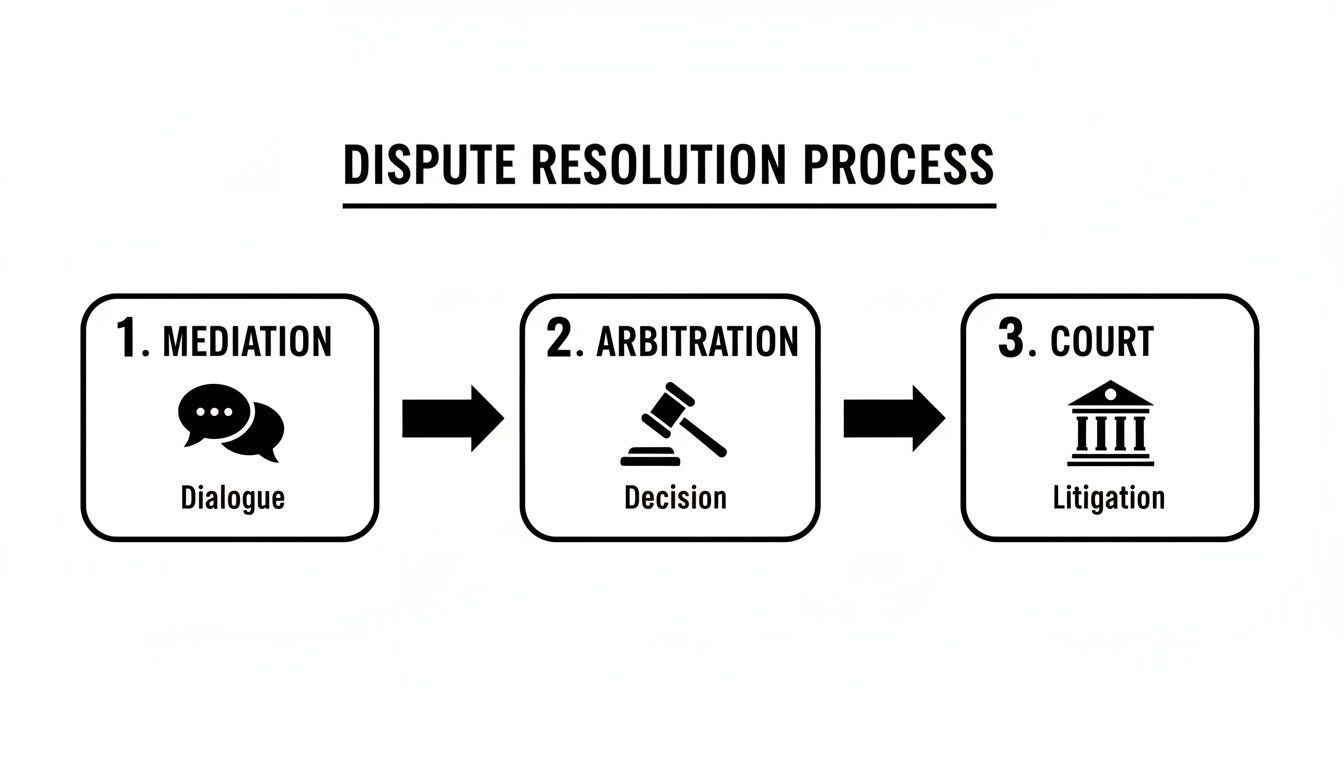
  • Mediation: A neutral, third-party mediator sits down with you and your spouse to guide the conversation. The mediator doesn’t make any decisions for you; their job is to help you find common ground and craft your own solutions. It’s completely confidential and usually much faster and cheaper than litigation.
  • Collaborative Family Law: This is a more team-based approach. Both you and your spouse, along with your specially trained collaborative lawyers, sign a binding agreement to resolve all issues without going to court. The process often includes financial and family professionals, and the entire focus is on reaching a settlement everyone can live with.

Both of these methods keep the control in your hands and are designed to preserve a respectful relationship, which is incredibly important if you have children together.

The Final Option: A Court Application

When every other avenue has been tried and failed, filing an application with the court becomes the necessary last resort. This action formally asks a judge to step in and make decisions on all the unresolved issues.

While going to court is the most time-consuming and expensive option, it guarantees a final resolution when your spouse simply refuses to cooperate on any level. The court can issue orders that are legally binding, effectively creating a resolution for you. These decisions are then put into a final court order, which works just like a signed agreement. You can learn more about how a judge’s ruling becomes an enforceable document by understanding what is a consent order in Ontario.

Starting a court application forces the issues and ensures your separation process moves forward—with or without your spouse’s signature.

How To Protect Your Rights And Finances Now

A person's hands holding house keys near a court application document on a wooden table, suggesting legal proceedings.

While the final resolution is stuck in limbo, your life doesn’t hit the pause button. Bills are still due, the kids need stability, and you have to worry about assets being sold or drained before you get your fair share. When your spouse won’t sign a separation agreement in Ontario, you can’t afford to just wait—you need to take immediate steps to secure your position.

Fortunately, the court system provides powerful tools for short-term relief. These are called interim court orders, and they act as temporary rules to govern your family’s finances and living arrangements until a final agreement or court order is in place.

These orders aren’t about winning the final fight. They’re about establishing stability and fairness right now by addressing the most urgent issues that pop up during a separation.

Securing Your Home And Financial Stability

One of the most immediate concerns is often the matrimonial home. Tensions can make living together unbearable or even unsafe. In these situations, you can ask the court for an order for exclusive possession, which legally requires one spouse to move out, regardless of whose name is on the title.

This is a critical step for creating a stable environment, especially for any children involved. It removes the daily conflict from the home while the long-term division of property gets sorted out.

Financial continuity is another huge worry. If your spouse was the primary earner and has suddenly cut you off financially, you can seek temporary orders for:

  • Child Support: To ensure your children’s needs are met immediately, based on the Federal Child Support Guidelines.
  • Spousal Support: To provide for your own necessary expenses while the separation process unfolds.

These temporary support orders provide a crucial financial lifeline. They prevent one spouse from using money as a weapon to force the other into an unfair settlement. To effectively protect your rights, it’s helpful to understand the implications of marital contracts, such as knowing what happens if you sign a prenup and get divorced.

Preventing The Depletion Of Family Assets

What if you have a legitimate fear that your spouse might empty bank accounts, cash out investments, or sell valuable assets before they can be divided? This is a common and completely valid concern.

You can file a motion for a non-depletion order, sometimes called a preservation order. This court order freezes significant assets, legally preventing either spouse from selling, transferring, or mortgaging property without written consent or another court order.

This is one of the most important protective measures you can take. It ensures the family property remains intact so it can be divided fairly later on. For a deeper look at safeguarding your assets during a split, check out our detailed guide on how to protect your property in a divorce. A skilled family lawyer in Brampton can file these motions quickly to secure your financial future.

The Reality of Family Court in Ontario

Deciding to go to court is a massive step, and it’s vital to have a clear-eyed view of what the process actually involves. When negotiation and mediation hit a wall because your spouse just won’t sign a separation agreement, the Ontario family court system becomes the only path to a final resolution.

This isn’t a quick or simple fix. It’s a formal, structured, and often painfully long journey.

The whole thing kicks off when one spouse files an Application with the court. That single step officially starts the litigation process and sets a whole series of events in motion. Both of you must then dive into mandatory financial disclosure—a detailed and often exhausting process of exchanging mountains of documents about income, assets, and debts. This isn’t optional; it’s the bedrock for every decision the court will make.

Key Stages of a Contested Court Case

Once the initial paperwork is filed, your case will crawl through several distinct stages, each with its own purpose and potential for delays. These aren’t just quick meetings; they are formal steps in a long, drawn-out process.

  • First Appearance: A brief, administrative court date just to make sure all the initial paperwork is in order.
  • Case Conference: This is the first real meeting with a judge. The goal here is to nail down the key issues, see if there’s any chance of a settlement, and set a timeline for what comes next. You’ll likely attend several of these.
  • Motions: If urgent problems pop up—like needing temporary support or exclusive possession of the home—either of you can bring a “motion” to ask a judge for a temporary order.
  • Settlement Conference: This is a more focused, serious attempt to resolve everything with a judge’s help before you get to the most expensive stage of all.
  • Trial: If you still can’t reach a settlement, the case goes to trial. This is where both sides present evidence, and a judge makes a final, binding decision for you.

The True Cost of Litigation

Going to court isn’t just emotionally draining; it’s also incredibly expensive. The adversarial, combative nature of litigation sends legal fees skyrocketing. A contested divorce often costs more than ten times what an uncontested one does, usually because of fights over support and property.

A revealing three-year study of reported Ontario family law cases looked at 470 cost decisions, showing just how often unsigned agreements spiral into costly litigation. Contested divorces in Ontario frequently average over $20,000, a huge jump from the sub-$2,000 cost of most uncontested cases. You can learn more about the financial impact of contested family law matters from these findings.

The timeline is just as intimidating. While every case is unique, it’s not at all unusual for a contested family law matter in Ontario to take 18 to 24 months—or even longer—to finally reach a conclusion. That prolonged uncertainty freezes your ability to move on with your life. Understanding this harsh reality is crucial before you decide that court is your only way forward.

Why an Experienced Family Lawyer Is Essential

Trying to manage a high-conflict separation on your own is a huge risk. The moment your spouse refuses to sign a separation agreement in Ontario, the dynamic shifts. What was once a private negotiation becomes a complex legal battle where the rules are anything but obvious.

This is exactly when the guidance of an experienced family lawyer goes from being a good idea to an absolute necessity.

A skilled lawyer does so much more than file paperwork. They become your strategic advisor, your negotiator, and your advocate, tasked with protecting your rights and your future at every single turn. Their job is to cut through the emotional chaos and transform a tense, messy situation into a structured, manageable legal process.

Strategic Negotiation and Advocacy

One of the most valuable roles a lawyer plays is negotiating from a position of strength and deep legal knowledge. They understand the nuances of Ontario’s Family Law Act and can spot leverage points you would almost certainly miss on your own.

For instance, a sharp family lawyer in Brampton might recognize that your spouse’s financial disclosure is incomplete, giving you a powerful advantage in negotiations or in court. They know how to frame proposals in a way that highlights the massive costs and risks of litigation for your spouse, which often brings a stubborn ex-partner back to the table.

This kind of expertise translates into very real results:

  • Securing fair support: Making sure child and spousal support calculations are accurate, complete, and just.
  • Protecting your assets: Preventing an unfair division of property, especially the matrimonial home.
  • Creating favourable parenting plans: Advocating for a parenting schedule that truly serves your children’s best interests.

Navigating the Court System

If court becomes inevitable, your lawyer’s mission is to present your case in the strongest, most compelling light. They handle the intricate procedural requirements, from filing the right documents on time to representing you effectively in front of a judge.

An experienced family lawyer anticipates the other side’s arguments and prepares persuasive, evidence-based responses. They remove the emotion from the equation and focus on the facts and the law—which is what ultimately sways a judge’s decision.

Investing in expert legal counsel isn’t just another expense; it’s the most effective way to protect your financial security and your family’s well-being. To get a better sense of the specific benefits, you can learn more about why hiring a local Brampton family lawyer makes such a critical difference in the outcome of your case.


Stuck with a spouse who won’t cooperate? Don’t wait. Book a consultation with our experienced family law team to understand your options and take back control.


Serving Brampton, Mississauga, and the GTA

At Badesha Law, we know the unique pressures families face in Brampton, Mississauga, and across the Greater Toronto Area. When you’re dealing with a spouse who won’t sign a separation agreement, having a local team that understands the Peel Region court system isn’t just a benefit—it’s critical. We offer the expert guidance you need when searching for a “family lawyer near me” to handle a difficult separation.

We regularly guide clients through this exact situation, offering clear, practical steps to cut through the stress and avoid the kind of costly mistakes that can happen when you’re trying to figure it all out on your own.

Our team lives and breathes the Brampton courthouse. That local experience means we know how to navigate the system efficiently, whether you’re just starting the separation process or you’re already caught in a contentious court battle. We’re here to protect your interests. For a closer look at local procedures, our guide on family law in Brampton covers divorce and support offers more detail.

If you’re stuck wondering what to do next because your spouse is refusing to sign, the best first step is to talk to a family lawyer in Brampton. We can lay out your legal options and help you build a clear path forward.

Related Reading


Frequently Asked Questions

Can I force my spouse to sign a separation agreement?

No, you absolutely cannot. A separation agreement is a voluntary contract. A judge in Ontario has no power to compel someone to sign. If a spouse is pressured or coerced into signing, the agreement could be challenged and set aside by a court later. For the document to be legally binding, both parties must sign willingly after receiving independent legal advice.

Can I still get divorced if we don’t have an agreement?

Yes, you can. In Ontario, you can file for divorce after being separated for one full year, with or without a signed agreement. However, if there are outstanding issues like property division, support, or parenting, a judge will likely not grant the divorce until those matters are formally resolved either by a separation agreement or a final court order.

How long can my spouse stall by refusing to sign?

Indefinitely, if you let them. A spouse can refuse to sign an agreement forever, but that doesn’t mean your separation is stuck in limbo. You can break the stalemate by filing a court application. This action forces the legal process to move forward, creating firm deadlines for financial disclosure and court appearances that your spouse must adhere to.

What’s the first step if my spouse won’t even negotiate?

If communication has completely broken down, your first step should be to consult with an experienced family lawyer. Your lawyer can open a formal line of communication by sending a letter to your spouse or their legal counsel. This official step outlines your position, proposes a path forward like mediation, and shows you are serious about resolving matters.

Is a court order the same as a separation agreement?

Functionally, yes. Both a signed separation agreement and a final court order are legally binding documents that are enforceable. They both clearly define your rights and obligations regarding finances, property, and parenting. The key difference is who made the decisions: in an agreement, you and your spouse decide; in a court order, a judge decides for you.

What if my spouse is hiding money or assets?

If you suspect your spouse is hiding or disposing of assets, you must act quickly. Your lawyer can file an urgent motion with the court to request a non-depletion or preservation order. This order freezes significant assets, legally preventing your spouse from selling, transferring, mortgaging, or draining accounts until the property can be fairly divided.

Is court really that much more expensive than mediation?

Yes, in almost all cases. Litigation is significantly more expensive than alternative dispute resolution methods like mediation. Mediation is a collaborative process designed to find common ground quickly, which keeps legal fees down. Court involves multiple appearances, extensive preparation, and an adversarial process, causing hourly legal costs to escalate rapidly.


Disclaimer: This article provides general information and does not constitute legal advice. For advice tailored to your specific situation, please consult with a qualified family lawyer.
Written by the legal team at Badesha Law, experts in Ontario family law.


What Is Uncontested Divorce? A Brampton Guide

An uncontested divorce is where both spouses agree on all the critical issues before finalizing their separation. It's a cooperative route that sidesteps court battles over property, support, and children, making the process faster, cheaper, and far less stressful for everyone involved. For families in Brampton, this means you control the outcome, not a judge.

Understanding the Uncontested Divorce Pathway in Brampton

Often called a simple divorce, an uncontested divorce is the most amicable way to legally end a marriage in Ontario. This process is built on mutual agreement rather than conflict. It’s a formal recognition that both partners have already done the hard work of resolving their issues and just need the court to legally dissolve their marriage.

This entire method is guided by Ontario's Family Law Act, which lays out the rules for things like property division and support obligations. For a divorce to be truly uncontested, you and your spouse have to be in complete agreement on every major point. No exceptions.

Key Areas of Agreement Required

To move forward with an uncontested divorce in Brampton, you must have settled every matter tied to your separation. This includes:

  • Property Division: How you’ll split the assets and debts you accumulated during the marriage, including the matrimonial home.

  • Spousal Support: Deciding if one person will pay support to the other, for how long, and exactly how much.

  • Child Custody and Access: Finalizing the parenting plan, which covers decision-making responsibilities and the schedule for when the children are with each parent.

  • Child Support: Calculating the financial support for the children based on the official Federal Child Support Guidelines.

All these decisions are recorded in a legally binding document called a Separation Agreement. This agreement becomes the backbone of your divorce application.

Uncontested vs. Contested At a Glance

The path you choose—uncontested or contested—completely changes the divorce experience. It's the difference between a cooperative negotiation and an adversarial legal fight. The table below breaks down the practical differences for families here in Brampton.

Factor Uncontested Divorce Contested Divorce
Foundation Mutual agreement and cooperation. Disagreement and conflict.
Decision-Making You and your spouse control the outcome. A judge makes the final decisions.
Typical Timeline Faster, usually a few months after filing. Slower, can take years to resolve.
Financial Cost Significantly lower, predictable legal fees. High and unpredictable legal costs.
Emotional Impact Lower stress and less animosity. High emotional and psychological strain.

An uncontested divorce is not a "DIY" process. While it's built on agreement, it still requires precise legal paperwork filed correctly with the court. An experienced Brampton divorce lawyer ensures your rights are protected and the process is completed without costly errors.

Uncontested vs. Contested Divorce: A Practical Comparison

Deciding how to approach your divorce in Brampton is more than just a legal choice—it’s a decision that will profoundly impact your finances, emotional health, and future. Think of it as a fork in the road: one path leads to a cooperative resolution, while the other leads to an adversarial battle in court.

One way is defined by teamwork and mutual agreement. The other is marked by disagreement and requires a judge to step in. This single distinction shapes every part of your separation, from the very first steps to the final order. Let's break down what each approach really means for you and your family in Brampton.

Control Over the Outcome

In an uncontested divorce, you and your spouse are in the driver's seat. You hold the power to shape your own future. Through direct negotiation, often guided by a Brampton divorce lawyer, you create a Separation Agreement that works for your family’s unique situation—one you both agree is fair.

A contested divorce is the exact opposite. When you can’t find common ground, you're essentially handing over control to a judge who will make life-altering decisions for you. Those decisions, while based on Ontario's Family Law Act, might not reflect what either of you actually wanted.

The core difference comes down to who holds the power. In an uncontested divorce, the power stays with you. In a contested divorce, you give that power to the court.

Financial Cost: A Tale of Two Budgets

The financial gap between these two paths can be staggering. An uncontested divorce comes with predictable, manageable costs. You're typically looking at flat fees for a lawyer to draft and finalize your Separation Agreement, plus standard court filing fees. There are no hidden surprises because the process is straightforward.

On the other hand, the costs of a contested divorce are unpredictable and can spiral out of control. Every motion filed, every court appearance, and every hour your lawyer spends in litigation adds to a growing legal bill. It’s not uncommon for disagreements over assets or support to drain the very resources you’re fighting to keep.

For instance, a couple in Brampton might spend a few thousand dollars to finalize an amicable, uncontested divorce. In stark contrast, a contested case with disputes over the matrimonial home and spousal support could easily soar past $25,000 to $50,000 per person, and sometimes much more.

The Emotional Strain on Your Family

The emotional toll is another critical factor to consider. An uncontested divorce, while still a difficult life event, is built to minimize conflict. It gives couples a path to separate with dignity, allowing them to focus on co-parenting and moving forward constructively. That cooperative spirit helps preserve a functional relationship, which is absolutely vital when kids are involved.

A contested divorce almost always amplifies animosity. The adversarial nature of court proceedings can poison relationships, turning disagreements into deep-seated resentment that makes effective co-parenting nearly impossible. The process is inherently stressful and filled with conflict that can leave lasting emotional scars on everyone—especially children.

Timeline: Predictability vs. Prolonged Uncertainty

Time is a resource you can’t get back, and these two divorce paths consume it very differently. An uncontested divorce runs on a fairly predictable schedule. Once you’ve met the one-year separation requirement and your paperwork is in order, the divorce can often be finalized in just a few months.

A contested divorce, however, moves at the pace of the court system, which is notoriously slow and backlogged. The process can drag on for years, bogged down in procedural delays, document discovery, and long waits for trial dates. This prolonged uncertainty keeps families in limbo, unable to find closure and start rebuilding their lives.

To make the differences even clearer, here is a side-by-side look at how these two approaches stack up for families in Ontario.

Key Differences: Uncontested vs. Contested Divorce in Ontario

This table breaks down the crucial distinctions between the two divorce pathways, helping you see which one might be a better fit for your family's circumstances in Brampton.

Factor Uncontested Divorce Contested Divorce
Decision-Making You and your spouse make all final decisions together. A judge imposes a final decision based on the law.
Financial Cost Predictable and significantly lower legal fees. Unpredictable, often escalating into tens of thousands.
Typical Timeline A few months after filing. Can take years to resolve through the court system.
Emotional Impact Lower stress, less conflict, and promotes amicable co-parenting. High emotional strain, fosters animosity, and harms relationships.
Privacy Kept private between you, your spouse, and your lawyers. Becomes a matter of public record in court documents.

Ultimately, knowing the difference between an uncontested and contested divorce gives you the power to make an informed choice. It boils down to a simple question: do you want to navigate your separation through cooperative problem-solving, or are you headed for a formal legal battle?

Meeting the Requirements for an Uncontested Divorce

Thinking about an uncontested divorce in Brampton? It’s not quite as simple as shaking hands and walking away. Before you can take advantage of this more cooperative route, you have to meet several non-negotiable legal requirements under the Family Law Act. If you miss one of these, the court can reject your application, leading to frustrating delays and costs you didn't plan for.

The very first hurdle is the mandatory one-year separation period. Canadian law is clear on this: you and your spouse must have lived separate and apart for at least one full year before a judge will grant the divorce. You can get the paperwork started before the year is up, but the final divorce order can't be issued until that timeline is met.

The Cornerstone of Your Agreement

The absolute foundation of any uncontested divorce is a comprehensive and legally sound Separation Agreement. This is the formal, written contract that proves to the court you’ve both resolved all the critical issues. A casual verbal agreement or a quick email exchange won’t cut it—the court simply won't accept it.

Your Separation Agreement needs to be incredibly detailed, spelling out exactly how you've settled all of the following:

  • Division of Property and Debts: A clear breakdown of how every family asset (like the matrimonial home, investments, and pensions) and all liabilities are going to be divided.

  • Spousal Support: This section must state whether one person will pay support to the other, for how much, and for how long. If you both agree to waive spousal support, that has to be explicitly written into the agreement.

  • Parenting Arrangements: A detailed parenting plan is essential. It must outline who has decision-making responsibility (formerly custody) and the specific access schedule for your children.

  • Child Support: The calculated amount of child support, which must follow the Federal Child Support Guidelines. No exceptions.

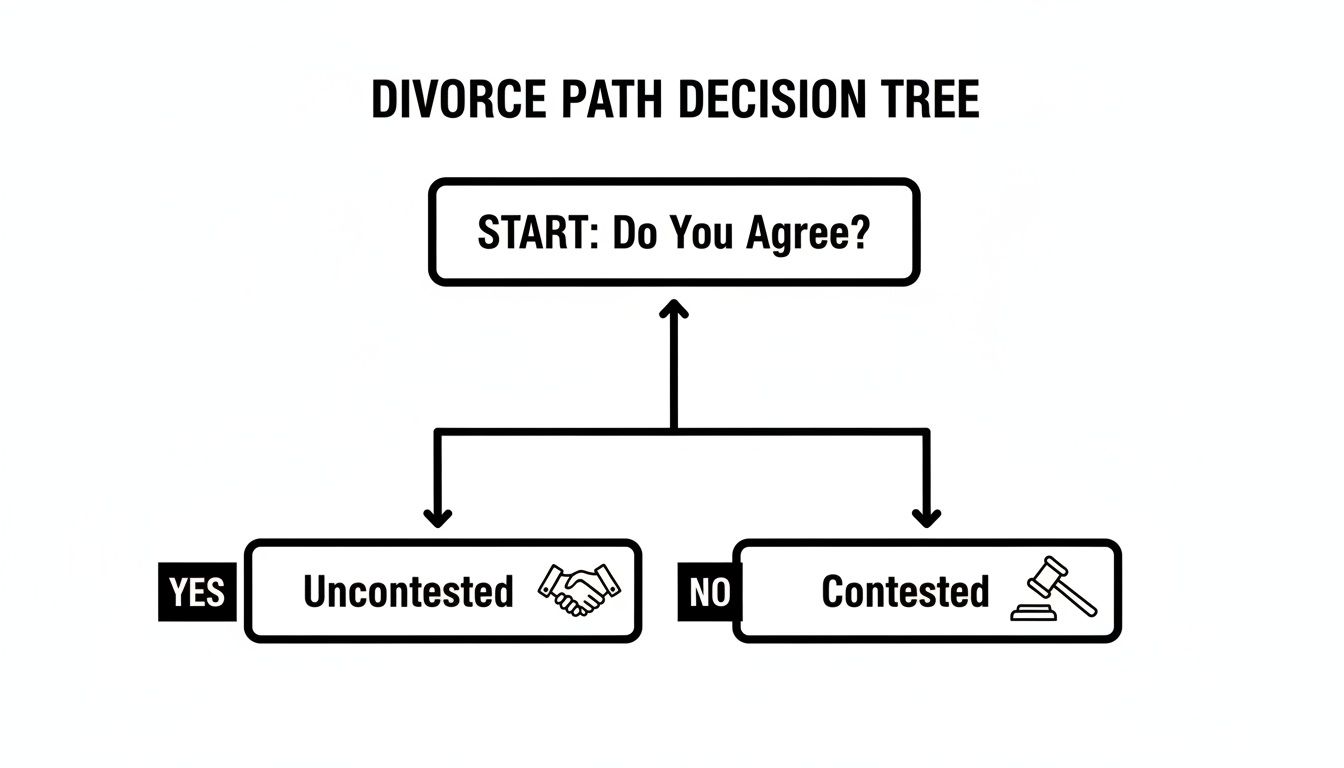
This decision tree shows the first choice every couple has to make.

Decision tree flowchart illustrating two divorce paths: Uncontested if both parties agree, or Contested if they don't.

As you can see, the whole process comes down to one simple question: can you agree? If the answer is yes, the smoother, uncontested path opens up for you.

Preparing for a Brampton Divorce Lawyer

To make sure your Separation Agreement is airtight and enforceable, it’s smart to get your documents in order before meeting with a lawyer. Having everything ready makes the process far more efficient and helps your lawyer protect your interests from day one.

A common misconception is that "uncontested" means "no lawyers needed." In reality, having a Brampton divorce lawyer draft or review your Separation Agreement is crucial to ensure it is fair, legally binding, and will hold up in court.

While Ontario law governs local divorces, the core principle of mutual agreement is common in many places. For example, in California, an uncontested divorce also requires both spouses to agree on all key issues like property division and support, allowing them to avoid a court trial based on "irreconcilable differences." You can read more about the California divorce rate and process to see how this principle is applied elsewhere.

Before your consultation, try to gather the following:

  • Financial Statements: Recent pay stubs, bank account statements, and investment details for both of you.

  • Asset and Debt Lists: A complete inventory of everything you own and owe, both jointly and individually.

  • Property Valuations: Appraisals or market assessments for major assets like your home or vehicles.

  • Tax Information: Your most recent income tax returns and Notices of Assessment.

Bringing these documents allows your lawyer to give you accurate advice and draft an agreement that truly reflects what you've both decided, setting the stage for a successful uncontested divorce.

The Uncontested Divorce Process Step by Step

Knowing what an uncontested divorce is one thing, but actually navigating the court process can feel like a maze of legal forms and procedures. For Brampton residents, the path is generally straightforward, but it demands careful attention to detail. This step-by-step guide breaks down each stage into clear, manageable actions so you know exactly what to expect from start to finish.

The journey begins long before you file any paperwork. It starts with collaboration and ends with a legally binding court order that officially dissolves your marriage.

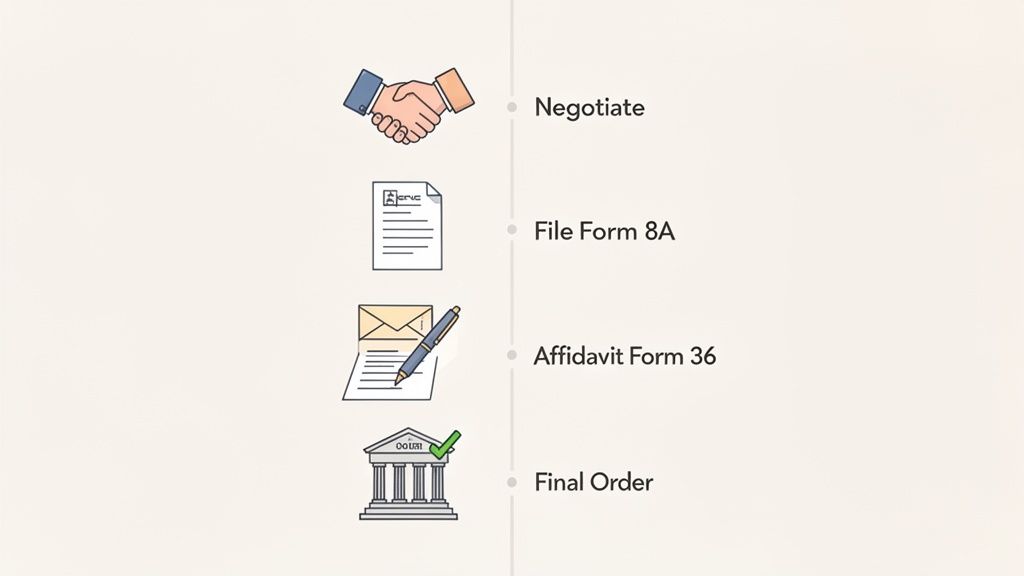
A four-step legal process timeline showing negotiation, filing forms, affidavit, and final order.

Step 1: Finalize Your Separation Agreement

This is the most critical stage. Before you can even think about filing for divorce, you and your spouse must have a fully signed and witnessed Separation Agreement. This document is the cornerstone of your uncontested divorce, proving to the court that you've already sorted out all the major issues related to property, support, and children.

A Brampton divorce lawyer can ensure this agreement is drafted correctly, follows Ontario's Family Law Act, and fully protects your rights. Trying to move forward without a comprehensive, legally sound agreement will bring the whole process to a grinding halt.

Step 2: Prepare and File the Application for Divorce

With your Separation Agreement finalized, the next step is to officially start the divorce proceeding with the court. This involves completing and filing an Application for Divorce (Form 8A), the document that formally asks the court to grant your divorce.

Your application includes essential information like your names, date of marriage, and the date you separated. You’ll file this form, along with your original marriage certificate, at the Superior Court of Justice in Brampton.

The accuracy of the information on Form 8A is vital. Even a small error, like a misspelled name or an incorrect date, can cause the court to reject your application, leading to preventable delays and additional filing fees.

This cooperative approach is becoming the standard for families looking for a less adversarial split. In fact, recent data shows that uncontested divorces make up the majority of cases, which is reshaping how family courts operate. For instance, a review of state statistics shows that nearly 90% of all divorces in California are uncontested, meaning spouses resolve their issues through a written agreement instead of a trial.

Step 3: Serve Your Spouse with the Divorce Documents

Once your Application for Divorce is filed and issued by the court, you must legally "serve" a copy to your spouse. This is a formal, mandatory step to ensure your spouse has been officially notified of the divorce proceedings.

In Ontario, you cannot serve the documents yourself. They have to be delivered by a third party who is over 18, like a friend, family member, or a professional process server. After serving the documents, this person must complete an Affidavit of Service (Form 6B) and swear before a commissioner that they did it correctly.

Step 4: Complete and File the Affidavit for Divorce

After your spouse has been served and the required 30-day response period has passed (which they won't act on in an uncontested case), you can move to the next stage. You now need to complete and file an Affidavit for Divorce (Form 36).

This is a sworn document that confirms several key details for the judge:

  • You meet the one-year separation requirement.

  • There is no chance of reconciliation.

  • All reasonable arrangements have been made for any children, in line with the Federal Child Support Guidelines.

You must sign this form in the presence of a lawyer or a commissioner for taking affidavits. It's then filed with the court, along with a draft of the final Divorce Order. To better understand how paralegals can help you navigate an uncontested split, you can explore the offerings of paralegal divorce services.

Step 5: Await the Final Divorce Order

Once all your paperwork has been filed correctly, a court clerk reviews it to make sure everything is complete. If it is, your file is passed to a judge for a final review. In an uncontested divorce, you don't need to appear in court—the judge reviews your documents in their chambers.

If the judge is satisfied that all legal requirements have been met, they will sign the Divorce Order. This order becomes legally effective 31 days after the date it is signed. After this waiting period, you can request a Certificate of Divorce, which is the official proof that your marriage has been legally terminated.

Understanding the Costs and Timelines in Brampton

When you're thinking about divorce, two of the biggest questions are always: "How much will this cost?" and "How long will this take?" For anyone in Brampton, an uncontested divorce offers a clear and predictable path forward, saving you a whole lot of money and stress compared to a drawn-out court battle. Knowing what to expect helps you plan for your future with a bit more confidence.

An uncontested divorce really has two types of expenses: fixed court filing fees and professional legal fees. The Ontario government sets standard fees for filing the Application for Divorce and getting the final order. While you can't avoid these, they’re a tiny fraction of what a prolonged legal fight could cost.

Breaking Down the Financial Costs

Where you really save money with an uncontested divorce is on the legal fees. Since you and your spouse have already done the hard work of agreeing on all the major issues, your Brampton divorce lawyer isn’t racking up hours on lengthy negotiations, court appearances, or filing endless motions. Their work is targeted and efficient.

Typically, legal services will cover:

  • Drafting the Separation Agreement: This is the critical legal document that puts all your mutual decisions about property, support, and the kids down on paper.

  • Providing Independent Legal Advice (ILA): It’s crucial that both you and your spouse fully understand your rights and what you’re signing. ILA ensures this happens.

  • Preparing and Filing Court Documents: Your lawyer will accurately handle all the necessary forms, like the Form 8A Application and Form 36 Affidavit, making sure they’re done right the first time.

The financial difference is night and day. An uncontested divorce with a solid agreement usually comes with predictable, flat-rate legal fees. A contested divorce, on the other hand, is a different story. With hourly billing for litigation, costs can quickly spiral into the tens of thousands of dollars—sometimes draining the very assets you’re fighting over.

This massive cost difference is why so many couples work hard to find an amicable solution. While fees can vary by location, the principle is universal. A fully litigated divorce can be incredibly expensive no matter where you are, whereas an uncontested divorce might only cost a little more than the court filing fees plus some legal help for the paperwork. To get a sense of how costs compare elsewhere, you can discover more insights about the cost of divorce in California.

Navigating the Divorce Timeline

Even though an uncontested divorce is much faster, some timelines are set in stone under Canadian law. The big one is the mandatory one-year separation period. You must live separate and apart from your spouse for at least 12 months before a judge can legally grant your divorce.

Once you’ve met that requirement and filed your completed application, the court’s processing time kicks in. Here in Brampton and the GTA, you can generally expect this to take between two to four months, assuming all your paperwork is flawless. Any mistakes or missing info can cause major delays, which is exactly why having a lawyer's professional eye on everything is so valuable.

After the judge signs the Divorce Order, there’s one last 31-day waiting period before it officially takes effect. This clear timeline gives you a predictable end date, so you can finally close this chapter and move on with your life.

How a Brampton Divorce Lawyer Protects Your Interests

Even when a separation is completely amicable, trying to handle an uncontested divorce without a lawyer is a major risk. You and your spouse might agree on everything, but the law itself is incredibly complex. A skilled Brampton divorce lawyer isn't there to create conflict; they act as your safety net, ensuring the agreement you've made is not just fair for today but legally solid for years to come.

Their main job is to protect your rights and look out for your long-term interests. A lawyer's trained eye can catch potential problems you might never see, like unspoken assumptions about how property is divided or what happens if financial needs change down the road. They make sure every single detail is compliant with Ontario's Family Law Act and the federal Divorce Act.

Three people under a Brampton umbrella holding an agreement document, with legal scales and books in the background.

Beyond Drafting Paperwork

Thinking a lawyer just fills out forms is a common misconception. Their true value is in strategic guidance and preventing future problems. An experienced family lawyer in Brampton performs critical tasks that safeguard your future well beyond the paperwork.

Here’s where their expertise becomes crucial:

  • Drafting Precise Legal Language: They take your verbal agreements and translate them into a legally binding Separation Agreement. The language they use is precise and ironclad, leaving no room for future arguments or misinterpretations.

  • Providing Independent Legal Advice (ILA): The court needs to know that both of you made informed choices without being pressured. ILA is a formal process where a lawyer confirms you fully understand your rights and the long-term consequences of the agreement you're about to sign.

  • Identifying Future Conflicts: A good lawyer thinks ahead. What if one person wants to move away with the kids? What if someone’s income changes dramatically? They help you build contingencies into the agreement to head off potential court battles later on.

  • Managing the Court Process: They handle the complex court filing process from start to finish. From the initial Form 8A Application to the final Form 36 Affidavit, they ensure every document is perfect to avoid costly rejections or delays from the court clerk.

A well-drafted Separation Agreement is your best insurance against future legal trouble. Investing in a lawyer to get it right from the start is far more cost-effective than hiring one later to fix a flawed or incomplete agreement.

Ultimately, your Brampton divorce lawyer’s role is to make sure the cooperative spirit of your uncontested divorce is cemented in a legally enforceable document. They provide the professional oversight needed to turn your handshake deal into a binding resolution, giving you the security and peace of mind to truly move forward.

Frequently Asked Questions About Uncontested Divorce

As you explore an uncontested divorce, you'll naturally have questions about the finer details. Here are some clear, straightforward answers to the questions we hear most often from clients in Brampton and the GTA.

Can We File an Uncontested Divorce if We Have Children?

Yes, absolutely. Having children doesn’t prevent you from pursuing an uncontested divorce. In fact, it’s often the best path forward for families, as long as you and your spouse are in complete agreement on all parenting matters.

This means you must have settled:

  • Decision-Making Responsibility: This used to be called custody. It’s about who will make the major decisions for your children’s health, education, and religious upbringing.

  • Parenting Time: This is the schedule that outlines when the children will be with each parent.

  • Child Support: The amount must follow the Federal Child Support Guidelines. This isn't something you can negotiate away; it's a legal requirement.

Your Separation Agreement needs to lay out a detailed parenting plan covering all these points. A Brampton divorce lawyer can make sure your plan is solid and meets the court’s standards, which is critical for getting your divorce approved.

What if My Spouse Lives Outside of Ontario?

You can still file for an uncontested divorce here, even if your spouse is in another province or another country altogether. The key legal requirement is that at least one of you has been “ordinarily resident” in Ontario for a full year right before filing the divorce application.

The process is mostly the same, but serving the divorce papers gets a little trickier. You have to follow specific rules for "out-of-jurisdiction service" to make sure the legal notification is done correctly. This is one of those steps where getting professional help from a Brampton divorce lawyer is crucial to avoid simple mistakes that could get your application rejected.

An uncontested divorce isn’t limited by geography, as long as one spouse meets Ontario’s residency rule. The important things are to maintain your agreement and follow the proper legal steps for serving documents across borders.

Do I Have to Go to Court for an Uncontested Divorce?

No, and for many people, this is the biggest benefit. You do not have to step foot in a courtroom for an uncontested divorce in Brampton. The whole process is handled on paper.

Once your Application for Divorce, Separation Agreement, and final Affidavit for Divorce are filed correctly, a judge reviews everything in their office—or "chambers." If they’re satisfied that all the legal boxes are ticked and that the arrangements for any children are fair, they will sign the Divorce Order. There's no hearing and no need to appear in person. This "desk divorce" saves a tremendous amount of time, money, and stress.


At Badesha Law, we know how to provide the clarity and guidance you need to get through your uncontested divorce with confidence. If you're in Brampton or the GTA and need a Brampton divorce lawyer on your side, we’re here to protect your interests and make the process as smooth as possible. Contact us today to discuss your situation by visiting www.badeshalaw.ca

Uncontested Divorce vs Contested Divorce in Brampton: A Guide


At a Glance: Uncontested vs. Contested Divorce in Ontario

This choice directly impacts the timeline, cost, and emotional energy your separation will demand. An uncontested divorce (often called a simple divorce) is only possible when you and your spouse have resolved everything related to child custody, parenting time, child support, spousal support, and property division in a signed Separation Agreement.

If even one issue remains unresolved, the divorce is automatically contested. This path requires the court’s intervention to settle disputes. It’s vital to understand the specific triggers for a contested divorce in Brampton.

This decision tree illustrates the core difference:

Here’s a quick breakdown of how the two paths compare:

FactorUncontested Divorce (Collaborative Path)Contested Divorce (Court-Involved Path)
Agreement LevelFull agreement on all issues is required before filing.Disagreement on one or more issues forces reliance on the court for final decisions.
Typical CostLower and more predictable. Often handled on a flat-fee basis.Higher and variable. Billed hourly, costs escalate with complexity and conflict.
TimelineFaster. Usually takes 4-6 months to finalize after filing.Slower. Can take 12-24 months or longer due to court processes.
ProcessPrimarily administrative; filing paperwork after signing a separation agreement.Adversarial; involves court filings, conferences, motions, and potentially a trial.
Emotional ImpactGenerally lower stress due to cooperation.Can be highly stressful due to its adversarial nature.
ControlYou and your spouse retain full control over the final terms.A judge makes the final decisions, which may not align with what either of you wanted.

The uncontested path offers speed, lower costs, and control in exchange for cooperation. The contested route provides a formal structure for resolving disputes but at a higher financial and emotional price.

The Uncontested Divorce Process in Ontario

A lawyer helps a couple sign divorce papers at a table, finalizing their agreement.

An uncontested divorce in Brampton is the most straightforward and cost-effective way to legally end your marriage. However, it is only available to couples who have reached a complete agreement on all issues before filing with the court.

Eligibility and Steps for an Uncontested Divorce

To be eligible, you must have lived separate and apart for at least one year and have a signed separation agreement resolving all matters.

  1. Negotiate a Separation Agreement: This is the most critical step. All terms regarding property, support, and parenting must be finalized in a legally binding agreement.
  2. Prepare the Application: The primary document is the Application for Divorce (Form 8A), which can be filed jointly or by one spouse.
  3. Gather Supporting Documents: You will also need an Affidavit for Divorce (Form 36) and your original Marriage Certificate.
  4. File with the Court: Documents are filed at the Superior Court of Justice in Brampton.
  5. Serve Your Spouse (if applicable): If you file a sole application, your spouse must be formally served with the documents.
  6. Receive the Divorce Order: A clerk reviews the file. If complete, a judge signs the Divorce Order, typically 4-6 months after filing.

Even minor paperwork errors can cause significant delays. Working with an experienced divorce lawyer in Brampton ensures everything is filed correctly the first time.

Documents Checklist for an Uncontested Divorce

  • Original Marriage Certificate (with certified translation if not in English or French)
  • Signed Separation Agreement
  • Completed Application for Divorce (Form 8A)
  • Completed Affidavit for Divorce (Form 36)
  • Draft Divorce Order (Form 25A)
  • Court filing fee

For a more detailed breakdown, explore our guide to the uncontested divorce process in Brampton, Ontario.

Navigating the Contested Divorce Process in Brampton

Two lawyers in robes reviewing legal documents intently at a table in a courtroom.

When you and your spouse cannot agree, your separation becomes a contested divorce. This means you are asking the Ontario court system to make final, binding decisions for your family. Common disputes arise over child custody, support amounts, or the division of complex assets like a family business.

Stages of a Contested Divorce

The contested process follows several distinct stages. A case can settle at any point, and a trial is always the last resort.

  1. Application and Answer: One spouse files an Application (Form 8) with the court outlining their claims. The other spouse has 30 days to file their Answer (Form 10).
  2. Financial Disclosure: Both spouses must exchange sworn Financial Statements (Form 13 or 13.1) with supporting documents. This step is mandatory and requires full transparency.
  3. Case Conference: The first court appearance before a judge to identify disputed issues, ensure disclosure is complete, and explore settlement options.
  4. Motions: If urgent issues arise (e.g., temporary support), a lawyer can file a motion to ask a judge for a temporary order.
  5. Settlement Conference: A court date focused on resolving the case. The judge often provides an opinion on the likely trial outcome to encourage a fair agreement.
  6. Trial: The final stage where both sides present evidence to a judge, who then makes a final, binding decision.

The court process is designed with multiple opportunities for settlement. We offer strategies for managing conflict in a contested divorce that can help keep friction—and costs—down.


Navigating a contested divorce is complex and requires strategic legal guidance. Our team can protect your rights and advocate for your best interests. Call us to discuss the next steps for your case.

Comparing Divorce Costs and Timelines in Brampton

The two most pressing questions in any divorce are, “How much will this cost?” and “How long will this take?” In Brampton, the answers depend almost entirely on the level of conflict between you and your spouse.

Fee Drivers and Typical Costs

An uncontested divorce offers cost certainty. Because all issues are settled, most family lawyers offer flat-fee packages for the paperwork, typically ranging from $1,500 to $3,500 plus court fees.

A contested divorce operates on an hourly billing model. Costs are driven by the amount of time your lawyer spends on your file and can range from $15,000 to $50,000 or more. Key fee drivers include:

  • The level of conflict and number of disagreements.
  • The complexity of financial assets, such as a business or pensions.
  • The need for third-party experts (e.g., accountants, valuators).
  • The number of court appearances required.

Our guide on how much a divorce costs in Ontario provides a more detailed breakdown.

How Timelines Diverge

The timeline for an uncontested divorce is predictable. After the mandatory one-year separation period, the court process takes about 4-6 months.

A contested divorce timeline is dictated by the court’s schedule. In the busy Brampton court system, reaching a final resolution can take 12-24 months or longer. Each step, from conferences to motions, adds layers of time, leaving you in legal limbo.

When to Speak to a Divorce Lawyer

Whether your divorce is amicable or contentious, seeking legal advice is crucial. A skilled family lawyer in Brampton protects your rights and helps you avoid common mistakes.

For an Uncontested Divorce

Even in a “simple” divorce, a lawyer’s role is vital. They will:

  • Draft or review your separation agreement to ensure it is fair, enforceable, and protects you from future claims.
  • Identify potential future conflicts you may have overlooked.
  • Manage the court filing process correctly to avoid rejections and delays.

For a Contested Divorce

In a contested divorce, your lawyer is your strategic advisor and advocate. They will:

  • Manage all court procedures and deadlines.
  • Advocate for you during negotiations and in court.
  • Provide objective advice to help you make rational, long-term decisions.
  • Work to resolve disputes through negotiation or mediation to avoid a costly trial.

Understanding why hiring a local Brampton family lawyer makes a critical difference can help you make an informed choice for your future.

Brampton Clients Often Ask…

1. Where do I file for divorce in Brampton?
You file your divorce application at the Superior Court of Justice located at 7755 Hurontario Street in Brampton. An experienced local lawyer can handle this process for you.

2. How long does a divorce take at the Brampton courthouse?
For an uncontested divorce, expect 4-6 months after filing. For a contested divorce, the process can take 18-24 months or more due to the high volume of cases in the Peel Region.

3. What if my spouse and I disagree on selling our Brampton home?
Disagreements over the matrimonial home are a common reason for a contested divorce. If you cannot agree, a judge will make an order regarding its sale or transfer as part of the property division process.

Frequently Asked Questions

1. What makes a divorce “contested” in Ontario?
A divorce is contested if you and your spouse cannot agree on one or more key issues, such as property division, spousal support, or parenting arrangements for your children.

2. Can we get a divorce without a separation agreement?
While technically possible in rare cases (e.g., a short marriage with no assets or children), it is highly discouraged. A separation agreement is the only way to legally finalize your financial obligations and protect yourself from future claims.

3. How long do we have to be separated before we can get a divorce?
In Canada, you must be separated for at least one year before a judge can grant a Divorce Order. You can, however, start negotiating your separation agreement and preparing documents as soon as you separate.

4. What if my spouse refuses to sign the divorce papers?
You do not need your spouse’s consent to get a divorce. If they refuse to cooperate, your case will proceed as a contested divorce, and a judge can make final orders even if your spouse does not participate.

5. How can we avoid a contested divorce?
The best way to avoid a contested divorce is through open communication, negotiation, or alternative dispute resolution methods like mediation. A mediator can help you resolve disagreements and reach a settlement, allowing you to file for a simple, uncontested divorce.

6. What is the difference between divorce and separation?
Separation is the act of living separate and apart with the intention of ending the marriage. A divorce is the legal court order that formally terminates the marriage. You must be separated for one year before you can be granted a divorce.


Disclaimer: The information provided in this article is for general informational purposes only and does not constitute legal advice. You should not rely on this information as a substitute for professional legal advice.


Navigating the difference between an uncontested vs contested divorce requires expert guidance. The team at Badesha Law Professional Corporation provides the clear, strategic advocacy you need to move forward.

To understand which path is right for you, request a consultation with our experienced Brampton divorce lawyers today.


What If Your Spouse Won’t Sign a Separation Agreement in Ontario? Your Brampton Legal Options

Last updated: December 20 2025 | By Badesha Law Professional Corporation


It’s a frustrating and all-too-common scenario: you’ve gone through tough conversations, spent time negotiating, and finally have a separation agreement ready, only for your spouse to refuse to sign it. It can feel like you’ve hit a brick wall, leaving you powerless in a critical moment.

But here’s the most important thing to understand: you are not stuck.

While you can’t physically force anyone to sign a document, their refusal doesn’t stop the separation process in Ontario. It just changes the path you need to take. You can still resolve every single outstanding issue—property division, child and spousal support, and parenting arrangements—through other legal channels. An uncooperative spouse doesn’t get to dictate the outcome or hold your future hostage.

At Badesha Law, serving Brampton and the GTA, we help clients navigate these roadblocks effectively. If you’re facing this challenge, book a consultation to discuss your next steps

Your Spouse Won’t Sign the Agreement, What Happens Now?

Two hands reaching towards a separation agreement document and a pen on a wooden table.

Facing a spouse’s refusal to sign feels like a major setback, and it’s normal to feel defeated. But in the legal world, this isn’t a dead end—it’s a detour. The family law system is specifically designed with clear pathways to resolve every aspect of your separation, even without your spouse’s cooperation.

This situation simply means your strategy needs to shift. Instead of a purely collaborative process, you’ll move toward more structured options like formal mediation, arbitration, or, if all else fails, court intervention to get a final, binding resolution.

Key Takeaway: You still have control and options. An uncooperative spouse doesn’t get the final say on your future. Ontario’s family law framework is designed to ensure that issues are resolved fairly, whether through a signed agreement or a binding court order.

Understanding Your Path Forward: Eligibility & Timelines

Your main goal is to formalize the terms of your separation and create a legally enforceable framework for your new reality. When a voluntary agreement isn’t on the table, the alternative is a court-ordered resolution. These two paths have huge impacts on the entire process.

Here’s a practical look at what you need to consider:

  • Eligibility: To use any legal process in Ontario, you must meet residency requirements—typically, one spouse must have lived in the province for at least one year before filing.
  • Control: A separation agreement in Ontario allows you and your spouse to craft creative, customized solutions that work for your family. Once you’re in the court system, a judge who doesn’t know you or your children will make the final decisions based strictly on the law.
  • Timelines: A negotiated agreement can often be wrapped up in a few months. In contrast, the court system can easily take over a year—or even longer—to finalize everything, especially in a busy jurisdiction like the Peel Region.
  • Costs: Court proceedings are almost always more expensive than negotiating and finalizing an agreement. Legal fees, court filing costs, and expenses for motions or conferences add up fast.

Navigating this fork in the road is tough. Here’s a clear comparison to help you understand the fundamental differences between a negotiated separation agreement and a court-ordered resolution.

Separation Agreement vs. Court Order At a Glance

FactorSigned Separation Agreement (Cooperative)Court Process (Uncooperative)
ControlYou and your spouse decide on the terms. High degree of control and flexibility.A judge makes the final decisions based on legal principles. You lose control over the outcome.
TimelineCan be completed in weeks or months, depending on cooperation.Can take 12-24+ months, depending on court backlogs and complexity.
CostSignificantly lower costs. You pay for legal advice, drafting, and maybe a mediator.Much higher costs. Includes lawyer fees, court filing fees, and potential trial expenses.
PrivacyThe process and final agreement are private and confidential.Court documents and proceedings are generally part of the public record.
Emotional ImpactLess stressful and adversarial. Promotes a healthier co-parenting relationship.Highly stressful and adversarial, which can damage future co-parenting dynamics.

Seeing the differences laid out like this makes it clear why an out-of-court settlement is usually the better option. However, when cooperation isn’t possible, the court provides a necessary path to resolution.

Why Won’t Your Spouse Sign the Separation Agreement?

It’s one of the most frustrating moments in a separation. You’ve done the work, you have an agreement ready, and your spouse simply refuses to sign. It’s natural to jump to conclusions—that they’re being difficult on purpose or trying to drag things out.

And sometimes, that’s true. But often, a refusal to sign is a symptom of a much deeper issue.

Before you fire back with an angry email or have your lawyer send a threatening letter, take a breath. The smartest thing you can do is figure out why they’re digging in their heels. This isn’t about making excuses for them; it’s about gathering the intelligence you need to make a strategic next move. Pinpointing the real problem can help you break the stalemate and find a quicker, less expensive way to move forward.

The Most Common Reasons for a Refusal

Every separation has its own unique story, but the reasons people stall often fall into a few predictable categories. If you can identify which one fits your situation, you can adjust your strategy instead of just pushing harder against a wall.

  • Emotional Roadblock: For some, signing a legal document makes the end of the marriage painfully real. Your spouse might not be emotionally ready to close that chapter, and refusing to sign is their way of avoiding that final step.
  • Fear of the Financial Future: They might be terrified of how they’ll manage on their own. Can they afford a new place? Will they be able to pay the bills? This fear can be paralyzing, causing them to avoid any decision that locks in their financial reality.
  • Bad Advice from the Sidelines: Well-meaning friends and family can be a source of terrible legal advice. Your spouse might genuinely believe the terms are unfair or that they’re going to “lose everything” because of something they’ve heard.
  • A Power Play: In a situation where they feel like they’ve lost all control, refusing to sign can be a last-ditch effort to exert some power. By creating a roadblock, they force you to deal with them on their terms.
  • One Specific Sticking Point: It’s possible the refusal isn’t about the whole agreement. It could boil down to one single issue—the exact number for spousal support, a disagreement over the parenting schedule for March Break, or how to divide a pension.

Matching Your Strategy to Their Motivation

Once you have a better guess as to what’s really going on, you can stop reacting and start acting strategically.

For instance, if you suspect the issue is a specific financial fear, providing full, transparent financial disclosure with clear, easy-to-understand summaries can work wonders. Seeing the actual numbers in black and white often calms unfounded anxieties. If the hold-up seems purely emotional, suggesting a session with a neutral third-party mediator might be far more productive than a formal letter from your family lawyer in Brampton.

On the other hand, if you’re convinced the refusal is a calculated delay tactic designed to gain leverage, then a more assertive legal strategy is absolutely necessary. This is especially true when you’re already dealing with common issues in a contested Ontario divorce.

Understanding why your spouse won’t sign gives you leverage. It shifts you from a position of frustration to one of strategic action, ultimately saving you time, money, and emotional energy.

What to Do When Direct Talks Stall

When you’ve hit a wall and direct conversations with your spouse are going nowhere, it’s easy to feel like your only option is a long, expensive court battle. Fortunately, that’s not true.

Ontario’s family law system strongly encourages using Alternative Dispute Resolution (ADR) methods as a productive middle ground. These processes are designed to get the conversation moving again with the help of a neutral professional, often saving you a mountain of time, money, and stress. For many couples we work with right here in Brampton, exploring ADR is the exact step that breaks the deadlock.

Mediation: Finding Common Ground Together

Mediation is almost always the first and most effective option when you’re stuck. In this process, you and your spouse sit down with a neutral, professionally trained mediator whose job is to facilitate a productive conversation—not to take sides or make decisions for you.

  • You Stay in Control: A mediator doesn’t impose a decision like a judge would. The final outcome is completely up to you and your spouse.
  • It’s Cost-Effective: Mediation is almost always less expensive than going to court, often by a huge margin.
  • It’s Forward-Looking: The process is designed to reduce conflict, which is incredibly important for preserving a functional co-parenting relationship.

If you reach an agreement, the mediator prepares a document called a Memorandum of Understanding (MOU). Your lawyers can then use this to draft a formal, legally binding separation agreement.

Arbitration: A Private Path to a Final Decision

Think of an arbitrator as a private judge. You and your spouse, along with your lawyers, agree to hire a neutral third party to hear both sides of the dispute and make a final, legally binding decision. It’s more formal than mediation but still far faster and less public than going to court.

The real power of arbitration is finality. You are guaranteed a decision on the outstanding issues, and that decision becomes legally enforceable just like a court order. This stops one person from dragging their feet and delaying the process forever.

Collaborative Family Law: A Commitment to Stay Out of Court

Another effective option is collaborative family law. In this process, both you and your spouse, along with your specially trained collaborative lawyers, sign a contract committing to resolve all your issues without ever stepping foot in a courtroom. This single commitment completely changes the dynamic, focusing everyone on finding creative, interest-based solutions.

If a negotiated settlement still isn’t possible, it’s time to consider the court process. Call us for next steps on how to protect your rights. Learning about strategies for managing conflict in a contested divorce can give you more insight into how to keep costs and stress down, even when you disagree.

Starting the Court Process in Ontario

When negotiation and mediation have hit a dead end, the court system is the final, definitive path forward. Taking that step can feel intimidating, but starting a family law case is often the only way to force a resolution when a spouse simply refuses to cooperate.

Filing a court application doesn’t mean you’re declaring war. It means you are moving the process into a structured environment where decisions will be made, deadlines must be met, and your separation will finally be dealt with.

Flowchart illustrating the dispute resolution process: mediation, arbitration, and court litigation steps.

The First Step: Filing an Application

The court process officially kicks off the moment you file an Application (Form 8) with the Ontario Superior Court of Justice or the Family Court branch. This is the foundational legal document of your case.

In this form, you will clearly state the orders you are asking the judge to make. This isn’t a vague request; it’s a specific, detailed list of what you are seeking on issues like:

  • Decision-Making Responsibility and Parenting Time
  • Child and Spousal Support
  • Property Division (Equalization)

Filing this Application sets the entire legal process in motion. More importantly, it establishes firm timelines that your spouse is now legally required to follow.

Key Insight: Often, the simple act of being served with a formal court Application is the wake-up call a stalling spouse needs. The reality of having to respond legally and appear before a judge can instantly change their willingness to negotiate seriously.

What Happens After You File?

Once your Application is filed, you must formally serve your spouse with the court documents. After being served, your spouse has a limited time—usually 30 days—to file their Answer (Form 10). This is their formal, written response to your claims. If they don’t respond, you might be able to proceed without their participation. The first major court event is usually a Case Conference.

Documents Checklist for Court

Being organized is crucial. Having a trusted uncontested divorce in Brampton lawyer to guide you through this process can prevent critical mistakes.

Your document checklist should include:

  • Financial Statements (Form 13 or 13.1)
  • Income Verification: Last three years of tax returns and Notices of Assessment.
  • Property Valuations: Appraisals for the matrimonial home and other significant assets.
  • Account Statements: Recent statements for all bank accounts, investments, and pensions.
  • Debt Statements: Statements for mortgages, lines of credit, and credit cards.

For a detailed breakdown of the entire legal procedure, you can learn more about how to file for divorce in Ontario in our comprehensive guide.

How a Judge Can Finalize Your Separation

A wooden gavel resting on a stand next to a 'Court Order' document on a table, with scales of justice in the background.

An uncooperative spouse cannot hold your life in legal limbo forever. The Ontario courts have the authority to create powerful, legally binding solutions for every issue in your separation—regardless of whether your spouse participates.

A judge will apply the Family Law Act to the facts of your situation and issue a series of court orders. These orders become the new, enforceable rules governing your lives. Your spouse’s refusal to sign a piece of paper doesn’t give them veto power; it just means the final decisions will be made by a judge instead of by the two of you.

Securing Your Financial Future with Court Orders

A judge can cut straight through arguments and make definitive orders on support and property.

  • Child Support: This is calculated using the Federal Child Support Guidelines. A judge will order the precise table amount of support to be paid monthly.
  • Spousal Support: The judge will assess entitlement, amount, and duration based on the Spousal Support Advisory Guidelines and existing case law.

Once a support order is made, it’s filed with the Family Responsibility Office (FRO), a government agency with serious enforcement tools like wage garnishment.

Dividing Your Property and Assets

Your spouse can’t block you from receiving your fair share of property. A judge has the authority to enforce Ontario’s equalization laws, period. This includes making binding orders about key assets, including:

  • The Matrimonial Home: A judge can order the sale of the home and the fair division of the proceeds.
  • Pensions and Investments: The court will order the valuation and division of complex assets like RRSPs and pensions.
  • Business Assets: The court can order a professional valuation and ensure its value is properly included in the equalization payment.

A court order provides the ultimate finality. It replaces uncertainty and conflict with clear, legally binding directives that both parties must follow.

Creating Enforceable Parenting Plans

A judge’s primary duty is to make orders that are in your children’s best interests. A judge can create a detailed and legally binding parenting order that sets out a clear schedule and rules for decision-making that your ex-spouse must follow. Your spouse’s refusal to sign a separation agreement in Ontario simply shifts the dispute into a legal framework where a court will resolve all outstanding issues.

Enforcement tools for non-compliance are robust. You can find more details by exploring the consequences of breaching a separation agreement in Ontario.

Brampton Clients Often Ask…

When you’re going through a separation in the Peel Region, you face practical, local questions that generic legal advice just can’t answer. Here are some of the most common concerns we hear from our Brampton clients when a spouse is refusing to cooperate.

How Long Does a Family Court Case Take at the Brampton Courthouse?

Realistically, a contested family law matter at the A. Grenville and William Davis Courthouse can take anywhere from 12 to 24 months to reach a final resolution. Timelines are affected by case complexity, the level of conflict, and judicial availability. Because the court process can be so long, exploring mediation or arbitration first is often a smarter, more cost-effective move.

Can My Spouse Force the Sale of Our Home in Mississauga if I Won’t Sign?

No. Your spouse cannot unilaterally sell the matrimonial home without either a signed agreement or a court order. However, they can ask a judge to order the sale. In most situations where there’s no other way to divide the home’s equity, a judge will eventually order it sold so the proceeds can be divided fairly.

What if We Share a Business in Brampton and Can’t Agree?

If you co-own a business and your spouse refuses to cooperate, the first step is to get a professional business valuation. If you still can’t agree, the court can step in. A judge has the power to appoint an official valuator, order one spouse to buy out the other, or, in the most deadlocked cases, order the business to be sold. It is crucial to get legal advice early to protect your financial stake.

For a comprehensive look at what goes into a legally sound agreement, our guide on preparing a separation agreement in Brampton provides detailed local context and practical tips.

Frequently Asked Questions

Can I be forced to leave the matrimonial home if I don’t sign a separation agreement?

No. Under Ontario’s Family Law Act, both spouses have an equal right to live in the matrimonial home, regardless of whose name is on the title. Your spouse cannot legally lock you out. The only way you can be required to leave is through a court order for “exclusive possession” or by mutual written agreement.

Is a verbal separation agreement enforceable in Ontario?

No. To be legally binding, a separation agreement in Ontario must be in writing, signed by both parties, and witnessed. Verbal agreements about property and support offer no legal protection and are not enforceable.

What happens if my spouse starts a court case and I don’t respond?

If you are served with a court application and fail to file a response (an Answer, Form 10) within the 30-day deadline, your spouse can proceed with the case without you. A judge can make final orders on all issues—support, property, and parenting—based only on the evidence your spouse provides. This is a very risky position to be in.

How can I get temporary support if my spouse is uncooperative?

You don’t have to wait for a final resolution. You can file a court application and bring a motion for a temporary order. A judge will review your initial financial documents and can make an interim order for child and/or spousal support to be paid while the bigger issues of your separation are being sorted out.

Can my spouse stop me from seeing our kids if I don’t sign?

No. Unless a court has issued an order restricting your access due to proven safety concerns, one parent cannot unilaterally prevent the other from seeing the children. Parenting time is legally considered the right of the child. If your spouse is withholding the children, you can bring an urgent motion to the court to establish a formal parenting schedule.

What is the most common mistake people make in this situation?

The most common mistake is waiting too long to act. Hoping an uncooperative spouse will simply change their mind can lead to months or even years of financial uncertainty and emotional stress. The longer you wait, the more complicated issues like property division can become. Seeking legal advice early gives you a clear strategy and puts you back in control of the process.


Disclaimer: This is general information, not legal advice. The information on this page is for educational purposes only and does not create a lawyer-client relationship.

Navigating a separation is challenging, especially with a spouse who won’t cooperate. You don’t have to face it alone. The experienced team at Badesha Law Professional Corporation can protect your rights and guide you toward a fair resolution. To understand your options and create a clear path forward, call us for a confidential consultation.

Book Your Free Consultation with a Brampton Divorce Lawyer


What if my spouse won’t sign our separation agreement in Brampton?

So, your spouse won’t sign the separation agreement. What now? It’s a frustrating position to be in, but it’s crucial to know that you are not stuck. While their signature is needed to make an agreement official, you can still legally separate and get a divorce in Ontario. The law doesn’t let one person hold the entire process hostage; it just means you’ll need to take a different road to get to the same destination right here in Brampton.

Your Options When a Spouse Refuses to Sign

Facing a refusal can feel like hitting a brick wall. It’s a surprisingly common scenario in Brampton, but it’s not the end of your journey. Ontario’s family law system has clear procedures to ensure you can move forward and get closure, even without your spouse’s willing participation.

Think of it this way: a stalemate isn’t a stop sign, it’s a detour. While a signed separation agreement is the ideal path—it gives you control, privacy, and keeps costs down—it’s just one of several tools available to finalize your separation.

Moving Beyond the Stalemate

When you can’t get an agreement through direct talks, your next move is to explore other ways to resolve the dispute, or if all else fails, turn to the court system. For those in Brampton and the wider Peel Region, there are several effective pathways forward.

Here are the key, actionable options on the table:

  • Lawyer-Assisted Negotiation: This is often the first step. Instead of you and your spouse arguing, your lawyers do the talking. They can cut through the emotional noise, focus on the legal facts, and find common ground that you might not see on your own.
  • Mediation: In mediation, a neutral third party steps in to guide the conversation. A mediator doesn’t take sides or make decisions for you; their job is to help you and your spouse find a resolution you can both live with in a structured, collaborative setting.
  • Court Application: If your spouse is completely unreasonable or simply won’t engage, filing an application at the Brampton courthouse is your ultimate backstop. This kicks off a formal legal process where a judge will eventually make binding decisions on everything from property division to parenting time.

Ultimately, a spouse’s refusal to sign does not prevent you from separating, dividing property, or establishing support and parenting arrangements. It simply changes the method you use to get there. The law ensures that one person cannot indefinitely block the process.

Each of these avenues leads to a legally binding outcome, whether it’s a mediated agreement that gets turned into a court order or a final decision from a judge. Your goal is to choose the path that makes the most sense for your family’s situation, so you can finally move on with clarity and security.

To make it clearer, here’s a quick summary of the main pathways forward.

Pathways Forward When Your Spouse Won’t Sign

This table breaks down your primary options in Ontario when a voluntary separation agreement isn’t possible.

Option Key Feature Best For
Lawyer-Assisted Negotiation Lawyers communicate on your behalf to find a compromise. Couples who are still somewhat willing to negotiate but need help removing emotion from the discussion.
Mediation A neutral third party helps guide you to an agreement. Situations where communication has broken down but both parties want to avoid court and find a solution.
Court Application A judge makes legally binding decisions on all unresolved issues. Cases where a spouse is uncooperative, unreasonable, or there are complex issues requiring a formal ruling.

Choosing the right option depends entirely on your unique circumstances, but understanding that you have options is the most important first step.

Why a Separation Agreement Is the Preferred First Step

Before diving into what happens when a spouse refuses to sign, it’s worth understanding why a separation agreement is so strongly recommended in Ontario. Think of it as the blueprint for your new, separate lives. It’s a legally binding contract that lets you and your spouse decide on your own terms how to untangle your shared life.

It’s a lot like dissolving a business partnership. You wouldn’t just walk away and hope for the best, would you? You’d create a detailed plan outlining who gets what assets and who is responsible for which debts. A separation agreement does the exact same thing for your family, providing a clear and predictable roadmap for the future.

This single document covers all the critical aspects of your separation, empowering you to make these decisions together instead of leaving them to a judge who doesn’t know you or your family.

Taking Control of Your Future

The single greatest benefit of a separation agreement is control. When you and your spouse sit down to negotiate the terms—usually with the help of your respective lawyers—you are in the driver’s seat. This collaborative approach keeps intensely personal decisions where they belong: with you.

A well-drafted agreement provides certainty and finality on all the key issues:

  • Division of Property: How you’ll split assets like the family home in Brampton, RRSPs, pensions, and vehicles.
  • Parenting Arrangements: A clear plan for where the children will live and how major decisions about their upbringing will be made.
  • Financial Support: Firm terms for child support and any spousal support, including exact amounts and for how long.
  • Debt Responsibility: A straightforward outline of who is responsible for paying off joint debts, like credit cards or lines of credit.

Without an agreement, all of these deeply personal matters get handed over to the court system. A judge will apply rigid legal formulas that may not be the right fit for your family’s unique circumstances.

By creating your own agreement, you replace uncertainty with clarity. You build a stable foundation for both of your futures, based on mutual understanding rather than a court-imposed order. The process is far less adversarial, more private, and significantly more cost-effective than heading to court.

Ultimately, while the court is a necessary tool when a spouse won’t sign a separation agreement in Ontario, it should always be the last resort. The agreement is the preferred first step because it empowers you to close one chapter of your life with dignity and start the next with a clear, mutually accepted plan.

Understanding Why Your Spouse Is Uncooperative

When your spouse refuses to sign a separation agreement in Ontario, it’s easy to jump to conclusions and assume they’re just being difficult. But in my experience, the refusal is rarely about simple stubbornness. It almost always stems from deeper, more complex issues. Figuring out the root cause of their hesitation is your first real step toward finding a path forward.

Most of the time, the reasons for not cooperating fall into one of three buckets: emotional roadblocks, financial fears, or practical disagreements. Once you can identify which of these is driving the stalemate, you and your lawyer can build a strategy that actually addresses the core problem, not just the symptom of their refusal to sign.

Emotional Roadblocks to Signing

Separation is an emotional rollercoaster, and your spouse’s refusal to sign might just be a reflection of their own internal struggle. The reality is, they may not be emotionally ready to accept that the relationship is over for good.

For some, refusing to sign is a way of clinging to the hope of getting back together. In their mind, as long as nothing is finalized on paper, the door isn’t fully closed. For others, it’s about anger, betrayal, or a feeling of injustice that makes signing feel like giving in. They might be using the refusal as a way to exert some control in a situation where they feel completely powerless.

Financial Motivations and Control

Money is a powerful motivator, and financial anxiety is often behind a spouse’s refusal to sign. Your spouse might be terrified about their future financial stability and genuinely believe the proposed terms will leave them in a bad spot. Sometimes, they just want to delay the process to keep control over shared assets or stay in the matrimonial home.

This is especially common when complex assets are involved:

  • The Family Home: With Brampton’s competitive real estate market, disagreements over the home’s value or who gets to buy out the other can bring everything to a grinding halt.
  • A Family Business: If you share a business, your spouse could be afraid of losing their livelihood or simply disagree on what the company is actually worth.
  • Pensions and Investments: Major pushback often comes from concerns over how retirement savings and other investments will be divided.

Understanding these financial fears is crucial. Sometimes, the refusal isn’t about stopping the separation but about making sure they feel financially secure once it’s done. Getting clear, professional valuations for key assets can often help calm these fears and get things moving again.

Genuine Disagreements on Key Terms

Finally, the refusal might be purely practical. Your spouse could genuinely disagree with specific clauses in the agreement, and they have every right to. Maybe they believe the proposed parenting schedule isn’t what’s best for the kids, or they think the spousal support calculations are unfair. This isn’t just being difficult; it’s a real dispute over the substance of the agreement. Pinpointing these specific points of contention is the most direct way to break the deadlock, either through further negotiation or mediation.

Your Legal Options When Negotiations Stall

When your spouse refuses to sign a separation agreement, it can feel like you’ve hit a brick wall. The whole process seems to stop dead in its tracks. But this is exactly where the legal system steps in to provide a clear path forward. You have real, powerful options to move things along, even without their signature.

The key is to shift your mindset from informal, voluntary talks to the formal legal process. This doesn’t automatically mean you’re headed for a nasty courtroom battle. There are smart, intermediate steps designed to be less combative and more cost-effective—steps the courts, including our local Brampton courthouse, strongly encourage.

Exploring Alternative Dispute Resolution

Before you even think about filing court papers, looking into Alternative Dispute Resolution (ADR) is almost always the best first move. Think of ADR as a guided negotiation, where a neutral professional helps break the deadlock.

  • Mediation: This is where you and your spouse sit down with a neutral third-party mediator. Their job isn’t to pick sides or make decisions for you. Instead, they facilitate a productive conversation, help you find common ground, and steer you toward an agreement you can both live with. It’s confidential, and often much faster and cheaper than court.
  • Collaborative Family Law: This is a team-based approach. You, your spouse, and your respective lawyers all sign a contract committing to resolve every issue without going to court. It’s a cooperative process that focuses on finding creative, respectful solutions tailored to your family.

Both of these ADR methods keep you in control of the final outcome and are significantly less expensive and stressful than litigation.

This infographic breaks down the common reasons a spouse might refuse to sign, which can help you figure out what’s really causing the stalemate.

Infographic about what if spouse won't sign separation agreement ontario

By understanding if the refusal is rooted in emotional resistance, financial anxiety, or a simple misunderstanding, you and your lawyer can choose a much more effective strategy.

Filing a Court Application in Brampton

If mediation or other negotiations just don’t work, your next definitive step is to start a court case. This is done by filing a document called a Form 8 Application at the A. Grenville and William Davis Courthouse in Brampton. Filing this application officially brings all the unresolved issues—like property division, support, or parenting time—before a judge.

Once that application is filed, the court process compels your spouse to participate. Their refusal to sign an agreement becomes irrelevant because a judge now has the authority to make binding decisions for both of you. This is a crucial safeguard in our legal system. With approximately 40% of marriages in Canada potentially ending in divorce, the courts are designed to ensure one person’s refusal can’t trap the other in legal limbo. You can learn more about the differences between separation and divorce and how the system handles each.

A court application completely changes the game. It shifts the power from your spouse having a veto to the court having the final say. The process creates a firm timeline, forces financial disclosure, and guarantees that things will move forward.

The court process in Brampton generally follows a few key stages:

  1. First Appearance: A quick, administrative court date just to get the ball rolling and set some initial timelines.
  2. Case Conference: This is a meeting with a judge to pinpoint the main issues, make sure all the financial information has been shared, and see if there’s a chance to settle. The judge’s feedback here often gives a reluctant spouse a serious reality check.
  3. Settlement Conference: Here, you meet with another judge whose entire focus is on helping you resolve the case without a trial. The judge will give a very strong opinion on what would likely happen at trial, putting a lot of pressure on any party who is being unreasonable.

If you still can’t reach an agreement after all that, the final step is a trial. At the end of the trial, a judge will issue a final, legally binding Court Order. This order does the exact same job as a separation agreement—it provides clear, enforceable rules on all the issues.

The Reality of Costs and Timelines in a Contested Separation

When a spouse refuses to sign a separation agreement in Ontario, the entire path to resolution changes. What could have been a straightforward, private negotiation suddenly becomes a much more complex, public, and expensive process. It’s critical to have a realistic understanding of the money and time you’ll need to invest when collaboration is no longer an option.

The cost difference between a peaceful settlement and a court battle is massive. A cooperatively drafted separation agreement is a manageable expense, mostly covering legal advice and drafting. But when your spouse’s refusal forces you into the court system, the bills start piling up fast.

Breaking Down the Expenses of a Contested Separation

The financial burden of a contested separation goes far beyond typical legal fees. You’re now looking at a whole new range of costs that add up quickly over time. These often include:

  • Lawyer’s Fees: Forget a flat fee for an agreement. You’ll now be billed hourly for everything—court preparation, appearances, emails, and phone calls.
  • Court Filing Fees: Every application and motion you file with the court comes with its own administrative price tag.
  • Expert Valuations: If you can’t agree on the value of major assets like a family business, property in Brampton, or a pension, you’ll have to hire professional appraisers or actuaries. These reports can easily cost thousands of dollars.

This financial strain is exactly why it’s so important to try and settle things at every opportunity. When one spouse refuses to cooperate, the legal costs skyrocket. The average cost of a divorce in Canada is already around $18,000, but that number climbs to $25,000 or more for contested cases. The burden gets even heavier when one person’s stubbornness forces the matter through the courts. You can discover more insights about the costs of separation in Canada.

Comparing Timelines From Agreement to Court Order

Just like the costs multiply, the timelines stretch out dramatically. A separation agreement can often be negotiated and signed within a few months, allowing everyone to move on.

In stark contrast, navigating the Brampton court system is a marathon, not a sprint.

A contested separation can easily take over a year or more to resolve. The court system has mandatory steps and is subject to scheduling backlogs, meaning you move at the court’s pace, not your own.

This dragged-out timeline extends the emotional and financial stress of the separation for everyone involved. It creates a long period of uncertainty that makes it incredibly difficult for you and your family to start fresh. Understanding this reality reinforces the immense value of reaching an agreement whenever possible, saving you time, money, and emotional energy in the long run.

How to Protect Yourself and Move Forward

A person organizing financial documents like bills and statements at a desk, symbolizing taking control of their separation.

When your spouse refuses to sign a separation agreement, it’s easy to feel stuck and powerless. But this is the moment to stop waiting for them to cooperate and start actively protecting your own interests.

You can take concrete steps right now to regain control of the situation. This isn’t about escalating conflict; it’s about building a solid foundation for whatever comes next, whether that’s a negotiated settlement or a court application. The key is to shift your focus from reacting to their delays to proactively moving your life forward.

Start Building Your Case Today

You don’t need your spouse’s permission to get organized. The goal is to create a complete and accurate financial picture of your shared life. This file is the bedrock of any successful resolution, whether you end up in mediation or before a judge at the Brampton courthouse.

Start by gathering these key documents:

  • Financial Statements: Collect bank account statements, credit card bills, and investment summaries for at least the last 12 months.
  • Tax Returns: Get copies of your and your spouse’s income tax returns and Notices of Assessment for the past three years.
  • Property Documents: Find the deeds for any real estate you own, along with property tax bills and current mortgage statements.
  • Proof of Income: Assemble recent pay stubs, T4 slips, or if either of you is self-employed, the business’s financial statements.

By gathering these documents, you are doing more than just collecting paper. You’re building a foundation of undeniable facts. These numbers will be the basis for dividing property and calculating support under Ontario’s Family Law Act, making it much harder for an uncooperative spouse to delay the process with disputes or claims of ignorance.

Seek Professional Guidance Immediately

While gathering your documents is a crucial first step, the single most important thing you can do is consult an experienced Brampton family lawyer. A lawyer can review your unique situation, explain your rights in plain language, and map out a clear strategy to move forward.

They can also help you get independent valuations for significant assets like the family home or a business—something that’s essential for ensuring a fair and equitable division of property.

Hiring a lawyer sends a clear signal that you are serious about resolving matters. It officially moves the process from a frustrating standstill to a structured, legally sound path toward resolution. This step empowers you to confidently handle whatever comes next, knowing your rights are protected every step of the way.

Your Questions Answered: Dealing with a Reluctant Spouse

When you’re trying to move forward and your spouse is digging in their heels, it’s natural to feel stuck and uncertain. Below are straightforward answers to the most common questions we hear from people in Brampton facing this exact situation.

Can My Spouse Actually Stop Our Divorce by Refusing to Sign?

No, they can’t. In Ontario, your spouse’s signature isn’t needed for you to get a divorce. Once you’ve been separated for at least one year, you are legally entitled to file your divorce application with the court.

Their refusal to sign a separation agreement definitely complicates things—it means a judge will have to step in to settle financial and parenting matters. But it cannot legally prevent the divorce itself from being finalized by the court.

What if I Suspect My Spouse Is Hiding Assets?

Full and honest financial disclosure isn’t just good faith; it’s a mandatory legal requirement in Ontario family law. If you believe your spouse is hiding assets or refusing to share financial information, your lawyer has formal tools to force their hand.

This might involve bringing a motion before a judge right here at the Brampton courthouse. Courts take non-disclosure very seriously and can impose stiff penalties. A judge could order your spouse to pay all your legal costs or even make a final decision using only the information you were able to provide.

Can I Get Temporary Support or Custody Orders to Tide Me Over?

Absolutely. If you have urgent needs, you don’t have to wait for the entire case to be resolved. You can ask the court for temporary orders (also called “interim” orders) to create stability while everything else gets sorted out.

These temporary orders can cover critical, immediate issues, such as:

  • Child and spousal support payments to cover expenses.
  • Parenting schedules and who makes decisions for the children.
  • Exclusive possession of the matrimonial home, allowing you or the children to remain there.

A judge can grant these orders early on, ensuring your family’s immediate needs are met and providing crucial support until a final agreement or court order is in place.


Facing a separation is tough, and it’s even harder when your spouse refuses to cooperate. At Badesha Law, our experienced Brampton family lawyers are here to protect your rights and guide you through every step. If you need clear advice and strong advocacy, contact us today for a consultation.