

What Is Uncontested Divorce? A Brampton Guide
An uncontested divorce is where both spouses agree on all the critical issues before finalizing their separation. It's a cooperative route that sidesteps court battles over property, support, and children, making the process faster, cheaper, and far less stressful for everyone involved. For families in Brampton, this means you control the outcome, not a judge.
Understanding the Uncontested Divorce Pathway in Brampton
Often called a simple divorce, an uncontested divorce is the most amicable way to legally end a marriage in Ontario. This process is built on mutual agreement rather than conflict. It’s a formal recognition that both partners have already done the hard work of resolving their issues and just need the court to legally dissolve their marriage.
This entire method is guided by Ontario's Family Law Act, which lays out the rules for things like property division and support obligations. For a divorce to be truly uncontested, you and your spouse have to be in complete agreement on every major point. No exceptions.
Key Areas of Agreement Required
To move forward with an uncontested divorce in Brampton, you must have settled every matter tied to your separation. This includes:
-
Property Division: How you’ll split the assets and debts you accumulated during the marriage, including the matrimonial home.
-
Spousal Support: Deciding if one person will pay support to the other, for how long, and exactly how much.
-
Child Custody and Access: Finalizing the parenting plan, which covers decision-making responsibilities and the schedule for when the children are with each parent.
-
Child Support: Calculating the financial support for the children based on the official Federal Child Support Guidelines.
All these decisions are recorded in a legally binding document called a Separation Agreement. This agreement becomes the backbone of your divorce application.
Uncontested vs. Contested At a Glance
The path you choose—uncontested or contested—completely changes the divorce experience. It's the difference between a cooperative negotiation and an adversarial legal fight. The table below breaks down the practical differences for families here in Brampton.
| Factor | Uncontested Divorce | Contested Divorce |
|---|---|---|
| Foundation | Mutual agreement and cooperation. | Disagreement and conflict. |
| Decision-Making | You and your spouse control the outcome. | A judge makes the final decisions. |
| Typical Timeline | Faster, usually a few months after filing. | Slower, can take years to resolve. |
| Financial Cost | Significantly lower, predictable legal fees. | High and unpredictable legal costs. |
| Emotional Impact | Lower stress and less animosity. | High emotional and psychological strain. |
An uncontested divorce is not a "DIY" process. While it's built on agreement, it still requires precise legal paperwork filed correctly with the court. An experienced Brampton divorce lawyer ensures your rights are protected and the process is completed without costly errors.
Uncontested vs. Contested Divorce: A Practical Comparison
Deciding how to approach your divorce in Brampton is more than just a legal choice—it’s a decision that will profoundly impact your finances, emotional health, and future. Think of it as a fork in the road: one path leads to a cooperative resolution, while the other leads to an adversarial battle in court.
One way is defined by teamwork and mutual agreement. The other is marked by disagreement and requires a judge to step in. This single distinction shapes every part of your separation, from the very first steps to the final order. Let's break down what each approach really means for you and your family in Brampton.
Control Over the Outcome
In an uncontested divorce, you and your spouse are in the driver's seat. You hold the power to shape your own future. Through direct negotiation, often guided by a Brampton divorce lawyer, you create a Separation Agreement that works for your family’s unique situation—one you both agree is fair.
A contested divorce is the exact opposite. When you can’t find common ground, you're essentially handing over control to a judge who will make life-altering decisions for you. Those decisions, while based on Ontario's Family Law Act, might not reflect what either of you actually wanted.
The core difference comes down to who holds the power. In an uncontested divorce, the power stays with you. In a contested divorce, you give that power to the court.
Financial Cost: A Tale of Two Budgets
The financial gap between these two paths can be staggering. An uncontested divorce comes with predictable, manageable costs. You're typically looking at flat fees for a lawyer to draft and finalize your Separation Agreement, plus standard court filing fees. There are no hidden surprises because the process is straightforward.
On the other hand, the costs of a contested divorce are unpredictable and can spiral out of control. Every motion filed, every court appearance, and every hour your lawyer spends in litigation adds to a growing legal bill. It’s not uncommon for disagreements over assets or support to drain the very resources you’re fighting to keep.
For instance, a couple in Brampton might spend a few thousand dollars to finalize an amicable, uncontested divorce. In stark contrast, a contested case with disputes over the matrimonial home and spousal support could easily soar past $25,000 to $50,000 per person, and sometimes much more.
The Emotional Strain on Your Family
The emotional toll is another critical factor to consider. An uncontested divorce, while still a difficult life event, is built to minimize conflict. It gives couples a path to separate with dignity, allowing them to focus on co-parenting and moving forward constructively. That cooperative spirit helps preserve a functional relationship, which is absolutely vital when kids are involved.
A contested divorce almost always amplifies animosity. The adversarial nature of court proceedings can poison relationships, turning disagreements into deep-seated resentment that makes effective co-parenting nearly impossible. The process is inherently stressful and filled with conflict that can leave lasting emotional scars on everyone—especially children.
Timeline: Predictability vs. Prolonged Uncertainty
Time is a resource you can’t get back, and these two divorce paths consume it very differently. An uncontested divorce runs on a fairly predictable schedule. Once you’ve met the one-year separation requirement and your paperwork is in order, the divorce can often be finalized in just a few months.
A contested divorce, however, moves at the pace of the court system, which is notoriously slow and backlogged. The process can drag on for years, bogged down in procedural delays, document discovery, and long waits for trial dates. This prolonged uncertainty keeps families in limbo, unable to find closure and start rebuilding their lives.
To make the differences even clearer, here is a side-by-side look at how these two approaches stack up for families in Ontario.
Key Differences: Uncontested vs. Contested Divorce in Ontario
This table breaks down the crucial distinctions between the two divorce pathways, helping you see which one might be a better fit for your family's circumstances in Brampton.
| Factor | Uncontested Divorce | Contested Divorce |
|---|---|---|
| Decision-Making | You and your spouse make all final decisions together. | A judge imposes a final decision based on the law. |
| Financial Cost | Predictable and significantly lower legal fees. | Unpredictable, often escalating into tens of thousands. |
| Typical Timeline | A few months after filing. | Can take years to resolve through the court system. |
| Emotional Impact | Lower stress, less conflict, and promotes amicable co-parenting. | High emotional strain, fosters animosity, and harms relationships. |
| Privacy | Kept private between you, your spouse, and your lawyers. | Becomes a matter of public record in court documents. |
Ultimately, knowing the difference between an uncontested and contested divorce gives you the power to make an informed choice. It boils down to a simple question: do you want to navigate your separation through cooperative problem-solving, or are you headed for a formal legal battle?
Meeting the Requirements for an Uncontested Divorce
Thinking about an uncontested divorce in Brampton? It’s not quite as simple as shaking hands and walking away. Before you can take advantage of this more cooperative route, you have to meet several non-negotiable legal requirements under the Family Law Act. If you miss one of these, the court can reject your application, leading to frustrating delays and costs you didn't plan for.
The very first hurdle is the mandatory one-year separation period. Canadian law is clear on this: you and your spouse must have lived separate and apart for at least one full year before a judge will grant the divorce. You can get the paperwork started before the year is up, but the final divorce order can't be issued until that timeline is met.
The Cornerstone of Your Agreement
The absolute foundation of any uncontested divorce is a comprehensive and legally sound Separation Agreement. This is the formal, written contract that proves to the court you’ve both resolved all the critical issues. A casual verbal agreement or a quick email exchange won’t cut it—the court simply won't accept it.
Your Separation Agreement needs to be incredibly detailed, spelling out exactly how you've settled all of the following:
-
Division of Property and Debts: A clear breakdown of how every family asset (like the matrimonial home, investments, and pensions) and all liabilities are going to be divided.
-
Spousal Support: This section must state whether one person will pay support to the other, for how much, and for how long. If you both agree to waive spousal support, that has to be explicitly written into the agreement.
-
Parenting Arrangements: A detailed parenting plan is essential. It must outline who has decision-making responsibility (formerly custody) and the specific access schedule for your children.
-
Child Support: The calculated amount of child support, which must follow the Federal Child Support Guidelines. No exceptions.
This decision tree shows the first choice every couple has to make.
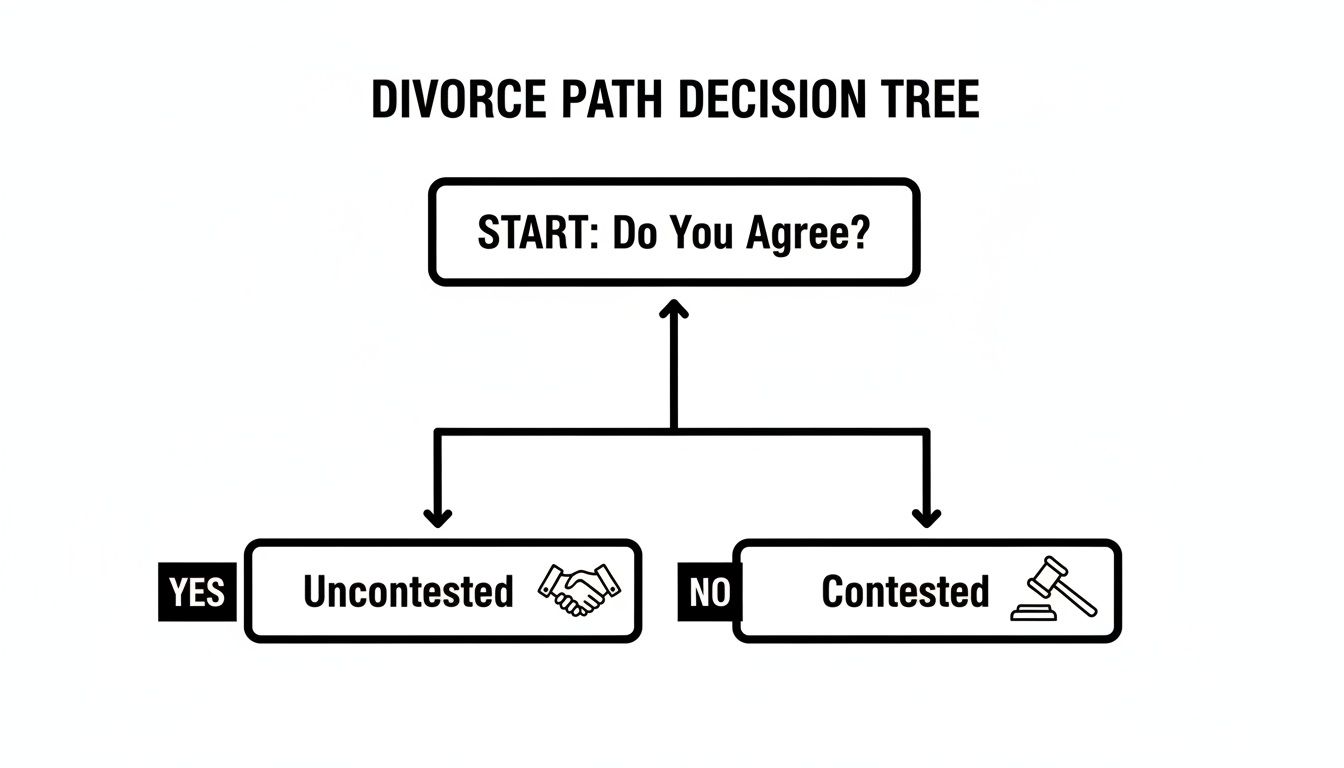
As you can see, the whole process comes down to one simple question: can you agree? If the answer is yes, the smoother, uncontested path opens up for you.
Preparing for a Brampton Divorce Lawyer
To make sure your Separation Agreement is airtight and enforceable, it’s smart to get your documents in order before meeting with a lawyer. Having everything ready makes the process far more efficient and helps your lawyer protect your interests from day one.
A common misconception is that "uncontested" means "no lawyers needed." In reality, having a Brampton divorce lawyer draft or review your Separation Agreement is crucial to ensure it is fair, legally binding, and will hold up in court.
While Ontario law governs local divorces, the core principle of mutual agreement is common in many places. For example, in California, an uncontested divorce also requires both spouses to agree on all key issues like property division and support, allowing them to avoid a court trial based on "irreconcilable differences." You can read more about the California divorce rate and process to see how this principle is applied elsewhere.
Before your consultation, try to gather the following:
-
Financial Statements: Recent pay stubs, bank account statements, and investment details for both of you.
-
Asset and Debt Lists: A complete inventory of everything you own and owe, both jointly and individually.
-
Property Valuations: Appraisals or market assessments for major assets like your home or vehicles.
-
Tax Information: Your most recent income tax returns and Notices of Assessment.
Bringing these documents allows your lawyer to give you accurate advice and draft an agreement that truly reflects what you've both decided, setting the stage for a successful uncontested divorce.
The Uncontested Divorce Process Step by Step
Knowing what an uncontested divorce is one thing, but actually navigating the court process can feel like a maze of legal forms and procedures. For Brampton residents, the path is generally straightforward, but it demands careful attention to detail. This step-by-step guide breaks down each stage into clear, manageable actions so you know exactly what to expect from start to finish.
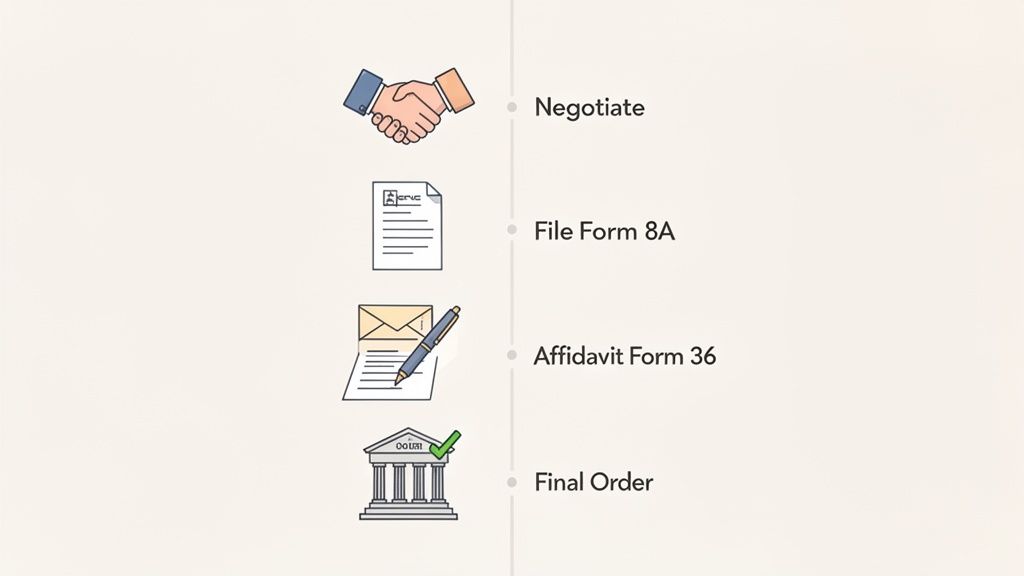
The journey begins long before you file any paperwork. It starts with collaboration and ends with a legally binding court order that officially dissolves your marriage.
Step 1: Finalize Your Separation Agreement
This is the most critical stage. Before you can even think about filing for divorce, you and your spouse must have a fully signed and witnessed Separation Agreement. This document is the cornerstone of your uncontested divorce, proving to the court that you've already sorted out all the major issues related to property, support, and children.
A Brampton divorce lawyer can ensure this agreement is drafted correctly, follows Ontario's Family Law Act, and fully protects your rights. Trying to move forward without a comprehensive, legally sound agreement will bring the whole process to a grinding halt.
Step 2: Prepare and File the Application for Divorce
With your Separation Agreement finalized, the next step is to officially start the divorce proceeding with the court. This involves completing and filing an Application for Divorce (Form 8A), the document that formally asks the court to grant your divorce.
Your application includes essential information like your names, date of marriage, and the date you separated. You’ll file this form, along with your original marriage certificate, at the Superior Court of Justice in Brampton.
The accuracy of the information on Form 8A is vital. Even a small error, like a misspelled name or an incorrect date, can cause the court to reject your application, leading to preventable delays and additional filing fees.
This cooperative approach is becoming the standard for families looking for a less adversarial split. In fact, recent data shows that uncontested divorces make up the majority of cases, which is reshaping how family courts operate. For instance, a review of state statistics shows that nearly 90% of all divorces in California are uncontested, meaning spouses resolve their issues through a written agreement instead of a trial.
Step 3: Serve Your Spouse with the Divorce Documents
Once your Application for Divorce is filed and issued by the court, you must legally "serve" a copy to your spouse. This is a formal, mandatory step to ensure your spouse has been officially notified of the divorce proceedings.
In Ontario, you cannot serve the documents yourself. They have to be delivered by a third party who is over 18, like a friend, family member, or a professional process server. After serving the documents, this person must complete an Affidavit of Service (Form 6B) and swear before a commissioner that they did it correctly.
Step 4: Complete and File the Affidavit for Divorce
After your spouse has been served and the required 30-day response period has passed (which they won't act on in an uncontested case), you can move to the next stage. You now need to complete and file an Affidavit for Divorce (Form 36).
This is a sworn document that confirms several key details for the judge:
-
You meet the one-year separation requirement.
-
There is no chance of reconciliation.
-
All reasonable arrangements have been made for any children, in line with the Federal Child Support Guidelines.
You must sign this form in the presence of a lawyer or a commissioner for taking affidavits. It's then filed with the court, along with a draft of the final Divorce Order. To better understand how paralegals can help you navigate an uncontested split, you can explore the offerings of paralegal divorce services.
Step 5: Await the Final Divorce Order
Once all your paperwork has been filed correctly, a court clerk reviews it to make sure everything is complete. If it is, your file is passed to a judge for a final review. In an uncontested divorce, you don't need to appear in court—the judge reviews your documents in their chambers.
If the judge is satisfied that all legal requirements have been met, they will sign the Divorce Order. This order becomes legally effective 31 days after the date it is signed. After this waiting period, you can request a Certificate of Divorce, which is the official proof that your marriage has been legally terminated.
Understanding the Costs and Timelines in Brampton
When you're thinking about divorce, two of the biggest questions are always: "How much will this cost?" and "How long will this take?" For anyone in Brampton, an uncontested divorce offers a clear and predictable path forward, saving you a whole lot of money and stress compared to a drawn-out court battle. Knowing what to expect helps you plan for your future with a bit more confidence.
An uncontested divorce really has two types of expenses: fixed court filing fees and professional legal fees. The Ontario government sets standard fees for filing the Application for Divorce and getting the final order. While you can't avoid these, they’re a tiny fraction of what a prolonged legal fight could cost.
Breaking Down the Financial Costs
Where you really save money with an uncontested divorce is on the legal fees. Since you and your spouse have already done the hard work of agreeing on all the major issues, your Brampton divorce lawyer isn’t racking up hours on lengthy negotiations, court appearances, or filing endless motions. Their work is targeted and efficient.
Typically, legal services will cover:
-
Drafting the Separation Agreement: This is the critical legal document that puts all your mutual decisions about property, support, and the kids down on paper.
-
Providing Independent Legal Advice (ILA): It’s crucial that both you and your spouse fully understand your rights and what you’re signing. ILA ensures this happens.
-
Preparing and Filing Court Documents: Your lawyer will accurately handle all the necessary forms, like the Form 8A Application and Form 36 Affidavit, making sure they’re done right the first time.
The financial difference is night and day. An uncontested divorce with a solid agreement usually comes with predictable, flat-rate legal fees. A contested divorce, on the other hand, is a different story. With hourly billing for litigation, costs can quickly spiral into the tens of thousands of dollars—sometimes draining the very assets you’re fighting over.
This massive cost difference is why so many couples work hard to find an amicable solution. While fees can vary by location, the principle is universal. A fully litigated divorce can be incredibly expensive no matter where you are, whereas an uncontested divorce might only cost a little more than the court filing fees plus some legal help for the paperwork. To get a sense of how costs compare elsewhere, you can discover more insights about the cost of divorce in California.
Navigating the Divorce Timeline
Even though an uncontested divorce is much faster, some timelines are set in stone under Canadian law. The big one is the mandatory one-year separation period. You must live separate and apart from your spouse for at least 12 months before a judge can legally grant your divorce.
Once you’ve met that requirement and filed your completed application, the court’s processing time kicks in. Here in Brampton and the GTA, you can generally expect this to take between two to four months, assuming all your paperwork is flawless. Any mistakes or missing info can cause major delays, which is exactly why having a lawyer's professional eye on everything is so valuable.
After the judge signs the Divorce Order, there’s one last 31-day waiting period before it officially takes effect. This clear timeline gives you a predictable end date, so you can finally close this chapter and move on with your life.
How a Brampton Divorce Lawyer Protects Your Interests
Even when a separation is completely amicable, trying to handle an uncontested divorce without a lawyer is a major risk. You and your spouse might agree on everything, but the law itself is incredibly complex. A skilled Brampton divorce lawyer isn't there to create conflict; they act as your safety net, ensuring the agreement you've made is not just fair for today but legally solid for years to come.
Their main job is to protect your rights and look out for your long-term interests. A lawyer's trained eye can catch potential problems you might never see, like unspoken assumptions about how property is divided or what happens if financial needs change down the road. They make sure every single detail is compliant with Ontario's Family Law Act and the federal Divorce Act.
Beyond Drafting Paperwork
Thinking a lawyer just fills out forms is a common misconception. Their true value is in strategic guidance and preventing future problems. An experienced family lawyer in Brampton performs critical tasks that safeguard your future well beyond the paperwork.
Here’s where their expertise becomes crucial:
-
Drafting Precise Legal Language: They take your verbal agreements and translate them into a legally binding Separation Agreement. The language they use is precise and ironclad, leaving no room for future arguments or misinterpretations.
-
Providing Independent Legal Advice (ILA): The court needs to know that both of you made informed choices without being pressured. ILA is a formal process where a lawyer confirms you fully understand your rights and the long-term consequences of the agreement you're about to sign.
-
Identifying Future Conflicts: A good lawyer thinks ahead. What if one person wants to move away with the kids? What if someone’s income changes dramatically? They help you build contingencies into the agreement to head off potential court battles later on.
-
Managing the Court Process: They handle the complex court filing process from start to finish. From the initial Form 8A Application to the final Form 36 Affidavit, they ensure every document is perfect to avoid costly rejections or delays from the court clerk.
A well-drafted Separation Agreement is your best insurance against future legal trouble. Investing in a lawyer to get it right from the start is far more cost-effective than hiring one later to fix a flawed or incomplete agreement.
Ultimately, your Brampton divorce lawyer’s role is to make sure the cooperative spirit of your uncontested divorce is cemented in a legally enforceable document. They provide the professional oversight needed to turn your handshake deal into a binding resolution, giving you the security and peace of mind to truly move forward.
Frequently Asked Questions About Uncontested Divorce
As you explore an uncontested divorce, you'll naturally have questions about the finer details. Here are some clear, straightforward answers to the questions we hear most often from clients in Brampton and the GTA.
Can We File an Uncontested Divorce if We Have Children?
Yes, absolutely. Having children doesn’t prevent you from pursuing an uncontested divorce. In fact, it’s often the best path forward for families, as long as you and your spouse are in complete agreement on all parenting matters.
This means you must have settled:
-
Decision-Making Responsibility: This used to be called custody. It’s about who will make the major decisions for your children’s health, education, and religious upbringing.
-
Parenting Time: This is the schedule that outlines when the children will be with each parent.
-
Child Support: The amount must follow the Federal Child Support Guidelines. This isn't something you can negotiate away; it's a legal requirement.
Your Separation Agreement needs to lay out a detailed parenting plan covering all these points. A Brampton divorce lawyer can make sure your plan is solid and meets the court’s standards, which is critical for getting your divorce approved.
What if My Spouse Lives Outside of Ontario?
You can still file for an uncontested divorce here, even if your spouse is in another province or another country altogether. The key legal requirement is that at least one of you has been “ordinarily resident” in Ontario for a full year right before filing the divorce application.
The process is mostly the same, but serving the divorce papers gets a little trickier. You have to follow specific rules for "out-of-jurisdiction service" to make sure the legal notification is done correctly. This is one of those steps where getting professional help from a Brampton divorce lawyer is crucial to avoid simple mistakes that could get your application rejected.
An uncontested divorce isn’t limited by geography, as long as one spouse meets Ontario’s residency rule. The important things are to maintain your agreement and follow the proper legal steps for serving documents across borders.
Do I Have to Go to Court for an Uncontested Divorce?
No, and for many people, this is the biggest benefit. You do not have to step foot in a courtroom for an uncontested divorce in Brampton. The whole process is handled on paper.
Once your Application for Divorce, Separation Agreement, and final Affidavit for Divorce are filed correctly, a judge reviews everything in their office—or "chambers." If they’re satisfied that all the legal boxes are ticked and that the arrangements for any children are fair, they will sign the Divorce Order. There's no hearing and no need to appear in person. This "desk divorce" saves a tremendous amount of time, money, and stress.
At Badesha Law, we know how to provide the clarity and guidance you need to get through your uncontested divorce with confidence. If you're in Brampton or the GTA and need a Brampton divorce lawyer on your side, we’re here to protect your interests and make the process as smooth as possible. Contact us today to discuss your situation by visiting www.badeshalaw.ca