What is a Settlement Conference in Ontario Family Law?

A settlement conference is one of the most important steps in your family law case—a mandatory meeting designed to get you and the other party to find a resolution without going to trial. Think of it as a guided, high-stakes negotiation with a judge acting as an expert referee. This is your chance to settle big issues like parenting time, property division, or support payments with the help of your divorce lawyer in Brampton, ultimately saving you money, reducing conflict, and giving you far more control over the final outcome.

Four people, including a judge or mediator, in a settlement conference room discussing documents.

Understanding the Settlement Conference in Ontario Family Law

When you’re navigating a separation or divorce in Ontario, the court system can feel like a maze. The process includes several required steps to keep cases moving fairly and efficiently, and one of the most critical milestones is the settlement conference. This process is governed by the Family Law Act and the Family Law Rules in Canada, ensuring a structured approach to resolving disputes.

This isn't a trial where a judge bangs a gavel and makes a final ruling. Far from it. This is a formal but private meeting where a judge acts as a neutral facilitator. Their one and only goal is to help you and the other party find enough common ground to reach a mutually acceptable agreement on some, or even all, of your outstanding issues.

The Judge's Role as a Facilitator

The judge’s job here is to offer an experienced, third-party perspective on your case. They will have read the materials filed by both sides, and they’ll give you their candid opinion on what would likely happen if your case went all the way to trial. This "reality check" is often the most valuable part of the day, helping both parties step back and see their positions more objectively.

A key thing to remember is that the judge at the settlement conference is there to guide you, not decide for you. Their insights come from seeing hundreds of cases just like yours, giving them a unique ability to point out the strengths and weaknesses in each side's arguments.

Key Issues Addressed in a Conference

Family law disputes can touch every part of your life, from your finances to your relationship with your children. A settlement conference is the perfect setting to negotiate these sensitive topics. A skilled family lawyer in Brampton will help you focus on resolving the core issues, such as:

  • Parenting Time and Decision-Making: Hammering out the schedules and responsibilities for your children, always with their best interests as the primary focus, as required by Canadian family law.

  • Child and Spousal Support: Calculating fair financial support based on legal guidelines and your family's specific circumstances.

  • Division of Property: Equitably dividing the assets and debts you accumulated during the marriage, including the all-important matrimonial home.

In Ontario's incredibly busy family courts, this step is more than just a formality—it works. In fact, data has shown that settlement conferences successfully resolved 21% of cases, highlighting just how crucial they are in helping families find a way forward without the immense stress and expense of a trial.

Successfully settling these matters gives you a clear, legally binding agreement so you can finally move on. For a deeper dive into the first steps of the process, you might find our guide on how to get a divorce in Canada helpful. Getting advice from a divorce lawyer in Brampton early on is the best way to make sure you walk into this critical meeting fully prepared.

The True Purpose and Goals of the Conference

Let's clear up a common misconception. While the name says "settle," the purpose of a settlement conference is much broader than just signing an agreement on the spot. Think of it as a strategic, judge-led meeting designed to break through the gridlock that keeps families stuck in expensive, draining court battles.

Its primary goal is to create a structured, off-the-record space for a candid conversation about how to resolve your case.

This is a world away from a trial. At trial, a judge hears evidence and imposes a final, binding decision on your family. In a settlement conference, the judge’s role is completely different. They act as a facilitator and guide—not a final decision-maker. Their job is to offer a neutral, expert opinion on how a trial might play out, pushing both sides toward a reasonable compromise.

Narrowing the Issues in Dispute

One of the most valuable things that happens in a settlement conference is narrowing the scope of the conflict. Even if you can’t solve the whole puzzle, you can often put a few key pieces in place.

For example, you might not agree on spousal support, but you might be able to agree on the value of the family home or a specific holiday schedule for the kids. By getting these smaller items off the table, you simplify the entire case. This saves a mountain of time and legal fees, ensuring that if you do end up at trial, it’s only to fight over the one or two core issues that truly need a judge’s ruling. This is precisely why a sharp divorce lawyer in Brampton will tell you how critical this step is.

The judge’s insight is like getting a sneak peek at how a court might view your case. This "reality check" can be powerful, often prompting both sides to reconsider entrenched positions and move closer to a fair agreement, empowering you to maintain control over the outcome.

Ensuring Full Financial Disclosure

Another critical function of the conference is to act as a financial checkpoint. Under Ontario’s Family Law Act, full and frank financial disclosure isn't optional—it's mandatory. This meeting is where the judge ensures everyone has laid their cards on the table.

The judge will confirm that all essential documents have been exchanged, such as:

  • Proof of income (pay stubs, tax returns)

  • Bank and investment account statements

  • Property valuations

  • Credit card and loan statements

If one side is holding back information, the judge can make a direct order compelling them to produce it. This ensures no one is negotiating in the dark and is the absolute bedrock of any fair settlement.

Finally, the conference is about exploring every possible path to resolution. This could mean brainstorming creative solutions you hadn’t considered or talking through different settlement proposals. For anyone weighing their options, understanding the massive difference between a negotiated settlement and a court battle is crucial. You can learn more about how these paths diverge in our article on contested vs. uncontested divorce.

Ultimately, the conference helps you and your family lawyer in Brampton map out the most efficient and effective way forward for your family.

How to Prepare for Your Settlement Conference

Success in a settlement conference isn't about luck—it's a direct result of meticulous preparation. Walking into that meeting unprepared is like trying to navigate a new city without a map. You'll get lost, fast. By taking deliberate steps beforehand, you and your family lawyer in Brampton can build a strong, clear, and persuasive case for your desired outcome.

The cornerstone of this preparation is your Settlement Conference Brief (Form 17C). This is, without a doubt, one of the most important documents you will file in your entire case. It's your formal opportunity to tell your story to the judge, outline the history of the dispute, clearly state what's left to resolve, and—most importantly—present your formal Offer to Settle.

Mastering the Settlement Conference Brief

Think of the brief as the judge’s roadmap to your case. A well-organized, compelling brief allows the judge to quickly grasp the core of the conflict and the reasonableness of your position before you even step into the room.

Your brief must include several key parts:

  • A Summary of the Issues: A clean, concise overview of what you've already agreed on and what's still in dispute.

  • Your Proposed Solutions: This is where you get specific. You'll detail your proposal for resolving each outstanding issue, whether it’s parenting time, property division, or something else.

  • Updated Financial Statements: Complete and accurate financial disclosure is non-negotiable. For a detailed breakdown, you can learn more about the Form 13.1 Financial Statement in our guide.

  • A Formal Offer to Settle: This is a crucial strategic document detailing the exact terms under which you are willing to resolve the entire case.

Filing this document on time is absolutely critical. Missing the court-mandated deadline can lead to cost penalties or even force the conference to be rescheduled, causing unnecessary delays and expenses.

Developing Your Negotiation Strategy

Beyond the paperwork, effective preparation means working closely with your divorce lawyer in Brampton to develop a clear and realistic negotiation strategy. This isn't about just showing up; it's about going into the conference with a firm understanding of your goals and your limits.

This infographic shows the fundamental goals of the settlement process.
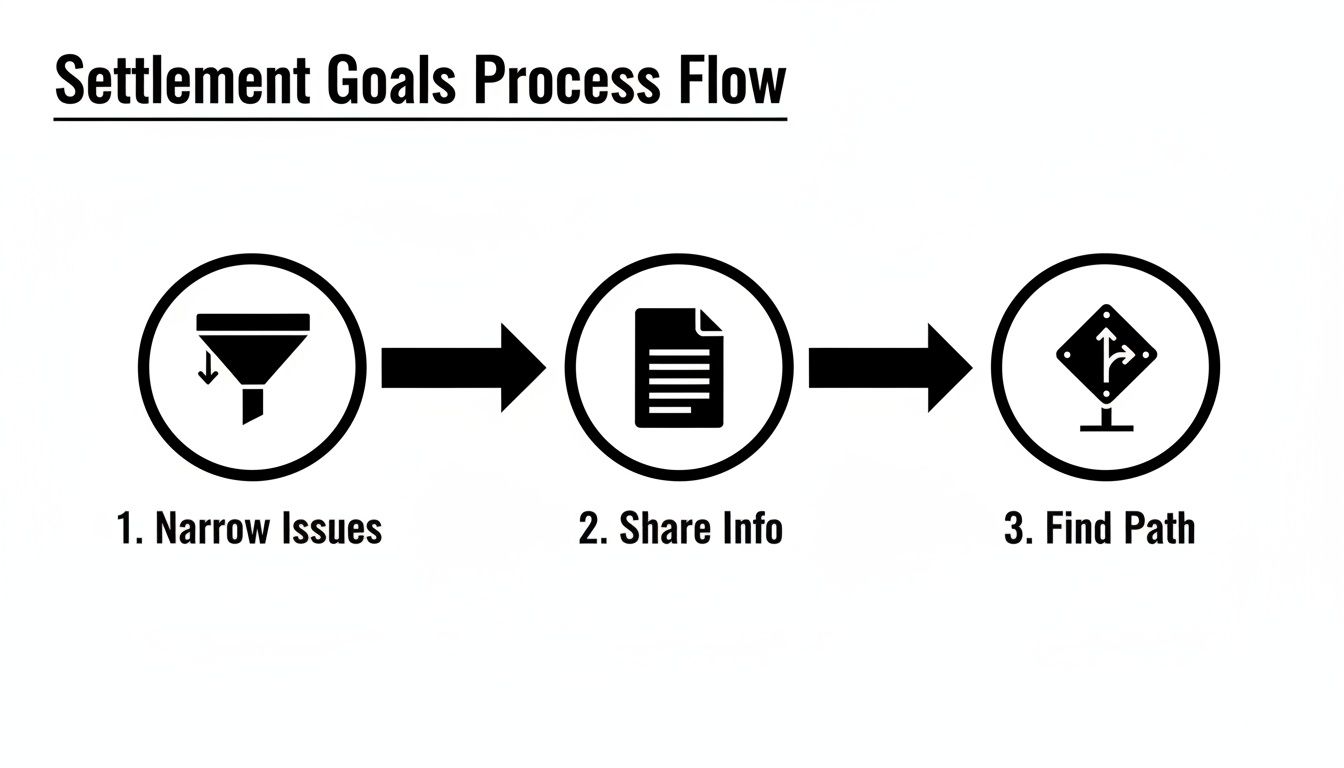
A flowchart illustrates three steps for settlement goals: Narrow Issues, Share Info, and Find Path.

As you can see, success comes from a structured approach: focus the dispute, ensure everyone has the right information, and then work together to find a path forward.

Before the conference, you and your lawyer should define three key settlement positions:

  1. Your Ideal Outcome (Best-Case Scenario): This is the opening position you will aim for.

  2. Your Acceptable Middle Ground: A reasonable compromise you are willing to consider.

  3. Your Bottom Line (Worst-Case Scenario): The absolute minimum you will accept before deciding to proceed to trial.

Knowing these three positions empowers you to negotiate from a place of strength and confidence. It prevents you from making reactive decisions under pressure and ensures any agreement you make aligns with your fundamental needs.

Ultimately, thorough preparation demystifies the entire process. It reduces anxiety and significantly increases the odds of achieving a fair and lasting resolution at your settlement conference.

Pros and Cons of a Settlement Conference

Heading to a settlement conference can bring a mix of hope and apprehension. While these conferences are a powerful tool for resolving your case, it's wise to enter with a balanced perspective. Understanding the potential upsides and downsides helps you and your divorce lawyer in Brampton set realistic goals and make clear-headed decisions.

The Pros: Clear Advantages of Settling

The benefits are significant, primarily saving you time, money, and emotional energy. A successful conference can conclude months or years of legal battles in a single day, allowing you to avoid the immense stress and expense of a full trial.

  • Cost and Time Savings: A trial is an incredibly expensive and slow process. Settling here means you avoid staggering legal fees, expert witness costs, and days spent in a courtroom.

  • Reduced Emotional Strain: The constant conflict of a trial takes a serious toll on you and your family. A settlement provides closure and allows everyone to move forward.

  • You Control the Outcome: In a trial, a judge makes the final decision. Here, you and the other party are in control, allowing for creative and personalized solutions that fit your family’s unique needs.

  • Priceless Judicial Insight: You get a rare chance to hear a judge’s honest, off-the-record take on your case. This feedback is invaluable, whether you settle that day or not.

The Cons: Potential Drawbacks and Risks

Of course, the process isn't perfect, and there are potential downsides. Knowing these risks helps you avoid disappointment and ensures you aren't pressured into an unfair compromise. A sharp family lawyer in Brampton will be your safeguard against these possibilities.

  • No Guaranteed Resolution: Despite best efforts, a settlement isn't guaranteed. If you can't reach an agreement, you'll have spent time and money on a meeting that didn't end the dispute.

  • Pressure to Settle: The environment is geared toward compromise, which can sometimes create intense pressure to accept an offer that feels unfair or falls short of your needs.

  • Emotional Burnout: The day can be long and emotionally draining. Fatigue can cloud your judgment when making critical decisions.

A settlement conference is a strategic fork in the road. It provides an excellent off-ramp from the lengthy and expensive highway of litigation, but only if the destination is fair and acceptable to you. Never feel forced to take an exit that doesn't lead where you need to go.

Effective Strategies for a Settlement Conference

Showing up to your settlement conference with a skilled legal advocate is like bringing a seasoned guide on a tough expedition. An experienced divorce lawyer in Brampton does more than just file paperwork; they come armed with specific, proven strategies designed to protect your interests and steer the negotiations toward a resolution in your favour.

A core strategy is shifting from positional bargaining ("I want the house") to interest-based negotiation ("I need the house for the children's stability"). This approach uncovers the real needs driving both sides, often revealing creative solutions that break through deadlocks.

The Power of the Offer to Settle

One of the most powerful tools is the formal Offer to Settle, submitted with your conference brief. This is a strategic legal move with serious weight under Ontario's Family Law Rules. A well-crafted offer clearly lays out a reasonable solution and creates significant cost consequences for the other party if they unreasonably reject it and fail to get a better result at trial.

An Offer to Settle is a calculated move that turns the tables. It's not a sign of weakness; it's a demonstration of reasonableness that puts the financial risk squarely on the other party if they choose to drag out the conflict.

Leveraging Judicial Feedback and Strategic Concessions

Throughout the conference, the judge will give candid feedback. An astute family lawyer in Brampton knows how to use these insights to your advantage. If the judge hints your position is strong, your lawyer will press that advantage. If the judge raises a concern, your lawyer will know how to pivot. Part of this involves making calculated concessions on lower-priority issues to build goodwill and encourage reciprocation on what matters most to you.

For those just starting this journey, understanding what to expect from an initial meeting is key. You can learn more by reading our guide on what happens during a free divorce lawyer consultation. This expert guidance ensures that every move made during the conference is deliberate and aimed at achieving your best possible outcome.

What Happens After the Conference Ends

The meeting is over, the discussions have ended, and you’re walking out of the courthouse. So, what’s next? The path forward now splits into two very different tracks, and it all depends on what happened inside that conference room—whether you managed to reach a full agreement, a partial one, or no deal at all.

Close-up of two professionals shaking hands over a contract, signifying a successful business agreement.

If You Reach an Agreement

This is the best-case scenario. When you and the other party successfully resolve all the outstanding issues, your divorce lawyer in Brampton immediately shifts gears to make that agreement official and legally binding. A handshake deal isn't enough; it needs to be properly documented and filed with the court.

This usually happens in two main steps:

  • Minutes of Settlement: This is the document often drafted right there at the courthouse while the terms are fresh in everyone’s mind. It lays out everything you agreed upon. Both you and the other party (and your lawyers) sign it, and it's filed with the court.

  • Consent Order: The terms from those Minutes of Settlement are then converted into a formal Consent Order. A judge signs this document, transforming your private agreement into a powerful, legally enforceable court order.

A signed agreement provides finality. Once it’s turned into a court order, it carries the full weight of the law. This ensures both sides must follow the terms you negotiated, bringing the dispute to an official close.

To get a clearer picture of this final step, you can learn more about what a consent order is and see how it cements your settlement into law.

If No Agreement Is Reached

Don’t lose hope if you can't solve every single issue. A settlement conference is almost never a waste of time. Even reaching a partial agreement is a win because it narrows down the list of things you still have to fight about in court.

For any issues that remain unresolved, the judge will set the schedule for the next phase of the court process. This typically includes:

  1. A Trial Management Conference: This is another meeting, but its purpose is purely logistical. You'll plan out the details of a trial, like scheduling witnesses and confirming what evidence will be presented.

  2. Trial: If a settlement just isn't possible, the remaining issues will ultimately be decided by a judge at a formal trial.

Even without a full resolution, the conference forces both sides to put their cards on the table. It clarifies everyone's position and gives your family lawyer in Brampton invaluable insight into the other party’s case—all of which is critical for trial preparation.

Frequently Asked Questions

When you're heading into a settlement conference, it's natural to have a lot of questions. Here are some straightforward answers to the most common ones we hear from our clients in Brampton.

Is a Settlement Conference Mandatory in Ontario?

Yes, for most contested family law cases, it absolutely is. Before you can even get a date for a trial, the court system in Ontario requires you to go through a settlement conference. Think of it as a mandatory, structured opportunity for you and your spouse to resolve your issues with the guidance of a judge and an experienced family lawyer in Brampton. The goal is to avoid the cost and stress of a trial if at all possible.

Can the Judge at the Settlement Conference Make a Final Decision?

No, and this is a critical point to understand. The judge's role at a settlement conference is to be a guide, not a final decision-maker. They'll listen to both sides, offer their experienced opinion on the likely outcome at trial, and help facilitate a productive discussion. However, they cannot impose a final, binding order on any contested issue unless both you and your spouse agree to it. To ensure fairness, the judge who oversees your settlement conference will never be the same judge who would preside over your trial if your case doesn't settle.

What if We Don’t Settle at the Conference?

Don't worry, this happens all the time. If you can't reach a full agreement, the conference is still incredibly valuable. The judge will make a note of any progress you made, which often helps narrow down the list of issues that actually need to go to trial. From there, the judge will set dates for the next steps in your case, which is usually a Trial Management Conference. A divorce lawyer in Brampton can walk you through what comes next and how to prepare.


Navigating a settlement conference successfully requires a clear strategy and strong, experienced advocacy. If you still have questions about what a settlement conference is or need clear guidance on your family law matter, the team at Badesha Law is here to help. We bring the expertise needed to protect your interests and work toward a fair, lasting resolution.

Contact us for a consultation at https://badeshalaw.ca.

What if Your Spouse Won’t Sign a Separation Agreement in Ontario? Your Next Steps

When your spouse refuses to sign a separation agreement, it feels less like a bump in the road and more like the road has disappeared entirely. Suddenly, the amicable path you hoped for is gone. This is the moment your separation shifts from a cooperative discussion to a formal, legal dispute. If you’re facing this challenge, understanding what if your spouse won’t sign a separation agreement in Ontario is the first step toward regaining control.

Instead of working together, you are now facing a contested separation. This means a judge, not you, will likely make the final decisions about your property, finances, and children.


Key Takeaways

  • Refusal to Sign Means a Contested Separation: Your spouse cannot be forced to sign. Their refusal moves the process from a private negotiation to a formal court-based system.
  • You Have Options: Even without a signed agreement, you can move forward through lawyer-assisted negotiation, mediation, or, if necessary, a court application.
  • Protect Yourself Immediately: You can seek interim court orders for exclusive possession of the home, child support, spousal support, and to freeze assets to prevent them from being depleted.
  • Court is a Last Resort: The court process is expensive and time-consuming, often costing over $20,000 and taking 18-24 months. A judge will make the final decisions, removing your control.
  • Legal Counsel is Crucial: An experienced family lawyer is essential to navigate the complexities, protect your rights, and guide you toward the most strategic and cost-effective resolution.

Table of Contents


The Immediate Shift From Amicable To Contested Separation

In Ontario, a spouse’s refusal to sign is more than just a frustrating delay. It’s a fundamental pivot in your legal journey. The cooperative process you envisioned evaporates, replaced by a formal, structured, and often adversarial court system.

Instead of working together to decide the terms of your future, you’re now preparing for a judge to make those decisions for you on the most critical issues: property division, spousal support, and the parenting plan for your children.

This refusal is what officially transforms your situation from an uncontested separation into a contested one. The reasons for this can be complex, and sometimes, understanding the dynamics can involve recognizing signs of narcissism, as certain personality traits often fuel conflict and a need to control the process.

From Cooperation To Court Intervention

Think about a typical Brampton couple. They agree to separate but hit a wall over who keeps the matrimonial home on their quiet suburban street. One spouse drafts a fair proposal, but the other, unwilling to budge, simply refuses to sign.

That one act escalates everything. What could have been resolved through a few focused negotiation sessions now requires court intervention, dramatically ratcheting up both the stress and the legal bills. It’s a scenario we see all the time when a partner won’t sign separation papers in Peel Region.

The financial hit is massive. An uncontested divorce might cost somewhere in the neighbourhood of $1,860, but a contested case can easily skyrocket to an average of $20,625 in Canada—a number that truly reflects the complex and lengthy court process in Ontario.

Loss Of Control And Predictability

The biggest consequence of a contested separation is the loss of control. A separation agreement is your chance to craft a customized solution that actually works for your unique family. When that option is gone, you’re handing the decision-making power to a judge who doesn’t know you, your finances, or your children.

Suddenly, you’re facing a world of uncertainty.

  • Financial Uncertainty: Without an agreement, there’s no way to predict how assets will be divided or what support payments will look like.
  • Parenting Decisions: A judge, based on limited information presented in a formal courtroom setting, will decide on parenting time and major decision-making for your kids.
  • Prolonged Conflict: The court process is inherently adversarial. It can poison an already tense relationship, making effective co-parenting down the road that much harder.

To get a clear picture of what you’re giving up, it helps to know what a good agreement covers. Our detailed guide on what a separation agreement in Ontario should include breaks down all the crucial components you’ll want to protect.

To make the difference crystal clear, let’s compare the two paths side-by-side. The table below shows just how different the journey becomes when that signature is missing.

Uncontested vs. Contested Separation: A Quick Comparison

Aspect Signed Separation Agreement (Uncontested) No Signed Agreement (Contested)
Process Collaborative and private. You file paperwork after all issues are settled. Adversarial and public. Involves court filings, conferences, and potentially a trial.
Control You and your spouse make all the final decisions about your future. A judge makes the final decisions based on the law and evidence presented.
Timeline Predictable and much faster. Typically 4-6 months for the court to process. Unpredictable and slow. Can take 12-24 months or even longer to resolve.
Cost Significantly lower. Often managed with flat fees, providing cost certainty. Substantially higher. Billed hourly, with costs escalating with every conflict.
Emotional Toll Lower stress. The focus is on finding common ground and moving forward. High stress. The process is designed for conflict, which can damage co-parenting relationships.

As you can see, the presence or absence of a signed agreement creates two completely different realities. One is a path you control; the other is a path controlled by the court system.

What Are Your Options When a Spouse Refuses to Sign?

When your spouse flat-out refuses to sign a separation agreement, it’s easy to feel like you’ve hit a brick wall. But it’s not the end of the road; it’s just a detour. This is where strategic thinking comes in, and thankfully, Ontario’s family law system provides several other paths forward. You are not powerless just because your spouse is being difficult.

Instead of working toward a single signed document, your journey now branches into different ways of resolving the dispute. The destination is the same: to formally and finally settle issues like property division, support, and parenting. It’s the route to get there that changes, shifting from a private agreement to a more structured negotiation or, if needed, court intervention.

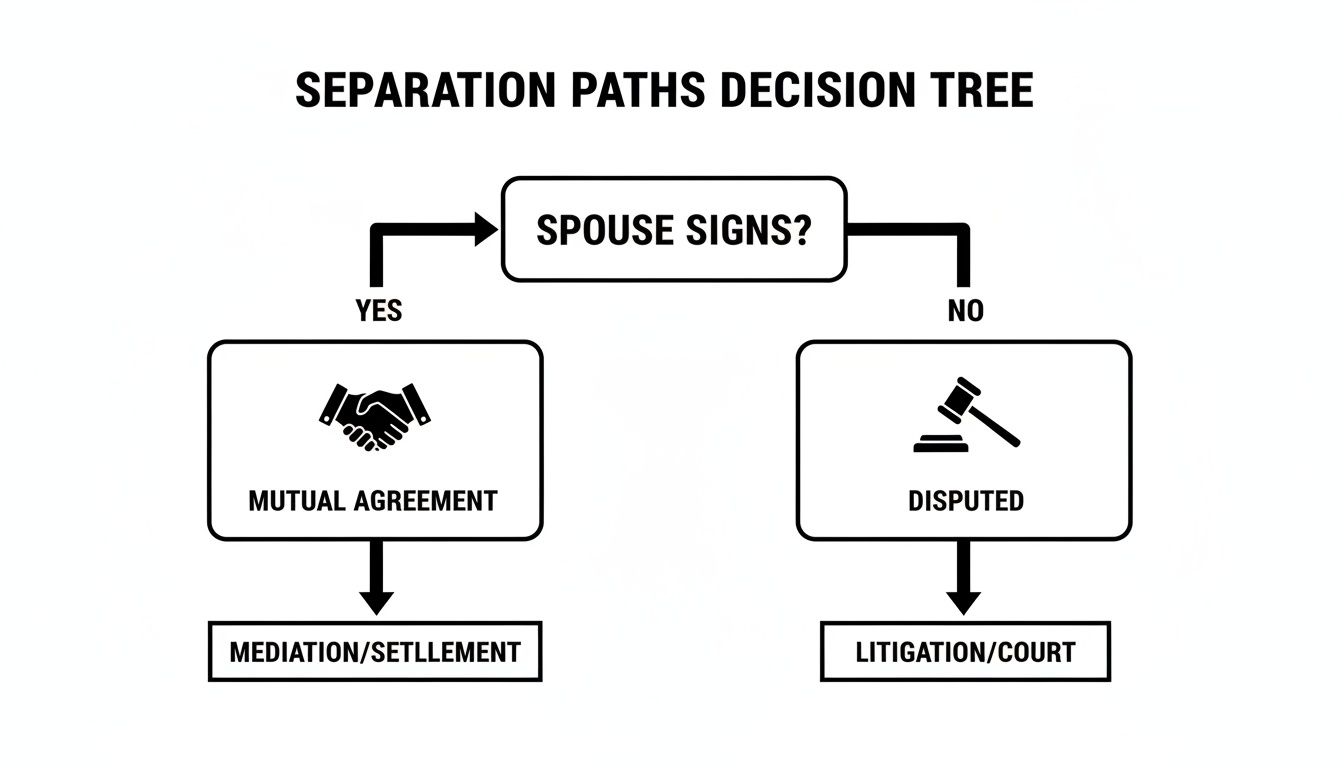
The flowchart below gives you a clear visual of the choice you’re facing. It separates the collaborative path from the formal legal one you’ll need to take when your spouse won’t cooperate.

A decision tree flowchart outlining separation paths based on spouse agreement, leading to mediation or litigation.

As you can see, a signed agreement is the most direct route. But a refusal to sign simply opens up other structured, necessary alternatives to get you to the finish line.

Lawyer-Assisted Negotiation

Often, the very first step after hitting an impasse is to get the lawyers talking. Your lawyer can communicate directly with your spouse’s lawyer, which shields you from the direct—and often highly emotional—conflict. They’ll present your position, exchange formal proposals, and work toward a compromise based on established legal principles.

A skilled family lawyer can pinpoint areas of leverage and reframe your proposals in a way that makes an agreement seem much more appealing, often turning a hard “no” into a “maybe.” That professional distance is frequently what it takes to break the stalemate.

This process is definitely less formal than going to court, but it’s far more structured than just talking things out yourselves. It leaves room for creative solutions while making sure your legal rights are protected every step of the way.

Mediation and Collaborative Family Law

If direct lawyer-to-lawyer negotiation doesn’t work, alternative dispute resolution (ADR) offers a great middle ground between negotiation and court.

  • Mediation: A neutral, third-party mediator sits down with you and your spouse to guide the conversation. The mediator doesn’t make any decisions for you; their job is to help you find common ground and craft your own solutions. It’s completely confidential and usually much faster and cheaper than litigation.
  • Collaborative Family Law: This is a more team-based approach. Both you and your spouse, along with your specially trained collaborative lawyers, sign a binding agreement to resolve all issues without going to court. The process often includes financial and family professionals, and the entire focus is on reaching a settlement everyone can live with.

Both of these methods keep the control in your hands and are designed to preserve a respectful relationship, which is incredibly important if you have children together.

The Final Option: A Court Application

When every other avenue has been tried and failed, filing an application with the court becomes the necessary last resort. This action formally asks a judge to step in and make decisions on all the unresolved issues.

While going to court is the most time-consuming and expensive option, it guarantees a final resolution when your spouse simply refuses to cooperate on any level. The court can issue orders that are legally binding, effectively creating a resolution for you. These decisions are then put into a final court order, which works just like a signed agreement. You can learn more about how a judge’s ruling becomes an enforceable document by understanding what is a consent order in Ontario.

Starting a court application forces the issues and ensures your separation process moves forward—with or without your spouse’s signature.

How To Protect Your Rights And Finances Now

A person's hands holding house keys near a court application document on a wooden table, suggesting legal proceedings.

While the final resolution is stuck in limbo, your life doesn’t hit the pause button. Bills are still due, the kids need stability, and you have to worry about assets being sold or drained before you get your fair share. When your spouse won’t sign a separation agreement in Ontario, you can’t afford to just wait—you need to take immediate steps to secure your position.

Fortunately, the court system provides powerful tools for short-term relief. These are called interim court orders, and they act as temporary rules to govern your family’s finances and living arrangements until a final agreement or court order is in place.

These orders aren’t about winning the final fight. They’re about establishing stability and fairness right now by addressing the most urgent issues that pop up during a separation.

Securing Your Home And Financial Stability

One of the most immediate concerns is often the matrimonial home. Tensions can make living together unbearable or even unsafe. In these situations, you can ask the court for an order for exclusive possession, which legally requires one spouse to move out, regardless of whose name is on the title.

This is a critical step for creating a stable environment, especially for any children involved. It removes the daily conflict from the home while the long-term division of property gets sorted out.

Financial continuity is another huge worry. If your spouse was the primary earner and has suddenly cut you off financially, you can seek temporary orders for:

  • Child Support: To ensure your children’s needs are met immediately, based on the Federal Child Support Guidelines.
  • Spousal Support: To provide for your own necessary expenses while the separation process unfolds.

These temporary support orders provide a crucial financial lifeline. They prevent one spouse from using money as a weapon to force the other into an unfair settlement. To effectively protect your rights, it’s helpful to understand the implications of marital contracts, such as knowing what happens if you sign a prenup and get divorced.

Preventing The Depletion Of Family Assets

What if you have a legitimate fear that your spouse might empty bank accounts, cash out investments, or sell valuable assets before they can be divided? This is a common and completely valid concern.

You can file a motion for a non-depletion order, sometimes called a preservation order. This court order freezes significant assets, legally preventing either spouse from selling, transferring, or mortgaging property without written consent or another court order.

This is one of the most important protective measures you can take. It ensures the family property remains intact so it can be divided fairly later on. For a deeper look at safeguarding your assets during a split, check out our detailed guide on how to protect your property in a divorce. A skilled family lawyer in Brampton can file these motions quickly to secure your financial future.

The Reality of Family Court in Ontario

Deciding to go to court is a massive step, and it’s vital to have a clear-eyed view of what the process actually involves. When negotiation and mediation hit a wall because your spouse just won’t sign a separation agreement, the Ontario family court system becomes the only path to a final resolution.

This isn’t a quick or simple fix. It’s a formal, structured, and often painfully long journey.

The whole thing kicks off when one spouse files an Application with the court. That single step officially starts the litigation process and sets a whole series of events in motion. Both of you must then dive into mandatory financial disclosure—a detailed and often exhausting process of exchanging mountains of documents about income, assets, and debts. This isn’t optional; it’s the bedrock for every decision the court will make.

Key Stages of a Contested Court Case

Once the initial paperwork is filed, your case will crawl through several distinct stages, each with its own purpose and potential for delays. These aren’t just quick meetings; they are formal steps in a long, drawn-out process.

  • First Appearance: A brief, administrative court date just to make sure all the initial paperwork is in order.
  • Case Conference: This is the first real meeting with a judge. The goal here is to nail down the key issues, see if there’s any chance of a settlement, and set a timeline for what comes next. You’ll likely attend several of these.
  • Motions: If urgent problems pop up—like needing temporary support or exclusive possession of the home—either of you can bring a “motion” to ask a judge for a temporary order.
  • Settlement Conference: This is a more focused, serious attempt to resolve everything with a judge’s help before you get to the most expensive stage of all.
  • Trial: If you still can’t reach a settlement, the case goes to trial. This is where both sides present evidence, and a judge makes a final, binding decision for you.

The True Cost of Litigation

Going to court isn’t just emotionally draining; it’s also incredibly expensive. The adversarial, combative nature of litigation sends legal fees skyrocketing. A contested divorce often costs more than ten times what an uncontested one does, usually because of fights over support and property.

A revealing three-year study of reported Ontario family law cases looked at 470 cost decisions, showing just how often unsigned agreements spiral into costly litigation. Contested divorces in Ontario frequently average over $20,000, a huge jump from the sub-$2,000 cost of most uncontested cases. You can learn more about the financial impact of contested family law matters from these findings.

The timeline is just as intimidating. While every case is unique, it’s not at all unusual for a contested family law matter in Ontario to take 18 to 24 months—or even longer—to finally reach a conclusion. That prolonged uncertainty freezes your ability to move on with your life. Understanding this harsh reality is crucial before you decide that court is your only way forward.

Why an Experienced Family Lawyer Is Essential

Trying to manage a high-conflict separation on your own is a huge risk. The moment your spouse refuses to sign a separation agreement in Ontario, the dynamic shifts. What was once a private negotiation becomes a complex legal battle where the rules are anything but obvious.

This is exactly when the guidance of an experienced family lawyer goes from being a good idea to an absolute necessity.

A skilled lawyer does so much more than file paperwork. They become your strategic advisor, your negotiator, and your advocate, tasked with protecting your rights and your future at every single turn. Their job is to cut through the emotional chaos and transform a tense, messy situation into a structured, manageable legal process.

Strategic Negotiation and Advocacy

One of the most valuable roles a lawyer plays is negotiating from a position of strength and deep legal knowledge. They understand the nuances of Ontario’s Family Law Act and can spot leverage points you would almost certainly miss on your own.

For instance, a sharp family lawyer in Brampton might recognize that your spouse’s financial disclosure is incomplete, giving you a powerful advantage in negotiations or in court. They know how to frame proposals in a way that highlights the massive costs and risks of litigation for your spouse, which often brings a stubborn ex-partner back to the table.

This kind of expertise translates into very real results:

  • Securing fair support: Making sure child and spousal support calculations are accurate, complete, and just.
  • Protecting your assets: Preventing an unfair division of property, especially the matrimonial home.
  • Creating favourable parenting plans: Advocating for a parenting schedule that truly serves your children’s best interests.

Navigating the Court System

If court becomes inevitable, your lawyer’s mission is to present your case in the strongest, most compelling light. They handle the intricate procedural requirements, from filing the right documents on time to representing you effectively in front of a judge.

An experienced family lawyer anticipates the other side’s arguments and prepares persuasive, evidence-based responses. They remove the emotion from the equation and focus on the facts and the law—which is what ultimately sways a judge’s decision.

Investing in expert legal counsel isn’t just another expense; it’s the most effective way to protect your financial security and your family’s well-being. To get a better sense of the specific benefits, you can learn more about why hiring a local Brampton family lawyer makes such a critical difference in the outcome of your case.


Stuck with a spouse who won’t cooperate? Don’t wait. Book a consultation with our experienced family law team to understand your options and take back control.


Serving Brampton, Mississauga, and the GTA

At Badesha Law, we know the unique pressures families face in Brampton, Mississauga, and across the Greater Toronto Area. When you’re dealing with a spouse who won’t sign a separation agreement, having a local team that understands the Peel Region court system isn’t just a benefit—it’s critical. We offer the expert guidance you need when searching for a “family lawyer near me” to handle a difficult separation.

We regularly guide clients through this exact situation, offering clear, practical steps to cut through the stress and avoid the kind of costly mistakes that can happen when you’re trying to figure it all out on your own.

Our team lives and breathes the Brampton courthouse. That local experience means we know how to navigate the system efficiently, whether you’re just starting the separation process or you’re already caught in a contentious court battle. We’re here to protect your interests. For a closer look at local procedures, our guide on family law in Brampton covers divorce and support offers more detail.

If you’re stuck wondering what to do next because your spouse is refusing to sign, the best first step is to talk to a family lawyer in Brampton. We can lay out your legal options and help you build a clear path forward.

Related Reading


Frequently Asked Questions

Can I force my spouse to sign a separation agreement?

No, you absolutely cannot. A separation agreement is a voluntary contract. A judge in Ontario has no power to compel someone to sign. If a spouse is pressured or coerced into signing, the agreement could be challenged and set aside by a court later. For the document to be legally binding, both parties must sign willingly after receiving independent legal advice.

Can I still get divorced if we don’t have an agreement?

Yes, you can. In Ontario, you can file for divorce after being separated for one full year, with or without a signed agreement. However, if there are outstanding issues like property division, support, or parenting, a judge will likely not grant the divorce until those matters are formally resolved either by a separation agreement or a final court order.

How long can my spouse stall by refusing to sign?

Indefinitely, if you let them. A spouse can refuse to sign an agreement forever, but that doesn’t mean your separation is stuck in limbo. You can break the stalemate by filing a court application. This action forces the legal process to move forward, creating firm deadlines for financial disclosure and court appearances that your spouse must adhere to.

What’s the first step if my spouse won’t even negotiate?

If communication has completely broken down, your first step should be to consult with an experienced family lawyer. Your lawyer can open a formal line of communication by sending a letter to your spouse or their legal counsel. This official step outlines your position, proposes a path forward like mediation, and shows you are serious about resolving matters.

Is a court order the same as a separation agreement?

Functionally, yes. Both a signed separation agreement and a final court order are legally binding documents that are enforceable. They both clearly define your rights and obligations regarding finances, property, and parenting. The key difference is who made the decisions: in an agreement, you and your spouse decide; in a court order, a judge decides for you.

What if my spouse is hiding money or assets?

If you suspect your spouse is hiding or disposing of assets, you must act quickly. Your lawyer can file an urgent motion with the court to request a non-depletion or preservation order. This order freezes significant assets, legally preventing your spouse from selling, transferring, mortgaging, or draining accounts until the property can be fairly divided.

Is court really that much more expensive than mediation?

Yes, in almost all cases. Litigation is significantly more expensive than alternative dispute resolution methods like mediation. Mediation is a collaborative process designed to find common ground quickly, which keeps legal fees down. Court involves multiple appearances, extensive preparation, and an adversarial process, causing hourly legal costs to escalate rapidly.


Disclaimer: This article provides general information and does not constitute legal advice. For advice tailored to your specific situation, please consult with a qualified family lawyer.

Written by the legal team at Badesha Law, experts in Ontario family law.


Marriage Contract Essentials for Brampton Business Owners

A marriage contract is a legally binding agreement under Ontario's Family Law Act that gives you and your partner the power to write your own financial rules for your marriage. Often called a "prenup," it serves as a clear roadmap for handling property and spousal support if you ever separate. For clients in Brampton, especially business owners, this ensures your arrangements reflect your unique life, not the one-size-fits-all rules set by provincial law.

What Is a Marriage Contract in Ontario?

A smiling cartoon couple holds a marriage contract document featuring a house, Canadian maple leaf, and piggy bank.

Think of a marriage contract as a personalized financial plan for your relationship. It’s not about planning for failure; it’s about creating clarity and understanding right from the start. For many couples in Brampton, this document is a smart, proactive tool for financial planning, fully compliant with the Family Law Act in Ontario.

Instead of leaving critical decisions to the default rules, a marriage contract lets you decide on key matters beforehand. This is especially important for Brampton business owners, people with assets from before the marriage, or anyone expecting an inheritance.

The Purpose of a Marriage Contract

The main goal is to create certainty. When you agree on how assets and debts will be handled if you separate, both partners can enter the marriage feeling confident and secure. A well-drafted contract can prevent serious conflicts down the road by making sure everyone is on the same page financially from day one.

Here are the actionable benefits for Brampton residents:

  • Protect Separate Property: You can clearly state that assets you owned before the marriage, or any gifts and inheritances you receive during it, remain your separate property and won't be divided.
  • Define Spousal Support: The contract can set out the terms for spousal support. You can agree to waive it completely, or you can establish a specific amount or a set timeframe for payments.
  • Safeguard Business Assets: For entrepreneurs in Brampton, this is a critical benefit. A contract can shield your business from being divided or sold off upon separation, protecting your livelihood and your employees.
  • Clarify Debt Responsibility: It can outline exactly how debts—both those you bring into the marriage and any you acquire together—will be managed.

A Modern Tool for Modern Marriages

Marriage in Ontario has changed a lot, and these agreements are more relevant than ever. Back in 1997, Ontario saw 23,629 divorces—a rate of 207 per 100,000 people. This reality has led more couples to use domestic contracts to manage their financial lives proactively. A family lawyer in Brampton can confirm the steady increase in requests for marriage contracts, especially in communities where business ownership and generational wealth are common. You can explore more historical data on marriage and divorce trends in Canada.

A marriage contract is not a sign of distrust. It is an act of financial transparency and responsible planning that strengthens a partnership by ensuring both individuals feel secure and respected. It lays a foundation of clear communication for your future together.

Why Brampton Business Owners Need a Marriage Contract

A cartoon man next to a Brampton building with a shield and a heart, symbolizing protection and care.

As a Brampton entrepreneur, your business is more than just an asset. It’s your passion, your legacy, and the result of countless hours of hard work. But have you considered what could happen to that effort if your marriage ends?

Without a marriage contract, the standard rules of Ontario's Family Law Act apply. This means any growth in your business's value during the marriage is typically split 50/50 through a process called equalization of net family property. For a business owner, this can be devastating.

To meet this obligation, you could be forced to sell shares, liquidate essential assets, or take on massive debt to pay your former spouse. For many Brampton businesses, this can cripple operations or even lead to a forced sale.

Protecting Your Business Is Protecting Your Future

Think of a marriage contract as a core part of your business's risk management strategy. You have insurance to protect against fires or theft; a marriage contract acts as a financial firewall that safeguards your company’s future from personal matters.

This agreement lets you proactively set the rules. You can explicitly state that your company, its shares, and any increase in its value are to be excluded from the property division process. It’s a simple, actionable step that ensures a personal life event doesn’t unravel the professional life you’ve built in Brampton.

A well-drafted contract doesn't just protect you; it protects your business partners, your employees, and the future of the company. It provides the certainty you need to operate without the threat of a court-ordered valuation.

The Real-World Impact for a Brampton Entrepreneur

Let’s look at a practical example. Imagine you launched a tech startup in Brampton before getting married, valued at $100,000. Over the next 15 years of marriage, your hard work pays off, and the business grows to be worth $2 million.

If you separate without a marriage contract, that $1.9 million in growth is considered family property. This means you could owe your spouse an equalization payment based on half that value—roughly $950,000. Where will that cash come from?

Suddenly, you're facing grim options:

  • Forced Sale: You might have to sell the business you built just to find the cash.
  • Loss of Control: You could be forced to sell a large stake, potentially giving up controlling interest.
  • Crippling Debt: Taking out a loan for nearly $1 million would strain your business’s cash flow for years, killing its ability to grow and hire.

A marriage contract helps you avoid this entire nightmare. By clearly defining that the business and its growth in value are your separate property, you remove it from the equalization math altogether.

Clarifying Roles and Contributions

A marriage contract can also clarify the role a spouse plays in the business. If your partner contributed directly (e.g., worked in the business) or indirectly (e.g., managed the household so you could focus on the company), the contract can pre-determine fair compensation for those efforts in the event of a separation. This proactive step helps you avoid bitter and expensive legal fights down the road.

By defining these terms while your relationship is strong, you create a clear, mutually agreed-upon plan. This prevents a court from making decisions about your business for you, ensuring the outcome is predictable and manageable.

This is precisely where guidance from an experienced family lawyer in Brampton becomes invaluable. A legal professional can help you navigate the tricky details of business valuation and property division under Ontario law. They will ensure your contract is drafted with precise language that protects your business while remaining fair and enforceable.

Key Components of an Effective Marriage Contract

A solid marriage contract is an agreement you build with your partner, piece by piece, to reflect your unique situation. When you sit down with a family lawyer in Brampton, understanding the key components ahead of time makes the conversation far more productive. It empowers you to build a contract that genuinely protects your interests.

Defining Separate Property and Inheritances

One of the most important jobs of a marriage contract is to clearly identify and protect what’s yours. Under Ontario's Family Law Act, most assets gained during the marriage are split equally if you separate. A contract lets you create your own rules for specific assets.

This clause is essential if you’re entering the marriage with:

  • Pre-marital assets: A Brampton condo, investments, or savings you owned before the wedding.
  • Expected inheritances: You can state that any future inheritance will remain yours alone.
  • Gifts from family: If your parents gift you a down payment for a house, the contract ensures that money stays on your side of the ledger.

Without these clauses, assets you thought were yours could end up on the negotiating table.

Addressing the Matrimonial Home

The matrimonial home has special status under Ontario law. Even if one of you owned the home long before the wedding, its full value is typically included for equal division upon separation.

A marriage contract lets you set different rules. For instance, you could agree that if you separate, the spouse who originally owned the home gets their initial investment back before the remaining equity is divided. This creates a fair and predictable outcome, heading off potential fights over your biggest asset.

Setting Predictable Rules for Spousal Support

Spousal support can be one of the most unpredictable issues in a separation. A marriage contract brings much-needed certainty. You and your partner can agree on the terms of spousal support ahead of time, which could mean:

  • Waiving it entirely: You can both agree that neither person will ask for spousal support.
  • Setting a specific amount or duration: You might decide on a fixed monthly payment for a set number of years.
  • Creating a formula: The contract can outline a formula to calculate support based on income and marriage length.

These agreements provide clarity and can save a fortune in legal fees and emotional stress.

A marriage contract allows couples to replace legal uncertainty with a clear, mutually agreed-upon plan. It's about designing your own financial future rather than leaving it to a one-size-fits-all legal framework.

The trend toward marriage contracts is growing, especially as people get married later in life with established careers and assets. In the 2011 census, 73% of adults aged 25–29 in Canada had never been married, a stark contrast to just 26% in 1981. For couples in Brampton, this often means they have already accumulated significant property, making a clear agreement even more critical. You can learn more about how marriage trends in Canada are influencing financial planning.

Making Your Marriage Contract Enforceable in Ontario

A marriage contract is only as strong as its ability to hold up in an Ontario court. Without meeting the specific legal standards laid out in the Family Law Act, your agreement might not be worth the paper it’s written on. The law requires fairness, transparency, and voluntary consent. It's crucial that neither party signs under duress, as coercion or threats can invalidate the contract under both family law and principles found in the Criminal Code of Canada.

For starters, a marriage contract must be in writing, signed by both partners, and witnessed. But the real key to an ironclad contract is complete honesty.

The Cornerstone of Enforceability: Full Financial Disclosure

If there’s one step you absolutely cannot skip, it's full and honest financial disclosure. This is the foundation of a solid marriage contract. Both partners must provide a complete and accurate picture of their assets, debts, and income.

Trying to hide an asset or downplay the value of a business is the fastest way to have a judge throw out your contract. The court needs to be certain that you both knew exactly what you were agreeing to, based on all the facts.

This means listing everything, including:

  • Real estate (your home, cottages, or investment properties in Brampton and beyond)
  • Bank accounts, investments, and RRSPs
  • Any business interests or shares
  • Vehicles, art, jewellery, and other valuables
  • All debts, from mortgages and car loans to lines of credit

This process does more than just tick a legal box. It builds trust and shows the agreement was made in good faith, making it far more difficult to challenge.

The Critical Role of Independent Legal Advice

While not always mandatory, getting Independent Legal Advice (ILA) is the single best thing you can do to protect your marriage contract. ILA means each of you sits down with your own family lawyer in Brampton to review the document.

Your lawyer will explain the contract’s terms, what your rights are under Ontario law, and what you’re giving up by signing. This step proves that neither person was pressured or taken advantage of. It confirms you both understood what you were signing.

A marriage contract that doesn't have ILA is far more vulnerable to being challenged. A court could conclude that one person didn’t truly understand the agreement, which could make the whole thing unenforceable. It's an essential safeguard.

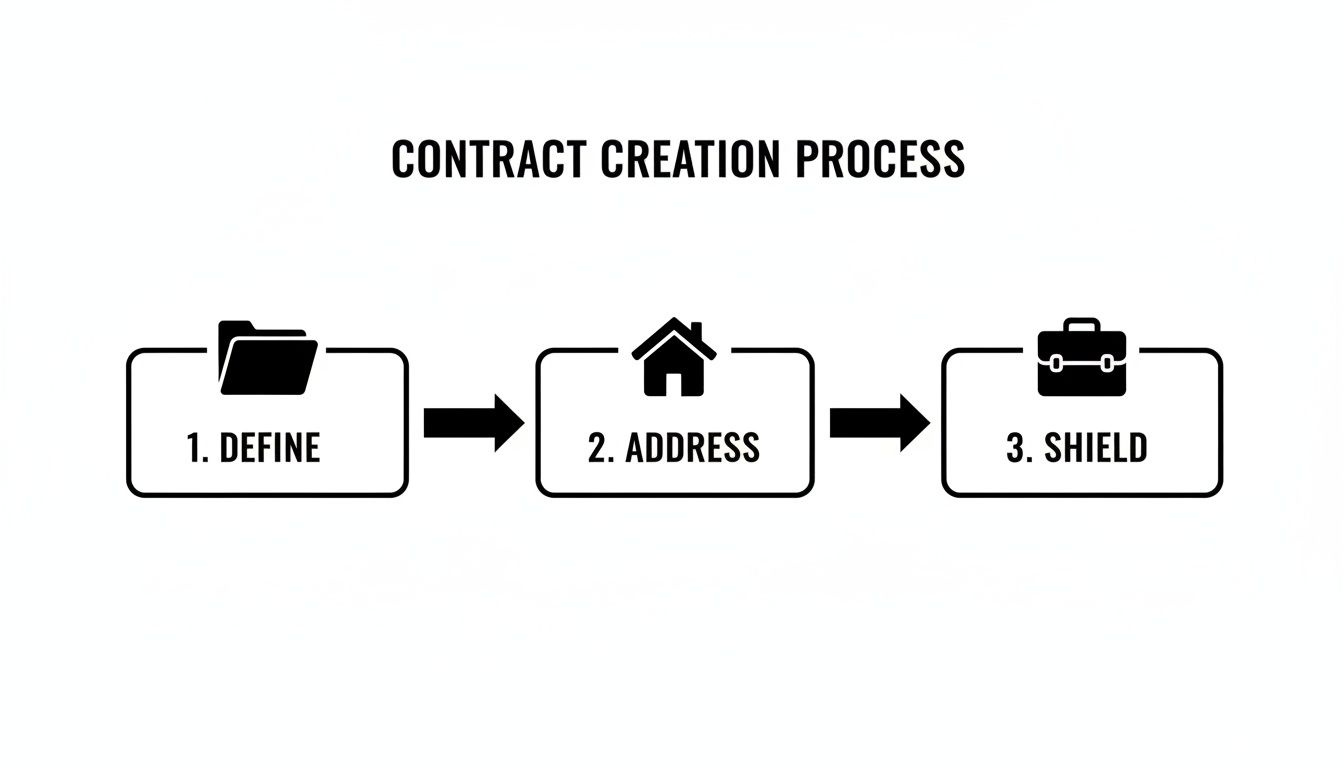
The path to an enforceable contract is about defining what’s yours, addressing how property will be handled, and shielding the assets that matter most.

A simple diagram illustrating the three-step contract creation process: Define, Address, and Shield.

As you can see, a strong contract starts with clear definitions and moves toward creating specific protections for both partners.

Modern Marriages and Modern Asset Protection

The need for enforceable contracts is more important than ever. People are getting married later and often bring significant assets into the relationship. For those of us in Brampton, a marriage contract has become a practical risk management tool. It’s used to protect what you owned before the wedding and to sidestep expensive court battles if the marriage ends.

To be legally sound, your marriage contract must contain certain essential elements of a valid contract. By making sure your agreement is in writing, includes full disclosure, and is reviewed with independent legal advice, you create a powerful document that delivers real security.

Common Myths About Marriage Contracts Debunked

Many couples in Brampton hesitate to bring up a marriage contract due to persistent myths. But much of that discomfort is based on a misunderstanding of what these agreements are truly for.

Instead of seeing it as a plan for failure, think of a marriage contract as a tool for open communication. It’s a chance to have a frank discussion about finances, goals, and expectations—a process that can build a stronger foundation for your future together.

Myth 1: They Are Only for the Super-Rich

This is completely outdated. Marriage contracts are incredibly practical for everyday people in Brampton, especially those who own small businesses, have professional careers, or are trying to enter the property market.

A contract is useful for anyone who wants to:

  • Protect a down payment on a house that came from one person’s family.
  • Keep a growing Brampton business as a separate asset.
  • Ensure an inheritance intended for you doesn't get divided in a separation.
  • Safeguard a professional designation or license that has significant value.

For the average Brampton family, a contract isn’t about protecting extreme wealth; it’s about safeguarding hard-earned assets and creating financial clarity.

Myth 2: Signing One Means You Don’t Trust Your Partner

The opposite is true. Creating a marriage contract requires a high level of trust and honesty. To make one, you both have to lay your financial cards on the table, which encourages transparency from the very beginning.

A marriage contract isn’t about a lack of faith in the relationship. It's an act of mature financial planning, similar to buying life insurance or creating a will. You hope you'll never need it, but you're both protected if circumstances change.

It shows you trust each other enough to have a tough conversation and make responsible decisions for your shared future. It’s about planning for life's "what ifs" so you can focus on building your life together.

Myth 3: They Encourage or Cause Divorce

There is zero evidence that signing a marriage contract makes a couple more likely to divorce. If anything, the process can prevent the financial disagreements that often lead to marital strain. After all, money is one of the leading causes of conflict in relationships.

By setting clear expectations and rules from the start, you eliminate a major source of future arguments. You and your partner get aligned on financial goals, debt management, and property rights.

Ultimately, a marriage contract is a proactive and sensible tool. It’s a private agreement between two people choosing to enter a partnership with their eyes wide open. A family lawyer in Brampton can help you navigate this conversation and draft an agreement that reflects fairness and respect for both of you.

Ready to Talk to a Brampton Family Lawyer?

Taking the first step towards a marriage contract is much less intimidating than you think. The process begins with a simple, honest conversation about your goals. You've learned how a well-planned agreement can bring financial clarity and protect what you’ve worked hard for under Ontario law—now it's about putting that knowledge into action.

At Badesha Law, our process starts with a confidential consultation. This is your time to tell us your story. Are you a Brampton business owner looking to protect your company? Or a couple wanting to set clear financial expectations from day one? We listen first to understand what truly matters to you.

Your Path Forward with Badesha Law

Once we have a clear picture of what you want to achieve, we'll walk you through the next steps. Our goal is to make everything transparent, collaborative, and stress-free.

Here’s our actionable process:

  1. Initial Goal Setting: We’ll meet to discuss your unique situation and map out a clear strategy for your marriage contract.
  2. Financial Disclosure: We help you gather and organize all the necessary financial information. This transparency is the bedrock of a strong, enforceable agreement.
  3. Drafting and Negotiation: Our experienced family lawyers will draft the contract. From there, we guide calm, productive negotiations to ensure the final terms are fair.
  4. Review and Finalization: We’ll go through every clause with you, line by line, making sure you fully understand what it means before you sign.

Think of a marriage contract as an act of responsible planning for your life together. It empowers you to build a partnership on a foundation of mutual understanding and respect, with a clear financial roadmap already in place.

Securing your assets and defining your financial future is one of the most proactive steps you can take for a stronger partnership. Don't leave your life’s work to chance.

Contact our Brampton office today to schedule a meeting with an experienced family lawyer in Brampton and take control of your financial security.

Frequently Asked Questions About Marriage Contracts

Thinking about a marriage contract in Ontario often brings up practical questions. Getting clear, straightforward answers is the best way to make an informed decision that feels right for you and your partner. Here are some of the most common queries we hear from our clients in Brampton.

Can We Get a Marriage Contract After We Are Married?

Yes, you absolutely can. In Ontario, an agreement you sign after your wedding day is still legally called a marriage contract. While some may call this a "postnuptial agreement," the Family Law Act treats it exactly the same as a contract signed before the marriage.

The legal requirements do not change. For the agreement to be valid, both you and your spouse must provide full and honest financial disclosure and have independent legal advice from your own lawyers. The timing is different, but the protections are identical.

What Happens if We Do Not Have a Marriage Contract?

Without a valid marriage contract, the default property division rules in Ontario's Family Law Act automatically apply if you separate.

Generally, this means:

  • Equalization of Property: The value of most property acquired during the marriage is calculated and split equally.
  • Matrimonial Home: The family home gets special treatment. Its full value is typically shared, regardless of who owned it before the marriage.
  • Spousal Support: Spousal support obligations will be decided based on legal guidelines and past court cases, which creates uncertainty.

A marriage contract gives you a powerful alternative, letting you create a custom plan that reflects your unique circumstances and what you both agree is fair.

A marriage contract isn't about avoiding the law; it's about personalizing it. It gives you and your partner the power to write your own clear, fair, and predictable rules for your financial future.

Is a Marriage Contract Only for Protecting Assets?

Not at all—its purpose is much broader. While shielding pre-marital property, an inheritance, or a business is a huge benefit for Brampton clients, a marriage contract is a flexible financial planning tool.

Beyond safeguarding assets, you can also use it to:

  • Define financial responsibilities during the marriage.
  • Outline how you'll manage household expenses and debts.
  • Protect one spouse from the other's business or personal liabilities.
  • Work alongside your estate plan to clarify what happens if a spouse passes away.

Think of it as a comprehensive agreement that helps you build a strong financial foundation based on clarity and mutual understanding.


Feeling more informed is a great start. The next step is a confidential conversation about your specific situation. The team at Badesha Law is here to provide the clear, actionable guidance you need. Contact us today to speak with a family lawyer in Brampton and secure your peace of mind.

What Is a Family Lawyer and When Do You Need One in Brampton?

When you’re going through a major life change like a separation or divorce, you’ll probably hear the term ‘family lawyer’ a lot. So, what is a family lawyer? Think of them less as just an attorney and more as a specialized legal guide—someone who helps you navigate the complicated and often emotional landscape of family transitions in Brampton. They are your personal advocate and strategist, dedicated to protecting your rights and helping you build a secure future under Ontario’s Family Law Act.

Defining a Family Lawyer’s Role in Ontario

A smiling lawyer with documents and briefcase stands with a family of three and a map of Canada.

A family lawyer does so much more than just file paperwork. Their primary role is to give you clear, strategic legal advice that’s grounded in your unique situation, specifically within the Brampton and Ontario legal systems. They help you understand your rights and obligations under the law, ensuring you feel confident and informed with every decision you make.

This means they have a deep understanding of specific legislation. In Ontario, a family lawyer is a regulated professional who helps Brampton residents with everything from separation and divorce to parenting arrangements and financial support, all governed by provincial and federal laws. For married spouses, this usually involves applying the federal Divorce Act, while Ontario’s Family Law Act covers critical issues like property division and support for both married and common-law partners.

The need for this specialized guidance is undeniable. As of 2021, there were approximately 2.74 million divorced individuals in Canada who had not remarried.

Your Advocate and Strategist

Your family lawyer is your personal champion in the Brampton legal system. They represent your best interests in every setting, whether it’s at the negotiation table, in mediation, or—if necessary—in a courtroom. Their goal is always to achieve a fair outcome that protects not only your financial stability but also your relationship with your children.

This work is extensive and focused on delivering real, tangible results for your family. Here’s what that looks like in practice:

  • Negotiating Agreements: They’ll help you craft a fair and legally solid separation agreement that clearly outlines everything from how property is divided to support payments and parenting schedules, making it enforceable in Ontario.

  • Protecting Parental Rights: They advocate for your rights when it comes to parenting time (formerly known as access) and decision-making responsibility, always keeping the child's best interests at the forefront as required by Ontario law.

  • Securing Financial Support: They ensure child and spousal support are calculated correctly according to legal guidelines, providing financial stability for you and your children.

  • Providing Objective Advice: During one of the most emotionally charged times of your life, they offer a calm, objective perspective. This helps you sidestep common mistakes and make choices that will benefit your family for years to come.

The Key Services a Brampton Family Lawyer Provides

Beyond the title, what does a family lawyer in Brampton actually do for you day-to-day? Their job is to take the tangled mess of your legal problem and turn it into a clear, enforceable solution that lets you build a stable future.

Think of each service they provide as a critical building block for your new life. A well-drafted agreement can prevent years of future arguments, while precise financial calculations ensure you receive what you're entitled to under Ontario's laws.

Crafting Legally Binding Agreements

One of the most important things a Brampton family lawyer does is draft and negotiate the agreements that set the terms of your separation. These aren't just casual promises; they are solid, legally binding contracts designed to give you certainty and closure.

  • Separation Agreements: This document is the cornerstone of any separation in Ontario. It details the division of property, spousal support, parenting plans, and other essential details, creating an enforceable roadmap for you and your ex-partner.

  • Cohabitation Agreements and Marriage Contracts: For couples starting their journey, these agreements (often called "prenups") define financial rights and responsibilities. They protect individual assets and ensure everyone is on the same page, preventing future disputes.

Navigating Parenting and Support Matters

When children are involved, a family lawyer’s role becomes even more critical. They ensure every decision is made in the best interests of the child, as mandated by Ontario’s Children’s Law Reform Act. This involves negotiating detailed parenting plans that cover everything from weekly schedules and holiday arrangements to who makes major decisions about education and healthcare.

At the same time, they handle the financial side of co-parenting. This includes:

  • Calculating child support based on the official Federal Child Support Guidelines.

  • Determining entitlement to spousal support and calculating the appropriate amount and duration.

A family lawyer's objective is to achieve a resolution that provides financial stability and fosters a positive co-parenting relationship. Reducing stress on the children during this difficult transition is a top priority.

Managing Property and Asset Division

Dividing the property accumulated during a marriage or common-law relationship can be incredibly complex. A Brampton family lawyer manages this entire process, ensuring every asset and debt is identified, valued correctly, and divided according to Ontario’s Family Law Act. This includes the matrimonial home, pensions, investments, and business assets. Their methodical approach is designed to protect your financial rights and secure your future.

For families with international connections or documents in different languages, reliable legal document translation services become essential to ensure all parties understand the proceedings. This step is crucial for fairness, especially when foreign assets or marriage certificates are involved. By managing every detail, your lawyer ensures your financial separation is complete and final.

Choosing Between a Family Lawyer and a Mediator

When separating in Brampton, you’ll hear two key terms: family lawyer and mediator. While both can help you and your former partner find a path forward, their roles are fundamentally different. Understanding which professional you need is a critical first step toward a fair outcome.

Think of it this way: a family lawyer is your personal advocate. Their sole duty is to protect your legal rights and advance your best interests under Ontario law. They provide confidential legal advice, develop a strategy, and negotiate on your behalf to achieve the best possible result for you. They are exclusively on your team.

A mediator, on the other hand, is a neutral third party hired by both of you. Their role is not to take sides but to facilitate a conversation and help you and your ex-partner find common ground. A mediator cannot give legal advice to either person—their impartiality is key to guiding the discussion.

When to Choose a Lawyer Over a Mediator

Mediation can be a great tool, especially for couples who communicate reasonably well. However, it’s not suitable for every case. In certain situations, retaining your own family lawyer is non-negotiable, particularly when there’s a significant power imbalance.

A lawyer becomes essential in cases like these:

  • A History of Domestic Violence: If there's any history of abuse, coercion, or intimidation, a neutral setting is not enough to ensure your safety or protect your rights. A lawyer will be your voice and can seek protective measures under both family law and, if necessary, Canada's Criminal Code.

  • Complex Financial Situations: When your separation involves businesses, multiple properties, or you suspect hidden assets, you need a lawyer. They have the legal tools to demand full financial disclosure and ensure everything is properly valued.

  • High-Conflict Disputes: If you and your ex cannot agree on major issues like parenting time or spousal support, a lawyer will advocate for a resolution that is fair to you and in your child's best interests.

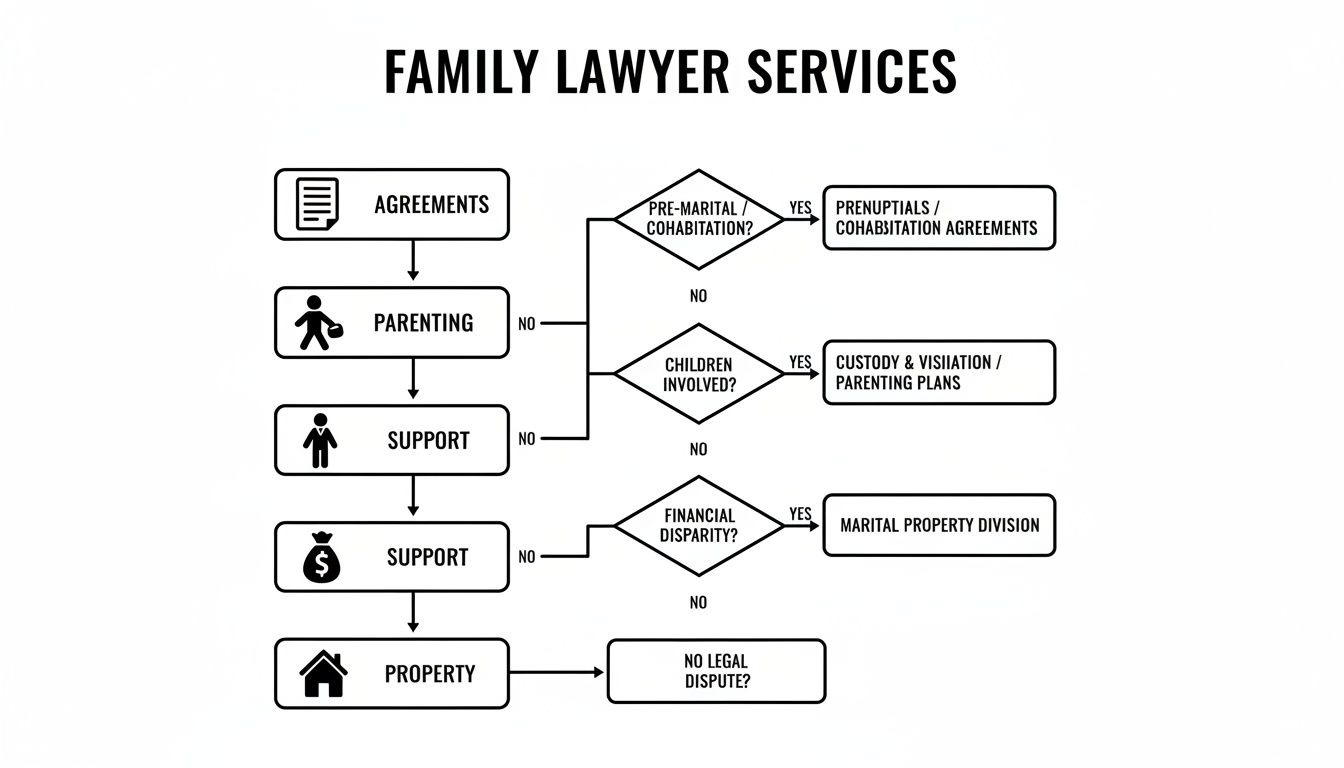
This flowchart gives you a quick visual breakdown of the core services a family lawyer provides, from negotiating agreements to handling property division.

A flowchart illustrating family lawyer services, including agreements, parenting, support, and property division.

Here’s the bottom line: even if you try mediation, it is highly recommended that you and your ex each have your own lawyer provide Independent Legal Advice (ILA) before signing any agreement. This is a crucial step to ensure the agreement is legally sound and that you fully understand your rights and obligations.

When You Absolutely Need to Hire a Family Lawyer

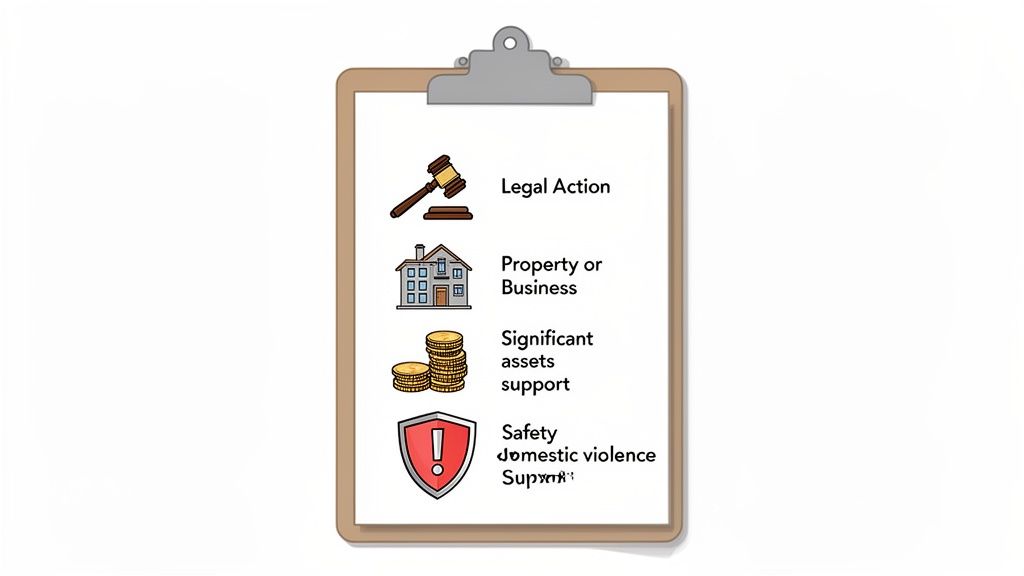
Some family situations are too complex and the stakes are too high to handle alone. While a peaceful negotiation is always the goal, certain red flags indicate it's time to hire a family lawyer in Brampton—immediately—to protect your rights and your future.

Clipboard with icons and text detailing legal support areas: legal action, property, assets, and safety.

Trying to represent yourself is a massive gamble. It's easy to miss a crucial legal deadline, misunderstand a financial document, or agree to terms that negatively impact you and your children for years. Recognizing these warning signs is the first step toward protecting yourself.

Your Former Partner Has Hired a Lawyer

This is the clearest sign you need legal representation. The moment your ex-partner hires a lawyer, the playing field is no longer level. Their lawyer’s sole job is to fight for their client's best interests, not to find a fair middle ground.

Hiring your own Brampton family lawyer puts you on equal footing. It means you have a professional on your side who understands Ontario's Family Law Act and can counter aggressive tactics or unreasonable demands.

Disputes Over Parenting and Children

If you and your ex cannot agree on parenting time or who makes major decisions for your children, a lawyer is essential. These disputes will define your child's upbringing and your relationship with them. A lawyer’s role is to advocate for your child’s best interests while ensuring your parental rights are respected.

The language in family law has evolved to be more child-focused. Major updates to Canada’s Divorce Act on March 1, 2021, replaced terms like “custody” and “access” with “parenting time” and “decision-making responsibility.” You can get more insights on these Canadian family law developments on chambers.com.

Complex Financial Assets Are Involved

Separations involving significant or complicated assets require professional legal help. You should not try to navigate this alone if your split involves:

  • A family business that needs proper valuation.

  • Multiple real estate properties.

  • Large investments, pensions, or RRSPs.

  • A suspicion that your ex is hiding assets or not being truthful about their finances.

A lawyer has the legal tools to compel full financial disclosure. If needed, they can engage forensic accountants to ensure every dollar is accounted for and the division of property is fair under Ontario law.

There Is a History of Family Violence

If your relationship has any history of domestic violence, abuse, or intimidation, you must contact a lawyer immediately. Your safety and your children's safety are paramount. A family lawyer can take urgent legal steps, like obtaining a restraining order, to put protective measures in place.

These situations are complex because they often involve both the Family Law Act and Canada's Criminal Code. A lawyer experienced in both areas can build a comprehensive strategy to protect you legally and physically, ensuring your voice is heard safely.

How to Find the Right Family Lawyer in Brampton for You

Choosing a family lawyer is one of the most critical decisions you'll make. This isn’t just about hiring someone who knows the law; it’s about finding a strategic partner who understands your unique situation and has the skills to protect your future in Brampton. The best family lawyer for you will be a sharp strategist, a clear communicator, and an expert in Ontario’s Family Law Act.

Your search in Brampton should begin with identifying your goals. If you hope to settle amicably through negotiation, you’ll want a lawyer with a collaborative approach. If your situation is contentious, you'll need a strong litigator who can confidently advocate for you in court. A great lawyer can adapt their strategy to match the dynamics of your case.

Key Qualities to Look For

When meeting with potential lawyers, pay close attention to their experience, communication style, and strategic approach. You need someone who can break down legal complexities into plain language, so you always feel informed and in control.

Here are a few critical qualities to watch for:

  • Specialized Expertise: Look for a lawyer whose practice is primarily dedicated to family law in Ontario. They will have an intimate understanding of the Brampton court procedures and judicial expectations.

  • A Clear Strategy: During your initial consultation, a good lawyer should outline a potential path forward. They will ask insightful questions to understand your circumstances and explain their proposed approach.

  • Transparent Communication: You need a lawyer who is responsive and keeps you informed. Ask about their communication policies—how often can you expect updates, and who will be your primary point of contact?

Why Experience in Criminal Law Matters

Sometimes, sensitive family law cases overlap with issues covered by the Criminal Code of Canada, such as allegations of domestic assault or threats. In these situations, hiring a Brampton lawyer with experience in both family and criminal law is a significant advantage. This dual expertise ensures a comprehensive legal strategy that protects you on all fronts, addressing both family court proceedings and any potential criminal charges.

An efficient law firm often relies on robust systems for organization. You might find it helpful to consider firms that leverage advanced tools, such as those described in a comprehensive guide to legal case management software. This can be an indicator of a well-run, professional practice.

Ultimately, the right lawyer is someone you trust. You're looking for a skilled professional who is genuinely committed to getting the best possible outcome for you, providing both expert legal guidance and unwavering support.


How Badesha Law Turns Legal Complexities into a Clear Path Forward

When you’re facing a separation or divorce in Brampton, you don't just need a lawyer who knows the law—you need someone who can create a clear, actionable strategy for your future. At Badesha Law, our entire practice is built on putting you first. We take the complicated language of Ontario's Family Law Act and translate it into practical advice you can actually use to move forward.

We know you're more than just a case file. You’re a person going through one of the most stressful times imaginable. That’s why we handle every situation—from a messy divorce and sensitive parenting dispute to drafting an iron-clad agreement—with a personalized game plan designed to protect your interests and bring you clarity.

A Client-First Approach Rooted in the Brampton Community

Our firm is deeply connected to the Brampton and Mississauga communities we serve, so we see the real-world impact of family law disputes every single day. With the proportion of Canadian marriages ending in divorce sitting near 38–40%, the need for skilled, compassionate legal guidance has never been greater. Statistics show a significant rise in divorces over the past two decades, which means a steady stream of cases involving tough parenting disagreements and complicated property division. You can learn more about the trends from these Canadian divorce statistics on nussbaumlaw.ca.

This reality is what drives our focused approach—whether we're drafting a strong agreement to prevent future conflict or litigating fiercely when negotiation just isn’t enough.

We provide dedicated, hands-on support in all the key areas you need:

  • Complex Divorce Proceedings: We manage every single detail, from untangling finances and valuing property to getting the support calculations right.

  • Parenting Disputes: We advocate for parenting arrangements that truly put your child’s well-being at the centre of the conversation.

  • Essential Agreements: We draft solid prenuptial, cohabitation, and separation agreements to protect your future, no matter what it holds.

Our unique dual expertise in both family and criminal law gives our clients a critical advantage. In sensitive cases involving allegations of domestic assault, we develop a comprehensive strategy that addresses issues under both the Family Law Act and Canada's Criminal Code, making sure you are protected on all fronts.

At Badesha Law, we’re more than just lawyers. We are the unwavering advocates you need to navigate this difficult time with strength, clarity, and confidence.

Your Family Law Questions Answered

Starting a family law case in Brampton can feel overwhelming. Questions pop up at every turn, and the uncertainty can be stressful. This FAQ section provides clear, practical answers to common concerns, grounded in Ontario law, to help you feel more confident about the path ahead.

How Long Does a Divorce Take in Ontario?

The timeline for a divorce in Ontario varies. For an uncontested divorce, where you and your spouse agree on all major issues, the process is faster. You could finalize the divorce in as little as four to six months.

However, a contested divorce—with disagreements over property, support, or parenting—will take longer. It can easily stretch over a year or more to resolve through negotiations or court. It’s also important to know that under the federal Divorce Act, you must be separated for at least one year before you can officially file for divorce, although you can start resolving other issues during that waiting period.

Do I Have to Go to Court for My Family Law Case?

No, you don't. In fact, most family law cases in Ontario are settled out of court. Court is typically the last resort because it is expensive, slow, and stressful.

Family lawyers in Brampton use alternative dispute resolution methods to find solutions, including:

  • Negotiation: Your lawyers communicate directly to work out a settlement.

  • Mediation: A neutral third party helps guide you and your ex-partner toward an agreement.

  • Arbitration: You agree to let a private decision-maker (an arbitrator) make a final, legally binding ruling.

  • Collaborative Family Law: A team-based approach where everyone agrees from the start to find a solution without going to court.

Settling out of court is almost always faster, more affordable, and leaves you in control of the final outcome.

What Is a Separation Agreement and Do I Need One?

A separation agreement is a legally binding contract that outlines the terms of your separation. It covers everything from the parenting plan and support payments to how your property and debts will be divided.

In Ontario, a formal, written separation agreement is highly recommended for both married and common-law couples. It provides crucial clarity, prevents future disputes, and is fully enforceable by the courts. Having a Brampton family lawyer draft or review this document is critical to ensure your rights are fully protected.

What Should I Bring to My First Consultation?

To make the most of your first meeting with a family lawyer, some preparation is helpful. Gather key documents like your marriage certificate, any existing agreements (prenuptial or cohabitation), and basic financial information for both you and your partner (like recent tax returns or pay stubs).

It’s also a good idea to write down a brief timeline of your relationship and a list of your main questions and goals. This helps your lawyer understand your situation quickly so they can provide focused, practical advice right from the start.


Facing a family law issue is a serious challenge, but you don't have to go through it alone. The team at Badesha Law provides clear, strategic guidance to protect your rights and help you move forward with confidence. For expert legal support in Brampton, contact us to schedule your consultation. Learn more about our services.

How Courts Decide Child Custody in Brampton: A Guide for Families

When you’re facing a child custody dispute in Brampton, it feels like your whole world is on the line. It’s an emotional, stressful, and often confusing journey. The most important thing to remember is that when it comes to custody rights in Ontario, one principle stands above all else: the “best interests of the child.”

This isn’t just a legal phrase; it’s the standard under Ontario’s Family Law Act that ensures every decision is made to support your child’s well-being and stability. Brampton courts aren’t interested in picking a “winner” between parents. Instead, their entire focus is on creating a supportive and nurturing environment for the child. A skilled family lawyer in Brampton can help you present a case that aligns with this core principle.

Navigating Child Custody Decisions in Brampton

A woman and child walk hand-in-hand towards Brampton Family Court, featuring a Canadian maple leaf.

Stepping into the Brampton family court process can feel incredibly intimidating. But once you understand how the court makes its decisions, you can start to replace that uncertainty with a sense of clarity. The legal system is designed to cut through complex family situations and find a path forward that puts your child’s needs first.

The primary goal of Ontario’s Family Law Act is to make sure a child can benefit from a strong, meaningful relationship with both parents—as long as it’s safe and positive for them to do so. This reflects a major shift away from old-school custody battles toward modern arrangements that encourage cooperation and shared responsibility.

The Court’s Modern Focus

Judges in Brampton look at a whole host of factors to figure out what arrangement will best support a child’s development. It’s not simply about deciding where the child will sleep. It’s about who will make the big decisions and how both parents will stay actively and positively involved in the child’s life.

Some of the key things a judge will consider include:

  • The emotional bonds the child shares with each parent.
  • Each parent’s ability to provide a stable, loving, and secure home.
  • How willing each parent is to support the child’s relationship with the other parent.
  • Any history of family violence or conduct that could impact the child’s safety, as defined under the Family Law Act and potentially the Criminal Code of Canada.

A judge’s decision isn’t about rewarding one parent or punishing the other. It is a forward-looking assessment of how to best structure the child’s life to promote their happiness, security, and emotional well-being after a separation.

Why Your Next Steps Matter

Every action you take and every decision you make during this process can have a huge impact on the final outcome. Knowing what to expect is the first step, but knowing how to present your case effectively is just as crucial. This is where having a knowledgeable family lawyer in Brampton on your side becomes absolutely essential.

An experienced child custody lawyer does more than just give legal advice. They help you gather the right evidence, communicate in a constructive way, and present a clear picture to the court that truly reflects your child’s best interests. They make sure your rights are protected while guiding you toward a resolution that is both fair and built to last. Preparing properly can be the difference between a long, drawn-out conflict and a positive new beginning for your family.

The Best Interests of the Child Test Explained

A balanced scale with a child on one side and a home and heart on the other, representing the best interests of the child.

When a Brampton court steps in to decide on parenting arrangements, one principle stands above all others: the best interests of the child. This isn’t just a friendly suggestion; it’s the core legal test laid out in Ontario’s Children’s Law Reform Act and Canada’s Divorce Act. The court’s job isn’t to pick a “winner” between the parents, but to protect the child’s well-being above all else.

Think of it as a judge carefully putting together a puzzle. Every piece of information—the child’s relationships, daily routines, emotional needs, and home environment—is a puzzle piece. The judge’s goal is to arrange these pieces to create a complete picture where the child is safe, supported, and has every opportunity to thrive.

Your personal feelings about your ex-partner, while completely valid, are not the focus here. Every argument you make and every piece of evidence you present must be framed through one lens: how does this benefit my child? A skilled family lawyer in Brampton is essential to help you build a case that speaks directly to this critical legal standard.

The Key Factors a Brampton Judge Considers

The “best interests” test isn’t based on a gut feeling. It’s a detailed, methodical analysis of specific factors that a judge must weigh when making a decision on child custody in Brampton. While the list is long, a few key elements consistently take centre stage in Brampton family court.

These primary factors include:

  • The Child’s Needs: This covers their physical, emotional, and psychological health, always considering their age and developmental stage. For a toddler, this could mean maintaining a consistent nap schedule. For a teenager, it might mean ensuring they can continue with their extracurriculars and social life.
  • Love, Affection, and Emotional Ties: The court carefully examines the bond the child has with each parent, as well as with siblings, grandparents, and other important people in their life.
  • The Child’s Views and Preferences: If a child is mature enough to express what they want, the judge will absolutely listen. There’s no “magic age,” but the older and more mature the child, the more weight their opinion will carry.
  • Each Parent’s Willingness to Support the Other Parent’s Relationship: This is a big one. The court wants to see which parent is more likely to encourage a healthy and loving relationship between the child and the other parent. A parent who tries to undermine the other is often viewed poorly.

The court’s main goal is to protect the child’s important relationships and ensure they have a stable, predictable environment. A parent who shows they are ready and willing to co-parent in a constructive way often has a significant advantage.

From Abstract Concepts to Concrete Evidence

Words like “stability” and “ability to provide care” sound good, but in court, they mean nothing without proof. This is where your actions and your ability to document them become absolutely critical.

For example, “stability” isn’t just about having a big house. It’s shown through real-world actions like:

  • Keeping consistent daily routines for meals, homework, and bedtime.
  • Making sure the child can stay at their school and in their usual activities.
  • Helping the child stay connected to their friends and community in Brampton.

Likewise, a parent’s “ability to provide care” is demonstrated by their history of involvement. Who was the one taking the child to doctor’s appointments? Who went to parent-teacher interviews? Who sat down to help with homework every night? Your child custody lawyer will help you gather the documents, emails, texts, and calendars needed to build a factual story of your consistent, hands-on role in your child’s life.

The Trend Towards Collaborative Parenting

Family law is always evolving, and there’s a clear shift toward shared parental responsibility. Courts increasingly recognize just how valuable it is for both parents to be actively involved. In fact, joint legal custody, where parents share major decisions about health, education, and religion, is the outcome in 59% of contested family cases in Ontario, according to recent data.

In the Greater Toronto Area, including Brampton, shared physical custody—where a child spends at least 40% of their time with each parent—now appears in 22% of contested orders. That’s a massive increase over the past two decades. You can explore more of these Canadian child custody statistics to see the trends for yourself.

Ultimately, successfully navigating the “best interests” test means looking forward, not backward. It’s about showing the court how you will provide a secure and loving future for your child, and—just as importantly—how you will support their fundamental right to a meaningful relationship with both of their parents.

Understanding Parenting Arrangements and Decision-Making

When you’re dealing with child custody in Brampton, one of the first things you’ll notice is that the language has changed. The old terms “custody” and “access” are gone. Today, the law talks about building a future for your kids, and the focus is on co-parenting and shared duties.

A Brampton family court will create a Parenting Order, which is broken down into two key parts: decision-making responsibility and parenting time. Getting a handle on what each of these means is the first step toward creating a stable, effective parenting plan for your children.

Think of it this way: decision-making is like being on the child’s “board of directors,” while parenting time is the actual day-to-day schedule they live by. Both are critical for a child’s well-being. A family lawyer in Brampton can help you define your role in both areas, ensuring the final arrangement truly serves your child’s best interests.

Decision-Making Responsibility Explained

Decision-making responsibility gives a parent the legal authority to make the big choices about their child’s life. This isn’t about everyday things like what’s for dinner or what TV show to watch. Instead, it covers the major pillars of a child’s upbringing.

In Brampton, this usually includes:

  • Health: Choosing doctors, dentists, therapists, and approving medical treatments.
  • Education: Deciding which school the child will attend, if they need tutoring, or enrolling them in special programs.
  • Religion and Spirituality: Guiding the child’s religious upbringing, if any.
  • Significant Extracurricular Activities: Major commitments like competitive hockey or a travelling arts program that shape a child’s schedule and development.

This power can be given to one parent (sole) or shared between both (joint). Joint decision-making is very common because courts want both parents involved in these important life choices. But it only works if parents can communicate and cooperate, and a judge will look closely at whether that’s realistic for your family.

Parenting Time: The Daily Schedule

Parenting time, on the other hand, is all about the “when”—the schedule that outlines when your child is in your care. This is the hands-on time you spend with your child, and it includes the responsibility to make all the day-to-day decisions while they’re with you.

The schedule can look a million different ways. It might be a detailed weekly rotation, or it could set out clear plans for holidays, summer vacations, and birthdays. The main goal is to create a routine that feels predictable and stable for the child, minimizing disruptions and giving them meaningful time with both parents. A child custody lawyer can help you draft a schedule that’s practical, fair, and designed for your family’s unique needs.

A common mistake is thinking that parenting time automatically equals decision-making authority. A parent can have lots of parenting time but no say in major decisions, or vice versa. The court looks at each part separately and decides what’s best for the child in each area.

To make this crystal clear, let’s break down the two concepts side-by-side.

Decision-Making Responsibility vs Parenting Time Explained

This table shows the key differences between the two main components of a parenting order in Ontario, helping you understand how they work together to create a complete plan.

Concept What It Covers Example Legal Terminology
Decision-Making Responsibility The authority to make significant, long-term choices about a child’s well-being and future. Deciding whether a child should attend a public or private school. Formerly part of “Legal Custody”
Parenting Time The physical time a child spends in the care of a parent, including day-to-day routines. Picking up a child from school on Tuesday and having them stay overnight. Formerly “Physical Custody” or “Access”

Understanding this distinction is vital. It allows you to negotiate a parenting plan that addresses both the big-picture decisions and the everyday reality of your child’s life.

Common Parenting Arrangements in Brampton

While every family’s plan will be unique, there are a few common arrangements you’ll hear about in the Brampton courthouse. Knowing these terms helps you understand what the options are.

Arrangement Type Decision-Making Responsibility Parenting Time Schedule What a Judge Considers
Sole Custody One parent makes all major decisions on their own. The child lives mostly with one parent. The other parent usually has a set parenting time schedule. This is often ordered in high-conflict situations or when there are concerns about one parent’s stability or judgment.
Joint Custody Both parents must talk and agree on major decisions together. The child’s time is divided between both parents. This could be a 50/50 split or another agreed-upon schedule. The parents’ ability to communicate and co-parent effectively is the most important factor for this to work.
Shared Custody Can be either sole or joint decision-making. This is a specific parenting time arrangement where the child spends at least 40% of their time with each parent. This has major implications for how child support is calculated under the Federal Child Support Guidelines.
Split Custody Applies when there are two or more children. One or more children live primarily with one parent, and one or more live with the other. This is a less common arrangement, usually seen when older children have strong preferences about where they want to live.

Ultimately, a judge’s decision will always come back to one thing: the best interests of the child. A well-thought-out parenting plan, especially a joint or shared one, shows the court you can put your child’s needs ahead of your own conflict. Working with a skilled family lawyer in Brampton is the best way to present a plan that is child-focused, practical, and persuasive.

The Brampton Family Court Process Step by Step

Starting a family court case can feel overwhelming, like being handed a complex puzzle without the picture on the box. But here’s the good news: the Brampton family court process is a structured path, designed to resolve disagreements while always keeping the focus where it belongs—on the best interests of your children. Knowing the roadmap can transform a daunting journey into a series of clear, manageable steps.

The process usually kicks off when one parent files an Application with the court. Think of this as the foundational document for your case. It spells out exactly what you’re asking the court to order—like a specific parenting time schedule or sole decision-making responsibility—and the facts that support your request. Once this document is filed and properly delivered (“served”) to the other parent, the court process has officially begun. Working with a skilled family lawyer in Brampton from the start ensures this crucial first step is handled correctly, setting a strong, strategic tone for everything that follows.

The core of any custody case revolves around two key elements: who makes the big decisions and how parenting time is shared. This is what the court process is built to resolve.

Process flow diagram explaining custody components: decision-making, parenting time, and child's best interests.

As you can see, every action the court takes, from the initial filing to the final order, is aimed at finding a stable and healthy resolution for your child’s life after separation.

Your First Court Appearance

After the Application is filed, your first stop is the First Appearance before a court clerk. This isn’t a dramatic courtroom scene; it’s mostly an administrative checkpoint to make sure all your paperwork is in order and to schedule your first real meeting with a judge, known as a Case Conference.

Soon after, most parents in Brampton will need to attend a Mandatory Information Program (MIP). This is a free session that gives you a rundown on separation, family law basics, and the court process. It also introduces alternatives to fighting it out in court, like mediation. The system strongly encourages parents to find solutions outside of a formal trial, and the MIP is a great first step in that direction.

The Role of Conferences

Case conferences are really the heart and soul of the Ontario family court system. You’ll attend at least one of these meetings with a judge, where you’ll discuss the issues, explore ways to settle, and map out the next steps. They’re much less formal than a trial because the goal isn’t to win an argument, but to narrow down disagreements and find some common ground.

While a judge at a case conference can’t issue a final order on issues you both disagree on, they play a huge role. They can:

  • Help you and the other parent pinpoint the real sticking points.
  • Give a professional opinion on what might happen if the case went all the way to a trial.
  • Make procedural orders, like requiring you both to exchange financial documents or bringing in the Office of the Children’s Lawyer.
  • Urge you both to try mediation to work things out collaboratively.

A well-prepared case conference brief, drafted by your child custody lawyer, is your most powerful tool at this stage. It tells the judge your side of the story, lays out your key arguments, and clearly states what you are asking for. A strong brief can significantly shape how the rest of your case unfolds.

Moving Towards a Resolution

If you and the other parent manage to find an agreement during these conferences—which is the goal—your child custody lawyer can help you formalize it in a document called Minutes of Settlement. Once this is signed by both of you and a judge, it becomes a legally binding court order. This is the best-case scenario, as it saves an incredible amount of time, money, and emotional energy.

But what if you still can’t agree? If several conferences don’t lead to a resolution, the court might schedule a Settlement Conference for one last big push to resolve the case. If that doesn’t work, the next step is a Trial Management Conference to get everything ready for a formal trial. Going to trial is always the last resort. It involves presenting evidence and witnesses to a judge, who will then make the final, binding decision for you. Trying to navigate these later stages without an expert in your corner is incredibly difficult, which is why the guidance of an experienced family lawyer in Brampton is so essential.

Here is the rewritten section, crafted to sound completely human-written and natural, following the provided style guide and examples.


How to Build a Strong Custody Case with Evidence

When you walk into a Brampton family court, you need to remember one thing: a judge makes decisions based on facts and evidence, not just emotional appeals or unproven claims. If you want to secure the parenting arrangement you believe is right, you need to build a solid case that clearly shows why your plan is in your child’s best interests. This isn’t about grand gestures; it’s about gathering specific, tangible proof of your involvement, your stability, and your willingness to co-parent.

Think of your case as a story you’re telling the court, but instead of just words, you’re using documents, communication logs, and witness accounts. Every single piece of evidence should tie back to the factors a judge is required to consider under Ontario’s family law. This is where a skilled child custody lawyer becomes invaluable—they know how to take all these details and weave them into a powerful and persuasive narrative for the court.

Creating a Clear Record of Your Parenting

Your documentation is easily your most powerful tool in a custody case. Start today by gathering evidence that paints a detailed, honest picture of your role as a parent. The goal here isn’t to collect “dirt” on the other parent—that can often backfire. Instead, you want to showcase your consistent, positive, and active involvement in your child’s life.

Here’s a checklist of what you should be collecting:

  • Communication Logs: Keep a clear record of all texts and emails with the other parent. You’ll want to highlight messages where you are cooperative, focused on the kids, and reasonable when discussing schedules or decisions.
  • Calendars and Schedules: Maintain a detailed calendar that tracks your parenting time. More importantly, note your involvement—every doctor’s appointment you attended, parent-teacher interviews you sat in on, and every soccer game or dance recital you supported from the sidelines.
  • School and Medical Records: Get your hands on report cards, attendance records, and notes from doctors or dentists. These official documents can quickly establish who the school’s primary contact is and who is actively managing the child’s health and education.
  • Financial Documents: Simple things like proof of income and a stable home (like a lease or mortgage statement) go a long way. They demonstrate your ability to provide a secure and predictable environment for your child.

The Role of Witnesses and Expert Assessments

Sometimes, your story needs a supporting voice. Witnesses can give the court an objective, third-party perspective on your parenting abilities and your relationship with your child. This could be a teacher, a daycare provider, a sports coach, or even a family friend who has seen you in action as a parent.

In more complex or high-conflict situations, the court might bring in the Office of the Children’s Lawyer (OCL). The OCL can either provide an independent lawyer for your child or conduct a full clinical investigation. Their job is to give the judge an impartial report on the family’s dynamics and recommend what’s truly in the child’s best interests.

Proving Your Case in a Modern Court

The landscape of family law has changed dramatically over the decades. Back in the mid-1990s, courts often leaned toward mothers, with government data showing 83% of children lived solely with them after a separation. Today, the focus is squarely on the child’s best interests, not gender. In Brampton, any parent seeking significant parenting time can succeed if they present compelling evidence of their deep involvement.

That said, legal representation still makes a huge difference. Statistics show that when only mothers have lawyers (30% of cases), they win sole physical custody 83% of the time. In contrast, that number drops to 31% when only fathers are represented. You can find out more about how legal counsel impacts custody outcomes.

Ultimately, building a strong case comes down to meticulous and thoughtful preparation. A dedicated family lawyer in Brampton won’t just help you gather the right evidence; they’ll make sure it’s presented clearly and effectively to the court, giving you the best possible chance to secure a positive future for you and your child.

Why You Need a Brampton Family Lawyer for Your Case

It’s tempting to think you can handle your own custody case in family court. And while it’s technically possible, going it alone when it comes to child custody in Brampton is a massive gamble—one that could affect your child’s future for years to come. Some situations are more than just paperwork; they’re high-stakes red flags telling you it’s time to call in a professional.

Think of an expert family lawyer in Brampton as your strategic partner. They manage the complex legal chess match so you can stay focused on what truly matters: your family.

When Professional Counsel Is Non-Negotiable

If your separation involves any of the following, picking up the phone to get legal advice should be your very next move.

  • Serious Allegations: When accusations of child abuse, neglect, or substance use are on the table, the stakes couldn’t be higher. A lawyer understands how to properly present evidence, challenge false claims, and navigate the strict rules of evidence under both the Family Law Act and the Criminal Code.
  • Relocation Plans: Thinking about moving out of Brampton or the province with your child? So is the other parent? This isn’t a simple decision—it triggers a complex set of legal hurdles that you must clear first.
  • High-Conflict Dynamics: If you’re dealing with constant arguments, a total breakdown in communication, or a history of domestic violence, you need an objective advocate. A lawyer can manage interactions, filter out the noise, and protect your rights from a position of strength.
  • Complex Finances: When there are business assets, major investments, or suspicions of hidden income, things get complicated fast. A lawyer ensures you get full and honest financial disclosure, which is critical for a fair outcome.

An experienced child custody lawyer offers far more than just legal knowledge; they give you a critical strategic edge. They can anticipate the other side’s next move, negotiate from a position of strength, and act as a buffer to shield you from direct conflict. This alone can be invaluable for your emotional well-being.

The numbers don’t lie—legal representation dramatically sways court outcomes. Research shows that when only mothers have a lawyer, they secure sole physical custody 83% of the time. In contrast, fathers with solo legal counsel win it in just 31% of cases. Shared custody works best when both parents can demonstrate cooperation. You can learn more about how legal representation impacts child custody statistics.

Hiring a family lawyer isn’t just an expense; it’s an investment in your child’s stability and your own peace of mind. The most powerful first step you can take is to contact a professional and start mapping out a clear, protective strategy.

Common Questions About Child Custody in Brampton

When you’re dealing with child custody issues, it’s the practical, day-to-day questions that often cause the most stress. Let’s clear up a few of the most common ones we hear from parents in Brampton to give you a bit more certainty as you figure out your next steps.

Does a 50/50 Parenting Schedule Automatically Apply in Brampton?

No, not at all. There’s no automatic rule in Ontario law that defaults to a 50/50 parenting schedule. The court’s one and only guiding principle is the “best interests of the child.” While shared parenting has become more common, a judge will only order it if it actually works for that specific child and their family.

A judge in Brampton is going to look closely at things like:

  • Can the parents communicate and cooperate without constant conflict?
  • What are the practical logistics? Do the parents live close enough to make it work without disrupting the child’s life in Brampton?
  • Does the child need the stability of one primary home base, or will they thrive with this kind of schedule?

An equal parenting split is only granted when it truly serves the child’s well-being, not just because it seems “fair” to the parents.

At What Age Can a Child Decide Who They Want to Live With?

This is a big one, but the answer is that there’s no “magic age” where a child gets to make the final call on their living situation. A judge will absolutely listen to a child’s wishes, but how much weight those wishes carry really depends on the child’s age and maturity.

Think of it this way: the opinion of a sharp, thoughtful 16-year-old is going to be taken far more seriously than that of a 7-year-old. But even then, the child’s preference is just one piece of the puzzle. The judge has to balance it against all the other factors in the “best interests” test before making a final decision.

It’s a common myth that at age 12, a child can just pick a parent. While their voice definitely gets stronger as they get older, it’s still just one factor among many for the court to consider.

Can I Deny Parenting Time if Child Support Is Unpaid?

The answer to this is a firm and absolute no. Under Ontario’s Family Law Act, parenting time (what we used to call “access”) and child support are two completely separate legal duties. One has nothing to do with the other. A parent’s right to see their child isn’t tied to their payment history.

Withholding court-ordered parenting time is a very serious misstep and can land you in hot water legally. If your ex isn’t paying child support, you need to go through the proper channels to enforce the order, like contacting the Family Responsibility Office (FRO). Denying access is not the solution. A family lawyer in Brampton can show you the right way to handle unpaid support without jeopardizing your own standing with the court.


Trying to figure out family law on your own can be overwhelming. The team at Badesha Law offers clear, strategic advice to protect your rights and, most importantly, your child’s future. For dedicated support with your custody matter in Brampton, Mississauga, or the GTA, contact us for a consultation. You can learn more about how we can help by visiting our website: https://badeshalaw.ca/brampton-criminal-lawyer

How a Brampton Family Lawyer Can Secure an Emergency Custody Order in Ontario

When your child is in immediate danger, an emergency custody order in Ontario is a powerful legal tool that allows a court to grant temporary custody to one parent right away, often without the other parent even being in the courtroom. Think of it as a swift, urgent measure designed solely to protect a child from imminent harm. Under Canadian family law, specifically Ontario’s Family Law Act, this is one of the most serious and immediate actions a court can take.

What To Do When Your Child’s Safety Is At Risk

Discovering your child is in a dangerous situation triggers a level of fear and panic no parent should have to experience. In these critical moments, understanding your legal options is the very first step toward taking decisive action to keep them safe, especially for clients in Brampton facing the local court system.

An emergency custody order isn’t for typical parenting disagreements or minor disputes. It is reserved for severe crises where waiting for a standard court date would place a child in serious jeopardy.

This type of order is formally known as an ex parte motion, a Latin term meaning “from one party.” It allows a judge to make a temporary ruling based on one parent’s evidence because the situation is simply too urgent to wait for the other parent to be notified and respond. The court’s entire focus is on one thing: preventing immediate, irreparable harm to the child.

Situations That May Justify an Emergency Order

A judge in Brampton will only grant such a powerful order if there’s compelling evidence of a genuine emergency. These are not tools to gain an advantage in a custody dispute—they are life-saving interventions for a child at risk, grounded in the principles of the Family Law Act.

The circumstances have to be severe. Here’s a clear look at what the court considers a true emergency.

What Qualifies as an Emergency for a Custody Order

Grounds for an Emergency Order Example Scenario Essential Evidence to Gather
Immediate Risk of Abuse or Harm You discover evidence of physical, sexual, or severe emotional abuse. This also includes a child being exposed to domestic violence in the home, which may also involve the Criminal Code of Canada. Photos, police reports (911 calls), medical records, text messages, emails, or witness statements from family or friends.
Threat of Abduction The other parent has credibly threatened to take the child out of Ontario without your consent and is taking steps to do so (e.g., booking one-way flights, selling assets, quitting their job). Screenshots of threats, flight itineraries, evidence of the parent liquidating assets, or communications showing their intent to flee.
Severe Neglect The child’s basic needs for safety, food, shelter, or critical medical care are being dangerously ignored, putting their health and well-being at immediate risk. Photos of unsafe living conditions, school attendance records showing chronic absence, doctor’s notes, or reports from a Children’s Aid Society worker.
Parental Incapacity A parent is experiencing a sudden and severe substance abuse issue or mental health crisis that makes them incapable of safely caring for the child. This can also relate to charges under the Criminal Code. Police records related to DUIs or public intoxication, hospital admission records, or documented evidence of erratic and dangerous behaviour.

It’s crucial to remember that the burden of proof is high. You must present clear and convincing evidence that the threat is not just possible, but immediate.

Your First Actionable Steps

When you’re facing a crisis like this, the goal is to replace panic with a clear plan. Your absolute priority is to gather any available proof and seek professional legal guidance without delay.

A specialized family lawyer in Brampton can quickly assess the urgency of your situation and immediately start preparing the necessary court documents to get you in front of a judge.

This is a high-stakes legal process where the quality of your initial evidence is absolutely paramount. A firm like Badesha Law, with deep experience in Brampton’s family courts, understands the specific evidence and arguments a judge needs to see to justify granting an emergency custody order. Their guidance can be the critical factor in protecting your child when every second counts.

Understanding the Legal Grounds for an Emergency Order

Seeking an emergency custody order in Ontario isn’t a step you take lightly—it’s a powerful legal tool reserved for truly serious situations. The entire process is built on a single, guiding principle of Canadian family law found in Ontario’s Family Law Act: the best interests of the child. This is the lens through which a judge views every single decision.

To get an emergency order, especially without the other parent present (known as an ex parte motion), you need to do more than just say you’re scared. You have to prove irreparable harm—a legal term for a catastrophic situation that can’t be fixed later. Think of it like a fire alarm: you pull it when there’s an actual fire, not for a disagreement over bedtime.

A Brampton judge needs to see clear evidence that if they don’t act right now, the child will face a severe, irreversible consequence. This is why the court system moves so cautiously. Granting an order without hearing from both parents is an extraordinary measure that temporarily strips away one parent’s rights. Judges will only take that step when a child’s safety is on the line.

The Standard of Proof Required

You have to convince the court that the danger is so immediate that it can’t possibly wait for a regular hearing where both parents get to tell their side of the story. Your affidavit—your sworn written statement—must draw a straight line between the other parent’s actions (or lack of action) and the immediate threat to your child.

The kinds of harm that meet this high standard usually involve:

  • Physical or sexual abuse: This requires concrete evidence of violence or inappropriate behaviour.
  • Imminent abduction: You need proof that the other parent has a plan to take the child out of Ontario.
  • Severe neglect: These are situations where a child’s fundamental needs for safety, food, or shelter are being dangerously ignored.
  • Exposure to criminal activity: The child is in direct danger because of a parent’s illegal actions, often implicating the Criminal Code of Canada.

Intersection with the Criminal Code of Canada

This is where family law and criminal law often cross paths, especially in cases involving violence. When a parent faces charges under the Criminal Code of Canada for something like domestic assault, it can become powerful grounds for an emergency order.

A criminal charge or the conditions of a bail release can directly affect a parent’s ability to care for a child. For example, if a parent is out on bail with a “no contact” condition, it instantly creates a parenting crisis. An emergency order can step in to provide stability and ensure the child remains safe.

A knowledgeable family lawyer in Brampton, particularly one with a background in criminal law like the team at Badesha Law, knows how to connect these dots. They can effectively argue how a breach of the Criminal Code is the “irreparable harm” a family court judge needs to see to act decisively and protect your child.

Emergency custody orders in Ontario are rare. They are granted only in dire scenarios like imminent child danger from abuse, removal risks, or where giving the other parent notice would itself cause irreparable harm. While the province doesn’t publish exact numbers for these specific motions, family court statistics from the Ontario Court of Justice show caseloads are surging. This is fuelling more urgent filings in the GTA as separation rates rise. You can learn more about trends in urgent family court filings. This trend highlights just how critical it is to present a clear, evidence-based case explaining why your situation demands the court’s immediate attention.

When you’re convinced your child is in immediate danger, that feeling is powerful and real. But a judge at the Brampton courthouse can’t act on feelings alone—they need cold, hard facts. To get an emergency custody order in Ontario, your job is to turn that valid fear into a compelling, evidence-based case that proves a genuine and immediate risk of harm.

Simple disagreements over parenting styles or scheduling conflicts just won’t cut it. The court has a very high bar for these urgent motions, and you need to show that the situation is a true emergency that absolutely cannot wait for a standard hearing. Think of it as presenting a clear, organized file of proof that paints an undeniable picture of risk.

The Most Powerful Types of Evidence

You need to become a detective building your case. Each piece of evidence you gather adds another layer of credibility to your story, so focus on collecting objective, verifiable proof that speaks for itself.

Here are the kinds of evidence a Brampton judge will find most persuasive:

  • Police Reports and Incident Numbers: If you’ve ever had to call the police because of the other parent’s behaviour, these official reports are gold. They offer an unbiased, third-party account of what happened.
  • Medical Records: Any records from a doctor or hospital detailing injuries to your child (or you), or notes documenting neglect, serve as powerful medical proof that can’t be easily dismissed.
  • School and Daycare Records: Reports from teachers or caregivers are incredibly helpful. Notes about unusual behaviour, signs of distress, unexplained absences, or other concerns about a child’s well-being can strongly support your claims.
  • Digital Communications: Save everything. Every single revealing text message, email, or social media post can be crucial. Screenshots of threats, admissions of substance abuse, or unhinged messages can directly show the other parent’s state of mind.
  • Photographs and Videos: A picture is worth a thousand words, especially in court. Clear photos of injuries, unsafe living conditions (like drug paraphernalia left out), or a video of a parent’s obvious intoxication can be incredibly impactful.

Once you have this information, the best thing you can do is organize it chronologically for your family lawyer in Brampton. This helps them immediately see the pattern of escalating risk and build the strongest possible argument on your behalf.

Crafting Your Affidavit: The Heart of Your Case

The single most important document in your entire application is your affidavit. This is your sworn statement to the court—it’s your story, told under oath. A well-written affidavit is clear, factual, and directly connects the other parent’s actions to the specific danger your child is facing.

When you sit down to write it, stick to these key principles:

  1. Stick to the Facts: This is the hardest part for most people, but you have to resist the urge to use emotional language or opinions. Instead of saying, “He is an irresponsible parent,” state a concrete fact: “On November 5, he left our six-year-old unsupervised at home for three hours, which I discovered when the school called me.”
  2. Be Chronological: Tell your story in the order it happened. Start with the most recent and severe events that are causing the immediate emergency, then provide the relevant background that shows a pattern of concerning behaviour.
  3. Be Specific: Vague statements are weak and unconvincing. Provide dates, times, locations, and direct quotes whenever you can. Instead of, “He threatened me,” write, “On November 10 at 8:15 PM, he sent me a text message that said, ‘You’ll never see your son again if you try to leave.'”

Your affidavit is where you turn raw anxiety into an organized, evidence-driven mission. At Badesha Law, we guide our Brampton clients through this critical step, helping them draft a clear and persuasive narrative that presents the facts in a way that is impossible for a judge to ignore. This document is the cornerstone upon which a successful motion for an emergency custody order in Ontario is built.

Navigating the Urgent Court Process in Brampton

When you’re in the middle of a crisis, the idea of going to court can feel overwhelming. But securing an emergency custody order in Ontario isn’t chaotic; it follows a clear, fast-tracked process designed to get your situation in front of a judge right away. Knowing this roadmap, especially how it works at the Brampton courthouse, can take away a lot of the anxiety and get you ready for what’s ahead.

Your family lawyer in Brampton will immediately get to work drafting a series of critical legal documents. This isn’t just filling out forms—it’s about formally telling your story to the court, under oath, and asking a judge to step in.

The Key Court Documents Explained

Think of these documents as the essential building blocks for your urgent case. Each one has a specific and vital job to do in making sure your matter is heard without delay.

  • Form 8 (Application): This is the document that officially kicks off your family law case. It provides the background of your family situation and clearly states the specific orders you’re asking the court to make.
  • Form 14B (Motion Form): This is the action document. It formally tells the court you are bringing an ex parte motion—a legal term meaning you need an urgent hearing without the other parent there—and lists the exact temporary orders you need a judge to grant to keep your child safe.
  • Form 35.1 (Affidavit in Support of Motion): This is truly the heart of your case. It’s your sworn statement, where you lay out all the facts and evidence you’ve collected in a detailed, chronological story that proves the immediate risk of harm to your child.

Once prepared, your lawyer files these documents with the Brampton court and makes a direct request to the trial coordinator for an urgent hearing. This is how your case gets to bypass the standard wait times and is put in front of a judge, often within a day or two.

This simple flow shows how your real-world concerns are translated into a formal case the court can act on.

As the graphic shows, it’s all about a logical progression: gathering the proof of danger and then formally presenting it to a judge through your sworn affidavit.

What to Expect at the Hearing

The first hearing is quick and to the point. Because it’s an ex parte motion, it will just be you and your lawyer appearing before the judge. Your lawyer will do the talking, presenting the most critical evidence from your affidavit and highlighting the facts that show an immediate and serious risk to your child.

The judge’s job here is to listen carefully and assess the urgency. They will likely ask you some direct questions to confirm the information in your affidavit. It’s vital to answer calmly and stick to the facts. The judge is focused on one thing: deciding if the situation meets the high legal bar of “irreparable harm” needed to make a decision without hearing from the other parent.

If the judge agrees that the danger is real and immediate, they will grant a temporary order. This order isn’t the final decision; it’s a short-term safety measure.

The order will set a date for a second court appearance, usually within 14 days, where both parents can be present. Just as importantly, the judge will order that the other parent must be formally served with all the court documents. This ensures they are fully aware of the temporary order and the next court date, setting the stage for the next phase of the legal process.

When family law and criminal charges collide, it’s rarely a gentle bump—it’s a high-speed crash. Suddenly, you’re not just dealing with one crisis, but two separate legal battles that are tangled together in a chaotic and frightening mess. This is especially true when a parent is charged with a criminal offence, a situation that almost always creates an urgent need for an emergency custody order in Ontario.

Criminal charges like domestic assault, impaired driving, or drug possession aren’t just about the accused parent. They throw a harsh spotlight on a child’s safety and well-being, forcing the family court to ask tough questions. The second those charges are laid, the entire landscape of your custody case can shift in an instant.

A judge is no longer just looking at your parenting history; they’re assessing immediate risk based on alleged criminal behaviour. It’s a complex intersection of two very different legal worlds, and navigating it without a coordinated strategy is a recipe for disaster.

The Immediate Impact of Bail Conditions

When someone is arrested in Brampton, one of the first things that happens is a bail hearing. The conditions of their release can have a massive and immediate impact on their ability to be a parent. For example, a common condition in a domestic assault case is a ‘no contact’ order, which legally prohibits the accused from communicating with or even going near the other parent.

If you’re the co-parent, this condition can effectively block the accused from seeing their child, creating a logistical and legal nightmare. It’s in moments like these that an emergency custody order isn’t just helpful—it’s essential to bring clarity and legally define the parenting rules while the criminal case moves forward.

This two-front legal war is where a firm like Badesha Law provides critical, specialized value. Our deep expertise in both criminal defence and family law means we can manage the bail hearing in criminal court and the urgent motion in family court at the same time. This integrated approach ensures your rights are protected on all fronts during an incredibly disorienting time.

When the Children’s Aid Society Gets Involved

A criminal charge involving violence, neglect, or drugs will almost certainly bring the Children’s Aid Society (CAS) to your door. An arrest for domestic assault, for example, is a major red flag for child protection agencies. Their involvement can escalate the situation dramatically, and they may even bring their own court application to ensure the child’s safety.

The system is designed to move fast when a child’s safety is on the line due to criminal allegations. In a recent report, Ontario’s Ombudsman received a staggering 30,675 complaints and inquiries, with thousands targeting correctional services, showing just how strained the system is. An arrest for domestic assault can lead directly to a CAS investigation and an ex parte emergency custody order if a child is believed to be at immediate risk. You can read more about the Ombudsman’s findings on public services here.

At this point, hiring a family lawyer in Brampton who is fluent in both the Family Law Act and the Criminal Code isn’t just an advantage—it’s a necessity. You need someone who can ensure your strategy in family court perfectly aligns with your defence in criminal court, giving you the comprehensive protection you need when everything is on the line.

What Happens After an Emergency Order Is Granted

Securing an emergency custody order in Ontario brings an incredible sense of relief. It’s a huge victory, but it’s important to see it for what it is: a critical first step, not the final destination. This initial order is temporary, designed purely to put immediate protections in place for your child. The legal journey now shifts from crisis management to building a more stable, short-term plan.

The very next step is one of the most important parts of the entire process: formally serving the other parent with all the court documents. This isn’t just a courtesy; it’s a legal requirement. A professional process server delivers the paperwork, officially notifying the other parent of the temporary order and the date for the follow-up hearing. This puts them on notice and sets the stage for the next court appearance, where they will have their chance to speak.

It’s vital to understand that an emergency order is, by its very nature, a temporary fix. These orders typically last only a few days or weeks—just long enough to get both parents back before a judge to address the situation with everyone present.

Preparing for the Next Court Hearing

Your focus must immediately shift to the next court date, which is usually scheduled within 14 days. At this second hearing, the judge’s goal is to gather more information and make a more informed, though still temporary, decision. The other parent will have the opportunity to present their side of the story and respond to the allegations you made in your affidavit.

This is where having an experienced family lawyer in Brampton becomes invaluable. They can help you anticipate the arguments the other parent might make and gather any further evidence needed to reinforce why ongoing protections are necessary for your child’s safety.

Potential outcomes and next steps from this hearing often include:

  • Supervised Parenting Time: The judge may order that the other parent’s time with the child must be supervised by a trusted family member or a professional agency.
  • Specific Restrictions: The order might include strict conditions, like no consumption of alcohol or drugs during parenting time.
  • Involvement of Third Parties: The court could ask for an investigation by the Office of the Children’s Lawyer to get an independent, third-party assessment of your child’s needs and wishes.

The Role of Kinship Care and Child Welfare

In some high-risk situations, the Children’s Aid Society (CAS) may already be involved. When CAS has to apprehend a child due to imminent safety risks, their first priority is to maintain family connections where possible.

Instead of foster care, they often turn to kinship arrangements, placing children with relatives. In the last fiscal year, Ontario’s child welfare system reported a monthly average of 2,782 children in kinship service placements. This really underscores the crucial role extended family can play in providing a bridge to stability. You can explore the role of kinship care in Ontario to learn more about how the system prioritizes keeping kids with family.

This next phase is all about building on the initial safety net you’ve created. Your goal is to transition from an emergency footing to a stable, court-ordered routine that protects your child while the bigger legal issues are sorted out. The team at Badesha Law provides the strategic guidance needed for this critical next step, ensuring you are thoroughly prepared for the follow-up hearing and the road ahead.

Frequently Asked Questions About Emergency Custody Orders

Navigating the stress of a child safety crisis is overwhelming, and the legal process can feel just as confusing. Here are some clear, straightforward answers to the questions we hear most often from parents in Brampton facing these urgent situations.

How Fast Can I Get an Emergency Custody Order in Brampton?

In a genuine emergency—one that meets the court’s very high standard for immediate risk—it’s possible to stand before a judge within 24 to 48 hours of filing your paperwork.

This incredible speed is entirely dependent on one thing: proving that your child is in immediate and serious danger. A skilled family lawyer in Brampton knows how to navigate the urgent filing procedures at the local courthouse, ensuring your case is heard without any unnecessary delays.

What if I Am Served With an Emergency Custody Order?

First, take a deep breath. Then, act quickly. Your absolute first step should be to contact a family lawyer who can explain what’s happening.

You will have a very short window—often less than two weeks—to prepare a formal response and gather your own evidence for the next court date. Having legal counsel is non-negotiable; it’s essential for understanding the allegations, challenging them effectively, and protecting your parental rights.

Can an Emergency Order Stop a Parent From Moving With Our Child?

Yes, it absolutely can. If you have solid proof that the other parent is planning to move the child out of the province without your consent—essentially abducting them—this is a classic reason to seek an emergency custody order in Ontario.

You must show the court that waiting for a standard hearing would be too late. The goal is to prove that the child’s removal would cause irreparable harm, severing their connection to their home and to you.

It’s important to know that an emergency custody order is different from a restraining order. A custody order decides who has temporary care of a child. A restraining order, on the other hand, prohibits someone from contacting or coming near you or your child. In situations involving domestic violence, a lawyer will often request both at the same time for complete protection.

This distinction is critical under both the Family Law Act and the Criminal Code of Canada.


When your child’s safety is on the line, there is no time for hesitation. You need clear, immediate, and effective legal action. At Badesha Law, our team has deep experience in both family and criminal law, giving us the unique strategic perspective needed to protect what matters most.

Whether you’re in Brampton and need to secure an emergency order or defend against one, contact us today for a consultation. Learn more about our approach and how we can help at https://badeshalaw.ca

What If Your Spouse Won’t Sign a Separation Agreement in Ontario? Your Brampton Legal Options

Last updated: December 20 2025 | By Badesha Law Professional Corporation


It’s a frustrating and all-too-common scenario: you’ve gone through tough conversations, spent time negotiating, and finally have a separation agreement ready, only for your spouse to refuse to sign it. It can feel like you’ve hit a brick wall, leaving you powerless in a critical moment.

But here’s the most important thing to understand: you are not stuck.

While you can’t physically force anyone to sign a document, their refusal doesn’t stop the separation process in Ontario. It just changes the path you need to take. You can still resolve every single outstanding issue—property division, child and spousal support, and parenting arrangements—through other legal channels. An uncooperative spouse doesn’t get to dictate the outcome or hold your future hostage.

At Badesha Law, serving Brampton and the GTA, we help clients navigate these roadblocks effectively. If you’re facing this challenge, book a consultation to discuss your next steps

Your Spouse Won’t Sign the Agreement, What Happens Now?

Two hands reaching towards a separation agreement document and a pen on a wooden table.

Facing a spouse’s refusal to sign feels like a major setback, and it’s normal to feel defeated. But in the legal world, this isn’t a dead end—it’s a detour. The family law system is specifically designed with clear pathways to resolve every aspect of your separation, even without your spouse’s cooperation.

This situation simply means your strategy needs to shift. Instead of a purely collaborative process, you’ll move toward more structured options like formal mediation, arbitration, or, if all else fails, court intervention to get a final, binding resolution.

Key Takeaway: You still have control and options. An uncooperative spouse doesn’t get the final say on your future. Ontario’s family law framework is designed to ensure that issues are resolved fairly, whether through a signed agreement or a binding court order.

Understanding Your Path Forward: Eligibility & Timelines

Your main goal is to formalize the terms of your separation and create a legally enforceable framework for your new reality. When a voluntary agreement isn’t on the table, the alternative is a court-ordered resolution. These two paths have huge impacts on the entire process.

Here’s a practical look at what you need to consider:

  • Eligibility: To use any legal process in Ontario, you must meet residency requirements—typically, one spouse must have lived in the province for at least one year before filing.
  • Control: A separation agreement in Ontario allows you and your spouse to craft creative, customized solutions that work for your family. Once you’re in the court system, a judge who doesn’t know you or your children will make the final decisions based strictly on the law.
  • Timelines: A negotiated agreement can often be wrapped up in a few months. In contrast, the court system can easily take over a year—or even longer—to finalize everything, especially in a busy jurisdiction like the Peel Region.
  • Costs: Court proceedings are almost always more expensive than negotiating and finalizing an agreement. Legal fees, court filing costs, and expenses for motions or conferences add up fast.

Navigating this fork in the road is tough. Here’s a clear comparison to help you understand the fundamental differences between a negotiated separation agreement and a court-ordered resolution.

Separation Agreement vs. Court Order At a Glance

FactorSigned Separation Agreement (Cooperative)Court Process (Uncooperative)
ControlYou and your spouse decide on the terms. High degree of control and flexibility.A judge makes the final decisions based on legal principles. You lose control over the outcome.
TimelineCan be completed in weeks or months, depending on cooperation.Can take 12-24+ months, depending on court backlogs and complexity.
CostSignificantly lower costs. You pay for legal advice, drafting, and maybe a mediator.Much higher costs. Includes lawyer fees, court filing fees, and potential trial expenses.
PrivacyThe process and final agreement are private and confidential.Court documents and proceedings are generally part of the public record.
Emotional ImpactLess stressful and adversarial. Promotes a healthier co-parenting relationship.Highly stressful and adversarial, which can damage future co-parenting dynamics.

Seeing the differences laid out like this makes it clear why an out-of-court settlement is usually the better option. However, when cooperation isn’t possible, the court provides a necessary path to resolution.

Why Won’t Your Spouse Sign the Separation Agreement?

It’s one of the most frustrating moments in a separation. You’ve done the work, you have an agreement ready, and your spouse simply refuses to sign. It’s natural to jump to conclusions—that they’re being difficult on purpose or trying to drag things out.

And sometimes, that’s true. But often, a refusal to sign is a symptom of a much deeper issue.

Before you fire back with an angry email or have your lawyer send a threatening letter, take a breath. The smartest thing you can do is figure out why they’re digging in their heels. This isn’t about making excuses for them; it’s about gathering the intelligence you need to make a strategic next move. Pinpointing the real problem can help you break the stalemate and find a quicker, less expensive way to move forward.

The Most Common Reasons for a Refusal

Every separation has its own unique story, but the reasons people stall often fall into a few predictable categories. If you can identify which one fits your situation, you can adjust your strategy instead of just pushing harder against a wall.

  • Emotional Roadblock: For some, signing a legal document makes the end of the marriage painfully real. Your spouse might not be emotionally ready to close that chapter, and refusing to sign is their way of avoiding that final step.
  • Fear of the Financial Future: They might be terrified of how they’ll manage on their own. Can they afford a new place? Will they be able to pay the bills? This fear can be paralyzing, causing them to avoid any decision that locks in their financial reality.
  • Bad Advice from the Sidelines: Well-meaning friends and family can be a source of terrible legal advice. Your spouse might genuinely believe the terms are unfair or that they’re going to “lose everything” because of something they’ve heard.
  • A Power Play: In a situation where they feel like they’ve lost all control, refusing to sign can be a last-ditch effort to exert some power. By creating a roadblock, they force you to deal with them on their terms.
  • One Specific Sticking Point: It’s possible the refusal isn’t about the whole agreement. It could boil down to one single issue—the exact number for spousal support, a disagreement over the parenting schedule for March Break, or how to divide a pension.

Matching Your Strategy to Their Motivation

Once you have a better guess as to what’s really going on, you can stop reacting and start acting strategically.

For instance, if you suspect the issue is a specific financial fear, providing full, transparent financial disclosure with clear, easy-to-understand summaries can work wonders. Seeing the actual numbers in black and white often calms unfounded anxieties. If the hold-up seems purely emotional, suggesting a session with a neutral third-party mediator might be far more productive than a formal letter from your family lawyer in Brampton.

On the other hand, if you’re convinced the refusal is a calculated delay tactic designed to gain leverage, then a more assertive legal strategy is absolutely necessary. This is especially true when you’re already dealing with common issues in a contested Ontario divorce.

Understanding why your spouse won’t sign gives you leverage. It shifts you from a position of frustration to one of strategic action, ultimately saving you time, money, and emotional energy.

What to Do When Direct Talks Stall

When you’ve hit a wall and direct conversations with your spouse are going nowhere, it’s easy to feel like your only option is a long, expensive court battle. Fortunately, that’s not true.

Ontario’s family law system strongly encourages using Alternative Dispute Resolution (ADR) methods as a productive middle ground. These processes are designed to get the conversation moving again with the help of a neutral professional, often saving you a mountain of time, money, and stress. For many couples we work with right here in Brampton, exploring ADR is the exact step that breaks the deadlock.

Mediation: Finding Common Ground Together

Mediation is almost always the first and most effective option when you’re stuck. In this process, you and your spouse sit down with a neutral, professionally trained mediator whose job is to facilitate a productive conversation—not to take sides or make decisions for you.

  • You Stay in Control: A mediator doesn’t impose a decision like a judge would. The final outcome is completely up to you and your spouse.
  • It’s Cost-Effective: Mediation is almost always less expensive than going to court, often by a huge margin.
  • It’s Forward-Looking: The process is designed to reduce conflict, which is incredibly important for preserving a functional co-parenting relationship.

If you reach an agreement, the mediator prepares a document called a Memorandum of Understanding (MOU). Your lawyers can then use this to draft a formal, legally binding separation agreement.

Arbitration: A Private Path to a Final Decision

Think of an arbitrator as a private judge. You and your spouse, along with your lawyers, agree to hire a neutral third party to hear both sides of the dispute and make a final, legally binding decision. It’s more formal than mediation but still far faster and less public than going to court.

The real power of arbitration is finality. You are guaranteed a decision on the outstanding issues, and that decision becomes legally enforceable just like a court order. This stops one person from dragging their feet and delaying the process forever.

Collaborative Family Law: A Commitment to Stay Out of Court

Another effective option is collaborative family law. In this process, both you and your spouse, along with your specially trained collaborative lawyers, sign a contract committing to resolve all your issues without ever stepping foot in a courtroom. This single commitment completely changes the dynamic, focusing everyone on finding creative, interest-based solutions.

If a negotiated settlement still isn’t possible, it’s time to consider the court process. Call us for next steps on how to protect your rights. Learning about strategies for managing conflict in a contested divorce can give you more insight into how to keep costs and stress down, even when you disagree.

Starting the Court Process in Ontario

When negotiation and mediation have hit a dead end, the court system is the final, definitive path forward. Taking that step can feel intimidating, but starting a family law case is often the only way to force a resolution when a spouse simply refuses to cooperate.

Filing a court application doesn’t mean you’re declaring war. It means you are moving the process into a structured environment where decisions will be made, deadlines must be met, and your separation will finally be dealt with.

Flowchart illustrating the dispute resolution process: mediation, arbitration, and court litigation steps.

The First Step: Filing an Application

The court process officially kicks off the moment you file an Application (Form 8) with the Ontario Superior Court of Justice or the Family Court branch. This is the foundational legal document of your case.

In this form, you will clearly state the orders you are asking the judge to make. This isn’t a vague request; it’s a specific, detailed list of what you are seeking on issues like:

  • Decision-Making Responsibility and Parenting Time
  • Child and Spousal Support
  • Property Division (Equalization)

Filing this Application sets the entire legal process in motion. More importantly, it establishes firm timelines that your spouse is now legally required to follow.

Key Insight: Often, the simple act of being served with a formal court Application is the wake-up call a stalling spouse needs. The reality of having to respond legally and appear before a judge can instantly change their willingness to negotiate seriously.

What Happens After You File?

Once your Application is filed, you must formally serve your spouse with the court documents. After being served, your spouse has a limited time—usually 30 days—to file their Answer (Form 10). This is their formal, written response to your claims. If they don’t respond, you might be able to proceed without their participation. The first major court event is usually a Case Conference.

Documents Checklist for Court

Being organized is crucial. Having a trusted uncontested divorce in Brampton lawyer to guide you through this process can prevent critical mistakes.

Your document checklist should include:

  • Financial Statements (Form 13 or 13.1)
  • Income Verification: Last three years of tax returns and Notices of Assessment.
  • Property Valuations: Appraisals for the matrimonial home and other significant assets.
  • Account Statements: Recent statements for all bank accounts, investments, and pensions.
  • Debt Statements: Statements for mortgages, lines of credit, and credit cards.

For a detailed breakdown of the entire legal procedure, you can learn more about how to file for divorce in Ontario in our comprehensive guide.

How a Judge Can Finalize Your Separation

A wooden gavel resting on a stand next to a 'Court Order' document on a table, with scales of justice in the background.

An uncooperative spouse cannot hold your life in legal limbo forever. The Ontario courts have the authority to create powerful, legally binding solutions for every issue in your separation—regardless of whether your spouse participates.

A judge will apply the Family Law Act to the facts of your situation and issue a series of court orders. These orders become the new, enforceable rules governing your lives. Your spouse’s refusal to sign a piece of paper doesn’t give them veto power; it just means the final decisions will be made by a judge instead of by the two of you.

Securing Your Financial Future with Court Orders

A judge can cut straight through arguments and make definitive orders on support and property.

  • Child Support: This is calculated using the Federal Child Support Guidelines. A judge will order the precise table amount of support to be paid monthly.
  • Spousal Support: The judge will assess entitlement, amount, and duration based on the Spousal Support Advisory Guidelines and existing case law.

Once a support order is made, it’s filed with the Family Responsibility Office (FRO), a government agency with serious enforcement tools like wage garnishment.

Dividing Your Property and Assets

Your spouse can’t block you from receiving your fair share of property. A judge has the authority to enforce Ontario’s equalization laws, period. This includes making binding orders about key assets, including:

  • The Matrimonial Home: A judge can order the sale of the home and the fair division of the proceeds.
  • Pensions and Investments: The court will order the valuation and division of complex assets like RRSPs and pensions.
  • Business Assets: The court can order a professional valuation and ensure its value is properly included in the equalization payment.

A court order provides the ultimate finality. It replaces uncertainty and conflict with clear, legally binding directives that both parties must follow.

Creating Enforceable Parenting Plans

A judge’s primary duty is to make orders that are in your children’s best interests. A judge can create a detailed and legally binding parenting order that sets out a clear schedule and rules for decision-making that your ex-spouse must follow. Your spouse’s refusal to sign a separation agreement in Ontario simply shifts the dispute into a legal framework where a court will resolve all outstanding issues.

Enforcement tools for non-compliance are robust. You can find more details by exploring the consequences of breaching a separation agreement in Ontario.

Brampton Clients Often Ask…

When you’re going through a separation in the Peel Region, you face practical, local questions that generic legal advice just can’t answer. Here are some of the most common concerns we hear from our Brampton clients when a spouse is refusing to cooperate.

How Long Does a Family Court Case Take at the Brampton Courthouse?

Realistically, a contested family law matter at the A. Grenville and William Davis Courthouse can take anywhere from 12 to 24 months to reach a final resolution. Timelines are affected by case complexity, the level of conflict, and judicial availability. Because the court process can be so long, exploring mediation or arbitration first is often a smarter, more cost-effective move.

Can My Spouse Force the Sale of Our Home in Mississauga if I Won’t Sign?

No. Your spouse cannot unilaterally sell the matrimonial home without either a signed agreement or a court order. However, they can ask a judge to order the sale. In most situations where there’s no other way to divide the home’s equity, a judge will eventually order it sold so the proceeds can be divided fairly.

What if We Share a Business in Brampton and Can’t Agree?

If you co-own a business and your spouse refuses to cooperate, the first step is to get a professional business valuation. If you still can’t agree, the court can step in. A judge has the power to appoint an official valuator, order one spouse to buy out the other, or, in the most deadlocked cases, order the business to be sold. It is crucial to get legal advice early to protect your financial stake.

For a comprehensive look at what goes into a legally sound agreement, our guide on preparing a separation agreement in Brampton provides detailed local context and practical tips.

Frequently Asked Questions

Can I be forced to leave the matrimonial home if I don’t sign a separation agreement?

No. Under Ontario’s Family Law Act, both spouses have an equal right to live in the matrimonial home, regardless of whose name is on the title. Your spouse cannot legally lock you out. The only way you can be required to leave is through a court order for “exclusive possession” or by mutual written agreement.

Is a verbal separation agreement enforceable in Ontario?

No. To be legally binding, a separation agreement in Ontario must be in writing, signed by both parties, and witnessed. Verbal agreements about property and support offer no legal protection and are not enforceable.

What happens if my spouse starts a court case and I don’t respond?

If you are served with a court application and fail to file a response (an Answer, Form 10) within the 30-day deadline, your spouse can proceed with the case without you. A judge can make final orders on all issues—support, property, and parenting—based only on the evidence your spouse provides. This is a very risky position to be in.

How can I get temporary support if my spouse is uncooperative?

You don’t have to wait for a final resolution. You can file a court application and bring a motion for a temporary order. A judge will review your initial financial documents and can make an interim order for child and/or spousal support to be paid while the bigger issues of your separation are being sorted out.

Can my spouse stop me from seeing our kids if I don’t sign?

No. Unless a court has issued an order restricting your access due to proven safety concerns, one parent cannot unilaterally prevent the other from seeing the children. Parenting time is legally considered the right of the child. If your spouse is withholding the children, you can bring an urgent motion to the court to establish a formal parenting schedule.

What is the most common mistake people make in this situation?

The most common mistake is waiting too long to act. Hoping an uncooperative spouse will simply change their mind can lead to months or even years of financial uncertainty and emotional stress. The longer you wait, the more complicated issues like property division can become. Seeking legal advice early gives you a clear strategy and puts you back in control of the process.


Disclaimer: This is general information, not legal advice. The information on this page is for educational purposes only and does not create a lawyer-client relationship.

Navigating a separation is challenging, especially with a spouse who won’t cooperate. You don’t have to face it alone. The experienced team at Badesha Law Professional Corporation can protect your rights and guide you toward a fair resolution. To understand your options and create a clear path forward, call us for a confidential consultation.

Book Your Free Consultation with a Brampton Divorce Lawyer


If Charged With Assault, Will It Affect Child Custody in Ontario?

If I’m Charged With Assault, Will It Affect My Child Custody in Ontario? How a Family Lawyer in Brampton Can Help

Being charged with assault is stressful on its own. When children are involved, the stakes rise fast—because custody and parenting time decisions in Ontario are driven by one core question: what arrangement best protects the child’s well-being and safety. Under Canada’s Divorce Act, courts must give primary consideration to a child’s physical, emotional, and psychological safety, security, and well-being when making parenting orders.

Important: This is general legal information, not legal advice. Every case turns on facts, court orders, and release conditions

Does an assault charge automatically end my parenting time?

Usually, no—an allegation or charge does not automatically terminate parenting time. But it can change parenting arrangements quickly, especially if the charge involves:

  • the other parent (domestic assault context),
  • the child witnessing the incident,
  • threats, harassment, or patterns of coercive control,
  • alleged substance abuse or instability, or
  • any scenario raising child safety concerns.

Courts deciding parenting issues must consider best interests of the child and give primary weight to safety.

Why the charge matters even before a conviction

Under the Divorce Act’s best-interests factors, the court can consider family violence and its impact, and it can also consider any civil or criminal proceeding, order, condition, or measure relevant to the child’s safety and well-being.

The Divorce Act also defines “family violence” broadly, including coercive and controlling behaviour and a child’s direct or indirect exposure.

This means your family case can be affected by:

  • criminal charges and the underlying allegations,
  • bail or release conditions,
  • peace bonds or restraining orders,
  • police involvement and safety planning.

The biggest “instant impact”: bail/release conditions and no-contact terms

If you are released with conditions (often called bail or an undertaking), those conditions can include no-contact terms—sometimes with the other parent and sometimes with the children. The court can impose a no-contact condition as part of release.

If you have a no-contact condition, you must follow it strictly. Even if the other person contacts you, you generally still cannot respond

What this means for parenting

A common practical issue is that a parent may be legally prohibited from direct communication, child exchanges, or attending a shared residence/school. That doesn’t automatically mean the parent is “cut off” forever—but it often means parenting time must be re-structured in a way that does not create a breach risk.

This is one of the clearest reasons to speak to a child custody lawyer early: the “family plan” must be built around criminal restrictions, not in conflict with them.

In practice, expect scrutiny on:

1) Child safety and exposure to conflict/violence

Courts examine whether the child was harmed, threatened, or exposed—directly or indirectly—to violence or intimidation. The Divorce Act explicitly requires consideration of family violence impacts.

2) Stability and caregiving history

Who has historically provided day-to-day care? What routines exist? How can stability be preserved? The Divorce Act lists stability and “history of care” as relevant factors.

3) Ability to co-parent and communicate appropriately

Courts consider each parent’s willingness and ability to communicate/cooperate on child-related matters—especially where cooperation is safe and appropriate.

4) Compliance with court orders and conditions

A single breach can change the trajectory of both the criminal file and the parenting file. Courts care about reliability, judgment, and risk management.

FAQ

Can I lose custody just because I’m charged with assault?

A charge alone does not automatically end parenting rights, but it can lead to temporary restrictions if the court believes safety measures are needed. The guiding standard is the child’s best interests and safety.

Will family court look at my criminal case?

Yes. The Divorce Act’s best-interests factors include consideration of relevant civil/criminal proceedings, orders, or conditions affecting child safety.

What if my bail says “no contact” with the other parent?

You must comply strictly. Even if the other person reaches out, you generally cannot respond.

What if my bail conditions restrict contact with my child?

You need immediate legal advice. A child custody lawyer can help you pursue a lawful interim arrangement that protects the child and avoids breaches.

Can a court order supervised parenting time?

Yes. Courts may order supervision temporarily where it’s needed to manage risk and protect the child.

Should I hire a child custody lawyer even if I already have a criminal lawyer?

Yes. A criminal lawyer defends the charge; a child custody lawyer protects your parenting position and builds a compliant parenting plan.

How can a family lawyer Brampton clients hire help me keep parenting time?

By bringing motions for temporary parenting orders, negotiating safe interim plans, coordinating with criminal counsel, and presenting a child-focused safety plan supported by evidence.

Can the Office of the Children’s Lawyer get involved?

In some parenting disputes, the OCL may provide services such as representation or reports focused on the child’s interests.

If you’re dealing with an assault charge and parenting issues at the same time, timing matters. A family lawyer Brampton parents rely on can help you stabilize the situation quickly—by building a legally compliant interim parenting plan, bringing the right court steps, and keeping the focus where the law requires it: the child’s safety and best interests.

Separation Agreement Template Ontario: Your Brampton Guide


Why a Separation Agreement is Your First Step

A separation agreement document, a pen, coffee, glasses, and a map of Ontario on a wooden desk.

A separation agreement is a legally binding contract you and your former partner create to settle key issues like property, support, and parenting without a judge making those decisions for you. Serving Brampton and the GTA, we know this document is crucial for creating certainty and preventing future conflicts.

The Foundation of a Fair Resolution

A well-crafted separation agreement puts you in control. It formalizes all the complex decisions, making sure both of you understand your rights and obligations.

The benefits include:

  • Clarity and Certainty: It clearly defines how your assets, debts, and responsibilities will be divided.
  • Cost-Effectiveness: Negotiating an agreement is almost always far less expensive than fighting in court. A simple uncontested divorce in Brampton can be finalized efficiently with a solid agreement in place.
  • Privacy: The details of your separation stay between you and your partner, unlike public court records.
  • Future Stability: It establishes a clear framework for co-parenting and financial support, reducing the odds of future disagreements.

The Legal Pathway From Separation to Divorce

In Ontario, you must live “separate and apart” for at least 12 months before you can get a formal divorce. This mandatory waiting period is why separation agreements are so vital.

Couples use this time to negotiate and finalize their agreement, resolving all the big issues. By settling everything in an agreement during that 12-month period, you can apply for a simple, uncontested divorce in Brampton once you’re eligible, making the whole process much smoother. For a deeper dive, explore the key differences between separation vs divorce in Ontario in our detailed guide.

Building The Core Of Your Ontario Separation Agreement

Hands exchanging a separation agreement document with tabs for parenting plan, child support, and property division.

A separation agreement is only as strong as what’s inside it. While a generic separation agreement template for Ontario might provide an outline, its real value comes from how well it handles the specific details of your family’s life. To be legally sound, your agreement must cover four critical areas. Getting these core sections right prevents expensive and painful disputes down the road.

The Parenting Plan (Decision-Making & Parenting Time)

When you have children, this is the most important section. A truly effective parenting plan needs to clearly define:

  • Decision-Making Responsibility: Formerly called “custody,” this outlines who makes major decisions about your children’s health, education, and religious upbringing. It can be sole or joint.
  • Parenting Time: This is the detailed schedule of when the children will be in each parent’s care, covering the regular routine, holidays, summer vacations, and birthdays. Vague terms like “reasonable access” often lead to conflict.
  • Communication Protocols: How will you and your ex-partner communicate about the kids?
  • Relocation: What happens if one parent wants to move? A well-written clause can establish a process for giving notice and getting consent.

Child and Spousal Support

Financial stability is a major concern during separation. These sections must be precise and follow Ontario law to be enforceable.

Child Support Child support is the right of the child. The amount is calculated using the federal Child Support Guidelines, based primarily on the paying parent’s income and the number of children. Your agreement must specify:

  • The base monthly table amount.
  • How you’ll split special and extraordinary expenses (Section 7), such as daycare or uninsured medical costs.
  • A clause requiring annual financial disclosure to ensure the support amount stays current.

For more details, check our guide on what to know about separation agreements.

Spousal Support Spousal support is more complex. Entitlement depends on factors like the length of the relationship and the roles each spouse played. A strong clause will address:

  • Entitlement: Does one spouse have a right to support?
  • Amount and Duration: How much will be paid, and for how long?
  • Waiver: If no support is being paid, a clear and final waiver is needed, which requires independent legal advice to be valid.

Division of Property and Equalization

Under Ontario’s Family Law Act, married spouses are generally entitled to an equal share of the wealth built during the marriage. This process is called equalization. The first step is for both of you to calculate your Net Family Property (NFP).

Checklist For Key Clauses In Your Separation Agreement

Clause CategoryKey Issues To AddressCommon Mistake To Avoid
Parenting PlanDecision-making, parenting time schedule (holidays, vacations), communication rules, relocation clause.Using vague language like “reasonable access.” Be specific to prevent future arguments.
Child SupportBase table amount, plan for Section 7 (special) expenses, annual income disclosure requirement.Forgetting to include a clause for annual income exchange, which leads to outdated support amounts.
Spousal SupportEntitlement (yes/no), amount, duration, and whether it’s a final waiver or reviewable.A vague or poorly drafted waiver that can be challenged in court later on.
Property & DebtsList of all assets/debts, how the matrimonial home is handled, division of pensions and investments.Failing to get a professional valuation for complex assets like pensions or a business.
EqualizationThe final Net Family Property (NFP) calculation for each spouse and the exact equalization payment amount and due date.Miscalculating the NFP by forgetting date-of-marriage deductions or excluded property.

Your property division section must be meticulous, covering the matrimonial home, pensions, investments, debts, and the final equalization payment.


The Importance Of Full Financial Disclosure

An agreement built on incomplete or hidden information is an agreement waiting to fail. In Ontario, full and honest financial disclosure isn’t just good practice—it’s a legal obligation and the bedrock of a valid separation agreement. Without it, your entire agreement is vulnerable to being overturned by a court.

What Full Disclosure Actually Means

Full financial disclosure is a comprehensive process requiring you to provide sworn financial statements and supporting documents for every asset and debt you hold. The goal is to create a clear snapshot of each person’s financial situation on the date of separation. This information is crucial for calculating your Net Family Property and determining the correct support amounts.

Financial Disclosure Checklist

Gathering the right documents is the first step. A typical disclosure package includes:

  • Last three years of Income Tax Returns and Notices of Assessment
  • Recent pay stubs or proof of current income
  • Bank, investment, and pension statements showing balances on the date of separation
  • Property valuations (e.g., an appraisal for the matrimonial home)
  • Debt statements for credit cards, loans, and mortgages
  • Corporate financial statements if a business is involved

A family lawyer in Brampton can manage this process for you, ensuring every document is properly exchanged and verified.

Getting Your Agreement Signed and Finalized

A perfectly written separation agreement is worthless if it isn’t legally binding. The final steps of signing and witnessing—”executing” the document—are critical.

The Role of Independent Legal Advice (ILA)

Before signing, both you and your spouse must get Independent Legal Advice (ILA). This is the most important step in making your agreement ironclad. ILA means each of you meets with your own separate lawyer to review the final draft.

Your lawyer will:

  • Explain the legal consequences of each clause.
  • Advise you on your rights and obligations under Ontario law.
  • Ensure the agreement is fair and reflects your wishes.
  • Confirm you are not being forced or pressured to sign.

A Certificate of Independent Legal Advice from each lawyer attached to your agreement is powerful proof that you both entered into it knowingly and fairly.

Witnessing and Storing the Agreement

For a separation agreement to be valid in Ontario, each signature must be witnessed by a neutral third party (usually your lawyer). Once signed, you and your spouse should each keep an original copy. You do not need to file it with the court unless enforcement becomes necessary, for instance, if your ex-spouse stops making support payments. You can then file the agreement with the Family Responsibility Office (FRO) to enforce it.

If you’re concerned your spouse won’t sign, it helps to know your options. Learn more by reading about what to do if your spouse won’t sign a separation agreement in Ontario.

Changes to Ontario’s succession laws can also affect your estate planning post-separation. A professionally drafted agreement will account for this. Read more about how separation can impact a will under Ontario’s new succession law.

Brampton Clients Often Ask…

How do I file my separation agreement at the Brampton courthouse?

You generally don’t need to file your separation agreement at the A. Grenville and William G. Davis Courthouse in Brampton. It is a private contract. You only file it if you need the court to enforce a term, such as support payments, which allows the Family Responsibility Office (FRO) to step in.

Are there recommended mediation services in Brampton?

Yes, Brampton and the Peel Region have many respected family mediators who can help you and your spouse negotiate your agreement cooperatively. Mediation is often a faster and more cost-effective way to resolve disputes. Our firm can provide referrals to qualified local mediators. This local knowledge is one of the key benefits of why hiring a local Brampton family lawyer makes a difference.

What if my spouse and I own a business in Brampton?

If you co-own a local business, a generic template is dangerous. You will need a professional business valuation to determine its worth for property division. Your agreement must then outline a clear plan: will one spouse buy out the other, will you remain co-owners, or will the business be sold? These are complex decisions that require specialized legal advice from a divorce lawyer in Brampton.

Frequently Asked Questions

Can we change our separation agreement later?

Yes. If you both agree, you can sign an “amending agreement.” If you don’t agree, one person can ask a court to vary the agreement, but only if there has been a significant and unforeseen “material change in circumstances.”

Do we need a lawyer if we agree on everything?

Yes. Even if you agree, you both must get Independent Legal Advice (ILA) from separate lawyers. ILA ensures you understand your rights and protects the agreement from being challenged later on.

How much does a separation agreement cost in Brampton?

Costs vary widely depending on complexity. A simple agreement where both parties agree on all terms may cost a few thousand dollars for drafting and ILA. If there are complex assets (like a business) or significant conflict, the legal fees for negotiation and drafting will be higher.

What is the timeline for a separation agreement?

If you and your spouse have agreed on all major issues and have your financial documents ready, it can take just a few weeks. If there are complex assets or ongoing negotiations, the process can take several months.

What happens if my spouse doesn’t follow the agreement?

A separation agreement is a legally binding contract. If your spouse breaches it (e.g., misses support payments), you can take steps to enforce it. This may involve filing the agreement with the court or the Family Responsibility Office (FRO).

What documents do I need for a separation agreement?

You will need comprehensive financial documents, including at least three years of tax returns, recent pay stubs, bank and investment statements, property appraisals, and statements for all debts.


Disclaimer: This is general information, not legal advice. Your situation is unique, and you should consult with a lawyer for advice specific to your circumstances.

Navigating the complexities of a separation agreement can feel daunting, but you don’t have to do it alone. The team at Badesha Law provides the clarity and legal guidance you need to protect your future. Whether you need an agreement drafted from scratch or a template reviewed for risks, we are ready to help.

Book a free consultation today to discuss your next steps.


Keywords: separation agreement template ontario, separation agreement brampton, ontario separation agreement, free separation agreement template ontario, simple separation agreement ontario, uncontested divorce brampton

Brampton Emergency Custody Orders: A Parent’s Guide

This guide provides general information and is not legal advice. For advice on your specific situation, consult with a lawyer.

Author: Badesha Law | Last Updated: December 17 2025

When your child’s immediate safety is on the line, you can’t afford to wait for a standard court date. In these critical moments, an emergency custody order in Ontario is your most important legal tool. Known formally as an urgent motion, it’s a fast, temporary measure designed to protect a child from immediate harm. A judge can grant this order ex parte—meaning, without the other parent’s initial input—to deal with a genuine crisis right now.

If you believe your child is in immediate danger, understanding how to seek an emergency order is crucial. The process is complex and the stakes are incredibly high. The experienced team at Badesha Law can help you navigate the Brampton court system and take decisive action.

Book a consultation to discuss your next steps and protect your child.

What Is an Emergency Custody Order in Ontario?

A solemn child holding an adult's hand stands outside a Family Court building.

An emergency custody order is a powerful but short-term intervention from the court, reserved for true emergencies. It is not a tool for settling everyday parenting arguments or for getting an advantage in a custody battle. The court’s only goal is to secure a child’s immediate safety until a full, two-sided hearing can be arranged.

This kind of order temporarily gives one parent (or another guardian) sole decision-making responsibility and parenting time. It’s the legal equivalent of pulling the fire alarm—you only do it when there’s a real, immediate threat that cannot wait for the regular court process to unfold.

If you genuinely believe your child is in danger, seeking an emergency order might be the most important step you ever take. A family lawyer in Brampton can help you determine if your situation meets the very high standard the court demands.

Key Takeaway: An emergency custody order is a temporary fix, not a final decision on custody. Its sole purpose is to shield a child from an immediate threat. The parent seeking the order must provide strong, credible evidence to convince a judge that the situation is a true emergency.

The High Standard of Proof Required

Courts in Ontario do not grant these orders lightly. Because they temporarily remove the other parent’s rights without giving them a chance to tell their side of the story, they are reserved for the most serious situations.

To succeed, you must prove to a judge that:

  • There is a genuine and immediate risk of harm to your child.
  • The risk is so serious that any delay would be detrimental to the child’s well-being.
  • Warning the other parent about the court action could worsen the situation—for example, it could create a risk of them abducting the child.

This means your evidence must be clear, compelling, and focused on a danger happening now. Old issues or high-conflict arguments almost never meet this strict standard. While it’s helpful to understand general custody rights in Ontario, an emergency order operates under much stricter rules.

Key Features of an Emergency Custody Order

CharacteristicDescription
PurposeTo protect a child from immediate, serious harm.
SpeedGranted quickly to address an urgent crisis.
DurationTemporary, usually lasting only until a full hearing can be held (approx. 10-14 days).
ProcessEx parte, meaning a judge hears from only one parent initially.
Evidence StandardVery high; requires clear and compelling proof of immediate danger.
Follow-upA full court hearing with both parents is scheduled very quickly after.

Understanding the Ex Parte Process

The term ex parte means “for one party.” In this context, it means a judge hears from just one side—the parent seeking protection—before deciding. This is done to prevent the other parent from taking harmful action if they were warned in advance.

This one-sided process is quickly balanced. An ex parte emergency order is temporary. The court will schedule a follow-up hearing, typically within 10 to 14 days, where both parents can present their case. This approach, governed by the Children’s Law Reform Act and the Divorce Act, balances the need for immediate action with the principles of fairness.

When Is an Emergency Order Necessary?

An emergency custody order is reserved for a true crisis. The legal test is deliberately high because an emergency order temporarily strips a parent of their rights without them having a chance to speak.

The one question a judge will ask is: “Is the child in immediate danger of serious harm?”

To have a chance of success, you must prove the risk is imminent. This means the danger is happening now or is about to happen, and waiting for a standard court date would be detrimental to the child. A long history of the other parent’s poor judgment isn’t enough on its own; your job is to connect that past behaviour to a very real, present-day threat.

This distinction is critical. Many urgent applications are dismissed because they address ongoing conflict, not an immediate crisis. A family lawyer in Brampton can provide an honest assessment of whether your situation meets this strict legal test before you invest time, money, and emotional energy into filing.

Defining Imminent Risk of Harm

Vague fears or general anxiety won’t convince a judge. The court needs specific, credible evidence of a situation that puts a child’s physical or psychological safety at risk right now.

Scenarios that may qualify for an emergency custody order in Ontario include:

  • Recent Family Violence: A documented incident of physical or sexual abuse against the child or another family member in the child’s presence.
  • Credible Abduction Threats: A parent has taken concrete steps to remove the child from the province or country (e.g., selling assets, quitting a job, obtaining a passport for the child without consent).
  • Severe Substance Abuse: A parent is driving with the child while intoxicated, leaving drugs accessible to the child, or is so impaired they are unable to provide basic care.
  • Acute Mental Health Crisis: A parent is experiencing a severe, untreated mental health episode that renders them incapable of safely supervising the child.

Crucial Distinction: High-conflict arguments, disagreements over parenting styles, or introducing a new partner are almost never grounds for an emergency order unless they directly create a situation of imminent harm. The court expects parents to use other legal routes, like mediation or standard motions, to resolve these issues.

Proving the Harm Is Immediate

The timing of the threat is everything. A judge needs to see a clear link between a past event and a current danger. For example, a single incident of domestic violence that happened a year ago, with no issues since, is unlikely to support an emergency order today.

However, if that same parent has started making new threats, is refusing medication, and was recently fired for aggressive behaviour, that past incident becomes highly relevant. It helps paint a picture of a present and escalating risk.

Your evidence must tell a compelling story of a clear and present danger that demands the court’s immediate intervention. It’s not just about what happened, but why it proves your child is unsafe today.

Navigating what the court considers an “immediate threat” is challenging. For a deeper look at the factors judges weigh, you can review this comprehensive parent’s guide to child custody laws in Brampton.

Navigating the Brampton Court Process

Filing an urgent motion for an emergency order in Brampton can feel overwhelming, especially under stress. The process is structured, and understanding the steps and documents required at the Brampton courthouse can provide clarity.

The two foundational court forms for an urgent motion are:

  • Form 8 Application (General): This document initiates your family law case. It identifies the parties, provides background, and clearly states the orders you are seeking.
  • Form 35.1 Affidavit in Support of Motion for Temporary Orders Without Notice: This is your sworn statement where you present the evidence and explain exactly why the situation is an emergency that requires a judge’s immediate attention without notifying the other parent.

Successfully filing an urgent motion is about building a powerful case on paper. At Badesha Law, as a family lawyer in Brampton, we work with local court procedures daily and know what judges in the Peel Region need to see to grant these serious orders.

If your child’s safety is at risk, don’t delay. Call Badesha Law now for guidance on your next steps.

Crafting a Powerful Affidavit

Your Form 35.1 Affidavit is your opportunity to convince a judge your child is in immediate danger. It must be factual, chronological, and persuasive without being overly emotional. A judge needs clear, objective evidence.

Think of your affidavit as a factual story. Start with the most recent and alarming events that created the emergency. Then, work backward to provide context, showing a pattern of behaviour if one exists. Be specific with dates, times, locations, and direct quotes. Stick to what you personally saw, heard, or experienced.

Pro Tip: Your affidavit is for facts, not feelings. Avoid making legal arguments or emotional pleas. Present the facts so clearly that they speak for themselves. A well-organized, fact-based account is infinitely more powerful than one filled with anger or speculation.

After drafting your documents, you’ll file them with the Superior Court of Justice in Brampton. If a judge agrees the situation is urgent, they will grant the ex parte order and provide a court-endorsed copy.

The visual below breaks down the three core criteria a judge will be looking for.

A flowchart illustrating the three criteria for an emergency order: Crisis, Imminent Risk, and No Alternative.

Success hinges on proving not just a crisis, but an imminent risk so severe that there is no other option but to act immediately.

Understanding Filing and Service

“Service” is the formal process of giving the other parent copies of court documents. In a true ex parte motion, you do not serve the other parent with your application before you see the judge. The purpose is to get a protective order in place first because giving notice could worsen the danger.

Once the judge grants the temporary emergency order, you will then be required to serve the other parent with the order and all the documents you filed. This ensures they are aware of the court’s decision and the upcoming court date where they will have a chance to respond. Timelines can vary, but the court system is designed to move quickly for urgent matters. The Ministry of the Attorney General’s published plans and annual reports outline its service standards for family court dockets in regions like Brampton.

Resources at the Brampton Courthouse

The Brampton courthouse has a Family Law Information Centre (FLIC) where staff can provide general information about court processes and help you find the right forms. They cannot give legal advice, but they are a helpful starting point.

However, given the extremely high stakes, getting guidance from a legal professional is strongly recommended. The process is unforgiving of mistakes. Our guide explains in detail why hiring a local Brampton family lawyer is a major strategic advantage, especially in a crisis. We are here to help families in Brampton and the GTA protect what matters most.

Gathering Evidence to Support Your Case

A judge won’t grant an emergency custody order on your word alone. Your story must be backed by solid, credible proof. Your goal is to present a clear, undeniable picture of immediate risk. Vague claims of “bad parenting” are insufficient; a detailed record of dangerous behaviour supported by proof is essential.

Checklist of Required Documents & Evidence

  • Police Reports: If you’ve called the police due to domestic violence, threats, or for a wellness check, obtain the occurrence numbers and any reports filed.
  • Children’s Aid Society (CAS) Files: If Peel CAS has been involved, their records can be crucial, as they may contain professional risk assessments or documented concerns.
  • Medical Records: Documentation from a doctor or hospital detailing injuries to you or your child serves as powerful evidence.
  • School Records: Reports from teachers or administrators noting changes in your child’s behaviour, appearance, or attendance.
  • Digital Communication:
    • Text Messages & Emails: Screenshots of harassing or threatening messages with the date, time, and sender clearly visible.
    • Voicemails: Saved audio files of threats or admissions of substance abuse.
    • Social Media Posts: Screenshots of public posts showing threats, drug use, or unstable behaviour.
  • Photos & Videos: Dated photos of injuries, property damage from a violent outburst, or unsafe living conditions (e.g., drug paraphernalia).

Key Insight: A report from a police officer or a CAS worker is often more persuasive to a judge than a letter from a family member. These professionals are trained to assess risk objectively and are considered neutral parties.

Organize this evidence logically and attach items as clearly labelled exhibits to your affidavit. This helps the judge follow your story and understand the significance of each piece of proof. Ultimately, every piece of evidence must align with the one legal principle that guides all custody decisions: what is in the best interests of the child.

What Happens at the Court Hearing

A father and his young child sit in a courtroom, with the child drawing while a judge observes.

The court process for an emergency order in Ontario typically happens in two stages: the initial ex parte hearing and a follow-up “return” hearing.

The first step is the ex parte hearing. This is a brief appearance before a judge with only you and your lawyer present. You present your affidavit and evidence to convince the judge of a genuine, immediate risk of harm to your child. The judge will ask direct questions to confirm the urgency. If they agree, they will grant a temporary emergency order and set a date for the second hearing, usually within 10 to 14 days.

The Return Hearing: What to Expect

The return hearing is the other parent’s opportunity to respond. They will have been served with your motion documents and the temporary order, giving them a chance to file their own affidavit.

Here, the judge’s focus is to decide what to do with the temporary order now that they have both sides of the story. They will review all written evidence and listen to arguments. The possible outcomes are:

  • Confirming the Order: The judge decides the emergency order should remain in place.
  • Varying the Order: The judge modifies the terms of the original order based on new information.
  • Setting Aside the Order: The judge dismisses the temporary order if they decide it wasn’t a true emergency or if the other parent’s evidence successfully refutes your claims.

Courtroom Etiquette and Preparation

Your conduct in court matters. It is critical to remain calm, be respectful, and stick to the facts. Address the judge as “Your Honour” and never interrupt. Your family lawyer in Brampton from a firm like Badesha Law will prepare you for the types of questions a judge may ask, helping you present your case with clarity and confidence. Having a grasp of family law in Brampton, from divorce to child custody, provides helpful context for these urgent matters.

Brampton Clients Often Ask…

At Badesha Law, we guide Brampton parents through the local legal system daily. Here are answers to common questions we hear from clients in Peel Region.

Which Brampton courthouse handles my urgent motion?

All urgent family law matters for residents of Brampton, Mississauga, and Caledon are filed at the Superior Court of Justice at 7755 Hurontario Street in Brampton. Filing at the correct venue is the critical first step to avoid delays.

How do Peel Regional Police or Peel CAS get involved?

If your child is in immediate physical danger, call 911. When Peel Regional Police respond, they create an official record that can become powerful evidence for your motion. If concerns involve neglect or abuse, Peel Children’s Aid Society (CAS) may also get involved. A formal CAS investigation and its findings carry significant weight with a judge.

Do you help clients who speak Punjabi?

Yes. Clear communication is essential in a stressful family law case. At Badesha Law, we are proud to offer full legal services to clients who are more comfortable discussing their situation in Punjabi. We ensure you understand every document and step of the legal process in the language you prefer.

Frequently Asked Questions

Can I file for an emergency custody order without a lawyer?

While you legally can represent yourself, it is strongly discouraged. The legal standard for an emergency order is extremely high, and the process is unforgiving of procedural errors. A mistake in your affidavit or how you present evidence can lead to your motion being dismissed, even if the danger to your child is real. An experienced family lawyer in Brampton knows what judges need to see and protects you from critical errors.

How much does an emergency motion cost?

The cost varies based on the complexity of your situation, the amount of evidence to review, and the time required to draft a persuasive affidavit and appear in court. While it is a significant investment, you must weigh that cost against the risk of an unsuccessful motion. We offer an initial consultation to help you understand your options and potential costs.

What happens if my request for an emergency order is denied?

If a judge denies your request, it means they were not convinced there was sufficient evidence of an immediate and serious risk of harm. A denial is a setback, but not the end of the road. Your case will proceed through standard family court channels, where you can still bring a regular motion for a temporary custody order.

How long does an emergency order last?

An emergency order is a temporary measure. An ex parte order typically lasts no more than 10 to 14 days. It sets a date for a “return hearing,” where both parents appear before a judge who will decide whether to extend, change, or end the order.

Can the other parent challenge the order?

Yes. The return hearing is their opportunity to respond. They will be served with your court documents and can file their own affidavit presenting their side of the story. The judge will make a new decision only after hearing from both of you.

Does an emergency order affect the final custody decision?

While a temporary order isn’t final, it can influence the outcome. If the arrangement under the emergency order works well and the child is stable, a judge may be hesitant to make significant changes later. The evidence presented can also set the tone for the rest of your case, making it critical to present the strongest case possible from the start.


At Badesha Law, we understand the fear you feel when your child’s safety is at risk. If you believe your child is in immediate danger, you cannot afford to wait. Contact our experienced Brampton family lawyers to discuss seeking an emergency custody order.

Book a free consultation to protect your child today.