

When you’re facing a separation in Brampton and thinking about your custody rights in Ontario, it's critical to take actionable steps that protect your child's future. The legal landscape, guided by Ontario's Family Law Act and the Children's Law Reform Act, has shifted away from confrontational battles over "winning custody." Your focus must be on what's best for your child, and that means understanding two core concepts: decision-making responsibility and parenting time. This guide provides practical steps for Brampton parents navigating this process.
Your First Look at Custody Rights in Ontario
In Brampton, when parents go through a separation, the legal system prioritizes the stability and well-being of their children. This priority is not merely an idea; it is a legal principle established in provincial laws like the *Children's Law Reform Act*. For those in Brampton, Mississauga, and the Greater Toronto Area, understanding this principle is essential for navigating the process smoothly and safeguarding your family. The traditional terms "custody" and "access" have been updated to promote a mindset shift. The objective is to steer parents away from adversarial battles and towards cooperative, child-centered solutions. The system encourages both parents to remain actively involved in their child's life, as long as it is safe and in the child's best interests. The courts take any actions opposing this, such as parental alienation, very seriously. For parents seeking guidance, a divorce lawyer in Brampton can be an invaluable resource. They can provide expert advice on navigating the legal landscape, ensuring that the best interests of the children are upheld throughout the process.
The Modern Legal Framework in Ontario
The laws governing custody rights in Ontario are built to be clear and consistent, ensuring every decision is viewed through the lens of a child’s best interests. Here is the legal structure that matters for your case:
-
Family Law Act: This act handles rights and responsibilities between spouses, such as property division and support. While it doesn't detail parenting specifics, it sets the stage for resolving family disputes in Ontario.
-
Children's Law Reform Act: This is the key legislation for parenting matters. It officially replaced "custody" with "decision-making responsibility" and "access" with "parenting time." More importantly, it outlines the factors a judge must consider when making an order about a child, all centred on their best interests.
-
Criminal Code of Canada: This federal law has a massive impact on family law cases in Brampton. Any allegations or charges of domestic assault, threats, or harassment under the Criminal Code will directly influence a court's decision about a parent’s time with their child and can lead to immediate restrictions.
The most crucial takeaway for any parent in Brampton is this: the court’s sole objective is to create an arrangement that supports the child’s physical, emotional, and psychological safety, security, and well-being. Your actions should align with this goal.
Navigating these acts can be complex, but their message is simple: put your child's needs first. For practical assistance, many families find resources like the Ministry of the Attorney General's family law services invaluable. This section provides the essential knowledge to understand how the system works before you decide on your next steps.
Decision-Making vs. Parenting Time: What You Need to Know
When dealing with custody rights in Ontario, it’s vital to use the correct legal terms. Under the Children's Law Reform Act, "custody" has been replaced with two clear concepts: decision-making responsibility and parenting time. For parents in Brampton, getting this distinction right is the first step toward building a stable, predictable future for your children and creating an effective parenting plan.
Decision-making responsibility is the legal authority to make major choices that shape your child's future. Parenting time is the schedule that dictates when your child is in the physical care of each parent.
The Power of Decision-Making
Decision-making authority is about who has the final say on the cornerstones of a child's upbringing. A parent with this responsibility has the right to make choices about:
-
Health: Choosing doctors and consenting to medical treatments.
-
Education: Deciding which school the child attends and their educational programs.
-
Religion and Spirituality: Determining the child's religious upbringing.
-
Significant Extracurricular Activities: Major commitments like competitive sports.
This can be structured as sole decision-making, where one parent makes all major calls, or joint decision-making, which is often favoured by Brampton courts as it requires parents to cooperate and keeps both deeply involved.
Structuring Parenting Time
Parenting time is the practical, day-to-day schedule. The goal is to create a consistent and stable routine that allows your child to have a strong relationship with both parents. The right schedule depends on your family's situation, including your child's age, school location, and each parent's work schedule.
Common parenting schedules in Ontario include:
-
Week-On/Week-Off: Children spend one full week with each parent.
-
The 2-2-5-5 Schedule: The child spends two days with Parent A, two with Parent B, then a five-day weekend with Parent A, followed by five days with Parent B. This ensures neither parent goes too long without seeing the child.
To help you visualize how these concepts fit together, here’s a quick comparison.
Decision-Making vs Parenting Time At a Glance
| Aspect | Decision-Making Responsibility | Parenting Time |
|---|---|---|
| What it is | The legal authority to make major life decisions for a child. | The physical schedule of when a child is in each parent's care. |
| Examples | School choice, medical treatments, religious upbringing. | Weekdays, weekends, holidays, summer vacation schedules. |
| Focus | Long-term welfare and direction of the child's life ("CEO" role). | Day-to-day care, routine, and direct parent-child interaction. |
| Common Arrangements | Sole (one parent decides) or Joint (both parents decide together). | 50/50 split, primary care with one parent, supervised access. |
Understanding this table is key to creating a parenting plan that works.
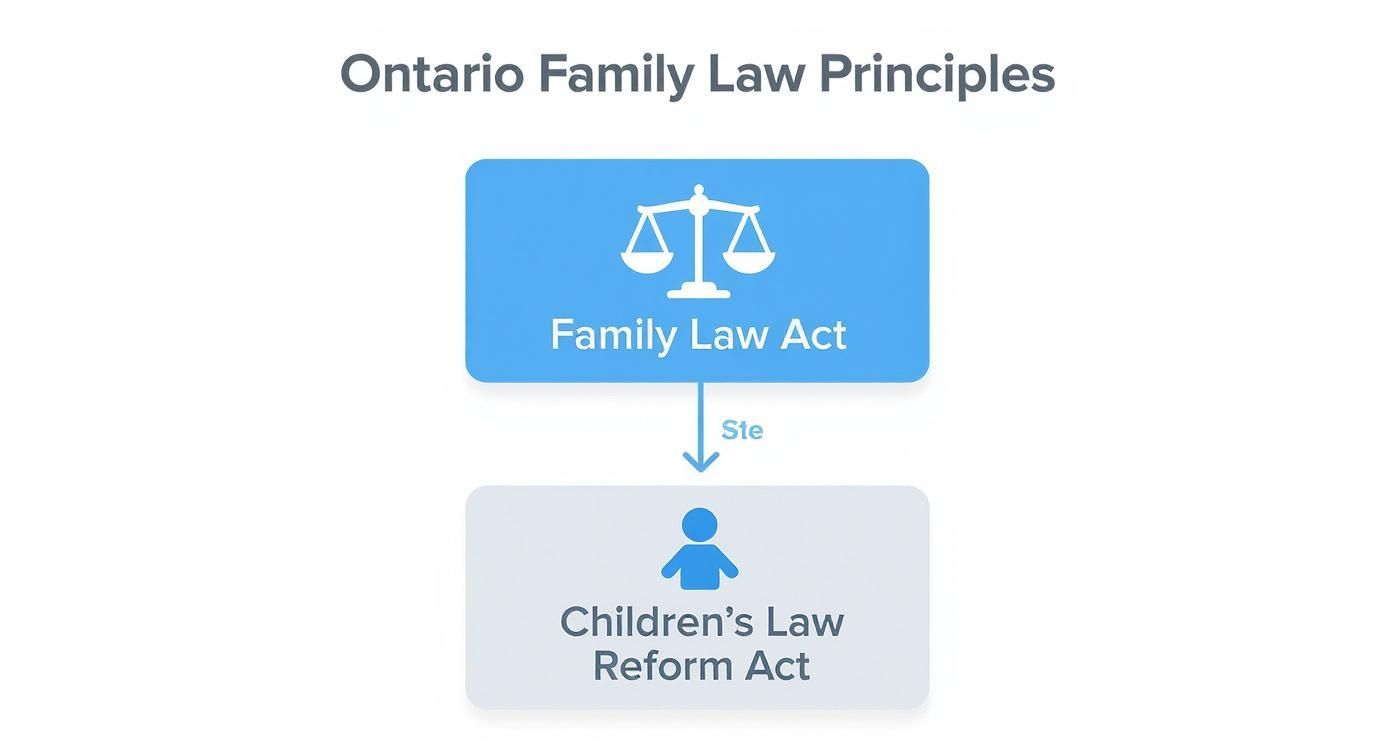
This chart shows how the Family Law Act connects with the Children's Law Reform Act, which details these parenting rights and responsibilities.
Your parenting plan is a blueprint for your child’s life post-separation. A clear plan, grounded in the Children’s Law Reform Act, prevents future conflict and provides the security your child needs.
The law starts with the assumption that both parents are equally entitled to decision-making authority. For a schedule to be considered "shared parenting," the child must spend at least 40% of their time with each parent. You can discover more insights about common custody arrangements to understand what it takes to pursue a specific plan in family court.
How Brampton Courts Prioritize Your Child's Best Interests
Every ruling on custody rights in Ontario, especially at the Brampton courthouse, is based on one principle: the best interests of the child. This is the mandatory legal standard under the Children's Law Reform Act. For you, this means every action you take should be justifiable as being for your child’s benefit.
The judge’s job is to determine which living situation and decision-making structure will best support your child's happiness, security, and development. No single factor is a trump card; it's the total picture that matters.

Core Factors in the Best Interests Test
A Brampton judge is guided by a specific list of factors. Proactively addressing these points with solid evidence is the most effective action you can take for your case.
-
Emotional Ties: The love, affection, and emotional bonds between the child and each parent, as well as with grandparents and other key relatives.
-
The Child's Views and Preferences: A child's wishes are taken seriously, especially as they get older and can articulate their reasoning.
-
Stability and the Status Quo: Courts are hesitant to disrupt a stable routine. The judge will consider where the child is living now and how well that arrangement has been working.
-
Each Parent's Ability to Provide: This is not about wealth. It’s about the ability to offer guidance, education, necessities, and special care in a stable home. This includes a parent's willingness to support the child's relationship with the other parent.
Demonstrating Your Parental Fitness
To show a Brampton judge you are focused on your child's best interests, you must document your involvement and your willingness to cooperate.
A judge in Brampton is looking for a parent who not only loves their child but also actively supports the child's relationship with the other parent. The ability to co-parent effectively is a massive indicator of parental fitness.
Your actionable step is to create a clear record of your role:
-
Communication Logs: Keep business-like records of texts, emails, and app messages with your co-parent focused on scheduling, school, and health.
-
School and Medical Records: Document your attendance at parent-teacher interviews and doctor's appointments to show you are involved.
-
Support for the Other Parent: Show how you have encouraged phone calls, video chats, and activities with the other parent.
How a Child's Age Influences the Decision
A child’s age and maturity are significant. There's no magic age where a child decides, but their voice grows louder over time.
For children under 12, statistics show mothers are often granted primary care, but as children mature and can better express their wishes (typically around age 12-14), shared parenting time becomes more common. These figures highlight how a child's evolving needs can shape the outcome. To learn more, see these insights on shared parenting in Canada.
Preparing for family court in Brampton means building a case around your child's well-being. By focusing on the factors that matter to the court and providing concrete proof of your positive involvement, you align your goals with the judge's objective and position yourself for a better result.
Your Action Plan for Seeking Custody Rights in Brampton
Establishing clear custody rights requires a structured, proactive approach. For parents in Brampton, a well-organized plan strengthens your case and centres the process on your child’s well-being. The best first move is not rushing to court; it's building a foundation of evidence and attempting to find common ground.
This journey starts with careful preparation. Begin by gathering all documents that paint a clear picture of your role in your child's life. This evidence is vital, whether you negotiate an agreement or present your case at the Brampton courthouse.

Step 1: Gather Your Key Documents
Before taking formal legal steps, compile a detailed record as proof of your commitment.
-
Communication Logs: Keep records of all co-parenting conversations via text, email, or a parenting app. This creates a clear timeline and shows your efforts to be cooperative.
-
School and Medical Reports: Collect report cards, attendance records, and notes from doctor’s appointments you attended to demonstrate your active involvement.
-
Photos and Calendars: Photos of you at school events or a calendar detailing your parenting schedule help establish your consistent presence.
This preparation is crucial because Ontario family law strongly encourages shared parenting. To seek significant parenting time, you must prove your active involvement and stability. To better understand this modern approach, see these Family Law Resources from Legal Aid Ontario.
Step 2: Draft a Comprehensive Parenting Plan
A parenting plan is your roadmap for co-parenting. A detailed plan prevents future arguments and sets clear expectations.
Your plan should cover:
-
Parenting Time Schedule: Outline the specific schedule for regular days, weekends, holidays, and summer vacations.
-
Decision-Making Responsibility: Specify how you’ll handle big decisions about health, education, and religion.
-
Communication Protocols: Set clear rules for how you’ll communicate with each other about the children.
Step 3: Explore Alternatives to Court
Court should be your last resort. Alternatives like mediation and collaborative family law are faster, cheaper, and less stressful for your children.
In Brampton, showing a judge you first tried a collaborative solution demonstrates your commitment to co-parenting and acting in your child’s best interests.
Services like Peel Region's mediation programs can connect you with a neutral third party to help you negotiate a parenting plan.
If court becomes unavoidable, the next step is to file an Application at the Brampton courthouse. This involves completing legal forms that outline the parenting arrangement you are seeking. You can find the necessary court forms on the Ministry of the Attorney General's website. Taking these organized steps gives you the best chance of securing a stable future for your children.
When Criminal Charges Impact Family Court Matters
When criminal law and family law intersect, the stakes for your custody rights become extremely high. For any parent in Brampton, facing a criminal charge—or making a serious allegation against a co-parent—adds a layer of complexity that the family court cannot ignore. Under the Family Law Act, the court's primary duty is to protect the child, and any sign of risk will trigger immediate protective measures.
Issues like domestic violence, assault, or serious substance abuse, which fall under the Criminal Code, directly impact your family law case. A judge at the Brampton courthouse must treat any potential threat to a child's safety as their top priority. This means a criminal charge can lead to swift and decisive court orders modifying parenting arrangements.
The Immediate Fallout of a Criminal Charge
A criminal allegation, even without a conviction, can have an immediate impact on your parenting time.
This can look like:
-
Suspension of Parenting Time: A judge may temporarily stop all in-person contact.
-
Supervised Parenting Time: The court can order that all visits must be supervised by an approved third party or at a designated access centre in Peel Region to ensure the child’s safety.
-
No-Contact Orders: Bail conditions or restraining orders issued under the Criminal Code of Canada can legally forbid a parent from contacting the other parent or child, making co-parenting impossible.
How Criminal Code Orders Overrule Your Family Life
It is critical to understand that conditions imposed by a criminal court are legally binding and will override any existing separation agreement or family court order.
A parent facing criminal charges must understand this: violating a no-contact order from a criminal court, even to see your child, can result in new criminal charges and immediate arrest. It completely overrides your previous parenting schedule.
A peace bond or a restraining order is a formal court order to prevent future harm. If one is in place, it sets the rules for all contact, and the family court will build its parenting orders around those restrictions to ensure the child's safety.
Navigating this dual-court reality alone is extremely difficult. The accused parent needs a strong criminal defence, while the other parent must act quickly in family court to protect their child.
This table shows how common issues can sway a judge's decision:
Impact of Common Issues on Custody Decisions
| Issue | Potential Impact on Custody Rights | Governing Legislation |
|---|---|---|
| Domestic Violence Allegations | Immediate suspension of unsupervised parenting time; potential for a restraining order. | Children's Law Reform Act, Criminal Code of Canada |
| Substance Abuse | Requirement for drug/alcohol testing; parenting time may be suspended or limited to supervised access until rehabilitation is proven. | Children's Law Reform Act, Divorce Act |
| Child Abduction/Flight Risk | Court may order the surrender of passports and restrict travel with the child. Decision-making may be granted solely to the other parent. | Hague Convention, Children's Law Reform Act |
| Breach of Bail Conditions | Viewed as a serious disregard for court orders, negatively impacting the parent's credibility and perceived stability. | Criminal Code of Canada |
The consequences are serious.
A Brampton family lawyer skilled in both the Criminal Code and the Family Law Act is essential. Evidence in one court can heavily influence outcomes in the other. Expert legal guidance is a necessity to protect your future and your relationship with your child. To understand how to handle these challenges, you can get expert advice from a Brampton criminal lawyer who has deep experience in these matters.
How to Change or Enforce Your Custody Order
A court order for parenting time and decision-making is not permanent. Life changes, and when those shifts are significant, the parenting arrangement must be flexible enough to adapt. Knowing how to modify or enforce your existing order is a crucial part of creating long-term stability for your child's life in Brampton.
A custody order can be changed, but you must prove there has been a material change in circumstances—a legal test meaning the change is substantial, was not foreseen when the first order was made, and impacts the child's well-being.
What Qualifies as a Material Change?
The change must be significant enough that the original judge would likely have made a different decision had they known about it.
Common examples include:
-
A Parent's Relocation: A move that significantly impacts the parenting schedule.
-
A Change in a Parent's Capacity: A serious illness, substance abuse problem, or criminal charges that affect a parent's ability to care for the child.
-
The Child's Evolving Needs: A teenager may have a strong, well-reasoned desire to change the primary living arrangement.
-
Failure to Comply with the Order: A consistent pattern of one parent willfully ignoring the terms of the order can be grounds for modification.
Enforcing Your Current Order in Brampton
If your co-parent is not following the court order—being late for pick-ups, making unilateral decisions, or denying your scheduled parenting time—you have legal options to enforce your custody rights in Ontario. This is a violation of a court order.
When a co-parent disregards a court order, it undermines the stability children need. The court has tools to compel compliance and hold a non-compliant parent accountable.
Your first step is to try and resolve it directly and document it in writing. If that fails, you can file a Motion to Change or an Application with the Brampton family court. A judge can order make-up parenting time, impose fines, or even change the primary parenting arrangement if the behaviour is harming the child. For specific guidance on the court process, the Family Law services offered in Ontario provide a reliable starting point.
Navigating modifications or enforcement actions requires a solid grasp of the Family Law Act and court procedures. Taking decisive legal action is key to protecting your child’s best interests.
Common Questions About Custody Rights in Ontario
Navigating custody can be overwhelming. Misinformation is common, and legal language can be confusing. Here are answers to some of the most common questions we hear from parents in Brampton.
At What Age Can a Child Decide Who to Live With in Ontario?
There is no specific age in Ontario family law where a child gets the final say. The law requires a judge to consider the child's views and preferences. The older and more mature the child, the more weight their opinion will carry. A judge will give serious thought to the reasoned opinion of a teenager, especially from age 12 to 14 onwards. However, the final decision is always based on the child’s best interests, and the judge must ensure the child’s choice is genuine and not the result of parental influence.
What Is a Parenting Plan and Do I Need One?
A parenting plan is a written document that you and your co-parent create to set the rules for raising your children after separation.
A solid plan should cover:
-
The parenting time schedule, including regular weeks, holidays, and vacations.
-
How you'll handle decision-making responsibility for major issues.
-
Protocols for communication.
While not legally required to start, creating a plan is a smart, actionable step. It can form the basis of a formal separation agreement or court order, helping you avoid future conflicts. It also shows a Brampton judge you are focused on cooperation. A great resource is the Government of Canada's Parenting Plan Checklist, which can guide you through the process.
How Do I Get Sole Custody of My Child in Brampton?
The term "sole custody" is now broken into two parts: having sole decision-making responsibility and having the child live primarily with you. To get this arrangement, you must file an application with the family court in Brampton. You will need to prove to a judge that this is in your child’s best interests. Since courts prefer arrangements that involve both parents, you must present strong evidence showing why joint decision-making would be harmful or why the other parent is unable to co-parent effectively. This typically involves serious issues such as domestic violence, substance abuse, or severe conflict that negatively impacts the child.
Answering these questions is a good start, but turning those answers into effective action requires real legal strategy. At Badesha Law, we provide the clear, practical guidance Brampton families need to protect their children's futures. Whether you're working on a parenting plan or facing a difficult court battle, we’re here to help. Contact us for a consultation to discuss your next steps.