Child Custody Ontario: A Modern Guide for Parents

When you're separating, one of the first things you'll notice is that the language around child custody in Ontario has changed. The law has moved away from confrontational terms like 'custody' and 'access.' Today, the focus is on parental responsibilities, not parental rights—a subtle but powerful shift designed to put your child’s well-being first.

Understanding How Ontario Defines Child Custody
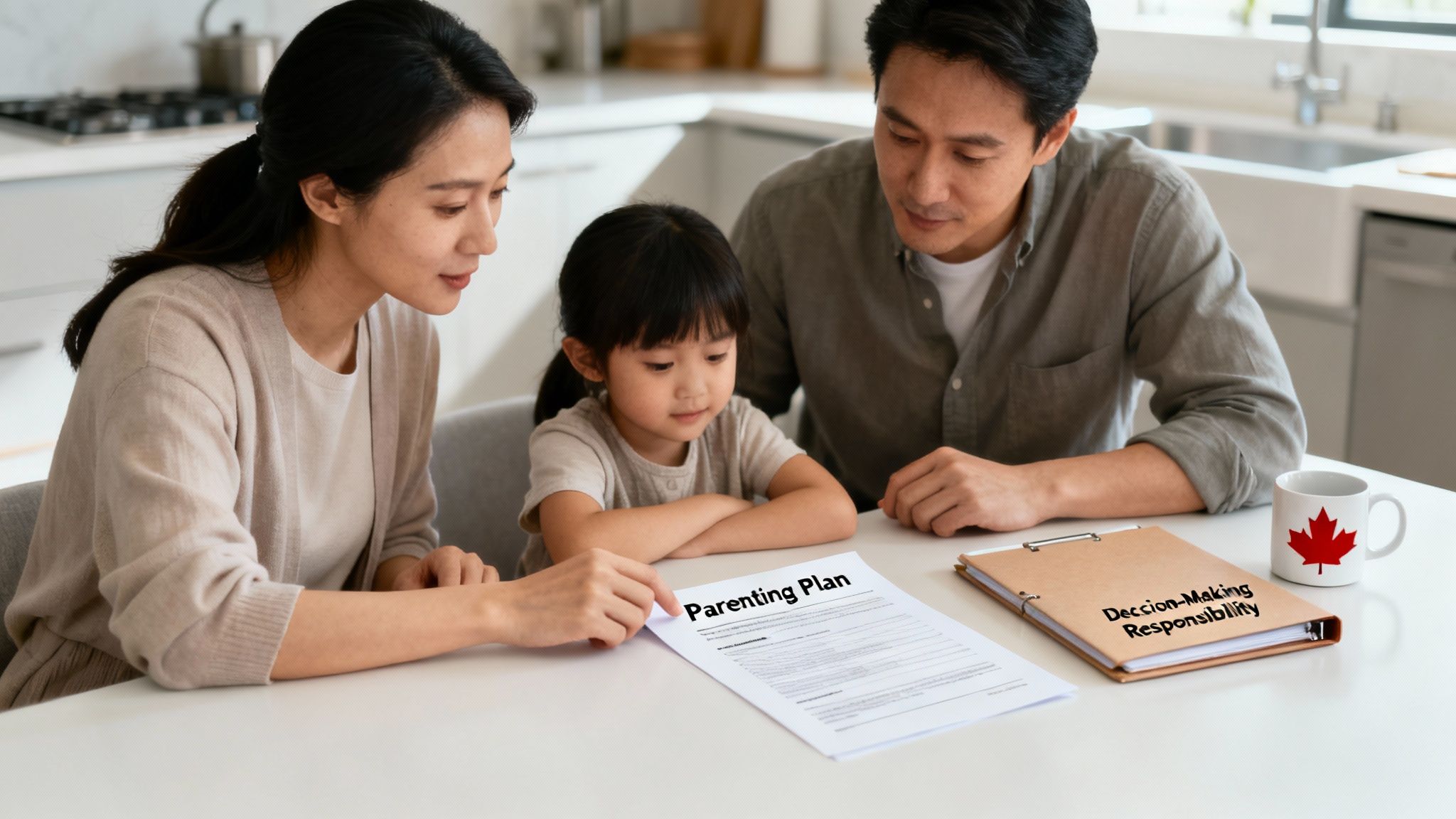
A family reviewing a 'Parenting Plan' and 'Decision-Making Responsibility' document with a Canadian mug.

If you're starting this journey, getting comfortable with the new legal vocabulary is key. This isn't just a matter of semantics; it’s a fundamental change in how the courts approach parenting after a split. The goal is to lower the temperature and encourage parents to work as partners in raising their children.

This modern framework is consistent across both the federal Divorce Act (for married couples) and Ontario's Children’s Law Reform Act (which applies to all parents, including common-law and unmarried couples). This alignment ensures a uniform approach to parenting matters across the province.

The Two Pillars of Parenting Arrangements

The old, single concept of "custody" has been split into two distinct and equally vital parts. Getting this distinction right is the foundation for creating a clear, stable plan for your kids.

  • Decision-Making Responsibility: This is about who has the legal authority to make the big calls on your child’s upbringing—think major decisions about health care, education, and religious or spiritual life.
  • Parenting Time: This is simply the schedule outlining when your child is in each parent's care. During your parenting time, you're in charge of all the day-to-day decisions, from what’s for dinner to when homework gets done.

Think of it like this: decision-making is the "what" and "why" of your child’s life strategy, while parenting time is the "when" and "how" of daily life.

This legal shift emphasizes that parents have responsibilities toward their children, rather than rights over them. The entire system is built to answer one question: What is in the best interests of the child?

The terminology may have been updated, but the core concepts are what parents have always negotiated. The new language just provides a healthier framework for those discussions. To help clarify, here’s a quick reference for the change in terms that happened in 2021.

Old vs New Child Custody Terms in Ontario

Old Term (Pre-2021) New Term (Current Law) What It Means in Practice
Custody Decision-Making Responsibility The authority to make major decisions about a child's health, education, and religion.
Access Parenting Time The schedule of when the child is in each parent's care.
"Custodial Parent" Parent with Primary Care The parent with whom the child lives most of the time. This is often tied to day-to-day decisions.
"Access Parent" Parent with Parenting Time A parent who has scheduled time with the child but isn't the primary caregiver.

These new terms are used in both the federal Divorce Act and Ontario's provincial laws, creating a consistent approach that focuses on cooperation rather than conflict.

How Responsibility is Divided

Decision-making responsibility isn't a one-size-fits-all arrangement. Depending on what's best for the child, a court can order sole decision-making responsibility (one parent makes all major choices) or joint decision-making responsibility (both parents must agree).

Often, even with a joint arrangement, one parent is named the primary caregiver. To learn more about this specific role, check out our detailed guide on the custodial parent definition.

The landscape of family law has shifted dramatically over the years. Where mothers were once awarded primary care in about 70% of cases, joint arrangements are becoming much more common. For child support purposes, a shared parenting time arrangement kicks in when a child spends at least 40% of their time with each parent.

What Courts Consider The Best Interests Of The Child

Parents comfort their son on a sofa next to a 'Best Interests' document on a clipboard.

When it comes to parenting time and decision-making responsibility, every single ruling a judge in Ontario makes is filtered through one powerful, guiding principle: the best interests of the child. This isn't just a suggestion; it's the absolute cornerstone of both the federal Divorce Act and Ontario's Children’s Law Reform Act.

This concept isn't some vague, feel-good idea. It's a specific legal test that forces a judge to look at the whole picture of a child’s unique life. The law actually provides a checklist of factors that have to be considered to figure out what arrangement will best protect a child's physical, emotional, and psychological well-being.

The court’s job is to see the entire situation from the child’s point of view. It’s not about what a parent wants or feels they are entitled to. It’s about creating the most stable, healthy, and supportive environment for that child as they move forward.

Key Factors in the Best Interests Test

When a judge is weighing decisions about child custody in Ontario, they look at a whole range of factors together. No single factor automatically outweighs the others; instead, they are all pieced together to form a complete picture of the family's dynamic.

Here are some of the main factors outlined in the legislation:

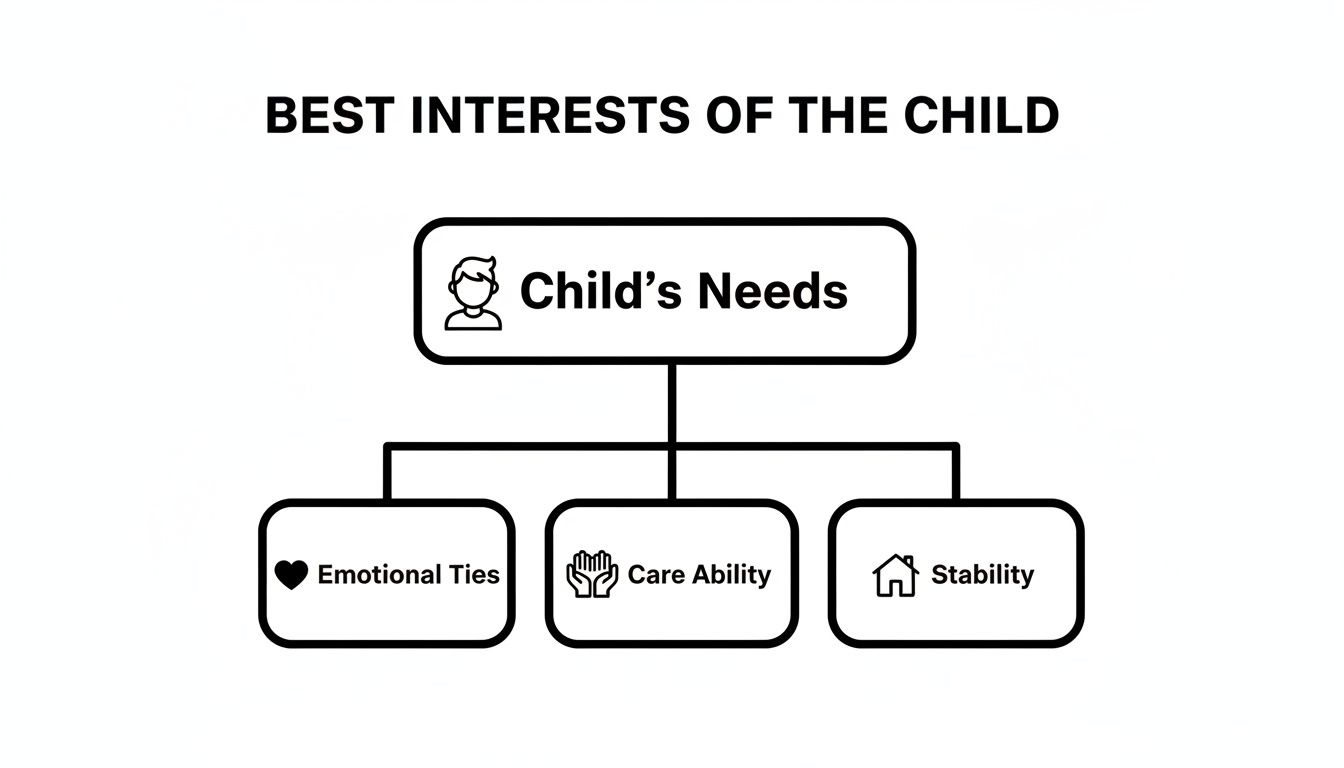
  • The Child's Needs: This goes beyond just food and shelter. It includes the need for love, affection, stability, and consistent emotional support—all the things that are fundamental to healthy development.
  • The Nature of Relationships: The court will examine the strength of the child’s bond with each parent, but also with their siblings, grandparents, and other people who play a significant role in their life.
  • Each Parent's Care Plan: Judges need to see a realistic, well-thought-out plan from each parent. This isn't just a wish list; it’s a practical outline of how you will care for the child day-to-day, including details about housing, school, and daily routines.
  • Stability: Children thrive on stability. The court will always consider how much a proposed change will disrupt the child’s current living situation and routines.

A parent’s past behaviour is usually only considered if that conduct directly impacts their ability to be a good parent. The focus is kept firmly on what is best for the child’s future.

The ultimate goal is to craft a parenting arrangement that allows the child to thrive. This means ensuring they have strong, positive relationships with both parents, provided it is safe and appropriate to do so.

The Child's Views and Preferences

A question we hear all the time is, "Does my child get to decide where they live?" The law is very clear on this: a child’s views and preferences must be considered, but the weight given to those wishes depends entirely on their age and maturity level.

For example, the opinion of a sharp, mature 16-year-old is going to carry a lot of weight with a judge. The preference of a 6-year-old, on the other hand, will be listened to but it certainly won't be the deciding factor. In the end, a judge always makes the final call based on all the evidence, which may or may not line up with what the child says they want.

The Impact of Family Violence and Conflict

The presence of family violence is a massive red flag for the court. The law requires judges to look closely at any instances of abuse or neglect, their effect on the child, and whether the offending parent can provide proper care.

Just as important, a parent's willingness to support the child’s relationship with the other parent is put under a microscope. A parent who constantly badmouths the other or creates conflict is often seen as not acting in the child’s best interests. This is a huge deal, because courts know that ongoing parental conflict is one of the most damaging things for a child’s well-being. To get a deeper insight into this complex evaluation, you can learn more about how courts decide child custody in these difficult situations.

Whether you're sitting down in mediation or standing in a courtroom, your ability to show how your plan checks all these boxes is everything. Presenting a clear, logical plan that puts your child’s needs first will always be your strongest strategy.

Crafting A Practical Parenting Plan

A well-crafted parenting plan is the single most important tool you have for preventing future conflict and bringing stability to your children's lives. Think of it as a detailed business plan for co-parenting. The clearer you make the terms, the less room there is for misunderstandings down the road, making it an absolutely essential document for any family navigating a child custody ontario matter.

This plan goes way beyond just agreeing on the basics. It’s a living document that anticipates what’s coming next and gives you both a clear roadmap for handling it. By investing the time to create a thorough plan now, you are building a foundation of predictability and security that benefits everyone—most importantly, your children.

Core Components of a Strong Parenting Plan

Every family is unique, so every parenting plan is going to look a little different. That said, a strong plan always covers the same fundamental areas to make sure all the major parts of a child's life are clearly addressed.

  • Parenting Time Schedule: This is the calendar of your child's life. It needs to be specific, covering the regular weekly schedule (like a 2-2-5-5 rotation), school breaks, summer holidays, and special days like birthdays and religious holidays.
  • Decision-Making Protocols: This section outlines how major decisions will be made. Will you decide everything together, or will one parent have the final say on specific areas like healthcare while the other decides on education? Be precise.
  • Communication Guidelines: Set the rules of engagement. Establish how you and the other parent will communicate about the children. This can mean specifying the use of a co-parenting app, setting rules for texting, and scheduling regular check-ins.
  • Child-Related Expenses: While child support covers the basics, your parenting plan should detail how extraordinary expenses (like competitive sports fees, tutoring, or orthodontics) will be shared.

A vague plan is a recipe for conflict. For example, just stating "holidays will be shared" is not enough. A much better clause would be: "Parent A will have the children for the first half of the winter break in even-numbered years, and Parent B will have them for the second half, with the schedule reversing in odd-numbered years." That level of detail removes any guesswork.

A parenting plan is not about winning or losing; it's about creating a stable, predictable environment for your child. It transforms abstract legal principles into a practical, day-to-day guide for your family.

Adding Details That Matter

The difference between a decent plan and a great one lies in the details. Thinking through potential future scenarios now can save you an immense amount of stress and legal fees later. These finer points show a real commitment to cooperative co-parenting.

For parents looking to create a schedule where time is divided more equally, understanding the nuances of different arrangements is key. You can learn more about how to structure these types of agreements by exploring our guide on shared and joint custody arrangements.

How to Create Your Parenting Plan

You have several options for developing your parenting plan, and the best path depends entirely on your family's ability to communicate and cooperate.

  1. Direct Negotiation: If you and your ex-partner are on amicable terms, you can sit down together and draft a plan. It is absolutely crucial to have a family lawyer review any agreement before you sign to ensure it's legally sound and enforceable.
  2. Mediation: A neutral third-party mediator can help guide your discussion, offer suggestions, and keep the conversation focused on your children's best interests. This is an excellent choice for parents who struggle to communicate but want to avoid court.
  3. Collaborative Family Law: In this process, both parents and their specially trained lawyers agree to work together to find a solution without ever going to court. It’s a team-based approach focused entirely on reaching a settlement.
  4. Litigation: If all other methods fail, a judge will create a parenting plan for you through a court order. This is the least desirable option, as it removes control from the parents and places it in the hands of the court.

Choosing Your Legal Path: Uncontested Vs. Contested

Once you’ve hammered out the details of a parenting plan, the next step is to make it official and legally binding. When it comes to child custody in Ontario, you’re essentially looking at two very different roads: the cooperative path of an uncontested agreement, or the structured, court-driven path of a contested case.

The route you take will have a massive impact on the cost, timeline, and emotional toll of your separation. Understanding the difference isn't just academic—it's the key to making an empowered choice for your family. One path puts the control in your hands, while the other asks a judge to make the final call when you and the other parent simply can't agree.

The Uncontested Path: Cooperation and Control

For most families, the uncontested route is the best-case scenario. It means both parents are able to work together—either on their own, with lawyers, or a mediator—to finalize a parenting plan and settle all their issues. This shared agreement is then locked into a formal, legally binding document.

There are two primary ways to do this:

  1. Separation Agreement: Think of this as a private, comprehensive contract between you and the other parent. It details every aspect of your separation, from parenting time and decision-making to financial support. When a lawyer drafts it properly, it's a powerful and fully enforceable document.
  2. Consent Order: If you’ve reached a full agreement, you can submit your terms to the court and ask a judge to convert them into a formal court order. This gives your agreement the exact same weight and enforceability as an order made by a judge after a full-blown trial. You can learn more about this powerful tool in our article on what is a consent order.

The upsides to staying out of court are huge. You keep control over the final outcome, you save an incredible amount of money on legal fees, and, most importantly, you protect your children from the conflict and stress of a court battle.
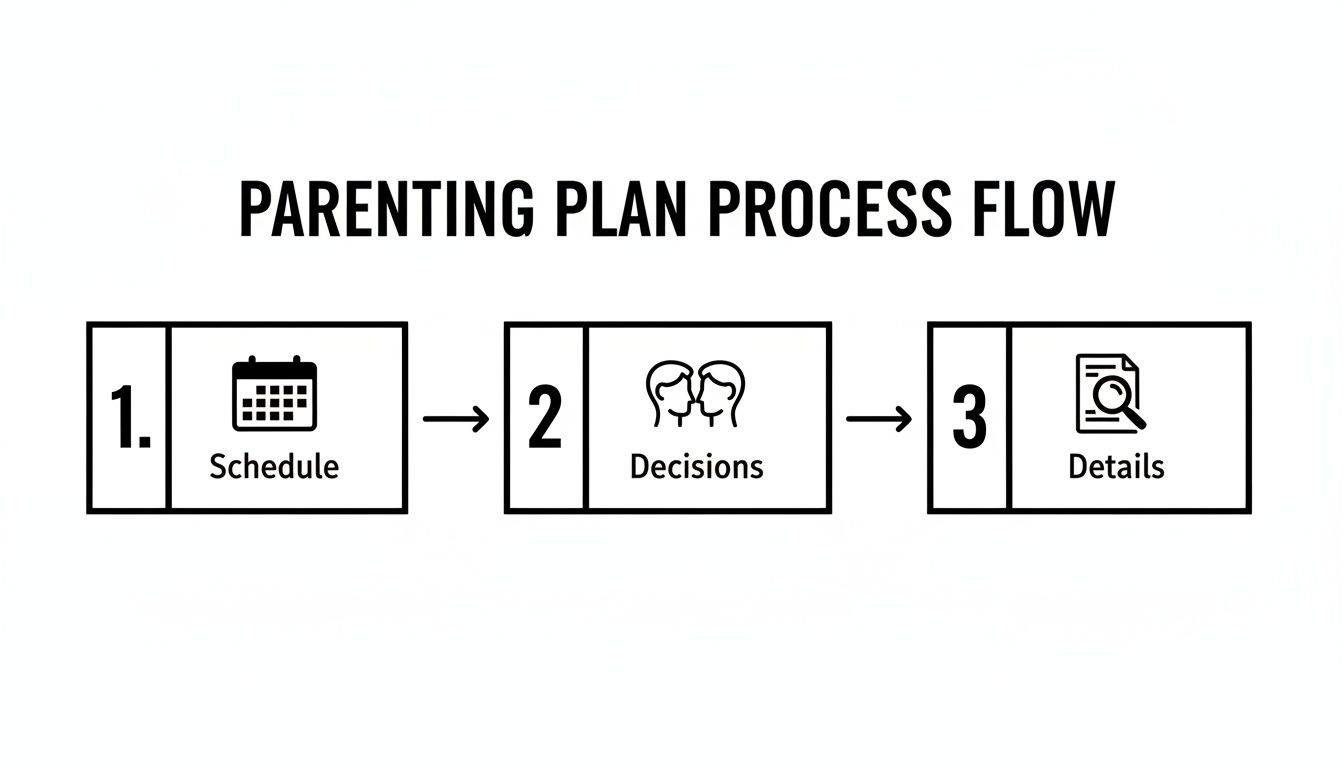
A parenting plan process flow diagram illustrating three steps: Schedule, Decisions, and Details.

This visual breaks down the core components of a solid parenting plan. Whether you're working together or heading to court, moving from the schedule to decisions and then ironing out the details is the foundation of a stable plan for your kids.

Navigating The Contested Path: When Agreement Fails

Sometimes, no matter how hard everyone tries, you just can't find common ground. When negotiation and mediation fall short, the contested path—going to court—is the only option left. This is a much more formal, structured, and frankly, expensive process where a judge will make the final decisions for you.

Ontario’s family courts are swamped. With 8,083 new family applications filed in a single recent year, the system is under incredible strain. This statistic alone should tell you why finding a way to agree is so important—it helps you avoid getting stuck in a very long queue.

But going to court isn't a single, dramatic event like you see on TV. It's actually a series of steps, and each one is designed to give you and the other parent another chance to settle.

The purpose of the family court system is to resolve disputes. While a trial is the final step, the process itself provides multiple opportunities for parents to reach an agreement with the help of judges and court resources.

Here’s a rough sketch of what the contested process looks like:

  1. Filing an Application: The process starts when one parent (the "Applicant") files an Application with the court. This document lays out what they're asking the judge to order. It then has to be formally served on the other parent (the "Respondent").
  2. First Appearance: This is a brief, administrative court date. It’s mostly about setting timelines and making sure everyone understands the next steps in the court process.
  3. Case Conference: This is a pivotal meeting with a judge. Both sides get to discuss the key issues, explore ways to settle, and map out a plan. The judge can't make a final order here, but they can offer their professional opinion, which often helps move things along.
  4. Motions for Temporary Orders: Life doesn't stop just because you have a court case. If there are urgent issues that can't wait for a trial—like who the kids live with day-to-day or who pays child support in the meantime—a parent can bring a "motion" to ask a judge for a temporary order.
  5. Trial: If all else fails and no settlement can be reached, the case moves to a trial. This is where both sides present their evidence and witnesses, and a judge makes a final, binding decision. When a case gets this far, having a perfect record is critical, and services for reliable court audio transcription can become essential.

The contested path can feel daunting, but knowing how it's structured can help take some of the fear away. Every step is part of a system designed to find a resolution that, above all, serves the best interests of your child.


Let's break down the core differences between these two paths in a simple table.

Comparing Uncontested and Contested Paths in Ontario

Feature Uncontested Process (Agreement) Contested Process (Court Litigation)
Control Over Outcome Complete control. You and the other parent decide the terms. No control. A judge makes the final, binding decisions.
Timeline Fast. Can be finalized in a few months once the agreement is signed. Slow. Often takes 12-24 months or longer to reach a trial.
Cost Predictable and much lower. Often handled with flat fees. Unpredictable and high. Billed hourly, costs escalate quickly.
Process Collaborative. Focuses on negotiation, mediation, and paperwork. Adversarial. Involves formal court procedures, motions, and evidence.
Emotional Stress Lower. Cooperation reduces conflict and shields children. High. The adversarial nature is stressful for parents and kids.
Privacy Private. Your agreement is a confidential contract. Public. Court documents and proceedings are generally public record.

As you can see, the path of agreement offers significant advantages in cost, speed, and emotional well-being. The court process provides a necessary structure for resolving deep-seated conflicts, but it comes at a much higher price—financially and emotionally.

How To Modify Or Enforce Your Parenting Arrangement

Parenting plans, whether they’re laid out in a separation agreement or a formal court order, are meant to create stability and predictability. But life isn’t static. Kids get older, their needs shift, and parents' circumstances can change dramatically, sometimes making the original terms unworkable.

Then there are the times when one parent simply doesn't stick to the plan. This can create chaos and conflict, undermining the very stability the arrangement was designed to provide. Knowing how to legally modify a parenting plan or enforce its terms is absolutely essential for managing your co-parenting relationship and protecting your child’s best interests.

How to Modify a Parenting Order or Agreement

You can't just ask a court to change a parenting order because you’ve had a change of heart. To get a judge in Ontario to alter an existing agreement or order, you have to prove there has been a “material change in circumstances.”

This is a specific legal test with a high bar. A material change isn't a small scheduling conflict; it’s a significant, unforeseen event that fundamentally alters the landscape for your child. It must be something that, had it been known when the original order was made, would have likely led to a completely different outcome.

A material change is more than a minor inconvenience or a small shift in schedules. It must be a fundamental alteration of the situation that directly impacts the child's well-being and was not anticipated when the original plan was made.

So, what actually qualifies? Here are a few common examples that might meet the test:

  • A parent has to relocate. A new job in another city could make the current parenting time schedule impossible to maintain.
  • A parent's capacity changes. A serious health diagnosis or a demanding new work schedule could make it impractical to stick to the original plan.
  • The child's needs evolve. A child might develop new medical needs or require specialized educational support that the current arrangement can’t accommodate.
  • A co-parenting breakdown. If one parent consistently refuses to communicate or actively undermines the other's role, joint decision-making might become impossible, forcing a change.

Enforcing Your Parenting Arrangement

What do you do when the other parent just isn’t holding up their end of the deal? Maybe they're consistently late for pick-ups, cancelling parenting time at the last minute, or making big decisions about the kids without even talking to you. It's incredibly frustrating and can be very damaging to your child's sense of routine and security.

Your first step should always be to document everything. Start a log. Write down every single breach with dates, times, and the specific details of what happened. This written record isn't just for your own sanity; it’s crucial evidence if you have to go to court.

If talking it out doesn’t work, your next move is to seek legal enforcement. This usually means filing a motion with the court. Depending on how serious and frequent the breaches are, a judge can order several different remedies:

  1. A Clarification Order: Sometimes the problem is just a poorly worded agreement. A judge can issue an order that clarifies the exact terms to remove any ambiguity.
  2. A Motion for Contempt: This is a very serious step. You're asking the court to formally declare that the other parent has wilfully disobeyed a court order. If you're successful, the penalties can range from fines to, in the most extreme cases, jail time.
  3. An Order for Make-Up Time: The court can order the parent who denied parenting time to provide that lost time back to the other parent.

When a situation becomes dire and you believe your child is at risk, you may need to act much more quickly. Our guide on obtaining an emergency child custody order explains the process for taking urgent court action. However, the best strategy is always to resolve these issues before they escalate to that point.

Common Questions About Child Custody In Ontario

As you navigate a separation, it’s completely normal for a flood of questions to surface. The world of family law can feel like a maze, and finding clear, direct answers to your biggest concerns is the first step toward regaining your footing. Let's tackle some of the most common questions we hear about child custody in Ontario to give you practical insights and more confidence moving forward.

At What Age Can A Child Decide Who To Live With In Ontario?

This is easily one of the biggest myths in family law. The truth is, there is no magic age in Ontario where a child suddenly gets to decide which parent they live with. A judge always makes the final call, and their decision is based on a full picture of the child’s best interests.

That said, a child's own views are a mandatory factor that judges must consider under both the federal Divorce Act and Ontario's Children's Law Reform Act. The real key is how much weight the judge gives those views. It all comes down to the child's age and maturity. The well-reasoned opinion of a 15-year-old will carry a lot more influence than the preference of a 7-year-old, whose wishes might be based on who has the better video games or fewer rules about bedtime.

While a child's voice is always heard, it is never the sole deciding factor. The court's primary duty is to ensure the parenting arrangement serves the child's overall physical, psychological, and emotional well-being, which may sometimes differ from the child's stated preference.

In the end, a judge will balance what the child wants against all the other best-interest factors, like the stability of each home and each parent’s ability to provide care.

What Is The Difference Between Sole And Joint Decision-Making Responsibility?

Getting this distinction right is absolutely critical when you're building a parenting plan. This isn't about where the child lives; it’s about who has the final say on the big, life-shaping decisions for them.

  • Sole Decision-Making Responsibility: Think of this as one parent being the designated captain for major choices about the child's health, education, and significant activities like religion. The other parent usually has a right to be consulted and given information, but the parent with sole responsibility gets to make the final call.
  • Joint Decision-Making Responsibility: This model requires both parents to function like a team. You have to reach a mutual agreement on all those major decisions together. It demands a high level of cooperation and communication. If parents with joint responsibility can’t agree, they’ll likely need a mediator or even have to go back to court to break the deadlock.

It’s important to remember this is separate from the small, everyday stuff. The parent who has the child in their care during their parenting time is always in charge of routine decisions like what’s for dinner, when homework gets done, and daily activities.

Do I Need A Lawyer To Get A Custody Order In Ontario?

Legally, you have the right to represent yourself in the child custody Ontario process. But just because you can doesn't mean you should. Family law is an incredibly specialized and complex field, with intricate court rules and case law that changes all the time. Going it alone is a huge risk.

An experienced family lawyer does far more than just fill out paperwork. They give you strategic advice, make sure your rights and your child’s interests are fiercely protected, and help you negotiate an agreement that is fair and legally airtight. A poorly drafted agreement, for example, could be challenged and overturned by a court years down the road, costing you far more in stress and money than hiring a lawyer from the start.

Think about what you get with a lawyer:

  • Expertise: They understand the nuances of the law and how judges in your specific courthouse are likely to rule.
  • Objectivity: They bring a calm, level-headed perspective to an emotionally explosive time, stopping you from making decisions driven by anger or hurt.
  • Efficiency: They know the system inside and out, helping you avoid rookie mistakes that cause frustrating and expensive delays.
  • Advocacy: They are your champion, ensuring your voice is heard and your case is presented in the strongest, most compelling way possible.

While it is an investment, hiring a lawyer is often the single most effective way to secure a stable and positive outcome for your family.

What Happens If My Ex-Partner Moves Away With Our Child?

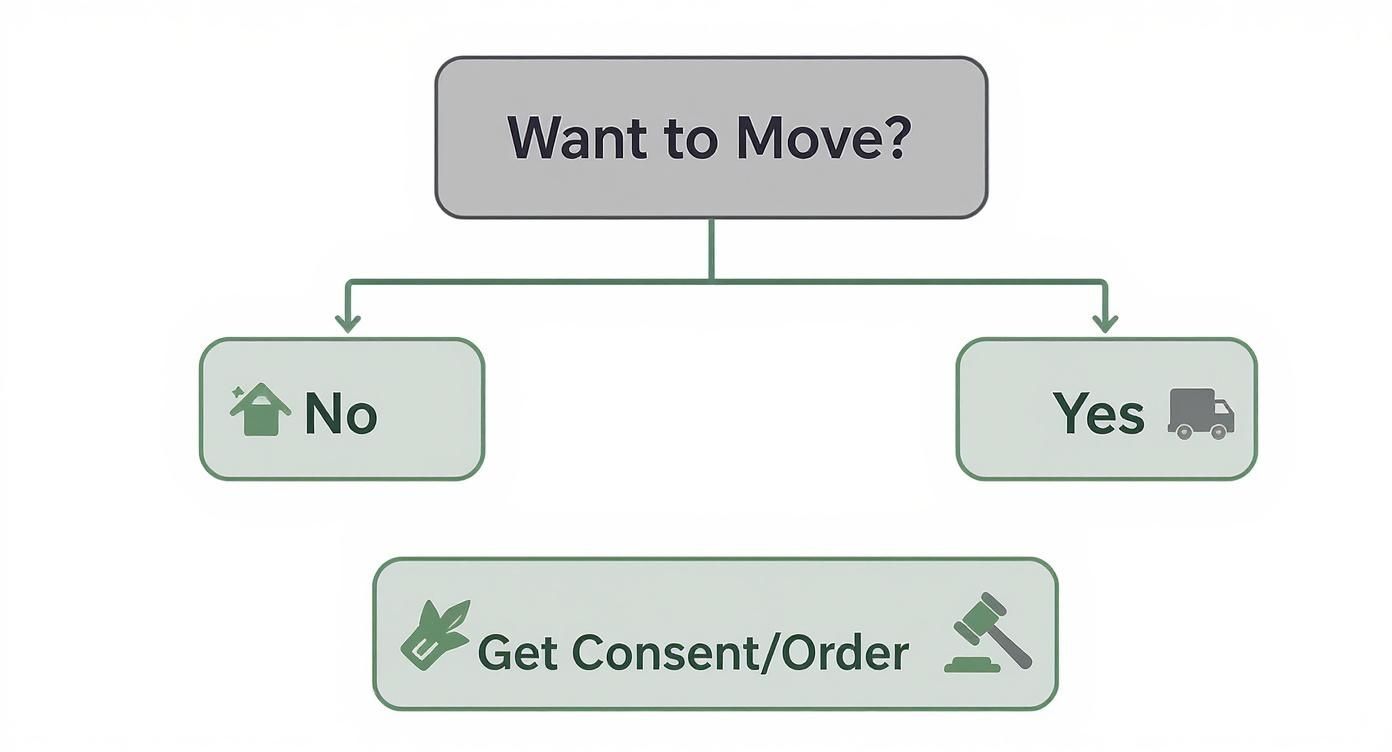
One parent can't just pack up and move with a child if it's going to significantly disrupt the other parent's time with them. This kind of major move is called a "relocation" under the Divorce Act, and it’s governed by very strict rules. Trying to relocate without permission can lead to serious legal consequences.

If a parent with decision-making responsibility or parenting time wants to relocate, they must provide at least 60 days' written notice to the other parent. This isn't just a casual heads-up; it's a formal notice that has to include the new address, the date of the move, and a proposal for a new parenting time schedule.

The other parent then has 30 days to object. If they do, the parent who wants to move is stuck—they cannot go anywhere without a court order. A judge will only grant permission if the moving parent proves two things: that the move is in "good faith" (for a legitimate reason, like a great new job) and that it is in the best interests of the child. The court will carefully weigh the pros of the move against the damage it could do by disrupting the child's relationship with the other parent and their entire community.


Navigating the complexities of child custody requires clear guidance and strong legal advocacy. The team at Badesha Law is committed to helping you understand your rights and responsibilities, so you can make informed decisions that protect your children and your future. If you are in Brampton or the GTA and need assistance with your family law matter, we invite you to reach out for a consultation.

Contact Badesha Law today to secure the expert legal support you deserve.

A Complete Guide to Shared Joint Custody in Ontario

When navigating a separation, your children's well-being is the top priority. This guide demystifies shared joint custody in Ontario, helping you create a stable and loving future for your family. At its core, shared joint custody means both parents collaborate on major life decisions (decision-making responsibility) and the child spends a significant amount of time with each parent—at least 40%, to be exact (parenting time). This arrangement is designed to keep both parents actively and meaningfully involved.

What Shared Joint Custody Means for Your Family

An African American family sitting at a table, attentively reading a document together.

Navigating a separation is tough, especially with kids. The good news is that Ontario's legal system is now completely child-centred. The old, adversarial language of "custody" and "access" is gone. Today, the law revolves around two core ideas: decision-making responsibility and parenting time.

A shared joint custody arrangement is a commitment to effective co-parenting. It’s built on the understanding that even though you are no longer a couple, you are both essential to your child's stability.

The Two Pillars of Shared Custody

Think of shared custody as having two essential pillars:

  1. Shared Decision-Making Responsibility: You and the other parent must consult each other on big issues like choosing a school, consenting to medical treatment, or deciding on religious education.

  2. Shared Parenting Time: To officially qualify as "shared," the child must spend at least 40% of the time with each parent, as set by the Federal Child Support Guidelines. This ensures deep involvement in daily routines.

A successful shared parenting plan is more than a schedule; it's a commitment to cooperative, child-focused communication that puts your child’s need for stability and connection with both parents first.

This guide is your roadmap for understanding the legal landscape in Brampton and the GTA. For a deeper dive into these legal terms, see our guide on understanding child custody in Ontario.

How Shared Custody Differs from Other Parenting Arrangements

Before deciding if a shared custody arrangement is right for you, you need to understand the alternatives. The main difference between models comes down to decision-making power and parenting time.

Shared joint custody is a true co-parenting partnership. Both parents get an equal say, and the child spends significant time in each home. This is very different from arrangements where one parent has all the decision-making authority.

Comparing Shared Custody with Sole Custody

Sole custody is the opposite of a shared arrangement. A court gives one parent both the child's primary residence and the exclusive authority to make all major decisions, including:

  • Education and school choice

  • Non-emergency medical and dental care

  • Religious instruction

  • Extracurricular activities

The other parent has scheduled parenting time but no legal say in these critical decisions. Courts in Ontario typically grant sole custody only in difficult situations, such as high-conflict separations, family violence, or when one parent is unable to care for the child.

Shared Custody Versus Split Custody

Split custody is a rare arrangement for families with two or more children. The siblings are separated, with at least one child living primarily with one parent and at least one other child living with the other parent.

For example, the son might live with his father while the daughter lives with her mother. Each parent would have sole decision-making power for the child in their home.

Courts generally avoid this setup because the sibling bond is vital. However, it might be ordered if older children have strong, clear, and reasonable preferences.

Comparing Ontario's Parenting Arrangements

The table below offers a straightforward comparison of the main parenting arrangements in Ontario.

Arrangement Type Decision-Making Responsibility Typical Parenting Time Best Suited For
Shared Custody Both parents must agree on major decisions regarding education, health, and religion. The child lives with each parent for at least 40% of the time over the course of a year. Parents who can communicate effectively and cooperate in the child's best interests.
Sole Custody One parent has the full legal authority to make all major decisions independently. The child lives primarily with one parent. The other parent has scheduled parenting time. High-conflict situations or when one parent is unable to provide adequate care.
Split Custody Each parent has sole decision-making power for the child living primarily with them. At least one child lives with one parent, and at least one child lives with the other. Rare cases, typically involving multiple older children with strong, differing preferences.

Ultimately, the goal is always to honour the single most important principle in Ontario family law: protecting the best interests of the child.

The Factors Ontario Courts Use to Decide Custody

When parents can't agree on a parenting plan, a judge must decide. The process isn't arbitrary. Ontario judges follow a clear legal test from the Divorce Act and Children's Law Reform Act: the best interests of the child.

This principle is the only factor guiding every custody decision. It's not about what a parent wants, but what will best support a child's safety, well-being, and development. It's a myth that courts automatically default to a 50/50 shared joint custody arrangement.

The Best Interests of the Child Test

To determine a child's best interests, the court considers a specific list of factors. No single factor is definitive; the judge looks at the complete picture.

Key factors a judge will analyze include:

  • The Child's Needs: This includes their need for stability, considering their age and stage of development.

  • Relationships with Each Parent: The court examines the emotional bonds between the child and each parent.

  • Each Parent's Willingness to Support the Other's Role: A judge looks for evidence that you will both encourage a healthy relationship with the other parent.

  • History of Care: The court considers who has been the primary caregiver, handling daily tasks like meals, appointments, and school help.

The court's primary goal is to protect the child’s right to a loving relationship with both parents, as long as it is safe. Any behaviour undermining this can be viewed negatively by a judge.

Stability and the Ability to Co-Parent

A critical piece for any joint custody arrangement is whether the parents can communicate and cooperate. The court needs to be convinced you can make decisions together without constant conflict. For more details on this process, read our article on how courts decide child custody matters.

Public Sentiment vs. Legal Reality

While there is no automatic legal presumption for shared parenting in Ontario, public opinion strongly supports it. A National Parents Organization survey found that 93% of respondents believe children benefit from spending maximum time with both parents. This shows a societal shift recognizing that kids thrive when both parents are involved. A skilled family lawyer can help reflect this principle in your parenting plan.

Designing a Practical Shared Parenting Schedule

Hands pointing at an open calendar with a toy car, colorful sticky notes, pens, and a coffee cup.

The success of a shared joint custody arrangement depends on its schedule. The goal is to create a practical, predictable rhythm that gives your children stability.

There's no one-size-fits-all solution. The best schedule fits your family's unique circumstances, considering your child's age, school location, and the distance between your homes.

Popular Shared Parenting Schedules

Several common schedules can be effective starting points.

  • The Week-On/Week-Off Schedule: Children spend one full week with Parent A, then the next with Parent B. This works well for older children as it reduces exchanges.

  • The 2-2-5-5 Schedule: Each parent gets the same two weekdays (e.g., Parent A has Mon/Tues, Parent B has Wed/Thurs). You then alternate long weekends.

  • The 2-2-3 Schedule: The kids are with Parent A for two days, Parent B for two days, then back with Parent A for a three-day weekend. The rotation flips the next week. This is ideal for younger children who need frequent contact.

For more legal context, see our guide on defining parenting time in Ontario.

Comparing Common Schedules

This table breaks down the key features of these popular schedules to help you decide.

Schedule Name How It Works Pros Cons
Week-On/Week-Off The child spends 7 days with one parent, then 7 days with the other. Fewer transitions; simple to track; works well for older children. A week can feel very long for younger children to be away from a parent.
2-2-5-5 Rotation Parent A has Mon/Tues, Parent B has Wed/Thurs. Weekends alternate. Consistent school week schedule; each parent gets longer weekend time. Can feel complex; requires careful calendar tracking.
2-2-3 Rotation 2 days with Parent A, 2 with Parent B, then a 3-day weekend that alternates. Frequent contact with both parents; ideal for very young children. High number of transitions can be disruptive for some kids.

Tips for a Successful Schedule

A successful joint parenting agreement requires detail and communication.

Plan for Holidays and Vacations
Your parenting plan must clearly outline:

  • How major holidays will be divided or alternated.

  • The process for scheduling summer vacation time.

  • How birthdays will be handled.

The most effective parenting schedules are child-focused, predictable, and flexible. They provide a reliable routine while allowing for adjustments as needs change.

Embrace Flexibility and Communication
Life is unpredictable. Successful co-parenting plans allow parents to communicate respectfully and adapt. Consider using a co-parenting schedule app to manage calendars, track expenses, and keep communication organized.

How Shared Custody Affects Child Support Payments

A common myth is that 50/50 parenting time means no one pays child support. This is false. In Ontario, both parents must financially support their children, regardless of the schedule. The goal is to provide a consistent standard of living in both homes.

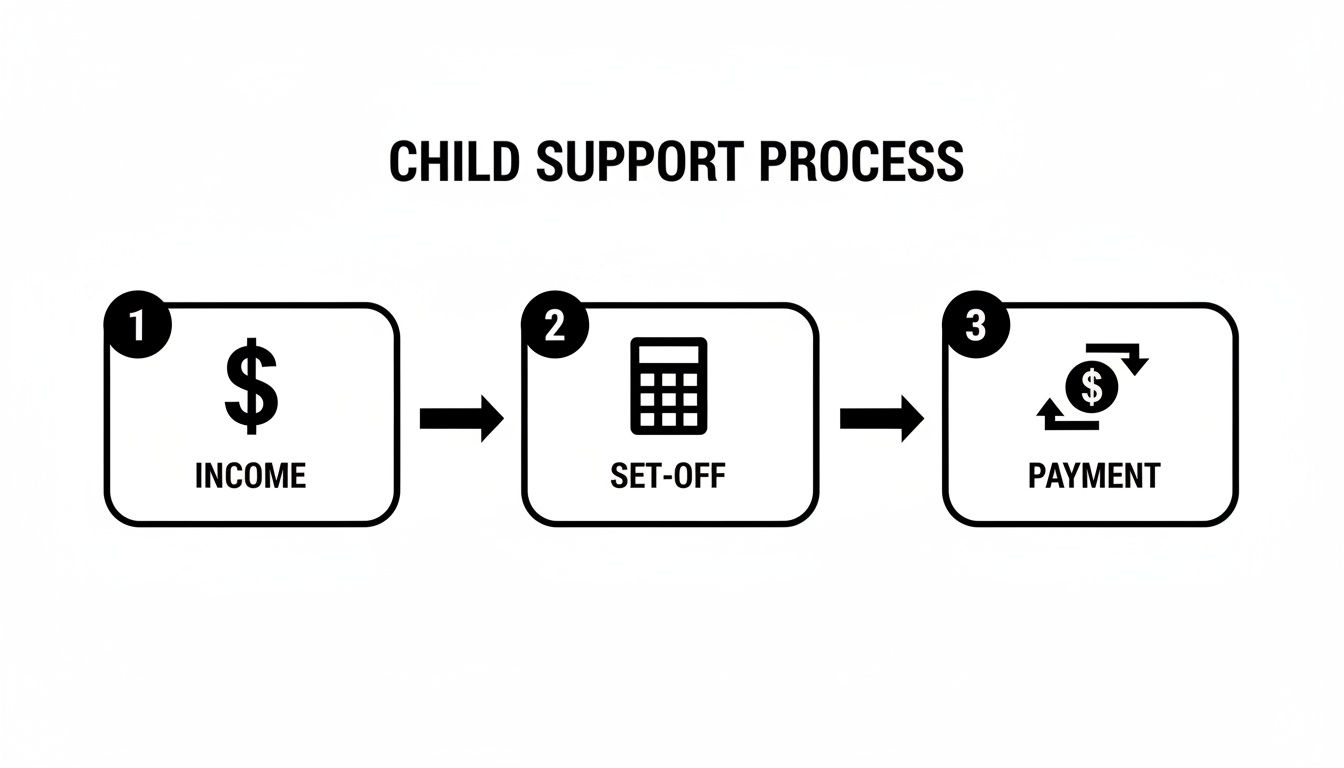
A shared joint custody arrangement changes how child support is calculated. The law recognizes that running two households increases costs. Therefore, the calculation uses a "set-off" amount, as outlined in the Federal Child Support Guidelines.

The Set-Off Calculation Explained

The set-off calculation levels the financial playing field for your child.

  1. Determine Each Parent's Table Amount: First, determine what each parent would pay based on their gross annual income using the official child support tables.

  2. Factor in Increased Costs: The court considers the increased costs of maintaining two separate households.

  3. Calculate the Difference: The smaller table amount is subtracted from the larger one. The parent with the higher income pays the difference (the "set-off" amount) to the parent with the lower income.

This method ensures financial support reflects both parents' incomes and the costs of a shared parenting schedule.

A Simplified Child Support Example

Let's walk through an example:

  • Parent A has a gross annual income of $80,000. Their monthly table amount for one child is $743.

  • Parent B has a gross annual income of $50,000. Their table amount is $450.

The set-off amount is the difference: $743 – $450 = $293.

In this shared custody scenario, Parent A pays Parent B $293 per month. For clear guidance on your obligations, learn more about navigating child support in Ontario.

It's a myth that 50/50 shared joint custody means no child support. Courts use a formula to ensure children maintain their standard of living. The higher-earning parent often pays the difference to the other to equalize the financial resources available to the child in each home. Discover more about how shared custody impacts support obligations on californiafamilylawgroup.com.

Navigating Common Co-Parenting Challenges

Even with the best intentions, co-parenting under a shared joint custody agreement has challenges. Success comes from managing disagreements constructively. Common hurdles include poor communication and inconsistent household rules.

Addressing Inconsistent Rules and Discipline

Different rules in each house can confuse children. The key is to align on the big stuff.

Focus on a united front for non-negotiables:

  • Safety: Rules around internet use and curfews.

  • Health: Bedtimes, screen time limits, and nutrition.

  • Academics: A consistent plan for homework.

  • Respect: Universal expectations for behaviour.

Flowchart illustrating the child support process steps: income, set-off calculation, and payment.

Improving Communication and Decision Making

Bad communication fuels most co-parenting conflicts. Treat your co-parenting relationship like a business partnership where the "business" is raising a healthy child. Other conflicts, like dealing with disputes over the marital home, can create tension, so it's vital to compartmentalize.

A game-changing strategy is to keep communication frequent, brief, and strictly about the kids. Schedule a regular 15-minute "business" call weekly to discuss appointments and updates.

If you are already in a high-conflict situation, understand your options when you are in a fight in family court for your child. Clear channels and firm boundaries can help you build a stable future.

Serving Brampton & The Greater Toronto Area

At Badesha Law, we have extensive experience helping families in Brampton and across the Greater Toronto Area navigate the complexities of shared joint custody. If you need a family lawyer "near me" who understands local court procedures and can provide tailored advice, our team is here to help. We are committed to finding practical, child-focused solutions for your family.

Ready to Create a Stable Future for Your Child?

Navigating shared custody can feel overwhelming, but you don't have to do it alone. Our experienced family lawyers can help you create a fair and practical parenting plan that protects your child's best interests.

Book a consultation today to discuss your unique situation and take the first step toward a stable co-parenting future. For more immediate information, download our free Co-Parenting Checklist to start organizing your thoughts.

Written by the legal team at Badesha Law. This article is for informational purposes only and does not constitute legal advice.

Related Reading

Frequently Asked Questions About Shared Joint Custody

Do we need to go to court for a shared custody agreement?

Not usually. Most parents negotiate a legally binding shared custody agreement through methods like mediation or collaborative family law. A lawyer then drafts a formal separation agreement, making the terms enforceable without court intervention. Court is a last resort for parents who cannot agree.

What happens if one parent wants to move?

A parent cannot simply relocate with a child if it would significantly disrupt the other parent's time under a joint custody arrangement. This is a complex legal issue called "mobility." You need the other parent's written consent or a court order allowing the move, based on the child’s best interests.

Can our shared custody arrangement be changed later?

Absolutely. Parenting plans are living documents. To modify a court order or separation agreement, you must show a "material change in circumstances" since the original agreement. This could be a major job change, remarriage, or the changing needs of a growing child.

At what age can a child choose who to live with?

There is no "magic age" in Ontario where a child's wishes become the final word. A judge will consider a child’s preferences, giving them more weight as the child matures. However, the child's wish is just one of many factors in the court's final decision, which is always based on their overall best interests.

What is the difference between shared custody and joint custody?

"Joint custody" traditionally refers to joint decision-making, while "shared custody" refers to the parenting time schedule (where the child spends at least 40% of the time with each parent). Today, many use "shared joint custody" to describe an arrangement that includes both shared decision-making and a shared parenting schedule.


Child Custody Ontario: A Parent’s Guide for Brampton Families

When you’re dealing with child custody in Ontario, the first thing you need to know is that the language has changed. The law has moved on from old, confrontational terms. Today, everything revolves around two key ideas: decision-making responsibility for the big choices and parenting time for the day-to-day schedule. At the heart of it all is one guiding principle, enforced by both the Family Law Act in Ontario and the federal Divorce Act: the child’s best interests come first, always.

Understanding Child Custody in Modern Ontario Law

An image contrasting adults in discussion at a table with a child's silhouette, calendar, clock, and teddy bear.

The first actionable step in any Brampton family law case is to set aside outdated terms like “sole custody” or “access.” Both Ontario’s Family Law Act and Canada’s Divorce Act have updated the vocabulary to better match the reality of modern co-parenting. This isn’t just legal jargon; it’s a fundamental shift in how the Brampton courts approach parental roles.

The goal is to move away from a winner-takes-all mindset and focus on collaboration and what’s best for the child. Think of it less like fighting over a title and more like creating a clear job description for how you’ll raise your child together after separating.

The Two Pillars of Modern Custody

The entire framework for child arrangements in Ontario is built on two distinct concepts. A Brampton judge can make orders for one or both, and they don’t have to be split the same way.

  • Decision-Making Responsibility: This is the authority to make major, life-shaping decisions for your child. It’s like being on the board of directors for your child’s future.
  • Parenting Time: This is the hands-on, day-to-day schedule that outlines when the child is in each parent’s care.

Understanding this distinction is critical for your case. For example, one parent might have the child living with them most of the time (more parenting time), but both parents could share the decision-making responsibility equally. This separation allows for flexible, creative solutions that fit your family’s unique needs.

In Brampton courts, it’s very common to see parents granted joint decision-making responsibility, which forces them to agree on the big stuff, even if the parenting time schedule isn’t a 50/50 split.

To make this clearer, let’s look at how the old terms translate to the new ones.

Old Custody Terms vs. Modern Ontario Terminology

This table will help you translate the traditional custody language you might see in movies or hear from friends into the current legal terms used in Brampton family courts today.

Outdated Term Modern Ontario Term What It Means in Practice
Sole Custody Sole Decision-Making Responsibility One parent makes all major decisions (health, education, religion) without needing the other’s consent.
Joint Custody Joint Decision-Making Responsibility Both parents must agree on major decisions. This requires effective communication and cooperation.
Access Parenting Time The schedule detailing when a child is with a parent. It can also include rights to contact (phone, video calls).
Primary Residence Primary Parent / Primary Residence The parent with whom the child lives most of the time. This parent often receives child support.

Thinking in these modern terms helps shift the focus from “winning” to “cooperating,” which is exactly what the Brampton courts want to see from you.

Deconstructing Decision-Making Responsibility

So, what exactly does “decision-making responsibility” cover? It’s all about the big-picture choices that shape a child’s life, health, and future. The court usually breaks this down into four key areas:

  1. Health: Includes everything from choosing a family doctor in Brampton to consenting to medical treatments or therapy.
  2. Education: Covers decisions about which Peel District school the child attends, whether they need tutoring, or if they should enroll in special programs.
  3. Religion and Spirituality: Involves determining the child’s religious upbringing, if any, and their participation in spiritual community activities.
  4. Significant Extracurricular Activities: This applies to major commitments like competitive sports teams, intensive arts programs, or anything that significantly impacts the child’s schedule and finances.

A judge can give this authority to one parent (sole), both parents (joint), or even split it up—for instance, one parent decides on health while the other decides on education. The final order depends entirely on what arrangement will best serve the child’s interests, stability, and well-being, taking into account how well you and the other parent can communicate.

What Brampton Courts Consider the Child’s Best Interests

A balance scale shows a house and red heart on one side, a child with a distressed thought bubble on the other.

When a Brampton family court judge makes a decision about parenting time or decision-making responsibility, every single detail flows from one guiding principle: what is in the best interests of the child. This isn’t just a friendly suggestion; it’s the core legal test laid out in Ontario’s Children’s Law Reform Act.

This principle forces everyone—parents, lawyers, and judges—to shift their focus away from what the adults want and onto what the child truly needs. To the court, your child’s physical, emotional, and psychological well-being is the only thing that matters.

Your job is to demonstrate how your proposed parenting plan supports those needs. It’s about proving that you can provide a stable, loving, and supportive environment in Brampton where your child can flourish.

Key Factors in the Best Interests Test

A Brampton judge doesn’t just go with their gut feeling. The law gives them a checklist of factors to analyze to get a complete picture of a child’s life. While every family is different, these are the core elements they will always consider.

The court will look at:

  • The emotional ties: How strong is the bond between the child and each parent? What about with siblings, grandparents, and other key figures in their life?
  • The child’s preferences: If a child is old enough and mature enough to have their own opinion, the court wants to hear it. A teenager’s views will carry a lot of weight, while a younger child’s wishes are considered but balanced with other factors.
  • Each parent’s caregiving plan: The judge will look at who is best equipped to provide the day-to-day necessities—guidance, education, food, shelter, and any special care the child requires.
  • The stability of the proposed home: Consistency is king. A parent who can offer a predictable, supportive home environment in Brampton has a major advantage.

It’s critical to remember that no single factor is a trump card. The judge weighs all of these elements together to decide what arrangement will best serve the child’s overall well-being.

The Role of the Primary Caregiver

Before the separation, who did most of the heavy lifting when it came to the kids? This “primary caregiver” role is a huge consideration for the Brampton court because it often points to who can provide the most stability and continuity for the child moving forward.

Actionable tip: Start documenting who typically handled these daily tasks:

  • Waking the kids up and getting them ready for school.
  • Making breakfasts and packing lunches.
  • Helping with homework and school projects.
  • Booking and taking them to doctor’s appointments in Brampton.
  • Organizing playdates, sports, and other activities.

While Ontario law is gender-neutral, tradition often meant mothers handled more of these primary caregiving tasks. Being able to document your consistent, hands-on involvement is one of the most powerful ways to show the court your central role in your child’s life.

This track record matters. Statistics from contested custody cases in 2018-2019 show that sole maternal physical custody was awarded in 56% of cases, while sole paternal physical custody was granted in just 7%. This isn’t because of a bias in the law, but because the “best interests” test often favours keeping the child’s established routines, which are frequently tied to the primary caregiver. 

Proving Your Plan Is in Your Child’s Best Interest

Ultimately, your goal is to present a clear, child-focused plan to the court. Don’t just say you’re a great parent—show it with concrete examples and a well-thought-out proposal.

This also means showing you can support your child’s relationship with their other parent. The Family Law Act explicitly asks judges to consider which parent is more likely to encourage a healthy bond with the other. Any attempt to undermine that relationship, which can be considered a criminal offence under the Criminal Code in severe cases, will be seen very negatively by the court and could seriously damage your case. The winning strategy is always one that offers stability, security, and nurtures all of the important family connections in your child’s life.

Crafting a Practical and Enforceable Parenting Plan

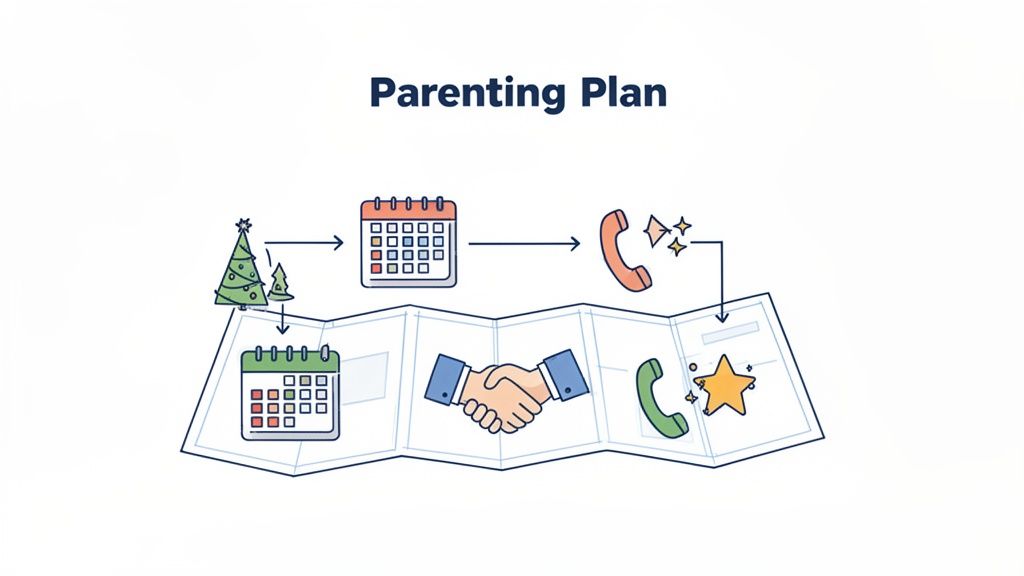
An illustration titled 'Parenting Plan' with a map showing icons for holidays, schedules, communication, and a handshake.

Think of a well-crafted parenting plan as your family’s roadmap for the future. It’s a detailed guide for co-parenting that anticipates disagreements and solves them before they ever start. This brings much-needed stability for your children and gives you genuine peace of mind.

This isn’t just some informal handshake deal; it’s a structured document that you can negotiate with the other parent, develop through mediation, or create with the help of a Brampton family lawyer. The more thorough your plan is, the less likely you’ll find yourself back in a Brampton court over every little conflict down the road.

For most parents, the ultimate goal is to turn this agreement into a consent order. This step makes it legally binding and fully enforceable by the court, giving it the exact same weight as an order a judge makes after a full trial.

Essential Elements of a Strong Parenting Plan

To actually work in the real world, your parenting plan has to be specific. Vague language is the enemy of a peaceful co-parenting relationship. A judge in Brampton will be looking for absolute clarity on a few key components before they’ll even consider signing off on it.

Your plan needs to clearly spell out:

  • A Detailed Parenting Time Schedule: This is the heart of your plan. It must specify the regular, day-to-day schedule, including exact pick-up and drop-off times and locations in Brampton.
  • Holiday and Vacation Schedules: Decide now who gets the kids for major holidays like Christmas, March Break, and summer vacation. This proactive step prevents the same arguments from happening year after year.
  • Communication Protocols: Set clear rules for how and when parents will communicate with each other about the children (e.g., email only, a co-parenting app). It should also include guidelines for the child’s communication with the parent they aren’t with.
  • Dispute Resolution Method: Smart plans include a clause on how you’ll handle future disagreements without running back to court, like agreeing to try mediation first.

Choosing a Parenting Time Schedule

There is no one-size-fits-all schedule that works for every Brampton family. The right choice will depend on your children’s ages, how far apart you live, and your work schedules. Some of the most common arrangements we see in Ontario include:

  • The 2-2-5-5 Schedule: With this setup, the child spends Monday and Tuesday with Parent A, Wednesday and Thursday with Parent B, and then you alternate weekends (Friday to Sunday). It’s popular because it ensures no parent goes more than five days without seeing their child.
  • The Week-On/Week-Off Schedule: This schedule offers maximum consistency, with the child spending one full week with each parent. It tends to work best for older children and for parents who live in relatively close proximity in the Brampton area.

While courts once heavily favoured sole maternal custody, the entire landscape has shifted. Survey data from 2018-2019 shows that shared physical custody—where a child lives with each parent at least 40% of the time—has jumped to 31% of all custody orders. That’s a massive increase from just 10% before 2006.

Making Your Plan Legally Binding

Once you and the other parent have a written agreement, it’s essentially just a private contract between the two of you. To give it real teeth, you need to file it with the court and have a judge approve it as a consent order. That’s the step that transforms it from a simple agreement into a document with true legal authority.

When finalizing your plan, it’s also helpful to know if digital signatures will hold up.  A Brampton family lawyer can make sure your plan is ironclad and meets all the legal requirements to become an enforceable order, giving your family the security and predictability you need.

Navigating the Brampton Family Court Process

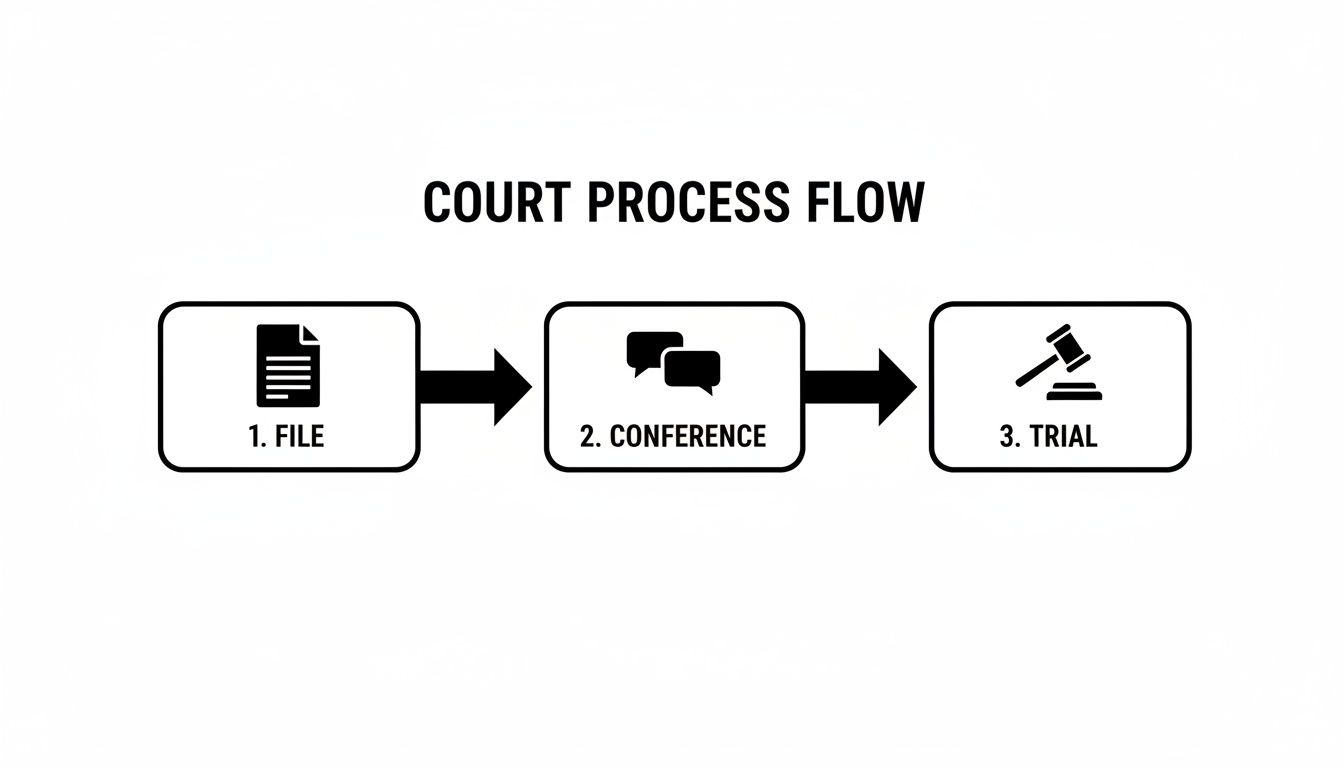
A flowchart illustrates the court process steps: 1. File (document icon), 2. Conference (speech bubbles), and 3. Trial (gavel icon).

For most parents, the idea of going to family court is downright terrifying. If you’re facing a child custody Ontario dispute in Peel Region, your case will be heard at the A. Grenville and William Davis Courthouse in Brampton, which follows a clear path to help families find resolutions.

Try to think of the court process not as one big, scary event, but as a series of stages. The system is designed to encourage you and your co-parent to find common ground, reserving the time and expense of a full trial for only the most difficult cases. Knowing what’s coming next empowers you to work with your lawyer and make smart, actionable decisions for your family.

The First Step: Starting Your Case

Your journey through the Brampton family court starts by filing a document called an Application (Form 8). This is the official paperwork that tells the court and the other parent what you’re asking for—like a specific parenting schedule or decision-making responsibility—and lays out the basic facts of your situation.

Once it’s filed with the court, this Application has to be legally delivered, or “served,” to the other parent. This isn’t just a formality; it’s a critical step that ensures they are officially notified and have a fair chance to respond.

Mandatory Programs and Early Appearances

Before you speak to a judge, you’ll attend a Mandatory Information Program (MIP). This free session gives you the essential rundown on separation, the court process, and how conflict affects children. The whole point is to give both parents a solid foundation in Ontario family law.

Your first court date is usually a First Appearance before a court clerk. This isn’t a hearing to argue your case; it’s an administrative check-in to make sure all necessary documents have been filed correctly so your case can move forward.

A huge misconception is that financial documents are only for support cases. In Brampton, full and honest financial disclosure is mandatory in all family law cases, even if you’re only talking about parenting. The court needs the complete financial picture to understand each parent’s ability to provide for the child.

Case Conferences: The Heart of the Process

The most critical stages of your child custody case are the conferences. These are meetings with a judge to narrow down the issues and push for a settlement. You’ll attend at least one of these before getting close to a trial.

  • Case Conference: This is your first chance to discuss the case with a judge, who will help pinpoint what you agree on, where you disagree, and map out the next steps.
  • Settlement Conference: Here, the judge will be more direct, giving a strong opinion on what would likely happen at a trial to encourage both of you to find a middle ground.
  • Trial Management Conference: If no settlement is reached, this final conference plans the trial, figuring out who will testify, how long it might take, and other procedural details.

During any of these conferences, the judge might involve the Office of the Children’s Lawyer (OCL). The OCL can provide a lawyer for your child or conduct an investigation and report back to the court. An OCL opinion carries a lot of weight with a Brampton judge.

Key Stages of a Brampton Child Custody Court Case

Court Stage Primary Purpose What You Need to Do
Filing an Application To officially start the court case and state what you are asking for. Prepare and file Form 8 with the court, then have it served on the other parent.
Mandatory Info Program (MIP) To educate parents on separation, the law, and the impact of conflict on kids. Attend the free two-hour session as scheduled by the court.
First Appearance To ensure all initial documents have been filed correctly. Confirm with the court clerk that your file is complete and ready to proceed.
Case Conference To identify issues, encourage disclosure, and explore settlement options. Prepare a Case Conference Brief outlining your position and desired outcomes.
Settlement Conference To focus entirely on negotiating a final agreement with a judge’s guidance. Come prepared to negotiate in good faith and consider compromise.
Trial Management Conference To plan the logistics of the trial if no settlement has been reached. Finalize witness lists, evidence, and agree on a trial schedule.
Trial To present evidence and arguments before a judge who will make a final, binding decision. Work closely with your lawyer to present your case effectively.

While this table outlines the standard path, remember that most cases are resolved during the conference stages. A trial is always the last resort.

Taking Action When Your Child’s Safety Is a Concern

When a separation involves high-conflict situations like family violence or substance abuse, your child’s safety is the absolute priority. If you believe their well-being is at risk, Ontario’s legal system provides tools for immediate protection. The courts in Brampton take these matters incredibly seriously, so you must be prepared to demonstrate exactly why urgent intervention is required. Protections are available under both Ontario’s Family Law Act and Canada’s Criminal Code.

Immediate Legal Protections You Can Seek

If your child is in immediate danger, you don’t have to wait. Your family lawyer can help you file a motion for urgent relief.

Key protective measures include:

  • Restraining Order: This order legally prohibits a parent from contacting you or your children. A violation of a restraining order is a criminal offence under the Criminal Code.
  • Exclusive Possession of the Matrimonial Home: The court can order one parent to move out of the family home, even if their name is on the title, to ensure a safe environment for you and your children.
  • Supervised Parenting Time: If a parent’s behaviour is a risk to a child, a judge can order that all of their time together must be supervised by a trusted adult or professional agency.

When a child’s safety is compromised, they may experience significant emotional and psychological distress. In these situations, understanding approaches like trauma-informed care is crucial for parents and support networks to provide sensitive and effective support.

Proving a Risk of Harm to the Court

A Brampton judge won’t restrict a parent’s access to their child based on accusations alone. You have to provide clear, compelling evidence that a real risk exists.

Your actionable step is to gather concrete proof. This might include:

  • Police reports or records of 911 calls.
  • Photos of injuries or damage to property.
  • Text messages, emails, or social media posts containing threats.
  • Statements from witnesses—like neighbours or teachers—who have seen the troubling behaviour firsthand.

The standard the court uses is always the best interests of the child. All your evidence must directly connect the other parent’s actions to a clear danger to your child’s physical or emotional safety.

Recent statistics from the Ontario Association of Children’s Aid Societies show that 97% of child welfare investigations end with children staying at home. This tells us there’s a strong preference for keeping families together, which means the evidence you present for court intervention must be truly significant and clearly demonstrate risk.

When to Hire a Brampton Family Lawyer

It’s tempting to think you can handle a parenting plan on your own. But many situations are far too complex or high-stakes to navigate without a professional in your corner. Going it alone in a child custody dispute in Brampton can put your rights—and your child’s future stability—at risk.

An experienced Brampton family lawyer acts as your advocate, making sure your voice is heard. They will help you understand your rights under Ontario’s Family Law Act and can protect you if things get complicated enough to involve the Criminal Code.

Clear Signs You Need Legal Help

If you find yourself in any of these situations, it’s time to call a lawyer immediately. These issues carry serious legal consequences and need a strategic approach right from the start.

  • Allegations of Abuse or Neglect: If there are any claims of family violence, substance abuse, or neglect, a lawyer is non-negotiable. Your child’s safety is the absolute priority, and these allegations must be handled with the gravity they deserve under both family law and the Criminal Code.
  • Threats to Move with the Child: Is the other parent threatening to move to another city or province without your consent? This is a serious issue known as parental mobility. A lawyer can take immediate steps to stop an unauthorized relocation.
  • Complete Communication Breakdown: If you and the other parent can’t speak civilly, you won’t be able to negotiate a fair agreement. A lawyer can step in to communicate on your behalf, cutting down on conflict and keeping the focus on a solution.

When the Stakes Are Too High

Beyond immediate safety threats, other complexities make a DIY approach incredibly risky. If you have high-value assets or a family business, things can get complicated quickly, even when the focus is on the kids.

Another big one? If the other parent has already hired a lawyer, you’ll be at a huge disadvantage without your own representation.

A Brampton family lawyer’s role isn’t to start a war; it’s to de-escalate one by providing clear, objective advice. They know how to separate the emotional issues from the legal ones, guiding you toward a resolution that is practical, enforceable, and truly in the best interests of your child.

Hiring a Brampton lawyer ensures the process is handled correctly from day one. They will help you build a compelling case—whether for negotiation, mediation, or a court hearing—making certain that every decision made serves your child’s well-being.

Your Top Child Custody Questions Answered

When you’re going through a separation, the details of child custody can feel overwhelming. You’ve got questions, and you need clear, straightforward answers. Here’s a look at some of the most common concerns we hear from parents in Brampton and Mississauga.

What Is The Difference Between Sole and Joint Decision-Making?

Think of decision-making responsibility as who gets the final say on the big-picture issues in your child’s life—things like healthcare, education, and religious upbringing.

With sole decision-making, one parent has the authority to make these major choices without needing the other parent’s formal consent. This approach is less common in Brampton and is usually reserved for high-conflict situations or cases involving family violence.

On the other hand, joint decision-making means both parents must agree on these critical matters together. This is what judges in Brampton prefer to see. It keeps both parents involved and encourages cooperation, but it only works if you and your ex-partner can communicate effectively.

At What Age Can My Child Decide Who To Live With?

This is a question parents ask all the time, and the answer often surprises them: there is no magic number in Ontario law. A child can’t legally choose their living arrangements at a specific age, whether it’s 12, 14, or 16.

What the law does say is that as a child gets older and more mature, a Brampton judge will give their opinion more weight. A teenager’s well-thought-out preference can be very influential, but it’s still just one piece of the puzzle. The judge’s final decision is always, without exception, based on the child’s overall best interests.

A child’s preference is important, but the court’s job is to look at the whole picture. They’ll consider things like each parent’s ability to provide a stable home in Brampton, the child’s emotional ties, and the existing parenting routine.

Can I Move To A New City With My Child?

No, not without permission. You can’t just pack up and move if the relocation would significantly impact the other parent’s time with your child. This issue is known as parental mobility, and it’s taken very seriously by Brampton courts.

To move, you need one of two things: the other parent’s written consent or a court order granting you permission.

If your ex-partner objects, you’ll have to make a formal application to the court. The judge will analyze your proposed move based entirely on your child’s best interests, looking at everything from your reasons for moving to how it will affect the child’s relationships. Attempting to move without authorization can have severe legal consequences.

How Does Child Support Work With 50/50 Shared Parenting Time?

When parents have a shared parenting arrangement—meaning the child lives with each parent at least 40% of the time—the way child support is calculated changes. It’s not as simple as nobody paying.

The most common method is called a “set-off.” Here’s how it works:

  1. First, we figure out the standard table amount of child support each parent would pay based on their income.
  2. Then, the smaller amount is subtracted from the larger one. The parent with the higher income pays the difference to the parent with the lower income.

A judge in Brampton can also adjust this amount if needed. They recognize that maintaining two separate homes for a child comes with extra costs, and the final support order may reflect that reality.


Navigating the complexities of child custody in Ontario requires more than just information—it demands clear, strategic legal advice. At Badesha Law, we provide the guidance and strong advocacy you need to protect your rights as a parent and ensure your child’s best interests remain the top priority. For dedicated support with your Brampton family law matter, connect with our team at https://badeshalaw.ca

Navigating Parenting Time In Brampton And Ontario Family Law

When you’re going through a separation or divorce in Brampton, one of the first questions on your mind is probably, “When will I see my children?” The legal term that answers this question is parenting time. It’s the official schedule that lays out when each parent is responsible for the children, and it’s governed by Ontario’s Family Law Act and Children’s Law Reform Act.

Understanding Parenting Time In Ontario

A loving family, with parents kissing and a small child standing nearby, against a backdrop of calendar-like columns and a city skyline.

If you’re a parent in Brampton navigating a separation, you might have heard older terms like “custody” and “access.” It’s crucial to understand that Ontario’s family law, specifically the Children’s Law Reform Act, has moved on. The term parenting time officially replaced “access” to shift the focus from a parent’s “right” to see a child toward the child’s right to spend meaningful time with each parent.

This wasn’t just a simple word swap. It signals a major shift in how the Brampton courts view family dynamics after a separation. The goal is to move away from the old “winner-takes-all” mindset of custody battles toward a more collaborative, child-focused approach. The objective is to create a stable and predictable routine where your child can thrive.

What Parenting Time Actually Covers

So, what does parenting time look like in practice for a family in Brampton? Think of it as the day-to-day calendar that outlines the physical care of your child. When it’s your parenting time, you are the parent in charge of all the little things that make up their daily life.

For families in Brampton, this means the parent with the child during their designated time is responsible for:

  • Daily routines like meals, homework, and getting them to bed.
  • Driving them to school, soccer practice at a local Brampton park, or music lessons.
  • Making the small, everyday decisions about their immediate well-being.

In short, when your child is with you, you’re the active parent responsible for their care and supervision.

Under Ontario law, the only factor a court in Brampton will consider when making decisions about a parenting schedule is the best interests of the child. This single principle guides everything, ensuring the child’s physical, emotional, and psychological well-being is the top priority.

The Shift From Old Terminology

The move away from “custody” and “access” was deliberate. Those older terms often created a power imbalance, implying there was a “primary” parent and a “secondary” one, which could easily fuel conflict. The language used today in both federal and provincial law promotes the idea that both parents play a valuable role in their child’s life.

To help clear things up, here’s a quick guide to the old and new terms.

Key Family Law Terms At A Glance

Modern Term (Current Law) Old Term (Pre-2021) What It Means Today for Brampton Families
Parenting Time Access The schedule outlining when the child is in each parent’s care. It focuses on the child’s right to spend time with both parents.
Decision-Making Custody The legal authority to make major decisions about the child’s life (e.g., health, education, religion). This can be held solely or jointly.
Parenting Order Custody Order A legally binding court order that sets out the details of both parenting time and decision-making responsibilities.
Contact Order N/A A court order that grants a non-parent (like a grandparent or step-parent) specific time with the child.

Getting a handle on this modern framework is the first step toward creating a fair and functional parenting time schedule that allows your child to maintain strong relationships with both parents.

Parenting Time Versus Decision-Making Responsibility

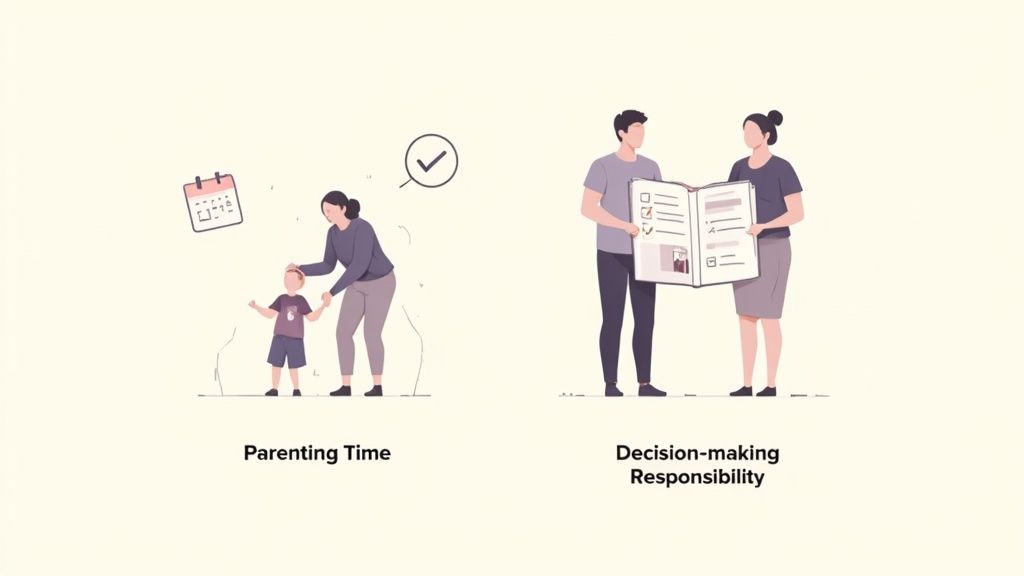
An illustration showing a mother with her child representing parenting time, and a couple making decisions.

For separating parents in Brampton, a key hurdle is understanding a fundamental concept in Ontario family law: the time you spend with your child is completely separate from the power to make major decisions for them. Grasping this distinction is the foundation for building a clear, stable, and conflict-free co-parenting relationship.

Parenting time is the schedule. It maps out the days and hours your child is physically with you. When it’s your parenting time, you’re in charge of day-to-day duties—making lunch, checking homework, and driving to activities.

Decision-making responsibility, on the other hand, is the legal authority to decide on the big-picture issues in your child’s life. This is the modern term for “custody.” It has nothing to do with who has the child on Tuesday night and everything to do with their long-term well-being.

What Decision-Making Responsibility Includes

When a Brampton judge assigns decision-making responsibility, they are giving a parent the authority to make critical choices that will shape a child’s future. These aren’t the small, everyday calls but the major life pillars.

Under Ontario’s Family Law Act, these key areas are:

  • Health: Choosing doctors and dentists, consenting to medical treatments, or deciding on therapy and vaccinations.
  • Education: Picking which school the child attends in Brampton, agreeing to special education programs, or hiring a tutor.
  • Religion and Spirituality: Determining the child’s religious upbringing and their participation in spiritual activities and ceremonies.
  • Significant Extracurricular Activities: This refers to bigger commitments, like enrolling in a competitive sports league or an intensive arts program that has a major impact on the child’s schedule and development.

A court can order parents to share this responsibility jointly or grant it solely to one parent. It’s entirely possible for one parent to have a 50/50 parenting time schedule but have no final say in their child’s education, or the other way around.

It’s a common myth that having more parenting time automatically gives you more say in the big decisions. Brampton courts look at each issue separately, always through the lens of the child’s best interests. A parent’s ability to handle daily care (parenting time) is a very different skill from their ability to make thoughtful, long-term decisions with a co-parent.

An Actionable Analogy

To understand this, picture raising your child after separation as a team project.

Parenting time is about which team member is “on shift” for the hands-on work. One parent might handle the Monday-to-Wednesday shift, taking care of all immediate tasks.

Decision-making responsibility is like being on the project’s steering committee. This group doesn’t handle daily tasks. Instead, they meet to vote on the project’s overall direction and major strategic goals.

A team member could have more on-shift hours (parenting time) but still only have an equal vote on the big-picture strategy (decision-making). This separation of duties gives the Brampton family court the flexibility to create arrangements that truly fit a family’s unique circumstances. The court recognizes this and can structure a parenting order that plays to each parent’s strengths.

How Brampton Courts Determine Parenting time

When you and your co-parent can’t agree on a schedule, a judge at the Brampton courthouse will make the decision for you. Understanding how the court thinks is the best way to prepare your case.

In Ontario, every single decision a judge makes about parenting time boils down to one guiding principle: the best interests of the child test, laid out in Ontario’s Children’s Law Reform Act. It is the only standard a judge will use. Forget myths about automatic 50/50 splits or preferences for mothers or fathers—it simply doesn’t work that way.

The Best Interests of the Child Test

The court’s job isn’t to decide what’s fair to the parents. Its sole focus is on what will best support a child’s physical, emotional, and psychological safety, security, and well-being. To figure that out, a Brampton judge looks at a specific list of factors.

Key considerations under the Children’s Law Reform Act include:

  • The child’s needs, based on their age and stage of development (a schedule for a toddler will be different from one for a teenager).
  • The love, affection, and emotional ties between the child and each parent.
  • Each parent’s willingness to support the child’s relationship with the other parent. Actively undermining the other parent is a major red flag for the court.
  • The history of care for the child. The court will want to know who has historically been the primary caregiver.
  • The child’s views and preferences, if they’re old enough to express them.
  • The proposed plan of care from each parent. A judge needs to see a thoughtful, practical plan.
  • The ability and willingness of each parent to care for the child.
  • The stability of the family unit where the child would live.
  • Any family violence or criminal conduct, which is always a critical factor affecting a child’s safety and well-being under both the Family Law Act and the Criminal Code of Canada.

A common myth is that Ontario courts start with a 50/50 parenting time split as the default. This is not true. Every family’s situation is unique, and the court tailors its decision based entirely on the evidence presented about the child’s specific needs and circumstances in Brampton.

Actionable Steps to Prove Your Case in Court

To get the outcome you’re hoping for, you need to provide clear, compelling evidence showing why your proposed parenting arrangement is in your child’s best interests. This is about demonstrating your ability to provide a stable, loving, and supportive home.

Here are a few actionable steps you can take:

  1. Document Your Involvement: Keep a calendar or journal detailing your role in your child’s life. Note things like attending parent-teacher interviews at their Brampton school, coaching their soccer team, or taking them to the dentist.
  2. Propose a Detailed Plan: Don’t just ask for time. Present a comprehensive, child-focused parenting plan that covers daily routines, holidays, communication rules, and everything in between.
  3. Focus on the Child: Always frame your arguments around your child’s needs, not your own wants. Explain why your proposed schedule benefits their stability, routine, and overall well-being.
  4. Show You’re Willing to Co-Parent: Demonstrate that you can communicate respectfully with the other parent and that you are genuinely committed to supporting their relationship with your child.

A judge in Brampton is tasked with creating a parenting order that gives your child the best possible chance to thrive. Your job is to provide the evidence that shows how your involvement and your proposed schedule will do exactly that.

Common Parenting Time Schedules That Work

Figuring out what a schedule looks like day-to-day is a major challenge. For families in Brampton, creating a practical, predictable schedule is the key to giving your kids stability after a separation. While there’s no one-size-fits-all solution, a few well-established schedules offer a great starting point.

The goal is to find a rhythm that causes the least disruption for your child while working for both parents. A good schedule creates security when everything else feels uncertain.

The Week On, Week Off Schedule

One of the most straightforward setups, especially for older children and teens, is the week on/week off schedule. The child spends one complete week with one parent, then switches to the other parent for the next week.

  • Pros: This schedule is easy to remember and cuts down on handovers, which can lower conflict. It gives each parent a chance to experience a full slice of daily life.
  • Cons: For very young children, a full week away from one parent can be too long. This arrangement can also be difficult if parents live far apart in different areas of Brampton, making the school run a logistical challenge.

This schedule works best when both parents live in the same school district and can communicate effectively.

The 2-2-3 and 2-2-5-5 Schedules

For younger kids, schedules with quicker transitions are often a much better fit. The 2-2-3 schedule is a common choice because it provides consistency without long goodbyes.

Here’s how a typical two-week cycle looks:

  • Parent A has the child for Monday and Tuesday.
  • Parent B has the child for Wednesday and Thursday.
  • Parent A then gets the long weekend (Friday, Saturday, Sunday).
  • The next week, it flips.

A close cousin is the 2-2-5-5 schedule. In this model, Parent A always has Monday/Tuesday, Parent B always has Wednesday/Thursday, and they simply alternate weekends. Both of these ensure a child never goes more than a couple of days without seeing each parent.

A flowchart titled 'Best Interests of the Child' illustrating Child's Needs, supported by Emotional Ties, Care Ability, and Stability.

This flowchart breaks down the core factors a Brampton judge will weigh when deciding what’s in a child’s best interests—the very same factors that should guide your choice of a parenting schedule. It’s a great reminder that everything comes back to the child’s needs.

Planning for Holidays and Special Occasions

No matter which weekly schedule you land on, the biggest source of future arguments is often holidays and special occasions. A well-drafted parenting plan tackles these dates head-on, leaving zero room for last-minute disagreements.

A vague schedule is a recipe for conflict. Using outdated terms like “reasonable access” just doesn’t work. Your agreement must be specific, detailing exact days, handover times, and exchange locations in Brampton to be effective and enforceable.

Your plan needs to clearly spell out:

  1. Statutory Holidays: How will you handle days like Christmas, Thanksgiving, and Easter? Many families alternate these holidays each year.
  2. Summer Vacation: Will each parent get a solid block of uninterrupted weeks? How will you pick those weeks, and what’s the deadline for notifying the other parent?
  3. March Break and Winter Break: These are often split or alternated annually.
  4. Birthdays: Will the child spend their birthday with the parent who has them that day, or will you split the day? Don’t forget to include arrangements for the parents’ birthdays, too.

Thinking through these details now will save you stress and legal fees down the road. For more on creating a rock-solid agreement, the Government of Ontario offers resources on drafting parenting plans.

Crafting An Enforceable Parenting Plan

A verbal agreement about your parenting time schedule might feel friendly, but it offers zero protection when a disagreement arises. To protect your child’s stability and your rights as a parent in Brampton, you need a formal, written parenting plan. This document is the detailed blueprint for your co-parenting future, designed to prevent conflict by making everything crystal clear.

A strong parenting plan anticipates future challenges—like holidays, vacations, or travel—and sets out clear, agreed-upon rules for handling them now. The goal is to build a document so thorough that you rarely have to argue about the details later on.

Core Components Of A Strong Parenting Plan

Every Brampton family is different, but an effective parenting plan in Ontario must cover several key areas. Specificity is your greatest tool for avoiding future disputes.

Your plan should spell out:

  • The Regular Schedule: Outline the day-to-day parenting time with precision. Specify exact handover times (e.g., Friday at 6:00 PM) and locations (e.g., at the curb of the parent’s home in Brampton).
  • Holidays and Vacations: Create a clear calendar for all statutory holidays, school breaks, and summer vacation. A common approach is to alternate major holidays each year.
  • Communication Protocols: Set clear guidelines for how you and the other parent will communicate about the children, such as using a specific co-parenting app or email.
  • Travel Rules: Include rules for out-of-province or international travel, such as requiring written consent from the other parent and sharing a detailed travel itinerary in advance.

A common mistake is using phrases like “reasonable access.” In Ontario family law, these terms are too vague to be enforced. A judge can’t order a parent to provide “reasonable” time because nobody can agree on what that means. Your plan must be a clear guide that anyone can understand.

From Agreement To Court Order

Once you’ve detailed your parenting plan, you have two main options in Brampton to make it legally binding: include it in a separation agreement or have it turned into a court order. They are enforced very differently.

A separation agreement is a private contract between you and the other parent. If one parent breaks the terms, your only option is to go back to court to have the agreement enforced, which can be a slow process.

A parenting order, on the other hand, is a direct command from a judge. If a parent ignores the terms of a court order, the consequences are far more immediate and serious. A violation can lead to a finding of contempt of court, which could result in fines or even jail time under the Criminal Code of Canada.

Understanding this difference is critical. A court order offers much stronger and faster enforcement, which might be necessary in a high-conflict situation. A family lawyer in Brampton can advise on the best path for your circumstances to ensure your plan is solid, enforceable, and truly serves the best interests of your child.

Common Questions About Parenting Time In Brampton

When you’re working through a parenting arrangement, a flood of specific questions is bound to come up. For parents in Brampton, these aren’t just abstract legal problems—they affect your daily life. This section tackles some of the most common questions with direct, practical answers grounded in Ontario’s Family Law Act.

The idea is to give you a clear sense of what to do next when you hit a roadblock.

What Can I Do If The Other Parent Denies My Parenting Time?

This is one of the most frustrating situations a parent can face. If you have a court-ordered parenting plan and the other parent is refusing to follow it, you have legal options. A parenting order isn’t a suggestion; it’s a legally binding directive from a judge.

Your first actionable step is to document everything. Keep a detailed log of every missed or denied visit. Note dates, times, and any texts or emails about why it happened. This record is vital evidence.

Next, you can take formal legal action by filing a motion with the Brampton court to enforce the parenting order. Under Ontario law, a judge can:

  • Order make-up parenting time to compensate you for the time you lost.
  • Order the non-compliant parent to cover any costs you incurred, such as legal fees.
  • In serious cases, find the other parent in contempt of court, which could lead to fines or, in extreme situations, even jail time under the Criminal Code of Canada.

Do not fall into the trap of “self-help” remedies, like withholding child support payments. That will only land you in legal trouble and weaken your position in court.

How Can We Modify An Existing Parenting Time Order?

Life changes. The schedule that was perfect two years ago might be impractical today. If you and the other parent both agree on the changes, the process is simple. You can both sign an Amending Agreement and file it with the court to create a new consent order.

But what if the other parent doesn’t agree? In that case, the parent who wants the change must bring a motion to change the existing order.

To successfully change a court order in Brampton without the other parent’s consent, you must prove there has been a material change in circumstances since the original order was made. This means you need to show that a significant, unforeseen change has happened that directly affects the child’s best interests and makes the current schedule unsuitable.

For example, a parent relocating for a new job in another part of the GTA, or a teenager’s school and social life becoming much more demanding, could both qualify as a material change. The court will then re-evaluate the situation using the “best interests of the child” test.

How Much Say Does My Child Get In The Schedule?

This is a key question, especially for parents with teens. In Ontario, there’s no magic age where a child can simply “choose” where to live. However, the law is clear: a judge must consider the child’s own views and preferences when making decisions about parenting time.

How much weight those views carry depends on the child’s age and maturity.

  • Younger Children (Under 10): A judge will listen, but other factors like stability and caregiving ability will carry more weight.
  • Older Children (10-13): Their preferences start to matter more, as long as they can explain their reasons.
  • Teenagers (14+): The views of a mature teenager are extremely influential. It’s very rare for a Brampton court to force a 16-year-old to follow a schedule they are strongly against.

A judge can hear from a child by ordering an assessment from a social worker (often through the Office of the Children’s Lawyer) or, in some cases, by speaking with the child directly. The court’s main priority is always to ensure the child’s preference is genuine and not the result of parental influence.

Can I Stop Parenting Time If I Fear For My Child’s Safety?

If you have a genuine and immediate fear that your child is at risk of harm, your first duty is to protect them. However, unilaterally withholding court-ordered parenting time is an extreme step with serious legal consequences under the Family Law Act and potentially the Criminal Code.

If the danger is immediate—for instance, you believe the other parent is impaired or there’s a risk of violence—your first call should be to Peel Regional Police or your local Children’s Aid Society. They have the authority to intervene and ensure the child is safe.

Immediately after, you must bring an urgent motion to the court to suspend or change the parenting order. You will need to provide clear, concrete evidence to back up your safety concerns. This requires proof, such as police reports, photos, threatening text messages, or witness statements. A judge can grant an emergency order to restrict the other parent’s time—perhaps making it supervised—until a full hearing can be scheduled. Simply stopping the visits without a court order can be seen as a breach and could seriously damage your credibility.


At Badesha Law, we know that questions about parenting time are deeply personal. Our experienced family law team offers clear, actionable advice to clients in Brampton, helping you protect your rights and your child’s best interests. Whether you need help enforcing, modifying, or creating a parenting plan, we’re here to provide the strategic support you need. Learn more about how our Brampton lawyers can assist you by visiting our website.

Custody Rights Ontario: A Brampton Parent’s Guide to Actionable Steps

When you’re facing a separation in Brampton and thinking about your custody rights in Ontario, it's critical to take actionable steps that protect your child's future. The legal landscape, guided by Ontario's Family Law Act and the Children's Law Reform Act, has shifted away from confrontational battles over "winning custody." Your focus must be on what's best for your child, and that means understanding two core concepts: decision-making responsibility and parenting time. This guide provides practical steps for Brampton parents navigating this process.

Your First Look at Custody Rights in Ontario

In Brampton, when parents go through a separation, the legal system prioritizes the stability and well-being of their children. This priority is not merely an idea; it is a legal principle established in provincial laws like the *Children's Law Reform Act*. For those in Brampton, Mississauga, and the Greater Toronto Area, understanding this principle is essential for navigating the process smoothly and safeguarding your family. The traditional terms "custody" and "access" have been updated to promote a mindset shift. The objective is to steer parents away from adversarial battles and towards cooperative, child-centered solutions. The system encourages both parents to remain actively involved in their child's life, as long as it is safe and in the child's best interests. The courts take any actions opposing this, such as parental alienation, very seriously. For parents seeking guidance, a divorce lawyer in Brampton can be an invaluable resource. They can provide expert advice on navigating the legal landscape, ensuring that the best interests of the children are upheld throughout the process.

The Modern Legal Framework in Ontario

The laws governing custody rights in Ontario are built to be clear and consistent, ensuring every decision is viewed through the lens of a child’s best interests. Here is the legal structure that matters for your case:

  • Family Law Act: This act handles rights and responsibilities between spouses, such as property division and support. While it doesn't detail parenting specifics, it sets the stage for resolving family disputes in Ontario.

  • Children's Law Reform Act: This is the key legislation for parenting matters. It officially replaced "custody" with "decision-making responsibility" and "access" with "parenting time." More importantly, it outlines the factors a judge must consider when making an order about a child, all centred on their best interests.

  • Criminal Code of Canada: This federal law has a massive impact on family law cases in Brampton. Any allegations or charges of domestic assault, threats, or harassment under the Criminal Code will directly influence a court's decision about a parent’s time with their child and can lead to immediate restrictions.

The most crucial takeaway for any parent in Brampton is this: the court’s sole objective is to create an arrangement that supports the child’s physical, emotional, and psychological safety, security, and well-being. Your actions should align with this goal.

Navigating these acts can be complex, but their message is simple: put your child's needs first. For practical assistance, many families find resources like the Ministry of the Attorney General's family law services invaluable. This section provides the essential knowledge to understand how the system works before you decide on your next steps.

Decision-Making vs. Parenting Time: What You Need to Know

When dealing with custody rights in Ontario, it’s vital to use the correct legal terms. Under the Children's Law Reform Act, "custody" has been replaced with two clear concepts: decision-making responsibility and parenting time. For parents in Brampton, getting this distinction right is the first step toward building a stable, predictable future for your children and creating an effective parenting plan.

Decision-making responsibility is the legal authority to make major choices that shape your child's future. Parenting time is the schedule that dictates when your child is in the physical care of each parent.

The Power of Decision-Making

Decision-making authority is about who has the final say on the cornerstones of a child's upbringing. A parent with this responsibility has the right to make choices about:

  • Health: Choosing doctors and consenting to medical treatments.

  • Education: Deciding which school the child attends and their educational programs.

  • Religion and Spirituality: Determining the child's religious upbringing.

  • Significant Extracurricular Activities: Major commitments like competitive sports.

This can be structured as sole decision-making, where one parent makes all major calls, or joint decision-making, which is often favoured by Brampton courts as it requires parents to cooperate and keeps both deeply involved.

Structuring Parenting Time

Parenting time is the practical, day-to-day schedule. The goal is to create a consistent and stable routine that allows your child to have a strong relationship with both parents. The right schedule depends on your family's situation, including your child's age, school location, and each parent's work schedule.

Common parenting schedules in Ontario include:

  • Week-On/Week-Off: Children spend one full week with each parent.

  • The 2-2-5-5 Schedule: The child spends two days with Parent A, two with Parent B, then a five-day weekend with Parent A, followed by five days with Parent B. This ensures neither parent goes too long without seeing the child.

To help you visualize how these concepts fit together, here’s a quick comparison.

Decision-Making vs Parenting Time At a Glance

Aspect Decision-Making Responsibility Parenting Time
What it is The legal authority to make major life decisions for a child. The physical schedule of when a child is in each parent's care.
Examples School choice, medical treatments, religious upbringing. Weekdays, weekends, holidays, summer vacation schedules.
Focus Long-term welfare and direction of the child's life ("CEO" role). Day-to-day care, routine, and direct parent-child interaction.
Common Arrangements Sole (one parent decides) or Joint (both parents decide together). 50/50 split, primary care with one parent, supervised access.

Understanding this table is key to creating a parenting plan that works.

Flowchart showing Ontario Family Law Principles: Family Law Act linked to Children's Law Reform Act.

This chart shows how the Family Law Act connects with the Children's Law Reform Act, which details these parenting rights and responsibilities.

Your parenting plan is a blueprint for your child’s life post-separation. A clear plan, grounded in the Children’s Law Reform Act, prevents future conflict and provides the security your child needs.

The law starts with the assumption that both parents are equally entitled to decision-making authority. For a schedule to be considered "shared parenting," the child must spend at least 40% of their time with each parent. You can discover more insights about common custody arrangements to understand what it takes to pursue a specific plan in family court.

How Brampton Courts Prioritize Your Child's Best Interests

Every ruling on custody rights in Ontario, especially at the Brampton courthouse, is based on one principle: the best interests of the child. This is the mandatory legal standard under the Children's Law Reform Act. For you, this means every action you take should be justifiable as being for your child’s benefit.

The judge’s job is to determine which living situation and decision-making structure will best support your child's happiness, security, and development. No single factor is a trump card; it's the total picture that matters.

Hands hold a child's drawing of two kids and a crayon, with a Canadian courthouse in the background.

Core Factors in the Best Interests Test

A Brampton judge is guided by a specific list of factors. Proactively addressing these points with solid evidence is the most effective action you can take for your case.

  • Emotional Ties: The love, affection, and emotional bonds between the child and each parent, as well as with grandparents and other key relatives.

  • The Child's Views and Preferences: A child's wishes are taken seriously, especially as they get older and can articulate their reasoning.

  • Stability and the Status Quo: Courts are hesitant to disrupt a stable routine. The judge will consider where the child is living now and how well that arrangement has been working.

  • Each Parent's Ability to Provide: This is not about wealth. It’s about the ability to offer guidance, education, necessities, and special care in a stable home. This includes a parent's willingness to support the child's relationship with the other parent.

Demonstrating Your Parental Fitness

To show a Brampton judge you are focused on your child's best interests, you must document your involvement and your willingness to cooperate.

A judge in Brampton is looking for a parent who not only loves their child but also actively supports the child's relationship with the other parent. The ability to co-parent effectively is a massive indicator of parental fitness.

Your actionable step is to create a clear record of your role:

  • Communication Logs: Keep business-like records of texts, emails, and app messages with your co-parent focused on scheduling, school, and health.

  • School and Medical Records: Document your attendance at parent-teacher interviews and doctor's appointments to show you are involved.

  • Support for the Other Parent: Show how you have encouraged phone calls, video chats, and activities with the other parent.

How a Child's Age Influences the Decision

A child’s age and maturity are significant. There's no magic age where a child decides, but their voice grows louder over time.

For children under 12, statistics show mothers are often granted primary care, but as children mature and can better express their wishes (typically around age 12-14), shared parenting time becomes more common. These figures highlight how a child's evolving needs can shape the outcome. To learn more, see these insights on shared parenting in Canada.

Preparing for family court in Brampton means building a case around your child's well-being. By focusing on the factors that matter to the court and providing concrete proof of your positive involvement, you align your goals with the judge's objective and position yourself for a better result.

Your Action Plan for Seeking Custody Rights in Brampton

Establishing clear custody rights requires a structured, proactive approach. For parents in Brampton, a well-organized plan strengthens your case and centres the process on your child’s well-being. The best first move is not rushing to court; it's building a foundation of evidence and attempting to find common ground.

This journey starts with careful preparation. Begin by gathering all documents that paint a clear picture of your role in your child's life. This evidence is vital, whether you negotiate an agreement or present your case at the Brampton courthouse.

Desk with 'Parenting Plan' and 'Court' documents, a phone showing Brampton on a map, and a calendar.

Step 1: Gather Your Key Documents

Before taking formal legal steps, compile a detailed record as proof of your commitment.

  • Communication Logs: Keep records of all co-parenting conversations via text, email, or a parenting app. This creates a clear timeline and shows your efforts to be cooperative.

  • School and Medical Reports: Collect report cards, attendance records, and notes from doctor’s appointments you attended to demonstrate your active involvement.

  • Photos and Calendars: Photos of you at school events or a calendar detailing your parenting schedule help establish your consistent presence.

This preparation is crucial because Ontario family law strongly encourages shared parenting. To seek significant parenting time, you must prove your active involvement and stability. To better understand this modern approach, see these Family Law Resources from Legal Aid Ontario.

Step 2: Draft a Comprehensive Parenting Plan

A parenting plan is your roadmap for co-parenting. A detailed plan prevents future arguments and sets clear expectations.

Your plan should cover:

  1. Parenting Time Schedule: Outline the specific schedule for regular days, weekends, holidays, and summer vacations.

  2. Decision-Making Responsibility: Specify how you’ll handle big decisions about health, education, and religion.

  3. Communication Protocols: Set clear rules for how you’ll communicate with each other about the children.

Step 3: Explore Alternatives to Court

Court should be your last resort. Alternatives like mediation and collaborative family law are faster, cheaper, and less stressful for your children.

In Brampton, showing a judge you first tried a collaborative solution demonstrates your commitment to co-parenting and acting in your child’s best interests.

Services like Peel Region's mediation programs can connect you with a neutral third party to help you negotiate a parenting plan.

If court becomes unavoidable, the next step is to file an Application at the Brampton courthouse. This involves completing legal forms that outline the parenting arrangement you are seeking. You can find the necessary court forms on the Ministry of the Attorney General's website. Taking these organized steps gives you the best chance of securing a stable future for your children.

When Criminal Charges Impact Family Court Matters

When criminal law and family law intersect, the stakes for your custody rights become extremely high. For any parent in Brampton, facing a criminal charge—or making a serious allegation against a co-parent—adds a layer of complexity that the family court cannot ignore. Under the Family Law Act, the court's primary duty is to protect the child, and any sign of risk will trigger immediate protective measures.

Issues like domestic violence, assault, or serious substance abuse, which fall under the Criminal Code, directly impact your family law case. A judge at the Brampton courthouse must treat any potential threat to a child's safety as their top priority. This means a criminal charge can lead to swift and decisive court orders modifying parenting arrangements.

The Immediate Fallout of a Criminal Charge

A criminal allegation, even without a conviction, can have an immediate impact on your parenting time.

This can look like:

  • Suspension of Parenting Time: A judge may temporarily stop all in-person contact.

  • Supervised Parenting Time: The court can order that all visits must be supervised by an approved third party or at a designated access centre in Peel Region to ensure the child’s safety.

  • No-Contact Orders: Bail conditions or restraining orders issued under the Criminal Code of Canada can legally forbid a parent from contacting the other parent or child, making co-parenting impossible.

How Criminal Code Orders Overrule Your Family Life

It is critical to understand that conditions imposed by a criminal court are legally binding and will override any existing separation agreement or family court order.

A parent facing criminal charges must understand this: violating a no-contact order from a criminal court, even to see your child, can result in new criminal charges and immediate arrest. It completely overrides your previous parenting schedule.

A peace bond or a restraining order is a formal court order to prevent future harm. If one is in place, it sets the rules for all contact, and the family court will build its parenting orders around those restrictions to ensure the child's safety.

Navigating this dual-court reality alone is extremely difficult. The accused parent needs a strong criminal defence, while the other parent must act quickly in family court to protect their child.

This table shows how common issues can sway a judge's decision:

Impact of Common Issues on Custody Decisions

Issue Potential Impact on Custody Rights Governing Legislation
Domestic Violence Allegations Immediate suspension of unsupervised parenting time; potential for a restraining order. Children's Law Reform Act, Criminal Code of Canada
Substance Abuse Requirement for drug/alcohol testing; parenting time may be suspended or limited to supervised access until rehabilitation is proven. Children's Law Reform Act, Divorce Act
Child Abduction/Flight Risk Court may order the surrender of passports and restrict travel with the child. Decision-making may be granted solely to the other parent. Hague Convention, Children's Law Reform Act
Breach of Bail Conditions Viewed as a serious disregard for court orders, negatively impacting the parent's credibility and perceived stability. Criminal Code of Canada

The consequences are serious.

A Brampton family lawyer skilled in both the Criminal Code and the Family Law Act is essential. Evidence in one court can heavily influence outcomes in the other. Expert legal guidance is a necessity to protect your future and your relationship with your child. To understand how to handle these challenges, you can get expert advice from a Brampton criminal lawyer who has deep experience in these matters.

How to Change or Enforce Your Custody Order

A court order for parenting time and decision-making is not permanent. Life changes, and when those shifts are significant, the parenting arrangement must be flexible enough to adapt. Knowing how to modify or enforce your existing order is a crucial part of creating long-term stability for your child's life in Brampton.

A custody order can be changed, but you must prove there has been a material change in circumstances—a legal test meaning the change is substantial, was not foreseen when the first order was made, and impacts the child's well-being.

What Qualifies as a Material Change?

The change must be significant enough that the original judge would likely have made a different decision had they known about it.

Common examples include:

  • A Parent's Relocation: A move that significantly impacts the parenting schedule.

  • A Change in a Parent's Capacity: A serious illness, substance abuse problem, or criminal charges that affect a parent's ability to care for the child.

  • The Child's Evolving Needs: A teenager may have a strong, well-reasoned desire to change the primary living arrangement.

  • Failure to Comply with the Order: A consistent pattern of one parent willfully ignoring the terms of the order can be grounds for modification.

Enforcing Your Current Order in Brampton

If your co-parent is not following the court order—being late for pick-ups, making unilateral decisions, or denying your scheduled parenting time—you have legal options to enforce your custody rights in Ontario. This is a violation of a court order.

When a co-parent disregards a court order, it undermines the stability children need. The court has tools to compel compliance and hold a non-compliant parent accountable.

Your first step is to try and resolve it directly and document it in writing. If that fails, you can file a Motion to Change or an Application with the Brampton family court. A judge can order make-up parenting time, impose fines, or even change the primary parenting arrangement if the behaviour is harming the child. For specific guidance on the court process, the Family Law services offered in Ontario provide a reliable starting point.

Navigating modifications or enforcement actions requires a solid grasp of the Family Law Act and court procedures. Taking decisive legal action is key to protecting your child’s best interests.

Common Questions About Custody Rights in Ontario

Navigating custody can be overwhelming. Misinformation is common, and legal language can be confusing. Here are answers to some of the most common questions we hear from parents in Brampton.

At What Age Can a Child Decide Who to Live With in Ontario?

There is no specific age in Ontario family law where a child gets the final say. The law requires a judge to consider the child's views and preferences. The older and more mature the child, the more weight their opinion will carry. A judge will give serious thought to the reasoned opinion of a teenager, especially from age 12 to 14 onwards. However, the final decision is always based on the child’s best interests, and the judge must ensure the child’s choice is genuine and not the result of parental influence.

What Is a Parenting Plan and Do I Need One?

A parenting plan is a written document that you and your co-parent create to set the rules for raising your children after separation.

A solid plan should cover:

  • The parenting time schedule, including regular weeks, holidays, and vacations.

  • How you'll handle decision-making responsibility for major issues.

  • Protocols for communication.

While not legally required to start, creating a plan is a smart, actionable step. It can form the basis of a formal separation agreement or court order, helping you avoid future conflicts. It also shows a Brampton judge you are focused on cooperation. A great resource is the Government of Canada's Parenting Plan Checklist, which can guide you through the process.

How Do I Get Sole Custody of My Child in Brampton?

The term "sole custody" is now broken into two parts: having sole decision-making responsibility and having the child live primarily with you. To get this arrangement, you must file an application with the family court in Brampton. You will need to prove to a judge that this is in your child’s best interests. Since courts prefer arrangements that involve both parents, you must present strong evidence showing why joint decision-making would be harmful or why the other parent is unable to co-parent effectively. This typically involves serious issues such as domestic violence, substance abuse, or severe conflict that negatively impacts the child.


Answering these questions is a good start, but turning those answers into effective action requires real legal strategy. At Badesha Law, we provide the clear, practical guidance Brampton families need to protect their children's futures. Whether you're working on a parenting plan or facing a difficult court battle, we’re here to help. Contact us for a consultation to discuss your next steps.

Custodial Parent Definition Brampton Family Law Guide

In family law, you’ll hear the term custodial parent thrown around a lot. Traditionally, it just means the parent the child lives with most of the time after a separation or divorce. While people still use this phrase in everyday conversation, it’s really important for Brampton families to know that Ontario’s laws, specifically the Family Law Act, have moved on, using clearer language to provide actionable insights and prevent confusion.

What Custodial Parent Means in Brampton Today

Father holding hands with young toddler child on living room sofa at home

If you’re going through a separation in Brampton, you’ve probably heard “custodial parent” and “non-custodial parent.” Think of custodial parent as the shorthand way to describe the parent who handles the day-to-day—the one managing school runs in Peel Region, making dinner, and tucking the kids into bed most nights.

However, the legal world in Ontario, which is guided by the provincial Family Law Act and the federal Divorce Act, has changed its vocabulary. For your Brampton-based case, it is crucial to understand that the law now splits up a parent’s role into two distinct concepts, which brings much-needed clarity to your situation.

The Modern Legal Terms in Ontario

Instead of lumping everything under the vague and often misleading term “custody,” courts now look at parental responsibilities in two separate categories. Understanding this distinction is your first step to building a strong case.

  • Parenting Time: This is all about where the child physically lives and on what schedule. It’s the modern-day equivalent of what we used to call physical custody. The parent who has the majority of the parenting time is who most people would call the “custodial parent.”
  • Decision-Making Responsibility: This is about who has the authority to make the big calls for a child’s life—things like healthcare choices, schooling, and religious upbringing. This power can belong to one parent (sole) or be shared between both (joint), and it has nothing to do with the parenting time schedule.

This split is critical. Just because your child lives with you most of the time doesn’t automatically mean you get to make all the major decisions alone. The court determines these two roles separately, always focusing on what is in the child’s best interests. This means you need a legal strategy for each.

This approach isn’t unique to Ontario. For example, California still uses the term “custodial parent” for primary physical custody, and data shows that around 80% of these parents are mothers. You can see more about these trends and California family law statistics on wadelitigation.com. This shows a widespread shift toward being more specific about parental roles.

Your Core Rights and Daily Responsibilities

Understanding the term “custodial parent” is one thing, but living the role day-to-day is something else entirely. For parents in Brampton, it’s about providing a stable, safe, and nurturing environment for your child. This goes far beyond just having the child live with you; it’s about managing their entire world.

Your most immediate job is to look after your child’s basic needs—a safe home, healthy meals, proper clothing, and a consistent daily routine. You’re the one making sure they get to school on time, finish their homework, and stick to a reasonable bedtime.

Making Everyday Decisions

As the parent with the majority of parenting time, you’re in charge of the routine, day-to-day decisions for your child. These are the small but constant choices that shape their daily life:

  • What’s for dinner tonight.
  • Which friends can come over after school.
  • What time they need to be in bed on a school night.
  • How to handle minor health issues, like treating a common cold.

It’s crucial to understand that these everyday choices are different from the big-picture decisions—like choosing a school, agreeing to major medical treatments, or deciding on religious upbringing. Those fall under decision-making responsibility, a separate legal right that can be held by one parent alone or shared by both, regardless of who the child lives with most of the time.

Financial Support and Relocation Rules

A key right that comes with your role is the entitlement to receive child support. Under Ontario’s Family Law Act and the Federal Child Support Guidelines, the other parent is legally obligated to contribute financially to raising your child. This support is calculated based on their income and is meant to help you cover the costs of providing for your child.

One of the most critical responsibilities—and a frequent source of conflict—is relocation. You don’t have an automatic right to move with your child, especially if it would significantly affect the other parent’s time with them.

Under Canada’s Divorce Act, any planned move that creates a significant geographic distance between the child and the other parent is legally considered a “relocation.” This means you must give the other parent 60 days’ written notice in a very specific format. If they disagree, you can’t move without getting a court order from a Brampton judge, who will only approve it if the move is proven to be in the child’s best interests.

Trying to move without consent or a court order can lead to severe legal trouble, including a judge potentially changing your entire parenting arrangement. In extreme cases, it could even lead to charges under the Criminal Code of Canada. Navigating these rules requires careful planning and legal advice to protect both your rights and your child’s stability.

How Brampton Courts Decide Parenting Arrangements

When parents in Brampton can’t agree on a path forward for their children, the decision ultimately lands with the Ontario Court of Justice. While the court always prefers parents to create their own parenting plan through negotiation or mediation, a judge will step in when a mutual agreement just isn’t possible. Their job is to protect the child’s well-being above all else.

The court’s entire process is driven by a single, powerful principle found in both the federal Divorce Act and Ontario’s Family Law Act: the best interests of the child. This isn’t just a vague concept; it’s a strict legal test that forces a judge to look at every factor impacting a child’s safety, security, and overall development.

The Best Interests of the Child Test

So, how does a judge in Brampton figure out what’s truly best for a child? They meticulously examine a wide range of factors, leaving no stone unturned. It’s crucial to understand that they won’t favour one parent over another based on gender or who started the separation. Their analysis is purely evidence-based and focuses entirely on the child’s world.

Some of the key considerations include:

  • The Child’s Needs: This covers everything from their physical and emotional health to their psychological needs, all viewed through the lens of their specific age and developmental stage.
  • Family Relationships: The court looks at the strength of the child’s bond with each parent, their siblings, and other important people in their life, like grandparents.
  • Each Parent’s Plan: A judge will carefully assess each parent’s proposal for the child’s care and how they plan to raise them.
  • The Child’s Views: If a child is old enough and mature enough to express their own preferences, the court will often listen.
  • History of Care: Who has historically been the primary caregiver? The court will look at the established routines and roles.
  • Ability to Parent: This involves each parent’s capacity to provide guidance, education, and the basic necessities of life.

The court is also required to consider any history of family violence, abuse, or any conduct that shows a parent is unable to properly care for the child. Things like substance abuse or neglect are treated with extreme seriousness and can heavily influence the judge’s final decision.

This flowchart gives a great visual of the decision-making process for a parent who wants to move—a major issue that courts often have to weigh in parenting arrangements.

Decision flowchart showing moving choice with yes or no options leading to consent order

As you can see, relocating isn’t a decision one parent can make alone. It always requires either the other parent’s consent or a formal court order.

Settling Outside of Court

While a judge has the final say in a dispute, it’s important to remember that most parenting arrangements are actually settled without ever stepping inside a courtroom. In fact, data from other jurisdictions suggests that roughly 90% of custody cases are resolved through mutual agreements, often with the help of mediation. This cooperative approach is strongly preferred because it usually leads to more stable and positive long-term co-parenting relationships. You can learn more about how courts analyze these factors in contested cases at drurypullenlaw.com.

Understanding Parenting Time vs Decision Making

Family calendar and formal parenting plan document on clipboard for child custody arrangement

When Brampton families navigate separation today, the old idea of a “custodial parent” can be a bit misleading. Modern Ontario family law, thanks to updates in the Divorce Act, has moved away from that single term. Instead, it breaks down parental duties into two distinct concepts: parenting time and decision-making responsibility.

Getting a handle on these two ideas is the first step to creating a clear, stable plan for your children.

Think of it like running a company together, but the “company” is your child’s upbringing. Parenting time is the day-to-day operations—it’s the schedule that dictates who is physically with the child. This covers everything from school runs and homework help to weekend fun and holiday plans. The parent who has the child for the majority of the time is often what people still informally call the “custodial parent.”

Decision-making responsibility, on the other hand, is like being on the board of directors. It’s about having the authority to make the big-picture, long-term decisions that will shape your child’s future.

What is Decision-Making Responsibility?

This responsibility isn’t about the daily routine; it’s about the major milestones and guiding principles in a child’s life. The parent (or parents) with this authority gets the final say on a few crucial things.

Key areas of decision-making include:

  • Health: Choosing doctors, consenting to major medical treatments, and making other significant healthcare choices. For a family in Brampton, this could mean selecting a family doctor at a clinic affiliated with the William Osler Health System.
  • Education: Deciding which school the child attends, what special programs they enroll in, or if they need extra academic support. This could involve choosing a school within the Peel District School Board.
  • Culture, Language, Religion, and Spirituality: Guiding the child’s religious upbringing and ensuring they stay connected to their cultural heritage.
  • Significant Extracurricular Activities: Approving participation in major commitments, like joining a competitive hockey league or a specialized arts program.

It’s absolutely critical to understand that parenting time and decision-making are not automatically bundled together. A parent can have the child living with them most of the week but still share the authority for major decisions equally with the other parent.

Under Ontario’s Family Law Act, courts look at parenting time and decision-making responsibility as separate issues. The number one factor in every single decision is the child’s best interests—not what the parents want.

To help clarify how these roles function, here’s a quick-reference table.

Parenting Time vs Decision Making At a Glance

Responsibility Type What It Covers Possible Arrangements (Sole/Joint)
Parenting Time The child’s daily schedule, including where they live and when they spend time with each parent. Covers day-to-day care, routine activities, and holidays. Primary Residence: One parent has the child most of the time.
Shared: Parents have the child for roughly equal amounts of time (at least 40% each).
Decision-Making Responsibility Significant, long-term choices about a child’s well-being, such as health, education, religion, and major extracurricular activities. Sole: One parent has the final say on all major decisions.
Joint: Both parents must agree on major decisions together.

This table shows how a parenting plan can be customized. A child might live primarily with one parent, but both parents could have a joint say in all the big decisions.

How These Roles Are Assigned

How these responsibilities are divided up really depends on what’s best for the child and how well the parents can work together.

Sole vs. Joint Arrangements:

  • Sole Decision-Making: One parent is given the full authority to make all major decisions, often without needing to consult the other parent. Courts usually only order this in high-conflict situations or when there’s a history of family violence that makes cooperation impossible.
  • Joint Decision-Making: Both parents are required to make major decisions together. This is the preferred route when parents can communicate effectively and co-parent respectfully, as it keeps both involved in the child’s life.

This legal shift is important. It moves us away from the outdated “winner-takes-all” mentality of custody battles. The focus now is on building a supportive structure that allows both parents to play a meaningful role in raising their child, no matter what the living arrangement looks like.

When a relationship ends, making sure your child is financially secure becomes a top priority. In Brampton, and right across Ontario, child support isn’t just a courtesy—it’s a legal right that belongs to your child. The whole point is to ensure they benefit from both parents’ financial resources, just as they would if the family were still living under one roof.

This isn’t about pulling numbers out of thin air. Child support is calculated using the Federal Child Support Guidelines, a framework designed to bring fairness and predictability to the process. It primarily hinges on two things: the paying parent’s gross annual income and the number of children they need to support.

How Parenting Time Factors into the Equation

The amount of time your child spends with each parent can have a big impact on the child support calculation. If one parent has the child for more than 60% of the time (what people often call being the “custodial parent”), the other parent usually pays the standard amount set out in the Guidelines’ tables.

But what if you have a shared parenting arrangement? This is where each parent has the child for at least 40% of the time. The math gets a bit more complicated here. The court will look at both parents’ incomes and acknowledge the higher costs of running two separate households for the child. While one parent may still pay support to the other, the final amount is often adjusted to reflect the shared responsibilities.

The Financial Squeeze on the Primary Caregiver

Beyond the legal formulas, the parent who has the child most of the time often faces a demanding financial reality. They’re typically on the hook for the majority of the day-to-day costs—everything from groceries and clothes to school fees and hockey practice. This responsibility can create a huge amount of pressure.

While child support is a legal obligation, getting those payments consistently and in full can be a real struggle for many families. That’s why having a clear, legally enforceable court order or separation agreement isn’t just a good idea—it’s essential for financial stability.

The statistics paint a pretty stark picture. On average, custodial parents are supposed to receive about $3,431 annually in child support, but studies show that only around 46% actually get the full court-ordered amount. This financial strain hits custodial mothers particularly hard, with roughly 27% living in poverty compared to just 11% of custodial-father families. These numbers highlight a significant gap. You can find more of these insights into family law statistics at growlaw.co.

These figures really drive home why it’s so critical for parents in Brampton to do more than just shake hands on a number. You need to get it formalized. An enforceable order gives you a powerful tool—Ontario’s Family Responsibility Office (FRO)—to make sure payments are made on time and in full, providing the financial security your child has a right to.

Your Next Steps for Legal Guidance in Brampton

Navigating the world of parenting time, decision-making, and child support in Brampton can feel overwhelming. Understanding the modern definition of a ‘custodial parent’ is a great start, but protecting your rights and your child’s best interests requires a clear, strategic plan. Taking the right steps now can head off future conflicts and create a stable, predictable outcome for your family.

Your first move? Get organized. Taking some time to gather essential documents before you speak with a family lawyer makes all the difference. This preparation means any legal advice you get will be far more effective and specific to your actual situation.

Preparing for Your Consultation

To get the most value out of a meeting with a legal professional, you’ll want to collect some key information. This groundwork helps paint a complete picture of your circumstances right from the start.

Try to assemble:

  • Financial Records: Gather recent pay stubs, tax returns, and bank statements for yourself and, if possible, for the other parent as well.
  • Key Dates: Make a note of the date you started living together, the date of marriage, and the date of separation. These milestones are legally critical.
  • Parenting History: Jot down notes about your involvement in your child’s life. Think about things like school activities, medical appointments, and who handles the day-to-day care routines.

A legally sound separation agreement or parenting plan isn’t just paperwork; it’s the blueprint for your family’s future stability. It turns verbal promises into an enforceable document that protects everyone’s rights under Ontario’s Family Law Act.

The most critical step you can take is to seek advice from a qualified Brampton family lawyer. An initial consultation will clarify your rights, give you a realistic idea of potential outcomes, and leave you with an actionable roadmap. Whether you need to negotiate a parenting plan, formalize a separation agreement, or file a court application, professional guidance ensures you can move forward with confidence and clarity.

Your Top Questions Answered

When you’re navigating family law in Brampton, a lot of questions can come up. Here are clear, straightforward answers to some of the most common concerns parents have about their rights and responsibilities.

Does the Custodial Parent Always Receive Child Support in Ontario?

Yes, in most cases, the parent with whom the child lives most of the time is entitled to receive child support. Under Ontario’s Family Law Act, the amount is calculated using the Federal Child Support Guidelines, which are based mainly on the paying parent’s income and the number of children.

Even in shared parenting situations, where each parent has the child for at least 40% of the time, support is often still paid. The math just gets a bit more complex, as the calculation will aim to reflect the costs each parent is carrying.

Can I Change the Current Parenting Arrangement in Brampton?

Absolutely, but it’s not as simple as just deciding you want something different. Parenting orders and agreements can be changed, but you need to show the court there has been a “material change in circumstances” since the original order was made.

This can’t be a minor inconvenience; it has to be a significant event that directly impacts the child’s best interests. For instance, a major change in a parent’s work schedule that makes the current arrangement impossible, or a shift in the child’s needs as they grow older, could qualify. A judge at the Brampton courthouse will then look at this new reality and decide what’s best for the child moving forward.

Can I Move Out of Brampton With My Child?

Moving with your child, especially if it will impact the other parent’s time with them, is a serious legal step governed by Canada’s Divorce Act. You can’t just pack up and go.

If you’re planning a “relocation,” you must give the other parent 60 days’ formal written notice. If they object, you are not allowed to move unless you get a court order. A judge will only grant permission if the move is proven to be in the child’s best interests. Trying to move without permission can lead to severe legal consequences, including the risk of losing some of your parenting time, and could in extreme cases, involve charges under the Criminal Code of Canada.


Navigating parenting arrangements, support, and relocation requires a careful legal strategy. At Badesha Law, we provide clear, direct guidance to protect your rights and your child’s future. If you’re facing a family law issue in Brampton, contact us for an effective and client-focused approach. Learn more at www.badeshlaw.ca