

Child Custody Ontario: A Modern Guide for Parents
When you're separating, one of the first things you'll notice is that the language around child custody in Ontario has changed. The law has moved away from confrontational terms like 'custody' and 'access.' Today, the focus is on parental responsibilities, not parental rights—a subtle but powerful shift designed to put your child’s well-being first.
Understanding How Ontario Defines Child Custody

If you're starting this journey, getting comfortable with the new legal vocabulary is key. This isn't just a matter of semantics; it’s a fundamental change in how the courts approach parenting after a split. The goal is to lower the temperature and encourage parents to work as partners in raising their children.
This modern framework is consistent across both the federal Divorce Act (for married couples) and Ontario's Children’s Law Reform Act (which applies to all parents, including common-law and unmarried couples). This alignment ensures a uniform approach to parenting matters across the province.
The Two Pillars of Parenting Arrangements
The old, single concept of "custody" has been split into two distinct and equally vital parts. Getting this distinction right is the foundation for creating a clear, stable plan for your kids.
- Decision-Making Responsibility: This is about who has the legal authority to make the big calls on your child’s upbringing—think major decisions about health care, education, and religious or spiritual life.
- Parenting Time: This is simply the schedule outlining when your child is in each parent's care. During your parenting time, you're in charge of all the day-to-day decisions, from what’s for dinner to when homework gets done.
Think of it like this: decision-making is the "what" and "why" of your child’s life strategy, while parenting time is the "when" and "how" of daily life.
This legal shift emphasizes that parents have responsibilities toward their children, rather than rights over them. The entire system is built to answer one question: What is in the best interests of the child?
The terminology may have been updated, but the core concepts are what parents have always negotiated. The new language just provides a healthier framework for those discussions. To help clarify, here’s a quick reference for the change in terms that happened in 2021.
Old vs New Child Custody Terms in Ontario
| Old Term (Pre-2021) | New Term (Current Law) | What It Means in Practice |
|---|---|---|
| Custody | Decision-Making Responsibility | The authority to make major decisions about a child's health, education, and religion. |
| Access | Parenting Time | The schedule of when the child is in each parent's care. |
| "Custodial Parent" | Parent with Primary Care | The parent with whom the child lives most of the time. This is often tied to day-to-day decisions. |
| "Access Parent" | Parent with Parenting Time | A parent who has scheduled time with the child but isn't the primary caregiver. |
These new terms are used in both the federal Divorce Act and Ontario's provincial laws, creating a consistent approach that focuses on cooperation rather than conflict.
How Responsibility is Divided
Decision-making responsibility isn't a one-size-fits-all arrangement. Depending on what's best for the child, a court can order sole decision-making responsibility (one parent makes all major choices) or joint decision-making responsibility (both parents must agree).
Often, even with a joint arrangement, one parent is named the primary caregiver. To learn more about this specific role, check out our detailed guide on the custodial parent definition.
The landscape of family law has shifted dramatically over the years. Where mothers were once awarded primary care in about 70% of cases, joint arrangements are becoming much more common. For child support purposes, a shared parenting time arrangement kicks in when a child spends at least 40% of their time with each parent.
What Courts Consider The Best Interests Of The Child

When it comes to parenting time and decision-making responsibility, every single ruling a judge in Ontario makes is filtered through one powerful, guiding principle: the best interests of the child. This isn't just a suggestion; it's the absolute cornerstone of both the federal Divorce Act and Ontario's Children’s Law Reform Act.
This concept isn't some vague, feel-good idea. It's a specific legal test that forces a judge to look at the whole picture of a child’s unique life. The law actually provides a checklist of factors that have to be considered to figure out what arrangement will best protect a child's physical, emotional, and psychological well-being.
The court’s job is to see the entire situation from the child’s point of view. It’s not about what a parent wants or feels they are entitled to. It’s about creating the most stable, healthy, and supportive environment for that child as they move forward.
Key Factors in the Best Interests Test
When a judge is weighing decisions about child custody in Ontario, they look at a whole range of factors together. No single factor automatically outweighs the others; instead, they are all pieced together to form a complete picture of the family's dynamic.
Here are some of the main factors outlined in the legislation:
- The Child's Needs: This goes beyond just food and shelter. It includes the need for love, affection, stability, and consistent emotional support—all the things that are fundamental to healthy development.
- The Nature of Relationships: The court will examine the strength of the child’s bond with each parent, but also with their siblings, grandparents, and other people who play a significant role in their life.
- Each Parent's Care Plan: Judges need to see a realistic, well-thought-out plan from each parent. This isn't just a wish list; it’s a practical outline of how you will care for the child day-to-day, including details about housing, school, and daily routines.
- Stability: Children thrive on stability. The court will always consider how much a proposed change will disrupt the child’s current living situation and routines.
A parent’s past behaviour is usually only considered if that conduct directly impacts their ability to be a good parent. The focus is kept firmly on what is best for the child’s future.
The ultimate goal is to craft a parenting arrangement that allows the child to thrive. This means ensuring they have strong, positive relationships with both parents, provided it is safe and appropriate to do so.
The Child's Views and Preferences
A question we hear all the time is, "Does my child get to decide where they live?" The law is very clear on this: a child’s views and preferences must be considered, but the weight given to those wishes depends entirely on their age and maturity level.
For example, the opinion of a sharp, mature 16-year-old is going to carry a lot of weight with a judge. The preference of a 6-year-old, on the other hand, will be listened to but it certainly won't be the deciding factor. In the end, a judge always makes the final call based on all the evidence, which may or may not line up with what the child says they want.
The Impact of Family Violence and Conflict
The presence of family violence is a massive red flag for the court. The law requires judges to look closely at any instances of abuse or neglect, their effect on the child, and whether the offending parent can provide proper care.
Just as important, a parent's willingness to support the child’s relationship with the other parent is put under a microscope. A parent who constantly badmouths the other or creates conflict is often seen as not acting in the child’s best interests. This is a huge deal, because courts know that ongoing parental conflict is one of the most damaging things for a child’s well-being. To get a deeper insight into this complex evaluation, you can learn more about how courts decide child custody in these difficult situations.
Whether you're sitting down in mediation or standing in a courtroom, your ability to show how your plan checks all these boxes is everything. Presenting a clear, logical plan that puts your child’s needs first will always be your strongest strategy.
Crafting A Practical Parenting Plan
A well-crafted parenting plan is the single most important tool you have for preventing future conflict and bringing stability to your children's lives. Think of it as a detailed business plan for co-parenting. The clearer you make the terms, the less room there is for misunderstandings down the road, making it an absolutely essential document for any family navigating a child custody ontario matter.
This plan goes way beyond just agreeing on the basics. It’s a living document that anticipates what’s coming next and gives you both a clear roadmap for handling it. By investing the time to create a thorough plan now, you are building a foundation of predictability and security that benefits everyone—most importantly, your children.
Core Components of a Strong Parenting Plan
Every family is unique, so every parenting plan is going to look a little different. That said, a strong plan always covers the same fundamental areas to make sure all the major parts of a child's life are clearly addressed.
- Parenting Time Schedule: This is the calendar of your child's life. It needs to be specific, covering the regular weekly schedule (like a 2-2-5-5 rotation), school breaks, summer holidays, and special days like birthdays and religious holidays.
- Decision-Making Protocols: This section outlines how major decisions will be made. Will you decide everything together, or will one parent have the final say on specific areas like healthcare while the other decides on education? Be precise.
- Communication Guidelines: Set the rules of engagement. Establish how you and the other parent will communicate about the children. This can mean specifying the use of a co-parenting app, setting rules for texting, and scheduling regular check-ins.
- Child-Related Expenses: While child support covers the basics, your parenting plan should detail how extraordinary expenses (like competitive sports fees, tutoring, or orthodontics) will be shared.
A vague plan is a recipe for conflict. For example, just stating "holidays will be shared" is not enough. A much better clause would be: "Parent A will have the children for the first half of the winter break in even-numbered years, and Parent B will have them for the second half, with the schedule reversing in odd-numbered years." That level of detail removes any guesswork.
A parenting plan is not about winning or losing; it's about creating a stable, predictable environment for your child. It transforms abstract legal principles into a practical, day-to-day guide for your family.
Adding Details That Matter
The difference between a decent plan and a great one lies in the details. Thinking through potential future scenarios now can save you an immense amount of stress and legal fees later. These finer points show a real commitment to cooperative co-parenting.
For parents looking to create a schedule where time is divided more equally, understanding the nuances of different arrangements is key. You can learn more about how to structure these types of agreements by exploring our guide on shared and joint custody arrangements.
How to Create Your Parenting Plan
You have several options for developing your parenting plan, and the best path depends entirely on your family's ability to communicate and cooperate.
- Direct Negotiation: If you and your ex-partner are on amicable terms, you can sit down together and draft a plan. It is absolutely crucial to have a family lawyer review any agreement before you sign to ensure it's legally sound and enforceable.
- Mediation: A neutral third-party mediator can help guide your discussion, offer suggestions, and keep the conversation focused on your children's best interests. This is an excellent choice for parents who struggle to communicate but want to avoid court.
- Collaborative Family Law: In this process, both parents and their specially trained lawyers agree to work together to find a solution without ever going to court. It’s a team-based approach focused entirely on reaching a settlement.
- Litigation: If all other methods fail, a judge will create a parenting plan for you through a court order. This is the least desirable option, as it removes control from the parents and places it in the hands of the court.
Choosing Your Legal Path: Uncontested Vs. Contested
Once you’ve hammered out the details of a parenting plan, the next step is to make it official and legally binding. When it comes to child custody in Ontario, you’re essentially looking at two very different roads: the cooperative path of an uncontested agreement, or the structured, court-driven path of a contested case.
The route you take will have a massive impact on the cost, timeline, and emotional toll of your separation. Understanding the difference isn't just academic—it's the key to making an empowered choice for your family. One path puts the control in your hands, while the other asks a judge to make the final call when you and the other parent simply can't agree.
The Uncontested Path: Cooperation and Control
For most families, the uncontested route is the best-case scenario. It means both parents are able to work together—either on their own, with lawyers, or a mediator—to finalize a parenting plan and settle all their issues. This shared agreement is then locked into a formal, legally binding document.
There are two primary ways to do this:
- Separation Agreement: Think of this as a private, comprehensive contract between you and the other parent. It details every aspect of your separation, from parenting time and decision-making to financial support. When a lawyer drafts it properly, it's a powerful and fully enforceable document.
- Consent Order: If you’ve reached a full agreement, you can submit your terms to the court and ask a judge to convert them into a formal court order. This gives your agreement the exact same weight and enforceability as an order made by a judge after a full-blown trial. You can learn more about this powerful tool in our article on what is a consent order.
The upsides to staying out of court are huge. You keep control over the final outcome, you save an incredible amount of money on legal fees, and, most importantly, you protect your children from the conflict and stress of a court battle.
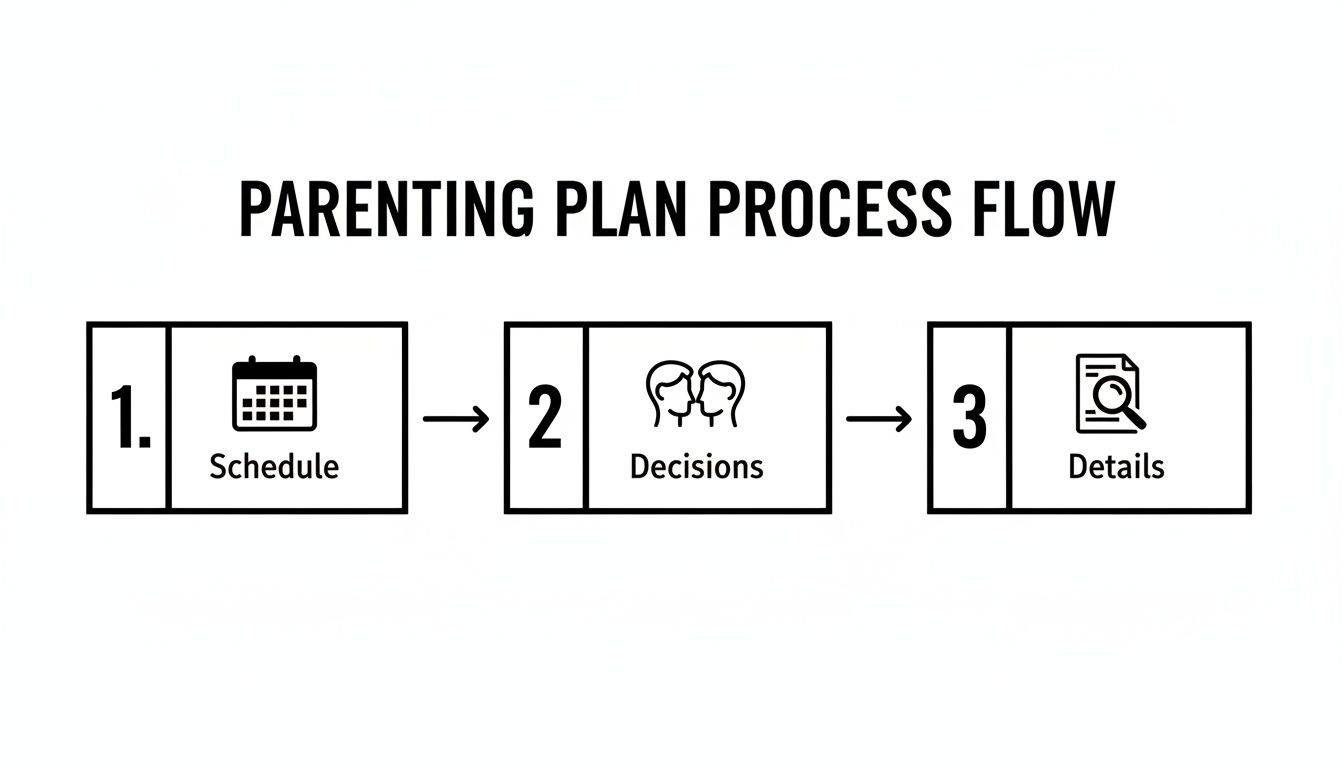
This visual breaks down the core components of a solid parenting plan. Whether you're working together or heading to court, moving from the schedule to decisions and then ironing out the details is the foundation of a stable plan for your kids.
Navigating The Contested Path: When Agreement Fails
Sometimes, no matter how hard everyone tries, you just can't find common ground. When negotiation and mediation fall short, the contested path—going to court—is the only option left. This is a much more formal, structured, and frankly, expensive process where a judge will make the final decisions for you.
Ontario’s family courts are swamped. With 8,083 new family applications filed in a single recent year, the system is under incredible strain. This statistic alone should tell you why finding a way to agree is so important—it helps you avoid getting stuck in a very long queue.
But going to court isn't a single, dramatic event like you see on TV. It's actually a series of steps, and each one is designed to give you and the other parent another chance to settle.
The purpose of the family court system is to resolve disputes. While a trial is the final step, the process itself provides multiple opportunities for parents to reach an agreement with the help of judges and court resources.
Here’s a rough sketch of what the contested process looks like:
- Filing an Application: The process starts when one parent (the "Applicant") files an Application with the court. This document lays out what they're asking the judge to order. It then has to be formally served on the other parent (the "Respondent").
- First Appearance: This is a brief, administrative court date. It’s mostly about setting timelines and making sure everyone understands the next steps in the court process.
- Case Conference: This is a pivotal meeting with a judge. Both sides get to discuss the key issues, explore ways to settle, and map out a plan. The judge can't make a final order here, but they can offer their professional opinion, which often helps move things along.
- Motions for Temporary Orders: Life doesn't stop just because you have a court case. If there are urgent issues that can't wait for a trial—like who the kids live with day-to-day or who pays child support in the meantime—a parent can bring a "motion" to ask a judge for a temporary order.
- Trial: If all else fails and no settlement can be reached, the case moves to a trial. This is where both sides present their evidence and witnesses, and a judge makes a final, binding decision. When a case gets this far, having a perfect record is critical, and services for reliable court audio transcription can become essential.
The contested path can feel daunting, but knowing how it's structured can help take some of the fear away. Every step is part of a system designed to find a resolution that, above all, serves the best interests of your child.
Let's break down the core differences between these two paths in a simple table.
Comparing Uncontested and Contested Paths in Ontario
| Feature | Uncontested Process (Agreement) | Contested Process (Court Litigation) |
|---|---|---|
| Control Over Outcome | Complete control. You and the other parent decide the terms. | No control. A judge makes the final, binding decisions. |
| Timeline | Fast. Can be finalized in a few months once the agreement is signed. | Slow. Often takes 12-24 months or longer to reach a trial. |
| Cost | Predictable and much lower. Often handled with flat fees. | Unpredictable and high. Billed hourly, costs escalate quickly. |
| Process | Collaborative. Focuses on negotiation, mediation, and paperwork. | Adversarial. Involves formal court procedures, motions, and evidence. |
| Emotional Stress | Lower. Cooperation reduces conflict and shields children. | High. The adversarial nature is stressful for parents and kids. |
| Privacy | Private. Your agreement is a confidential contract. | Public. Court documents and proceedings are generally public record. |
As you can see, the path of agreement offers significant advantages in cost, speed, and emotional well-being. The court process provides a necessary structure for resolving deep-seated conflicts, but it comes at a much higher price—financially and emotionally.
How To Modify Or Enforce Your Parenting Arrangement
Parenting plans, whether they’re laid out in a separation agreement or a formal court order, are meant to create stability and predictability. But life isn’t static. Kids get older, their needs shift, and parents' circumstances can change dramatically, sometimes making the original terms unworkable.
Then there are the times when one parent simply doesn't stick to the plan. This can create chaos and conflict, undermining the very stability the arrangement was designed to provide. Knowing how to legally modify a parenting plan or enforce its terms is absolutely essential for managing your co-parenting relationship and protecting your child’s best interests.
How to Modify a Parenting Order or Agreement
You can't just ask a court to change a parenting order because you’ve had a change of heart. To get a judge in Ontario to alter an existing agreement or order, you have to prove there has been a “material change in circumstances.”
This is a specific legal test with a high bar. A material change isn't a small scheduling conflict; it’s a significant, unforeseen event that fundamentally alters the landscape for your child. It must be something that, had it been known when the original order was made, would have likely led to a completely different outcome.
A material change is more than a minor inconvenience or a small shift in schedules. It must be a fundamental alteration of the situation that directly impacts the child's well-being and was not anticipated when the original plan was made.
So, what actually qualifies? Here are a few common examples that might meet the test:
- A parent has to relocate. A new job in another city could make the current parenting time schedule impossible to maintain.
- A parent's capacity changes. A serious health diagnosis or a demanding new work schedule could make it impractical to stick to the original plan.
- The child's needs evolve. A child might develop new medical needs or require specialized educational support that the current arrangement can’t accommodate.
- A co-parenting breakdown. If one parent consistently refuses to communicate or actively undermines the other's role, joint decision-making might become impossible, forcing a change.
Enforcing Your Parenting Arrangement
What do you do when the other parent just isn’t holding up their end of the deal? Maybe they're consistently late for pick-ups, cancelling parenting time at the last minute, or making big decisions about the kids without even talking to you. It's incredibly frustrating and can be very damaging to your child's sense of routine and security.
Your first step should always be to document everything. Start a log. Write down every single breach with dates, times, and the specific details of what happened. This written record isn't just for your own sanity; it’s crucial evidence if you have to go to court.
If talking it out doesn’t work, your next move is to seek legal enforcement. This usually means filing a motion with the court. Depending on how serious and frequent the breaches are, a judge can order several different remedies:
- A Clarification Order: Sometimes the problem is just a poorly worded agreement. A judge can issue an order that clarifies the exact terms to remove any ambiguity.
- A Motion for Contempt: This is a very serious step. You're asking the court to formally declare that the other parent has wilfully disobeyed a court order. If you're successful, the penalties can range from fines to, in the most extreme cases, jail time.
- An Order for Make-Up Time: The court can order the parent who denied parenting time to provide that lost time back to the other parent.
When a situation becomes dire and you believe your child is at risk, you may need to act much more quickly. Our guide on obtaining an emergency child custody order explains the process for taking urgent court action. However, the best strategy is always to resolve these issues before they escalate to that point.
Common Questions About Child Custody In Ontario
As you navigate a separation, it’s completely normal for a flood of questions to surface. The world of family law can feel like a maze, and finding clear, direct answers to your biggest concerns is the first step toward regaining your footing. Let's tackle some of the most common questions we hear about child custody in Ontario to give you practical insights and more confidence moving forward.
At What Age Can A Child Decide Who To Live With In Ontario?
This is easily one of the biggest myths in family law. The truth is, there is no magic age in Ontario where a child suddenly gets to decide which parent they live with. A judge always makes the final call, and their decision is based on a full picture of the child’s best interests.
That said, a child's own views are a mandatory factor that judges must consider under both the federal Divorce Act and Ontario's Children's Law Reform Act. The real key is how much weight the judge gives those views. It all comes down to the child's age and maturity. The well-reasoned opinion of a 15-year-old will carry a lot more influence than the preference of a 7-year-old, whose wishes might be based on who has the better video games or fewer rules about bedtime.
While a child's voice is always heard, it is never the sole deciding factor. The court's primary duty is to ensure the parenting arrangement serves the child's overall physical, psychological, and emotional well-being, which may sometimes differ from the child's stated preference.
In the end, a judge will balance what the child wants against all the other best-interest factors, like the stability of each home and each parent’s ability to provide care.
What Is The Difference Between Sole And Joint Decision-Making Responsibility?
Getting this distinction right is absolutely critical when you're building a parenting plan. This isn't about where the child lives; it’s about who has the final say on the big, life-shaping decisions for them.
- Sole Decision-Making Responsibility: Think of this as one parent being the designated captain for major choices about the child's health, education, and significant activities like religion. The other parent usually has a right to be consulted and given information, but the parent with sole responsibility gets to make the final call.
- Joint Decision-Making Responsibility: This model requires both parents to function like a team. You have to reach a mutual agreement on all those major decisions together. It demands a high level of cooperation and communication. If parents with joint responsibility can’t agree, they’ll likely need a mediator or even have to go back to court to break the deadlock.
It’s important to remember this is separate from the small, everyday stuff. The parent who has the child in their care during their parenting time is always in charge of routine decisions like what’s for dinner, when homework gets done, and daily activities.
Do I Need A Lawyer To Get A Custody Order In Ontario?
Legally, you have the right to represent yourself in the child custody Ontario process. But just because you can doesn't mean you should. Family law is an incredibly specialized and complex field, with intricate court rules and case law that changes all the time. Going it alone is a huge risk.
An experienced family lawyer does far more than just fill out paperwork. They give you strategic advice, make sure your rights and your child’s interests are fiercely protected, and help you negotiate an agreement that is fair and legally airtight. A poorly drafted agreement, for example, could be challenged and overturned by a court years down the road, costing you far more in stress and money than hiring a lawyer from the start.
Think about what you get with a lawyer:
- Expertise: They understand the nuances of the law and how judges in your specific courthouse are likely to rule.
- Objectivity: They bring a calm, level-headed perspective to an emotionally explosive time, stopping you from making decisions driven by anger or hurt.
- Efficiency: They know the system inside and out, helping you avoid rookie mistakes that cause frustrating and expensive delays.
- Advocacy: They are your champion, ensuring your voice is heard and your case is presented in the strongest, most compelling way possible.
While it is an investment, hiring a lawyer is often the single most effective way to secure a stable and positive outcome for your family.
What Happens If My Ex-Partner Moves Away With Our Child?
One parent can't just pack up and move with a child if it's going to significantly disrupt the other parent's time with them. This kind of major move is called a "relocation" under the Divorce Act, and it’s governed by very strict rules. Trying to relocate without permission can lead to serious legal consequences.
If a parent with decision-making responsibility or parenting time wants to relocate, they must provide at least 60 days' written notice to the other parent. This isn't just a casual heads-up; it's a formal notice that has to include the new address, the date of the move, and a proposal for a new parenting time schedule.
The other parent then has 30 days to object. If they do, the parent who wants to move is stuck—they cannot go anywhere without a court order. A judge will only grant permission if the moving parent proves two things: that the move is in "good faith" (for a legitimate reason, like a great new job) and that it is in the best interests of the child. The court will carefully weigh the pros of the move against the damage it could do by disrupting the child's relationship with the other parent and their entire community.
Navigating the complexities of child custody requires clear guidance and strong legal advocacy. The team at Badesha Law is committed to helping you understand your rights and responsibilities, so you can make informed decisions that protect your children and your future. If you are in Brampton or the GTA and need assistance with your family law matter, we invite you to reach out for a consultation.
Contact Badesha Law today to secure the expert legal support you deserve.