

In family law, you’ll hear the term custodial parent thrown around a lot. Traditionally, it just means the parent the child lives with most of the time after a separation or divorce. While people still use this phrase in everyday conversation, it’s really important for Brampton families to know that Ontario’s laws, specifically the Family Law Act, have moved on, using clearer language to provide actionable insights and prevent confusion.
What Custodial Parent Means in Brampton Today

If you’re going through a separation in Brampton, you’ve probably heard “custodial parent” and “non-custodial parent.” Think of custodial parent as the shorthand way to describe the parent who handles the day-to-day—the one managing school runs in Peel Region, making dinner, and tucking the kids into bed most nights.
However, the legal world in Ontario, which is guided by the provincial Family Law Act and the federal Divorce Act, has changed its vocabulary. For your Brampton-based case, it is crucial to understand that the law now splits up a parent’s role into two distinct concepts, which brings much-needed clarity to your situation.
The Modern Legal Terms in Ontario
Instead of lumping everything under the vague and often misleading term “custody,” courts now look at parental responsibilities in two separate categories. Understanding this distinction is your first step to building a strong case.
- Parenting Time: This is all about where the child physically lives and on what schedule. It’s the modern-day equivalent of what we used to call physical custody. The parent who has the majority of the parenting time is who most people would call the “custodial parent.”
- Decision-Making Responsibility: This is about who has the authority to make the big calls for a child’s life—things like healthcare choices, schooling, and religious upbringing. This power can belong to one parent (sole) or be shared between both (joint), and it has nothing to do with the parenting time schedule.
This split is critical. Just because your child lives with you most of the time doesn’t automatically mean you get to make all the major decisions alone. The court determines these two roles separately, always focusing on what is in the child’s best interests. This means you need a legal strategy for each.
This approach isn’t unique to Ontario. For example, California still uses the term “custodial parent” for primary physical custody, and data shows that around 80% of these parents are mothers. You can see more about these trends and California family law statistics on wadelitigation.com. This shows a widespread shift toward being more specific about parental roles.
Your Core Rights and Daily Responsibilities
Understanding the term “custodial parent” is one thing, but living the role day-to-day is something else entirely. For parents in Brampton, it’s about providing a stable, safe, and nurturing environment for your child. This goes far beyond just having the child live with you; it’s about managing their entire world.
Your most immediate job is to look after your child’s basic needs—a safe home, healthy meals, proper clothing, and a consistent daily routine. You’re the one making sure they get to school on time, finish their homework, and stick to a reasonable bedtime.
Making Everyday Decisions
As the parent with the majority of parenting time, you’re in charge of the routine, day-to-day decisions for your child. These are the small but constant choices that shape their daily life:
- What’s for dinner tonight.
- Which friends can come over after school.
- What time they need to be in bed on a school night.
- How to handle minor health issues, like treating a common cold.
It’s crucial to understand that these everyday choices are different from the big-picture decisions—like choosing a school, agreeing to major medical treatments, or deciding on religious upbringing. Those fall under decision-making responsibility, a separate legal right that can be held by one parent alone or shared by both, regardless of who the child lives with most of the time.
Financial Support and Relocation Rules
A key right that comes with your role is the entitlement to receive child support. Under Ontario’s Family Law Act and the Federal Child Support Guidelines, the other parent is legally obligated to contribute financially to raising your child. This support is calculated based on their income and is meant to help you cover the costs of providing for your child.
One of the most critical responsibilities—and a frequent source of conflict—is relocation. You don’t have an automatic right to move with your child, especially if it would significantly affect the other parent’s time with them.
Under Canada’s Divorce Act, any planned move that creates a significant geographic distance between the child and the other parent is legally considered a “relocation.” This means you must give the other parent 60 days’ written notice in a very specific format. If they disagree, you can’t move without getting a court order from a Brampton judge, who will only approve it if the move is proven to be in the child’s best interests.
Trying to move without consent or a court order can lead to severe legal trouble, including a judge potentially changing your entire parenting arrangement. In extreme cases, it could even lead to charges under the Criminal Code of Canada. Navigating these rules requires careful planning and legal advice to protect both your rights and your child’s stability.
How Brampton Courts Decide Parenting Arrangements
When parents in Brampton can’t agree on a path forward for their children, the decision ultimately lands with the Ontario Court of Justice. While the court always prefers parents to create their own parenting plan through negotiation or mediation, a judge will step in when a mutual agreement just isn’t possible. Their job is to protect the child’s well-being above all else.
The court’s entire process is driven by a single, powerful principle found in both the federal Divorce Act and Ontario’s Family Law Act: the best interests of the child. This isn’t just a vague concept; it’s a strict legal test that forces a judge to look at every factor impacting a child’s safety, security, and overall development.
The Best Interests of the Child Test
So, how does a judge in Brampton figure out what’s truly best for a child? They meticulously examine a wide range of factors, leaving no stone unturned. It’s crucial to understand that they won’t favour one parent over another based on gender or who started the separation. Their analysis is purely evidence-based and focuses entirely on the child’s world.
Some of the key considerations include:
- The Child’s Needs: This covers everything from their physical and emotional health to their psychological needs, all viewed through the lens of their specific age and developmental stage.
- Family Relationships: The court looks at the strength of the child’s bond with each parent, their siblings, and other important people in their life, like grandparents.
- Each Parent’s Plan: A judge will carefully assess each parent’s proposal for the child’s care and how they plan to raise them.
- The Child’s Views: If a child is old enough and mature enough to express their own preferences, the court will often listen.
- History of Care: Who has historically been the primary caregiver? The court will look at the established routines and roles.
- Ability to Parent: This involves each parent’s capacity to provide guidance, education, and the basic necessities of life.
The court is also required to consider any history of family violence, abuse, or any conduct that shows a parent is unable to properly care for the child. Things like substance abuse or neglect are treated with extreme seriousness and can heavily influence the judge’s final decision.
This flowchart gives a great visual of the decision-making process for a parent who wants to move—a major issue that courts often have to weigh in parenting arrangements.
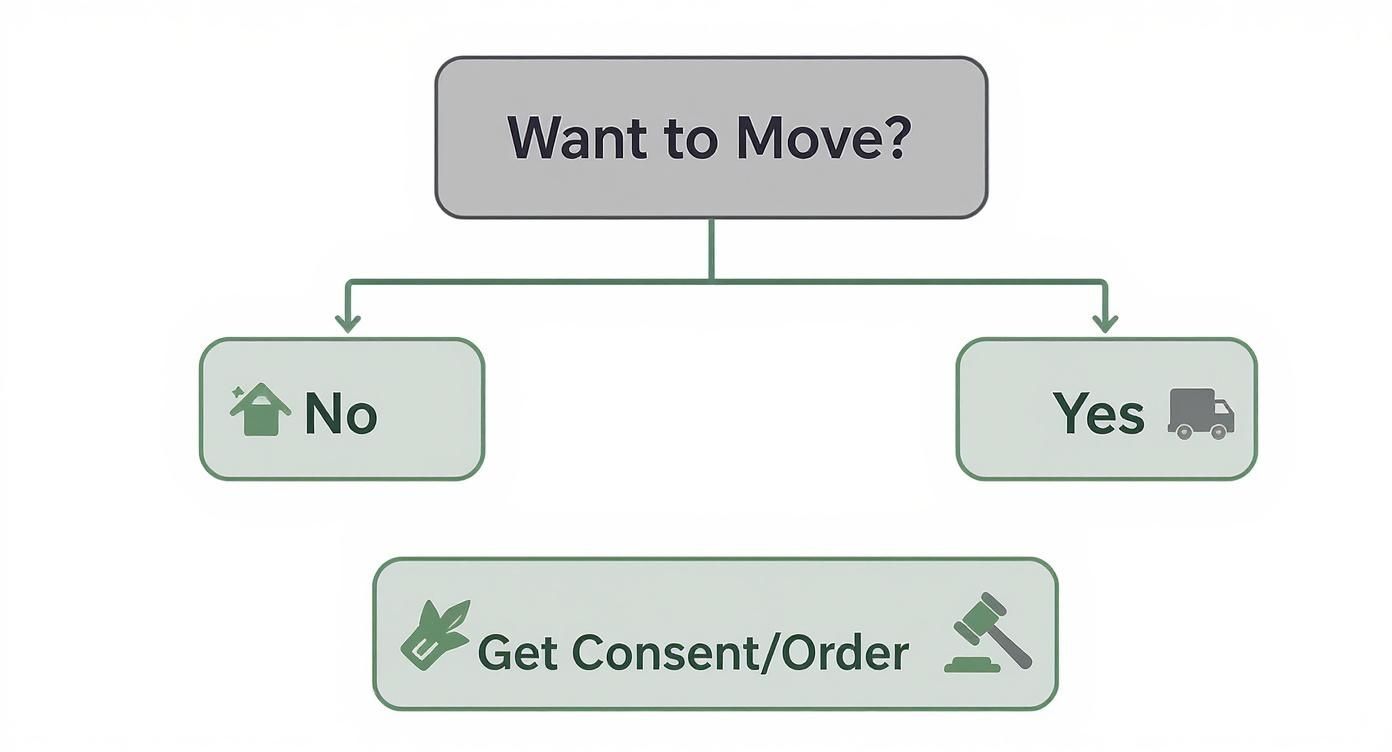
As you can see, relocating isn’t a decision one parent can make alone. It always requires either the other parent’s consent or a formal court order.
Settling Outside of Court
While a judge has the final say in a dispute, it’s important to remember that most parenting arrangements are actually settled without ever stepping inside a courtroom. In fact, data from other jurisdictions suggests that roughly 90% of custody cases are resolved through mutual agreements, often with the help of mediation. This cooperative approach is strongly preferred because it usually leads to more stable and positive long-term co-parenting relationships. You can learn more about how courts analyze these factors in contested cases at drurypullenlaw.com.
Understanding Parenting Time vs Decision Making

When Brampton families navigate separation today, the old idea of a “custodial parent” can be a bit misleading. Modern Ontario family law, thanks to updates in the Divorce Act, has moved away from that single term. Instead, it breaks down parental duties into two distinct concepts: parenting time and decision-making responsibility.
Getting a handle on these two ideas is the first step to creating a clear, stable plan for your children.
Think of it like running a company together, but the “company” is your child’s upbringing. Parenting time is the day-to-day operations—it’s the schedule that dictates who is physically with the child. This covers everything from school runs and homework help to weekend fun and holiday plans. The parent who has the child for the majority of the time is often what people still informally call the “custodial parent.”
Decision-making responsibility, on the other hand, is like being on the board of directors. It’s about having the authority to make the big-picture, long-term decisions that will shape your child’s future.
What is Decision-Making Responsibility?
This responsibility isn’t about the daily routine; it’s about the major milestones and guiding principles in a child’s life. The parent (or parents) with this authority gets the final say on a few crucial things.
Key areas of decision-making include:
- Health: Choosing doctors, consenting to major medical treatments, and making other significant healthcare choices. For a family in Brampton, this could mean selecting a family doctor at a clinic affiliated with the William Osler Health System.
- Education: Deciding which school the child attends, what special programs they enroll in, or if they need extra academic support. This could involve choosing a school within the Peel District School Board.
- Culture, Language, Religion, and Spirituality: Guiding the child’s religious upbringing and ensuring they stay connected to their cultural heritage.
- Significant Extracurricular Activities: Approving participation in major commitments, like joining a competitive hockey league or a specialized arts program.
It’s absolutely critical to understand that parenting time and decision-making are not automatically bundled together. A parent can have the child living with them most of the week but still share the authority for major decisions equally with the other parent.
Under Ontario’s Family Law Act, courts look at parenting time and decision-making responsibility as separate issues. The number one factor in every single decision is the child’s best interests—not what the parents want.
To help clarify how these roles function, here’s a quick-reference table.
Parenting Time vs Decision Making At a Glance
| Responsibility Type | What It Covers | Possible Arrangements (Sole/Joint) |
|---|---|---|
| Parenting Time | The child’s daily schedule, including where they live and when they spend time with each parent. Covers day-to-day care, routine activities, and holidays. | Primary Residence: One parent has the child most of the time. Shared: Parents have the child for roughly equal amounts of time (at least 40% each). |
| Decision-Making Responsibility | Significant, long-term choices about a child’s well-being, such as health, education, religion, and major extracurricular activities. | Sole: One parent has the final say on all major decisions. Joint: Both parents must agree on major decisions together. |
This table shows how a parenting plan can be customized. A child might live primarily with one parent, but both parents could have a joint say in all the big decisions.
How These Roles Are Assigned
How these responsibilities are divided up really depends on what’s best for the child and how well the parents can work together.
Sole vs. Joint Arrangements:
- Sole Decision-Making: One parent is given the full authority to make all major decisions, often without needing to consult the other parent. Courts usually only order this in high-conflict situations or when there’s a history of family violence that makes cooperation impossible.
- Joint Decision-Making: Both parents are required to make major decisions together. This is the preferred route when parents can communicate effectively and co-parent respectfully, as it keeps both involved in the child’s life.
This legal shift is important. It moves us away from the outdated “winner-takes-all” mentality of custody battles. The focus now is on building a supportive structure that allows both parents to play a meaningful role in raising their child, no matter what the living arrangement looks like.
When a relationship ends, making sure your child is financially secure becomes a top priority. In Brampton, and right across Ontario, child support isn’t just a courtesy—it’s a legal right that belongs to your child. The whole point is to ensure they benefit from both parents’ financial resources, just as they would if the family were still living under one roof.
This isn’t about pulling numbers out of thin air. Child support is calculated using the Federal Child Support Guidelines, a framework designed to bring fairness and predictability to the process. It primarily hinges on two things: the paying parent’s gross annual income and the number of children they need to support.
How Parenting Time Factors into the Equation
The amount of time your child spends with each parent can have a big impact on the child support calculation. If one parent has the child for more than 60% of the time (what people often call being the “custodial parent”), the other parent usually pays the standard amount set out in the Guidelines’ tables.
But what if you have a shared parenting arrangement? This is where each parent has the child for at least 40% of the time. The math gets a bit more complicated here. The court will look at both parents’ incomes and acknowledge the higher costs of running two separate households for the child. While one parent may still pay support to the other, the final amount is often adjusted to reflect the shared responsibilities.
The Financial Squeeze on the Primary Caregiver
Beyond the legal formulas, the parent who has the child most of the time often faces a demanding financial reality. They’re typically on the hook for the majority of the day-to-day costs—everything from groceries and clothes to school fees and hockey practice. This responsibility can create a huge amount of pressure.
While child support is a legal obligation, getting those payments consistently and in full can be a real struggle for many families. That’s why having a clear, legally enforceable court order or separation agreement isn’t just a good idea—it’s essential for financial stability.
The statistics paint a pretty stark picture. On average, custodial parents are supposed to receive about $3,431 annually in child support, but studies show that only around 46% actually get the full court-ordered amount. This financial strain hits custodial mothers particularly hard, with roughly 27% living in poverty compared to just 11% of custodial-father families. These numbers highlight a significant gap. You can find more of these insights into family law statistics at growlaw.co.
These figures really drive home why it’s so critical for parents in Brampton to do more than just shake hands on a number. You need to get it formalized. An enforceable order gives you a powerful tool—Ontario’s Family Responsibility Office (FRO)—to make sure payments are made on time and in full, providing the financial security your child has a right to.
Your Next Steps for Legal Guidance in Brampton
Navigating the world of parenting time, decision-making, and child support in Brampton can feel overwhelming. Understanding the modern definition of a ‘custodial parent’ is a great start, but protecting your rights and your child’s best interests requires a clear, strategic plan. Taking the right steps now can head off future conflicts and create a stable, predictable outcome for your family.
Your first move? Get organized. Taking some time to gather essential documents before you speak with a family lawyer makes all the difference. This preparation means any legal advice you get will be far more effective and specific to your actual situation.
Preparing for Your Consultation
To get the most value out of a meeting with a legal professional, you’ll want to collect some key information. This groundwork helps paint a complete picture of your circumstances right from the start.
Try to assemble:
- Financial Records: Gather recent pay stubs, tax returns, and bank statements for yourself and, if possible, for the other parent as well.
- Key Dates: Make a note of the date you started living together, the date of marriage, and the date of separation. These milestones are legally critical.
- Parenting History: Jot down notes about your involvement in your child’s life. Think about things like school activities, medical appointments, and who handles the day-to-day care routines.
A legally sound separation agreement or parenting plan isn’t just paperwork; it’s the blueprint for your family’s future stability. It turns verbal promises into an enforceable document that protects everyone’s rights under Ontario’s Family Law Act.
The most critical step you can take is to seek advice from a qualified Brampton family lawyer. An initial consultation will clarify your rights, give you a realistic idea of potential outcomes, and leave you with an actionable roadmap. Whether you need to negotiate a parenting plan, formalize a separation agreement, or file a court application, professional guidance ensures you can move forward with confidence and clarity.
Your Top Questions Answered
When you’re navigating family law in Brampton, a lot of questions can come up. Here are clear, straightforward answers to some of the most common concerns parents have about their rights and responsibilities.
Does the Custodial Parent Always Receive Child Support in Ontario?
Yes, in most cases, the parent with whom the child lives most of the time is entitled to receive child support. Under Ontario’s Family Law Act, the amount is calculated using the Federal Child Support Guidelines, which are based mainly on the paying parent’s income and the number of children.
Even in shared parenting situations, where each parent has the child for at least 40% of the time, support is often still paid. The math just gets a bit more complex, as the calculation will aim to reflect the costs each parent is carrying.
Can I Change the Current Parenting Arrangement in Brampton?
Absolutely, but it’s not as simple as just deciding you want something different. Parenting orders and agreements can be changed, but you need to show the court there has been a “material change in circumstances” since the original order was made.
This can’t be a minor inconvenience; it has to be a significant event that directly impacts the child’s best interests. For instance, a major change in a parent’s work schedule that makes the current arrangement impossible, or a shift in the child’s needs as they grow older, could qualify. A judge at the Brampton courthouse will then look at this new reality and decide what’s best for the child moving forward.
Can I Move Out of Brampton With My Child?
Moving with your child, especially if it will impact the other parent’s time with them, is a serious legal step governed by Canada’s Divorce Act. You can’t just pack up and go.
If you’re planning a “relocation,” you must give the other parent 60 days’ formal written notice. If they object, you are not allowed to move unless you get a court order. A judge will only grant permission if the move is proven to be in the child’s best interests. Trying to move without permission can lead to severe legal consequences, including the risk of losing some of your parenting time, and could in extreme cases, involve charges under the Criminal Code of Canada.
Navigating parenting arrangements, support, and relocation requires a careful legal strategy. At Badesha Law, we provide clear, direct guidance to protect your rights and your child’s future. If you’re facing a family law issue in Brampton, contact us for an effective and client-focused approach. Learn more at www.badeshlaw.ca