

This guide provides general information and is not legal advice. For advice on your specific situation, consult with a lawyer.
Author: Badesha Law | Last Updated: December 17 2025
When your child’s immediate safety is on the line, you can’t afford to wait for a standard court date. In these critical moments, an emergency custody order in Ontario is your most important legal tool. Known formally as an urgent motion, it’s a fast, temporary measure designed to protect a child from immediate harm. A judge can grant this order ex parte—meaning, without the other parent’s initial input—to deal with a genuine crisis right now.
If you believe your child is in immediate danger, understanding how to seek an emergency order is crucial. The process is complex and the stakes are incredibly high. The experienced team at Badesha Law can help you navigate the Brampton court system and take decisive action.
Book a consultation to discuss your next steps and protect your child.
What Is an Emergency Custody Order in Ontario?

An emergency custody order is a powerful but short-term intervention from the court, reserved for true emergencies. It is not a tool for settling everyday parenting arguments or for getting an advantage in a custody battle. The court’s only goal is to secure a child’s immediate safety until a full, two-sided hearing can be arranged.
This kind of order temporarily gives one parent (or another guardian) sole decision-making responsibility and parenting time. It’s the legal equivalent of pulling the fire alarm—you only do it when there’s a real, immediate threat that cannot wait for the regular court process to unfold.
If you genuinely believe your child is in danger, seeking an emergency order might be the most important step you ever take. A family lawyer in Brampton can help you determine if your situation meets the very high standard the court demands.
Key Takeaway: An emergency custody order is a temporary fix, not a final decision on custody. Its sole purpose is to shield a child from an immediate threat. The parent seeking the order must provide strong, credible evidence to convince a judge that the situation is a true emergency.
The High Standard of Proof Required
Courts in Ontario do not grant these orders lightly. Because they temporarily remove the other parent’s rights without giving them a chance to tell their side of the story, they are reserved for the most serious situations.
To succeed, you must prove to a judge that:
- There is a genuine and immediate risk of harm to your child.
- The risk is so serious that any delay would be detrimental to the child’s well-being.
- Warning the other parent about the court action could worsen the situation—for example, it could create a risk of them abducting the child.
This means your evidence must be clear, compelling, and focused on a danger happening now. Old issues or high-conflict arguments almost never meet this strict standard. While it’s helpful to understand general custody rights in Ontario, an emergency order operates under much stricter rules.
Key Features of an Emergency Custody Order
| Characteristic | Description |
|---|---|
| Purpose | To protect a child from immediate, serious harm. |
| Speed | Granted quickly to address an urgent crisis. |
| Duration | Temporary, usually lasting only until a full hearing can be held (approx. 10-14 days). |
| Process | Ex parte, meaning a judge hears from only one parent initially. |
| Evidence Standard | Very high; requires clear and compelling proof of immediate danger. |
| Follow-up | A full court hearing with both parents is scheduled very quickly after. |
Understanding the Ex Parte Process
The term ex parte means “for one party.” In this context, it means a judge hears from just one side—the parent seeking protection—before deciding. This is done to prevent the other parent from taking harmful action if they were warned in advance.
This one-sided process is quickly balanced. An ex parte emergency order is temporary. The court will schedule a follow-up hearing, typically within 10 to 14 days, where both parents can present their case. This approach, governed by the Children’s Law Reform Act and the Divorce Act, balances the need for immediate action with the principles of fairness.
When Is an Emergency Order Necessary?
An emergency custody order is reserved for a true crisis. The legal test is deliberately high because an emergency order temporarily strips a parent of their rights without them having a chance to speak.
The one question a judge will ask is: “Is the child in immediate danger of serious harm?”
To have a chance of success, you must prove the risk is imminent. This means the danger is happening now or is about to happen, and waiting for a standard court date would be detrimental to the child. A long history of the other parent’s poor judgment isn’t enough on its own; your job is to connect that past behaviour to a very real, present-day threat.
This distinction is critical. Many urgent applications are dismissed because they address ongoing conflict, not an immediate crisis. A family lawyer in Brampton can provide an honest assessment of whether your situation meets this strict legal test before you invest time, money, and emotional energy into filing.
Defining Imminent Risk of Harm
Vague fears or general anxiety won’t convince a judge. The court needs specific, credible evidence of a situation that puts a child’s physical or psychological safety at risk right now.
Scenarios that may qualify for an emergency custody order in Ontario include:
- Recent Family Violence: A documented incident of physical or sexual abuse against the child or another family member in the child’s presence.
- Credible Abduction Threats: A parent has taken concrete steps to remove the child from the province or country (e.g., selling assets, quitting a job, obtaining a passport for the child without consent).
- Severe Substance Abuse: A parent is driving with the child while intoxicated, leaving drugs accessible to the child, or is so impaired they are unable to provide basic care.
- Acute Mental Health Crisis: A parent is experiencing a severe, untreated mental health episode that renders them incapable of safely supervising the child.
Crucial Distinction: High-conflict arguments, disagreements over parenting styles, or introducing a new partner are almost never grounds for an emergency order unless they directly create a situation of imminent harm. The court expects parents to use other legal routes, like mediation or standard motions, to resolve these issues.
Proving the Harm Is Immediate
The timing of the threat is everything. A judge needs to see a clear link between a past event and a current danger. For example, a single incident of domestic violence that happened a year ago, with no issues since, is unlikely to support an emergency order today.
However, if that same parent has started making new threats, is refusing medication, and was recently fired for aggressive behaviour, that past incident becomes highly relevant. It helps paint a picture of a present and escalating risk.
Your evidence must tell a compelling story of a clear and present danger that demands the court’s immediate intervention. It’s not just about what happened, but why it proves your child is unsafe today.
Navigating what the court considers an “immediate threat” is challenging. For a deeper look at the factors judges weigh, you can review this comprehensive parent’s guide to child custody laws in Brampton.
Navigating the Brampton Court Process
Filing an urgent motion for an emergency order in Brampton can feel overwhelming, especially under stress. The process is structured, and understanding the steps and documents required at the Brampton courthouse can provide clarity.
The two foundational court forms for an urgent motion are:
- Form 8 Application (General): This document initiates your family law case. It identifies the parties, provides background, and clearly states the orders you are seeking.
- Form 35.1 Affidavit in Support of Motion for Temporary Orders Without Notice: This is your sworn statement where you present the evidence and explain exactly why the situation is an emergency that requires a judge’s immediate attention without notifying the other parent.
Successfully filing an urgent motion is about building a powerful case on paper. At Badesha Law, as a family lawyer in Brampton, we work with local court procedures daily and know what judges in the Peel Region need to see to grant these serious orders.
If your child’s safety is at risk, don’t delay. Call Badesha Law now for guidance on your next steps.
Crafting a Powerful Affidavit
Your Form 35.1 Affidavit is your opportunity to convince a judge your child is in immediate danger. It must be factual, chronological, and persuasive without being overly emotional. A judge needs clear, objective evidence.
Think of your affidavit as a factual story. Start with the most recent and alarming events that created the emergency. Then, work backward to provide context, showing a pattern of behaviour if one exists. Be specific with dates, times, locations, and direct quotes. Stick to what you personally saw, heard, or experienced.
Pro Tip: Your affidavit is for facts, not feelings. Avoid making legal arguments or emotional pleas. Present the facts so clearly that they speak for themselves. A well-organized, fact-based account is infinitely more powerful than one filled with anger or speculation.
After drafting your documents, you’ll file them with the Superior Court of Justice in Brampton. If a judge agrees the situation is urgent, they will grant the ex parte order and provide a court-endorsed copy.
The visual below breaks down the three core criteria a judge will be looking for.
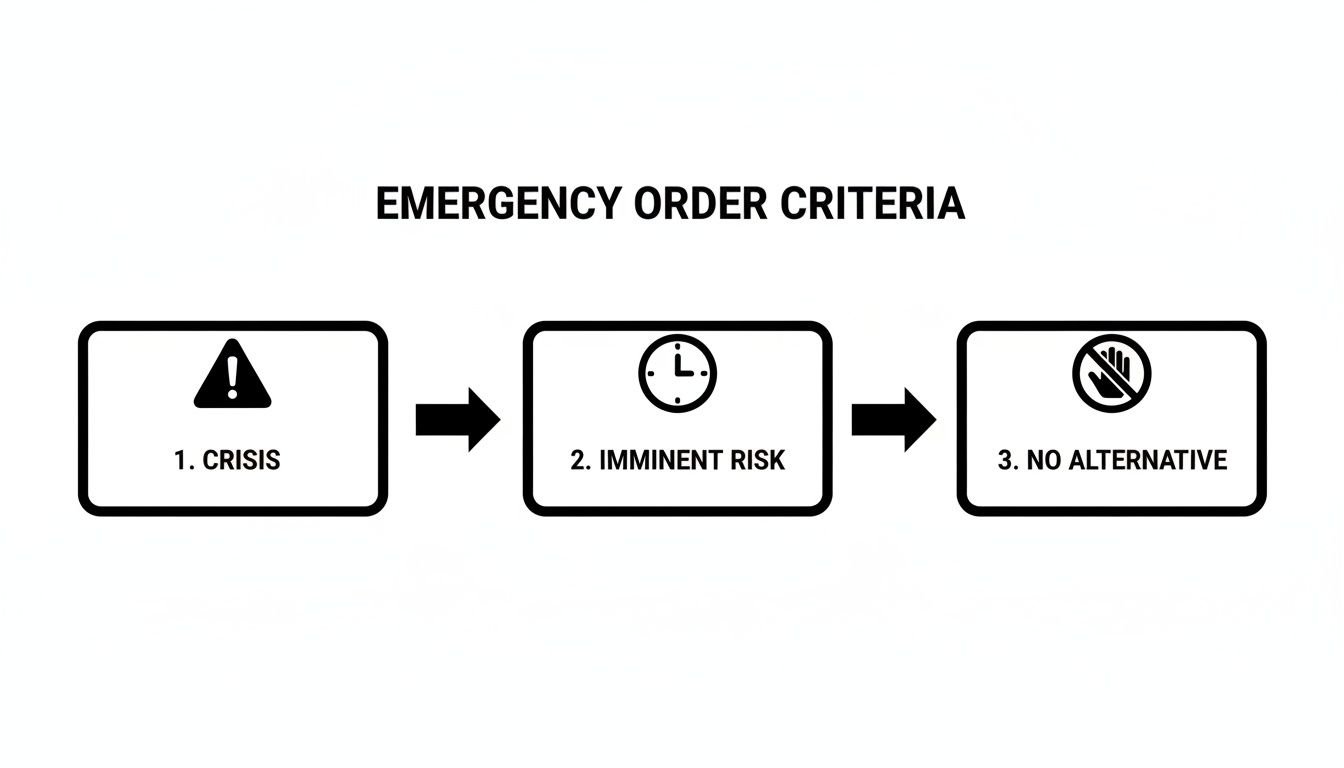
Success hinges on proving not just a crisis, but an imminent risk so severe that there is no other option but to act immediately.
Understanding Filing and Service
“Service” is the formal process of giving the other parent copies of court documents. In a true ex parte motion, you do not serve the other parent with your application before you see the judge. The purpose is to get a protective order in place first because giving notice could worsen the danger.
Once the judge grants the temporary emergency order, you will then be required to serve the other parent with the order and all the documents you filed. This ensures they are aware of the court’s decision and the upcoming court date where they will have a chance to respond. Timelines can vary, but the court system is designed to move quickly for urgent matters. The Ministry of the Attorney General’s published plans and annual reports outline its service standards for family court dockets in regions like Brampton.
Resources at the Brampton Courthouse
The Brampton courthouse has a Family Law Information Centre (FLIC) where staff can provide general information about court processes and help you find the right forms. They cannot give legal advice, but they are a helpful starting point.
However, given the extremely high stakes, getting guidance from a legal professional is strongly recommended. The process is unforgiving of mistakes. Our guide explains in detail why hiring a local Brampton family lawyer is a major strategic advantage, especially in a crisis. We are here to help families in Brampton and the GTA protect what matters most.
Gathering Evidence to Support Your Case
A judge won’t grant an emergency custody order on your word alone. Your story must be backed by solid, credible proof. Your goal is to present a clear, undeniable picture of immediate risk. Vague claims of “bad parenting” are insufficient; a detailed record of dangerous behaviour supported by proof is essential.
Checklist of Required Documents & Evidence
- Police Reports: If you’ve called the police due to domestic violence, threats, or for a wellness check, obtain the occurrence numbers and any reports filed.
- Children’s Aid Society (CAS) Files: If Peel CAS has been involved, their records can be crucial, as they may contain professional risk assessments or documented concerns.
- Medical Records: Documentation from a doctor or hospital detailing injuries to you or your child serves as powerful evidence.
- School Records: Reports from teachers or administrators noting changes in your child’s behaviour, appearance, or attendance.
- Digital Communication:
- Text Messages & Emails: Screenshots of harassing or threatening messages with the date, time, and sender clearly visible.
- Voicemails: Saved audio files of threats or admissions of substance abuse.
- Social Media Posts: Screenshots of public posts showing threats, drug use, or unstable behaviour.
- Photos & Videos: Dated photos of injuries, property damage from a violent outburst, or unsafe living conditions (e.g., drug paraphernalia).
Key Insight: A report from a police officer or a CAS worker is often more persuasive to a judge than a letter from a family member. These professionals are trained to assess risk objectively and are considered neutral parties.
Organize this evidence logically and attach items as clearly labelled exhibits to your affidavit. This helps the judge follow your story and understand the significance of each piece of proof. Ultimately, every piece of evidence must align with the one legal principle that guides all custody decisions: what is in the best interests of the child.
What Happens at the Court Hearing

The court process for an emergency order in Ontario typically happens in two stages: the initial ex parte hearing and a follow-up “return” hearing.
The first step is the ex parte hearing. This is a brief appearance before a judge with only you and your lawyer present. You present your affidavit and evidence to convince the judge of a genuine, immediate risk of harm to your child. The judge will ask direct questions to confirm the urgency. If they agree, they will grant a temporary emergency order and set a date for the second hearing, usually within 10 to 14 days.
The Return Hearing: What to Expect
The return hearing is the other parent’s opportunity to respond. They will have been served with your motion documents and the temporary order, giving them a chance to file their own affidavit.
Here, the judge’s focus is to decide what to do with the temporary order now that they have both sides of the story. They will review all written evidence and listen to arguments. The possible outcomes are:
- Confirming the Order: The judge decides the emergency order should remain in place.
- Varying the Order: The judge modifies the terms of the original order based on new information.
- Setting Aside the Order: The judge dismisses the temporary order if they decide it wasn’t a true emergency or if the other parent’s evidence successfully refutes your claims.
Courtroom Etiquette and Preparation
Your conduct in court matters. It is critical to remain calm, be respectful, and stick to the facts. Address the judge as “Your Honour” and never interrupt. Your family lawyer in Brampton from a firm like Badesha Law will prepare you for the types of questions a judge may ask, helping you present your case with clarity and confidence. Having a grasp of family law in Brampton, from divorce to child custody, provides helpful context for these urgent matters.
Brampton Clients Often Ask…
At Badesha Law, we guide Brampton parents through the local legal system daily. Here are answers to common questions we hear from clients in Peel Region.
Which Brampton courthouse handles my urgent motion?
All urgent family law matters for residents of Brampton, Mississauga, and Caledon are filed at the Superior Court of Justice at 7755 Hurontario Street in Brampton. Filing at the correct venue is the critical first step to avoid delays.
How do Peel Regional Police or Peel CAS get involved?
If your child is in immediate physical danger, call 911. When Peel Regional Police respond, they create an official record that can become powerful evidence for your motion. If concerns involve neglect or abuse, Peel Children’s Aid Society (CAS) may also get involved. A formal CAS investigation and its findings carry significant weight with a judge.
Do you help clients who speak Punjabi?
Yes. Clear communication is essential in a stressful family law case. At Badesha Law, we are proud to offer full legal services to clients who are more comfortable discussing their situation in Punjabi. We ensure you understand every document and step of the legal process in the language you prefer.
Frequently Asked Questions
Can I file for an emergency custody order without a lawyer?
While you legally can represent yourself, it is strongly discouraged. The legal standard for an emergency order is extremely high, and the process is unforgiving of procedural errors. A mistake in your affidavit or how you present evidence can lead to your motion being dismissed, even if the danger to your child is real. An experienced family lawyer in Brampton knows what judges need to see and protects you from critical errors.
How much does an emergency motion cost?
The cost varies based on the complexity of your situation, the amount of evidence to review, and the time required to draft a persuasive affidavit and appear in court. While it is a significant investment, you must weigh that cost against the risk of an unsuccessful motion. We offer an initial consultation to help you understand your options and potential costs.
What happens if my request for an emergency order is denied?
If a judge denies your request, it means they were not convinced there was sufficient evidence of an immediate and serious risk of harm. A denial is a setback, but not the end of the road. Your case will proceed through standard family court channels, where you can still bring a regular motion for a temporary custody order.
How long does an emergency order last?
An emergency order is a temporary measure. An ex parte order typically lasts no more than 10 to 14 days. It sets a date for a “return hearing,” where both parents appear before a judge who will decide whether to extend, change, or end the order.
Can the other parent challenge the order?
Yes. The return hearing is their opportunity to respond. They will be served with your court documents and can file their own affidavit presenting their side of the story. The judge will make a new decision only after hearing from both of you.
Does an emergency order affect the final custody decision?
While a temporary order isn’t final, it can influence the outcome. If the arrangement under the emergency order works well and the child is stable, a judge may be hesitant to make significant changes later. The evidence presented can also set the tone for the rest of your case, making it critical to present the strongest case possible from the start.
At Badesha Law, we understand the fear you feel when your child’s safety is at risk. If you believe your child is in immediate danger, you cannot afford to wait. Contact our experienced Brampton family lawyers to discuss seeking an emergency custody order.
Book a free consultation to protect your child today.