

Navigating Parenting Time In Brampton And Ontario Family Law
When you’re going through a separation or divorce in Brampton, one of the first questions on your mind is probably, “When will I see my children?” The legal term that answers this question is parenting time. It’s the official schedule that lays out when each parent is responsible for the children, and it’s governed by Ontario’s Family Law Act and Children’s Law Reform Act.
Understanding Parenting Time In Ontario
If you’re a parent in Brampton navigating a separation, you might have heard older terms like “custody” and “access.” It’s crucial to understand that Ontario’s family law, specifically the Children’s Law Reform Act, has moved on. The term parenting time officially replaced “access” to shift the focus from a parent’s “right” to see a child toward the child’s right to spend meaningful time with each parent.
This wasn’t just a simple word swap. It signals a major shift in how the Brampton courts view family dynamics after a separation. The goal is to move away from the old “winner-takes-all” mindset of custody battles toward a more collaborative, child-focused approach. The objective is to create a stable and predictable routine where your child can thrive.
What Parenting Time Actually Covers
So, what does parenting time look like in practice for a family in Brampton? Think of it as the day-to-day calendar that outlines the physical care of your child. When it’s your parenting time, you are the parent in charge of all the little things that make up their daily life.
For families in Brampton, this means the parent with the child during their designated time is responsible for:
- Daily routines like meals, homework, and getting them to bed.
- Driving them to school, soccer practice at a local Brampton park, or music lessons.
- Making the small, everyday decisions about their immediate well-being.
In short, when your child is with you, you’re the active parent responsible for their care and supervision.
Under Ontario law, the only factor a court in Brampton will consider when making decisions about a parenting schedule is the best interests of the child. This single principle guides everything, ensuring the child’s physical, emotional, and psychological well-being is the top priority.
The Shift From Old Terminology
The move away from “custody” and “access” was deliberate. Those older terms often created a power imbalance, implying there was a “primary” parent and a “secondary” one, which could easily fuel conflict. The language used today in both federal and provincial law promotes the idea that both parents play a valuable role in their child’s life.
To help clear things up, here’s a quick guide to the old and new terms.
Key Family Law Terms At A Glance
| Modern Term (Current Law) | Old Term (Pre-2021) | What It Means Today for Brampton Families |
|---|---|---|
| Parenting Time | Access | The schedule outlining when the child is in each parent’s care. It focuses on the child’s right to spend time with both parents. |
| Decision-Making | Custody | The legal authority to make major decisions about the child’s life (e.g., health, education, religion). This can be held solely or jointly. |
| Parenting Order | Custody Order | A legally binding court order that sets out the details of both parenting time and decision-making responsibilities. |
| Contact Order | N/A | A court order that grants a non-parent (like a grandparent or step-parent) specific time with the child. |
Getting a handle on this modern framework is the first step toward creating a fair and functional parenting time schedule that allows your child to maintain strong relationships with both parents.
Parenting Time Versus Decision-Making Responsibility
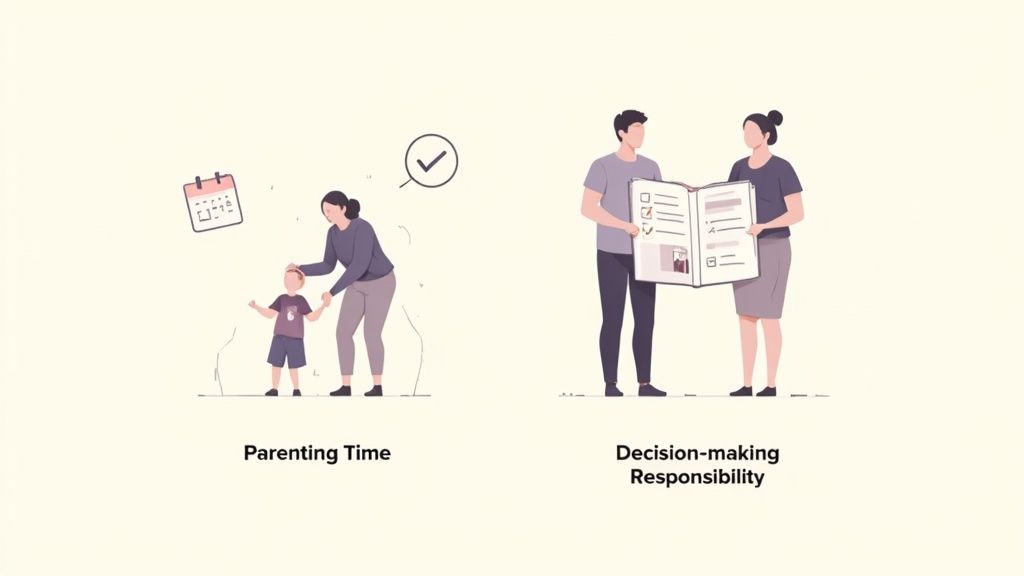
For separating parents in Brampton, a key hurdle is understanding a fundamental concept in Ontario family law: the time you spend with your child is completely separate from the power to make major decisions for them. Grasping this distinction is the foundation for building a clear, stable, and conflict-free co-parenting relationship.
Parenting time is the schedule. It maps out the days and hours your child is physically with you. When it’s your parenting time, you’re in charge of day-to-day duties—making lunch, checking homework, and driving to activities.
Decision-making responsibility, on the other hand, is the legal authority to decide on the big-picture issues in your child’s life. This is the modern term for “custody.” It has nothing to do with who has the child on Tuesday night and everything to do with their long-term well-being.
What Decision-Making Responsibility Includes
When a Brampton judge assigns decision-making responsibility, they are giving a parent the authority to make critical choices that will shape a child’s future. These aren’t the small, everyday calls but the major life pillars.
Under Ontario’s Family Law Act, these key areas are:
- Health: Choosing doctors and dentists, consenting to medical treatments, or deciding on therapy and vaccinations.
- Education: Picking which school the child attends in Brampton, agreeing to special education programs, or hiring a tutor.
- Religion and Spirituality: Determining the child’s religious upbringing and their participation in spiritual activities and ceremonies.
- Significant Extracurricular Activities: This refers to bigger commitments, like enrolling in a competitive sports league or an intensive arts program that has a major impact on the child’s schedule and development.
A court can order parents to share this responsibility jointly or grant it solely to one parent. It’s entirely possible for one parent to have a 50/50 parenting time schedule but have no final say in their child’s education, or the other way around.
It’s a common myth that having more parenting time automatically gives you more say in the big decisions. Brampton courts look at each issue separately, always through the lens of the child’s best interests. A parent’s ability to handle daily care (parenting time) is a very different skill from their ability to make thoughtful, long-term decisions with a co-parent.
An Actionable Analogy
To understand this, picture raising your child after separation as a team project.
Parenting time is about which team member is “on shift” for the hands-on work. One parent might handle the Monday-to-Wednesday shift, taking care of all immediate tasks.
Decision-making responsibility is like being on the project’s steering committee. This group doesn’t handle daily tasks. Instead, they meet to vote on the project’s overall direction and major strategic goals.
A team member could have more on-shift hours (parenting time) but still only have an equal vote on the big-picture strategy (decision-making). This separation of duties gives the Brampton family court the flexibility to create arrangements that truly fit a family’s unique circumstances. The court recognizes this and can structure a parenting order that plays to each parent’s strengths.
How Brampton Courts Determine Parenting time
When you and your co-parent can’t agree on a schedule, a judge at the Brampton courthouse will make the decision for you. Understanding how the court thinks is the best way to prepare your case.
In Ontario, every single decision a judge makes about parenting time boils down to one guiding principle: the best interests of the child test, laid out in Ontario’s Children’s Law Reform Act. It is the only standard a judge will use. Forget myths about automatic 50/50 splits or preferences for mothers or fathers—it simply doesn’t work that way.
The Best Interests of the Child Test
The court’s job isn’t to decide what’s fair to the parents. Its sole focus is on what will best support a child’s physical, emotional, and psychological safety, security, and well-being. To figure that out, a Brampton judge looks at a specific list of factors.
Key considerations under the Children’s Law Reform Act include:
- The child’s needs, based on their age and stage of development (a schedule for a toddler will be different from one for a teenager).
- The love, affection, and emotional ties between the child and each parent.
- Each parent’s willingness to support the child’s relationship with the other parent. Actively undermining the other parent is a major red flag for the court.
- The history of care for the child. The court will want to know who has historically been the primary caregiver.
- The child’s views and preferences, if they’re old enough to express them.
- The proposed plan of care from each parent. A judge needs to see a thoughtful, practical plan.
- The ability and willingness of each parent to care for the child.
- The stability of the family unit where the child would live.
- Any family violence or criminal conduct, which is always a critical factor affecting a child’s safety and well-being under both the Family Law Act and the Criminal Code of Canada.
A common myth is that Ontario courts start with a 50/50 parenting time split as the default. This is not true. Every family’s situation is unique, and the court tailors its decision based entirely on the evidence presented about the child’s specific needs and circumstances in Brampton.
Actionable Steps to Prove Your Case in Court
To get the outcome you’re hoping for, you need to provide clear, compelling evidence showing why your proposed parenting arrangement is in your child’s best interests. This is about demonstrating your ability to provide a stable, loving, and supportive home.
Here are a few actionable steps you can take:
- Document Your Involvement: Keep a calendar or journal detailing your role in your child’s life. Note things like attending parent-teacher interviews at their Brampton school, coaching their soccer team, or taking them to the dentist.
- Propose a Detailed Plan: Don’t just ask for time. Present a comprehensive, child-focused parenting plan that covers daily routines, holidays, communication rules, and everything in between.
- Focus on the Child: Always frame your arguments around your child’s needs, not your own wants. Explain why your proposed schedule benefits their stability, routine, and overall well-being.
- Show You’re Willing to Co-Parent: Demonstrate that you can communicate respectfully with the other parent and that you are genuinely committed to supporting their relationship with your child.
A judge in Brampton is tasked with creating a parenting order that gives your child the best possible chance to thrive. Your job is to provide the evidence that shows how your involvement and your proposed schedule will do exactly that.
Common Parenting Time Schedules That Work
Figuring out what a schedule looks like day-to-day is a major challenge. For families in Brampton, creating a practical, predictable schedule is the key to giving your kids stability after a separation. While there’s no one-size-fits-all solution, a few well-established schedules offer a great starting point.
The goal is to find a rhythm that causes the least disruption for your child while working for both parents. A good schedule creates security when everything else feels uncertain.
The Week On, Week Off Schedule
One of the most straightforward setups, especially for older children and teens, is the week on/week off schedule. The child spends one complete week with one parent, then switches to the other parent for the next week.
- Pros: This schedule is easy to remember and cuts down on handovers, which can lower conflict. It gives each parent a chance to experience a full slice of daily life.
- Cons: For very young children, a full week away from one parent can be too long. This arrangement can also be difficult if parents live far apart in different areas of Brampton, making the school run a logistical challenge.
This schedule works best when both parents live in the same school district and can communicate effectively.
The 2-2-3 and 2-2-5-5 Schedules
For younger kids, schedules with quicker transitions are often a much better fit. The 2-2-3 schedule is a common choice because it provides consistency without long goodbyes.
Here’s how a typical two-week cycle looks:
- Parent A has the child for Monday and Tuesday.
- Parent B has the child for Wednesday and Thursday.
- Parent A then gets the long weekend (Friday, Saturday, Sunday).
- The next week, it flips.
A close cousin is the 2-2-5-5 schedule. In this model, Parent A always has Monday/Tuesday, Parent B always has Wednesday/Thursday, and they simply alternate weekends. Both of these ensure a child never goes more than a couple of days without seeing each parent.
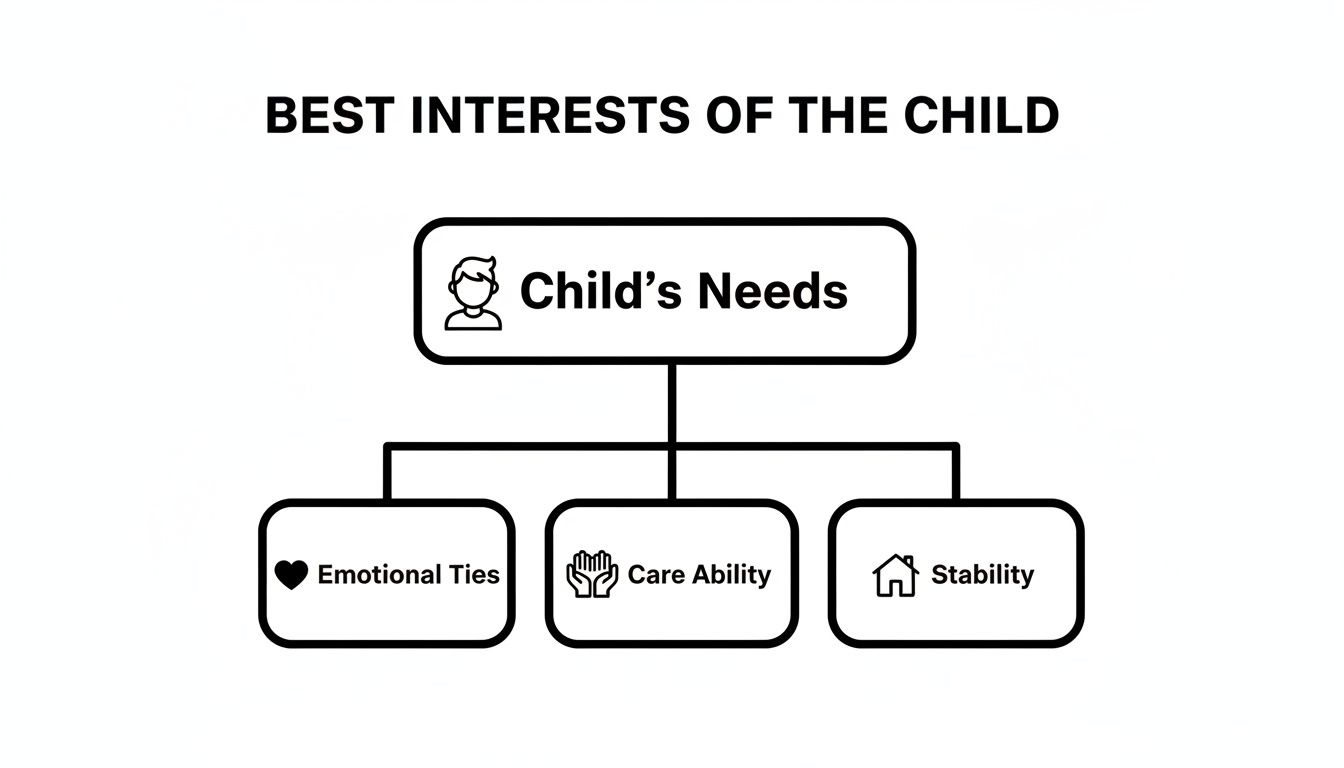
This flowchart breaks down the core factors a Brampton judge will weigh when deciding what’s in a child’s best interests—the very same factors that should guide your choice of a parenting schedule. It’s a great reminder that everything comes back to the child’s needs.
Planning for Holidays and Special Occasions
No matter which weekly schedule you land on, the biggest source of future arguments is often holidays and special occasions. A well-drafted parenting plan tackles these dates head-on, leaving zero room for last-minute disagreements.
A vague schedule is a recipe for conflict. Using outdated terms like “reasonable access” just doesn’t work. Your agreement must be specific, detailing exact days, handover times, and exchange locations in Brampton to be effective and enforceable.
Your plan needs to clearly spell out:
- Statutory Holidays: How will you handle days like Christmas, Thanksgiving, and Easter? Many families alternate these holidays each year.
- Summer Vacation: Will each parent get a solid block of uninterrupted weeks? How will you pick those weeks, and what’s the deadline for notifying the other parent?
- March Break and Winter Break: These are often split or alternated annually.
- Birthdays: Will the child spend their birthday with the parent who has them that day, or will you split the day? Don’t forget to include arrangements for the parents’ birthdays, too.
Thinking through these details now will save you stress and legal fees down the road. For more on creating a rock-solid agreement, the Government of Ontario offers resources on drafting parenting plans.
Crafting An Enforceable Parenting Plan
A verbal agreement about your parenting time schedule might feel friendly, but it offers zero protection when a disagreement arises. To protect your child’s stability and your rights as a parent in Brampton, you need a formal, written parenting plan. This document is the detailed blueprint for your co-parenting future, designed to prevent conflict by making everything crystal clear.
A strong parenting plan anticipates future challenges—like holidays, vacations, or travel—and sets out clear, agreed-upon rules for handling them now. The goal is to build a document so thorough that you rarely have to argue about the details later on.
Core Components Of A Strong Parenting Plan
Every Brampton family is different, but an effective parenting plan in Ontario must cover several key areas. Specificity is your greatest tool for avoiding future disputes.
Your plan should spell out:
- The Regular Schedule: Outline the day-to-day parenting time with precision. Specify exact handover times (e.g., Friday at 6:00 PM) and locations (e.g., at the curb of the parent’s home in Brampton).
- Holidays and Vacations: Create a clear calendar for all statutory holidays, school breaks, and summer vacation. A common approach is to alternate major holidays each year.
- Communication Protocols: Set clear guidelines for how you and the other parent will communicate about the children, such as using a specific co-parenting app or email.
- Travel Rules: Include rules for out-of-province or international travel, such as requiring written consent from the other parent and sharing a detailed travel itinerary in advance.
A common mistake is using phrases like “reasonable access.” In Ontario family law, these terms are too vague to be enforced. A judge can’t order a parent to provide “reasonable” time because nobody can agree on what that means. Your plan must be a clear guide that anyone can understand.
From Agreement To Court Order
Once you’ve detailed your parenting plan, you have two main options in Brampton to make it legally binding: include it in a separation agreement or have it turned into a court order. They are enforced very differently.
A separation agreement is a private contract between you and the other parent. If one parent breaks the terms, your only option is to go back to court to have the agreement enforced, which can be a slow process.
A parenting order, on the other hand, is a direct command from a judge. If a parent ignores the terms of a court order, the consequences are far more immediate and serious. A violation can lead to a finding of contempt of court, which could result in fines or even jail time under the Criminal Code of Canada.
Understanding this difference is critical. A court order offers much stronger and faster enforcement, which might be necessary in a high-conflict situation. A family lawyer in Brampton can advise on the best path for your circumstances to ensure your plan is solid, enforceable, and truly serves the best interests of your child.
Common Questions About Parenting Time In Brampton
When you’re working through a parenting arrangement, a flood of specific questions is bound to come up. For parents in Brampton, these aren’t just abstract legal problems—they affect your daily life. This section tackles some of the most common questions with direct, practical answers grounded in Ontario’s Family Law Act.
The idea is to give you a clear sense of what to do next when you hit a roadblock.
What Can I Do If The Other Parent Denies My Parenting Time?
This is one of the most frustrating situations a parent can face. If you have a court-ordered parenting plan and the other parent is refusing to follow it, you have legal options. A parenting order isn’t a suggestion; it’s a legally binding directive from a judge.
Your first actionable step is to document everything. Keep a detailed log of every missed or denied visit. Note dates, times, and any texts or emails about why it happened. This record is vital evidence.
Next, you can take formal legal action by filing a motion with the Brampton court to enforce the parenting order. Under Ontario law, a judge can:
- Order make-up parenting time to compensate you for the time you lost.
- Order the non-compliant parent to cover any costs you incurred, such as legal fees.
- In serious cases, find the other parent in contempt of court, which could lead to fines or, in extreme situations, even jail time under the Criminal Code of Canada.
Do not fall into the trap of “self-help” remedies, like withholding child support payments. That will only land you in legal trouble and weaken your position in court.
How Can We Modify An Existing Parenting Time Order?
Life changes. The schedule that was perfect two years ago might be impractical today. If you and the other parent both agree on the changes, the process is simple. You can both sign an Amending Agreement and file it with the court to create a new consent order.
But what if the other parent doesn’t agree? In that case, the parent who wants the change must bring a motion to change the existing order.
To successfully change a court order in Brampton without the other parent’s consent, you must prove there has been a material change in circumstances since the original order was made. This means you need to show that a significant, unforeseen change has happened that directly affects the child’s best interests and makes the current schedule unsuitable.
For example, a parent relocating for a new job in another part of the GTA, or a teenager’s school and social life becoming much more demanding, could both qualify as a material change. The court will then re-evaluate the situation using the “best interests of the child” test.
How Much Say Does My Child Get In The Schedule?
This is a key question, especially for parents with teens. In Ontario, there’s no magic age where a child can simply “choose” where to live. However, the law is clear: a judge must consider the child’s own views and preferences when making decisions about parenting time.
How much weight those views carry depends on the child’s age and maturity.
- Younger Children (Under 10): A judge will listen, but other factors like stability and caregiving ability will carry more weight.
- Older Children (10-13): Their preferences start to matter more, as long as they can explain their reasons.
- Teenagers (14+): The views of a mature teenager are extremely influential. It’s very rare for a Brampton court to force a 16-year-old to follow a schedule they are strongly against.
A judge can hear from a child by ordering an assessment from a social worker (often through the Office of the Children’s Lawyer) or, in some cases, by speaking with the child directly. The court’s main priority is always to ensure the child’s preference is genuine and not the result of parental influence.
Can I Stop Parenting Time If I Fear For My Child’s Safety?
If you have a genuine and immediate fear that your child is at risk of harm, your first duty is to protect them. However, unilaterally withholding court-ordered parenting time is an extreme step with serious legal consequences under the Family Law Act and potentially the Criminal Code.
If the danger is immediate—for instance, you believe the other parent is impaired or there’s a risk of violence—your first call should be to Peel Regional Police or your local Children’s Aid Society. They have the authority to intervene and ensure the child is safe.
Immediately after, you must bring an urgent motion to the court to suspend or change the parenting order. You will need to provide clear, concrete evidence to back up your safety concerns. This requires proof, such as police reports, photos, threatening text messages, or witness statements. A judge can grant an emergency order to restrict the other parent’s time—perhaps making it supervised—until a full hearing can be scheduled. Simply stopping the visits without a court order can be seen as a breach and could seriously damage your credibility.
At Badesha Law, we know that questions about parenting time are deeply personal. Our experienced family law team offers clear, actionable advice to clients in Brampton, helping you protect your rights and your child’s best interests. Whether you need help enforcing, modifying, or creating a parenting plan, we’re here to provide the strategic support you need. Learn more about how our Brampton lawyers can assist you by visiting our website.