

When you’re dealing with child custody in Ontario, the first thing you need to know is that the language has changed. The law has moved on from old, confrontational terms. Today, everything revolves around two key ideas: decision-making responsibility for the big choices and parenting time for the day-to-day schedule. At the heart of it all is one guiding principle, enforced by both the Family Law Act in Ontario and the federal Divorce Act: the child’s best interests come first, always.
Understanding Child Custody in Modern Ontario Law

The first actionable step in any Brampton family law case is to set aside outdated terms like “sole custody” or “access.” Both Ontario’s Family Law Act and Canada’s Divorce Act have updated the vocabulary to better match the reality of modern co-parenting. This isn’t just legal jargon; it’s a fundamental shift in how the Brampton courts approach parental roles.
The goal is to move away from a winner-takes-all mindset and focus on collaboration and what’s best for the child. Think of it less like fighting over a title and more like creating a clear job description for how you’ll raise your child together after separating.
The Two Pillars of Modern Custody
The entire framework for child arrangements in Ontario is built on two distinct concepts. A Brampton judge can make orders for one or both, and they don’t have to be split the same way.
- Decision-Making Responsibility: This is the authority to make major, life-shaping decisions for your child. It’s like being on the board of directors for your child’s future.
- Parenting Time: This is the hands-on, day-to-day schedule that outlines when the child is in each parent’s care.
Understanding this distinction is critical for your case. For example, one parent might have the child living with them most of the time (more parenting time), but both parents could share the decision-making responsibility equally. This separation allows for flexible, creative solutions that fit your family’s unique needs.
In Brampton courts, it’s very common to see parents granted joint decision-making responsibility, which forces them to agree on the big stuff, even if the parenting time schedule isn’t a 50/50 split.
To make this clearer, let’s look at how the old terms translate to the new ones.
Old Custody Terms vs. Modern Ontario Terminology
This table will help you translate the traditional custody language you might see in movies or hear from friends into the current legal terms used in Brampton family courts today.
| Outdated Term | Modern Ontario Term | What It Means in Practice |
|---|---|---|
| Sole Custody | Sole Decision-Making Responsibility | One parent makes all major decisions (health, education, religion) without needing the other’s consent. |
| Joint Custody | Joint Decision-Making Responsibility | Both parents must agree on major decisions. This requires effective communication and cooperation. |
| Access | Parenting Time | The schedule detailing when a child is with a parent. It can also include rights to contact (phone, video calls). |
| Primary Residence | Primary Parent / Primary Residence | The parent with whom the child lives most of the time. This parent often receives child support. |
Thinking in these modern terms helps shift the focus from “winning” to “cooperating,” which is exactly what the Brampton courts want to see from you.
Deconstructing Decision-Making Responsibility
So, what exactly does “decision-making responsibility” cover? It’s all about the big-picture choices that shape a child’s life, health, and future. The court usually breaks this down into four key areas:
- Health: Includes everything from choosing a family doctor in Brampton to consenting to medical treatments or therapy.
- Education: Covers decisions about which Peel District school the child attends, whether they need tutoring, or if they should enroll in special programs.
- Religion and Spirituality: Involves determining the child’s religious upbringing, if any, and their participation in spiritual community activities.
- Significant Extracurricular Activities: This applies to major commitments like competitive sports teams, intensive arts programs, or anything that significantly impacts the child’s schedule and finances.
A judge can give this authority to one parent (sole), both parents (joint), or even split it up—for instance, one parent decides on health while the other decides on education. The final order depends entirely on what arrangement will best serve the child’s interests, stability, and well-being, taking into account how well you and the other parent can communicate.
What Brampton Courts Consider the Child’s Best Interests

When a Brampton family court judge makes a decision about parenting time or decision-making responsibility, every single detail flows from one guiding principle: what is in the best interests of the child. This isn’t just a friendly suggestion; it’s the core legal test laid out in Ontario’s Children’s Law Reform Act.
This principle forces everyone—parents, lawyers, and judges—to shift their focus away from what the adults want and onto what the child truly needs. To the court, your child’s physical, emotional, and psychological well-being is the only thing that matters.
Your job is to demonstrate how your proposed parenting plan supports those needs. It’s about proving that you can provide a stable, loving, and supportive environment in Brampton where your child can flourish.
Key Factors in the Best Interests Test
A Brampton judge doesn’t just go with their gut feeling. The law gives them a checklist of factors to analyze to get a complete picture of a child’s life. While every family is different, these are the core elements they will always consider.
The court will look at:
- The emotional ties: How strong is the bond between the child and each parent? What about with siblings, grandparents, and other key figures in their life?
- The child’s preferences: If a child is old enough and mature enough to have their own opinion, the court wants to hear it. A teenager’s views will carry a lot of weight, while a younger child’s wishes are considered but balanced with other factors.
- Each parent’s caregiving plan: The judge will look at who is best equipped to provide the day-to-day necessities—guidance, education, food, shelter, and any special care the child requires.
- The stability of the proposed home: Consistency is king. A parent who can offer a predictable, supportive home environment in Brampton has a major advantage.
It’s critical to remember that no single factor is a trump card. The judge weighs all of these elements together to decide what arrangement will best serve the child’s overall well-being.
The Role of the Primary Caregiver
Before the separation, who did most of the heavy lifting when it came to the kids? This “primary caregiver” role is a huge consideration for the Brampton court because it often points to who can provide the most stability and continuity for the child moving forward.
Actionable tip: Start documenting who typically handled these daily tasks:
- Waking the kids up and getting them ready for school.
- Making breakfasts and packing lunches.
- Helping with homework and school projects.
- Booking and taking them to doctor’s appointments in Brampton.
- Organizing playdates, sports, and other activities.
While Ontario law is gender-neutral, tradition often meant mothers handled more of these primary caregiving tasks. Being able to document your consistent, hands-on involvement is one of the most powerful ways to show the court your central role in your child’s life.
This track record matters. Statistics from contested custody cases in 2018-2019 show that sole maternal physical custody was awarded in 56% of cases, while sole paternal physical custody was granted in just 7%. This isn’t because of a bias in the law, but because the “best interests” test often favours keeping the child’s established routines, which are frequently tied to the primary caregiver.
Proving Your Plan Is in Your Child’s Best Interest
Ultimately, your goal is to present a clear, child-focused plan to the court. Don’t just say you’re a great parent—show it with concrete examples and a well-thought-out proposal.
This also means showing you can support your child’s relationship with their other parent. The Family Law Act explicitly asks judges to consider which parent is more likely to encourage a healthy bond with the other. Any attempt to undermine that relationship, which can be considered a criminal offence under the Criminal Code in severe cases, will be seen very negatively by the court and could seriously damage your case. The winning strategy is always one that offers stability, security, and nurtures all of the important family connections in your child’s life.
Crafting a Practical and Enforceable Parenting Plan
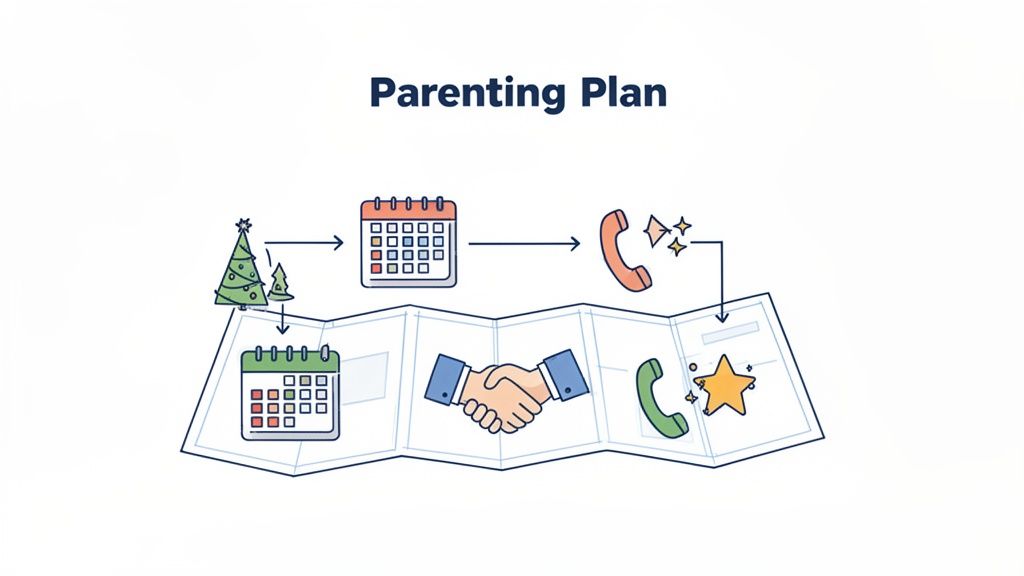
Think of a well-crafted parenting plan as your family’s roadmap for the future. It’s a detailed guide for co-parenting that anticipates disagreements and solves them before they ever start. This brings much-needed stability for your children and gives you genuine peace of mind.
This isn’t just some informal handshake deal; it’s a structured document that you can negotiate with the other parent, develop through mediation, or create with the help of a Brampton family lawyer. The more thorough your plan is, the less likely you’ll find yourself back in a Brampton court over every little conflict down the road.
For most parents, the ultimate goal is to turn this agreement into a consent order. This step makes it legally binding and fully enforceable by the court, giving it the exact same weight as an order a judge makes after a full trial.
Essential Elements of a Strong Parenting Plan
To actually work in the real world, your parenting plan has to be specific. Vague language is the enemy of a peaceful co-parenting relationship. A judge in Brampton will be looking for absolute clarity on a few key components before they’ll even consider signing off on it.
Your plan needs to clearly spell out:
- A Detailed Parenting Time Schedule: This is the heart of your plan. It must specify the regular, day-to-day schedule, including exact pick-up and drop-off times and locations in Brampton.
- Holiday and Vacation Schedules: Decide now who gets the kids for major holidays like Christmas, March Break, and summer vacation. This proactive step prevents the same arguments from happening year after year.
- Communication Protocols: Set clear rules for how and when parents will communicate with each other about the children (e.g., email only, a co-parenting app). It should also include guidelines for the child’s communication with the parent they aren’t with.
- Dispute Resolution Method: Smart plans include a clause on how you’ll handle future disagreements without running back to court, like agreeing to try mediation first.
Choosing a Parenting Time Schedule
There is no one-size-fits-all schedule that works for every Brampton family. The right choice will depend on your children’s ages, how far apart you live, and your work schedules. Some of the most common arrangements we see in Ontario include:
- The 2-2-5-5 Schedule: With this setup, the child spends Monday and Tuesday with Parent A, Wednesday and Thursday with Parent B, and then you alternate weekends (Friday to Sunday). It’s popular because it ensures no parent goes more than five days without seeing their child.
- The Week-On/Week-Off Schedule: This schedule offers maximum consistency, with the child spending one full week with each parent. It tends to work best for older children and for parents who live in relatively close proximity in the Brampton area.
While courts once heavily favoured sole maternal custody, the entire landscape has shifted. Survey data from 2018-2019 shows that shared physical custody—where a child lives with each parent at least 40% of the time—has jumped to 31% of all custody orders. That’s a massive increase from just 10% before 2006.
Making Your Plan Legally Binding
Once you and the other parent have a written agreement, it’s essentially just a private contract between the two of you. To give it real teeth, you need to file it with the court and have a judge approve it as a consent order. That’s the step that transforms it from a simple agreement into a document with true legal authority.
When finalizing your plan, it’s also helpful to know if digital signatures will hold up. A Brampton family lawyer can make sure your plan is ironclad and meets all the legal requirements to become an enforceable order, giving your family the security and predictability you need.
Navigating the Brampton Family Court Process
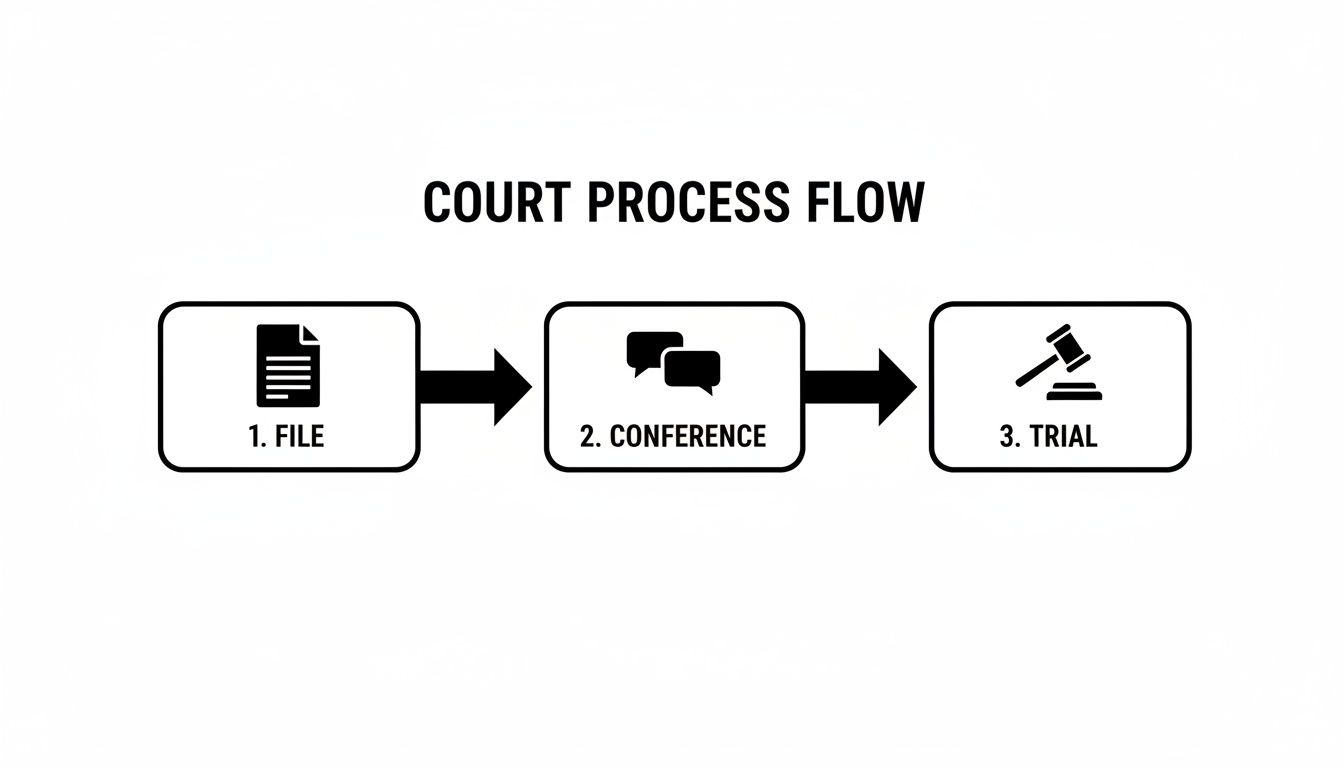
For most parents, the idea of going to family court is downright terrifying. If you’re facing a child custody Ontario dispute in Peel Region, your case will be heard at the A. Grenville and William Davis Courthouse in Brampton, which follows a clear path to help families find resolutions.
Try to think of the court process not as one big, scary event, but as a series of stages. The system is designed to encourage you and your co-parent to find common ground, reserving the time and expense of a full trial for only the most difficult cases. Knowing what’s coming next empowers you to work with your lawyer and make smart, actionable decisions for your family.
The First Step: Starting Your Case
Your journey through the Brampton family court starts by filing a document called an Application (Form 8). This is the official paperwork that tells the court and the other parent what you’re asking for—like a specific parenting schedule or decision-making responsibility—and lays out the basic facts of your situation.
Once it’s filed with the court, this Application has to be legally delivered, or “served,” to the other parent. This isn’t just a formality; it’s a critical step that ensures they are officially notified and have a fair chance to respond.
Mandatory Programs and Early Appearances
Before you speak to a judge, you’ll attend a Mandatory Information Program (MIP). This free session gives you the essential rundown on separation, the court process, and how conflict affects children. The whole point is to give both parents a solid foundation in Ontario family law.
Your first court date is usually a First Appearance before a court clerk. This isn’t a hearing to argue your case; it’s an administrative check-in to make sure all necessary documents have been filed correctly so your case can move forward.
A huge misconception is that financial documents are only for support cases. In Brampton, full and honest financial disclosure is mandatory in all family law cases, even if you’re only talking about parenting. The court needs the complete financial picture to understand each parent’s ability to provide for the child.
Case Conferences: The Heart of the Process
The most critical stages of your child custody case are the conferences. These are meetings with a judge to narrow down the issues and push for a settlement. You’ll attend at least one of these before getting close to a trial.
- Case Conference: This is your first chance to discuss the case with a judge, who will help pinpoint what you agree on, where you disagree, and map out the next steps.
- Settlement Conference: Here, the judge will be more direct, giving a strong opinion on what would likely happen at a trial to encourage both of you to find a middle ground.
- Trial Management Conference: If no settlement is reached, this final conference plans the trial, figuring out who will testify, how long it might take, and other procedural details.
During any of these conferences, the judge might involve the Office of the Children’s Lawyer (OCL). The OCL can provide a lawyer for your child or conduct an investigation and report back to the court. An OCL opinion carries a lot of weight with a Brampton judge.
Key Stages of a Brampton Child Custody Court Case
| Court Stage | Primary Purpose | What You Need to Do |
|---|---|---|
| Filing an Application | To officially start the court case and state what you are asking for. | Prepare and file Form 8 with the court, then have it served on the other parent. |
| Mandatory Info Program (MIP) | To educate parents on separation, the law, and the impact of conflict on kids. | Attend the free two-hour session as scheduled by the court. |
| First Appearance | To ensure all initial documents have been filed correctly. | Confirm with the court clerk that your file is complete and ready to proceed. |
| Case Conference | To identify issues, encourage disclosure, and explore settlement options. | Prepare a Case Conference Brief outlining your position and desired outcomes. |
| Settlement Conference | To focus entirely on negotiating a final agreement with a judge’s guidance. | Come prepared to negotiate in good faith and consider compromise. |
| Trial Management Conference | To plan the logistics of the trial if no settlement has been reached. | Finalize witness lists, evidence, and agree on a trial schedule. |
| Trial | To present evidence and arguments before a judge who will make a final, binding decision. | Work closely with your lawyer to present your case effectively. |
While this table outlines the standard path, remember that most cases are resolved during the conference stages. A trial is always the last resort.
Taking Action When Your Child’s Safety Is a Concern
When a separation involves high-conflict situations like family violence or substance abuse, your child’s safety is the absolute priority. If you believe their well-being is at risk, Ontario’s legal system provides tools for immediate protection. The courts in Brampton take these matters incredibly seriously, so you must be prepared to demonstrate exactly why urgent intervention is required. Protections are available under both Ontario’s Family Law Act and Canada’s Criminal Code.
Immediate Legal Protections You Can Seek
If your child is in immediate danger, you don’t have to wait. Your family lawyer can help you file a motion for urgent relief.
Key protective measures include:
- Restraining Order: This order legally prohibits a parent from contacting you or your children. A violation of a restraining order is a criminal offence under the Criminal Code.
- Exclusive Possession of the Matrimonial Home: The court can order one parent to move out of the family home, even if their name is on the title, to ensure a safe environment for you and your children.
- Supervised Parenting Time: If a parent’s behaviour is a risk to a child, a judge can order that all of their time together must be supervised by a trusted adult or professional agency.
When a child’s safety is compromised, they may experience significant emotional and psychological distress. In these situations, understanding approaches like trauma-informed care is crucial for parents and support networks to provide sensitive and effective support.
Proving a Risk of Harm to the Court
A Brampton judge won’t restrict a parent’s access to their child based on accusations alone. You have to provide clear, compelling evidence that a real risk exists.
Your actionable step is to gather concrete proof. This might include:
- Police reports or records of 911 calls.
- Photos of injuries or damage to property.
- Text messages, emails, or social media posts containing threats.
- Statements from witnesses—like neighbours or teachers—who have seen the troubling behaviour firsthand.
The standard the court uses is always the best interests of the child. All your evidence must directly connect the other parent’s actions to a clear danger to your child’s physical or emotional safety.
Recent statistics from the Ontario Association of Children’s Aid Societies show that 97% of child welfare investigations end with children staying at home. This tells us there’s a strong preference for keeping families together, which means the evidence you present for court intervention must be truly significant and clearly demonstrate risk.
When to Hire a Brampton Family Lawyer
It’s tempting to think you can handle a parenting plan on your own. But many situations are far too complex or high-stakes to navigate without a professional in your corner. Going it alone in a child custody dispute in Brampton can put your rights—and your child’s future stability—at risk.
An experienced Brampton family lawyer acts as your advocate, making sure your voice is heard. They will help you understand your rights under Ontario’s Family Law Act and can protect you if things get complicated enough to involve the Criminal Code.
Clear Signs You Need Legal Help
If you find yourself in any of these situations, it’s time to call a lawyer immediately. These issues carry serious legal consequences and need a strategic approach right from the start.
- Allegations of Abuse or Neglect: If there are any claims of family violence, substance abuse, or neglect, a lawyer is non-negotiable. Your child’s safety is the absolute priority, and these allegations must be handled with the gravity they deserve under both family law and the Criminal Code.
- Threats to Move with the Child: Is the other parent threatening to move to another city or province without your consent? This is a serious issue known as parental mobility. A lawyer can take immediate steps to stop an unauthorized relocation.
- Complete Communication Breakdown: If you and the other parent can’t speak civilly, you won’t be able to negotiate a fair agreement. A lawyer can step in to communicate on your behalf, cutting down on conflict and keeping the focus on a solution.
When the Stakes Are Too High
Beyond immediate safety threats, other complexities make a DIY approach incredibly risky. If you have high-value assets or a family business, things can get complicated quickly, even when the focus is on the kids.
Another big one? If the other parent has already hired a lawyer, you’ll be at a huge disadvantage without your own representation.
A Brampton family lawyer’s role isn’t to start a war; it’s to de-escalate one by providing clear, objective advice. They know how to separate the emotional issues from the legal ones, guiding you toward a resolution that is practical, enforceable, and truly in the best interests of your child.
Hiring a Brampton lawyer ensures the process is handled correctly from day one. They will help you build a compelling case—whether for negotiation, mediation, or a court hearing—making certain that every decision made serves your child’s well-being.
Your Top Child Custody Questions Answered
When you’re going through a separation, the details of child custody can feel overwhelming. You’ve got questions, and you need clear, straightforward answers. Here’s a look at some of the most common concerns we hear from parents in Brampton and Mississauga.
What Is The Difference Between Sole and Joint Decision-Making?
Think of decision-making responsibility as who gets the final say on the big-picture issues in your child’s life—things like healthcare, education, and religious upbringing.
With sole decision-making, one parent has the authority to make these major choices without needing the other parent’s formal consent. This approach is less common in Brampton and is usually reserved for high-conflict situations or cases involving family violence.
On the other hand, joint decision-making means both parents must agree on these critical matters together. This is what judges in Brampton prefer to see. It keeps both parents involved and encourages cooperation, but it only works if you and your ex-partner can communicate effectively.
At What Age Can My Child Decide Who To Live With?
This is a question parents ask all the time, and the answer often surprises them: there is no magic number in Ontario law. A child can’t legally choose their living arrangements at a specific age, whether it’s 12, 14, or 16.
What the law does say is that as a child gets older and more mature, a Brampton judge will give their opinion more weight. A teenager’s well-thought-out preference can be very influential, but it’s still just one piece of the puzzle. The judge’s final decision is always, without exception, based on the child’s overall best interests.
A child’s preference is important, but the court’s job is to look at the whole picture. They’ll consider things like each parent’s ability to provide a stable home in Brampton, the child’s emotional ties, and the existing parenting routine.
Can I Move To A New City With My Child?
No, not without permission. You can’t just pack up and move if the relocation would significantly impact the other parent’s time with your child. This issue is known as parental mobility, and it’s taken very seriously by Brampton courts.
To move, you need one of two things: the other parent’s written consent or a court order granting you permission.
If your ex-partner objects, you’ll have to make a formal application to the court. The judge will analyze your proposed move based entirely on your child’s best interests, looking at everything from your reasons for moving to how it will affect the child’s relationships. Attempting to move without authorization can have severe legal consequences.
How Does Child Support Work With 50/50 Shared Parenting Time?
When parents have a shared parenting arrangement—meaning the child lives with each parent at least 40% of the time—the way child support is calculated changes. It’s not as simple as nobody paying.
The most common method is called a “set-off.” Here’s how it works:
- First, we figure out the standard table amount of child support each parent would pay based on their income.
- Then, the smaller amount is subtracted from the larger one. The parent with the higher income pays the difference to the parent with the lower income.
A judge in Brampton can also adjust this amount if needed. They recognize that maintaining two separate homes for a child comes with extra costs, and the final support order may reflect that reality.
Navigating the complexities of child custody in Ontario requires more than just information—it demands clear, strategic legal advice. At Badesha Law, we provide the guidance and strong advocacy you need to protect your rights as a parent and ensure your child’s best interests remain the top priority. For dedicated support with your Brampton family law matter, connect with our team at https://badeshalaw.ca