If I’m Charged With Assault, Will It Affect My Child Custody in Ontario? How a Family Lawyer in Brampton Can Help
Being charged with assault is stressful on its own. When children are involved, the stakes rise fast—because custody and parenting time decisions in Ontario are driven by one core question: what arrangement best protects the child’s well-being and safety. Under Canada’s Divorce Act, courts must give primary consideration to a child’s physical, emotional, and psychological safety, security, and well-being when making parenting orders.
Important: This is general legal information, not legal advice. Every case turns on facts, court orders, and release conditions
Does an assault charge automatically end my parenting time?
Usually, no—an allegation or charge does not automatically terminate parenting time. But it can change parenting arrangements quickly, especially if the charge involves:
the other parent (domestic assault context),
the child witnessing the incident,
threats, harassment, or patterns of coercive control,
alleged substance abuse or instability, or
any scenario raising child safety concerns.
Courts deciding parenting issues must consider best interests of the child and give primary weight to safety.
Why the charge matters even before a conviction
Under the Divorce Act’s best-interests factors, the court can consider family violence and its impact, and it can also consider any civil or criminal proceeding, order, condition, or measure relevant to the child’s safety and well-being.
The Divorce Act also defines “family violence” broadly, including coercive and controlling behaviour and a child’s direct or indirect exposure.
This means your family case can be affected by:
criminal charges and the underlying allegations,
bail or release conditions,
peace bonds or restraining orders,
police involvement and safety planning.
The biggest “instant impact”: bail/release conditions and no-contact terms
If you are released with conditions (often called bail or an undertaking), those conditions can include no-contact terms—sometimes with the other parent and sometimes with the children. The court can impose a no-contact condition as part of release.
If you have a no-contact condition, you must follow it strictly. Even if the other person contacts you, you generally still cannot respond
What this means for parenting
A common practical issue is that a parent may be legally prohibited from direct communication, child exchanges, or attending a shared residence/school. That doesn’t automatically mean the parent is “cut off” forever—but it often means parenting time must be re-structured in a way that does not create a breach risk.
This is one of the clearest reasons to speak to a child custody lawyer early: the “family plan” must be built around criminal restrictions, not in conflict with them.
In practice, expect scrutiny on:
1) Child safety and exposure to conflict/violence
Courts examine whether the child was harmed, threatened, or exposed—directly or indirectly—to violence or intimidation. The Divorce Act explicitly requires consideration of family violence impacts.
2) Stability and caregiving history
Who has historically provided day-to-day care? What routines exist? How can stability be preserved? The Divorce Act lists stability and “history of care” as relevant factors.
3) Ability to co-parent and communicate appropriately
Courts consider each parent’s willingness and ability to communicate/cooperate on child-related matters—especially where cooperation is safe and appropriate.
4) Compliance with court orders and conditions
A single breach can change the trajectory of both the criminal file and the parenting file. Courts care about reliability, judgment, and risk management.
FAQ
Can I lose custody just because I’m charged with assault?
A charge alone does not automatically end parenting rights, but it can lead to temporary restrictions if the court believes safety measures are needed. The guiding standard is the child’s best interests and safety.
Will family court look at my criminal case?
Yes. The Divorce Act’s best-interests factors include consideration of relevant civil/criminal proceedings, orders, or conditions affecting child safety.
What if my bail says “no contact” with the other parent?
You must comply strictly. Even if the other person reaches out, you generally cannot respond.
What if my bail conditions restrict contact with my child?
You need immediate legal advice. A child custody lawyer can help you pursue a lawful interim arrangement that protects the child and avoids breaches.
Can a court order supervised parenting time?
Yes. Courts may order supervision temporarily where it’s needed to manage risk and protect the child.
Should I hire a child custody lawyer even if I already have a criminal lawyer?
Yes. A criminal lawyer defends the charge; a child custody lawyer protects your parenting position and builds a compliant parenting plan.
How can a family lawyer Brampton clients hire help me keep parenting time?
By bringing motions for temporary parenting orders, negotiating safe interim plans, coordinating with criminal counsel, and presenting a child-focused safety plan supported by evidence.
Can the Office of the Children’s Lawyer get involved?
In some parenting disputes, the OCL may provide services such as representation or reports focused on the child’s interests.
If you’re dealing with an assault charge and parenting issues at the same time, timing matters. A family lawyer Brampton parents rely on can help you stabilize the situation quickly—by building a legally compliant interim parenting plan, bringing the right court steps, and keeping the focus where the law requires it: the child’s safety and best interests.
Being charged with domestic assault in Brampton is a grave issue that can disrupt your life considerably. Under Canada’s Criminal Code, this charge extends beyond physical violence to include threats or gestures that instill fear for one’s safety in a domestic relationship. In Ontario, this relationship may involve a current or former spouse, a common-law partner, or a parent. Your initial step should be to familiarize yourself with the law, the process, and the measures you can take to safeguard your future. Consulting a Brampton criminal lawyer, such as Badesha Law, can provide valuable guidance in these situations.
Understanding a Domestic Assault Charge in Ontario
Facing a domestic assault charge in Brampton can be overwhelming and confusing. The legal system is swift, and its terminology can be daunting. This guide offers practical insights tailored to your situation, focusing specifically on Ontario’s laws and the procedures at the Brampton courthouse.
Essentially, a domestic assault involves any assault occurring between individuals in an intimate, family, or dependent relationship. The distinction between a standard assault and a domestic one lies in the relationship between the involved parties.
The “domestic” label acts as a specific flag for Peel Regional Police, prosecutors, and judges, indicating that the case adheres to a stricter protocol. Ontario’s zero-tolerance policy on domestic violence aims to protect vulnerable individuals, guiding law enforcement actions from the initial call.
The Immediate Impact of Ontario’s Zero-Tolerance Policy
When Peel Regional Police respond to a domestic dispute in Brampton, their first task is to de-escalate the situation and separate those involved. Due to the province’s stringent directives, if officers find reasonable grounds to suspect an assault, an arrest is almost always made.
This results in several immediate and life-changing consequences for the accused:
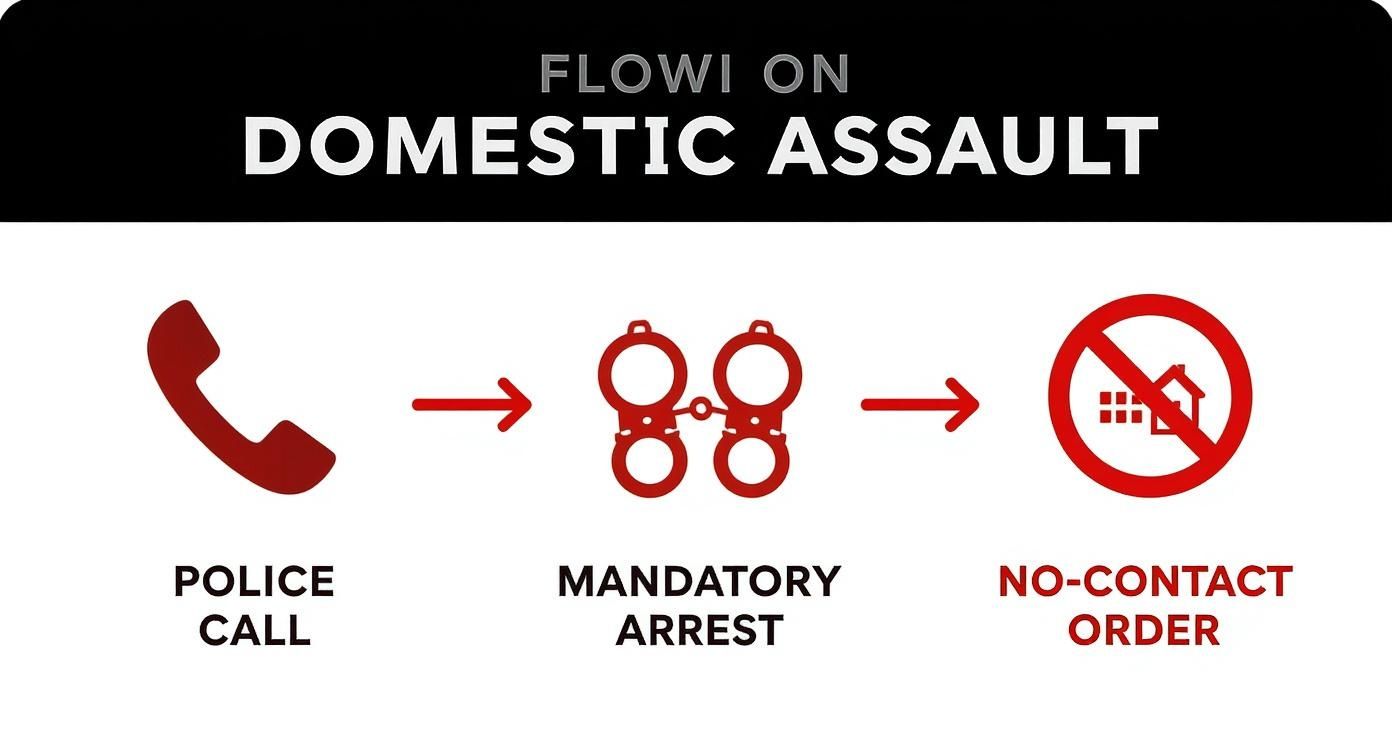
Mandatory Arrest: Regardless of whether the situation has calmed or if the complainant does not wish to press charges, police are likely to lay a charge and take the accused into custody.
Strict Release Conditions: To be released from custody, you will probably face strict conditions, often detailed in documents like a Form 10 or Form 11 Undertaking.
No-Contact Orders: A typical condition is a stringent “no-contact order,” prohibiting any form of communication with the complainant, directly or indirectly. This often means you cannot return to your shared home.
It is crucial to understand that once a charge is laid, the choice to drop it rests with the Crown Attorney, not the complainant. Even if the complainant changes their story or wishes to withdraw the accusation, the Crown can—and frequently does—proceed with the prosecution. Seeking advice from a Brampton criminal lawyer, such as Badesha Law Criminal Lawyer in Brampton Ontario, can be crucial in navigating these complexities.
Defining Assault Under the Criminal Code of Canada
To get a handle on a domestic assault charge, you have to know what “assault” actually means under the Criminal Code of Canada. An assault can happen in three different ways, and none of them require causing an actual physical injury.
According to Section 265 of the Criminal Code, you commit an assault when you:
Apply Force Intentionally: This is what most people think of as assault. It’s intentionally applying force—direct or indirect—to someone without their consent. A push, a slap, or even spitting on someone all count.
Attempt or Threaten to Apply Force: You can be charged for trying to apply force or for threatening to do so with an act or gesture. This applies if you make the other person believe you can actually carry out the threat. For example, just raising a fist in a threatening way could be enough.
Accosting or Impeding While Carrying a Weapon: Simply approaching someone while openly carrying a weapon (or something that looks like one) is also considered an assault.
When any of these things happen in a domestic relationship, the charge becomes a domestic assault. That’s what triggers the specialized and very serious response from the Brampton justice system.
Navigating the Brampton Court Process Step by Step
Being charged with domestic assault in Brampton throws you headfirst into a complex and often frightening legal maze. The first step toward finding your way out is understanding the path ahead. From the moment of arrest to a final court decision, the process follows a very specific sequence, and each stage has its own set of rules and goals.
It all starts with the arrest, which, as we’ve covered, is almost always mandatory in domestic situations because of Ontario’s zero-tolerance policy. Immediately after the arrest, the next critical step is the bail hearing, which usually happens within 24 hours.
This hearing is your first formal appearance, held before a Justice of the Peace. The main objective isn’t to decide if you’re guilty, but simply to determine if you can be released from custody while your case moves forward. In Brampton, domestic assault cases nearly always come with very strict release conditions, typically spelled out in a document called a Form 10 or 11 Undertaking.
The First Stages: Arrest, Bail, and Your First Appearance
The bail hearing focuses on assessing risk. The court evaluates whether you pose a threat to the public and if you are likely to attend future court dates. The Crown Attorney, often from a specialized Peel Region unit handling domestic cases, might argue for your continued custody.
If released, your freedom will be heavily restricted. Conditions will typically include:
No Contact: A strict order prohibiting any communication with the complainant, whether directly or indirectly. This includes no calls, texts, emails, or messages through others.
Residency Restrictions: You will likely be prohibited from returning to the family home or approaching the complainant’s workplace or school.
Weapons Prohibition: A mandatory ban on possessing any weapons.
Violating any of these conditions constitutes a separate criminal offense known as “Failure to Comply,” leading to re-arrest and complicating the resolution of the original domestic assault charge.
Upon release, you will be scheduled for your First Appearance at the Brampton courthouse. This is not a trial but a procedural session where you or your lawyer will appear before a judge to receive the initial evidence collected by the police, known as “disclosure.”
For legal assistance, consider consulting a criminal lawyer in Brampton. The infographic below illustrates how quickly things can escalate from a single police call.
As you can see, a police call triggers a mandatory arrest and a strict no-contact order, setting the entire court process in motion almost instantly.
Negotiations and Pre-Trial Meetings
Once you’ve had your First Appearance, your case moves into a critical negotiation phase. This is where having an experienced Brampton lawyer really counts. The goal is to open a dialogue with the specialized Crown Attorney handling your file to discuss the case’s strengths and weaknesses.
These discussions happen at a Crown Pre-Trial (CPT), which is a meeting between your defence lawyer and the prosecutor. During the CPT, your lawyer will:
Go over the disclosure evidence with the Crown.
Highlight inconsistencies, legal issues, or weaknesses in the police investigation or witness statements.
Explain your personal circumstances and present any mitigating factors.
Negotiate for a potential resolution, like getting the domestic assault charge withdrawn.
A key objective during these negotiations is to convince the Crown that it is not in the public interest to proceed with a trial. This might involve proposing alternatives, like a peace bond or agreeing to complete counselling.
If your lawyer and the Crown can’t agree on a resolution at the CPT, the next step is a Judicial Pre-Trial (JPT). This is a more formal meeting held in a judge’s chambers, involving your lawyer, the Crown Attorney, and a judge.
The JPT is designed to narrow down the issues and get a judge’s perspective on the case, which often helps both sides see a clearer path forward. The judge might comment on likely outcomes if the case went to trial, frequently encouraging a resolution to avoid tying up the court system. For anyone facing a domestic assault charge in Brampton, these pre-trial stages are the most important opportunities to achieve a positive outcome without the stress and risk of a full trial.
Your First Steps After Being Charged
The moments and days right after a domestic assault charge in Brampton are confusing and absolutely critical. What you do in the first 48 hours can shape the entire path of your case. This isn’t a time to wait around and see what happens—it’s a time for smart, decisive action.
Your first and most important priority is to hire an experienced criminal defence lawyer who specializes in domestic assault cases in Brampton. The legal system moves fast, and without immediate professional help, you’re at a serious disadvantage. Think of a lawyer as your advocate, strategist, and guide through what is otherwise an overwhelming process.
Why Immediate Legal Counsel Is Non-Negotiable
Contacting a lawyer isn’t just about planning for a trial down the road; it’s about managing the crisis you’re in right now. A Brampton defence lawyer will jump into action to protect your rights from the very start.
Here’s what they will prioritize immediately:
Navigating Bail Conditions: Your release from custody will come with a long list of rules. A lawyer makes sure you understand every single condition to prevent an accidental breach. Messing this up means new criminal charges and makes your original case much harder.
Explaining the No-Contact Order: This is often the toughest condition. It almost always means you can’t go back to your home or talk to your partner. Your lawyer will explain exactly what this order means and discuss if there are any ways to get it changed later on, though it’s never easy.
Preserving Critical Evidence: Evidence that tells your side of the story can disappear quickly. Your lawyer will immediately tell you how to save things like text messages, emails, or names of witnesses that could be crucial for your defence.
The Crown Attorney and the police already have a head start building their case against you. Hiring a lawyer immediately is the single most important thing you can do to level the playing field and start building your own defence strategy.
Your Immediate Dos and Don’ts Checklist
While your lawyer gets to work on the legal strategy, how you act personally is just as important. From the moment you’re charged, your actions are under a microscope. Following these rules is essential to protect your legal position.
What You MUST Do:
Follow Every Release Condition Perfectly: Treat your bail conditions like they are absolute law. This means curfews, where you’re allowed to live, and any other restrictions. There is zero room for error.
Document Everything You Can Remember: While it’s still fresh, write down a detailed, step-by-step account of what happened from your point of view. Note the time, location, what was said, and who was there. Give this document only to your lawyer.
Secure Alternative Living Arrangements: If a no-contact order means you can’t go home, find a stable place to stay right away. This shows the court you are responsible.
What You MUST NOT Do:
Do NOT Contact the Complainant: This is non-negotiable. Do not call, text, email, use social media, or even ask a friend or family member to pass along a message. Any attempt to make contact, no matter how good your intentions are, is a criminal offence that will land you right back in custody.
Do NOT Discuss the Case on Social Media: The Crown can and will use anything you post against you. It’s best to deactivate your accounts or, at the very least, stop posting anything about the incident, your personal life, or the complainant.
Do NOT Speak to the Police Without Your Lawyer: You have the right to remain silent. Police might ask you for “your side of the story,” but any statement you make can be used to strengthen their case. Always talk to your lawyer first.
This initial period is all about damage control and setting yourself up for the best possible outcome. By following this guide and getting legal help right away, you give yourself the best chance to manage this crisis and work toward a favourable resolution.
Penalties and Hidden Long-Term Consequences
A domestic assault conviction in Brampton is much more than just a bad day in court. Think of it like a stone thrown into a pond—the immediate splash is the penalty from the judge, but the ripples spread out, touching every part of your life for years to come. Grasping just how deep and lasting these consequences are is key to understanding what’s really at stake.
The direct penalties are what most people worry about first. These are the punishments handed down by a judge under the Criminal Code of Canada, and they can vary widely depending on the details of your case.
Even for a first offence, you aren’t just looking at a slap on the wrist. A conviction almost always leads to a period of probation, which can last up to three years and comes with strict conditions. You’ll also likely be ordered to complete a mandatory Partner Assault Response (PARS) program—a specialized counselling course you must attend and finish.
The Immediate Legal Penalties
If the assault is deemed more serious or if you have a prior record, the penalties get much tougher, fast. The Crown prosecutor can choose to proceed by indictment, which opens the door to far more severe sentences.
A conviction could land you with:
Significant Fines: The court can impose heavy financial penalties that create a real financial strain.
Probation: This means reporting to a probation officer and following strict rules like curfews, attending counselling, or staying away from alcohol.
Jail Time: For more serious cases, a jail sentence is a very real threat. A conviction could mean up to two years in prison for a summary offence, and even longer if it’s an indictable offence.
Weapons Prohibition: You’ll face a mandatory court order banning you from owning or possessing firearms, often for 10 years or more.
These penalties are serious, but in many ways, they’re only the beginning. The hidden consequences—the collateral damage from having a criminal record for domestic assault—can be even more devastating.
The Lifelong Shadow of a Criminal Record
Once you’re convicted, you have a criminal record. This isn’t just some file tucked away in a courthouse; it’s a permanent red flag that follows you everywhere, creating roadblocks that can change the entire direction of your life.
Think of it as a permanent mark on every background check you’ll ever face. The impact is felt in almost every important part of modern life.
The toughest part of a domestic assault conviction often isn’t the sentence itself, but the lifelong civil disabilities that come with it. These are the hidden penalties the court doesn’t sentence you to, but which you will face all the same.
The collateral consequences include:
Employment Struggles: Many employers in Brampton and the GTA demand a clean criminal record check. A domestic assault conviction can make you ineligible for jobs in fields like education, healthcare, finance, or government, and it’s a major hurdle for any career advancement.
Travel Restrictions: Your ability to travel, especially to the United States, will be severely limited. The U.S. considers domestic violence a “crime of moral turpitude,” meaning you will almost certainly be denied entry at the border. This impacts everything from family vacations to cross-border work.
Immigration Status at Risk: For non-citizens, a conviction can be catastrophic. It can lead to the denial of permanent residency applications, the revocation of your current status, and even deportation.
Family Court Disadvantage: A domestic assault conviction will absolutely be used against you in any family law case. It can cripple your chances of getting custody of your children or securing fair access, since the court’s primary focus is always the children’s best interests under Ontario’s Family Law Act.
The table below draws a sharp contrast between the court-ordered penalties and these life-altering impacts, showing how a single charge creates two very different sets of problems.
Direct Penalties vs Collateral Consequences of a Conviction
Type of Consequence
Specific Examples
Direct Legal Penalties
Jail time, fines, probation with strict conditions, mandatory PARS counselling program, weapons prohibition orders.
Collateral Consequences
Inability to find meaningful employment, being barred from entering the United States, jeopardy to immigration status (including deportation), and severe disadvantages in child custody battles.
Facing a domestic assault charge isn’t just about staying out of jail; it’s about protecting your entire future. With consequences this severe, building a strategic and aggressive legal defence isn’t just an option—it’s an absolute necessity.
Building a Defence and Seeking a Better Outcome
An accusation is not a conviction. When you’re facing a domestic assault charge in Brampton, it’s easy to feel hopeless, but this is the moment where strategy becomes everything. A strong, well-prepared defence can challenge the Crown’s case and open up pathways to a resolution that protects your future.
The entire case against you rests on the Crown’s ability to prove every element of the offence beyond a reasonable doubt. That’s a very high standard, and it creates opportunities for an experienced defence lawyer to find weaknesses in the evidence and build a compelling counter-narrative.
Common Legal Defences in Domestic Assault Cases
In the Canadian legal system, several defences can be raised to fight a domestic assault charge. The right strategy depends entirely on the specific facts of your case, from what’s in the police report to witness statements and your own account of what happened.
Your lawyer will meticulously review all the evidence from the Crown to figure out which defence holds the most promise. Some of the most common and effective approaches include:
Challenging the Complainant’s Credibility: Often, the Crown’s entire case hinges on the testimony of the complainant. If there are inconsistencies in their story, a history of making things up, or clear motives to lie, these facts can be used to create that crucial reasonable doubt.
Arguing Self-Defence: Under Section 34 of the Criminal Code, you are allowed to use reasonable force to protect yourself or others from an attack. To win with this defence, we have to show that you genuinely believed force was being used against you and that your response was reasonable in the circumstances.
Lack of Intent (Mens Rea): Assault is a crime that requires intent. If the physical contact was truly accidental—maybe you stumbled and inadvertently pushed someone—you may not have the required “guilty mind” (mens rea) for a conviction.
An experienced lawyer’s job is to dissect the evidence. Are there conflicting witness accounts? Does the physical evidence actually match the complainant’s story? Every single detail matters in building a defence that can lead to an acquittal at trial.
Proactive Mitigation and Alternative Resolutions
Sometimes, taking a case all the way to trial isn’t the best strategic move. The evidence might be strong, or the personal and financial toll of a trial is just too high. In these situations, the goal shifts from fighting the charge in court to negotiating a better outcome with the Crown Attorney.
This is where proactive mitigation becomes your most powerful tool. By taking real, concrete steps to address the court’s underlying concerns about domestic conflict, you can show the Crown that you are not a risk to the public and that a harsh penalty isn’t necessary.
Taking these steps can dramatically improve your position:
Enrolling in Counselling: Voluntarily attending sessions for anger management, substance use, or general therapy shows personal responsibility and a real commitment to self-improvement.
Gathering Character References: Strong letters from employers, community leaders, or family friends who can speak to your good character can be very persuasive to a prosecutor.
Making Amends: In certain situations, and only with careful legal guidance, offering to pay for any damages (like a broken phone) can be a positive step.
These proactive measures send a clear message to the Crown: you are taking this situation seriously. This often opens the door to negotiations for a resolution that avoids a criminal record, with the most common and valuable option being a peace bond.
Understanding the Section 810 Peace Bond
For many people facing a first-time domestic assault charge in Brampton, a Section 810 Peace Bond is the best possible outcome short of having the charge withdrawn completely. It’s important to understand that a peace bond is not a conviction and does not result in a criminal record.
Think of it as a court-ordered promise to keep the peace and be on good behaviour. In exchange for you agreeing to the peace bond, the Crown agrees to withdraw the criminal domestic assault charge against you.
Here’s how the process usually works:
Your lawyer negotiates with the Crown, presenting all the mitigation steps you’ve taken.
If the Crown agrees, you appear in court and agree to “enter into the peace bond.”
You will be placed on specific conditions for a set time, usually 12 months. These conditions are often similar to bail, including no contact with the complainant and a ban on possessing weapons.
Once you successfully complete the term of the peace bond without any issues, the matter is finished. The original charge is withdrawn, and you can honestly say you were never convicted. This strategic resolution allows you to move forward without the lifelong burden of a criminal record, making it a primary goal in many domestic assault cases.
Why a Brampton Criminal Defence Lawyer Is Essential
Trying to navigate the Peel Region’s justice system alone after a domestic assault charge is an enormous risk. The process is a minefield of complexities, the Crown Attorneys you’ll face are specialized prosecutors, and the stakes for your future are incredibly high. Retaining an experienced Brampton defence lawyer isn’t just a good idea—it’s the single most critical step you can take to protect your rights and your future.
From the moment you hire them, your lawyer becomes your advocate. They step in right away, arguing for less restrictive bail conditions to give you as much freedom as possible while your case is before the courts. They also act as your shield, handling all communication with the police and the Crown. This is a crucial buffer that prevents you from accidentally saying or doing something that could harm your case.
Your Top Questions About Domestic Charges Answered
When you’re facing a domestic assault charge in Brampton, your mind is racing with urgent and stressful questions. Let’s cut through the confusion and get you some clear, direct answers to the most common concerns.
Can the Complainant Drop the Charges?
This is easily one of the biggest myths out there. The short answer is no.
Once the police have laid a domestic assault charge, the complainant (often the alleged victim) loses control over the case. From that moment on, the decision to continue or withdraw the charges belongs entirely to the Crown Attorney’s office in Brampton. Even if the complainant changes their mind and wants to “take back” their statement, they can’t. The Crown will move forward if they believe there’s enough evidence and it’s in the public interest to do so.
What Happens If I Violate My No-Contact Order?
Breaking a no-contact order is like pouring gasoline on a fire. It’s a separate criminal offence under the Criminal Code called “Failure to Comply,” and it’s taken very seriously.
If you text, call, or even have a friend pass along a message, you can be re-arrested on the spot. This new charge complicates everything. It signals to the court that you can’t follow rules, making it much harder for your lawyer to negotiate a favourable outcome for the original domestic assault case.
Following every single bail condition, especially the no-contact rule, is absolutely critical. There is no room for error, as the consequences for a breach are severe and immediate.
Will a Domestic Charge Affect My Family Court Case?
Yes, and the impact is significant. A criminal charge for domestic assault will cast a long shadow over any family law matters, especially when it comes to child custody and access.
Under Ontario’s Family Law Act, a judge’s number one priority is the best interests of the child. An allegation or conviction for domestic violence can seriously damage your standing in family court and drastically affect custody arrangements. It’s crucial to get legal advice for both your criminal and family law files to make sure your rights are protected on all fronts.
If you’re facing a domestic assault charge, you need immediate legal advice to protect your rights and your future. The team at Badesha Law has the expertise to defend you at the Brampton courthouse and fight for the best possible outcome. Contact us today for a confidential consultation at https://badeshalaw.ca/brampton-criminal-lawyer.