

When your spouse refuses to sign a separation agreement, it feels less like a bump in the road and more like the road has disappeared entirely. Suddenly, the amicable path you hoped for is gone. This is the moment your separation shifts from a cooperative discussion to a formal, legal dispute. If you’re facing this challenge, understanding what if your spouse won’t sign a separation agreement in Ontario is the first step toward regaining control.
Instead of working together, you are now facing a contested separation. This means a judge, not you, will likely make the final decisions about your property, finances, and children.
Key Takeaways
- Refusal to Sign Means a Contested Separation: Your spouse cannot be forced to sign. Their refusal moves the process from a private negotiation to a formal court-based system.
- You Have Options: Even without a signed agreement, you can move forward through lawyer-assisted negotiation, mediation, or, if necessary, a court application.
- Protect Yourself Immediately: You can seek interim court orders for exclusive possession of the home, child support, spousal support, and to freeze assets to prevent them from being depleted.
- Court is a Last Resort: The court process is expensive and time-consuming, often costing over $20,000 and taking 18-24 months. A judge will make the final decisions, removing your control.
- Legal Counsel is Crucial: An experienced family lawyer is essential to navigate the complexities, protect your rights, and guide you toward the most strategic and cost-effective resolution.
Table of Contents
- The Immediate Shift From Amicable To Contested Separation
- What Are Your Options When a Spouse Refuses to Sign?
- How To Protect Your Rights And Finances Now
- The Reality of Family Court in Ontario
- Why an Experienced Family Lawyer Is Essential
- Serving Brampton, Mississauga, and the GTA
- Frequently Asked Questions
The Immediate Shift From Amicable To Contested Separation
In Ontario, a spouse’s refusal to sign is more than just a frustrating delay. It’s a fundamental pivot in your legal journey. The cooperative process you envisioned evaporates, replaced by a formal, structured, and often adversarial court system.
Instead of working together to decide the terms of your future, you’re now preparing for a judge to make those decisions for you on the most critical issues: property division, spousal support, and the parenting plan for your children.
This refusal is what officially transforms your situation from an uncontested separation into a contested one. The reasons for this can be complex, and sometimes, understanding the dynamics can involve recognizing signs of narcissism, as certain personality traits often fuel conflict and a need to control the process.
From Cooperation To Court Intervention
Think about a typical Brampton couple. They agree to separate but hit a wall over who keeps the matrimonial home on their quiet suburban street. One spouse drafts a fair proposal, but the other, unwilling to budge, simply refuses to sign.
That one act escalates everything. What could have been resolved through a few focused negotiation sessions now requires court intervention, dramatically ratcheting up both the stress and the legal bills. It’s a scenario we see all the time when a partner won’t sign separation papers in Peel Region.
The financial hit is massive. An uncontested divorce might cost somewhere in the neighbourhood of $1,860, but a contested case can easily skyrocket to an average of $20,625 in Canada—a number that truly reflects the complex and lengthy court process in Ontario.
Loss Of Control And Predictability
The biggest consequence of a contested separation is the loss of control. A separation agreement is your chance to craft a customized solution that actually works for your unique family. When that option is gone, you’re handing the decision-making power to a judge who doesn’t know you, your finances, or your children.
Suddenly, you’re facing a world of uncertainty.
- Financial Uncertainty: Without an agreement, there’s no way to predict how assets will be divided or what support payments will look like.
- Parenting Decisions: A judge, based on limited information presented in a formal courtroom setting, will decide on parenting time and major decision-making for your kids.
- Prolonged Conflict: The court process is inherently adversarial. It can poison an already tense relationship, making effective co-parenting down the road that much harder.
To get a clear picture of what you’re giving up, it helps to know what a good agreement covers. Our detailed guide on what a separation agreement in Ontario should include breaks down all the crucial components you’ll want to protect.
To make the difference crystal clear, let’s compare the two paths side-by-side. The table below shows just how different the journey becomes when that signature is missing.
Uncontested vs. Contested Separation: A Quick Comparison
| Aspect | Signed Separation Agreement (Uncontested) | No Signed Agreement (Contested) |
|---|---|---|
| Process | Collaborative and private. You file paperwork after all issues are settled. | Adversarial and public. Involves court filings, conferences, and potentially a trial. |
| Control | You and your spouse make all the final decisions about your future. | A judge makes the final decisions based on the law and evidence presented. |
| Timeline | Predictable and much faster. Typically 4-6 months for the court to process. | Unpredictable and slow. Can take 12-24 months or even longer to resolve. |
| Cost | Significantly lower. Often managed with flat fees, providing cost certainty. | Substantially higher. Billed hourly, with costs escalating with every conflict. |
| Emotional Toll | Lower stress. The focus is on finding common ground and moving forward. | High stress. The process is designed for conflict, which can damage co-parenting relationships. |
As you can see, the presence or absence of a signed agreement creates two completely different realities. One is a path you control; the other is a path controlled by the court system.
What Are Your Options When a Spouse Refuses to Sign?
When your spouse flat-out refuses to sign a separation agreement, it’s easy to feel like you’ve hit a brick wall. But it’s not the end of the road; it’s just a detour. This is where strategic thinking comes in, and thankfully, Ontario’s family law system provides several other paths forward. You are not powerless just because your spouse is being difficult.
Instead of working toward a single signed document, your journey now branches into different ways of resolving the dispute. The destination is the same: to formally and finally settle issues like property division, support, and parenting. It’s the route to get there that changes, shifting from a private agreement to a more structured negotiation or, if needed, court intervention.
The flowchart below gives you a clear visual of the choice you’re facing. It separates the collaborative path from the formal legal one you’ll need to take when your spouse won’t cooperate.
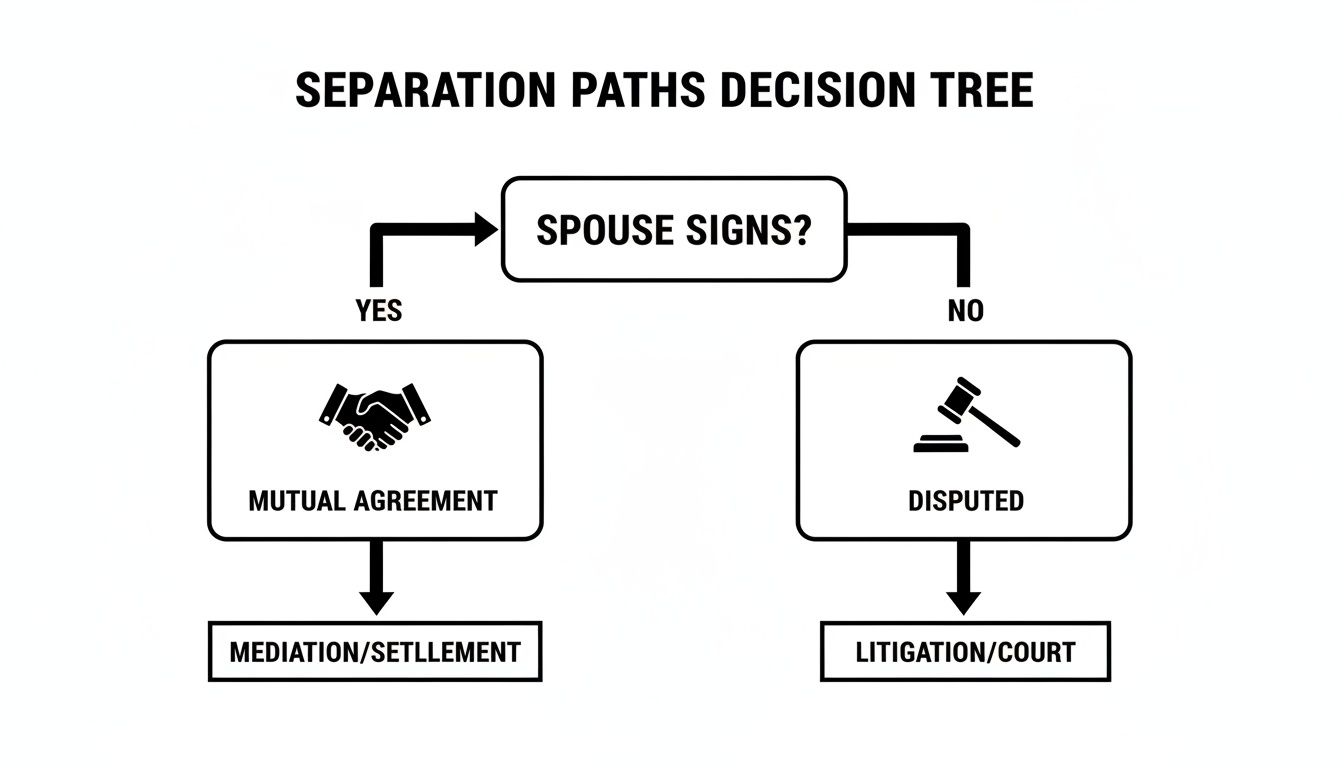
As you can see, a signed agreement is the most direct route. But a refusal to sign simply opens up other structured, necessary alternatives to get you to the finish line.
Lawyer-Assisted Negotiation
Often, the very first step after hitting an impasse is to get the lawyers talking. Your lawyer can communicate directly with your spouse’s lawyer, which shields you from the direct—and often highly emotional—conflict. They’ll present your position, exchange formal proposals, and work toward a compromise based on established legal principles.
A skilled family lawyer can pinpoint areas of leverage and reframe your proposals in a way that makes an agreement seem much more appealing, often turning a hard “no” into a “maybe.” That professional distance is frequently what it takes to break the stalemate.
This process is definitely less formal than going to court, but it’s far more structured than just talking things out yourselves. It leaves room for creative solutions while making sure your legal rights are protected every step of the way.
Mediation and Collaborative Family Law
If direct lawyer-to-lawyer negotiation doesn’t work, alternative dispute resolution (ADR) offers a great middle ground between negotiation and court.
- Mediation: A neutral, third-party mediator sits down with you and your spouse to guide the conversation. The mediator doesn’t make any decisions for you; their job is to help you find common ground and craft your own solutions. It’s completely confidential and usually much faster and cheaper than litigation.
- Collaborative Family Law: This is a more team-based approach. Both you and your spouse, along with your specially trained collaborative lawyers, sign a binding agreement to resolve all issues without going to court. The process often includes financial and family professionals, and the entire focus is on reaching a settlement everyone can live with.
Both of these methods keep the control in your hands and are designed to preserve a respectful relationship, which is incredibly important if you have children together.
The Final Option: A Court Application
When every other avenue has been tried and failed, filing an application with the court becomes the necessary last resort. This action formally asks a judge to step in and make decisions on all the unresolved issues.
While going to court is the most time-consuming and expensive option, it guarantees a final resolution when your spouse simply refuses to cooperate on any level. The court can issue orders that are legally binding, effectively creating a resolution for you. These decisions are then put into a final court order, which works just like a signed agreement. You can learn more about how a judge’s ruling becomes an enforceable document by understanding what is a consent order in Ontario.
Starting a court application forces the issues and ensures your separation process moves forward—with or without your spouse’s signature.
How To Protect Your Rights And Finances Now

While the final resolution is stuck in limbo, your life doesn’t hit the pause button. Bills are still due, the kids need stability, and you have to worry about assets being sold or drained before you get your fair share. When your spouse won’t sign a separation agreement in Ontario, you can’t afford to just wait—you need to take immediate steps to secure your position.
Fortunately, the court system provides powerful tools for short-term relief. These are called interim court orders, and they act as temporary rules to govern your family’s finances and living arrangements until a final agreement or court order is in place.
These orders aren’t about winning the final fight. They’re about establishing stability and fairness right now by addressing the most urgent issues that pop up during a separation.
Securing Your Home And Financial Stability
One of the most immediate concerns is often the matrimonial home. Tensions can make living together unbearable or even unsafe. In these situations, you can ask the court for an order for exclusive possession, which legally requires one spouse to move out, regardless of whose name is on the title.
This is a critical step for creating a stable environment, especially for any children involved. It removes the daily conflict from the home while the long-term division of property gets sorted out.
Financial continuity is another huge worry. If your spouse was the primary earner and has suddenly cut you off financially, you can seek temporary orders for:
- Child Support: To ensure your children’s needs are met immediately, based on the Federal Child Support Guidelines.
- Spousal Support: To provide for your own necessary expenses while the separation process unfolds.
These temporary support orders provide a crucial financial lifeline. They prevent one spouse from using money as a weapon to force the other into an unfair settlement. To effectively protect your rights, it’s helpful to understand the implications of marital contracts, such as knowing what happens if you sign a prenup and get divorced.
Preventing The Depletion Of Family Assets
What if you have a legitimate fear that your spouse might empty bank accounts, cash out investments, or sell valuable assets before they can be divided? This is a common and completely valid concern.
You can file a motion for a non-depletion order, sometimes called a preservation order. This court order freezes significant assets, legally preventing either spouse from selling, transferring, or mortgaging property without written consent or another court order.
This is one of the most important protective measures you can take. It ensures the family property remains intact so it can be divided fairly later on. For a deeper look at safeguarding your assets during a split, check out our detailed guide on how to protect your property in a divorce. A skilled family lawyer in Brampton can file these motions quickly to secure your financial future.
The Reality of Family Court in Ontario
Deciding to go to court is a massive step, and it’s vital to have a clear-eyed view of what the process actually involves. When negotiation and mediation hit a wall because your spouse just won’t sign a separation agreement, the Ontario family court system becomes the only path to a final resolution.
This isn’t a quick or simple fix. It’s a formal, structured, and often painfully long journey.
The whole thing kicks off when one spouse files an Application with the court. That single step officially starts the litigation process and sets a whole series of events in motion. Both of you must then dive into mandatory financial disclosure—a detailed and often exhausting process of exchanging mountains of documents about income, assets, and debts. This isn’t optional; it’s the bedrock for every decision the court will make.
Key Stages of a Contested Court Case
Once the initial paperwork is filed, your case will crawl through several distinct stages, each with its own purpose and potential for delays. These aren’t just quick meetings; they are formal steps in a long, drawn-out process.
- First Appearance: A brief, administrative court date just to make sure all the initial paperwork is in order.
- Case Conference: This is the first real meeting with a judge. The goal here is to nail down the key issues, see if there’s any chance of a settlement, and set a timeline for what comes next. You’ll likely attend several of these.
- Motions: If urgent problems pop up—like needing temporary support or exclusive possession of the home—either of you can bring a “motion” to ask a judge for a temporary order.
- Settlement Conference: This is a more focused, serious attempt to resolve everything with a judge’s help before you get to the most expensive stage of all.
- Trial: If you still can’t reach a settlement, the case goes to trial. This is where both sides present evidence, and a judge makes a final, binding decision for you.
The True Cost of Litigation
Going to court isn’t just emotionally draining; it’s also incredibly expensive. The adversarial, combative nature of litigation sends legal fees skyrocketing. A contested divorce often costs more than ten times what an uncontested one does, usually because of fights over support and property.
A revealing three-year study of reported Ontario family law cases looked at 470 cost decisions, showing just how often unsigned agreements spiral into costly litigation. Contested divorces in Ontario frequently average over $20,000, a huge jump from the sub-$2,000 cost of most uncontested cases. You can learn more about the financial impact of contested family law matters from these findings.
The timeline is just as intimidating. While every case is unique, it’s not at all unusual for a contested family law matter in Ontario to take 18 to 24 months—or even longer—to finally reach a conclusion. That prolonged uncertainty freezes your ability to move on with your life. Understanding this harsh reality is crucial before you decide that court is your only way forward.
Why an Experienced Family Lawyer Is Essential
Trying to manage a high-conflict separation on your own is a huge risk. The moment your spouse refuses to sign a separation agreement in Ontario, the dynamic shifts. What was once a private negotiation becomes a complex legal battle where the rules are anything but obvious.
This is exactly when the guidance of an experienced family lawyer goes from being a good idea to an absolute necessity.
A skilled lawyer does so much more than file paperwork. They become your strategic advisor, your negotiator, and your advocate, tasked with protecting your rights and your future at every single turn. Their job is to cut through the emotional chaos and transform a tense, messy situation into a structured, manageable legal process.
Strategic Negotiation and Advocacy
One of the most valuable roles a lawyer plays is negotiating from a position of strength and deep legal knowledge. They understand the nuances of Ontario’s Family Law Act and can spot leverage points you would almost certainly miss on your own.
For instance, a sharp family lawyer in Brampton might recognize that your spouse’s financial disclosure is incomplete, giving you a powerful advantage in negotiations or in court. They know how to frame proposals in a way that highlights the massive costs and risks of litigation for your spouse, which often brings a stubborn ex-partner back to the table.
This kind of expertise translates into very real results:
- Securing fair support: Making sure child and spousal support calculations are accurate, complete, and just.
- Protecting your assets: Preventing an unfair division of property, especially the matrimonial home.
- Creating favourable parenting plans: Advocating for a parenting schedule that truly serves your children’s best interests.
Navigating the Court System
If court becomes inevitable, your lawyer’s mission is to present your case in the strongest, most compelling light. They handle the intricate procedural requirements, from filing the right documents on time to representing you effectively in front of a judge.
An experienced family lawyer anticipates the other side’s arguments and prepares persuasive, evidence-based responses. They remove the emotion from the equation and focus on the facts and the law—which is what ultimately sways a judge’s decision.
Investing in expert legal counsel isn’t just another expense; it’s the most effective way to protect your financial security and your family’s well-being. To get a better sense of the specific benefits, you can learn more about why hiring a local Brampton family lawyer makes such a critical difference in the outcome of your case.
Stuck with a spouse who won’t cooperate? Don’t wait. Book a consultation with our experienced family law team to understand your options and take back control.
Serving Brampton, Mississauga, and the GTA
At Badesha Law, we know the unique pressures families face in Brampton, Mississauga, and across the Greater Toronto Area. When you’re dealing with a spouse who won’t sign a separation agreement, having a local team that understands the Peel Region court system isn’t just a benefit—it’s critical. We offer the expert guidance you need when searching for a “family lawyer near me” to handle a difficult separation.
We regularly guide clients through this exact situation, offering clear, practical steps to cut through the stress and avoid the kind of costly mistakes that can happen when you’re trying to figure it all out on your own.
Our team lives and breathes the Brampton courthouse. That local experience means we know how to navigate the system efficiently, whether you’re just starting the separation process or you’re already caught in a contentious court battle. We’re here to protect your interests. For a closer look at local procedures, our guide on family law in Brampton covers divorce and support offers more detail.
If you’re stuck wondering what to do next because your spouse is refusing to sign, the best first step is to talk to a family lawyer in Brampton. We can lay out your legal options and help you build a clear path forward.
Related Reading
- A Complete Guide to Separation Agreements in Ontario
- How to Protect Your Property During a Divorce
- What is a Consent Order and How Does it Work?
- Benefits of Hiring a Local Brampton Family Lawyer
Frequently Asked Questions
Can I force my spouse to sign a separation agreement?
No, you absolutely cannot. A separation agreement is a voluntary contract. A judge in Ontario has no power to compel someone to sign. If a spouse is pressured or coerced into signing, the agreement could be challenged and set aside by a court later. For the document to be legally binding, both parties must sign willingly after receiving independent legal advice.
Can I still get divorced if we don’t have an agreement?
Yes, you can. In Ontario, you can file for divorce after being separated for one full year, with or without a signed agreement. However, if there are outstanding issues like property division, support, or parenting, a judge will likely not grant the divorce until those matters are formally resolved either by a separation agreement or a final court order.
How long can my spouse stall by refusing to sign?
Indefinitely, if you let them. A spouse can refuse to sign an agreement forever, but that doesn’t mean your separation is stuck in limbo. You can break the stalemate by filing a court application. This action forces the legal process to move forward, creating firm deadlines for financial disclosure and court appearances that your spouse must adhere to.
What’s the first step if my spouse won’t even negotiate?
If communication has completely broken down, your first step should be to consult with an experienced family lawyer. Your lawyer can open a formal line of communication by sending a letter to your spouse or their legal counsel. This official step outlines your position, proposes a path forward like mediation, and shows you are serious about resolving matters.
Is a court order the same as a separation agreement?
Functionally, yes. Both a signed separation agreement and a final court order are legally binding documents that are enforceable. They both clearly define your rights and obligations regarding finances, property, and parenting. The key difference is who made the decisions: in an agreement, you and your spouse decide; in a court order, a judge decides for you.
What if my spouse is hiding money or assets?
If you suspect your spouse is hiding or disposing of assets, you must act quickly. Your lawyer can file an urgent motion with the court to request a non-depletion or preservation order. This order freezes significant assets, legally preventing your spouse from selling, transferring, mortgaging, or draining accounts until the property can be fairly divided.
Is court really that much more expensive than mediation?
Yes, in almost all cases. Litigation is significantly more expensive than alternative dispute resolution methods like mediation. Mediation is a collaborative process designed to find common ground quickly, which keeps legal fees down. Court involves multiple appearances, extensive preparation, and an adversarial process, causing hourly legal costs to escalate rapidly.
Disclaimer: This article provides general information and does not constitute legal advice. For advice tailored to your specific situation, please consult with a qualified family lawyer.
Written by the legal team at Badesha Law, experts in Ontario family law.