

Last updated: December 20 2025 | By Badesha Law Professional Corporation
It’s a frustrating and all-too-common scenario: you’ve gone through tough conversations, spent time negotiating, and finally have a separation agreement ready, only for your spouse to refuse to sign it. It can feel like you’ve hit a brick wall, leaving you powerless in a critical moment.
But here’s the most important thing to understand: you are not stuck.
While you can’t physically force anyone to sign a document, their refusal doesn’t stop the separation process in Ontario. It just changes the path you need to take. You can still resolve every single outstanding issue—property division, child and spousal support, and parenting arrangements—through other legal channels. An uncooperative spouse doesn’t get to dictate the outcome or hold your future hostage.
At Badesha Law, serving Brampton and the GTA, we help clients navigate these roadblocks effectively. If you’re facing this challenge, book a consultation to discuss your next steps
Your Spouse Won’t Sign the Agreement, What Happens Now?
Facing a spouse’s refusal to sign feels like a major setback, and it’s normal to feel defeated. But in the legal world, this isn’t a dead end—it’s a detour. The family law system is specifically designed with clear pathways to resolve every aspect of your separation, even without your spouse’s cooperation.
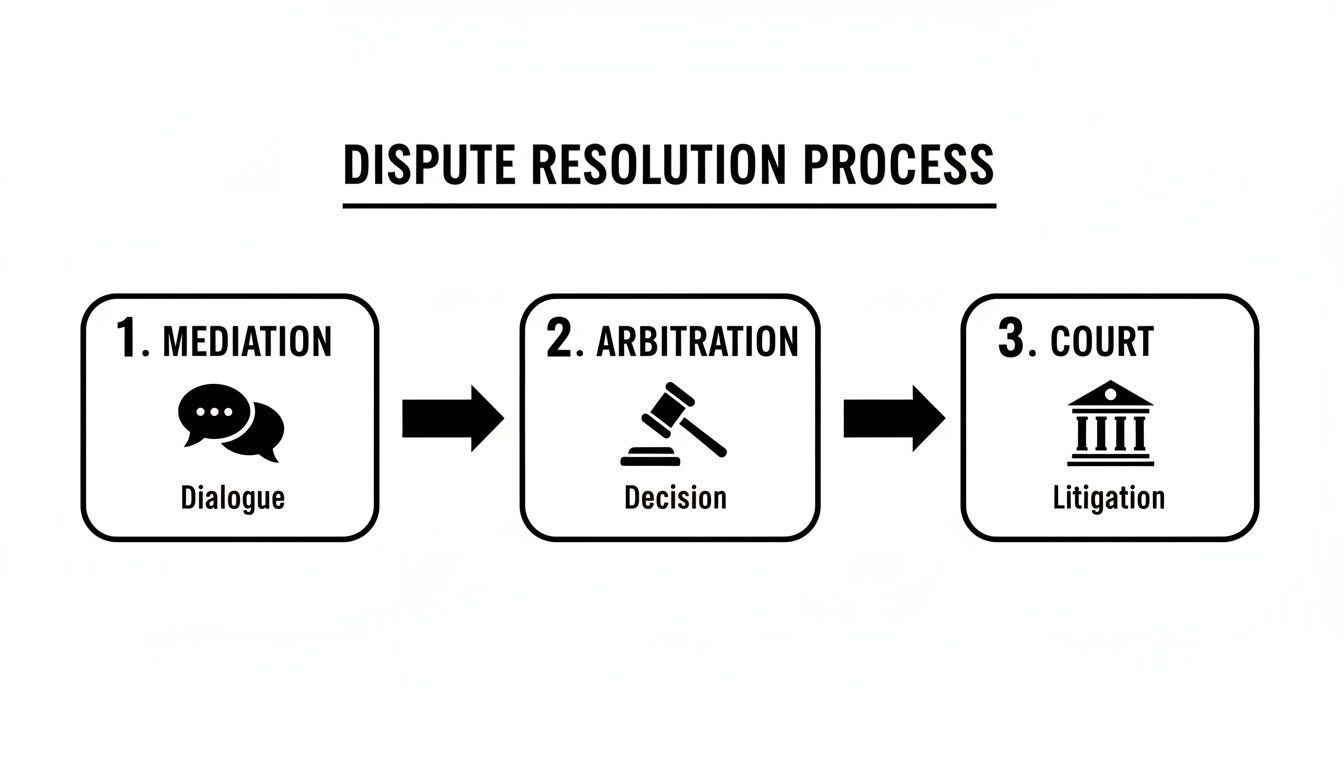
This situation simply means your strategy needs to shift. Instead of a purely collaborative process, you’ll move toward more structured options like formal mediation, arbitration, or, if all else fails, court intervention to get a final, binding resolution.
Key Takeaway: You still have control and options. An uncooperative spouse doesn’t get the final say on your future. Ontario’s family law framework is designed to ensure that issues are resolved fairly, whether through a signed agreement or a binding court order.
Understanding Your Path Forward: Eligibility & Timelines
Your main goal is to formalize the terms of your separation and create a legally enforceable framework for your new reality. When a voluntary agreement isn’t on the table, the alternative is a court-ordered resolution. These two paths have huge impacts on the entire process.
Here’s a practical look at what you need to consider:
- Eligibility: To use any legal process in Ontario, you must meet residency requirements—typically, one spouse must have lived in the province for at least one year before filing.
- Control: A separation agreement in Ontario allows you and your spouse to craft creative, customized solutions that work for your family. Once you’re in the court system, a judge who doesn’t know you or your children will make the final decisions based strictly on the law.
- Timelines: A negotiated agreement can often be wrapped up in a few months. In contrast, the court system can easily take over a year—or even longer—to finalize everything, especially in a busy jurisdiction like the Peel Region.
- Costs: Court proceedings are almost always more expensive than negotiating and finalizing an agreement. Legal fees, court filing costs, and expenses for motions or conferences add up fast.
Navigating this fork in the road is tough. Here’s a clear comparison to help you understand the fundamental differences between a negotiated separation agreement and a court-ordered resolution.
Separation Agreement vs. Court Order At a Glance
| Factor | Signed Separation Agreement (Cooperative) | Court Process (Uncooperative) |
|---|---|---|
| Control | You and your spouse decide on the terms. High degree of control and flexibility. | A judge makes the final decisions based on legal principles. You lose control over the outcome. |
| Timeline | Can be completed in weeks or months, depending on cooperation. | Can take 12-24+ months, depending on court backlogs and complexity. |
| Cost | Significantly lower costs. You pay for legal advice, drafting, and maybe a mediator. | Much higher costs. Includes lawyer fees, court filing fees, and potential trial expenses. |
| Privacy | The process and final agreement are private and confidential. | Court documents and proceedings are generally part of the public record. |
| Emotional Impact | Less stressful and adversarial. Promotes a healthier co-parenting relationship. | Highly stressful and adversarial, which can damage future co-parenting dynamics. |
Seeing the differences laid out like this makes it clear why an out-of-court settlement is usually the better option. However, when cooperation isn’t possible, the court provides a necessary path to resolution.
Why Won’t Your Spouse Sign the Separation Agreement?
It’s one of the most frustrating moments in a separation. You’ve done the work, you have an agreement ready, and your spouse simply refuses to sign. It’s natural to jump to conclusions—that they’re being difficult on purpose or trying to drag things out.
And sometimes, that’s true. But often, a refusal to sign is a symptom of a much deeper issue.
Before you fire back with an angry email or have your lawyer send a threatening letter, take a breath. The smartest thing you can do is figure out why they’re digging in their heels. This isn’t about making excuses for them; it’s about gathering the intelligence you need to make a strategic next move. Pinpointing the real problem can help you break the stalemate and find a quicker, less expensive way to move forward.
The Most Common Reasons for a Refusal
Every separation has its own unique story, but the reasons people stall often fall into a few predictable categories. If you can identify which one fits your situation, you can adjust your strategy instead of just pushing harder against a wall.
- Emotional Roadblock: For some, signing a legal document makes the end of the marriage painfully real. Your spouse might not be emotionally ready to close that chapter, and refusing to sign is their way of avoiding that final step.
- Fear of the Financial Future: They might be terrified of how they’ll manage on their own. Can they afford a new place? Will they be able to pay the bills? This fear can be paralyzing, causing them to avoid any decision that locks in their financial reality.
- Bad Advice from the Sidelines: Well-meaning friends and family can be a source of terrible legal advice. Your spouse might genuinely believe the terms are unfair or that they’re going to “lose everything” because of something they’ve heard.
- A Power Play: In a situation where they feel like they’ve lost all control, refusing to sign can be a last-ditch effort to exert some power. By creating a roadblock, they force you to deal with them on their terms.
- One Specific Sticking Point: It’s possible the refusal isn’t about the whole agreement. It could boil down to one single issue—the exact number for spousal support, a disagreement over the parenting schedule for March Break, or how to divide a pension.
Matching Your Strategy to Their Motivation
Once you have a better guess as to what’s really going on, you can stop reacting and start acting strategically.
For instance, if you suspect the issue is a specific financial fear, providing full, transparent financial disclosure with clear, easy-to-understand summaries can work wonders. Seeing the actual numbers in black and white often calms unfounded anxieties. If the hold-up seems purely emotional, suggesting a session with a neutral third-party mediator might be far more productive than a formal letter from your family lawyer in Brampton.
On the other hand, if you’re convinced the refusal is a calculated delay tactic designed to gain leverage, then a more assertive legal strategy is absolutely necessary. This is especially true when you’re already dealing with common issues in a contested Ontario divorce.
Understanding why your spouse won’t sign gives you leverage. It shifts you from a position of frustration to one of strategic action, ultimately saving you time, money, and emotional energy.
What to Do When Direct Talks Stall
When you’ve hit a wall and direct conversations with your spouse are going nowhere, it’s easy to feel like your only option is a long, expensive court battle. Fortunately, that’s not true.
Ontario’s family law system strongly encourages using Alternative Dispute Resolution (ADR) methods as a productive middle ground. These processes are designed to get the conversation moving again with the help of a neutral professional, often saving you a mountain of time, money, and stress. For many couples we work with right here in Brampton, exploring ADR is the exact step that breaks the deadlock.
Mediation: Finding Common Ground Together
Mediation is almost always the first and most effective option when you’re stuck. In this process, you and your spouse sit down with a neutral, professionally trained mediator whose job is to facilitate a productive conversation—not to take sides or make decisions for you.
- You Stay in Control: A mediator doesn’t impose a decision like a judge would. The final outcome is completely up to you and your spouse.
- It’s Cost-Effective: Mediation is almost always less expensive than going to court, often by a huge margin.
- It’s Forward-Looking: The process is designed to reduce conflict, which is incredibly important for preserving a functional co-parenting relationship.
If you reach an agreement, the mediator prepares a document called a Memorandum of Understanding (MOU). Your lawyers can then use this to draft a formal, legally binding separation agreement.
Arbitration: A Private Path to a Final Decision
Think of an arbitrator as a private judge. You and your spouse, along with your lawyers, agree to hire a neutral third party to hear both sides of the dispute and make a final, legally binding decision. It’s more formal than mediation but still far faster and less public than going to court.
The real power of arbitration is finality. You are guaranteed a decision on the outstanding issues, and that decision becomes legally enforceable just like a court order. This stops one person from dragging their feet and delaying the process forever.
Collaborative Family Law: A Commitment to Stay Out of Court
Another effective option is collaborative family law. In this process, both you and your spouse, along with your specially trained collaborative lawyers, sign a contract committing to resolve all your issues without ever stepping foot in a courtroom. This single commitment completely changes the dynamic, focusing everyone on finding creative, interest-based solutions.
If a negotiated settlement still isn’t possible, it’s time to consider the court process. Call us for next steps on how to protect your rights. Learning about strategies for managing conflict in a contested divorce can give you more insight into how to keep costs and stress down, even when you disagree.
Starting the Court Process in Ontario
When negotiation and mediation have hit a dead end, the court system is the final, definitive path forward. Taking that step can feel intimidating, but starting a family law case is often the only way to force a resolution when a spouse simply refuses to cooperate.
Filing a court application doesn’t mean you’re declaring war. It means you are moving the process into a structured environment where decisions will be made, deadlines must be met, and your separation will finally be dealt with.
The First Step: Filing an Application
The court process officially kicks off the moment you file an Application (Form 8) with the Ontario Superior Court of Justice or the Family Court branch. This is the foundational legal document of your case.
In this form, you will clearly state the orders you are asking the judge to make. This isn’t a vague request; it’s a specific, detailed list of what you are seeking on issues like:
- Decision-Making Responsibility and Parenting Time
- Child and Spousal Support
- Property Division (Equalization)
Filing this Application sets the entire legal process in motion. More importantly, it establishes firm timelines that your spouse is now legally required to follow.
Key Insight: Often, the simple act of being served with a formal court Application is the wake-up call a stalling spouse needs. The reality of having to respond legally and appear before a judge can instantly change their willingness to negotiate seriously.
What Happens After You File?
Once your Application is filed, you must formally serve your spouse with the court documents. After being served, your spouse has a limited time—usually 30 days—to file their Answer (Form 10). This is their formal, written response to your claims. If they don’t respond, you might be able to proceed without their participation. The first major court event is usually a Case Conference.
Documents Checklist for Court
Being organized is crucial. Having a trusted uncontested divorce in Brampton lawyer to guide you through this process can prevent critical mistakes.
Your document checklist should include:
- Financial Statements (Form 13 or 13.1)
- Income Verification: Last three years of tax returns and Notices of Assessment.
- Property Valuations: Appraisals for the matrimonial home and other significant assets.
- Account Statements: Recent statements for all bank accounts, investments, and pensions.
- Debt Statements: Statements for mortgages, lines of credit, and credit cards.
For a detailed breakdown of the entire legal procedure, you can learn more about how to file for divorce in Ontario in our comprehensive guide.
How a Judge Can Finalize Your Separation

An uncooperative spouse cannot hold your life in legal limbo forever. The Ontario courts have the authority to create powerful, legally binding solutions for every issue in your separation—regardless of whether your spouse participates.
A judge will apply the Family Law Act to the facts of your situation and issue a series of court orders. These orders become the new, enforceable rules governing your lives. Your spouse’s refusal to sign a piece of paper doesn’t give them veto power; it just means the final decisions will be made by a judge instead of by the two of you.
Securing Your Financial Future with Court Orders
A judge can cut straight through arguments and make definitive orders on support and property.
- Child Support: This is calculated using the Federal Child Support Guidelines. A judge will order the precise table amount of support to be paid monthly.
- Spousal Support: The judge will assess entitlement, amount, and duration based on the Spousal Support Advisory Guidelines and existing case law.
Once a support order is made, it’s filed with the Family Responsibility Office (FRO), a government agency with serious enforcement tools like wage garnishment.
Dividing Your Property and Assets
Your spouse can’t block you from receiving your fair share of property. A judge has the authority to enforce Ontario’s equalization laws, period. This includes making binding orders about key assets, including:
- The Matrimonial Home: A judge can order the sale of the home and the fair division of the proceeds.
- Pensions and Investments: The court will order the valuation and division of complex assets like RRSPs and pensions.
- Business Assets: The court can order a professional valuation and ensure its value is properly included in the equalization payment.
A court order provides the ultimate finality. It replaces uncertainty and conflict with clear, legally binding directives that both parties must follow.
Creating Enforceable Parenting Plans
A judge’s primary duty is to make orders that are in your children’s best interests. A judge can create a detailed and legally binding parenting order that sets out a clear schedule and rules for decision-making that your ex-spouse must follow. Your spouse’s refusal to sign a separation agreement in Ontario simply shifts the dispute into a legal framework where a court will resolve all outstanding issues.
Enforcement tools for non-compliance are robust. You can find more details by exploring the consequences of breaching a separation agreement in Ontario.
Brampton Clients Often Ask…
When you’re going through a separation in the Peel Region, you face practical, local questions that generic legal advice just can’t answer. Here are some of the most common concerns we hear from our Brampton clients when a spouse is refusing to cooperate.
How Long Does a Family Court Case Take at the Brampton Courthouse?
Realistically, a contested family law matter at the A. Grenville and William Davis Courthouse can take anywhere from 12 to 24 months to reach a final resolution. Timelines are affected by case complexity, the level of conflict, and judicial availability. Because the court process can be so long, exploring mediation or arbitration first is often a smarter, more cost-effective move.
Can My Spouse Force the Sale of Our Home in Mississauga if I Won’t Sign?
No. Your spouse cannot unilaterally sell the matrimonial home without either a signed agreement or a court order. However, they can ask a judge to order the sale. In most situations where there’s no other way to divide the home’s equity, a judge will eventually order it sold so the proceeds can be divided fairly.
What if We Share a Business in Brampton and Can’t Agree?
If you co-own a business and your spouse refuses to cooperate, the first step is to get a professional business valuation. If you still can’t agree, the court can step in. A judge has the power to appoint an official valuator, order one spouse to buy out the other, or, in the most deadlocked cases, order the business to be sold. It is crucial to get legal advice early to protect your financial stake.
For a comprehensive look at what goes into a legally sound agreement, our guide on preparing a separation agreement in Brampton provides detailed local context and practical tips.
Frequently Asked Questions
Can I be forced to leave the matrimonial home if I don’t sign a separation agreement?
No. Under Ontario’s Family Law Act, both spouses have an equal right to live in the matrimonial home, regardless of whose name is on the title. Your spouse cannot legally lock you out. The only way you can be required to leave is through a court order for “exclusive possession” or by mutual written agreement.
Is a verbal separation agreement enforceable in Ontario?
No. To be legally binding, a separation agreement in Ontario must be in writing, signed by both parties, and witnessed. Verbal agreements about property and support offer no legal protection and are not enforceable.
What happens if my spouse starts a court case and I don’t respond?
If you are served with a court application and fail to file a response (an Answer, Form 10) within the 30-day deadline, your spouse can proceed with the case without you. A judge can make final orders on all issues—support, property, and parenting—based only on the evidence your spouse provides. This is a very risky position to be in.
How can I get temporary support if my spouse is uncooperative?
You don’t have to wait for a final resolution. You can file a court application and bring a motion for a temporary order. A judge will review your initial financial documents and can make an interim order for child and/or spousal support to be paid while the bigger issues of your separation are being sorted out.
Can my spouse stop me from seeing our kids if I don’t sign?
No. Unless a court has issued an order restricting your access due to proven safety concerns, one parent cannot unilaterally prevent the other from seeing the children. Parenting time is legally considered the right of the child. If your spouse is withholding the children, you can bring an urgent motion to the court to establish a formal parenting schedule.
What is the most common mistake people make in this situation?
The most common mistake is waiting too long to act. Hoping an uncooperative spouse will simply change their mind can lead to months or even years of financial uncertainty and emotional stress. The longer you wait, the more complicated issues like property division can become. Seeking legal advice early gives you a clear strategy and puts you back in control of the process.
Disclaimer: This is general information, not legal advice. The information on this page is for educational purposes only and does not create a lawyer-client relationship.
Navigating a separation is challenging, especially with a spouse who won’t cooperate. You don’t have to face it alone. The experienced team at Badesha Law Professional Corporation can protect your rights and guide you toward a fair resolution. To understand your options and create a clear path forward, call us for a confidential consultation.
Book Your Free Consultation with a Brampton Divorce Lawyer