

Filing for divorce in Ontario involves a structured legal process, as outlined by Canada’s federal Divorce Act. For residents of Brampton, initiating this process requires confirming eligibility, assembling necessary documents such as the Application for Divorce (Form 8A), and deciding between a sole application (filing independently) or a joint application (filing with your spouse). For more information, explore Badesha Law for guidance on Brampton-specific procedures and tailored legal assistance.
Initial Steps in the Ontario Divorce Process
Beginning the divorce process can be daunting, but having a thorough understanding of each step provides a clear roadmap. In Brampton, this process starts at the Ontario Superior Court of Justice, centering around a pivotal decision: will your divorce be uncontested or contested? This choice greatly influences the duration, cost, and emotional toll of the proceedings.
An uncontested divorce is the simplest option, suitable when you and your spouse agree on all major aspects—property division, parenting time and decision-making responsibility, and support arrangements. Essentially, you are asking the court to formalize an agreement that you and your spouse have already settled. For expert advice on navigating an uncontested divorce, consider consulting Badesha Law.
Conversely, a contested divorce arises when there is disagreement on one or more critical issues. This path involves intricate steps such as negotiation, mediation, or court hearings to resolve disputes, resulting in a more extended and costly process. For assistance through the complexities of a contested divorce, visit Badesha Law for professional support and strategic legal solutions.
Uncontested vs. Contested Divorce
Understanding the difference between these two paths is the first actionable step in figuring out how to file for divorce in Ontario. The diagram below shows how every divorce starts from the same place but can head in very different directions depending on how much you and your spouse agree.
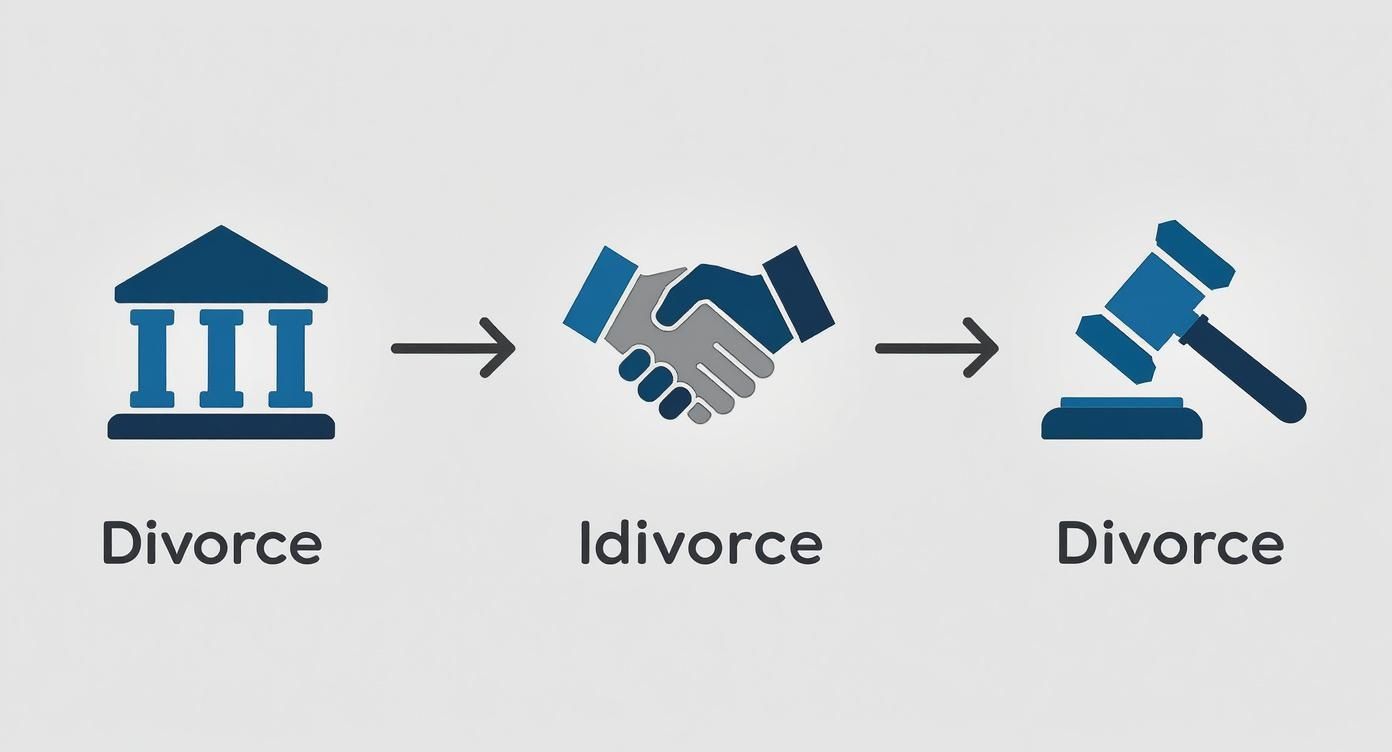
As you can see, collaboration is the key to a simpler, faster process.
The legal reason for almost every divorce in Canada is boiled down to one thing: marriage breakdown. While the Divorce Act allows you to file based on adultery or cruelty, these grounds are rarely used as they require proof and can lead to conflict. The vast majority of couples prove a marriage breakdown by living “separate and apart” for at least one year. This one-year separation is a mandatory waiting period before a judge can legally grant your divorce. You don’t have to wait the full year to start the paperwork; you can begin the filing process sooner, but the divorce won’t be finalized until that year is up.
A key takeaway from the Family Law Act is that “separate and apart” doesn’t always mean living in different homes. For financial or parenting reasons, you can be legally separated while still living under the same roof, as long as you are no longer living together as a married couple.
This initial stage is about building a solid foundation. Getting a handle on these core ideas—uncontested vs. contested paths and the one-year separation rule—is what empowers you to make smart, informed decisions as you move forward with your application in Brampton.
To simplify these initial concepts, here’s a quick table summarizing the main stages.
Quick Overview of the Ontario Divorce Process
This table breaks down the key stages and what you need to think about as you begin the divorce process in Brampton.
| Stage | Key Action Required | Primary Consideration |
|---|---|---|
| Eligibility & Grounds | Confirm you’ve lived in Ontario for 1 year and have grounds for divorce. | Most divorces are based on a one‑year separation. |
| Application Type | Decide whether to file a sole or joint application. | A joint application is simpler and only possible in uncontested cases. |
| Filing & Service | Complete and file Form 8A with the Brampton court. Serve your spouse if filing solely. | Accuracy is critical. Errors in paperwork can cause significant delays. |
| Resolution Path | Determine if your divorce is uncontested (agreed) or contested (disagreed). | This choice dictates the timeline, cost, and complexity of your divorce. |
| Final Order | The court reviews all documents and, if satisfied, issues a Divorce Order. | The order becomes final 31 days after it’s granted. |
Navigating these early steps correctly sets the tone for your entire divorce. With a clear understanding of the path ahead, you can approach the process with more confidence and control.
Before you can even begin filling out forms, you need to meet the essential legal requirements laid out in Canada’s federal Divorce Act. The Brampton court will not review your application unless you meet these criteria.
The first requirement is residency: at least one spouse must have been ordinarily resident in Ontario for a full year immediately before filing the divorce application. This gives the Ontario Superior Court of Justice the jurisdiction to handle your case.
Proving Your Marriage Has Broken Down
Once you’ve cleared the residency requirement, the next step is showing the court why you need a divorce. In Canada, there’s only one legal reason for divorce: a breakdown of the marriage. The law gives you three ways to prove this has happened.
By far, the most common and practical path is living separate and apart for at least one year.
- Living Separate and Apart for One Year: This is a “no-fault” divorce. It doesn’t require blaming anyone. It is a simple acknowledgment that the relationship is over and you’ve been living separate lives for at least 12 months.
A crucial point that many people misunderstand is the meaning of “separate and apart.”
Under the Family Law Act, you can be legally separated while still living under the same roof. The key is that you’re no longer living as a married couple. This could mean sleeping in different rooms, not sharing meals or social outings, and making it clear the marriage is over.
This rule recognizes that for many couples in Brampton, moving into two separate homes right away isn’t financially realistic or practical for co-parenting.
The Less Common Grounds for Divorce
While the one-year separation is the standard, the Divorce Act does provide two other grounds based on “fault”: adultery and cruelty. These are rarely used in Ontario today because they are more complicated, confrontational, and expensive to prove in court. It is important to know that allegations of cruelty could also involve actions that fall under the Criminal Code of Canada, such as assault or uttering threats, which would be handled as separate criminal matters.
- Adultery: To file on these grounds, you must provide the court with concrete proof that your spouse was physically intimate with another person. This requires solid evidence, not just suspicion, which can be difficult and costly to obtain.
- Cruelty: This requires proving your spouse has treated you with physical or mental cruelty so severe that it makes living together intolerable. The behaviour must be grave and have a serious impact, making it a very challenging case to build.
Given these hurdles, nearly everyone in Brampton opts for the one-year separation. It’s a simpler, less adversarial path that lets you focus on resolving practical issues like property, support, and parenting arrangements.
When you start planning how to file for divorce in Ontario, the cost is a major concern. The financial impact of your divorce largely depends on whether your path is contested or uncontested.
An uncontested divorce is the most cost-effective way forward. It means you and your spouse have already agreed on all the big issues: property and debt division, parenting arrangements, and child or spousal support. With no legal battles to fight, the costs stay predictable and manageable.
Your main expenses will be the mandatory court filing fees. These are standard fees set by the province to process your application at the Brampton courthouse.
Breaking Down Uncontested Divorce Costs
With an uncontested divorce, the financial picture is clear. The standard court fees in Ontario usually consist of two parts:
- Application Filing Fee: This is what you pay to officially start your divorce case with the court.
- Final Order Fee: You’ll pay this fee when you submit the last of your documents for a judge to review and finalize.
By negotiating and agreeing on the terms beforehand, you avoid the escalating costs of legal disputes. This collaborative approach can save you thousands of dollars, providing a more stable financial start to your next chapter. It’s the simplest and most affordable way to legally end your marriage.
The core idea is simple: agreement equals affordability. The more you and your spouse can resolve between yourselves, the lower your costs will be. This keeps you in control of your finances, instead of handing that control over to a lengthy court process.
The Financial Reality of a Contested Divorce
A contested divorce is the opposite. This is the path taken when you and your spouse cannot agree on key issues like property, parenting, or support. Lawyers—and possibly the court—must step in to help find a resolution.
This is where costs can escalate. Unlike the fixed fees of an uncontested divorce, a contested case involves ongoing legal expenses. Every step, from exchanging financial documents to attending mediation or court, has a cost. Lawyers typically bill by the hour, so the longer the dispute, the more expensive it becomes.
An uncontested divorce in Ontario might cost around $1,860 on average. A contested divorce, however, can see average costs soar to $20,625 or higher. You can find more insights on Canadian divorce statistics.
Practical Tips for Brampton Residents
If you’re in Brampton and concerned about divorce costs, aim for an uncontested resolution. Even if you start with disagreements, you can reach an agreement without a costly court battle.
Consider mediation as a useful option. A neutral mediator can help you and your spouse resolve issues in a structured setting. Mediation is generally less expensive than court and allows you to create an agreement that suits your family. By focusing on finding solutions rather than conflict, you can make a contested divorce uncontested, saving time, stress, and money.
A Guide to Ontario Divorce Forms and Documents
When filing for divorce in Ontario, the paperwork can seem daunting. Getting these forms right is crucial for a smooth process, as any errors can cause frustrating delays at the Brampton courthouse.
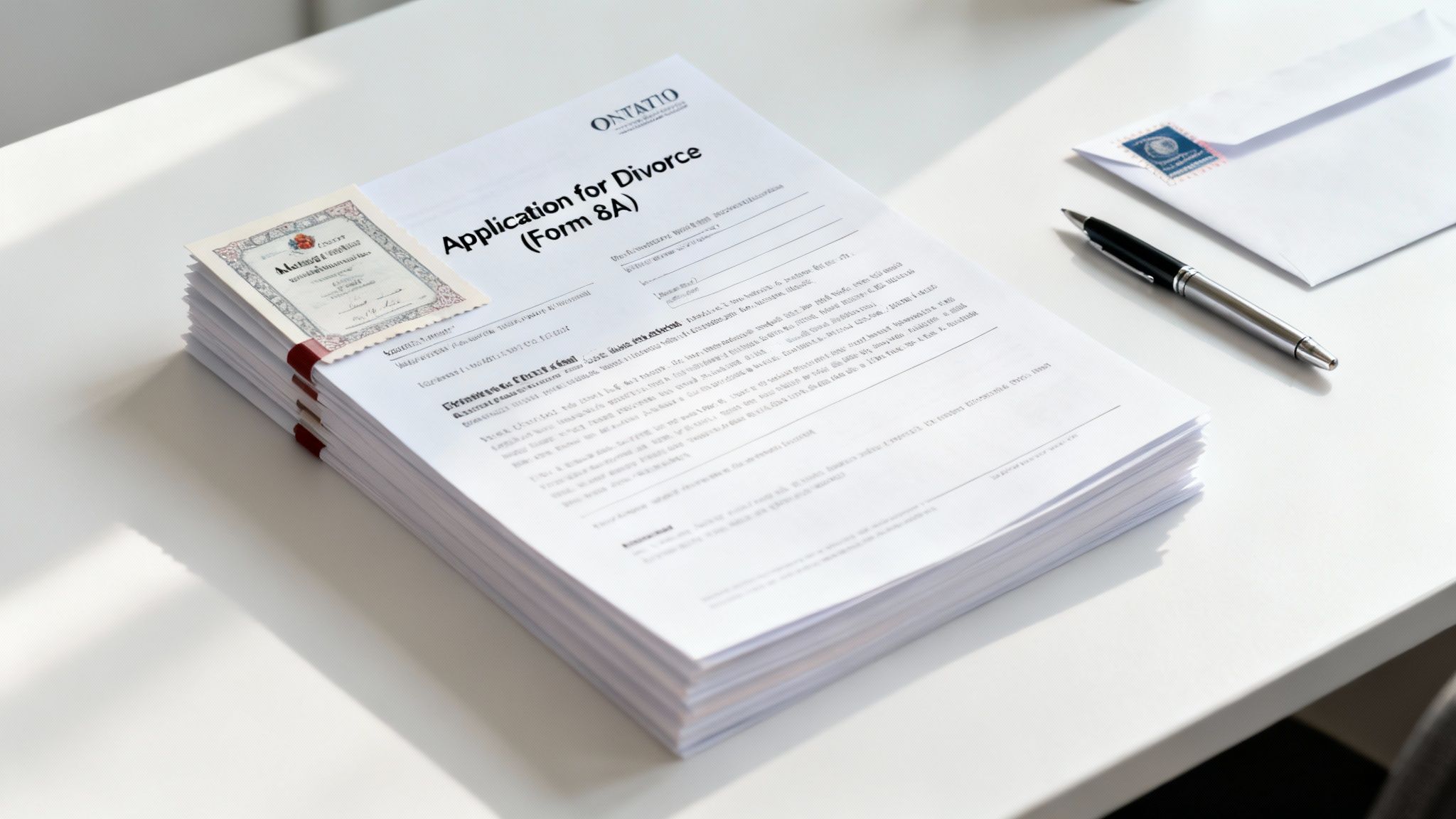
Your journey begins by gathering all the key documents. The exact forms you’ll need depend on your situation, but some are always required.
Your Essential Document Checklist
Before filling anything out, collect the necessary paperwork to make the process more manageable.
- Original Marriage Certificate: The official certificate issued by the government. If you married outside of Canada, you’ll need the original certificate and a certified translation if it’s not in English or French.
- Application for Divorce (Form 8A): This is the main form that officially starts your divorce proceedings.
- Registration of Divorce Proceeding Form: This form is sent to the federal government’s Central Registry of Divorce Proceedings to ensure there isn’t another divorce case for the same marriage already in the system.
Actionable Tip: Always use the most current versions of these forms. You can find them on the official Ontario Court Forms website. Using an outdated form is a common mistake that will get your application rejected by the court clerk in Brampton.
Sole Application vs. Joint Application
When filling out your Application for Divorce (Form 8A), you have two options. The choice between a sole and joint application depends on how well you and your spouse are cooperating.
A sole application is filed by one spouse, the “Applicant.” This is the common route, especially if there are disagreements. The Applicant completes the form, files it with the court, and then must legally “serve” the documents on the other spouse, the “Respondent.”
A joint application is filed by both spouses together. This is a simpler option available only for uncontested divorces where you agree on all terms. You both act as Applicants and file together, which eliminates the need to formally serve papers.
Filling Out the Application for Divorce (Form 8A)
The Form 8A is the cornerstone of your divorce. It requires specific, detailed information about your marriage, separation, and any children.
When you complete this form, you’ll need to provide:
- Personal Information: Full legal names, dates of birth, and contact information for both spouses.
- Marriage and Separation Details: The date and location of your wedding and the official date you separated.
- Details About Children: Full names and birth dates for any dependent children.
- Claims: This section states what you are asking the court to do. For a simple divorce, you’ll just ask for the divorce itself. If you’re also dealing with property or support, you must state that clearly here.
Take time to double-check every detail before you file. Simple typos or incorrect dates frequently cause applications to be rejected at the Brampton courthouse, forcing you to start over.
Once your divorce forms are filled out, you’re ready to start the legal process. This next phase involves filing the paperwork with the court and ensuring your spouse is formally notified. Let’s walk through how this works at the Brampton Superior Court of Justice.
Getting this filing stage right is critical. A mistake here can cause delays, so attention to detail is key.
The Filing Process at the Brampton Courthouse
Filing your application means officially submitting your request to the court. You’ll need to take your completed documents to the family court counter at the Brampton Superior Court of Justice.
Here’s a checklist of what you’ll need to bring:
- The Original Documents: Your signed Application for Divorce (Form 8A) and the Registration of Divorce Proceeding form.
- Multiple Copies: Bring at least two photocopies of everything—one for you and one to serve on your spouse.
- Your Original Marriage Certificate: The court needs this to confirm your marriage is valid.
- Court Fees: There’s a fee to file your application. Call the Brampton courthouse ahead of time to confirm the exact amount and accepted payment methods.
A court clerk will review your documents, stamp them, and assign a court file number. This is the moment your application is officially “issued,” and your divorce case begins.
Serving Your Spouse: The Next Critical Step
After the court issues your application, the next mandatory step in a sole application is service. This is the legal process of delivering a copy of the filed court documents to your spouse (the Respondent). Service is non-negotiable; it ensures your spouse is aware of the divorce and has an opportunity to respond.
Under Ontario’s Family Law Rules, you can’t just drop the documents in the mail. The rules are strict to protect everyone’s rights by guaranteeing the papers were received.
The most common method is special service, which means the documents are handed directly to your spouse in person.
A key rule: you cannot serve the documents yourself. They must be delivered by someone else who is at least 18 years old. This could be a friend or family member, but hiring a professional process server is often the best choice, as they know the rules and can provide the necessary proof of service.
Proving Service with an Affidavit of Service
The final piece is proving to the court that you followed the rules. You do this by filing an Affidavit of Service (Form 6B). The person who served the documents fills out this form and signs it in front of a commissioner for taking affidavits, swearing under oath that they delivered everything correctly.
This form details:
- Who was served.
- Which documents were served.
- The precise date, time, and location of service.
Once that affidavit is completed and sworn, you file it with the Brampton court. This document becomes the official proof that your spouse has been notified, allowing your divorce case to move forward.
Finalizing Your Divorce: Understanding the Last Steps
Once you’ve filed your application and served your spouse, you’ve reached the final phase. This is where your case moves from a pending application to a legal reality. Understanding these concluding steps helps you set a realistic timeline for closure at the Brampton court.
The clock starts the moment your spouse receives the divorce papers. They have a 30-day window to file a formal response, known as an Answer (Form 10). This is their opportunity to contest any claims you’ve made.
What Happens After the 30-Day Window?
If your spouse files an Answer, your divorce becomes contested, and you’ll need to navigate further court processes like case conferences to resolve the disagreements.
However, the most common scenario is that the 30 days pass with no response. In this case, the court assumes your spouse agrees, and your case proceeds as uncontested. This is the simplest, fastest, and least stressful outcome.
Once this 30-day period expires without an Answer, you can submit the final set of documents.
The main document at this stage is the Affidavit for Divorce (Form 36B). This is a sworn statement where you confirm all the information in your original application is true and that you’ve met all legal requirements for a divorce in Ontario.
Actionable Insight: Think of this Affidavit as your final evidence. You are testifying in writing that every legal condition has been met, including making appropriate arrangements for any children of the marriage, as required by the Family Law Act.
After you complete and swear this affidavit, you file it with the court clerk, signaling that your file is ready for a judge to review.
The Judge’s Review and the Divorce Order
With your final paperwork submitted, a court clerk will do one last check. If everything is in order, it goes to a judge for a “desk audit.” This means the judge reviews all the documents in their office, and you don’t have to appear in court.
The judge’s job is to verify:
- That at least one spouse has lived in Ontario for at least one year.
- That you have valid grounds for divorce (usually the one-year separation).
- That reasonable arrangements are in place for any children regarding support and parenting time, in compliance with the Divorce Act.
If the judge is satisfied, they will sign the Divorce Order, the official court document that legally ends your marriage.
However, the divorce isn’t immediate. The Divorce Order takes effect 31 days after the date the judge grants it. This waiting period allows time for any last-minute appeals. Once those 31 days are up, your divorce is final, and you can request a Certificate of Divorce as official proof.
In Brampton’s bustling court system, it’s important to note that delays are a possibility. In 2020, Ontario experienced a 36% reduction in processed divorces, primarily because of pandemic-related backlogs. For further details on how court operations impact divorce rates. This emphasizes the importance of ensuring your documentation is thorough and precise from the outset to prevent avoidable delays.
Of course. Here is the rewritten section, crafted to sound completely human-written and natural, following the provided style guide and examples.
When to Hire a Brampton Divorce Lawyer
Although handling an uncontested divorce on your own might appear straightforward, it often involves complexities. Deciding when to seek professional legal assistance is crucial for safeguarding your future.
A family lawyer serves as your essential guide through Ontario’s Family Law Act. They protect your rights, help you avoid common pitfalls, and ensure you don’t agree to terms you might regret.
Indicators That You Need a Lawyer
Certain circumstances are too intricate to navigate alone. If any of these apply to your situation, obtaining legal advice in Brampton is crucial:
- Disagreements Over Children: If you and your spouse cannot agree on decision-making responsibility or parenting time, a lawyer becomes indispensable. These arrangements are vital for your children’s future. A lawyer will advocate for a fair parenting plan that serves their best interests.
- Complex Finances: Dividing assets like pensions, businesses, investments, or real estate requires specialized knowledge. A lawyer ensures all property is accurately valued and divided fairly according to Ontario law, ensuring you receive your rightful share.
- Conflict Over Support: Determining child and spousal support can be intricate. A lawyer ensures the amounts are calculated correctly using official guidelines, protecting both the payer and recipient from unfair assessments.
- Power Imbalance or Domestic Abuse: If your relationship involves domestic violence, control, or intimidation, hiring a lawyer is crucial. They act as a protective intermediary, managing all communication and prioritizing your safety and legal rights. Any abusive actions may also be offences under the Criminal Code of Canada, and a lawyer can guide you on how to proceed safely.
A competent lawyer does more than manage paperwork. They offer strategic advice specific to the Brampton court system, helping you anticipate challenges, negotiate effectively, and ensure any agreement is fair and enforceable.
The Unique Challenges of a “Grey Divorce”
The necessity for expert legal assistance is particularly important for older couples. While overall divorce rates have been declining, statistics indicate the rate for those aged 55-59 only decreased by 27.7% between 2016 and 2020.
Later-in-life separations present unique financial challenges, such as unraveling decades of shared assets, dividing pensions, and determining long-term spousal support. These are significant issues that require a specialist’s insight. You can find more details in these recent divorce statistics in Canada.
Ultimately, hiring a Brampton divorce lawyer, such as those at Badesha Law, is an investment in your future. It provides peace of mind from knowing every aspect is managed correctly and that the final outcome will be fair, secure, and legally sound.
When you’re facing the overwhelming stress of a separation, you don’t have to go through it alone. The experienced team at Badesha Law provides clear, strategic, and compassionate guidance to protect your rights and help you move forward. For expert legal support with your family law matter in Brampton, contact us today by visiting our family law page.