Ultimate Guide: How to Get a Divorce in Canada
Before you can file a single document, you need to get a handle on the legal basics. Getting a divorce in Canada isn't about pointing fingers or proving who was at fault. The law is designed to be much more practical than that.
So, where do you start? The entire process hinges on proving that your marriage has broken down, which is a key requirement under the federal Divorce Act.
Grounds for Divorce: The One-Year Separation Rule
Under Canada’s federal Divorce Act, there are three ways to demonstrate a marriage breakdown. By far the most common path—the one nearly everyone takes—is living separate and apart for at least one year.
This is a no-fault approach. It allows you and your spouse to move on without dredging up painful details of who did what to whom.
While much rarer, there are two other grounds available:
- Adultery: Your spouse was physically intimate with someone else.
- Cruelty: Your spouse’s physical or mental cruelty has made it impossible to continue living together.
These are harder to prove and often add unnecessary conflict and cost, which is why the one-year separation is the standard.
It's a common misconception that "separate and apart" automatically means living in different houses. You can absolutely be separated while still living under the same roof. The key is that you're no longer living as a couple—you might sleep in separate rooms, manage finances independently, and no longer present as a married pair socially. Getting clear on the difference between legal separation and divorce is a crucial first step.
Residency: Where Can You File?
Before a Canadian court can grant your divorce, you have to meet a simple but strict residency rule. The Divorce Act requires that either you or your spouse must have lived in a Canadian province or territory for at least one full year right before you start the divorce proceedings.
This isn't flexible. It's what gives the court in your province the jurisdiction to handle your case. If you live in Brampton, for example, you or your spouse must have been an Ontario resident for the last 12 months to file here.
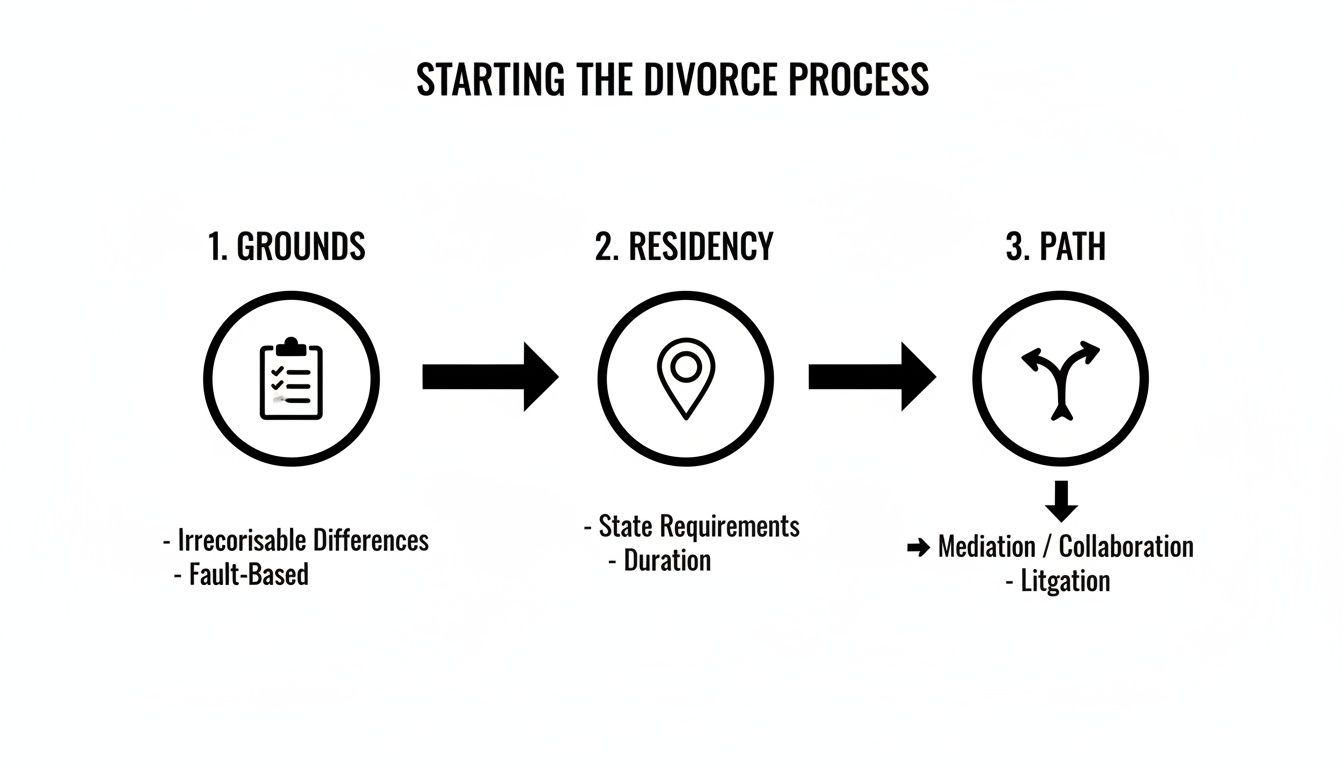
This flowchart really breaks it down: confirm your grounds, meet the residency requirement, and then choose your path forward.
The Two Paths: Uncontested vs. Contested Divorce
Once the grounds and residency are sorted, your divorce will go one of two ways. This is probably the biggest decision you'll make, as it dictates the cost, timeline, and stress level of the entire process.
An uncontested divorce (also known as a simple or joint divorce) is the goal for most people. It’s possible only when you and your spouse agree on everything: parenting, support, and how to divide your property. It’s faster, cheaper, and far less stressful.
A contested divorce, on the other hand, is what happens when you can’t agree. This path means you’re asking the courts to step in and make decisions for you. It involves a formal court process with case conferences, motions, and potentially a full trial. It’s a much longer, more complex, and significantly more expensive journey.
To help clarify, here's a look at the fundamental differences between the two approaches.
| Aspect | Uncontested Divorce | Contested Divorce |
|---|---|---|
| Agreement | You and your spouse agree on all issues before filing. | You disagree on at least one major issue (e.g., property, support, parenting). |
| Cost | Much lower and often predictable (flat-fee pricing is common). | Significantly higher and unpredictable, billed by the hour. |
| Timeline | Faster. Usually finalized within 4-6 months after filing. | Much slower. Can take well over a year, sometimes several years. |
| Complexity | A straightforward administrative process of filing paperwork. | An adversarial legal process involving multiple court appearances. |
Ultimately, the uncontested route puts you in control, while the contested route hands that control over to the court system.
In 2020, an encouraging 31% of all divorce applications in Canada were filed jointly. This reflects a growing trend towards cooperation, which is a smart move. That year saw 42,933 divorces granted nationally, the lowest number since 1973. Here in the GTA, the financial incentive is clear: an average uncontested divorce might cost around $1,860 in legal fees, but a contested case can easily skyrocket to $18,000-$25,000 or more.
The Uncontested Divorce Pathway: From Paperwork to Final Order
If you and your spouse have managed to agree on everything, you're heading for an uncontested divorce. This is by far the most direct, affordable, and emotionally manageable way to legally end a marriage in Canada. It transforms the process from a potential courtroom battle into a much calmer administrative procedure, keeping you in the driver's seat.
But even with total agreement, you still have to navigate a process governed by strict legal rules and precise paperwork. Getting these details right is the secret to a smooth and timely resolution.

Preparing and Filing the Application for Divorce
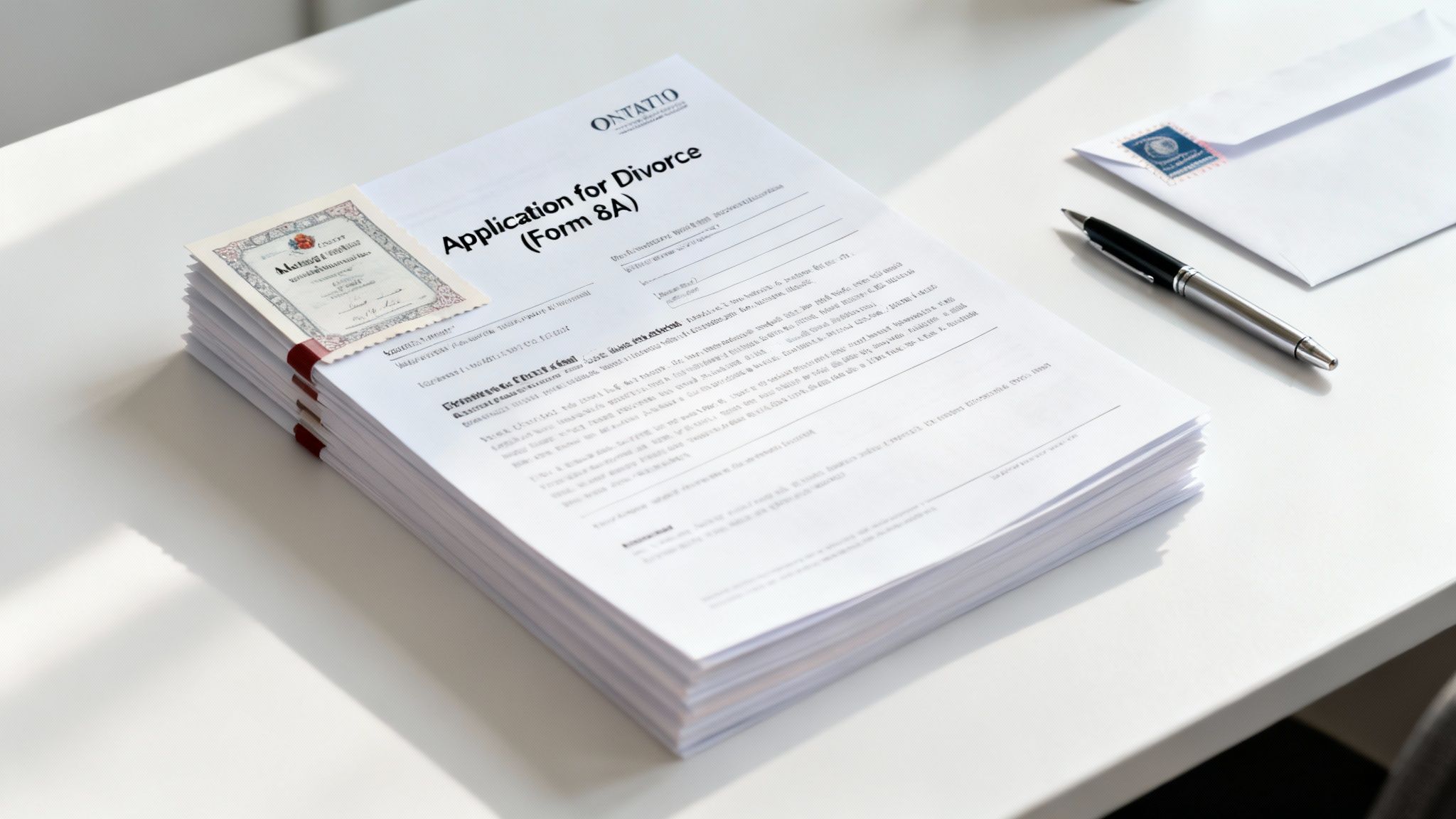
Your journey officially kicks off with the Application for Divorce. In Ontario, this is specifically Form 8A. This document is the cornerstone of your entire filing, giving the court all the essential information about your marriage, your separation, and any children you have together.
Think of the Application as your formal request to the court. It has to be filled out perfectly. Even simple mistakes—like getting a date of marriage wrong or misspelling a name—can cause the court to reject your file, forcing you to start all over again and leading to major delays.
Along with the Application, you'll need a few other key documents:
- Your original marriage certificate: The court needs the official, government-issued certificate. A photocopy or the decorative record from your religious ceremony won't cut it. If the certificate is in a language other than English or French, you'll also need a certified translation.
- Court Filing Fee: There is a fee required to file the application with the court.
- Draft Divorce Order (Form 25A): This is the final order you'll be asking the judge to sign.
Once everything is ready, these documents get filed with the Superior Court of Justice in the municipality where either you or your spouse lives. For anyone in Brampton or Mississauga, this would be the court located in the Peel Region.
Why Serving Documents Is Non-Negotiable
Even in the most amicable, uncontested divorce, the law requires you to formally "serve" your spouse with a copy of the filed Application for Divorce. This is a step you simply cannot skip.
Serving documents is the court's way of ensuring your spouse is officially notified of the legal proceedings. It’s a fundamental principle of justice—everyone has the right to know about a court case that directly involves them.
This doesn't have to be some big, confrontational event. Usually, a friend, a family member (as long as they are over 18), or a professional process server just hands the documents to your spouse. The one person who cannot serve the papers is you. Afterwards, the server must complete an Affidavit of Service (Form 6B), sign it in front of a commissioner for taking affidavits, and file it with the court. This affidavit acts as your proof that the legal notification requirement has been met.
Keep in mind that accuracy here is critical. An incorrectly completed Affidavit of Service is one of the most common reasons court staff delay or reject a divorce application.
The Final Steps Toward Your Divorce Order
After your spouse has been served, they have 30 days to file an Answer if they want to dispute anything in your application. In a truly uncontested divorce, they won't file anything. Once that 30-day window closes, you can move on to the final stage.
You will file a second set of documents with the court, including:
- Affidavit for Divorce (Form 36B): A sworn statement confirming all the information in your application is true and that there are no legal barriers to getting the divorce.
- Your completed Affidavit of Service.
- The draft Divorce Order.
Once all this is filed, a court clerk will review your entire file to make sure every single procedural requirement has been met. If everything is in order, the file goes to a judge for a final review. The judge grants the Divorce Order if they are satisfied that all legal conditions have been addressed, especially those concerning any children.
This final order officially takes effect 31 days after the judge signs it. This waiting period is there to allow for any last-minute appeals. After that, your divorce is legally final, and you can get your official Divorce Certificate. It's also smart to understand the financial side of things; you can learn more about typical Ontario divorce costs in our article to help you budget.
Navigating a Contested Divorce When You Can’t Agree
When you and your spouse hit a wall on fundamental issues like parenting, support, or how to divide your assets, the divorce becomes contested. This isn't just a bump in the road; it's a complete shift in the process. Your divorce moves from a cooperative task to a formal legal proceeding where the court steps in to make the final decisions.
It’s a more complex, expensive, and emotionally draining path, but it's the necessary route when a compromise is simply out of reach.
The whole process kicks off when one spouse files an Application (Form 8A) with the court. This document does more than just ask for a divorce—it lays out all the claims for things like decision-making responsibility for the kids, child and spousal support, and what should happen with the family home.

The First Steps in a Contested Divorce
Once the Application is filed and served, the clock starts ticking. The other spouse has to formally respond by filing an Answer (Form 10). This is their chance to address the claims made against them and to make their own. Generally, they have 30 days to get this done after being served.
Ignoring this step is a huge mistake. If no Answer is filed, the court can move forward without their input, potentially making decisions based on only one side of the story. This initial exchange of documents essentially draws the battle lines, defining exactly what the court needs to resolve.
The Critical Role of Financial Disclosure
At the heart of every single contested divorce is full and honest financial disclosure. This is non-negotiable. Both of you are legally required to lay all your financial cards on the table. It means completing a detailed Financial Statement, which is a sworn document listing every dollar of income, every asset, every debt, and all your monthly expenses.
Why is this so strict? Because a judge can't make fair rulings on support or property division without seeing the complete picture. Hiding assets or fudging income numbers will destroy your credibility and can lead to serious penalties from the court.
The entire family court system is built on a foundation of transparency. A dishonest or incomplete Financial Statement can unravel your whole case, leading a judge to doubt everything else you say.
For many people, this is the most intimidating part of the divorce. You can learn more about completing the crucial Form 13.1 Financial Statement in our detailed guide, where we break down exactly what you need to provide.
A Real-World Contested Divorce Scenario
Let’s picture a couple in Brampton who can’t agree on what to do with their family home, especially in a volatile housing market. One spouse wants to sell it right away and split the cash. The other wants to buy out their partner's share so the kids don’t have to switch schools.
This one disagreement is enough to trigger a full-blown contested divorce. Suddenly, the court needs to weigh in on:
- The home's current market value, likely requiring a formal appraisal.
- Whether the spouse who wants to stay can actually qualify for a new mortgage to buy out the other.
- What’s in the best interests of the children and how much disruption a move would cause.
- How this decision impacts the division of all other family property.
Just like that, you’re caught up in court motions, financial evaluations, and legal arguments—all because you couldn't find common ground on one major asset.
The Court Process Unfolded
A contested divorce doesn't mean you're heading straight for a courtroom trial. Far from it. The family court system in Ontario is actually designed to help you settle your issues at several points before a trial ever becomes necessary. The process usually involves a series of specific court appearances.
- Case Conference: This is usually your first time in front of a judge. It's a less formal meeting designed to identify the key issues, make sure financial disclosure is complete, and map out the next steps. The judge acts as a guide, helping you and your spouse narrow down the conflict.
- Settlement Conference: This meeting is much more focused. Here, a judge will give their professional opinion on how your case would likely play out if it went to trial. This reality check is meant to push both sides toward a reasonable settlement and avoid the massive cost and uncertainty of a trial.
Throughout this entire journey, an experienced family lawyer is your advocate. They make sure your documents are filed properly, represent your interests at every meeting, and build a strong legal case on your behalf. They handle the procedural headaches so you can focus on the big picture.
Tackling the Big Three: Children, Support, and Property
A divorce order doesn't just end a marriage—it sets the stage for your family's entire future. Before any judge in Canada will sign off, the major issues that stem from the relationship have to be sorted out. This means creating a clear, legally sound plan for parenting, finances, and the division of your property.
Successfully getting through this part of the process means you need a solid grasp of how the law handles these three pillars. Whether you figure things out through negotiation, mediation, or have to go to court, reaching an agreement is non-negotiable. A well-drafted separation agreement is your most powerful tool here, turning what could be a battlefield into a predictable roadmap.
The Best Interests of the Child Always Come First
When kids are in the picture, Canadian law is unwavering: every single decision must be made in their best interests. This is the guiding principle of the Divorce Act, and it’s the lens through which a judge will view any proposed parenting plan.
The courts have moved on from old-fashioned terms like "custody" and "access." The conversation today is about two key ideas:
- Decision-Making Responsibility: This is about who gets to make the big calls for a child—things like healthcare, education choices, and religious upbringing. It can be held by one parent (sole) or shared between both (joint).
- Parenting Time: This is simply the schedule that lays out when the children are in each parent's care. The goal isn't about winning or losing time; it's about making sure the child has as much time with each parent as is healthy and practical for them.
A judge looks at a whole host of factors, like the child's well-being, their relationship with each parent, and how willing each parent is to support the child's bond with the other parent. To get a deeper understanding of these arrangements, you can learn more about shared and joint custody in our comprehensive guide.
Understanding Your Financial Support Obligations
Money is almost always a huge source of stress during a separation. Thankfully, the law has created clear frameworks for calculating both child and spousal support to bring some much-needed predictability and fairness to the table.
Child Support is considered the right of the child. It's calculated using the Federal Child Support Guidelines, which is basically a formula based on the payor parent's income and the number of children. This is pretty straightforward, and there's very little wiggle room on the base amount.
Spousal Support, on the other hand, is much more nuanced. It’s not automatic. Whether it’s paid depends on things like how long you were married, the roles each of you played during the marriage, and if one person has a genuine financial need because of the breakdown. The point is to address any economic advantages or disadvantages that the marriage or its end created.
"A common misconception is that spousal support is a punishment for one party or a reward for another. In reality, it’s a legal tool designed to help both spouses transition to financial independence and to compensate for economic sacrifices made during the marriage."
Dividing Property and the Matrimonial Home
In Ontario, property division for married couples is governed by the Family Law Act, which uses a system called equalization of net family property. It sounds complicated, but the concept is straightforward. Each spouse calculates their "net family property"—that’s the value of everything they acquired during the marriage, minus any debts. The spouse with the higher total makes a payment to the other to "equalize" the difference.
The matrimonial home gets special treatment. Its full value is always included in the calculation, even if one of you owned it before the wedding. This unique status often makes it the most significant—and emotionally charged—asset you’ll have to deal with.
Interestingly, while the divorce rate in Canada is at a 50-year low, the average marriage that ends now lasts 15.3 years. This trend, especially clear in Ontario, means many couples have spent over a decade building significant assets together. That makes the division of the home and other long-term investments a central piece of the puzzle. You can discover more insights about these Canadian divorce trends and what they mean for families.
Finalizing Your Divorce and Handling Special Circumstances
You’ve made it to the final stretch of the divorce process. This is a huge step, but the last few hurdles are all about precision. It's not just a matter of waiting for a clerk to stamp your papers; it's about making sure every single detail is perfect to avoid getting your entire file sent back, forcing you to start over.
Think of this as the final inspection before you can truly move on. Getting these last steps right means your divorce is legally ironclad, giving you the peace of mind to start your next chapter.
Common Mistakes That Can Derail Your Application
I've seen it happen time and time again: even in the most straightforward, uncontested divorce, a simple administrative error brings everything to a halt. The court clerks are incredibly meticulous—and they have to be. If anything is out of place, your application gets rejected.
Here are the most common pitfalls that stall the process:
- Incomplete or Incorrect Forms: A missed signature, an unchecked box, or a simple typo like the wrong date of marriage will get your application flagged instantly.
- Improper Service of Documents: This is a big one. If you fail to have your spouse properly served with the divorce papers or make a mistake on the Affidavit of Service (Form 6B), the court sees it as a critical failure. They need absolute proof your spouse was legally notified.
- Issues with the Marriage Certificate: Submitting a photocopy instead of the official, government-issued original is a non-starter. The same goes for forgetting a certified translation if your certificate is in a language other than English or French.
These might feel like minor details, but to the court, they are non-negotiable rules for anyone learning how to get a divorce in Canada.
Understanding the Difference Between a Divorce Order and Certificate
Once a judge has reviewed your file and is satisfied that all legal requirements have been met, they will grant a Divorce Order. This is the official court document, signed by the judge, that legally terminates your marriage.
But here’s a crucial detail many people miss: the Divorce Order is not the document you need if you want to remarry. The order only takes effect 31 days after the date it was granted. Once that waiting period is over, you can then apply for your Divorce Certificate.
The Divorce Certificate is the official proof your divorce is final and absolute. It is the only document the government will accept when you apply for a new marriage licence. Don't mix them up—this is the piece of paper you need for any future plans.
You have to formally request and pay a fee for the certificate from the same court that granted your divorce. For a clear breakdown of the steps, you might find our guide on how to get a divorce certificate in Ontario helpful.
Handling a Foreign Divorce in Canada
What happens if you were divorced in another country? Generally, Canada will recognize a foreign divorce as long as you or your ex-spouse lived in that country for at least one year before you filed for divorce. This rule ensures the foreign court had a legitimate connection to you and your marriage.
However, if you're planning to remarry here in Ontario, you can't just use your foreign divorce papers. You need a specific legal document called a Foreign Divorce Opinion Letter.
This is a formal letter prepared by an Ontario lawyer who has reviewed your foreign divorce documents. The lawyer provides a professional opinion to the Government of Ontario confirming that your divorce is valid and should be recognized here. This letter is a mandatory part of the marriage licence application for anyone with a foreign divorce. Without it, you simply won't be allowed to remarry in the province.
Common Questions We Hear About Divorce
Going through a divorce brings up a ton of questions. Getting clear, no-nonsense answers is the first step toward feeling in control and making smart decisions for your future. Here are some of the most common things people ask when they start exploring the divorce process in Canada.
How Long Does a Divorce Take in Canada?
This is the big one, and the answer always comes down to one thing: whether you and your spouse are on the same page.
An uncontested divorce, where you’ve both agreed on every single detail beforehand, is always the quickest path. Once all the paperwork is filed correctly with the court, you’re typically looking at a four to six-month wait for the final order. Keep in mind, though, that even a small mistake on a form or a busy courthouse can easily add delays.
A contested divorce is a whole different story. Because you’re relying on the court system to resolve disputes through conferences, negotiations, and maybe even a trial, the timeline is far less certain. These cases can drag on for 18 months to several years. The more you have to fight about, the longer it will take.
What Are the Residency Rules for a Canadian Divorce?
To file for divorce in a particular province, Canadian law is very specific. At least one of you—either you or your spouse—must have been "ordinarily resident" in that province for a minimum of one full year right before filing the divorce application.
This one-year rule is what gives the court in that province the legal authority, or jurisdiction, to grant your divorce. So, if you live in Brampton, you or your spouse must have lived in Ontario for the last 12 months to file your divorce here. It’s a non-negotiable requirement.
Can I Get a Divorce Without a Lawyer?
Legally, yes. You can file for a simple, uncontested divorce on your own. It's often called a "do-it-yourself" divorce, and plenty of people manage it when their situation is truly straightforward.
But here’s the reality: the court forms and legal procedures are incredibly particular. The system is not forgiving of errors. One mistake can get your entire application thrown out, sending you back to square one after months of waiting. If your situation involves kids, property, or any kind of support payments, the risk of getting it wrong is just too high. A good family lawyer makes sure your rights are protected and that the final agreement is solid, fair, and actually enforceable.
It's tempting to think that handling it yourself saves money, but a poorly drafted divorce can create far more expensive and painful problems down the road. An experienced lawyer helps you sidestep the common pitfalls and build a stable foundation for your future.
What Is the Difference Between Separation and Divorce?
People often use these terms as if they mean the same thing, but in the eyes of the law, they are completely different.
Separation is simply when two married people start living apart with the intention of ending their marriage. You don't need a court's permission for this to happen; it starts the moment you begin living separate lives. You can even be "separated" while living under the same roof.
A divorce, on the other hand, is the official court order that legally terminates your marriage. In Canada, separation is a mandatory first step—you must be separated for at least one year before a judge can legally grant your divorce.
Navigating a divorce can feel overwhelming, but you don't have to do it alone. The experienced team at Badesha Law provides clear, compassionate, and precise guidance through every step of the process. Whether you need help with an uncontested filing, are facing a contested divorce, or require a foreign divorce opinion letter, we are here to protect your interests and help you move forward with confidence. To learn more or to schedule your free consultation, visit us at https://badeshalaw.ca.