How to File for Divorce Ontario: How to File for Divorce

When people search how to file for divorce ontario, they’re usually not looking for theory. They’re trying to move a difficult situation forward without making a costly mistake. In Brampton, Mississauga, Toronto, and across the GTA, that usually means juggling court forms, practical deadlines, parenting concerns, living arrangements, and the stress of not knowing what happens next.

The good news is that the Ontario divorce process is manageable when you break it into the right decisions. The hard part is that many delays come from small administrative errors, not major legal disputes. A missing marriage certificate, an affidavit signed improperly, or service done the wrong way can stall a file that should have been straightforward.

Some divorces are mostly paperwork. Others become disputes about parenting, support, or property. The path you’re on matters from the start, because it affects what you file, how long the process takes, and where legal help becomes worth it. If you want a broader overview first, this guide to the divorce process in Ontario is a useful companion.

Starting the Ontario Divorce Process

The first practical step is to separate the emotional decision from the court process. Wanting a divorce and being ready to file are related, but they aren’t always the same thing. Before you prepare forms, you need to know whether Ontario has jurisdiction, whether you meet the legal ground for divorce, and whether the rest of your family issues are already resolved.

For many people in Peel Region, the process becomes easier once they stop treating it as one giant problem. It’s really a series of smaller questions. Can you file in Ontario? Is this a simple divorce or a contested one? Do you have the right documents? Can your spouse be served properly? Have parenting, child support, spousal support, and property issues been dealt with?

Practical rule: A divorce order ends the marriage. It doesn’t automatically fix everything else that broke down around the marriage.

That distinction matters. If you and your spouse already agree on the important terms, the filing side may be relatively direct. If you still disagree about children, support, or assets, the divorce paperwork is only one part of a larger family law matter.

Confirming Your Eligibility to File for Divorce

A common Brampton problem looks like this: one spouse has moved out, the other is asking whether they can “file now,” and nobody is sure whether the court will accept the application. Before you spend time on forms or filing fees, confirm two things. Ontario must have jurisdiction, and you must meet a legal ground for divorce.

A person reviews a divorce eligibility checklist document on a wooden table with the flag of Ontario nearby.

The ground for divorce

Under the Divorce Act, the court grants a divorce only if there has been a breakdown of the marriage. In day-to-day Ontario practice, that usually means one year of separation. Adultery and cruelty are also legal grounds, but they often create more proof issues, more conflict, and little practical advantage for someone who can rely on separation instead.

You do not always have to wait until the full year has passed before preparing the paperwork. But the court cannot finalize the divorce until the one-year separation period is complete. That timing point is explained in this Ontario filing guide from GTA Divorce.

Separation also causes confusion when spouses still live under the same roof, which happens often in Peel because housing costs are high. You can be separated while living in the same home if the relationship has ended and you are functioning separately in the ways that matter. If you are unsure whether your separation date is clear enough for court forms, this article on the difference between legal separation and divorce explains the distinction.

The residency rule

Ontario can process your divorce only if at least one spouse has been ordinarily resident in Ontario for at least 12 consecutive months immediately before the application is issued. That rule comes from the Divorce Act.

“Ordinarily resident” means Ontario is the person’s regular home. Short trips outside the province usually do not cause a problem. A recent move to Brampton or Mississauga can cause one. I often see delay start here, especially where one spouse has immigration paperwork, works outside Canada for stretches, or married abroad and assumes Ontario can deal with the divorce immediately.

If residency is uncertain, check it before filing. A rejected application costs time, and in some cases you lose filing fees and have to start again with corrected material.

A practical eligibility check

A file is usually ready to proceed when these points are true:

  • There is a valid legal basis for divorce. In most cases, that is one year of separation, even if the paperwork is started earlier.
  • Ontario has jurisdiction. One spouse has lived here ordinarily for the required 12 months before the application is issued.
  • You can prove the marriage. The court will expect a marriage certificate or other acceptable proof, and extra steps may be needed if the certificate is from outside Canada or not in English.
  • Your facts are clear enough for court forms. Unclear separation dates, disputed addresses, or missing marriage documents are common administrative problems that slow GTA divorce files.

Filing before these basics are confirmed usually creates a practical problem, not a strategic advantage. The court may reject the material, request corrections, or leave the file stalled until the missing piece is fixed.

Choosing Your Path Contested vs Uncontested Divorce

The biggest practical decision isn’t the form. It’s the level of agreement between you and your spouse. That determines whether your file is likely to move through a simple paper process or into a more involved family court matter.

A comparison infographic showing the key differences between contested and uncontested divorce processes for legal guidance.

What uncontested really means

An uncontested divorce works best when there’s no dispute over the divorce itself and no unresolved fight over parenting, support, or property. In the cleanest version of this process, one spouse files a sole application and the other spouse doesn’t oppose it, or both spouses file together in a joint application.

People often confuse “we’re being civil” with “we have an uncontested divorce.” They’re not the same. You can be polite and still have a contested matter if you disagree about child support, the matrimonial home, or decision-making for the children.

For a closer breakdown of that distinction, this article on contested vs uncontested divorce is worth reading.

What makes a divorce contested

A contested divorce means there’s a live dispute that the parties haven’t resolved. Sometimes that dispute is about the divorce itself. More often, it’s about the related family law issues. Once that happens, the court process becomes more procedural and more demanding. You may be dealing with case conferences, financial disclosure, motions, and, in some cases, a trial track.

That doesn’t mean every disagreement leads to a final hearing. Many contested files still settle. But the preparation is different from day one.

Uncontested vs. Contested Divorce in Ontario

Factor Uncontested Divorce (Simple Divorce) Contested Divorce
Agreement level Both spouses agree, or one spouse doesn’t oppose the divorce Spouses disagree on one or more major issues
Filing style Often sole simple application or joint application Usually broader family court pleadings and ongoing procedural steps
Court involvement Primarily document review if the paperwork is complete Active court management may be needed
Stress level Usually lower if the settlement is already done Often higher because issues remain unresolved
Common issues Administrative accuracy, service, document completeness Parenting disputes, support disputes, property division, disclosure problems
Best use Ending the marriage formally after issues are settled Resolving legal disputes before or alongside the divorce

Sole application or joint application

People also need to choose how the file starts.

  • Joint application: Both spouses file together. This is often the cleanest option when everything is settled and both people are willing to sign.
  • Sole application: One spouse starts the divorce. This can still be uncontested if the other spouse doesn’t oppose it.
  • Contested application: One spouse starts the case and the other responds because there’s disagreement over important terms.

Here’s the trade-off. A joint divorce tends to reduce friction because there’s no issue of one spouse “serving” the other in the usual way. A sole application can still work well, but only if service is done correctly and the responding spouse doesn’t escalate the matter.

The fastest-looking path isn’t always the best path. If the paperwork says “simple divorce” but the relationship still has unresolved financial or parenting conflict, the file usually stops being simple very quickly.

How to decide honestly

Ask yourself these questions:

  1. Do we agree on all major issues already?
    If not, don’t assume the divorce filing will force a settlement.

  2. Do we have a written separation agreement?
    If yes, your path may be much smoother.

  3. Will my spouse cooperate with signatures and service?
    If the answer is uncertain, plan for a sole application and possible service issues.

  4. Are there children, support issues, or property claims still in dispute?
    If yes, you may need legal advice before treating this as a simple filing exercise.

Gathering Your Essential Divorce Documents

Most delays begin before the file even reaches a judge. They start when the applicant doesn’t have the right documents, doesn’t understand what a form is for, or files incomplete materials. If you’re trying to handle how to file for divorce ontario without unnecessary delay, document control matters more than often realized.

The core documents for a simple divorce

Ontario simple divorce filings commonly involve these documents:

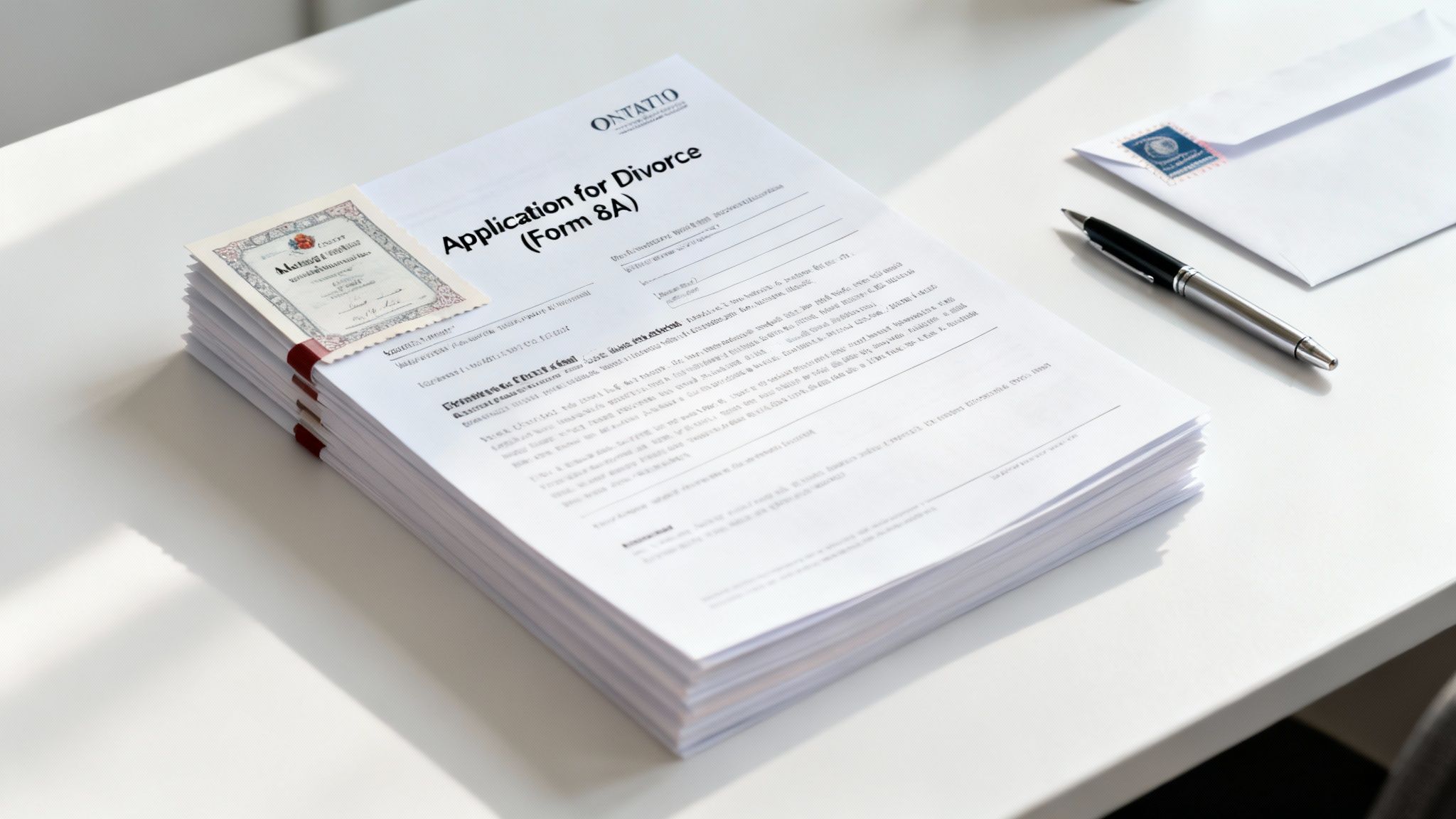
  • Form 8A Application for Divorce: This is the main court form used to ask for a divorce.
  • Form 36 Affidavit for Divorce: This confirms the factual basis for the divorce and supports the request for a divorce order.
  • Registration of Divorce Proceedings: This federal registration helps prevent duplicate divorce proceedings.
  • Original marriage certificate: The court expects proof of the marriage.
  • Table of Contents for the Continuing Record: In the simple-application track, court materials need to be organised properly in the continuing record.

The practical point is that each form does a different job. One starts the case. Another proves the legal basis. Another handles federal registration. Another confirms the marriage itself. When people treat the package as “just paperwork,” that’s when missing items slip through.

The marriage certificate issue

The original marriage certificate is one of the most common problem areas. If it’s missing, damaged, or issued in another country, don’t leave that issue to the last minute. A foreign marriage document may still be usable, but the court file needs proper proof of marriage and sometimes supporting explanation.

This is also where people sometimes discover a separate legal issue. If there was a prior divorce outside Canada, Ontario may require additional legal analysis before a new marriage or new divorce matter can proceed properly.

A file can be legally straightforward and still get delayed because the documents don’t prove the basics cleanly.

If support is in dispute, your paperwork changes

A simple divorce is narrow. Once child support, spousal support, or property claims are part of the court case, the document list grows and the work becomes more technical. Financial disclosure may become necessary, and that’s where forms such as a Form 13.1 financial statement become relevant.

That’s why it’s important to identify your path early. People often gather the wrong documents because they think they’re filing only for divorce, when in reality they’re starting a broader family law proceeding.

Court fees and fee waiver options

Cost matters. For many filers, the total court fees are approximately $632, and that can be a real barrier. Legal Aid Ontario notes that if you can’t afford the fee, you can ask the court to waive it by submitting a Fee Waiver Request form, and eligibility is based on a means test, as described in Legal Aid Ontario’s page on simple divorce and fee waiver information.

If cost is tight, deal with that issue before filing rather than after the clerk asks for payment. Fee waiver requests can be worth exploring, but the supporting documents and timing can vary in practice.

The Filing and Serving Process Explained

A Brampton client can have every form signed, the marriage certificate ready, and the court fee paid, then still lose weeks because the application was issued but never served properly. That is a common GTA problem. The court process has two separate steps, and each one has to be done correctly.

A pair of hands holding legal documents from the Ontario Superior Court inside a manila file folder.

Filing the application with the court

Divorce applications in Ontario go to the Superior Court of Justice. For many sole uncontested divorces, the court will issue the application if the forms are complete, the filing fee is paid or waived, and the supporting documents match what the rules require.

The practical problem is not usually the act of filing. It is filing a package the court staff can process without sending it back. Missing dates, inconsistent names, an unclear address for service, or a marriage certificate that does not match the application can all slow the file down. In Peel Region, those small errors often matter more than people expect because they create another round of corrections, re-sworn forms, and delay.

A clean filing also depends on the kind of divorce case you are starting. If support is still in dispute, or if parenting terms are not settled, the court process may require more than a simple divorce application. Anyone dealing with children should understand how Ontario courts assess child support obligations under Ontario law before assuming the file will stay simple.

What happens after filing

Once the court issues the application, you have an active court file. In a sole application, the next job is service. The court does not usually serve your spouse for you, and the applicant cannot ignore that step because the file number has been assigned.

Joint divorces are different. If both spouses sign and file together, service is usually not the issue it is in a sole application. In sole files, service is often the first real obstacle.

Service is often where self-represented files stall

Under the Family Law Rules, the applicant usually cannot serve the divorce application personally. Another adult has to do it, and the person who served the documents must complete proof of service. If that proof is missing or inaccurate, the court can refuse to move the file forward.

That creates real problems in the GTA. A spouse may have moved from Brampton to another city, may be staying with relatives, or may be avoiding contact altogether. Sometimes there are safety concerns, especially where there has been family violence. In those cases, proper service is no longer an administrative detail. It becomes a strategy issue.

Ontario courts can permit another method of service when ordinary service is not working, but you do not get to choose that on your own. A judge must authorize substituted service or another form of service if the rules require it, as discussed in this guide to an uncontested divorce in Ontario and service challenges.

Service problems usually start as practical obstacles. You need a reliable address, a lawful method, and proof the documents reached the right person.

What usually helps

  • Use a reliable server. A friend can sometimes do it, but a professional process server is often the better choice if the spouse is evasive, lives outside Peel, or there are safety concerns.
  • Give the server accurate information. A full name, current address, work location, photo, and vehicle details can save several failed attempts.
  • Get the affidavit of service done promptly. Service without proper proof often creates the same delay as no service at all.
  • Address foreign or out-of-province service early. If your spouse is outside Ontario or outside Canada, the timing and method can change, and mistakes there are expensive to fix.
  • Ask for help when the facts are messy. Badesha Law handles filing and service logistics for clients who do not want to manage those court steps themselves.

What causes avoidable delay

  • Serving the documents yourself in a sole application.
  • Mailing materials without authority when personal service is required.
  • Using an old address because it is the only one you have.
  • Waiting too long to deal with an evasive spouse instead of bringing a motion for another service method if the facts support it.

For GTA residents, this is the stage where local experience often saves time. I often see straightforward divorces become expensive because someone guessed at service, filed the wrong proof, or waited until a deadline had already passed before asking how to fix it.

Resolving Parenting Support and Property Division

Many people think the divorce application is where everything gets sorted out. In reality, the divorce order mainly ends the marriage itself. The family issues that matter day to day usually need their own resolution, whether by agreement, negotiation, or litigation.

Divorce doesn’t replace a settlement

If you have children, shared property, support obligations, or a dispute about the home, those issues generally need to be resolved separately from the basic request for a divorce. In an uncontested situation, that often means the spouses already have a separation agreement in place before the divorce materials go in.

That order of operations matters. A simple divorce moves best when the substantive disputes are already settled. If they aren’t, the court file can become more complex very quickly.

Parenting issues come first in real life

For parents, the urgent questions are usually practical. Where will the children live? How will parenting time work? Who makes major decisions? What happens on holidays, school breaks, or during transitions between homes?

The law now uses terms like parenting time and decision-making responsibility, but the practical concern is the same. Children need a stable plan. If child support is also in play, the financial side should be addressed at the same time. This overview of child support laws in Ontario is a helpful starting point if support hasn’t been worked out yet.

The main issues that need to be settled

When spouses say they want an uncontested divorce, these are the subjects that usually have to be clear first:

  • Parenting arrangements: A schedule, decision-making structure, and a realistic routine for the children.
  • Child support: Proper support based on the applicable legal framework.
  • Spousal support: Whether it’s payable, in what amount, and for how long.
  • Property division: Who keeps what, whether equalisation is owed, and what happens with the matrimonial home.
  • Debts and practical clean-up: Joint accounts, lines of credit, household contents, insurance, and beneficiary designations.

Why the matrimonial home causes so much conflict

The home often carries both financial and emotional weight. One spouse may want to keep it. The other may want it sold. Sometimes both are focused on affordability, not ownership. Sometimes the underlying conflict is about where the children will live and whether a move is possible.

That’s why property discussions can’t be left vague. A divorce order doesn’t automatically transfer title, remove a spouse from a mortgage, or settle equalisation rights. Those details need to be negotiated and documented properly.

A clean divorce file is usually the result of earlier legal work, not a shortcut around it.

When settlement is possible

Settlement works best when both spouses have exchanged the information needed to make informed decisions. That usually includes financial disclosure, practical proposals, and a willingness to document terms clearly. Informal verbal understandings often collapse later because each person remembers them differently.

If your issues are modest and both sides are cooperative, a separation agreement can keep the actual divorce filing relatively narrow. If the issues are significant or trust is low, legal advice before signing anything is the safer course.

Common Pitfalls and When to Call a Lawyer

A Brampton spouse files the paperwork, pays the fee, and expects the divorce to move ahead. A few weeks later, the court sends the materials back because the marriage certificate is missing, the affidavit was not commissioned properly, or service does not meet the Family Law Rules. That kind of delay is common in Peel and across the GTA. It usually starts with procedure, not a fight in court.

The practical problem is simple. Ontario divorce forms are manageable, but the court expects accuracy. If dates do not match, documents are incomplete, or service was done the wrong way, the file can stall for weeks or months.

Errors that routinely slow divorce files

Certain mistakes show up again and again:

  • Inconsistent separation dates: If the date in the application does not match the affidavit or other materials, the court may question whether the ground for divorce has been proven.
  • Affidavit defects: Form 36 must be sworn or affirmed properly before a commissioner for taking affidavits. If that step is done incorrectly, the court can reject it.
  • Missing marriage document: An original marriage certificate, or the proper replacement or explanation, is often required. This is a frequent administrative problem.
  • Incomplete filing package: One missing form, endorsement, or supporting document can stop the file from being issued or reviewed.
  • Improper service: A spouse usually cannot serve their own divorce application. If service is not done according to the rules, the next steps may be invalid.
  • Using the wrong divorce stream: A simple divorce is only for the divorce itself. If parenting, support, or property issues are still disputed, the paperwork needs to match that reality.

Court staff can identify a missing document. They cannot advise on strategy, disputed facts, or how to fix a file that was started on the wrong track.

Local pitfalls GTA clients run into

In Brampton and Mississauga files, I often see delays tied to small administrative points that look minor until the clerk reviews the package. Names on the marriage certificate do not exactly match current ID. A party was married outside Canada and does not know what document the Ontario court will accept. Someone tries to use email service without the other side consenting or without a court order permitting it. These are fixable problems, but they are easier to fix before filing than after rejection.

Cost is another place people make avoidable mistakes. The court filing fees for a divorce are usually paid in stages, not all at once, and rejected materials can mean lost time, extra commissioning, extra process server fees, or another attendance at the courthouse. For GTA clients balancing work, childcare, and court deadlines, that practical cost matters as much as the legal fee.

When calling a lawyer makes practical sense

Some files are realistic do-it-yourself matters. Others deserve legal help early because the risk of delay or a bad outcome is much higher.

Consider speaking to a lawyer if:

  1. Children are involved and parenting is not fully settled
    Parenting terms need to be clear, workable, and focused on the child’s best interests. Vague arrangements often create fresh conflict after the divorce is granted.

  2. Support is disputed or uncertain
    Child support and spousal support affect monthly cash flow, tax planning, and enforcement risk. A rushed position can be expensive to correct later.

  3. Property issues are still live
    If there is a house, pension, business interest, significant debt, or disagreement about equalization, the divorce itself is only one part of the file.

  4. Your spouse is in another province or another country
    Service, jurisdiction, and timing become more technical quickly. This is especially true where a spouse is avoiding service or where court materials need to cross borders.

  5. A foreign divorce is part of the history
    Ontario courts, immigration authorities, and remarriage planning sometimes require a foreign divorce opinion letter or other proof that the overseas divorce should be recognized here.

  6. There are safety concerns or coercive control
    Service arrangements, communication, and court attendance should be planned carefully. These are not routine filing details.

What a lawyer should actually help with

Good legal help is not limited to appearing in court. In many GTA divorce files, its primary value is earlier and more practical. That includes checking whether the case is genuinely uncontested, confirming the right forms are being used, arranging valid service, spotting issues tied to foreign marriage documents, and making sure the divorce order will fit with the larger family law picture.

For clients in Peel, local experience can also save time. Each courthouse has its own filing habits, clerk expectations, and recurring document problems. That does not change the law, but it does affect how smoothly a file moves through the system.

If you’re trying to move ahead with a divorce in Brampton, Mississauga, Toronto, or elsewhere in the GTA, Badesha Law assists with sole and joint uncontested divorces, contested family court matters, separation agreements, parenting and support issues, property division, and foreign divorce opinion letters. Early advice often prevents the kind of filing mistake that is inexpensive to avoid and frustrating to repair.

How to Apply for Divorce Ontario: A Practical Guide

So, you're considering a divorce in Ontario. The thought alone can be overwhelming, but breaking the process down into clear, manageable steps makes it far less intimidating. It all starts not with a courtroom battle, but with understanding the basic rules of the road: your eligibility, the legal grounds, and the critical difference between a smooth, uncontested process and a more complex, contested one.

Getting these initial pieces right sets the tone for everything that follows.

Your First Steps in the Ontario Divorce Process

Before you dive into filling out forms, you need to confirm a few foundational things. This is the groundwork that ensures your application starts off on the right foot, saving you from hitting frustrating and costly roadblocks later on.

A man in a gray shirt reviews paperwork in a binder at a kitchen table, with a laptop and coffee mug nearby.

Confirming Your Eligibility to File in Ontario

First things first: does Ontario have the authority to grant your divorce? The rule is simple but non-negotiable. According to the federal Divorce Act, at least one of you must have been "ordinarily resident" in Ontario for a full year immediately before you start the divorce application.

This is a strict requirement. If you just moved to the province, you'll need to wait until you hit that one-year mark before the courts here can handle your case.

Understanding the Grounds for Divorce

In Canada, there's only one legal reason for divorce: marriage breakdown. The Divorce Act gives you three ways to prove this has happened:

  1. Separation: You and your spouse have lived separate and apart for at least one year.
  2. Adultery: One spouse has committed adultery.
  3. Cruelty: One spouse has treated the other with such severe physical or mental cruelty that living together has become intolerable.

By a huge margin, citing a one-year separation is the most common path. It’s what we call a "no-fault" divorce because it doesn't require pointing fingers or proving someone did something wrong. You can even file the paperwork before the full year is up, but the judge won't sign the final divorce order until that 365-day separation period is officially complete.

One of the biggest misconceptions I see is about what "living separate and apart" actually means. It doesn't always require two different addresses. Many couples continue to live under the same roof for financial reasons or for the kids' stability while being legally separated. The key is demonstrating a clear intention to end the marriage—things like sleeping in separate rooms, having separate finances, and no longer presenting yourselves as a couple to the outside world.

Choosing Your Path: Uncontested vs. Contested Divorce

This is one of the most important forks in the road. Your choice between filing a simple (uncontested) or general (contested) divorce will shape the entire experience—from the cost and timeline to the overall stress level.

An uncontested divorce is the goal. It’s possible when you and your spouse agree on all the major issues: how to divide property, who pays support, and what the parenting arrangements will be. A contested divorce is what happens when you can't agree on one or more of these issues and need a judge to make the decisions for you.

Here’s a quick breakdown to help you see the difference.

Uncontested vs. Contested Divorce At a Glance

Feature Uncontested Divorce (Simple) Contested Divorce (General)
Agreement Both spouses agree on all key issues. Spouses cannot agree on one or more issues (e.g., property, support, parenting).
Timeline Faster. Often completed in 4-6 months. Slower. Can take 1-3 years or more.
Cost Significantly lower. Minimal legal fees. Substantially higher. Involves fees for lawyers, motions, and potentially trial.
Process Primarily paperwork-based. Little to no court time. Involves multiple court appearances, financial disclosure, and negotiations.
Control You and your spouse control the outcome. A judge makes the final decisions.
Emotional Toll Lower stress and less conflict. High stress, emotionally draining, and adversarial.

Thankfully, the trend is moving toward more amicable resolutions. Data shows that 31% of divorce applications in 2020 were filed jointly by both spouses, a clear sign that more couples are choosing to work together.

The best strategy is often to turn a contested situation into an uncontested one through negotiation, mediation, or a well-drafted separation agreement. This is where a family lawyer provides a huge strategic advantage. We can help you understand your rights, negotiate a fair settlement, and guide you down the most efficient path, helping you avoid common mistakes that cause delays and frustration. You can read our guide to better understand the difference between legal separation and divorce and see how a separation agreement is the key to an uncontested divorce.

Gathering Your Essential Divorce Forms and Documents

Once you've figured out your eligibility and the path you're taking, it's time to tackle the paperwork. Honestly, navigating the required forms is one of the most detail-heavy parts of getting a divorce in Ontario. But think of it this way: you're building the foundation for your court application. Getting this part right from the start saves you from frustrating delays and rejections down the road.

The whole process kicks off with one key document, but others quickly come into play depending on your family’s situation, especially if you have children.

The Core Application: Form 8A

The absolute centrepiece of any divorce application is Form 8A Application (Divorce). This is the document where you officially ask the court to grant your divorce and state the legal grounds for it—which, for most people, is the one-year separation. It also collects the basic details about you, your spouse, your marriage, and any kids you have.

It’s a pretty straightforward form, but accuracy is everything. Double-check that names are spelled exactly as they are on your marriage certificate and that all your dates are correct. A simple typo here can create a real procedural headache later on.

Proving Your Marriage and Its End

Along with your main application, the court needs two other critical pieces of paper to get things moving. These documents officially register your divorce with the government and prove the marriage you're asking to dissolve actually exists.

  • Registration of Divorce Proceeding Form: This form gets sent to the federal Department of Justice's Central Registry of Divorce Proceedings. Its job is to make sure there isn't another divorce application for you and your spouse already filed somewhere else in Canada. It's a simple safeguard against duplicate cases.

  • Original Marriage Certificate: The court needs your original, government-issued marriage certificate. A photocopy just won't cut it. If you were married here in Ontario, you can easily order a new one from ServiceOntario. If you got married outside of Canada, you'll need the original certificate from that country. And if it isn't in English or French, you must provide a certified translation.

What if you can't find your marriage certificate? Don't panic. You can file a sworn statement, known as an affidavit, explaining why you can't produce it and giving as many details as you can remember about the marriage ceremony. Still, getting a replacement is always the cleaner and more direct route.

Additional Forms When You're a Parent

If you and your spouse have dependent children, the Divorce Act is very clear: a judge must be satisfied that reasonable arrangements are in place for their support before they will grant a divorce. This means you have to file a few more documents that lay out your parenting and financial details.

The main forms you'll run into are:

  • Parenting Affidavit (Form 35.1): This form gives the court a snapshot of your current parenting setup and what you're proposing for the future regarding decision-making and parenting time.
  • Financial Statement (Form 13 or 13.1): This is one of the most critical documents anytime support is on the table. It paints a complete picture of your income, expenses, assets, and debts. Our firm has put together a detailed guide to help you get your head around the Form 13.1 Financial Statement and why it's so important for calculating support.
  • Child Support Information: You'll also need to provide calculations based on the Federal Child Support Guidelines to show the court that the correct amount of child support is being paid.

Your Most Powerful Tool: The Separation Agreement

While it's not a mandatory court form, a Separation Agreement is the single most effective document you can have when you're aiming for an uncontested divorce. This is a legally binding contract that you and your spouse work out before filing with the court to settle all the big issues—property division, spousal support, child support, and parenting.

When you attach a comprehensive, signed Separation Agreement to your application, you're essentially telling the judge, "We've already sorted everything out." It signals that there are no fights left to be had, making the court's job of reviewing and approving your divorce significantly faster and easier. It's the key to turning a potentially messy divorce into a streamlined, administrative process.

The Filing and Serving Process Explained

Once you have your paperwork meticulously prepared, it’s time to make your divorce application official. This is a two-part move: filing the documents with the court and then formally notifying your spouse. Getting this procedural part right is absolutely non-negotiable for anyone learning how to apply for divorce in Ontario.

Choosing Your Filing Method

You have two main avenues for filing your application with the Ontario Superior Court of Justice.

  • Online Filing: The Ontario government now has an online portal for filing divorce applications. For many, this is the faster and more convenient route, letting you submit everything electronically from home. It's an excellent choice for straightforward, uncontested cases.
  • In-Person Filing: You can always go the traditional route and file your documents in person at your local courthouse. This can be a good option if you have questions for the court clerk or just feel more comfortable handling physical copies of your paperwork.

Regardless of which path you choose, you'll need to pay the court filing fees at this stage. These fees cover the administrative costs of opening your file and having a judge review it.

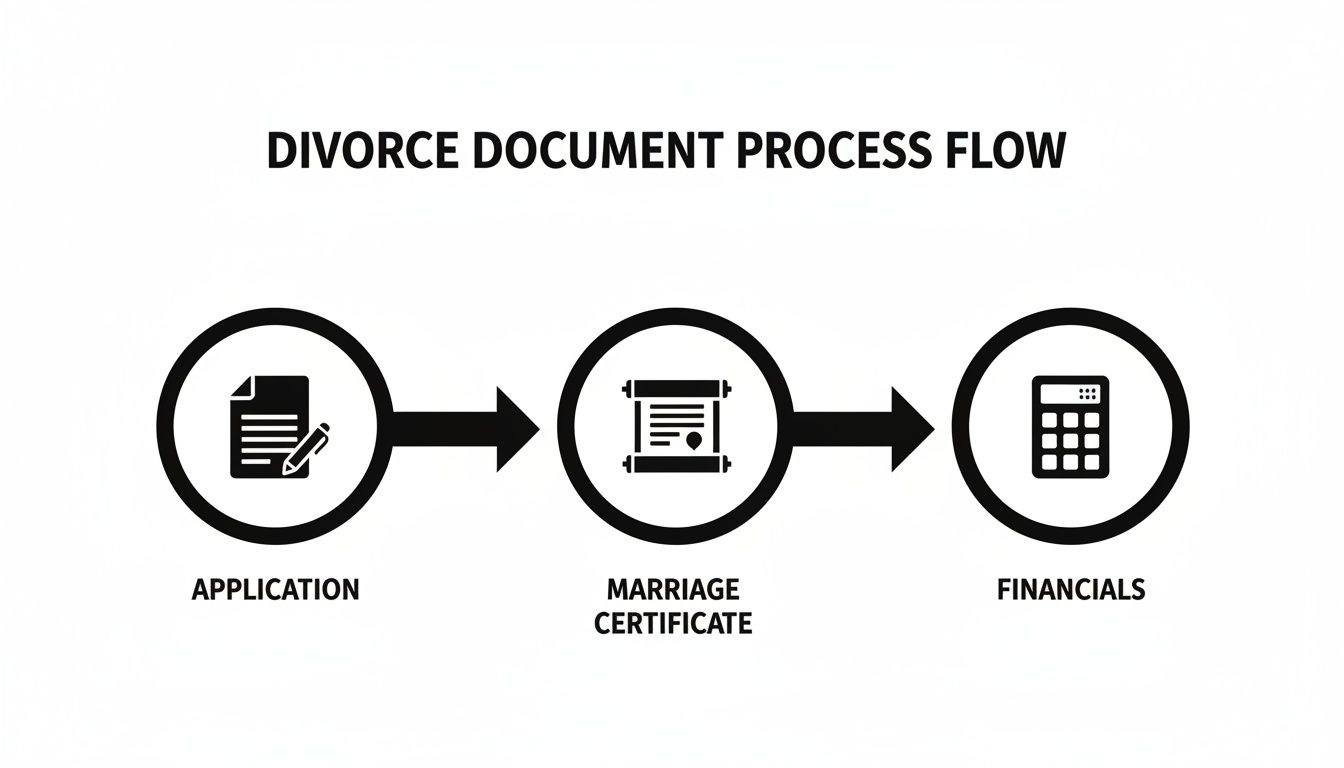
The key documents you’re submitting at this point are your application, marriage certificate, and any financial statements.

A divorce document process flow diagram detailing the steps: Application, Marriage Certificate, and Financials.

As this flow shows, these documents form the core package that officially starts your divorce proceedings.

The Critical Step of Serving Your Spouse

Filing with the court is only half the battle. The law is very clear that your spouse must be formally notified of the divorce application—a process called “serving” the documents. You cannot simply hand the papers to them yourself.

Service isn't just a formality; it ensures the other person is aware of the legal action and has a fair chance to respond. In most situations, service has to be done by a neutral third party, like a friend or family member (as long as they are over 18) or a professional process server. They physically deliver a copy of the court-stamped documents to your spouse.

Of course, if you and your spouse are on good terms and filing together, you can bypass this step completely. Our detailed guide explains the benefits of a joint divorce application in Ontario, which is a much simpler process that doesn't require formal service.

Proving Service with Form 6B

After the documents have been successfully delivered, the person who served them must complete Form 6B: Affidavit of Service. This is a sworn legal document where they confirm they handed the papers to your spouse on a specific date and time.

This affidavit is your official proof for the court. Without a properly completed Form 6B, the court will not accept that your spouse has been notified, and your divorce application will stall. It’s a small form with a huge impact on your case's progress.

What Happens When Service Becomes Complicated

Sometimes, serving a spouse isn't as simple as knocking on a door. They might be actively avoiding the server or could have moved without leaving a forwarding address. When this happens, you can't just give up; you have to ask the court for permission to serve them in a different way.

  • Substituted Service: This is when you ask a judge for an order allowing you to use an alternative method. For example, you might get permission to leave the documents with another adult at their workplace or send them via registered mail to their last known address.
  • Special Service: In more extreme cases, like when you have absolutely no idea where your spouse is, a judge might grant an order for special service. This could involve serving a close relative of theirs or, in very rare circumstances, dispensing with service altogether if you can prove you've exhausted every possible avenue to find them.

Navigating substituted or special service requires a formal court motion and solid evidence. It's a clear example of when having legal guidance becomes essential to prevent your divorce from getting stuck on a procedural technicality.

Understanding Divorce Costs and Timelines in Ontario

When you start down the path of divorce, two questions almost always come first: how much is this going to cost, and how long is this going to take?

Getting a realistic handle on the financial and time commitments from the outset helps you plan and keeps expectations grounded. The single biggest factor that will shape both of these answers is the path you and your spouse take—specifically, whether your divorce is uncontested or contested.

Breaking Down the Costs of Divorce

The expenses you'll face fall into two main buckets: mandatory court fees and professional legal fees. While the court fees are fixed, your legal costs can swing dramatically depending on how complicated your situation is.

The court fees are set by the province and are non-negotiable. As of early 2024, you can expect to pay:

  • $224 to file your initial Application for Divorce.
  • $445 for the court to review your final paperwork and grant the Divorce Order.

That brings the total for the required administrative fees to $669. This covers the court's side of the process but doesn't include smaller expenses like commissioning affidavits or hiring a process server, which might add a little bit more.

Legal Fees: The Biggest Variable

This is where the real cost of a divorce lies, and it's where the difference between a smooth, uncontested split and a messy, contested one becomes crystal clear.

If you and your spouse have already sorted everything out in a Separation Agreement, the divorce is simple. Your lawyer’s job is mainly to draft the documents, make sure they’re filed correctly, and guide the application through the court system. The legal fees are much, much lower.

But if you’re at odds over major issues like property division or support, the costs can escalate fast. A contested divorce has a lot more moving parts: tense negotiations, deep dives into financial disclosures, court motions, and maybe even a trial. Every one of these steps requires a significant amount of your lawyer's time, which directly translates to higher fees. For a more detailed look, you might find our guide on how Ontario divorce costs are calculated helpful.

The financial reality is a major factor for most people. An uncontested divorce can still cost a few thousand dollars in legal fees, but that figure can skyrocket in a contested case. It’s this financial pressure that often pushes couples to find common ground rather than endure a long, expensive court battle.

Mapping Out the Divorce Timeline

Just like the costs, the timeline for your divorce depends heavily on cooperation. An uncontested divorce in Ontario tends to follow a fairly predictable schedule.

Once all your final documents are filed, the process is mostly out of your hands. A court clerk will review everything to make sure it’s all in order. If it is, the file lands on a judge’s desk for a final review and signature. This administrative phase usually takes between 2 to 4 months, but it can stretch longer if your local courthouse has a backlog.

After the judge signs the Divorce Order, it's not official just yet. There’s a mandatory 31-day waiting period. This is a built-in cooling-off period that gives either person a last chance to appeal.

Once those 31 days are up, your divorce is legally final. At that point, you can apply for your official Certificate of Divorce, which is the document you’ll need if you ever plan to remarry.

For a contested divorce, there is no set timeline. The process can drag on for over a year, or even several years. It all comes down to how long it takes to resolve the disputed issues, whether through negotiation or court proceedings. This uncertainty is exactly why finding a way to agree outside of court is almost always the most efficient path forward.

Sorting Out the Big Three: Parenting, Support, and Property

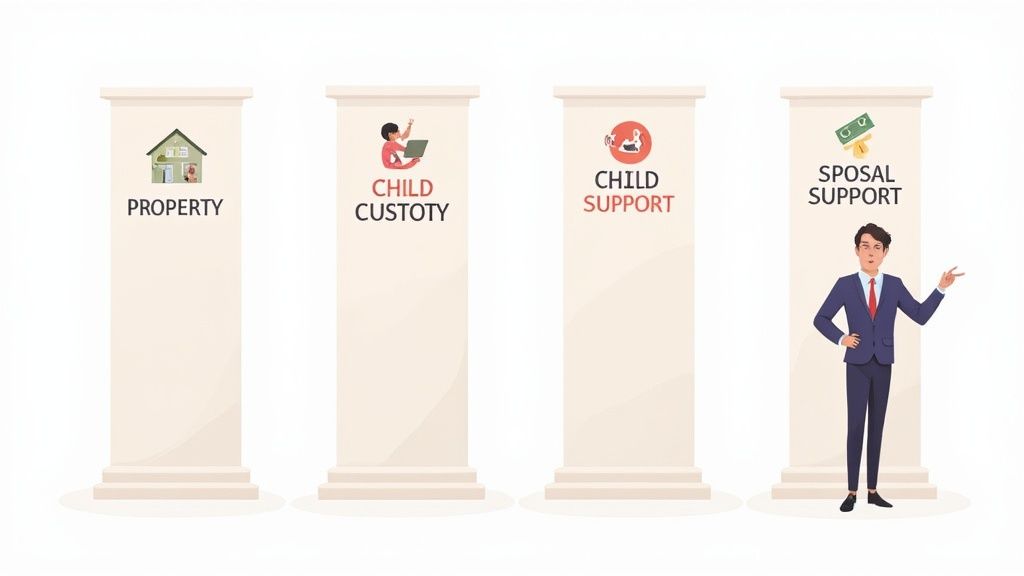
A divorce order officially ends your marriage, but it's the agreements you make on the major issues that truly shape what your life will look like afterward. Before any judge in Ontario will sign off on your divorce, they need to be satisfied that three critical areas have been properly handled: parenting arrangements, financial support, and the division of your property.

A framed family photo, model house, and documents with a pen on a wooden desk.

Tackling these things head-on is the single best way to ensure your divorce proceeds smoothly. The most powerful tool you have for this is a Separation Agreement.

This is a legally binding contract where you and your spouse decide the terms of your split yourselves, instead of leaving it in the hands of a judge. It's your way of showing the court that all the potential conflicts are already resolved, which turns the divorce application itself into a much simpler, administrative process.

Parenting Language Has Changed for the Better

You might have noticed that the legal language around parenting has shifted. Canada's Divorce Act was updated to be more child-focused and less about parental conflict. The old, adversarial terms "custody" and "access" have been officially replaced.

Here’s the new terminology you'll see on all court documents:

  • Parenting Time: This is simply the schedule that outlines when the children are in each parent's care. The focus is on the child's actual experience, not a parent's "right" to have them.
  • Decision-Making Responsibility: This covers who gets to make the big calls on things like education, major healthcare decisions, and religious upbringing. It can be shared jointly between parents or assigned to just one.

At the end of the day, the court has only one guiding principle: the best interests of the child. A clear, thoughtful, and stable parenting plan isn't just a good idea—it's a requirement before a judge will grant your divorce.

The Math Behind Financial Support

Money is often the biggest source of stress during a divorce, but the rules in Ontario provide a pretty clear framework for both child and spousal support.

Child Support is considered the right of the child, which means it’s not something parents can negotiate away. The amount is calculated using the Federal Child Support Guidelines, based on a straightforward formula:

  1. The paying parent's gross annual income.
  2. The number of children who need support.
  3. The province where the paying parent lives.

Spousal Support, however, isn't automatic. It's designed to address any financial imbalances that came about because of the marriage or its breakdown. A judge will look at many factors, like how long you were married, the roles each of you played during that time, and one spouse's financial need versus the other's ability to pay.

A common myth I hear all the time is that a short marriage or similar incomes automatically means no spousal support. While those are key factors, the court looks at the whole story. For instance, if one spouse gave up a career to support the other's ambitions, they might be entitled to support to help them get back on their feet, even if the marriage was relatively short.

Dividing Your Property and the Family Home

Under Ontario's Family Law Act, married couples go through a process called equalization of Net Family Property (NFP). In simple terms, you each calculate the growth in your net worth from the day you got married to the day you separated. The spouse whose net worth grew more usually makes a payment to the other to "equalize" the difference.

But the matrimonial home gets special treatment. Unlike other assets you might have owned before the marriage, the home's full value on the date of separation is included in this calculation, no matter whose name is on the title. This unique rule really highlights how central the family home is in the eyes of the law.

These legal frameworks are also adapting to modern family structures. The 2021 census revealed that 23% of Canadian couples are now living common-law, a huge increase that often happens before marriage. This means many people who apply for divorce have already lived together and acquired assets during that time, which makes having a detailed and comprehensive separation agreement more crucial than ever. You can dig into more of these family law trends and what the latest data reveals.

By proactively addressing these three pillars—parenting, support, and property—you take control of the process and put yourself on the fastest track to a fair and efficient divorce.

Finalizing Your Divorce and Preparing for the Future

Once your divorce application is filed and your spouse has been properly served, the heavy lifting on your end is mostly done. The process now moves into a final, administrative stage where the court system takes over to finalize everything.

First, your file lands on the desk of a court clerk for a thorough review. They are the gatekeepers, meticulously checking that every form is complete, every signature is in place, and all the procedural rules have been followed. If anything is missing or incorrect, they'll send the file back, and unfortunately, that means delays.

From the Clerk to the Judge

After the clerk gives your file the green light, it’s passed on to a judge for the final sign-off. The judge reviews all the documents to make sure the legal requirements of the Divorce Act have been met.

Crucially, if you have children, the judge will pay close attention to the child support arrangements. They must be satisfied that reasonable support is in place before they will grant the divorce.

This entire review happens "on the desk," which means for a simple, uncontested divorce, you won't have to step foot in a courtroom. The judge simply reviews the paperwork and, if everything is in order, signs the Divorce Order—the official document that legally ends your marriage.

Don't celebrate just yet. Your divorce isn't final the moment the judge signs the order. There is a mandatory 31-day waiting period that starts right after the order is issued. This window exists to allow for any last-minute appeals, and only after it expires is your divorce legally complete.

Once those 31 days have passed, you can officially get your Certificate of Divorce. This is the ultimate proof that you are divorced, and you'll absolutely need it if you ever plan to remarry. For the specifics on getting this final document, check out our guide on how to get your divorce certificate in Ontario.

Post-Divorce Administrative Tasks

With the legal process officially behind you, it’s time to tackle the personal admin that comes with your new status. This isn’t just tidying up; it's about securing your future.

Here are a few key tasks you'll need to handle:

  • Update your will and powers of attorney immediately.
  • Change the beneficiary designations on any life insurance policies, RRSPs, and pensions.
  • Update your marital status with government agencies like the Canada Revenue Agency (CRA).

Common Questions We Hear About Ontario Divorces

Even with a detailed guide, the divorce process can bring up specific questions that feel unique to your situation. Here are some clear, straightforward answers to the queries we see pop up time and time again.

I Was Married Abroad. Can I Still Get Divorced in Ontario?

Yes, you absolutely can. The key isn't where you got married, but where you live now.

Under Canada’s federal Divorce Act, the only thing that matters for jurisdiction is residency. As long as either you or your spouse has been living in Ontario for at least one full year right before filing the paperwork, our courts have the authority to legally end your marriage.

You'll just need to provide your original marriage certificate from that country. If it isn't in English or French, you'll also have to get it translated by a certified translator and submit their sworn affidavit along with the translated copy.

What’s the Difference Between a Divorce and a Separation Agreement?

This is a big one, and it's easy to get them mixed up. Think of it like this: they are two separate but closely related legal steps.

A separation agreement is a private, legally binding contract you and your spouse create. It’s the detailed playbook for how you’ll untangle your lives—settling everything from property division and support payments to parenting schedules. It's where you make all the important decisions.

A divorce, on the other hand, is the official court order that legally terminates your marriage. A solid separation agreement is the foundation for a smooth, uncontested divorce. It shows the court you've already resolved all the potentially contentious issues, turning the divorce itself into a simple, administrative step.

A well-drafted separation agreement is the single most powerful tool you have to control the cost, timeline, and outcome of your divorce. It shifts the process from a potential court battle into a straightforward paperwork exercise.

Do I Actually Have to Go to Court for My Divorce?

For the vast majority of uncontested divorces in Ontario, the answer is no—you never have to set foot in a courtroom.

The entire process is managed through the documents you file. A judge simply reviews your application and all the supporting paperwork from their desk. If everything is in order, they sign and grant the Divorce Order without ever needing to see or speak to you in person.

Court appearances are really only necessary for contested divorces, where you and your spouse can't agree on key issues and a judge needs to hear arguments from both sides before making a final decision.


Navigating the divorce process requires precision and clarity at every turn. At Badesha Law, we provide the expert guidance needed to manage your application efficiently, helping you sidestep costly errors and unnecessary stress. Whether you're moving toward a simple uncontested divorce or need strong advocacy for a more complex matter, our team is ready to help you move forward with confidence. For a free consultation to discuss your specific situation, contact us today.

Can a Divorce Be Denied in Canada? A Guide from a Divorce Lawyer in Brampton

It’s a question that keeps many people up at night when they start the separation process: can a judge actually say no and deny your divorce?

While it’s a daunting thought, the simple answer is that it's extremely rare for a divorce to be outright denied in Canada. If you meet the legal grounds set out in the federal Divorce Act, the court is obligated to grant your divorce. The key is making sure your application is prepared correctly and all related matters, like child support, are resolved according to Ontario law. This is where a skilled divorce lawyer in Brampton can make all the difference, ensuring your case moves forward without unnecessary hurdles.

The Rare Cases Where a Divorce Can Be Denied in Canada

A judge's main role in a divorce hearing isn't to decide if you should get divorced, but to confirm that a legal "breakdown of the marriage" has actually happened. Once that's established, the divorce must be granted.

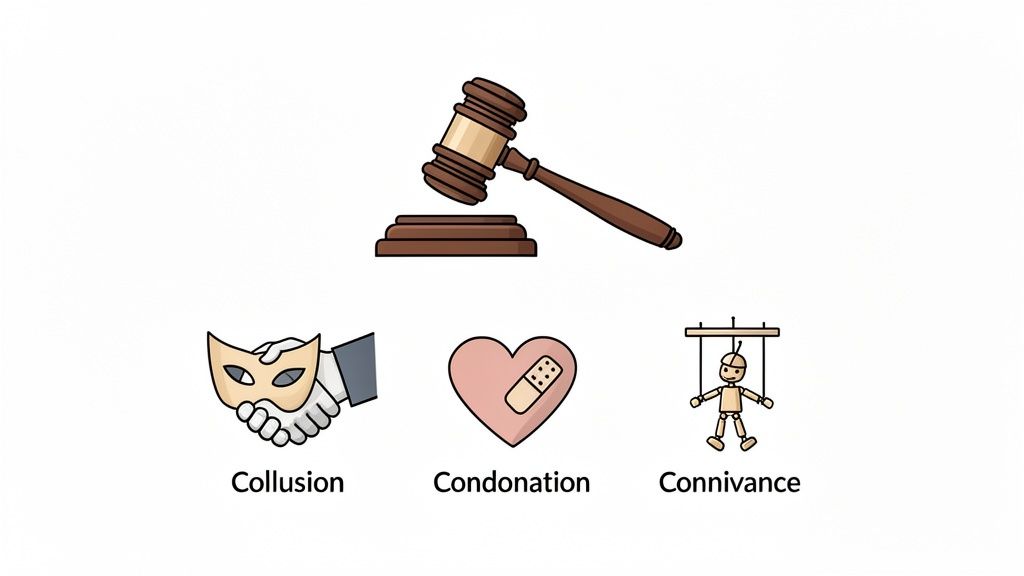
However, the Divorce Act does contain a few specific "bars to divorce" that can stop the process in its tracks. These are rarely used today, but they exist as safeguards to prevent people from misusing the court system.

A judge's gavel above three icons representing legal terms: collusion (masked handshake), condonation (bandaged heart), and connivance (puppet).

Think of these bars as the court’s way of ensuring the reasons for the divorce are genuine and not fabricated to get a faster result.

Understanding Collusion

Collusion is when spouses agree to lie to the court. This could mean inventing grounds for divorce—like making up a story about adultery or fudging the date of separation—just to speed things up.

For example, if a Brampton couple falsely claims one person had an affair to get around the mandatory one-year separation period, that’s collusion. If a judge discovers this, they are required by the Divorce Act to dismiss the divorce petition. It's a serious issue that undermines the integrity of the family court system.

Key Takeaway: The court system in Brampton operates on honesty. Any attempt to mislead the court by faking the reasons for your divorce can get your case thrown out immediately.

Connivance and Condonation

Two other historical roadblocks are connivance and condonation. These pop up specifically when a divorce is filed based on adultery.

  • Connivance: This is when one spouse actively encourages or helps the other spouse cheat, essentially setting them up to create grounds for divorce.
  • Condonation: This happens when a spouse forgives their partner for adultery and the couple fully resumes their marital relationship. If you knew about the affair and chose to reconcile, you can’t turn around later and use that same affair as your reason for divorce.

Imagine a spouse finds out about an affair, forgives their partner, and they continue living together as a couple for another year. Legally, that act of adultery has been "condoned." They would have to rely on other grounds, like the one-year separation, to move forward with the divorce.

The Most Common Hurdle: Delay, Not Denial

While those legal bars are rare, the single biggest reason a divorce hits a snag is far more practical: unresolved issues about the children.

Section 11(1)(b) of the Divorce Act is crystal clear on this. A judge must be satisfied that reasonable arrangements have been made for child support before they will grant a divorce. This isn't a suggestion; it's a mandatory rule grounded in both federal and Ontario's Family Law Act.

If your child support plan doesn't follow the Child Support Guidelines or if there are still disputes over parenting time and decision-making, a judge will simply refuse to sign the final Divorce Order.

Your case isn't denied forever, but it’s put on hold until you can prove the children's needs have been properly and legally sorted out. For any parent in Brampton, this means having a solid separation agreement or court order that clearly lays out child support is non-negotiable. An experienced local family lawyer will make this their top priority, ensuring your kids are protected so your divorce can proceed without hitting this very common, and very avoidable, roadblock.

Establishing Grounds for Divorce in Ontario

Getting a divorce in Ontario isn’t as simple as just deciding your marriage is over. You have to legally prove that your marriage has had an "irretrievable breakdown." Under Canada's Divorce Act, there are only three ways to do this.

Getting this first step right is critical. If you can't properly establish one of these grounds, your entire application can stall. This is why getting actionable advice from a Brampton divorce lawyer early on is so important—it sets the foundation for a successful outcome.

The No-Fault Path: Separation for One Year

By far, the most common and least confrontational way to get divorced is by living separate and apart for at least one year. This is the "no-fault" route because you don't have to assign blame for why the marriage ended.

Most people in Brampton prefer this path because it’s much less adversarial. The one-year clock starts the moment you begin living separately with the intention to end the marriage. You can file your Application for Divorce before the year is up, but the court in Brampton won't grant the final Divorce Order until the full 365-day period has passed.

Key Insight: The court's focus here isn't on who did what to whom. It's about recognizing the marriage has broken down. This client-focused approach helps lower conflict, allowing you and your ex-partner to focus on resolving practical matters like finances and parenting arrangements.

Can You Be "Separated" Under the Same Roof?

With the high cost of living in Brampton, a critical question for many clients is whether you can start the separation clock while still living in the same house. The answer is a clear yes. The law understands that it’s often financially impossible for a couple to suddenly support two separate households.

But you have to prove it. To show you're truly separated while cohabiting, there needs to be a fundamental change in your lifestyle. This means:

  • Sleeping in separate bedrooms.
  • Stopping all intimate and social aspects of your relationship.
  • Handling your own laundry, cooking, and finances separately.
  • Telling friends and family that you have officially separated.

Real-World Scenario: A couple in Brampton with two children can't afford to immediately sell their home near Professor's Lake. One spouse moves into the basement, they open separate bank accounts, create individual budgets, and stop attending community events as a couple. Their lawyer helps them draft a Separation Agreement that clearly states their date of separation, which the court later accepts without issue.

The Fault-Based Grounds: Adultery and Cruelty

While less common, you can still file for divorce on "fault" grounds. The main advantage? You can apply immediately without the one-year wait. These grounds are adultery and cruelty.

Adultery: This means your spouse engaged in physical intimacy with someone else. To use this as your reason for divorce, you need proof, which can be difficult and emotionally taxing to obtain. You must also swear in a legal affidavit that you did not condone or connive in the affair.

Cruelty: This involves physical or mental cruelty from your spouse that makes it unbearable to continue living together. This is a very high legal standard to meet. The court looks for cruelty of a "grave and weighty" nature, not just arguments or unhappiness.

  • Physical Cruelty: This includes acts of domestic violence. These are also criminal matters handled under the Criminal Code of Canada, so ensuring your safety is the absolute first priority.
  • Mental Cruelty: This could be relentless verbal abuse, emotional manipulation, or severe financial control that seriously harms your well-being.

Seeking a divorce based on cruelty requires strong evidence, such as medical reports, police records, or testimony from witnesses. A Brampton divorce lawyer can provide an honest assessment of whether your situation meets this strict legal test and guide you on the safest way to proceed while protecting your rights under both family and criminal law.

Why Child Support Is a Non-Negotiable Hurdle

If there’s one issue guaranteed to bring your divorce proceedings to a grinding halt in a Brampton courthouse, it’s unresolved child support. This isn't just a common snag; it's a complete showstopper. The reason is rooted firmly in federal law—specifically, Section 11(1)(b) of the Divorce Act.

This section makes it crystal clear: a judge must be satisfied that "reasonable arrangements" have been made for the financial support of any children before they can grant a divorce. This isn't a suggestion or a guideline. It's a strict legal obligation. Your divorce simply cannot move forward until this condition is met.

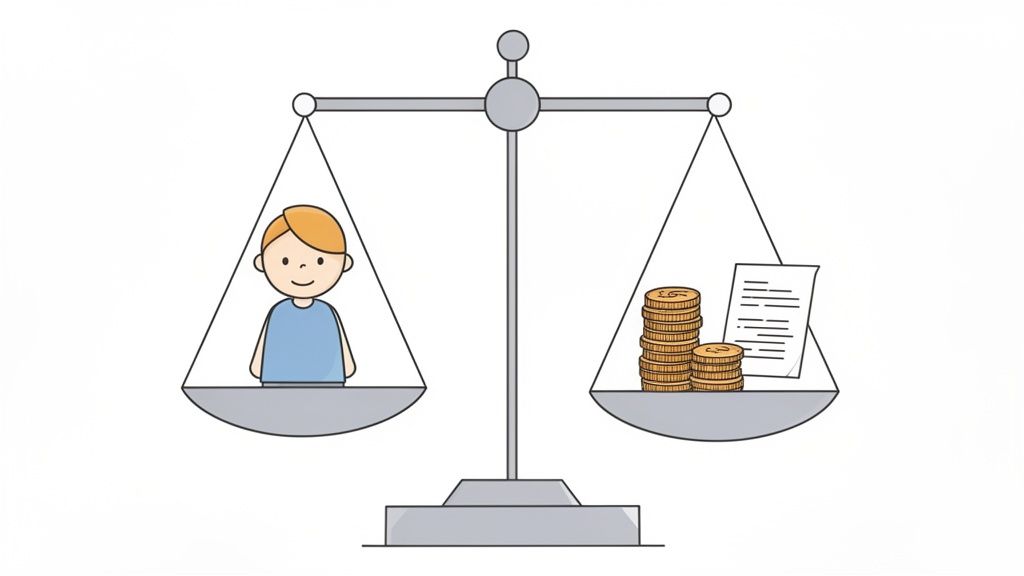
A balanced scale comparing a person's importance with stacks of money and a legal document.

This rule exists for a simple, powerful reason: to protect the children. The court acts as a final safeguard, ensuring their financial stability isn't a casualty of their parents' separation. It’s about honouring every child’s right to support.

The Role of Ontario’s Child Support Guidelines

So, what exactly are "reasonable arrangements"? For that, Ontario courts turn to the provincial Child Support Guidelines. Think of the Guidelines as a set of rules and tables used to calculate the base amount of child support one parent pays to the other.

The calculation comes down to a few key factors:

  • The paying parent's gross annual income.
  • How many children need support.
  • The province where the paying parent lives.

The goal is to create a fair and consistent standard so that children continue to benefit from the financial means of both parents, just as they would if the family were still together. A judge will not sign off on a divorce where the child support arrangement deviates from these guidelines without a very, very good reason.

Key Takeaway: The Child Support Guidelines are not optional. A Brampton judge will expect any agreement you present to align with these official calculations. Trying to agree on a lower amount without proper justification is one of the most common reasons a divorce application gets rejected.

Common Disputes That Stall a Divorce

Even with a formula, things get complicated. Disputes pop up all the time that can stall the entire process, often requiring an experienced divorce lawyer in Brampton to get things back on track.

1. Disagreements Over Income
This is a big one. It's common to see arguments over a spouse's true income, especially if they are self-employed, own a business in Peel Region, or get paid in cash. We often see one party claim their income is much lower than it really is to try and reduce their support obligation.

2. Section 7 Expenses
These are the "special or extraordinary expenses" that go above and beyond the basic table amount. Think costs for competitive sports, private tutoring, orthodontics, or post-secondary education. Parents frequently disagree on whether an expense is truly necessary or reasonable, and how the cost should be split.

3. Parenting Time and Set-Offs
If parenting time is shared almost equally (meaning each parent has the children at least 40% of the time), the child support calculation can change. This can spark disputes over the parenting schedule itself, because the calendar now directly impacts the wallet.

A Brampton-Based Scenario

Let's picture a couple separating right here in Brampton. The father is a self-employed contractor, and the mother is a salaried nurse with two kids. Their divorce hits a wall.

First, the father claims his income is only $50,000 a year. But a closer look at his business statements shows a lot of personal expenses—car payments, vacations, meals—being run through the company. The mother's lawyer digs in and argues his real income for support purposes is closer to $90,000.

Second, they’re fighting over Section 7 expenses. Their son plays rep hockey, and it's not cheap. The father insists it’s an unnecessary luxury and refuses to pay his share. A judge, seeing this mess, will absolutely refuse to sign the final Divorce Order until the income is properly determined and a fair contribution to the hockey costs is locked in.

The Path Forward: Full Disclosure and Smart Negotiation

The only way to avoid this major roadblock is with complete financial transparency and skilled negotiation. Both of you have a legal duty to provide full and honest financial disclosure. Hiding assets or fudging income numbers won't work—it will eventually come out, causing massive delays and driving up legal costs.

This is exactly where a dedicated divorce lawyer proves their worth. We ensure all financial documents are properly exchanged, analyze the numbers to pinpoint the correct income for support, and negotiate a fair agreement on those tricky special expenses. By building a child support arrangement that follows the guidelines and meets your children's needs, you clear the biggest hurdle standing between you and your final Divorce Order.

How Financial Pressures in Brampton Can Stall Your Separation

Sometimes, the biggest roadblock in a separation isn't a legal snag or a fight with your spouse—it’s the stark financial reality staring back at you from your bank account. A judge might be ready to grant your divorce, but the high cost of living in Brampton and across the Peel Region can feel like a denial in itself.

It's a trap I see clients fall into all the time. The math just doesn't add up. Trying to fund two separate households on the same combined income is, for many, simply impossible. Imagine the cost of two apartments or condos, two sets of hydro bills, and double the daily living expenses. It’s overwhelming.

This financial pressure often forces couples to keep living under the same roof long after they've decided to go their separate ways, creating a tense and emotionally draining environment for the entire family. It's one thing to be emotionally ready to move on, but it’s another thing entirely to be able to afford it.

The Staggering Cost of a Contested Divorce

Beyond just finding a new place to live, the potential cost of the divorce itself is a massive source of anxiety. The financial path you take can split dramatically depending on one thing: whether your divorce is contested or uncontested.

An uncontested divorce, where you and your spouse agree on all the big issues like property and support, is by far the most affordable route. But when disagreements crop up, legal fees can skyrocket, turning a manageable expense into a financial nightmare.

To put it in perspective, let's look at the numbers.

Comparing Divorce Costs in Ontario: Uncontested vs. Contested

The difference in cost between a smooth, agreed-upon separation and a drawn-out court battle is huge. This table breaks down what Brampton residents can generally expect to face financially.

Divorce Type Average Legal Fees Key Characteristics
Uncontested Divorce ~$1,860 Both spouses agree on all major issues. Minimal court involvement. Faster timeline (4-6 months). Focus on paperwork and settlement.
Contested Divorce ~$20,625+ Spouses disagree on property, support, or parenting. Requires multiple court appearances, negotiations, and potentially a trial. Can take over a year to resolve.

Source: Canadian Lawyer’s 2022 Legal Fees Survey

As you can see, the financial stakes are incredibly high. The average cost of a contested divorce can climb well over $20,000 and even hit $25,000 in particularly messy cases. This stark difference is exactly why avoiding a court battle is so critical for families in Brampton who are already feeling the financial squeeze.

From My Experience: The single most effective way to control the cost of your divorce is to minimize conflict. A good Brampton divorce lawyer won’t rush you into court. Instead, they’ll prioritize practical solutions like negotiation and mediation to help you reach a fair settlement, saving you thousands of dollars and months of stress.

A Strategic Path Forward

Feeling financially stuck is a tough spot to be in, but it doesn't have to be permanent. With the right legal strategy, you can carve out a path that makes separation financially possible.

A client-focused divorce lawyer in Brampton gets it. They understand the local economic pressures you're up against and will work with you to create a realistic plan that doesn’t break the bank. This approach usually involves:

  • Focusing on a Separation Agreement: This is a legally binding contract that lets you sort everything out privately, giving you certainty and saving you from massive court fees.
  • Exploring Mediation: A neutral mediator can help you and your spouse find common ground on tough issues, often at a fraction of the cost of litigation.
  • Demanding Transparent Fees: You should have a clear picture of potential costs from day one, with no surprises down the road.
  • Finding Creative Financial Solutions: This might mean a structured buyout of the family home or other smart arrangements that allow for a fair split of assets without forcing a costly fire sale.

By taking these practical, strategic steps, what once seemed like an economic impossibility can become a manageable process. It’s about finding the right tools to finally let you move forward with your life.

Your Action Plan for a Successful Divorce in Brampton

Moving from confusion to control requires a clear, organized strategy. For anyone in Brampton facing a divorce, the first steps you take can mean the difference between a drawn-out, expensive battle and a fair, efficient resolution. Think of this as your personal roadmap—a way to get organized and feel like you're back in the driver's seat.

A skilled divorce lawyer in Brampton, Ontario, is more than just a legal representative; they're your strategic advisor. Their job is to help you see around corners and avoid common pitfalls, whether it's a simple procedural error like improperly serving documents or a major issue like incomplete financial disclosure. Getting organized from day one is the single best thing you can do to protect your rights.

Begin with Financial Housekeeping

The entire foundation of a divorce settlement rests on a clear picture of the family's finances. Before you file a single document, your first job is to gather all the relevant financial information. This isn't just a good idea—it's a legal requirement in Ontario known as financial disclosure, mandated by the Family Law Act.

Start collecting the key documents now. Being prepared will save you a surprising amount of time and money when you meet your lawyer.

  • Income Verification: Pull together your last three years of income tax returns, Notices of Assessment, and recent pay stubs. If you own a business, you'll need proof of that income too.
  • Asset Documentation: This includes bank statements, investment account statements (like RRSPs and TFSAs), and any property deeds for real estate you own.
  • Debt Information: Make a file with statements for all liabilities—mortgages, lines of credit, credit cards, and car loans.
  • Valuations: If you own a business, a pension, or even valuable items like art or jewellery, you'll likely need to get them professionally appraised.

Expert Tip: Create a simple spreadsheet listing all assets and debts. Note their value on two specific dates: the date you were married and the date you separated. This "Net Family Property" calculation is how property division is determined in Ontario, and having this ready is a massive head start.

The Power of a Separation Agreement

Many people assume divorce automatically means a messy court battle, but that's rarely the case. In reality, the vast majority of divorces in Brampton are settled out of court, and the key is a comprehensive Separation Agreement. This is a legally binding contract that you and your spouse negotiate and sign, spelling out how you'll resolve all the big issues.

A well-drafted agreement covers absolutely everything:

  • Division of property and debts.
  • Spousal support (if it applies).
  • Parenting time and decision-making responsibility.
  • Child support, including the base amount and any special or extraordinary expenses.

Finalizing a separation agreement before heading to court makes the entire divorce process faster, cheaper, and infinitely less stressful. It puts you and your spouse in control, rather than leaving life-altering decisions to a judge who doesn't know you or your family.

Exploring Cost-Effective Alternatives

The emotional and financial weight of a contested divorce can be crushing. Thankfully, there are effective, lower-conflict ways to reach an agreement without ever stepping inside a courtroom.

Mediation is an incredibly popular choice for couples in Brampton. A neutral third-party mediator helps you and your spouse have a productive conversation, guiding you toward a solution you can both live with. The mediator doesn't make decisions for you; they just help you find common ground. The whole process is confidential and usually far more affordable than litigation.

Of course, the legal side is only one part of the journey. Addressing the emotional impact is just as important. Resources like professional counselling can provide essential support during and after your separation. Seeking grief and loss counselling can be an invaluable part of your action plan, helping you build the resilience you'll need for the path ahead.

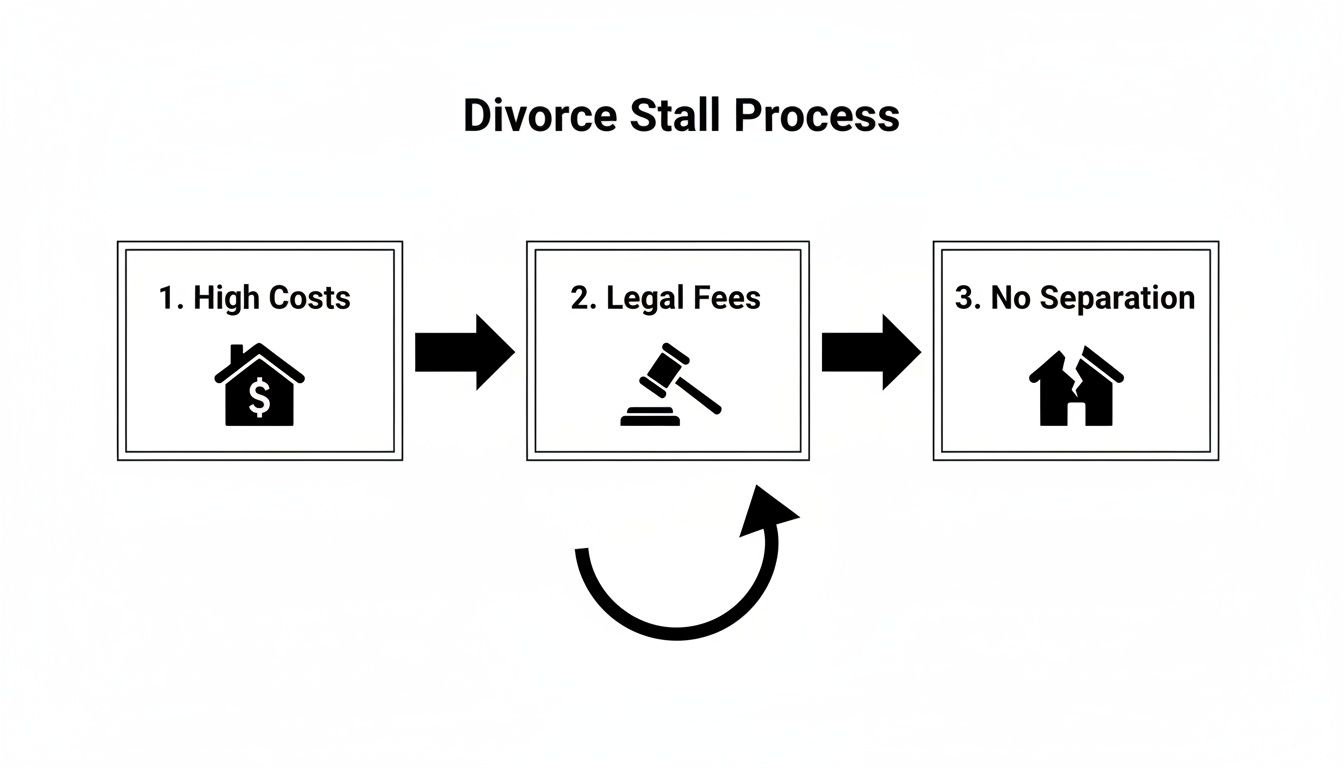
This infographic shows just how easily the divorce process can stall out when finances get tight, which is a common reality in a high-cost area like Brampton.

A flowchart illustrates the divorce stall process due to high costs, escalating legal fees, and ultimately, no separation.

It really highlights how the high cost of living, stacked on top of legal fees, can create a financial trap that keeps couples from moving on with their lives.

Interestingly, the bigger picture of marriage dissolution in Canada is pretty complex. The national divorce rate has actually hit a 50-year low of 5.6 per 1,000 married persons. But while younger couples are divorcing less, "grey divorce"—separation among those aged 55 and older—is on the rise, showing just how different the pressures are across generations.

By gathering your documents, focusing on a separation agreement, and exploring collaborative options, you can take charge of your separation. This approach not only protects your financial future but also helps set a much more positive tone for your next chapter.

Common Questions About Divorce in Brampton

As you start to navigate the separation process, you're bound to have questions. The legal system can feel like a maze, so getting clear, straightforward answers is key. Here are some of the most common questions we hear from our clients in Brampton as they tackle the practical side of getting divorced.

Does My Spouse Have to Agree to the Divorce?

This is a huge source of anxiety for many people, but the answer is refreshingly simple: no, your spouse’s consent is not required in Ontario.

If your spouse refuses to sign anything or just plain objects to the divorce, you can still move forward. As long as you can prove one of the three legal grounds for a marriage breakdown—living separate for one year, adultery, or cruelty—a judge can and will grant the divorce. The one-year separation is the go-to path in these situations because it’s a “no-fault” ground, meaning you don’t have to prove anyone did anything wrong.

To get the ball rolling, you’ll file what’s called a sole Application for Divorce. Your divorce lawyer in Brampton will then make sure your spouse is properly served with the legal documents. If they choose not to respond, the process can continue without their participation.

Key Takeaway: Your spouse can’t trap you in a marriage just by refusing to sign papers. The law in Ontario gives you a clear path to end a marriage, even if you’re the only one who wants to.

What if I Can't Find My Spouse to Serve the Divorce Papers?

Properly "serving" your spouse with the divorce documents isn't optional—it's a mandatory step. You can't just skip it and move on. If you've made a real, documented effort to find your spouse but genuinely can't locate them, you have to get permission from the court to serve them in a different way.

This is done by filing a motion for an order for "substituted service." It’s a formal legal step where you ask a judge to approve an alternative way of letting your spouse know you’ve filed for divorce.

Some common methods a judge might approve include:

  • Serving a close relative of your spouse, like a parent or sibling.
  • Sending the documents to their last known employer.
  • Publishing a notice in a newspaper where they were last known to be living.

Trying to bypass this step will get your divorce application rejected. It's a critical rule that's in place to protect everyone's rights.

Can We Get Divorced While Still Living in the Same House?

Yes, you absolutely can. With the high cost of housing in Brampton and the GTA, this has become an incredibly common scenario. The law recognizes that it’s often just not financially possible for a couple to immediately set up two separate homes.

You can be legally "separated" while living under the same roof, but you have to prove you are genuinely living "separate and apart." This means you've stopped functioning as a married couple. Think sleeping in separate rooms, managing your own finances, cooking your own meals, and no longer going out as a couple or telling friends and family that you're together.

In these situations, a formal Separation Agreement becomes vital. It creates an official record of your separation date for the court, which is what you'll need to prove the one-year separation required for the divorce.

How Long Does a Simple, Uncontested Divorce Take in Brampton?

For a truly simple, uncontested divorce—meaning you and your spouse have already agreed on all the big issues like property, support, and parenting—the timeline is fairly predictable. Once all the right paperwork is filed with the Brampton courthouse, you can usually expect the final Divorce Order to be granted in about 4 to 6 months.

But that timeline is only for straightforward cases. If there's any disagreement that needs negotiation, mediation, or a court appearance, it becomes a contested divorce. A contested divorce can easily take a year, and often much longer, depending on how complex the issues are and how backed up the courts are. This huge difference in time and cost is exactly why trying to reach an amicable settlement is always the best first approach.


Navigating the divorce process requires clear guidance and strong advocacy. At Badesha Law, our team is dedicated to protecting your rights and helping you find the most efficient path forward. If you have questions about your separation or need an experienced divorce lawyer in Brampton, contact us for a consultation. Learn more by visiting us at https://badeshalaw.ca/brampton-criminal-lawyer.

Finding the Best Divorce Lawyer in Bramton: A Client’s Guide

When you’re searching for the “best divorce lawyers in Brampton with good client reviews,” you’re not just looking for a legal representative. You’re seeking a strategic partner who understands your needs and can fiercely protect your future. A top-tier lawyer doesn’t just know Ontario’s Family Law Act; they have a proven track record in the Brampton court system and are committed to turning an overwhelming, high-stakes process into a clear, actionable plan for you.

Why a Brampton Divorce Lawyer Is Your Strongest Ally

Navigating a divorce can feel like weathering a storm without a compass. The emotional toll is immense, and the legal complexities can seem impossible to untangle. This is precisely why hiring an experienced Brampton divorce lawyer isn’t a luxury—it’s a critical first step toward building a stable future for yourself and your children.

A specialized lawyer does far more than just file paperwork. They act as your strategic advisor, identifying potential legal pitfalls before they arise and crafting a legal strategy tailored to your specific situation. Their primary role is to bring order and clarity to a process that often feels chaotic, ensuring your decisions are informed and legally sound.

Local Expertise Matters More Than You Think

Every courthouse has its own unique procedures and unwritten rules. A lawyer who is a regular presence in the Peel Region courts understands the expectations of Brampton judges and is familiar with the local legal community. This insider knowledge is a significant advantage, whether you are negotiating a separation agreement or presenting your case before a judge.

This local insight is especially vital in a diverse and growing city like Brampton. According to the 2016 Statistics Canada census, 4.21% of Brampton’s residents were divorced, a rate slightly higher than the Ontario average. This statistic underscores the need for skilled, local legal guidance from a professional who understands the specific challenges faced by families in our community.

Turning Legal Jargon into a Clear Plan

The Family Law Act and Canada’s Criminal Code (which can be relevant in cases involving domestic issues) are dense and complex. A skilled lawyer’s job is to translate these intricate laws into practical, straightforward advice that empowers you. They will clarify your rights and obligations regarding:

  • Property Division: Ensuring a fair and legal equalization of family property, including the matrimonial home, investments, and pensions, as mandated by Ontario law.
  • Spousal and Child Support: Accurately calculating support payments based on federal guidelines and advocating for your financial security.
  • Child Custody and Access: Developing a parenting plan that prioritizes your children’s well-being while safeguarding your parental rights.

A great divorce lawyer doesn’t just react to problems—they build a proactive strategy. They anticipate the other side’s moves, protect you from common pitfalls, and focus on achieving a fair resolution that allows you to move forward with confidence and security.

Think of your lawyer as a professional who builds a protective wall around you during this difficult time. They handle all the stressful communications with your ex-spouse’s lawyer, manage all the deadlines, and gather the financial proof needed to build your case. This frees you up to focus on what really matters: your emotional health and your family. By preventing costly mistakes and advocating fiercely for you, a Brampton divorce lawyer becomes your most crucial supporter during one of life’s toughest transitions.

Understanding the Brampton Divorce Process Step by Step

Going through a divorce in Ontario can feel like trying to find your way through a legal maze, filled with confusing paperwork and unfamiliar rules. If you live in Brampton, getting a clear picture of the steps involved can make a world of difference, cutting down on the stress and uncertainty. Think of it as a roadmap—it helps you see what’s coming next so you can prepare properly and protect your rights from start to finish.

The whole process kicks off with one crucial step: filing the Application for Divorce. This is done with a specific court document called Form 8A Application (Divorce), which gets submitted to the Superior Court of Justice right here in Brampton. This form officially begins the legal proceedings and tells the court what you’re asking for on issues like property, support, and child custody.

Once that’s filed, the next critical task is to make sure your spouse is legally notified. This is known as “serving” the documents, and it has to be done by the book according to Ontario’s rules, or it won’t count. An experienced divorce lawyer in Brampton makes sure this gets handled perfectly, preventing simple mistakes that could stall your case right out of the gate.

This is where a lawyer really shows their value—transforming a confusing and overwhelming situation into a clear, guided process.

As you can see, the journey starts with confusion but ends in clarity. Your lawyer is the one who builds that bridge, guiding you every step of the way.

To give you a clearer picture of the road ahead, here’s a breakdown of the key stages you’ll encounter when filing for divorce at the Brampton courthouse.

Key Stages of the Ontario Divorce Process in Brampton

Stage Purpose Key Document(s)
1. Application To officially start the divorce proceedings and state your claims. Form 8A: Application (Divorce)
2. Service To legally notify your spouse that you have filed for divorce. Form 6B: Affidavit of Service
3. Answer For your spouse to respond to your application and state their claims. Form 10: Answer
4. Financial Disclosure For both parties to provide full details of their finances. Form 13.1: Financial Statement
5. Case Conference An initial meeting with a judge to identify issues and plan next steps. Case Conference Brief
6. Settlement Conference A meeting with a judge to encourage a final agreement before trial. Settlement Conference Brief
7. Trial If no agreement is reached, a judge hears evidence and makes a final decision. Trial Record, Witness Statements

This table outlines the typical path, but remember, not every case will go through every single stage. The goal is always to find a resolution as early as possible.

Contested Versus Uncontested Divorce

The path your divorce takes through the Brampton court system really boils down to one thing: is it contested or uncontested? Knowing the difference is huge, as it directly impacts the timeline, the cost, and the emotional energy required.

  • Uncontested Divorce: This is the ideal scenario. It happens when you and your spouse agree on all the big issues—property, support, and the kids. The process is mostly paperwork, and you might not even need to set foot in a courtroom. It’s faster, cheaper, and far less stressful.
  • Contested Divorce: This is what happens when you can’t agree on one or more key issues. The matter has to move through the court system, where a resolution will be reached through negotiation, mediation, or ultimately, a judge’s ruling.

Even if you think your separation is amicable, it’s always smart to have a lawyer look over your agreement. A small oversight can easily turn into a major headache down the road.

Key Milestones in a Contested Divorce

If you and your spouse can’t find common ground, your case will proceed through a series of court events designed to help you reach a resolution. Your lawyer will be by your side for each one, fighting for your best interests.

The first major step is financial disclosure. This isn’t optional. Both of you are legally required to provide a complete and honest picture of your finances—income, assets, debts, everything. This transparency is the bedrock of any fair negotiation on property division or support. Trying to hide assets is a serious mistake with severe consequences under the Family Law Act.

After disclosure, you’ll likely attend one or more conferences at the Brampton courthouse:

  1. Case Conference: This is an informal meeting with a judge. The goal is to talk about the issues, make sure everyone has shared the necessary information, and see if there are opportunities to settle.
  2. Settlement Conference: This meeting is more focused. The judge will give their opinion on what would likely happen if the case went to trial, putting pressure on both sides to find a final agreement.

It’s worth knowing that the vast majority of divorce cases in Ontario, including those here in Brampton, are settled long before they ever see a trial. These conferences are specifically designed to make that happen, saving everyone time, money, and heartache.

If you still can’t reach an agreement after these steps, the final stop is a trial. This is where a judge hears all the evidence and testimony from both sides and then makes a final, legally binding order. Having a skilled divorce lawyer at this stage is absolutely essential to present your case clearly and ensure the judge has what they need to make a fair decision.

Navigating the Core Issues in Your Divorce

A divorce is so much more than just ending a marriage. It’s the complicated process of untangling two lives that were once completely woven together. Here at Badesha Law, we find the best way to tackle this is to break it down into four key pillars. By addressing each one with a clear, focused strategy, your divorce lawyer in Brampton can build a strong case that protects your rights and secures your future.

Four pillars representing family law topics: property, child custody, child support, and spousal support, with a lawyer.

These four pillars are property division, child custody and access, child support, and spousal support. Each one is governed by specific rules under Ontario’s Family Law Act and federal guidelines, and how they’re handled will have a real, lasting impact on your life after the divorce is final.

Property Division and Equalization

One of the biggest jobs in any divorce is dividing up the assets you and your spouse built during your marriage. In Ontario, this process is called equalization, and it’s designed to ensure a fair split of the financial value you created as a team.

Think of your marriage like a joint business venture. When that partnership ends, you have to calculate the growth in value from the day you started to the day you separated. Your lawyer’s job is to meticulously catalogue every asset and debt to make sure this calculation is spot-on. This includes everything from:

  • The Matrimonial Home: This is often the most significant asset and is treated uniquely under the law.
  • Investments and Savings: RRSPs, TFSAs, stocks, and bank accounts all get factored in.
  • Pensions and Business Interests: These are complex assets that demand careful, expert valuation.
  • Debts: Mortgages, car loans, and credit card balances are also part of the final equation.

The goal is for the spouse with the higher net family property value to make a payment to the other to “equalize” their financial positions. Hiding assets isn’t just frowned upon—it’s a serious offence with severe penalties, which is why full and honest financial disclosure is mandatory.

Child Custody and Parenting Time

When children are involved, their best interests become the court’s absolute top priority. This single principle guides every decision about custody (who makes the major decisions) and access (the parenting schedule). The terms might sound a bit clinical, but what they’re really about is making sure your children have a stable, supportive, and loving environment to thrive in.

Your lawyer will help you create a detailed parenting plan, which is essentially a practical roadmap for co-parenting. It covers everything from the weekly schedule and holidays to birthdays and travel arrangements. A well-thought-out plan minimizes future arguments and gives your kids the consistency they need.

A key thing to remember is that under Ontario law, there is no automatic preference for mothers or fathers. The court’s sole focus is on what arrangement best serves the child’s physical, emotional, and psychological well-being. They’ll look at the history of caregiving and, depending on their age and maturity, the child’s own wishes.

Child Support Obligations

Both parents have a legal duty to financially support their children. It’s important to understand that child support is the right of the child, not the parent receiving it. The amounts are calculated using the federal Child Support Guidelines, which ensures payments are consistent and predictable no matter where you are in the country.

The calculation is generally based on two main factors:

  1. The paying parent’s gross annual income.
  2. The number of children who need support.

While the base amount is fairly straightforward, things can get more complex with shared parenting time or when calculating “special and extraordinary expenses.” These are costs for things like competitive sports, tutoring, or orthodontic care. A good lawyer makes sure all income is properly declared and that the final support payments are fair and legally sound.

Spousal Support Considerations

Spousal support is intended to address any financial imbalances that happen because of the marriage or its breakdown. It isn’t automatic and depends entirely on the specific circumstances of your family. It might be awarded to a spouse who paused their career to raise children, or to help a lower-earning spouse get back on their feet financially.

Unlike child support, there’s no simple formula. A judge will look at the length of the marriage, the roles each spouse played, and their financial means and needs. Your divorce lawyer in Brampton will build a strong argument based on these factors to secure a fair outcome, whether you are the one paying or receiving support.

Choosing Your Path: Negotiation, Mediation, or Court

Not every divorce has to end in a dramatic courtroom battle. In fact, most don’t. The Ontario family law system actually encourages couples to find common ground outside of a formal trial, and for good reason—it’s faster, cheaper, and far less stressful.

Choosing the right path forward—whether it’s negotiation, mediation, or court—is one of the most important strategic decisions you’ll make with your divorce lawyer in Brampton. It sets the tone for your entire separation and has a huge impact on the cost, timeline, and emotional fallout.

Many people picture divorce as two lawyers fighting it out in front of a judge, but the truth is, the vast majority of cases in Brampton are settled long before a trial. The key is using Alternative Dispute Resolution (ADR), which is just a formal name for processes designed to help you and your spouse reach a fair agreement without a judge making the final call.

The Power of Collaborative Negotiation

Often, the most direct route to a resolution is through collaborative negotiation. This isn’t just random back-and-forth arguing. It’s a structured process where you and your lawyer work directly with your spouse and their lawyer to hammer out the details of your separation agreement.

Think of it as a series of focused business meetings with a clear goal. In these meetings, your lawyer’s job is to champion your best interests, give you clear advice on what’s being proposed, and make sure any final agreement is fair, legally sound, and compliant with Ontario’s Family Law Act. The biggest advantage here is control—you and your spouse make the decisions, not a judge who doesn’t know you or your family.

Finding Middle Ground with Mediation

What if direct talks stall? Mediation is an excellent next step. This process brings in a neutral third party—the mediator—who is specially trained to guide conversations and help you and your spouse find creative solutions to your disagreements.

It’s really important to understand what a mediator does (and doesn’t do):

  • They don’t give legal advice. A mediator can’t take sides or tell you what to do. They’re impartial.
  • They guide the conversation. Their role is to keep discussions productive and focused on finding a resolution.
  • They help you find common ground. A great mediator can help you look past the immediate conflict to find shared goals, especially when it comes to your children.

Even when you’re in mediation, your divorce lawyer plays a crucial role behind the scenes. They’ll prepare you for each session, offer private legal advice on the options on the table, and, once you’ve reached a deal, draft the final, legally binding separation agreement.

Mediation gives you the power to create a customized agreement that actually works for your unique family. It’s almost always faster and significantly less expensive than going to court, which helps preserve both your finances and your ability to co-parent peacefully down the road.

When Court Becomes Necessary

Sometimes, no matter how hard everyone tries, an agreement just isn’t possible. This might happen if there’s a history of domestic violence, a serious power imbalance, or if one person simply refuses to be honest about their finances or negotiate in good faith. In these tough situations, heading to court—or litigation—becomes the only way to protect your rights.

Litigation is the most formal and structured path. It follows the court timelines and procedures we’ve discussed, moving through case conferences and, if no settlement is reached, to a trial at the Brampton courthouse. At a trial, a judge listens to the evidence and arguments from both sides before making a final, binding decision on everything.

While court is the last resort, having a skilled litigator from a firm with deep experience in Brampton’s family courts is your strongest asset if you have to go this route. They will build a solid case, present your evidence effectively, and fight fiercely to get you a just outcome under the law. Choosing the right path is the first step, and a skilled divorce lawyer in Brampton can guide you to the one that best protects your family’s future.

How to Prepare for Your First Lawyer Meeting

That first consultation with a divorce lawyer in Brampton is more than just a meeting. Think of it as an interview—you’re deciding if this is the right professional to guide you through one of life’s most challenging chapters. When you walk in prepared, the conversation immediately shifts from a general overview into a productive, focused strategy session. It lets the lawyer give you meaningful, specific advice right from the start.

Being organized shows you’re serious and helps your potential lawyer get a clear, immediate picture of your situation. This initial clarity is key to building a strong foundation for your case and making sure you get the most out of this crucial first step.

A person holds a clipboard titled 'First lawyer meeting,' with another hand pointing and a question mark.

What to Bring: Essential Documents

You don’t need every single piece of paper you own, but bringing key documents can significantly speed things up. It gives the lawyer tangible information to work with, rather than just relying on your memory.

Try to gather what you can from this list:

  • Personal Information: Your full name, your spouse’s full name, and your marriage certificate.
  • Financial Records: Recent pay stubs for both of you (if you have access), tax returns, and statements for bank accounts, investments, and debts.
  • Property Documents: Deeds for any real estate, property tax bills, and mortgage statements.
  • Children’s Information: Full names and birthdates of any children.
  • Existing Agreements: Any prenuptial or cohabitation agreements you might have signed.

Don’t worry if you can’t find everything. The goal here is to provide a snapshot, not a complete archive. Your lawyer will guide you on gathering the rest later on.

Questions to Ask Your Potential Lawyer

The documents tell your story, but your questions help you understand the lawyer’s. This is your chance to look past the website and see if their approach actually aligns with what you need. It’s about more than just asking about fees.

Your initial meeting is the best time to gauge a lawyer’s communication style, experience, and strategic thinking. A good lawyer will welcome detailed questions and provide clear, direct answers that build your confidence in their ability to handle your case.

Here are some insightful questions you should consider asking:

  1. Experience: How many divorce cases have you handled specifically in the Brampton court system? Do you have experience with situations similar to mine (e.g., involving business assets, high conflict, etc.)?
  2. Strategy: Based on what I’ve shared, what’s your initial assessment? What do you see as the potential strengths and weaknesses of my case?
  3. Communication: What is your preferred way to communicate? Who will be my main point of contact at the firm, and what’s your policy on returning calls or emails?
  4. Process: What is your philosophy on negotiation versus going to court? Do you see my case as one that could likely be settled through mediation or collaborative law?
  5. Billing: Can you explain your fee structure in detail? What does the initial retainer cover, and when would I be billed for additional costs?

Coming prepared with these documents and questions will help you leave that first meeting with a clear sense of direction. It empowers you to confidently choose the right divorce lawyer in Brampton—someone who will protect your interests and guide you toward a secure future.

Frequently Asked Questions About Divorce in Brampton

Stepping into the world of divorce brings up a flood of questions. Getting clear, honest answers is the first step toward reducing stress and making decisions you can feel confident about. Here, we tackle some of the most common concerns people have when they start looking for a divorce lawyer in Brampton, with practical information grounded in Ontario family law.

How Much Does a Divorce Lawyer in Brampton Cost?

This is usually the first question on everyone’s mind, and for good reason. The truth is, the cost of a divorce in Brampton can vary wildly, and it really comes down to the complexity of your situation and how much conflict there is between you and your spouse. It’s best to think of it in two main buckets.

  • Uncontested Divorce: If you and your spouse are on the same page about all the big issues—property, support, and the kids—the process is far simpler. For a straightforward, uncontested divorce, legal fees generally fall in the $2,000 to $5,000 range. This typically covers the cost of drafting your separation agreement and filing all the necessary court paperwork.
  • Contested Divorce: When you can’t agree, the costs climb. A contested divorce that involves back-and-forth negotiations, court appearances, and deep dives into financial records can range from $15,000 to well over $50,000. The final bill is driven by the number of hours your lawyer needs to invest to resolve the disputes.

Most family lawyers in Brampton work on an hourly rate and will ask for an initial retainer. This is an upfront payment held in a trust account that they draw from as they work on your case. Make sure you ask for a clear breakdown of their fees during your first meeting.

How Long Does a Divorce Take in Brampton?

Like the cost, the timeline for a divorce isn’t set in stone. One thing is non-negotiable, though: in Canada, you must be separated from your spouse for at least one full year before a court can officially grant your divorce. There’s no way around this waiting period.

Once you’ve hit the one-year mark and filed your application, the timeline splits depending on whether your case is contested.

An uncontested divorce can be wrapped up relatively quickly, often within 4 to 6 months after filing. The main holdups are usually just the administrative processing times at the Brampton courthouse.

A contested divorce, on the other hand, is a marathon, not a sprint. Because it requires financial disclosures, negotiations, and potentially multiple court conferences, these cases can easily take 18 months to several years to resolve completely. Unfortunately, backlogs in the Peel Region court system can add to these delays.

Do I Have to Go to Court for My Divorce?

Not necessarily. In fact, most divorce cases in Ontario are settled without anyone ever stepping into a courtroom for a full trial. The family law system is designed to encourage you to find solutions outside of court.

If you and your spouse can hammer out a comprehensive agreement on all the issues, it’s very likely you’ll never have to appear before a judge. This can be done through direct negotiations between your lawyers, collaborative family law, or mediation.

Court is really reserved for contested cases where a judge needs to step in and make a decision. Even then, you might only attend case conferences or settlement conferences, which are more informal meetings designed to help you reach an agreement. A full-blown trial is the last resort.

What Is the Difference Between Separation and Divorce?

People often use these terms interchangeably, but in Ontario law, they mean very different things. Getting the distinction right is key to protecting your rights.

Separation is the moment you and your spouse decide to live apart with no real chance of reconciliation. You can even be legally “separated” while still living in the same house, as long as you’re leading separate lives (think different bedrooms, separate finances, no more social life as a couple). A Separation Agreement is a crucial legal contract that lays out all the terms of your split—property, support, and parenting. It’s highly recommended, but it doesn’t legally end your marriage.

Divorce is the official, legal end of your marriage. You can only get a divorce through a court order, which you can apply for after you’ve been separated for a year. The divorce order is what legally dissolves the marriage and allows you to remarry. In most cases, your Separation Agreement becomes the foundation for the final divorce order. An experienced divorce lawyer in Brampton can draft a solid Separation Agreement that protects you and makes the final divorce process much smoother.


Navigating your separation and divorce requires a strategic partner who can protect your rights and guide you toward a stable future. At Badesha Law, we provide clear, client-focused legal advice tailored to your unique situation. To discuss your case and learn how we can help, schedule a confidential consultation with our team.

Learn more and contact us at https://badeshalaw.ca

Finding a Brampton Divorce Lawyer for Your Uncontested Divorce

So, you and your spouse have talked everything through and managed to agree on the big stuff. That’s a huge step. But now you’re probably wondering, “Which Brampton divorce lawyers actually have experience with uncontested divorces?” It’s a great question, because even when things are amicable, you need the right legal guide to make your separation official and legally sound.

Think of an uncontested divorce like this: you’ve already designed the house, but you need a skilled builder to construct it properly so it doesn’t fall down later. A divorce lawyer in Brampton who specializes in these amicable separations is that builder. They aren’t there to start a fight; they’re there to make sure your agreement is solid under Ontario’s Family Law Act and filed correctly with the Brampton court. This final step is all about protecting your future and preventing headaches down the road.

So, What Exactly is an Uncontested Divorce in Brampton?

Let’s start with a chat about what this really means. An uncontested divorce, sometimes called a simple or joint divorce, is when you and your spouse have already settled all the key issues before any court papers are filed. We’re talking about the big three:

  • Division of Property: How you’ll split your assets—the house in Brampton, the cars, pensions, and any debts.
  • Support Payments: A clear agreement on child support and, if it applies, spousal support.
  • Parenting Arrangements: If you have kids, a solid plan for who makes major decisions (what used to be called custody) and the parenting time schedule.

Even if you’ve shaken hands on all of this, you still need a lawyer. Why? Because their job is to take your verbal agreements and draft a formal, legally binding Separation Agreement. This document is the absolute foundation of your divorce.

A couple, dressed professionally, walks in front of a courthouse, suggesting a smooth legal proceeding.

Why a Local Brampton Lawyer Makes a Difference

You might think any lawyer can handle this, but choosing a divorce lawyer in Brampton who handles uncontested cases every day gives you a real home-field advantage. They know the specific procedures and preferences of the Brampton Superior Court of Justice on Hurontario Street.

This isn’t just about convenience. It’s about avoiding common filing mistakes that can get your application rejected, delaying your divorce for months. A local expert knows exactly what the judges in Brampton expect to see, making the whole process smoother and faster.

The point of an uncontested divorce isn’t just to separate. It’s to do it with total clarity and legal certainty. Your lawyer’s job is to translate what you’ve agreed upon into an enforceable document that protects you both for years to come.

It’s an interesting trend we’re seeing. While lawyers in Brampton stay busy, divorce rates in Ontario have actually dropped. Between 2016 and 2020, the rate fell by 36%, the steepest decline in Canada. You can read more in this breakdown of Canadian divorce trends. This suggests more couples are finding cooperative ways to resolve things, which is exactly what an uncontested divorce is all about. It’s the most efficient path forward when separation is necessary.

Ultimately, the right lawyer provides peace of mind. They’re the expert who confirms your agreement is fair, covers all the legal bases under the federal Divorce Act and Ontario’s laws, and gets you across the finish line correctly.

How to Spot the Right Kind of Divorce Lawyer in Brampton

Alright, let’s talk about finding your “builder.” When you’re searching for a legal partner for an uncontested divorce, you’re not looking for a “shark” who loves a courtroom battle. You need an architect—someone methodical, efficient, and skilled at building solid agreements. The entire goal is a clean resolution, not a fight.

When you’re looking for a divorce lawyer in Brampton, focus on firms that talk about collaboration, mediation, and streamlined processes. Their whole approach should be about accuracy and efficiency, so you avoid frustrating delays and unexpected costs.

Look for a Specialist in Amicable Separations

Not all family lawyers are the same. A lawyer who primarily handles high-conflict litigation might not have the right mindset or process for a smooth, uncontested case. You want a lawyer who regularly files joint divorce applications and knows precisely how to draft an ironclad Separation Agreement.

You can usually tell right away. During your first chat, do they talk about solutions and clear steps, or do they focus on potential conflicts? A lawyer who specializes in amicable divorce gets it. They understand your goal is to formalize your agreement and move on, and their process is built to do just that.

Think of it this way: you wouldn’t hire a demolition expert to build a custom home. For an uncontested divorce, you need a builder—a legal professional skilled in constructing agreements that meet all the requirements of Ontario’s Family Law Act and will stand strong over time.

Check Their Fees and Process

One of the biggest clues that a lawyer is experienced in uncontested divorce is their fee structure. Many lawyers who focus on these cases offer flat-fee packages. This is a huge benefit for you because it provides cost certainty from day one. No more watching the clock and worrying about hourly billing.

A flat fee shows that the lawyer has a proven, efficient system for handling cases just like yours. It’s a world away from the open-ended hourly rates of contested divorces, where costs can easily spiral.

When you have that first consultation, ask these direct questions:

  • “What is your step-by-step process for an uncontested divorce?” They should be able to walk you through it clearly, from drafting the agreement to the final filing.
  • “How often do you handle cases at the Brampton courthouse?” This tells you about their local experience and familiarity with Peel Region’s specific procedures.
  • “Do you offer a flat fee, and what does it cover?” Get the money talk out of the way early so you know exactly what you’re paying for.

Their answers will reveal a lot about their experience and whether their style fits your goal for a smooth, straightforward separation.

This guide breaks down the key stages of finding and choosing the right lawyer for your specific situation.

A three-step guide outlining how to find a lawyer, covering qualities, essential questions, and fee structures.

It walks you through what to look for, the essential questions you need to ask, and how to understand different fee structures so you can find the best fit.

The Uncontested Divorce Process in Brampton, Step-by-Step

When you hear “divorce,” it’s easy to imagine dramatic courtroom scenes. But an uncontested divorce in Ontario is the complete opposite. It’s an administrative, paper-based process that is surprisingly predictable when handled by an experienced lawyer.

So, what does this actually look like for a couple in Brampton?

First things first, you can only begin after meeting the main requirement under Canada’s Divorce Act: you and your spouse must have been separated for at least one full year. This is a non-negotiable waiting period before a court can legally grant your divorce.

Step 1: The Separation Agreement

The absolute cornerstone of your uncontested divorce is the Separation Agreement. This is not a generic template you download online. It’s a detailed legal document drafted by your lawyer that captures every single part of the settlement you and your spouse agreed on.

A skilled Brampton divorce lawyer will ensure it meticulously covers all the critical areas required by Ontario’s Family Law Act, including:

  • Parenting Plans: If you have children, this section outlines who makes major decisions and the parenting time schedule.
  • Support Calculations: It will set out child and spousal support amounts, making sure they comply with the Federal Child Support Guidelines.
  • Division of Assets & Debts: This formalizes who gets what—from the family home and cars to pensions, RRSPs, and any shared debts.

For example, I’ve seen clients in Brampton where one spouse keeps the house, and the other receives a larger share of their combined retirement savings as a trade-off. A lawyer’s job is to document this fairly and legally, leaving zero room for future disputes.

An architect in a hard hat presents a real estate diagram to two attentive clients.

Uncontested vs. Contested: A Quick Comparison

It helps to see just how different the two paths are. This table breaks down the differences in time, cost, and stress.

Aspect Uncontested Divorce Contested Divorce
Timeline Typically 4-6 months after filing. Can take 1 to 3+ years.
Cost Average around $1,860. Can easily exceed $20,000.
Process Administrative, paper-based. Involves court appearances and possibly a trial.
Court Appearances None required for you or your spouse. Multiple court dates are often necessary.
Emotional Stress Low and predictable. High levels of stress and uncertainty.

As you can see, agreeing beforehand saves a massive amount of time, money, and emotional energy.

Step 2: Filing the Divorce Application

Once your Separation Agreement is signed and you’ve both received Independent Legal Advice (ILA), your lawyer prepares the formal court application. This package of documents, including the key Form 8A Application (Divorce), officially starts the legal process.

Your lawyer files everything with the Superior Court of Justice in Brampton. Because you’ve already agreed on everything, there are no court appearances. A judge simply reviews the paperwork from their office—which is why it’s called a “desk order divorce.” As long as the documents are correct, the judge signs the Divorce Order.

The real beauty of an uncontested divorce is its efficiency. You’re giving the court a finished solution instead of asking a judge to fix your problems. That’s what keeps you out of the courtroom.

More and more couples are choosing this route. Data shows that joint divorce filings in Ontario climbed from 25% in 2016 to 31% in 2020. This makes perfect sense when you compare the average cost of an uncontested divorce (around $1,860) to the staggering $20,625 for contested cases.

Let’s Talk About the Cost of an Uncontested Divorce in Brampton

Let’s be honest, financial clarity is a huge relief during a separation. When you and your spouse have already worked things out, the last thing you need is a surprise legal bill. This is where an uncontested divorce really shines, especially with an experienced divorce lawyer in Brampton.

Unlike the unpredictable hourly fees of a court battle, most lawyers who specialize in amicable separations offer a flat-rate fee. This is a game-changer. It gives you a clear, upfront cost, so you can budget effectively and move forward without financial anxiety.

That single fee should cover all the essential legal work to finalize your divorce.

What Does a Flat Fee Usually Cover?

When a Brampton lawyer quotes a flat fee, you’re getting a complete service package. This generally includes:

  • Drafting the Separation Agreement: This is the most important part. Your lawyer turns your verbal agreements into a solid legal document that covers property, support, and parenting, all in line with Ontario’s Family Law Act.
  • Preparing All Court Forms: This means meticulously completing and assembling every required form, like the Form 8A Application for Divorce and Affidavits.
  • Managing the Court Filing: Your lawyer handles everything, from filing the application at the Brampton courthouse to all communication with the court clerk.

Besides your lawyer’s fee, there are mandatory court filing fees set by the province. There might also be small costs for commissioning documents, but these are usually minor.

What’s a Realistic Cost in the Brampton Area?

For a standard uncontested divorce in Brampton, you can generally expect the total cost—including legal fees and court disbursements—to be between $1,500 and $3,000. The exact amount can depend on complexity. For instance, a case with business assets or multiple properties will require more detailed work and be at the higher end of that range.

The real story here is what you’re saving. An uncontested divorce can save you tens of thousands of dollars. It completely avoids the financial guesswork of a court battle, where legal bills can easily fly past the $20,000 mark.

This cost-effective approach is becoming more popular for a reason. In the Peel Region, the divorce rate was 7.2 per 1,000 married persons from 2016-2020. During that time, lawyers in Brampton saw the average cost of a contested divorce hover between $18,000 and $25,000. This has pushed more couples toward cooperation, with joint applications now making up 31% of all filings. You can find more insights on these divorce trends in Canada.

The financial savings are undeniable, making it the smartest path for couples who can find common ground.

Frequently Asked Questions (FAQs) About Uncontested Divorce

Even in the most amicable separations, questions come up. Here are straight answers to some of the most common ones we hear from clients in Brampton.

1. What’s the biggest mistake people make in an uncontested divorce?

Trying to do it themselves with online templates. A DIY Separation Agreement often misses crucial legal details required by Ontario law, like proper pension division or tax considerations. This can make the agreement unenforceable and lead to incredibly expensive legal battles years later. Hiring a professional from the start is an investment in your future security.

2. How long does the whole process take in Brampton from start to finish?

Once you’ve been separated for one year and have a signed agreement, the court portion is pretty quick. After your divorce lawyer in Brampton files the paperwork, it typically takes 2 to 4 months for a judge to review and grant the Divorce Order. The whole court phase is usually done in under six months.

3. Do I really need my own lawyer if we agree on everything?

Yes, absolutely. Here’s why: one lawyer can’t ethically represent both of you (it’s a conflict of interest). The standard process is for one lawyer to draft the Separation Agreement. Your spouse must then take that document to their own lawyer for Independent Legal Advice (ILA). This step is critical—it confirms that both of you understood the agreement and weren’t pressured, which makes it legally ironclad and prevents it from being challenged later.

4. What if we hit a snag on one last issue? Does that ruin everything?

Not at all. A single disagreement doesn’t have to turn into a full-blown contested divorce. An experienced family lawyer can often help you resolve it through targeted negotiation or a short mediation session focused only on that one issue. The goal is always to get a full agreement before filing with the court to keep the process smooth and affordable.

5. Do we have to go to court in Brampton?

No, and this is a huge relief for most people. In an uncontested divorce, you never have to step foot in the courthouse at 7755 Hurontario Street. Your lawyer manages all the filings. The judge makes their decision based entirely on the paperwork you submit. It saves time, money, and a lot of stress.

6. Does the Criminal Code of Canada ever apply in a divorce?

Generally, divorce is a civil matter governed by family law. However, the Criminal Code can become relevant in situations involving domestic violence, threats, or failure to comply with certain court orders (like repeatedly ignoring a restraining order). If you have any safety concerns, it is crucial to tell your lawyer immediately. They can help you take the necessary steps to protect yourself, which may happen alongside the divorce proceedings.


At Badesha Law, we specialize in making the uncontested divorce process as clear and straightforward as possible. If you’re ready to take the next step with confidence, our team is here to provide the precise, plain-language guidance you need. We’ll help you finalize your separation efficiently, ensuring your agreement is legally sound and your future is protected. To discuss your situation and get the expert legal support you deserve, get in touch with our divorce lawyers.

How to file for divorce ontario: Brampton Divorce Lawyer

Filing for divorce in Ontario involves a structured legal process, as outlined by Canada’s federal Divorce Act. For residents of Brampton, initiating this process requires confirming eligibility, assembling necessary documents such as the Application for Divorce (Form 8A), and deciding between a sole application (filing independently) or a joint application (filing with your spouse). For more information, explore Badesha Law for guidance on Brampton-specific procedures and tailored legal assistance.

Initial Steps in the Ontario Divorce Process

Beginning the divorce process can be daunting, but having a thorough understanding of each step provides a clear roadmap. In Brampton, this process starts at the Ontario Superior Court of Justice, centering around a pivotal decision: will your divorce be uncontested or contested? This choice greatly influences the duration, cost, and emotional toll of the proceedings.

An uncontested divorce is the simplest option, suitable when you and your spouse agree on all major aspects—property division, parenting time and decision-making responsibility, and support arrangements. Essentially, you are asking the court to formalize an agreement that you and your spouse have already settled. For expert advice on navigating an uncontested divorce, consider consulting Badesha Law.

Conversely, a contested divorce arises when there is disagreement on one or more critical issues. This path involves intricate steps such as negotiation, mediation, or court hearings to resolve disputes, resulting in a more extended and costly process. For assistance through the complexities of a contested divorce, visit Badesha Law for professional support and strategic legal solutions.

Uncontested vs. Contested Divorce

Understanding the difference between these two paths is the first actionable step in figuring out how to file for divorce in Ontario. The diagram below shows how every divorce starts from the same place but can head in very different directions depending on how much you and your spouse agree.

A diagram illustrating the divorce process with icons for a courthouse, a handshake representing agreement, and a judge's gavel.

As you can see, collaboration is the key to a simpler, faster process.

The legal reason for almost every divorce in Canada is boiled down to one thing: marriage breakdown. While the Divorce Act allows you to file based on adultery or cruelty, these grounds are rarely used as they require proof and can lead to conflict. The vast majority of couples prove a marriage breakdown by living “separate and apart” for at least one year. This one-year separation is a mandatory waiting period before a judge can legally grant your divorce. You don’t have to wait the full year to start the paperwork; you can begin the filing process sooner, but the divorce won’t be finalized until that year is up.

A key takeaway from the Family Law Act is that “separate and apart” doesn’t always mean living in different homes. For financial or parenting reasons, you can be legally separated while still living under the same roof, as long as you are no longer living together as a married couple.

This initial stage is about building a solid foundation. Getting a handle on these core ideas—uncontested vs. contested paths and the one-year separation rule—is what empowers you to make smart, informed decisions as you move forward with your application in Brampton.

To simplify these initial concepts, here’s a quick table summarizing the main stages.

Quick Overview of the Ontario Divorce Process

This table breaks down the key stages and what you need to think about as you begin the divorce process in Brampton.

Stage Key Action Required Primary Consideration
Eligibility & Grounds Confirm you’ve lived in Ontario for 1 year and have grounds for divorce. Most divorces are based on a one‑year separation.
Application Type Decide whether to file a sole or joint application. A joint application is simpler and only possible in uncontested cases.
Filing & Service Complete and file Form 8A with the Brampton court. Serve your spouse if filing solely. Accuracy is critical. Errors in paperwork can cause significant delays.
Resolution Path Determine if your divorce is uncontested (agreed) or contested (disagreed). This choice dictates the timeline, cost, and complexity of your divorce.
Final Order The court reviews all documents and, if satisfied, issues a Divorce Order. The order becomes final 31 days after it’s granted.

Navigating these early steps correctly sets the tone for your entire divorce. With a clear understanding of the path ahead, you can approach the process with more confidence and control.

Before you can even begin filling out forms, you need to meet the essential legal requirements laid out in Canada’s federal Divorce Act. The Brampton court will not review your application unless you meet these criteria.

The first requirement is residency: at least one spouse must have been ordinarily resident in Ontario for a full year immediately before filing the divorce application. This gives the Ontario Superior Court of Justice the jurisdiction to handle your case.

Proving Your Marriage Has Broken Down

Once you’ve cleared the residency requirement, the next step is showing the court why you need a divorce. In Canada, there’s only one legal reason for divorce: a breakdown of the marriage. The law gives you three ways to prove this has happened.

By far, the most common and practical path is living separate and apart for at least one year.

  • Living Separate and Apart for One Year: This is a “no-fault” divorce. It doesn’t require blaming anyone. It is a simple acknowledgment that the relationship is over and you’ve been living separate lives for at least 12 months.

A crucial point that many people misunderstand is the meaning of “separate and apart.”

Under the Family Law Act, you can be legally separated while still living under the same roof. The key is that you’re no longer living as a married couple. This could mean sleeping in different rooms, not sharing meals or social outings, and making it clear the marriage is over.

This rule recognizes that for many couples in Brampton, moving into two separate homes right away isn’t financially realistic or practical for co-parenting.

The Less Common Grounds for Divorce

While the one-year separation is the standard, the Divorce Act does provide two other grounds based on “fault”: adultery and cruelty. These are rarely used in Ontario today because they are more complicated, confrontational, and expensive to prove in court. It is important to know that allegations of cruelty could also involve actions that fall under the Criminal Code of Canada, such as assault or uttering threats, which would be handled as separate criminal matters.

  • Adultery: To file on these grounds, you must provide the court with concrete proof that your spouse was physically intimate with another person. This requires solid evidence, not just suspicion, which can be difficult and costly to obtain.
  • Cruelty: This requires proving your spouse has treated you with physical or mental cruelty so severe that it makes living together intolerable. The behaviour must be grave and have a serious impact, making it a very challenging case to build.

Given these hurdles, nearly everyone in Brampton opts for the one-year separation. It’s a simpler, less adversarial path that lets you focus on resolving practical issues like property, support, and parenting arrangements.

When you start planning how to file for divorce in Ontario, the cost is a major concern. The financial impact of your divorce largely depends on whether your path is contested or uncontested.

An uncontested divorce is the most cost-effective way forward. It means you and your spouse have already agreed on all the big issues: property and debt division, parenting arrangements, and child or spousal support. With no legal battles to fight, the costs stay predictable and manageable.

Your main expenses will be the mandatory court filing fees. These are standard fees set by the province to process your application at the Brampton courthouse.

Breaking Down Uncontested Divorce Costs

With an uncontested divorce, the financial picture is clear. The standard court fees in Ontario usually consist of two parts:

  • Application Filing Fee: This is what you pay to officially start your divorce case with the court.
  • Final Order Fee: You’ll pay this fee when you submit the last of your documents for a judge to review and finalize.

By negotiating and agreeing on the terms beforehand, you avoid the escalating costs of legal disputes. This collaborative approach can save you thousands of dollars, providing a more stable financial start to your next chapter. It’s the simplest and most affordable way to legally end your marriage.

The core idea is simple: agreement equals affordability. The more you and your spouse can resolve between yourselves, the lower your costs will be. This keeps you in control of your finances, instead of handing that control over to a lengthy court process.

The Financial Reality of a Contested Divorce

A contested divorce is the opposite. This is the path taken when you and your spouse cannot agree on key issues like property, parenting, or support. Lawyers—and possibly the court—must step in to help find a resolution.

This is where costs can escalate. Unlike the fixed fees of an uncontested divorce, a contested case involves ongoing legal expenses. Every step, from exchanging financial documents to attending mediation or court, has a cost. Lawyers typically bill by the hour, so the longer the dispute, the more expensive it becomes.

An uncontested divorce in Ontario might cost around $1,860 on average. A contested divorce, however, can see average costs soar to $20,625 or higher. You can find more insights on Canadian divorce statistics.

Practical Tips for Brampton Residents

If you’re in Brampton and concerned about divorce costs, aim for an uncontested resolution. Even if you start with disagreements, you can reach an agreement without a costly court battle.

Consider mediation as a useful option. A neutral mediator can help you and your spouse resolve issues in a structured setting. Mediation is generally less expensive than court and allows you to create an agreement that suits your family. By focusing on finding solutions rather than conflict, you can make a contested divorce uncontested, saving time, stress, and money.

A Guide to Ontario Divorce Forms and Documents

When filing for divorce in Ontario, the paperwork can seem daunting. Getting these forms right is crucial for a smooth process, as any errors can cause frustrating delays at the Brampton courthouse.

Stack of Ontario Application for Divorce (Form 8A) documents on a desk with a pen and envelope.

Your journey begins by gathering all the key documents. The exact forms you’ll need depend on your situation, but some are always required.

Your Essential Document Checklist

Before filling anything out, collect the necessary paperwork to make the process more manageable.

  • Original Marriage Certificate: The official certificate issued by the government. If you married outside of Canada, you’ll need the original certificate and a certified translation if it’s not in English or French.
  • Application for Divorce (Form 8A): This is the main form that officially starts your divorce proceedings.
  • Registration of Divorce Proceeding Form: This form is sent to the federal government’s Central Registry of Divorce Proceedings to ensure there isn’t another divorce case for the same marriage already in the system.

Actionable Tip: Always use the most current versions of these forms. You can find them on the official Ontario Court Forms website. Using an outdated form is a common mistake that will get your application rejected by the court clerk in Brampton.

Sole Application vs. Joint Application

When filling out your Application for Divorce (Form 8A), you have two options. The choice between a sole and joint application depends on how well you and your spouse are cooperating.

A sole application is filed by one spouse, the “Applicant.” This is the common route, especially if there are disagreements. The Applicant completes the form, files it with the court, and then must legally “serve” the documents on the other spouse, the “Respondent.”

A joint application is filed by both spouses together. This is a simpler option available only for uncontested divorces where you agree on all terms. You both act as Applicants and file together, which eliminates the need to formally serve papers.

Filling Out the Application for Divorce (Form 8A)

The Form 8A is the cornerstone of your divorce. It requires specific, detailed information about your marriage, separation, and any children.

When you complete this form, you’ll need to provide:

  1. Personal Information: Full legal names, dates of birth, and contact information for both spouses.
  2. Marriage and Separation Details: The date and location of your wedding and the official date you separated.
  3. Details About Children: Full names and birth dates for any dependent children.
  4. Claims: This section states what you are asking the court to do. For a simple divorce, you’ll just ask for the divorce itself. If you’re also dealing with property or support, you must state that clearly here.

Take time to double-check every detail before you file. Simple typos or incorrect dates frequently cause applications to be rejected at the Brampton courthouse, forcing you to start over.

Once your divorce forms are filled out, you’re ready to start the legal process. This next phase involves filing the paperwork with the court and ensuring your spouse is formally notified. Let’s walk through how this works at the Brampton Superior Court of Justice.

A person holding divorce papers on a clipboard outside the Brampton Superior Court building.

Getting this filing stage right is critical. A mistake here can cause delays, so attention to detail is key.

The Filing Process at the Brampton Courthouse

Filing your application means officially submitting your request to the court. You’ll need to take your completed documents to the family court counter at the Brampton Superior Court of Justice.

Here’s a checklist of what you’ll need to bring:

  • The Original Documents: Your signed Application for Divorce (Form 8A) and the Registration of Divorce Proceeding form.
  • Multiple Copies: Bring at least two photocopies of everything—one for you and one to serve on your spouse.
  • Your Original Marriage Certificate: The court needs this to confirm your marriage is valid.
  • Court Fees: There’s a fee to file your application. Call the Brampton courthouse ahead of time to confirm the exact amount and accepted payment methods.

A court clerk will review your documents, stamp them, and assign a court file number. This is the moment your application is officially “issued,” and your divorce case begins.

Serving Your Spouse: The Next Critical Step

After the court issues your application, the next mandatory step in a sole application is service. This is the legal process of delivering a copy of the filed court documents to your spouse (the Respondent). Service is non-negotiable; it ensures your spouse is aware of the divorce and has an opportunity to respond.

Under Ontario’s Family Law Rules, you can’t just drop the documents in the mail. The rules are strict to protect everyone’s rights by guaranteeing the papers were received.

The most common method is special service, which means the documents are handed directly to your spouse in person.

A key rule: you cannot serve the documents yourself. They must be delivered by someone else who is at least 18 years old. This could be a friend or family member, but hiring a professional process server is often the best choice, as they know the rules and can provide the necessary proof of service.

Proving Service with an Affidavit of Service

The final piece is proving to the court that you followed the rules. You do this by filing an Affidavit of Service (Form 6B). The person who served the documents fills out this form and signs it in front of a commissioner for taking affidavits, swearing under oath that they delivered everything correctly.

This form details:

  1. Who was served.
  2. Which documents were served.
  3. The precise date, time, and location of service.

Once that affidavit is completed and sworn, you file it with the Brampton court. This document becomes the official proof that your spouse has been notified, allowing your divorce case to move forward.

Finalizing Your Divorce: Understanding the Last Steps

Once you’ve filed your application and served your spouse, you’ve reached the final phase. This is where your case moves from a pending application to a legal reality. Understanding these concluding steps helps you set a realistic timeline for closure at the Brampton court.

The clock starts the moment your spouse receives the divorce papers. They have a 30-day window to file a formal response, known as an Answer (Form 10). This is their opportunity to contest any claims you’ve made.

What Happens After the 30-Day Window?

If your spouse files an Answer, your divorce becomes contested, and you’ll need to navigate further court processes like case conferences to resolve the disagreements.

However, the most common scenario is that the 30 days pass with no response. In this case, the court assumes your spouse agrees, and your case proceeds as uncontested. This is the simplest, fastest, and least stressful outcome.

Once this 30-day period expires without an Answer, you can submit the final set of documents.

The main document at this stage is the Affidavit for Divorce (Form 36B). This is a sworn statement where you confirm all the information in your original application is true and that you’ve met all legal requirements for a divorce in Ontario.

Actionable Insight: Think of this Affidavit as your final evidence. You are testifying in writing that every legal condition has been met, including making appropriate arrangements for any children of the marriage, as required by the Family Law Act.

After you complete and swear this affidavit, you file it with the court clerk, signaling that your file is ready for a judge to review.

The Judge’s Review and the Divorce Order

With your final paperwork submitted, a court clerk will do one last check. If everything is in order, it goes to a judge for a “desk audit.” This means the judge reviews all the documents in their office, and you don’t have to appear in court.

The judge’s job is to verify:

  • That at least one spouse has lived in Ontario for at least one year.
  • That you have valid grounds for divorce (usually the one-year separation).
  • That reasonable arrangements are in place for any children regarding support and parenting time, in compliance with the Divorce Act.

If the judge is satisfied, they will sign the Divorce Order, the official court document that legally ends your marriage.

However, the divorce isn’t immediate. The Divorce Order takes effect 31 days after the date the judge grants it. This waiting period allows time for any last-minute appeals. Once those 31 days are up, your divorce is final, and you can request a Certificate of Divorce as official proof.

In Brampton’s bustling court system, it’s important to note that delays are a possibility. In 2020, Ontario experienced a 36% reduction in processed divorces, primarily because of pandemic-related backlogs. For further details on how court operations impact divorce rates. This emphasizes the importance of ensuring your documentation is thorough and precise from the outset to prevent avoidable delays.

Of course. Here is the rewritten section, crafted to sound completely human-written and natural, following the provided style guide and examples.


When to Hire a Brampton Divorce Lawyer

Although handling an uncontested divorce on your own might appear straightforward, it often involves complexities. Deciding when to seek professional legal assistance is crucial for safeguarding your future.

A family lawyer serves as your essential guide through Ontario’s Family Law Act. They protect your rights, help you avoid common pitfalls, and ensure you don’t agree to terms you might regret.

Indicators That You Need a Lawyer

Certain circumstances are too intricate to navigate alone. If any of these apply to your situation, obtaining legal advice in Brampton is crucial:

  • Disagreements Over Children: If you and your spouse cannot agree on decision-making responsibility or parenting time, a lawyer becomes indispensable. These arrangements are vital for your children’s future. A lawyer will advocate for a fair parenting plan that serves their best interests.
  • Complex Finances: Dividing assets like pensions, businesses, investments, or real estate requires specialized knowledge. A lawyer ensures all property is accurately valued and divided fairly according to Ontario law, ensuring you receive your rightful share.
  • Conflict Over Support: Determining child and spousal support can be intricate. A lawyer ensures the amounts are calculated correctly using official guidelines, protecting both the payer and recipient from unfair assessments.
  • Power Imbalance or Domestic Abuse: If your relationship involves domestic violence, control, or intimidation, hiring a lawyer is crucial. They act as a protective intermediary, managing all communication and prioritizing your safety and legal rights. Any abusive actions may also be offences under the Criminal Code of Canada, and a lawyer can guide you on how to proceed safely.

A competent lawyer does more than manage paperwork. They offer strategic advice specific to the Brampton court system, helping you anticipate challenges, negotiate effectively, and ensure any agreement is fair and enforceable.

The Unique Challenges of a “Grey Divorce”

The necessity for expert legal assistance is particularly important for older couples. While overall divorce rates have been declining, statistics indicate the rate for those aged 55-59 only decreased by 27.7% between 2016 and 2020.

Later-in-life separations present unique financial challenges, such as unraveling decades of shared assets, dividing pensions, and determining long-term spousal support. These are significant issues that require a specialist’s insight. You can find more details in these recent divorce statistics in Canada.

Ultimately, hiring a Brampton divorce lawyer, such as those at Badesha Law, is an investment in your future. It provides peace of mind from knowing every aspect is managed correctly and that the final outcome will be fair, secure, and legally sound.


When you’re facing the overwhelming stress of a separation, you don’t have to go through it alone. The experienced team at Badesha Law provides clear, strategic, and compassionate guidance to protect your rights and help you move forward. For expert legal support with your family law matter in Brampton, contact us today by visiting our family law page.