Family Responsibility Office Contact: Ontario FRO Guide 2026

TL;DR: The essential family responsibility office contact points are the main toll-free line 1-800-267-4330, the Toronto line 416-326-1817, and the online portal at ontario.ca/FROonline. Those are the primary ways to deal with support enforcement questions, payment issues, case updates, and routine account management.

If you're searching for family responsibility office contact information, you're probably not doing it casually. Usually, there's a missed payment, confusion about arrears, a letter you don't fully understand, or a support order that exists on paper but doesn't seem to be producing results in real life.

That frustration is normal. The Family Responsibility Office, or FRO, plays a critical role in Ontario family law. It enforces child support and spousal support orders and certain domestic contracts that have been properly filed. But it is also a large bureaucracy, and families often feel lost when they try to get a clear answer quickly.

Navigating Your Family Responsibility Office Contact

A lot of clients first reach out after they have already spent time calling, waiting, and repeating the same explanation. One parent wants to know why support hasn't been collected. Another is trying to avoid falling behind but can't tell whether FRO has updated their file. Both are dealing with the same reality. The system is formal, document-driven, and not especially forgiving of small mistakes.

That helps explain why the FRO generated the most complaints to Ontario's Ombudsman in the fiscal year leading up to 2017, with 1,025 complaints, many involving enforcement inconsistencies, as reported by Global News on the Ombudsman's findings about the Family Responsibility Office. If you're finding the process difficult, you're not the only one.

The practical way to approach the FRO is to treat every contact as part of a strategy. You need the right channel, the right documents, and the right expectation about what the office can do. If you're still getting oriented to the broader legal framework, it also helps to understand your rights and responsibilities under Canadian family law.

Practical rule: Don't contact the FRO casually. Contact them with a purpose, a file reference, and a record of what you asked for.

Quick Reference FRO Contact Details

When people search for family responsibility office contact, they often need one thing fast. A number, an address, or confirmation that they're sending material to the right place. These circumstances often result in many avoidable delays.

A contact information graphic for the Family Responsibility Office listing phone, mailing, website, and portal support details.

Phone contacts

  • General toll-free line: 1-800-267-4330
  • Toronto local line: 416-326-1817
  • Automated information line: available 24 hours a day, 7 days a week
  • TTY line: 1-866-545-0083

Main locations and mailing uses

The FRO uses different addresses for different purposes. According to Ontario's InfoGO listing for the Family Responsibility Office, the office operates with a multi-location structure. Its primary administrative address is Building B, 125 Sir William Hearst Avenue, Toronto, ON M3M 0B5, but general correspondence goes to P.O. Box 200, Station A, Oshawa, ON L1H 0C5, and support payments must be sent to P.O. Box 2204, Station P, Toronto, ON M5S 3E9.

Why this matters

Use the wrong address and your issue may not move when you expect it to. The most common errors I see are simple:

  • Payments sent to the correspondence address: That risks delay because the Oshawa address isn't the payment processing location.
  • Court material sent like ordinary mail: Legal service has its own process and should be handled carefully.
  • People assuming one office does everything: It doesn't. The FRO splits functions across different channels and units.

A good rule is simple. Before you send anything, ask yourself whether it is a payment, general correspondence, or a legal document. Those are not treated the same way.

Using FRO Online Your 24/7 Digital Portal

For routine account management, the phone isn't always your best first move. In many files, the most effective family responsibility office contact isn't a live call at all. It's the online portal.

A professional man in a suit interacting with financial data on a tablet in an office.

The FRO Online usage guide published by Ontario confirms that FRO Online lets payors and recipients access case details, submit forms such as the Director's Statement of Arrears, upload documents, update personal information, and message caseworkers 24/7. That matters because many FRO problems are really documentation problems, not legal problems.

What works well online

The portal is especially useful for tasks that need a clear record:

  • Updating contact information: If your address, phone number, or other details change, the portal gives you a direct method to update them.
  • Uploading documents: This is often better than relying on a verbal summary over the phone.
  • Reviewing case details: You can confirm what is on file instead of guessing.
  • Messaging caseworkers: Written communication creates a record you can refer back to later.

What the portal does better than a call

A phone call can help when you need clarification. It is less useful when your issue depends on exact wording, proof of delivery, or a timeline of prior communications. In support disputes, records matter. That is one reason I generally tell clients to use the portal for anything that may later connect to a support argument, arrears dispute, or enforcement complaint. If child support is the underlying issue, it also helps to review how child support works in Ontario.

Keep screenshots, confirmation messages, and upload timestamps. If the file becomes contested later, your own record can become very important.

How to Prepare For Your Call to the FRO

A productive call usually starts before you dial. If you call without your file information, your questions, or your documents, you often end up with a partial answer and another task to complete later.

A professional woman writing a to-do list in a notebook at a clean table with her smartphone.

Before you call

Have these ready:

  • Your case number and PIN: Without them, routine file access can become harder.
  • Your support order or filed agreement: You need the exact wording, not your memory of it.
  • A short list of questions: Write them down in order of importance.
  • Any recent letters or notices from FRO: Read them before the call, not during it.

If the dispute involves support calculations, disclosure, or missing financial information, review your paperwork carefully. Many family court support problems begin with incomplete financial records, which is why understanding a Form 13.1 financial statement in Ontario family law can be so useful.

During and after the call

Use a notebook or digital note app and record:

  1. Date and time of the call
  2. Name of the representative, if provided
  3. What you asked
  4. What you were told to do next

Ask direct questions. "Has my order been registered?" is better than "What's happening with my case?"

If the answer sounds unclear, repeat it back in your own words and confirm it before the call ends.

Common Issues the FRO Handles and How They Enforce Support

The FRO is an enforcement office. It isn't there to rewrite your separation terms, explain your litigation strategy, or decide whether a support amount feels fair. It works from the order or filed domestic contract that is already in place.

Under Ontario family law, including the enforcement framework that works alongside support obligations under the Family Law Act, the office commonly deals with missed payments, partial payments, arrears disputes, and ongoing collection problems after an order has been filed. In practical terms, that means the FRO tries to collect what the existing order says is due.

What that means for recipients

If support isn't being paid, the FRO can use enforcement tools available under Ontario's support enforcement regime. Those may include measures such as wage deductions, licence suspensions, and asset seizure, where legally available through the enforcement process described in Ontario's official FRO contact materials.

What that means for payors

If your income has changed, the FRO cannot lower your payment just because you called and explained the situation. It will continue enforcing the order on file until the order is changed or a new enforceable agreement is properly dealt with through the legal process. That's the point where many people need advice about child support enforcement and variation issues.

A useful distinction is this:

Issue Can FRO fix it on its own
Missed support payment Yes, through enforcement steps
Need to change support amount No
Confusion about wording in the order Not usually
Collection of existing arrears Yes, if the order is enforceable

Navigating Interjurisdictional and Special Cases

Some support files become more complicated because one party lives outside Ontario. That doesn't mean the file is impossible to enforce. It means you need the right unit from the start.

The FRO has a dedicated Interjurisdictional Support Orders Unit for cases involving different provinces or countries. According to Ontario's FRO contact page for the Director and ISO Unit, that unit can be reached at 416-240-2410 or 1-800-463-3533, and its mailing address is PO Box 600, Steeles West Post Office, Toronto, ON M3J 0K8.

When to use the ISO Unit

Use that contact path when:

  • The payor lives outside Ontario
  • The recipient lives outside Ontario
  • Your support order involves another province
  • There is a reciprocal enforcement issue involving another country

What people get wrong

The most common mistake is treating an interjurisdictional file like a normal local enforcement file. That often leads to repeat calls to the general line, with little progress. Cross-border support enforcement usually requires more formal coordination and a more exact paper trail.

If your case has any out-of-province or out-of-country element, start with the specialised unit. It is far easier to begin in the right place than to redirect the file later.

What to Do When Standard FRO Contact Methods Fail

Many people assume persistence alone will solve the problem. They keep calling the same number, explaining the same facts, and hoping a different representative will access the file. That usually isn't a strategy. It's just repetition.

The harder truth is that guidance on escalation is often thin. As noted by Information London's Family Responsibility Office listing, official materials identify general contact channels but don't clearly explain timelines or protocols for escalating unresolved issues beyond initial contact. That's a serious gap when enforcement delays are affecting a child or former spouse.

A better escalation path

When ordinary contact isn't moving the matter, use a structured approach:

  • First, document the problem clearly: Identify the missed action, date, and what outcome you need.
  • Second, gather your record: Keep portal messages, letters, notices, and call notes together.
  • Third, ask for review at a higher level: Be polite, but specific about why the issue hasn't been resolved.
  • Fourth, submit your concern in writing when needed: Written escalation is often stronger than another verbal complaint.

When urgency changes the analysis

If non-payment is tied to an immediate court problem, a parenting dispute, or a situation where delay is causing real legal prejudice, don't assume FRO escalation alone is enough. Some files cross from administration into urgent litigation. In those cases, people often need to understand whether a court remedy, including an emergency motion in family court, is the more appropriate next step.

Repeated calls are not the same thing as escalation. A documented written complaint is a different step.

When to Stop Calling the FRO and Contact a Family Lawyer

The FRO enforces. A family lawyer advises, negotiates, drafts, and goes to court. Once you understand that distinction, it becomes easier to know when calling the FRO is no longer the right tool.

A hand rests on a legal document beside a smartphone displaying the Family Responsibility Office logo.

You should usually shift to legal advice if any of these are true:

  • You need to change support: The FRO can't vary the order for you.
  • The wording of the order is unclear: Enforcement is difficult when the order itself is vague.
  • There is a serious arrears dispute: Especially where one side says the accounting is wrong.
  • Income is difficult to verify: This often happens with self-employment, cash income, or incomplete disclosure.
  • There is a linked court issue: Parenting, property, or disclosure disputes often affect support strategy.

A lawyer can help turn a frustrating administrative problem into a legal plan. That may mean bringing a motion, clarifying the order, negotiating updated terms, or preparing the evidence needed to support a change. If your problem is with the order itself, the FRO is not where that gets fixed.

Your Next Steps with Badesha Law

If your support issue has moved beyond basic family responsibility office contact questions, legal help can save time, stress, and repeat mistakes. Badesha Law assists clients across Brampton, Mississauga, and the Greater Toronto Area with child support, spousal support, separation agreements, contested enforcement issues, and divorce-related court proceedings.

The firm can review your current order or agreement, identify whether the problem is administrative or legal, and help you decide on the next move. In some files, that means improving how the matter is presented to the FRO. In others, it means taking the issue back to court for a clearer and more enforceable result.

Support cases often become expensive when people wait too long to fix a defective order, poor disclosure, or an unresolved arrears dispute. Early legal advice can narrow the issue and help you avoid spending months chasing the wrong solution.

Frequently Asked Questions About the FRO

How long does it take for the FRO to start enforcement after an order is registered

The answer depends on whether the order or agreement has been properly filed and whether the file information is complete. In practice, enforcement can be delayed if the paperwork is missing details, if the order is unclear, or if the wrong documents were sent to the wrong place.

Can the FRO change the amount of support

No. The FRO enforces the amount set out in the court order or filed domestic contract. If the amount needs to change, that usually requires a new agreement properly handled through the legal process or a new court order.

What if the payor is self-employed or paid in cash

Those files are often harder to enforce because income may be less visible than employment income. The FRO may still have enforcement options, but if the underlying problem is proving true income or obtaining proper disclosure, that usually points back to court and legal advice rather than repeated administrative contact.

Should I call or use FRO Online

For routine updates, document uploads, and written communication, the portal is often the better first step. For clarification on a live issue or where you need immediate direction on an existing file, a call may still be useful.


If you're dealing with missed support, arrears, enforcement delays, or an order that no longer reflects reality, Badesha Law can help you understand your options and take the next step with confidence.

When is Spousal Support Denied in Ontario? A Complete Guide

Facing a separation is overwhelming, and financial stability is often the first concern. It’s a common myth that spousal support is an automatic part of divorce, but this is a dangerous misconception. Understanding when is spousal support denied is crucial, as Ontario law is very specific about who qualifies and who doesn’t.

In Ontario, spousal support is never guaranteed. Before a court considers how much to award, the person making the claim must first prove they are legally entitled to it. Many claims fail at this initial hurdle for clear reasons, from the length of the relationship to a former partner’s ability to become self-sufficient. This guide will walk you through the common reasons a claim is rejected.

Key Takeaways

  • Entitlement is Not Automatic: You must prove you have a legal right to support based on compensatory, needs-based, or contractual grounds. A simple income difference is not enough.
  • Short Relationships are a Barrier: Support is often denied for relationships under five years, especially without children, as long-term economic dependency is unlikely to have been created.
  • Self-Sufficiency is Expected: Courts expect both parties to make reasonable efforts to become financially independent. A claim can be denied if you are not actively seeking employment or retraining.
  • Contracts are Powerful: A valid prenuptial or separation agreement that waives spousal support will almost always be upheld by a court, leading to a denial.
  • Misconduct is Irrelevant: Adultery or other marital misconduct does not affect entitlement to spousal support under Canadian law.

Table of Contents

  • Understanding Entitlement: The First Hurdle in Any Support Claim
  • Denial Reason One: Short-Term Relationships Without Dependency
  • Denial Reason Two: The Expectation Of Self-Sufficiency
  • Other Reasons a Judge Might Deny Spousal Support
  • Serving Brampton and the GTA
  • Related Reading
  • Frequently Asked Questions
  • Why Choose Badesha Law?

Understanding Entitlement: The First Hurdle in Any Support Claim

Before a single dollar of spousal support is calculated, every claim must clear a fundamental hurdle: entitlement. Think of it as the gatekeeper. If you cannot prove you are legally entitled to receive support, the conversation stops, and the claim will be denied.

Entitlement isn’t about simply needing money or having a lower income. It’s about proving that the relationship—and the roles each of you played in it—created a valid legal reason for financial support to continue after separation. Ontario law looks for a genuine connection between how your life was structured during the relationship and your financial reality after the breakup.

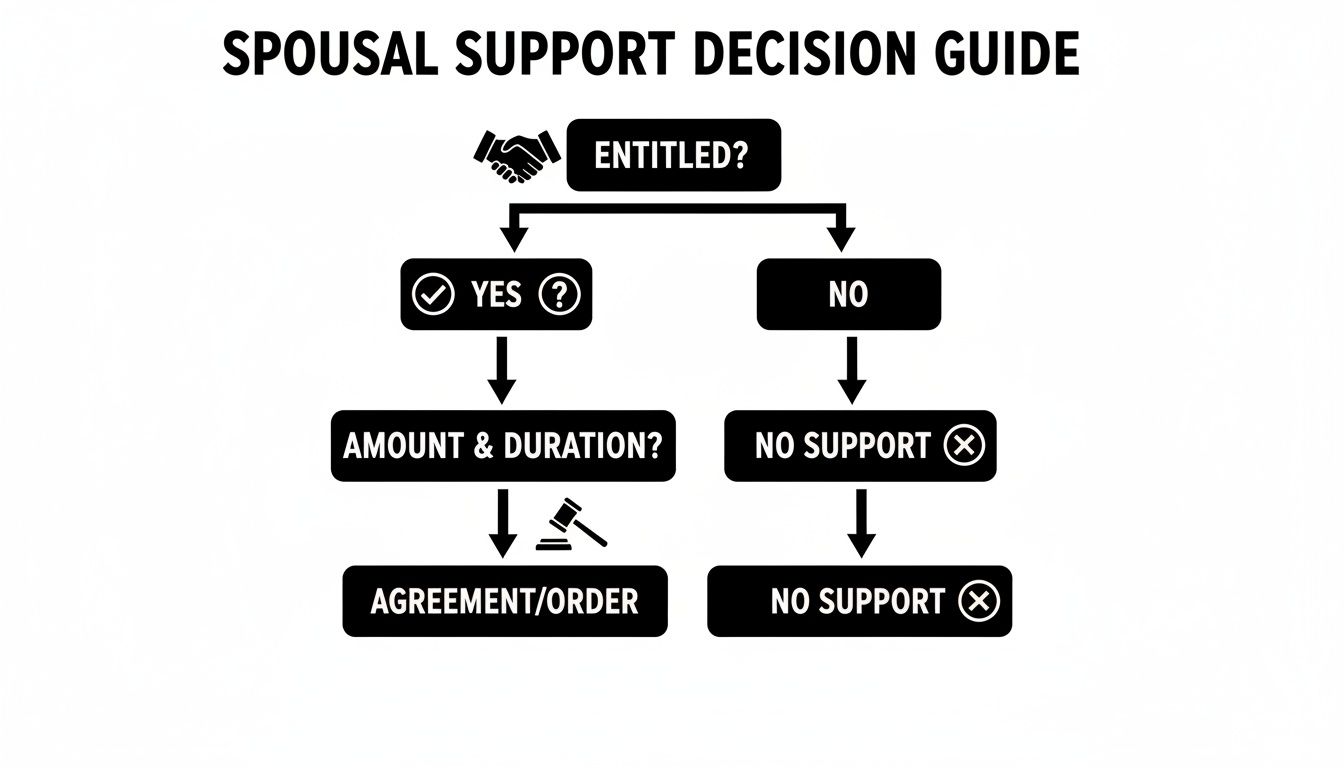
This decision tree gives you a bird’s-eye view of the very first question a court considers in any spousal support claim.

Flowchart guiding spousal support decisions, from initial entitlement questions to final agreement or denial.

As the chart makes clear, if you can’t establish entitlement based on one of the accepted legal grounds, the path leads directly to a denial. No other factors will even be considered.

The Three Paths to Proving Entitlement

Your claim must be grounded in one of three specific legal arguments. Failing to build your case on at least one of these pillars is a primary reason a spousal support claim is denied. Let’s break down these legal grounds.

The Three Grounds for Spousal Support Entitlement in Ontario

Ground for Entitlement Basis of the Claim Common Example Scenario
Compensatory One partner sacrificed career or economic opportunities for the benefit of the family. A spouse leaves their job to raise children for 15 years, allowing the other spouse to build a high-earning career.
Non-Compensatory (Needs-Based) The breakdown of the relationship left one partner in genuine financial need, while the other has the ability to help. After a 20-year marriage, a partner with a chronic illness is unable to work and cannot cover their basic living expenses post-separation.
Contractual A valid legal agreement (like a prenup or separation agreement) outlines the right to spousal support. The couple signed a cohabitation agreement stating that if they separate after 10 years, one partner will pay the other a set amount of support.

Successfully arguing your case under one of these categories is absolutely essential. It applies to both married and common-law spouses, though specific rules can differ. You can learn more in our guide on spousal support for common-law partners in Ontario.

Key Insight: A significant income difference, on its own, does not automatically create an entitlement to spousal support. You must connect that disparity directly to the roles you both took on during the relationship or show that it has created a genuine inability for you to meet your basic needs.

For those looking to explore different scenarios, tools like the supportGPT application can offer valuable insights.

Denial Reason One: Short-Term Relationships Without Dependency

Two wedding rings, one with diamonds, next to a small desk calendar displaying "3 years" on a white table.

One of the most straightforward reasons spousal support gets denied is the length of the relationship. When a marriage or common-law partnership is brief, the legal system assumes you haven’t created the kind of deep economic link that requires one person to support the other long-term.

A 20-year marriage is like a complete business merger where finances and careers become tangled. A short-term relationship, however, is more like a temporary joint venture. The court’s goal isn’t to create a lasting financial tie but to help each person return to their pre-relationship financial footing as quickly as possible.

The Five-Year Guideline and Common Mistakes

While there’s no magic number, relationships under five years—especially without children—are almost always seen as short-term by Ontario courts. The shorter the union, the weaker the argument for support.

A judge will look for hard evidence of economic integration. Did one of you give up a career? Did you buy a house together? In a two or three-year relationship, the answer is usually “no.” Without that dependency, a judge will likely decide there’s no entitlement.

A common mistake is waiting too long after separation to file a claim. If you wait months or even years, you send a signal that you were managing on your own, undermining any argument of need. This delay can be a fatal flaw in your case.

A Word of Caution: The passage of time weakens a spousal support claim. A court may view a delayed application as proof that you were self-sufficient and that any current financial hardship is unrelated to the marriage.

To get a better handle on how roles can be defined even while living together, it’s worth reviewing the details of cohabitation agreements in Ontario.

Denial Reason Two: The Expectation Of Self-Sufficiency

A person types on a laptop displaying 'Employment Opportunities', with documents and coffee on the desk.

In Ontario family law, spousal support is a transitional bridge, not a permanent destination. A core principle is the expectation that both people will make a real effort to become financially independent. A claim can be dead in the water if the person asking for money is already self-sufficient or hasn’t taken meaningful steps to get there.

The Duty to Become Self-Sufficient

The law is straightforward: every adult has a duty to support themselves to the best of their ability. While a court will recognize genuine barriers like illness or age, it will still look for evidence of effort.

To build a stronger case, you must demonstrate proactive steps:

  • Actively searching for a job: Keep detailed records of applications and interviews.
  • Going back to school or retraining: Enrolling in courses that boost your job prospects is powerful evidence.
  • Updating your skills: Taking online courses shows a serious commitment to re-entering the workforce.

The Concept Of Imputed Income

What happens if someone can work but chooses not to? This is where imputed income comes into play. The court assigns a potential income to a person who is voluntarily unemployed or underemployed. It calculates support based on what you should be earning, not your actual low income.

A judge may impute income if they believe a party is intentionally depressing their earnings to either increase the support they receive or decrease the support they have to pay. It is a tool used to ensure fairness.

For example, a former accountant who takes a part-time retail job after separation could have an accountant’s salary imputed to them. This action could drastically reduce or eliminate a spousal support award. While our guide on using a spousal support calculator in Ontario can give you a baseline, imputed income can change the numbers dramatically.

Other Reasons a Judge Might Deny Spousal Support

Beyond relationship length or self-sufficiency, a few other common-sense reasons can stop a claim. These roadblocks are based on fairness and evidence.

The Power of a Valid Domestic Contract

One of the cleanest ways to settle the issue is with a domestic contract. Agreements like a prenuptial agreement or a separation agreement carry significant weight. If you both signed a contract with independent legal advice that clearly waives the right to spousal support, a court will almost always honour it.

For the waiver to be ironclad, it must be done right. A judge will ensure:

  • There was full and honest financial disclosure from both parties.
  • Each person received independent legal advice.
  • The agreement was signed voluntarily, without pressure or coercion.

The Misunderstood Role of Misconduct

Many people assume bad behaviour, like cheating, will be punished by the court. In reality, that’s almost never the case.

Under Canada’s Divorce Act, marital misconduct is not a factor in determining spousal support. The court’s job is to deal with the financial fallout of the breakup, not to play moral referee.

The only time bad behaviour might matter is if it directly wrecked the family’s finances, such as a gambling addiction. The act of infidelity itself has zero impact on a spousal support claim.

No Real Income Gap or Hiding Financials

Finally, there are two practical, money-related reasons a judge will deny support. First, if both partners earn similar incomes and can maintain a comparable standard of living, there’s no financial gap to fill.

Second, the system is built on financial transparency. You have a legal duty to provide complete and honest disclosure (tax returns, pay stubs, etc.). Refusing to provide these documents can lead a judge to draw an adverse inference, assuming the information would not help your case and potentially denying your claim outright.

Serving Brampton and the GTA

While the rules are the same across Ontario, navigating the courthouses of Brampton, Mississauga, and the Greater Toronto Area requires local expertise. A local family lawyer understands the nuances of the Peel Region courts and how a particular judge might view your case.

When you’re preparing for a spousal support case in Brampton, one of the first practical steps is understanding the financial commitment involved. That includes getting a clear picture of typical lawyer consultation fees so you can budget for the road ahead. If you need clear, direct advice on your specific situation near you, our team can help.

Related Reading

Frequently Asked Questions

Can my spousal support claim be denied if I live with a new partner?

Yes, this is a common reason for denial. Moving in with a new partner is seen as a major financial change. The court assumes your new partner contributes to household expenses, which reduces or eliminates your need for support from an ex-spouse and directly undermines a needs-based claim.

Does misconduct like adultery automatically disqualify me from support?

No. Canada’s Divorce Act is clear that marital misconduct is irrelevant to spousal support entitlement. A court’s job is to address the financial consequences of the separation, not to assign blame. The only exception is if the behaviour directly harmed the family’s finances.

What happens if my ex-spouse and I earn similar incomes?

If your incomes are close, a spousal support claim is very likely to be denied. Support is intended to correct a significant economic imbalance created by the relationship. When no such financial gap exists, a court will almost always conclude that both parties are self-sufficient and no support is required.

Is spousal support denied if there are no children from the marriage?

Not automatically, but it makes denial more likely, especially in shorter marriages. Without children, it is harder to make a compensatory claim (arguing you sacrificed your career for the family). However, a needs-based claim might still be valid in a long-term marriage due to age or health.

What if I signed a prenup waiving spousal support?

A valid prenuptial or separation agreement that waives spousal support is a powerful document. As long as it was signed with full financial disclosure and independent legal advice for both parties, a court will almost certainly uphold it and deny any subsequent claim for support.

How long do you have to be married to get spousal support in Ontario?

There is no “minimum” time, but duration is a critical factor. For marriages under five years without children, spousal support is often denied. For longer marriages, especially over 20 years, some form of support is much more likely if there is a valid entitlement claim.


Disclaimer: This article is for informational purposes only and does not constitute legal advice. Please consult with a qualified family lawyer to discuss your specific situation.

Written by the legal team at Badesha Law, dedicated to providing expert family law guidance in the GTA.

Why Choose Badesha Law?

Navigating the complexities of when spousal support is denied requires clear, experienced legal guidance. At Badesha Law, we provide the precise representation you need to protect your financial future in Brampton and the surrounding areas. Our deep understanding of local court practices gives you a distinct advantage.

Can a Divorce Be Denied in Canada? A Guide from a Divorce Lawyer in Brampton

It’s a question that keeps many people up at night when they start the separation process: can a judge actually say no and deny your divorce?

While it’s a daunting thought, the simple answer is that it's extremely rare for a divorce to be outright denied in Canada. If you meet the legal grounds set out in the federal Divorce Act, the court is obligated to grant your divorce. The key is making sure your application is prepared correctly and all related matters, like child support, are resolved according to Ontario law. This is where a skilled divorce lawyer in Brampton can make all the difference, ensuring your case moves forward without unnecessary hurdles.

The Rare Cases Where a Divorce Can Be Denied in Canada

A judge's main role in a divorce hearing isn't to decide if you should get divorced, but to confirm that a legal "breakdown of the marriage" has actually happened. Once that's established, the divorce must be granted.

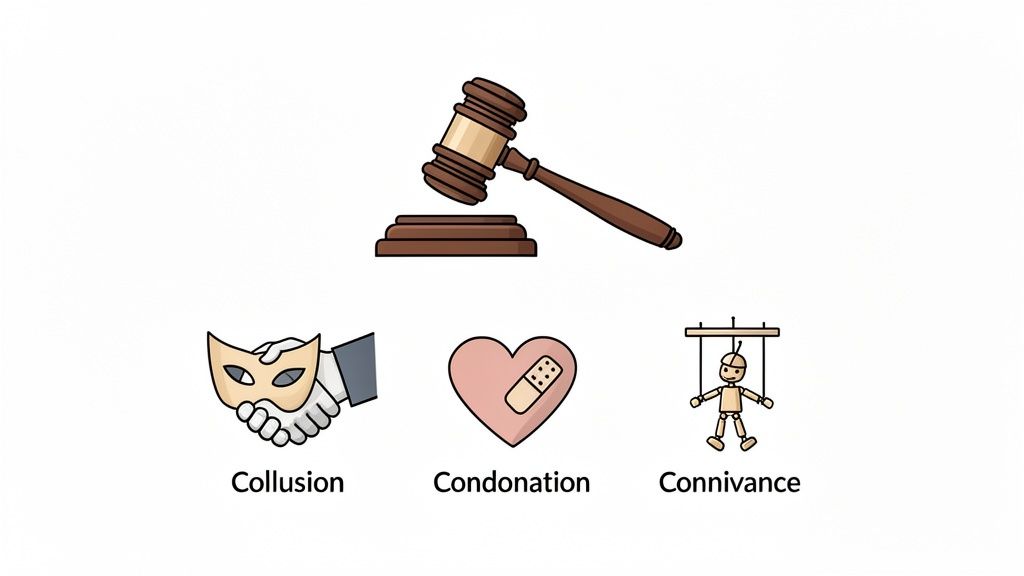
However, the Divorce Act does contain a few specific "bars to divorce" that can stop the process in its tracks. These are rarely used today, but they exist as safeguards to prevent people from misusing the court system.

A judge's gavel above three icons representing legal terms: collusion (masked handshake), condonation (bandaged heart), and connivance (puppet).

Think of these bars as the court’s way of ensuring the reasons for the divorce are genuine and not fabricated to get a faster result.

Understanding Collusion

Collusion is when spouses agree to lie to the court. This could mean inventing grounds for divorce—like making up a story about adultery or fudging the date of separation—just to speed things up.

For example, if a Brampton couple falsely claims one person had an affair to get around the mandatory one-year separation period, that’s collusion. If a judge discovers this, they are required by the Divorce Act to dismiss the divorce petition. It's a serious issue that undermines the integrity of the family court system.

Key Takeaway: The court system in Brampton operates on honesty. Any attempt to mislead the court by faking the reasons for your divorce can get your case thrown out immediately.

Connivance and Condonation

Two other historical roadblocks are connivance and condonation. These pop up specifically when a divorce is filed based on adultery.

  • Connivance: This is when one spouse actively encourages or helps the other spouse cheat, essentially setting them up to create grounds for divorce.
  • Condonation: This happens when a spouse forgives their partner for adultery and the couple fully resumes their marital relationship. If you knew about the affair and chose to reconcile, you can’t turn around later and use that same affair as your reason for divorce.

Imagine a spouse finds out about an affair, forgives their partner, and they continue living together as a couple for another year. Legally, that act of adultery has been "condoned." They would have to rely on other grounds, like the one-year separation, to move forward with the divorce.

The Most Common Hurdle: Delay, Not Denial

While those legal bars are rare, the single biggest reason a divorce hits a snag is far more practical: unresolved issues about the children.

Section 11(1)(b) of the Divorce Act is crystal clear on this. A judge must be satisfied that reasonable arrangements have been made for child support before they will grant a divorce. This isn't a suggestion; it's a mandatory rule grounded in both federal and Ontario's Family Law Act.

If your child support plan doesn't follow the Child Support Guidelines or if there are still disputes over parenting time and decision-making, a judge will simply refuse to sign the final Divorce Order.

Your case isn't denied forever, but it’s put on hold until you can prove the children's needs have been properly and legally sorted out. For any parent in Brampton, this means having a solid separation agreement or court order that clearly lays out child support is non-negotiable. An experienced local family lawyer will make this their top priority, ensuring your kids are protected so your divorce can proceed without hitting this very common, and very avoidable, roadblock.

Establishing Grounds for Divorce in Ontario

Getting a divorce in Ontario isn’t as simple as just deciding your marriage is over. You have to legally prove that your marriage has had an "irretrievable breakdown." Under Canada's Divorce Act, there are only three ways to do this.

Getting this first step right is critical. If you can't properly establish one of these grounds, your entire application can stall. This is why getting actionable advice from a Brampton divorce lawyer early on is so important—it sets the foundation for a successful outcome.

The No-Fault Path: Separation for One Year

By far, the most common and least confrontational way to get divorced is by living separate and apart for at least one year. This is the "no-fault" route because you don't have to assign blame for why the marriage ended.

Most people in Brampton prefer this path because it’s much less adversarial. The one-year clock starts the moment you begin living separately with the intention to end the marriage. You can file your Application for Divorce before the year is up, but the court in Brampton won't grant the final Divorce Order until the full 365-day period has passed.

Key Insight: The court's focus here isn't on who did what to whom. It's about recognizing the marriage has broken down. This client-focused approach helps lower conflict, allowing you and your ex-partner to focus on resolving practical matters like finances and parenting arrangements.

Can You Be "Separated" Under the Same Roof?

With the high cost of living in Brampton, a critical question for many clients is whether you can start the separation clock while still living in the same house. The answer is a clear yes. The law understands that it’s often financially impossible for a couple to suddenly support two separate households.

But you have to prove it. To show you're truly separated while cohabiting, there needs to be a fundamental change in your lifestyle. This means:

  • Sleeping in separate bedrooms.
  • Stopping all intimate and social aspects of your relationship.
  • Handling your own laundry, cooking, and finances separately.
  • Telling friends and family that you have officially separated.

Real-World Scenario: A couple in Brampton with two children can't afford to immediately sell their home near Professor's Lake. One spouse moves into the basement, they open separate bank accounts, create individual budgets, and stop attending community events as a couple. Their lawyer helps them draft a Separation Agreement that clearly states their date of separation, which the court later accepts without issue.

The Fault-Based Grounds: Adultery and Cruelty

While less common, you can still file for divorce on "fault" grounds. The main advantage? You can apply immediately without the one-year wait. These grounds are adultery and cruelty.

Adultery: This means your spouse engaged in physical intimacy with someone else. To use this as your reason for divorce, you need proof, which can be difficult and emotionally taxing to obtain. You must also swear in a legal affidavit that you did not condone or connive in the affair.

Cruelty: This involves physical or mental cruelty from your spouse that makes it unbearable to continue living together. This is a very high legal standard to meet. The court looks for cruelty of a "grave and weighty" nature, not just arguments or unhappiness.

  • Physical Cruelty: This includes acts of domestic violence. These are also criminal matters handled under the Criminal Code of Canada, so ensuring your safety is the absolute first priority.
  • Mental Cruelty: This could be relentless verbal abuse, emotional manipulation, or severe financial control that seriously harms your well-being.

Seeking a divorce based on cruelty requires strong evidence, such as medical reports, police records, or testimony from witnesses. A Brampton divorce lawyer can provide an honest assessment of whether your situation meets this strict legal test and guide you on the safest way to proceed while protecting your rights under both family and criminal law.

Why Child Support Is a Non-Negotiable Hurdle

If there’s one issue guaranteed to bring your divorce proceedings to a grinding halt in a Brampton courthouse, it’s unresolved child support. This isn't just a common snag; it's a complete showstopper. The reason is rooted firmly in federal law—specifically, Section 11(1)(b) of the Divorce Act.

This section makes it crystal clear: a judge must be satisfied that "reasonable arrangements" have been made for the financial support of any children before they can grant a divorce. This isn't a suggestion or a guideline. It's a strict legal obligation. Your divorce simply cannot move forward until this condition is met.

A balanced scale comparing a person's importance with stacks of money and a legal document.

This rule exists for a simple, powerful reason: to protect the children. The court acts as a final safeguard, ensuring their financial stability isn't a casualty of their parents' separation. It’s about honouring every child’s right to support.

The Role of Ontario’s Child Support Guidelines

So, what exactly are "reasonable arrangements"? For that, Ontario courts turn to the provincial Child Support Guidelines. Think of the Guidelines as a set of rules and tables used to calculate the base amount of child support one parent pays to the other.

The calculation comes down to a few key factors:

  • The paying parent's gross annual income.
  • How many children need support.
  • The province where the paying parent lives.

The goal is to create a fair and consistent standard so that children continue to benefit from the financial means of both parents, just as they would if the family were still together. A judge will not sign off on a divorce where the child support arrangement deviates from these guidelines without a very, very good reason.

Key Takeaway: The Child Support Guidelines are not optional. A Brampton judge will expect any agreement you present to align with these official calculations. Trying to agree on a lower amount without proper justification is one of the most common reasons a divorce application gets rejected.

Common Disputes That Stall a Divorce

Even with a formula, things get complicated. Disputes pop up all the time that can stall the entire process, often requiring an experienced divorce lawyer in Brampton to get things back on track.

1. Disagreements Over Income
This is a big one. It's common to see arguments over a spouse's true income, especially if they are self-employed, own a business in Peel Region, or get paid in cash. We often see one party claim their income is much lower than it really is to try and reduce their support obligation.

2. Section 7 Expenses
These are the "special or extraordinary expenses" that go above and beyond the basic table amount. Think costs for competitive sports, private tutoring, orthodontics, or post-secondary education. Parents frequently disagree on whether an expense is truly necessary or reasonable, and how the cost should be split.

3. Parenting Time and Set-Offs
If parenting time is shared almost equally (meaning each parent has the children at least 40% of the time), the child support calculation can change. This can spark disputes over the parenting schedule itself, because the calendar now directly impacts the wallet.

A Brampton-Based Scenario

Let's picture a couple separating right here in Brampton. The father is a self-employed contractor, and the mother is a salaried nurse with two kids. Their divorce hits a wall.

First, the father claims his income is only $50,000 a year. But a closer look at his business statements shows a lot of personal expenses—car payments, vacations, meals—being run through the company. The mother's lawyer digs in and argues his real income for support purposes is closer to $90,000.

Second, they’re fighting over Section 7 expenses. Their son plays rep hockey, and it's not cheap. The father insists it’s an unnecessary luxury and refuses to pay his share. A judge, seeing this mess, will absolutely refuse to sign the final Divorce Order until the income is properly determined and a fair contribution to the hockey costs is locked in.

The Path Forward: Full Disclosure and Smart Negotiation

The only way to avoid this major roadblock is with complete financial transparency and skilled negotiation. Both of you have a legal duty to provide full and honest financial disclosure. Hiding assets or fudging income numbers won't work—it will eventually come out, causing massive delays and driving up legal costs.

This is exactly where a dedicated divorce lawyer proves their worth. We ensure all financial documents are properly exchanged, analyze the numbers to pinpoint the correct income for support, and negotiate a fair agreement on those tricky special expenses. By building a child support arrangement that follows the guidelines and meets your children's needs, you clear the biggest hurdle standing between you and your final Divorce Order.

How Financial Pressures in Brampton Can Stall Your Separation

Sometimes, the biggest roadblock in a separation isn't a legal snag or a fight with your spouse—it’s the stark financial reality staring back at you from your bank account. A judge might be ready to grant your divorce, but the high cost of living in Brampton and across the Peel Region can feel like a denial in itself.

It's a trap I see clients fall into all the time. The math just doesn't add up. Trying to fund two separate households on the same combined income is, for many, simply impossible. Imagine the cost of two apartments or condos, two sets of hydro bills, and double the daily living expenses. It’s overwhelming.

This financial pressure often forces couples to keep living under the same roof long after they've decided to go their separate ways, creating a tense and emotionally draining environment for the entire family. It's one thing to be emotionally ready to move on, but it’s another thing entirely to be able to afford it.

The Staggering Cost of a Contested Divorce

Beyond just finding a new place to live, the potential cost of the divorce itself is a massive source of anxiety. The financial path you take can split dramatically depending on one thing: whether your divorce is contested or uncontested.

An uncontested divorce, where you and your spouse agree on all the big issues like property and support, is by far the most affordable route. But when disagreements crop up, legal fees can skyrocket, turning a manageable expense into a financial nightmare.

To put it in perspective, let's look at the numbers.

Comparing Divorce Costs in Ontario: Uncontested vs. Contested

The difference in cost between a smooth, agreed-upon separation and a drawn-out court battle is huge. This table breaks down what Brampton residents can generally expect to face financially.

Divorce Type Average Legal Fees Key Characteristics
Uncontested Divorce ~$1,860 Both spouses agree on all major issues. Minimal court involvement. Faster timeline (4-6 months). Focus on paperwork and settlement.
Contested Divorce ~$20,625+ Spouses disagree on property, support, or parenting. Requires multiple court appearances, negotiations, and potentially a trial. Can take over a year to resolve.

Source: Canadian Lawyer’s 2022 Legal Fees Survey

As you can see, the financial stakes are incredibly high. The average cost of a contested divorce can climb well over $20,000 and even hit $25,000 in particularly messy cases. This stark difference is exactly why avoiding a court battle is so critical for families in Brampton who are already feeling the financial squeeze.

From My Experience: The single most effective way to control the cost of your divorce is to minimize conflict. A good Brampton divorce lawyer won’t rush you into court. Instead, they’ll prioritize practical solutions like negotiation and mediation to help you reach a fair settlement, saving you thousands of dollars and months of stress.

A Strategic Path Forward

Feeling financially stuck is a tough spot to be in, but it doesn't have to be permanent. With the right legal strategy, you can carve out a path that makes separation financially possible.

A client-focused divorce lawyer in Brampton gets it. They understand the local economic pressures you're up against and will work with you to create a realistic plan that doesn’t break the bank. This approach usually involves:

  • Focusing on a Separation Agreement: This is a legally binding contract that lets you sort everything out privately, giving you certainty and saving you from massive court fees.
  • Exploring Mediation: A neutral mediator can help you and your spouse find common ground on tough issues, often at a fraction of the cost of litigation.
  • Demanding Transparent Fees: You should have a clear picture of potential costs from day one, with no surprises down the road.
  • Finding Creative Financial Solutions: This might mean a structured buyout of the family home or other smart arrangements that allow for a fair split of assets without forcing a costly fire sale.

By taking these practical, strategic steps, what once seemed like an economic impossibility can become a manageable process. It’s about finding the right tools to finally let you move forward with your life.

Your Action Plan for a Successful Divorce in Brampton

Moving from confusion to control requires a clear, organized strategy. For anyone in Brampton facing a divorce, the first steps you take can mean the difference between a drawn-out, expensive battle and a fair, efficient resolution. Think of this as your personal roadmap—a way to get organized and feel like you're back in the driver's seat.

A skilled divorce lawyer in Brampton, Ontario, is more than just a legal representative; they're your strategic advisor. Their job is to help you see around corners and avoid common pitfalls, whether it's a simple procedural error like improperly serving documents or a major issue like incomplete financial disclosure. Getting organized from day one is the single best thing you can do to protect your rights.

Begin with Financial Housekeeping

The entire foundation of a divorce settlement rests on a clear picture of the family's finances. Before you file a single document, your first job is to gather all the relevant financial information. This isn't just a good idea—it's a legal requirement in Ontario known as financial disclosure, mandated by the Family Law Act.

Start collecting the key documents now. Being prepared will save you a surprising amount of time and money when you meet your lawyer.

  • Income Verification: Pull together your last three years of income tax returns, Notices of Assessment, and recent pay stubs. If you own a business, you'll need proof of that income too.
  • Asset Documentation: This includes bank statements, investment account statements (like RRSPs and TFSAs), and any property deeds for real estate you own.
  • Debt Information: Make a file with statements for all liabilities—mortgages, lines of credit, credit cards, and car loans.
  • Valuations: If you own a business, a pension, or even valuable items like art or jewellery, you'll likely need to get them professionally appraised.

Expert Tip: Create a simple spreadsheet listing all assets and debts. Note their value on two specific dates: the date you were married and the date you separated. This "Net Family Property" calculation is how property division is determined in Ontario, and having this ready is a massive head start.

The Power of a Separation Agreement

Many people assume divorce automatically means a messy court battle, but that's rarely the case. In reality, the vast majority of divorces in Brampton are settled out of court, and the key is a comprehensive Separation Agreement. This is a legally binding contract that you and your spouse negotiate and sign, spelling out how you'll resolve all the big issues.

A well-drafted agreement covers absolutely everything:

  • Division of property and debts.
  • Spousal support (if it applies).
  • Parenting time and decision-making responsibility.
  • Child support, including the base amount and any special or extraordinary expenses.

Finalizing a separation agreement before heading to court makes the entire divorce process faster, cheaper, and infinitely less stressful. It puts you and your spouse in control, rather than leaving life-altering decisions to a judge who doesn't know you or your family.

Exploring Cost-Effective Alternatives

The emotional and financial weight of a contested divorce can be crushing. Thankfully, there are effective, lower-conflict ways to reach an agreement without ever stepping inside a courtroom.

Mediation is an incredibly popular choice for couples in Brampton. A neutral third-party mediator helps you and your spouse have a productive conversation, guiding you toward a solution you can both live with. The mediator doesn't make decisions for you; they just help you find common ground. The whole process is confidential and usually far more affordable than litigation.

Of course, the legal side is only one part of the journey. Addressing the emotional impact is just as important. Resources like professional counselling can provide essential support during and after your separation. Seeking grief and loss counselling can be an invaluable part of your action plan, helping you build the resilience you'll need for the path ahead.

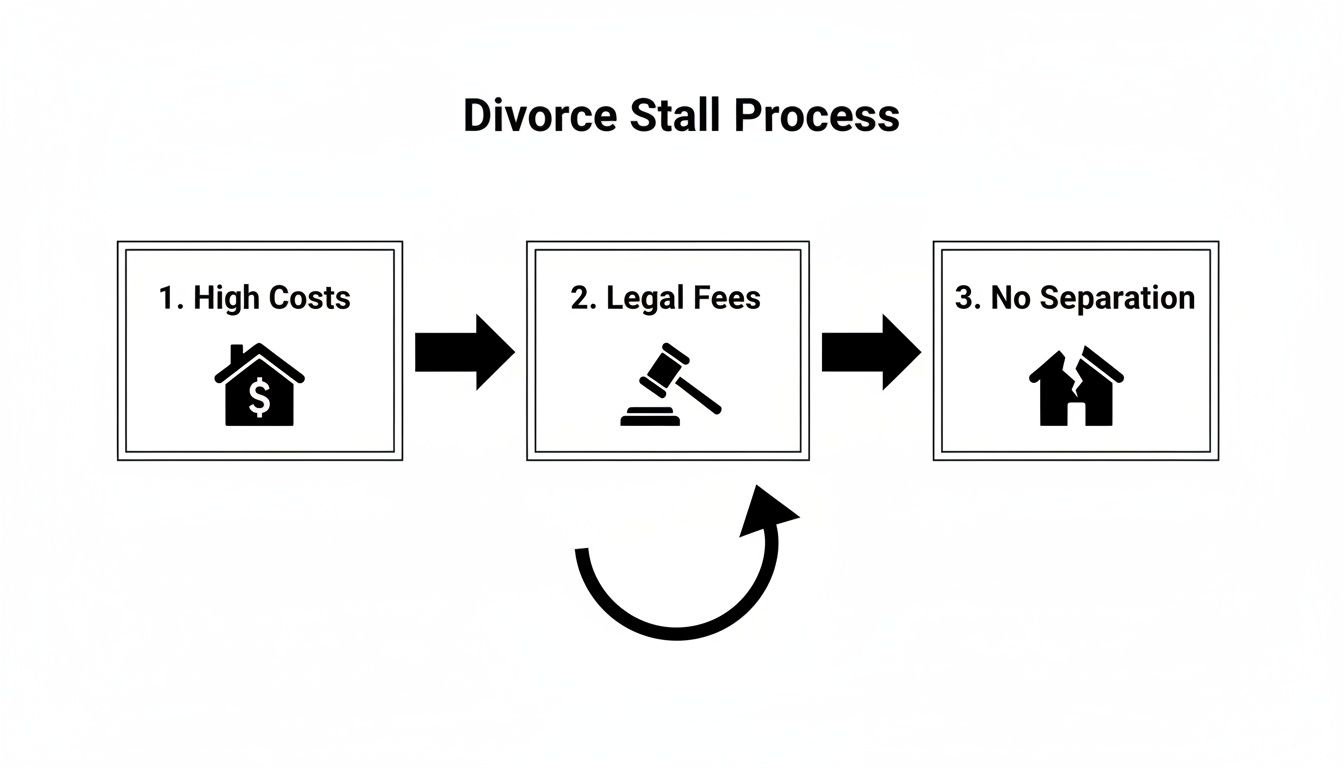
This infographic shows just how easily the divorce process can stall out when finances get tight, which is a common reality in a high-cost area like Brampton.

A flowchart illustrates the divorce stall process due to high costs, escalating legal fees, and ultimately, no separation.

It really highlights how the high cost of living, stacked on top of legal fees, can create a financial trap that keeps couples from moving on with their lives.

Interestingly, the bigger picture of marriage dissolution in Canada is pretty complex. The national divorce rate has actually hit a 50-year low of 5.6 per 1,000 married persons. But while younger couples are divorcing less, "grey divorce"—separation among those aged 55 and older—is on the rise, showing just how different the pressures are across generations.

By gathering your documents, focusing on a separation agreement, and exploring collaborative options, you can take charge of your separation. This approach not only protects your financial future but also helps set a much more positive tone for your next chapter.

Common Questions About Divorce in Brampton

As you start to navigate the separation process, you're bound to have questions. The legal system can feel like a maze, so getting clear, straightforward answers is key. Here are some of the most common questions we hear from our clients in Brampton as they tackle the practical side of getting divorced.

Does My Spouse Have to Agree to the Divorce?

This is a huge source of anxiety for many people, but the answer is refreshingly simple: no, your spouse’s consent is not required in Ontario.

If your spouse refuses to sign anything or just plain objects to the divorce, you can still move forward. As long as you can prove one of the three legal grounds for a marriage breakdown—living separate for one year, adultery, or cruelty—a judge can and will grant the divorce. The one-year separation is the go-to path in these situations because it’s a “no-fault” ground, meaning you don’t have to prove anyone did anything wrong.

To get the ball rolling, you’ll file what’s called a sole Application for Divorce. Your divorce lawyer in Brampton will then make sure your spouse is properly served with the legal documents. If they choose not to respond, the process can continue without their participation.

Key Takeaway: Your spouse can’t trap you in a marriage just by refusing to sign papers. The law in Ontario gives you a clear path to end a marriage, even if you’re the only one who wants to.

What if I Can't Find My Spouse to Serve the Divorce Papers?

Properly "serving" your spouse with the divorce documents isn't optional—it's a mandatory step. You can't just skip it and move on. If you've made a real, documented effort to find your spouse but genuinely can't locate them, you have to get permission from the court to serve them in a different way.

This is done by filing a motion for an order for "substituted service." It’s a formal legal step where you ask a judge to approve an alternative way of letting your spouse know you’ve filed for divorce.

Some common methods a judge might approve include:

  • Serving a close relative of your spouse, like a parent or sibling.
  • Sending the documents to their last known employer.
  • Publishing a notice in a newspaper where they were last known to be living.

Trying to bypass this step will get your divorce application rejected. It's a critical rule that's in place to protect everyone's rights.

Can We Get Divorced While Still Living in the Same House?

Yes, you absolutely can. With the high cost of housing in Brampton and the GTA, this has become an incredibly common scenario. The law recognizes that it’s often just not financially possible for a couple to immediately set up two separate homes.

You can be legally "separated" while living under the same roof, but you have to prove you are genuinely living "separate and apart." This means you've stopped functioning as a married couple. Think sleeping in separate rooms, managing your own finances, cooking your own meals, and no longer going out as a couple or telling friends and family that you're together.

In these situations, a formal Separation Agreement becomes vital. It creates an official record of your separation date for the court, which is what you'll need to prove the one-year separation required for the divorce.

How Long Does a Simple, Uncontested Divorce Take in Brampton?

For a truly simple, uncontested divorce—meaning you and your spouse have already agreed on all the big issues like property, support, and parenting—the timeline is fairly predictable. Once all the right paperwork is filed with the Brampton courthouse, you can usually expect the final Divorce Order to be granted in about 4 to 6 months.

But that timeline is only for straightforward cases. If there's any disagreement that needs negotiation, mediation, or a court appearance, it becomes a contested divorce. A contested divorce can easily take a year, and often much longer, depending on how complex the issues are and how backed up the courts are. This huge difference in time and cost is exactly why trying to reach an amicable settlement is always the best first approach.


Navigating the divorce process requires clear guidance and strong advocacy. At Badesha Law, our team is dedicated to protecting your rights and helping you find the most efficient path forward. If you have questions about your separation or need an experienced divorce lawyer in Brampton, contact us for a consultation. Learn more by visiting us at https://badeshalaw.ca/brampton-criminal-lawyer.

A Practical Guide to Prenuptial Agreements in Brampton, Ontario

In Canada, a prenuptial agreement is a legally binding contract two people sign before getting married, spelling out how things like assets and support will be handled if the relationship ever ends. In Ontario, it’s officially called a marriage contract, and for couples in Brampton, it gives you and your partner the power to write your own financial rules instead of defaulting to the province's Family Law Act.

Why a Prenup Is Smart Financial Planning for Your Marriage

Let's be honest, talking about a prenuptial agreement can feel a little awkward. But it's time we changed the way we think about it. Far from being a red flag, a prenuptial agreement in Canada is one of the smartest financial tools a couple in Brampton can use before tying the knot.

Think of it as insurance for your shared future. You don’t buy home insurance expecting a fire, but you get it for peace of mind. A marriage contract works the same way—it’s an actionable step to create clarity, encourage open conversations about money, and head off potential conflicts down the road.

A Private Contract for Your Future

Under Ontario's Family Law Act, a marriage contract is a private agreement that lets couples in Brampton and across the province set their own terms. It lays out a clear roadmap for dealing with assets, debts, and spousal support, making sure both partners walk into the marriage with confidence and a shared financial understanding.

This practical approach is becoming more and more common. In fact, recent trends show that 61% of Canadians now see prenups as a good idea—not as a bad omen, but as a practical financial tool. This is especially true for millennials, who often marry later in life with more established careers and assets.

A well-drafted contract can help you:

  • Protect assets you owned before the marriage or a family business.

  • Define how property you acquire together will be divided.

  • Clarify who is responsible for pre-existing and future debts.

  • Outline spousal support obligations to create predictability.

A marriage contract isn’t about planning for failure; it’s about building a marriage on a foundation of transparency and mutual respect. By discussing finances openly, you establish a precedent for honest communication that can strengthen your relationship for years to come.

Beyond just sorting out marital finances, prenups are also a key part of broader asset protection planning, helping to safeguard individual wealth before you say "I do." For couples in Brampton, where property values are a major financial factor, having a clear agreement in place is an invaluable step toward security. It removes ambiguity and lets you focus on what really matters: building your life together.

What Your Prenuptial Agreement Can and Cannot Cover

A prenuptial agreement, or a marriage contract as it’s called in Ontario, is a powerful tool for mapping out your financial future together. But it’s not a blank cheque. Understanding what you can and can’t include is crucial for any couple in Brampton looking to create a fair, legally sound document that will actually hold up if it's ever needed.

Think of it like setting the ground rules for your financial life as a married couple. You can define the boundaries of the playing field, but some rules—especially those protecting children—are non-negotiable under both the Family Law Act and federal laws like the Criminal Code. A prenup is about being proactive and clear, not pessimistic.

H3: What You Can Include in Your Prenuptial Agreement

Under Ontario's Family Law Act, a marriage contract gives you and your partner a surprising amount of freedom to customize your financial arrangements. You get to decide on key issues that, without an agreement, would simply be handled by the default provincial laws if you ever separated.

Here are the main areas your agreement can cover:

  • Protecting Pre-Marital Assets: You can clearly state that any assets you each brought into the marriage—like savings, investments, or a condo you owned before the wedding—remain your own separate property. They won't be subject to division if you part ways.

  • Managing Property Acquired During Marriage: You can set your own rules for how you’ll divide property and assets you accumulate during the marriage. This allows you to opt out of Ontario's standard equalization process, which is especially important for couples in the GTA where real estate is often the most significant asset.

  • Ownership of the Matrimonial Home: While the matrimonial home has a special legal status, a prenup can address how the asset is handled financially. For example, you can decide ahead of time how the proceeds will be split if the home is sold.

  • Spousal Support Obligations: The agreement can provide clarity and predictability by setting out the terms for spousal support. You can define if it will be paid, for how long, and even set a specific amount or a formula for calculating it.

  • Responsibility for Debts: You can clarify how debts will be handled, whether they were brought into the marriage or racked up during it. This is a practical way to protect one another from financial liabilities.

  • Inheritances and Gifts: A prenup can make sure that any future inheritances or large gifts from family members remain the separate property of the person who received them.

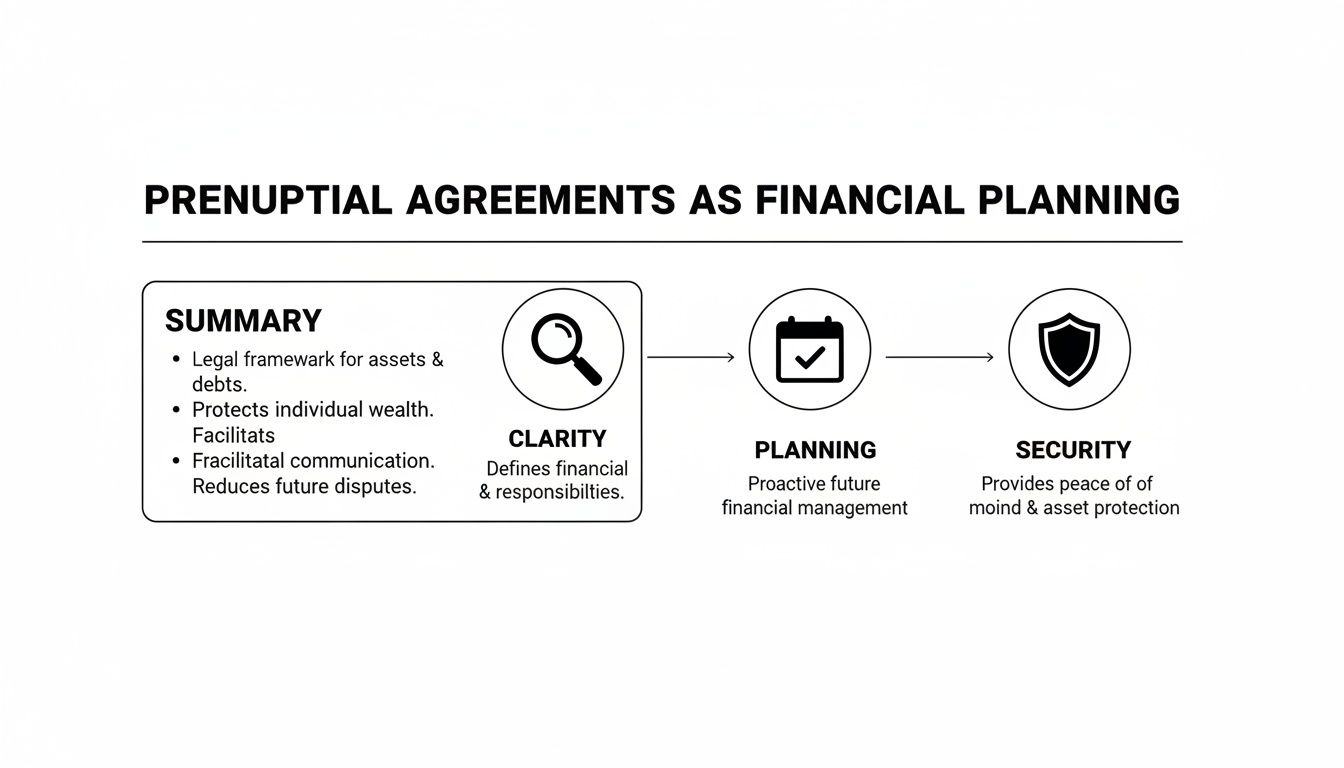
This diagram shows how a prenup really works as a financial planning tool, creating a foundation of clarity, planning, and security for your life together.

Diagram illustrating prenuptial agreements as a financial planning tool, emphasizing clarity, planning, and security.

By tackling these key areas head-on, you turn vague financial anxieties into a concrete, mutually agreed-upon plan.

What You Cannot Include in Your Prenuptial Agreement

Just as important as knowing what to put in your agreement is understanding its legal limits. The law draws some very firm lines, mostly to protect the rights of children and prevent one-sided or unfair arrangements. If you try to include prohibited clauses, a court will simply strike them out. In a worst-case scenario, it could even put the validity of your entire agreement at risk.

Under Canadian law, the rights of a child always come first. A prenuptial agreement cannot override the court’s duty to act in a child’s best interests, which is a non-negotiable principle.

A valid prenuptial agreement in Canada can't touch the following:

  • Child Custody or Access: You simply cannot decide custody (decision-making responsibility) or parenting time for children you don't have yet. If you separate, a court will make these decisions based only on the child's best interests at that specific time.

  • Child Support: The right to child support belongs to the child, not the parents. You can't waive it or lock in a specific amount in a prenup. Child support must be calculated based on the Federal Child Support Guidelines when and if the parents separate.

  • Possession of the Matrimonial Home: While you can agree on how to divide the value of the home, you can't use a prenup to kick a spouse or children out of the family home upon separation. That right of possession is protected under the Family Law Act.

  • Anything Illegal or Against Public Policy: This should go without saying, but any clause that encourages illegal activity or goes against public policy is automatically void. Provisions related to anything in the Criminal Code of Canada, for example, would be thrown out immediately.

To put it simply, here’s a quick breakdown of what’s on and off the table when drafting your contract.

Permitted vs Prohibited Clauses in an Ontario Marriage Contract

What You Can Include What You Cannot Include
Division of property and assets Child custody or parenting time arrangements
Spousal support terms (amount, duration, or waiver) Child support terms (amount, duration, or waiver)
Ownership of the matrimonial home Right to possession of the matrimonial home
Responsibility for debts Clauses that violate public policy or the law
Protection of inheritances and gifts Anything that is not about financial matters
Rules for managing finances during the marriage Provisions that are unconscionable or grossly unfair

Ultimately, a marriage contract gives you incredible control over your financial destiny as a couple. It just has to operate within a legal framework designed to ensure fairness and protect the vulnerable. Working with an experienced Brampton family lawyer is the best way to ensure your agreement does exactly what you want it to while remaining strong and enforceable.

The Legal Steps to an Enforceable Ontario Prenup

A prenuptial agreement is only as strong as its legal foundation. In Ontario, you can't just write down what you want and call it a day. The Family Law Act requires very specific steps to ensure the agreement is fair, transparent, and legally binding. Following these steps isn’t just a good idea—it’s non-negotiable if you want a contract that will actually stand up in court if it's ever challenged.

Think of it like building a house in Brampton. You wouldn't skip the foundation or the structural inspections, right? Skipping a legal step, like getting proper advice, can cause the entire agreement to crumble under legal pressure, leaving you unprotected. This is why the process matters just as much as the final document.

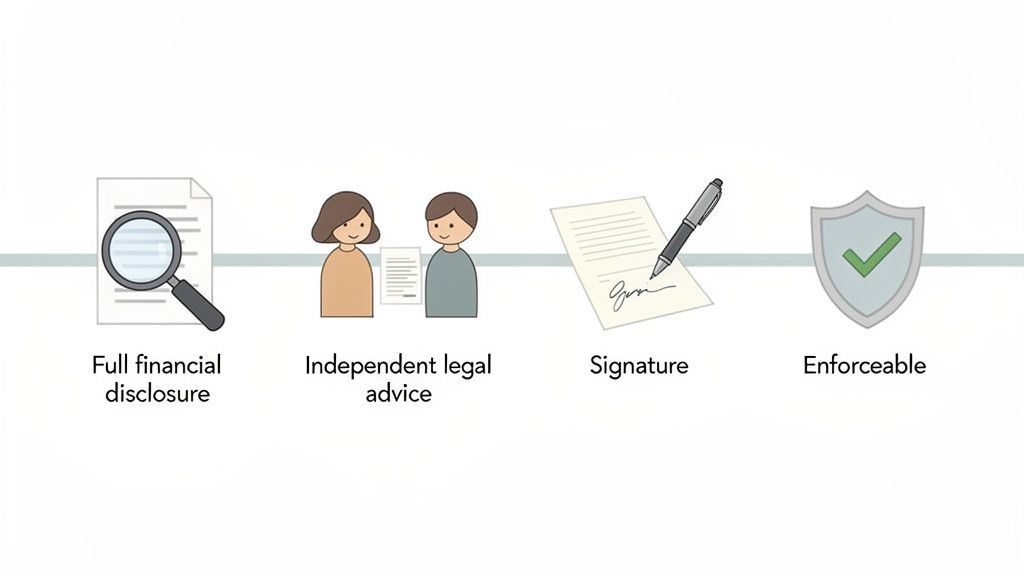
Illustrates four key steps for an enforceable legal agreement: financial disclosure, legal advice, signature, and enforceability.

Let's break down the essential pillars of an enforceable prenuptial agreement in Canada, specifically for those of us here in Ontario.

Full and Honest Financial Disclosure

The cornerstone of any valid marriage contract is transparency. Before you sign anything, both you and your partner must provide a complete and truthful picture of all your finances. This means laying all your cards on the table—no exceptions.

This isn't just a suggestion; it’s a legal requirement under Ontario’s Family Law Act. Hiding an asset or downplaying a debt can be grounds for a judge to throw out the entire agreement later on.

Your disclosure should include documentation for:

  • Assets: Bank accounts, investments, real estate holdings, business interests, vehicles, and valuable personal property.

  • Debts: Mortgages, loans, credit card balances, and any other financial liabilities.

  • Income: A clear statement of your current earnings from all sources.

This step ensures that both of you are making informed decisions based on a complete financial picture. It's about building an agreement on a foundation of honesty from the very beginning.

Independent Legal Advice (ILA)

This is arguably the most critical step in the entire process. To ensure a prenup is enforceable, both you and your partner must each have your own lawyer. This is what’s known as Independent Legal Advice (ILA).

Your lawyer's job is to look out for your interests and yours alone. They will review the draft agreement, explain what each clause means for your future, and advise you on your rights and obligations under Ontario law. The same lawyer cannot advise both of you, as that would be a clear conflict of interest.

Having separate lawyers protects both parties. It proves to a court that neither person was taken advantage of and that both fully understood the rights they were signing away. Without ILA, an agreement is highly vulnerable to being challenged and overturned.

When you each have ILA, your respective lawyers will sign a certificate confirming they provided this advice. This certificate becomes powerful evidence that the process was fair and the agreement was entered into with full knowledge.

Signing Without Pressure or Duress

For a contract to be valid, it has to be signed freely and voluntarily. There can be no hint of pressure, threats, or manipulation—legally known as duress or undue influence.

A classic example of duress is presenting a prenup to your partner a week before the wedding with an ultimatum: "Sign this, or the wedding is off." A court may see this as coercive, as one person might feel they have no real choice but to sign under the immense social and financial pressure of a pending wedding.

To avoid this, it’s crucial to:

  1. Start Early: Begin the prenup conversation months before the wedding date. This gives both of you plenty of time for disclosure, negotiation, and legal review without feeling rushed.

  2. Ensure Fair Negotiations: The process should be a collaborative discussion, not a one-sided demand.

Ensuring the agreement is signed without duress confirms that it reflects the true and willing intentions of both partners. A Brampton family lawyer can help manage the timeline and process to ensure everything is handled fairly and professionally, creating a document that truly protects you both.

Common Mistakes That Can Invalidate Your Agreement

Knowing the right steps to create a prenuptial agreement is only half the battle. Just as crucial is understanding the common pitfalls that can render your contract unenforceable in Ontario, potentially leading to the very legal battles you sought to avoid. A seemingly minor misstep can unravel even the best intentions.

For couples in Brampton, a few key mistakes consistently appear when agreements are challenged in court. Avoiding these errors is essential to ensuring your marriage contract provides the security and clarity it was designed for. Let's look at the most frequent and damaging blunders.

The Dangers of DIY or 'Kitchen Table' Agreements

In an effort to save time or money, some couples are tempted to download a template online or draft a simple agreement themselves. This is one of the biggest risks you can take. These "kitchen table" agreements almost always fail to meet the strict legal standards required by Ontario's Family Law Act.

A DIY prenup often lacks the necessary components for enforceability:

  • Improper Financial Disclosure: It may not include a complete and formal exchange of financial information, which is a non-negotiable requirement.

  • Lack of ILA: It will not have certificates of Independent Legal Advice from separate lawyers, which is a massive red flag for any court.

  • Vague or Illegal Clauses: Without legal expertise, it's easy to include terms that are ambiguous, unenforceable (like child custody provisions), or contrary to public policy.

A contract is more than just a piece of paper; it's a complex legal instrument. To further ensure its robustness, understanding broader contract management best practices can help you appreciate the formalities required to mitigate common mistakes that might otherwise invalidate the agreement.

Signing Under Duress or Too Close to the Wedding

The timing and circumstances of signing your prenuptial agreement are critically important. A contract is only valid if both parties sign it freely and voluntarily, without any form of pressure or coercion. This is known as avoiding duress.

A classic example of duress is presenting the agreement days before the wedding with a "sign it or it's off" ultimatum. The emotional and financial pressure of a looming wedding can make it difficult for a person to refuse, and a judge may later decide they didn't sign willingly.

An agreement signed under pressure isn't a true agreement. A court will set aside a contract if it believes one party was unfairly coerced or did not have a meaningful choice in the matter, undermining the entire purpose of the prenup.

To avoid this, start the process at least 4-6 months before your wedding date. This provides ample time for open discussions, thorough financial disclosure, and proper legal review without a stressful deadline hanging over your heads.

Using Unfair or Vague Terms

Finally, the substance of the agreement itself matters. Ontario courts can set aside a prenuptial agreement if its terms are found to be "unconscionable" or grossly unfair to one party. While you can create your own financial rules, they must still exist within a realm of fairness.

For instance, a clause that leaves one spouse with all the assets and the other with all the debts and no spousal support after a long marriage would likely be seen as unconscionable.

Similarly, vague language can be fatal. Terms like "reasonable support" or "a portion of the business" are open to interpretation and can lead to disputes. A strong agreement uses precise, clear language that leaves no room for ambiguity. An experienced Brampton family lawyer will ensure your contract is both fair and specific, protecting it from future challenges.

Navigating the Prenup Process From Start to Finish

Creating a prenuptial agreement might sound intimidating, but it’s really just a series of clear, manageable steps. Think of it as a blueprint for your financial future. For couples in Brampton, a straightforward roadmap transforms a complex legal task into a collaborative project, guided by an experienced family lawyer.

The entire process is designed to be transparent and cooperative, making sure the final document truly reflects your shared goals. It flows logically from your first conversations to the final signature, with key checkpoints along the way. Understanding this workflow helps set expectations and shows how each stage builds on the last to create a solid, legally sound agreement.

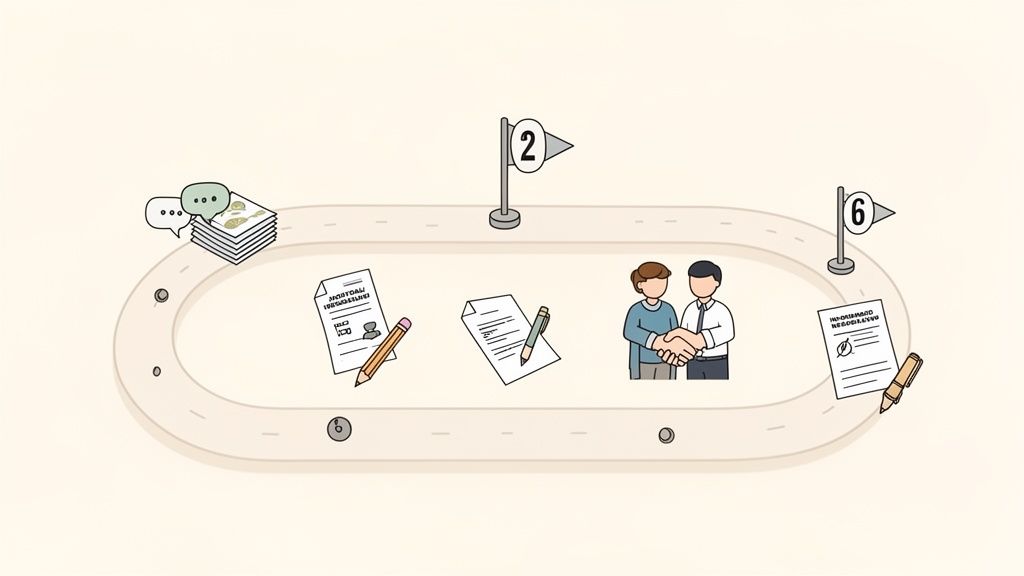
Illustrated workflow on an oval path, showing steps from documents and discussion to a handshake.

Step 1: The Initial Consultation and Goal Setting

Your journey begins with an initial consultation with your family lawyer. This first meeting is all about laying the groundwork. You and your partner will sit down and talk about your goals, what you want to protect, and how you see your financial future together. It’s the perfect time to ask questions and learn how a marriage contract can be shaped to fit your unique situation.

Your lawyer will walk you through the legal framework under Ontario’s Family Law Act and help you clarify what you want to achieve. Maybe you want to protect a family business, keep an inheritance separate, or simply create a clear plan for property you acquire during the marriage.

Step 2: Comprehensive Financial Disclosure

Next up is the most critical part of the process: full financial disclosure. This is where you and your partner lay all your financial cards on the table. It’s a non-negotiable step for any valid prenuptial agreement in Canada, because honesty and transparency are what make the agreement enforceable down the road.

This exchange means sharing everything, including:

  • Statements from all bank accounts, investments, and retirement funds.

  • Up-to-date appraisals for any real estate you own.

  • Valuations for business interests or other major assets.

  • A clear list of all debts, like mortgages, student loans, or credit card balances.

This step creates the factual foundation for the entire agreement. Without it, the whole structure could collapse if challenged later.

A prenuptial agreement is only as strong as the financial disclosure it's built on. Complete honesty at this stage is the best way to prevent the agreement from being challenged and potentially invalidated in the future.

Step 3: Drafting the Agreement

Once all the financial information is on the table, one of your lawyers will draft the first version of the marriage contract. This initial draft takes all your conversations and goals and turns them into formal legal clauses. It will cover all the key areas you’ve discussed, from how property will be handled to whether spousal support will be paid.

Think of this document as a starting point. It’s meant to be reviewed, discussed, and adjusted. It’s rare for the first draft to be the final one, so expect a bit of back-and-forth as you and your lawyers fine-tune the details.

Step 4: Independent Legal Advice and Negotiation

After the draft is ready, the other partner must take it to their own lawyer for Independent Legal Advice (ILA). This is a non-negotiable step in Ontario. It ensures that both of you fully understand your rights and obligations and aren’t being pressured into signing something that isn’t in your best interest. Their lawyer will review the document with a fresh set of eyes, focused entirely on protecting their client.

This is also the negotiation phase. If one lawyer has concerns or wants to suggest changes, they’ll communicate with the other lawyer. This collaborative process continues until both of you are completely satisfied that the agreement is fair, balanced, and reflects what you both want.

Step 5: Finalizing and Signing the Agreement

Once negotiations are done and everyone agrees on the terms, the final version of the agreement is drawn up. You and your partner will then sign the document in front of a witness. To complete the process, your respective lawyers will sign Certificates of ILA, confirming that they provided you with the necessary legal counsel.

As for costs, they can vary. Typically, you'll see a flat fee for the initial drafting, with additional hourly fees for the negotiation process and the ILA review. Talking about costs upfront with your lawyer will help you budget accordingly. It’s a detailed journey, but the result is a powerful legal tool that provides clarity and protection for your future.

Your Prenup Questions, Answered

When you start looking into marriage contracts, a lot of questions pop up. For couples in Brampton and across Ontario, getting clear on the details of the Family Law Act is the first step toward making a smart decision. Here are some straightforward answers to the questions we hear most often, designed to give you the confidence to move forward.

Each answer gets right to the point, tackling the real-world concerns couples have when they think about this important financial planning tool.

Is a Prenuptial Agreement Only for the Very Wealthy?

This is probably the biggest myth out there, but it's just not true. While prenups are fantastic for protecting major assets, a prenuptial agreement in Canada is a practical tool for anyone with savings, property, a business, or even debt.

They are especially useful for:

  • Couples in second marriages looking to protect assets for children from a previous relationship.

  • Anyone expecting an inheritance who wants to make sure it remains their separate property.

  • Business owners who need to shield their company from being divided in a separation.

  • People buying property in Brampton, where a prenup can clarify exactly how the matrimonial home's ownership and equity are handled.

Think of it less about being "wealthy" and more about creating financial clarity. It’s a smart move for any couple wanting to set clear expectations right from the start.

Can We Update Our Prenuptial Agreement in the Future?

Absolutely. In fact, we highly recommend it. A marriage contract shouldn't be a document you sign and then file away forever. It should be a living agreement that grows and changes along with your life.

It's a good idea to revisit and possibly amend your agreement after big life events, like:

  • Having children.

  • A major change in either partner's income.

  • Receiving a large inheritance or gift.

  • Starting a new business, whether together or on your own.

Just remember, for any update to be legally valid, both partners must agree to it. The changes have to be put in writing, signed, and witnessed with the same legal steps as the original agreement. If you don't update it after a major change, a court could decide years later that the original terms are unfair and refuse to enforce them.

What Happens in Ontario if We Do Not Have a Prenup?

If you don't have a marriage contract, how your assets are divided after a split is automatically decided by the rules in Ontario's Family Law Act. This process is called the "equalization of net family property."

In simple terms, the value of most property you both acquired during the marriage gets added up and split right down the middle. The matrimonial home gets special treatment under the law—its entire value is usually included in this calculation, no matter who owned it before the wedding day.

A prenuptial agreement is your way of opting out of these default government rules. It lets you create your own custom plan for how assets and debts will be handled, giving you much more control and certainty over your financial future.

Without a prenup, you're essentially letting the provincial legal system make these critical financial decisions for you. An agreement lets you and your partner make those calls yourselves.

How Can I Suggest a Prenup Without Causing a Fight?

This is often the trickiest part, but you can navigate it with a bit of sensitivity and a collaborative spirit. It all comes down to how you frame the conversation.

Instead of making it sound like a plan for divorce, position it as a responsible financial planning step for your marriage—just like making a will or getting life insurance.

Here are a few tips that actually work:

  1. Frame it as a Team Effort: Try saying something like, "I think we should talk about a marriage contract to make sure we're on the same page with our finances. It’s about being a strong team."

  2. Focus on Transparency: Explain that it's about being open and honest about money to avoid misunderstandings down the road. It’s a sign of mutual respect.

  3. Make it a Joint Learning Experience: Suggest booking a consultation with a family lawyer together. This turns it into a shared activity where you can both ask questions and learn from a neutral expert.

When you approach the topic with care and focus on clarity and partnership, you can turn what feels like a difficult conversation into a constructive one that actually strengthens your relationship.

Can We Create a Prenup After We Are Already Married?

No, by definition, a prenuptial agreement has to be signed before you get married. But if you're already married and want to put a similar legal contract in place, you absolutely can.

In Ontario, this is called a postnuptial agreement—or more simply, a marriage contract signed after the wedding. It does the exact same thing as a prenup by outlining how assets, debts, and spousal support will be handled. It must follow all the same legal rules to be enforceable, including full financial disclosure and Independent Legal Advice for both of you.


Navigating the complexities of a prenuptial agreement requires clear, expert guidance. Whether you are just starting the conversation or are ready to draft an agreement, the team at Badesha Law is here to protect your interests with precise legal counsel. Contact us today to ensure your future is built on a foundation of clarity and security. Learn more at https://badeshalaw.ca/

A Guide to Spousal Support Calculator in Ontario: Actionable Insights for Brampton Families

Experiencing a separation in Brampton can be daunting, and financial insecurity further increases the pressure. Consulting a spousal support calculator in Ontario is an important initial step, providing an early estimate of potential outcomes tailored to your family’s specifics. This tool offers clarity and a practical guide for what to anticipate, based on Ontario’s Family Law Act. For additional support and guidance, consider reaching out to a Brampton family lawyer, such as Badesha Law, for professional assistance.

Your First Step in Understanding Spousal Support

A person uses a laptop displaying a spousal support calculator for Ontario on screen.

Experiencing a separation in Brampton often brings emotional and financial challenges, with spousal support being a common concern. Questions usually arise about how it works, who qualifies, and what the payments might be. This guide aims to clarify this aspect of family law and offer practical advice.

We will highlight useful tools, particularly online spousal support calculators. These should be viewed as a starting point rather than a definitive solution. They apply legal guidelines to your specific situation, providing an initial financial estimate.

Having this estimate helps you plan your next steps with greater confidence. For those in Brampton, understanding these numbers is crucial for managing expectations and preparing for negotiations or court proceedings.

The Legal Framework Behind the Calculator

Every spousal support calculator in Ontario is built on a specific legal framework established by the Family Law Act and federal legislation. It doesn’t just pull numbers out of thin air; it applies a set of established rules to your financial data to create a predictable and consistent approach.

The most influential tool used by lawyers and judges in Brampton is the Spousal Support Advisory Guidelines (SSAGs). The SSAGs are essentially a set of formulas that estimate support amounts by looking at factors like the length of your relationship, the difference in your incomes, and any child support obligations.

A calculator provides a baseline by applying the SSAG formulas to your unique situation. This turns abstract legal principles into a concrete financial range, showing potential monthly payments and duration.

This framework ensures the calculations aren’t arbitrary. They are rooted in the principles of Ontario’s family law, which aims to address the financial advantages or disadvantages that arise from a relationship or its breakdown, ensuring a fair and equitable resolution.

What the Calculator Aims to Achieve

The purpose of spousal support—and by extension, the calculator—is to achieve several key goals recognized by law. Understanding these goals helps make sense of the numbers the calculator produces. The main objectives include:

  • Recognizing Contributions: To compensate a spouse for sacrifices made during the relationship, such as pausing a career to raise children in your Brampton home.
  • Addressing Financial Hardship: To help a lower-income spouse manage the financial difficulties that often come with a separation.
  • Promoting Self-Sufficiency: To support a spouse for a specific period while they take actionable steps to become financially independent again.

A calculator is your starting point for seeing how these principles might apply to you, turning complex legal ideas into an understandable financial preview.

Gathering Your Financial Information

An Ontario spousal support calculator is only as accurate as the information you provide. To get an actionable and reliable estimate, you must start with precise financial details.

Before you go online, your first step is to get your financial paperwork in order. This isn’t just busywork; it’s about ensuring the numbers you use are grounded in reality. For families in Brampton, having these details ready makes the entire process smoother and prepares you for productive discussions with a family lawyer.

Your Essential Document Checklist

To get a clear and accurate estimate, you’ll need to pull together a few key financial documents. These papers contain the specific numbers that the Spousal Support Advisory Guidelines (SSAGs) rely on. The goal is to create an honest picture of each spouse’s financial life.

Here’s a practical table outlining exactly what you’ll need.

Checklist for Spousal Support Calculation

Information Needed Why It Matters Common Documents to Check
Gross Annual Income This is the foundation of the entire calculation. It determines each spouse’s financial capacity. T1 General Tax Returns (look for Line 15000), Notices of Assessment (NOA) from the CRA.
Recent Pay Information Confirms current earnings and deductions, ensuring the income used is up-to-date. Recent pay stubs (last 2-3).
Business Financials Crucial for self-employed individuals to determine the actual income available for support. Profit & loss statements, balance sheets, corporate tax returns.
Key Relationship Dates The length of the relationship directly impacts how long support might be paid. Marriage certificate, cohabitation records (leases, joint bills), separation agreement drafts.
Birthdates Ages of the spouses and children can influence both the amount and duration of support. Birth certificates, passports.
Child Support Amount Child support is calculated first and affects the income available for spousal support. Child support order or written agreement, bank statements showing payments.

Having these documents organized not only helps you get a better estimate but also prepares you for a productive first meeting with your Brampton family lawyer.

Key Dates and Family Details

It’s not all about the money. The calculator also needs to understand the timeline of your relationship and your family structure. These details are critical, as they heavily influence both the amount and the duration of potential spousal support under the Family Law Act.

Make sure you have these dates and details written down:

  • Date of Marriage or Cohabitation: The day you officially began living together as a couple.
  • Date of Separation: The date you stopped living together in a marriage-like relationship.
  • Birthdates: You’ll need your own, your spouse’s, and the birthdates of any children you share.
  • Child Support Information: If child support is already being paid, you must have the exact monthly figure. In Ontario, child support is always the top priority.

It is absolutely critical to remember that child support comes first. Calculators use a different formula when children are involved to ensure the paying spouse can meet their spousal support obligations after their child support duties are met.

Gathering all this information might feel tedious, but it’s essential groundwork. A well-organized file doesn’t just give you a more accurate calculator result; it puts you in a much stronger position for productive discussions with a family lawyer in Brampton when you’re ready to take that next step.

How to Use an Online Spousal Support Calculator

Once you have your financial documents in order, you’re ready to turn those numbers into a real-world estimate. Using an online spousal support calculator in Ontario is a straightforward process, and knowing what you’re looking at makes the experience much more productive. Let’s walk through a realistic scenario relevant to a family in Brampton.

Imagine a couple, Priya and Raj, who live in Brampton. They’ve been married for 15 years and have two kids, aged 10 and 12. Priya has a gross annual income of $65,000, while Raj earns $110,000. After separating, they’ve agreed that Priya will have primary care of the children. This scenario will be our guide as we plug the numbers into a calculator.

A Step-by-Step Walkthrough

Most online calculators are set up in a similar, logical way. You’ll enter your information into specific fields, and the software runs it through the Spousal Support Advisory Guidelines (SSAGs) formulas to give you a result.

Here’s the typical process you can expect:

  1. Enter Incomes: First, input the gross annual income for both spouses. For Priya, we’d enter $65,000, and for Raj, $110,000.
  2. Input Key Dates: Next, you’ll enter the date you started living together or married, and the date of separation. For our Brampton couple, this covers a span of 15 years.
  3. Provide Children’s Information: You will need to add the number of children and their birthdates. This is a critical step because child support is always calculated first and takes priority under Ontario’s Family Law Act.
  4. Specify Parenting Arrangement: The calculator needs to know the parenting schedule, as it directly impacts the child support calculation. In this case, Priya has primary care.
  5. Run the Calculation: With all the data entered, you hit the “calculate” button to see the estimated range.

These three core pieces of information—income, relationship details, and the children’s situation—are the building blocks for any spousal support calculation.

Icons representing income (tax document), relationship (calendar), and children (family) as factors for support calculations.

Think of each one as a vital ingredient that the SSAG formulas use to generate the final estimated support range.

Interpreting the Results

After completing the calculations for Priya and Raj, the tool produces a detailed report. This report highlights two critical aspects: the potential support amount and the duration of payments.

The results are presented as a range (low, mid, high). This approach is intentional because the Spousal Support Advisory Guidelines (SSAGs) serve as recommendations rather than strict rules. Judges have the flexibility to determine an amount anywhere within that range—or even outside it—based on the unique circumstances presented in a Brampton courthouse.

  • Amount (Quantum): This refers to the estimated monthly support payment. For Priya and Raj, the calculator might indicate a range from $650 (low) to $1,200 (high) per month. Typically, the “mid-range” figure acts as a starting point for negotiations.
  • Duration: This reflects the length of time the payments are expected to continue. Given a 15-year marriage, the duration would likely range from 7.5 to 15 years. In some long-term relationships, support may be indefinite.

Reputable online calculators offer reliable estimates that align with those used by courts, converting abstract legal formulas into a clear financial snapshot. For our Brampton couple, this provides a realistic baseline. Priya gains a clearer understanding of what she might receive, while Raj obtains a better grasp of his potential obligations. This is the first practical step toward achieving financial clarity.

Using a spousal support calculator in Ontario provides a set of numbers that offer insight into your financial future. These figures—the low, mid, and high estimates—indicate where your final agreement or court order might fall.

Understanding how to interpret this range is crucial in transforming a simple estimate into an effective planning tool. The “mid-range” number often serves as the starting point for negotiations, representing a neutral application of the Spousal Support Advisory Guidelines. However, various factors can influence the final amount toward either end of that spectrum.

The Story Behind the Low to High Range

The SSAGs were designed with flexibility to account for the real-world complexities a calculator can’t understand. For families in Brampton navigating a separation, these details are crucial. A judge or mediator will always look beyond the raw numbers to the unique circumstances of your life.

What might push an award toward the high end of the range?

  • Significant Debt Load: If one spouse is left with significant family debt from the relationship, higher support may be needed.
  • Career Sacrifices: A strong case showing one spouse gave up major career opportunities for the family can justify a higher amount.
  • Health Concerns: If the recipient has health issues that hinder their ability to become self-sufficient, a higher figure may be necessary.

Conversely, some situations could pull the final number closer to the low end:

  • Significant Assets: If the lower-income spouse received a substantial share of assets from property division, their immediate need for support might be less.
  • Shorter Relationships: For relationships on the shorter side of the scale, a judge might lean toward the low end.
  • Payor’s Hardships: If the paying spouse has unusually high and unavoidable expenses, it could influence the final amount.

The calculator gives you the map, but your personal circumstances create the route. A skilled Brampton family lawyer can build a compelling case for why your situation justifies a specific outcome within those guidelines.

Understanding the Two Key Formulas

You’ll notice the calculator asks whether you have children for a critical reason. It automatically applies one of two completely different SSAG formulas based on your answer.

The two main formulas are:

  1. The Without Child Support Formula: For couples with no dependent children. It focuses on the length of the relationship and the income gap to determine the amount and duration of support.
  2. The With Child Support Formula: When children are involved, this formula takes over, built on a core principle of Ontario’s Family Law Act: child support always comes first. This formula calculates child support, deducts it, and then determines spousal support based on what’s left.

This ensures the paying parent can meet both critical obligations, protecting the financial well-being of the children as the law demands. Understanding this is vital for setting realistic expectations.

When a Calculator Is Not Enough

Two women review financial documents; one appears distressed while the other points to a negative trend.

An online spousal support calculator in Ontario is a fantastic tool for a quick financial snapshot, but it’s a starting point, not the final word. The algorithm has blind spots and can’t process the complex, human elements that define every family’s story.

These calculators run on straightforward inputs like gross income. They can’t analyze nuanced financial situations or the unique circumstances that shape a fair support arrangement.

The Spousal Support Advisory Guidelines (SSAGs) are advisory, not absolute law. A judge has the discretion to deviate from a calculator’s range based on the unique facts of your case—a reality every Brampton family should understand.

This is where the calculator’s usefulness ends and the need for legal expertise begins. Your family’s situation is unique, and many factors can dramatically shift the final spousal support outcome.

Complex Income and Hidden Assets

One of the biggest limitations of any calculator is its inability to properly assess complex income streams. For many families in Brampton, income isn’t just a simple salary figure from a T4 slip.

An algorithm can’t dig into the details of things like:

  • Self-Employment Income: A calculator can’t differentiate between legitimate business expenses and personal ones or determine a business owner’s true available income.
  • Variable Compensation: Bonuses, stock options, and commissions fluctuate and require careful analysis to establish a fair income for support.
  • Hidden Assets: A calculator assumes financial transparency. It cannot uncover undeclared income or assets a spouse might be concealing, which can constitute a serious offence under the Criminal Code of Canada if it amounts to fraud.

These situations demand a detailed financial review that goes far beyond what an online tool can manage.

Non-Financial Contributions and Special Expenses

The SSAGs and Ontario’s Family Law Act recognize that contributions to a marriage are not just financial. A calculator cannot quantify the value of a spouse who paused their career to raise children or supported their partner’s professional ambitions. These are powerful arguments that can justify a support award at the higher end of the range.

Furthermore, unique family expenses can significantly impact what’s needed for support. For Brampton families managing high living costs, these details are critical.

Special considerations could include:

  • Expenses for a child with special needs.
  • Unusually high healthcare or medical costs.
  • Significant debts taken on for the family’s benefit.

The reality is that support payments vary widely based on family composition. For example, statistics show that median monthly support payments can range from about $272 for cases with one child to as high as $1,800 when a former spouse and three or more children are involved. You can learn more about these findings on spousal support payments in Canada.

These nuances are exactly where a calculator falls short. It gives you a baseline number, but a truly fair resolution requires a strategy built on the complete story of your relationship and your family’s actual needs.

Taking the Next Step with a Brampton Family Lawyer

Getting an estimate from a **spousal support calculator in Ontario** is a great first step. But once you have those numbers, the most important move is to seek professional legal advice. This turns a rough estimate into a solid, legally sound strategy that protects your future.

For anyone in Brampton, a local family lawyer is your advocate, ensuring your rights under Ontario’s Family Law Act are fully protected. They do more than just run the numbers; they build a case around the unique details of your life that a calculator could never understand.

When to Call a Lawyer

While everyone can benefit from a legal consultation, some situations make it absolutely essential. If you face any of the following, it’s a clear sign that you need professional guidance.

These red flags often include:

  • Disagreements Over Income: Do you suspect your spouse isn’t being fully transparent about their earnings? This is common with self-employed individuals. A lawyer is needed to ensure you get accurate financial disclosure.
  • Complex Property Division: A calculator won’t help with assets. If you have a matrimonial home in Brampton, pensions, or business assets to divide, legal expertise is non-negotiable.
  • High-Conflict Separations: When communication breaks down, a lawyer acts as your representative, managing tough negotiations and protecting you from unfair pressure. It’s important to note that any threats or harassment during this process could engage the Criminal Code of Canada, and a lawyer can advise on the proper steps to ensure your safety.
  • Uncertainty About Entitlement: If you are unsure if you are entitled to support, or if your spouse’s claim is valid, a lawyer can provide a clear assessment based on Ontario law.

A family lawyer’s role is to ensure the final agreement isn’t just a number, but a fair and enforceable resolution. They formalize everything, whether through a separation agreement or a court order, making it legally binding.

Protecting Your Financial Future in Brampton

A lawyer’s guidance is an investment in your stability. They know how to navigate the Brampton courthouse, file the necessary documents, and advocate for an outcome that reflects both the financial and non-financial contributions you made during your relationship.

Ultimately, a spousal support calculator gives you a starting point, but a Brampton family lawyer provides the path forward. They help secure a fair resolution that protects your long-term financial well-being, allowing you to move on with clarity and confidence.

Common Questions About Spousal Support Calculators

It’s completely normal to have questions after using a spousal support calculator in Ontario. The numbers on the screen can be overwhelming. Let’s walk through some of the most common questions Brampton residents ask.

Is the Spousal Support Amount from a Calculator Guaranteed?

Absolutely not. Think of the figure from an online calculator as an estimate—an educated guess, but not a guarantee. These tools are built on the Spousal Support Advisory Guidelines (SSAGs), which are influential but not legally binding laws in Ontario.

A judge in a Brampton court has the final say. They will review the unique details of your case and can set an amount they feel is fair, which may differ from the calculator’s result. The calculator gives you a starting point, not a final court order.

Does the Calculator Use Gross or Net Income?

Spousal support calculators in Ontario always ask for your gross annual income. This is your total income before taxes or deductions—typically found on Line 15000 of your tax return.

The software handles the necessary tax calculations behind the scenes. It takes the gross income for both you and your ex-partner to figure out a fair, after-tax support range that aligns with the Family Law Act.

Can I Use a Calculator if My Ex-Partner Is Self-Employed?

You can, but you must be extremely cautious. Determining the true income of a self-employed person is one of the trickiest parts of family law. A simple calculator can’t analyze business statements, differentiate between legitimate expenses and personal spending, or uncover hidden income.

When dealing with self-employment or cash-based income in Brampton, a calculator’s estimate can be unreliable. This is a significant indicator that you need professional legal and financial experts to ensure a fair and accurate income determination.

How Does Child Support Affect Spousal Support Calculations?

Child support always comes first—it’s the top priority under the Family Law Act. The children’s financial needs must be met before anything else. The SSAGs are built around this principle and use a different formula when kids are involved.

This “With Child Support” formula calculates the required child support amount first. Only then does it determine spousal support based on what’s left of the payor’s income. This ensures the paying parent can cover both obligations without compromising the children’s financial security. A calculator does this automatically, but understanding the legal priority is key to setting realistic expectations.


An online tool is a helpful first step, but it can’t replace personalized legal advice. For guidance that truly considers every detail of your unique situation in Brampton, you can trust the experienced team at Badesha Law. We work to protect your rights and fight for a fair resolution that secures your financial future. Contact us today to schedule a consultation.

Separation Agreement Ontario for Brampton Residents: Your Essential Guide

When you and your partner decide to go your separate ways, the future can feel like a huge question mark. A separation agreement in Ontario is the first step toward finding answers. It's a legally binding contract that you and your former partner—whether you were married or common-law—create together after deciding to live apart. This document is where you formalize all the big decisions about your future, from property division and spousal support to parenting arrangements, all without a judge having to make those choices for you. For clients in Brampton, this guide will keep you focused on actionable steps that comply with Ontario’s Family Law Act and relevant Criminal Code protections.

What a Separation Agreement Really Means in Ontario

A couple sitting at a table signing documents, symbolizing a separation agreement.

Think of a separation agreement not as a sign of conflict, but as a practical roadmap you and your former partner build together. It’s the rulebook that will guide your financial and parental responsibilities from this point forward, giving you both a clear path to follow.

This private contract puts the power back in your hands, letting you make your own decisions instead of leaving them to the courts. For couples in Brampton and across Ontario, this document offers stability and predictability during what is often a very challenging time. It’s designed to work for both married spouses and common-law partners, making sure everyone’s rights are clearly defined under the province's Family Law Act. If there are existing criminal matters—such as domestic violence charges under the Criminal Code—ensure your agreement does not conflict with any no-contact or peace bond orders; Criminal Code provisions take precedence.

Your Blueprint for a New Beginning

At its heart, a separation agreement is a tool for taking control and creating clarity. It lets you settle the issues that could otherwise drag on for months or even years, leading to bitter disputes and expensive court battles. By dealing with everything upfront, you lay a solid foundation for your new life in Brampton.

A good agreement will typically iron out all the major details, including:

  • Property and Debts: How will you split the assets you built together? This covers everything from the matrimonial home and investments to pensions and any shared debts.
  • Parenting and Children: This section outlines custody, access schedules (parenting time), and who makes the big decisions for your kids, all to ensure their routine and well-being are protected.
  • Financial Support: Here, you’ll determine if one person needs spousal support and calculate child support based on the official federal guidelines.

The Growing Importance of Agreements

Separation agreements have become a cornerstone of modern family law in Ontario. More and more couples are choosing to formalize their separation this way, often without immediately moving on to a divorce. As the number of separations continues to rise—with some studies suggesting up to 40% of married couples may separate—having a solid agreement is more critical than ever. The Ontario Family Law Act gives these agreements their legal weight, protecting the rights and outlining the responsibilities of both parties. You can learn more about the key differences between separation and divorce in Ontario.

A separation agreement is about creating certainty. It transforms verbal understandings into an enforceable contract, protecting you from future misunderstandings and legal challenges. This is your first and most critical step toward a stable, fair resolution.

The Four Pillars of Your Separation Agreement

A professional legal document being reviewed on a wooden desk, symbolizing the key components of a separation agreement.

Think of a strong separation agreement like a well-built house—it needs a solid foundation. In Ontario, that foundation rests on four critical pillars. These aren't just legal sections; they're the main chapters of the rulebook for your new lives apart.

Getting them right is everything. A well-drafted agreement addresses the most significant parts of your shared life—your children, your finances, and your property—to prevent future conflict and create a clear path forward for everyone. Let's break down exactly what needs to be included in your separation agreement Ontario.

Pillar 1: Custody and Parenting Time

When children are involved, their well-being isn't just a priority; it's the only priority under Ontario's Family Law Act. This pillar of your agreement needs to clearly spell out the parenting arrangements. This is about more than just deciding who the children live with; it's about building a predictable and stable routine they can count on.

You’ll need to define two key concepts:

  • Decision-Making Responsibility (formerly Custody): This covers who gets to make the big decisions about your children’s lives—think education, major healthcare choices, and religious upbringing. It can be held solely by one parent or shared jointly.
  • Parenting Time (formerly Access): This is the nitty-gritty schedule detailing when the children will be with each parent. A solid plan covers the regular weekly routine, but also holidays, summer vacations, and birthdays.

For instance, a couple in Brampton might agree to joint decision-making, meaning they have to consult on big choices. At the same time, they could set a "week-on, week-off" parenting schedule to give their kids much-needed consistency.

Pillar 2: Child Support

Once the parenting schedule is settled, the next logical step is child support. In Canada, this isn't a number you negotiate like any other term. Child support is the legal right of the child, and its calculation follows the mandatory Federal Child Support Guidelines. This provides a structured and predictable framework so there are no surprises.

The amount is calculated based on two main things: the paying parent's gross annual income and the number of children they need to support. The entire goal is to make sure your children continue to benefit from the financial means of both parents, just as they would if you were still together. Your agreement must reflect these guideline amounts unless there's a very specific, justifiable reason to do otherwise.

Pillar 3: Spousal Support

Spousal support is easily one of the trickiest parts of a separation agreement because it’s not an automatic right. Unlike child support, there isn't a simple table to consult. Instead, whether someone is entitled to support depends on factors like the length of the relationship, the roles each person played, and any economic disadvantages one spouse suffered because of the marriage.

If entitlement is established, then you figure out the amount and duration of support, weighing the recipient's needs against the payor's ability to pay.

Spousal support is designed to address financial imbalances that come from the breakdown of the relationship. It can be compensatory (for sacrifices made), non-compensatory (based on need), or contractual (if you agreed to it previously).

Pillar 4: Division of Property and Debts

The final pillar is all about untangling your financial lives. For married couples in Ontario, this process is called equalization. It's a structured way to divide the wealth you built together. Each of you calculates your Net Family Property (NFP), which is basically the value of your assets on the day you separated, minus your debts and any assets you brought into the marriage (with a few exceptions).

The spouse with the higher NFP then makes an "equalization payment" to the spouse with the lower NFP. The goal is simple: you both walk away with an equal share of the wealth accumulated during the marriage. This includes the value of your matrimonial home, pensions, investments, and business assets.

When dividing up your life together, it's crucial to understand how different assets and debts are handled. The table below gives a snapshot of the typical approach under Ontario's family law principles.

Typical Handling of Assets and Debts in an Ontario Separation

Item Typical Treatment Key Consideration
Matrimonial Home Value is divided equally, regardless of who is on title. Cannot be deducted as a date-of-marriage asset, even if owned prior.
Pensions & RRSPs Value accumulated during the marriage is included in NFP. A professional valuation is often required to determine the correct amount.
Bank Accounts/Investments Balances on the date of separation are included in each spouse's NFP. Funds must be traced to ensure they weren't gifts or inheritances.
Gifts/Inheritances Excluded from NFP if kept separate and not used for the home. If co-mingled or put toward the matrimonial home, the exclusion may be lost.
Debts (Loans, Credit Cards) Debts incurred during the marriage are deducted from each spouse's assets. Must prove the debt was for a family purpose to be included in NFP.
Business Assets Value of the business is included in the owner-spouse's NFP. A business valuation is almost always necessary and can be complex.

The matrimonial home, for example, is often a family’s biggest asset and gets special treatment. A couple might decide one person will buy out the other's share, or they may agree to sell it and split the proceeds. Whatever you decide, it must be clearly laid out in the agreement to be legally binding and avoid headaches down the road.

Making Your Agreement Legally Bulletproof

A solid foundation being laid for a house, symbolizing the legal pillars of a separation agreement.

A separation agreement is only as strong as its legal foundation. Without the right elements in place, the document you spent time and money creating could be challenged and overturned by a court, leaving you completely unprotected. To make your separation agreement Ontario truly enforceable, you have to make sure it's legally bulletproof from the very start.

Think of your agreement like building a house. You wouldn't build on shaky ground, and the same principle applies here. There are three non-negotiable pillars that give your agreement the strength to stand up to future scrutiny, ensuring the terms you agree on today will actually protect you tomorrow.

These pillars aren't just suggestions; they are strict requirements under Ontario's Family Law Act. Missing even one can put the entire structure at risk.

The First Pillar: Full Financial Disclosure

The first and most critical pillar is Full Financial Disclosure. This means both you and your former partner must be completely honest and transparent about your financial situations. Every asset, every debt, and every source of income has to be on the table.

This isn't the time for secrets. Hiding a bank account, downplaying the value of a business, or failing to mention a future bonus can invalidate the whole agreement. A court simply will not uphold a contract if it was based on incomplete or misleading information. For example, failing to disclose a work pension could lead a judge to set aside the property division clauses years down the road.

To meet this requirement, both of you will typically need to provide:

  • Financial Statements: These are detailed forms that outline all your assets and liabilities.
  • Supporting Documents: Think tax returns, pay stubs, bank statements, property appraisals, and pension valuations.

The Second Pillar: Independent Legal Advice

The second pillar is Independent Legal Advice (ILA). This is arguably the most important shield protecting your agreement from ever being challenged. ILA means that each of you has met with your own separate lawyer to review the agreement, understand its terms, and confirm you are signing it voluntarily.

This step proves to a court that neither person was pressured, coerced, or taken advantage of. It confirms that you both understood your rights and obligations under Ontario law and made a truly informed decision. For instance, if one partner later claims they "didn't understand" what they were signing, the ILA certificate from their lawyer serves as powerful evidence against that claim.

A common misconception is that if you and your partner agree on everything, you don't need separate lawyers. This is a dangerous mistake. Without ILA, your agreement has a significant vulnerability that could be exploited down the road.

The Third Pillar: Proper Legal Execution

Finally, the agreement must be executed correctly. This is the formal process of signing the document and making it legally binding. Under the Family Law Act, a domestic contract like a separation agreement must follow specific formalities.

These formalities are straightforward but absolutely essential:

  1. In Writing: The agreement must be a physical document, not just a verbal understanding.
  2. Signed: Both you and your ex-partner must sign the final agreement.
  3. Witnessed: Each of your signatures must be witnessed by another person, who also signs the document.

Without these three simple steps, your agreement isn't legally valid. A handshake deal or an unsigned draft holds zero legal weight in an Ontario family court. By ensuring these three pillars—full disclosure, independent legal advice, and proper execution—are firmly in place, you transform your agreement from a simple document into a legally sound contract that secures your future.

Your Step-by-Step Path to a Final Agreement

Moving from the emotional decision to separate to a signed, legally sound document can feel like a massive undertaking. But the journey to a final separation agreement in Ontario isn’t a mystery—it’s a clear, manageable sequence of steps. Think of it as a roadmap that transforms uncertainty into an actionable plan, putting you back in control.

For our clients in Brampton, the path always starts with getting professional guidance to understand your rights and figure out the best course for your specific circumstances.

Step 1: Initial Consultation and Information Gathering

Your very first move should be booking an initial consultation with a Brampton family lawyer—ideally one who understands both the Family Law Act and relevant Criminal Code considerations. This meeting is your chance to get the lay of the legal land, discuss the details of your situation, and get a realistic picture of what’s ahead. It’s a crucial first step for building a strategy that actually fits your goals.

After that meeting, the next phase is all about gathering your financial documents. This is the foundation of your entire agreement, so it’s not a step to rush. You’ll be collecting things like:

  • Tax returns and notices of assessment
  • Statements for bank, investment, and retirement accounts
  • Property appraisals and mortgage statements
  • Credit card statements and any loan documents

This stage is known as financial disclosure, and it’s mandatory under Ontario law. It ensures that all negotiations are based on a complete and honest financial picture, leaving no room for guesswork.

Step 2: Choosing Your Negotiation Method

Once your finances are organized, you and your former partner need to decide how you’ll negotiate the terms. There’s no one-size-fits-all approach here; the best method really depends on your ability to communicate and cooperate. The two most common paths in Ontario are mediation and collaborative family law.

Mediation brings in a neutral third-party professional—the mediator—to help guide a conversation between you and your ex-partner. The mediator doesn't make decisions for you; their job is to help you find common ground and craft your own solutions. It's often a faster and less confrontational route than heading to court.

Collaborative Family Law, on the other hand, involves both you and your partner having your own specially trained lawyers in the room for every negotiation. Everyone signs an agreement at the start promising not to go to court. This creates a team-oriented environment focused entirely on reaching a settlement that works for everyone.

Comparing Negotiation Approaches

Feature Mediation Collaborative Family Law
Key Professional A neutral mediator facilitates. Each person has their own lawyer present.
Decision-Making You and your partner make the final calls. You and your partner decide, with legal advice.
Legal Advice The mediator is neutral; you need separate lawyers for ILA. Lawyers provide real-time advice during talks.
Best For Couples who can communicate reasonably well. Couples who want strong legal support in a non-adversarial setting.

Step 3: Drafting and Finalizing the Agreement

After negotiations are done and you’ve reached a consensus on the big issues—parenting, support, and property—it’s time to draft the formal separation agreement. Typically, one person's lawyer will write up the first draft based on the terms you’ve settled on.

This draft is not the final word. It's a starting point for review. Both you and your respective lawyers will carefully comb through the document to make sure it accurately reflects your agreement and doesn't contain any vague or confusing language.

Once both sides are happy with the wording, you move to the last, critical step: obtaining Independent Legal Advice (ILA). Each of you will meet separately with your own lawyer to review the final document and sign it in front of a witness. With those signatures, your roadmap is complete. You now have a legally binding and enforceable separation agreement Ontario that provides clarity and security for your future.

Avoiding Common Pitfalls in Your Agreement

Learning from the missteps of others is one of the smartest ways to protect yourself during a separation. Crafting a separation agreement in Ontario is a detailed process, and a few common errors can lead to serious emotional and financial pain down the road. Steering clear of these pitfalls is key to creating a document that is fair, enforceable, and built to last.

One of the most damaging mistakes is a lack of full financial disclosure. Under Ontario's Family Law Act, both parties must be completely transparent about their assets, debts, and income. Hiding an investment account or undervaluing a business isn't just unethical; it can give your former partner grounds to have the entire agreement thrown out by a court years later. Honesty isn't just the best policy—it's a legal requirement.

Another frequent error is relying on generic, do-it-yourself templates found online. While they might seem like a cost-effective solution, these documents often fail to address the specific legal nuances of Ontario law or your unique family situation. A template can’t account for the special treatment of a matrimonial home in Brampton or properly structure a complex pension division, leaving you dangerously exposed.

Resisting Pressure and Planning for the Future

Signing an agreement under duress or coercion is a critical mistake that can invalidate the entire thing. You should never feel rushed or pressured into signing. The requirement for Independent Legal Advice (ILA) exists for this exact reason—to ensure you fully understand the terms and are signing voluntarily. If you feel pressured, it's a major red flag to step back and speak with your lawyer immediately.

Failing to consider future life changes is another common oversight. What happens if one of you loses a job, wants to move, or becomes seriously ill? A well-drafted agreement includes clauses that anticipate these possibilities, outlining a clear process for how to handle them. Without this foresight, you could be forced back into costly court proceedings just to make necessary changes.

This infographic outlines the core steps to building a solid agreement, helping you visualize the path from our first meeting to a final, negotiated settlement.

Infographic about separation agreement ontario

By following a structured process of consulting, gathering information, and negotiating, you can systematically avoid the common errors that derail so many agreements.

Vague Language and Economic Pressures

Ambiguity is the enemy of a strong separation agreement. Using vague terms like "reasonable access" for parenting time or "help with expenses" for support is a recipe for endless conflict. Your agreement must be precise and specific, with clear schedules, exact support amounts, and detailed descriptions of how property will be divided.

It's also important to acknowledge how external factors can influence separations. Recent economic pressures have played a significant role in relationship breakdowns across Ontario. A recent study highlighted that rising costs for essentials like groceries, housing, and gas have increased family conflict, leading to more separations. In this climate, agreements have become a practical tool for couples to manage property and support issues without the immediate and substantial cost of a formal divorce. You can discover more insights about how economic factors impact separation rates in Ontario.

Key Takeaway: The most reliable way to avoid these pitfalls is to secure professional legal guidance from the start. An experienced family lawyer in Brampton can help ensure full disclosure, tailor the agreement to your specific needs, protect you from pressure, and draft clear, enforceable terms that safeguard your future.

Your Separation Agreement Questions Answered

When a relationship ends, it’s natural to have a million questions running through your mind. This FAQ section tackles the most common and pressing queries we hear from our clients in Brampton and across Ontario. The answers are straightforward, practical, and based on the realities of Ontario's Family Law Act—designed to give you the clarity you need to move forward.

Do We Need a Separation Agreement If We Agree on Everything?

Yes, absolutely. Even if you and your former partner are on great terms and have everything figured out, a handshake deal just won’t cut it in the eyes of the law. Verbal understandings are not legally enforceable in Ontario.

People’s memories fade, circumstances change, and what seemed crystal clear one day can become a major point of conflict the next. A written, signed, and witnessed separation agreement ontario turns your mutual understanding into a proper legal contract. Think of it as insurance for your amicable split—it’s the official record of your decisions, protecting both of you from incredibly stressful and expensive court battles down the road.

What Does a Separation Agreement Cost in Brampton?

There’s no one-size-fits-all answer here. The cost to prepare a separation agreement in Brampton can vary quite a bit, depending on how complex your situation is and how well you and your former partner are cooperating.

A few key factors will influence the final cost:

  • Complexity of Assets: A couple with a shared home, a couple of bank accounts, and simple pensions will almost always have lower legal costs than a couple with a family business, multiple investment properties, or complicated international assets.
  • Level of Conflict: If you and your partner have already sorted out most of the big issues and can negotiate the rest amicably, the process is much faster and cheaper. High-conflict separations that require back-and-forth negotiations will naturally drive up the cost.
  • Negotiation Method: Choosing a process like mediation is often far more cost-effective than a traditional, adversarial approach where lawyers do all the negotiating.

While it’s tempting to look for the cheapest option, remember that investing in a properly drafted agreement by an experienced Brampton family lawyer is an investment in your future. It’s designed to prevent the much bigger financial and emotional costs that come with a weak or unenforceable document.

Can We Change Our Separation Agreement Later?

Yes, you can. A separation agreement isn't necessarily locked in forever. Life is unpredictable, and an arrangement that works perfectly today might not be suitable in five or ten years. The law gets this, which is why agreements can be changed, or "varied," under certain circumstances.

If you and your former partner both agree to the changes, the process is pretty simple. You’ll create a formal "amending agreement," which has to follow the same legal rules as the original: it must be in writing, signed by both of you, and properly witnessed. It's also strongly recommended that you both get Independent Legal Advice (ILA) on the amendment.

But what if one person doesn’t agree? The other party might have to go to court. A judge will only change a final agreement if there has been a material change in circumstances. This can’t be just any small change—it has to be significant, something that wasn’t foreseen when the agreement was made, and has a lasting impact. For example, a major and involuntary job loss could qualify as a material change.

How Long Do We Have to Be Separated to Get an Agreement?

You don’t have to wait at all. In fact, you can—and should—start working on a separation agreement in Ontario as soon as you and your partner have decided to separate. Getting started early allows you to set clear rules for your finances, property, and parenting arrangements right away. This helps minimize conflict and creates stability for everyone, especially children.

To be legally "separated," you just need to be living "separate and apart" with the plan to end the relationship. It's a common myth that one person has to physically move out. You can be separated while still living under the same roof, as long as you’re no longer functioning as a couple—for instance, sleeping in separate rooms, handling your finances independently, and not presenting yourselves socially as a couple. The day this starts is your "date of separation," a critical date for calculating property division.


Navigating the details of a separation agreement requires clear, strategic legal advice. If you are in Brampton or the GTA and need guidance on your rights and options, the team at Badesha Law is here to help you achieve a fair and secure resolution. Contact us today to ensure your future is protected. Find out more at https://badeshalaw.ca/brampton-criminal-lawyer.