How to Write a Prenuptial Agreement in Canada: Ontario Guide

You're probably here because the wedding planning is moving fast, the conversations are getting more practical, and someone has finally asked the question: should we get a prenup?

That moment often feels awkward at first. One person may be thinking about a home they already own, a business they built before the relationship, family money, existing debt, or children from a previous relationship. The other may be wondering whether the request signals distrust. In practice, the strongest prenuptial agreements usually come from couples who treat the process as financial planning, not conflict planning.

In Ontario, a prenup is usually called a marriage contract. If you're learning how to write a prenuptial agreement in Canada, it helps to start with one core idea. The legal rules are not random paperwork. They exist to prevent the exact arguments that later destroy agreements in court. A well-prepared contract creates clarity now and reduces room for future allegations of surprise, pressure, or unfairness.

Table of Contents

Starting the Prenup Conversation

A couple might spend months comparing venues, guest lists, and mortgage options, yet avoid one direct conversation about how they'll handle property, debt, and support if life changes later. That silence creates more risk than the prenup itself.

A marriage contract works best when it starts as an honest talk. One partner may say, “I own a condo and want clarity about it.” The other may want protection from pre-existing debt. Another couple may want a shared understanding of how savings, inheritances, or business interests will be treated. None of that is cynical. It's organised.

A happy couple sitting on a sofa looking at a tablet screen together.

Why the conversation matters

When couples talk early, they usually uncover practical issues before lawyers start drafting. That matters because legal drafting cannot fix a conversation that never happened. If one person assumes the house will remain separate property and the other assumes marriage changes everything, the core problem is not the document. The core problem is the mismatch in expectations.

Practical rule: Raise the topic when there's still time to think, ask questions, and revise. A prenup should feel deliberate, not imposed.

Ontario law begins with a simple baseline. Under Section 55(1) of the Ontario Family Law Act, which continues the authority granted by the 1978 Family Law Reform Act, a marriage contract must be in writing, signed by both parties, and witnessed by at least one other person to be legally valid in Canada, rendering oral agreements unenforceable, as explained in this overview of prenuptial agreements in Canada.

That rule exists for a reason. Couples often remember conversations differently, especially after separation. A written agreement reduces disputes about who said what, when they said it, and whether both people agreed. If you're at the stage of asking whether legal help is worth it, this guide on finding a prenuptial agreement lawyer near you can help you understand what to look for.

A better frame for the discussion

It helps to approach the subject as a joint planning exercise:

  • Protect what already exists: A home, business, investment account, or inherited asset may need clear treatment.
  • Clarify responsibility: Debt brought into the marriage should not remain vague.
  • Reduce future conflict: Clear language now can prevent expensive arguments later.
  • Create transparency: The process pushes both people to be candid about finances.

If you want to know how to write a prenuptial agreement in Canada, start there. Not with a template. With a conversation both of you can stand behind later.

What a Prenup Can and Cannot Legally Include

A good prenup is powerful because it's specific. A bad one fails because it tries to control matters the law reserves for the court. The key is knowing where the line is.

What you can include

Most valid marriage contracts focus on financial and property issues. That's where these agreements do their best work.

You can usually address matters such as:

  • Property ownership: Who brought what into the marriage, and how certain assets should be treated later.
  • Division of assets: How investment accounts, savings, real estate interests, or business growth will be handled if the relationship ends.
  • Debt allocation: Whether one spouse remains solely responsible for pre-marriage liabilities or specific obligations.
  • Spousal support: The agreement may address support and can include a waiver, although courts still retain oversight in unfair situations.
  • Family gifts and inheritances: Couples often want express language around money or property received from relatives.

This is one area where many couples confuse marriage contracts with cohabitation agreements. The goals overlap, but the legal context changes once marriage is involved. If you're comparing options before the wedding, it helps to understand cohabitation agreements in Ontario.

What you cannot include

The biggest drafting errors happen when people assume they can contract around everything. They can't.

Child-related terms are not controlled by private preference alone. As noted in this discussion of whether self-signed prenups are recognized in Canada, while prenups can address spousal support and property, they are largely ineffective for child-related matters. Child support must comply with the Federal Child Support Guidelines, and parenting arrangements, formerly custody and access, are determined by courts based on the child's best interests at the time of separation. Section 7 special expenses also cannot be waived.

That rule protects children from agreements made before anyone knows what the child's needs, living arrangements, health, schooling, or care costs will be.

Another major limit concerns the matrimonial home. In Ontario and under federal divorce law protections, spouses cannot contract out of the statutory rights attached to the matrimonial home. Clauses attempting to remove those protections are vulnerable because the law treats the family home differently from other property.

A marriage contract can organise financial expectations between adults. It cannot override the legal protections the law reserves for children or the matrimonial home.

Quick comparison

Prenuptial Agreement: Includable vs. Unenforceable Clauses What You CAN Include What You CANNOT Include
Property Ownership of pre-marriage assets, treatment of investments, business interests, debt responsibility Terms that attempt to remove statutory matrimonial home protections
Support Spousal support terms, including waivers, subject to court review in unfair circumstances Child support terms that conflict with the Federal Child Support Guidelines
Parenting General statements of values may appear, but they won't decide legal rights Decision-making responsibility and parenting time
Child expenses None as a binding waiver mechanism Waivers or fixed terms for Section 7 expenses

A useful drafting test is simple. Ask, does this clause govern the financial relationship between the spouses, or does it try to bind the court on future child issues or protected rights? If it's the latter, it likely doesn't belong.

The Three Pillars of an Enforceable Agreement in Ontario

An Ontario prenup is strongest when it can survive a judge's most predictable questions. Was it signed properly? Did both people know the financial picture? Did anyone feel cornered? Those questions form the core of enforceability.

A diagram outlining the three essential pillars for creating an enforceable prenuptial agreement in Ontario, Canada.

Pillar one, proper form

The first pillar is formal execution. In Ontario, the agreement must be in writing, signed, and witnessed. That sounds basic, but formalities matter because they answer future arguments about authenticity.

A properly executed document tells the court that this was meant to be a real legal contract, not a draft, not a rough note, and not a casual exchange of messages. Form is the first layer of proof.

Pillar two, full disclosure

The second pillar is complete financial disclosure. Many agreements frequently founder at this point.

As explained in this article on what can be included in an Ontario marriage contract, in Ontario a prenuptial agreement must be in writing, signed, and witnessed, and each party must provide full financial disclosure. That same source states that a 2023 Ontario Bar Association study found that 32% of contested marriage contracts were struck down due to a lack of transparency or unequal bargaining power.

That figure tells you why disclosure is not a side task. It is central. If one person signs without knowing the other's assets, liabilities, income, gifts, or inheritances, the court may conclude the bargain was never informed in the first place.

For many couples, the easiest way to approach disclosure is to prepare the same kind of information family courts expect in other financial cases. A practical starting point is understanding the documents behind a Form 13.1 financial statement, even if your lawyer tailors the disclosure package for a prenup.

Pillar three, real consent

The third pillar is voluntary consent. A court wants to see that both people had time to think, obtain advice, and make a free choice.

This requirement exists because weddings create pressure. Deposits are paid. Guests are invited. Family expectations build. If the agreement appears suddenly, the weaker party may sign to save the event, not because the terms are fair or understood. Courts know that.

Legal reality: The closer the signing is to the wedding, the easier it is for one party to argue pressure, haste, or lack of meaningful choice.

The three pillars work together. Proper signatures prove the contract exists. Full disclosure proves the bargain was informed. Real consent proves the choice was voluntary. When one pillar is weak, the entire agreement becomes easier to attack.

A Practical Guide to Negotiating Your Prenup

Negotiating a prenup is not a courtroom exercise. It should feel more like careful planning with legal guardrails. The tone matters almost as much as the terms.

Start early and speak plainly

Start the discussion well before final wedding preparations take over. Last-minute drafting creates the wrong atmosphere. People become defensive when time is short.

Use direct language. “I want to protect my business.” “I'm worried about taking on debt I didn't create.” “I want us both to know what happens if one of us pauses work to raise children.” Those statements are easier to work with than vague assurances.

A strong first conversation usually includes three topics:

  1. What each person wants to protect
  2. What each person fears
  3. What would feel fair if the marriage ended years from now

Prepare before you negotiate

Do not start with opinions. Start with documents.

Each person should gather the information their lawyer will need. That often includes a list of assets, debts, income sources, business interests, expected inheritances or gifts, and any property already owned. Once the facts are on the table, the discussion becomes more grounded and much less emotional.

Bring paper, not assumptions. Most prenup disputes begin where one person guessed and the other stayed silent.

If negotiations become tense, some couples benefit from a structured process that reduces positional arguing. In some cases, understanding the difference between mediation and litigation helps couples choose a more constructive path for difficult financial conversations.

Keep the process collaborative

A practical approach is to separate the conversation into categories rather than argue about everything at once.

For example:

  • Category one, existing property: What belongs to whom now?
  • Category two, future accumulation: How will savings, investments, or business growth be treated?
  • Category three, support expectations: What happens if one spouse earns less or leaves work for family reasons?
  • Category four, debt: Which debts stay individual, and which become shared?

That approach works because it narrows the disagreement. Couples often agree on two categories quickly and need focused help only on the others.

It also helps to keep draft language neutral. A clause doesn't need to sound suspicious to be effective. The best drafting is usually clear, spare, and precise. If a sentence invites three interpretations, it needs rewriting.

When people ask how to write a prenuptial agreement in Canada, they often expect a form. The better answer is a process. Clear goals, full information, careful drafting, and enough time for both people to say yes without pressure.

Costly Mistakes That Can Invalidate Your Agreement

Most broken prenups do not fail because the couple lacked good intentions. They fail because one practical mistake gave the court a reason to doubt the whole process.

An infographic detailing five costly mistakes to avoid when drafting a prenuptial agreement for legal validity.

The rushed signing problem

A classic example is the agreement produced at the last moment. One partner is told the document must be signed immediately because the wedding is days away, travel is booked, and relatives are arriving.

Ontario courts look hard at those facts. According to this discussion of Ontario prenuptial agreement pitfalls, an Ontario Superior Court of Justice ruling in 2022 voided a prenup signed on the wedding day due to evidence of coercion. The same source notes that clauses attempting to predetermine child custody or waive Section 7 expenses are legally unenforceable.

That outcome makes sense. If the pressure of cancelling a wedding hangs over the signature, the court may conclude the agreement was not freely made.

The hidden information problem

Another common failure starts with omission. One spouse lists the house but not the line of credit. A business interest is described vaguely. An expected inheritance is mentioned casually but never properly disclosed. The couple still signs because they want to move forward.

Years later, the missing information becomes the centre of the dispute.

A judge does not need to see dramatic fraud to lose confidence in the agreement. Even partial disclosure can create a serious problem if it affected bargaining power. The issue is not only dishonesty. It is whether the other person had enough information to make an informed decision.

The illegal clause problem

Some couples download a broad template and add whatever terms feel important. They include future parenting schedules, child support amounts, or a clause saying one spouse has no claim to the family home under any circumstances.

Those clauses often create more trouble than protection. They signal that the agreement was drafted without attention to the boundaries of family law. In some cases, one bad clause can also invite scrutiny of the rest of the document.

The most dangerous prenup language is often the language that sounds toughest. Courts enforce careful agreements, not overreaching ones.

A few caution signs deserve immediate attention:

  • Wedding-week signing: Courts may see urgency as evidence of duress.
  • Missing schedules: If assets and debts are not attached clearly, the bargain looks incomplete.
  • One-sided language: Terms that are grossly unfair invite an unconscionability argument.
  • Improper signing steps: A strong draft can still fail if execution is sloppy.
  • Copied templates: Generic clauses often ignore Ontario-specific limits.

The lesson is simple. A prenup doesn't become stronger by being aggressive. It becomes stronger by being fair, complete, and carefully prepared.

Why a DIY Prenup Is a Gamble You Cannot Afford

The attraction of a DIY prenup is obvious. Download a template, fill in names and assets, sign it, and move on. For a legal document with long-term consequences, that shortcut is risky.

Templates miss the legal pressure points

A template cannot assess whether the disclosure was complete, whether a support waiver may later look unconscionable, whether the treatment of a business interest is precise enough, or whether the timing of the signing creates a duress problem.

It also cannot provide Independent Legal Advice, which is one of the strongest protections against later challenges. As explained in this overview of prenuptial agreement costs and enforceability, the DIY prenup myth overlooks the critical role of ILA. That source states that without ILA certificates, Ontario courts frequently set agreements aside as unconscionable, and that drafting costs with lawyers typically range from CA$2,500 to CA$7,500 per party.

That cost is significant. So is the cost of litigating over a defective agreement years later.

Legal review is part of the protection

Separate legal advice does more than “check the box.” It helps prove that each person understood the terms, had a chance to ask questions, and was not passively led through a signing exercise. That is exactly the kind of evidence courts care about.

For some clients, full representation is the right fit. For others, a more targeted service may still be better than going fully alone. If you're weighing options, learning how a limited scope retainer works can help you decide whether you need complete drafting support or a narrower legal review.

A DIY prenup often saves money only if it never gets tested. The moment it does, its weaknesses become expensive.


If you're considering a marriage contract and want careful, practical guidance, Badesha Law helps clients in Brampton, Peel Region, and across the GTA prepare, review, and negotiate prenuptial agreements that reflect Ontario family law requirements. The firm provides clear advice on financial disclosure, enforceability, support terms, and the matrimonial home, with a focus on reducing stress and avoiding costly mistakes before the wedding day.


Prenuptial Agreements Canada: A Complete Guide to Marriage Contracts in Ontario

A prenuptial agreement in Canada—officially called a marriage contract in Ontario—is a practical financial planning tool for modern couples. It is not a sign of mistrust or a prediction of failure. Instead, it’s a smart, responsible step you take together to create financial transparency and security before you say, “I do.” Using a marriage contract in Canada lets you and your partner decide how you’ll manage assets and debts during your marriage and what would happen if you ever separate.

This guide provides everything you need to know about how these agreements work.

Key Takeaways

  • Financial Clarity: A prenup (marriage contract) allows couples to define financial rights and obligations, protecting pre-marital assets, inheritances, and business interests.
  • Legal Requirements: For a prenup to be enforceable in Ontario, it requires full financial disclosure, no duress or pressure, and ideally, independent legal advice for each partner.
  • What It Can’t Do: A prenuptial agreement in Canada cannot make binding decisions about child custody (parenting time) or child support. These matters are always based on the child’s best interests.
  • Modern Tool: Once stigmatized, prenups are now seen as a sign of financial maturity and open communication, especially for couples marrying later in life with existing assets.

Securing Your Future With a Prenup

Smiling man and woman reviewing a document and discussing details at a table.

When people hear the words prenuptial agreement in Canada, their minds often jump to dramatic movie scenes. The reality is far more sensible. It’s about laying a strong, transparent financial foundation for the life you’re building together. For couples here in the Greater Toronto Area, a marriage contract provides a clear roadmap for financial expectations, which can prevent conflict down the line.

Think of it as a private contract between you and your partner, tailored to your unique situation. It empowers you both to make crucial decisions about your financial future while you’re united as a team, instead of leaving those choices up to provincial laws during a stressful time.

What a Prenup Can Achieve

A well-drafted marriage contract delivers incredible peace of mind by giving you control over your financial landscape. Here’s what it typically does:

  • Protect Pre-Marital Assets: Secure property, investments, or a family business you owned before the marriage.
  • Clarify Debt Responsibility: Clearly define who is responsible for debts brought into the marriage or accumulated during it.
  • Define Spousal Support: Set out terms for spousal support, or even agree to waive it, as long as the terms are legally fair.
  • Safeguard Inheritances: Ensure future inheritances or large family gifts remain your separate property.
  • Promote Financial Transparency: Spark open and honest conversations about money right from the start.

Taking the time to understand the benefits of a Canadian prenuptial agreement is the first step toward making an informed decision for your future.

Key Legal Limitations

While a prenup is a powerful tool, it has clear boundaries under Ontario law. Most critically, it has no power over decisions related to your children.

A marriage contract cannot make binding decisions about child custody (now called parenting time). Those decisions must always be made based on the child’s best interests at the time of a separation. Similarly, child support is the legal right of the child and cannot be waived or predetermined in a prenup.

To make these rules easier to digest, here’s a quick summary.

Prenuptial Agreement at a Glance: What It Can and Cannot Do

Area of Control What It Can Do What It Cannot Do
Property Division Protect pre-marital assets, specify how marital property is divided, and protect inheritances. Violate the rights to equal possession of the matrimonial home.
Spousal Support Define the amount and duration of support, or waive it, provided the terms are fair and not unconscionable. Set terms that are grossly unfair, which a court could overturn.
Debt Responsibility Clearly assign responsibility for debts each partner brought into the marriage or accumulated during it. Unilaterally assign joint debts (like a shared mortgage) to one person without the creditor’s agreement.
Child-Related Matters Address non-binding parenting philosophies or educational goals (though these are not enforceable). Make any binding decisions on child custody, parenting time, or child support.
Estate Planning Outline how assets will be handled upon the death of one spouse, complementing a will. Completely override a spouse’s rights under succession law without explicit and informed consent.

Ultimately, a prenup gives you a say in your financial future, but the law always reserves the right to protect the vulnerable—especially children.

What Is a Prenuptial Agreement in Canada?

A prenuptial agreement in Canada is a legal contract you and your partner create before getting married. The best way to think of it is as a financial blueprint for your marriage. It gives both of you the power to decide upfront how your assets, debts, and finances will be managed during your life together and, if it ever comes to it, in the event of a separation.

In Ontario, the official legal term for this document is a marriage contract. Its whole purpose is to bring clarity and a shared understanding to your financial life from day one.

Making this kind of plan is a smart financial move, particularly for professionals in Brampton and the Peel Region who might be coming into the marriage with their own assets—like a business, real estate, or children from a previous relationship.

Distinguishing a Prenup from Other Agreements

It’s easy to get marriage contracts mixed up with other domestic agreements, but they serve different functions at different points in a relationship.

  • Cohabitation Agreement: This is for unmarried partners who live together. It outlines property and support rights for common-law relationships. If the couple later marries, their cohabitation agreement can often become their marriage contract.
  • Separation Agreement: This document is created at the end of a relationship. It spells out the terms of a separation or divorce—like property division and support—after the decision to part ways has been made.

A marriage contract is unique because it’s created with the anticipation of a life together. To see how these agreements fit into the bigger picture, it helps to understand their place within the broader field of family law.

Why Are Prenups Gaining Popularity?

The old stigma around prenups is fading. What was once seen as a sign of mistrust is now viewed as a mark of financial maturity and open communication. This shift is especially noticeable among younger generations.

Family lawyers across Canada are seeing a surge in prenuptial agreements among millennials, driven by greater financial savvy and the fact that people are marrying later in life. Data from Statistics Canada shows the average age at first marriage is climbing, meaning people often walk down the aisle with significant personal assets to protect.

A prenuptial agreement isn’t about planning for failure; it’s about building a partnership on a foundation of honesty, transparency, and mutual respect.

This modern perspective reframes the conversation. It’s not asking, “what if we break up?” but rather, “how can we align our financial goals and protect each other?” For a deeper dive, explore our guide on prenuptials in Canada and their role in modern relationships.

How to Create an Enforceable Marriage Contract in Ontario

For a marriage contract in Canada to hold up in court, it can’t just be a piece of paper you both sign. In Ontario, an enforceable agreement must be built on fairness and transparency. To make your agreement legally sound, it has to stand on three non-negotiable pillars: complete financial disclosure, a pressure-free environment for signing, and independent legal advice for each partner.

The Pillar of Full Financial Disclosure

The first and most critical requirement is full financial disclosure. This isn’t the time for a partial overview. Both of you must provide a completely honest and accurate picture of your financial world.

This means putting everything on the table:

  • All Assets: Real estate, bank accounts, investments, RRSPs, vehicles, and business interests.
  • All Debts: Mortgages, lines of credit, student loans, and credit card balances.
  • All Income: Your entire income from all sources.

If one partner “forgets” to mention a significant investment portfolio, a judge could throw out the entire agreement, ruling it was signed based on faulty information. Transparency is everything.

The Importance of a Pressure-Free Environment

A valid marriage contract must be signed voluntarily, without any hint of pressure, threats, or manipulation. The legal term for this is signing without duress or undue influence. A court needs to be satisfied that both of you signed of your own free will, with a clear understanding of what it meant.

A classic example of duress is surprising your partner with a prenup days before the wedding. The emotional pressure makes it almost impossible for them to get proper legal advice. This kind of last-minute move could easily render the contract unenforceable.

This is why starting the process for prenuptial agreements in Canada months in advance is so crucial. It gives you both space for calm, thoughtful negotiation.

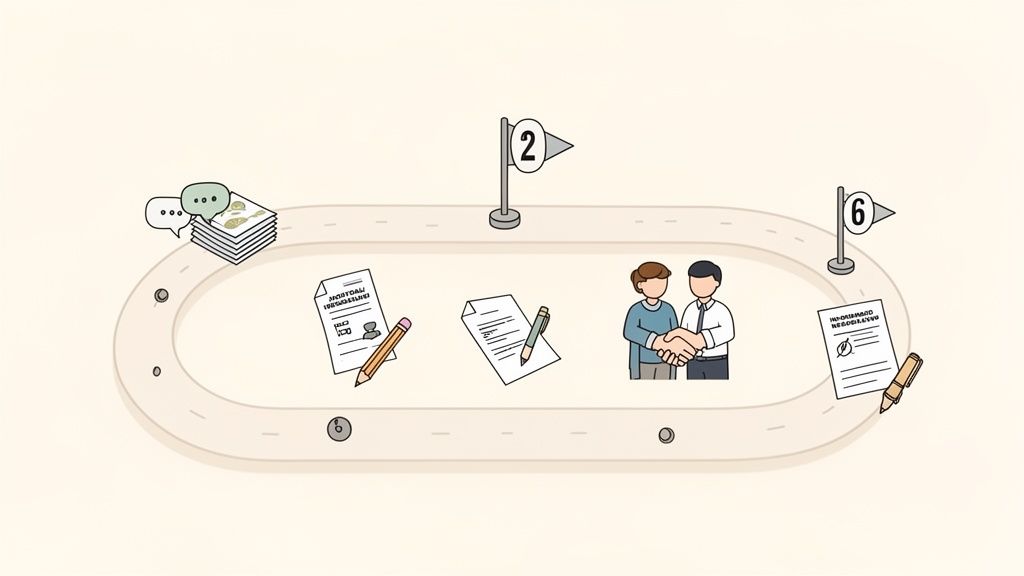
This infographic shows how legal agreements like prenups fit into the timeline of a relationship.

As you can see, a prenuptial agreement is a proactive step taken at the marriage stage to plan for the future.

Securing Independent Legal Advice (ILA)

Finally, the strongest safeguard is Independent Legal Advice (ILA). While not technically mandatory in every case, it’s so highly recommended by the courts that it’s practically essential. ILA means each of you hires your own separate lawyer to go over the agreement.

During the ILA process, your lawyer’s job is to:

  1. Explain what every clause means in plain English.
  2. Outline your legal rights and obligations with and without the contract.
  3. Ensure you understand the long-term consequences of what you are signing.

When a lawyer signs a Certificate of Independent Legal Advice, it provides powerful proof that you understood the agreement and signed it willingly. To navigate these complexities, it is highly recommended to seek guidance from specialized family law firms. For a detailed walkthrough, see our guide on how to make a prenuptial agreement.

Essential Clauses for Your Prenuptial Agreement

A flat lay shows a miniature house, coins in a jar, a legal document, and a black briefcase.

Once the legal foundations are sorted, the real work begins: deciding what goes inside your marriage contract. A well-drafted agreement is your personalized financial plan, reflecting your shared goals. The power of prenuptial agreements in Canada lies in their specific clauses, each designed to bring clarity to issues that could otherwise cause conflict.

Property Division

One of the cornerstones of any prenup is the property division clause. This section lets you draw a clear line between “family property” and “separate property,” giving you control over assets you bring into the marriage.

Without a marriage contract, Ontario’s family law defaults to equalizing the value of everything accumulated during the marriage. A prenup lets you write your own rules.

  • Protecting Pre-Marital Assets: Specify that a business you started, an investment portfolio you grew, or a condo you bought remains yours.
  • Defining Family Property: Decide how assets acquired during the marriage will be handled.
  • Safeguarding Gifts and Inheritances: Explicitly shield future inheritances or family gifts from being split if the marriage ends.

This clause is non-negotiable for anyone entering a marriage with significant assets. For a deeper dive, our guide to the division of property in a divorce lays it all out.

Debt Responsibility

Just as a prenup can ring-fence assets, it can do the same for your debts. This clause ensures neither of you gets unfairly saddled with financial obligations you didn’t create. This section clearly assigns responsibility for debts from before the marriage and those taken on during it.

A debt responsibility clause provides critical financial protection. It prevents a scenario where one spouse’s pre-existing liabilities could torpedo the other’s financial security during a separation.

This part of your marriage contract promotes financial accountability and shields the more fiscally responsible partner.

Spousal Support

Spousal support is another key area you can tackle in a marriage contract. This is where you and your partner have the flexibility to define your own terms for predictability and security.

Your agreement can clearly specify:

  • The amount of spousal support to be paid.
  • The duration for which support will be paid.
  • A complete waiver of spousal support altogether.

However, courts have the final say. A judge can override a spousal support clause if, at the time of separation, it’s deemed “unconscionable” or grossly unfair according to the Divorce Act. For example, a complete waiver might be tossed out if it would leave one person destitute after a long marriage.

Special Considerations for the Matrimonial Home

In Ontario, the law puts the matrimonial home in a special, protected category. The province’s Family Law Act is clear: both spouses have an equal right to possess the matrimonial home, regardless of whose name is on the title.

This means you cannot use a marriage contract to kick your spouse out of the family home right after a separation. What a prenup can do is address the division of the home’s financial value. You can include a clause specifying that the partner who owned the home before marriage gets their original down payment back first, before the remaining equity is divided.

Why Don’t More Canadian Couples Get a Prenup?

Given how much sense they make, it’s a fair question: why are prenuptial agreements in Canada still uncommon? The answer has little to do with the law and everything to do with human nature. For many, bringing up a marriage contract feels awkward and uncomfortable.

The Head-in-the-Sand Problem

Two major psychological roadblocks stop couples from exploring a prenup. The first is “false optimism”—the belief that, “Sure, divorce happens to other people, but it won’t happen to us.” It makes planning for a potential split feel pessimistic.

The second barrier is the fear of offence. People worry that asking for a prenup sends a message of distrust, as if they’re not fully committed. That fear of hurting their partner’s feelings is a massive deterrent.

Instead of viewing a marriage contract as planning for divorce, it’s more accurate to see it as an act of profound financial transparency and mutual respect—two essential ingredients for a strong partnership.

Experts estimate that only 5% to 10% of couples sign a prenuptial agreement. That’s a shockingly low number, considering the national divorce rate sits at around 38%. You can read the full analysis on why prenups remain uncommon despite their benefits.

Changing the Conversation

The only way past these hurdles is to reframe what a prenup is. This isn’t about expecting failure; it’s about responsible financial planning. Think of it as a tool that gets you talking openly about money, values, and expectations before they become points of conflict. When approached with teamwork and mutual respect, the entire dynamic shifts.

Serving Brampton and the Greater Toronto Area

Figuring out the ins and outs of prenuptial agreements in Canada requires an expert who understands Ontario’s specific legal landscape. Here at Badesha Law, we provide clear guidance to clients across Brampton, Mississauga, Toronto, and the entire Peel Region. We live and work here, so we understand the unique financial realities of the GTA.

Our approach is built on making this process straightforward. We use affordable, transparent fee structures for drafting and reviewing these agreements. As a leading prenup lawyer in Brampton, our job is to give you the knowledge you need to protect your future.

For more on what makes an effective prenup in our local area, take a look at our insights on crafting prenuptial agreements in Brampton.


Written by Badesha Law, Family Law Specialists.
Disclaimer: This article provides general information and does not constitute legal advice. For advice on your specific situation, please consult with a qualified family lawyer.

Related Reading

Ready to take the next step? Book your free consultation today to speak with an experienced family lawyer and secure your financial future.

For more resources, subscribe to our newsletter for insights on family law in Ontario.

Frequently Asked Questions About Prenups in Canada

How much does a prenuptial agreement cost in Ontario?

The cost for a prenuptial agreement in Ontario typically ranges from $1,500 to several thousand dollars. The final price depends on the complexity of your finances, the amount of negotiation required, and your lawyer’s rates. A simple agreement will be on the lower end, while complex assets increase the cost.

Can we change a prenup after getting married?

Yes, you can change or cancel a marriage contract after the wedding. Life changes, and your agreement can adapt. Any amendments must be in writing, signed by both partners, and properly witnessed. Both spouses should get independent legal advice on the new terms to ensure they remain enforceable.

When is the best time to get a prenup?

Ideally, you should start the process at least 3-6 months before your wedding. This timeline removes any hint of pressure or duress, which could be used to challenge the prenup’s validity later. It allows ample time for calm discussions, full financial disclosure, and securing independent legal advice.

Can a prenup protect my future inheritance?

Absolutely. One of a prenup’s most powerful features is protecting future assets like an inheritance. By stating in your contract that any inheritance is to remain your separate property, you can prevent it from being mixed with family assets and becoming subject to division if the marriage ends.

Is our Ontario prenup valid if we move to another province?

Generally, yes. A properly drafted Ontario prenuptial agreement is typically recognized across Canada due to shared contract law principles. However, since family law is provincial, it’s wise to have your agreement reviewed by a family lawyer in your new province to confirm its ongoing strength and alignment with local laws.

Do I need a lawyer for a prenuptial agreement in Canada?

While you can technically draft an agreement without a lawyer, it is highly inadvisable. To ensure the contract is legally binding and fair, both partners should retain their own lawyers for independent legal advice. This step is crucial for preventing the agreement from being challenged and overturned in the future.

What happens if you don’t have a prenup in Canada?

Without a prenup, provincial family law statutes dictate how assets and debts are divided upon separation or divorce. In Ontario, this generally means an equalization of the net family property accumulated during the marriage. A prenup allows you to create your own rules instead of relying on these default laws.

Who should get a prenuptial agreement?

Anyone can benefit from a prenup, but they are especially recommended for individuals who own a business, have significant pre-marital assets or debts, expect a large inheritance, have children from a previous relationship, or want to define spousal support obligations clearly from the outset.

The Ultimate Guide to Prenuptial Agreements in Ontario

Planning your future together is an exciting time. A key part of that planning, often overlooked, is discussing your finances. A prenuptial agreement in Ontario, legally known as a marriage contract, is a smart, proactive tool that allows you and your partner to decide how finances will be managed during your marriage and, if necessary, upon separation. It’s about setting clear, mutually agreed-upon rules for assets and debts, providing security and predictability as you build your life together.

Key Takeaways

  • Custom Financial Plan: A prenuptial agreement (marriage contract) lets you opt out of Ontario’s default property division rules and create a financial plan tailored to your specific situation.
  • Asset Protection: It can protect pre-marital assets, business interests, inheritances, and the matrimonial home from automatic equal division.
  • Clarity on Support & Debts: The agreement can define spousal support obligations or waive them entirely, and clarify who is responsible for pre-existing and future debts.
  • Legal Requirements are Crucial: For an Ontario prenup to be enforceable, it requires full financial disclosure, no duress, and independent legal advice (ILA) for both partners.
  • Cannot Dictate Child Matters: An agreement cannot pre-determine child support, decision-making responsibility (custody), or parenting time.

Table of Contents

What Is a Prenuptial Agreement in Ontario?

A woman points to a prenuptial agreement document while discussing with a man.

Think of a prenup as a personalized financial roadmap for your marriage. Here in Ontario, the Family Law Act officially calls this document a marriage contract. It lets you and your future spouse agree on key financial issues like property division and spousal support long before they could ever become a problem.

Getting a prenup isn’t about expecting the worst; it’s about starting your marriage with open communication. By tackling the tough money conversations before you walk down the aisle, you build a foundation of trust. A marriage contract essentially replaces the province’s default property laws with terms you both agree are fair for your unique situation.

Why Are More Couples in the GTA Considering Prenups?

The stigma around marriage contracts is fading. Once seen as a tool for the wealthy, prenups are now a practical planning document for everyday couples across the Greater Toronto Area. This shift is especially strong among younger generations who value financial transparency.

A recent survey from HelloPrenup, for instance, showed a clear generational trend: 52% of Gen Z respondents said they would insist on a prenup before marriage. We’re seeing this firsthand with millennials and business owners in Peel Region and Brampton, who are taking proactive steps to protect their assets and define their financial partnership on their own terms.

To get a better sense of how financial outcomes can differ, let’s compare what happens during a separation with and without a prenuptial agreement in Ontario.

Prenuptial Agreement vs Default Ontario Law

Financial Aspect Without a Prenuptial Agreement (Default Rules) With a Prenuptial Agreement
Property Division Most property acquired during the marriage is divided equally through equalization. You define what property is shared and what remains separate (e.g., a business or inheritance).
Matrimonial Home The home is typically shared 50/50, even if one person owned it before the marriage. You can specify a different arrangement for the home, protecting one partner’s initial investment.
Spousal Support Entitlement and amount are determined by formulas based on income and marriage length. You can set specific terms for support, including waiving it entirely or defining the amount and duration.
Business Assets The growth in value of a business during the marriage is included in equalization calculations. You can protect a business from being divided or valued as part of a separation.
Debts Debts incurred during the marriage are generally shared in the final property calculation. You can clarify who is responsible for specific debts, both pre-marital and future.

As you can see, a marriage contract gives you and your partner the power to write your own rules, providing far more control and certainty than the one-size-fits-all approach of Ontario’s default laws.

The Core Purpose of a Marriage Contract

At its heart, a marriage contract lets you opt out of Ontario’s standard legal framework for dividing assets and create a plan that actually fits your life. This becomes incredibly important if:

  • One of you owns a business or has a professional practice.
  • There’s a big difference in the assets or debts you’re each bringing into the marriage.
  • One or both of you have children from a previous relationship.
  • You’re expecting a significant inheritance or a gift from family down the line.
  • You want to protect specific assets, like a family cottage or investments you owned before the wedding.

A prenuptial agreement is less about planning for an end and more about carefully designing a beginning. It empowers couples to define their financial partnership on their own terms, fostering trust and clarity.

Without one, the law takes over. The default process, called equalization, dictates that the value of most property gained during the marriage gets split right down the middle. The matrimonial home gets special treatment and is often divided equally, no matter who owned it first.

A prenup puts you back in control of those outcomes. It provides certainty by ensuring your financial future reflects your shared intentions, not a rigid legal formula. You can explore more about the numerous benefits of prenuptial agreements in our detailed article.

What a Prenuptial Agreement Can Protect

A wooden house model, a legal document, and a family photo on a desk near a window.

Think of a prenuptial agreement in Ontario as creating a custom-made financial blueprint for your marriage. Instead of defaulting to the province’s one-size-fits-all legal rules, you and your partner get to decide—proactively—how you’ll manage your assets and responsibilities. It’s about building a plan that actually fits your unique life and shared goals.

This contract is so much more than a legal formality; it’s a powerful tool for clarity. It allows you to tackle the big financial questions head-on, giving you both certainty and minimizing the chances of conflict down the road. Whether it’s shielding a family business or setting out expectations for spousal support, a marriage contract lets you build your financial future with confidence.

Safeguarding Your Property and Assets

One of the most common reasons couples come to us for a marriage contract is to protect specific assets. This is especially true if one person is bringing significantly more property into the marriage or has a reasonable expectation of receiving major assets in the future.

The agreement allows you to draw a clear line, defining what counts as “separate property” versus “family property.” This distinction is critical because, under Ontario law, the growth in the value of most assets during a marriage is typically shared equally upon separation.

Common assets that a prenup can ring-fence include:

  • Pre-Marital Real Estate: If you owned a house before the wedding, a prenup can protect its value as yours alone. This is particularly important for the matrimonial home, which gets special treatment under the Family Law Act and is often split, regardless of who originally bought it.
  • Business Interests: For any entrepreneur, a prenup is essential. It can prevent your business from being dragged into a separation, protecting it from a forced valuation or division.
  • Inheritances and Family Gifts: You can spell out that any future inheritances or significant gifts from your family will remain your separate property, keeping them out of the net family property calculation.
  • Investments and Pensions: A contract can dictate how retirement savings, stock portfolios, and other investments are to be handled, ensuring your long-term financial strategy stays on track.

Defining Spousal Support Obligations

Spousal support is another massive area where a marriage contract can bring clarity. Without an agreement, the issue—who is entitled, how much they get, and for how long—is left up to legal formulas and a judge’s discretion. This uncertainty can fuel long disputes.

A prenuptial agreement puts you back in control. You and your partner can decide on the terms of spousal support in advance, which could look like:

  • Waiving Support Entirely: You can agree that neither of you will ever seek spousal support from the other.
  • Setting Specific Terms: You could define an exact support amount, set a time limit (a “sunset clause”), or outline the circumstances that would trigger a payment.
  • Lump-Sum Payments: You could agree on a single, one-time payment to settle any and all potential support claims.

By proactively defining your support obligations, you replace a huge legal question mark with a clear, mutually agreed-upon answer. This step alone can save an immense amount of emotional and financial pain if the marriage ever ends.

Clarifying Responsibility for Debts

Debt is a major part of modern financial life, and a marriage contract is the perfect place to clarify how it will be handled. The agreement can specify who is responsible for debts brought into the marriage and how any debts acquired during the marriage will be treated upon separation.

For instance, you can make sure that one partner’s pre-existing student loans or business debts remain their sole responsibility. This protects the other partner from being on the hook for those obligations. Getting a handle on how assets and liabilities are treated is a key part of financial planning, and you can learn more about the default rules by reading our guide on property division in Ontario.

Understanding the Legal Boundaries of Your Agreement

While a prenuptial agreement in Ontario gives you a tremendous amount of control over your financial future, it isn’t an all-powerful document. Think of it like building a custom house; Ontario’s laws provide the essential, non-negotiable foundation that ensures the structure is safe and fair. The legal system sets clear boundaries to protect fundamental rights, especially those of children.

A marriage contract operates within a framework of fairness and public policy. Its purpose is to create certainty and predictability, not to leave one person at a severe disadvantage or undermine legal safety nets.

The Best Interests of the Child Come First

This is the most important rule: you cannot use a prenup to decide on child-related matters. This is a hard-and-fast boundary that protects a child’s rights, which belong to them alone and can’t be signed away by their parents in advance.

Specifically, your agreement cannot pre-determine:

  • Decision-Making Responsibility (Custody): You can’t decide in a prenup who will make major decisions for a child you might have years from now. A court will always assess what is in the child’s best interests at the time of separation.
  • Parenting Time (Access): Similarly, schedules for when a child spends time with each parent can’t be locked into a marriage contract. A child’s needs will inevitably change.
  • Child Support: This is the right of the child, not the parent. It is calculated based on the parents’ incomes when they separate, following the official Child Support Guidelines. You cannot waive child support or preset the amounts in your agreement.

The law is structured this way because a child’s needs and a parent’s circumstances can change dramatically. A court must always have the final say to ensure a child’s well-being is the top priority.

Clauses That Will Not Be Enforced

Beyond child-related issues, courts in Ontario can set aside clauses—or an entire agreement—that cross certain legal or ethical lines. To really get a handle on the enforceability of your agreement, it helps to understand the core ideas behind Mastering Contract Interpretation Principles.

A contract that shocks the conscience of the court or fundamentally destabilizes the institution of marriage will not stand. Fairness is the bedrock of enforceability in Ontario family law.

Two key types of clauses that a judge will refuse to enforce are:

  • Unconscionable Terms: This legal term applies to clauses that are grossly unfair or exploitative. If an agreement is so one-sided that it would leave one partner destitute, a judge will almost certainly intervene. For example, a clause stating one spouse gets 100% of all assets, regardless of contributions, would be challenged.
  • Clauses Encouraging Separation: Any term that creates a financial incentive for one person to end the marriage is considered against public policy and is void. A classic example would be a clause promising one spouse a massive payout only if they initiate a separation within a certain timeframe.

These legal guardrails ensure your agreement promotes fairness, not opportunism. This is precisely why having separate, independent legal advice is so crucial—it serves as a check and balance, confirming that both people fully understand their rights.

For unmarried couples looking for similar protections, learning about cohabitation agreements in Ontario can provide valuable insight.

How to Create a Legally Binding Prenup in Ontario

A prenuptial agreement is only as strong as its foundation. For a prenuptial agreement in Ontario to be legally enforceable, it must follow a specific process designed to ensure fairness, transparency, and voluntary consent.

Skipping these steps doesn’t just weaken your agreement—it can make it completely invalid. Creating an ironclad marriage contract involves a careful approach built on complete financial disclosure, the absence of any pressure, and independent legal advice for each person.

The Pillar of Full Financial Disclosure

The first and most critical step is full and honest financial disclosure. This means both you and your partner must provide a complete and accurate picture of your finances—every asset, every debt, and every source of income. Think of it as putting all your financial cards on the table.

This transparency is non-negotiable. If one person hides a significant asset—like a secret investment account—the entire agreement could be thrown out by a court. The goal is to make sure both of you are making informed decisions based on the same set of facts.

To meet this standard, you’ll need to gather and share documentation, including:

  • Assets: Bank accounts, investment statements, real estate holdings, business interests.
  • Debts: Mortgages, lines of credit, student loans, credit card balances.
  • Income: Recent pay stubs and tax returns.

Avoiding Duress and Undue Influence

For a prenup to be valid, both of you must sign it freely and voluntarily. This means you can’t be subjected to duress or undue influence—legal terms for being pressured, threatened, or manipulated into signing.

Timing is often the biggest red flag. Presenting a prenup days before the wedding is a classic example of creating a high-pressure situation. A court might see this as coercive, figuring one partner felt they had no real choice but to sign or call off the wedding.

A rushed process is a recipe for disaster. To ensure your agreement is seen as voluntary, we strongly recommend starting the conversation 3-6 months before your wedding date. This gives everyone plenty of time for thoughtful negotiation and removes any hint of last-minute pressure.

The Critical Role of Independent Legal Advice

Perhaps the most important safeguard for a binding marriage contract is ensuring both partners receive Independent Legal Advice (ILA). This means each of you hires your own separate family lawyer to review the document.

Your lawyer’s job is to explain what the agreement means for you personally. They’ll outline your rights under Ontario law and spell out exactly how the contract changes those rights. As you figure out how to create a legally binding prenuptial agreement, it helps to also understand the general principles of personal family contracts.

A Certificate of ILA, signed by each lawyer, provides powerful proof that you both understood the agreement and signed it willingly. Without it, one partner could later claim they didn’t know what they were signing, creating an opening to challenge the contract’s validity. If you need this guidance, it is wise to consult with a prenuptial agreement lawyer near you to handle this crucial step.

Checklist for an Enforceable Ontario Prenup

Requirement Why It’s Critical Badesha Law’s Recommendation
Full Financial Disclosure Ensures both partners make informed decisions. Hiding assets can invalidate the entire agreement. Exchange sworn Financial Statements with supporting documents (tax returns, bank statements) at the outset.
No Duress or Undue Influence The agreement must be signed voluntarily. Any hint of pressure or threats can be grounds to set it aside. Start the process 3-6 months before the wedding to allow for calm, unhurried negotiations.
Independent Legal Advice (ILA) Proves both parties understood the terms and their legal consequences before signing. Each partner must retain their own separate lawyer. A Certificate of ILA from each lawyer is essential.
Agreement in Writing & Signed A verbal agreement is not a marriage contract. It must be a formal, written document signed by both partners. The final document must be physically signed by both partners and their respective witnesses.
Witnessed Signatures The Family Law Act requires that the signatures of both partners be properly witnessed. Each signature must be witnessed by someone other than the other partner. Your lawyer can act as a witness.

Following these steps methodically is the best way to ensure the prenup you sign today will be respected by a court years from now.

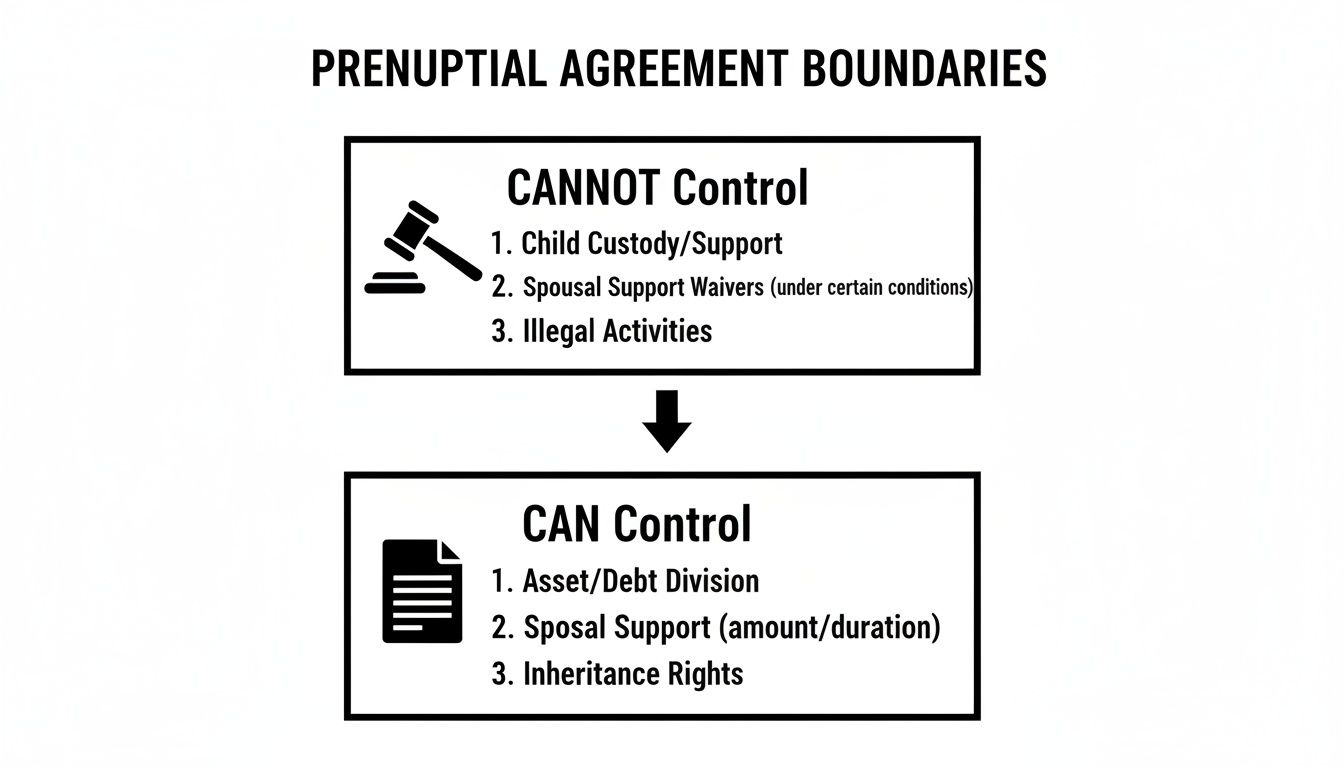
Diagram illustrating what prenuptial agreements can and cannot control, including assets and child support.

This map shows what you can and cannot pre-determine in your agreement. While you have significant control over financial matters like property and spousal support, anything related to children remains under the court’s ultimate jurisdiction.

Navigating the Costs of a Prenuptial Agreement in the GTA

It’s a mistake to see a prenuptial agreement in Ontario as just another wedding expense. A better way to think about it is as an investment in your financial future—one that buys you clarity and security. The price isn’t a simple flat fee; it depends on the complexity of your finances and how much negotiation is needed.

For a couple with straightforward assets, a simple agreement can be quite affordable. But if your situation involves a business, multiple properties, or a significant investment portfolio, the legal work required to protect those assets will naturally be more involved.

Breaking Down the Investment

The cost of a marriage contract in the Greater Toronto Area mostly comes down to your lawyer’s time. This includes initial consultations, drafting the agreement, reviewing financial disclosure, and negotiating the final terms with your partner’s lawyer.

In the GTA, you can generally expect a comprehensive prenup to cost between $2,500 and $5,000. This investment protects you from Ontario’s default property division rules, which otherwise split the value of everything gained during the marriage. You can discover more insights about these financial protections and typical costs from other family law experts in the region.

A Proactive Investment in Financial Security

You have to frame this expense in the right context. When you consider the staggering financial and emotional cost of a contested separation, the upfront investment in a prenup is tiny in comparison. A single fight over the matrimonial home or a business can easily rack up legal fees that dwarf the cost of the agreement.

A prenuptial agreement is one of the most cost-effective planning tools available. It replaces uncertainty and potential conflict with a clear, predictable roadmap that you both agreed upon during a time of cooperation and trust.

Think of it this way: the investment you make today is designed to prevent a much bigger, more painful expense tomorrow. By sorting out the financial details when you’re both on the same team, you are building a stronger, more transparent foundation. The cost of a well-drafted prenup truly pales in comparison to the expenses of a protracted court battle, which is why understanding how much a divorce can cost in Ontario gives you a powerful perspective on the value of planning ahead.

Serving Peel Region and the GTA

At Badesha Law, we are proud to serve clients across the Greater Toronto Area, with a special focus on our communities in Peel Region. Whether you are looking for a prenuptial agreement lawyer in Brampton, Mississauga, or the surrounding areas, our team is here to provide expert, localized guidance to protect your future. We understand the unique financial landscapes for families and business owners in this region.

Frequently Asked Questions About Ontario Prenuptial Agreements

Talking about legal contracts while planning a wedding can feel awkward. But getting clear answers to your questions is the first step toward building a strong, transparent partnership. Here are the most common questions we hear about marriage contracts in Ontario.

When is the best time to get a prenuptial agreement in Ontario?

Ideally, you should start the process 3 to 6 months before your wedding. This gives both of you ample time for calm conversations, full financial disclosure, and negotiations without the pressure of a fast-approaching wedding day. Signing an agreement too close to the ceremony can risk it being challenged on the grounds of duress.

What happens if we divorce in Ontario without a prenup?

Without a prenup, Ontario’s Family Law Act automatically sets the rules. The default system is “equalization,” which means you will generally share equally in the value of all property and assets built up during the marriage. Special rules also apply to the matrimonial home. A prenuptial agreement lets you create your own customized plan.

Can we change our prenuptial agreement after we are married?

Yes, a prenup isn’t set in stone. You can amend or update your agreement after marriage, but it must be done correctly. Any changes must be in writing, and both spouses must voluntarily agree to and sign the new document in front of a witness. We strongly recommend getting independent legal advice before making any changes.

Is a prenuptial agreement still valid if we move out of Ontario?

This can be complicated. While a properly drafted Ontario prenup is often recognized elsewhere, its enforceability will depend on the family laws of your new province or country. If you are planning a move, it’s smart to have your agreement reviewed by a family lawyer in your new location to ensure it holds up.

Does a prenup protect against a partner’s debts?

Absolutely. This is one of the most practical functions of a prenuptial agreement in Ontario. The agreement can clearly state that you are not responsible for your partner’s personal or business debts—whether they brought them into the marriage or accumulated them during it. This provides a critical financial firewall for your own assets.

How much does a prenup cost in Ontario?

The cost for a prenuptial agreement in Ontario typically ranges from $2,500 to $5,000, but this can vary. The final price depends on the complexity of your finances, the assets involved, and the amount of negotiation required between lawyers. It’s best to view this as an investment in financial certainty and conflict prevention.

Can a prenup be overturned in Ontario?

Yes, a court can set aside a prenup if it was created improperly. The most common reasons for a prenup being overturned are a lack of full financial disclosure, one party signing under duress or undue influence, or the absence of independent legal advice for both partners. Following the correct legal process is essential.

Do I need a lawyer for a prenuptial agreement in Ontario?

Yes, it is crucial that both you and your partner have your own separate lawyers. This is called Independent Legal Advice (ILA). It is a key requirement for ensuring the agreement is legally binding and enforceable. A lawyer ensures you fully understand your rights and the terms you are agreeing to, protecting the contract from future challenges.


Written by Badesha Law, Family Law Specialists. This article is for informational purposes only and does not constitute legal advice. Please consult with a qualified family lawyer to discuss your specific situation.

Are you ready to build a strong, transparent financial foundation for your marriage? The family law team at Badesha Law provides expert guidance on drafting fair and enforceable prenuptial agreements.

Book a Consultation Today

A Practical Guide to Prenuptial Agreements in Brampton, Ontario

In Canada, a prenuptial agreement is a legally binding contract two people sign before getting married, spelling out how things like assets and support will be handled if the relationship ever ends. In Ontario, it’s officially called a marriage contract, and for couples in Brampton, it gives you and your partner the power to write your own financial rules instead of defaulting to the province's Family Law Act.

Why a Prenup Is Smart Financial Planning for Your Marriage

Let's be honest, talking about a prenuptial agreement can feel a little awkward. But it's time we changed the way we think about it. Far from being a red flag, a prenuptial agreement in Canada is one of the smartest financial tools a couple in Brampton can use before tying the knot.

Think of it as insurance for your shared future. You don’t buy home insurance expecting a fire, but you get it for peace of mind. A marriage contract works the same way—it’s an actionable step to create clarity, encourage open conversations about money, and head off potential conflicts down the road.

A Private Contract for Your Future

Under Ontario's Family Law Act, a marriage contract is a private agreement that lets couples in Brampton and across the province set their own terms. It lays out a clear roadmap for dealing with assets, debts, and spousal support, making sure both partners walk into the marriage with confidence and a shared financial understanding.

This practical approach is becoming more and more common. In fact, recent trends show that 61% of Canadians now see prenups as a good idea—not as a bad omen, but as a practical financial tool. This is especially true for millennials, who often marry later in life with more established careers and assets.

A well-drafted contract can help you:

  • Protect assets you owned before the marriage or a family business.

  • Define how property you acquire together will be divided.

  • Clarify who is responsible for pre-existing and future debts.

  • Outline spousal support obligations to create predictability.

A marriage contract isn’t about planning for failure; it’s about building a marriage on a foundation of transparency and mutual respect. By discussing finances openly, you establish a precedent for honest communication that can strengthen your relationship for years to come.

Beyond just sorting out marital finances, prenups are also a key part of broader asset protection planning, helping to safeguard individual wealth before you say "I do." For couples in Brampton, where property values are a major financial factor, having a clear agreement in place is an invaluable step toward security. It removes ambiguity and lets you focus on what really matters: building your life together.

What Your Prenuptial Agreement Can and Cannot Cover

A prenuptial agreement, or a marriage contract as it’s called in Ontario, is a powerful tool for mapping out your financial future together. But it’s not a blank cheque. Understanding what you can and can’t include is crucial for any couple in Brampton looking to create a fair, legally sound document that will actually hold up if it's ever needed.

Think of it like setting the ground rules for your financial life as a married couple. You can define the boundaries of the playing field, but some rules—especially those protecting children—are non-negotiable under both the Family Law Act and federal laws like the Criminal Code. A prenup is about being proactive and clear, not pessimistic.

H3: What You Can Include in Your Prenuptial Agreement

Under Ontario's Family Law Act, a marriage contract gives you and your partner a surprising amount of freedom to customize your financial arrangements. You get to decide on key issues that, without an agreement, would simply be handled by the default provincial laws if you ever separated.

Here are the main areas your agreement can cover:

  • Protecting Pre-Marital Assets: You can clearly state that any assets you each brought into the marriage—like savings, investments, or a condo you owned before the wedding—remain your own separate property. They won't be subject to division if you part ways.

  • Managing Property Acquired During Marriage: You can set your own rules for how you’ll divide property and assets you accumulate during the marriage. This allows you to opt out of Ontario's standard equalization process, which is especially important for couples in the GTA where real estate is often the most significant asset.

  • Ownership of the Matrimonial Home: While the matrimonial home has a special legal status, a prenup can address how the asset is handled financially. For example, you can decide ahead of time how the proceeds will be split if the home is sold.

  • Spousal Support Obligations: The agreement can provide clarity and predictability by setting out the terms for spousal support. You can define if it will be paid, for how long, and even set a specific amount or a formula for calculating it.

  • Responsibility for Debts: You can clarify how debts will be handled, whether they were brought into the marriage or racked up during it. This is a practical way to protect one another from financial liabilities.

  • Inheritances and Gifts: A prenup can make sure that any future inheritances or large gifts from family members remain the separate property of the person who received them.

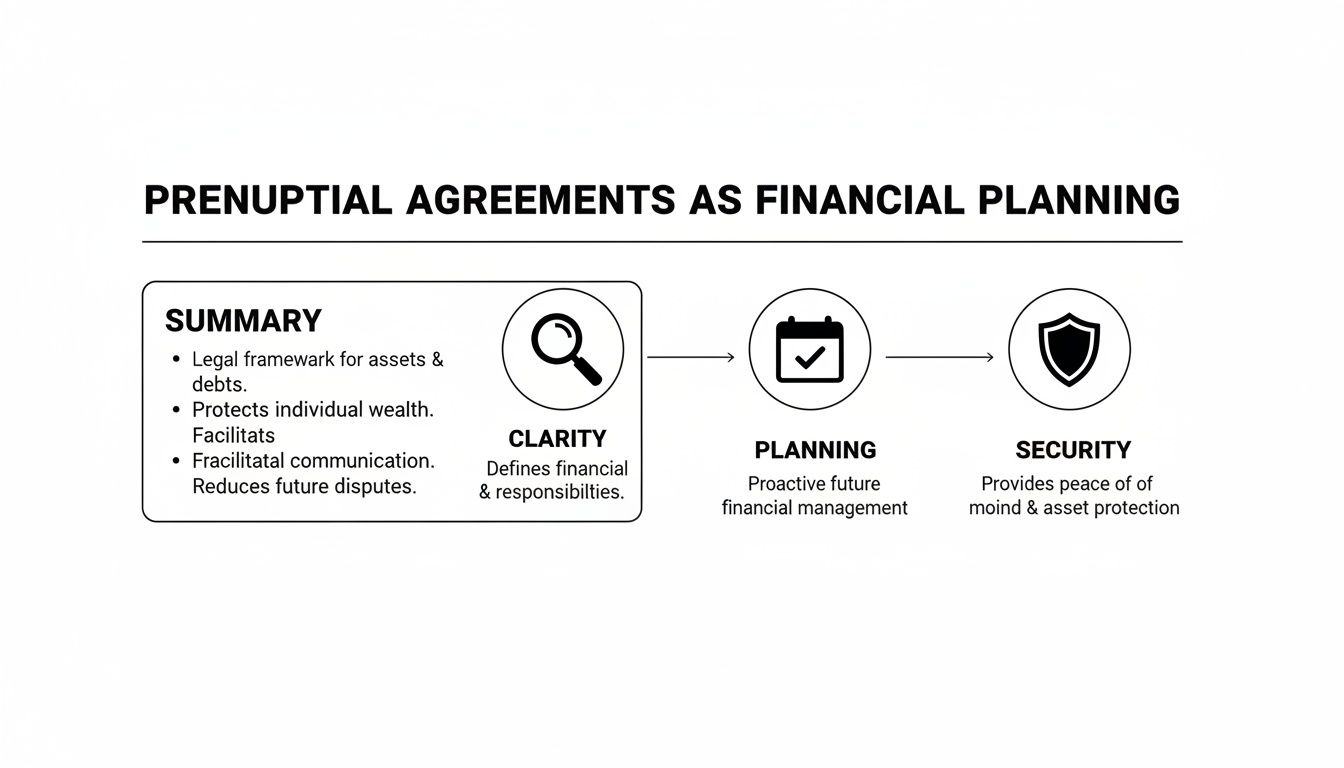
This diagram shows how a prenup really works as a financial planning tool, creating a foundation of clarity, planning, and security for your life together.

Diagram illustrating prenuptial agreements as a financial planning tool, emphasizing clarity, planning, and security.

By tackling these key areas head-on, you turn vague financial anxieties into a concrete, mutually agreed-upon plan.

What You Cannot Include in Your Prenuptial Agreement

Just as important as knowing what to put in your agreement is understanding its legal limits. The law draws some very firm lines, mostly to protect the rights of children and prevent one-sided or unfair arrangements. If you try to include prohibited clauses, a court will simply strike them out. In a worst-case scenario, it could even put the validity of your entire agreement at risk.

Under Canadian law, the rights of a child always come first. A prenuptial agreement cannot override the court’s duty to act in a child’s best interests, which is a non-negotiable principle.

A valid prenuptial agreement in Canada can't touch the following:

  • Child Custody or Access: You simply cannot decide custody (decision-making responsibility) or parenting time for children you don't have yet. If you separate, a court will make these decisions based only on the child's best interests at that specific time.

  • Child Support: The right to child support belongs to the child, not the parents. You can't waive it or lock in a specific amount in a prenup. Child support must be calculated based on the Federal Child Support Guidelines when and if the parents separate.

  • Possession of the Matrimonial Home: While you can agree on how to divide the value of the home, you can't use a prenup to kick a spouse or children out of the family home upon separation. That right of possession is protected under the Family Law Act.

  • Anything Illegal or Against Public Policy: This should go without saying, but any clause that encourages illegal activity or goes against public policy is automatically void. Provisions related to anything in the Criminal Code of Canada, for example, would be thrown out immediately.

To put it simply, here’s a quick breakdown of what’s on and off the table when drafting your contract.

Permitted vs Prohibited Clauses in an Ontario Marriage Contract

What You Can Include What You Cannot Include
Division of property and assets Child custody or parenting time arrangements
Spousal support terms (amount, duration, or waiver) Child support terms (amount, duration, or waiver)
Ownership of the matrimonial home Right to possession of the matrimonial home
Responsibility for debts Clauses that violate public policy or the law
Protection of inheritances and gifts Anything that is not about financial matters
Rules for managing finances during the marriage Provisions that are unconscionable or grossly unfair

Ultimately, a marriage contract gives you incredible control over your financial destiny as a couple. It just has to operate within a legal framework designed to ensure fairness and protect the vulnerable. Working with an experienced Brampton family lawyer is the best way to ensure your agreement does exactly what you want it to while remaining strong and enforceable.

The Legal Steps to an Enforceable Ontario Prenup

A prenuptial agreement is only as strong as its legal foundation. In Ontario, you can't just write down what you want and call it a day. The Family Law Act requires very specific steps to ensure the agreement is fair, transparent, and legally binding. Following these steps isn’t just a good idea—it’s non-negotiable if you want a contract that will actually stand up in court if it's ever challenged.

Think of it like building a house in Brampton. You wouldn't skip the foundation or the structural inspections, right? Skipping a legal step, like getting proper advice, can cause the entire agreement to crumble under legal pressure, leaving you unprotected. This is why the process matters just as much as the final document.

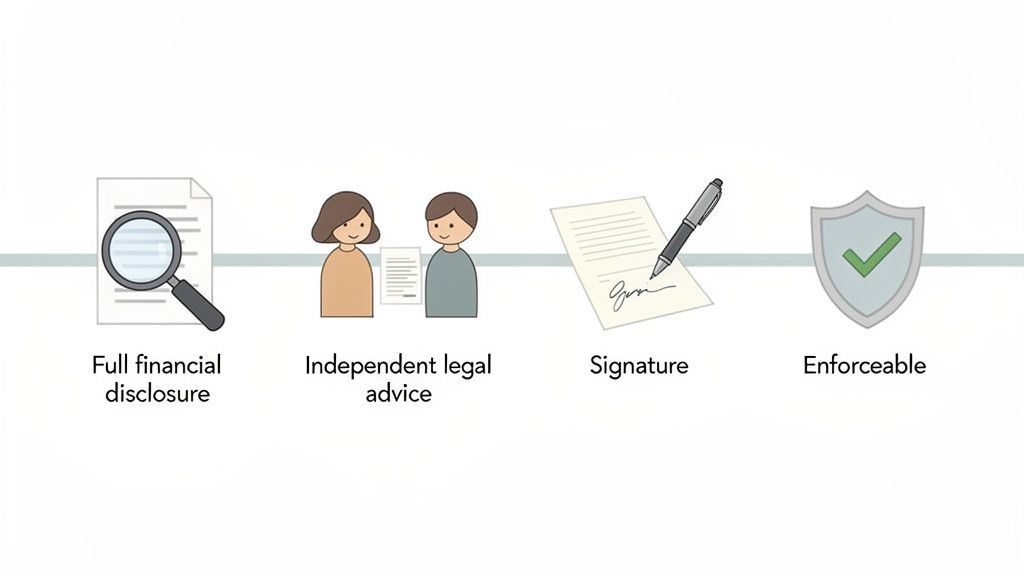
Illustrates four key steps for an enforceable legal agreement: financial disclosure, legal advice, signature, and enforceability.

Let's break down the essential pillars of an enforceable prenuptial agreement in Canada, specifically for those of us here in Ontario.

Full and Honest Financial Disclosure

The cornerstone of any valid marriage contract is transparency. Before you sign anything, both you and your partner must provide a complete and truthful picture of all your finances. This means laying all your cards on the table—no exceptions.

This isn't just a suggestion; it’s a legal requirement under Ontario’s Family Law Act. Hiding an asset or downplaying a debt can be grounds for a judge to throw out the entire agreement later on.

Your disclosure should include documentation for:

  • Assets: Bank accounts, investments, real estate holdings, business interests, vehicles, and valuable personal property.

  • Debts: Mortgages, loans, credit card balances, and any other financial liabilities.

  • Income: A clear statement of your current earnings from all sources.

This step ensures that both of you are making informed decisions based on a complete financial picture. It's about building an agreement on a foundation of honesty from the very beginning.

Independent Legal Advice (ILA)

This is arguably the most critical step in the entire process. To ensure a prenup is enforceable, both you and your partner must each have your own lawyer. This is what’s known as Independent Legal Advice (ILA).

Your lawyer's job is to look out for your interests and yours alone. They will review the draft agreement, explain what each clause means for your future, and advise you on your rights and obligations under Ontario law. The same lawyer cannot advise both of you, as that would be a clear conflict of interest.

Having separate lawyers protects both parties. It proves to a court that neither person was taken advantage of and that both fully understood the rights they were signing away. Without ILA, an agreement is highly vulnerable to being challenged and overturned.

When you each have ILA, your respective lawyers will sign a certificate confirming they provided this advice. This certificate becomes powerful evidence that the process was fair and the agreement was entered into with full knowledge.

Signing Without Pressure or Duress

For a contract to be valid, it has to be signed freely and voluntarily. There can be no hint of pressure, threats, or manipulation—legally known as duress or undue influence.

A classic example of duress is presenting a prenup to your partner a week before the wedding with an ultimatum: "Sign this, or the wedding is off." A court may see this as coercive, as one person might feel they have no real choice but to sign under the immense social and financial pressure of a pending wedding.

To avoid this, it’s crucial to:

  1. Start Early: Begin the prenup conversation months before the wedding date. This gives both of you plenty of time for disclosure, negotiation, and legal review without feeling rushed.

  2. Ensure Fair Negotiations: The process should be a collaborative discussion, not a one-sided demand.

Ensuring the agreement is signed without duress confirms that it reflects the true and willing intentions of both partners. A Brampton family lawyer can help manage the timeline and process to ensure everything is handled fairly and professionally, creating a document that truly protects you both.

Common Mistakes That Can Invalidate Your Agreement

Knowing the right steps to create a prenuptial agreement is only half the battle. Just as crucial is understanding the common pitfalls that can render your contract unenforceable in Ontario, potentially leading to the very legal battles you sought to avoid. A seemingly minor misstep can unravel even the best intentions.

For couples in Brampton, a few key mistakes consistently appear when agreements are challenged in court. Avoiding these errors is essential to ensuring your marriage contract provides the security and clarity it was designed for. Let's look at the most frequent and damaging blunders.

The Dangers of DIY or 'Kitchen Table' Agreements

In an effort to save time or money, some couples are tempted to download a template online or draft a simple agreement themselves. This is one of the biggest risks you can take. These "kitchen table" agreements almost always fail to meet the strict legal standards required by Ontario's Family Law Act.

A DIY prenup often lacks the necessary components for enforceability:

  • Improper Financial Disclosure: It may not include a complete and formal exchange of financial information, which is a non-negotiable requirement.

  • Lack of ILA: It will not have certificates of Independent Legal Advice from separate lawyers, which is a massive red flag for any court.

  • Vague or Illegal Clauses: Without legal expertise, it's easy to include terms that are ambiguous, unenforceable (like child custody provisions), or contrary to public policy.

A contract is more than just a piece of paper; it's a complex legal instrument. To further ensure its robustness, understanding broader contract management best practices can help you appreciate the formalities required to mitigate common mistakes that might otherwise invalidate the agreement.

Signing Under Duress or Too Close to the Wedding

The timing and circumstances of signing your prenuptial agreement are critically important. A contract is only valid if both parties sign it freely and voluntarily, without any form of pressure or coercion. This is known as avoiding duress.

A classic example of duress is presenting the agreement days before the wedding with a "sign it or it's off" ultimatum. The emotional and financial pressure of a looming wedding can make it difficult for a person to refuse, and a judge may later decide they didn't sign willingly.

An agreement signed under pressure isn't a true agreement. A court will set aside a contract if it believes one party was unfairly coerced or did not have a meaningful choice in the matter, undermining the entire purpose of the prenup.

To avoid this, start the process at least 4-6 months before your wedding date. This provides ample time for open discussions, thorough financial disclosure, and proper legal review without a stressful deadline hanging over your heads.

Using Unfair or Vague Terms

Finally, the substance of the agreement itself matters. Ontario courts can set aside a prenuptial agreement if its terms are found to be "unconscionable" or grossly unfair to one party. While you can create your own financial rules, they must still exist within a realm of fairness.

For instance, a clause that leaves one spouse with all the assets and the other with all the debts and no spousal support after a long marriage would likely be seen as unconscionable.

Similarly, vague language can be fatal. Terms like "reasonable support" or "a portion of the business" are open to interpretation and can lead to disputes. A strong agreement uses precise, clear language that leaves no room for ambiguity. An experienced Brampton family lawyer will ensure your contract is both fair and specific, protecting it from future challenges.

Navigating the Prenup Process From Start to Finish

Creating a prenuptial agreement might sound intimidating, but it’s really just a series of clear, manageable steps. Think of it as a blueprint for your financial future. For couples in Brampton, a straightforward roadmap transforms a complex legal task into a collaborative project, guided by an experienced family lawyer.

The entire process is designed to be transparent and cooperative, making sure the final document truly reflects your shared goals. It flows logically from your first conversations to the final signature, with key checkpoints along the way. Understanding this workflow helps set expectations and shows how each stage builds on the last to create a solid, legally sound agreement.

Illustrated workflow on an oval path, showing steps from documents and discussion to a handshake.

Step 1: The Initial Consultation and Goal Setting

Your journey begins with an initial consultation with your family lawyer. This first meeting is all about laying the groundwork. You and your partner will sit down and talk about your goals, what you want to protect, and how you see your financial future together. It’s the perfect time to ask questions and learn how a marriage contract can be shaped to fit your unique situation.

Your lawyer will walk you through the legal framework under Ontario’s Family Law Act and help you clarify what you want to achieve. Maybe you want to protect a family business, keep an inheritance separate, or simply create a clear plan for property you acquire during the marriage.

Step 2: Comprehensive Financial Disclosure

Next up is the most critical part of the process: full financial disclosure. This is where you and your partner lay all your financial cards on the table. It’s a non-negotiable step for any valid prenuptial agreement in Canada, because honesty and transparency are what make the agreement enforceable down the road.

This exchange means sharing everything, including:

  • Statements from all bank accounts, investments, and retirement funds.

  • Up-to-date appraisals for any real estate you own.

  • Valuations for business interests or other major assets.

  • A clear list of all debts, like mortgages, student loans, or credit card balances.

This step creates the factual foundation for the entire agreement. Without it, the whole structure could collapse if challenged later.

A prenuptial agreement is only as strong as the financial disclosure it's built on. Complete honesty at this stage is the best way to prevent the agreement from being challenged and potentially invalidated in the future.

Step 3: Drafting the Agreement

Once all the financial information is on the table, one of your lawyers will draft the first version of the marriage contract. This initial draft takes all your conversations and goals and turns them into formal legal clauses. It will cover all the key areas you’ve discussed, from how property will be handled to whether spousal support will be paid.

Think of this document as a starting point. It’s meant to be reviewed, discussed, and adjusted. It’s rare for the first draft to be the final one, so expect a bit of back-and-forth as you and your lawyers fine-tune the details.

Step 4: Independent Legal Advice and Negotiation

After the draft is ready, the other partner must take it to their own lawyer for Independent Legal Advice (ILA). This is a non-negotiable step in Ontario. It ensures that both of you fully understand your rights and obligations and aren’t being pressured into signing something that isn’t in your best interest. Their lawyer will review the document with a fresh set of eyes, focused entirely on protecting their client.

This is also the negotiation phase. If one lawyer has concerns or wants to suggest changes, they’ll communicate with the other lawyer. This collaborative process continues until both of you are completely satisfied that the agreement is fair, balanced, and reflects what you both want.

Step 5: Finalizing and Signing the Agreement

Once negotiations are done and everyone agrees on the terms, the final version of the agreement is drawn up. You and your partner will then sign the document in front of a witness. To complete the process, your respective lawyers will sign Certificates of ILA, confirming that they provided you with the necessary legal counsel.

As for costs, they can vary. Typically, you'll see a flat fee for the initial drafting, with additional hourly fees for the negotiation process and the ILA review. Talking about costs upfront with your lawyer will help you budget accordingly. It’s a detailed journey, but the result is a powerful legal tool that provides clarity and protection for your future.

Your Prenup Questions, Answered

When you start looking into marriage contracts, a lot of questions pop up. For couples in Brampton and across Ontario, getting clear on the details of the Family Law Act is the first step toward making a smart decision. Here are some straightforward answers to the questions we hear most often, designed to give you the confidence to move forward.

Each answer gets right to the point, tackling the real-world concerns couples have when they think about this important financial planning tool.

Is a Prenuptial Agreement Only for the Very Wealthy?

This is probably the biggest myth out there, but it's just not true. While prenups are fantastic for protecting major assets, a prenuptial agreement in Canada is a practical tool for anyone with savings, property, a business, or even debt.

They are especially useful for:

  • Couples in second marriages looking to protect assets for children from a previous relationship.

  • Anyone expecting an inheritance who wants to make sure it remains their separate property.

  • Business owners who need to shield their company from being divided in a separation.

  • People buying property in Brampton, where a prenup can clarify exactly how the matrimonial home's ownership and equity are handled.

Think of it less about being "wealthy" and more about creating financial clarity. It’s a smart move for any couple wanting to set clear expectations right from the start.

Can We Update Our Prenuptial Agreement in the Future?

Absolutely. In fact, we highly recommend it. A marriage contract shouldn't be a document you sign and then file away forever. It should be a living agreement that grows and changes along with your life.

It's a good idea to revisit and possibly amend your agreement after big life events, like:

  • Having children.

  • A major change in either partner's income.

  • Receiving a large inheritance or gift.

  • Starting a new business, whether together or on your own.

Just remember, for any update to be legally valid, both partners must agree to it. The changes have to be put in writing, signed, and witnessed with the same legal steps as the original agreement. If you don't update it after a major change, a court could decide years later that the original terms are unfair and refuse to enforce them.

What Happens in Ontario if We Do Not Have a Prenup?

If you don't have a marriage contract, how your assets are divided after a split is automatically decided by the rules in Ontario's Family Law Act. This process is called the "equalization of net family property."

In simple terms, the value of most property you both acquired during the marriage gets added up and split right down the middle. The matrimonial home gets special treatment under the law—its entire value is usually included in this calculation, no matter who owned it before the wedding day.

A prenuptial agreement is your way of opting out of these default government rules. It lets you create your own custom plan for how assets and debts will be handled, giving you much more control and certainty over your financial future.

Without a prenup, you're essentially letting the provincial legal system make these critical financial decisions for you. An agreement lets you and your partner make those calls yourselves.

How Can I Suggest a Prenup Without Causing a Fight?

This is often the trickiest part, but you can navigate it with a bit of sensitivity and a collaborative spirit. It all comes down to how you frame the conversation.

Instead of making it sound like a plan for divorce, position it as a responsible financial planning step for your marriage—just like making a will or getting life insurance.

Here are a few tips that actually work:

  1. Frame it as a Team Effort: Try saying something like, "I think we should talk about a marriage contract to make sure we're on the same page with our finances. It’s about being a strong team."

  2. Focus on Transparency: Explain that it's about being open and honest about money to avoid misunderstandings down the road. It’s a sign of mutual respect.

  3. Make it a Joint Learning Experience: Suggest booking a consultation with a family lawyer together. This turns it into a shared activity where you can both ask questions and learn from a neutral expert.

When you approach the topic with care and focus on clarity and partnership, you can turn what feels like a difficult conversation into a constructive one that actually strengthens your relationship.

Can We Create a Prenup After We Are Already Married?

No, by definition, a prenuptial agreement has to be signed before you get married. But if you're already married and want to put a similar legal contract in place, you absolutely can.

In Ontario, this is called a postnuptial agreement—or more simply, a marriage contract signed after the wedding. It does the exact same thing as a prenup by outlining how assets, debts, and spousal support will be handled. It must follow all the same legal rules to be enforceable, including full financial disclosure and Independent Legal Advice for both of you.


Navigating the complexities of a prenuptial agreement requires clear, expert guidance. Whether you are just starting the conversation or are ready to draft an agreement, the team at Badesha Law is here to protect your interests with precise legal counsel. Contact us today to ensure your future is built on a foundation of clarity and security. Learn more at https://badeshalaw.ca/