The Ultimate Guide to Prenuptial Agreements in Ontario
Planning your future together is an exciting time. A key part of that planning, often overlooked, is discussing your finances. A prenuptial agreement in Ontario, legally known as a marriage contract, is a smart, proactive tool that allows you and your partner to decide how finances will be managed during your marriage and, if necessary, upon separation. It’s about setting clear, mutually agreed-upon rules for assets and debts, providing security and predictability as you build your life together.
Key Takeaways
- Custom Financial Plan: A prenuptial agreement (marriage contract) lets you opt out of Ontario’s default property division rules and create a financial plan tailored to your specific situation.
- Asset Protection: It can protect pre-marital assets, business interests, inheritances, and the matrimonial home from automatic equal division.
- Clarity on Support & Debts: The agreement can define spousal support obligations or waive them entirely, and clarify who is responsible for pre-existing and future debts.
- Legal Requirements are Crucial: For an Ontario prenup to be enforceable, it requires full financial disclosure, no duress, and independent legal advice (ILA) for both partners.
- Cannot Dictate Child Matters: An agreement cannot pre-determine child support, decision-making responsibility (custody), or parenting time.
Table of Contents
- What Is a Prenuptial Agreement in Ontario?
- What a Prenuptial Agreement Can Protect
- Understanding the Legal Boundaries of Your Agreement
- How to Create a Legally Binding Prenup in Ontario
- Navigating the Costs of a Prenuptial Agreement in the GTA
- Serving Peel Region and the GTA
- Frequently Asked Questions About Ontario Prenuptial Agreements
What Is a Prenuptial Agreement in Ontario?

Think of a prenup as a personalized financial roadmap for your marriage. Here in Ontario, the Family Law Act officially calls this document a marriage contract. It lets you and your future spouse agree on key financial issues like property division and spousal support long before they could ever become a problem.
Getting a prenup isn’t about expecting the worst; it’s about starting your marriage with open communication. By tackling the tough money conversations before you walk down the aisle, you build a foundation of trust. A marriage contract essentially replaces the province’s default property laws with terms you both agree are fair for your unique situation.
Why Are More Couples in the GTA Considering Prenups?
The stigma around marriage contracts is fading. Once seen as a tool for the wealthy, prenups are now a practical planning document for everyday couples across the Greater Toronto Area. This shift is especially strong among younger generations who value financial transparency.
A recent survey from HelloPrenup, for instance, showed a clear generational trend: 52% of Gen Z respondents said they would insist on a prenup before marriage. We’re seeing this firsthand with millennials and business owners in Peel Region and Brampton, who are taking proactive steps to protect their assets and define their financial partnership on their own terms.
To get a better sense of how financial outcomes can differ, let’s compare what happens during a separation with and without a prenuptial agreement in Ontario.
Prenuptial Agreement vs Default Ontario Law
| Financial Aspect | Without a Prenuptial Agreement (Default Rules) | With a Prenuptial Agreement |
|---|---|---|
| Property Division | Most property acquired during the marriage is divided equally through equalization. | You define what property is shared and what remains separate (e.g., a business or inheritance). |
| Matrimonial Home | The home is typically shared 50/50, even if one person owned it before the marriage. | You can specify a different arrangement for the home, protecting one partner’s initial investment. |
| Spousal Support | Entitlement and amount are determined by formulas based on income and marriage length. | You can set specific terms for support, including waiving it entirely or defining the amount and duration. |
| Business Assets | The growth in value of a business during the marriage is included in equalization calculations. | You can protect a business from being divided or valued as part of a separation. |
| Debts | Debts incurred during the marriage are generally shared in the final property calculation. | You can clarify who is responsible for specific debts, both pre-marital and future. |
As you can see, a marriage contract gives you and your partner the power to write your own rules, providing far more control and certainty than the one-size-fits-all approach of Ontario’s default laws.
The Core Purpose of a Marriage Contract
At its heart, a marriage contract lets you opt out of Ontario’s standard legal framework for dividing assets and create a plan that actually fits your life. This becomes incredibly important if:
- One of you owns a business or has a professional practice.
- There’s a big difference in the assets or debts you’re each bringing into the marriage.
- One or both of you have children from a previous relationship.
- You’re expecting a significant inheritance or a gift from family down the line.
- You want to protect specific assets, like a family cottage or investments you owned before the wedding.
A prenuptial agreement is less about planning for an end and more about carefully designing a beginning. It empowers couples to define their financial partnership on their own terms, fostering trust and clarity.
Without one, the law takes over. The default process, called equalization, dictates that the value of most property gained during the marriage gets split right down the middle. The matrimonial home gets special treatment and is often divided equally, no matter who owned it first.
A prenup puts you back in control of those outcomes. It provides certainty by ensuring your financial future reflects your shared intentions, not a rigid legal formula. You can explore more about the numerous benefits of prenuptial agreements in our detailed article.
What a Prenuptial Agreement Can Protect

Think of a prenuptial agreement in Ontario as creating a custom-made financial blueprint for your marriage. Instead of defaulting to the province’s one-size-fits-all legal rules, you and your partner get to decide—proactively—how you’ll manage your assets and responsibilities. It’s about building a plan that actually fits your unique life and shared goals.
This contract is so much more than a legal formality; it’s a powerful tool for clarity. It allows you to tackle the big financial questions head-on, giving you both certainty and minimizing the chances of conflict down the road. Whether it’s shielding a family business or setting out expectations for spousal support, a marriage contract lets you build your financial future with confidence.
Safeguarding Your Property and Assets
One of the most common reasons couples come to us for a marriage contract is to protect specific assets. This is especially true if one person is bringing significantly more property into the marriage or has a reasonable expectation of receiving major assets in the future.
The agreement allows you to draw a clear line, defining what counts as “separate property” versus “family property.” This distinction is critical because, under Ontario law, the growth in the value of most assets during a marriage is typically shared equally upon separation.
Common assets that a prenup can ring-fence include:
- Pre-Marital Real Estate: If you owned a house before the wedding, a prenup can protect its value as yours alone. This is particularly important for the matrimonial home, which gets special treatment under the Family Law Act and is often split, regardless of who originally bought it.
- Business Interests: For any entrepreneur, a prenup is essential. It can prevent your business from being dragged into a separation, protecting it from a forced valuation or division.
- Inheritances and Family Gifts: You can spell out that any future inheritances or significant gifts from your family will remain your separate property, keeping them out of the net family property calculation.
- Investments and Pensions: A contract can dictate how retirement savings, stock portfolios, and other investments are to be handled, ensuring your long-term financial strategy stays on track.
Defining Spousal Support Obligations
Spousal support is another massive area where a marriage contract can bring clarity. Without an agreement, the issue—who is entitled, how much they get, and for how long—is left up to legal formulas and a judge’s discretion. This uncertainty can fuel long disputes.
A prenuptial agreement puts you back in control. You and your partner can decide on the terms of spousal support in advance, which could look like:
- Waiving Support Entirely: You can agree that neither of you will ever seek spousal support from the other.
- Setting Specific Terms: You could define an exact support amount, set a time limit (a “sunset clause”), or outline the circumstances that would trigger a payment.
- Lump-Sum Payments: You could agree on a single, one-time payment to settle any and all potential support claims.
By proactively defining your support obligations, you replace a huge legal question mark with a clear, mutually agreed-upon answer. This step alone can save an immense amount of emotional and financial pain if the marriage ever ends.
Clarifying Responsibility for Debts
Debt is a major part of modern financial life, and a marriage contract is the perfect place to clarify how it will be handled. The agreement can specify who is responsible for debts brought into the marriage and how any debts acquired during the marriage will be treated upon separation.
For instance, you can make sure that one partner’s pre-existing student loans or business debts remain their sole responsibility. This protects the other partner from being on the hook for those obligations. Getting a handle on how assets and liabilities are treated is a key part of financial planning, and you can learn more about the default rules by reading our guide on property division in Ontario.
Understanding the Legal Boundaries of Your Agreement
While a prenuptial agreement in Ontario gives you a tremendous amount of control over your financial future, it isn’t an all-powerful document. Think of it like building a custom house; Ontario’s laws provide the essential, non-negotiable foundation that ensures the structure is safe and fair. The legal system sets clear boundaries to protect fundamental rights, especially those of children.
A marriage contract operates within a framework of fairness and public policy. Its purpose is to create certainty and predictability, not to leave one person at a severe disadvantage or undermine legal safety nets.
The Best Interests of the Child Come First
This is the most important rule: you cannot use a prenup to decide on child-related matters. This is a hard-and-fast boundary that protects a child’s rights, which belong to them alone and can’t be signed away by their parents in advance.
Specifically, your agreement cannot pre-determine:
- Decision-Making Responsibility (Custody): You can’t decide in a prenup who will make major decisions for a child you might have years from now. A court will always assess what is in the child’s best interests at the time of separation.
- Parenting Time (Access): Similarly, schedules for when a child spends time with each parent can’t be locked into a marriage contract. A child’s needs will inevitably change.
- Child Support: This is the right of the child, not the parent. It is calculated based on the parents’ incomes when they separate, following the official Child Support Guidelines. You cannot waive child support or preset the amounts in your agreement.
The law is structured this way because a child’s needs and a parent’s circumstances can change dramatically. A court must always have the final say to ensure a child’s well-being is the top priority.
Clauses That Will Not Be Enforced
Beyond child-related issues, courts in Ontario can set aside clauses—or an entire agreement—that cross certain legal or ethical lines. To really get a handle on the enforceability of your agreement, it helps to understand the core ideas behind Mastering Contract Interpretation Principles.
A contract that shocks the conscience of the court or fundamentally destabilizes the institution of marriage will not stand. Fairness is the bedrock of enforceability in Ontario family law.
Two key types of clauses that a judge will refuse to enforce are:
- Unconscionable Terms: This legal term applies to clauses that are grossly unfair or exploitative. If an agreement is so one-sided that it would leave one partner destitute, a judge will almost certainly intervene. For example, a clause stating one spouse gets 100% of all assets, regardless of contributions, would be challenged.
- Clauses Encouraging Separation: Any term that creates a financial incentive for one person to end the marriage is considered against public policy and is void. A classic example would be a clause promising one spouse a massive payout only if they initiate a separation within a certain timeframe.
These legal guardrails ensure your agreement promotes fairness, not opportunism. This is precisely why having separate, independent legal advice is so crucial—it serves as a check and balance, confirming that both people fully understand their rights.
For unmarried couples looking for similar protections, learning about cohabitation agreements in Ontario can provide valuable insight.
How to Create a Legally Binding Prenup in Ontario
A prenuptial agreement is only as strong as its foundation. For a prenuptial agreement in Ontario to be legally enforceable, it must follow a specific process designed to ensure fairness, transparency, and voluntary consent.
Skipping these steps doesn’t just weaken your agreement—it can make it completely invalid. Creating an ironclad marriage contract involves a careful approach built on complete financial disclosure, the absence of any pressure, and independent legal advice for each person.
The Pillar of Full Financial Disclosure
The first and most critical step is full and honest financial disclosure. This means both you and your partner must provide a complete and accurate picture of your finances—every asset, every debt, and every source of income. Think of it as putting all your financial cards on the table.
This transparency is non-negotiable. If one person hides a significant asset—like a secret investment account—the entire agreement could be thrown out by a court. The goal is to make sure both of you are making informed decisions based on the same set of facts.
To meet this standard, you’ll need to gather and share documentation, including:
- Assets: Bank accounts, investment statements, real estate holdings, business interests.
- Debts: Mortgages, lines of credit, student loans, credit card balances.
- Income: Recent pay stubs and tax returns.
Avoiding Duress and Undue Influence
For a prenup to be valid, both of you must sign it freely and voluntarily. This means you can’t be subjected to duress or undue influence—legal terms for being pressured, threatened, or manipulated into signing.
Timing is often the biggest red flag. Presenting a prenup days before the wedding is a classic example of creating a high-pressure situation. A court might see this as coercive, figuring one partner felt they had no real choice but to sign or call off the wedding.
A rushed process is a recipe for disaster. To ensure your agreement is seen as voluntary, we strongly recommend starting the conversation 3-6 months before your wedding date. This gives everyone plenty of time for thoughtful negotiation and removes any hint of last-minute pressure.
The Critical Role of Independent Legal Advice
Perhaps the most important safeguard for a binding marriage contract is ensuring both partners receive Independent Legal Advice (ILA). This means each of you hires your own separate family lawyer to review the document.
Your lawyer’s job is to explain what the agreement means for you personally. They’ll outline your rights under Ontario law and spell out exactly how the contract changes those rights. As you figure out how to create a legally binding prenuptial agreement, it helps to also understand the general principles of personal family contracts.
A Certificate of ILA, signed by each lawyer, provides powerful proof that you both understood the agreement and signed it willingly. Without it, one partner could later claim they didn’t know what they were signing, creating an opening to challenge the contract’s validity. If you need this guidance, it is wise to consult with a prenuptial agreement lawyer near you to handle this crucial step.
Checklist for an Enforceable Ontario Prenup
| Requirement | Why It’s Critical | Badesha Law’s Recommendation |
|---|---|---|
| Full Financial Disclosure | Ensures both partners make informed decisions. Hiding assets can invalidate the entire agreement. | Exchange sworn Financial Statements with supporting documents (tax returns, bank statements) at the outset. |
| No Duress or Undue Influence | The agreement must be signed voluntarily. Any hint of pressure or threats can be grounds to set it aside. | Start the process 3-6 months before the wedding to allow for calm, unhurried negotiations. |
| Independent Legal Advice (ILA) | Proves both parties understood the terms and their legal consequences before signing. | Each partner must retain their own separate lawyer. A Certificate of ILA from each lawyer is essential. |
| Agreement in Writing & Signed | A verbal agreement is not a marriage contract. It must be a formal, written document signed by both partners. | The final document must be physically signed by both partners and their respective witnesses. |
| Witnessed Signatures | The Family Law Act requires that the signatures of both partners be properly witnessed. | Each signature must be witnessed by someone other than the other partner. Your lawyer can act as a witness. |
Following these steps methodically is the best way to ensure the prenup you sign today will be respected by a court years from now.
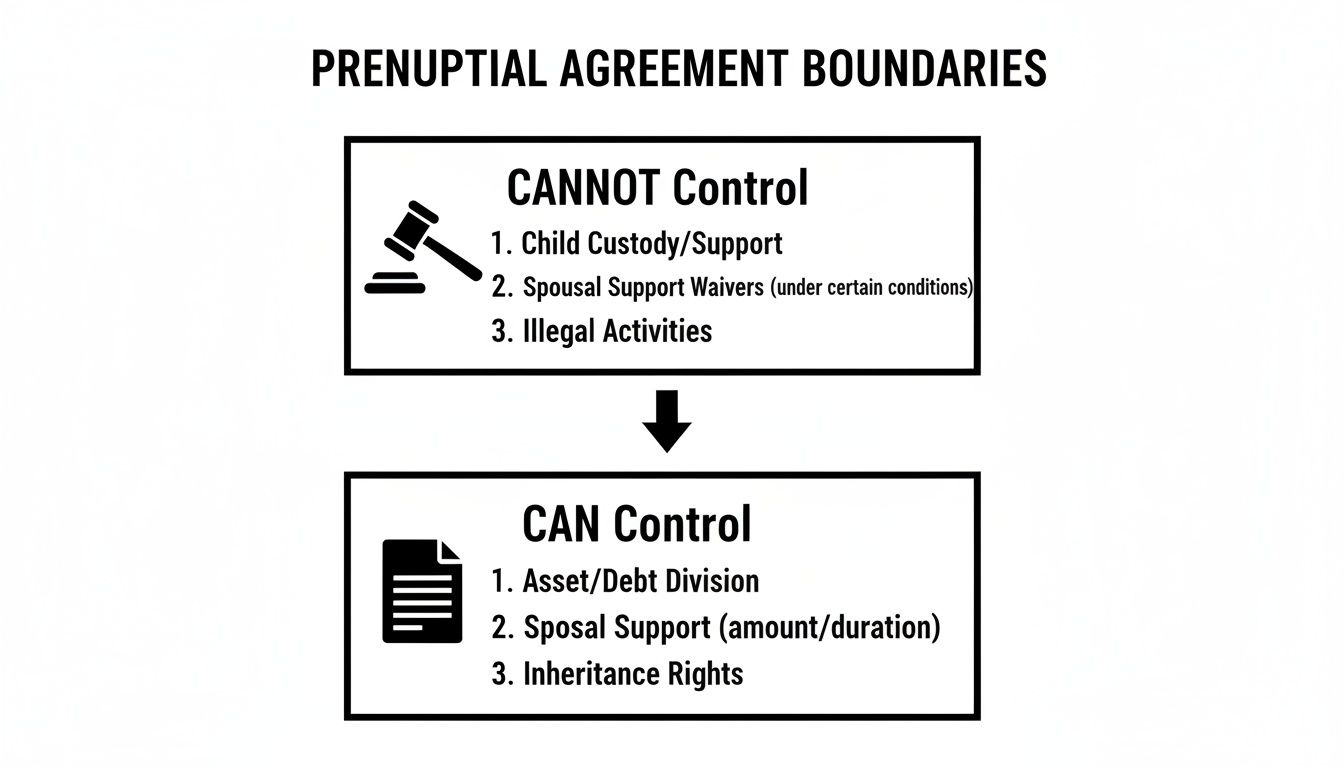
This map shows what you can and cannot pre-determine in your agreement. While you have significant control over financial matters like property and spousal support, anything related to children remains under the court’s ultimate jurisdiction.
Navigating the Costs of a Prenuptial Agreement in the GTA
It’s a mistake to see a prenuptial agreement in Ontario as just another wedding expense. A better way to think about it is as an investment in your financial future—one that buys you clarity and security. The price isn’t a simple flat fee; it depends on the complexity of your finances and how much negotiation is needed.
For a couple with straightforward assets, a simple agreement can be quite affordable. But if your situation involves a business, multiple properties, or a significant investment portfolio, the legal work required to protect those assets will naturally be more involved.
Breaking Down the Investment
The cost of a marriage contract in the Greater Toronto Area mostly comes down to your lawyer’s time. This includes initial consultations, drafting the agreement, reviewing financial disclosure, and negotiating the final terms with your partner’s lawyer.
In the GTA, you can generally expect a comprehensive prenup to cost between $2,500 and $5,000. This investment protects you from Ontario’s default property division rules, which otherwise split the value of everything gained during the marriage. You can discover more insights about these financial protections and typical costs from other family law experts in the region.
A Proactive Investment in Financial Security
You have to frame this expense in the right context. When you consider the staggering financial and emotional cost of a contested separation, the upfront investment in a prenup is tiny in comparison. A single fight over the matrimonial home or a business can easily rack up legal fees that dwarf the cost of the agreement.
A prenuptial agreement is one of the most cost-effective planning tools available. It replaces uncertainty and potential conflict with a clear, predictable roadmap that you both agreed upon during a time of cooperation and trust.
Think of it this way: the investment you make today is designed to prevent a much bigger, more painful expense tomorrow. By sorting out the financial details when you’re both on the same team, you are building a stronger, more transparent foundation. The cost of a well-drafted prenup truly pales in comparison to the expenses of a protracted court battle, which is why understanding how much a divorce can cost in Ontario gives you a powerful perspective on the value of planning ahead.
Serving Peel Region and the GTA
At Badesha Law, we are proud to serve clients across the Greater Toronto Area, with a special focus on our communities in Peel Region. Whether you are looking for a prenuptial agreement lawyer in Brampton, Mississauga, or the surrounding areas, our team is here to provide expert, localized guidance to protect your future. We understand the unique financial landscapes for families and business owners in this region.
Frequently Asked Questions About Ontario Prenuptial Agreements
Talking about legal contracts while planning a wedding can feel awkward. But getting clear answers to your questions is the first step toward building a strong, transparent partnership. Here are the most common questions we hear about marriage contracts in Ontario.
When is the best time to get a prenuptial agreement in Ontario?
Ideally, you should start the process 3 to 6 months before your wedding. This gives both of you ample time for calm conversations, full financial disclosure, and negotiations without the pressure of a fast-approaching wedding day. Signing an agreement too close to the ceremony can risk it being challenged on the grounds of duress.
What happens if we divorce in Ontario without a prenup?
Without a prenup, Ontario’s Family Law Act automatically sets the rules. The default system is “equalization,” which means you will generally share equally in the value of all property and assets built up during the marriage. Special rules also apply to the matrimonial home. A prenuptial agreement lets you create your own customized plan.
Can we change our prenuptial agreement after we are married?
Yes, a prenup isn’t set in stone. You can amend or update your agreement after marriage, but it must be done correctly. Any changes must be in writing, and both spouses must voluntarily agree to and sign the new document in front of a witness. We strongly recommend getting independent legal advice before making any changes.
Is a prenuptial agreement still valid if we move out of Ontario?
This can be complicated. While a properly drafted Ontario prenup is often recognized elsewhere, its enforceability will depend on the family laws of your new province or country. If you are planning a move, it’s smart to have your agreement reviewed by a family lawyer in your new location to ensure it holds up.
Does a prenup protect against a partner’s debts?
Absolutely. This is one of the most practical functions of a prenuptial agreement in Ontario. The agreement can clearly state that you are not responsible for your partner’s personal or business debts—whether they brought them into the marriage or accumulated them during it. This provides a critical financial firewall for your own assets.
How much does a prenup cost in Ontario?
The cost for a prenuptial agreement in Ontario typically ranges from $2,500 to $5,000, but this can vary. The final price depends on the complexity of your finances, the assets involved, and the amount of negotiation required between lawyers. It’s best to view this as an investment in financial certainty and conflict prevention.
Can a prenup be overturned in Ontario?
Yes, a court can set aside a prenup if it was created improperly. The most common reasons for a prenup being overturned are a lack of full financial disclosure, one party signing under duress or undue influence, or the absence of independent legal advice for both partners. Following the correct legal process is essential.
Do I need a lawyer for a prenuptial agreement in Ontario?
Yes, it is crucial that both you and your partner have your own separate lawyers. This is called Independent Legal Advice (ILA). It is a key requirement for ensuring the agreement is legally binding and enforceable. A lawyer ensures you fully understand your rights and the terms you are agreeing to, protecting the contract from future challenges.
Written by Badesha Law, Family Law Specialists. This article is for informational purposes only and does not constitute legal advice. Please consult with a qualified family lawyer to discuss your specific situation.
Are you ready to build a strong, transparent financial foundation for your marriage? The family law team at Badesha Law provides expert guidance on drafting fair and enforceable prenuptial agreements.