

Prenuptial Agreements in Brampton: A Guide to Ontario Marriage Contracts
Last Updated: December 15, 2025 | Badesha Law Professional Corporation
In Ontario, what most people call a “prenup” is legally known as a marriage contract. It’s a private, legally binding agreement that a couple signs before their wedding to set out clear rules for how their financial lives will be handled if they ever separate or divorce. Think of it not as a prediction of failure, but as smart financial planning that brings clarity and security to your partnership from day one.
A well-drafted marriage contract can save you and your partner significant stress, conflict, and legal fees down the road. It ensures you both start your life together with open, honest communication about finances, assets, and future expectations.
Ready to secure your financial future? Book a consultation with our Brampton family lawyers to discuss if a marriage contract is right for you.
Why a Prenup Is Smart Financial Planning
Many couples in Brampton are moving past outdated stigmas and recognizing marriage contracts for what they are: a practical and mature step in building a strong partnership. It’s similar to business partners signing a shareholder agreement; it simply sets clear expectations from the beginning. A properly drafted contract provides a roadmap for financial matters, dramatically reducing the potential for conflict and costly legal battles if a separation occurs.
Starting your marriage with an open conversation about finances is a sign of strength. It ensures you are both on the same page about assets, debts, and future goals.
Who Benefits From a Prenuptial Agreement in Brampton?
The idea that prenups are only for the very wealthy is a myth. Today, couples from all financial backgrounds use marriage contracts to protect their futures. You should strongly consider one if you or your partner:
- Own a business or professional practice. A prenup can shield your business assets from being divided in a divorce.
- Have significant personal assets. This includes investments, savings, or real estate you owned before the marriage.
- Expect a future inheritance. You can ensure any family inheritance remains your separate property.
- Have children from a previous relationship. A contract can protect their inheritance rights and financial security.
- Are entering a second marriage. It brings clarity when there are assets or support obligations from a previous union.
This modern approach is gaining traction. A recent TD Bank survey revealed a significant generational shift, with 52% of Gen Z respondents wanting their partner to sign a prenup, a notable increase from the 31% national average. It’s clear that views on financial planning for couples are evolving.
For a deeper dive into how these agreements work, explore the basics of prenuptials in Canada in our related article.
At Badesha Law, we have been serving Brampton and the GTA for years, helping couples create clear, fair, and enforceable marriage contracts that protect their interests and provide peace of mind.
The Legal Blueprint for a Valid Ontario Marriage Contract

For a prenuptial agreement to be legally binding in Ontario, it must follow specific rules set out in the province’s Family Law Act. These requirements are the foundation of the agreement; if any part is missing or weak, a court could set it aside during a separation.
This is why downloading a generic template from the internet is a significant risk. These documents rarely meet Ontario’s strict legal standards and are easily challenged. A valid contract must be built correctly from the start to be enforceable.
The Core Requirements for Validity
A marriage contract must meet three basic requirements to be considered legally valid in Ontario:
- In Writing: Verbal promises about finances and support are not enforceable. The entire contract must be a physical or digital document.
- Signed by Both Partners: Both individuals must willingly sign the final document, indicating their full consent to its terms.
- Properly Witnessed: A third party must watch each partner sign their name, adding a crucial layer of formality.
While these steps are the baseline, the real strength of a marriage contract comes from the integrity of the process leading up to the signing.
Full and Frank Financial Disclosure
The principle of full and frank financial disclosure is the single most critical element for ensuring a prenup holds up in court. Both partners must provide a complete and honest picture of their financial situation before signing.
This means exchanging detailed information about all assets, debts, and income. Hiding a major asset or downplaying the value of a business could be grounds for a judge to invalidate the entire agreement later on.
The Crucial Role of Independent Legal Advice
While not technically mandatory under the Family Law Act, getting Independent Legal Advice (ILA) is the most important step you can take to create an ironclad marriage contract. ILA means each partner meets with their own separate lawyer.
A court is far more likely to uphold a marriage contract if both parties received independent legal advice. It demonstrates that each person fully understood their rights, the implications of the agreement, and signed it freely, without pressure or duress.
During the ILA process, your lawyer will:
- Explain every clause of the agreement in plain English.
- Advise you on your legal rights and obligations under Ontario law.
- Ensure the agreement is fair and doesn’t leave you vulnerable.
- Confirm that you are signing voluntarily and without coercion.
Trying to draft a prenup without ILA is a common and costly mistake. To learn more about specific rules, read our detailed guide on the requirements for a prenuptial agreement in Ontario.
What You Can and Cannot Include in Your Agreement
Think of a marriage contract as a custom financial blueprint for your relationship. While it offers incredible flexibility, Ontario’s Family Law Act sets clear boundaries on what you can and cannot decide ahead of time. Getting these rules right is critical to creating an agreement that is both practical and legally enforceable in Brampton.
A well-drafted contract gives you control over your financial future, allowing you to set your own rules for property and support instead of relying on the default ones set out by provincial law.
Looking for personalized advice on what to include in your agreement? Call our Brampton family law office to book a consultation.
What You Can Include in Your Agreement
The primary purpose of a prenuptial agreement is to manage two key financial areas: property and spousal support. You have significant freedom to decide how these will be handled.
You can outline how assets acquired during the marriage will be divided, which can differ from Ontario’s standard division of property in Ontario. You can also address spousal support in advance, whether that means setting a specific amount, limiting its duration, or even waiving the right to it entirely—as long as that waiver is fair at the time of separation.
Essentially, you are building a private financial framework that suits your specific circumstances. Here’s a look at typical issues addressed in a marriage contract.
Common Clauses In An Ontario Marriage Contract
This table breaks down some of the most common clauses found in an Ontario marriage contract.
| Clause Type | What It Covers | Enforceability Notes |
|---|---|---|
| Separate Property | Lists specific assets owned by each person before the marriage (e.g., savings, investments) and confirms they will remain separate, not subject to division. | Generally very strong, provided the assets are clearly identified and kept separate from joint family funds. |
| Business Interests | Shields a business from being treated as a family asset. It can prevent valuation disputes and protect the business from being divided upon separation. | A critical clause for any entrepreneur. A professional business valuation is often recommended to support this. |
| Future Inheritances | Explicitly states that any inheritance received by one spouse during the marriage will be excluded from divisible family property, offering stronger protection than the default law. | This is a smart move for future-proofing your agreement against unexpected windfalls that aren’t a product of the marriage. |
| Spousal Support | Can set a specific amount or duration for spousal support, or it can be waived entirely. | A court can set aside a spousal support waiver if it is found to be “unconscionable” at the time of separation. Fairness is key. |
| Matrimonial Home | Addresses how the value of the home will be divided. For example, it can specify how an initial down payment contribution is returned to one spouse before the remaining equity is split. | You cannot sign away a spouse’s right to live in the home. This clause only deals with the financial division. |
These clauses provide certainty and can prevent long, expensive fights down the road. They allow you to tailor your financial future to your unique situation.
What You Cannot Include in Your Agreement
While you have significant control over finances, some issues are strictly off-limits. Ontario law reserves certain decisions for the courts to protect the well-being of vulnerable people, especially children.
Crucial Limitation: Under Ontario law, any clause in a marriage contract that attempts to pre-determine child custody (decision-making responsibility) or parenting time is not enforceable. A judge will always make these decisions based on the child’s best interests at the time of separation.
Here are the key areas you cannot include:
- Child Custody and Parenting Time: You cannot dictate future parenting arrangements. A child’s needs evolve, and a court must have the final say.
- Child Support: You cannot waive or set a specific amount for child support in a prenup. Child support is the right of the child, not the parents, and must be calculated using the Federal Child Support Guidelines.
- Possession of the Matrimonial Home: While you can decide how the home’s value is divided, you cannot sign away a spouse’s legal right to live in it.
Trying to include these clauses won’t just make them invalid; it could put your entire agreement at risk. Working with an experienced family lawyer in Brampton ensures your agreement respects these legal boundaries.
The Step-by-Step Process for Getting a Prenup in Brampton
Creating a marriage contract in Brampton should be a smooth, collaborative process. With a clear roadmap and professional guidance, you can navigate each step with confidence.
Timeline: We recommend starting the conversation about a prenup at least three to six months before the wedding. This provides enough time for thoughtful negotiation without the pressure of an impending deadline, which is crucial for creating an agreement a court will see as fair and voluntary.
Our firm has a refined process to guide you through each stage.
Documents Checklist for a Prenup
To ensure full financial disclosure, you and your partner will typically need to gather the following:
- Recent tax returns (last 3 years)
- Pay stubs or proof of income
- Bank and investment account statements
- Property deeds and mortgage statements
- Appraisals for real estate, businesses, or valuable assets
- A list of significant debts (loans, credit cards)
- Information on pensions and RRSPs
Step 1: Initial Consultations
The process begins when each of you hires your own separate family lawyer to ensure you both receive Independent Legal Advice (ILA). In your first meeting, your lawyer will explain your rights and obligations under Ontario’s Family Law Act and discuss your goals for the agreement.
Step 2: Full Financial Disclosure
Next, both you and your partner will exchange detailed financial documents. Absolute transparency is mandatory. Hiding assets or providing incomplete information is one of the surest ways for a court to invalidate your agreement later.
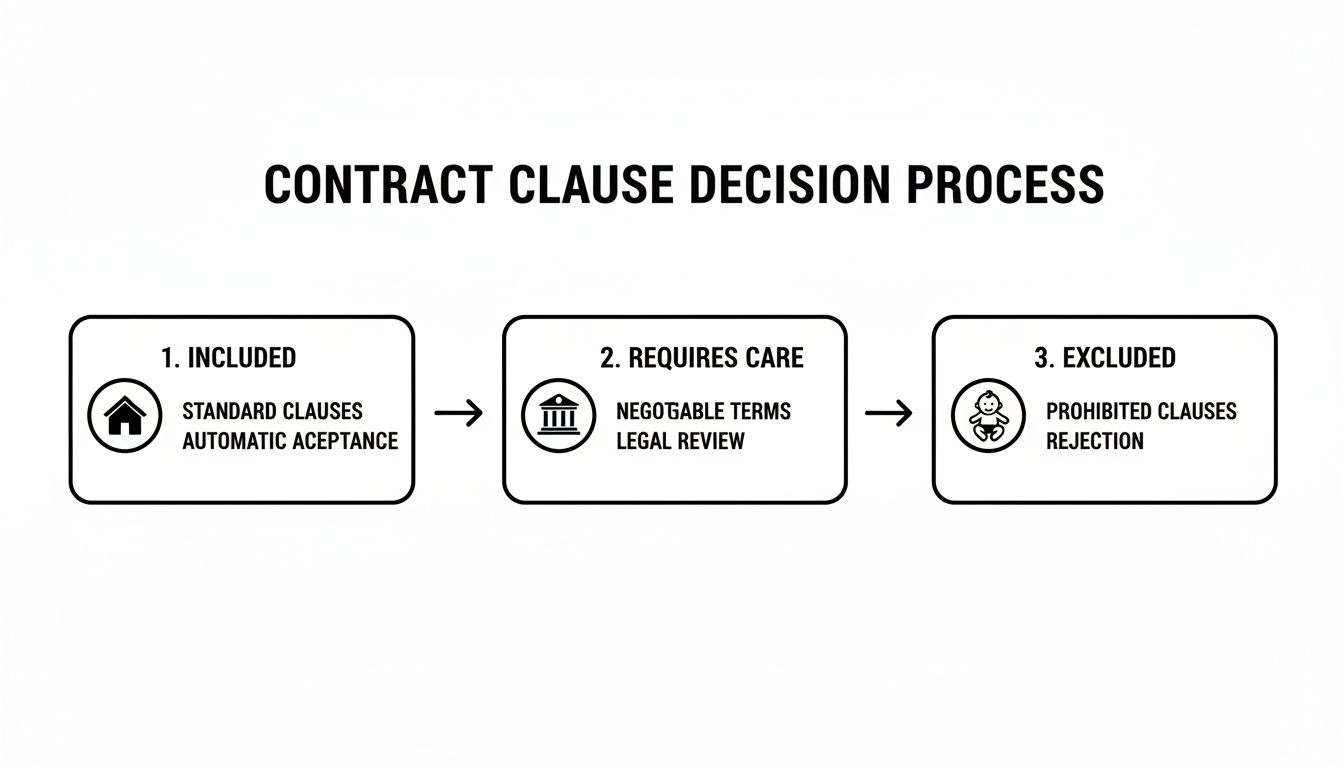
As this visual guide shows, while you have control over property and support, any decisions involving children will always be decided based on their best interests at the time of separation.
Step 3: Negotiation and Drafting
Once all financial information is exchanged, the lawyers begin negotiating the terms based on your instructions. When an agreement is reached, one lawyer will draft the first version of the marriage contract. The goal is to create a fair, balanced agreement that both partners support.
Step 4: Review and Finalization
You and your lawyer will review the draft agreement line by line to ensure it accurately reflects your understanding. Any necessary revisions are made until the document is finalized.
Step 5: Signing and Witnessing
The final step is the formal signing. You and your partner will sign the agreement in the presence of a witness. Each lawyer will also sign a Certificate of Independent Legal Advice, confirming they advised you on your rights and that you signed the agreement freely.
Typical Costs and Fee Drivers
The cost of a prenuptial agreement in Brampton varies. For a straightforward contract with simple finances, costs may range from $2,500 to $5,000, including fees for both lawyers. However, the final cost can be higher if your finances are complex (e.g., involving businesses or trusts) or if negotiations are extensive.
Common Mistakes That Can Invalidate Your Marriage Contract
A poorly drafted marriage contract can create a false sense of security and may be set aside by an Ontario court if it was created unfairly. Knowing the common pitfalls is the first step toward creating an agreement that is solid and enforceable.
Rushing the Process
Waiting until the last minute is a critical mistake. Presenting a prenup days before a wedding creates an atmosphere of pressure and duress. A court may view this as coercive, suggesting one partner lacked sufficient time to consider the terms. Start the process three to six months before your wedding day.
Incomplete or Dishonest Financial Disclosure
The foundation of a fair marriage contract is full and frank financial disclosure. Hiding a significant asset or debt can lead a judge to invalidate the entire agreement on the grounds that one person’s consent was not fully informed.
Forgoing Independent Legal Advice
Skipping Independent Legal Advice (ILA) is a major red flag for the courts. ILA is the best way to prove that both partners understood their rights, knew the consequences of the contract, and signed it voluntarily. Without it, it becomes much easier for a spouse to later claim they were pressured or didn’t understand what they were signing.
Using Vague or Ambiguous Language
DIY templates are often filled with vague language that is difficult to enforce. A strong contract must be specific. For example, a clause stating a “business asset will be protected” is not enough. The agreement must clearly define the asset, how its value will be handled, and what happens to any growth in its value during the marriage.
Including Unenforceable Clauses
As mentioned, any attempt to pre-determine child custody, parenting time, or child support will render those clauses void. Including these forbidden terms can sometimes cast doubt on the fairness and validity of the entire agreement. For more context on the importance of consent, read about what happens if a spouse won’t sign a separation agreement in Ontario.
Updating or Challenging a Marriage Contract
A marriage contract is not set in stone. Life is unpredictable, and an agreement that seemed fair on your wedding day might become unjust a decade later. Ontario’s laws provide paths for both updating an agreement and, if necessary, challenging its fairness in court.
When Can a Marriage Contract Be Challenged?
A court will not set aside a signed contract lightly. However, under Ontario’s Family Law Act, a judge can invalidate a marriage contract or a specific clause if certain conditions are met:
- Failure to Disclose: One partner hid significant assets or debts.
- Signing Under Duress: The agreement was signed under pressure, threats, or coercion.
- Lack of Understanding: One person can prove they genuinely did not grasp the contract’s meaning or consequences, often because they lacked ILA.
- Unconscionable Outcome: Enforcing the agreement would be shockingly unfair and “shock the conscience of the court.”
How to Properly Update Your Agreement
If your financial circumstances change significantly (e.g., a large inheritance, a new business), you cannot rely on a verbal agreement to alter your prenup.
The only way to legally change a marriage contract is with a formal, written amendment. This new document must be signed and witnessed with the same legal formality as the original contract. Read more about the factors driving prenup trends in Canada.
Whether you need to review an existing agreement or update it to reflect your current reality, getting advice from an experienced family lawyer in Brampton is the only way to ensure your rights are protected.
Frequently Asked Questions About Prenuptial Agreements
Are prenuptial agreements enforceable in Ontario?
Yes, they are legally binding under the Family Law Act when created correctly. Enforceability depends on meeting key standards, including being in writing, full financial disclosure, and ensuring both parties receive independent legal advice.
How much does a prenuptial agreement cost in Brampton?
The cost varies based on complexity. For a straightforward agreement, you can expect costs to start around $2,500 to $5,000 to cover both lawyers’ fees. Costs increase if finances are complex (e.g., business assets, trusts) or negotiations are lengthy.
Can a prenup protect my future inheritance?
Yes. Protecting a future inheritance is one of the most common reasons people get a marriage contract. The agreement can explicitly state that any inheritance received by one spouse will remain their separate property and will not be subject to division upon separation.
What if we are a common-law couple?
Common-law couples can create a cohabitation agreement, which functions like a prenuptial agreement. It allows you to define rights and obligations regarding property and financial support. This is crucial, as common-law partners do not have the same automatic property rights as married couples under Ontario law.
Can we make a prenup after we are already married?
Yes. An agreement signed after the wedding is still called a marriage contract in Ontario (sometimes referred to as a “postnuptial agreement”). It follows the same legal rules for validity and can address the same financial issues as a prenup.
What happens if we don’t have a prenup?
Without a marriage contract, the rules of Ontario’s Family Law Act will automatically apply to your separation or divorce. This includes the equalization of net family property, which generally means all assets acquired during the marriage are divided equally, with some exceptions.
Brampton clients often ask…
- Does our family’s cultural background affect the prenup? Ontario law applies to everyone, but a skilled lawyer can draft an agreement that respects your family’s values while remaining fully enforceable. We can discuss how to protect family gifts or business interests in a culturally sensitive way.
- My fiancé owns a house in Brampton. How can a prenup protect it? A marriage contract can specify that the pre-marital value of the home and any down payment contribution remain your fiancé’s separate property. It can also outline how any increase in the home’s value during the marriage will be treated.
- Is it too late if our wedding is in two months? It’s not ideal, but it may still be possible. The key is to start immediately to ensure there is enough time for proper financial disclosure, negotiation, and independent legal advice without creating a sense of duress.
Disclaimer: This article provides general information and does not constitute legal advice. For advice on your specific situation, you should consult with a lawyer.
Navigating the details of a marriage contract requires clear, professional guidance. At Badesha Law, our team is ready to answer your questions and help you build a fair agreement that secures your future.
To understand your options and get started, book a free consultation with a trusted Divorce Lawyer Brampton Badesha Law today.