

A Practical Guide to Prenuptial Agreements in Brampton, Ontario
In Canada, a prenuptial agreement is a legally binding contract two people sign before getting married, spelling out how things like assets and support will be handled if the relationship ever ends. In Ontario, it’s officially called a marriage contract, and for couples in Brampton, it gives you and your partner the power to write your own financial rules instead of defaulting to the province's Family Law Act.
Why a Prenup Is Smart Financial Planning for Your Marriage
Let's be honest, talking about a prenuptial agreement can feel a little awkward. But it's time we changed the way we think about it. Far from being a red flag, a prenuptial agreement in Canada is one of the smartest financial tools a couple in Brampton can use before tying the knot.
Think of it as insurance for your shared future. You don’t buy home insurance expecting a fire, but you get it for peace of mind. A marriage contract works the same way—it’s an actionable step to create clarity, encourage open conversations about money, and head off potential conflicts down the road.
A Private Contract for Your Future
Under Ontario's Family Law Act, a marriage contract is a private agreement that lets couples in Brampton and across the province set their own terms. It lays out a clear roadmap for dealing with assets, debts, and spousal support, making sure both partners walk into the marriage with confidence and a shared financial understanding.
This practical approach is becoming more and more common. In fact, recent trends show that 61% of Canadians now see prenups as a good idea—not as a bad omen, but as a practical financial tool. This is especially true for millennials, who often marry later in life with more established careers and assets.
A well-drafted contract can help you:
-
Protect assets you owned before the marriage or a family business.
-
Define how property you acquire together will be divided.
-
Clarify who is responsible for pre-existing and future debts.
-
Outline spousal support obligations to create predictability.
A marriage contract isn’t about planning for failure; it’s about building a marriage on a foundation of transparency and mutual respect. By discussing finances openly, you establish a precedent for honest communication that can strengthen your relationship for years to come.
Beyond just sorting out marital finances, prenups are also a key part of broader asset protection planning, helping to safeguard individual wealth before you say "I do." For couples in Brampton, where property values are a major financial factor, having a clear agreement in place is an invaluable step toward security. It removes ambiguity and lets you focus on what really matters: building your life together.
What Your Prenuptial Agreement Can and Cannot Cover
A prenuptial agreement, or a marriage contract as it’s called in Ontario, is a powerful tool for mapping out your financial future together. But it’s not a blank cheque. Understanding what you can and can’t include is crucial for any couple in Brampton looking to create a fair, legally sound document that will actually hold up if it's ever needed.
Think of it like setting the ground rules for your financial life as a married couple. You can define the boundaries of the playing field, but some rules—especially those protecting children—are non-negotiable under both the Family Law Act and federal laws like the Criminal Code. A prenup is about being proactive and clear, not pessimistic.
H3: What You Can Include in Your Prenuptial Agreement
Under Ontario's Family Law Act, a marriage contract gives you and your partner a surprising amount of freedom to customize your financial arrangements. You get to decide on key issues that, without an agreement, would simply be handled by the default provincial laws if you ever separated.
Here are the main areas your agreement can cover:
-
Protecting Pre-Marital Assets: You can clearly state that any assets you each brought into the marriage—like savings, investments, or a condo you owned before the wedding—remain your own separate property. They won't be subject to division if you part ways.
-
Managing Property Acquired During Marriage: You can set your own rules for how you’ll divide property and assets you accumulate during the marriage. This allows you to opt out of Ontario's standard equalization process, which is especially important for couples in the GTA where real estate is often the most significant asset.
-
Ownership of the Matrimonial Home: While the matrimonial home has a special legal status, a prenup can address how the asset is handled financially. For example, you can decide ahead of time how the proceeds will be split if the home is sold.
-
Spousal Support Obligations: The agreement can provide clarity and predictability by setting out the terms for spousal support. You can define if it will be paid, for how long, and even set a specific amount or a formula for calculating it.
-
Responsibility for Debts: You can clarify how debts will be handled, whether they were brought into the marriage or racked up during it. This is a practical way to protect one another from financial liabilities.
-
Inheritances and Gifts: A prenup can make sure that any future inheritances or large gifts from family members remain the separate property of the person who received them.
This diagram shows how a prenup really works as a financial planning tool, creating a foundation of clarity, planning, and security for your life together.
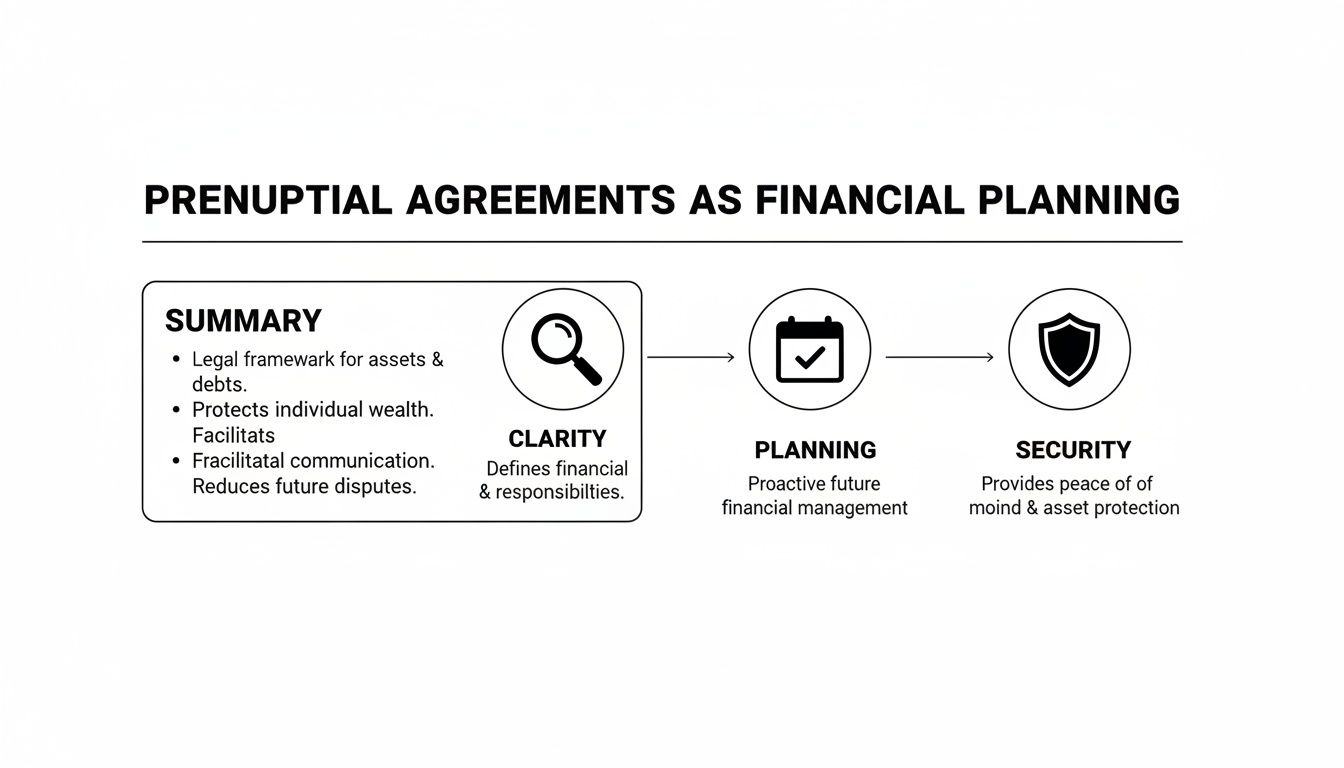
By tackling these key areas head-on, you turn vague financial anxieties into a concrete, mutually agreed-upon plan.
What You Cannot Include in Your Prenuptial Agreement
Just as important as knowing what to put in your agreement is understanding its legal limits. The law draws some very firm lines, mostly to protect the rights of children and prevent one-sided or unfair arrangements. If you try to include prohibited clauses, a court will simply strike them out. In a worst-case scenario, it could even put the validity of your entire agreement at risk.
Under Canadian law, the rights of a child always come first. A prenuptial agreement cannot override the court’s duty to act in a child’s best interests, which is a non-negotiable principle.
A valid prenuptial agreement in Canada can't touch the following:
-
Child Custody or Access: You simply cannot decide custody (decision-making responsibility) or parenting time for children you don't have yet. If you separate, a court will make these decisions based only on the child's best interests at that specific time.
-
Child Support: The right to child support belongs to the child, not the parents. You can't waive it or lock in a specific amount in a prenup. Child support must be calculated based on the Federal Child Support Guidelines when and if the parents separate.
-
Possession of the Matrimonial Home: While you can agree on how to divide the value of the home, you can't use a prenup to kick a spouse or children out of the family home upon separation. That right of possession is protected under the Family Law Act.
-
Anything Illegal or Against Public Policy: This should go without saying, but any clause that encourages illegal activity or goes against public policy is automatically void. Provisions related to anything in the Criminal Code of Canada, for example, would be thrown out immediately.
To put it simply, here’s a quick breakdown of what’s on and off the table when drafting your contract.
Permitted vs Prohibited Clauses in an Ontario Marriage Contract
| What You Can Include | What You Cannot Include |
|---|---|
| Division of property and assets | Child custody or parenting time arrangements |
| Spousal support terms (amount, duration, or waiver) | Child support terms (amount, duration, or waiver) |
| Ownership of the matrimonial home | Right to possession of the matrimonial home |
| Responsibility for debts | Clauses that violate public policy or the law |
| Protection of inheritances and gifts | Anything that is not about financial matters |
| Rules for managing finances during the marriage | Provisions that are unconscionable or grossly unfair |
Ultimately, a marriage contract gives you incredible control over your financial destiny as a couple. It just has to operate within a legal framework designed to ensure fairness and protect the vulnerable. Working with an experienced Brampton family lawyer is the best way to ensure your agreement does exactly what you want it to while remaining strong and enforceable.
The Legal Steps to an Enforceable Ontario Prenup
A prenuptial agreement is only as strong as its legal foundation. In Ontario, you can't just write down what you want and call it a day. The Family Law Act requires very specific steps to ensure the agreement is fair, transparent, and legally binding. Following these steps isn’t just a good idea—it’s non-negotiable if you want a contract that will actually stand up in court if it's ever challenged.
Think of it like building a house in Brampton. You wouldn't skip the foundation or the structural inspections, right? Skipping a legal step, like getting proper advice, can cause the entire agreement to crumble under legal pressure, leaving you unprotected. This is why the process matters just as much as the final document.
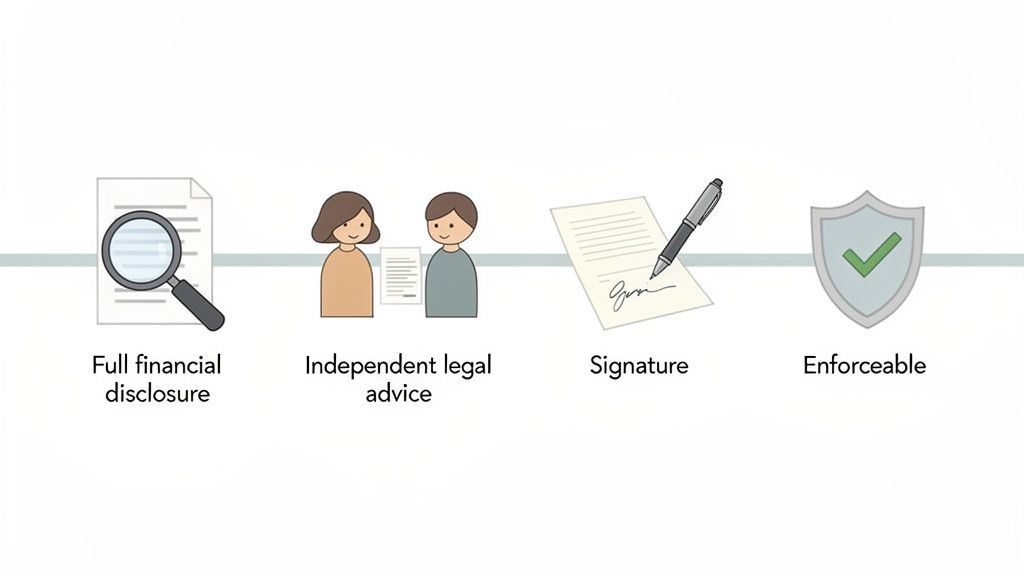
Let's break down the essential pillars of an enforceable prenuptial agreement in Canada, specifically for those of us here in Ontario.
Full and Honest Financial Disclosure
The cornerstone of any valid marriage contract is transparency. Before you sign anything, both you and your partner must provide a complete and truthful picture of all your finances. This means laying all your cards on the table—no exceptions.
This isn't just a suggestion; it’s a legal requirement under Ontario’s Family Law Act. Hiding an asset or downplaying a debt can be grounds for a judge to throw out the entire agreement later on.
Your disclosure should include documentation for:
-
Assets: Bank accounts, investments, real estate holdings, business interests, vehicles, and valuable personal property.
-
Debts: Mortgages, loans, credit card balances, and any other financial liabilities.
-
Income: A clear statement of your current earnings from all sources.
This step ensures that both of you are making informed decisions based on a complete financial picture. It's about building an agreement on a foundation of honesty from the very beginning.
Independent Legal Advice (ILA)
This is arguably the most critical step in the entire process. To ensure a prenup is enforceable, both you and your partner must each have your own lawyer. This is what’s known as Independent Legal Advice (ILA).
Your lawyer's job is to look out for your interests and yours alone. They will review the draft agreement, explain what each clause means for your future, and advise you on your rights and obligations under Ontario law. The same lawyer cannot advise both of you, as that would be a clear conflict of interest.
Having separate lawyers protects both parties. It proves to a court that neither person was taken advantage of and that both fully understood the rights they were signing away. Without ILA, an agreement is highly vulnerable to being challenged and overturned.
When you each have ILA, your respective lawyers will sign a certificate confirming they provided this advice. This certificate becomes powerful evidence that the process was fair and the agreement was entered into with full knowledge.
Signing Without Pressure or Duress
For a contract to be valid, it has to be signed freely and voluntarily. There can be no hint of pressure, threats, or manipulation—legally known as duress or undue influence.
A classic example of duress is presenting a prenup to your partner a week before the wedding with an ultimatum: "Sign this, or the wedding is off." A court may see this as coercive, as one person might feel they have no real choice but to sign under the immense social and financial pressure of a pending wedding.
To avoid this, it’s crucial to:
-
Start Early: Begin the prenup conversation months before the wedding date. This gives both of you plenty of time for disclosure, negotiation, and legal review without feeling rushed.
-
Ensure Fair Negotiations: The process should be a collaborative discussion, not a one-sided demand.
Ensuring the agreement is signed without duress confirms that it reflects the true and willing intentions of both partners. A Brampton family lawyer can help manage the timeline and process to ensure everything is handled fairly and professionally, creating a document that truly protects you both.
Common Mistakes That Can Invalidate Your Agreement
Knowing the right steps to create a prenuptial agreement is only half the battle. Just as crucial is understanding the common pitfalls that can render your contract unenforceable in Ontario, potentially leading to the very legal battles you sought to avoid. A seemingly minor misstep can unravel even the best intentions.
For couples in Brampton, a few key mistakes consistently appear when agreements are challenged in court. Avoiding these errors is essential to ensuring your marriage contract provides the security and clarity it was designed for. Let's look at the most frequent and damaging blunders.
The Dangers of DIY or 'Kitchen Table' Agreements
In an effort to save time or money, some couples are tempted to download a template online or draft a simple agreement themselves. This is one of the biggest risks you can take. These "kitchen table" agreements almost always fail to meet the strict legal standards required by Ontario's Family Law Act.
A DIY prenup often lacks the necessary components for enforceability:
-
Improper Financial Disclosure: It may not include a complete and formal exchange of financial information, which is a non-negotiable requirement.
-
Lack of ILA: It will not have certificates of Independent Legal Advice from separate lawyers, which is a massive red flag for any court.
-
Vague or Illegal Clauses: Without legal expertise, it's easy to include terms that are ambiguous, unenforceable (like child custody provisions), or contrary to public policy.
A contract is more than just a piece of paper; it's a complex legal instrument. To further ensure its robustness, understanding broader contract management best practices can help you appreciate the formalities required to mitigate common mistakes that might otherwise invalidate the agreement.
Signing Under Duress or Too Close to the Wedding
The timing and circumstances of signing your prenuptial agreement are critically important. A contract is only valid if both parties sign it freely and voluntarily, without any form of pressure or coercion. This is known as avoiding duress.
A classic example of duress is presenting the agreement days before the wedding with a "sign it or it's off" ultimatum. The emotional and financial pressure of a looming wedding can make it difficult for a person to refuse, and a judge may later decide they didn't sign willingly.
An agreement signed under pressure isn't a true agreement. A court will set aside a contract if it believes one party was unfairly coerced or did not have a meaningful choice in the matter, undermining the entire purpose of the prenup.
To avoid this, start the process at least 4-6 months before your wedding date. This provides ample time for open discussions, thorough financial disclosure, and proper legal review without a stressful deadline hanging over your heads.
Using Unfair or Vague Terms
Finally, the substance of the agreement itself matters. Ontario courts can set aside a prenuptial agreement if its terms are found to be "unconscionable" or grossly unfair to one party. While you can create your own financial rules, they must still exist within a realm of fairness.
For instance, a clause that leaves one spouse with all the assets and the other with all the debts and no spousal support after a long marriage would likely be seen as unconscionable.
Similarly, vague language can be fatal. Terms like "reasonable support" or "a portion of the business" are open to interpretation and can lead to disputes. A strong agreement uses precise, clear language that leaves no room for ambiguity. An experienced Brampton family lawyer will ensure your contract is both fair and specific, protecting it from future challenges.
Navigating the Prenup Process From Start to Finish
Creating a prenuptial agreement might sound intimidating, but it’s really just a series of clear, manageable steps. Think of it as a blueprint for your financial future. For couples in Brampton, a straightforward roadmap transforms a complex legal task into a collaborative project, guided by an experienced family lawyer.
The entire process is designed to be transparent and cooperative, making sure the final document truly reflects your shared goals. It flows logically from your first conversations to the final signature, with key checkpoints along the way. Understanding this workflow helps set expectations and shows how each stage builds on the last to create a solid, legally sound agreement.
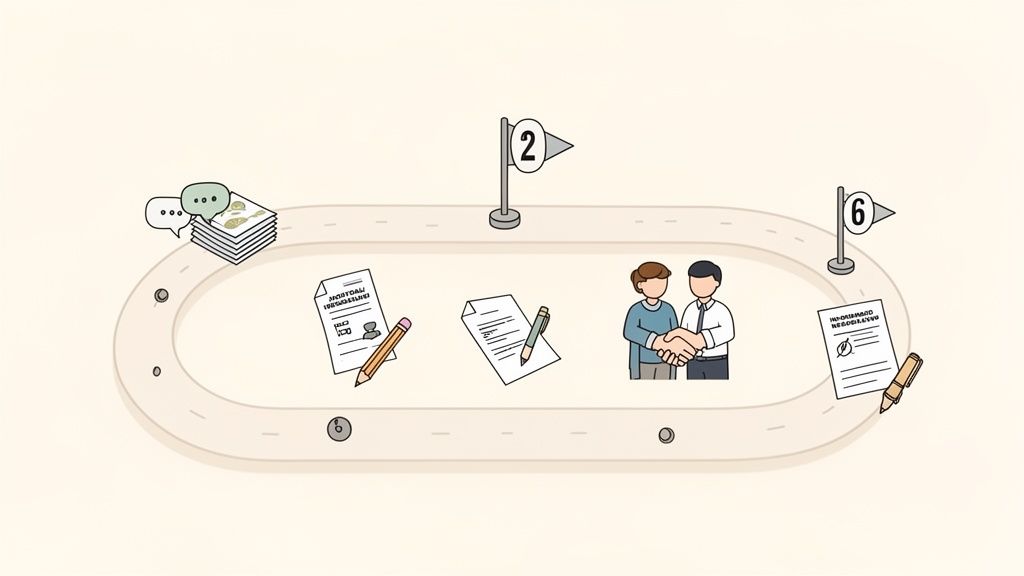
Step 1: The Initial Consultation and Goal Setting
Your journey begins with an initial consultation with your family lawyer. This first meeting is all about laying the groundwork. You and your partner will sit down and talk about your goals, what you want to protect, and how you see your financial future together. It’s the perfect time to ask questions and learn how a marriage contract can be shaped to fit your unique situation.
Your lawyer will walk you through the legal framework under Ontario’s Family Law Act and help you clarify what you want to achieve. Maybe you want to protect a family business, keep an inheritance separate, or simply create a clear plan for property you acquire during the marriage.
Step 2: Comprehensive Financial Disclosure
Next up is the most critical part of the process: full financial disclosure. This is where you and your partner lay all your financial cards on the table. It’s a non-negotiable step for any valid prenuptial agreement in Canada, because honesty and transparency are what make the agreement enforceable down the road.
This exchange means sharing everything, including:
-
Statements from all bank accounts, investments, and retirement funds.
-
Up-to-date appraisals for any real estate you own.
-
Valuations for business interests or other major assets.
-
A clear list of all debts, like mortgages, student loans, or credit card balances.
This step creates the factual foundation for the entire agreement. Without it, the whole structure could collapse if challenged later.
A prenuptial agreement is only as strong as the financial disclosure it's built on. Complete honesty at this stage is the best way to prevent the agreement from being challenged and potentially invalidated in the future.
Step 3: Drafting the Agreement
Once all the financial information is on the table, one of your lawyers will draft the first version of the marriage contract. This initial draft takes all your conversations and goals and turns them into formal legal clauses. It will cover all the key areas you’ve discussed, from how property will be handled to whether spousal support will be paid.
Think of this document as a starting point. It’s meant to be reviewed, discussed, and adjusted. It’s rare for the first draft to be the final one, so expect a bit of back-and-forth as you and your lawyers fine-tune the details.
Step 4: Independent Legal Advice and Negotiation
After the draft is ready, the other partner must take it to their own lawyer for Independent Legal Advice (ILA). This is a non-negotiable step in Ontario. It ensures that both of you fully understand your rights and obligations and aren’t being pressured into signing something that isn’t in your best interest. Their lawyer will review the document with a fresh set of eyes, focused entirely on protecting their client.
This is also the negotiation phase. If one lawyer has concerns or wants to suggest changes, they’ll communicate with the other lawyer. This collaborative process continues until both of you are completely satisfied that the agreement is fair, balanced, and reflects what you both want.
Step 5: Finalizing and Signing the Agreement
Once negotiations are done and everyone agrees on the terms, the final version of the agreement is drawn up. You and your partner will then sign the document in front of a witness. To complete the process, your respective lawyers will sign Certificates of ILA, confirming that they provided you with the necessary legal counsel.
As for costs, they can vary. Typically, you'll see a flat fee for the initial drafting, with additional hourly fees for the negotiation process and the ILA review. Talking about costs upfront with your lawyer will help you budget accordingly. It’s a detailed journey, but the result is a powerful legal tool that provides clarity and protection for your future.
Your Prenup Questions, Answered
When you start looking into marriage contracts, a lot of questions pop up. For couples in Brampton and across Ontario, getting clear on the details of the Family Law Act is the first step toward making a smart decision. Here are some straightforward answers to the questions we hear most often, designed to give you the confidence to move forward.
Each answer gets right to the point, tackling the real-world concerns couples have when they think about this important financial planning tool.
Is a Prenuptial Agreement Only for the Very Wealthy?
This is probably the biggest myth out there, but it's just not true. While prenups are fantastic for protecting major assets, a prenuptial agreement in Canada is a practical tool for anyone with savings, property, a business, or even debt.
They are especially useful for:
-
Couples in second marriages looking to protect assets for children from a previous relationship.
-
Anyone expecting an inheritance who wants to make sure it remains their separate property.
-
Business owners who need to shield their company from being divided in a separation.
-
People buying property in Brampton, where a prenup can clarify exactly how the matrimonial home's ownership and equity are handled.
Think of it less about being "wealthy" and more about creating financial clarity. It’s a smart move for any couple wanting to set clear expectations right from the start.
Can We Update Our Prenuptial Agreement in the Future?
Absolutely. In fact, we highly recommend it. A marriage contract shouldn't be a document you sign and then file away forever. It should be a living agreement that grows and changes along with your life.
It's a good idea to revisit and possibly amend your agreement after big life events, like:
-
Having children.
-
A major change in either partner's income.
-
Receiving a large inheritance or gift.
-
Starting a new business, whether together or on your own.
Just remember, for any update to be legally valid, both partners must agree to it. The changes have to be put in writing, signed, and witnessed with the same legal steps as the original agreement. If you don't update it after a major change, a court could decide years later that the original terms are unfair and refuse to enforce them.
What Happens in Ontario if We Do Not Have a Prenup?
If you don't have a marriage contract, how your assets are divided after a split is automatically decided by the rules in Ontario's Family Law Act. This process is called the "equalization of net family property."
In simple terms, the value of most property you both acquired during the marriage gets added up and split right down the middle. The matrimonial home gets special treatment under the law—its entire value is usually included in this calculation, no matter who owned it before the wedding day.
A prenuptial agreement is your way of opting out of these default government rules. It lets you create your own custom plan for how assets and debts will be handled, giving you much more control and certainty over your financial future.
Without a prenup, you're essentially letting the provincial legal system make these critical financial decisions for you. An agreement lets you and your partner make those calls yourselves.
How Can I Suggest a Prenup Without Causing a Fight?
This is often the trickiest part, but you can navigate it with a bit of sensitivity and a collaborative spirit. It all comes down to how you frame the conversation.
Instead of making it sound like a plan for divorce, position it as a responsible financial planning step for your marriage—just like making a will or getting life insurance.
Here are a few tips that actually work:
-
Frame it as a Team Effort: Try saying something like, "I think we should talk about a marriage contract to make sure we're on the same page with our finances. It’s about being a strong team."
-
Focus on Transparency: Explain that it's about being open and honest about money to avoid misunderstandings down the road. It’s a sign of mutual respect.
-
Make it a Joint Learning Experience: Suggest booking a consultation with a family lawyer together. This turns it into a shared activity where you can both ask questions and learn from a neutral expert.
When you approach the topic with care and focus on clarity and partnership, you can turn what feels like a difficult conversation into a constructive one that actually strengthens your relationship.
Can We Create a Prenup After We Are Already Married?
No, by definition, a prenuptial agreement has to be signed before you get married. But if you're already married and want to put a similar legal contract in place, you absolutely can.
In Ontario, this is called a postnuptial agreement—or more simply, a marriage contract signed after the wedding. It does the exact same thing as a prenup by outlining how assets, debts, and spousal support will be handled. It must follow all the same legal rules to be enforceable, including full financial disclosure and Independent Legal Advice for both of you.
Navigating the complexities of a prenuptial agreement requires clear, expert guidance. Whether you are just starting the conversation or are ready to draft an agreement, the team at Badesha Law is here to protect your interests with precise legal counsel. Contact us today to ensure your future is built on a foundation of clarity and security. Learn more at https://badeshalaw.ca/