How to Write a Prenuptial Agreement in Canada: Ontario Guide
You're probably here because the wedding planning is moving fast, the conversations are getting more practical, and someone has finally asked the question: should we get a prenup?
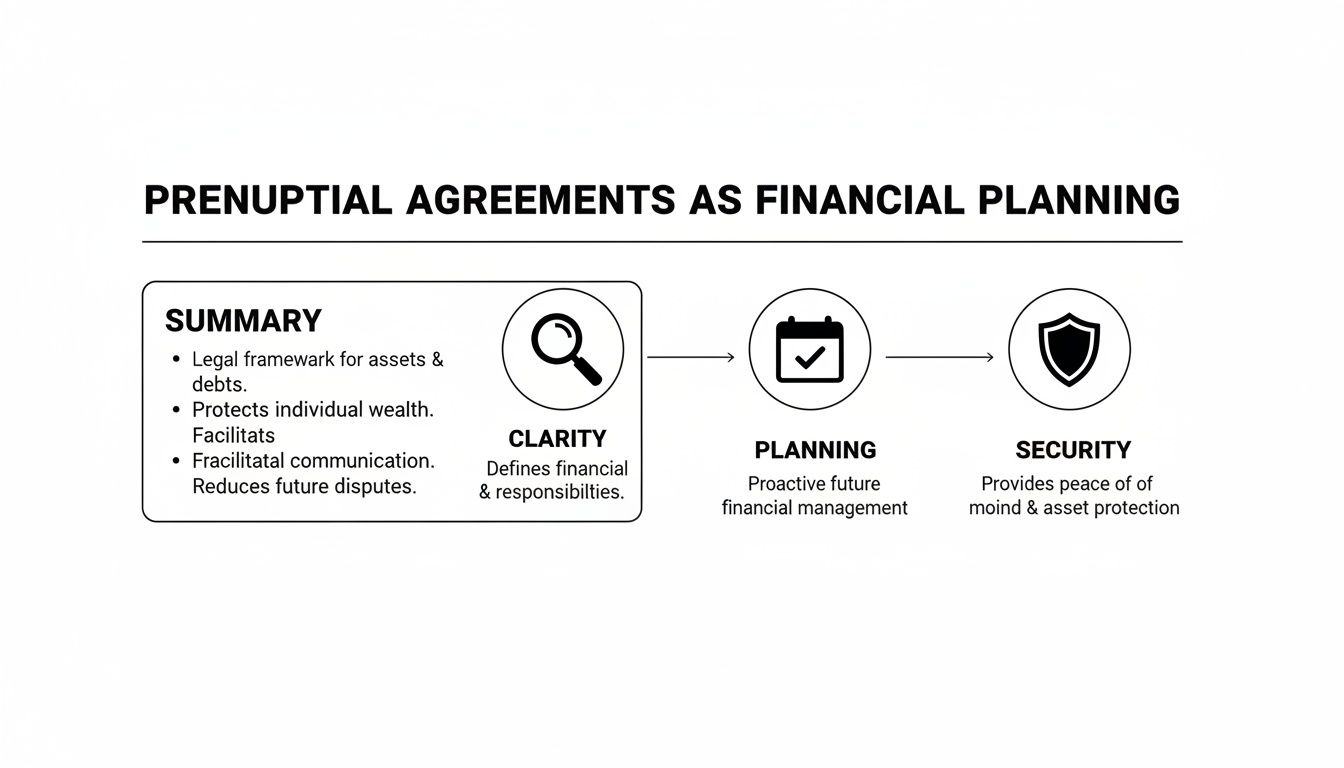
That moment often feels awkward at first. One person may be thinking about a home they already own, a business they built before the relationship, family money, existing debt, or children from a previous relationship. The other may be wondering whether the request signals distrust. In practice, the strongest prenuptial agreements usually come from couples who treat the process as financial planning, not conflict planning.
In Ontario, a prenup is usually called a marriage contract. If you're learning how to write a prenuptial agreement in Canada, it helps to start with one core idea. The legal rules are not random paperwork. They exist to prevent the exact arguments that later destroy agreements in court. A well-prepared contract creates clarity now and reduces room for future allegations of surprise, pressure, or unfairness.
Table of Contents
- Starting the Prenup Conversation
- What a Prenup Can and Cannot Legally Include
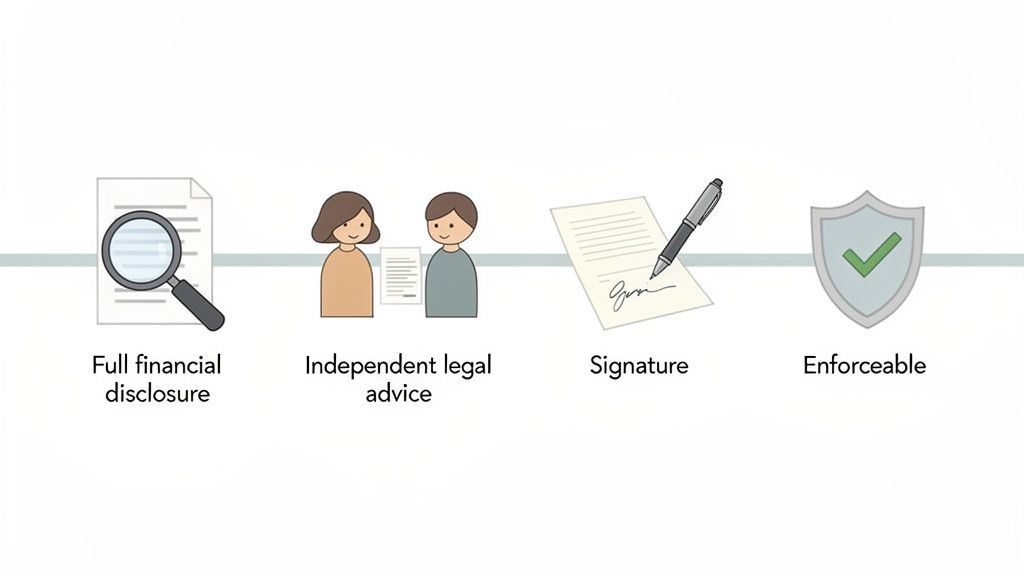
- The Three Pillars of an Enforceable Agreement in Ontario
- A Practical Guide to Negotiating Your Prenup
- Costly Mistakes That Can Invalidate Your Agreement
- Why a DIY Prenup Is a Gamble You Cannot Afford
Starting the Prenup Conversation
A couple might spend months comparing venues, guest lists, and mortgage options, yet avoid one direct conversation about how they'll handle property, debt, and support if life changes later. That silence creates more risk than the prenup itself.
A marriage contract works best when it starts as an honest talk. One partner may say, “I own a condo and want clarity about it.” The other may want protection from pre-existing debt. Another couple may want a shared understanding of how savings, inheritances, or business interests will be treated. None of that is cynical. It's organised.

Why the conversation matters
When couples talk early, they usually uncover practical issues before lawyers start drafting. That matters because legal drafting cannot fix a conversation that never happened. If one person assumes the house will remain separate property and the other assumes marriage changes everything, the core problem is not the document. The core problem is the mismatch in expectations.
Practical rule: Raise the topic when there's still time to think, ask questions, and revise. A prenup should feel deliberate, not imposed.
Ontario law begins with a simple baseline. Under Section 55(1) of the Ontario Family Law Act, which continues the authority granted by the 1978 Family Law Reform Act, a marriage contract must be in writing, signed by both parties, and witnessed by at least one other person to be legally valid in Canada, rendering oral agreements unenforceable, as explained in this overview of prenuptial agreements in Canada.
That rule exists for a reason. Couples often remember conversations differently, especially after separation. A written agreement reduces disputes about who said what, when they said it, and whether both people agreed. If you're at the stage of asking whether legal help is worth it, this guide on finding a prenuptial agreement lawyer near you can help you understand what to look for.
A better frame for the discussion
It helps to approach the subject as a joint planning exercise:
- Protect what already exists: A home, business, investment account, or inherited asset may need clear treatment.
- Clarify responsibility: Debt brought into the marriage should not remain vague.
- Reduce future conflict: Clear language now can prevent expensive arguments later.
- Create transparency: The process pushes both people to be candid about finances.
If you want to know how to write a prenuptial agreement in Canada, start there. Not with a template. With a conversation both of you can stand behind later.
What a Prenup Can and Cannot Legally Include
A good prenup is powerful because it's specific. A bad one fails because it tries to control matters the law reserves for the court. The key is knowing where the line is.
What you can include
Most valid marriage contracts focus on financial and property issues. That's where these agreements do their best work.
You can usually address matters such as:
- Property ownership: Who brought what into the marriage, and how certain assets should be treated later.
- Division of assets: How investment accounts, savings, real estate interests, or business growth will be handled if the relationship ends.
- Debt allocation: Whether one spouse remains solely responsible for pre-marriage liabilities or specific obligations.
- Spousal support: The agreement may address support and can include a waiver, although courts still retain oversight in unfair situations.
- Family gifts and inheritances: Couples often want express language around money or property received from relatives.
This is one area where many couples confuse marriage contracts with cohabitation agreements. The goals overlap, but the legal context changes once marriage is involved. If you're comparing options before the wedding, it helps to understand cohabitation agreements in Ontario.
What you cannot include
The biggest drafting errors happen when people assume they can contract around everything. They can't.
Child-related terms are not controlled by private preference alone. As noted in this discussion of whether self-signed prenups are recognized in Canada, while prenups can address spousal support and property, they are largely ineffective for child-related matters. Child support must comply with the Federal Child Support Guidelines, and parenting arrangements, formerly custody and access, are determined by courts based on the child's best interests at the time of separation. Section 7 special expenses also cannot be waived.
That rule protects children from agreements made before anyone knows what the child's needs, living arrangements, health, schooling, or care costs will be.
Another major limit concerns the matrimonial home. In Ontario and under federal divorce law protections, spouses cannot contract out of the statutory rights attached to the matrimonial home. Clauses attempting to remove those protections are vulnerable because the law treats the family home differently from other property.
A marriage contract can organise financial expectations between adults. It cannot override the legal protections the law reserves for children or the matrimonial home.
Quick comparison
| Prenuptial Agreement: Includable vs. Unenforceable Clauses | What You CAN Include | What You CANNOT Include |
|---|---|---|
| Property | Ownership of pre-marriage assets, treatment of investments, business interests, debt responsibility | Terms that attempt to remove statutory matrimonial home protections |
| Support | Spousal support terms, including waivers, subject to court review in unfair circumstances | Child support terms that conflict with the Federal Child Support Guidelines |
| Parenting | General statements of values may appear, but they won't decide legal rights | Decision-making responsibility and parenting time |
| Child expenses | None as a binding waiver mechanism | Waivers or fixed terms for Section 7 expenses |
A useful drafting test is simple. Ask, does this clause govern the financial relationship between the spouses, or does it try to bind the court on future child issues or protected rights? If it's the latter, it likely doesn't belong.
The Three Pillars of an Enforceable Agreement in Ontario
An Ontario prenup is strongest when it can survive a judge's most predictable questions. Was it signed properly? Did both people know the financial picture? Did anyone feel cornered? Those questions form the core of enforceability.

Pillar one, proper form
The first pillar is formal execution. In Ontario, the agreement must be in writing, signed, and witnessed. That sounds basic, but formalities matter because they answer future arguments about authenticity.
A properly executed document tells the court that this was meant to be a real legal contract, not a draft, not a rough note, and not a casual exchange of messages. Form is the first layer of proof.
Pillar two, full disclosure
The second pillar is complete financial disclosure. Many agreements frequently founder at this point.
As explained in this article on what can be included in an Ontario marriage contract, in Ontario a prenuptial agreement must be in writing, signed, and witnessed, and each party must provide full financial disclosure. That same source states that a 2023 Ontario Bar Association study found that 32% of contested marriage contracts were struck down due to a lack of transparency or unequal bargaining power.
That figure tells you why disclosure is not a side task. It is central. If one person signs without knowing the other's assets, liabilities, income, gifts, or inheritances, the court may conclude the bargain was never informed in the first place.
For many couples, the easiest way to approach disclosure is to prepare the same kind of information family courts expect in other financial cases. A practical starting point is understanding the documents behind a Form 13.1 financial statement, even if your lawyer tailors the disclosure package for a prenup.
Pillar three, real consent
The third pillar is voluntary consent. A court wants to see that both people had time to think, obtain advice, and make a free choice.
This requirement exists because weddings create pressure. Deposits are paid. Guests are invited. Family expectations build. If the agreement appears suddenly, the weaker party may sign to save the event, not because the terms are fair or understood. Courts know that.
Legal reality: The closer the signing is to the wedding, the easier it is for one party to argue pressure, haste, or lack of meaningful choice.
The three pillars work together. Proper signatures prove the contract exists. Full disclosure proves the bargain was informed. Real consent proves the choice was voluntary. When one pillar is weak, the entire agreement becomes easier to attack.
A Practical Guide to Negotiating Your Prenup
Negotiating a prenup is not a courtroom exercise. It should feel more like careful planning with legal guardrails. The tone matters almost as much as the terms.
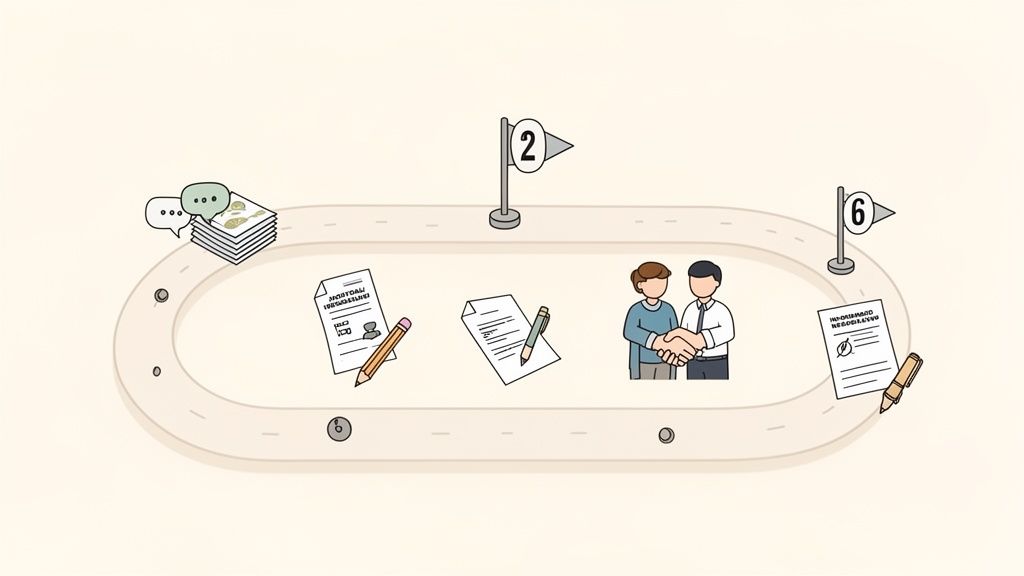
Start early and speak plainly
Start the discussion well before final wedding preparations take over. Last-minute drafting creates the wrong atmosphere. People become defensive when time is short.
Use direct language. “I want to protect my business.” “I'm worried about taking on debt I didn't create.” “I want us both to know what happens if one of us pauses work to raise children.” Those statements are easier to work with than vague assurances.
A strong first conversation usually includes three topics:
- What each person wants to protect
- What each person fears
- What would feel fair if the marriage ended years from now
Prepare before you negotiate
Do not start with opinions. Start with documents.
Each person should gather the information their lawyer will need. That often includes a list of assets, debts, income sources, business interests, expected inheritances or gifts, and any property already owned. Once the facts are on the table, the discussion becomes more grounded and much less emotional.
Bring paper, not assumptions. Most prenup disputes begin where one person guessed and the other stayed silent.
If negotiations become tense, some couples benefit from a structured process that reduces positional arguing. In some cases, understanding the difference between mediation and litigation helps couples choose a more constructive path for difficult financial conversations.
Keep the process collaborative
A practical approach is to separate the conversation into categories rather than argue about everything at once.
For example:
- Category one, existing property: What belongs to whom now?
- Category two, future accumulation: How will savings, investments, or business growth be treated?
- Category three, support expectations: What happens if one spouse earns less or leaves work for family reasons?
- Category four, debt: Which debts stay individual, and which become shared?
That approach works because it narrows the disagreement. Couples often agree on two categories quickly and need focused help only on the others.
It also helps to keep draft language neutral. A clause doesn't need to sound suspicious to be effective. The best drafting is usually clear, spare, and precise. If a sentence invites three interpretations, it needs rewriting.
When people ask how to write a prenuptial agreement in Canada, they often expect a form. The better answer is a process. Clear goals, full information, careful drafting, and enough time for both people to say yes without pressure.
Costly Mistakes That Can Invalidate Your Agreement
Most broken prenups do not fail because the couple lacked good intentions. They fail because one practical mistake gave the court a reason to doubt the whole process.

The rushed signing problem
A classic example is the agreement produced at the last moment. One partner is told the document must be signed immediately because the wedding is days away, travel is booked, and relatives are arriving.
Ontario courts look hard at those facts. According to this discussion of Ontario prenuptial agreement pitfalls, an Ontario Superior Court of Justice ruling in 2022 voided a prenup signed on the wedding day due to evidence of coercion. The same source notes that clauses attempting to predetermine child custody or waive Section 7 expenses are legally unenforceable.
That outcome makes sense. If the pressure of cancelling a wedding hangs over the signature, the court may conclude the agreement was not freely made.
The hidden information problem
Another common failure starts with omission. One spouse lists the house but not the line of credit. A business interest is described vaguely. An expected inheritance is mentioned casually but never properly disclosed. The couple still signs because they want to move forward.
Years later, the missing information becomes the centre of the dispute.
A judge does not need to see dramatic fraud to lose confidence in the agreement. Even partial disclosure can create a serious problem if it affected bargaining power. The issue is not only dishonesty. It is whether the other person had enough information to make an informed decision.
The illegal clause problem
Some couples download a broad template and add whatever terms feel important. They include future parenting schedules, child support amounts, or a clause saying one spouse has no claim to the family home under any circumstances.
Those clauses often create more trouble than protection. They signal that the agreement was drafted without attention to the boundaries of family law. In some cases, one bad clause can also invite scrutiny of the rest of the document.
The most dangerous prenup language is often the language that sounds toughest. Courts enforce careful agreements, not overreaching ones.
A few caution signs deserve immediate attention:
- Wedding-week signing: Courts may see urgency as evidence of duress.
- Missing schedules: If assets and debts are not attached clearly, the bargain looks incomplete.
- One-sided language: Terms that are grossly unfair invite an unconscionability argument.
- Improper signing steps: A strong draft can still fail if execution is sloppy.
- Copied templates: Generic clauses often ignore Ontario-specific limits.
The lesson is simple. A prenup doesn't become stronger by being aggressive. It becomes stronger by being fair, complete, and carefully prepared.
Why a DIY Prenup Is a Gamble You Cannot Afford
The attraction of a DIY prenup is obvious. Download a template, fill in names and assets, sign it, and move on. For a legal document with long-term consequences, that shortcut is risky.
Templates miss the legal pressure points
A template cannot assess whether the disclosure was complete, whether a support waiver may later look unconscionable, whether the treatment of a business interest is precise enough, or whether the timing of the signing creates a duress problem.
It also cannot provide Independent Legal Advice, which is one of the strongest protections against later challenges. As explained in this overview of prenuptial agreement costs and enforceability, the DIY prenup myth overlooks the critical role of ILA. That source states that without ILA certificates, Ontario courts frequently set agreements aside as unconscionable, and that drafting costs with lawyers typically range from CA$2,500 to CA$7,500 per party.
That cost is significant. So is the cost of litigating over a defective agreement years later.
Legal review is part of the protection
Separate legal advice does more than “check the box.” It helps prove that each person understood the terms, had a chance to ask questions, and was not passively led through a signing exercise. That is exactly the kind of evidence courts care about.
For some clients, full representation is the right fit. For others, a more targeted service may still be better than going fully alone. If you're weighing options, learning how a limited scope retainer works can help you decide whether you need complete drafting support or a narrower legal review.
A DIY prenup often saves money only if it never gets tested. The moment it does, its weaknesses become expensive.
If you're considering a marriage contract and want careful, practical guidance, Badesha Law helps clients in Brampton, Peel Region, and across the GTA prepare, review, and negotiate prenuptial agreements that reflect Ontario family law requirements. The firm provides clear advice on financial disclosure, enforceability, support terms, and the matrimonial home, with a focus on reducing stress and avoiding costly mistakes before the wedding day.