Lump Sum Spousal Support Calculator Ontario: A 2026 Guide

You’re probably here because you typed “lump sum spousal support calculator Ontario” into Google and expected a clean tool where you enter two incomes, click a button, and get an answer.

That tool doesn’t really exist for Ontario.

That’s frustrating, especially when you’re trying to make decisions about separation, housing, support, and how to move forward without getting lost in legal jargon. But there’s a good reason for it. In Ontario, a proper lump sum spousal support calculation isn’t a one-step formula. It’s a legal and financial process.

If you understand that process, you’ll be in a much stronger position. You’ll know why many online calculators are misleading, what numbers matter, and when a proposed buyout is reasonable versus risky.

Why You Can’t Find a Simple Ontario Lump Sum Calculator

A concerned woman looking at an Ontario lump sum spousal support calculator on her laptop screen.

People assume spousal support should work like child support. Enter income, get a number, move on. Ontario doesn’t work that way for lump sums.

The first problem is that Ontario lacks any official or standardised lump sum spousal support calculator. Generic online tools are often built for U.S. jurisdictions and apply formulas that don’t match Ontario law. A source discussing these calculator issues notes that Ontario courts determine lump sums through present value calculations of ongoing support under the Divorce Act, which generic tools ignore (discussion of calculator limitations and present value under the Divorce Act).

Child support has tables. Spousal support doesn’t.

That distinction matters. Child support is built around formal guideline tables. Spousal support is more discretionary. Courts look at incomes, the length of the relationship, the roles each spouse had during the marriage, and other facts that affect need and ability to pay.

For lump sum support, there’s another layer. Before anyone can even talk about a buyout amount, someone has to determine what the periodic support would have been. After that, the future stream of payments has to be converted into a present-day value.

That’s why a simple “calculator” usually fails. It skips the legal work and pretends the financial work is automatic.

What most online calculators get wrong

Many online tools mix together concepts from different places. Some use U.S. alimony formulas. Some rely on rough income percentages. Some just multiply a monthly amount by a number of months. That may feel clear, but it isn’t reliable.

A proper Ontario analysis has to fit within Canadian family law principles and the support framework courts use. If you need a broader overview of how support fits into separation rights and obligations, it helps to review family law rights and responsibilities in Canada.

Practical rule: If a “lump sum spousal support calculator” gives you an answer without first dealing with periodic support and present value, treat it as rough internet content, not legal guidance.

Here’s the more accurate way to approach it:

What people look for What Ontario actually requires
One calculator A two-step legal and financial method
One final number A support range, duration analysis, and present value conversion
Generic formula Case-specific assessment under Canadian family law principles

The Two-Step Method Lawyers Use for Lump Sum Support

An infographic showing the two-step method for calculating lump sum spousal support with periodic payments and present value conversion.

When lawyers assess a lump sum spousal support issue in Ontario, they usually work through two separate calculations. People often search for one tool, but this method has two parts because the law and the math answer different questions.

Step one is legal

The first question is this: What should the support amount and duration be if it were paid periodically?

That analysis usually starts with the Spousal Support Advisory Guidelines, often called the SSAGs. They aren’t binding in the way some people think a formula is binding, but they are widely used as a framework for estimating support.

The inputs matter. Income matters. The relationship length matters. Whether there are children matters. In some files, the timing of separation, bonuses, or self-employment income can also complicate the picture.

If you want background on how support is generally calculated, this guide on how to calculate spousal support in Canada is a useful starting point.

Step two is financial

Once the periodic support picture is clear, the second question is different: What is that stream of future payments worth today as a single lump sum?

That’s a present value analysis.

A lump sum isn’t usually the same as adding up all future monthly payments. The law recognises that money paid now and money paid years from now are not economically identical. A one-time payment gives immediate access to capital, but it also shifts risk and finality in a way monthly payments do not.

A quick roadmap

Lawyers typically work through something like this:

  1. Gather income information
    Tax returns, pay records, business records, and other financial documents shape the support analysis.

  2. Estimate periodic support
    The SSAG framework helps identify an amount range and a likely duration.

  3. Choose the structure
    Decide whether monthly support, a lump sum, or a blended approach makes sense in the specific case.

  4. Convert to present value
    Financial software or detailed calculations are used to discount future payments into a present-day amount.

The legal question is “what support is fair?” The financial question is “what is that support worth if paid now instead of over time?”

Those are not the same question, and treating them as one is where many mistakes start.

Step One Calculating Periodic Support with the SSAGs

A professional analyzing Spousal Support Advisory Guidelines on a tablet screen in a bright office environment.

The first half of a lump sum spousal support calculator analysis is not really about the lump sum at all. It’s about building the support foundation correctly.

In Canada, the Spousal Support Advisory Guidelines are commonly used as a framework. They are not legally binding, but they are important because they help lawyers and courts estimate what periodic support may look like in a given case. One summary of the SSAG framework states that, after support is paid, the receiving spouse should typically have between 40% and 46% of the couple’s combined net income (SSAG summary and income-sharing framework).

What goes into the SSAG analysis

This isn’t just a matter of comparing two salaries. Support calculations often turn on the quality of the financial disclosure.

A proper review usually includes:

  • Income from all relevant sources. Employment income is the obvious starting point, but support discussions can become more complicated where there are bonuses, commissions, business income, or fluctuating earnings.
  • Length of the relationship. Duration often affects both amount and how long support may be payable.
  • Family structure. Cases with children can produce very different support outcomes than cases without children.
  • Post-separation reality. A court or negotiator still needs to understand actual financial circumstances, not just headline income figures.

Why the result is usually a range

Clients often want one precise monthly number. In many cases, the SSAGs produce a range, not a single fixed amount. That’s normal.

The range reflects the fact that support decisions involve judgment. Two spouses may agree on income and still disagree on the right point within the range. One side may argue for more support because of a clear economic disadvantage caused by the marriage. The other may argue for a lower figure because the recipient has stronger earning capacity than they claim.

If you want to compare your situation to a general Ontario framework, this overview of a spousal support calculator in Ontario can help you understand the basic inputs.

Documents that help most

When someone asks for a lump sum estimate, the quality of the answer depends heavily on the paperwork available. The most useful starting materials usually include:

  • Recent tax returns
  • Current proof of income
  • Records of variable compensation
  • A clear separation date
  • Information about children and parenting arrangements
  • A summary of monthly expenses

A weak support calculation at step one produces a weak lump sum analysis at step two.

That’s why experienced lawyers spend time on the income and support foundation before talking seriously about a buyout.

Step Two Converting Periodic Payments to Present Value

A person writing complex financial equations in a notebook with a pen, with a calculator nearby.

Once periodic support has been estimated, the next issue is whether those future payments can be translated into one fair number today.

People often get tripped up at this point. They assume a lump sum is just the monthly payment multiplied by the number of months. That feels intuitive, but present value analysis works differently.

What present value means in plain language

Present value asks a simple question: if someone was supposed to receive support over time, what single payment today would be financially equivalent?

The answer is usually lower than the total of all future payments added together. That isn’t because the recipient is being shortchanged by definition. It’s because money received now has current use and potential investment value, while money received over time is delayed.

Courts and lawyers use a discount rate to convert those future payments into a present-day amount. The selection of that rate matters. A higher discount rate usually lowers the lump sum. A lower discount rate usually increases it.

A worked example

One real-world example shows why this matters. A spousal support order of $2,400 monthly for 120 months, using a 4.57% discount rate, was converted into a present value lump sum of approximately $213,000, not $288,000 from simple multiplication (present value example using monthly support and discount rate).

That example tells you two important things.

First, simple multiplication can badly distort the value of a buyout. Second, the technical assumptions behind the calculation matter enough to change negotiation outcomes in a major way.

Why duration changes everything

A short support period and a long support period should not be treated the same way. The longer the support stream, the more important discounting becomes. Timing changes value.

The discount rate also has practical impact. Family law software often uses treasury-based rates or rates grounded in legal practice. But software is only as good as the assumptions entered into it. Garbage in, garbage out still applies.

Here’s a simple comparison:

Method How it works Main problem
Simple multiplication Monthly support × number of months Ignores present value
Present value analysis Discounts future payments into today’s dollars Requires careful assumptions

What lawyers and financial professionals look at

A proper present value review usually considers several moving parts at once:

  • Support amount and duration. These come from the periodic support analysis.
  • Discount rate. This affects how heavily future payments are reduced to present value.
  • Tax treatment. The net effect of periodic versus lump sum support can differ.
  • Inflation and purchasing power. Ignoring future value erosion can distort fairness.
  • Risk and finality. A lump sum may end future enforcement disputes, but it may also shift long-term risk to one side.

If someone gives you a lump sum number without explaining the discount rate and assumptions behind it, you don’t have a calculation. You have a proposal.

Why some clients still prefer a lump sum

Even where the math is properly done, the best structure depends on the people involved.

A recipient may prefer a lump sum for certainty. There’s no monthly collection issue, no worry about missed payments, and no ongoing tie to the former spouse on support enforcement.

A payor may also prefer a lump sum because it creates finality. There may be value in closing the issue completely and reducing future conflict.

But certainty can come at a cost. A recipient who takes a lump sum gives up the possibility of future variation in some circumstances. A payor who agrees to a buyout may be taking on a significant immediate financial burden.

That’s why the number itself is only part of the conversation. The structure has to make practical sense too.

Critical Pitfalls in Lump Sum Negotiations

The most expensive errors in lump sum support cases usually happen in negotiation, not in court. People get tired. They want closure. They accept a number that sounds fair because it looks large in one sentence or reasonable in a text exchange.

That’s dangerous.

A key warning from commentary on lump sum alimony is that parties who skip present value analysis and multiply monthly support by duration can end up with settlements worth 15% to 30% less than the actuarial equivalent of the monthly payments (warning about miscalculation and loss in lump sum settlements).

The most common mistake

The simplest mistake is also the most common. Someone says, “Support would have been this amount per month for this many years, so let’s just multiply it.”

That shortcut can miss the mark badly. It ignores present value. It can also ignore timing, tax consequences, enforceability concerns, and the possibility that the periodic support estimate itself was off.

Tax treatment can change the real value

In practice, tax treatment often changes the fairness of a deal. Lump sum and periodic support are not always economically identical just because the gross numbers look similar.

A deal can look balanced on paper and still be uneven in real life if no one has tested the net effect. This is one reason separation agreements need careful drafting and careful financial review. If you’re working through settlement terms generally, a guide to an Ontario separation agreement template can help you understand how support terms fit into the larger agreement.

Watch for these negotiation traps

  • A large number with no explanation. If the other side offers a lump sum but won’t show the assumptions, be cautious.
  • Pressure to settle quickly. Fast offers often benefit the person who already understands the math.
  • Confusing certainty with fairness. A clean break can be attractive, but finality alone doesn’t make the amount reasonable.
  • Ignoring future enforcement risk. Monthly support can create collection problems. A lump sum removes some risks but creates others.
  • Overlooking drafting issues. The agreement has to state the support terms clearly and match the intended legal effect.

A fair lump sum is not the same thing as a convenient lump sum.

What tends to work better

The stronger approach is slower, but safer.

Ask for the periodic support basis first. Then ask how the lump sum was derived from that support stream. Then test whether the structure makes sense for your actual life. Can the payor fund it? Does the recipient need long-term income stability more than immediate capital? Are there other settlement terms being traded against support?

People often focus only on the headline dollar figure. That’s rarely enough.

When You Need a Lawyer Not a Calculator

A basic online estimator can help you understand vocabulary. It won’t reliably resolve your case.

Lump sum spousal support involves legal judgment, financial modelling, and careful drafting. Even when both spouses want an amicable resolution, the details still matter. Income must be assessed properly. The support framework must fit the facts. The present value analysis must use defensible assumptions. The final agreement must reflect what the parties intended.

Ontario family law doesn’t treat spousal support like a plug-in formula. The Family Law Act and the Divorce Act sit in the background of these negotiations, and support outcomes still depend on the facts of the marriage, the separation, and each spouse’s financial position.

If you’re trying to decide between monthly support and a buyout, or you’ve been handed a lump sum figure that doesn’t fully make sense, get legal advice before signing anything. A proper review now can prevent a very expensive mistake later. If you need legal help focused specifically on support issues, see this overview of spousal support legal services.


Badesha Law helps clients in Brampton, Peel Region, and across the GTA understand spousal support clearly and negotiate practical, legally sound outcomes. If you need advice on a lump sum spousal support calculator issue, a separation agreement, or a full divorce matter, contact Badesha Law for guidance specific to your situation.


A Practical Guide on How to Calculate Spousal Support in Canada

Before you can even begin to calculate spousal support in Canada, you have to answer a more fundamental question: is there a legal right to it in the first place? Spousal support isn't automatic. It's awarded based on specific grounds laid out in Canada's federal Divorce Act and provincial family laws, such as Ontario's Family Law Act, which are designed to address the real-world economic consequences of a relationship breakdown.

Determining Your Entitlement to Spousal Support

A man reads a document about divorce and spousal support, with a family photo and Lady Justice in the background.

Before any numbers are crunched, a court must establish why one partner should pay support to the other. Canadian law does not treat support as a punishment for a failed relationship. Instead, its purpose is to fairly address the financial imbalance that often occurs when a couple separates.

Whether you were married and fall under the federal Divorce Act, or you were in a common-law relationship in Ontario and are covered by the Family Law Act, a spouse must prove they have a right to support based on one of three grounds.

The Three Grounds for Spousal Support Entitlement

Figuring out which basis—or bases—applies to your situation is the very first hurdle in any spousal support claim. The grounds can be compensatory, non-compensatory, or contractual.

  • Compensatory Support: This applies to a spouse who sacrificed their career for the benefit of the family. A common example is a partner who left a promising job to raise children, allowing the other spouse to advance their career without interruption. Support here is meant to compensate for the economic disadvantage they took on for the family's benefit.
  • Non-Compensatory Support: Often called "needs-based" support, this ground applies when the separation itself creates a significant financial need. If one spouse cannot meet their basic living expenses and the other has the ability to help, support may be awarded to bridge that gap and prevent genuine hardship.
  • Contractual Support: This is straightforward. It applies when you and your partner have a valid pre-existing agreement—like a marriage contract or cohabitation agreement—that specifies spousal support obligations in the event of separation.

It’s not uncommon for a claim to be based on more than one ground. For example, a spouse who stayed home to raise children (compensatory) might also struggle to re-enter the workforce after a long absence (non-compensatory), strengthening their claim.

Key Takeaway: Entitlement is not based on who was at fault for the breakup. The court focuses on the roles each person played during the relationship and the financial impact of the separation.

Married vs Common-Law Spouses in Ontario

The legal path to claiming support differs depending on your relationship status. While the core principles of entitlement are the same, the governing laws are distinct.

For married couples, spousal support claims are handled under the federal Divorce Act as part of the overall divorce proceedings, ensuring a consistent standard across Canada.

For unmarried, common-law partners in Ontario, the right to seek support comes from the provincial Family Law Act. To qualify as a "spouse" under this Act, you must have either:

  • Cohabited continuously for at least three years, or
  • Been in a "relationship of some permanence" and are the parents of a child.

While Canada's divorce rate hit a historic low of 5.6 divorces per 1,000 married people in 2020, family courts remain busy with complex separations involving both married and common-law partners.

Establishing your eligibility is non-negotiable. Without a solid basis for entitlement, any attempt to calculate spousal support is premature, and your claim could be denied outright. For more on this, see our guide on when spousal support is denied. Once entitlement is clear, the next step is to determine the numbers: how much support, and for how long.

Understanding the Spousal Support Advisory Guidelines (SSAG)

Once you’ve established that spousal support is on the table, the conversation quickly moves from if it will be paid to how much and for how long. This is precisely where the Spousal Support Advisory Guidelines (SSAG) come in.

While they aren't a strict law like the speed limit, these guidelines are the go-to tool for lawyers and judges across Canada. They bring a much-needed layer of consistency and predictability to what could otherwise be a wildly unpredictable process.

Think of the SSAG as a sophisticated calculator that takes the unique facts of your family life and generates a range for both the monthly support amount and how long it should be paid. Understanding how it works is key to understanding the numbers that will likely be the starting point for negotiation in your case.

The Two Core SSAG Formulas

The SSAG is not a one-size-fits-all model. It uses two distinct formulas, and the correct one for your situation depends on a single question: are there dependent children involved?

  • The Without Child Support Formula: This is the more straightforward of the two. It's used when a couple separates with no dependent children. The calculation focuses almost entirely on the difference between the spouses' gross incomes and the length of their relationship.

  • The With Child Support Formula: When child support is also a factor, things get more complex. This formula correctly recognizes that child support is the primary financial priority. It performs a deeper analysis to determine how much money is left for each spouse after child support and taxes are paid, ensuring the dependent spouse still receives a fair share of the remaining income.

Choosing the right formula is the first critical step. Using the wrong one will produce completely inaccurate numbers and risk derailing negotiations before they even begin.

This screenshot from the Department of Justice Canada's website shows the introductory page to the Spousal Support Advisory Guidelines.

This page is the official starting point for understanding the guidelines, making it clear they're designed to provide a solid framework for figuring out spousal support amounts and duration.

Essential Inputs for the Formulas

Before you can calculate spousal support in Canada, you need to gather specific financial and personal details. The formulas are powerful, but they're only as good as the information you feed them.

Below is a quick comparison of the information you’ll need to have on hand for each of the two main formulas. As you can see, the With Child Support formula requires a bit more detail to ensure the calculations are fair.

Key Inputs for SSAG Formulas

Required Information Without Child Support Formula With Child Support Formula
Gross Annual Income of Both Spouses Yes (The starting point for everything) Yes (Crucial for the initial analysis)
Length of the Relationship Yes (Includes marriage and cohabitation) Yes (A key factor for duration)
Ages of the Spouses Yes (Especially for duration in long-term relationships) Yes (Impacts duration calculations)
Child Support Details Not Applicable Yes (The exact amount being paid)
Parenting Arrangement Not Applicable Yes (Who the children live with primarily)

These advisory guidelines have been the standard since their introduction in 2005, bringing a level of consistency to provinces like Ontario. For example, in a 12-year marriage with children, the guidelines might suggest a support duration of 6 to 12 years. If one spouse made significant career sacrifices for the family, the duration would likely lean towards the longer end of that range—perhaps until the youngest child finishes high school. You can read more about the Canadian experience with formula-based spousal maintenance for some deeper insights.

A Practical Example of the SSAG in Action

Let’s walk through a simple scenario. Imagine Amir and Sarah are separating after a 15-year marriage with no children. Amir earns $120,000 a year, while Sarah, working part-time, earns $40,000.

Because there are no children, we’d use the Without Child Support formula. A family lawyer would plug these numbers into their software, and the SSAG would generate a result. But it's not a single, magic number—it's a range.

Example Outcome:

  • Amount (Quantum): A low end of $1,000/month, a mid-range of $1,333/month, and a high end of $1,667/month.
  • Duration: A low end of 7.5 years, a high end of 15 years, or even potentially indefinite support given the length of the marriage.

This range provides a realistic starting point for negotiations. From here, Amir and Sarah (or a court) would look at other factors—like Sarah’s health or any significant debt Amir might have—to decide where the final figure should land within that range.

For those in Ontario wanting to run some numbers, our detailed guide on the spousal support calculator in Ontario offers more specific examples and tools. The SSAG provides the map, but it's the unique facts of your case that determine the final destination.

Putting the SSAG Formulas into Practice

Okay, you’ve read about the Spousal Support Advisory Guidelines (SSAG), but it's all just theory until you see the numbers in action. This is the part where the abstract rules become real money and real timelines. Seeing how a lawyer or a judge actually works through the formulas helps demystify the entire process, turning complex guidelines into a clear financial range.

Let’s walk through a common scenario. We’ll call our couple David and Chloe. They’re separating after a 15-year marriage. David earns a gross annual income of $110,000, and Chloe, who pulled back on her career to manage the home and support David's, earns $35,000. They don’t have dependent children, which means we’ll be using the Without Child Support formula.

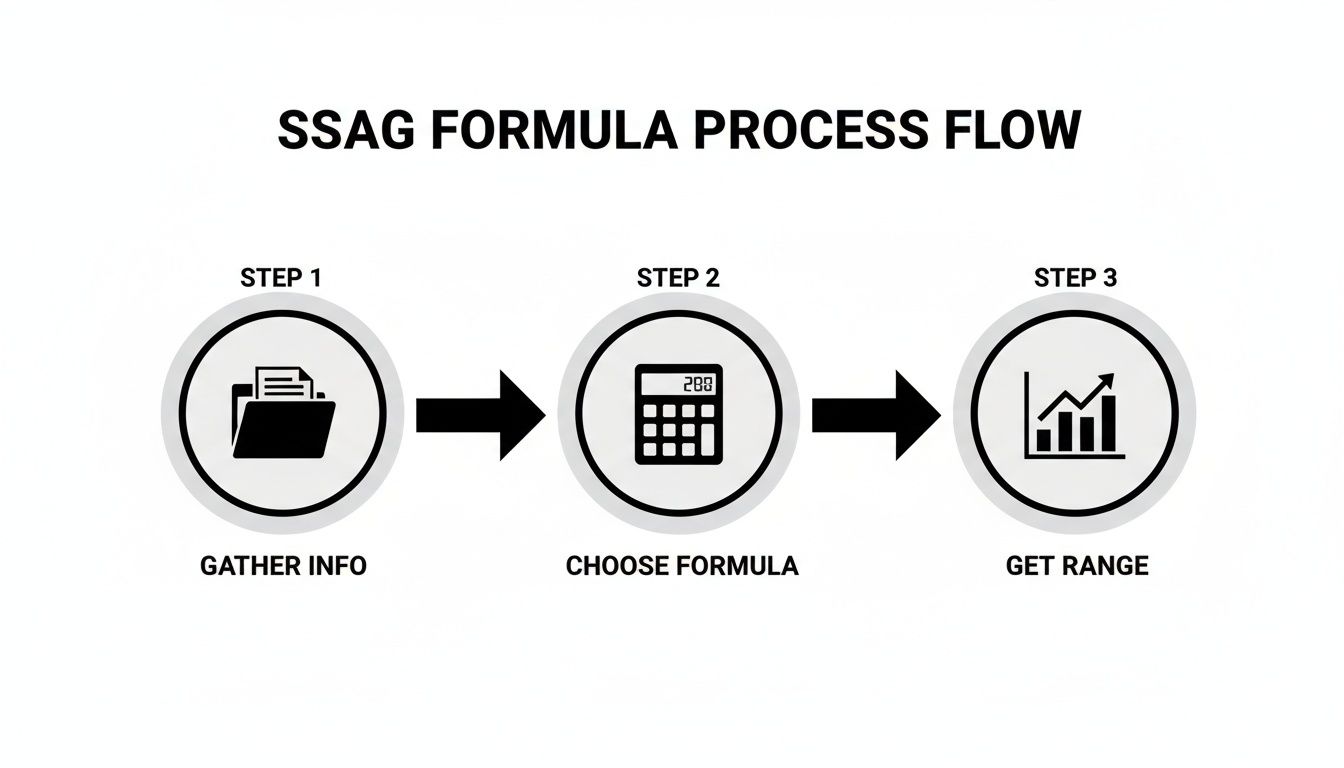
This whole process can feel complicated, but it really boils down to three core stages.

A three-step process flow for SSAG formula, showing gather info, choose formula, and get range.

As the visual shows, it starts with getting the financial details right, picking the correct formula, and then working with the range that the guidelines produce.

Calculating the Quantum (The Monthly Amount)

First up is the "quantum"—that’s the legal term for the actual monthly spousal support payment. With no kids involved, the Without Child Support formula zeroes in on two key factors: the difference in their gross incomes and the length of the marriage.

  • The formula uses a multiplier of 1.5% to 2% for each year of marriage. David and Chloe were married for 15 years, so their multiplier is between 22.5% (15 x 1.5) and 30% (15 x 2).
  • We then apply that percentage to the gap in their gross incomes, which is $75,000 ($110,000 – $35,000).

Running the numbers gives us a clear range:

  • Low End: $75,000 x 22.5% = $16,875 per year, which works out to $1,406 per month.
  • High End: $75,000 x 30% = $22,500 per year, or $1,875 per month.

The mid-point lands around $1,640 per month. This range isn't the final answer; it's the starting point for negotiation. Things like Chloe’s health issues or David carrying significant family debt could push the final number toward the higher or lower end.

Key Takeaway: The SSAG doesn’t spit out a single magic number. It creates a reasonable range for negotiation or for a judge to consider. The specific facts of your case will always determine where you land within that range.

Determining the Duration of Support Payments

Next, we figure out how long the payments will last. For marriages like David and Chloe's, the SSAG suggests a duration of 0.5 to 1 year of support for every year they were married.

Here's how that applies to their 15-year marriage:

  • Low End Duration: 15 years x 0.5 = 7.5 years.
  • High End Duration: 15 years x 1 = 15 years.

Because their marriage was 15 years long, they are getting close to the point where indefinite support becomes a real possibility. Support could be set for a fixed term somewhere in that 7.5 to 15-year window, or it could be ordered indefinitely, meaning it continues until there's a major change like retirement.

A huge factor here is the "Rule of 65." This guideline suggests indefinite support if the length of the marriage plus the recipient’s age at separation adds up to 65 or more. If Chloe was 50 when they separated, her score would be 65 (15 years of marriage + 50 years of age), building a very strong argument for indefinite support.

A Word of Caution on Online Calculators

Online spousal support calculators can be a useful starting point, but they are absolutely no substitute for proper legal advice. I’ve seen countless clients come in with skewed numbers because these tools miss the critical nuances a family lawyer is trained to spot.

Common Pitfalls to Avoid:

  • Getting the Income Wrong: This is the single biggest mistake people make. It’s especially tricky for business owners, contractors, or anyone with bonuses and commissions. You must use the gross, pre-tax income figure, but calculating it correctly isn't always simple.
  • Assuming Entitlement: Calculators work on the assumption that spousal support is owed. They don’t analyze why it should be paid—whether there’s a valid compensatory or needs-based claim to begin with.
  • Ignoring the Complexities: These tools can't factor in unique circumstances like a spouse's disability, unusual debts from the marriage, or pre-existing support obligations to a former partner.

Getting your financial picture right is everything. For a detailed look at the financial disclosure process, check out our guide on completing the Form 13.1 Financial Statement. In Ontario family law, this document is the foundation for every support calculation. Even a small error on this form can throw the entire spousal support calculation off by thousands of dollars.

The SSAG provides the map, but you still need an experienced guide to navigate it properly. The only way to get a truly accurate assessment is to have a professional review the unique facts of your situation.

Factors That Can Change Your Spousal Support Amount

The initial calculation from the Spousal Support Advisory Guidelines (SSAG) is a powerful starting point, but it's rarely the final word. Think of it as a baseline—a number generated in a vacuum. Real life is far more complex, and Canadian family law is designed to account for that.

A whole host of factors can—and frequently do—adjust the final support amount up or down. Understanding these variables is the difference between accepting a formulaic result and advocating for an outcome that truly reflects your financial reality. Let's get into the key circumstances that can significantly alter the numbers.

Defining Income Beyond a Pay Cheque

One of the most common areas of dispute is figuring out a spouse's true income. A simple T4 slip showing a salary is just the beginning of the story. For many people, especially business owners or high-income earners, income is a far more intricate picture.

Courts look at the total financial resources available. This means including:

  • Bonuses and Commissions: These are often variable but are absolutely considered part of a person's income for support purposes.
  • Stock Options: The value of vested stock options is often included in the income calculation, even if they haven't been cashed out.
  • Corporate Income: For self-employed individuals, a court will scrutinize the company's pre-tax corporate income. Personal expenses paid by the business are often added back to the owner's income.
  • Investment Income: Dividends, capital gains, and other returns on investments all count.

Example Scenario
Mark is a salaried employee earning $100,000 per year. His ex-spouse, Lisa, is a business owner who pays herself a salary of $50,000. However, her corporation also pays for her car, phone, and travel, and retains $40,000 in profit each year. A court would likely "impute" an income closer to $90,000 for Lisa, dramatically changing the support calculation.

How Parenting Arrangements Affect Support

When child support is involved, the parenting arrangement has a direct impact on spousal support. The With Child Support formula is designed to prioritize the children's financial needs first, leaving the remaining parental income to be divided.

A shared parenting arrangement, where children spend at least 40% of the time with each parent, often complicates matters. In these situations, child support is typically calculated based on the difference between what each parent would pay (the "set-off" amount). This change in the child support figure directly alters the inputs for the spousal support calculation, often resulting in a different range than in a sole custody scenario.

New Relationships and Remarriage

One of the first questions people ask is what happens when the recipient spouse enters a new relationship. Re-partnering or remarrying can be a material change in circumstances that justifies a review, reduction, or even termination of spousal support.

The key factor is the financial benefit the recipient gains from the new relationship. If they are cohabiting with a new partner who contributes to household expenses, their financial need is reduced. This doesn't automatically kill the support obligation, especially if the original entitlement was compensatory, but it almost always triggers a reassessment.

Key Takeaway: The obligation to pay spousal support is not automatically cancelled by a recipient's new relationship. However, it provides strong grounds for the paying spouse to apply to the court to vary the existing order or agreement.

Other Game-Changing Circumstances

Several other life events can push the final spousal support amount away from the initial SSAG range. It's vital to consider if any of these apply to your situation.

  • Post-Separation Raises: If a paying spouse gets a significant raise after separation, the recipient may not be automatically entitled to a share of that new income, particularly if it wasn't connected to efforts made during the relationship.
  • Pension Division: When a pension is divided as family property, it can impact spousal support. The portion of the payor's income that comes from their pension might be excluded from the support calculation to avoid "double-dipping" by the recipient.
  • Retirement: A reasonable, good-faith retirement (usually around age 65) is a valid reason to seek a reduction or termination of spousal support payments.
  • Debt Payments: Significant family debts that one spouse is responsible for can sometimes lead to a support amount on the lower end of the SSAG range.

These factors highlight why a simple online calculator can be so misleading. It gives you a number, but it lacks the context that a family lawyer brings to the table. Before you agree to anything, it's wise to consider how all these pieces fit together. For instance, many of these issues can be proactively addressed in prenuptial agreements in Canada, offering clarity long before a separation occurs.

Making Your Spousal Support Agreement Official

A person signs a separation agreement document with a pen, with wedding rings and a miniature courthouse nearby.

After the tough work of calculating and negotiating, reaching an agreement on spousal support feels like a huge win. But a handshake deal or an email exchange won't cut it. To protect both of you and sidestep future conflict, that agreement needs to be locked down in a legally binding and enforceable document.

You generally have two ways to do this. The most common route is to build the terms into a formal Separation Agreement, which is a comprehensive legal contract signed by both spouses. The other option, if your case is already in the court system, is to have the terms formalized in a Consent Order. Both of these documents turn your understanding into a legal obligation.

Why You Can't Skip This Step

Ignoring this final step is a massive gamble. An informal promise to pay support is incredibly difficult—if not impossible—to enforce if the payments suddenly stop. Without that signed agreement or court order, your only option is to start a costly and stressful court application from square one.

A formalized agreement brings clarity and certainty for everyone involved. It clearly spells out:

  • The exact monthly payment.
  • The precise start and end dates for support.
  • How payments will be made (e.g., direct deposit).
  • The process for dealing with future changes, like cost-of-living adjustments or income reviews.

This isn't about mistrust. It's about building a stable and predictable financial future for both you and your ex-spouse, ensuring the agreement actually holds up for the long haul.

Understanding Tax Implications and Enforcement

One of the most critical reasons to formalize your agreement is how it interacts with the Canada Revenue Agency (CRA). When periodic spousal support payments are made under a written agreement or court order, the rules are straightforward.

The spouse paying support (the payor) can generally deduct the payments from their taxable income. On the flip side, the spouse receiving the payments (the recipient) must report that amount as taxable income. This tax treatment is a major factor when you calculate spousal support in Canada, as it changes the real, after-tax cost for the payor and the net benefit for the recipient.

In Ontario, enforcement is handled by the Family Responsibility Office (FRO). Once your agreement or court order is filed with them, the FRO can step in if payments are missed. They have the power to take action, like garnishing wages or bank accounts, providing a government-backed way to ensure compliance without you having to drag your ex back to court.

Planning for Life's Curveballs

Life is unpredictable. A job loss, a new relationship, or a serious illness can completely change someone’s financial picture. A well-drafted Separation Agreement anticipates these shifts by including clauses for reviewing and potentially changing support down the road.

This built-in flexibility helps the agreement stay fair over time. For instance, many agreements require an annual exchange of income tax returns to adjust support if needed. It’s a proactive approach that helps manage change without automatically creating conflict. Statistics Canada's surveys show that enforcement programs are constantly adapting, with some provinces even indexing payments to inflation. Quebec's 2025 indexation of 2.6%, for example, automatically adjusts support payments to reflect the rising cost of living. You can learn more about the evolving landscape of support payments in Canada.

Finalizing your agreement through a Separation Agreement or Consent Order delivers crucial peace of mind. For a deeper look into how court orders work, you can explore our guide on what is a Consent Order.

Common Questions About Spousal Support Calculations

When you're trying to figure out spousal support, the formulas and guidelines are just the starting point. Real life is always more complicated, and specific questions inevitably pop up. Here are some clear, practical answers to the most common queries we get from clients navigating spousal support in Canada.

Can I Get Spousal Support If We Were Never Married?

Yes. In Ontario and many other provinces, common-law partners can absolutely have a right to spousal support. You don't need a marriage certificate to build a life with someone.

Generally, you'll need to have lived together for at least three years, or have a child together in what the law calls a "relationship of some permanence." The same principles of entitlement and the Spousal Support Advisory Guidelines (SSAG) apply, but be prepared for a potential dispute over the exact start and end dates of your cohabitation—this is a frequent point of contention.

What If My Ex-Spouse's Income Changes Significantly?

Spousal support is not carved in stone. It’s designed to adapt to major life changes. If there's a "material change in circumstances"—something significant and unforeseen like an involuntary job loss, a major promotion, or a large inheritance—the support amount can be revisited and adjusted.

A well-drafted Separation Agreement should always include a clause for annual income disclosure. This proactive step helps manage these changes collaboratively instead of letting a surprise income shift turn into another major conflict.

Your agreement should lay out a clear process for these reviews to keep things fair as your lives evolve.

Is Spousal Support Always Paid Monthly?

While monthly payments are the norm, a one-time lump sum payment is another route some couples take. A lump sum can provide a clean financial break, closing the book on the support issue for good and avoiding any future enforcement headaches.

It’s not for everyone, though. The payor needs to have significant assets to make it a realistic option. The tax implications are also completely different: lump sum payments are typically not tax-deductible for the person paying, nor are they considered taxable income for the person receiving them. It is absolutely essential to get both legal and financial advice before going down this path.

Does Spousal Support End When I Retire?

Retirement can be a valid reason to reduce or terminate spousal support, but it's never automatic. If you retire at a standard age, say 65, the courts will almost always see that as a material change that justifies a review of your support obligations.

Taking an early retirement, however, might face more scrutiny. A judge will want to know if the decision was reasonable and made in good faith, not just an attempt to avoid support payments. Even an "indefinite" support order doesn't literally mean it lasts forever, but you must formally apply to the court to have it changed based on your new financial reality after you've stopped working.


Understanding your rights and obligations is the first step toward a fair resolution. At Badesha Law, we provide clear, step-by-step guidance to help you navigate the complexities of spousal support. Schedule a consultation today by visiting us at https://badeshalaw.ca.

When is Spousal Support Denied in Ontario? A Complete Guide

Facing a separation is overwhelming, and financial stability is often the first concern. It’s a common myth that spousal support is an automatic part of divorce, but this is a dangerous misconception. Understanding when is spousal support denied is crucial, as Ontario law is very specific about who qualifies and who doesn’t.

In Ontario, spousal support is never guaranteed. Before a court considers how much to award, the person making the claim must first prove they are legally entitled to it. Many claims fail at this initial hurdle for clear reasons, from the length of the relationship to a former partner’s ability to become self-sufficient. This guide will walk you through the common reasons a claim is rejected.

Key Takeaways

  • Entitlement is Not Automatic: You must prove you have a legal right to support based on compensatory, needs-based, or contractual grounds. A simple income difference is not enough.
  • Short Relationships are a Barrier: Support is often denied for relationships under five years, especially without children, as long-term economic dependency is unlikely to have been created.
  • Self-Sufficiency is Expected: Courts expect both parties to make reasonable efforts to become financially independent. A claim can be denied if you are not actively seeking employment or retraining.
  • Contracts are Powerful: A valid prenuptial or separation agreement that waives spousal support will almost always be upheld by a court, leading to a denial.
  • Misconduct is Irrelevant: Adultery or other marital misconduct does not affect entitlement to spousal support under Canadian law.

Table of Contents

  • Understanding Entitlement: The First Hurdle in Any Support Claim
  • Denial Reason One: Short-Term Relationships Without Dependency
  • Denial Reason Two: The Expectation Of Self-Sufficiency
  • Other Reasons a Judge Might Deny Spousal Support
  • Serving Brampton and the GTA
  • Related Reading
  • Frequently Asked Questions
  • Why Choose Badesha Law?

Understanding Entitlement: The First Hurdle in Any Support Claim

Before a single dollar of spousal support is calculated, every claim must clear a fundamental hurdle: entitlement. Think of it as the gatekeeper. If you cannot prove you are legally entitled to receive support, the conversation stops, and the claim will be denied.

Entitlement isn’t about simply needing money or having a lower income. It’s about proving that the relationship—and the roles each of you played in it—created a valid legal reason for financial support to continue after separation. Ontario law looks for a genuine connection between how your life was structured during the relationship and your financial reality after the breakup.

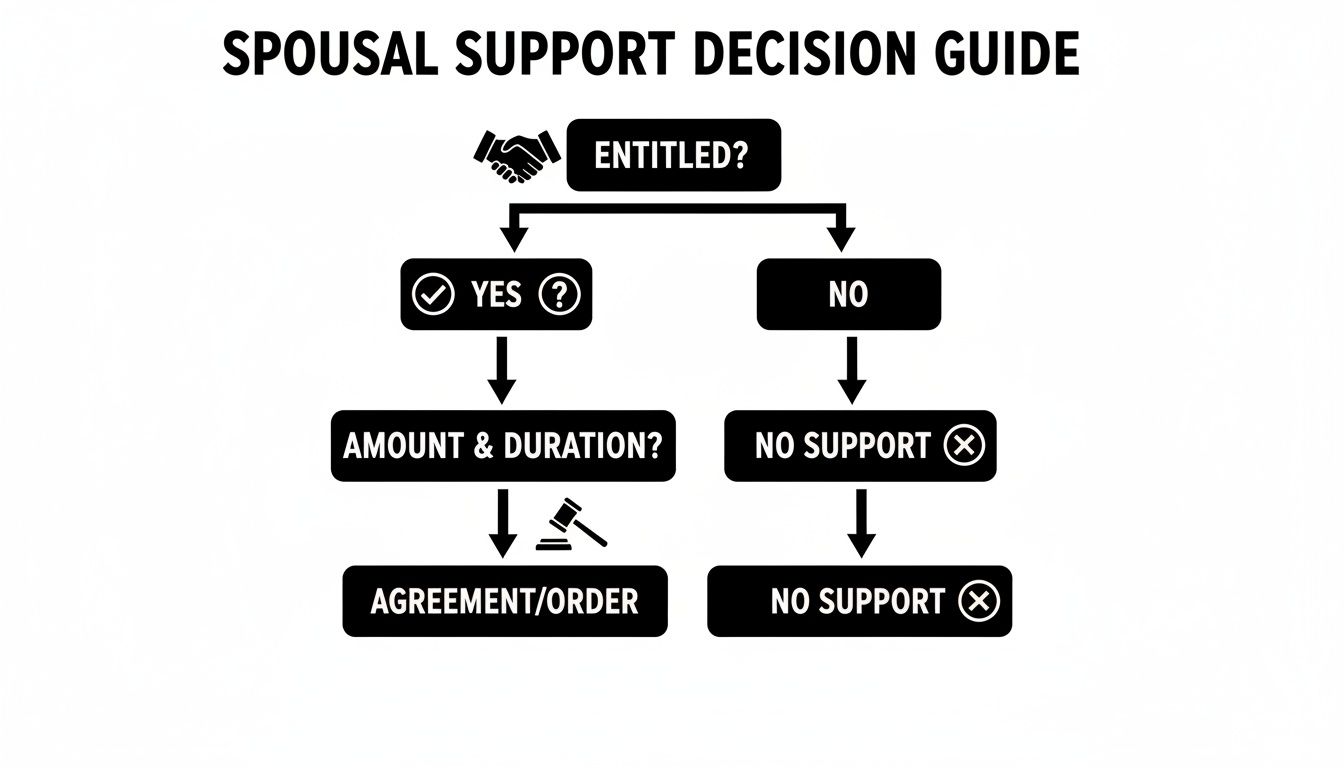
This decision tree gives you a bird’s-eye view of the very first question a court considers in any spousal support claim.

Flowchart guiding spousal support decisions, from initial entitlement questions to final agreement or denial.

As the chart makes clear, if you can’t establish entitlement based on one of the accepted legal grounds, the path leads directly to a denial. No other factors will even be considered.

The Three Paths to Proving Entitlement

Your claim must be grounded in one of three specific legal arguments. Failing to build your case on at least one of these pillars is a primary reason a spousal support claim is denied. Let’s break down these legal grounds.

The Three Grounds for Spousal Support Entitlement in Ontario

Ground for Entitlement Basis of the Claim Common Example Scenario
Compensatory One partner sacrificed career or economic opportunities for the benefit of the family. A spouse leaves their job to raise children for 15 years, allowing the other spouse to build a high-earning career.
Non-Compensatory (Needs-Based) The breakdown of the relationship left one partner in genuine financial need, while the other has the ability to help. After a 20-year marriage, a partner with a chronic illness is unable to work and cannot cover their basic living expenses post-separation.
Contractual A valid legal agreement (like a prenup or separation agreement) outlines the right to spousal support. The couple signed a cohabitation agreement stating that if they separate after 10 years, one partner will pay the other a set amount of support.

Successfully arguing your case under one of these categories is absolutely essential. It applies to both married and common-law spouses, though specific rules can differ. You can learn more in our guide on spousal support for common-law partners in Ontario.

Key Insight: A significant income difference, on its own, does not automatically create an entitlement to spousal support. You must connect that disparity directly to the roles you both took on during the relationship or show that it has created a genuine inability for you to meet your basic needs.

For those looking to explore different scenarios, tools like the supportGPT application can offer valuable insights.

Denial Reason One: Short-Term Relationships Without Dependency

Two wedding rings, one with diamonds, next to a small desk calendar displaying "3 years" on a white table.

One of the most straightforward reasons spousal support gets denied is the length of the relationship. When a marriage or common-law partnership is brief, the legal system assumes you haven’t created the kind of deep economic link that requires one person to support the other long-term.

A 20-year marriage is like a complete business merger where finances and careers become tangled. A short-term relationship, however, is more like a temporary joint venture. The court’s goal isn’t to create a lasting financial tie but to help each person return to their pre-relationship financial footing as quickly as possible.

The Five-Year Guideline and Common Mistakes

While there’s no magic number, relationships under five years—especially without children—are almost always seen as short-term by Ontario courts. The shorter the union, the weaker the argument for support.

A judge will look for hard evidence of economic integration. Did one of you give up a career? Did you buy a house together? In a two or three-year relationship, the answer is usually “no.” Without that dependency, a judge will likely decide there’s no entitlement.

A common mistake is waiting too long after separation to file a claim. If you wait months or even years, you send a signal that you were managing on your own, undermining any argument of need. This delay can be a fatal flaw in your case.

A Word of Caution: The passage of time weakens a spousal support claim. A court may view a delayed application as proof that you were self-sufficient and that any current financial hardship is unrelated to the marriage.

To get a better handle on how roles can be defined even while living together, it’s worth reviewing the details of cohabitation agreements in Ontario.

Denial Reason Two: The Expectation Of Self-Sufficiency

A person types on a laptop displaying 'Employment Opportunities', with documents and coffee on the desk.

In Ontario family law, spousal support is a transitional bridge, not a permanent destination. A core principle is the expectation that both people will make a real effort to become financially independent. A claim can be dead in the water if the person asking for money is already self-sufficient or hasn’t taken meaningful steps to get there.

The Duty to Become Self-Sufficient

The law is straightforward: every adult has a duty to support themselves to the best of their ability. While a court will recognize genuine barriers like illness or age, it will still look for evidence of effort.

To build a stronger case, you must demonstrate proactive steps:

  • Actively searching for a job: Keep detailed records of applications and interviews.
  • Going back to school or retraining: Enrolling in courses that boost your job prospects is powerful evidence.
  • Updating your skills: Taking online courses shows a serious commitment to re-entering the workforce.

The Concept Of Imputed Income

What happens if someone can work but chooses not to? This is where imputed income comes into play. The court assigns a potential income to a person who is voluntarily unemployed or underemployed. It calculates support based on what you should be earning, not your actual low income.

A judge may impute income if they believe a party is intentionally depressing their earnings to either increase the support they receive or decrease the support they have to pay. It is a tool used to ensure fairness.

For example, a former accountant who takes a part-time retail job after separation could have an accountant’s salary imputed to them. This action could drastically reduce or eliminate a spousal support award. While our guide on using a spousal support calculator in Ontario can give you a baseline, imputed income can change the numbers dramatically.

Other Reasons a Judge Might Deny Spousal Support

Beyond relationship length or self-sufficiency, a few other common-sense reasons can stop a claim. These roadblocks are based on fairness and evidence.

The Power of a Valid Domestic Contract

One of the cleanest ways to settle the issue is with a domestic contract. Agreements like a prenuptial agreement or a separation agreement carry significant weight. If you both signed a contract with independent legal advice that clearly waives the right to spousal support, a court will almost always honour it.

For the waiver to be ironclad, it must be done right. A judge will ensure:

  • There was full and honest financial disclosure from both parties.
  • Each person received independent legal advice.
  • The agreement was signed voluntarily, without pressure or coercion.

The Misunderstood Role of Misconduct

Many people assume bad behaviour, like cheating, will be punished by the court. In reality, that’s almost never the case.

Under Canada’s Divorce Act, marital misconduct is not a factor in determining spousal support. The court’s job is to deal with the financial fallout of the breakup, not to play moral referee.

The only time bad behaviour might matter is if it directly wrecked the family’s finances, such as a gambling addiction. The act of infidelity itself has zero impact on a spousal support claim.

No Real Income Gap or Hiding Financials

Finally, there are two practical, money-related reasons a judge will deny support. First, if both partners earn similar incomes and can maintain a comparable standard of living, there’s no financial gap to fill.

Second, the system is built on financial transparency. You have a legal duty to provide complete and honest disclosure (tax returns, pay stubs, etc.). Refusing to provide these documents can lead a judge to draw an adverse inference, assuming the information would not help your case and potentially denying your claim outright.

Serving Brampton and the GTA

While the rules are the same across Ontario, navigating the courthouses of Brampton, Mississauga, and the Greater Toronto Area requires local expertise. A local family lawyer understands the nuances of the Peel Region courts and how a particular judge might view your case.

When you’re preparing for a spousal support case in Brampton, one of the first practical steps is understanding the financial commitment involved. That includes getting a clear picture of typical lawyer consultation fees so you can budget for the road ahead. If you need clear, direct advice on your specific situation near you, our team can help.

Related Reading

Frequently Asked Questions

Can my spousal support claim be denied if I live with a new partner?

Yes, this is a common reason for denial. Moving in with a new partner is seen as a major financial change. The court assumes your new partner contributes to household expenses, which reduces or eliminates your need for support from an ex-spouse and directly undermines a needs-based claim.

Does misconduct like adultery automatically disqualify me from support?

No. Canada’s Divorce Act is clear that marital misconduct is irrelevant to spousal support entitlement. A court’s job is to address the financial consequences of the separation, not to assign blame. The only exception is if the behaviour directly harmed the family’s finances.

What happens if my ex-spouse and I earn similar incomes?

If your incomes are close, a spousal support claim is very likely to be denied. Support is intended to correct a significant economic imbalance created by the relationship. When no such financial gap exists, a court will almost always conclude that both parties are self-sufficient and no support is required.

Is spousal support denied if there are no children from the marriage?

Not automatically, but it makes denial more likely, especially in shorter marriages. Without children, it is harder to make a compensatory claim (arguing you sacrificed your career for the family). However, a needs-based claim might still be valid in a long-term marriage due to age or health.

What if I signed a prenup waiving spousal support?

A valid prenuptial or separation agreement that waives spousal support is a powerful document. As long as it was signed with full financial disclosure and independent legal advice for both parties, a court will almost certainly uphold it and deny any subsequent claim for support.

How long do you have to be married to get spousal support in Ontario?

There is no “minimum” time, but duration is a critical factor. For marriages under five years without children, spousal support is often denied. For longer marriages, especially over 20 years, some form of support is much more likely if there is a valid entitlement claim.


Disclaimer: This article is for informational purposes only and does not constitute legal advice. Please consult with a qualified family lawyer to discuss your specific situation.

Written by the legal team at Badesha Law, dedicated to providing expert family law guidance in the GTA.

Why Choose Badesha Law?

Navigating the complexities of when spousal support is denied requires clear, experienced legal guidance. At Badesha Law, we provide the precise representation you need to protect your financial future in Brampton and the surrounding areas. Our deep understanding of local court practices gives you a distinct advantage.

A Practical Guide to Cohabitation Agreements in Ontario

A cohabitation agreement in Ontario is a legal contract for unmarried couples that outlines how you’ll handle assets, debts, and support if the relationship ever ends. It’s a smart, proactive step for Brampton couples that provides clarity and protection where the Family Law Act doesn't automatically grant property rights, unlike for married spouses.

Why a Cohabitation Agreement Is a Smart Move for Brampton Couples

A cartoon couple holds a cohabitation agreement document with a house plan in a city.

As more couples in Brampton and the Greater Toronto Area build their lives together without getting married, many find themselves in a legal grey area without even realizing it. A common—and costly—mistake is believing that "common-law" status automatically provides the same property rights as marriage. Under Ontario's Family Law Act, this is simply not true.

Think of a cohabitation agreement not as a sign of distrust, but as a practical blueprint for your financial future. It functions like a business partnership agreement, creating certainty and preventing expensive, emotionally draining disputes down the road. It’s about laying a strong foundation by agreeing on the rules ahead of time, while things are good, so you and your partner can focus on your life together.

The Growing Need for Clarity in Brampton

Living together without marriage is a fast-growing trend. Between 1981 and 2021, the number of common‑law couples in Canada surged by an incredible 447%. In major GTA centres like Brampton and Mississauga, over 18% of couples are choosing cohabitation, reflecting a major lifestyle shift.

As more couples enter these relationships unaware that their legal rights differ dramatically from married spouses, the need for a clear agreement has never been greater. For clients in Brampton, this is an actionable step to protect your assets. You can discover more insights about common-law couples in Ontario and the unique legal landscape they face.

A cohabitation agreement transforms ambiguity into certainty. It allows you and your partner—not a court—to decide what is fair regarding your finances and property if your paths diverge in the future.

This guide is your roadmap to understanding your rights. A well-drafted agreement offers essential protection, particularly in a high-asset region like Brampton, by ensuring fairness and predictability. It’s a tool for empowerment, helping you and your partner build a future with confidence and mutual understanding.

How Ontario Law Treats Married vs Common-Law Property

Here's the single most important thing for Brampton clients to understand: when it comes to property, Ontario's Family Law Act treats married and common-law couples in vastly different ways. This isn't a minor detail—it's the core reason why cohabitation agreements in Ontario are an essential tool for protecting yourself financially.

For married couples, Ontario's Family Law Act lays out a clear process called equalization. This recognizes marriage as an equal economic partnership. When a marriage ends, the value of most assets built up during that time is tallied and split right down the middle, 50/50. It doesn't matter whose name is on the title.

Common-law partners get no such automatic protection. None at all.

The Common-Law Property Trap

For unmarried couples, the law operates on a much harsher principle: what's in your name is yours. Period.

There is no automatic right to share in the value of your partner's property, no matter how long you've lived together or how much you contributed to the household. This catches countless people by surprise, often with devastating financial consequences.

A striking feature of Ontario family law is that common‑law partners do not benefit from the matrimonial property “equalization” regime, no matter how long they live together. Unlike married spouses, common‑law partners in Ontario do not automatically share in the growth of each other’s net worth.

This creates deeply unfair situations that we see all the time in our Brampton practice. For a clearer picture, you can learn more about how Ontario law treats common-law relationships and the financial risks involved.

Here are a couple of classic scenarios we see with couples in Brampton:

  • Scenario 1: The Pre-Owned Home. You move into the Brampton house your partner owned before you met. For 15 years, you help with the mortgage, pay for a new kitchen, and cover the bills. If you split up, you have no automatic claim to a single dollar of that home's value or the equity you helped build. Legally, it’s still 100% your partner’s.

  • Scenario 2: The Jointly Paid Asset. You and your partner buy an investment condo in Mississauga, but it's put in your partner’s name to get a better mortgage rate. You both chipped in for the down payment and split the costs every month. If the relationship ends, your partner is the sole legal owner. You’d be left with nothing without a fight.

The Costly and Uncertain Alternative

Without a cohabitation agreement, your only way to claim a share of property is to sue your ex-partner for what’s called a trust claim. This means heading to court and trying to prove that your contributions—whether money or work—made your partner wealthier while leaving you at a financial disadvantage.

A trust claim is a complex, expensive, and emotionally draining legal battle with no guaranteed outcome. You’re asking a judge to create a financial remedy where the Family Law Act doesn't provide one automatically. This process can drag on for years and rack up tens of thousands of dollars in legal fees.

A cohabitation agreement is the most predictable and peaceful way to ensure fairness. It lets you and your partner set your own rules for property, choosing certainty over a potential court battle.

To see these differences side-by-side, take a look at this table. It breaks down the default legal positions for married versus common-law partners in Ontario if you don't have an agreement in place.

Property and Support Rights Married vs Common-Law Partners

Legal Right or Obligation Married Spouses (Family Law Act) Common-Law Partners (Default Law)
Property Division Automatic right to equalize the value of property acquired during the marriage. Each spouse is generally entitled to 50% of the growth in net worth. No automatic right to property division. Each partner keeps what is in their own name.
Matrimonial Home Both spouses have equal rights to possess the matrimonial home, regardless of whose name is on the title. It receives special protection. No "matrimonial home" concept. The person whose name is on the title has the right to the home. The other partner may be forced to leave.
Spousal Support Entitled to claim spousal support based on the roles and contributions during the marriage. Entitled to claim spousal support if they meet the definition of "spouse" (cohabited for 3+ years or have a child together).
Inheritance (No Will) The surviving spouse automatically inherits a significant portion or all of the deceased spouse's estate under intestacy laws. No automatic inheritance rights. The surviving partner gets nothing unless specifically named in a will.

As you can see, the legal safety nets available to married spouses simply don’t exist for common-law couples. An agreement allows you to build those protections yourselves, on your own terms.

Understanding Spousal Support and Legal Timelines

When it comes to common-law relationships, the rules around spousal support are a huge source of confusion—and risk. While the property division rules are completely different from those for married couples, many people in Brampton wrongly assume that if they aren't married, no financial support obligations can ever arise after a breakup. This is a dangerous myth.

The reality is, Ontario’s Family Law Act absolutely allows a common-law partner to claim spousal support. This is a critical point for clients to understand. Unlike property rights, which aren't automatic, support obligations can be triggered simply by the length and nature of your relationship. A cohabitation agreement is your only real tool to get ahead of this possibility.

The Timelines That Trigger Support Obligations

The Family Law Act is very clear about the thresholds that can define you as a "spouse" for support purposes, even if you never married. Knowing these timelines is essential for any cohabiting couple in Ontario.

A potential claim for spousal support can arise if you meet either of these two conditions:

  • The Three-Year Rule: You have lived together in a conjugal (marriage-like) relationship continuously for at least three years.
  • The Parent Rule: You are in a "relationship of some permanence" and have a child together, whether by birth or adoption.

If your relationship ticks either of these boxes, a judge can order one partner to pay spousal support to the other if you separate. How much and for how long depends on things like income differences, the roles each person played in the relationship, and whether one partner was left at an economic disadvantage.

For example, think of a Brampton couple where one partner steps back from their career to raise a child. Even if they were together for less than three years, that partner could be entitled to support after a split because their earning ability was hurt for the good of the family.

Gaining Certainty and Control with an Agreement

These legal timelines create a potential financial obligation that catches many couples completely off guard. A well-drafted cohabitation agreement lets you address or even completely waive these obligations, giving you financial predictability. To get a better handle on your situation, learn more about how cohabitation is legally defined in Ontario.

A cohabitation agreement allows you to write your own rules for spousal support. You get to decide what’s fair for your specific circumstances, rather than leaving that decision to a judge years down the road.

This is especially vital in Brampton, where incomes between partners can be worlds apart. An agreement lets you set out crystal-clear terms, such as:

  • A full waiver of support: Both partners agree that no spousal support will be paid by either person, no matter how long they live together.
  • Lump-sum payment: Instead of ongoing monthly payments, a specific, one-time amount is agreed upon.
  • Time-limited support: Support will only be paid for a set period (like one year) to help the lower-income partner get back on their feet.

Without an agreement, you’re stuck with the default rules of the Family Law Act. By creating one, you and your partner take control, ensuring any potential separation is handled on your own terms.

What Every Ontario Cohabitation Agreement Should Cover

Okay, let's move from the "what if" to the "what's in it." A cohabitation agreement is your relationship's financial rulebook. It's a document you and your partner build to set clear expectations for your assets, debts, and future responsibilities. While no two couples are the same, every solid, protective agreement drafted for a Brampton client should have a few core components locked down.

Think of these clauses as the essential pillars holding up the entire structure. If one is weak or missing, the whole agreement could be challenged down the road if you ever need to rely on it.

Defining Property Ownership and Division

This is the most important part of any cohabitation agreement. Since Ontario's Family Law Act doesn't automatically split property for common-law couples, this section is where you create your own fair rules. It must clearly state who owns what coming into the relationship and what happens to property you buy together if you separate.

Specificity is key. It’s not enough to say, "we'll split the house." A properly drafted agreement gets into the details:

  • Existing Assets: List the significant assets each of you is bringing to the table (like RRSPs, cars, or investment accounts) and confirm they will always remain your separate property.
  • The Home: For most Brampton couples, the home is the biggest asset. If one person already owns it, will the other get a share of the equity for helping with the mortgage or renovations? If you buy a home together, how will you divide the proceeds if you sell it—a straight 50/50 split, or based on who contributed to the down payment?
  • Future Assets: Lay out the plan for assets you acquire as a couple, such as joint savings accounts or new investments.

For example, say you move into your partner's condo in Brampton. The agreement can state that your partner keeps the condo's original value, but you’ll share 50% of the increase in its value from the day you moved in. This acknowledges your contributions to the mortgage and upkeep.

Clarifying Responsibility for Debts

Just like assets, debts are treated separately under Ontario law for common-law couples. You are only responsible for debts in your name. But couples often take on joint debt—think lines of credit, shared credit cards, or car loans.

This clause is your protection against being saddled with your partner's debt. It should clearly state:

  • Which debts belong to each individual and which ones are shared.
  • How any joint debts will be paid off if you separate.
  • A confirmation that neither of you is responsible for the other’s pre-relationship or secret debts.

Setting Out Terms for Spousal Support

As we’ve covered, spousal support can be an obligation for common-law couples in Ontario. Your agreement is your chance to decide on this issue for yourselves instead of leaving it to a judge.

An agreement gives you total control over spousal support. You can set clear limits, define specific terms, or waive it entirely, giving both of you complete financial certainty for the future.

You could agree to a full waiver, where both of you give up any right to seek support from the other. Or, you could set specific terms, like a one-time lump-sum payment or monthly support for a fixed amount of time. To ensure your cohabitation agreement is comprehensive, legally sound, and addresses all necessary considerations, an AI Legal Contract Analyzer can provide invaluable insights and identify potential gaps.

Addressing Estate Rights and Inheritance

This is a critical section many people overlook. If you pass away without a will, Ontario's intestacy laws do not automatically give your common-law partner any right to your estate. Your assets would likely go to your next of kin (like your parents or siblings), leaving your partner with nothing.

While a cohabitation agreement isn't a substitute for a will, it can include a clause where you both agree to give up your rights to make a dependant’s support claim against the other’s estate. More importantly, it can state that each of you promises to create a will that provides for the other in a specific way. This simple step ensures your final wishes are honoured and your partner is taken care of.

How to Create a Legally Binding Agreement

A cohabitation agreement is a powerful legal tool. But for it to protect you, it needs to be created correctly. Under Ontario's Family Law Act, there are specific steps you must follow to make sure the agreement is legally enforceable and can hold up if ever challenged in court. This process is about creating fairness, transparency, and crystal-clear understanding for both partners.

For cohabitation agreements in Ontario, the foundation is built on total honesty and proper legal procedure.

Step 1: Start with an Open Conversation

Before any lawyers get involved, the very first step is for you and your partner to sit down and have an honest, calm conversation about your goals and concerns. What assets are you each bringing into the relationship? What about debts? How do you picture handling finances as a couple? This initial chat sets the stage for a much smoother process.

Step 2: Complete Full and Honest Financial Disclosure

This is the most critical, non-negotiable step. For a cohabitation agreement to be valid, both partners must provide a complete and truthful picture of their finances. This means listing all your assets (property, investments, savings), debts (loans, credit card balances), and income.

Hiding an asset or downplaying your income can invalidate the entire agreement later on. A judge can set aside an agreement if they discover that one partner wasn't fully honest, because it means the other person couldn't have made a truly informed decision.

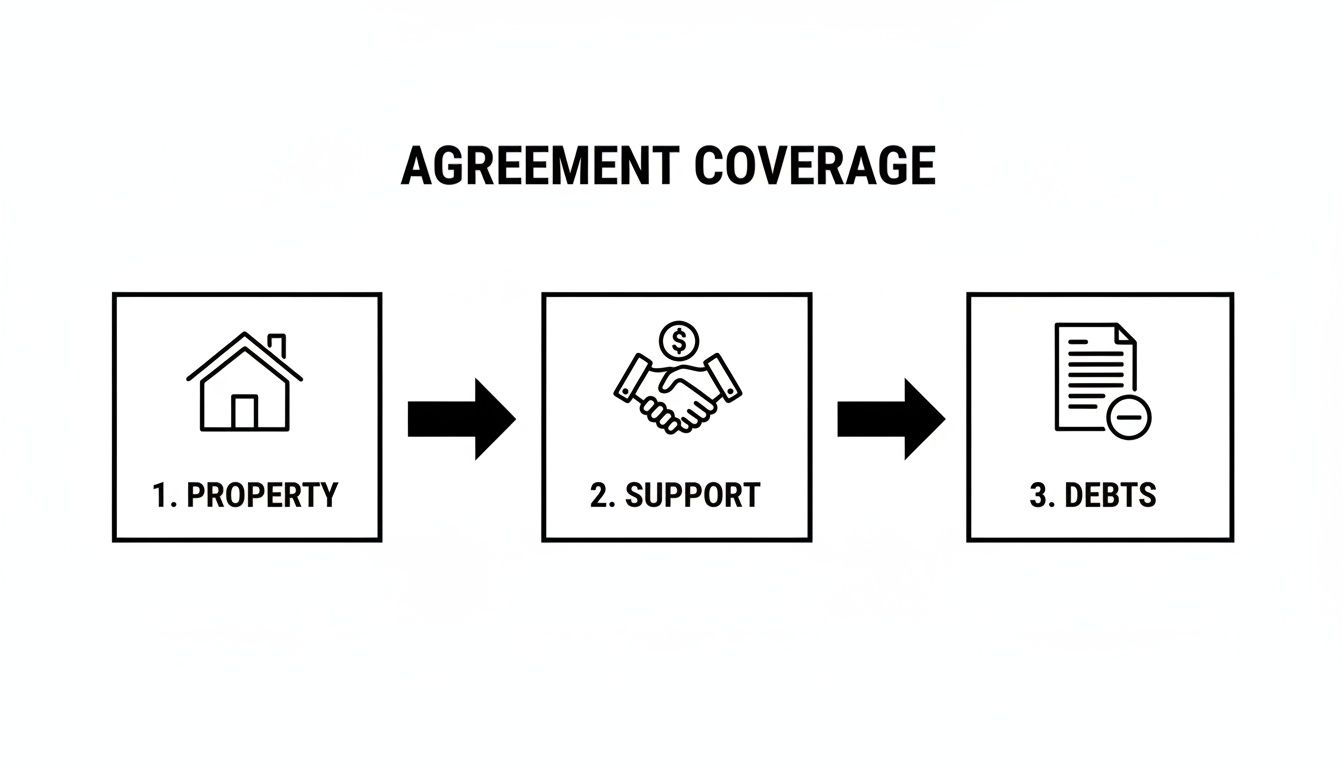
This flowchart shows the key areas a typical agreement will cover—all of which depend on honest disclosure.

Flowchart illustrating agreement coverage, detailing property, support, and debts with corresponding icons.

The way property, support, and debts are all connected shows just how intertwined your financial lives can become, reinforcing why full disclosure is the bedrock of a fair outcome.

Step 3: Get Independent Legal Advice

Here’s another mandatory requirement: each partner must get advice from their own, separate lawyer. One lawyer cannot represent both of you, as it would be a clear conflict of interest. Your lawyer’s job is to explain your rights under the Family Law Act, go through the proposed agreement with you, and make sure you understand exactly what you are signing and what rights you might be giving up.

Independent Legal Advice (ILA) is the legal system's built-in safeguard. It proves that both partners signed the agreement with their eyes wide open, free from any pressure or misunderstanding, which makes the contract that much stronger.

Step 4: Draft and Finalize the Agreement

Once disclosure is complete and you’ve both spoken with your lawyers, one of the lawyers will draft the initial agreement based on your discussions. This draft is then sent to the other lawyer for review, who may suggest changes or additions. This back-and-forth negotiation continues until both you and your lawyers are satisfied with the final terms.

Step 5: Properly Sign and Witness the Document

The last step is signing the agreement, and it has to be done correctly for it to be legally binding. Your signature, and your partner's, must be witnessed by another person. Your lawyers will typically act as the witnesses for you.

To ensure your cohabitation agreement is legally sound, understanding modern signing methods is also helpful. You can learn more about how to electronically sign documents for a convenient and secure option. Following these steps ensures your agreement will work as the reliable shield it’s meant to be.

Common Mistakes That Can Invalidate Your Agreement

Putting together a cohabitation agreement is a huge step toward financial clarity. But a few critical missteps can render your agreement totally useless, turning that shield you built into a worthless document right when you need it most. Knowing these common pitfalls is the only way to ensure your agreement will actually stand up in an Ontario court.

If your agreement isn't enforceable, you're right back where you started—facing the default rules of the Family Law Act and a likely court battle. For couples in Brampton, where property values are soaring, a voided agreement can be financially devastating.

The Pitfall of Incomplete Financial Disclosure

This is, without a doubt, the number one reason judges throw cohabitation agreements out. The entire point of a fair agreement is transparency. Both you and your partner must provide a full, honest, and detailed picture of your finances. We’re talking every asset, every debt, and every source of income.

Trying to hide a secret investment account or downplaying the value of your business is a fatal mistake. If a court finds out that one partner wasn't completely truthful, it can invalidate the entire contract.

Under Ontario's Family Law Act, a court has the power to set aside an agreement if a party failed to disclose significant assets or debts. Honesty isn’t just good practice; it's a legal requirement.

Signing Under Duress or Pressure

For an agreement to be legally sound, both partners have to sign it freely and voluntarily. Duress is a legal term for being pressured, threatened, or otherwise forced into signing something. An Ontario court will not uphold a contract that wasn't entered into willingly by both sides.

A classic example of a high-pressure situation is being handed the agreement just days before you’re set to close on a new house in Brampton.

  • Cautionary Scenario: Imagine your partner says, "You need to sign this by tomorrow, or we’re going to lose the house we've been dreaming of." This creates a massive power imbalance and could easily be seen as duress, putting the entire agreement at risk.

The timing of the signing matters. It should be a calm, considered process, not a last-minute ultimatum tied to a major life event.

Relying on Generic Online Templates

Downloading a cheap template from the internet is one of the riskiest shortcuts you can take. These one-size-fits-all documents are not tailored to Ontario's Family Law Act and can’t account for the unique details of your financial situation. They almost always lack the specific clauses and legal language needed to be enforceable here.

Using a generic template without having an Ontario family lawyer review it is like trying to perform surgery with a plastic knife—it’s the completely wrong tool for the job, and it will almost certainly end in disaster.

Including Unfair or Illegal Terms

Finally, an agreement can be set aside if its terms are fundamentally unfair or if they break Canadian law. While you have a lot of freedom to set your own rules, there are limits. For example, you cannot include clauses that try to pre-determine child custody or waive child support. Those rights belong to the child, not the parents, and are always unenforceable. Likewise, any term that violates the Criminal Code of Canada would obviously be void.

Trying to cut corners on legal advice to save money now often means paying far more in legal fees and financial losses down the road. Getting professional guidance from the start is the only way to ensure your agreement truly protects you.

Frequently Asked Questions About Cohabitation Agreements

Diving into the world of cohabitation agreements naturally brings up a few questions. Below, I’ve answered the most common ones we hear from couples across Brampton and the GTA, giving you the clear, straightforward information you need to move forward.

How Much Does a Cohabitation Agreement Cost in Brampton?

The cost of drafting a cohabitation agreement really depends on how complex your financial picture is. A couple with straightforward assets will pay less than partners who own businesses, have diverse investment portfolios, or need to negotiate more complicated terms.

It’s helpful to think of this not as an expense, but as an investment in your financial future. A professionally drafted agreement is your shield against the potentially massive legal fees and financial headaches that can come with a messy separation down the road. The best way to know for sure is to book a consultation, where we can give you a clear estimate based on your specific situation.

Can We Change Our Cohabitation Agreement Later?

Absolutely. A cohabitation agreement is a living document, not something set in stone. If you and your partner both agree, you can amend or even cancel the agreement entirely.

Life changes, and your agreement should be able to change with it. Just remember, any updates must follow the same legal rules as the original document to be valid:

  • The changes must be in writing.
  • Both of you must sign the new document.
  • Each signature needs to be properly witnessed.

It’s a smart move to pull out your agreement and review it after any major life event—like having a child, getting a big inheritance, or a significant change in either of your incomes—to make sure it still makes sense for you.

What Happens if We Get Married After Signing an Agreement?

Under Ontario's Family Law Act, if you get married, your cohabitation agreement automatically becomes a marriage contract (what many people call a prenup). The terms you already agreed to will generally stay in place and remain enforceable.

However, marriage brings a new set of legal rights and obligations that don't apply to common-law partners, especially when it comes to the matrimonial home. Because of this, it is highly recommended that you review and update your agreement before you get married. This step ensures it addresses these new legal realities and aligns with your intentions as a married couple.

Do We Need a Lawyer if We Agree on Everything?

Yes, this one is non-negotiable. For a cohabitation agreement in Ontario to hold up in court, both partners must have received independent legal advice (ILA).

An Ontario court has the power to set aside an agreement if one partner didn't have their own lawyer explain its terms and what they mean. Legal oversight isn’t just a good idea; it’s what makes your agreement legally solid.

Having your own lawyer ensures you fully understand your rights and obligations, confirms all financial information has been shared openly, and verifies that you’re signing the document freely and without pressure. This professional guidance is what gives the agreement its real power to protect you.


At Badesha Law, we offer clear, strategic guidance for couples in Brampton and the GTA looking to build a secure future with a strong cohabitation agreement. We make the process transparent and ensure you feel confident every step of the way. Contact us to schedule a consultation and take control of your financial future today.

Divorce Process In Ontario: For Brampton Residents

Facing a divorce in Brampton can feel overwhelming, but you don’t have to navigate it alone. This is where a Brampton divorce lawyer becomes your essential guide, translating Ontario’s complex Family Law Act into an actionable plan tailored to your needs. They are not just legal advisors; they are strategic partners dedicated to protecting your rights and securing a stable future for you and your family.

Your Guide Through the Brampton Divorce Process

Ending a marriage is a formal legal process with long-term consequences. In Brampton, this process is governed by Ontario’s Family Law Act and Canada’s Divorce Act, which dictate everything from property division to parenting arrangements. Without professional guidance, you risk making critical errors that could impact your financial security and family life for years.

A Brampton divorce lawyer serves as both your advocate and your strategist. Their primary role is to protect your rights at every stage, whether that means negotiating a fair separation agreement or representing you at the Brampton Superior Court of Justice. They provide objective advice, helping you make clear, logical decisions during a highly emotional time.

Why Local Expertise Matters

Hiring a lawyer who is an expert in the Brampton legal landscape provides a distinct advantage. An experienced local lawyer understands the specific procedures and judicial nuances of the A. Grenville and William Davis Courthouse on Hurontario Street. This insider knowledge helps prevent costly delays and procedural mistakes that could otherwise stall your case, ensuring a more efficient process.

This is especially relevant in Brampton, where local data shows that 4.21% of residents are divorced, slightly above the provincial average, indicating a significant local need for skilled legal support. The financial stakes are high: an uncontested divorce might average $1,439, but a contested case can quickly escalate past $23,278. Investing in an experienced Brampton divorce lawyer is a crucial step toward resolving your matter efficiently. You can read more about the local divorce landscape to understand the financial context.

The Core Responsibilities of Your Lawyer

Your Brampton divorce lawyer takes on several key responsibilities to manage the legal complexities and reduce your burden:

  • Protecting Your Legal Rights: Ensuring every step taken is compliant with Ontario’s Family Law Act and Canada’s Divorce Act.
  • Strategic Negotiation: Advocating for your best interests in discussions about property division, spousal support, and parenting arrangements.
  • Managing Documentation: Preparing, filing, and serving all necessary legal documents accurately and on schedule to avoid court delays.
  • Providing Objective Advice: Offering a clear-headed perspective to help you separate emotions from the critical legal decisions you must make for your future.

Ultimately, your lawyer is your partner in building a solid foundation for your new life. They work to ensure the final resolution is fair, legally sound, and supports your long-term well-being.

Mapping Out the Ontario Divorce Timeline

Understanding the divorce process in Ontario can feel daunting, but it follows a structured path with clear milestones. For anyone in Brampton, knowing these steps provides a realistic roadmap of what to expect.

The process begins with the date of separation. This is the legal starting point, marking the day you and your spouse began living “separate and apart,” which can occur even while sharing the same home. Following this date, Canada’s Divorce Act requires a mandatory one-year waiting period before a divorce can be granted, which is the most common grounds for divorce in Ontario.

The Two Paths: Uncontested vs. Contested Divorce

After the one-year separation period, your divorce will proceed down one of two paths, determined by whether you and your spouse can agree on the key issues. This choice will significantly impact the timeline, cost, and emotional stress of the process.

An uncontested divorce, also known as a simple divorce, is the most direct route. This is possible when both parties have resolved all major issues—such as property division, support, and parenting—and have formalized them in a signed separation agreement. The court process then becomes primarily administrative.

A contested divorce occurs when you cannot agree on one or more key issues. This path requires formal legal steps, including case conferences, motions, and potentially a trial at the Brampton courthouse. It is a longer, more expensive, and more stressful process.

The visual below illustrates the three key phases your lawyer will manage to bring your case to a resolution.

Timeline illustrating a lawyer's evolving role: strategize, negotiate, and resolve phases with associated days.

As shown, your lawyer’s role evolves from initial strategy-building to active negotiation and, finally, to a formal resolution, achieved either through settlement or a court order.

To help you understand the practical differences, here is a comparison of the two paths.

Uncontested vs. Contested Divorce in Brampton: A Snapshot

Aspect Uncontested (Simple) Divorce Contested Divorce
Agreement Spouses agree on all major issues (property, support, custody). Spouses disagree on one or more significant issues.
Timeline Typically 4-6 months after filing. Can take over a year, sometimes much longer.
Cost Much lower. The average is around $1,860. Significantly higher. Can easily exceed $20,000.
Process Primarily administrative paperwork filed with the court. Involves multiple steps: negotiations, case conferences, motions, potentially a trial.
Emotional Impact Less stressful and allows for more privacy. High-stress, adversarial, and emotionally draining.

Choosing cooperation is the most effective way to control the cost, timeline, and emotional toll of your divorce.

Key Milestones in the Brampton Divorce Process

Regardless of the path, several legal milestones must be met. A skilled Brampton divorce lawyer will manage each step carefully to prevent delays at the Superior Court of Justice on Hurontario Street.

  1. Filing the Application for Divorce (Form 8A): This document officially starts the court process. Your lawyer drafts and files it, outlining the grounds for divorce and any claims for support or decision-making responsibility for children.
  2. Serving Your Spouse: Your spouse must be formally notified of the divorce application by having the court documents “served” to them. This step must comply with Ontario’s Family Law Rules to be legally valid.
  3. Receiving the Final Divorce Order: After a judge reviews and approves all documents, a Divorce Order is issued. This is the legal document that officially dissolves your marriage, becoming final 31 days after the judge signs it.

The choice between an uncontested and contested divorce has profound financial and emotional implications. Cooperation is the single most effective tool for controlling costs and reducing stress during this challenging time.

For couples who can find common ground, the benefits are significant. A simple divorce in Brampton is a faster, more affordable path, usually concluding in 4 to 6 months after filing. This stands in stark contrast to contested divorces, which can last over a year and see costs escalate beyond $20,000, compared to the $1,860 average for uncontested cases. This financial reality provides a powerful incentive to seek an amicable resolution.

You can learn more about the benefits of a simple divorce in Brampton and how it streamlines the process.

Handling Key Family Law Issues with Confidence

A divorce is more than just a legal document; it is the process of untangling two intertwined lives to build a stable new beginning. The real work lies in resolving the core issues that arise when a family separates. In Brampton, these matters are governed by Ontario’s Family Law Act and Canada’s Divorce Act.

An experienced Brampton divorce lawyer is your guide through these four critical areas, ensuring your rights are protected and the final agreement is fair and sustainable.

Child Custody and Parenting Time

When children are involved, their well-being is the court’s paramount concern. The law has shifted from terms like “custody” and “access” to decision-making responsibility and parenting time, reflecting a focus on the best interests of the child.

Decision-making responsibility covers significant choices in a child’s life:

  • Health: Decisions about doctors, treatments, and medical care.
  • Education: Choosing schools and educational paths.
  • Religion: Guiding their religious or spiritual upbringing.
  • Major extracurriculars: Approving significant commitments like competitive sports.

This responsibility can be shared jointly or assigned to one parent. Parenting time refers to the schedule outlining when the child is in each parent’s care. A skilled lawyer will help you create a detailed parenting plan that works for your family’s unique situation, whether you live across Brampton or in different parts of Peel Region.

Child Support Obligations

Child support is the legal right of the child. In Canada, the amount is calculated using the federal Child Support Guidelines, making it straightforward in most cases. The system ensures children receive financial support from both parents, reflecting the income that would have been available if the family were intact.

The calculation is based on two main factors:

  1. The paying parent’s gross annual income.
  2. The number of children requiring support.

The guidelines provide specific tables for each province. For instance, a parent in Ontario earning $80,000 annually with two children has a set base support payment. Your lawyer’s role is to ensure accurate income figures are used and to address complexities like shared parenting time or “special expenses” for items like daycare, hockey, or orthodontics.

Spousal Support Entitlement

Spousal support is one of the most complex areas of divorce law and is not an automatic right. Its purpose is to address financial imbalances that arise from the marriage or its breakdown.

Spousal support isn’t about punishing one person or rewarding another. It’s a legal tool designed to create economic fairness and help both spouses get back on their feet financially after a separation.

To determine if support is warranted, a lawyer or court will consider several factors:

  • The length of the marriage.
  • The roles each spouse played (e.g., one was a primary caregiver).
  • The income and earning capacity of each person.
  • Any economic hardship resulting from the marriage.

For example, if one spouse paused their career for 15 years to raise children in your Brampton home, they might be entitled to support to help them re-enter the workforce. Your lawyer will use the Spousal Support Advisory Guidelines (SSAGs) to propose a fair amount and duration for any potential payments.

Division of Property and Equalization

Under Ontario’s Family Law Act, marriage is an economic partnership. Upon separation, the wealth accumulated during the marriage is divided equally through a process called equalization.

Each spouse calculates their Net Family Property (NFP), which is the value of all assets on the date of separation, minus debts and the value of assets brought into the marriage (with the exception of the matrimonial home). The spouse with the higher NFP pays the other spouse half the difference.

This ensures both partners share equally in the financial growth of the marriage. Common assets to be divided include:

  • The matrimonial home (e.g., a house in Castlemore or a condo near Bramalea).
  • Pensions and RRSPs.
  • Bank accounts and investments.
  • Vehicles and other valuable property.

The matrimonial home is treated specially and is always included in the calculation, even if owned by one spouse before the marriage. A lawyer is vital to ensure all assets are properly disclosed, valued, and divided according to law, securing your financial future.

Your Client Journey from Consultation to Resolution

Working with a Brampton divorce lawyer is a structured journey designed to move you from uncertainty to a clear and fair resolution. Understanding this path can reduce anxiety and empower you to participate actively in shaping your future.

The process is built on strategy, communication, and, whenever possible, cooperation. While every case is unique, the steps follow a logical progression, with the priority always on finding the most efficient and least adversarial route to a final agreement.

Diagram illustrating the four stages of a legal client journey: consultation, financial disclosure, mediation, and court.

Stage 1 The Initial Consultation

Your journey starts with an initial consultation. This is a strategic session where you explain your situation, and we provide an assessment of your rights and obligations under Ontario’s Family Law Act.

This meeting is a two-way street: you determine if we are the right fit, and we gather the details needed to provide meaningful preliminary advice. Preparation is key to making this session as productive as possible.

The initial consultation is the cornerstone of your entire case. Coming prepared with organized documents and clear questions allows your lawyer to provide meaningful, specific advice from day one, saving you time and money.

To get the most out of our first meeting, use this checklist.

What to Bring to Your Initial Consultation

Being prepared helps us understand your situation quickly and offer the best possible advice from the start.

Document Category Specific Examples
Personal Information Your full name, date of birth, date of marriage, and date of separation. Similar information for your spouse and any children.
Financial Documents Recent pay stubs, income tax returns (last 3 years), bank statements, and credit card statements.
Asset & Debt Information A list of major assets (home, vehicles, investments) and debts (mortgage, loans, lines of credit).
Legal Documents Any existing marriage contracts, cohabitation agreements, or previous court orders.
List of Questions A written list of your most pressing questions about the process, your children, or your finances.

Having these items on hand isn’t mandatory, but it allows us to focus immediately on what matters most to you.

Stage 2 Financial Disclosure

The next critical step is financial disclosure. This is a mandatory stage in every Ontario divorce where each spouse must provide complete and honest documentation of their income, assets, and debts.

This is the foundation of a fair settlement. Without full transparency, it is impossible to correctly calculate support or divide property. Any attempt to hide assets can lead to severe court penalties and will undermine negotiations. We will guide you in completing your Financial Statement (Form 13 or 13.1) accurately.

Stage 3 Negotiation and Mediation

With financial disclosure complete, the focus shifts to resolution. The vast majority of Brampton divorce cases are settled out of court through negotiation or mediation, as these methods are faster, cheaper, and less stressful.

Our first approach is typically to negotiate a comprehensive separation agreement with your spouse’s lawyer. This legally binding contract will cover all aspects of your separation, from the parenting schedule to the division of property.

If negotiations stall, mediation is an effective next step. A neutral mediator helps you and your spouse find common ground. Throughout this process, our role is to advise you and ensure any proposed settlement protects your legal rights. These methods keep you in control of the outcome.

Stage 4 The Court Process

Going to court is the last resort, used only when other resolution attempts have failed. Litigation may be necessary if your spouse is unreasonable, uncooperative, or if there are serious issues like domestic violence that fall under Canada’s Criminal Code.

The court process is highly structured, involving steps like case conferences, motions, and a potential trial at the Brampton Superior Court of Justice. This is where our local experience as Brampton divorce lawyers is invaluable, as we navigate the court system and advocate fiercely on your behalf. Even in litigation, our goal remains to resolve matters as efficiently as possible.

Understanding Legal Fees and Retainers

The cost of divorce is a valid and common concern. Understanding how a Brampton divorce lawyer bills for their services is the first step toward managing your finances and avoiding surprises. Transparency is key to a successful financial partnership with your legal team.

Most family law cases in Ontario use an hourly billing model. You are charged for the actual time your lawyer and their team spend working on your file, including drafting documents, corresponding with the other party, and representing you in negotiations or court. This time is tracked meticulously and detailed in monthly invoices.

The Role of the Retainer

To begin work, your Brampton divorce lawyer will require a retainer. This is an upfront payment held in a special trust account, acting as a security deposit for legal services. It is not a flat fee for the entire divorce.

As your lawyer works on your case, their hourly fees are drawn from this trust account. You will receive regular, itemized invoices showing the work performed and the remaining retainer balance.

A retainer is essentially a trust fund for your legal fees. Your lawyer draws from this fund as they perform work on your file, and you are required to replenish it if the balance falls below an agreed-upon amount. This ensures your legal representation can continue without interruption.

This system ensures your lawyer is compensated for their work as it is performed, and you maintain a clear understanding of your legal costs.

Differentiating Between Billing Methods

While hourly billing is standard, especially for complex cases, it’s not the only model.

  • Hourly Rates: This is the most common approach for cases with unpredictable timelines or complexity. You pay for the precise time and expertise your case requires.
  • Flat Fees: These are sometimes offered for straightforward, predictable tasks like an uncontested divorce where a separation agreement is already in place. You pay a single, all-inclusive price for a clearly defined service.
  • Disbursements: These are out-of-pocket expenses your lawyer pays on your behalf to advance your case. They are billed back to you in addition to legal fees and include costs like court filing fees (which can exceed $600 in Ontario), process server fees, and expert reports like property valuations.

Discussing these options during your initial consultation is crucial. A reputable Brampton divorce lawyer will be transparent about their billing practices and help you anticipate potential costs, empowering you to make informed financial decisions.

How to Choose the Right Brampton Divorce Lawyer

Choosing the right legal partner is the most critical decision you will make during your divorce. You need more than just a lawyer; you need an advocate who understands your unique situation and is an expert in the Brampton legal system.

Treat your initial consultations like interviews where you are the employer. To make an informed choice, you must go beyond fees and assess their strategy, experience, and communication style to ensure they are the right fit for you.

Key Questions to Ask During a Consultation

Asking the right questions will reveal a lawyer’s real-world expertise and approach. A good Brampton divorce lawyer will welcome these questions and provide clear, direct answers.

Here are essential questions to ask:

  • Experience with Cases Like Yours: “How much of your practice is dedicated to family law? Have you handled cases with similar issues to mine, like dealing with business assets or a high-conflict custody battle?”
  • Local Brampton Court Experience: “How familiar are you with the judges and the way things work at the Brampton Superior Court of Justice on Hurontario Street?”
  • Negotiation vs. Litigation Philosophy: “What’s your general approach to solving disputes? When do you push for negotiation or mediation, and at what point do you say it’s time to go to court?”
  • Communication and Caseload: “Who will I be dealing with day-to-day? What’s your policy for returning calls and emails, and what does your current caseload look like?”
  • Strategy for Your Case: “Based on what I’ve told you, what do you see as the biggest hurdles in my case, and what would your initial game plan be?”

Choosing a lawyer is a personal decision. Look for someone who not only has the right legal skills but also communicates in a way that gives you confidence and clarity, rather than confusion and anxiety.

Red Flags to Watch For

Knowing what to avoid is as important as knowing what to look for. Certain behaviours are major warning signs that a lawyer may not be the right advocate for you.

Be wary of any lawyer who:

  1. Guarantees a Specific Outcome: The legal system is unpredictable. An ethical lawyer will discuss potential outcomes and strategies but will never guarantee a win.
  2. Lacks Transparency About Fees: If they are vague about their hourly rates, retainer costs, or other potential expenses, it is a significant red flag.
  3. Communicates Poorly: If they are difficult to reach, use excessive legal jargon without explanation, or seem dismissive of your questions, this is a preview of your future working relationship.
  4. Pressures You to Sign: A reputable lawyer will give you time to consider your decision. High-pressure tactics are a clear sign that you should look elsewhere.

By asking the right questions and watching for these red flags, you can confidently choose the best Brampton divorce lawyer to protect your interests and guide you to a fair resolution.

Common Questions About Divorce in Brampton

Going through a divorce brings up countless questions. It is normal to feel uncertain. To provide clarity, here are answers to some of the most common questions we hear from clients in Brampton.

How Long Does a Divorce Take in Brampton?

The timeline for a divorce in Brampton depends almost entirely on cooperation. For an uncontested divorce, where you and your spouse agree on all issues and have a signed separation agreement, the process is relatively quick. You can expect it to take 4 to 6 months from the date of filing at the Brampton courthouse.

A contested divorce, where disagreements exist, is much longer. These cases can easily last for a year or more due to the need for extensive negotiations, multiple court appearances, and procedural delays.

Can We Get Divorced Without Going to Court?

Yes, absolutely. The vast majority of divorces in Brampton are resolved out of court through negotiation, mediation, or collaborative family law. These methods save significant time, money, and emotional stress.

Court should be viewed as a last resort, necessary only when all other attempts at agreement have failed. Your Brampton divorce lawyer’s primary goal will be to achieve a fair settlement that keeps you out of the courtroom and in control of the outcome.

The single biggest factor in keeping your divorce costs down is minimizing conflict. The more you and your spouse can agree on without a judge’s intervention, the lower your legal fees will be.

What Are the Grounds for Divorce in Ontario?

Under Canada’s Divorce Act, there is only one ground for divorce: marriage breakdown. This breakdown can be established in one of three ways:

  1. One-Year Separation: This is the most common ground. You and your spouse must have lived separate and apart for at least one year.
  2. Adultery: You must prove that your spouse has committed adultery.
  3. Cruelty: You must demonstrate that your spouse has treated you with physical or mental cruelty that makes cohabitation intolerable.

Most people proceed on the basis of a one-year separation because it is a no-fault ground. This avoids assigning blame, which helps minimize conflict and allows both parties to move forward more amicably.


When you’re facing the complexities of family law, you need clear guidance and strong advocacy. At Badesha Law, we provide strategic, client-focused support to protect your rights and help you build a stable future. For help with your separation or divorce, contact us today by visiting Badesha Law.