

Divorce Process In Ontario: For Brampton Residents
Facing a divorce in Brampton can feel overwhelming, but you don’t have to navigate it alone. This is where a Brampton divorce lawyer becomes your essential guide, translating Ontario’s complex Family Law Act into an actionable plan tailored to your needs. They are not just legal advisors; they are strategic partners dedicated to protecting your rights and securing a stable future for you and your family.
Your Guide Through the Brampton Divorce Process
Ending a marriage is a formal legal process with long-term consequences. In Brampton, this process is governed by Ontario’s Family Law Act and Canada’s Divorce Act, which dictate everything from property division to parenting arrangements. Without professional guidance, you risk making critical errors that could impact your financial security and family life for years.
A Brampton divorce lawyer serves as both your advocate and your strategist. Their primary role is to protect your rights at every stage, whether that means negotiating a fair separation agreement or representing you at the Brampton Superior Court of Justice. They provide objective advice, helping you make clear, logical decisions during a highly emotional time.
Why Local Expertise Matters
Hiring a lawyer who is an expert in the Brampton legal landscape provides a distinct advantage. An experienced local lawyer understands the specific procedures and judicial nuances of the A. Grenville and William Davis Courthouse on Hurontario Street. This insider knowledge helps prevent costly delays and procedural mistakes that could otherwise stall your case, ensuring a more efficient process.
This is especially relevant in Brampton, where local data shows that 4.21% of residents are divorced, slightly above the provincial average, indicating a significant local need for skilled legal support. The financial stakes are high: an uncontested divorce might average $1,439, but a contested case can quickly escalate past $23,278. Investing in an experienced Brampton divorce lawyer is a crucial step toward resolving your matter efficiently. You can read more about the local divorce landscape to understand the financial context.
The Core Responsibilities of Your Lawyer
Your Brampton divorce lawyer takes on several key responsibilities to manage the legal complexities and reduce your burden:
- Protecting Your Legal Rights: Ensuring every step taken is compliant with Ontario’s Family Law Act and Canada’s Divorce Act.
- Strategic Negotiation: Advocating for your best interests in discussions about property division, spousal support, and parenting arrangements.
- Managing Documentation: Preparing, filing, and serving all necessary legal documents accurately and on schedule to avoid court delays.
- Providing Objective Advice: Offering a clear-headed perspective to help you separate emotions from the critical legal decisions you must make for your future.
Ultimately, your lawyer is your partner in building a solid foundation for your new life. They work to ensure the final resolution is fair, legally sound, and supports your long-term well-being.
Mapping Out the Ontario Divorce Timeline
Understanding the divorce process in Ontario can feel daunting, but it follows a structured path with clear milestones. For anyone in Brampton, knowing these steps provides a realistic roadmap of what to expect.
The process begins with the date of separation. This is the legal starting point, marking the day you and your spouse began living “separate and apart,” which can occur even while sharing the same home. Following this date, Canada’s Divorce Act requires a mandatory one-year waiting period before a divorce can be granted, which is the most common grounds for divorce in Ontario.
The Two Paths: Uncontested vs. Contested Divorce
After the one-year separation period, your divorce will proceed down one of two paths, determined by whether you and your spouse can agree on the key issues. This choice will significantly impact the timeline, cost, and emotional stress of the process.
An uncontested divorce, also known as a simple divorce, is the most direct route. This is possible when both parties have resolved all major issues—such as property division, support, and parenting—and have formalized them in a signed separation agreement. The court process then becomes primarily administrative.
A contested divorce occurs when you cannot agree on one or more key issues. This path requires formal legal steps, including case conferences, motions, and potentially a trial at the Brampton courthouse. It is a longer, more expensive, and more stressful process.
The visual below illustrates the three key phases your lawyer will manage to bring your case to a resolution.
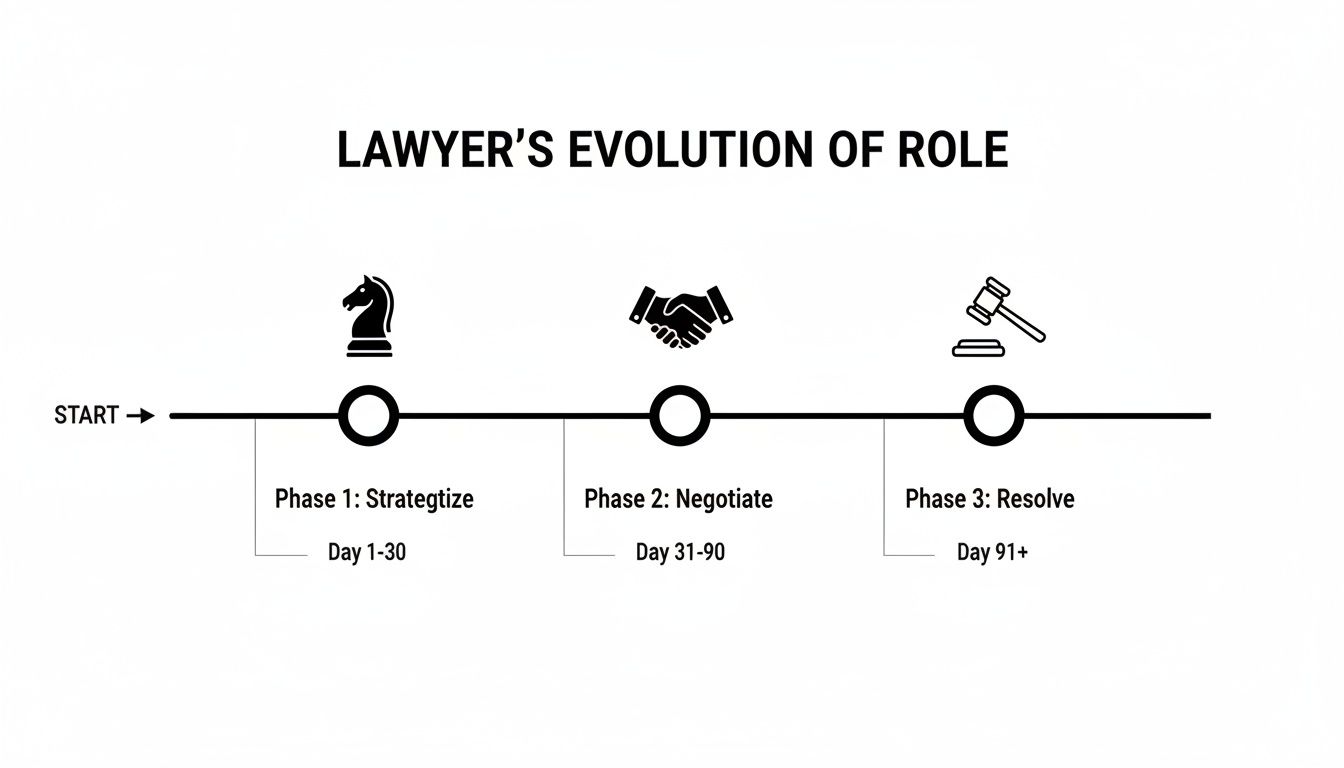
As shown, your lawyer’s role evolves from initial strategy-building to active negotiation and, finally, to a formal resolution, achieved either through settlement or a court order.
To help you understand the practical differences, here is a comparison of the two paths.
Uncontested vs. Contested Divorce in Brampton: A Snapshot
| Aspect | Uncontested (Simple) Divorce | Contested Divorce |
|---|---|---|
| Agreement | Spouses agree on all major issues (property, support, custody). | Spouses disagree on one or more significant issues. |
| Timeline | Typically 4-6 months after filing. | Can take over a year, sometimes much longer. |
| Cost | Much lower. The average is around $1,860. | Significantly higher. Can easily exceed $20,000. |
| Process | Primarily administrative paperwork filed with the court. | Involves multiple steps: negotiations, case conferences, motions, potentially a trial. |
| Emotional Impact | Less stressful and allows for more privacy. | High-stress, adversarial, and emotionally draining. |
Choosing cooperation is the most effective way to control the cost, timeline, and emotional toll of your divorce.
Key Milestones in the Brampton Divorce Process
Regardless of the path, several legal milestones must be met. A skilled Brampton divorce lawyer will manage each step carefully to prevent delays at the Superior Court of Justice on Hurontario Street.
- Filing the Application for Divorce (Form 8A): This document officially starts the court process. Your lawyer drafts and files it, outlining the grounds for divorce and any claims for support or decision-making responsibility for children.
- Serving Your Spouse: Your spouse must be formally notified of the divorce application by having the court documents “served” to them. This step must comply with Ontario’s Family Law Rules to be legally valid.
- Receiving the Final Divorce Order: After a judge reviews and approves all documents, a Divorce Order is issued. This is the legal document that officially dissolves your marriage, becoming final 31 days after the judge signs it.
The choice between an uncontested and contested divorce has profound financial and emotional implications. Cooperation is the single most effective tool for controlling costs and reducing stress during this challenging time.
For couples who can find common ground, the benefits are significant. A simple divorce in Brampton is a faster, more affordable path, usually concluding in 4 to 6 months after filing. This stands in stark contrast to contested divorces, which can last over a year and see costs escalate beyond $20,000, compared to the $1,860 average for uncontested cases. This financial reality provides a powerful incentive to seek an amicable resolution.
You can learn more about the benefits of a simple divorce in Brampton and how it streamlines the process.
Handling Key Family Law Issues with Confidence
A divorce is more than just a legal document; it is the process of untangling two intertwined lives to build a stable new beginning. The real work lies in resolving the core issues that arise when a family separates. In Brampton, these matters are governed by Ontario’s Family Law Act and Canada’s Divorce Act.
An experienced Brampton divorce lawyer is your guide through these four critical areas, ensuring your rights are protected and the final agreement is fair and sustainable.
Child Custody and Parenting Time
When children are involved, their well-being is the court’s paramount concern. The law has shifted from terms like “custody” and “access” to decision-making responsibility and parenting time, reflecting a focus on the best interests of the child.
Decision-making responsibility covers significant choices in a child’s life:
- Health: Decisions about doctors, treatments, and medical care.
- Education: Choosing schools and educational paths.
- Religion: Guiding their religious or spiritual upbringing.
- Major extracurriculars: Approving significant commitments like competitive sports.
This responsibility can be shared jointly or assigned to one parent. Parenting time refers to the schedule outlining when the child is in each parent’s care. A skilled lawyer will help you create a detailed parenting plan that works for your family’s unique situation, whether you live across Brampton or in different parts of Peel Region.
Child Support Obligations
Child support is the legal right of the child. In Canada, the amount is calculated using the federal Child Support Guidelines, making it straightforward in most cases. The system ensures children receive financial support from both parents, reflecting the income that would have been available if the family were intact.
The calculation is based on two main factors:
- The paying parent’s gross annual income.
- The number of children requiring support.
The guidelines provide specific tables for each province. For instance, a parent in Ontario earning $80,000 annually with two children has a set base support payment. Your lawyer’s role is to ensure accurate income figures are used and to address complexities like shared parenting time or “special expenses” for items like daycare, hockey, or orthodontics.
Spousal Support Entitlement
Spousal support is one of the most complex areas of divorce law and is not an automatic right. Its purpose is to address financial imbalances that arise from the marriage or its breakdown.
Spousal support isn’t about punishing one person or rewarding another. It’s a legal tool designed to create economic fairness and help both spouses get back on their feet financially after a separation.
To determine if support is warranted, a lawyer or court will consider several factors:
- The length of the marriage.
- The roles each spouse played (e.g., one was a primary caregiver).
- The income and earning capacity of each person.
- Any economic hardship resulting from the marriage.
For example, if one spouse paused their career for 15 years to raise children in your Brampton home, they might be entitled to support to help them re-enter the workforce. Your lawyer will use the Spousal Support Advisory Guidelines (SSAGs) to propose a fair amount and duration for any potential payments.
Division of Property and Equalization
Under Ontario’s Family Law Act, marriage is an economic partnership. Upon separation, the wealth accumulated during the marriage is divided equally through a process called equalization.
Each spouse calculates their Net Family Property (NFP), which is the value of all assets on the date of separation, minus debts and the value of assets brought into the marriage (with the exception of the matrimonial home). The spouse with the higher NFP pays the other spouse half the difference.
This ensures both partners share equally in the financial growth of the marriage. Common assets to be divided include:
- The matrimonial home (e.g., a house in Castlemore or a condo near Bramalea).
- Pensions and RRSPs.
- Bank accounts and investments.
- Vehicles and other valuable property.
The matrimonial home is treated specially and is always included in the calculation, even if owned by one spouse before the marriage. A lawyer is vital to ensure all assets are properly disclosed, valued, and divided according to law, securing your financial future.
Your Client Journey from Consultation to Resolution
Working with a Brampton divorce lawyer is a structured journey designed to move you from uncertainty to a clear and fair resolution. Understanding this path can reduce anxiety and empower you to participate actively in shaping your future.
The process is built on strategy, communication, and, whenever possible, cooperation. While every case is unique, the steps follow a logical progression, with the priority always on finding the most efficient and least adversarial route to a final agreement.
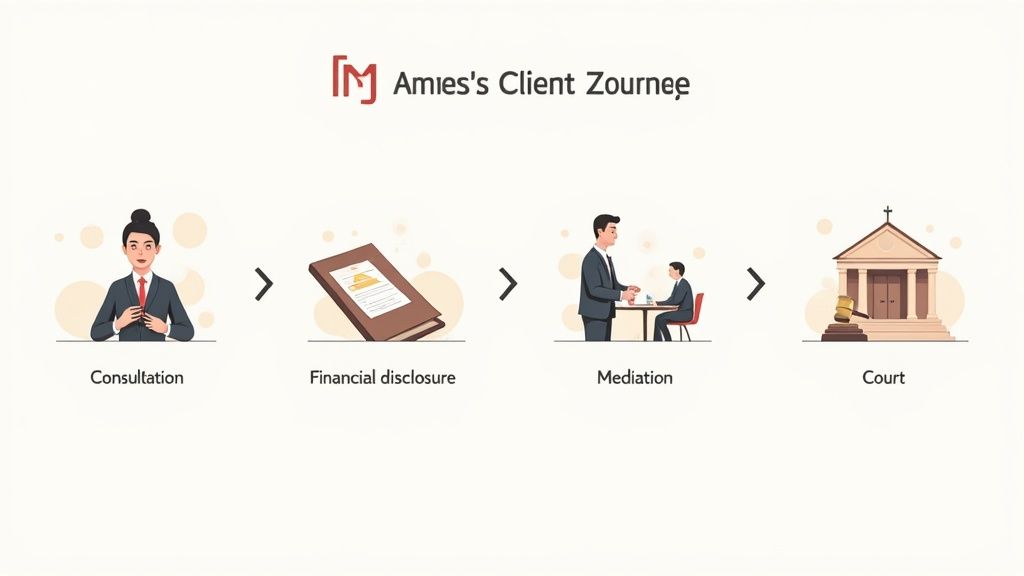
Stage 1 The Initial Consultation
Your journey starts with an initial consultation. This is a strategic session where you explain your situation, and we provide an assessment of your rights and obligations under Ontario’s Family Law Act.
This meeting is a two-way street: you determine if we are the right fit, and we gather the details needed to provide meaningful preliminary advice. Preparation is key to making this session as productive as possible.
The initial consultation is the cornerstone of your entire case. Coming prepared with organized documents and clear questions allows your lawyer to provide meaningful, specific advice from day one, saving you time and money.
To get the most out of our first meeting, use this checklist.
What to Bring to Your Initial Consultation
Being prepared helps us understand your situation quickly and offer the best possible advice from the start.
| Document Category | Specific Examples |
|---|---|
| Personal Information | Your full name, date of birth, date of marriage, and date of separation. Similar information for your spouse and any children. |
| Financial Documents | Recent pay stubs, income tax returns (last 3 years), bank statements, and credit card statements. |
| Asset & Debt Information | A list of major assets (home, vehicles, investments) and debts (mortgage, loans, lines of credit). |
| Legal Documents | Any existing marriage contracts, cohabitation agreements, or previous court orders. |
| List of Questions | A written list of your most pressing questions about the process, your children, or your finances. |
Having these items on hand isn’t mandatory, but it allows us to focus immediately on what matters most to you.
Stage 2 Financial Disclosure
The next critical step is financial disclosure. This is a mandatory stage in every Ontario divorce where each spouse must provide complete and honest documentation of their income, assets, and debts.
This is the foundation of a fair settlement. Without full transparency, it is impossible to correctly calculate support or divide property. Any attempt to hide assets can lead to severe court penalties and will undermine negotiations. We will guide you in completing your Financial Statement (Form 13 or 13.1) accurately.
Stage 3 Negotiation and Mediation
With financial disclosure complete, the focus shifts to resolution. The vast majority of Brampton divorce cases are settled out of court through negotiation or mediation, as these methods are faster, cheaper, and less stressful.
Our first approach is typically to negotiate a comprehensive separation agreement with your spouse’s lawyer. This legally binding contract will cover all aspects of your separation, from the parenting schedule to the division of property.
If negotiations stall, mediation is an effective next step. A neutral mediator helps you and your spouse find common ground. Throughout this process, our role is to advise you and ensure any proposed settlement protects your legal rights. These methods keep you in control of the outcome.
Stage 4 The Court Process
Going to court is the last resort, used only when other resolution attempts have failed. Litigation may be necessary if your spouse is unreasonable, uncooperative, or if there are serious issues like domestic violence that fall under Canada’s Criminal Code.
The court process is highly structured, involving steps like case conferences, motions, and a potential trial at the Brampton Superior Court of Justice. This is where our local experience as Brampton divorce lawyers is invaluable, as we navigate the court system and advocate fiercely on your behalf. Even in litigation, our goal remains to resolve matters as efficiently as possible.
Understanding Legal Fees and Retainers
The cost of divorce is a valid and common concern. Understanding how a Brampton divorce lawyer bills for their services is the first step toward managing your finances and avoiding surprises. Transparency is key to a successful financial partnership with your legal team.
Most family law cases in Ontario use an hourly billing model. You are charged for the actual time your lawyer and their team spend working on your file, including drafting documents, corresponding with the other party, and representing you in negotiations or court. This time is tracked meticulously and detailed in monthly invoices.
The Role of the Retainer
To begin work, your Brampton divorce lawyer will require a retainer. This is an upfront payment held in a special trust account, acting as a security deposit for legal services. It is not a flat fee for the entire divorce.
As your lawyer works on your case, their hourly fees are drawn from this trust account. You will receive regular, itemized invoices showing the work performed and the remaining retainer balance.
A retainer is essentially a trust fund for your legal fees. Your lawyer draws from this fund as they perform work on your file, and you are required to replenish it if the balance falls below an agreed-upon amount. This ensures your legal representation can continue without interruption.
This system ensures your lawyer is compensated for their work as it is performed, and you maintain a clear understanding of your legal costs.
Differentiating Between Billing Methods
While hourly billing is standard, especially for complex cases, it’s not the only model.
- Hourly Rates: This is the most common approach for cases with unpredictable timelines or complexity. You pay for the precise time and expertise your case requires.
- Flat Fees: These are sometimes offered for straightforward, predictable tasks like an uncontested divorce where a separation agreement is already in place. You pay a single, all-inclusive price for a clearly defined service.
- Disbursements: These are out-of-pocket expenses your lawyer pays on your behalf to advance your case. They are billed back to you in addition to legal fees and include costs like court filing fees (which can exceed $600 in Ontario), process server fees, and expert reports like property valuations.
Discussing these options during your initial consultation is crucial. A reputable Brampton divorce lawyer will be transparent about their billing practices and help you anticipate potential costs, empowering you to make informed financial decisions.
How to Choose the Right Brampton Divorce Lawyer
Choosing the right legal partner is the most critical decision you will make during your divorce. You need more than just a lawyer; you need an advocate who understands your unique situation and is an expert in the Brampton legal system.
Treat your initial consultations like interviews where you are the employer. To make an informed choice, you must go beyond fees and assess their strategy, experience, and communication style to ensure they are the right fit for you.
Key Questions to Ask During a Consultation
Asking the right questions will reveal a lawyer’s real-world expertise and approach. A good Brampton divorce lawyer will welcome these questions and provide clear, direct answers.
Here are essential questions to ask:
- Experience with Cases Like Yours: “How much of your practice is dedicated to family law? Have you handled cases with similar issues to mine, like dealing with business assets or a high-conflict custody battle?”
- Local Brampton Court Experience: “How familiar are you with the judges and the way things work at the Brampton Superior Court of Justice on Hurontario Street?”
- Negotiation vs. Litigation Philosophy: “What’s your general approach to solving disputes? When do you push for negotiation or mediation, and at what point do you say it’s time to go to court?”
- Communication and Caseload: “Who will I be dealing with day-to-day? What’s your policy for returning calls and emails, and what does your current caseload look like?”
- Strategy for Your Case: “Based on what I’ve told you, what do you see as the biggest hurdles in my case, and what would your initial game plan be?”
Choosing a lawyer is a personal decision. Look for someone who not only has the right legal skills but also communicates in a way that gives you confidence and clarity, rather than confusion and anxiety.
Red Flags to Watch For
Knowing what to avoid is as important as knowing what to look for. Certain behaviours are major warning signs that a lawyer may not be the right advocate for you.
Be wary of any lawyer who:
- Guarantees a Specific Outcome: The legal system is unpredictable. An ethical lawyer will discuss potential outcomes and strategies but will never guarantee a win.
- Lacks Transparency About Fees: If they are vague about their hourly rates, retainer costs, or other potential expenses, it is a significant red flag.
- Communicates Poorly: If they are difficult to reach, use excessive legal jargon without explanation, or seem dismissive of your questions, this is a preview of your future working relationship.
- Pressures You to Sign: A reputable lawyer will give you time to consider your decision. High-pressure tactics are a clear sign that you should look elsewhere.
By asking the right questions and watching for these red flags, you can confidently choose the best Brampton divorce lawyer to protect your interests and guide you to a fair resolution.
Common Questions About Divorce in Brampton
Going through a divorce brings up countless questions. It is normal to feel uncertain. To provide clarity, here are answers to some of the most common questions we hear from clients in Brampton.
How Long Does a Divorce Take in Brampton?
The timeline for a divorce in Brampton depends almost entirely on cooperation. For an uncontested divorce, where you and your spouse agree on all issues and have a signed separation agreement, the process is relatively quick. You can expect it to take 4 to 6 months from the date of filing at the Brampton courthouse.
A contested divorce, where disagreements exist, is much longer. These cases can easily last for a year or more due to the need for extensive negotiations, multiple court appearances, and procedural delays.
Can We Get Divorced Without Going to Court?
Yes, absolutely. The vast majority of divorces in Brampton are resolved out of court through negotiation, mediation, or collaborative family law. These methods save significant time, money, and emotional stress.
Court should be viewed as a last resort, necessary only when all other attempts at agreement have failed. Your Brampton divorce lawyer’s primary goal will be to achieve a fair settlement that keeps you out of the courtroom and in control of the outcome.
The single biggest factor in keeping your divorce costs down is minimizing conflict. The more you and your spouse can agree on without a judge’s intervention, the lower your legal fees will be.
What Are the Grounds for Divorce in Ontario?
Under Canada’s Divorce Act, there is only one ground for divorce: marriage breakdown. This breakdown can be established in one of three ways:
- One-Year Separation: This is the most common ground. You and your spouse must have lived separate and apart for at least one year.
- Adultery: You must prove that your spouse has committed adultery.
- Cruelty: You must demonstrate that your spouse has treated you with physical or mental cruelty that makes cohabitation intolerable.
Most people proceed on the basis of a one-year separation because it is a no-fault ground. This avoids assigning blame, which helps minimize conflict and allows both parties to move forward more amicably.
When you’re facing the complexities of family law, you need clear guidance and strong advocacy. At Badesha Law, we provide strategic, client-focused support to protect your rights and help you build a stable future. For help with your separation or divorce, contact us today by visiting Badesha Law.