

Before you can even begin to calculate spousal support in Canada, you have to answer a more fundamental question: is there a legal right to it in the first place? Spousal support isn't automatic. It's awarded based on specific grounds laid out in Canada's federal Divorce Act and provincial family laws, such as Ontario's Family Law Act, which are designed to address the real-world economic consequences of a relationship breakdown.
Determining Your Entitlement to Spousal Support

Before any numbers are crunched, a court must establish why one partner should pay support to the other. Canadian law does not treat support as a punishment for a failed relationship. Instead, its purpose is to fairly address the financial imbalance that often occurs when a couple separates.
Whether you were married and fall under the federal Divorce Act, or you were in a common-law relationship in Ontario and are covered by the Family Law Act, a spouse must prove they have a right to support based on one of three grounds.
The Three Grounds for Spousal Support Entitlement
Figuring out which basis—or bases—applies to your situation is the very first hurdle in any spousal support claim. The grounds can be compensatory, non-compensatory, or contractual.
- Compensatory Support: This applies to a spouse who sacrificed their career for the benefit of the family. A common example is a partner who left a promising job to raise children, allowing the other spouse to advance their career without interruption. Support here is meant to compensate for the economic disadvantage they took on for the family's benefit.
- Non-Compensatory Support: Often called "needs-based" support, this ground applies when the separation itself creates a significant financial need. If one spouse cannot meet their basic living expenses and the other has the ability to help, support may be awarded to bridge that gap and prevent genuine hardship.
- Contractual Support: This is straightforward. It applies when you and your partner have a valid pre-existing agreement—like a marriage contract or cohabitation agreement—that specifies spousal support obligations in the event of separation.
It’s not uncommon for a claim to be based on more than one ground. For example, a spouse who stayed home to raise children (compensatory) might also struggle to re-enter the workforce after a long absence (non-compensatory), strengthening their claim.
Key Takeaway: Entitlement is not based on who was at fault for the breakup. The court focuses on the roles each person played during the relationship and the financial impact of the separation.
Married vs Common-Law Spouses in Ontario
The legal path to claiming support differs depending on your relationship status. While the core principles of entitlement are the same, the governing laws are distinct.
For married couples, spousal support claims are handled under the federal Divorce Act as part of the overall divorce proceedings, ensuring a consistent standard across Canada.
For unmarried, common-law partners in Ontario, the right to seek support comes from the provincial Family Law Act. To qualify as a "spouse" under this Act, you must have either:
- Cohabited continuously for at least three years, or
- Been in a "relationship of some permanence" and are the parents of a child.
While Canada's divorce rate hit a historic low of 5.6 divorces per 1,000 married people in 2020, family courts remain busy with complex separations involving both married and common-law partners.
Establishing your eligibility is non-negotiable. Without a solid basis for entitlement, any attempt to calculate spousal support is premature, and your claim could be denied outright. For more on this, see our guide on when spousal support is denied. Once entitlement is clear, the next step is to determine the numbers: how much support, and for how long.
Understanding the Spousal Support Advisory Guidelines (SSAG)
Once you’ve established that spousal support is on the table, the conversation quickly moves from if it will be paid to how much and for how long. This is precisely where the Spousal Support Advisory Guidelines (SSAG) come in.
While they aren't a strict law like the speed limit, these guidelines are the go-to tool for lawyers and judges across Canada. They bring a much-needed layer of consistency and predictability to what could otherwise be a wildly unpredictable process.
Think of the SSAG as a sophisticated calculator that takes the unique facts of your family life and generates a range for both the monthly support amount and how long it should be paid. Understanding how it works is key to understanding the numbers that will likely be the starting point for negotiation in your case.
The Two Core SSAG Formulas
The SSAG is not a one-size-fits-all model. It uses two distinct formulas, and the correct one for your situation depends on a single question: are there dependent children involved?
The Without Child Support Formula: This is the more straightforward of the two. It's used when a couple separates with no dependent children. The calculation focuses almost entirely on the difference between the spouses' gross incomes and the length of their relationship.
The With Child Support Formula: When child support is also a factor, things get more complex. This formula correctly recognizes that child support is the primary financial priority. It performs a deeper analysis to determine how much money is left for each spouse after child support and taxes are paid, ensuring the dependent spouse still receives a fair share of the remaining income.
Choosing the right formula is the first critical step. Using the wrong one will produce completely inaccurate numbers and risk derailing negotiations before they even begin.
This screenshot from the Department of Justice Canada's website shows the introductory page to the Spousal Support Advisory Guidelines.
This page is the official starting point for understanding the guidelines, making it clear they're designed to provide a solid framework for figuring out spousal support amounts and duration.
Essential Inputs for the Formulas
Before you can calculate spousal support in Canada, you need to gather specific financial and personal details. The formulas are powerful, but they're only as good as the information you feed them.
Below is a quick comparison of the information you’ll need to have on hand for each of the two main formulas. As you can see, the With Child Support formula requires a bit more detail to ensure the calculations are fair.
Key Inputs for SSAG Formulas
| Required Information | Without Child Support Formula | With Child Support Formula |
|---|---|---|
| Gross Annual Income of Both Spouses | Yes (The starting point for everything) | Yes (Crucial for the initial analysis) |
| Length of the Relationship | Yes (Includes marriage and cohabitation) | Yes (A key factor for duration) |
| Ages of the Spouses | Yes (Especially for duration in long-term relationships) | Yes (Impacts duration calculations) |
| Child Support Details | Not Applicable | Yes (The exact amount being paid) |
| Parenting Arrangement | Not Applicable | Yes (Who the children live with primarily) |
These advisory guidelines have been the standard since their introduction in 2005, bringing a level of consistency to provinces like Ontario. For example, in a 12-year marriage with children, the guidelines might suggest a support duration of 6 to 12 years. If one spouse made significant career sacrifices for the family, the duration would likely lean towards the longer end of that range—perhaps until the youngest child finishes high school. You can read more about the Canadian experience with formula-based spousal maintenance for some deeper insights.
A Practical Example of the SSAG in Action
Let’s walk through a simple scenario. Imagine Amir and Sarah are separating after a 15-year marriage with no children. Amir earns $120,000 a year, while Sarah, working part-time, earns $40,000.
Because there are no children, we’d use the Without Child Support formula. A family lawyer would plug these numbers into their software, and the SSAG would generate a result. But it's not a single, magic number—it's a range.
Example Outcome:
- Amount (Quantum): A low end of $1,000/month, a mid-range of $1,333/month, and a high end of $1,667/month.
- Duration: A low end of 7.5 years, a high end of 15 years, or even potentially indefinite support given the length of the marriage.
This range provides a realistic starting point for negotiations. From here, Amir and Sarah (or a court) would look at other factors—like Sarah’s health or any significant debt Amir might have—to decide where the final figure should land within that range.
For those in Ontario wanting to run some numbers, our detailed guide on the spousal support calculator in Ontario offers more specific examples and tools. The SSAG provides the map, but it's the unique facts of your case that determine the final destination.
Putting the SSAG Formulas into Practice
Okay, you’ve read about the Spousal Support Advisory Guidelines (SSAG), but it's all just theory until you see the numbers in action. This is the part where the abstract rules become real money and real timelines. Seeing how a lawyer or a judge actually works through the formulas helps demystify the entire process, turning complex guidelines into a clear financial range.
Let’s walk through a common scenario. We’ll call our couple David and Chloe. They’re separating after a 15-year marriage. David earns a gross annual income of $110,000, and Chloe, who pulled back on her career to manage the home and support David's, earns $35,000. They don’t have dependent children, which means we’ll be using the Without Child Support formula.
This whole process can feel complicated, but it really boils down to three core stages.
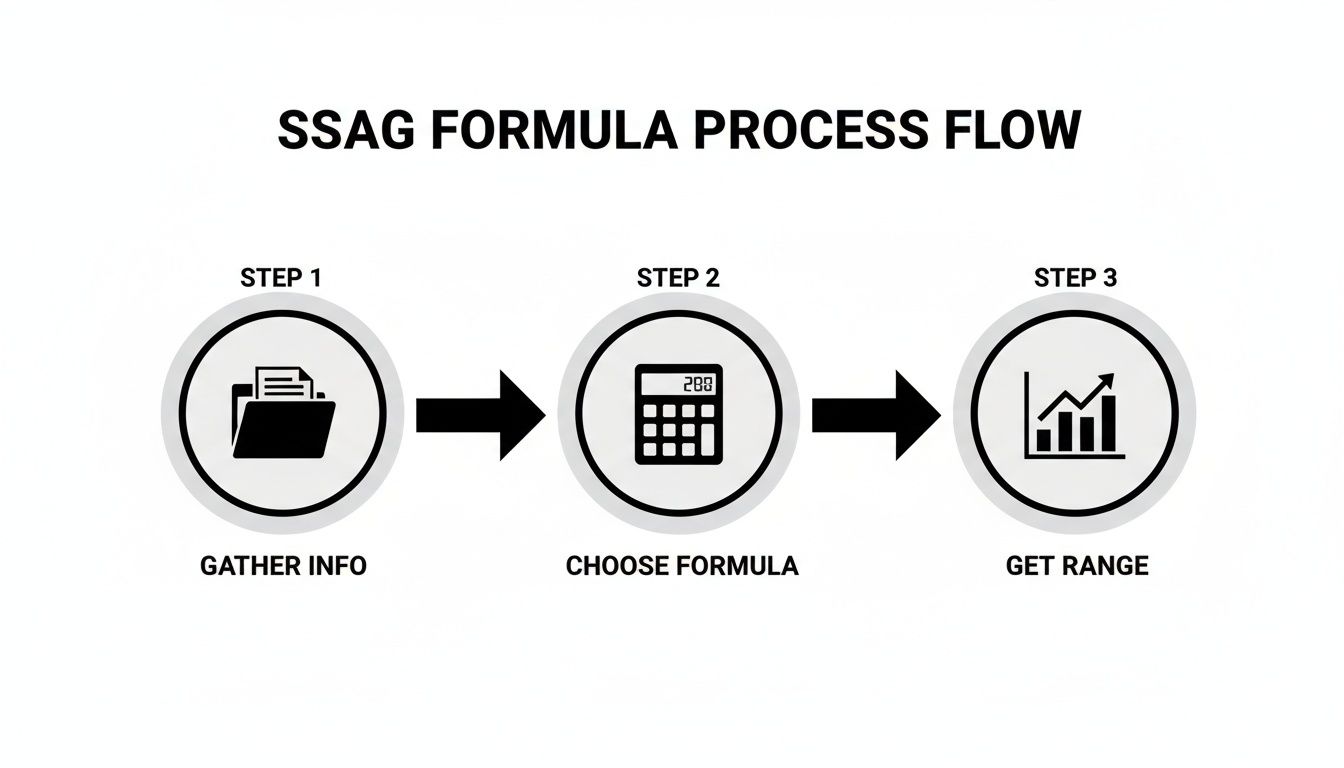
As the visual shows, it starts with getting the financial details right, picking the correct formula, and then working with the range that the guidelines produce.
Calculating the Quantum (The Monthly Amount)
First up is the "quantum"—that’s the legal term for the actual monthly spousal support payment. With no kids involved, the Without Child Support formula zeroes in on two key factors: the difference in their gross incomes and the length of the marriage.
- The formula uses a multiplier of 1.5% to 2% for each year of marriage. David and Chloe were married for 15 years, so their multiplier is between 22.5% (15 x 1.5) and 30% (15 x 2).
- We then apply that percentage to the gap in their gross incomes, which is $75,000 ($110,000 – $35,000).
Running the numbers gives us a clear range:
- Low End: $75,000 x 22.5% = $16,875 per year, which works out to $1,406 per month.
- High End: $75,000 x 30% = $22,500 per year, or $1,875 per month.
The mid-point lands around $1,640 per month. This range isn't the final answer; it's the starting point for negotiation. Things like Chloe’s health issues or David carrying significant family debt could push the final number toward the higher or lower end.
Key Takeaway: The SSAG doesn’t spit out a single magic number. It creates a reasonable range for negotiation or for a judge to consider. The specific facts of your case will always determine where you land within that range.
Determining the Duration of Support Payments
Next, we figure out how long the payments will last. For marriages like David and Chloe's, the SSAG suggests a duration of 0.5 to 1 year of support for every year they were married.
Here's how that applies to their 15-year marriage:
- Low End Duration: 15 years x 0.5 = 7.5 years.
- High End Duration: 15 years x 1 = 15 years.
Because their marriage was 15 years long, they are getting close to the point where indefinite support becomes a real possibility. Support could be set for a fixed term somewhere in that 7.5 to 15-year window, or it could be ordered indefinitely, meaning it continues until there's a major change like retirement.
A huge factor here is the "Rule of 65." This guideline suggests indefinite support if the length of the marriage plus the recipient’s age at separation adds up to 65 or more. If Chloe was 50 when they separated, her score would be 65 (15 years of marriage + 50 years of age), building a very strong argument for indefinite support.
A Word of Caution on Online Calculators
Online spousal support calculators can be a useful starting point, but they are absolutely no substitute for proper legal advice. I’ve seen countless clients come in with skewed numbers because these tools miss the critical nuances a family lawyer is trained to spot.
Common Pitfalls to Avoid:
- Getting the Income Wrong: This is the single biggest mistake people make. It’s especially tricky for business owners, contractors, or anyone with bonuses and commissions. You must use the gross, pre-tax income figure, but calculating it correctly isn't always simple.
- Assuming Entitlement: Calculators work on the assumption that spousal support is owed. They don’t analyze why it should be paid—whether there’s a valid compensatory or needs-based claim to begin with.
- Ignoring the Complexities: These tools can't factor in unique circumstances like a spouse's disability, unusual debts from the marriage, or pre-existing support obligations to a former partner.
Getting your financial picture right is everything. For a detailed look at the financial disclosure process, check out our guide on completing the Form 13.1 Financial Statement. In Ontario family law, this document is the foundation for every support calculation. Even a small error on this form can throw the entire spousal support calculation off by thousands of dollars.
The SSAG provides the map, but you still need an experienced guide to navigate it properly. The only way to get a truly accurate assessment is to have a professional review the unique facts of your situation.
Factors That Can Change Your Spousal Support Amount
The initial calculation from the Spousal Support Advisory Guidelines (SSAG) is a powerful starting point, but it's rarely the final word. Think of it as a baseline—a number generated in a vacuum. Real life is far more complex, and Canadian family law is designed to account for that.
A whole host of factors can—and frequently do—adjust the final support amount up or down. Understanding these variables is the difference between accepting a formulaic result and advocating for an outcome that truly reflects your financial reality. Let's get into the key circumstances that can significantly alter the numbers.
Defining Income Beyond a Pay Cheque
One of the most common areas of dispute is figuring out a spouse's true income. A simple T4 slip showing a salary is just the beginning of the story. For many people, especially business owners or high-income earners, income is a far more intricate picture.
Courts look at the total financial resources available. This means including:
- Bonuses and Commissions: These are often variable but are absolutely considered part of a person's income for support purposes.
- Stock Options: The value of vested stock options is often included in the income calculation, even if they haven't been cashed out.
- Corporate Income: For self-employed individuals, a court will scrutinize the company's pre-tax corporate income. Personal expenses paid by the business are often added back to the owner's income.
- Investment Income: Dividends, capital gains, and other returns on investments all count.
Example Scenario
Mark is a salaried employee earning $100,000 per year. His ex-spouse, Lisa, is a business owner who pays herself a salary of $50,000. However, her corporation also pays for her car, phone, and travel, and retains $40,000 in profit each year. A court would likely "impute" an income closer to $90,000 for Lisa, dramatically changing the support calculation.
How Parenting Arrangements Affect Support
When child support is involved, the parenting arrangement has a direct impact on spousal support. The With Child Support formula is designed to prioritize the children's financial needs first, leaving the remaining parental income to be divided.
A shared parenting arrangement, where children spend at least 40% of the time with each parent, often complicates matters. In these situations, child support is typically calculated based on the difference between what each parent would pay (the "set-off" amount). This change in the child support figure directly alters the inputs for the spousal support calculation, often resulting in a different range than in a sole custody scenario.
New Relationships and Remarriage
One of the first questions people ask is what happens when the recipient spouse enters a new relationship. Re-partnering or remarrying can be a material change in circumstances that justifies a review, reduction, or even termination of spousal support.
The key factor is the financial benefit the recipient gains from the new relationship. If they are cohabiting with a new partner who contributes to household expenses, their financial need is reduced. This doesn't automatically kill the support obligation, especially if the original entitlement was compensatory, but it almost always triggers a reassessment.
Key Takeaway: The obligation to pay spousal support is not automatically cancelled by a recipient's new relationship. However, it provides strong grounds for the paying spouse to apply to the court to vary the existing order or agreement.
Other Game-Changing Circumstances
Several other life events can push the final spousal support amount away from the initial SSAG range. It's vital to consider if any of these apply to your situation.
- Post-Separation Raises: If a paying spouse gets a significant raise after separation, the recipient may not be automatically entitled to a share of that new income, particularly if it wasn't connected to efforts made during the relationship.
- Pension Division: When a pension is divided as family property, it can impact spousal support. The portion of the payor's income that comes from their pension might be excluded from the support calculation to avoid "double-dipping" by the recipient.
- Retirement: A reasonable, good-faith retirement (usually around age 65) is a valid reason to seek a reduction or termination of spousal support payments.
- Debt Payments: Significant family debts that one spouse is responsible for can sometimes lead to a support amount on the lower end of the SSAG range.
These factors highlight why a simple online calculator can be so misleading. It gives you a number, but it lacks the context that a family lawyer brings to the table. Before you agree to anything, it's wise to consider how all these pieces fit together. For instance, many of these issues can be proactively addressed in prenuptial agreements in Canada, offering clarity long before a separation occurs.
Making Your Spousal Support Agreement Official

After the tough work of calculating and negotiating, reaching an agreement on spousal support feels like a huge win. But a handshake deal or an email exchange won't cut it. To protect both of you and sidestep future conflict, that agreement needs to be locked down in a legally binding and enforceable document.
You generally have two ways to do this. The most common route is to build the terms into a formal Separation Agreement, which is a comprehensive legal contract signed by both spouses. The other option, if your case is already in the court system, is to have the terms formalized in a Consent Order. Both of these documents turn your understanding into a legal obligation.
Why You Can't Skip This Step
Ignoring this final step is a massive gamble. An informal promise to pay support is incredibly difficult—if not impossible—to enforce if the payments suddenly stop. Without that signed agreement or court order, your only option is to start a costly and stressful court application from square one.
A formalized agreement brings clarity and certainty for everyone involved. It clearly spells out:
- The exact monthly payment.
- The precise start and end dates for support.
- How payments will be made (e.g., direct deposit).
- The process for dealing with future changes, like cost-of-living adjustments or income reviews.
This isn't about mistrust. It's about building a stable and predictable financial future for both you and your ex-spouse, ensuring the agreement actually holds up for the long haul.
Understanding Tax Implications and Enforcement
One of the most critical reasons to formalize your agreement is how it interacts with the Canada Revenue Agency (CRA). When periodic spousal support payments are made under a written agreement or court order, the rules are straightforward.
The spouse paying support (the payor) can generally deduct the payments from their taxable income. On the flip side, the spouse receiving the payments (the recipient) must report that amount as taxable income. This tax treatment is a major factor when you calculate spousal support in Canada, as it changes the real, after-tax cost for the payor and the net benefit for the recipient.
In Ontario, enforcement is handled by the Family Responsibility Office (FRO). Once your agreement or court order is filed with them, the FRO can step in if payments are missed. They have the power to take action, like garnishing wages or bank accounts, providing a government-backed way to ensure compliance without you having to drag your ex back to court.
Planning for Life's Curveballs
Life is unpredictable. A job loss, a new relationship, or a serious illness can completely change someone’s financial picture. A well-drafted Separation Agreement anticipates these shifts by including clauses for reviewing and potentially changing support down the road.
This built-in flexibility helps the agreement stay fair over time. For instance, many agreements require an annual exchange of income tax returns to adjust support if needed. It’s a proactive approach that helps manage change without automatically creating conflict. Statistics Canada's surveys show that enforcement programs are constantly adapting, with some provinces even indexing payments to inflation. Quebec's 2025 indexation of 2.6%, for example, automatically adjusts support payments to reflect the rising cost of living. You can learn more about the evolving landscape of support payments in Canada.
Finalizing your agreement through a Separation Agreement or Consent Order delivers crucial peace of mind. For a deeper look into how court orders work, you can explore our guide on what is a Consent Order.
Common Questions About Spousal Support Calculations
When you're trying to figure out spousal support, the formulas and guidelines are just the starting point. Real life is always more complicated, and specific questions inevitably pop up. Here are some clear, practical answers to the most common queries we get from clients navigating spousal support in Canada.
Can I Get Spousal Support If We Were Never Married?
Yes. In Ontario and many other provinces, common-law partners can absolutely have a right to spousal support. You don't need a marriage certificate to build a life with someone.
Generally, you'll need to have lived together for at least three years, or have a child together in what the law calls a "relationship of some permanence." The same principles of entitlement and the Spousal Support Advisory Guidelines (SSAG) apply, but be prepared for a potential dispute over the exact start and end dates of your cohabitation—this is a frequent point of contention.
What If My Ex-Spouse's Income Changes Significantly?
Spousal support is not carved in stone. It’s designed to adapt to major life changes. If there's a "material change in circumstances"—something significant and unforeseen like an involuntary job loss, a major promotion, or a large inheritance—the support amount can be revisited and adjusted.
A well-drafted Separation Agreement should always include a clause for annual income disclosure. This proactive step helps manage these changes collaboratively instead of letting a surprise income shift turn into another major conflict.
Your agreement should lay out a clear process for these reviews to keep things fair as your lives evolve.
Is Spousal Support Always Paid Monthly?
While monthly payments are the norm, a one-time lump sum payment is another route some couples take. A lump sum can provide a clean financial break, closing the book on the support issue for good and avoiding any future enforcement headaches.
It’s not for everyone, though. The payor needs to have significant assets to make it a realistic option. The tax implications are also completely different: lump sum payments are typically not tax-deductible for the person paying, nor are they considered taxable income for the person receiving them. It is absolutely essential to get both legal and financial advice before going down this path.
Does Spousal Support End When I Retire?
Retirement can be a valid reason to reduce or terminate spousal support, but it's never automatic. If you retire at a standard age, say 65, the courts will almost always see that as a material change that justifies a review of your support obligations.
Taking an early retirement, however, might face more scrutiny. A judge will want to know if the decision was reasonable and made in good faith, not just an attempt to avoid support payments. Even an "indefinite" support order doesn't literally mean it lasts forever, but you must formally apply to the court to have it changed based on your new financial reality after you've stopped working.
Understanding your rights and obligations is the first step toward a fair resolution. At Badesha Law, we provide clear, step-by-step guidance to help you navigate the complexities of spousal support. Schedule a consultation today by visiting us at https://badeshalaw.ca.