

A Practical Guide to Cohabitation Agreements in Ontario
A cohabitation agreement in Ontario is a legal contract for unmarried couples that outlines how you’ll handle assets, debts, and support if the relationship ever ends. It’s a smart, proactive step for Brampton couples that provides clarity and protection where the Family Law Act doesn't automatically grant property rights, unlike for married spouses.
Why a Cohabitation Agreement Is a Smart Move for Brampton Couples

As more couples in Brampton and the Greater Toronto Area build their lives together without getting married, many find themselves in a legal grey area without even realizing it. A common—and costly—mistake is believing that "common-law" status automatically provides the same property rights as marriage. Under Ontario's Family Law Act, this is simply not true.
Think of a cohabitation agreement not as a sign of distrust, but as a practical blueprint for your financial future. It functions like a business partnership agreement, creating certainty and preventing expensive, emotionally draining disputes down the road. It’s about laying a strong foundation by agreeing on the rules ahead of time, while things are good, so you and your partner can focus on your life together.
The Growing Need for Clarity in Brampton
Living together without marriage is a fast-growing trend. Between 1981 and 2021, the number of common‑law couples in Canada surged by an incredible 447%. In major GTA centres like Brampton and Mississauga, over 18% of couples are choosing cohabitation, reflecting a major lifestyle shift.
As more couples enter these relationships unaware that their legal rights differ dramatically from married spouses, the need for a clear agreement has never been greater. For clients in Brampton, this is an actionable step to protect your assets. You can discover more insights about common-law couples in Ontario and the unique legal landscape they face.
A cohabitation agreement transforms ambiguity into certainty. It allows you and your partner—not a court—to decide what is fair regarding your finances and property if your paths diverge in the future.
This guide is your roadmap to understanding your rights. A well-drafted agreement offers essential protection, particularly in a high-asset region like Brampton, by ensuring fairness and predictability. It’s a tool for empowerment, helping you and your partner build a future with confidence and mutual understanding.
How Ontario Law Treats Married vs Common-Law Property
Here's the single most important thing for Brampton clients to understand: when it comes to property, Ontario's Family Law Act treats married and common-law couples in vastly different ways. This isn't a minor detail—it's the core reason why cohabitation agreements in Ontario are an essential tool for protecting yourself financially.
For married couples, Ontario's Family Law Act lays out a clear process called equalization. This recognizes marriage as an equal economic partnership. When a marriage ends, the value of most assets built up during that time is tallied and split right down the middle, 50/50. It doesn't matter whose name is on the title.
Common-law partners get no such automatic protection. None at all.
The Common-Law Property Trap
For unmarried couples, the law operates on a much harsher principle: what's in your name is yours. Period.
There is no automatic right to share in the value of your partner's property, no matter how long you've lived together or how much you contributed to the household. This catches countless people by surprise, often with devastating financial consequences.
A striking feature of Ontario family law is that common‑law partners do not benefit from the matrimonial property “equalization” regime, no matter how long they live together. Unlike married spouses, common‑law partners in Ontario do not automatically share in the growth of each other’s net worth.
This creates deeply unfair situations that we see all the time in our Brampton practice. For a clearer picture, you can learn more about how Ontario law treats common-law relationships and the financial risks involved.
Here are a couple of classic scenarios we see with couples in Brampton:
-
Scenario 1: The Pre-Owned Home. You move into the Brampton house your partner owned before you met. For 15 years, you help with the mortgage, pay for a new kitchen, and cover the bills. If you split up, you have no automatic claim to a single dollar of that home's value or the equity you helped build. Legally, it’s still 100% your partner’s.
-
Scenario 2: The Jointly Paid Asset. You and your partner buy an investment condo in Mississauga, but it's put in your partner’s name to get a better mortgage rate. You both chipped in for the down payment and split the costs every month. If the relationship ends, your partner is the sole legal owner. You’d be left with nothing without a fight.
The Costly and Uncertain Alternative
Without a cohabitation agreement, your only way to claim a share of property is to sue your ex-partner for what’s called a trust claim. This means heading to court and trying to prove that your contributions—whether money or work—made your partner wealthier while leaving you at a financial disadvantage.
A trust claim is a complex, expensive, and emotionally draining legal battle with no guaranteed outcome. You’re asking a judge to create a financial remedy where the Family Law Act doesn't provide one automatically. This process can drag on for years and rack up tens of thousands of dollars in legal fees.
A cohabitation agreement is the most predictable and peaceful way to ensure fairness. It lets you and your partner set your own rules for property, choosing certainty over a potential court battle.
To see these differences side-by-side, take a look at this table. It breaks down the default legal positions for married versus common-law partners in Ontario if you don't have an agreement in place.
Property and Support Rights Married vs Common-Law Partners
| Legal Right or Obligation | Married Spouses (Family Law Act) | Common-Law Partners (Default Law) |
|---|---|---|
| Property Division | Automatic right to equalize the value of property acquired during the marriage. Each spouse is generally entitled to 50% of the growth in net worth. | No automatic right to property division. Each partner keeps what is in their own name. |
| Matrimonial Home | Both spouses have equal rights to possess the matrimonial home, regardless of whose name is on the title. It receives special protection. | No "matrimonial home" concept. The person whose name is on the title has the right to the home. The other partner may be forced to leave. |
| Spousal Support | Entitled to claim spousal support based on the roles and contributions during the marriage. | Entitled to claim spousal support if they meet the definition of "spouse" (cohabited for 3+ years or have a child together). |
| Inheritance (No Will) | The surviving spouse automatically inherits a significant portion or all of the deceased spouse's estate under intestacy laws. | No automatic inheritance rights. The surviving partner gets nothing unless specifically named in a will. |
As you can see, the legal safety nets available to married spouses simply don’t exist for common-law couples. An agreement allows you to build those protections yourselves, on your own terms.
Understanding Spousal Support and Legal Timelines
When it comes to common-law relationships, the rules around spousal support are a huge source of confusion—and risk. While the property division rules are completely different from those for married couples, many people in Brampton wrongly assume that if they aren't married, no financial support obligations can ever arise after a breakup. This is a dangerous myth.
The reality is, Ontario’s Family Law Act absolutely allows a common-law partner to claim spousal support. This is a critical point for clients to understand. Unlike property rights, which aren't automatic, support obligations can be triggered simply by the length and nature of your relationship. A cohabitation agreement is your only real tool to get ahead of this possibility.
The Timelines That Trigger Support Obligations
The Family Law Act is very clear about the thresholds that can define you as a "spouse" for support purposes, even if you never married. Knowing these timelines is essential for any cohabiting couple in Ontario.
A potential claim for spousal support can arise if you meet either of these two conditions:
- The Three-Year Rule: You have lived together in a conjugal (marriage-like) relationship continuously for at least three years.
- The Parent Rule: You are in a "relationship of some permanence" and have a child together, whether by birth or adoption.
If your relationship ticks either of these boxes, a judge can order one partner to pay spousal support to the other if you separate. How much and for how long depends on things like income differences, the roles each person played in the relationship, and whether one partner was left at an economic disadvantage.
For example, think of a Brampton couple where one partner steps back from their career to raise a child. Even if they were together for less than three years, that partner could be entitled to support after a split because their earning ability was hurt for the good of the family.
Gaining Certainty and Control with an Agreement
These legal timelines create a potential financial obligation that catches many couples completely off guard. A well-drafted cohabitation agreement lets you address or even completely waive these obligations, giving you financial predictability. To get a better handle on your situation, learn more about how cohabitation is legally defined in Ontario.
A cohabitation agreement allows you to write your own rules for spousal support. You get to decide what’s fair for your specific circumstances, rather than leaving that decision to a judge years down the road.
This is especially vital in Brampton, where incomes between partners can be worlds apart. An agreement lets you set out crystal-clear terms, such as:
- A full waiver of support: Both partners agree that no spousal support will be paid by either person, no matter how long they live together.
- Lump-sum payment: Instead of ongoing monthly payments, a specific, one-time amount is agreed upon.
- Time-limited support: Support will only be paid for a set period (like one year) to help the lower-income partner get back on their feet.
Without an agreement, you’re stuck with the default rules of the Family Law Act. By creating one, you and your partner take control, ensuring any potential separation is handled on your own terms.
What Every Ontario Cohabitation Agreement Should Cover
Okay, let's move from the "what if" to the "what's in it." A cohabitation agreement is your relationship's financial rulebook. It's a document you and your partner build to set clear expectations for your assets, debts, and future responsibilities. While no two couples are the same, every solid, protective agreement drafted for a Brampton client should have a few core components locked down.
Think of these clauses as the essential pillars holding up the entire structure. If one is weak or missing, the whole agreement could be challenged down the road if you ever need to rely on it.
Defining Property Ownership and Division
This is the most important part of any cohabitation agreement. Since Ontario's Family Law Act doesn't automatically split property for common-law couples, this section is where you create your own fair rules. It must clearly state who owns what coming into the relationship and what happens to property you buy together if you separate.
Specificity is key. It’s not enough to say, "we'll split the house." A properly drafted agreement gets into the details:
- Existing Assets: List the significant assets each of you is bringing to the table (like RRSPs, cars, or investment accounts) and confirm they will always remain your separate property.
- The Home: For most Brampton couples, the home is the biggest asset. If one person already owns it, will the other get a share of the equity for helping with the mortgage or renovations? If you buy a home together, how will you divide the proceeds if you sell it—a straight 50/50 split, or based on who contributed to the down payment?
- Future Assets: Lay out the plan for assets you acquire as a couple, such as joint savings accounts or new investments.
For example, say you move into your partner's condo in Brampton. The agreement can state that your partner keeps the condo's original value, but you’ll share 50% of the increase in its value from the day you moved in. This acknowledges your contributions to the mortgage and upkeep.
Clarifying Responsibility for Debts
Just like assets, debts are treated separately under Ontario law for common-law couples. You are only responsible for debts in your name. But couples often take on joint debt—think lines of credit, shared credit cards, or car loans.
This clause is your protection against being saddled with your partner's debt. It should clearly state:
- Which debts belong to each individual and which ones are shared.
- How any joint debts will be paid off if you separate.
- A confirmation that neither of you is responsible for the other’s pre-relationship or secret debts.
Setting Out Terms for Spousal Support
As we’ve covered, spousal support can be an obligation for common-law couples in Ontario. Your agreement is your chance to decide on this issue for yourselves instead of leaving it to a judge.
An agreement gives you total control over spousal support. You can set clear limits, define specific terms, or waive it entirely, giving both of you complete financial certainty for the future.
You could agree to a full waiver, where both of you give up any right to seek support from the other. Or, you could set specific terms, like a one-time lump-sum payment or monthly support for a fixed amount of time. To ensure your cohabitation agreement is comprehensive, legally sound, and addresses all necessary considerations, an AI Legal Contract Analyzer can provide invaluable insights and identify potential gaps.
Addressing Estate Rights and Inheritance
This is a critical section many people overlook. If you pass away without a will, Ontario's intestacy laws do not automatically give your common-law partner any right to your estate. Your assets would likely go to your next of kin (like your parents or siblings), leaving your partner with nothing.
While a cohabitation agreement isn't a substitute for a will, it can include a clause where you both agree to give up your rights to make a dependant’s support claim against the other’s estate. More importantly, it can state that each of you promises to create a will that provides for the other in a specific way. This simple step ensures your final wishes are honoured and your partner is taken care of.
How to Create a Legally Binding Agreement
A cohabitation agreement is a powerful legal tool. But for it to protect you, it needs to be created correctly. Under Ontario's Family Law Act, there are specific steps you must follow to make sure the agreement is legally enforceable and can hold up if ever challenged in court. This process is about creating fairness, transparency, and crystal-clear understanding for both partners.
For cohabitation agreements in Ontario, the foundation is built on total honesty and proper legal procedure.
Step 1: Start with an Open Conversation
Before any lawyers get involved, the very first step is for you and your partner to sit down and have an honest, calm conversation about your goals and concerns. What assets are you each bringing into the relationship? What about debts? How do you picture handling finances as a couple? This initial chat sets the stage for a much smoother process.
Step 2: Complete Full and Honest Financial Disclosure
This is the most critical, non-negotiable step. For a cohabitation agreement to be valid, both partners must provide a complete and truthful picture of their finances. This means listing all your assets (property, investments, savings), debts (loans, credit card balances), and income.
Hiding an asset or downplaying your income can invalidate the entire agreement later on. A judge can set aside an agreement if they discover that one partner wasn't fully honest, because it means the other person couldn't have made a truly informed decision.
This flowchart shows the key areas a typical agreement will cover—all of which depend on honest disclosure.
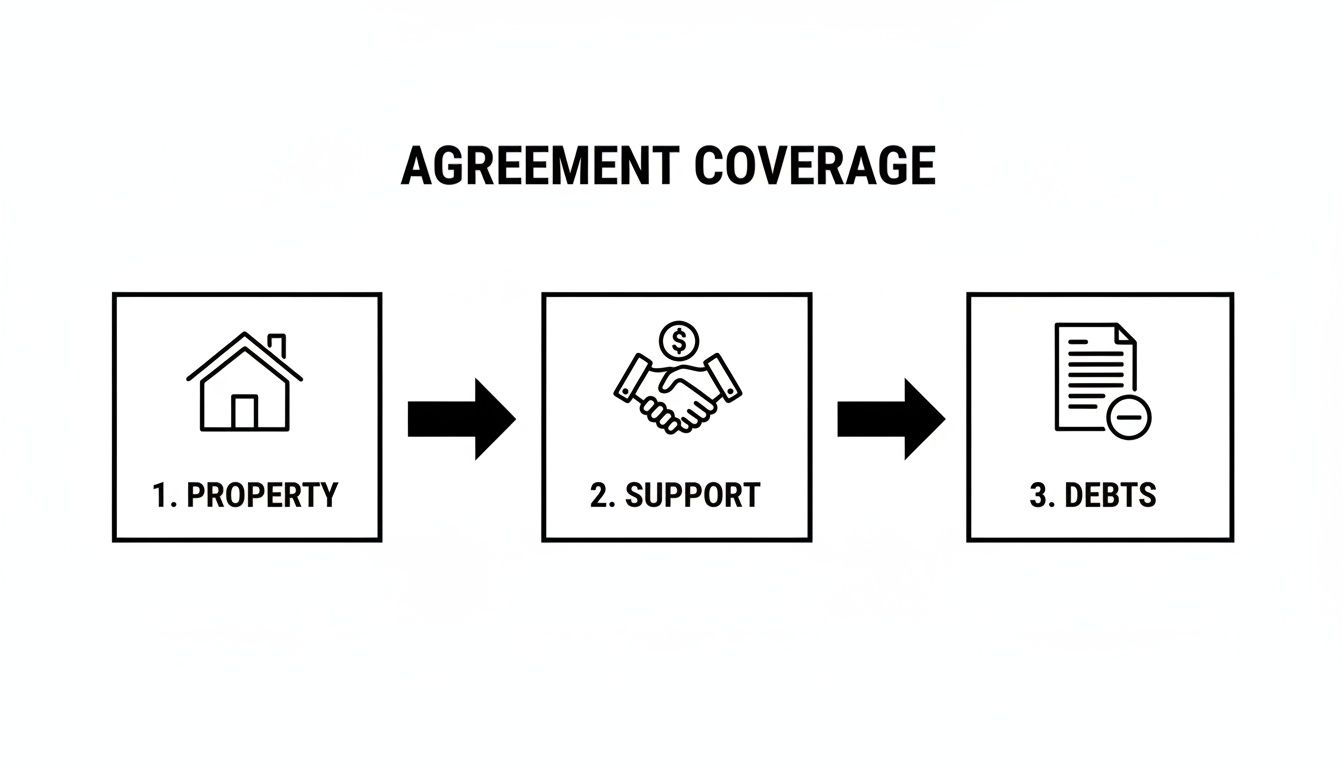
The way property, support, and debts are all connected shows just how intertwined your financial lives can become, reinforcing why full disclosure is the bedrock of a fair outcome.
Step 3: Get Independent Legal Advice
Here’s another mandatory requirement: each partner must get advice from their own, separate lawyer. One lawyer cannot represent both of you, as it would be a clear conflict of interest. Your lawyer’s job is to explain your rights under the Family Law Act, go through the proposed agreement with you, and make sure you understand exactly what you are signing and what rights you might be giving up.
Independent Legal Advice (ILA) is the legal system's built-in safeguard. It proves that both partners signed the agreement with their eyes wide open, free from any pressure or misunderstanding, which makes the contract that much stronger.
Step 4: Draft and Finalize the Agreement
Once disclosure is complete and you’ve both spoken with your lawyers, one of the lawyers will draft the initial agreement based on your discussions. This draft is then sent to the other lawyer for review, who may suggest changes or additions. This back-and-forth negotiation continues until both you and your lawyers are satisfied with the final terms.
Step 5: Properly Sign and Witness the Document
The last step is signing the agreement, and it has to be done correctly for it to be legally binding. Your signature, and your partner's, must be witnessed by another person. Your lawyers will typically act as the witnesses for you.
To ensure your cohabitation agreement is legally sound, understanding modern signing methods is also helpful. You can learn more about how to electronically sign documents for a convenient and secure option. Following these steps ensures your agreement will work as the reliable shield it’s meant to be.
Common Mistakes That Can Invalidate Your Agreement
Putting together a cohabitation agreement is a huge step toward financial clarity. But a few critical missteps can render your agreement totally useless, turning that shield you built into a worthless document right when you need it most. Knowing these common pitfalls is the only way to ensure your agreement will actually stand up in an Ontario court.
If your agreement isn't enforceable, you're right back where you started—facing the default rules of the Family Law Act and a likely court battle. For couples in Brampton, where property values are soaring, a voided agreement can be financially devastating.
The Pitfall of Incomplete Financial Disclosure
This is, without a doubt, the number one reason judges throw cohabitation agreements out. The entire point of a fair agreement is transparency. Both you and your partner must provide a full, honest, and detailed picture of your finances. We’re talking every asset, every debt, and every source of income.
Trying to hide a secret investment account or downplaying the value of your business is a fatal mistake. If a court finds out that one partner wasn't completely truthful, it can invalidate the entire contract.
Under Ontario's Family Law Act, a court has the power to set aside an agreement if a party failed to disclose significant assets or debts. Honesty isn’t just good practice; it's a legal requirement.
Signing Under Duress or Pressure
For an agreement to be legally sound, both partners have to sign it freely and voluntarily. Duress is a legal term for being pressured, threatened, or otherwise forced into signing something. An Ontario court will not uphold a contract that wasn't entered into willingly by both sides.
A classic example of a high-pressure situation is being handed the agreement just days before you’re set to close on a new house in Brampton.
- Cautionary Scenario: Imagine your partner says, "You need to sign this by tomorrow, or we’re going to lose the house we've been dreaming of." This creates a massive power imbalance and could easily be seen as duress, putting the entire agreement at risk.
The timing of the signing matters. It should be a calm, considered process, not a last-minute ultimatum tied to a major life event.
Relying on Generic Online Templates
Downloading a cheap template from the internet is one of the riskiest shortcuts you can take. These one-size-fits-all documents are not tailored to Ontario's Family Law Act and can’t account for the unique details of your financial situation. They almost always lack the specific clauses and legal language needed to be enforceable here.
Using a generic template without having an Ontario family lawyer review it is like trying to perform surgery with a plastic knife—it’s the completely wrong tool for the job, and it will almost certainly end in disaster.
Including Unfair or Illegal Terms
Finally, an agreement can be set aside if its terms are fundamentally unfair or if they break Canadian law. While you have a lot of freedom to set your own rules, there are limits. For example, you cannot include clauses that try to pre-determine child custody or waive child support. Those rights belong to the child, not the parents, and are always unenforceable. Likewise, any term that violates the Criminal Code of Canada would obviously be void.
Trying to cut corners on legal advice to save money now often means paying far more in legal fees and financial losses down the road. Getting professional guidance from the start is the only way to ensure your agreement truly protects you.
Frequently Asked Questions About Cohabitation Agreements
Diving into the world of cohabitation agreements naturally brings up a few questions. Below, I’ve answered the most common ones we hear from couples across Brampton and the GTA, giving you the clear, straightforward information you need to move forward.
How Much Does a Cohabitation Agreement Cost in Brampton?
The cost of drafting a cohabitation agreement really depends on how complex your financial picture is. A couple with straightforward assets will pay less than partners who own businesses, have diverse investment portfolios, or need to negotiate more complicated terms.
It’s helpful to think of this not as an expense, but as an investment in your financial future. A professionally drafted agreement is your shield against the potentially massive legal fees and financial headaches that can come with a messy separation down the road. The best way to know for sure is to book a consultation, where we can give you a clear estimate based on your specific situation.
Can We Change Our Cohabitation Agreement Later?
Absolutely. A cohabitation agreement is a living document, not something set in stone. If you and your partner both agree, you can amend or even cancel the agreement entirely.
Life changes, and your agreement should be able to change with it. Just remember, any updates must follow the same legal rules as the original document to be valid:
- The changes must be in writing.
- Both of you must sign the new document.
- Each signature needs to be properly witnessed.
It’s a smart move to pull out your agreement and review it after any major life event—like having a child, getting a big inheritance, or a significant change in either of your incomes—to make sure it still makes sense for you.
What Happens if We Get Married After Signing an Agreement?
Under Ontario's Family Law Act, if you get married, your cohabitation agreement automatically becomes a marriage contract (what many people call a prenup). The terms you already agreed to will generally stay in place and remain enforceable.
However, marriage brings a new set of legal rights and obligations that don't apply to common-law partners, especially when it comes to the matrimonial home. Because of this, it is highly recommended that you review and update your agreement before you get married. This step ensures it addresses these new legal realities and aligns with your intentions as a married couple.
Do We Need a Lawyer if We Agree on Everything?
Yes, this one is non-negotiable. For a cohabitation agreement in Ontario to hold up in court, both partners must have received independent legal advice (ILA).
An Ontario court has the power to set aside an agreement if one partner didn't have their own lawyer explain its terms and what they mean. Legal oversight isn’t just a good idea; it’s what makes your agreement legally solid.
Having your own lawyer ensures you fully understand your rights and obligations, confirms all financial information has been shared openly, and verifies that you’re signing the document freely and without pressure. This professional guidance is what gives the agreement its real power to protect you.
At Badesha Law, we offer clear, strategic guidance for couples in Brampton and the GTA looking to build a secure future with a strong cohabitation agreement. We make the process transparent and ensure you feel confident every step of the way. Contact us to schedule a consultation and take control of your financial future today.