

When is Spousal Support Denied in Ontario? A Complete Guide
Facing a separation is overwhelming, and financial stability is often the first concern. It’s a common myth that spousal support is an automatic part of divorce, but this is a dangerous misconception. Understanding when is spousal support denied is crucial, as Ontario law is very specific about who qualifies and who doesn’t.
In Ontario, spousal support is never guaranteed. Before a court considers how much to award, the person making the claim must first prove they are legally entitled to it. Many claims fail at this initial hurdle for clear reasons, from the length of the relationship to a former partner’s ability to become self-sufficient. This guide will walk you through the common reasons a claim is rejected.
Key Takeaways
- Entitlement is Not Automatic: You must prove you have a legal right to support based on compensatory, needs-based, or contractual grounds. A simple income difference is not enough.
- Short Relationships are a Barrier: Support is often denied for relationships under five years, especially without children, as long-term economic dependency is unlikely to have been created.
- Self-Sufficiency is Expected: Courts expect both parties to make reasonable efforts to become financially independent. A claim can be denied if you are not actively seeking employment or retraining.
- Contracts are Powerful: A valid prenuptial or separation agreement that waives spousal support will almost always be upheld by a court, leading to a denial.
- Misconduct is Irrelevant: Adultery or other marital misconduct does not affect entitlement to spousal support under Canadian law.
Table of Contents
- Understanding Entitlement: The First Hurdle in Any Support Claim
- Denial Reason One: Short-Term Relationships Without Dependency
- Denial Reason Two: The Expectation Of Self-Sufficiency
- Other Reasons a Judge Might Deny Spousal Support
- Serving Brampton and the GTA
- Related Reading
- Frequently Asked Questions
- Why Choose Badesha Law?
Understanding Entitlement: The First Hurdle in Any Support Claim
Before a single dollar of spousal support is calculated, every claim must clear a fundamental hurdle: entitlement. Think of it as the gatekeeper. If you cannot prove you are legally entitled to receive support, the conversation stops, and the claim will be denied.
Entitlement isn’t about simply needing money or having a lower income. It’s about proving that the relationship—and the roles each of you played in it—created a valid legal reason for financial support to continue after separation. Ontario law looks for a genuine connection between how your life was structured during the relationship and your financial reality after the breakup.
This decision tree gives you a bird’s-eye view of the very first question a court considers in any spousal support claim.
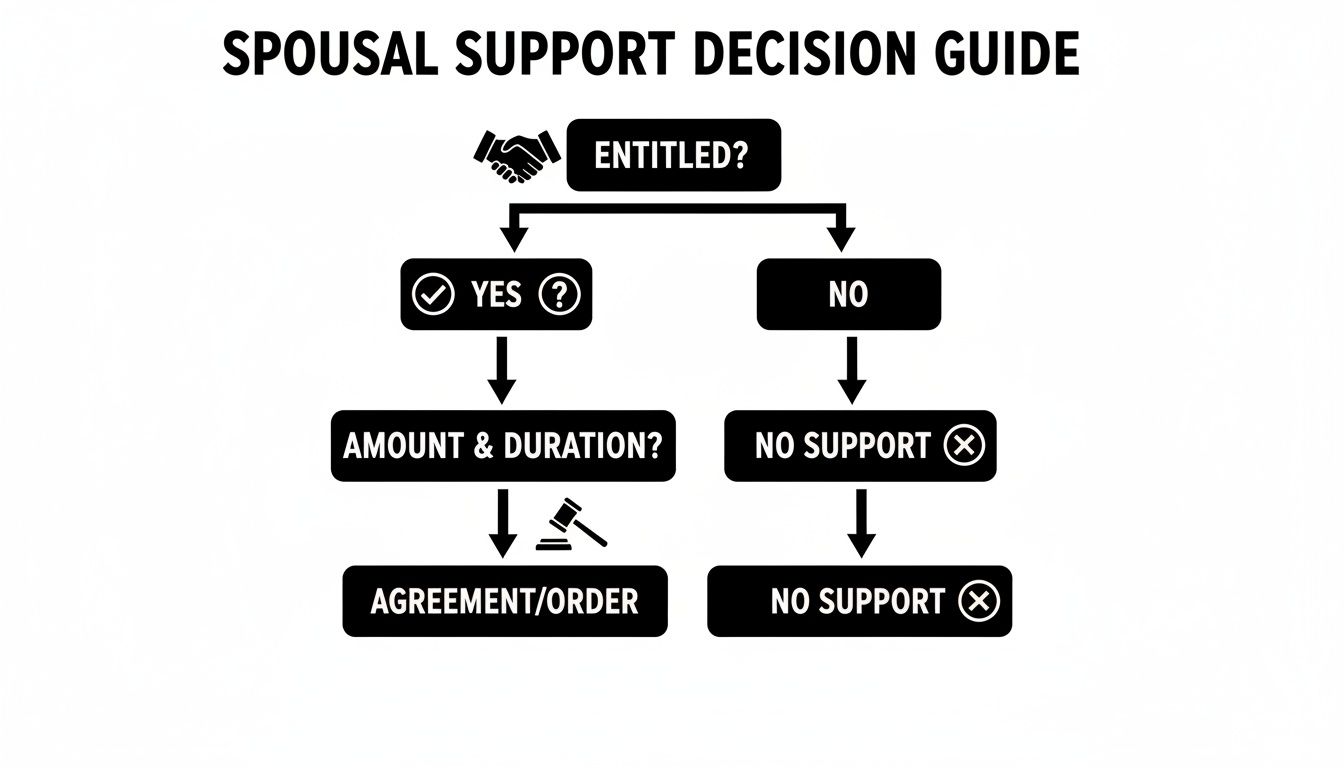
As the chart makes clear, if you can’t establish entitlement based on one of the accepted legal grounds, the path leads directly to a denial. No other factors will even be considered.
The Three Paths to Proving Entitlement
Your claim must be grounded in one of three specific legal arguments. Failing to build your case on at least one of these pillars is a primary reason a spousal support claim is denied. Let’s break down these legal grounds.
The Three Grounds for Spousal Support Entitlement in Ontario
| Ground for Entitlement | Basis of the Claim | Common Example Scenario |
|---|---|---|
| Compensatory | One partner sacrificed career or economic opportunities for the benefit of the family. | A spouse leaves their job to raise children for 15 years, allowing the other spouse to build a high-earning career. |
| Non-Compensatory (Needs-Based) | The breakdown of the relationship left one partner in genuine financial need, while the other has the ability to help. | After a 20-year marriage, a partner with a chronic illness is unable to work and cannot cover their basic living expenses post-separation. |
| Contractual | A valid legal agreement (like a prenup or separation agreement) outlines the right to spousal support. | The couple signed a cohabitation agreement stating that if they separate after 10 years, one partner will pay the other a set amount of support. |
Successfully arguing your case under one of these categories is absolutely essential. It applies to both married and common-law spouses, though specific rules can differ. You can learn more in our guide on spousal support for common-law partners in Ontario.
Key Insight: A significant income difference, on its own, does not automatically create an entitlement to spousal support. You must connect that disparity directly to the roles you both took on during the relationship or show that it has created a genuine inability for you to meet your basic needs.
For those looking to explore different scenarios, tools like the supportGPT application can offer valuable insights.
Denial Reason One: Short-Term Relationships Without Dependency

One of the most straightforward reasons spousal support gets denied is the length of the relationship. When a marriage or common-law partnership is brief, the legal system assumes you haven’t created the kind of deep economic link that requires one person to support the other long-term.
A 20-year marriage is like a complete business merger where finances and careers become tangled. A short-term relationship, however, is more like a temporary joint venture. The court’s goal isn’t to create a lasting financial tie but to help each person return to their pre-relationship financial footing as quickly as possible.
The Five-Year Guideline and Common Mistakes
While there’s no magic number, relationships under five years—especially without children—are almost always seen as short-term by Ontario courts. The shorter the union, the weaker the argument for support.
A judge will look for hard evidence of economic integration. Did one of you give up a career? Did you buy a house together? In a two or three-year relationship, the answer is usually “no.” Without that dependency, a judge will likely decide there’s no entitlement.
A common mistake is waiting too long after separation to file a claim. If you wait months or even years, you send a signal that you were managing on your own, undermining any argument of need. This delay can be a fatal flaw in your case.
A Word of Caution: The passage of time weakens a spousal support claim. A court may view a delayed application as proof that you were self-sufficient and that any current financial hardship is unrelated to the marriage.
To get a better handle on how roles can be defined even while living together, it’s worth reviewing the details of cohabitation agreements in Ontario.
Denial Reason Two: The Expectation Of Self-Sufficiency

In Ontario family law, spousal support is a transitional bridge, not a permanent destination. A core principle is the expectation that both people will make a real effort to become financially independent. A claim can be dead in the water if the person asking for money is already self-sufficient or hasn’t taken meaningful steps to get there.
The Duty to Become Self-Sufficient
The law is straightforward: every adult has a duty to support themselves to the best of their ability. While a court will recognize genuine barriers like illness or age, it will still look for evidence of effort.
To build a stronger case, you must demonstrate proactive steps:
- Actively searching for a job: Keep detailed records of applications and interviews.
- Going back to school or retraining: Enrolling in courses that boost your job prospects is powerful evidence.
- Updating your skills: Taking online courses shows a serious commitment to re-entering the workforce.
The Concept Of Imputed Income
What happens if someone can work but chooses not to? This is where imputed income comes into play. The court assigns a potential income to a person who is voluntarily unemployed or underemployed. It calculates support based on what you should be earning, not your actual low income.
A judge may impute income if they believe a party is intentionally depressing their earnings to either increase the support they receive or decrease the support they have to pay. It is a tool used to ensure fairness.
For example, a former accountant who takes a part-time retail job after separation could have an accountant’s salary imputed to them. This action could drastically reduce or eliminate a spousal support award. While our guide on using a spousal support calculator in Ontario can give you a baseline, imputed income can change the numbers dramatically.
Other Reasons a Judge Might Deny Spousal Support
Beyond relationship length or self-sufficiency, a few other common-sense reasons can stop a claim. These roadblocks are based on fairness and evidence.
The Power of a Valid Domestic Contract
One of the cleanest ways to settle the issue is with a domestic contract. Agreements like a prenuptial agreement or a separation agreement carry significant weight. If you both signed a contract with independent legal advice that clearly waives the right to spousal support, a court will almost always honour it.
For the waiver to be ironclad, it must be done right. A judge will ensure:
- There was full and honest financial disclosure from both parties.
- Each person received independent legal advice.
- The agreement was signed voluntarily, without pressure or coercion.
The Misunderstood Role of Misconduct
Many people assume bad behaviour, like cheating, will be punished by the court. In reality, that’s almost never the case.
Under Canada’s Divorce Act, marital misconduct is not a factor in determining spousal support. The court’s job is to deal with the financial fallout of the breakup, not to play moral referee.
The only time bad behaviour might matter is if it directly wrecked the family’s finances, such as a gambling addiction. The act of infidelity itself has zero impact on a spousal support claim.
No Real Income Gap or Hiding Financials
Finally, there are two practical, money-related reasons a judge will deny support. First, if both partners earn similar incomes and can maintain a comparable standard of living, there’s no financial gap to fill.
Second, the system is built on financial transparency. You have a legal duty to provide complete and honest disclosure (tax returns, pay stubs, etc.). Refusing to provide these documents can lead a judge to draw an adverse inference, assuming the information would not help your case and potentially denying your claim outright.
Serving Brampton and the GTA
While the rules are the same across Ontario, navigating the courthouses of Brampton, Mississauga, and the Greater Toronto Area requires local expertise. A local family lawyer understands the nuances of the Peel Region courts and how a particular judge might view your case.
When you’re preparing for a spousal support case in Brampton, one of the first practical steps is understanding the financial commitment involved. That includes getting a clear picture of typical lawyer consultation fees so you can budget for the road ahead. If you need clear, direct advice on your specific situation near you, our team can help.
Related Reading
- Spousal Support in Ontario with an Experienced Lawyer
- What to Know About Family Law in Brampton
- The Complete Guide to Cohabitation Agreements in Ontario
- How a Spousal Support Calculator in Ontario Works
- Spousal Support for Common-Law Partners in Ontario
Frequently Asked Questions
Can my spousal support claim be denied if I live with a new partner?
Yes, this is a common reason for denial. Moving in with a new partner is seen as a major financial change. The court assumes your new partner contributes to household expenses, which reduces or eliminates your need for support from an ex-spouse and directly undermines a needs-based claim.
Does misconduct like adultery automatically disqualify me from support?
No. Canada’s Divorce Act is clear that marital misconduct is irrelevant to spousal support entitlement. A court’s job is to address the financial consequences of the separation, not to assign blame. The only exception is if the behaviour directly harmed the family’s finances.
What happens if my ex-spouse and I earn similar incomes?
If your incomes are close, a spousal support claim is very likely to be denied. Support is intended to correct a significant economic imbalance created by the relationship. When no such financial gap exists, a court will almost always conclude that both parties are self-sufficient and no support is required.
Is spousal support denied if there are no children from the marriage?
Not automatically, but it makes denial more likely, especially in shorter marriages. Without children, it is harder to make a compensatory claim (arguing you sacrificed your career for the family). However, a needs-based claim might still be valid in a long-term marriage due to age or health.
What if I signed a prenup waiving spousal support?
A valid prenuptial or separation agreement that waives spousal support is a powerful document. As long as it was signed with full financial disclosure and independent legal advice for both parties, a court will almost certainly uphold it and deny any subsequent claim for support.
How long do you have to be married to get spousal support in Ontario?
There is no “minimum” time, but duration is a critical factor. For marriages under five years without children, spousal support is often denied. For longer marriages, especially over 20 years, some form of support is much more likely if there is a valid entitlement claim.
Disclaimer: This article is for informational purposes only and does not constitute legal advice. Please consult with a qualified family lawyer to discuss your specific situation.
Written by the legal team at Badesha Law, dedicated to providing expert family law guidance in the GTA.
Why Choose Badesha Law?
Navigating the complexities of when spousal support is denied requires clear, experienced legal guidance. At Badesha Law, we provide the precise representation you need to protect your financial future in Brampton and the surrounding areas. Our deep understanding of local court practices gives you a distinct advantage.