Spousal Support Eligibility in Ontario

If you are separating or divorcing in Brampton, one of the biggest questions is often whether spousal support may be owed, or whether you may be entitled to receive it. Many people assume support is automatic after marriage or that it only applies when one spouse never worked. In Ontario, the reality is more nuanced.

Spousal support is about more than a simple income gap. The law looks at the nature of the relationship, the roles each person took on during it, the financial impact of separation, and whether one person is at an economic disadvantage because of the relationship or its breakdown. In some cases, support is clearly appropriate. In others, entitlement is weak or may not exist at all.

For separating spouses in Brampton and across Ontario, it helps to break the issue into three separate questions:

  1. Eligibility: Does this person have a legal basis to ask for spousal support?
  2. Amount: If support is appropriate, how much might be paid?
  3. Duration: If support is appropriate, how long might it last?

Those questions are related, but they are not the same. A person can qualify to make a claim and still receive less support than expected, or support for a shorter time than expected.

What Is Spousal Support?

Who Counts as a Spouse Under Ontario and Federal Law

Two gates, not one

Where You Stand Before You Ask About Spousal Support Eligibility

Spousal support is money paid by one spouse or partner to the other after separation or divorce in certain circumstances. Its purpose may include compensating someone for economic disadvantages linked to the relationship, helping with financial need after separation, or supporting a transition toward greater financial independence.

The main legal framework comes from the federal Divorce Act for married spouses who are divorcing, and Ontario’s Family Law Act for married and eligible common-law partners in Ontario. Public guidance from Ontario.ca also makes clear that support is not automatic just because a relationship has ended.

In practical terms, spousal support after divorce or separation may arise when one person earned much more, one partner stepped back from a career for children or family responsibilities, or one person is left in genuine financial hardship after the relationship ends.

Is Spousal Support Automatic After Divorce?

No. Spousal support is not automatic after divorce, separation, or the end of a common-law relationship.

This is one of the most common misunderstandings in family law. A marriage certificate alone does not guarantee support. A large income difference alone does not guarantee support either. The person asking for support usually needs to show a legal basis for entitlement.

That is why it is important to separate these issues:

  • Being married or qualifying as a spouse gives someone the ability to raise a support claim.
  • Entitlement determines whether support should be paid at all.
  • Amount and duration are considered only after entitlement is established.

The Department of Justice Canada explains that spousal support may be based on compensatory and non-compensatory considerations, and that each case turns on its own facts.

Where You Stand Before You Ask About Spousal Support Eligibility

A useful way to think about spousal support eligibility is to picture two gates, not one.

Two gates, not one

The first gate is status. You must be a spouse for support purposes, either because you are married or because you meet Ontario’s common-law support rules.

The second gate is entitlement. Even if you are a spouse in law, support is not automatic. You still need to show a legal basis for support, such as economic disadvantage, need, or a history of roles that affected one person’s earning capacity.

This two-step framework helps answer many common questions quickly. For example, someone may clearly count as a spouse but still have a weak support claim. Someone else may have a strong entitlement argument, but only if they can first prove common-law status.

Who Counts as a Spouse Under Ontario and Federal Law

Married spouses

If you are legally married, you may be able to claim spousal support under the Divorce Act or Ontario’s Family Law Act, depending on the type of proceeding.

Common-law partners

In Ontario, some common-law partners can also claim support under the Family Law Act. A partner may seek support if the parties:

  • lived together continuously for at least three years, or
  • lived together in a relationship of some permanence and are the parents of a child together

This is why common law spousal support Ontario claims are very real, even where the parties never married.

Am I Eligible for Spousal Support in Ontario?

There is no single checklist that guarantees entitlement, but the following signs often mean it is worth getting legal advice.

You should consider speaking with a family lawyer if one or more of these apply:

  • there is a significant income difference between you and your spouse or former partner
  • you stayed home to raise children during part of the relationship
  • you reduced your work hours or career growth because of family responsibilities
  • you helped your spouse build a career, business, or professional practice
  • you were financially dependent during the relationship
  • you are having difficulty becoming financially independent after separation
  • you have a health issue, age-related limitation, or work interruption that affects your earning ability
  • you were in a long-term relationship where one person carried more of the domestic or caregiving role

These factors do not automatically guarantee support. They simply suggest that a closer legal assessment may be important.

Questions about eligibility? Call 289 406 0110

A person may have several of these factors and still face arguments against support. On the other hand, even someone who worked throughout the relationship may still have a valid claim if the relationship created an economic disadvantage.

Who Qualifies for Spousal Support in Ontario?

When people ask who qualifies for spousal support, the answer usually starts with relationship status and then moves to entitlement.

Broadly speaking, support claims are more likely to arise where there is:

  • financial need after separation
  • a history of career sacrifice during the relationship
  • unequal economic consequences from family roles
  • illness, disability, age, or reduced earning capacity
  • a long relationship where one person became financially dependent

The law does not require every factor to be present. The question is whether there is a legal basis for support on the facts of that relationship.

The Difference Between Eligibility, Amount, and Duration

discussion of when spousal support is denied

This distinction matters in almost every spousal support eligibility case.

1. Eligibility

Eligibility asks whether there is a legal basis for support.

2. Amount

If support is appropriate, the next issue is how much should be paid. This often involves income information and the Spousal Support Advisory Guidelines, usually called the SSAG.

3. Duration

Duration asks how long support may continue. Some support orders are time-limited. Others may be indefinite, subject to later review or variation.

People often jump straight to the monthly number, but that can be a mistake. If entitlement is weak, the amount may not matter because support may not be ordered at all.

Factors Considered When Determining Entitlement

Ontario courts do not use a single mechanical rule. Instead, the analysis usually focuses on the relationship and its financial consequences.

Income differences between spouses

A higher income can be relevant, but it does not automatically mean support is payable. The law does not simply equalize incomes. Instead, the court looks at why there is a difference and whether the relationship created economic disadvantage or need.

Career sacrifices and stay-at-home parents

One of the strongest support claims often arises where one spouse stayed home with children, worked less, turned down promotions, or left the workforce to support the family. In those situations, the person may have lost income, pension growth, work experience, or long-term earning potential.

Compensatory support

Compensatory support is meant to address economic loss or disadvantage caused by the relationship or its breakdown. For example, if one spouse paused a career to care for children while the other built earning power, support may be used to recognize that imbalance.

Needs-based or non-compensatory support

Support can also be based on financial need, especially after a long relationship or where a person cannot reasonably become self-sufficient right away. This is sometimes described as non-compensatory support.

Age, health, and employability

A person’s age, health, and realistic ability to return to work can all affect entitlement. A short interruption in work may be easier to recover from than a long absence from the workforce.

Roles during the relationship

Courts often look at how responsibilities were shared. If one spouse advanced professionally while the other took on more childcare, household management, or support work behind the scenes, that history may matter.

Can Both Working Spouses Still Have a Spousal Support Claim?

Yes. Both spouses working does not automatically rule out spousal support.

A person may still have a valid claim even if they are employed full time, especially if:

  • they earn much less than the other spouse
  • they gave up advancement opportunities for family reasons
  • they moved for the other spouse’s career
  • they took on primary childcare or domestic responsibilities that affected earnings
  • their current income does not reflect what they could likely have earned without those sacrifices

A working spouse may still have an entitlement claim if the relationship created an economic disadvantage or if there is real ongoing need.

Common-Law Spousal Support in Ontario

A strong section on common-law support matters because many people in Brampton assume that common-law partners have no support rights. That is not correct.

Under Ontario’s Family Law Act, a common-law partner may seek support if the parties:

  • lived together continuously for at least three years, or
  • lived together in a relationship of some permanence and are the parents of a child together

This means common law spousal support Ontario claims can exist even when the couple never married.

Common-law support rights are different from property rights

This is a critical distinction. Common-law partners may have support rights, but that does not mean they have the same automatic property division rights as married spouses. Support and property are separate legal issues.

A person may have a support claim but no automatic right to equalization of net family property. That is one reason common-law separation often requires careful legal review of both support and property questions.

What courts may look at in common-law cases

Common-law support cases often turn on proof of the relationship itself and the roles each partner had. Helpful evidence may include:

  • leases or mortgage records
  • joint bills or shared accounts
  • tax documents
  • proof of shared address
  • records showing parenting roles or financial dependence
  • messages or documents showing how the parties organized their lives

how spousal support is calculated in Canada

For many people searching who qualifies for spousal support after a common-law breakup, the answer depends on both relationship status and the same entitlement factors that apply in married cases.

A four-step infographic explaining how spousal support advisory guidelines determine payment amounts and duration.

Does Cheating Affect Spousal Support?

Usually, no.

In Canada, family law generally does not award or deny spousal support based on who was morally at fault for the relationship breakdown. Adultery may matter in a divorce context for ending the marriage, but it does not usually determine spousal support entitlement.

The real questions are economic. Did the relationship create financial disadvantage, dependence, or need? Is there a legal basis for support under the law?

That means cheating is often emotionally significant, but it is usually not legally decisive for support.

Child Support Versus Spousal Support

People often confuse child support and spousal support, but they serve different purposes.

  • Child support is for the support of the child.
  • Spousal support is for the spouse or former partner.

Child support usually takes priority when both are being considered. A parent cannot trade away a child’s support rights simply to settle a spousal issue. The legal analysis, calculation methods, and policy goals are different.

In many family law files, both issues need to be assessed together because child support obligations can affect the range used for spousal support calculations under the SSAG.

How Is Spousal Support Generally Calculated?

Once entitlement is established, lawyers and courts often use the Spousal Support Advisory Guidelines to help estimate a range for amount and duration.

The SSAG are not legislation, but they are widely used across Canada as a practical framework.

The calculation usually depends on factors such as:

  • each spouse’s income
  • whether there are dependent children
  • the amount of child support being paid
  • the length of the relationship or cohabitation
  • the ages of the spouses
  • any other relevant financial circumstances

There are different formulas for cases with child support and without child support. Because of that, online estimates can be misleading if income is unclear or parenting arrangements are still in dispute.

family law services in Hamilton and the GTA

How Long Does Spousal Support Last?

There is no universal answer.

Support may last for:

  • a short transition period
  • several years
  • an indefinite period, especially after a long relationship or where age or health affects self-sufficiency

The SSAG provide ranges for duration, but outcomes vary depending on the facts. In some cases, support is reviewed after a set period. In others, it continues unless there is a later material change.

Factors that may affect duration include:

Badesha Law’s free consultation page

  • length of the relationship
  • age of the spouses
  • time out of the workforce
  • childcare responsibilities
  • efforts toward financial independence
  • health and employability

Indefinite support does not always mean permanent support. It often means there is no fixed end date at the time of the order.

Separation Agreements and Spousal Support

Many spousal support issues are resolved by agreement rather than trial. A separation agreement may set out whether support will be paid, how much, for how long, and whether it can later be reviewed or changed.

That said, an agreement should be approached carefully. If one party did not understand their rights, lacked disclosure, or signed under pressure, support terms may later be challenged.

Good agreements are usually based on:

  • complete financial disclosure
  • realistic legal advice
  • clear language about amount, duration, review, and termination
  • coordination with child support and property issues

Before signing away support rights or agreeing to pay support, it helps to understand what a court might have done in the same situation.

What Happens When Spouses Cannot Agree?

When spouses cannot agree on support, the issue may be resolved through negotiation, mediation, lawyer-assisted settlement discussions, court motions for temporary support, or a trial.

In Brampton family law matters, the outcome often depends on the quality of financial disclosure and the strength of the entitlement argument. If one person is self-employed, underreporting income, or refusing disclosure, the case can become more complex.

When a dispute reaches court, the judge may consider the legislation, the evidence, prior agreements, and the SSAG framework. Temporary support may be ordered while the case is ongoing.

Why This Matters in Real Life

Many people searching about spousal support Ontario want a simple yes or no answer. In real life, support cases rarely work that way.

A person may have a strong claim but need proper financial disclosure to prove it. Another person may worry they will automatically have to pay support because they earn more, when the legal picture is actually much more limited. Some cases settle early. Others turn on small but important facts, such as who took time away from work, whether a relationship qualifies as common-law, or whether child support changes the support range.

That is why early legal advice can make a real difference. Understanding the difference between status, entitlement, amount, and duration often helps people make better decisions before signing an agreement or taking a firm position.

Simple Hypothetical Examples

Example 1: Stay-at-home parent after a long marriage

Priya and Aman were married for 14 years in Brampton. Priya left her job when their children were young and only recently returned to part-time work. Aman earns substantially more. Priya may have a strong claim for support because the relationship appears to have affected her earning capacity and left her financially disadvantaged after separation.

Example 2: Both spouses work, but one career was limited

Sara and Daniel both work full time. Daniel earns more, but that alone does not decide the issue. During the relationship, Sara turned down promotions and handled most of the childcare so Daniel could travel for work. Sara may still have a spousal support claim even though she is employed.

Example 3: Common-law relationship with a child

Nina and Raj lived together for four years in Ontario and have one child. They never married. Nina reduced her hours after the child was born and became partly financially dependent. Nina may be able to pursue common law spousal support Ontario under the Family Law Act, even though property rights may be different from those of married spouses.

These examples are simplified. Real outcomes depend on the full facts, income evidence, and legal context.

FAQ

Who qualifies for spousal support in Ontario?

A person may qualify if they are a married spouse or an eligible common-law partner and can show a legal basis for support, such as financial need, career sacrifice, caregiving impact, or economic disadvantage caused by the relationship.

Is spousal support automatic?

No. Spousal support is not automatic after separation or divorce. The person asking for support must usually show entitlement based on the facts of the relationship and its financial consequences.

Can common-law partners get spousal support?

Yes. In Ontario, some common-law partners can seek support under the Family Law Act if they lived together continuously for at least three years, or if they were in a relationship of some permanence and had a child together.

Do I have to pay spousal support if my spouse works?

Possibly. A working spouse may still have a support claim if there is a significant income gap, past career sacrifice, childcare-related disadvantage, or ongoing financial need.

Does a higher income automatically mean support is payable?

No. Higher income is important, but it does not automatically create support. The legal analysis also looks at entitlement, economic disadvantage, need, and the history of the relationship.

How is spousal support calculated?

After entitlement is established, support is often estimated using the Spousal Support Advisory Guidelines. The calculation usually considers incomes, length of relationship, child support, and other financial factors.

How long does spousal support last?

It depends. Support may be short term, time-limited, or indefinite, depending on factors such as the length of the relationship, age, health, work history, and the ability to become self-sufficient.

Does cheating affect spousal support?

Usually not. Spousal support is generally based on financial and legal factors, not moral blame for the relationship ending.

Speak With a Spousal Support Lawyer in Brampton

If you are unsure whether you may have a claim, or whether you may have to pay support, it helps to get advice before making assumptions or signing an agreement. A spousal support lawyer Brampton families trust can help review entitlement, income issues, common-law status, separation terms, and likely support ranges.

Book a free consultation with Badesha Law to get clear answers about your support rights and obligations. If you are separating or divorcing in Brampton, early legal advice can help you avoid costly mistakes and take the right next steps with confidence.

Book Your Free Consultation, Call 289 406 0110

At Badesha Law, we help clients in Brampton understand their possible rights and obligations involving spousal support, divorce, separation, child-related issues, and financial claims that arise when relationships end. Early advice can make a major difference in how you negotiate, what documents you gather, and what outcome may be realistic.

If you are dealing with separation or divorce in Brampton, Badesha Law can help you assess whether support may be owed, whether support may be challenged, and what practical next steps make sense for your situation.

Speak With Badesha Law Today, Free Consultation

You may also want to explore related support and family law topics, including Divorce Lawyer Brampton, Family Lawyer Brampton, Separation Agreements, Child Support, Property Division, and the Contact page.


A Guide to Spousal Support Calculator in Ontario: Actionable Insights for Brampton Families

Experiencing a separation in Brampton can be daunting, and financial insecurity further increases the pressure. Consulting a spousal support calculator in Ontario is an important initial step, providing an early estimate of potential outcomes tailored to your family’s specifics. This tool offers clarity and a practical guide for what to anticipate, based on Ontario’s Family Law Act. For additional support and guidance, consider reaching out to a Brampton family lawyer, such as Badesha Law, for professional assistance.

Your First Step in Understanding Spousal Support

A person uses a laptop displaying a spousal support calculator for Ontario on screen.

Experiencing a separation in Brampton often brings emotional and financial challenges, with spousal support being a common concern. Questions usually arise about how it works, who qualifies, and what the payments might be. This guide aims to clarify this aspect of family law and offer practical advice.

We will highlight useful tools, particularly online spousal support calculators. These should be viewed as a starting point rather than a definitive solution. They apply legal guidelines to your specific situation, providing an initial financial estimate.

Having this estimate helps you plan your next steps with greater confidence. For those in Brampton, understanding these numbers is crucial for managing expectations and preparing for negotiations or court proceedings.

The Legal Framework Behind the Calculator

Every spousal support calculator in Ontario is built on a specific legal framework established by the Family Law Act and federal legislation. It doesn’t just pull numbers out of thin air; it applies a set of established rules to your financial data to create a predictable and consistent approach.

The most influential tool used by lawyers and judges in Brampton is the Spousal Support Advisory Guidelines (SSAGs). The SSAGs are essentially a set of formulas that estimate support amounts by looking at factors like the length of your relationship, the difference in your incomes, and any child support obligations.

A calculator provides a baseline by applying the SSAG formulas to your unique situation. This turns abstract legal principles into a concrete financial range, showing potential monthly payments and duration.

This framework ensures the calculations aren’t arbitrary. They are rooted in the principles of Ontario’s family law, which aims to address the financial advantages or disadvantages that arise from a relationship or its breakdown, ensuring a fair and equitable resolution.

What the Calculator Aims to Achieve

The purpose of spousal support—and by extension, the calculator—is to achieve several key goals recognized by law. Understanding these goals helps make sense of the numbers the calculator produces. The main objectives include:

  • Recognizing Contributions: To compensate a spouse for sacrifices made during the relationship, such as pausing a career to raise children in your Brampton home.
  • Addressing Financial Hardship: To help a lower-income spouse manage the financial difficulties that often come with a separation.
  • Promoting Self-Sufficiency: To support a spouse for a specific period while they take actionable steps to become financially independent again.

A calculator is your starting point for seeing how these principles might apply to you, turning complex legal ideas into an understandable financial preview.

Gathering Your Financial Information

An Ontario spousal support calculator is only as accurate as the information you provide. To get an actionable and reliable estimate, you must start with precise financial details.

Before you go online, your first step is to get your financial paperwork in order. This isn’t just busywork; it’s about ensuring the numbers you use are grounded in reality. For families in Brampton, having these details ready makes the entire process smoother and prepares you for productive discussions with a family lawyer.

Your Essential Document Checklist

To get a clear and accurate estimate, you’ll need to pull together a few key financial documents. These papers contain the specific numbers that the Spousal Support Advisory Guidelines (SSAGs) rely on. The goal is to create an honest picture of each spouse’s financial life.

Here’s a practical table outlining exactly what you’ll need.

Checklist for Spousal Support Calculation

Information Needed Why It Matters Common Documents to Check
Gross Annual Income This is the foundation of the entire calculation. It determines each spouse’s financial capacity. T1 General Tax Returns (look for Line 15000), Notices of Assessment (NOA) from the CRA.
Recent Pay Information Confirms current earnings and deductions, ensuring the income used is up-to-date. Recent pay stubs (last 2-3).
Business Financials Crucial for self-employed individuals to determine the actual income available for support. Profit & loss statements, balance sheets, corporate tax returns.
Key Relationship Dates The length of the relationship directly impacts how long support might be paid. Marriage certificate, cohabitation records (leases, joint bills), separation agreement drafts.
Birthdates Ages of the spouses and children can influence both the amount and duration of support. Birth certificates, passports.
Child Support Amount Child support is calculated first and affects the income available for spousal support. Child support order or written agreement, bank statements showing payments.

Having these documents organized not only helps you get a better estimate but also prepares you for a productive first meeting with your Brampton family lawyer.

Key Dates and Family Details

It’s not all about the money. The calculator also needs to understand the timeline of your relationship and your family structure. These details are critical, as they heavily influence both the amount and the duration of potential spousal support under the Family Law Act.

Make sure you have these dates and details written down:

  • Date of Marriage or Cohabitation: The day you officially began living together as a couple.
  • Date of Separation: The date you stopped living together in a marriage-like relationship.
  • Birthdates: You’ll need your own, your spouse’s, and the birthdates of any children you share.
  • Child Support Information: If child support is already being paid, you must have the exact monthly figure. In Ontario, child support is always the top priority.

It is absolutely critical to remember that child support comes first. Calculators use a different formula when children are involved to ensure the paying spouse can meet their spousal support obligations after their child support duties are met.

Gathering all this information might feel tedious, but it’s essential groundwork. A well-organized file doesn’t just give you a more accurate calculator result; it puts you in a much stronger position for productive discussions with a family lawyer in Brampton when you’re ready to take that next step.

How to Use an Online Spousal Support Calculator

Once you have your financial documents in order, you’re ready to turn those numbers into a real-world estimate. Using an online spousal support calculator in Ontario is a straightforward process, and knowing what you’re looking at makes the experience much more productive. Let’s walk through a realistic scenario relevant to a family in Brampton.

Imagine a couple, Priya and Raj, who live in Brampton. They’ve been married for 15 years and have two kids, aged 10 and 12. Priya has a gross annual income of $65,000, while Raj earns $110,000. After separating, they’ve agreed that Priya will have primary care of the children. This scenario will be our guide as we plug the numbers into a calculator.

A Step-by-Step Walkthrough

Most online calculators are set up in a similar, logical way. You’ll enter your information into specific fields, and the software runs it through the Spousal Support Advisory Guidelines (SSAGs) formulas to give you a result.

Here’s the typical process you can expect:

  1. Enter Incomes: First, input the gross annual income for both spouses. For Priya, we’d enter $65,000, and for Raj, $110,000.
  2. Input Key Dates: Next, you’ll enter the date you started living together or married, and the date of separation. For our Brampton couple, this covers a span of 15 years.
  3. Provide Children’s Information: You will need to add the number of children and their birthdates. This is a critical step because child support is always calculated first and takes priority under Ontario’s Family Law Act.
  4. Specify Parenting Arrangement: The calculator needs to know the parenting schedule, as it directly impacts the child support calculation. In this case, Priya has primary care.
  5. Run the Calculation: With all the data entered, you hit the “calculate” button to see the estimated range.

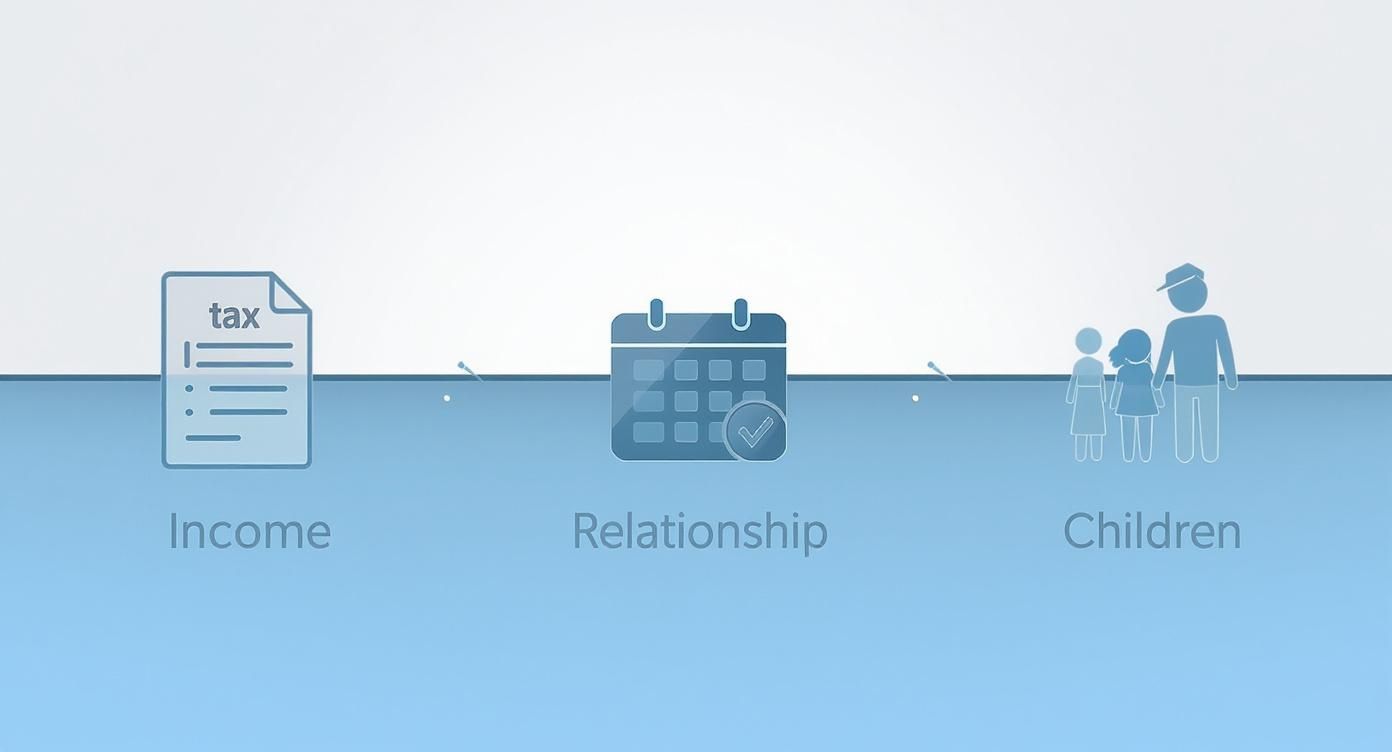
These three core pieces of information—income, relationship details, and the children’s situation—are the building blocks for any spousal support calculation.

Icons representing income (tax document), relationship (calendar), and children (family) as factors for support calculations.

Think of each one as a vital ingredient that the SSAG formulas use to generate the final estimated support range.

Interpreting the Results

After completing the calculations for Priya and Raj, the tool produces a detailed report. This report highlights two critical aspects: the potential support amount and the duration of payments.

The results are presented as a range (low, mid, high). This approach is intentional because the Spousal Support Advisory Guidelines (SSAGs) serve as recommendations rather than strict rules. Judges have the flexibility to determine an amount anywhere within that range—or even outside it—based on the unique circumstances presented in a Brampton courthouse.

  • Amount (Quantum): This refers to the estimated monthly support payment. For Priya and Raj, the calculator might indicate a range from $650 (low) to $1,200 (high) per month. Typically, the “mid-range” figure acts as a starting point for negotiations.
  • Duration: This reflects the length of time the payments are expected to continue. Given a 15-year marriage, the duration would likely range from 7.5 to 15 years. In some long-term relationships, support may be indefinite.

Reputable online calculators offer reliable estimates that align with those used by courts, converting abstract legal formulas into a clear financial snapshot. For our Brampton couple, this provides a realistic baseline. Priya gains a clearer understanding of what she might receive, while Raj obtains a better grasp of his potential obligations. This is the first practical step toward achieving financial clarity.

Using a spousal support calculator in Ontario provides a set of numbers that offer insight into your financial future. These figures—the low, mid, and high estimates—indicate where your final agreement or court order might fall.

Understanding how to interpret this range is crucial in transforming a simple estimate into an effective planning tool. The “mid-range” number often serves as the starting point for negotiations, representing a neutral application of the Spousal Support Advisory Guidelines. However, various factors can influence the final amount toward either end of that spectrum.

The Story Behind the Low to High Range

The SSAGs were designed with flexibility to account for the real-world complexities a calculator can’t understand. For families in Brampton navigating a separation, these details are crucial. A judge or mediator will always look beyond the raw numbers to the unique circumstances of your life.

What might push an award toward the high end of the range?

  • Significant Debt Load: If one spouse is left with significant family debt from the relationship, higher support may be needed.
  • Career Sacrifices: A strong case showing one spouse gave up major career opportunities for the family can justify a higher amount.
  • Health Concerns: If the recipient has health issues that hinder their ability to become self-sufficient, a higher figure may be necessary.

Conversely, some situations could pull the final number closer to the low end:

  • Significant Assets: If the lower-income spouse received a substantial share of assets from property division, their immediate need for support might be less.
  • Shorter Relationships: For relationships on the shorter side of the scale, a judge might lean toward the low end.
  • Payor’s Hardships: If the paying spouse has unusually high and unavoidable expenses, it could influence the final amount.

The calculator gives you the map, but your personal circumstances create the route. A skilled Brampton family lawyer can build a compelling case for why your situation justifies a specific outcome within those guidelines.

Understanding the Two Key Formulas

You’ll notice the calculator asks whether you have children for a critical reason. It automatically applies one of two completely different SSAG formulas based on your answer.

The two main formulas are:

  1. The Without Child Support Formula: For couples with no dependent children. It focuses on the length of the relationship and the income gap to determine the amount and duration of support.
  2. The With Child Support Formula: When children are involved, this formula takes over, built on a core principle of Ontario’s Family Law Act: child support always comes first. This formula calculates child support, deducts it, and then determines spousal support based on what’s left.

This ensures the paying parent can meet both critical obligations, protecting the financial well-being of the children as the law demands. Understanding this is vital for setting realistic expectations.

When a Calculator Is Not Enough

Two women review financial documents; one appears distressed while the other points to a negative trend.

An online spousal support calculator in Ontario is a fantastic tool for a quick financial snapshot, but it’s a starting point, not the final word. The algorithm has blind spots and can’t process the complex, human elements that define every family’s story.

These calculators run on straightforward inputs like gross income. They can’t analyze nuanced financial situations or the unique circumstances that shape a fair support arrangement.

The Spousal Support Advisory Guidelines (SSAGs) are advisory, not absolute law. A judge has the discretion to deviate from a calculator’s range based on the unique facts of your case—a reality every Brampton family should understand.

This is where the calculator’s usefulness ends and the need for legal expertise begins. Your family’s situation is unique, and many factors can dramatically shift the final spousal support outcome.

Complex Income and Hidden Assets

One of the biggest limitations of any calculator is its inability to properly assess complex income streams. For many families in Brampton, income isn’t just a simple salary figure from a T4 slip.

An algorithm can’t dig into the details of things like:

  • Self-Employment Income: A calculator can’t differentiate between legitimate business expenses and personal ones or determine a business owner’s true available income.
  • Variable Compensation: Bonuses, stock options, and commissions fluctuate and require careful analysis to establish a fair income for support.
  • Hidden Assets: A calculator assumes financial transparency. It cannot uncover undeclared income or assets a spouse might be concealing, which can constitute a serious offence under the Criminal Code of Canada if it amounts to fraud.

These situations demand a detailed financial review that goes far beyond what an online tool can manage.

Non-Financial Contributions and Special Expenses

The SSAGs and Ontario’s Family Law Act recognize that contributions to a marriage are not just financial. A calculator cannot quantify the value of a spouse who paused their career to raise children or supported their partner’s professional ambitions. These are powerful arguments that can justify a support award at the higher end of the range.

Furthermore, unique family expenses can significantly impact what’s needed for support. For Brampton families managing high living costs, these details are critical.

Special considerations could include:

  • Expenses for a child with special needs.
  • Unusually high healthcare or medical costs.
  • Significant debts taken on for the family’s benefit.

The reality is that support payments vary widely based on family composition. For example, statistics show that median monthly support payments can range from about $272 for cases with one child to as high as $1,800 when a former spouse and three or more children are involved. You can learn more about these findings on spousal support payments in Canada.

These nuances are exactly where a calculator falls short. It gives you a baseline number, but a truly fair resolution requires a strategy built on the complete story of your relationship and your family’s actual needs.

Taking the Next Step with a Brampton Family Lawyer

Getting an estimate from a **spousal support calculator in Ontario** is a great first step. But once you have those numbers, the most important move is to seek professional legal advice. This turns a rough estimate into a solid, legally sound strategy that protects your future.

For anyone in Brampton, a local family lawyer is your advocate, ensuring your rights under Ontario’s Family Law Act are fully protected. They do more than just run the numbers; they build a case around the unique details of your life that a calculator could never understand.

When to Call a Lawyer

While everyone can benefit from a legal consultation, some situations make it absolutely essential. If you face any of the following, it’s a clear sign that you need professional guidance.

These red flags often include:

  • Disagreements Over Income: Do you suspect your spouse isn’t being fully transparent about their earnings? This is common with self-employed individuals. A lawyer is needed to ensure you get accurate financial disclosure.
  • Complex Property Division: A calculator won’t help with assets. If you have a matrimonial home in Brampton, pensions, or business assets to divide, legal expertise is non-negotiable.
  • High-Conflict Separations: When communication breaks down, a lawyer acts as your representative, managing tough negotiations and protecting you from unfair pressure. It’s important to note that any threats or harassment during this process could engage the Criminal Code of Canada, and a lawyer can advise on the proper steps to ensure your safety.
  • Uncertainty About Entitlement: If you are unsure if you are entitled to support, or if your spouse’s claim is valid, a lawyer can provide a clear assessment based on Ontario law.

A family lawyer’s role is to ensure the final agreement isn’t just a number, but a fair and enforceable resolution. They formalize everything, whether through a separation agreement or a court order, making it legally binding.

Protecting Your Financial Future in Brampton

A lawyer’s guidance is an investment in your stability. They know how to navigate the Brampton courthouse, file the necessary documents, and advocate for an outcome that reflects both the financial and non-financial contributions you made during your relationship.

Ultimately, a spousal support calculator gives you a starting point, but a Brampton family lawyer provides the path forward. They help secure a fair resolution that protects your long-term financial well-being, allowing you to move on with clarity and confidence.

Common Questions About Spousal Support Calculators

It’s completely normal to have questions after using a spousal support calculator in Ontario. The numbers on the screen can be overwhelming. Let’s walk through some of the most common questions Brampton residents ask.

Is the Spousal Support Amount from a Calculator Guaranteed?

Absolutely not. Think of the figure from an online calculator as an estimate—an educated guess, but not a guarantee. These tools are built on the Spousal Support Advisory Guidelines (SSAGs), which are influential but not legally binding laws in Ontario.

A judge in a Brampton court has the final say. They will review the unique details of your case and can set an amount they feel is fair, which may differ from the calculator’s result. The calculator gives you a starting point, not a final court order.

Does the Calculator Use Gross or Net Income?

Spousal support calculators in Ontario always ask for your gross annual income. This is your total income before taxes or deductions—typically found on Line 15000 of your tax return.

The software handles the necessary tax calculations behind the scenes. It takes the gross income for both you and your ex-partner to figure out a fair, after-tax support range that aligns with the Family Law Act.

Can I Use a Calculator if My Ex-Partner Is Self-Employed?

You can, but you must be extremely cautious. Determining the true income of a self-employed person is one of the trickiest parts of family law. A simple calculator can’t analyze business statements, differentiate between legitimate expenses and personal spending, or uncover hidden income.

When dealing with self-employment or cash-based income in Brampton, a calculator’s estimate can be unreliable. This is a significant indicator that you need professional legal and financial experts to ensure a fair and accurate income determination.

How Does Child Support Affect Spousal Support Calculations?

Child support always comes first—it’s the top priority under the Family Law Act. The children’s financial needs must be met before anything else. The SSAGs are built around this principle and use a different formula when kids are involved.

This “With Child Support” formula calculates the required child support amount first. Only then does it determine spousal support based on what’s left of the payor’s income. This ensures the paying parent can cover both obligations without compromising the children’s financial security. A calculator does this automatically, but understanding the legal priority is key to setting realistic expectations.


An online tool is a helpful first step, but it can’t replace personalized legal advice. For guidance that truly considers every detail of your unique situation in Brampton, you can trust the experienced team at Badesha Law. We work to protect your rights and fight for a fair resolution that secures your financial future. Contact us today to schedule a consultation.