

Separation Agreement Ontario for Brampton Residents: Your Essential Guide
When you and your partner decide to go your separate ways, the future can feel like a huge question mark. A separation agreement in Ontario is the first step toward finding answers. It's a legally binding contract that you and your former partner—whether you were married or common-law—create together after deciding to live apart. This document is where you formalize all the big decisions about your future, from property division and spousal support to parenting arrangements, all without a judge having to make those choices for you. For clients in Brampton, this guide will keep you focused on actionable steps that comply with Ontario’s Family Law Act and relevant Criminal Code protections.
What a Separation Agreement Really Means in Ontario

Think of a separation agreement not as a sign of conflict, but as a practical roadmap you and your former partner build together. It’s the rulebook that will guide your financial and parental responsibilities from this point forward, giving you both a clear path to follow.
This private contract puts the power back in your hands, letting you make your own decisions instead of leaving them to the courts. For couples in Brampton and across Ontario, this document offers stability and predictability during what is often a very challenging time. It’s designed to work for both married spouses and common-law partners, making sure everyone’s rights are clearly defined under the province's Family Law Act. If there are existing criminal matters—such as domestic violence charges under the Criminal Code—ensure your agreement does not conflict with any no-contact or peace bond orders; Criminal Code provisions take precedence.
Your Blueprint for a New Beginning
At its heart, a separation agreement is a tool for taking control and creating clarity. It lets you settle the issues that could otherwise drag on for months or even years, leading to bitter disputes and expensive court battles. By dealing with everything upfront, you lay a solid foundation for your new life in Brampton.
A good agreement will typically iron out all the major details, including:
- Property and Debts: How will you split the assets you built together? This covers everything from the matrimonial home and investments to pensions and any shared debts.
- Parenting and Children: This section outlines custody, access schedules (parenting time), and who makes the big decisions for your kids, all to ensure their routine and well-being are protected.
- Financial Support: Here, you’ll determine if one person needs spousal support and calculate child support based on the official federal guidelines.
The Growing Importance of Agreements
Separation agreements have become a cornerstone of modern family law in Ontario. More and more couples are choosing to formalize their separation this way, often without immediately moving on to a divorce. As the number of separations continues to rise—with some studies suggesting up to 40% of married couples may separate—having a solid agreement is more critical than ever. The Ontario Family Law Act gives these agreements their legal weight, protecting the rights and outlining the responsibilities of both parties. You can learn more about the key differences between separation and divorce in Ontario.
A separation agreement is about creating certainty. It transforms verbal understandings into an enforceable contract, protecting you from future misunderstandings and legal challenges. This is your first and most critical step toward a stable, fair resolution.
The Four Pillars of Your Separation Agreement

Think of a strong separation agreement like a well-built house—it needs a solid foundation. In Ontario, that foundation rests on four critical pillars. These aren't just legal sections; they're the main chapters of the rulebook for your new lives apart.
Getting them right is everything. A well-drafted agreement addresses the most significant parts of your shared life—your children, your finances, and your property—to prevent future conflict and create a clear path forward for everyone. Let's break down exactly what needs to be included in your separation agreement Ontario.
Pillar 1: Custody and Parenting Time
When children are involved, their well-being isn't just a priority; it's the only priority under Ontario's Family Law Act. This pillar of your agreement needs to clearly spell out the parenting arrangements. This is about more than just deciding who the children live with; it's about building a predictable and stable routine they can count on.
You’ll need to define two key concepts:
- Decision-Making Responsibility (formerly Custody): This covers who gets to make the big decisions about your children’s lives—think education, major healthcare choices, and religious upbringing. It can be held solely by one parent or shared jointly.
- Parenting Time (formerly Access): This is the nitty-gritty schedule detailing when the children will be with each parent. A solid plan covers the regular weekly routine, but also holidays, summer vacations, and birthdays.
For instance, a couple in Brampton might agree to joint decision-making, meaning they have to consult on big choices. At the same time, they could set a "week-on, week-off" parenting schedule to give their kids much-needed consistency.
Pillar 2: Child Support
Once the parenting schedule is settled, the next logical step is child support. In Canada, this isn't a number you negotiate like any other term. Child support is the legal right of the child, and its calculation follows the mandatory Federal Child Support Guidelines. This provides a structured and predictable framework so there are no surprises.
The amount is calculated based on two main things: the paying parent's gross annual income and the number of children they need to support. The entire goal is to make sure your children continue to benefit from the financial means of both parents, just as they would if you were still together. Your agreement must reflect these guideline amounts unless there's a very specific, justifiable reason to do otherwise.
Pillar 3: Spousal Support
Spousal support is easily one of the trickiest parts of a separation agreement because it’s not an automatic right. Unlike child support, there isn't a simple table to consult. Instead, whether someone is entitled to support depends on factors like the length of the relationship, the roles each person played, and any economic disadvantages one spouse suffered because of the marriage.
If entitlement is established, then you figure out the amount and duration of support, weighing the recipient's needs against the payor's ability to pay.
Spousal support is designed to address financial imbalances that come from the breakdown of the relationship. It can be compensatory (for sacrifices made), non-compensatory (based on need), or contractual (if you agreed to it previously).
Pillar 4: Division of Property and Debts
The final pillar is all about untangling your financial lives. For married couples in Ontario, this process is called equalization. It's a structured way to divide the wealth you built together. Each of you calculates your Net Family Property (NFP), which is basically the value of your assets on the day you separated, minus your debts and any assets you brought into the marriage (with a few exceptions).
The spouse with the higher NFP then makes an "equalization payment" to the spouse with the lower NFP. The goal is simple: you both walk away with an equal share of the wealth accumulated during the marriage. This includes the value of your matrimonial home, pensions, investments, and business assets.
When dividing up your life together, it's crucial to understand how different assets and debts are handled. The table below gives a snapshot of the typical approach under Ontario's family law principles.
Typical Handling of Assets and Debts in an Ontario Separation
| Item | Typical Treatment | Key Consideration |
|---|---|---|
| Matrimonial Home | Value is divided equally, regardless of who is on title. | Cannot be deducted as a date-of-marriage asset, even if owned prior. |
| Pensions & RRSPs | Value accumulated during the marriage is included in NFP. | A professional valuation is often required to determine the correct amount. |
| Bank Accounts/Investments | Balances on the date of separation are included in each spouse's NFP. | Funds must be traced to ensure they weren't gifts or inheritances. |
| Gifts/Inheritances | Excluded from NFP if kept separate and not used for the home. | If co-mingled or put toward the matrimonial home, the exclusion may be lost. |
| Debts (Loans, Credit Cards) | Debts incurred during the marriage are deducted from each spouse's assets. | Must prove the debt was for a family purpose to be included in NFP. |
| Business Assets | Value of the business is included in the owner-spouse's NFP. | A business valuation is almost always necessary and can be complex. |
The matrimonial home, for example, is often a family’s biggest asset and gets special treatment. A couple might decide one person will buy out the other's share, or they may agree to sell it and split the proceeds. Whatever you decide, it must be clearly laid out in the agreement to be legally binding and avoid headaches down the road.
Making Your Agreement Legally Bulletproof

A separation agreement is only as strong as its legal foundation. Without the right elements in place, the document you spent time and money creating could be challenged and overturned by a court, leaving you completely unprotected. To make your separation agreement Ontario truly enforceable, you have to make sure it's legally bulletproof from the very start.
Think of your agreement like building a house. You wouldn't build on shaky ground, and the same principle applies here. There are three non-negotiable pillars that give your agreement the strength to stand up to future scrutiny, ensuring the terms you agree on today will actually protect you tomorrow.
These pillars aren't just suggestions; they are strict requirements under Ontario's Family Law Act. Missing even one can put the entire structure at risk.
The First Pillar: Full Financial Disclosure
The first and most critical pillar is Full Financial Disclosure. This means both you and your former partner must be completely honest and transparent about your financial situations. Every asset, every debt, and every source of income has to be on the table.
This isn't the time for secrets. Hiding a bank account, downplaying the value of a business, or failing to mention a future bonus can invalidate the whole agreement. A court simply will not uphold a contract if it was based on incomplete or misleading information. For example, failing to disclose a work pension could lead a judge to set aside the property division clauses years down the road.
To meet this requirement, both of you will typically need to provide:
- Financial Statements: These are detailed forms that outline all your assets and liabilities.
- Supporting Documents: Think tax returns, pay stubs, bank statements, property appraisals, and pension valuations.
The Second Pillar: Independent Legal Advice
The second pillar is Independent Legal Advice (ILA). This is arguably the most important shield protecting your agreement from ever being challenged. ILA means that each of you has met with your own separate lawyer to review the agreement, understand its terms, and confirm you are signing it voluntarily.
This step proves to a court that neither person was pressured, coerced, or taken advantage of. It confirms that you both understood your rights and obligations under Ontario law and made a truly informed decision. For instance, if one partner later claims they "didn't understand" what they were signing, the ILA certificate from their lawyer serves as powerful evidence against that claim.
A common misconception is that if you and your partner agree on everything, you don't need separate lawyers. This is a dangerous mistake. Without ILA, your agreement has a significant vulnerability that could be exploited down the road.
The Third Pillar: Proper Legal Execution
Finally, the agreement must be executed correctly. This is the formal process of signing the document and making it legally binding. Under the Family Law Act, a domestic contract like a separation agreement must follow specific formalities.
These formalities are straightforward but absolutely essential:
- In Writing: The agreement must be a physical document, not just a verbal understanding.
- Signed: Both you and your ex-partner must sign the final agreement.
- Witnessed: Each of your signatures must be witnessed by another person, who also signs the document.
Without these three simple steps, your agreement isn't legally valid. A handshake deal or an unsigned draft holds zero legal weight in an Ontario family court. By ensuring these three pillars—full disclosure, independent legal advice, and proper execution—are firmly in place, you transform your agreement from a simple document into a legally sound contract that secures your future.
Your Step-by-Step Path to a Final Agreement
Moving from the emotional decision to separate to a signed, legally sound document can feel like a massive undertaking. But the journey to a final separation agreement in Ontario isn’t a mystery—it’s a clear, manageable sequence of steps. Think of it as a roadmap that transforms uncertainty into an actionable plan, putting you back in control.
For our clients in Brampton, the path always starts with getting professional guidance to understand your rights and figure out the best course for your specific circumstances.
Step 1: Initial Consultation and Information Gathering
Your very first move should be booking an initial consultation with a Brampton family lawyer—ideally one who understands both the Family Law Act and relevant Criminal Code considerations. This meeting is your chance to get the lay of the legal land, discuss the details of your situation, and get a realistic picture of what’s ahead. It’s a crucial first step for building a strategy that actually fits your goals.
After that meeting, the next phase is all about gathering your financial documents. This is the foundation of your entire agreement, so it’s not a step to rush. You’ll be collecting things like:
- Tax returns and notices of assessment
- Statements for bank, investment, and retirement accounts
- Property appraisals and mortgage statements
- Credit card statements and any loan documents
This stage is known as financial disclosure, and it’s mandatory under Ontario law. It ensures that all negotiations are based on a complete and honest financial picture, leaving no room for guesswork.
Step 2: Choosing Your Negotiation Method
Once your finances are organized, you and your former partner need to decide how you’ll negotiate the terms. There’s no one-size-fits-all approach here; the best method really depends on your ability to communicate and cooperate. The two most common paths in Ontario are mediation and collaborative family law.
Mediation brings in a neutral third-party professional—the mediator—to help guide a conversation between you and your ex-partner. The mediator doesn't make decisions for you; their job is to help you find common ground and craft your own solutions. It's often a faster and less confrontational route than heading to court.
Collaborative Family Law, on the other hand, involves both you and your partner having your own specially trained lawyers in the room for every negotiation. Everyone signs an agreement at the start promising not to go to court. This creates a team-oriented environment focused entirely on reaching a settlement that works for everyone.
Comparing Negotiation Approaches
| Feature | Mediation | Collaborative Family Law |
|---|---|---|
| Key Professional | A neutral mediator facilitates. | Each person has their own lawyer present. |
| Decision-Making | You and your partner make the final calls. | You and your partner decide, with legal advice. |
| Legal Advice | The mediator is neutral; you need separate lawyers for ILA. | Lawyers provide real-time advice during talks. |
| Best For | Couples who can communicate reasonably well. | Couples who want strong legal support in a non-adversarial setting. |
Step 3: Drafting and Finalizing the Agreement
After negotiations are done and you’ve reached a consensus on the big issues—parenting, support, and property—it’s time to draft the formal separation agreement. Typically, one person's lawyer will write up the first draft based on the terms you’ve settled on.
This draft is not the final word. It's a starting point for review. Both you and your respective lawyers will carefully comb through the document to make sure it accurately reflects your agreement and doesn't contain any vague or confusing language.
Once both sides are happy with the wording, you move to the last, critical step: obtaining Independent Legal Advice (ILA). Each of you will meet separately with your own lawyer to review the final document and sign it in front of a witness. With those signatures, your roadmap is complete. You now have a legally binding and enforceable separation agreement Ontario that provides clarity and security for your future.
Avoiding Common Pitfalls in Your Agreement
Learning from the missteps of others is one of the smartest ways to protect yourself during a separation. Crafting a separation agreement in Ontario is a detailed process, and a few common errors can lead to serious emotional and financial pain down the road. Steering clear of these pitfalls is key to creating a document that is fair, enforceable, and built to last.
One of the most damaging mistakes is a lack of full financial disclosure. Under Ontario's Family Law Act, both parties must be completely transparent about their assets, debts, and income. Hiding an investment account or undervaluing a business isn't just unethical; it can give your former partner grounds to have the entire agreement thrown out by a court years later. Honesty isn't just the best policy—it's a legal requirement.
Another frequent error is relying on generic, do-it-yourself templates found online. While they might seem like a cost-effective solution, these documents often fail to address the specific legal nuances of Ontario law or your unique family situation. A template can’t account for the special treatment of a matrimonial home in Brampton or properly structure a complex pension division, leaving you dangerously exposed.
Resisting Pressure and Planning for the Future
Signing an agreement under duress or coercion is a critical mistake that can invalidate the entire thing. You should never feel rushed or pressured into signing. The requirement for Independent Legal Advice (ILA) exists for this exact reason—to ensure you fully understand the terms and are signing voluntarily. If you feel pressured, it's a major red flag to step back and speak with your lawyer immediately.
Failing to consider future life changes is another common oversight. What happens if one of you loses a job, wants to move, or becomes seriously ill? A well-drafted agreement includes clauses that anticipate these possibilities, outlining a clear process for how to handle them. Without this foresight, you could be forced back into costly court proceedings just to make necessary changes.
This infographic outlines the core steps to building a solid agreement, helping you visualize the path from our first meeting to a final, negotiated settlement.
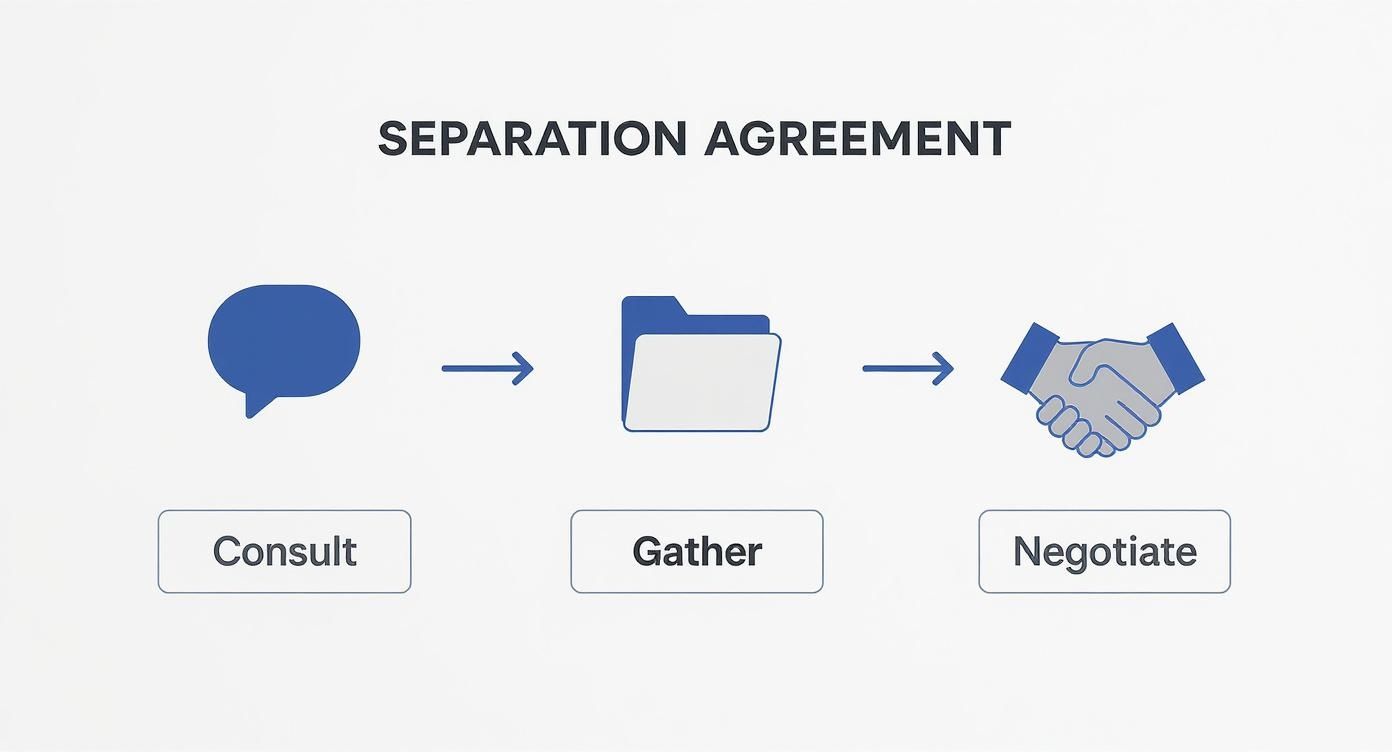
By following a structured process of consulting, gathering information, and negotiating, you can systematically avoid the common errors that derail so many agreements.
Vague Language and Economic Pressures
Ambiguity is the enemy of a strong separation agreement. Using vague terms like "reasonable access" for parenting time or "help with expenses" for support is a recipe for endless conflict. Your agreement must be precise and specific, with clear schedules, exact support amounts, and detailed descriptions of how property will be divided.
It's also important to acknowledge how external factors can influence separations. Recent economic pressures have played a significant role in relationship breakdowns across Ontario. A recent study highlighted that rising costs for essentials like groceries, housing, and gas have increased family conflict, leading to more separations. In this climate, agreements have become a practical tool for couples to manage property and support issues without the immediate and substantial cost of a formal divorce. You can discover more insights about how economic factors impact separation rates in Ontario.
Key Takeaway: The most reliable way to avoid these pitfalls is to secure professional legal guidance from the start. An experienced family lawyer in Brampton can help ensure full disclosure, tailor the agreement to your specific needs, protect you from pressure, and draft clear, enforceable terms that safeguard your future.
Your Separation Agreement Questions Answered
When a relationship ends, it’s natural to have a million questions running through your mind. This FAQ section tackles the most common and pressing queries we hear from our clients in Brampton and across Ontario. The answers are straightforward, practical, and based on the realities of Ontario's Family Law Act—designed to give you the clarity you need to move forward.
Do We Need a Separation Agreement If We Agree on Everything?
Yes, absolutely. Even if you and your former partner are on great terms and have everything figured out, a handshake deal just won’t cut it in the eyes of the law. Verbal understandings are not legally enforceable in Ontario.
People’s memories fade, circumstances change, and what seemed crystal clear one day can become a major point of conflict the next. A written, signed, and witnessed separation agreement ontario turns your mutual understanding into a proper legal contract. Think of it as insurance for your amicable split—it’s the official record of your decisions, protecting both of you from incredibly stressful and expensive court battles down the road.
What Does a Separation Agreement Cost in Brampton?
There’s no one-size-fits-all answer here. The cost to prepare a separation agreement in Brampton can vary quite a bit, depending on how complex your situation is and how well you and your former partner are cooperating.
A few key factors will influence the final cost:
- Complexity of Assets: A couple with a shared home, a couple of bank accounts, and simple pensions will almost always have lower legal costs than a couple with a family business, multiple investment properties, or complicated international assets.
- Level of Conflict: If you and your partner have already sorted out most of the big issues and can negotiate the rest amicably, the process is much faster and cheaper. High-conflict separations that require back-and-forth negotiations will naturally drive up the cost.
- Negotiation Method: Choosing a process like mediation is often far more cost-effective than a traditional, adversarial approach where lawyers do all the negotiating.
While it’s tempting to look for the cheapest option, remember that investing in a properly drafted agreement by an experienced Brampton family lawyer is an investment in your future. It’s designed to prevent the much bigger financial and emotional costs that come with a weak or unenforceable document.
Can We Change Our Separation Agreement Later?
Yes, you can. A separation agreement isn't necessarily locked in forever. Life is unpredictable, and an arrangement that works perfectly today might not be suitable in five or ten years. The law gets this, which is why agreements can be changed, or "varied," under certain circumstances.
If you and your former partner both agree to the changes, the process is pretty simple. You’ll create a formal "amending agreement," which has to follow the same legal rules as the original: it must be in writing, signed by both of you, and properly witnessed. It's also strongly recommended that you both get Independent Legal Advice (ILA) on the amendment.
But what if one person doesn’t agree? The other party might have to go to court. A judge will only change a final agreement if there has been a material change in circumstances. This can’t be just any small change—it has to be significant, something that wasn’t foreseen when the agreement was made, and has a lasting impact. For example, a major and involuntary job loss could qualify as a material change.
How Long Do We Have to Be Separated to Get an Agreement?
You don’t have to wait at all. In fact, you can—and should—start working on a separation agreement in Ontario as soon as you and your partner have decided to separate. Getting started early allows you to set clear rules for your finances, property, and parenting arrangements right away. This helps minimize conflict and creates stability for everyone, especially children.
To be legally "separated," you just need to be living "separate and apart" with the plan to end the relationship. It's a common myth that one person has to physically move out. You can be separated while still living under the same roof, as long as you’re no longer functioning as a couple—for instance, sleeping in separate rooms, handling your finances independently, and not presenting yourselves socially as a couple. The day this starts is your "date of separation," a critical date for calculating property division.
Navigating the details of a separation agreement requires clear, strategic legal advice. If you are in Brampton or the GTA and need guidance on your rights and options, the team at Badesha Law is here to help you achieve a fair and secure resolution. Contact us today to ensure your future is protected. Find out more at https://badeshalaw.ca/brampton-criminal-lawyer.