

It’s a question that keeps many people up at night when they start the separation process: can a judge actually say no and deny your divorce?
While it’s a daunting thought, the simple answer is that it's extremely rare for a divorce to be outright denied in Canada. If you meet the legal grounds set out in the federal Divorce Act, the court is obligated to grant your divorce. The key is making sure your application is prepared correctly and all related matters, like child support, are resolved according to Ontario law. This is where a skilled divorce lawyer in Brampton can make all the difference, ensuring your case moves forward without unnecessary hurdles.
The Rare Cases Where a Divorce Can Be Denied in Canada
A judge's main role in a divorce hearing isn't to decide if you should get divorced, but to confirm that a legal "breakdown of the marriage" has actually happened. Once that's established, the divorce must be granted.
However, the Divorce Act does contain a few specific "bars to divorce" that can stop the process in its tracks. These are rarely used today, but they exist as safeguards to prevent people from misusing the court system.
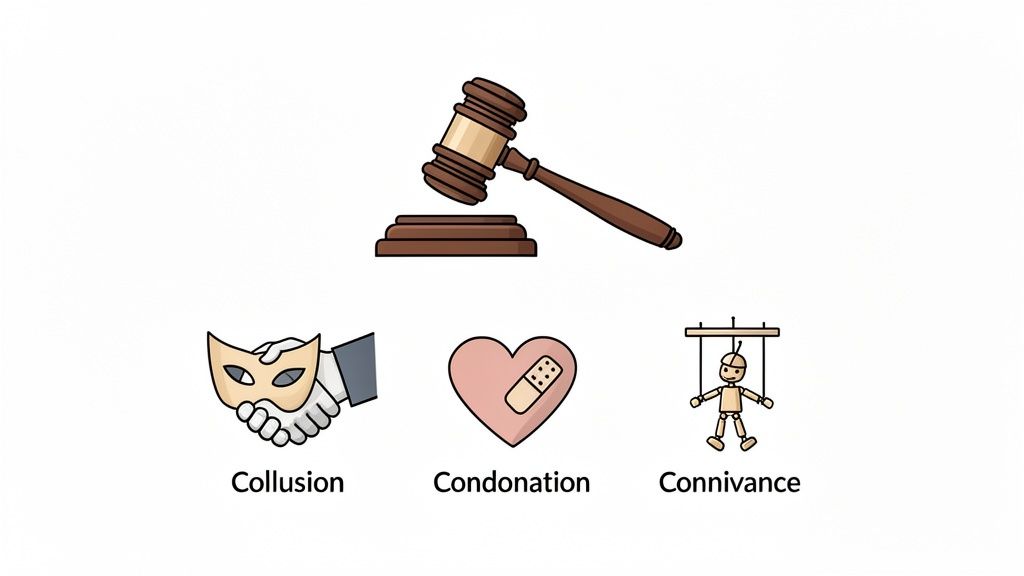
Think of these bars as the court’s way of ensuring the reasons for the divorce are genuine and not fabricated to get a faster result.
Understanding Collusion
Collusion is when spouses agree to lie to the court. This could mean inventing grounds for divorce—like making up a story about adultery or fudging the date of separation—just to speed things up.
For example, if a Brampton couple falsely claims one person had an affair to get around the mandatory one-year separation period, that’s collusion. If a judge discovers this, they are required by the Divorce Act to dismiss the divorce petition. It's a serious issue that undermines the integrity of the family court system.
Key Takeaway: The court system in Brampton operates on honesty. Any attempt to mislead the court by faking the reasons for your divorce can get your case thrown out immediately.
Connivance and Condonation
Two other historical roadblocks are connivance and condonation. These pop up specifically when a divorce is filed based on adultery.
- Connivance: This is when one spouse actively encourages or helps the other spouse cheat, essentially setting them up to create grounds for divorce.
- Condonation: This happens when a spouse forgives their partner for adultery and the couple fully resumes their marital relationship. If you knew about the affair and chose to reconcile, you can’t turn around later and use that same affair as your reason for divorce.
Imagine a spouse finds out about an affair, forgives their partner, and they continue living together as a couple for another year. Legally, that act of adultery has been "condoned." They would have to rely on other grounds, like the one-year separation, to move forward with the divorce.
The Most Common Hurdle: Delay, Not Denial
While those legal bars are rare, the single biggest reason a divorce hits a snag is far more practical: unresolved issues about the children.
Section 11(1)(b) of the Divorce Act is crystal clear on this. A judge must be satisfied that reasonable arrangements have been made for child support before they will grant a divorce. This isn't a suggestion; it's a mandatory rule grounded in both federal and Ontario's Family Law Act.
If your child support plan doesn't follow the Child Support Guidelines or if there are still disputes over parenting time and decision-making, a judge will simply refuse to sign the final Divorce Order.
Your case isn't denied forever, but it’s put on hold until you can prove the children's needs have been properly and legally sorted out. For any parent in Brampton, this means having a solid separation agreement or court order that clearly lays out child support is non-negotiable. An experienced local family lawyer will make this their top priority, ensuring your kids are protected so your divorce can proceed without hitting this very common, and very avoidable, roadblock.
Establishing Grounds for Divorce in Ontario
Getting a divorce in Ontario isn’t as simple as just deciding your marriage is over. You have to legally prove that your marriage has had an "irretrievable breakdown." Under Canada's Divorce Act, there are only three ways to do this.
Getting this first step right is critical. If you can't properly establish one of these grounds, your entire application can stall. This is why getting actionable advice from a Brampton divorce lawyer early on is so important—it sets the foundation for a successful outcome.
The No-Fault Path: Separation for One Year
By far, the most common and least confrontational way to get divorced is by living separate and apart for at least one year. This is the "no-fault" route because you don't have to assign blame for why the marriage ended.
Most people in Brampton prefer this path because it’s much less adversarial. The one-year clock starts the moment you begin living separately with the intention to end the marriage. You can file your Application for Divorce before the year is up, but the court in Brampton won't grant the final Divorce Order until the full 365-day period has passed.
Key Insight: The court's focus here isn't on who did what to whom. It's about recognizing the marriage has broken down. This client-focused approach helps lower conflict, allowing you and your ex-partner to focus on resolving practical matters like finances and parenting arrangements.
Can You Be "Separated" Under the Same Roof?
With the high cost of living in Brampton, a critical question for many clients is whether you can start the separation clock while still living in the same house. The answer is a clear yes. The law understands that it’s often financially impossible for a couple to suddenly support two separate households.
But you have to prove it. To show you're truly separated while cohabiting, there needs to be a fundamental change in your lifestyle. This means:
- Sleeping in separate bedrooms.
- Stopping all intimate and social aspects of your relationship.
- Handling your own laundry, cooking, and finances separately.
- Telling friends and family that you have officially separated.
Real-World Scenario: A couple in Brampton with two children can't afford to immediately sell their home near Professor's Lake. One spouse moves into the basement, they open separate bank accounts, create individual budgets, and stop attending community events as a couple. Their lawyer helps them draft a Separation Agreement that clearly states their date of separation, which the court later accepts without issue.
The Fault-Based Grounds: Adultery and Cruelty
While less common, you can still file for divorce on "fault" grounds. The main advantage? You can apply immediately without the one-year wait. These grounds are adultery and cruelty.
Adultery: This means your spouse engaged in physical intimacy with someone else. To use this as your reason for divorce, you need proof, which can be difficult and emotionally taxing to obtain. You must also swear in a legal affidavit that you did not condone or connive in the affair.
Cruelty: This involves physical or mental cruelty from your spouse that makes it unbearable to continue living together. This is a very high legal standard to meet. The court looks for cruelty of a "grave and weighty" nature, not just arguments or unhappiness.
- Physical Cruelty: This includes acts of domestic violence. These are also criminal matters handled under the Criminal Code of Canada, so ensuring your safety is the absolute first priority.
- Mental Cruelty: This could be relentless verbal abuse, emotional manipulation, or severe financial control that seriously harms your well-being.
Seeking a divorce based on cruelty requires strong evidence, such as medical reports, police records, or testimony from witnesses. A Brampton divorce lawyer can provide an honest assessment of whether your situation meets this strict legal test and guide you on the safest way to proceed while protecting your rights under both family and criminal law.
Why Child Support Is a Non-Negotiable Hurdle
If there’s one issue guaranteed to bring your divorce proceedings to a grinding halt in a Brampton courthouse, it’s unresolved child support. This isn't just a common snag; it's a complete showstopper. The reason is rooted firmly in federal law—specifically, Section 11(1)(b) of the Divorce Act.
This section makes it crystal clear: a judge must be satisfied that "reasonable arrangements" have been made for the financial support of any children before they can grant a divorce. This isn't a suggestion or a guideline. It's a strict legal obligation. Your divorce simply cannot move forward until this condition is met.
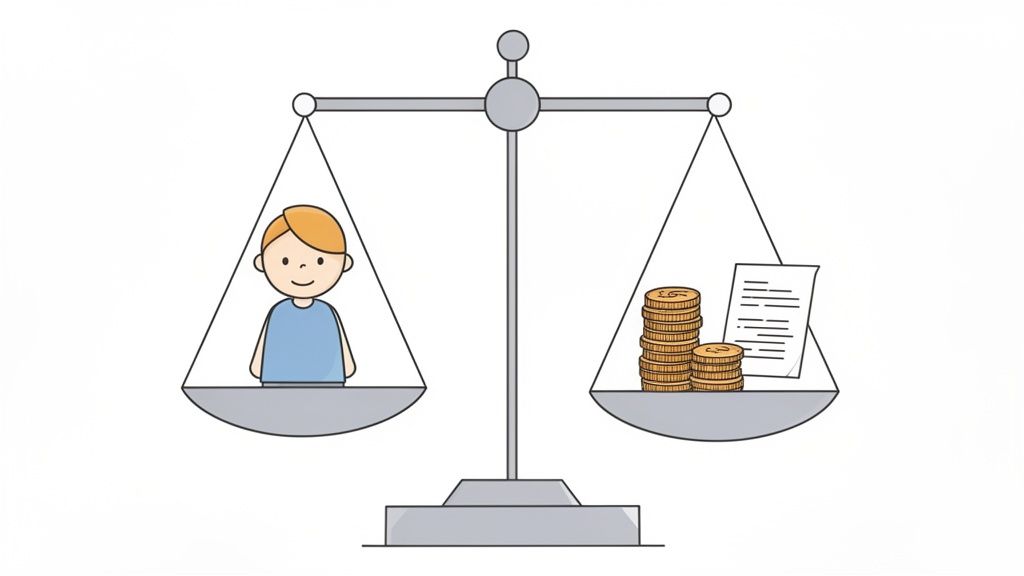
This rule exists for a simple, powerful reason: to protect the children. The court acts as a final safeguard, ensuring their financial stability isn't a casualty of their parents' separation. It’s about honouring every child’s right to support.
The Role of Ontario’s Child Support Guidelines
So, what exactly are "reasonable arrangements"? For that, Ontario courts turn to the provincial Child Support Guidelines. Think of the Guidelines as a set of rules and tables used to calculate the base amount of child support one parent pays to the other.
The calculation comes down to a few key factors:
- The paying parent's gross annual income.
- How many children need support.
- The province where the paying parent lives.
The goal is to create a fair and consistent standard so that children continue to benefit from the financial means of both parents, just as they would if the family were still together. A judge will not sign off on a divorce where the child support arrangement deviates from these guidelines without a very, very good reason.
Key Takeaway: The Child Support Guidelines are not optional. A Brampton judge will expect any agreement you present to align with these official calculations. Trying to agree on a lower amount without proper justification is one of the most common reasons a divorce application gets rejected.
Common Disputes That Stall a Divorce
Even with a formula, things get complicated. Disputes pop up all the time that can stall the entire process, often requiring an experienced divorce lawyer in Brampton to get things back on track.
1. Disagreements Over Income
This is a big one. It's common to see arguments over a spouse's true income, especially if they are self-employed, own a business in Peel Region, or get paid in cash. We often see one party claim their income is much lower than it really is to try and reduce their support obligation.
2. Section 7 Expenses
These are the "special or extraordinary expenses" that go above and beyond the basic table amount. Think costs for competitive sports, private tutoring, orthodontics, or post-secondary education. Parents frequently disagree on whether an expense is truly necessary or reasonable, and how the cost should be split.
3. Parenting Time and Set-Offs
If parenting time is shared almost equally (meaning each parent has the children at least 40% of the time), the child support calculation can change. This can spark disputes over the parenting schedule itself, because the calendar now directly impacts the wallet.
A Brampton-Based Scenario
Let's picture a couple separating right here in Brampton. The father is a self-employed contractor, and the mother is a salaried nurse with two kids. Their divorce hits a wall.
First, the father claims his income is only $50,000 a year. But a closer look at his business statements shows a lot of personal expenses—car payments, vacations, meals—being run through the company. The mother's lawyer digs in and argues his real income for support purposes is closer to $90,000.
Second, they’re fighting over Section 7 expenses. Their son plays rep hockey, and it's not cheap. The father insists it’s an unnecessary luxury and refuses to pay his share. A judge, seeing this mess, will absolutely refuse to sign the final Divorce Order until the income is properly determined and a fair contribution to the hockey costs is locked in.
The Path Forward: Full Disclosure and Smart Negotiation
The only way to avoid this major roadblock is with complete financial transparency and skilled negotiation. Both of you have a legal duty to provide full and honest financial disclosure. Hiding assets or fudging income numbers won't work—it will eventually come out, causing massive delays and driving up legal costs.
This is exactly where a dedicated divorce lawyer proves their worth. We ensure all financial documents are properly exchanged, analyze the numbers to pinpoint the correct income for support, and negotiate a fair agreement on those tricky special expenses. By building a child support arrangement that follows the guidelines and meets your children's needs, you clear the biggest hurdle standing between you and your final Divorce Order.
How Financial Pressures in Brampton Can Stall Your Separation
Sometimes, the biggest roadblock in a separation isn't a legal snag or a fight with your spouse—it’s the stark financial reality staring back at you from your bank account. A judge might be ready to grant your divorce, but the high cost of living in Brampton and across the Peel Region can feel like a denial in itself.
It's a trap I see clients fall into all the time. The math just doesn't add up. Trying to fund two separate households on the same combined income is, for many, simply impossible. Imagine the cost of two apartments or condos, two sets of hydro bills, and double the daily living expenses. It’s overwhelming.
This financial pressure often forces couples to keep living under the same roof long after they've decided to go their separate ways, creating a tense and emotionally draining environment for the entire family. It's one thing to be emotionally ready to move on, but it’s another thing entirely to be able to afford it.
The Staggering Cost of a Contested Divorce
Beyond just finding a new place to live, the potential cost of the divorce itself is a massive source of anxiety. The financial path you take can split dramatically depending on one thing: whether your divorce is contested or uncontested.
An uncontested divorce, where you and your spouse agree on all the big issues like property and support, is by far the most affordable route. But when disagreements crop up, legal fees can skyrocket, turning a manageable expense into a financial nightmare.
To put it in perspective, let's look at the numbers.
Comparing Divorce Costs in Ontario: Uncontested vs. Contested
The difference in cost between a smooth, agreed-upon separation and a drawn-out court battle is huge. This table breaks down what Brampton residents can generally expect to face financially.
| Divorce Type | Average Legal Fees | Key Characteristics |
|---|---|---|
| Uncontested Divorce | ~$1,860 | Both spouses agree on all major issues. Minimal court involvement. Faster timeline (4-6 months). Focus on paperwork and settlement. |
| Contested Divorce | ~$20,625+ | Spouses disagree on property, support, or parenting. Requires multiple court appearances, negotiations, and potentially a trial. Can take over a year to resolve. |
Source: Canadian Lawyer’s 2022 Legal Fees Survey
As you can see, the financial stakes are incredibly high. The average cost of a contested divorce can climb well over $20,000 and even hit $25,000 in particularly messy cases. This stark difference is exactly why avoiding a court battle is so critical for families in Brampton who are already feeling the financial squeeze.
From My Experience: The single most effective way to control the cost of your divorce is to minimize conflict. A good Brampton divorce lawyer won’t rush you into court. Instead, they’ll prioritize practical solutions like negotiation and mediation to help you reach a fair settlement, saving you thousands of dollars and months of stress.
A Strategic Path Forward
Feeling financially stuck is a tough spot to be in, but it doesn't have to be permanent. With the right legal strategy, you can carve out a path that makes separation financially possible.
A client-focused divorce lawyer in Brampton gets it. They understand the local economic pressures you're up against and will work with you to create a realistic plan that doesn’t break the bank. This approach usually involves:
- Focusing on a Separation Agreement: This is a legally binding contract that lets you sort everything out privately, giving you certainty and saving you from massive court fees.
- Exploring Mediation: A neutral mediator can help you and your spouse find common ground on tough issues, often at a fraction of the cost of litigation.
- Demanding Transparent Fees: You should have a clear picture of potential costs from day one, with no surprises down the road.
- Finding Creative Financial Solutions: This might mean a structured buyout of the family home or other smart arrangements that allow for a fair split of assets without forcing a costly fire sale.
By taking these practical, strategic steps, what once seemed like an economic impossibility can become a manageable process. It’s about finding the right tools to finally let you move forward with your life.
Your Action Plan for a Successful Divorce in Brampton
Moving from confusion to control requires a clear, organized strategy. For anyone in Brampton facing a divorce, the first steps you take can mean the difference between a drawn-out, expensive battle and a fair, efficient resolution. Think of this as your personal roadmap—a way to get organized and feel like you're back in the driver's seat.
A skilled divorce lawyer in Brampton, Ontario, is more than just a legal representative; they're your strategic advisor. Their job is to help you see around corners and avoid common pitfalls, whether it's a simple procedural error like improperly serving documents or a major issue like incomplete financial disclosure. Getting organized from day one is the single best thing you can do to protect your rights.
Begin with Financial Housekeeping
The entire foundation of a divorce settlement rests on a clear picture of the family's finances. Before you file a single document, your first job is to gather all the relevant financial information. This isn't just a good idea—it's a legal requirement in Ontario known as financial disclosure, mandated by the Family Law Act.
Start collecting the key documents now. Being prepared will save you a surprising amount of time and money when you meet your lawyer.
- Income Verification: Pull together your last three years of income tax returns, Notices of Assessment, and recent pay stubs. If you own a business, you'll need proof of that income too.
- Asset Documentation: This includes bank statements, investment account statements (like RRSPs and TFSAs), and any property deeds for real estate you own.
- Debt Information: Make a file with statements for all liabilities—mortgages, lines of credit, credit cards, and car loans.
- Valuations: If you own a business, a pension, or even valuable items like art or jewellery, you'll likely need to get them professionally appraised.
Expert Tip: Create a simple spreadsheet listing all assets and debts. Note their value on two specific dates: the date you were married and the date you separated. This "Net Family Property" calculation is how property division is determined in Ontario, and having this ready is a massive head start.
The Power of a Separation Agreement
Many people assume divorce automatically means a messy court battle, but that's rarely the case. In reality, the vast majority of divorces in Brampton are settled out of court, and the key is a comprehensive Separation Agreement. This is a legally binding contract that you and your spouse negotiate and sign, spelling out how you'll resolve all the big issues.
A well-drafted agreement covers absolutely everything:
- Division of property and debts.
- Spousal support (if it applies).
- Parenting time and decision-making responsibility.
- Child support, including the base amount and any special or extraordinary expenses.
Finalizing a separation agreement before heading to court makes the entire divorce process faster, cheaper, and infinitely less stressful. It puts you and your spouse in control, rather than leaving life-altering decisions to a judge who doesn't know you or your family.
Exploring Cost-Effective Alternatives
The emotional and financial weight of a contested divorce can be crushing. Thankfully, there are effective, lower-conflict ways to reach an agreement without ever stepping inside a courtroom.
Mediation is an incredibly popular choice for couples in Brampton. A neutral third-party mediator helps you and your spouse have a productive conversation, guiding you toward a solution you can both live with. The mediator doesn't make decisions for you; they just help you find common ground. The whole process is confidential and usually far more affordable than litigation.
Of course, the legal side is only one part of the journey. Addressing the emotional impact is just as important. Resources like professional counselling can provide essential support during and after your separation. Seeking grief and loss counselling can be an invaluable part of your action plan, helping you build the resilience you'll need for the path ahead.
This infographic shows just how easily the divorce process can stall out when finances get tight, which is a common reality in a high-cost area like Brampton.
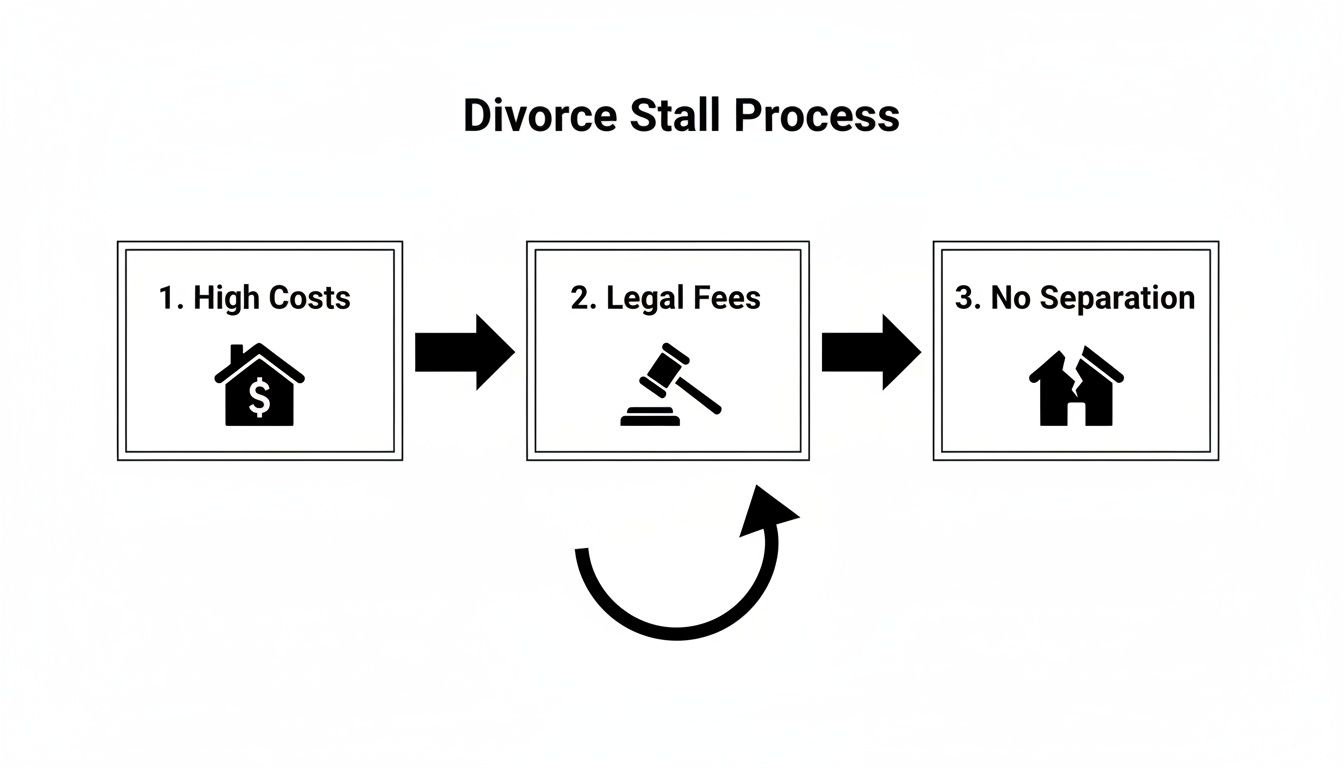
It really highlights how the high cost of living, stacked on top of legal fees, can create a financial trap that keeps couples from moving on with their lives.
Interestingly, the bigger picture of marriage dissolution in Canada is pretty complex. The national divorce rate has actually hit a 50-year low of 5.6 per 1,000 married persons. But while younger couples are divorcing less, "grey divorce"—separation among those aged 55 and older—is on the rise, showing just how different the pressures are across generations.
By gathering your documents, focusing on a separation agreement, and exploring collaborative options, you can take charge of your separation. This approach not only protects your financial future but also helps set a much more positive tone for your next chapter.
Common Questions About Divorce in Brampton
As you start to navigate the separation process, you're bound to have questions. The legal system can feel like a maze, so getting clear, straightforward answers is key. Here are some of the most common questions we hear from our clients in Brampton as they tackle the practical side of getting divorced.
Does My Spouse Have to Agree to the Divorce?
This is a huge source of anxiety for many people, but the answer is refreshingly simple: no, your spouse’s consent is not required in Ontario.
If your spouse refuses to sign anything or just plain objects to the divorce, you can still move forward. As long as you can prove one of the three legal grounds for a marriage breakdown—living separate for one year, adultery, or cruelty—a judge can and will grant the divorce. The one-year separation is the go-to path in these situations because it’s a “no-fault” ground, meaning you don’t have to prove anyone did anything wrong.
To get the ball rolling, you’ll file what’s called a sole Application for Divorce. Your divorce lawyer in Brampton will then make sure your spouse is properly served with the legal documents. If they choose not to respond, the process can continue without their participation.
Key Takeaway: Your spouse can’t trap you in a marriage just by refusing to sign papers. The law in Ontario gives you a clear path to end a marriage, even if you’re the only one who wants to.
What if I Can't Find My Spouse to Serve the Divorce Papers?
Properly "serving" your spouse with the divorce documents isn't optional—it's a mandatory step. You can't just skip it and move on. If you've made a real, documented effort to find your spouse but genuinely can't locate them, you have to get permission from the court to serve them in a different way.
This is done by filing a motion for an order for "substituted service." It’s a formal legal step where you ask a judge to approve an alternative way of letting your spouse know you’ve filed for divorce.
Some common methods a judge might approve include:
- Serving a close relative of your spouse, like a parent or sibling.
- Sending the documents to their last known employer.
- Publishing a notice in a newspaper where they were last known to be living.
Trying to bypass this step will get your divorce application rejected. It's a critical rule that's in place to protect everyone's rights.
Can We Get Divorced While Still Living in the Same House?
Yes, you absolutely can. With the high cost of housing in Brampton and the GTA, this has become an incredibly common scenario. The law recognizes that it’s often just not financially possible for a couple to immediately set up two separate homes.
You can be legally "separated" while living under the same roof, but you have to prove you are genuinely living "separate and apart." This means you've stopped functioning as a married couple. Think sleeping in separate rooms, managing your own finances, cooking your own meals, and no longer going out as a couple or telling friends and family that you're together.
In these situations, a formal Separation Agreement becomes vital. It creates an official record of your separation date for the court, which is what you'll need to prove the one-year separation required for the divorce.
How Long Does a Simple, Uncontested Divorce Take in Brampton?
For a truly simple, uncontested divorce—meaning you and your spouse have already agreed on all the big issues like property, support, and parenting—the timeline is fairly predictable. Once all the right paperwork is filed with the Brampton courthouse, you can usually expect the final Divorce Order to be granted in about 4 to 6 months.
But that timeline is only for straightforward cases. If there's any disagreement that needs negotiation, mediation, or a court appearance, it becomes a contested divorce. A contested divorce can easily take a year, and often much longer, depending on how complex the issues are and how backed up the courts are. This huge difference in time and cost is exactly why trying to reach an amicable settlement is always the best first approach.
Navigating the divorce process requires clear guidance and strong advocacy. At Badesha Law, our team is dedicated to protecting your rights and helping you find the most efficient path forward. If you have questions about your separation or need an experienced divorce lawyer in Brampton, contact us for a consultation. Learn more by visiting us at https://badeshalaw.ca/brampton-criminal-lawyer.