

How to Apply for Divorce Ontario: A Practical Guide
So, you're considering a divorce in Ontario. The thought alone can be overwhelming, but breaking the process down into clear, manageable steps makes it far less intimidating. It all starts not with a courtroom battle, but with understanding the basic rules of the road: your eligibility, the legal grounds, and the critical difference between a smooth, uncontested process and a more complex, contested one.
Getting these initial pieces right sets the tone for everything that follows.
Your First Steps in the Ontario Divorce Process
Before you dive into filling out forms, you need to confirm a few foundational things. This is the groundwork that ensures your application starts off on the right foot, saving you from hitting frustrating and costly roadblocks later on.
Confirming Your Eligibility to File in Ontario
First things first: does Ontario have the authority to grant your divorce? The rule is simple but non-negotiable. According to the federal Divorce Act, at least one of you must have been "ordinarily resident" in Ontario for a full year immediately before you start the divorce application.
This is a strict requirement. If you just moved to the province, you'll need to wait until you hit that one-year mark before the courts here can handle your case.
Understanding the Grounds for Divorce
In Canada, there's only one legal reason for divorce: marriage breakdown. The Divorce Act gives you three ways to prove this has happened:
- Separation: You and your spouse have lived separate and apart for at least one year.
- Adultery: One spouse has committed adultery.
- Cruelty: One spouse has treated the other with such severe physical or mental cruelty that living together has become intolerable.
By a huge margin, citing a one-year separation is the most common path. It’s what we call a "no-fault" divorce because it doesn't require pointing fingers or proving someone did something wrong. You can even file the paperwork before the full year is up, but the judge won't sign the final divorce order until that 365-day separation period is officially complete.
One of the biggest misconceptions I see is about what "living separate and apart" actually means. It doesn't always require two different addresses. Many couples continue to live under the same roof for financial reasons or for the kids' stability while being legally separated. The key is demonstrating a clear intention to end the marriage—things like sleeping in separate rooms, having separate finances, and no longer presenting yourselves as a couple to the outside world.
Choosing Your Path: Uncontested vs. Contested Divorce
This is one of the most important forks in the road. Your choice between filing a simple (uncontested) or general (contested) divorce will shape the entire experience—from the cost and timeline to the overall stress level.
An uncontested divorce is the goal. It’s possible when you and your spouse agree on all the major issues: how to divide property, who pays support, and what the parenting arrangements will be. A contested divorce is what happens when you can't agree on one or more of these issues and need a judge to make the decisions for you.
Here’s a quick breakdown to help you see the difference.
Uncontested vs. Contested Divorce At a Glance
| Feature | Uncontested Divorce (Simple) | Contested Divorce (General) |
|---|---|---|
| Agreement | Both spouses agree on all key issues. | Spouses cannot agree on one or more issues (e.g., property, support, parenting). |
| Timeline | Faster. Often completed in 4-6 months. | Slower. Can take 1-3 years or more. |
| Cost | Significantly lower. Minimal legal fees. | Substantially higher. Involves fees for lawyers, motions, and potentially trial. |
| Process | Primarily paperwork-based. Little to no court time. | Involves multiple court appearances, financial disclosure, and negotiations. |
| Control | You and your spouse control the outcome. | A judge makes the final decisions. |
| Emotional Toll | Lower stress and less conflict. | High stress, emotionally draining, and adversarial. |
Thankfully, the trend is moving toward more amicable resolutions. Data shows that 31% of divorce applications in 2020 were filed jointly by both spouses, a clear sign that more couples are choosing to work together.
The best strategy is often to turn a contested situation into an uncontested one through negotiation, mediation, or a well-drafted separation agreement. This is where a family lawyer provides a huge strategic advantage. We can help you understand your rights, negotiate a fair settlement, and guide you down the most efficient path, helping you avoid common mistakes that cause delays and frustration. You can read our guide to better understand the difference between legal separation and divorce and see how a separation agreement is the key to an uncontested divorce.
Gathering Your Essential Divorce Forms and Documents
Once you've figured out your eligibility and the path you're taking, it's time to tackle the paperwork. Honestly, navigating the required forms is one of the most detail-heavy parts of getting a divorce in Ontario. But think of it this way: you're building the foundation for your court application. Getting this part right from the start saves you from frustrating delays and rejections down the road.
The whole process kicks off with one key document, but others quickly come into play depending on your family’s situation, especially if you have children.
The Core Application: Form 8A
The absolute centrepiece of any divorce application is Form 8A Application (Divorce). This is the document where you officially ask the court to grant your divorce and state the legal grounds for it—which, for most people, is the one-year separation. It also collects the basic details about you, your spouse, your marriage, and any kids you have.
It’s a pretty straightforward form, but accuracy is everything. Double-check that names are spelled exactly as they are on your marriage certificate and that all your dates are correct. A simple typo here can create a real procedural headache later on.
Proving Your Marriage and Its End
Along with your main application, the court needs two other critical pieces of paper to get things moving. These documents officially register your divorce with the government and prove the marriage you're asking to dissolve actually exists.
Registration of Divorce Proceeding Form: This form gets sent to the federal Department of Justice's Central Registry of Divorce Proceedings. Its job is to make sure there isn't another divorce application for you and your spouse already filed somewhere else in Canada. It's a simple safeguard against duplicate cases.
Original Marriage Certificate: The court needs your original, government-issued marriage certificate. A photocopy just won't cut it. If you were married here in Ontario, you can easily order a new one from ServiceOntario. If you got married outside of Canada, you'll need the original certificate from that country. And if it isn't in English or French, you must provide a certified translation.
What if you can't find your marriage certificate? Don't panic. You can file a sworn statement, known as an affidavit, explaining why you can't produce it and giving as many details as you can remember about the marriage ceremony. Still, getting a replacement is always the cleaner and more direct route.
Additional Forms When You're a Parent
If you and your spouse have dependent children, the Divorce Act is very clear: a judge must be satisfied that reasonable arrangements are in place for their support before they will grant a divorce. This means you have to file a few more documents that lay out your parenting and financial details.
The main forms you'll run into are:
- Parenting Affidavit (Form 35.1): This form gives the court a snapshot of your current parenting setup and what you're proposing for the future regarding decision-making and parenting time.
- Financial Statement (Form 13 or 13.1): This is one of the most critical documents anytime support is on the table. It paints a complete picture of your income, expenses, assets, and debts. Our firm has put together a detailed guide to help you get your head around the Form 13.1 Financial Statement and why it's so important for calculating support.
- Child Support Information: You'll also need to provide calculations based on the Federal Child Support Guidelines to show the court that the correct amount of child support is being paid.
Your Most Powerful Tool: The Separation Agreement
While it's not a mandatory court form, a Separation Agreement is the single most effective document you can have when you're aiming for an uncontested divorce. This is a legally binding contract that you and your spouse work out before filing with the court to settle all the big issues—property division, spousal support, child support, and parenting.
When you attach a comprehensive, signed Separation Agreement to your application, you're essentially telling the judge, "We've already sorted everything out." It signals that there are no fights left to be had, making the court's job of reviewing and approving your divorce significantly faster and easier. It's the key to turning a potentially messy divorce into a streamlined, administrative process.
The Filing and Serving Process Explained
Once you have your paperwork meticulously prepared, it’s time to make your divorce application official. This is a two-part move: filing the documents with the court and then formally notifying your spouse. Getting this procedural part right is absolutely non-negotiable for anyone learning how to apply for divorce in Ontario.
Choosing Your Filing Method
You have two main avenues for filing your application with the Ontario Superior Court of Justice.
- Online Filing: The Ontario government now has an online portal for filing divorce applications. For many, this is the faster and more convenient route, letting you submit everything electronically from home. It's an excellent choice for straightforward, uncontested cases.
- In-Person Filing: You can always go the traditional route and file your documents in person at your local courthouse. This can be a good option if you have questions for the court clerk or just feel more comfortable handling physical copies of your paperwork.
Regardless of which path you choose, you'll need to pay the court filing fees at this stage. These fees cover the administrative costs of opening your file and having a judge review it.
The key documents you’re submitting at this point are your application, marriage certificate, and any financial statements.
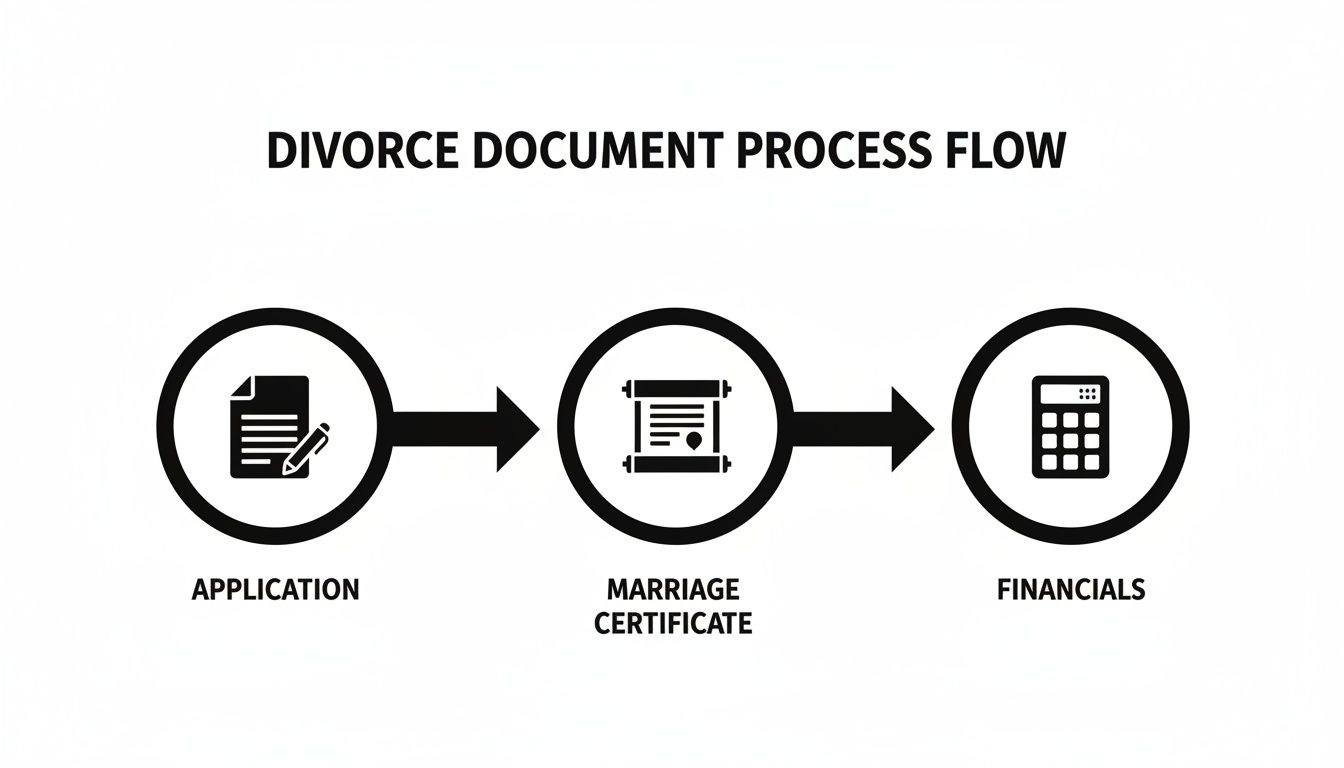
As this flow shows, these documents form the core package that officially starts your divorce proceedings.
The Critical Step of Serving Your Spouse
Filing with the court is only half the battle. The law is very clear that your spouse must be formally notified of the divorce application—a process called “serving” the documents. You cannot simply hand the papers to them yourself.
Service isn't just a formality; it ensures the other person is aware of the legal action and has a fair chance to respond. In most situations, service has to be done by a neutral third party, like a friend or family member (as long as they are over 18) or a professional process server. They physically deliver a copy of the court-stamped documents to your spouse.
Of course, if you and your spouse are on good terms and filing together, you can bypass this step completely. Our detailed guide explains the benefits of a joint divorce application in Ontario, which is a much simpler process that doesn't require formal service.
Proving Service with Form 6B
After the documents have been successfully delivered, the person who served them must complete Form 6B: Affidavit of Service. This is a sworn legal document where they confirm they handed the papers to your spouse on a specific date and time.
This affidavit is your official proof for the court. Without a properly completed Form 6B, the court will not accept that your spouse has been notified, and your divorce application will stall. It’s a small form with a huge impact on your case's progress.
What Happens When Service Becomes Complicated
Sometimes, serving a spouse isn't as simple as knocking on a door. They might be actively avoiding the server or could have moved without leaving a forwarding address. When this happens, you can't just give up; you have to ask the court for permission to serve them in a different way.
- Substituted Service: This is when you ask a judge for an order allowing you to use an alternative method. For example, you might get permission to leave the documents with another adult at their workplace or send them via registered mail to their last known address.
- Special Service: In more extreme cases, like when you have absolutely no idea where your spouse is, a judge might grant an order for special service. This could involve serving a close relative of theirs or, in very rare circumstances, dispensing with service altogether if you can prove you've exhausted every possible avenue to find them.
Navigating substituted or special service requires a formal court motion and solid evidence. It's a clear example of when having legal guidance becomes essential to prevent your divorce from getting stuck on a procedural technicality.
Understanding Divorce Costs and Timelines in Ontario
When you start down the path of divorce, two questions almost always come first: how much is this going to cost, and how long is this going to take?
Getting a realistic handle on the financial and time commitments from the outset helps you plan and keeps expectations grounded. The single biggest factor that will shape both of these answers is the path you and your spouse take—specifically, whether your divorce is uncontested or contested.
Breaking Down the Costs of Divorce
The expenses you'll face fall into two main buckets: mandatory court fees and professional legal fees. While the court fees are fixed, your legal costs can swing dramatically depending on how complicated your situation is.
The court fees are set by the province and are non-negotiable. As of early 2024, you can expect to pay:
- $224 to file your initial Application for Divorce.
- $445 for the court to review your final paperwork and grant the Divorce Order.
That brings the total for the required administrative fees to $669. This covers the court's side of the process but doesn't include smaller expenses like commissioning affidavits or hiring a process server, which might add a little bit more.
Legal Fees: The Biggest Variable
This is where the real cost of a divorce lies, and it's where the difference between a smooth, uncontested split and a messy, contested one becomes crystal clear.
If you and your spouse have already sorted everything out in a Separation Agreement, the divorce is simple. Your lawyer’s job is mainly to draft the documents, make sure they’re filed correctly, and guide the application through the court system. The legal fees are much, much lower.
But if you’re at odds over major issues like property division or support, the costs can escalate fast. A contested divorce has a lot more moving parts: tense negotiations, deep dives into financial disclosures, court motions, and maybe even a trial. Every one of these steps requires a significant amount of your lawyer's time, which directly translates to higher fees. For a more detailed look, you might find our guide on how Ontario divorce costs are calculated helpful.
The financial reality is a major factor for most people. An uncontested divorce can still cost a few thousand dollars in legal fees, but that figure can skyrocket in a contested case. It’s this financial pressure that often pushes couples to find common ground rather than endure a long, expensive court battle.
Mapping Out the Divorce Timeline
Just like the costs, the timeline for your divorce depends heavily on cooperation. An uncontested divorce in Ontario tends to follow a fairly predictable schedule.
Once all your final documents are filed, the process is mostly out of your hands. A court clerk will review everything to make sure it’s all in order. If it is, the file lands on a judge’s desk for a final review and signature. This administrative phase usually takes between 2 to 4 months, but it can stretch longer if your local courthouse has a backlog.
After the judge signs the Divorce Order, it's not official just yet. There’s a mandatory 31-day waiting period. This is a built-in cooling-off period that gives either person a last chance to appeal.
Once those 31 days are up, your divorce is legally final. At that point, you can apply for your official Certificate of Divorce, which is the document you’ll need if you ever plan to remarry.
For a contested divorce, there is no set timeline. The process can drag on for over a year, or even several years. It all comes down to how long it takes to resolve the disputed issues, whether through negotiation or court proceedings. This uncertainty is exactly why finding a way to agree outside of court is almost always the most efficient path forward.
Sorting Out the Big Three: Parenting, Support, and Property
A divorce order officially ends your marriage, but it's the agreements you make on the major issues that truly shape what your life will look like afterward. Before any judge in Ontario will sign off on your divorce, they need to be satisfied that three critical areas have been properly handled: parenting arrangements, financial support, and the division of your property.

Tackling these things head-on is the single best way to ensure your divorce proceeds smoothly. The most powerful tool you have for this is a Separation Agreement.
This is a legally binding contract where you and your spouse decide the terms of your split yourselves, instead of leaving it in the hands of a judge. It's your way of showing the court that all the potential conflicts are already resolved, which turns the divorce application itself into a much simpler, administrative process.
Parenting Language Has Changed for the Better
You might have noticed that the legal language around parenting has shifted. Canada's Divorce Act was updated to be more child-focused and less about parental conflict. The old, adversarial terms "custody" and "access" have been officially replaced.
Here’s the new terminology you'll see on all court documents:
- Parenting Time: This is simply the schedule that outlines when the children are in each parent's care. The focus is on the child's actual experience, not a parent's "right" to have them.
- Decision-Making Responsibility: This covers who gets to make the big calls on things like education, major healthcare decisions, and religious upbringing. It can be shared jointly between parents or assigned to just one.
At the end of the day, the court has only one guiding principle: the best interests of the child. A clear, thoughtful, and stable parenting plan isn't just a good idea—it's a requirement before a judge will grant your divorce.
The Math Behind Financial Support
Money is often the biggest source of stress during a divorce, but the rules in Ontario provide a pretty clear framework for both child and spousal support.
Child Support is considered the right of the child, which means it’s not something parents can negotiate away. The amount is calculated using the Federal Child Support Guidelines, based on a straightforward formula:
- The paying parent's gross annual income.
- The number of children who need support.
- The province where the paying parent lives.
Spousal Support, however, isn't automatic. It's designed to address any financial imbalances that came about because of the marriage or its breakdown. A judge will look at many factors, like how long you were married, the roles each of you played during that time, and one spouse's financial need versus the other's ability to pay.
A common myth I hear all the time is that a short marriage or similar incomes automatically means no spousal support. While those are key factors, the court looks at the whole story. For instance, if one spouse gave up a career to support the other's ambitions, they might be entitled to support to help them get back on their feet, even if the marriage was relatively short.
Dividing Your Property and the Family Home
Under Ontario's Family Law Act, married couples go through a process called equalization of Net Family Property (NFP). In simple terms, you each calculate the growth in your net worth from the day you got married to the day you separated. The spouse whose net worth grew more usually makes a payment to the other to "equalize" the difference.
But the matrimonial home gets special treatment. Unlike other assets you might have owned before the marriage, the home's full value on the date of separation is included in this calculation, no matter whose name is on the title. This unique rule really highlights how central the family home is in the eyes of the law.
These legal frameworks are also adapting to modern family structures. The 2021 census revealed that 23% of Canadian couples are now living common-law, a huge increase that often happens before marriage. This means many people who apply for divorce have already lived together and acquired assets during that time, which makes having a detailed and comprehensive separation agreement more crucial than ever. You can dig into more of these family law trends and what the latest data reveals.
By proactively addressing these three pillars—parenting, support, and property—you take control of the process and put yourself on the fastest track to a fair and efficient divorce.
Finalizing Your Divorce and Preparing for the Future
Once your divorce application is filed and your spouse has been properly served, the heavy lifting on your end is mostly done. The process now moves into a final, administrative stage where the court system takes over to finalize everything.
First, your file lands on the desk of a court clerk for a thorough review. They are the gatekeepers, meticulously checking that every form is complete, every signature is in place, and all the procedural rules have been followed. If anything is missing or incorrect, they'll send the file back, and unfortunately, that means delays.
From the Clerk to the Judge
After the clerk gives your file the green light, it’s passed on to a judge for the final sign-off. The judge reviews all the documents to make sure the legal requirements of the Divorce Act have been met.
Crucially, if you have children, the judge will pay close attention to the child support arrangements. They must be satisfied that reasonable support is in place before they will grant the divorce.
This entire review happens "on the desk," which means for a simple, uncontested divorce, you won't have to step foot in a courtroom. The judge simply reviews the paperwork and, if everything is in order, signs the Divorce Order—the official document that legally ends your marriage.
Don't celebrate just yet. Your divorce isn't final the moment the judge signs the order. There is a mandatory 31-day waiting period that starts right after the order is issued. This window exists to allow for any last-minute appeals, and only after it expires is your divorce legally complete.
Once those 31 days have passed, you can officially get your Certificate of Divorce. This is the ultimate proof that you are divorced, and you'll absolutely need it if you ever plan to remarry. For the specifics on getting this final document, check out our guide on how to get your divorce certificate in Ontario.
Post-Divorce Administrative Tasks
With the legal process officially behind you, it’s time to tackle the personal admin that comes with your new status. This isn’t just tidying up; it's about securing your future.
Here are a few key tasks you'll need to handle:
- Update your will and powers of attorney immediately.
- Change the beneficiary designations on any life insurance policies, RRSPs, and pensions.
- Update your marital status with government agencies like the Canada Revenue Agency (CRA).
Common Questions We Hear About Ontario Divorces
Even with a detailed guide, the divorce process can bring up specific questions that feel unique to your situation. Here are some clear, straightforward answers to the queries we see pop up time and time again.
I Was Married Abroad. Can I Still Get Divorced in Ontario?
Yes, you absolutely can. The key isn't where you got married, but where you live now.
Under Canada’s federal Divorce Act, the only thing that matters for jurisdiction is residency. As long as either you or your spouse has been living in Ontario for at least one full year right before filing the paperwork, our courts have the authority to legally end your marriage.
You'll just need to provide your original marriage certificate from that country. If it isn't in English or French, you'll also have to get it translated by a certified translator and submit their sworn affidavit along with the translated copy.
What’s the Difference Between a Divorce and a Separation Agreement?
This is a big one, and it's easy to get them mixed up. Think of it like this: they are two separate but closely related legal steps.
A separation agreement is a private, legally binding contract you and your spouse create. It’s the detailed playbook for how you’ll untangle your lives—settling everything from property division and support payments to parenting schedules. It's where you make all the important decisions.
A divorce, on the other hand, is the official court order that legally terminates your marriage. A solid separation agreement is the foundation for a smooth, uncontested divorce. It shows the court you've already resolved all the potentially contentious issues, turning the divorce itself into a simple, administrative step.
A well-drafted separation agreement is the single most powerful tool you have to control the cost, timeline, and outcome of your divorce. It shifts the process from a potential court battle into a straightforward paperwork exercise.
Do I Actually Have to Go to Court for My Divorce?
For the vast majority of uncontested divorces in Ontario, the answer is no—you never have to set foot in a courtroom.
The entire process is managed through the documents you file. A judge simply reviews your application and all the supporting paperwork from their desk. If everything is in order, they sign and grant the Divorce Order without ever needing to see or speak to you in person.
Court appearances are really only necessary for contested divorces, where you and your spouse can't agree on key issues and a judge needs to hear arguments from both sides before making a final decision.
Navigating the divorce process requires precision and clarity at every turn. At Badesha Law, we provide the expert guidance needed to manage your application efficiently, helping you sidestep costly errors and unnecessary stress. Whether you're moving toward a simple uncontested divorce or need strong advocacy for a more complex matter, our team is ready to help you move forward with confidence. For a free consultation to discuss your specific situation, contact us today.