

How Much Does a Divorce Cost in Ontario? A 2024 Guide
When you’re facing a separation, the most stressful question is often the most practical: “What is this going to cost me?” Understanding Ontario divorce costs upfront is the first step toward regaining control. The honest answer is that the price varies widely. A simple, amicable split might cost as little as $1,500, while a high-conflict court battle can easily exceed $50,000.
The final bill isn’t a random number. It’s a direct result of the legal path you choose, the level of cooperation between you and your spouse, and the complexity of your finances. This guide will break down the numbers, explain what drives costs up, and give you practical strategies to protect your finances.
Estimated Ontario Divorce Costs at a Glance
That feeling of uncertainty about divorce costs is completely normal. The good news is that you have more control over the final expense than you might think. Getting a handle on what drives the price up—or keeps it down—is the first step toward managing it.
The single biggest driver of your legal bill is conflict. An amicable, uncontested divorce is by far the most affordable route. In these cases, your lawyer’s job is mostly about drafting the right documents, which can often be done for a predictable flat fee.
On the other hand, a contested divorce—where you disagree on property, support, or parenting—is where hourly billing comes into play. Costs add up quickly through negotiations, financial disclosures, court filings, and appearances. Beyond your lawyer’s fees, other expenses can pop up. For instance, if your marriage involves international documents, understanding document translation costs can help you budget for that piece of the puzzle.
This table provides a high-level summary of potential costs to help you identify the financial scale of your situation.
| Divorce Type | Typical Cost Range (Per Person) | Key Influencing Factors |
|---|---|---|
| Simple Uncontested Divorce | $1,500 – $3,500 | Full agreement on all issues; minimal legal negotiation needed. |
| Negotiated/Mediated Divorce | $5,000 – $15,000 | Some disagreements that require professional help to resolve, but avoids court. |
| Moderately Contested Divorce | $15,000 – $30,000 | Several court appearances (conferences, motions) but settles before trial. |
| High-Conflict/Trial Divorce | $50,000+ | Multiple complex issues (business valuation, custody battles) that go to trial. |
As you can see, the path you choose has a massive impact on the bottom line. A simple uncontested divorce is the most budget-friendly, and many Ontario law firms offer flat-rate packages to make the divorce process in Ontario more predictable.
Comparing Uncontested vs. Contested Divorce Costs
The path your divorce takes is the single biggest factor influencing your final legal bill. Think of it as the difference between buying a fixed-price ticket for a direct flight versus hailing a taxi in rush-hour traffic with the meter running. One is predictable; the other can become wildly expensive.
This is the core difference between an uncontested and a contested divorce. Understanding how each one impacts the average cost of divorce in Ontario is the first step in managing both your budget and your expectations.
The Predictable Cost of an Uncontested Divorce
An uncontested divorce is, by far, the most straightforward and affordable route. This happens when you and your spouse have already agreed on all the major issues—how to divide property, who pays what support, and the parenting plan—before a single court document is filed.
In this scenario, your lawyer’s role is to ensure your agreement is legally sound, draft the paperwork, and file it correctly. Because the work is defined, most family law firms in Ontario offer a flat-rate fee for this service.
- Legal Fees: Usually a flat rate, which gives you complete cost certainty.
- Court Fees: Standardized government charges for filing the application.
- Timeline: Much faster, often wrapping up in just a few months.
This streamlined process keeps billable hours to a minimum, making the overall price tag low and predictable.
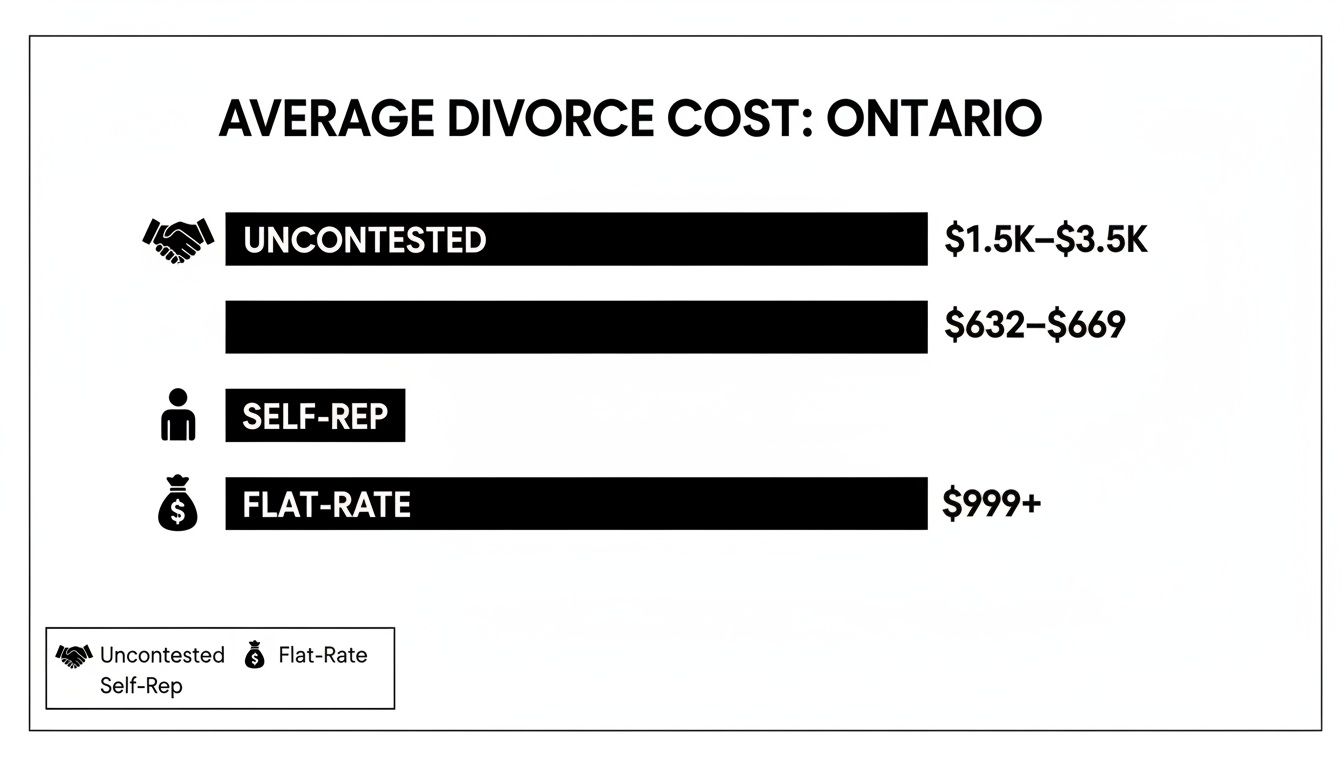
As you can see, a lawyer-assisted uncontested divorce is dramatically more affordable. For a deeper look, you can explore the key differences between contested and uncontested divorce in Brampton in our detailed guide.
Why Contested Divorce Costs Escalate
A contested divorce is where the legal meter starts running. This happens when you and your spouse can’t agree on one or more issues, forcing your lawyers to negotiate, mediate, or ultimately, fight it out in court.
In these situations, lawyers almost always bill by the hour. Every phone call, email, and court document adds to the final bill. The more conflict there is, the more hours your legal team must dedicate to your case.
Common Mistake: Underestimating how quickly small disagreements can inflate legal bills. An argument over a $5,000 asset can easily cost $10,000 in legal fees to resolve in court. Always weigh the cost of the fight against the value of what you’re fighting for.
Contested divorces in Ontario carry much higher financial stakes. The actions that drive up hourly billing include:
- Financial Disclosure: Compiling, reviewing, and often disputing complex financial statements.
- Motions: Filing formal legal requests with the court for temporary decisions.
- Questioning/Discovery: The formal process where lawyers question the other party under oath.
- Court Conferences: Mandatory meetings with a judge to narrow down issues.
- Trial Preparation: Extensive and costly work required if your case heads to trial.
Uncovering the Hidden Financial Layers of Divorce

It’s a common misconception that your lawyer’s bill is the only expense. A realistic picture of your Ontario divorce costs must include other professional services needed to untangle a shared life.
These are the necessary expenses that arise from the complex details of your marriage. Budgeting for these layers isn’t just smart—it’s crucial for your long-term financial health and helps you make more strategic decisions.
The Cost of Expert Reports and Valuations
When you and your spouse can’t agree on the value of a major asset, the court needs objective opinions from neutral experts. The cost for these reports is typically shared, and they can be a significant line item.
Here are the most common experts you might need:
- Business Valuations: A chartered business valuator (CBV) is needed to determine the fair market value of a family business. This can cost anywhere from $5,000 to $25,000 or more.
- Property Appraisals: A certified appraiser provides the value of the matrimonial home or other real estate. These reports usually run between $500 and $1,000 per property.
- Pension Valuations: A pension must be valued by an actuary before it can be divided. Expect this to cost $1,000 to $3,000.
- Parenting Assessments (Section 30): In high-conflict custody battles, a judge might order a formal parenting assessment to recommend what’s in the children’s best interests. These can cost from $10,000 to $30,000.
Pro Tip: These expert reports might seem expensive, but they provide the hard data needed to end arguments. Investing in an accurate valuation can save you thousands in legal fees fighting over what something is worth.
Trying to cut corners here can backfire. Our guide on the hidden costs of ignoring family law issues dives deeper into why being proactive is so important.
Investing in Alternative Dispute Resolution
It might sound strange to add another professional’s fee, but services like mediation are investments, not just costs. Alternative Dispute Resolution (ADR) aims to solve problems outside a courtroom, which is almost always faster and cheaper.
Mediation brings in a neutral third party to help you negotiate your own agreement. A qualified mediator in Ontario typically charges between $300 and $700 per hour, a cost you usually split. A few productive sessions can resolve issues that would have taken months—and thousands more in legal fees—to battle out in court. It’s also critical to understand how divorce can impact your taxes to get a complete financial picture.
How Core Issues Drive Up Your Divorce Bill
Think of your divorce cost like a fire. Every unresolved disagreement is another piece of fuel. The final bill for your divorce in Ontario is the cumulative cost of every argument that requires a lawyer’s time to sort out.
It’s the hours spent negotiating, drafting proposals, and preparing for court that inflate the final number. Knowing which disputes act as financial accelerants is key to keeping your costs under control.
The Financial Drain of Property Division Disputes
Dividing property often becomes one of the most heated parts of a divorce. These arguments aren’t just about who gets the couch; they’re about complex assets that can trigger a cascade of expensive professional services.
When you can’t agree on what something is worth, you must bring in outside experts. This is where costs climb:
- Business Valuations: If one of you owns a business, its value must be calculated. This requires a Chartered Business Valuator (CBV) and can easily cost $10,000 to $25,000.
- Pension Valuations: You’ll likely need an actuary to calculate a pension’s value for equalization, adding another $1,000 to $3,000.
- The Matrimonial Home: Disagreements over the home’s value can lead to appraisals and court motions, all adding hours to your lawyer’s invoice.
Child Support and Parenting Time Conflicts
Nothing is more emotionally charged than issues involving children, and that emotional weight often translates directly into higher legal costs. Disagreements over parenting time and decision-making can become the most draining aspect of a divorce.
When parents can’t agree on a schedule, lawyers step in. This can quickly lead to:
- Multiple court appearances.
- Drafting complex parenting plans.
- Negotiations that drag on for months.
In high-conflict situations, a judge may order a formal parenting assessment. These investigations, conducted by social workers or psychologists, are incredibly thorough and can cost between $10,000 and $30,000.
The High Cost of Spousal Support Arguments
Spousal support is another major battleground. Unlike child support, which often follows clear formulas, spousal support involves more judicial discretion, fueling intense and expensive disputes.
Arguments typically boil down to three key questions:
- Entitlement: Is one spouse even entitled to support?
- Amount: If so, how much should be paid?
- Duration: And for how long?
Resolving these questions requires extensive financial disclosure and legal arguments, which can easily add tens of thousands of dollars to your final legal bill. You can learn more about the common issues in a contested Ontario divorce in our detailed guide.
Practical Strategies to Lower Your Divorce Costs

While the factors driving up Ontario divorce costs can feel intimidating, you have significant control over the final legal bill. By taking a proactive, organized, and resolution-focused approach, you can actively cut down on unnecessary fees.
Think of your lawyer’s time as an expensive resource. Every minute they spend chasing documents or de-escalating conflicts is a minute you pay for. The more work you do upfront, the less your lawyer has to.
Be Your Lawyer’s Most Efficient Client
One of the most effective ways to lower your legal bill is to make your lawyer’s job easier. When you walk in prepared and organized, you minimize the hours they spend on administrative legwork.
Before your first meeting, start gathering documents:
- Financial Statements: At least three years of statements for all bank accounts, credit cards, and investments.
- Tax Returns: Your last three years of income tax returns and Notices of Assessment from the Canada Revenue Agency.
- Property Documents: Deeds, mortgage statements, and recent property tax bills.
- Debt Information: Up-to-date statements for any loans, lines of credit, or other debts.
Presenting this information clearly drastically reduces the time your lawyer needs for financial discovery, directly cutting your costs.
Embrace Cooperation Over Conflict
Conflict is the fuel that powers an expensive divorce. Consciously choosing a cooperative mindset can dramatically lower the temperature—and the cost. Every issue you and your spouse resolve directly is one less issue your lawyers need to bill hours negotiating.
Prioritizing a negotiated settlement over a court battle is the single most impactful financial decision you can make. A firm that focuses on negotiation first aligns with a cost-effective strategy that protects your assets and well-being.
Seriously consider Alternative Dispute Resolution (ADR) options like mediation. It is almost always faster and significantly cheaper than court. You can find qualified professionals through organizations like the Ontario Association for Family Mediation (OAFM). This approach saves money and gives you more control over the final outcome.
Your Cost-Saving Divorce Checklist
| Action Item | Why It Saves Money | Pro Tip |
|---|---|---|
| Gather All Financials First | Reduces the hours your lawyer spends on administrative “discovery” tasks. | Create a simple, organized digital folder with subfolders for bank statements, taxes, and property docs. |
| Create a Marital Balance Sheet | Listing all assets and debts gives your lawyer a clear snapshot, saving them analysis time. | Use a basic spreadsheet. List everything you own and owe, and note who holds the title or debt. |
| Discuss Goals with Your Spouse | Finding common ground on even small issues (like who keeps the couch) saves negotiation time. | Focus on what you can agree on first to build momentum. Don’t start with the biggest fights. |
| Be Honest and Transparent | Hiding assets or income leads to expensive legal battles and potential court sanctions. | Full financial disclosure is mandatory in Ontario. Hiding things will always cost you more in the long run. |
| Keep Communications Business-Like | Emotional, angry emails require your lawyer to spend time deciphering and de-escalating. | Stick to the facts. Communicate calmly and clearly, as if you were writing to a business colleague. |
| Bundle Your Questions | Instead of multiple calls or emails a day, send one organized email with a list of questions. | This respects your lawyer’s time and prevents you from being billed for five separate small interactions. |
By being proactive and organized, you can effectively manage the costs of your divorce. What to do next? The best first step is to book a confidential consultation to understand your specific situation and get a clear picture of potential costs and strategies.
Serving Brampton and the Greater Toronto Area
Getting divorced in the Greater Toronto Area brings its own unique financial pressures. Between the high cost of living and a competitive real estate market, understanding your Ontario divorce costs is critical.
At Badesha Law, we are part of this community. We provide focused, practical legal support to families in Brampton, Mississauga, and across the Peel Region. Our deep understanding of the local court system and GTA property market gives our clients a real-world advantage.
Local Expertise for Your Financial Peace of Mind
Whether you’re dividing a matrimonial home in this market or calculating support based on local income realities, having a legal team that gets the regional context is invaluable. We pride ourselves on offering accessible, compassionate legal guidance.
Our client-first approach is simple: clear communication and completely transparent fees. We believe you should never feel in the dark about your legal spending.
Choosing a divorce lawyer in Brampton who is committed to a cost-effective, negotiation-first strategy can make all the difference. We are dedicated to helping our neighbours manage their divorce costs wisely so they can move forward with confidence.
Ready to understand your options? Book a confidential consultation with our team today to get clarity on your next steps.
Frequently Asked Questions About Ontario Divorce Costs
What is the average cost of divorce in Ontario?
The average cost varies dramatically. A simple, uncontested divorce often costs between $1,500 and $3,500. However, a contested divorce that requires negotiation or court appearances can easily range from $15,000 to over $50,000 per person. The final price depends entirely on the level of conflict and complexity.
How can I get a cheap divorce in Ontario?
The cheapest way to get a divorce is by filing for an uncontested divorce. This means you and your spouse agree on all major issues beforehand. Using a lawyer’s flat-rate service for this process is a cost-effective way to ensure it’s done correctly while keeping the price predictable and avoiding costly mistakes.
Does my spouse have to pay my legal fees?
Generally, each person pays their own legal fees in an Ontario divorce. However, a judge can order one spouse to pay a portion of the other’s costs if that person has behaved unreasonably—for example, by hiding assets, ignoring court orders, or making frivolous claims that unnecessarily prolong the process.
Is mediation cheaper than going to court?
Yes, absolutely. Mediation is almost always significantly cheaper than litigation. The collaborative process of mediation helps you resolve issues directly with your spouse, avoiding the massive expenses associated with court filings, multiple appearances, and trial preparation. It can save you tens of thousands of dollars and months, if not years, of time.
How are lawyer fees for a contested divorce calculated?
For a contested divorce, lawyers typically bill by the hour. Your final bill is based on the total time spent on your case, including phone calls, emails, document drafting, and court appearances. You will usually pay an upfront “retainer,” and the lawyer’s hourly rate is drawn from that amount as work is completed.
Related Reading
- Divorce Process in Ontario: A Step-by-Step Guide
- Common Issues in a Contested Ontario Divorce
- The Hidden Costs of Ignoring Family Law Issues
- Difference Between Contested and Uncontested Divorce in Brampton
Written by the legal team at Badesha Law. Our family lawyers are dedicated to providing clear, practical guidance on divorce and separation.
Disclaimer: This article provides general information and does not constitute legal advice. For advice on your specific situation, please consult with a qualified family lawyer.