

A Brampton Family Lawyer’s Guide to Division of Property in Divorce
When you're facing a separation in Brampton, one of the most pressing questions is always about your finances and assets. Many people assume division of property in Ontario means splitting every single item 50/50, but that’s not quite right. The real goal is to equalize the financial growth you achieved together as a couple. This whole process is guided by Ontario's Family Law Act, giving you a structured path to a fair outcome.
How Property Division Works in a Brampton Divorce
When a marriage ends here in Ontario, the law isn't focused on dividing up your furniture piece by piece. Instead, it’s designed to achieve a fair financial result by balancing the economic gains you both made during your partnership. Think of it less like splitting household items and more like sharing the increase in your collective net worth from your wedding day to the day you separated.
This process is officially called the equalization of Net Family Property. It helps to think of your marriage as a kind of shared financial venture. Now that the venture is ending, the law makes sure that both partners walk away with an equal share of the wealth that was built together.
The Principle of Equalization
At its core, equalization is about fairness. To get there, each of you will calculate your own Net Family Property (NFP), which is basically a financial snapshot of your individual standing on the day you officially separated.
This calculation breaks down into three key parts:
-
The total value of all your assets on your date of separation.
-
The total value of all your debts on that same date.
-
The value of any assets (minus debts) you already owned on the day you got married.
Once you and your spouse have figured out your individual NFP, the person with the higher number usually makes a payment to the person with the lower number. This is the "equalization payment," and its job is to make your final NFP values equal.
To help simplify this, here are the core ideas that drive property division in our province.
Key Principles of Property Division in Ontario
| Principle | What It Means for You |
|---|---|
| Equalization, Not Division | The law doesn’t split assets 50/50. Instead, it equalizes the growth in your net worth from marriage to separation. |
| Net Family Property (NFP) | This is your individual financial worth on the separation date, minus what you brought into the marriage and certain exclusions. |
| Equalization Payment | A payment made from the spouse with the higher NFP to the spouse with the lower NFP to balance the scales. |
| Valuation Date is Key | The "date of separation" is the critical moment for valuing all assets and debts. |
| Full Financial Disclosure | Both you and your spouse are legally required to provide a complete and honest picture of your finances. |
This framework ensures that every contribution to the marriage—whether it was earning an income or raising children and managing the home—is recognized as having equal value in building the family’s wealth.
Why You Need a Brampton Divorce Lawyer
Navigating the rules of property division is complex and requires a solid grasp of the Family Law Act. A skilled Brampton divorce lawyer is absolutely essential to protect your rights and ensure the final calculation is fair and accurate.
An experienced family lawyer in Brampton will help you identify every relevant asset and debt, get proper valuations for tricky items like business shares or pensions, and argue effectively for your best interests. This guidance is what secures your financial future as you start your next chapter.
Calculating Your Net Family Property and Equalization
When a marriage ends in Ontario, the law doesn’t focus on physically splitting every single asset down the middle. Instead, it’s all about balancing the financial books. This process, outlined in the Family Law Act, uses a specific formula to make sure the outcome is fair. To get there, we first have to figure out your Net Family Property (NFP), which is the cornerstone of the whole division.
Think of your marriage like a business partnership. The law wants to measure the financial growth that happened from the day you started (your wedding day) to the day it ended (your separation date). The NFP calculation is how we measure that growth for each of you, giving a clear snapshot of your individual finances on the day you separated.
The Basic NFP Formula Explained
At its heart, the NFP formula is a pretty straightforward calculation. For both you and your spouse, the process looks like this:
-
List all your assets: First, you add up the fair market value of everything you owned on your date of separation. This means your share of the house, cars, bank accounts, RRSPs, pensions—everything goes on the list.
-
Subtract your debts: Next, you subtract all your liabilities from that total. This includes mortgages, car loans, lines of credit, credit card balances, and any other debts you had on the separation date.
-
Deduct what you started with: Finally, you subtract the value of any property (minus debts) that you brought into the marriage. This step also includes deducting most gifts or inheritances you received from a third party during the marriage.
The number you're left with is your Net Family Property. We do this exact same calculation for both you and your spouse, completely independently.
The whole point of the NFP calculation is to isolate the wealth that was built up during the marriage. By subtracting what you had before you got married, the law makes sure you're only dividing the value you created together.
From NFP to an Equalization Payment
Once you and your ex have calculated your individual NFP values, you simply compare the two numbers. It’s almost never a perfect match. The spouse with the higher NFP then pays half of the difference to the spouse with the lower NFP. This payment is what we call the equalization payment.
Let’s look at a quick example. Imagine Spouse A has an NFP of $300,000 and Spouse B has an NFP of $100,000.
-
The Difference: $300,000 – $100,000 = $200,000
-
Half the Difference: $200,000 ÷ 2 = $100,000
In this case, Spouse A would owe Spouse B an equalization payment of $100,000. Once that’s paid, both spouses effectively walk away with $200,000 each from the wealth built during the marriage. This payment is what makes the division of property equitable, fulfilling the law’s promise to share the marriage’s financial growth equally.
Why This Calculation Matters for Brampton Families
Having a set formula like this brings a clear, structured approach to what can otherwise be a very emotional and messy process. It shifts the conversation away from fighting over who gets the couch and toward a more objective, mathematical calculation. That said, the math can get tricky, especially when you need to value complex assets like pensions or a family business.
This is where a Brampton divorce lawyer becomes essential. We make sure every asset is correctly identified, properly valued, and included in your financial statements. An experienced family lawyer in Brampton will protect your financial interests, ensure all your deductions are claimed, and see to it that the final equalization payment is calculated accurately and fairly under Ontario law. Getting that professional guidance is critical to securing a stable financial future as you move forward.
Identifying What's Included in Your Net Family Property
The first real step in any division of property is to create a complete and honest inventory of your shared financial life. This isn’t just about listing the big-ticket items; it’s a detailed accounting of everything you both own and owe. Under Ontario's Family Law Act, this comprehensive list is the foundation for calculating each person’s Net Family Property (NFP), making sure the final equalization is fair and accurate.
To do this right, you have to think broadly. The law considers almost everything acquired during the marriage as part of the family’s wealth. This process demands diligence and, most importantly, absolute transparency from both you and your spouse.
This diagram helps simplify the NFP calculation by showing how your assets, debts, and the resulting marital property all connect.
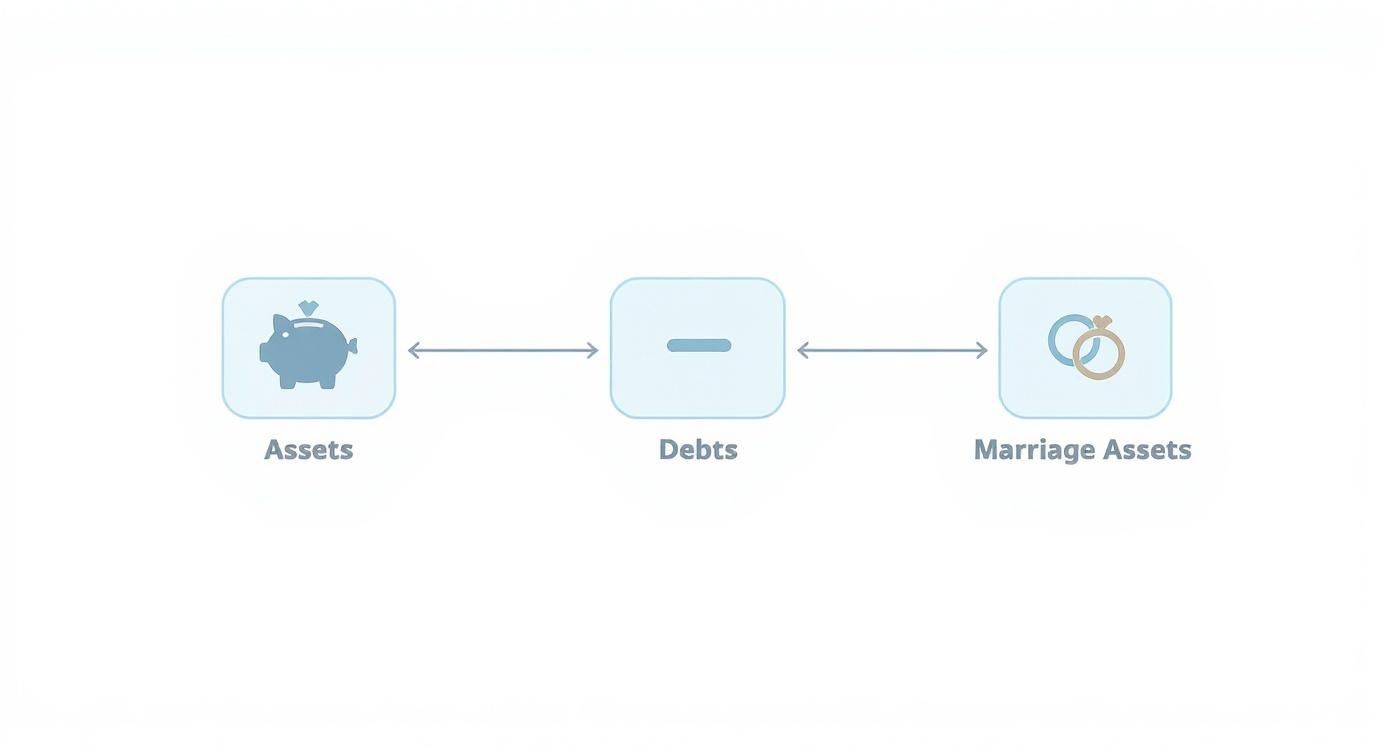
As the visual shows, the core of the equalization process is simple on the surface: subtract what you owe from what you own. The result is the net value created during your marriage, which is what we aim to divide fairly.
What Goes on the Asset List
When you start compiling your assets, the goal is to capture the fair market value of each item as of your official date of separation. Think of it as taking a complete financial snapshot on that specific day. An experienced Brampton divorce lawyer will guide you, but you can get a head start by gathering documents for the following:
-
The Matrimonial Home: The full value of the home you shared is always included, no matter whose name is on the title.
-
Other Real Estate: This includes any cottages, investment properties, or land you own, whether in Brampton or somewhere else.
-
Bank Accounts: Pull together statements for all chequing, savings, and joint accounts.
-
Investments: This is a wide category that includes RRSPs, TFSAs, stocks, bonds, and mutual funds.
-
Pensions: The value of a pension earned during the marriage is a major asset that must be professionally valued.
-
Vehicles: Cars, trucks, boats, and any other motor vehicles all count.
-
Business Interests: If either of you owns a business, its value has to be professionally assessed.
-
Personal Belongings: High-value items like jewellery, art, and expensive collections are also part of the calculation.
Acknowledging Your Liabilities
Just as important as your assets are your debts. You can't get an accurate NFP calculation without a complete picture of your liabilities. You’ll need to list every single debt that existed on your date of separation.
Common liabilities include:
-
Mortgages on any real estate
-
Car loans or leases
-
Personal lines of credit
-
Student loans
-
Credit card balances
Subtracting these debts from your total assets gives you the “net” value that is so central to the equalization formula.
The Critical Importance of Full Financial Disclosure
Under the Family Law Act, both you and your spouse have a legal duty to provide full and honest financial disclosure. This isn’t just a suggestion; it’s a mandatory requirement. Hiding assets or deliberately undervaluing property is a serious mistake with severe consequences.
A court can impose harsh penalties if it finds that one spouse has intentionally hidden assets. These can include ordering that spouse to pay a larger share of the equalization payment, forcing them to cover the other’s legal fees, or even assigning the entire value of the hidden asset to the dishonest party.
In the most serious cases, hiding assets can move beyond family court. Providing false information in sworn financial documents can lead to charges under the Criminal Code of Canada, such as perjury or fraud. This is exactly why working with a trusted family lawyer in Brampton is so critical. We make sure your financial disclosure is complete and accurate, protecting you from legal trouble while securing your fair share.
Understanding Which Assets Are Excluded from Division
When you're facing a separation in Brampton, it’s easy to assume that every single thing you own gets thrown into one big pot for division. But that’s not quite how it works. While Ontario’s goal is fairness, the Family Law Act recognizes that some assets just aren’t a product of the marriage. These are considered your separate property.
Think of it like this: the law creates a protective bubble around certain assets, shielding them from the equalization calculation. This means their value isn't included in your Net Family Property (NFP), so you don't have to share them with your spouse. Understanding what fits inside this bubble is a game-changer in the division of property.
Key Exclusions Under the Family Law Act
The law is very clear about what counts as excluded property. If you received an asset that falls into one of these categories and you still have it on the day you separate, you can deduct its value from your side of the ledger.
Here are the most common examples of property you get to keep:
-
Gifts from a Third Party: Any gift you personally received from someone other than your spouse is yours. For example, if your parents gave you $25,000 to buy a car that’s only in your name, that money is excluded from the family pot.
-
Inheritances: If you inherited money or property during the marriage, it remains yours. That $100,000 GIC left to you by your grandmother? It's protected and doesn’t get split.
-
Life Insurance Proceeds: Payouts from a life insurance policy where you were named the beneficiary are considered excluded funds.
-
Damages from Personal Injury Lawsuits: Compensation you received from a settlement—like for a car accident—is meant to make you whole, not to be shared as a family asset.
It's on you to prove an asset should be excluded. You need a clear paper trail showing where the money or property came from and that you still had it at separation. This is where good record-keeping becomes your best friend.
The Importance of Keeping Excluded Property Separate
Here’s the catch: to keep that protective bubble intact, you have to keep the excluded asset separate. Don’t mix it with family money. For instance, if you inherit $50,000 and put it into a new investment account solely in your name, it stays excluded. Simple.
But if you take that same $50,000 and drop it into the joint chequing account you both use for groceries and bills, you’ve likely just gifted it to the family. Once commingled, the law may see it as joint property, and you could lose your right to exclude it. A family lawyer in Brampton can give you practical advice on how to handle these funds correctly from day one.
The Major Exception: The Matrimonial Home
There’s one huge exception that trips up a lot of people in Brampton: the matrimonial home. Under Ontario law, the family home is treated differently than any other asset. Its special status trumps almost all other rules.
Even if you poured your entire inheritance or a massive gift into the down payment or mortgage, you cannot exclude that amount from the home's value. So, if your parents gifted you $100,000 for the down payment on your house, that money is now part of the home's divisible value. The law prioritizes the stability of the family residence above protecting individual contributions. This rule often comes as a shock and is a perfect example of why getting clear legal advice from a Brampton divorce lawyer is non-negotiable for a fair outcome.
Why the Matrimonial Home Is a Special Asset
When it comes to dividing property in an Ontario divorce, one asset stands in a class of its own: the matrimonial home. The Family Law Act carves out a unique set of rules just for the family home, recognizing its central role in a family’s life. It isn't treated like an RRSP, a car, or a cottage.
For homeowners in Brampton and the GTA going through a separation, getting a handle on these specific rules is absolutely critical. The law is designed to protect the value and stability the home represents, making it the cornerstone of the entire property division calculation.

No Deduction for Pre-Marriage Value
Here’s the biggest difference: you cannot deduct the value of the matrimonial home that you owned before the marriage. Think about that for a second. If you owned the house on your wedding day, its entire value on the date you separate gets included in your Net Family Property (NFP). This is a huge departure from other assets, like an investment account, where you’d get to subtract its pre-marriage value.
This rule holds true even if the home was a gift or an inheritance. Let's say your parents gifted you a house, and you and your spouse moved in and made it your family home. You’ve just lost the ability to exclude that gift from the NFP calculation. The law effectively transforms what was once your separate property into a shared family asset.
Equal Possessory Rights After Separation
Another unique feature of the matrimonial home is what’s known as possessory rights. Under Ontario law, both spouses have an equal right to live in the home after you separate, and it doesn't matter whose name is on the title.
This means one spouse can’t just change the locks and kick the other one out. To force someone to leave, you need either a court order or a signed separation agreement. These rights are in place to prevent a spouse from being left homeless and to maintain stability, especially when there are children involved.
Common Scenarios for Brampton Homeowners
For most families in Brampton, the home is their single biggest asset, which naturally makes it a major focus of negotiations. When it comes to deciding what to do, there are usually three main options:
-
One Spouse Buys Out the Other: If one person wants to stay in the home, they can buy out their spouse's share of the equity. This almost always requires refinancing the mortgage to qualify for a new, larger loan on a single income—a tough financial hurdle for many.
-
The House Is Sold: This is the most common path. You sell the home, pay off the mortgage and all the costs like real estate commissions and legal fees, and then split the leftover equity.
-
Delayed Sale: Sometimes, particularly when young children are involved, a couple agrees that one parent will stay in the home for a set period. The house is then sold down the road, maybe when the youngest child finishes high school.
The treatment of property varies greatly by jurisdiction. For example, in California, which operates under community property laws, the state's high home values significantly impact divorces. California homeowners have nearly triple the home equity of those in other states, making the division of the marital home a central and complex issue in their family law system. You can discover more insights about assets and wealth in California on ppic.org.
Working through the financial and legal maze surrounding the matrimonial home requires a solid strategy. A knowledgeable Brampton divorce lawyer can walk you through your rights, help you weigh the pros and cons of a buyout versus a sale, and ensure your largest asset is handled fairly in the final settlement.
Navigating the Property Division Process Step by Step
Thinking about the division of property can feel overwhelming, but it's not a chaotic free-for-all. It's actually a structured path with clear, deliberate steps designed to get a fair and legally sound outcome under Ontario's Family Law Act.
The whole process kicks off the moment you and your spouse separate. That specific day establishes the all-important valuation date—the snapshot in time used to value all your assets and debts for the NFP calculation. From there, you move into gathering and sharing information, which is the bedrock of any good negotiation.

Gathering Your Financial Information
The first active step is to collect every single relevant financial document. This part is non-negotiable and demands thoroughness. You and your spouse will need to formally exchange this information in a document called a Financial Statement, which is a sworn legal document confirming its accuracy.
It can feel like a lot, but breaking it down makes it manageable. Focus on getting proof for:
-
Income: Recent pay stubs, T4 slips, and income tax returns.
-
Assets: Bank statements, investment summaries (RRSPs, TFSAs), property deeds, and vehicle ownerships.
-
Debts: Mortgage statements, credit card bills, and loan agreements.
To make this crucial step easier, here's a checklist of the documents you'll need to start gathering. Having these ready will save you time and help your lawyer build a clear picture of your finances from day one.
| Document Category | Specific Examples |
|---|---|
| Proof of Income | Pay stubs, T4/T4A slips, recent tax returns and Notices of Assessment, business financial statements. |
| Bank & Investment Accounts | Statements for chequing/savings accounts, RRSPs, TFSAs, GICs, stocks, and mutual funds. |
| Real Estate | Property deeds, mortgage statements, property tax assessments (MPAC), home appraisal reports. |
| Pensions & Retirement Plans | Pension plan statements, company retirement plan summaries. |
| Vehicles & Valuables | Vehicle ownership documents (pink slips), appraisals for art, jewelry, or collectibles. |
| Debts & Liabilities | Credit card statements, lines of credit statements, student loan agreements, car loan documents. |
| Insurance | Life insurance policies with a cash surrender value. |
This isn't an exhaustive list, but it's a solid start. The goal is complete transparency—it’s the only way to ensure the final division is fair and legally sound.
Valuing Your Assets and Negotiating a Settlement
Once all the information is on the table, the next step is to put a fair market value on each asset as of your separation date. While figuring out the value of a bank account is easy, some assets are more complicated. Things like pensions, stock options, or business interests often require professional appraisers to lock down an accurate value.
With a clear financial picture, you can finally start negotiating a settlement. For many Brampton couples, this doesn't have to mean a drawn-out courtroom battle. There are several ways to get to a resolution:
-
Lawyer-led Negotiation: Your lawyers talk directly to hammer out an agreement on your behalf.
-
Mediation: A neutral third-party mediator guides you and your spouse toward a compromise.
-
Collaborative Family Law: You, your spouse, and your lawyers all commit to working together outside of court to find a solution.
The goal of any negotiation is to arrive at a legally binding Separation Agreement. This document finalizes the equalization payment and settles all property issues, allowing both of you to move forward with financial certainty.
While Ontario's legal framework guides how we handle things here, it's interesting to see how other places tackle similar issues. For instance, California’s property tax system can add a whole other layer of complexity. There, assessed values for tax purposes can be much lower than actual market values, which significantly impacts how properties are valued in a divorce. You can see how they manage statewide assessments through the California State Board of Equalization.
Every single step, from digging up old bank statements to signing a final agreement, is critical. Getting guidance from an experienced Brampton divorce lawyer makes sure you follow the right procedures, protect your rights, and achieve a result that is truly fair.
Common Questions About Property Division in Brampton
When a relationship ends, it's natural to have a flood of urgent questions. Here in Brampton, we often hear the same concerns from clients trying to make sense of their rights and what comes next. Let's tackle some of the most common questions we get about division of property in Ontario.
What Happens to Property for Common-Law Partners?
This is one of the biggest misconceptions in Ontario family law. Many people believe common-law partners have the same property rights as married spouses, but that's simply not the case under the Family Law Act. The rules for equalization of Net Family Property—the 50/50 split—do not automatically apply to unmarried couples.
Instead of splitting the wealth you built together, property is usually divided based on who legally owns it. If your name is on the title, you typically keep the asset. However, it's not always that simple. If one partner contributed significantly to an asset owned by the other (like paying down the mortgage on a house they don't own), they may have a trust claim for "unjust enrichment" to get compensated. This is a complex legal argument and requires help from an experienced family lawyer in Brampton to navigate successfully.
Can We Agree to an Unequal Division?
Absolutely. The 50/50 equalization rule is just the starting point. You and your spouse have the freedom to negotiate a different arrangement that you both feel is fair and works for your unique situation.
For an agreement like this to hold up in court, it has to be formalized in a legally binding Separation Agreement. To make sure the agreement is solid and can't be easily challenged later, both of you must:
-
Provide full and honest financial disclosure to each other.
-
Get independent legal advice from your own separate lawyers.
-
Sign the agreement voluntarily, without being pressured or forced.
What if My Spouse Is Hiding Assets?
Trying to hide assets during a separation is a massive mistake with serious legal consequences, not just under the Family Law Act but also potentially under the Criminal Code of Canada. If you have a gut feeling that your spouse isn't being upfront about their finances, your lawyer can take immediate action. This could mean filing a motion with the court to force them to produce specific documents and be transparent.
A judge has the power to bring down heavy penalties for hiding assets. This can include giving the innocent spouse a larger share of the property, ordering the dishonest spouse to pay all the legal costs, or even assigning the full value of the hidden asset to their side of the ledger.
Is There a Deadline to Make a Property Claim?
Yes, and the timelines are strict. You must file a property claim with the court within:
-
Six years from the date you separated.
-
Two years from the date your divorce was finalized.
If you miss these deadlines, you could permanently lose your right to an equalization payment. It is absolutely critical to speak with a Brampton divorce lawyer as soon as possible after you separate to make sure your rights are protected.
Navigating these complexities requires clear, strategic legal advice. If you are facing a separation in Brampton, a dedicated family lawyer can protect your financial future and guide you toward a fair resolution. Contact a legal professional to ensure your rights are protected at every step. Learn more at https://badeshalaw.ca/brampton-criminal-lawyer.