A Brampton Family Lawyer’s Guide to Division of Property in Divorce

When you're facing a separation in Brampton, one of the most pressing questions is always about your finances and assets. Many people assume division of property in Ontario means splitting every single item 50/50, but that’s not quite right. The real goal is to equalize the financial growth you achieved together as a couple. This whole process is guided by Ontario's Family Law Act, giving you a structured path to a fair outcome.

How Property Division Works in a Brampton Divorce

When a marriage ends here in Ontario, the law isn't focused on dividing up your furniture piece by piece. Instead, it’s designed to achieve a fair financial result by balancing the economic gains you both made during your partnership. Think of it less like splitting household items and more like sharing the increase in your collective net worth from your wedding day to the day you separated.

This process is officially called the equalization of Net Family Property. It helps to think of your marriage as a kind of shared financial venture. Now that the venture is ending, the law makes sure that both partners walk away with an equal share of the wealth that was built together.
A scale of justice on a desk with an open book, pen, and laptop, highlighting 'Equalization Basics'.

The Principle of Equalization

At its core, equalization is about fairness. To get there, each of you will calculate your own Net Family Property (NFP), which is basically a financial snapshot of your individual standing on the day you officially separated.

This calculation breaks down into three key parts:

  • The total value of all your assets on your date of separation.

  • The total value of all your debts on that same date.

  • The value of any assets (minus debts) you already owned on the day you got married.

Once you and your spouse have figured out your individual NFP, the person with the higher number usually makes a payment to the person with the lower number. This is the "equalization payment," and its job is to make your final NFP values equal.

To help simplify this, here are the core ideas that drive property division in our province.

Key Principles of Property Division in Ontario

Principle What It Means for You
Equalization, Not Division The law doesn’t split assets 50/50. Instead, it equalizes the growth in your net worth from marriage to separation.
Net Family Property (NFP) This is your individual financial worth on the separation date, minus what you brought into the marriage and certain exclusions.
Equalization Payment A payment made from the spouse with the higher NFP to the spouse with the lower NFP to balance the scales.
Valuation Date is Key The "date of separation" is the critical moment for valuing all assets and debts.
Full Financial Disclosure Both you and your spouse are legally required to provide a complete and honest picture of your finances.

This framework ensures that every contribution to the marriage—whether it was earning an income or raising children and managing the home—is recognized as having equal value in building the family’s wealth.

Why You Need a Brampton Divorce Lawyer

Navigating the rules of property division is complex and requires a solid grasp of the Family Law Act. A skilled Brampton divorce lawyer is absolutely essential to protect your rights and ensure the final calculation is fair and accurate.

An experienced family lawyer in Brampton will help you identify every relevant asset and debt, get proper valuations for tricky items like business shares or pensions, and argue effectively for your best interests. This guidance is what secures your financial future as you start your next chapter.

Calculating Your Net Family Property and Equalization

When a marriage ends in Ontario, the law doesn’t focus on physically splitting every single asset down the middle. Instead, it’s all about balancing the financial books. This process, outlined in the Family Law Act, uses a specific formula to make sure the outcome is fair. To get there, we first have to figure out your Net Family Property (NFP), which is the cornerstone of the whole division.

Think of your marriage like a business partnership. The law wants to measure the financial growth that happened from the day you started (your wedding day) to the day it ended (your separation date). The NFP calculation is how we measure that growth for each of you, giving a clear snapshot of your individual finances on the day you separated.

The Basic NFP Formula Explained

At its heart, the NFP formula is a pretty straightforward calculation. For both you and your spouse, the process looks like this:

  1. List all your assets: First, you add up the fair market value of everything you owned on your date of separation. This means your share of the house, cars, bank accounts, RRSPs, pensions—everything goes on the list.

  2. Subtract your debts: Next, you subtract all your liabilities from that total. This includes mortgages, car loans, lines of credit, credit card balances, and any other debts you had on the separation date.

  3. Deduct what you started with: Finally, you subtract the value of any property (minus debts) that you brought into the marriage. This step also includes deducting most gifts or inheritances you received from a third party during the marriage.

The number you're left with is your Net Family Property. We do this exact same calculation for both you and your spouse, completely independently.

The whole point of the NFP calculation is to isolate the wealth that was built up during the marriage. By subtracting what you had before you got married, the law makes sure you're only dividing the value you created together.

From NFP to an Equalization Payment

Once you and your ex have calculated your individual NFP values, you simply compare the two numbers. It’s almost never a perfect match. The spouse with the higher NFP then pays half of the difference to the spouse with the lower NFP. This payment is what we call the equalization payment.

Let’s look at a quick example. Imagine Spouse A has an NFP of $300,000 and Spouse B has an NFP of $100,000.

  • The Difference: $300,000 – $100,000 = $200,000

  • Half the Difference: $200,000 ÷ 2 = $100,000

In this case, Spouse A would owe Spouse B an equalization payment of $100,000. Once that’s paid, both spouses effectively walk away with $200,000 each from the wealth built during the marriage. This payment is what makes the division of property equitable, fulfilling the law’s promise to share the marriage’s financial growth equally.

Why This Calculation Matters for Brampton Families

Having a set formula like this brings a clear, structured approach to what can otherwise be a very emotional and messy process. It shifts the conversation away from fighting over who gets the couch and toward a more objective, mathematical calculation. That said, the math can get tricky, especially when you need to value complex assets like pensions or a family business.

This is where a Brampton divorce lawyer becomes essential. We make sure every asset is correctly identified, properly valued, and included in your financial statements. An experienced family lawyer in Brampton will protect your financial interests, ensure all your deductions are claimed, and see to it that the final equalization payment is calculated accurately and fairly under Ontario law. Getting that professional guidance is critical to securing a stable financial future as you move forward.

Identifying What's Included in Your Net Family Property

The first real step in any division of property is to create a complete and honest inventory of your shared financial life. This isn’t just about listing the big-ticket items; it’s a detailed accounting of everything you both own and owe. Under Ontario's Family Law Act, this comprehensive list is the foundation for calculating each person’s Net Family Property (NFP), making sure the final equalization is fair and accurate.

To do this right, you have to think broadly. The law considers almost everything acquired during the marriage as part of the family’s wealth. This process demands diligence and, most importantly, absolute transparency from both you and your spouse.

This diagram helps simplify the NFP calculation by showing how your assets, debts, and the resulting marital property all connect.
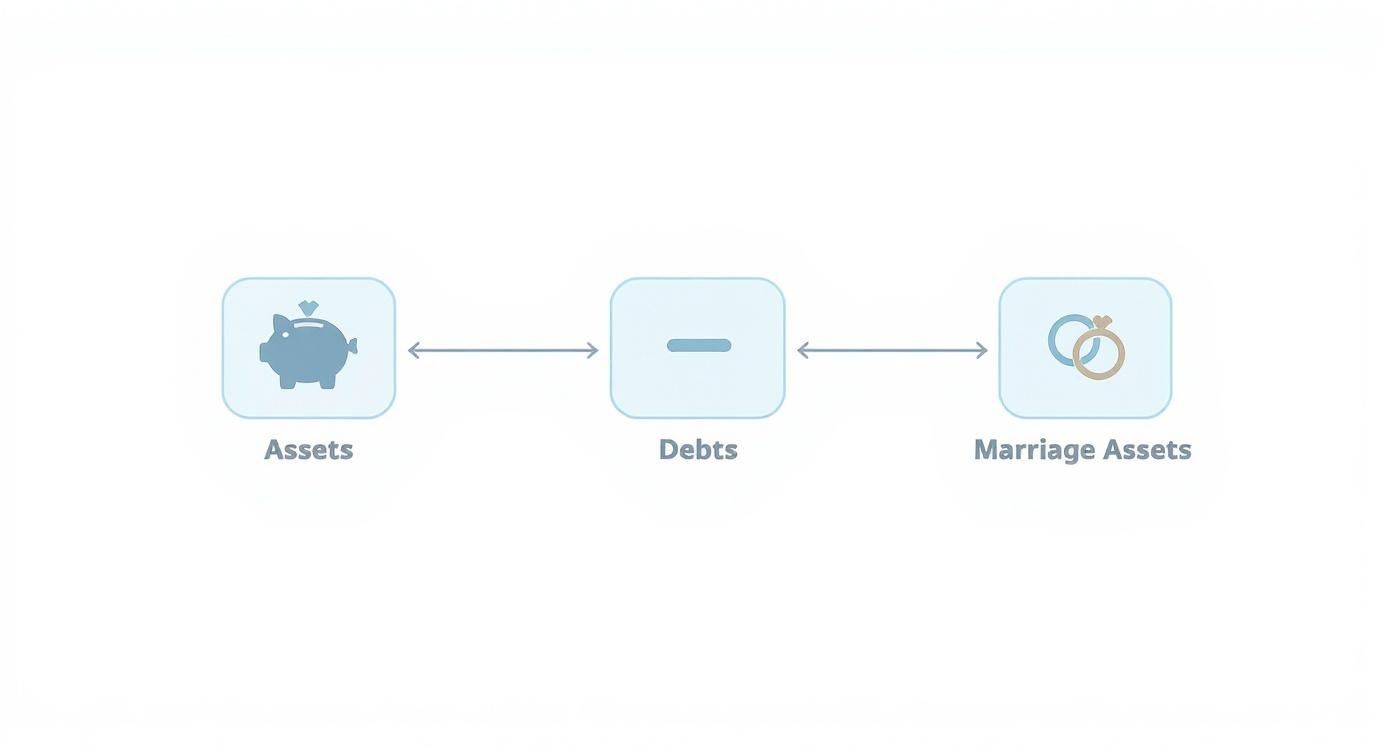
Diagram showing the financial relationship between personal Assets, Debts, and shared Marriage Assets.

As the visual shows, the core of the equalization process is simple on the surface: subtract what you owe from what you own. The result is the net value created during your marriage, which is what we aim to divide fairly.

What Goes on the Asset List

When you start compiling your assets, the goal is to capture the fair market value of each item as of your official date of separation. Think of it as taking a complete financial snapshot on that specific day. An experienced Brampton divorce lawyer will guide you, but you can get a head start by gathering documents for the following:

  • The Matrimonial Home: The full value of the home you shared is always included, no matter whose name is on the title.

  • Other Real Estate: This includes any cottages, investment properties, or land you own, whether in Brampton or somewhere else.

  • Bank Accounts: Pull together statements for all chequing, savings, and joint accounts.

  • Investments: This is a wide category that includes RRSPs, TFSAs, stocks, bonds, and mutual funds.

  • Pensions: The value of a pension earned during the marriage is a major asset that must be professionally valued.

  • Vehicles: Cars, trucks, boats, and any other motor vehicles all count.

  • Business Interests: If either of you owns a business, its value has to be professionally assessed.

  • Personal Belongings: High-value items like jewellery, art, and expensive collections are also part of the calculation.

Acknowledging Your Liabilities

Just as important as your assets are your debts. You can't get an accurate NFP calculation without a complete picture of your liabilities. You’ll need to list every single debt that existed on your date of separation.

Common liabilities include:

  • Mortgages on any real estate

  • Car loans or leases

  • Personal lines of credit

  • Student loans

  • Credit card balances

Subtracting these debts from your total assets gives you the “net” value that is so central to the equalization formula.

The Critical Importance of Full Financial Disclosure

Under the Family Law Act, both you and your spouse have a legal duty to provide full and honest financial disclosure. This isn’t just a suggestion; it’s a mandatory requirement. Hiding assets or deliberately undervaluing property is a serious mistake with severe consequences.

A court can impose harsh penalties if it finds that one spouse has intentionally hidden assets. These can include ordering that spouse to pay a larger share of the equalization payment, forcing them to cover the other’s legal fees, or even assigning the entire value of the hidden asset to the dishonest party.

In the most serious cases, hiding assets can move beyond family court. Providing false information in sworn financial documents can lead to charges under the Criminal Code of Canada, such as perjury or fraud. This is exactly why working with a trusted family lawyer in Brampton is so critical. We make sure your financial disclosure is complete and accurate, protecting you from legal trouble while securing your fair share.

Understanding Which Assets Are Excluded from Division

When you're facing a separation in Brampton, it’s easy to assume that every single thing you own gets thrown into one big pot for division. But that’s not quite how it works. While Ontario’s goal is fairness, the Family Law Act recognizes that some assets just aren’t a product of the marriage. These are considered your separate property.

Think of it like this: the law creates a protective bubble around certain assets, shielding them from the equalization calculation. This means their value isn't included in your Net Family Property (NFP), so you don't have to share them with your spouse. Understanding what fits inside this bubble is a game-changer in the division of property.

Key Exclusions Under the Family Law Act

The law is very clear about what counts as excluded property. If you received an asset that falls into one of these categories and you still have it on the day you separate, you can deduct its value from your side of the ledger.

Here are the most common examples of property you get to keep:

  • Gifts from a Third Party: Any gift you personally received from someone other than your spouse is yours. For example, if your parents gave you $25,000 to buy a car that’s only in your name, that money is excluded from the family pot.

  • Inheritances: If you inherited money or property during the marriage, it remains yours. That $100,000 GIC left to you by your grandmother? It's protected and doesn’t get split.

  • Life Insurance Proceeds: Payouts from a life insurance policy where you were named the beneficiary are considered excluded funds.

  • Damages from Personal Injury Lawsuits: Compensation you received from a settlement—like for a car accident—is meant to make you whole, not to be shared as a family asset.

It's on you to prove an asset should be excluded. You need a clear paper trail showing where the money or property came from and that you still had it at separation. This is where good record-keeping becomes your best friend.

The Importance of Keeping Excluded Property Separate

Here’s the catch: to keep that protective bubble intact, you have to keep the excluded asset separate. Don’t mix it with family money. For instance, if you inherit $50,000 and put it into a new investment account solely in your name, it stays excluded. Simple.

But if you take that same $50,000 and drop it into the joint chequing account you both use for groceries and bills, you’ve likely just gifted it to the family. Once commingled, the law may see it as joint property, and you could lose your right to exclude it. A family lawyer in Brampton can give you practical advice on how to handle these funds correctly from day one.

The Major Exception: The Matrimonial Home

There’s one huge exception that trips up a lot of people in Brampton: the matrimonial home. Under Ontario law, the family home is treated differently than any other asset. Its special status trumps almost all other rules.

Even if you poured your entire inheritance or a massive gift into the down payment or mortgage, you cannot exclude that amount from the home's value. So, if your parents gifted you $100,000 for the down payment on your house, that money is now part of the home's divisible value. The law prioritizes the stability of the family residence above protecting individual contributions. This rule often comes as a shock and is a perfect example of why getting clear legal advice from a Brampton divorce lawyer is non-negotiable for a fair outcome.

Why the Matrimonial Home Is a Special Asset

When it comes to dividing property in an Ontario divorce, one asset stands in a class of its own: the matrimonial home. The Family Law Act carves out a unique set of rules just for the family home, recognizing its central role in a family’s life. It isn't treated like an RRSP, a car, or a cottage.

For homeowners in Brampton and the GTA going through a separation, getting a handle on these specific rules is absolutely critical. The law is designed to protect the value and stability the home represents, making it the cornerstone of the entire property division calculation.

A two-story brick house with a green lawn, a driveway, and a sign reading 'MATRIMONIAL HOME'.

No Deduction for Pre-Marriage Value

Here’s the biggest difference: you cannot deduct the value of the matrimonial home that you owned before the marriage. Think about that for a second. If you owned the house on your wedding day, its entire value on the date you separate gets included in your Net Family Property (NFP). This is a huge departure from other assets, like an investment account, where you’d get to subtract its pre-marriage value.

This rule holds true even if the home was a gift or an inheritance. Let's say your parents gifted you a house, and you and your spouse moved in and made it your family home. You’ve just lost the ability to exclude that gift from the NFP calculation. The law effectively transforms what was once your separate property into a shared family asset.

Equal Possessory Rights After Separation

Another unique feature of the matrimonial home is what’s known as possessory rights. Under Ontario law, both spouses have an equal right to live in the home after you separate, and it doesn't matter whose name is on the title.

This means one spouse can’t just change the locks and kick the other one out. To force someone to leave, you need either a court order or a signed separation agreement. These rights are in place to prevent a spouse from being left homeless and to maintain stability, especially when there are children involved.

Common Scenarios for Brampton Homeowners

For most families in Brampton, the home is their single biggest asset, which naturally makes it a major focus of negotiations. When it comes to deciding what to do, there are usually three main options:

  1. One Spouse Buys Out the Other: If one person wants to stay in the home, they can buy out their spouse's share of the equity. This almost always requires refinancing the mortgage to qualify for a new, larger loan on a single income—a tough financial hurdle for many.

  2. The House Is Sold: This is the most common path. You sell the home, pay off the mortgage and all the costs like real estate commissions and legal fees, and then split the leftover equity.

  3. Delayed Sale: Sometimes, particularly when young children are involved, a couple agrees that one parent will stay in the home for a set period. The house is then sold down the road, maybe when the youngest child finishes high school.

The treatment of property varies greatly by jurisdiction. For example, in California, which operates under community property laws, the state's high home values significantly impact divorces. California homeowners have nearly triple the home equity of those in other states, making the division of the marital home a central and complex issue in their family law system. You can discover more insights about assets and wealth in California on ppic.org.

Working through the financial and legal maze surrounding the matrimonial home requires a solid strategy. A knowledgeable Brampton divorce lawyer can walk you through your rights, help you weigh the pros and cons of a buyout versus a sale, and ensure your largest asset is handled fairly in the final settlement.

Navigating the Property Division Process Step by Step

Thinking about the division of property can feel overwhelming, but it's not a chaotic free-for-all. It's actually a structured path with clear, deliberate steps designed to get a fair and legally sound outcome under Ontario's Family Law Act.

The whole process kicks off the moment you and your spouse separate. That specific day establishes the all-important valuation date—the snapshot in time used to value all your assets and debts for the NFP calculation. From there, you move into gathering and sharing information, which is the bedrock of any good negotiation.

A wooden desk with a laptop, a green book, a pen, and a notebook displaying 'STEP-BY-STEP GUIDE' with a checked box.

Gathering Your Financial Information

The first active step is to collect every single relevant financial document. This part is non-negotiable and demands thoroughness. You and your spouse will need to formally exchange this information in a document called a Financial Statement, which is a sworn legal document confirming its accuracy.

It can feel like a lot, but breaking it down makes it manageable. Focus on getting proof for:

  • Income: Recent pay stubs, T4 slips, and income tax returns.

  • Assets: Bank statements, investment summaries (RRSPs, TFSAs), property deeds, and vehicle ownerships.

  • Debts: Mortgage statements, credit card bills, and loan agreements.

To make this crucial step easier, here's a checklist of the documents you'll need to start gathering. Having these ready will save you time and help your lawyer build a clear picture of your finances from day one.

Document Category Specific Examples
Proof of Income Pay stubs, T4/T4A slips, recent tax returns and Notices of Assessment, business financial statements.
Bank & Investment Accounts Statements for chequing/savings accounts, RRSPs, TFSAs, GICs, stocks, and mutual funds.
Real Estate Property deeds, mortgage statements, property tax assessments (MPAC), home appraisal reports.
Pensions & Retirement Plans Pension plan statements, company retirement plan summaries.
Vehicles & Valuables Vehicle ownership documents (pink slips), appraisals for art, jewelry, or collectibles.
Debts & Liabilities Credit card statements, lines of credit statements, student loan agreements, car loan documents.
Insurance Life insurance policies with a cash surrender value.

This isn't an exhaustive list, but it's a solid start. The goal is complete transparency—it’s the only way to ensure the final division is fair and legally sound.

Valuing Your Assets and Negotiating a Settlement

Once all the information is on the table, the next step is to put a fair market value on each asset as of your separation date. While figuring out the value of a bank account is easy, some assets are more complicated. Things like pensions, stock options, or business interests often require professional appraisers to lock down an accurate value.

With a clear financial picture, you can finally start negotiating a settlement. For many Brampton couples, this doesn't have to mean a drawn-out courtroom battle. There are several ways to get to a resolution:

  • Lawyer-led Negotiation: Your lawyers talk directly to hammer out an agreement on your behalf.

  • Mediation: A neutral third-party mediator guides you and your spouse toward a compromise.

  • Collaborative Family Law: You, your spouse, and your lawyers all commit to working together outside of court to find a solution.

The goal of any negotiation is to arrive at a legally binding Separation Agreement. This document finalizes the equalization payment and settles all property issues, allowing both of you to move forward with financial certainty.

While Ontario's legal framework guides how we handle things here, it's interesting to see how other places tackle similar issues. For instance, California’s property tax system can add a whole other layer of complexity. There, assessed values for tax purposes can be much lower than actual market values, which significantly impacts how properties are valued in a divorce. You can see how they manage statewide assessments through the California State Board of Equalization.

Every single step, from digging up old bank statements to signing a final agreement, is critical. Getting guidance from an experienced Brampton divorce lawyer makes sure you follow the right procedures, protect your rights, and achieve a result that is truly fair.

Common Questions About Property Division in Brampton

When a relationship ends, it's natural to have a flood of urgent questions. Here in Brampton, we often hear the same concerns from clients trying to make sense of their rights and what comes next. Let's tackle some of the most common questions we get about division of property in Ontario.

What Happens to Property for Common-Law Partners?

This is one of the biggest misconceptions in Ontario family law. Many people believe common-law partners have the same property rights as married spouses, but that's simply not the case under the Family Law Act. The rules for equalization of Net Family Property—the 50/50 split—do not automatically apply to unmarried couples.

Instead of splitting the wealth you built together, property is usually divided based on who legally owns it. If your name is on the title, you typically keep the asset. However, it's not always that simple. If one partner contributed significantly to an asset owned by the other (like paying down the mortgage on a house they don't own), they may have a trust claim for "unjust enrichment" to get compensated. This is a complex legal argument and requires help from an experienced family lawyer in Brampton to navigate successfully.

Can We Agree to an Unequal Division?

Absolutely. The 50/50 equalization rule is just the starting point. You and your spouse have the freedom to negotiate a different arrangement that you both feel is fair and works for your unique situation.

For an agreement like this to hold up in court, it has to be formalized in a legally binding Separation Agreement. To make sure the agreement is solid and can't be easily challenged later, both of you must:

  • Provide full and honest financial disclosure to each other.

  • Get independent legal advice from your own separate lawyers.

  • Sign the agreement voluntarily, without being pressured or forced.

What if My Spouse Is Hiding Assets?

Trying to hide assets during a separation is a massive mistake with serious legal consequences, not just under the Family Law Act but also potentially under the Criminal Code of Canada. If you have a gut feeling that your spouse isn't being upfront about their finances, your lawyer can take immediate action. This could mean filing a motion with the court to force them to produce specific documents and be transparent.

A judge has the power to bring down heavy penalties for hiding assets. This can include giving the innocent spouse a larger share of the property, ordering the dishonest spouse to pay all the legal costs, or even assigning the full value of the hidden asset to their side of the ledger.

Is There a Deadline to Make a Property Claim?

Yes, and the timelines are strict. You must file a property claim with the court within:

  • Six years from the date you separated.

  • Two years from the date your divorce was finalized.

If you miss these deadlines, you could permanently lose your right to an equalization payment. It is absolutely critical to speak with a Brampton divorce lawyer as soon as possible after you separate to make sure your rights are protected.


Navigating these complexities requires clear, strategic legal advice. If you are facing a separation in Brampton, a dedicated family lawyer can protect your financial future and guide you toward a fair resolution. Contact a legal professional to ensure your rights are protected at every step. Learn more at https://badeshalaw.ca/brampton-criminal-lawyer.

How to Protect Your Property During a Divorce: Insights from a Family Lawyer in Brampton

When experiencing a separation in Brampton, a common concern is, ‘How do I safeguard my property during a divorce?’ The solution involves taking prompt and careful measures in accordance with Ontario’s *Family Law Act*. It’s important to avoid concealing assets or engaging in deceptive practices. Instead, begin by creating a comprehensive inventory of all family assets and liabilities. Additionally, systematically gather all essential financial documents. This approach not only ensures proper preparation but also lays the foundation for an equitable division of property. Consulting with Badesha Law, a knowledgeable family lawyer in Brampton, can provide valuable guidance and support through this process.

Your First Financial Moves When Separation Looms – Guidance from a Brampton Family Lawyer

Staring down a separation in Brampton is overwhelming, and it’s completely normal to feel anxious about your financial security. The entire process of dividing property is guided by Ontario’s legal framework, which is built on fairness and full financial disclosure.

Protecting your assets isn’t about deception. In fact, trying to hide money or property can lead to severe legal penalties under both family law and, in extreme cases, the Criminal Code of Canada. True protection comes from creating a clear, honest, and complete picture of your financial life as a couple. This initial stage is your chance to gain clarity and take back some control.

Start with a Detailed Financial Inventory

Before you can even begin talking about who gets what, you need to know exactly what’s on the table. This means creating a detailed inventory of everything you and your spouse own and owe as of your date of separation. Think of it as a complete financial snapshot of your married life.

Your inventory list needs to be exhaustive. Leave nothing out. It should include:

  • Real Estate: The matrimonial home in Brampton, any rental properties, the family cottage, or other real estate.
  • Bank Accounts: All chequing, savings, and joint accounts.
  • Investments: Stocks, bonds, mutual funds, GICs, and RRSPs.
  • Vehicles: Cars, trucks, motorcycles, boats, and any other recreational vehicles.
  • Pensions and Retirement Plans: Both private employer plans and government pensions.
  • Personal Property: Valuables like jewellery, art collections, and high-end electronics.
  • Business Interests: Any shares or ownership you have in a business.
  • Debts and Liabilities: Mortgages, car loans, lines of credit, and credit card balances.

This step is non-negotiable. A thorough inventory prevents nasty surprises down the road and makes sure every asset is accounted for during the equalization process.

Gather Your Essential Documents

Once you have your list, it’s time to find the paperwork that proves the existence and value of each item. This documentation is the evidence you’ll rely on. It’s incredibly important to make copies of everything and keep them in a secure location your spouse can’t access, like with a trusted friend, family member, or in a new safety deposit box.

Taking proactive steps to organize your financial records isn’t just good practice; it’s a strategic move. A well-documented financial file empowers you and your lawyer to build a strong case, ensuring transparency and preventing assets from being overlooked or undervalued during negotiations.

Key documents you need to find and copy include:

  • Tax Returns and Notices of Assessment: At least the last three years for both you and your spouse.
  • Bank and Investment Statements: Statements for all accounts covering the period from the date of marriage to the date of separation.
  • Property Deeds and Mortgage Statements: For any real estate you own.
  • Pension and RRSP Statements: The most recent statements available are a good start.
  • Vehicle Ownership Documents: Proof of ownership and any information on outstanding loans.
  • Credit Card and Loan Statements: To accurately list all shared debts.

Gathering these documents lays the foundation for your financial disclosure, which is a mandatory step in any Ontario divorce. It ensures you’re prepared for what comes next and helps protect your property by establishing a clear, provable financial history from the get-go.

Immediate Asset Protection Checklist

To get started, it helps to have a clear, actionable checklist. The table below summarizes the critical first steps you should take to preserve your financial standing right at the outset of your separation in Brampton.

Action Item Why It’s Critical in Brampton Documents to Gather
Inventory All Assets Ontario’s Family Law Act requires a full accounting of all property for equalization. Missing an asset can cost you later. List of all real estate, bank accounts, investments, pensions, vehicles, and valuable personal items.
List All Debts Both assets and debts are shared. You need a clear picture of mortgages, loans, and credit card balances to calculate Net Family Property. Recent mortgage statements, car loan agreements, line of credit statements, and credit card bills.
Gather Financial Statements These documents provide proof of value at key dates (date of marriage and date of separation), which is essential for the equalization calculation. Bank, investment, and RRSP statements from the date of marriage and the date of separation.
Copy Tax Returns Your T1 Generals and Notices of Assessment from the CRA for the last 3 years are mandatory for financial disclosure in court. Both spouses’ income tax returns and Notices of Assessment (at least the last 3 years).
Secure Important Papers Having your own copies prevents documents from “disappearing” and ensures you and your lawyer have the information you need. Property deeds, vehicle ownerships, insurance policies, and business records. Make digital and physical copies.

This checklist isn’t exhaustive, but it covers the non-negotiable first moves. Acting quickly to get this information organized will put you in a much stronger position as you move forward.

Decoding the Matrimonial Home and Equalization

When you’re trying to figure out how to protect your property during a divorce, two concepts from Ontario’s Family Law Act are absolutely critical: the Matrimonial Home and Equalization. Getting a handle on these isn’t just helpful—it’s the foundation for setting realistic expectations for your financial future in Brampton. They explain why your family home gets special treatment and how all the wealth you built together gets divided.

What Makes the Matrimonial Home So Special?

In Ontario, the home you and your spouse ordinarily lived in during your marriage is considered the matrimonial home. This gives it a unique status under the law, and it doesn’t matter whose name is on the title.

This means even if you owned your Brampton house before you got married and it’s solely in your name, it becomes the matrimonial home once you live in it as a family. From that point on, your spouse has an equal right to live there. Neither of you can sell it, take out a mortgage on it, or kick the other person out without their consent or a court order. It’s a powerful protection designed to ensure stability during a very unstable time.

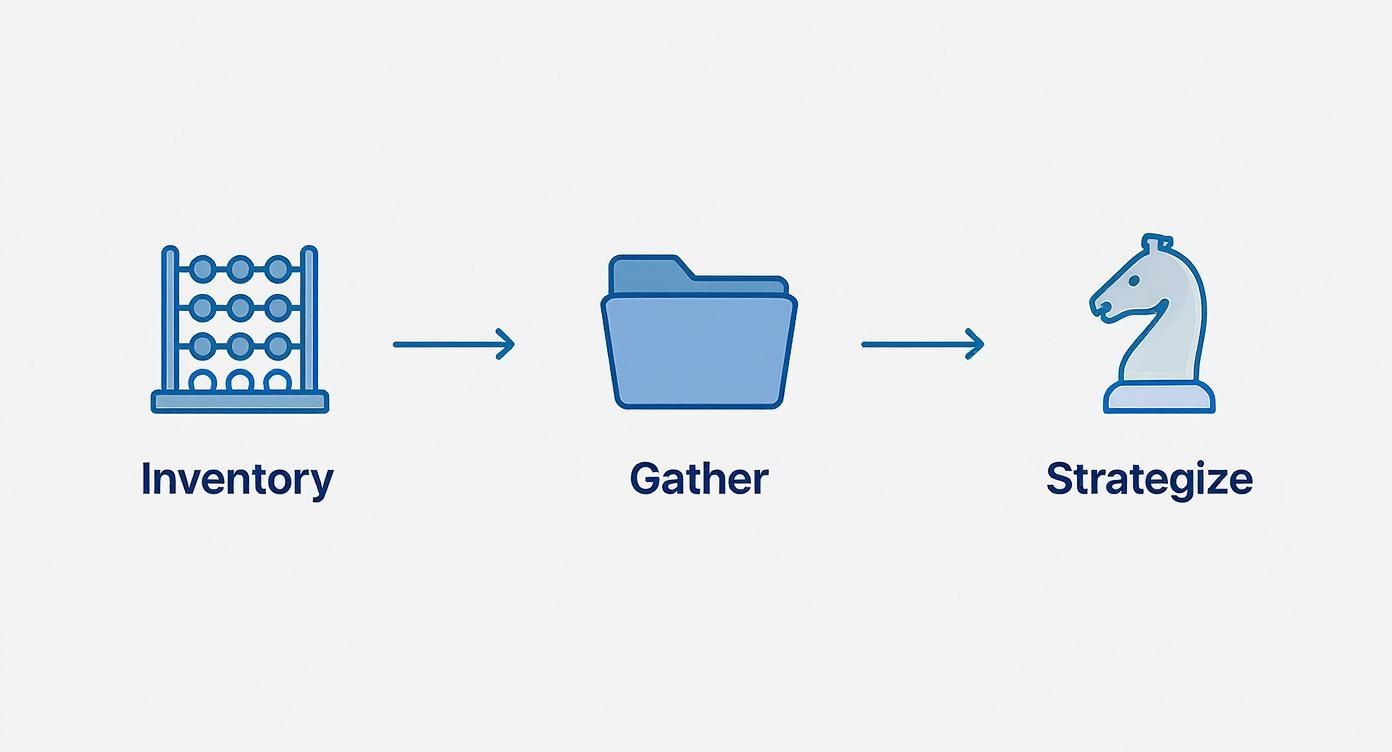
The process always starts with a clear-eyed inventory of what you have, followed by gathering all the necessary proof, and only then can you build a smart strategy.

A blue icon diagram illustrates a three-step process: Inventory (abacus), Gather (folder), and Strategize (chess knight), connected by arrows.

This flow highlights a key takeaway for our Brampton clients: protecting your assets isn’t about hiding things. It’s about meticulous organization and having a complete, honest financial picture from the very beginning.

Understanding Equalization of Net Family Property

Beyond the home, Ontario law is built on the idea that both spouses should share equally in the wealth built up during the marriage. This process is called equalization.

Think of it as a formula, not a feeling. The goal is to calculate the growth in each person’s net worth from the wedding day to the separation day, and then “equalize” the difference.

Here’s the basic idea:

  1. Calculate Net Family Property (NFP) for each spouse.
  2. Find the difference between the higher and lower NFP.
  3. The spouse with the higher NFP pays half of that difference to the other spouse.

This payment ensures both partners leave the marriage with an equal share of the value created during their time together.

How Net Family Property Is Calculated

Calculating your NFP is essentially a detailed accounting of your financial life. We take a snapshot at two specific moments: the day you married and the day you separated.

The basic formula looks like this:

  • Value of your assets on the date of separation
  • Minus your debts on the date of separation
  • Minus the value of your assets on the date of marriage
  • Minus your debts on the date of marriage
  • Equals your Net Family Property

Certain assets can sometimes be excluded, like gifts or inheritances you received during the marriage, but only if you kept them totally separate and didn’t use them for the family. The matrimonial home is the big exception here—its value is almost always included in the calculation, even if you owned it long before the wedding.

The concept of equalization is the bedrock of Ontario family law. It recognizes marriage as an economic partnership. Any attempt to quickly sell assets or move money after separation is usually pointless, as courts will almost always use the ‘date of separation’ value for their calculations. Full transparency isn’t just a good idea; it’s required.

While Ontario uses this equalization model, other places have different rules. For instance, a critical strategy for protecting property in a California divorce is the careful tracing and documentation of “separate property.” California law makes a hard distinction between community property (acquired during marriage) and separate property (owned before marriage or received as a gift or inheritance). If you can prove an asset is separate, it won’t be divided. This shows why, no matter where you are, meticulous record-keeping is universally important.

A Brampton Scenario

Let’s make this real. Imagine a Brampton couple, Priya and Raj, are separating.

  • After all the calculations, Priya’s NFP is $400,000.
  • Raj’s NFP comes out to $100,000.

The total family wealth they accumulated during the marriage is $500,000. To equalize this, they should each walk away with $250,000.

To get there, Priya, who has the higher NFP, needs to make an equalization payment to Raj. We find the difference between their NFPs ($300,000) and divide it by two.

Priya owes Raj an equalization payment of $150,000. This payment doesn’t have to be a cheque; it can be made by transferring assets, like a portion of an RRSP, or from the cash generated by selling the matrimonial home.

Navigating Complex Assets Like Businesses and Pensions

Man analyzing financial data on laptop and notebook, with text 'PROTECT COMPLEX ASSETS'.

When you’re trying to figure out how to protect your property in a divorce, the financial picture often extends far beyond the family home. Things get complicated fast when you have joint bank accounts, a family business, or retirement funds in the mix. These assets are usually tied directly to your long-term security, making their fair division one of the most critical parts of the process.

Let’s start with joint bank accounts. The first instinct for many is fear—what if my spouse drains the account and leaves me with nothing? It’s a valid concern, but emptying a joint account yourself can be seen as acting in bad faith and can really hurt you down the line.

A much better approach is to try and agree with your spouse to freeze the account. Another option is to divide the funds equally and move them into separate, individual accounts. This ensures you both have money for immediate expenses while preserving the rest for the final equalization calculation. Acting on your own without communication almost always complicates things, so talking it through—ideally via your lawyers—is key.

Valuing a Brampton Business in Divorce

For many entrepreneurs in Brampton, their business is their single most significant asset. Under Ontario’s Family Law Act, any business that was started or grew in value during the marriage is considered property to be divided. It makes no difference if your spouse was never involved in the day-to-day operations; the value accumulated is seen as a product of the marital partnership.

Protecting your business starts with getting a proper valuation. This isn’t a simple DIY task. It almost always requires a Chartered Business Valuator (CBV) to determine the business’s fair market value as of your separation date. The valuator will look at everything:

  • Tangible assets like equipment, real estate, and inventory.
  • Intangible assets such as goodwill, client lists, and brand reputation.
  • Liabilities and any outstanding business debts.

The final value they land on gets included in your Net Family Property calculation for equalization. It’s a common mistake to think you can shield your business by putting it in someone else’s name or deliberately undervaluing it. These moves are easy for forensic accountants to spot and can lead to serious legal penalties.

Demystifying the Division of Pensions and Retirement Funds

Pensions, RRSPs, and other retirement funds are often one of a couple’s most valuable assets—sometimes worth even more than the matrimonial home. These are treated as family property and are subject to equalization. The portion of the pension’s value that was earned during the marriage is what needs to be accounted for.

Figuring out the value of a pension for division can be incredibly complex, especially for defined benefit plans common in government and public sector jobs. You’ll almost certainly need a professional actuary to calculate the correct “commuted value” for the period of the marriage.

Pensions represent deferred income earned during the marriage. Failing to have them professionally valued is one of the most significant and costly mistakes people make in a divorce. The future income stream they represent must be fairly divided to protect both spouses’ long-term financial health.

While Ontario’s laws dictate how these assets are treated, legal frameworks can vary significantly by jurisdiction. For example, protecting your property in a divorce in California is heavily shaped by community property laws, which typically mandate a 50/50 split of assets acquired during the marriage. This rigid rule underscores the universal importance of accurate valuation and full disclosure, no matter the local laws. You can explore more about these distinct legal systems and their impact on divorce statistics.

Once the pension is properly valued, the amount can be equalized in a couple of ways:

  • Immediate Transfer: A portion of the pension can be transferred directly from one spouse’s plan to the other’s locked-in retirement account. This is a clean way to handle it.
  • Asset Trade-off: The spouse with the pension can keep it all but “buy out” the other’s share by giving them another asset of equal value, like a larger portion of the home’s equity.

Navigating these complex financial instruments is not something to do alone. You need professional guidance to ensure the valuation is accurate and the division is fair, securing your retirement future.

Using Legal Tools to Prevent Your Ex from Hiding Assets

A gavel, safe, and sealed envelopes with “FREEZE ASSETS” text, symbolizing legal action.

One of the biggest fears people in Brampton have during a separation is that their spouse will start secretly selling, transferring, or draining marital property before it can be divided fairly. It’s a valid concern. Actions like these can seriously damage your financial future.

Thankfully, Ontario’s legal system has powerful tools to stop this from happening. If you have good reason to believe your spouse is about to make a major move with family assets, you can’t afford to just wait and see. The law offers ways to freeze property right in its tracks, preserving everything until a final settlement or court order is reached.

What is a Preservation Order?

In Ontario, the main tool we use to stop a spouse from getting rid of assets is a preservation order, which you’ll often hear called an injunction. It’s a court order that effectively freezes specific property, making it illegal for either spouse to sell, mortgage, or dispose of it without the other’s permission or a judge’s approval.

This isn’t a step the court takes lightly. A Brampton judge will only grant a preservation order if you can show there’s a real, genuine risk that your spouse is about to dissipate assets. Vague suspicions won’t cut it—you need to bring evidence.

When Will a Brampton Court Grant an Injunction?

To get a preservation order, your lawyer needs to build a compelling case. Courts are most likely to step in when there’s a clear attempt to undermine the equalization process.

Here are a few real-world scenarios where an injunction might be granted:

  • Shady Business Deals: Your spouse owns a business and suddenly tries to sell their shares to a family member for way less than they’re worth.
  • Moving Money Offshore: You find wire transfer receipts showing your spouse is sending large sums of money to an overseas bank account.
  • Surprise Property Listings: You discover your spouse has listed a rental property you both own for sale without ever telling you.
  • Cashing Out Investments: Your spouse suddenly starts liquidating shared investments or RRSPs, which is completely out of character for their usual financial behaviour.

In situations like these, a preservation order is a critical tool to keep the financial situation stable and ensure every asset is on the table for a fair division.

A preservation order sends a clear message: all assets must stay put until they are properly dealt with under the Family Law Act. It’s a crucial legal safeguard that stops one person from unfairly changing the financial picture before negotiations even start.

The Criminal Code and Fraudulent Asset Hiding

This goes beyond just family law. Intentionally hiding or fraudulently getting rid of assets to cheat your spouse out of their rightful claim can have very severe consequences. Section 392 of the Criminal Code of Canada makes it a crime to dispose of or hide property with the intent to defraud creditors—and a spouse with a claim to that property can fall into that category.

Now, meeting this high standard is tough, and criminal charges are rare in divorce cases. But it shows just how seriously the legal system treats this kind of fraudulent behaviour. While the main goal in family court is a fair property division, knowing these criminal provisions exist adds another layer of protection and acts as a strong deterrent against deceit.

While legal orders are a powerful tool, some couples opt for proactive agreements to define asset division from the outset. For instance, in other jurisdictions, prenuptial and postnuptial agreements are widely used to specify how property will be handled in a divorce, bypassing default legal rules. Recent trends show a significant increase in couples using these contracts to protect individual assets. You can discover more insights about the rising popularity of prenuptial agreements and related divorce statistics.

The Best Defence: How the Best Family Lawyer in Brampton Helps You Craft a Strong Separation Agreement

While court orders and injunctions are powerful tools, they usually mean you’re on an adversarial path. The most effective, efficient, and empowering way to protect your property during a divorce is by creating a comprehensive Separation Agreement with your spouse. This legally binding contract is your single most important tool for gaining certainty and control over your future.

Think of a Separation Agreement as a detailed roadmap for your financial split. Instead of a judge in a Brampton courthouse making decisions about your life, you and your spouse sit down—with your respective lawyers guiding you—and make those decisions yourselves. The amount of time, money, and emotional stress this saves compared to a court battle is immense.

Taking Control of Your Financial Future

A well-drafted agreement can cover every single aspect of your separation. It’s your chance to be creative and find solutions that work for your unique family situation, rather than being forced into a one-size-fits-all outcome from a judge.

The scope of a Separation Agreement is incredibly broad and can spell out exactly how to handle things like:

  • The Matrimonial Home: Who gets it? Will one spouse buy the other out, or will it be sold with the proceeds divided down the middle?
  • The Equalization Payment: The agreement will state the exact equalization amount and the payment terms—whether it’s a lump sum, an asset transfer (like an RRSP rollover), or structured payments over time.
  • Specific Assets: You can decide who keeps the car, the cottage furniture, or even specific sentimental items that a court wouldn’t care about.
  • Debts and Liabilities: It clearly outlines who is responsible for paying off the mortgage, credit card balances, or lines of credit, protecting you from creditors coming after you for your ex’s debts.

When you settle these matters in an agreement, you eliminate the unknown. You know exactly what you owe and what you’re entitled to, which allows you to move forward with a clear, stable plan.

The Non-Negotiable Step: Independent Legal Advice

Here’s a crucial point for anyone in Brampton. Under Ontario’s Family Law Act, for a Separation Agreement to be legally binding and hold up in court, both parties must provide full and honest financial disclosure. Even more importantly, each spouse must obtain Independent Legal Advice (ILA) from their own lawyer before signing it.

This isn’t just a friendly suggestion; it’s a critical legal requirement. ILA ensures that:

  1. You completely understand the terms of the agreement and its long-term consequences.
  2. You know your rights and obligations under Ontario law.
  3. You are not being pressured or forced into signing something that isn’t fair.

A family lawyer will review the entire document with you, flag any potential red flags, and confirm that it truly protects your interests. If you skip this step, a court could easily set aside the agreement down the road, undoing everything you worked to achieve and throwing your financial life back into chaos.

A Separation Agreement without Independent Legal Advice is not worth the paper it’s written on. It’s the final, essential step that transforms a simple document into a powerful, legally enforceable tool that protects your property and secures your future.

Why an Agreement Is Almost Always Better Than Court

Going to court should be a last resort. It’s a public process, it’s incredibly expensive, and at the end of the day, the final decision is completely out of your hands. Crafting a Separation Agreement keeps your affairs private and encourages collaboration.

It empowers you and your spouse to end your marriage with dignity and respect, which is especially important when children are involved. By proactively defining the terms of your separation, you are taking the most powerful step possible to protect your property and build a secure foundation for your new beginning.

Common Questions on Protecting Your Assets During a Divorce

When you’re facing a separation in Brampton, a flood of questions about your home, your savings, and your future can feel overwhelming. With emotions running high, you need clear, practical answers grounded in Ontario’s Family Law Act. We’ll tackle some of the most common concerns we hear every day, giving you the straightforward information you need to protect what’s yours.

Can My Spouse Kick Me Out of Our Brampton Home?

This is usually the first and most urgent fear people have. The short answer is a firm no.

In Ontario, if the property was your regular family residence, it’s legally considered the “matrimonial home.” This status gives you special protections, and it doesn’t matter whose name is on the title.

Both of you have an equal right to live in the matrimonial home until there’s a court order or a signed Separation Agreement that states otherwise. Your spouse can’t legally change the locks on you, sell the house from under you, or take out a new mortgage without your explicit written consent. These rules are in place to ensure stability for you and any children while you navigate the separation.

What Happens to Gifts or Inheritances I Received?

It’s a common assumption that a gift or inheritance is automatically yours to keep, no questions asked. While that’s the general idea, the reality can be much more complicated. Under the Family Law Act, gifts and inheritances you received during the marriage can usually be excluded from your Net Family Property calculation, meaning they aren’t split.

But there’s a massive catch: you lose this protection if you mix, or “commingle,” those funds with family assets. For instance, if you inherit $50,000 and put it into a joint bank account or use it to pay down the mortgage on the matrimonial home, that money is very likely to be treated as a family asset and get divided.

Want to protect an inheritance or gift? The trick is to keep it completely separate. Open a new bank account in your name only and never let those funds touch your joint finances. Meticulous records are your best friend if you ever have to prove the money was always separate.

How Are Our Debts Divided in the Divorce?

Debts are just as important as assets when figuring out the financial picture. Mortgages, car loans, lines of credit, and credit card balances—any debt built up during the marriage is considered a family liability. It all gets factored into the equalization process.

When we calculate your Net Family Property, the value of your debts on the date of separation is subtracted from the value of your assets. This means if your name is on a joint credit card, you are legally on the hook for the entire balance, even if your spouse did all the spending. It’s crucial to deal with joint debts head-on in a Separation Agreement, spelling out exactly who is responsible for paying off each one.

What if We Were Common-Law?

This is a huge point of confusion for couples in Brampton, and the rules are completely different. In Ontario, common-law partners do not have the same property rights as married spouses. There is no automatic right to equalization, which means there’s no automatic 50/50 split of the property you acquired together.

When a common-law relationship ends, you generally leave with the assets and debts that are in your name. The special protections for a “matrimonial home” don’t apply, so if the house is solely in your partner’s name, you have no automatic right to stay there.

That said, you may have options. If you made significant contributions to an asset your partner owns—like paying for major renovations on their house—you might be able to make a trust claim to be compensated. These claims are complex and hinge on providing detailed proof of your contributions, making expert legal advice absolutely essential.


Navigating property division requires a clear head, a solid strategy, and professional guidance. The team at Badesha Law is here to protect your rights and help secure your financial future in Brampton. Whether you need to draft a fair Separation Agreement or are facing a contentious dispute, we provide the strong, client-focused advocacy you deserve. Contact us to ensure your interests are protected every step of the way.