

Step-by-Step Guide to Getting a Divorce in Ontario
Navigating a divorce can feel overwhelming, especially when you’re trying to understand the legal system in Brampton. For anyone needing a Divorce Lawyer in Brampton, the first step is often the hardest: figuring out where to begin. This guide provides a clear, step-by-step roadmap to the divorce process in Ontario, grounded in the Family Law Act and Canada’s Divorce Act, giving you actionable insights to move forward with confidence.
Your First Steps in the Brampton Divorce Process
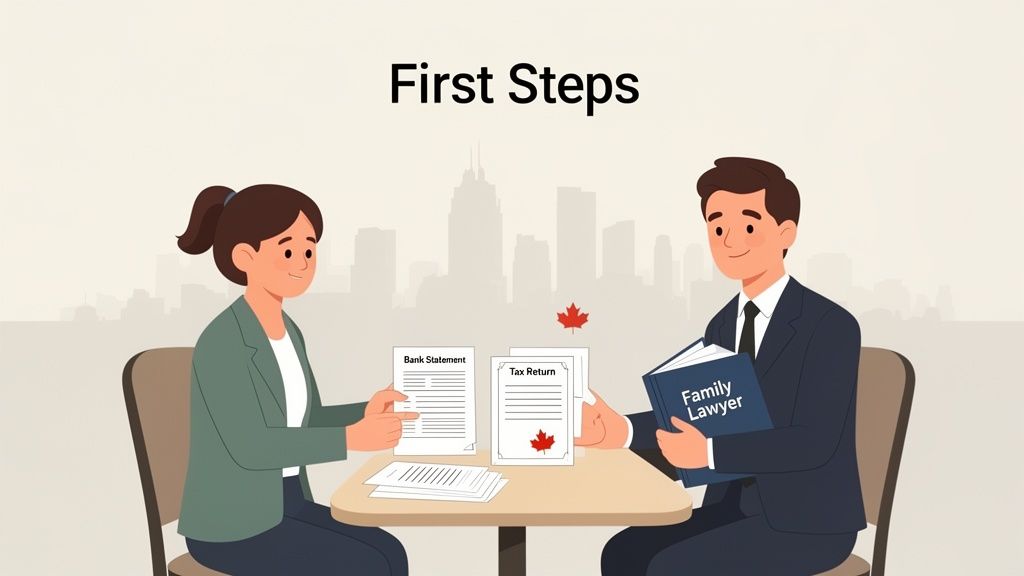
Starting the divorce process in Brampton is about strategic preparation, not emotional reactions. Before filing any paperwork, it’s crucial to build a solid foundation. By focusing on these initial tasks, you empower yourself with the knowledge and organization needed to navigate the legal journey ahead, taking back control of your situation.
Step 1: Confirm You Are Eligible for a Divorce
Before any legal action can be taken, you must meet the basic requirements for a divorce in Canada. Under the federal Divorce Act, the sole ground for divorce is marriage breakdown. The most common way to prove this is by living separate and apart from your spouse for at least one year.
This one-year separation is a mandatory waiting period. However, you do not have to wait for the year to be over to start the process. You can begin negotiations, draft a separation agreement, and even file your Application for Divorce. The final Divorce Order will simply not be granted until the one-year mark has passed.
Step 2: Schedule an Initial Legal Consultation
One of the most powerful first moves you can make is scheduling a consultation with an experienced family lawyer in Brampton. This meeting is not about starting a conflict; it’s about understanding your rights and obligations regarding property division, support, and parenting arrangements under Ontario law.
A proactive consultation provides a personalized roadmap. You’ll understand potential outcomes, the process ahead, and how to protect your interests before making irreversible decisions.
This early legal advice is invaluable. It helps you avoid common mistakes, such as informally agreeing to terms that are not in your best interest or moving out of the matrimonial home without understanding the potential legal consequences.
Step 3: Organize Your Financial Documents
Financial disclosure is the cornerstone of any Ontario divorce. Getting a head start on gathering your financial paperwork will save you significant time, stress, and money. This involves creating a complete financial snapshot of your marriage.
Start collecting these key documents for both yourself and, if possible, for your spouse:
- Proof of Income: Recent pay stubs, T4 slips, and Notices of Assessment from the Canada Revenue Agency for the last three years.
- Asset Information: Bank account statements, investment summaries (RRSPs, TFSAs), and property deeds.
- Debt Records: Statements for mortgages, lines of credit, credit cards, and car loans.
- Business Valuations: If you or your spouse owns a business, any relevant financial statements are crucial.
As you navigate these initial stages, you may also consider new living arrangements; finding reliable movers in Brampton can help facilitate a smoother transition. Taking these organized steps provides the foundation needed to approach the rest of your divorce with clarity and confidence.
Understanding the Grounds for Divorce in Ontario
In Canada, the divorce process is designed to be “no-fault.” The federal Divorce Act establishes only one legal reason for divorce: marriage breakdown. This approach removes blame from the legal equation and focuses instead on achieving a fair and practical resolution for your family’s future.
For most couples in Brampton, proving marriage breakdown is straightforward: you must show that you and your spouse have lived separate and apart for at least one full year. This is the standard path to legally ending a marriage.
The One-Year Separation Rule
“Living separate and apart” is the key to demonstrating marriage breakdown. This doesn’t necessarily mean one person must move out immediately. Many couples continue to live in the same home while legally separated for financial reasons or to provide stability for their children.
What matters is the intention to end the marital relationship. This means you stop living as a couple—perhaps by sleeping in separate rooms, managing finances independently, and no longer presenting socially as a couple. This one-year period allows both individuals time to be certain about their decision. A skilled divorce lawyer in Brampton can provide clear advice on what constitutes a legal separation, even if you are still living under the same roof.
Are There Other Grounds for Divorce?
While the one-year separation is the most common path, the Divorce Act does provide two other grounds for proving marriage breakdown:
- Adultery: You would need to provide clear proof that your spouse was physically intimate with another person.
- Cruelty: This requires showing that your spouse has treated you with such severe physical or mental cruelty that it is impossible to continue living together.
In modern family law, these “fault-based” grounds are rarely used. The standard of proof is extremely high, and attempting to prove them can turn the process into an expensive and emotionally draining battle. Crucially, proving fault does not provide an advantage in matters of property division or support. For these reasons, legal experts almost universally recommend proceeding based on the one-year separation.
The purpose of Ontario’s divorce system is not to punish past behaviour. It is to dissolve the legal union and create a fair plan for the future, focusing on key issues like parenting, support, and property division.
The rapid growth in Peel Region has placed significant pressure on the Brampton courthouse, leading to serious backlogs. With local divorce rates at approximately 12.5 per 1,000 marriages—higher than the provincial average—you need an expert to navigate this congested system. An experienced Brampton lawyer ensures your documents are prepared perfectly to avoid the rejections and delays that affect many others.
Solving the Core Issues of Your Divorce
Once the divorce process is initiated, the real work involves resolving the three core pillars: property, support, and children’s well-being. By addressing each of these methodically, you can work toward a fair and stable resolution that allows everyone to move forward.
An experienced family lawyer in Brampton is your guide through this process, ensuring you understand how the Family Law Act protects your rights at every stage.
Untangling Your Finances: Property Division
Under Ontario law, marriage is viewed as an equal economic partnership. The wealth you accumulated together during the marriage must be shared fairly when it ends. This is achieved through a process called equalization.
The process involves balancing the financial growth of each spouse during the marriage. Each spouse calculates their Net Family Property (NFP) by taking their assets on the date of separation and subtracting their debts and the assets they brought into the marriage. The spouse with the higher NFP pays the other spouse half of the difference.
This is called an equalization payment, and its purpose is to ensure both partners leave the marriage with an equal share of the wealth accumulated as a team.
The calculation follows these steps:
- List all assets and debts as of the date of separation.
- Do the same for the date of marriage (excluding certain items like gifts or inheritances).
- Subtract the marriage-date value from the separation-date value for each spouse to determine their individual NFP.
- The spouse with the higher NFP pays half the difference to the other.
The matrimonial home receives special treatment in these calculations. For many, deciding what to do with the house is a significant challenge. Understanding your options for selling your marital home during a divorce is a critical part of financial planning.
To clarify these core issues, here is a summary of what you will be navigating.
Key Divorce Issues in Ontario at a Glance
| Issue | What It Involves | Governing Principle (Ontario Family Law Act) |
|---|---|---|
| Property Division | Calculating and dividing the wealth accumulated during the marriage. Includes assets like the home, pensions, investments, and debts. | Equalization: The spouse with the higher Net Family Property growth pays the other half of the difference to ensure both partners share the marital wealth equally. |
| Support | Determining financial assistance for a spouse (spousal support) and children (child support) to address financial imbalances post-separation. | Fairness and Need: Spousal support is based on factors like roles in the marriage and need. Child support is a child’s right, calculated using mandatory government guidelines. |
| Parenting | Creating a plan for how children will be cared for. This includes who makes major life decisions (decision-making) and the schedule of time spent with each parent (parenting time). | Best Interests of the Child: All decisions must prioritize the child’s physical, emotional, and psychological well-being above all else. |
Each issue is governed by a distinct legal principle, which is why a clear strategy is essential.
Establishing Financial Stability: Spousal and Child Support
Support payments are not a penalty. They are a legal mechanism to ensure financial fairness and stability after separation, particularly for children or a spouse who may be financially disadvantaged.
Spousal Support
Spousal support is not automatic. It is intended to recognize a spouse’s contributions to the marriage and assist them in becoming self-sufficient. To determine if support is warranted, a court will consider:
- The length of the marriage.
- The roles each spouse played (e.g., one as primary caregiver while the other advanced their career).
- The income and earning capacity of each spouse.
- Any economic hardship caused by the separation.
Child Support
Unlike spousal support, child support is the legal right of every child. The calculation is based on mandatory government guidelines. The amount depends almost entirely on the paying parent’s gross annual income and the number of children, ensuring predictable financial support.
Focusing on the Future: Parenting and Decision-Making
When children are involved, Ontario law prioritizes their best interests above all else. The federal Divorce Act now uses terms like “decision-making responsibility” and “parenting time” instead of “custody” and “access” to encourage a more collaborative approach.
This shift in language encourages parents to focus on their roles and responsibilities, rather than on “winning” or “losing” their children.
Decision-Making Responsibility refers to who makes major decisions about a child’s life, such as:
- Health and medical care
- Education
- Religious upbringing
- Significant extracurricular activities
Parenting Time is the schedule that outlines when the children are in the care of each parent. The goal is to create a stable routine that allows the children to maintain a strong relationship with both parents. A Brampton family lawyer can help you create a detailed parenting plan that fits your family’s unique needs, preventing future conflicts and providing stability for your children.
The Step-by-Step Ontario Divorce Court Process
While the Ontario court system may seem intimidating, it follows a structured and predictable path. Understanding this roadmap helps set realistic expectations and highlights the value of having a skilled legal guide in Brampton.
The process begins when the first set of documents is filed with the court. Each subsequent stage is designed to narrow down the issues, encourage settlement, and move your case toward a final resolution.
Step 1: Filing the Initial Application
The first official step is filing an Application for Divorce (Form 8A). This document formally requests a divorce from the court and outlines the issues you need resolved, such as property division, support, and parenting arrangements.
Once completed with the help of your family lawyer, the application is filed with the Superior Court of Justice in Brampton. This officially opens your court file and initiates the legal process.
Step 2: Serving Your Spouse and Waiting for a Response
After filing, you must “serve” your spouse with a copy of the Application. This formal delivery process ensures your spouse is officially notified of the legal action.
Your spouse then has 30 days to file an Answer (Form 10) (or 60 days if living outside Canada or the US). If they fail to respond, the divorce may proceed as “uncontested,” which can significantly speed up the process.
This flowchart illustrates the three core pillars the court process is designed to resolve.
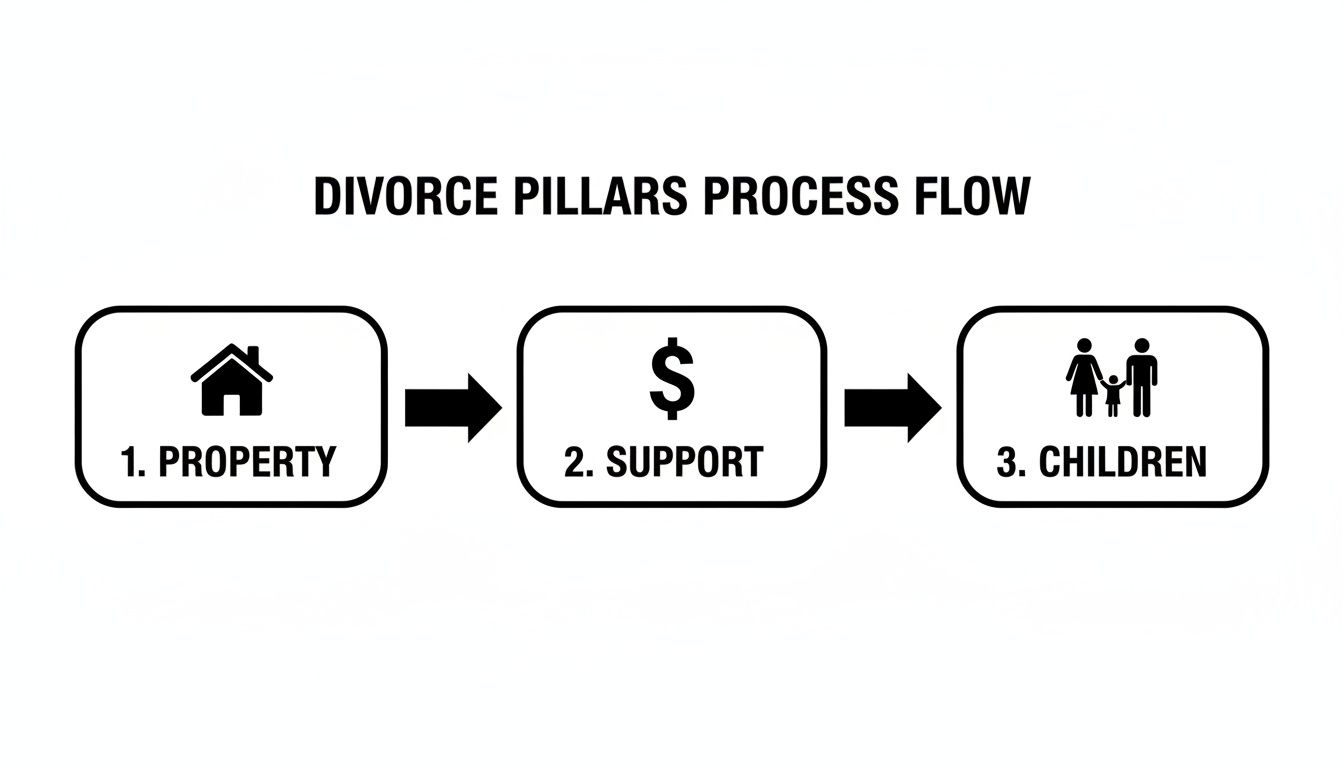
The system methodically addresses property, support, and children to achieve a comprehensive and final resolution.
Step 3: The All-Important Exchange of Financials
This is one of the most critical stages. Both you and your spouse are legally required to provide full and honest financial disclosure by completing a Financial Statement (Form 13 or 13.1). This must be supported by documents like tax returns, pay stubs, and bank statements.
Full financial disclosure is the bedrock of a fair settlement. Hiding assets can lead to severe court penalties. Without transparency, it is impossible to correctly calculate equalization or determine support.
An experienced family lawyer in Brampton will ensure your financial statement is prepared accurately, helping you avoid common errors that cause delays in the busy Brampton court system.
Step 4: Navigating the Court Conferences
Before a case goes to trial, it must proceed through a series of conferences with a judge. These are structured meetings designed to manage the case and explore settlement opportunities.
- Case Conference: The first meeting with a judge to identify disputed issues, ensure documents have been exchanged, and set a timeline.
- Settlement Conference: The focus is on resolving the case. The judge will offer an opinion on the likely outcome at trial to encourage a compromise.
- Trial Management Conference: If no settlement is reached, this final conference prepares for trial by finalizing witness lists and scheduling trial dates.
Each conference is a checkpoint to resolve your divorce without the cost and stress of a full trial. A good lawyer uses these meetings strategically to advocate for you and guide your case toward an efficient resolution.
Reaching a Fair Agreement Outside of Court
Court is not the only path to a divorce. In fact, most successful divorces in Brampton are settled amicably outside the courtroom. Alternative Dispute Resolution (ADR) methods like negotiation and mediation can save you significant time, money, and emotional stress.
These methods empower you to control the outcome rather than having a judge make decisions for your family. This is often the best way to maintain a respectful co-parenting relationship.
Lawyer-Led Negotiation
The most common starting point is direct negotiation between lawyers. Your family lawyer in Brampton communicates with your spouse’s lawyer to resolve key issues like property, support, and parenting. Your lawyer acts as your professional advocate, presenting your position and providing strategic advice based on Ontario’s Family Law Act. This is often the quickest and most cost-effective way to achieve a comprehensive separation agreement.
Mediation: A Guided Path to Common Ground
If direct negotiations stall, mediation is an excellent option. In this voluntary process, a neutral third-party mediator helps guide a productive conversation between you and your spouse. The mediator’s role is not to make decisions but to improve communication, identify common interests, and explore creative solutions that a court might not be able to order. You still have your own lawyer providing independent legal advice.
Mediation empowers you to be the architect of your own settlement. It shifts the focus from winning and losing to finding a practical, fair resolution that works for your entire family.
Collaborative Family Law: A Team-Based Approach
Collaborative family law is a unique process where you, your spouse, and your specially trained lawyers sign an agreement committing to resolve all issues without going to court. If the process fails, both lawyers must withdraw, creating a strong incentive for good-faith cooperation. This model often includes neutral financial specialists or family coaches to provide expert guidance, making it an excellent option for couples determined to minimize conflict.
How to Choose the Right Family Lawyer in Brampton
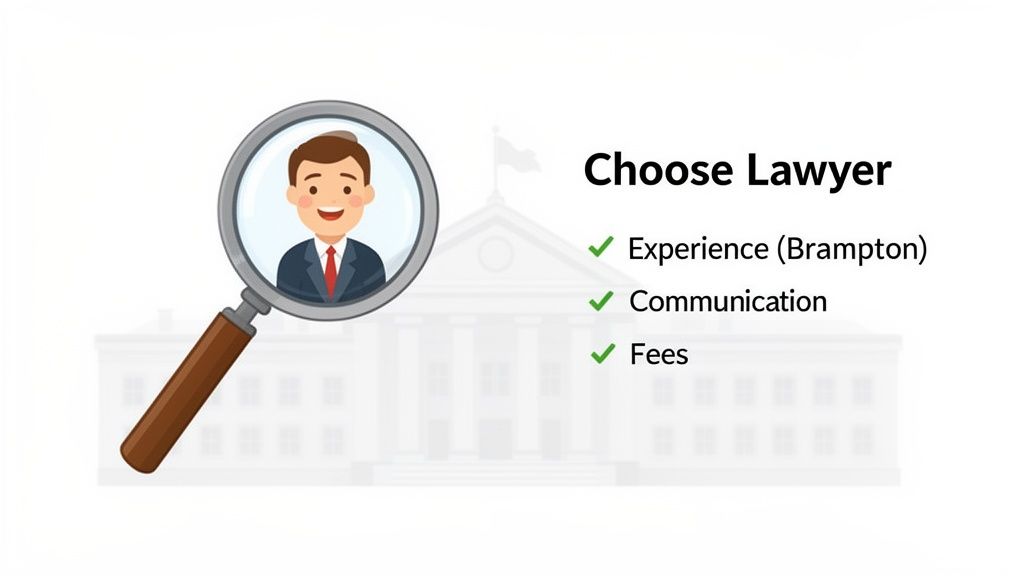
Choosing the right legal advocate is the most critical decision you will make in your divorce. Your lawyer is your strategist, advisor, and advocate. The right fit ensures your journey through the legal system is as smooth and fair as possible. It’s about finding a professional who understands your goals and has the specific experience to achieve them within the Brampton legal landscape.
Look for Deep Brampton Court Experience
The family court in Brampton has its own unique procedures and judicial personalities. A lawyer who is a regular presence at the Brampton courthouse offers a significant advantage. They understand the system’s nuances and know how to prepare documents that won’t get bogged down in administrative delays. This local knowledge is a practical asset that saves you time and money.
Choosing a lawyer with deep local roots is about competence. Their familiarity with the Brampton court system translates directly into a smoother, more predictable process for you.
Key Questions for Your Consultation
The initial consultation is your opportunity to interview a potential lawyer. Be prepared to ask direct questions to understand their approach and whether they are the right fit for you.
Here are a few essential questions to ask any family lawyer in Brampton:
- Strategic Approach: Based on my situation, would you recommend negotiation, mediation, or court? What is your general philosophy on resolving cases like mine?
- Local Experience: How frequently are you in the Brampton courthouse? What is your experience with cases similar to mine in this jurisdiction?
- Communication Style: Who will be my primary point of contact? How quickly can I expect a response to calls or emails?
- Fee Structure: Can you explain your retainer and hourly rates? What other potential costs should I anticipate?
Clear, straightforward answers are a sign of a transparent and client-focused firm. Take your time to choose a legal partner you trust to protect your future.
Common Questions About Divorce in Brampton
Going through a divorce brings up many questions. Here are straightforward answers to common concerns we hear from clients in Brampton.
How Long Does a Divorce Take in Brampton?
The timeline depends almost entirely on the level of cooperation between you and your spouse. A simple, uncontested divorce, where all issues are resolved in a separation agreement, typically takes 4 to 6 months after filing the paperwork.
However, a contested case requiring court intervention can take over a year due to significant backlogs at the Brampton courthouse. The fastest way to finalize your divorce is by reaching a settlement outside of court.
Can I File for Divorce Without a Lawyer?
While you can legally represent yourself, it is strongly discouraged. Ontario’s family law is complex, and errors in paperwork or negotiation can lead to long-term negative financial and parenting consequences.
Hiring an experienced family lawyer in Brampton is an investment in your future. A good lawyer ensures your rights under the Family Law Act are protected, files documents correctly to avoid delays, and advocates for a fair, legally sound outcome.
Your separation agreement is the most important document in your divorce. It is a legally binding contract that outlines all arrangements for property, support, and parenting, forming the blueprint for an efficient, uncontested divorce.
How Much Will a Divorce Lawyer Cost?
The cost is directly tied to the complexity and conflict level of your case. An uncontested divorce with a signed separation agreement may cost a few thousand dollars. A high-conflict case that proceeds to trial can cost tens of thousands.
The best way to manage legal fees is to work toward a resolution without a protracted fight. Choose a lawyer who is transparent about their fee structure from the outset.
Navigating the complexities of divorce requires a clear strategy and trusted legal advice. The team at Badesha Law is here to provide the guidance you need to protect your rights and secure a fair resolution. Contact us today for a consultation to discuss your case by visiting https://badeshalaw.ca/